
Last Updated May 28, 2026
Biology is not only the scientific study of life. It is also one of the major ways human beings decide what life means, which lives receive protection, how living systems may be studied, when intervention is justified, and what responsibilities follow from biological knowledge. Medicine, genetics, ecology, conservation, biotechnology, agriculture, neuroscience, public health, synthetic biology, epidemiology, animal research, biodiversity science, and environmental health all involve decisions about living beings and the conditions that sustain them.
This article examines the relationship between biology, ethics, and the human understanding of life. It argues that biological knowledge becomes socially meaningful only when joined to ethical reflection: respect for persons, care for animals, ecological responsibility, justice, consent, public accountability, data governance, biosafety, humility about uncertainty, and attention to those most affected by scientific decisions.
Main Library
Publications
Article Map
Biology
Related Topic
Chemistry
Related Topic
Earth Science
Related Topic
Environmental Science
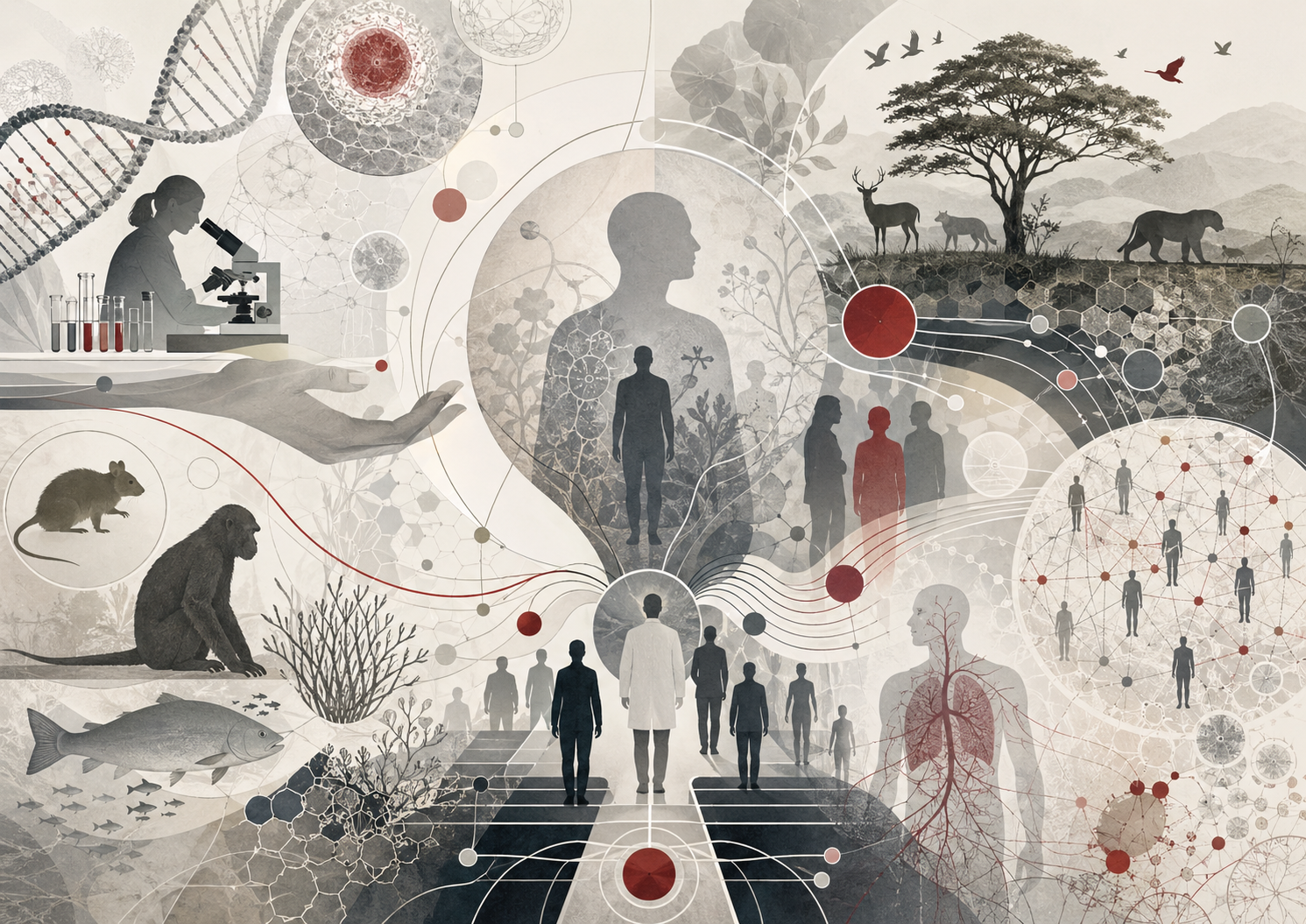
Biology can reveal how organisms function, evolve, reproduce, suffer, adapt, communicate, interact, and die. Ethics asks how that knowledge should guide action. Should a genome be edited? Should an organism be released into the environment? Should animal research proceed? Should biodiversity be protected for human benefit, intrinsic value, ecological function, or intergenerational justice? Who owns biological data? Who benefits from research? Who bears risk? Whose knowledge counts?
The central argument is that biology deepens human understanding of life, but it does not by itself determine how life should be valued. That requires ethical reasoning, public responsibility, institutional restraint, and sustained attention to the unequal conditions under which biological knowledge is produced and applied.
This article is written for biologists, ecologists, medical and environmental-health readers, biodiversity scientists, computational biologists, bioethicists, public-health researchers, biotechnology teams, policy readers, scientific software developers, and anyone interested in how life science becomes a moral and civic project.
Why biology needs ethics
Biology needs ethics because the study of life is never detached from decisions about life. To study an organism is to choose what counts as evidence. To conduct research is to decide what risks are acceptable. To treat disease is to weigh benefit, harm, access, dignity, and uncertainty. To protect biodiversity is to decide which obligations extend beyond human use. To engineer cells or ecosystems is to ask whether technical ability should become permission.
Ethics enters biology wherever knowledge becomes action. It enters clinical trials, conservation planning, animal experimentation, genome editing, public-health policy, biological data sharing, infectious-disease surveillance, ecological restoration, reproductive medicine, agriculture, synthetic biology, and environmental regulation.
The ethical stakes are especially high because biology concerns vulnerable systems: patients, research participants, animals, endangered species, ecosystems, future generations, marginalized communities, and organisms that cannot speak for themselves. Scientific power is not evenly distributed. Research is conducted by institutions with resources, authority, and technical expertise. Those affected by biological decisions may have less power to shape them.
Biology therefore requires more than technical competence. It requires ethical literacy: the ability to ask what should be done, not only what can be done.
Life as knowledge and moral concern
Biology transforms life into knowledge. It describes genes, cells, tissues, organs, organisms, populations, ecosystems, and evolutionary histories. It studies inheritance, metabolism, reproduction, development, immunity, behavior, disease, adaptation, and death. It reveals the material structure of living systems.
But life is not only an object of knowledge. It is also an object of moral concern. Living beings can be harmed. Some can suffer. Some participate in ecological communities. Some are connected to human identity, ancestry, food, health, culture, spirituality, livelihood, and place. Some are part of evolutionary lineages that existed long before human institutions and may persist long after them.
This creates a tension. Biology often needs abstraction: samples, datasets, models, specimens, populations, indicators, sequences, tissues, cells, and species. Ethics asks researchers not to forget what these abstractions represent. A “sample” may be a person’s tissue. A “population” may be a community. A “model organism” may be a sentient animal. A “field site” may be Indigenous land. A “genetic resource” may be connected to community knowledge, ecological history, and benefit-sharing obligations.
The human understanding of life becomes more responsible when it holds both truths together: life can be studied scientifically, and life can matter morally.
Human subjects, consent, and research trust
Human-subjects research sits at the center of modern bioethics because it involves people who may be exposed to risk for the sake of knowledge. Clinical trials, epidemiological studies, genetic research, behavioral studies, tissue banking, biobanks, digital health platforms, public-health surveillance, and biomedical AI all raise questions of consent, privacy, vulnerability, benefit, and justice.
Several principles recur across modern research ethics:
- Respect for persons: individuals should be treated as agents capable of informed decision-making, with additional protections for those with diminished autonomy.
- Beneficence: research should maximize possible benefits and minimize possible harms.
- Justice: the burdens and benefits of research should be distributed fairly.
- Scientific validity: unethical research includes poorly designed research that exposes participants to risk without meaningful knowledge gain.
- Transparency: participants and communities should understand the purpose, risks, benefits, and governance of research.
Consent is not merely a signed form. It is a process of communication. It requires clarity about risk, uncertainty, alternatives, data use, future research, withdrawal, confidentiality, and institutional responsibility. In genomic and biobank research, consent is complicated by future uses that may not yet be known, shared genetic information among relatives, group-level implications, and commercial partnerships.
Research trust is fragile. It has been damaged by histories of exploitation, racialized medical abuse, colonial extraction, disability discrimination, coercive reproductive policies, and unequal access to the benefits of science. Ethical biology must take these histories seriously. Trust cannot be demanded by institutions. It must be earned through accountability.
Animals, sentience, and experimental responsibility
Animal research has contributed to biological and medical knowledge, but it raises profound ethical questions because animals are living beings capable of pain, distress, social interaction, and species-specific forms of flourishing. The ethical issue is not only whether animal research produces useful knowledge. It is whether the knowledge justifies the harm, whether alternatives exist, and whether animals are treated with appropriate care.
The widely used “3Rs” framework — replacement, reduction, and refinement — captures a practical ethical discipline:
- Replacement: use non-animal methods when possible, including cell culture, organoids, computational models, human data, or lower-sentience systems.
- Reduction: use the fewest animals needed to answer a valid scientific question.
- Refinement: minimize pain, distress, fear, poor housing, and unnecessary harm.
Animal ethics also requires species-specific attention. Mice, fish, birds, dogs, pigs, primates, cephalopods, livestock, and wild animals differ in cognition, sociality, behavior, welfare needs, ecological role, and cultural meaning. Ethical review should not treat animals as interchangeable biological instruments.
Research involving animals should meet a high standard of scientific value. Poorly designed animal research is ethically unacceptable because it produces suffering without reliable knowledge. Reproducibility, statistical rigor, transparent reporting, welfare monitoring, and humane endpoints are therefore ethical requirements, not only technical ones.
Genetics, genomics, and biological identity
Genetics and genomics changed how human beings understand inheritance, disease, ancestry, kinship, identity, and risk. Genomic data can illuminate disease mechanisms, population history, pathogen transmission, cancer evolution, biodiversity, and conservation. It can also expose people and communities to privacy risks, discrimination, stigmatization, commercial exploitation, and biological determinism.
Genetic information is not ordinary data. It can be persistent, identifying, shared among relatives, connected to ancestry, and meaningful beyond the individual who provides the sample. A person’s genomic data may reveal information about parents, siblings, children, and communities. Population-level genomic research can affect how groups are represented, categorized, or misunderstood.
Several ethical risks matter:
- Privacy: genomic data can be difficult to fully anonymize.
- Discrimination: genetic risk information may affect insurance, employment, stigma, or social treatment.
- Group harm: research findings can affect communities, not only individuals.
- Commercialization: biological samples and data may generate profit without fair benefit-sharing.
- Determinism: genes can be misrepresented as destiny, ignoring environment, development, social conditions, and chance.
- Consent complexity: future uses of genomic data may exceed what participants understood when samples were collected.
A responsible genomics culture must treat biological identity with care. It should resist simplistic claims about ancestry, intelligence, behavior, race, disease, or destiny. Genetic variation is real, but social categories and biological categories are not the same thing. Ethical biology requires precision because biological language can easily be misused.
Biotechnology, intervention, and the limits of permission
Biotechnology gives biology practical force. It enables genome editing, synthetic biology, gene therapy, cell therapy, reproductive technologies, agricultural modification, microbial engineering, environmental biosensors, and biological manufacturing. These tools can reduce suffering, treat disease, improve food systems, monitor pollution, and support sustainability. They can also deepen inequality, alter ecosystems, enable dual-use risks, and normalize intervention without adequate consent.
The central ethical question is not whether biotechnology is “good” or “bad.” It is how intervention should be governed. Technical ability does not automatically create moral permission. A biological intervention must be assessed through safety, efficacy, reversibility, uncertainty, access, consent, justice, ecological risk, long-term monitoring, and public accountability.
Genome editing illustrates the problem. Somatic editing may treat disease in an individual. Heritable editing could affect future generations. Agricultural editing may improve crop traits but also affect seed systems, biodiversity, farmer autonomy, and market concentration. Ecological interventions may promise conservation or disease control but raise questions about release, spread, monitoring, and consent across communities and borders.
Biotechnology requires a moral distinction between therapeutic repair, enhancement, market optimization, ecological intervention, and social control. These categories can overlap, but they should not be collapsed. The ability to alter life demands restraint equal to its power.
Ecology, biodiversity, and the value of living systems
Ecology expands bioethics beyond human medicine. It asks how human beings should relate to ecosystems, species, habitats, evolutionary lineages, microbial communities, soil systems, oceans, forests, rivers, and the biosphere. Biodiversity is not only a resource inventory. It is the living fabric of Earth’s ecological stability and evolutionary history.
The ethical value of biodiversity can be understood in several ways:
- Instrumental value: ecosystems support food, water, medicine, climate regulation, pollination, soil fertility, and human survival.
- Intrinsic value: living beings and ecological communities may matter beyond their usefulness to humans.
- Relational value: people value landscapes, species, and ecosystems through culture, identity, responsibility, care, and place.
- Intergenerational value: future generations inherit the biological world shaped by present decisions.
Conservation ethics is not simple. Protecting biodiversity may conflict with livelihoods, land rights, development needs, or historical injustices. Conservation has sometimes displaced Indigenous peoples and local communities in the name of “nature.” Ethical ecology must therefore reject the false choice between people and nature while also refusing to treat the living world as endlessly expendable.
Biodiversity governance must include those who live with and steward ecosystems. Indigenous peoples, local communities, small-scale farmers, fishers, pastoralists, and forest communities often carry ecological knowledge that formal institutions have ignored or extracted. Ethical biology requires benefit-sharing, respect for knowledge sovereignty, and attention to historical injustice.
Data, AI, and the governance of biological information
Modern biology is increasingly data-intensive. Genomes, images, electronic health records, ecological observations, satellite data, biobank records, wearable sensors, clinical trials, microbial sequences, protein structures, and biodiversity databases now feed computational models and AI systems. Biological understanding increasingly depends on data infrastructure.
This creates new ethical responsibilities. Biological data can be powerful, predictive, identifiable, biased, incomplete, and commercially valuable. AI systems trained on biological data can reproduce inequity, obscure uncertainty, generate misleading predictions, or separate decision-making from accountability.
Several questions should guide biological data governance:
- Who contributed the data?
- Were consent and governance adequate?
- Can individuals or communities be reidentified?
- Who benefits from the model or dataset?
- Who can audit the system?
- What errors are most likely, and who is harmed by them?
- Does the model work across populations, environments, species, or contexts?
- How are uncertainty and limitations communicated?
AI can help biology, but it should not become an authority that escapes scrutiny. Biological models should be evaluated through evidence, transparency, external validation, domain expertise, and ethical governance. A model can be technically impressive and ethically weak.
Public health, One Health, and collective responsibility
Public health shows that biological ethics is collective as well as individual. Infectious disease, vaccination, antimicrobial resistance, environmental contamination, air pollution, food safety, occupational exposure, climate stress, water quality, and zoonotic spillover all involve shared vulnerability.
One Health frameworks emphasize that human health, animal health, and ecosystem health are connected. A virus can move across species. Antibiotic use in humans, animals, and agriculture can shape microbial evolution. Land-use change can alter disease ecology. Pollution can harm bodies, soils, rivers, and food webs. Climate change can shift vector ranges, food security, heat exposure, and water risk.
Public-health ethics must balance individual liberty, collective safety, equity, trust, and proportionality. Coercive measures require strong justification. Communication must be honest about uncertainty. Interventions should not place disproportionate burdens on already vulnerable communities. Public-health systems must avoid treating marginalized groups as problems to be managed rather than communities with rights, knowledge, and agency.
Biological vulnerability is not distributed evenly. Poor housing, unsafe work, environmental racism, food insecurity, weak healthcare access, incarceration, disability, displacement, colonial histories, and poverty all shape biological risk. Ethical biology must connect mechanisms to conditions.
Justice, power, and the history of biological science
Biology has helped cure disease, protect ecosystems, improve agriculture, and expand knowledge. It has also been misused. Biological language has been used to justify slavery, colonialism, eugenics, forced sterilization, racial hierarchy, disability exclusion, gender oppression, unethical experimentation, and extractive research.
This history matters because scientific authority can naturalize inequality. When social injustice is redescribed as biological inevitability, ethics has already failed. Responsible biology must distinguish evidence from ideology, variation from hierarchy, difference from inferiority, and description from justification.
Justice in biology requires attention to:
- who defines research priorities;
- who is studied and how they are represented;
- who owns biological samples and data;
- who benefits from therapies, patents, conservation, or agricultural innovation;
- who is exposed to environmental and biological risk;
- whose knowledge is treated as legitimate;
- whose suffering is ignored because it is politically inconvenient.
A more ethical biology does not pretend to be outside history. It learns from history. It recognizes that biological knowledge is produced by institutions, funded by priorities, shaped by categories, and applied within unequal societies.
Mathematical lens: biology and ethics
Mathematics cannot resolve ethical questions by itself, but it can help make assumptions visible. Ethical analysis often involves trade-offs among benefit, harm, uncertainty, justice, autonomy, ecological risk, and reversibility.
Expected benefit
B = \sum_{i=1}^{n} p_i b_i
\]
Interpretation: Expected benefit is represented as the probability-weighted sum of possible benefits, where \(p_i\) is the probability of outcome \(i\) and \(b_i\) is the benefit associated with that outcome.
Expected harm
H = \sum_{i=1}^{n} p_i h_i
\]
Interpretation: Expected harm is represented as the probability-weighted sum of possible harms, where \(h_i\) is the harm associated with outcome \(i\).
Benefit-harm balance
Q = B – H
\]
Interpretation: A positive value suggests expected benefit exceeds expected harm, but ethical judgment also requires justice, consent, uncertainty, reversibility, and context.
Justice-adjusted benefit
B_j = B(1-I)
\]
Interpretation: Justice-adjusted benefit reduces aggregate benefit by an inequality penalty \(I\), where \(I\) ranges from 0 to 1. A high aggregate benefit may be ethically weaker if benefits are distributed unfairly.
Consent completeness
C = \frac{c_{\text{understood}}}{c_{\text{required}}}
\]
Interpretation: Consent completeness compares the consent elements meaningfully understood by participants with the elements required for informed participation.
Ecological risk
R_e = P_{\text{exposure}} \times M_{\text{harm}} \times U_{\text{uncertainty}}
\]
Interpretation: Ecological risk increases with exposure probability, harm magnitude, and uncertainty. This is especially important for interventions that may spread, persist, or affect ecological systems beyond the initial research setting.
Reversibility weight
G = Q \times r
\]
Interpretation: Reversibility weights the benefit-harm balance by a reversibility factor \(r\). Less reversible interventions should require stronger justification and more careful governance.
Ethical review score
E = w_1B – w_2H – w_3U + w_4C + w_5J + w_6R
\]
Interpretation: A review score can make assumptions explicit by combining benefit, harm, uncertainty, consent quality, justice, and reversibility. It is a transparency tool, not a substitute for ethical deliberation.
Python and R workflows
The following compact examples illustrate how ethical dimensions in biological research can be represented computationally. The full GitHub repository expands these examples into a broader reproducible workflow with Python, R, Julia, Fortran, Rust, Go, C, C++, SQL, notebooks, synthetic data, ethical-review scoring, consent-completeness indicators, justice-adjusted benefit, ecological-risk assessment, provenance documentation, and responsible-use notes.
Python example: ethical review scaffolding for biological research
"""
Conceptual ethical review scaffold for biological research.

This synthetic example does not automate ethics.
It makes assumptions visible for review and discussion.
"""

import pandas as pd

projects = pd.DataFrame(
    {
        "project": [
            "clinical_genomics_study",
            "animal_model_experiment",
            "environmental_biosensor_release",
            "biodiversity_data_platform",
        ],
        "expected_benefit": [0.80, 0.60, 0.70, 0.65],
        "expected_harm": [0.25, 0.45, 0.40, 0.20],
        "uncertainty": [0.30, 0.35, 0.55, 0.25],
        "consent_quality": [0.75, 0.00, 0.40, 0.55],
        "justice_score": [0.60, 0.45, 0.50, 0.65],
        "reversibility": [0.70, 0.30, 0.35, 0.80],
    }
)

projects["ethical_review_score"] = (
    projects["expected_benefit"] * 0.25
    - projects["expected_harm"] * 0.20
    - projects["uncertainty"] * 0.15
    + projects["consent_quality"] * 0.15
    + projects["justice_score"] * 0.15
    + projects["reversibility"] * 0.10
)

ranked = projects.sort_values("ethical_review_score", ascending=False)

print(ranked.round(3).to_string(index=False))
Python example: justice-adjusted benefit
"""
Calculate justice-adjusted benefit for synthetic biological interventions.

The calculation is a transparency aid, not a moral decision rule.
"""

import pandas as pd

interventions = pd.DataFrame(
    {
        "intervention": [
            "gene_therapy",
            "waterborne_pathogen_surveillance",
            "crop_biodiversity_program",
            "urban_air_quality_biomonitoring",
        ],
        "expected_benefit": [0.88, 0.76, 0.70, 0.82],
        "inequality_penalty": [0.65, 0.25, 0.20, 0.45],
    }
)

interventions["justice_adjusted_benefit"] = (
    interventions["expected_benefit"] * (1 - interventions["inequality_penalty"])
)

print(
    interventions.sort_values(
        "justice_adjusted_benefit",
        ascending=False
    ).round(3).to_string(index=False)
)
R example: consent completeness
# Conceptual consent-completeness table.
# Synthetic values are used for demonstration only.

consent <- data.frame(
  study = c("biobank", "clinical_trial", "genomics_platform", "public_health_surveillance"),
  elements_required = c(8, 10, 9, 7),
  elements_understood = c(5, 8, 6, 4)
)

consent$consent_completeness <- with(
  consent,
  elements_understood / elements_required
)

consent$review_flag <- consent$consent_completeness < 0.75

print(consent)
R example: ecological risk and reversibility
# Conceptual ecological risk and reversibility scoring.
# Synthetic values are used for demonstration only.

projects <- data.frame(
  project = c("contained_lab", "field_biosensor", "engineered_microbe_release", "habitat_restoration"),
  exposure_probability = c(0.05, 0.35, 0.75, 0.20),
  harm_magnitude = c(0.20, 0.40, 0.70, 0.25),
  uncertainty = c(0.20, 0.45, 0.80, 0.35),
  reversibility = c(0.90, 0.55, 0.20, 0.70)
)

projects$ecological_risk <- with(
  projects,
  exposure_probability * harm_magnitude * uncertainty
)

projects$reversibility_adjusted_risk <- with(
  projects,
  ecological_risk * (1 - reversibility)
)

print(round(projects, 3))GitHub repository
The companion repository provides a reproducible technical scaffold for the article’s computational examples, including synthetic biological-ethics data structures, ethical-review scoring, consent-completeness indicators, justice-adjusted benefit, ecological-risk assessment, provenance documentation, and responsible-use notes.
The full code distribution for this article, including selected article examples, expanded computational workflows, reproducible data structures, provenance documentation, and full-stack scientific-computing scaffolding, is available on GitHub.
Limits, ethics, and responsible interpretation
Ethics cannot be reduced to scoring. Mathematical models, dashboards, decision matrices, and computational workflows can help make assumptions visible, but they cannot determine what is right by themselves. Ethical judgment requires deliberation, accountability, evidence, context, public reasoning, and humility.
Several limits matter.
First, ethical principles can conflict. Consent, benefit, justice, ecological protection, and public health may not always point in the same direction.
Second, aggregate benefit can hide unequal harm. A project may produce social benefit while exposing a marginalized group to disproportionate risk.
Third, uncertainty is ethically important. The less reversible an intervention is, the more carefully uncertainty must be handled.
Fourth, ethics is not only compliance. A project can satisfy formal requirements and still fail morally if it ignores community concerns, historical injustice, or unequal access.
Fifth, ethical biology must include voices beyond technical experts. Patients, participants, Indigenous peoples, disabled people, farm workers, conservation communities, public-health workers, animal-welfare experts, and those living near environmental risks all hold knowledge relevant to biological decision-making.
Responsible biology is not biology constrained by ethics. It is biology made more trustworthy by ethics.
Why this matters now
Biology is becoming more powerful, more computational, more interventionist, and more entangled with society. Genome editing, synthetic biology, AI-driven drug discovery, biobanks, microbial engineering, reproductive technologies, ecological restoration, biodiversity monitoring, public-health surveillance, and biological data platforms are expanding what life science can do.
At the same time, ecological degradation, climate change, pandemics, antimicrobial resistance, biodiversity loss, chronic disease, food-system stress, and environmental injustice show that biological knowledge cannot remain morally narrow. The question is not only how life works. The question is how human beings should live with the power to study, classify, alter, manage, protect, and sometimes harm life.
Ethics matters now because biological capability is accelerating faster than public trust. Trust requires transparency, humility, fairness, and accountability. It requires institutions that can say no when intervention is premature, harmful, unjust, or poorly governed.
The future of biology will be shaped not only by better instruments, models, and data, but by whether biological power is guided by wisdom.
Conclusion
Biology deepens the human understanding of life by revealing its mechanisms, histories, dependencies, vulnerabilities, and interconnections. Ethics deepens that understanding by asking what follows from it. Together, they show that life is not only something to be measured. It is something to be respected, protected, interpreted, and governed with care.
A mature biological culture must hold scientific ambition and moral responsibility together. It should pursue knowledge, reduce suffering, protect biodiversity, respect persons, care for animals, govern data, confront injustice, and remain humble before ecological complexity.
The human understanding of life is incomplete if it stops at mechanism. Biology tells us how living systems work. Ethics asks how we should act once we know.
Related articles
- Biology
- Biotechnology, Intervention, and the Power to Alter Life
- Synthetic Biology and the Engineering of Biological Systems
- Evolutionary Medicine and the Biological Understanding of Disease
- Agriculture, Food Systems, and the Management of Life
- Restoration Ecology and the Repair of Living Systems
- Machine Learning in the Life Sciences
- Computational Notebooks and Reproducible Biological Research
- Systems Biology and Complexity in Living Networks
Further reading
- UNESCO (2005) Universal Declaration on Bioethics and Human Rights. Paris: UNESCO. Available at: https://www.unesco.org/en/legal-affairs/universal-declaration-bioethics-and-human-rights
- World Medical Association (2024) WMA Declaration of Helsinki: Ethical Principles for Medical Research Involving Human Participants. Available at: https://www.wma.net/policies-post/wma-declaration-of-helsinki/
- U.S. Department of Health and Human Services (1979) The Belmont Report: Ethical Principles and Guidelines for the Protection of Human Subjects of Research. Available at: https://www.hhs.gov/ohrp/regulations-and-policy/belmont-report/index.html
- Convention on Biological Diversity (2022) Kunming-Montreal Global Biodiversity Framework. Available at: https://www.cbd.int/gbf
- National Academies of Sciences, Engineering, and Medicine (2017) Human Genome Editing: Science, Ethics, and Governance. Washington, DC: National Academies Press. Available at: https://nap.nationalacademies.org/catalog/24623/human-genome-editing-science-ethics-and-governance
References
- Beauchamp, T.L. and Childress, J.F. (2019) Principles of Biomedical Ethics. 8th edn. New York: Oxford University Press. Available at: https://global.oup.com/academic/product/principles-of-biomedical-ethics-9780190640873
- Convention on Biological Diversity (2022) Kunming-Montreal Global Biodiversity Framework. Available at: https://www.cbd.int/gbf
- European Commission (n.d.) Ethics and Data Protection. Available at: https://ec.europa.eu/info/funding-tenders/opportunities/docs/2021-2027/horizon/guidance/ethics-and-data-protection_he_en.pdf
- HHS Office for Human Research Protections (1979) The Belmont Report: Ethical Principles and Guidelines for the Protection of Human Subjects of Research. Available at: https://www.hhs.gov/ohrp/regulations-and-policy/belmont-report/index.html
- National Academies of Sciences, Engineering, and Medicine (2017) Human Genome Editing: Science, Ethics, and Governance. Washington, DC: National Academies Press. Available at: https://nap.nationalacademies.org/catalog/24623/human-genome-editing-science-ethics-and-governance
- National Academies of Sciences, Engineering, and Medicine (2018) Biodefense in the Age of Synthetic Biology. Washington, DC: National Academies Press. Available at: https://nap.nationalacademies.org/catalog/24890/biodefense-in-the-age-of-synthetic-biology
- National Centre for the Replacement, Refinement and Reduction of Animals in Research (n.d.) The 3Rs. Available at: https://nc3rs.org.uk/who-we-are/3rs
- Nuffield Council on Bioethics (2012) Emerging Biotechnologies: Technology, Choice and the Public Good. Available at: https://www.nuffieldbioethics.org/publications/emerging-biotechnologies
- Nuffield Council on Bioethics (2018) Genome Editing and Human Reproduction: Social and Ethical Issues. Available at: https://www.nuffieldbioethics.org/publications/genome-editing-and-human-reproduction
- UNESCO (2005) Universal Declaration on Bioethics and Human Rights. Paris: UNESCO. Available at: https://www.unesco.org/en/legal-affairs/universal-declaration-bioethics-and-human-rights
- World Health Organization (2021) Human Genome Editing: A Framework for Governance. Geneva: WHO. Available at: https://www.who.int/publications/i/item/9789240030060
- World Medical Association (2024) WMA Declaration of Helsinki: Ethical Principles for Medical Research Involving Human Participants. Available at: https://www.wma.net/policies-post/wma-declaration-of-helsinki/