
Last Updated May 28, 2026
Evolution and the history of life examine how living systems change through time, how hereditary variation is sorted through selection and other evolutionary processes, and how the diversity of organisms on Earth emerged from shared ancestry across deep geological history. Evolution is one of the central principles of biology because it explains both the unity and the diversity of life: unity through common descent, and diversity through inherited modification, selection, drift, mutation, recombination, gene flow, extinction, ecological divergence, and developmental innovation. For scientist-facing biological work, evolution is not only a general statement that species change. It is a multi-scale historical framework linking molecular inheritance, population process, lineage branching, developmental constraint, ecological restructuring, and Earth-system transformation.
This article develops Evolution and the History of Life as a foundational article within the Biology knowledge series. It treats evolution as descent with modification, as a set of mechanisms that alter inherited variation, and as a historical framework for reconstructing the long unfolding of life from early microbial systems to complex multicellular organisms, terrestrial ecosystems, ecological radiations, mass extinctions, and the modern biosphere. Evolutionary biology is not one mechanism alone. It is a layered explanatory system connecting genes, cells, organisms, populations, species, clades, ecosystems, and planetary history.
The article develops evolution and the history of life across common ancestry, inherited variation, natural selection, genetic drift, mutation, recombination, migration, speciation, extinction, fossil evidence, deep time, major transitions, microbial history, comparative genomics, developmental evolution, conservation risk, disease evolution, ecological transformation, biotechnology, bioinformatics, and computational evolutionary analysis.
The article also extends evolutionary biology into quantitative and computational analysis through allele-frequency change, Hardy-Weinberg baselines, genotype-specific selection, bidirectional mutation, migration, Wright-Fisher drift, heterozygosity, sequence divergence, Jukes-Cantor distance, birth-death diversification, lineage-through-time screening, evolutionary condition scoring, R workflows, Python workflows, SQL provenance structures, and a linked full-stack GitHub repository containing Python, R, Julia, Fortran, Rust, Go, C, C++, SQL, notebooks, data files, validation notes, and reproducibility documentation.
Main Library
Publications
Article Map
Biology
Related Topic
Chemistry
Related Topic
Earth Science
Related Topic
Environmental Science
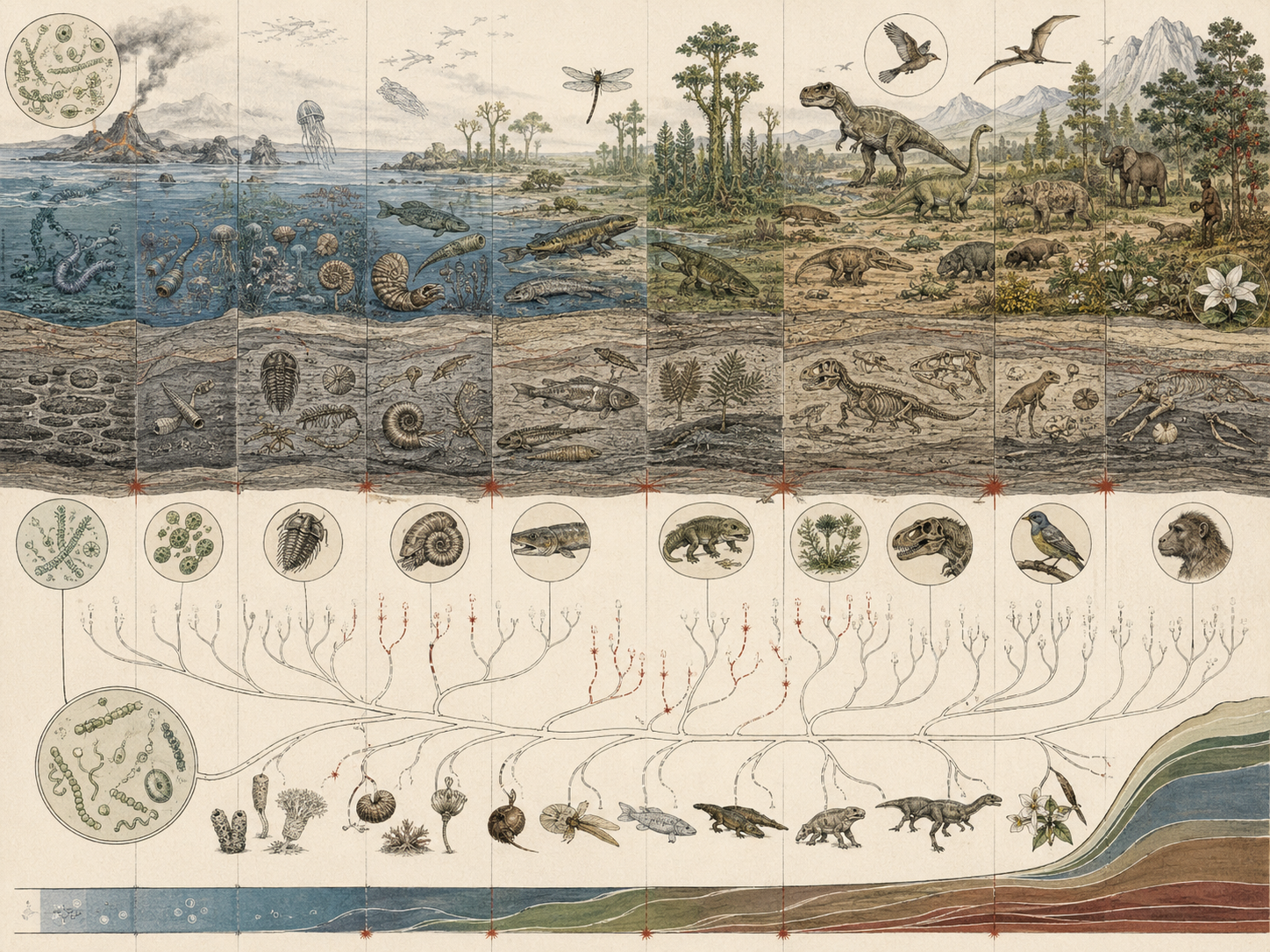
What Evolution Is
Evolution is biological change through time, but more precisely it is descent with inherited modification. That phrase matters because it captures both continuity and transformation. Organisms resemble their ancestors because hereditary information is transmitted across generations, yet they also differ because inherited variation is sorted, recombined, amplified, silenced, or lost under changing conditions. Evolution therefore explains why life is historically connected while also remaining open to divergence, novelty, adaptation, and extinction.
This makes evolution one of biology’s deepest organizing principles. It explains why organisms share homologous structures, why populations can adapt, why species branch, why fossils appear in ordered patterns through geological strata, why genomes preserve traces of common ancestry, and why the living world is both unified and diverse. Without evolution, biology would remain a catalog of organisms and processes without a coherent account of their history.
Evolution is also indispensable because it is not confined to one scale. It includes small-scale changes in allele frequencies within populations, longer-term divergence among lineages, and large-scale patterns visible in the history of life. Biology is strongest when it sees these as connected rather than separate domains. The same broad historical framework must account for microbial adaptation over months, vertebrate diversification across tens of millions of years, and the long transition from early geochemical environments to a biosphere structured by plants, animals, fungi, protists, and vast microbial communities.
Evolution is therefore not merely a theory of origins or a story about the distant past. It is an ongoing biological process. Populations evolve now. Pathogens evolve now. Tumors evolve within bodies. Crops, pests, symbionts, fisheries, forests, microbial communities, and restored ecosystems all carry evolutionary histories and future evolutionary possibilities. Evolution is the historical grammar through which biology explains why living systems are related, differentiated, adaptive, constrained, and vulnerable.
Descent with Modification and Common Ancestry
The idea of descent with modification is central because it explains both relatedness and difference. Living lineages are not isolated biological facts without history. They are historically connected branches of a larger tree of life. Common ancestry means that different organisms can share traits because they inherited them, directly or indirectly, from earlier forms. Modification means those inherited systems can change through time, producing new structures, functions, developmental patterns, ecological roles, and genomic architectures.
This principle gives biology extraordinary explanatory power. Similar bones in vertebrate limbs, shared molecular pathways across distant taxa, conserved genes, homologous developmental systems, common metabolic circuits, and ordered fossil transitions become intelligible when understood as products of common ancestry rather than coincidence. Evolutionary history therefore links molecular biology, anatomy, development, ecology, paleontology, and genomics within a shared framework.
Common ancestry is also one of the reasons the history of life can be reconstructed at all. Fossils, comparative morphology, developmental similarity, biogeography, and molecular sequence all become evidence not merely of resemblance, but of historical branching. This is why the tree of life is not a decorative metaphor alone. It is a working scientific representation of branching descent, extinction, divergence, and lineage persistence. Diversity is genealogical before it is simply taxonomic.
This does not mean every similarity has the same explanation. Some similarities are homologous because they reflect shared ancestry. Others are convergent because similar environmental pressures or functional constraints produced similar outcomes independently. Evolutionary biology is powerful because it distinguishes these possibilities using multiple lines of evidence: morphology, fossil sequence, developmental mechanism, molecular data, stratigraphy, ecological context, and phylogenetic inference. Common ancestry gives biology a historical framework, but careful comparison determines how particular similarities should be interpreted.
Variation, Selection, Drift, and Other Evolutionary Processes
Evolution requires inherited variation, but variation alone is not enough. Biological change through time depends on processes that sort, redistribute, preserve, or eliminate that variation. Natural selection is among the most important because it favors variants that reproduce more effectively under particular environmental conditions. Yet selection is not the only evolutionary process. Genetic drift, mutation, recombination, gene flow, population structure, and developmental constraint also shape the composition of populations and lineages.
This matters because evolution is not a single mechanism. Mutation introduces new sequence difference. Recombination reshuffles existing variants into new combinations. Gene flow moves variation among populations. Drift changes frequencies by chance, especially in smaller populations. Selection acts non-randomly on differences in survival and reproduction. Developmental systems filter which variants can become viable traits. Ecology determines what conditions make differences consequential. Evolutionary history is therefore produced by interacting processes rather than by one isolated cause.
The relative importance of these processes can vary across organisms, timescales, and environments. Some lineages may be shaped primarily by strong directional selection. Others may be shaped by stochastic drift in small populations. Others may be shaped by repeated gene flow across landscapes, aquatic networks, microbial communities, or host-pathogen systems. A useful account of evolution has to hold these forces together rather than treating one as universally decisive.
This is why evolutionary biology is both conceptually rich and quantitatively demanding. It studies not only change, but the mechanisms and constraints through which change occurs. Selection, drift, mutation, recombination, and migration can be described mathematically, simulated computationally, and tested against genetic, ecological, or fossil evidence. Evolutionary biology is therefore not only historical narrative. It is also a quantitative science of changing inherited systems.
Speciation, Divergence, and the Branching of Life
One of evolution’s most consequential outcomes is speciation: the divergence of lineages into distinct species. Speciation matters because it explains how the tree of life branches rather than simply changing along one continuous line. Populations may diverge through geographic separation, ecological specialization, reproductive isolation, chromosomal change, host shifts, hybridization dynamics, behavioral divergence, or other mechanisms that reduce gene exchange and allow differences to accumulate.
Divergence is therefore central to the history of life. Biodiversity is not merely the result of organisms changing within one shared pool forever. It is the result of repeated branching events through which lineages separate and acquire their own evolutionary trajectories. Speciation makes possible adaptive radiation, ecological novelty, and much of the large-scale structure of biodiversity.
This branching view is also important because it replaces ladder-like ideas of progress with a more accurate picture of life’s history. Evolution is not a march toward a single summit. It is a branching, contingent, and uneven history of divergence and persistence. Many lineages remain relatively conservative, some diversify explosively, and many disappear entirely. The history of life is therefore not a straight path toward complexity, but a tree repeatedly shaped by splitting, ecological opportunity, constraint, and extinction.
Speciation is also not always clean or instantaneous. Lineages may exchange genes after divergence. Hybrid zones may persist. Microbial evolution can involve horizontal gene transfer. Some groups show rapid radiation in which relationships are difficult to resolve. Others remain connected by intermittent gene flow. Evolutionary biology therefore treats species as historical lineages, reproductive communities, ecological populations, and genomic patterns whose boundaries may be sharp in some cases and complex in others.
The Fossil Record and the Reconstruction of Deep Time
The fossil record is one of the most important archives through which the history of life is reconstructed. Fossils preserve traces of extinct organisms, ecological worlds, anatomical transitions, and major episodes of radiation and extinction. They do not offer a complete record of all organisms that ever lived, but they reveal strong large-scale patterns across geological time.
This matters because evolution is not inferred only from living organisms. Fossils allow biology to place lineages in time, test hypotheses about ancestry and divergence, identify extinct forms, reconstruct changing ecosystems, and study the appearance, transformation, and disappearance of body plans. The fossil record therefore provides a historical dimension that molecular and ecological data alone cannot fully supply.
Fossils also reveal that the history of life is punctuated by both persistence and disruption. Some lineages remain relatively stable for long periods, while others diversify rapidly or disappear. The history of life is therefore neither perfectly gradual nor purely catastrophic. It is historically uneven, and that unevenness is itself biologically meaningful. Deep time becomes scientifically visible not because the record is perfect, but because consistent stratigraphic pattern, repeated transitions, radiometric dating, comparative anatomy, and congruence with molecular evidence make large-scale history inferable.
The fossil record also helps protect evolutionary thinking from presentism. Modern organisms are only surviving tips of a much larger historical tree. Many major forms of life are extinct. Many ecosystems have no exact modern equivalent. Some past organisms combined traits in ways that no living group does. Fossils therefore remind biology that present diversity is not the whole history of life, but the surviving residue of branching, pruning, contingency, and ecological transformation.
Origins of Life and the Earliest Biological Worlds
The history of life includes the question of origins: how Earth moved from prebiotic chemistry to the earliest living systems. This remains one of biology’s deepest open problems. The point is not that every detail is settled, but that the origin of life belongs to the history of biology because living systems had to emerge from nonliving matter under the conditions of early Earth.
The earliest strong evidence for life is very ancient, and the long initial history of life appears to have been dominated by microbial systems rather than by plants or animals. For most of Earth history, life was microbial. This is essential because it reframes the history of life away from a narrow human-centered, mammal-centered, or vertebrate-centered lens. Early life likely transformed Earth long before large multicellular lineages appeared.
This is important because the earliest biological worlds were already geochemically consequential. Microbial metabolisms altered atmosphere, oceans, sediments, redox conditions, and nutrient cycling. The biosphere did not merely adapt to the planet. Life helped transform the planetary conditions under which later life evolved. The history of life is therefore also a history of feedback between biology and Earth systems.
Origins research also shows why evolutionary biology connects to chemistry, geology, planetary science, and systems thinking. The emergence of replication, metabolism, compartmentalization, information storage, energy flow, and selection-like processes cannot be explained by one discipline alone. The earliest history of life is a boundary zone where geochemistry, molecular evolution, thermodynamics, planetary environment, and biological organization meet.
Major Transitions in the History of Life
The history of life includes major transitions that reorganized biological possibility. Among the most important are the emergence of cellular life, the diversification of prokaryotic metabolisms, the evolution of photosynthesis, the oxygenation of Earth’s surface environments, the rise of eukaryotic cells, the evolution of sexual reproduction, the repeated emergence of multicellularity, the diversification of plants and animals, the colonization of land, and the formation of complex ecological systems. Each transition changed what kinds of organisms, interactions, and evolutionary futures became possible.
These transitions matter because evolution is not only the accumulation of small differences. At certain points, the architecture of life itself changes in ways that open new ecological and developmental possibilities. Multicellularity, for example, made possible differentiation, tissues, organs, and new scales of ecological interaction. Land colonization made possible terrestrial forests, soils, herbivory, pollination systems, and complex land food webs. Eukaryotic cells created new forms of intracellular organization, symbiosis, and regulatory complexity.
Thinking in terms of major transitions also helps connect molecular, cellular, ecological, and geological history. Evolution is not only about organisms adapting to environments. It is also about life transforming the conditions under which later life evolves. These transitions are therefore not isolated milestones. They are reorganizations of evolutionary possibility.
Major transitions also remind us that biological complexity is not automatic. It depends on ecological opportunity, developmental architecture, genetic systems, cooperation, conflict management, energy flow, and historical contingency. Multicellularity evolved more than once, but not every lineage moved toward it. Complex nervous systems evolved in some branches and not others. Photosynthesis transformed the planet, but only under particular evolutionary and geochemical conditions. The history of life is therefore structured by opportunity and constraint, not by inevitability.
Extinction, Radiation, and the Uneven Pace of Evolution
The pace of evolution is uneven. Some lineages show long intervals of relative stasis, while others diversify rapidly or change sharply during periods of ecological opportunity, environmental stress, or lineage splitting. The fossil record shows evidence for both slow and more episodic patterns of change. Evolutionary history therefore does not conform to one single rhythm.
Extinction is equally important because the history of life includes loss as well as diversification. Mass extinctions, background extinctions, local disappearances, and lineage collapse have repeatedly reshaped the tree of life. Extinction removes forms, closes some possibilities, and opens others by altering ecosystems and competitive landscapes. It is not merely the absence of evolution. It is one of the processes that gives evolutionary history its shape.
Adaptive radiation then becomes possible when lineages diversify into newly available niches after ecological release, innovation, dispersal, or disruption. The history of life is therefore shaped by a continual interplay among persistence, extinction, and opportunity. Evolution is a history of both creation and loss. Modern biodiversity cannot be understood simply as the cumulative addition of species over time. It is the residual structure left by branching, pruning, and repeated ecological reorganization.
This perspective is especially important in the present. Current biodiversity loss is not just the disappearance of individual species. It is the erosion of evolutionary history, ecological function, phylogenetic diversity, local adaptation, and future evolutionary possibility. Extinction is a biological event, but also a historical loss.
Evolution in Physiology, Development, and Biological Function
Evolution is not confined to visible anatomy. Physiological systems, developmental pathways, regulatory networks, metabolic strategies, immune systems, sensory systems, reproductive systems, and behavioral tendencies all evolve. This matters because function, not just form, is historically shaped. Organisms do not merely look different through time. They process energy differently, regulate development differently, respond to environments differently, and occupy different ecological roles.
Developmental biology is especially relevant because evolutionary change is filtered through developmental systems. Novelty must become developmentally viable. Regulatory shifts, timing changes, heterochrony, altered patterning, modular redeployment, and changes in developmental constraint can all contribute to evolutionary transformation. Evolution acts through organisms whose bodies are made by development, not outside that process.
This makes evolution a deeply integrative science. It explains not only what changed in the history of life, but how function, form, and biological organization became historically organized. Physiological adaptation, developmental constraint, genetic architecture, ecological interaction, and environmental feedback are not side issues. They are part of the machinery through which lineages persist, diversify, or fail.
Evolution also helps explain why biological systems often contain compromises. A trait may be functional without being optimal in an abstract engineering sense. It may reflect inherited constraint, past selection, developmental tradeoffs, pleiotropy, or ecological conditions no longer present. Evolutionary reasoning therefore provides a historical explanation for biological imperfection, constraint, redundancy, and tradeoff.
Ecology, Conservation, and Sustainability-Adjacent Biology
Evolution is central to ecology and sustainability-adjacent biology because populations and species do not exist outside history. They carry inherited variation shaped by past selection, constraint, demographic change, and ecological interaction. Resilience, adaptation, vulnerability, and extinction risk all depend partly on evolutionary context and the distribution of variation across populations.
Conservation biology especially benefits from evolutionary thinking because biodiversity is not only a count of species in the present. It is the result of deep historical branching, local adaptation, coevolution, and lineage persistence across time. When lineages disappear, the loss is not only numerical. It is historical, functional, and evolutionary. Conservation therefore protects not only organisms, but also evolutionary histories and future adaptive possibility.
This matters for sustainability because environmental disruption is altering the conditions under which populations persist and adapt. Climate change, fragmentation, pollution, overexploitation, invasive species, land-use change, freshwater stress, ocean warming, and disease all affect not only current abundance but also future evolutionary possibility. Evolutionary history therefore belongs directly within long-horizon ecological stewardship.
Preserving biodiversity is also preserving the inherited capacity of life to continue branching, responding, and reorganizing under change. A population may survive numerically while losing genetic diversity. A species may persist while losing locally adapted lineages. An ecosystem may retain visible structure while losing evolutionary depth. Evolutionary thinking helps sustainability science see these hidden losses.
Marine, Freshwater, Soil, Plant, and Microbial Relevance
Marine biology is deeply evolutionary because oceans preserve long histories of diversification, extinction, adaptive radiation, symbiosis, and metabolic innovation. Marine microbes shaped early Earth systems; marine invertebrates and vertebrates document major transitions in body plans and ecosystems; and modern marine populations continue to evolve under warming, acidification, fishing pressure, hypoxia, shifting currents, changing food webs, and disease pressure.
Freshwater biology shows similar evolutionary dynamics in isolated basins, rivers, wetlands, lakes, and aquatic corridors where fragmentation, dispersal, local adaptation, hybridization, and environmental change shape lineages through time. Freshwater species often experience strong population structure because drainage systems, barriers, drought cycles, and human modification restrict movement. Evolutionary history is therefore crucial for interpreting freshwater biodiversity and restoration.
Soil biology and microbiology are especially relevant because much of life’s history is microbial, and microbes continue to drive decomposition, nutrient cycling, symbiosis, carbon turnover, disease suppression, and biogeochemical change across ecosystems. Microbial evolution can be rapid, horizontal, and metabolically consequential. It is therefore central to both ancient Earth history and current ecosystem function.
Plant science, agroecology, forestry, and restoration ecology also depend strongly on evolutionary history. Plants evolved major innovations in vascular tissue, reproduction, seeds, flowers, symbioses, and terrestrial adaptation, and modern plant populations continue to respond evolutionarily to drought, disease, herbivory, land-use change, and climate stress. Evolutionary biology therefore links the history of life directly to present sustainability challenges across terrestrial and aquatic systems alike.
Medical, Biomedical, and Disease Ecology Relevance
Evolution is foundational to medicine and biomedicine because pathogens evolve, hosts evolve, tumors evolve, and drug resistance evolves. Many biomedical problems are incomprehensible without evolutionary reasoning. Infectious disease, immune evasion, antimicrobial resistance, cancer progression, host susceptibility, vaccine escape, vector adaptation, and population-level vulnerability all depend on change through time under selection and constraint.
Evolution also matters because human biology itself is historical. Anatomical structure, physiology, metabolism, reproduction, immune function, and susceptibility reflect the evolutionary history of our lineage. Medicine is therefore not only a science of present malfunction. It is also a science operating on historically shaped organisms in historically shifting environments.
Disease ecology deepens this further by connecting pathogen evolution, host population structure, ecological transmission, and environmental pressures. Evolution links molecular change to clinical consequence and population dynamics alike. In practical terms, evolutionary thinking helps explain why treatments fail, why resistance emerges, why host shifts matter, why immune pressure changes pathogen populations, and why medical intervention itself often becomes part of the selective environment.
Cancer biology is another important example. Tumors are evolving cell populations. Mutations, clonal expansion, selection under therapy, tissue environments, immune pressure, and stochastic lineage dynamics all shape disease progression. Evolutionary reasoning therefore belongs not only to infectious disease and ecology, but also to oncology and precision medicine.
Biotechnology, Bioinformatics, and Computational Relevance
Biotechnology depends strongly on evolutionary reasoning. Directed evolution, comparative genomics, phylogenetic inference, strain improvement, protein engineering, sequence alignment, variant tracking, molecular surveillance, environmental DNA interpretation, and pathogen monitoring all build on the fact that biological systems change through descent with modification. Evolutionary ideas are therefore not only explanatory. They are operational in laboratory and applied scientific contexts.
Bioinformatics is especially important because modern evolutionary biology increasingly depends on sequence comparison, phylogenetics, population-genetic inference, and large datasets from genomes, metagenomes, transcriptomes, and environmental sampling. The history of life is now reconstructed not only through fossils and morphology, but also through molecular evidence analyzed computationally.
This makes evolution one of the strongest bridges between historical biology and data-rich modern science. The past is increasingly inferable through present-day information systems. Computational evolutionary biology therefore combines mathematics, statistics, algorithms, and biological interpretation in one of the most powerful synthetic domains in science.
This computational power also requires careful provenance. Sequence alignment choices, reference genomes, sampling bias, model assumptions, rate variation, missing taxa, recombination, horizontal gene transfer, and convergence can all affect evolutionary inference. A distance matrix is not automatically a tree, and a tree is not automatically a complete history. Strong computational evolution requires transparent assumptions, reproducible workflows, and biological validation.
Mathematical Lens
Evolutionary biology is deeply quantitative because change through time can often be represented through frequencies, rates, probabilities, branching patterns, comparative distances, and stochastic processes. This does not reduce evolution to mathematics alone, but it does make evolutionary mechanisms more explicit, testable, and reproducible.
At a locus with two alleles, the basic frequency relation is:
p+q=1 \]
Interpretation: In a two-allele model, the allele frequencies sum to one.
where \(p\) and \(q\) are allele frequencies. Under Hardy-Weinberg assumptions, expected genotype frequencies are:
p^2+2pq+q^2=1 \]
Interpretation: Hardy-Weinberg expectations provide a baseline for genotype frequencies under idealized assumptions.
This is useful because population evolution is often first described as change in allele frequencies across generations.
If genotypes have relative fitnesses \(w_{AA}\), \(w_{Aa}\), and \(w_{aa}\), then mean population fitness is:
\bar{w}=p^2w_{AA}+2pqw_{Aa}+q^2w_{aa} \]
Interpretation: Mean fitness averages genotype-specific fitness across expected genotype frequencies.
The next-generation allele frequency of \(A\) after genotype-specific selection can be written as:
p’=\frac{p^2w_{AA}+pqw_{Aa}}{\bar{w}} \]
Interpretation: Selection changes allele frequency according to genotype frequencies and relative reproductive success.
This is useful because it turns verbal evolutionary claims into a measurable recurrence process.
If allele \(A\) mutates to \(a\) at rate \(\mu\) and the reverse occurs at rate \(\nu\), then:
p’=p(1-\mu)+q\nu \]
Interpretation: Mutation changes allele frequency by removing copies through forward mutation and adding copies through reverse mutation.
If migrants enter at fraction \(m\) from a source population with allele frequency \(p_m\), then:
p’=(1-m)p+mp_m \]
Interpretation: Migration shifts allele frequency toward the migrant source population.
These are useful because evolution is rarely a closed, mutation-free, migration-free process.
In a diploid Wright-Fisher population of size \(N\), drift can be represented as:
X_{t+1}\sim\mathrm{Binomial}(2N,p_t) \]
Interpretation: The number of allele copies in the next generation is sampled from a binomial distribution.
p_{t+1}=\frac{X_{t+1}}{2N} \]
Interpretation: The next allele frequency is the sampled allele count divided by the total number of allele copies.
This is useful because finite populations change partly by chance, not only by deterministic selection.
For two aligned sequences of equal length, an observed proportion difference can be written as:
d=\frac{m}{L} \]
Interpretation: Observed sequence distance is the fraction of aligned positions that differ.
where \(m\) is the number of mismatches and \(L\) is sequence length. A Jukes-Cantor correction gives:
d_{\mathrm{JC}}=-\frac{3}{4}\ln\left(1-\frac{4d}{3}\right) \]
Interpretation: Jukes-Cantor correction adjusts observed distance for hidden substitutions under a simple evolutionary model.
This matters because raw mismatch counts can underestimate historical divergence once multiple substitutions occur at the same site.
At macroevolutionary scale, lineage richness depends on both origination and extinction. A net diversification rate can be written as:
r=\lambda-\mu \]
Interpretation: Net diversification is the difference between speciation rate and extinction rate.
where \(\lambda\) is speciation rate and \(\mu\) is extinction rate. Under a simplified constant-rate approximation:
N(t)=N_0e^{rt} \]
Interpretation: Lineage richness grows exponentially under a constant net diversification rate.
This is analytically useful because biodiversity depends not only on branching, but on survival.
Variables, Units, and Evolutionary Interpretation
Quantitative evolutionary biology depends on variables that connect allele frequency, genotype frequency, fitness, mutation, migration, drift, sequence distance, lineage diversification, and biological interpretation. The table below summarizes several central quantities.
| Symbol or Term | Meaning | Typical Unit or Scale | Evolutionary Interpretation |
|---|---|---|---|
| \(p, q\) | Allele frequencies | fraction from 0 to 1 | Relative frequency of alleles in a population or sample |
| \(p^2, 2pq, q^2\) | Expected genotype frequencies | frequency or probability | Baseline genotype expectations under Hardy-Weinberg assumptions |
| \(w_{AA}, w_{Aa}, w_{aa}\) | Genotype-specific relative fitnesses | relative fitness scale | Expected reproductive contribution of each genotype relative to others |
| \(\bar{w}\) | Mean population fitness | relative fitness | Average fitness across genotype classes |
| \(p’\) | Next-generation allele frequency | fraction from 0 to 1 | Allele frequency after selection, mutation, migration, or other update process |
| \(\mu\) | Forward mutation rate | per generation or replication cycle | Rate at which allele \(A\) changes to allele \(a\) |
| \(\nu\) | Reverse mutation rate | per generation or replication cycle | Rate at which allele \(a\) changes to allele \(A\) |
| \(m\) | Migration fraction | fraction from 0 to 1 | Share of a population replaced or supplemented by migrants |
| \(p_m\) | Migrant-source allele frequency | fraction from 0 to 1 | Allele frequency in the source population contributing migrants |
| \(N\) | Diploid population size | individuals | Population size determining strength of drift in simple Wright-Fisher models |
| \(X_{t+1}\) | Sampled allele count in next generation | count from 0 to \(2N\) | Number of allele copies after stochastic sampling |
| \(H\) | Expected heterozygosity | fraction from 0 to 1 | Compact measure of genetic diversity, often \(2p(1-p)\) for biallelic loci |
| \(m\) in sequence context | Mismatch count | count | Number of differing positions between aligned sequences |
| \(L\) | Sequence length or aligned sites | base pairs, nucleotides, amino acids, or sites | Number of positions available for comparison |
| \(d\) | Observed sequence distance | fraction from 0 to 1 | Share of aligned positions that differ |
| \(d_{\mathrm{JC}}\) | Jukes-Cantor corrected distance | substitutions per site under a simple model | Corrected molecular distance accounting for hidden substitutions |
| \(\lambda\) | Speciation or origination rate | lineages per lineage per time | Rate at which lineages branch |
| \(\mu\) in diversification context | Extinction rate | lineages per lineage per time | Rate at which lineages disappear |
| \(r\) | Net diversification rate | per time | Speciation rate minus extinction rate |
| \(N(t)\) | Lineage richness through time | number of lineages | Number of lineages present at time \(t\) under a diversification model |
The table shows why evolutionary quantities require context. An allele frequency, fitness estimate, drift model, sequence distance, or diversification rate becomes biologically meaningful only when linked to population size, inheritance mode, sampling design, organism, timescale, environmental context, and historical interpretation.
Worked Example: Selection, Drift, Sequence Distance, and Diversification
Suppose allele \(A\) has frequency \(p=0.7\). Then \(q=0.3\), and expected genotype frequencies are:
AA=p^2=(0.7)^2=0.49 \]
Interpretation: The expected homozygous \(AA\) frequency is 0.49 under idealized assumptions.
Aa=2pq=2(0.7)(0.3)=0.42 \]
Interpretation: The expected heterozygous frequency is 0.42.
aa=q^2=(0.3)^2=0.09 \]
Interpretation: The expected homozygous \(aa\) frequency is 0.09.
This is useful because it provides a baseline against which evolutionary change, nonrandom mating, population structure, or selection can be interpreted.
Now suppose genotype fitnesses are \(w_{AA}=1.10\), \(w_{Aa}=1.02\), and \(w_{aa}=1.00\). Mean fitness is:
\bar{w}=0.49(1.10)+0.42(1.02)+0.09(1.00)=1.0574 \]
Interpretation: The mean fitness is the genotype-frequency-weighted average of relative fitness.
The next-generation allele frequency after selection is:
p’=\frac{0.49(1.10)+(0.7)(0.3)(1.02)}{1.0574}\approx0.7116 \]
Interpretation: Selection increases the frequency of allele \(A\) from 0.70 to approximately 0.7116 under this model.
This shows how a verbal claim about selection can become a measurable recurrence relation.
Sequence comparison can also be analyzed quantitatively. Suppose two equal-length sequences have 4 mismatches across 40 aligned positions:
d=\frac{4}{40}=0.10 \]
Interpretation: The observed sequence distance is 0.10, meaning 10 percent of aligned positions differ.
A Jukes-Cantor correction gives:
d_{\mathrm{JC}}=-\frac{3}{4}\ln\left(1-\frac{4(0.10)}{3}\right)\approx0.107 \]
Interpretation: The corrected distance is slightly larger because it accounts for possible hidden substitutions.
This is useful because evolutionary comparison often begins with observed differences but must consider unobserved substitutions across time.
At macroevolutionary scale, suppose a clade begins with \(N_0=10\) lineages, with speciation rate \(\lambda=0.08\) and extinction rate \(\mu=0.03\) per lineage per time unit. The net diversification rate is:
r=\lambda-\mu=0.08-0.03=0.05 \]
Interpretation: The net diversification rate is 0.05 per time unit.
After \(t=20\) time units under a simplified constant-rate model:
N(t)=10e^{0.05(20)}=10e^1\approx27.18 \]
Interpretation: The simplified expected richness is approximately 27 lineages.
This is useful because it shows how biodiversity depends on both origination and extinction, not branching alone.
Computational Modeling
Computational modeling helps make evolutionary biology explicit because evolution is historical, stochastic, comparative, and multi-scale. Allele-frequency models formalize selection, mutation, migration, and drift. Wright-Fisher simulations show how replicate populations diverge by chance and selection. Sequence-distance workflows compare molecular divergence. Birth-death models represent lineage origination and extinction. Lineage-through-time summaries connect branching and survival to macroevolutionary pattern. Evolutionary condition scoring can help structure conservation or disease-evolution interpretation when multiple pressures interact.
The selected examples below focus on compact, reusable workflows: genotype-specific selection, bidirectional mutation, migration, stochastic drift, expected heterozygosity, pairwise sequence distance, Jukes-Cantor correction, exploratory distance matrices, birth-death diversification, and lineage-through-time screening. The GitHub repository extends the same logic into richer workflows for SQL provenance, reproducible data files, validation notes, notebooks, major-transition documentation, and multi-language scientific-computing examples.
The purpose is not to reduce evolution to code. The purpose is to make evolutionary reasoning inspectable. An evolutionary claim becomes stronger when assumptions, population size, fitness values, mutation rates, migration parameters, sequence data, diversification rates, fossil or genomic evidence, and analytical code are documented together.
R Workflow: Selection, Mutation, Migration, Drift, Sequence Distance, and Diversification
R is useful for evolutionary biology because it supports simulation, statistical summaries, tabular workflows, comparative analysis, and reproducible reporting. The following workflow simulates allele-frequency change under genotype-specific selection, bidirectional mutation, migration, and drift; builds a comparative sequence-distance matrix; and simulates simple birth-death diversification across macroevolutionary scenarios.
# Evolution and the History of Life Workflow
#
# This workflow demonstrates three quantitative evolutionary tasks:
#
#   1. Simulate allele-frequency evolution under selection, mutation,
#      migration, and drift.
#   2. Build pairwise sequence divergence and Jukes-Cantor distance matrices.
#   3. Simulate simple birth-death diversification across macroevolutionary
#      scenarios.
#
# These examples can be adapted for population genetics, comparative genomics,
# conservation biology, pathogen evolution, paleobiology, macroevolution,
# disease ecology, and computational evolutionary analysis.

library(dplyr)
library(tidyr)
library(purrr)
library(stringr)
library(tibble)

# ------------------------------------------------------------
# 1. Allele-frequency evolution
# ------------------------------------------------------------

simulate_evolution <- function(
  generations = 200,
  p0 = 0.5,
  N = 500,
  w_AA = 1.0,
  w_Aa = 1.0,
  w_aa = 1.0,
  mu_forward = 0.0,
  nu_reverse = 0.0,
  migration_fraction = 0.0,
  p_migrant = 0.5,
  drift = TRUE,
  seed = 123
) {
  set.seed(seed)

  p <- numeric(generations + 1)
  q <- numeric(generations + 1)
  Hexp <- numeric(generations + 1)
  wbar_vec <- numeric(generations + 1)

  p[1] <- p0
  q[1] <- 1 - p0
  Hexp[1] <- 2 * p0 * (1 - p0)
  wbar_vec[1] <- NA_real_

  for (t in 1:generations) {
    pt <- p[t]
    qt <- 1 - pt

    wbar <- pt^2 * w_AA + 2 * pt * qt * w_Aa + qt^2 * w_aa

    p_after_selection <- (
      pt^2 * w_AA + pt * qt * w_Aa
    ) / wbar

    q_after_selection <- 1 - p_after_selection

    p_after_mutation <- (
      p_after_selection * (1 - mu_forward) +
      q_after_selection * nu_reverse
    )

    p_after_migration <- (
      (1 - migration_fraction) * p_after_mutation +
      migration_fraction * p_migrant
    )

    if (drift) {
      count_A <- rbinom(1, 2 * N, p_after_migration)
      p_next <- count_A / (2 * N)
    } else {
      p_next <- p_after_migration
    }

    p[t + 1] <- p_next
    q[t + 1] <- 1 - p_next
    Hexp[t + 1] <- 2 * p_next * (1 - p_next)
    wbar_vec[t + 1] <- wbar
  }

  tibble(
    generation = 0:generations,
    p = p,
    q = q,
    expected_heterozygosity = Hexp,
    mean_fitness = wbar_vec
  )
}

scenarios <- tibble(
  scenario = c(
    "neutral_large_population",
    "positive_selection",
    "migration_selection",
    "mutation_selection_balance"
  ),
  p0 = c(0.50, 0.20, 0.80, 0.98),
  N = c(5000, 1000, 1000, 3000),
  w_AA = c(1.00, 1.12, 1.08, 1.00),
  w_Aa = c(1.00, 1.05, 1.02, 0.97),
  w_aa = c(1.00, 1.00, 1.00, 0.90),
  mu_forward = c(0.0000, 0.0000, 0.0000, 0.0010),
  nu_reverse = c(0.0000, 0.0000, 0.0000, 0.0001),
  migration_fraction = c(0.000, 0.000, 0.030, 0.000),
  p_migrant = c(0.50, 0.50, 0.20, 0.50),
  drift = c(TRUE, TRUE, TRUE, FALSE)
)

evolution_results <- scenarios %>%
  mutate(
    sim = pmap(
      list(
        p0,
        N,
        w_AA,
        w_Aa,
        w_aa,
        mu_forward,
        nu_reverse,
        migration_fraction,
        p_migrant,
        drift
      ),
      function(
        p0,
        N,
        w_AA,
        w_Aa,
        w_aa,
        mu_forward,
        nu_reverse,
        migration_fraction,
        p_migrant,
        drift
      ) {
        simulate_evolution(
          generations = 220,
          p0 = p0,
          N = N,
          w_AA = w_AA,
          w_Aa = w_Aa,
          w_aa = w_aa,
          mu_forward = mu_forward,
          nu_reverse = nu_reverse,
          migration_fraction = migration_fraction,
          p_migrant = p_migrant,
          drift = drift,
          seed = 123
        )
      }
    )
  ) %>%
  select(scenario, sim) %>%
  unnest(sim)

evolution_summary <- evolution_results %>%
  group_by(scenario) %>%
  summarise(
    initial_p = first(p),
    final_p = last(p),
    final_H = last(expected_heterozygosity),
    final_mean_fitness = last(mean_fitness),
    .groups = "drop"
  )

# ------------------------------------------------------------
# 2. Pairwise sequence divergence and exploratory clustering
# ------------------------------------------------------------

seqs <- c(
  lineage_A = "ATGCTAGCTAACGGTACCTA",
  lineage_B = "ATGCTGGCTATCGGTACCTA",
  lineage_C = "ATGATGGCTATCGGTTCCTA",
  lineage_D = "ATGCTAGTTAACGGAACCTG",
  lineage_E = "ATGCTAGCTAACGGAACCTA"
)

pair_dist <- function(s1, s2) {
  x <- str_split(s1, "", simplify = TRUE)
  y <- str_split(s2, "", simplify = TRUE)

  mismatches <- sum(x != y)
  L <- length(x)
  p_distance <- mismatches / L

  jukes_cantor <- ifelse(
    p_distance >= 0.75,
    NA_real_,
    -(3 / 4) * log(1 - (4 / 3) * p_distance)
  )

  tibble(
    mismatches = mismatches,
    p_distance = p_distance,
    jukes_cantor = jukes_cantor
  )
}

distance_pairs <- expand.grid(
  seq1 = names(seqs),
  seq2 = names(seqs),
  stringsAsFactors = FALSE
) %>%
  as_tibble() %>%
  filter(seq1 < seq2) %>%
  mutate(
    res = map2(seq1, seq2, ~ pair_dist(seqs[[.x]], seqs[[.y]]))
  ) %>%
  unnest(res)

taxa <- names(seqs)

distance_matrix <- matrix(
  0,
  nrow = length(taxa),
  ncol = length(taxa),
  dimnames = list(taxa, taxa)
)

for (i in seq_len(nrow(distance_pairs))) {
  a <- distance_pairs$seq1[i]
  b <- distance_pairs$seq2[i]

  distance_matrix[a, b] <- distance_pairs$jukes_cantor[i]
  distance_matrix[b, a] <- distance_pairs$jukes_cantor[i]
}

distance_cluster <- hclust(as.dist(distance_matrix), method = "average")

# ------------------------------------------------------------
# 3. Simple birth-death diversification
# ------------------------------------------------------------

simulate_birth_death <- function(
  steps = 120,
  N0 = 6,
  lambda = 0.10,
  extinction_rate = 0.04,
  seed = NULL
) {
  if (!is.null(seed)) {
    set.seed(seed)
  }

  richness <- numeric(steps + 1)
  richness[1] <- N0

  for (t in 2:(steps + 1)) {
    current <- richness[t - 1]

    births <- rpois(1, lambda * current)
    deaths <- rpois(1, extinction_rate * current)

    richness[t] <- max(current + births - deaths, 0)
  }

  tibble(time = 0:steps, richness = richness)
}

diversification_scenarios <- tibble(
  scenario = c("net_positive", "near_equilibrium", "high_turnover"),
  lambda = c(0.10, 0.07, 0.14),
  extinction_rate = c(0.03, 0.06, 0.12)
)

diversification_runs <- diversification_scenarios %>%
  mutate(
    sim = pmap(
      list(lambda, extinction_rate),
      ~ simulate_birth_death(
        steps = 150,
        N0 = 8,
        lambda = ..1,
        extinction_rate = ..2,
        seed = 42
      )
    )
  ) %>%
  select(scenario, sim) %>%
  unnest(sim)

diversification_summary <- diversification_runs %>%
  group_by(scenario) %>%
  summarise(
    final_richness = last(richness),
    peak_richness = max(richness),
    .groups = "drop"
  )

print(evolution_summary %>% mutate(across(where(is.numeric), round, 4)))
print(evolution_results %>% filter(generation %in% c(0, 25, 50, 100, 150, 220)) %>% mutate(across(where(is.numeric), round, 4)))

print(distance_pairs %>% mutate(across(where(is.numeric), round, 4)))
print(round(distance_matrix, 4))
print(distance_cluster)

print(diversification_summary)
print(diversification_runs %>% filter(time %in% c(0, 25, 50, 100, 150)))
This R workflow is useful because it connects several core evolutionary mechanisms in one reproducible framework rather than isolating them into disconnected examples. It lets readers compare how different processes change frequencies, diversity, mean fitness, sequence divergence, and lineage richness through time.
Python Workflow: Wright-Fisher Evolution, Sequence Distance, and Birth-Death Diversification
Python is useful for evolutionary biology because it supports stochastic simulation, sequence comparison, matrix operations, pipeline design, tabular screening, and reproducible computation. The following workflow simulates selection and drift across replicate populations, builds a pairwise sequence-distance matrix, and screens stochastic birth-death diversification.
"""
Evolution and the History of Life Workflow

This workflow demonstrates three quantitative evolutionary tasks:

1. Simulate Wright-Fisher evolution with genotype-specific selection and drift
   across replicate populations.
2. Build pairwise sequence-distance tables and Jukes-Cantor distance matrices.
3. Simulate stochastic birth-death diversification and summarize lineage risk.

The examples are compact, but the same structures can be extended to
population genetics, comparative genomics, conservation biology, pathogen
evolution, paleobiology, macroevolution, disease ecology, and computational
evolutionary analysis.
"""

from __future__ import annotations

from itertools import combinations

import numpy as np
import pandas as pd

def wright_fisher_evolution(
    generations: int = 250,
    N: int = 200,
    p0: float = 0.4,
    w_AA: float = 1.10,
    w_Aa: float = 1.03,
    w_aa: float = 1.00,
    replicates: int = 250,
    seed: int = 42,
) -> tuple[pd.DataFrame, pd.DataFrame, pd.DataFrame]:
    """
    Simulate selection and drift across replicate diploid populations.
    """
    rng = np.random.default_rng(seed)

    records = []

    for rep in range(replicates):
        p = p0

        for generation in range(generations + 1):
            records.append(
                {
                    "replicate": rep,
                    "generation": generation,
                    "p": p,
                    "q": 1.0 - p,
                    "heterozygosity": 2.0 * p * (1.0 - p),
                }
            )

            if generation == generations:
                continue

            q = 1.0 - p

            f_AA = p**2
            f_Aa = 2.0 * p * q
            f_aa = q**2

            wbar = f_AA * w_AA + f_Aa * w_Aa + f_aa * w_aa

            p_after_selection = (
                f_AA * w_AA + 0.5 * f_Aa * w_Aa
            ) / wbar

            count_A = rng.binomial(2 * N, p_after_selection)
            p = count_A / (2.0 * N)

    df = pd.DataFrame(records)

    summary = (
        df.groupby("generation")
        .agg(
            mean_p=("p", "mean"),
            sd_p=("p", "std"),
            mean_heterozygosity=("heterozygosity", "mean"),
        )
        .reset_index()
    )

    finals = df[df["generation"] == generations]

    final_summary = pd.DataFrame(
        {
            "fixation_probability": [np.mean(finals["p"] == 1.0)],
            "loss_probability": [np.mean(finals["p"] == 0.0)],
            "mean_final_p": [finals["p"].mean()],
            "mean_final_heterozygosity": [finals["heterozygosity"].mean()],
        }
    )

    return df, summary, final_summary

def jukes_cantor_distance(p_distance: float) -> float:
    """
    Calculate Jukes-Cantor corrected distance from observed p-distance.
    """
    if p_distance >= 0.75:
        return float("nan")

    return float(-(3.0 / 4.0) * np.log(1.0 - (4.0 / 3.0) * p_distance))

def pairwise_sequence_distance() -> tuple[pd.DataFrame, pd.DataFrame]:
    """
    Build pairwise sequence-distance table and Jukes-Cantor distance matrix.
    """
    seqs = {
        "lineage_A": "ATGCTAGCTAACGGTACCTA",
        "lineage_B": "ATGCTGGCTATCGGTACCTA",
        "lineage_C": "ATGATGGCTATCGGTTCCTA",
        "lineage_D": "ATGCTAGTTAACGGAACCTG",
        "lineage_E": "ATGCTAGCTAACGGAACCTA",
    }

    def distance(seq1: str, seq2: str) -> tuple[int, float, float]:
        if len(seq1) != len(seq2):
            raise ValueError("Sequences must be equal length for this compact example.")

        mismatches = sum(a != b for a, b in zip(seq1, seq2))
        length = len(seq1)
        p_distance = mismatches / length
        jc_distance = jukes_cantor_distance(p_distance)

        return mismatches, p_distance, jc_distance

    rows = []

    for lineage_a, lineage_b in combinations(seqs.keys(), 2):
        mismatches, p_distance, jc_distance = distance(
            seqs[lineage_a],
            seqs[lineage_b],
        )

        rows.append(
            {
                "lineage_1": lineage_a,
                "lineage_2": lineage_b,
                "mismatches": mismatches,
                "p_distance": p_distance,
                "jukes_cantor": jc_distance,
            }
        )

    distance_df = pd.DataFrame(rows)

    lineages = list(seqs.keys())
    matrix = pd.DataFrame(
        np.zeros((len(lineages), len(lineages))),
        index=lineages,
        columns=lineages,
    )

    for _, row in distance_df.iterrows():
        matrix.loc[row["lineage_1"], row["lineage_2"]] = row["jukes_cantor"]
        matrix.loc[row["lineage_2"], row["lineage_1"]] = row["jukes_cantor"]

    return distance_df, matrix

def birth_death_simulation(
    time_steps: int = 150,
    N0: int = 8,
    lambda_rate: float = 0.10,
    extinction_rate: float = 0.06,
    n_iter: int = 1000,
    seed: int = 7,
) -> tuple[pd.DataFrame, pd.DataFrame]:
    """
    Simulate stochastic lineage richness under birth-death logic.
    """
    rng = np.random.default_rng(seed)

    finals = []
    peaks = []
    extinct_by_end = []

    for _ in range(n_iter):
        richness = N0
        peak = richness

        for _ in range(time_steps):
            births = rng.poisson(lambda_rate * richness)
            deaths = rng.poisson(extinction_rate * richness)

            richness = max(richness + births - deaths, 0)
            peak = max(peak, richness)

            if richness == 0:
                break

        finals.append(richness)
        peaks.append(peak)
        extinct_by_end.append(richness == 0)

    runs = pd.DataFrame(
        {
            "final_richness": finals,
            "peak_richness": peaks,
            "extinct_by_end": extinct_by_end,
        }
    )

    summary = pd.DataFrame(
        {
            "extinction_probability": [runs["extinct_by_end"].mean()],
            "mean_final_richness": [runs["final_richness"].mean()],
            "median_final_richness": [runs["final_richness"].median()],
            "mean_peak_richness": [runs["peak_richness"].mean()],
        }
    )

    return runs, summary

def evolutionary_condition_score() -> pd.DataFrame:
    """
    Build a compact evolutionary condition screen for applied interpretation.
    """
    systems = pd.DataFrame(
        {
            "system": [
                "fragmented_freshwater_population",
                "pathogen_under_drug_pressure",
                "restored_grassland_seed_mix",
                "marine_fishery_population",
            ],
            "standing_variation": [0.30, 0.75, 0.55, 0.40],
            "effective_population_size": [0.22, 0.80, 0.60, 0.35],
            "selection_pressure": [0.55, 0.95, 0.40, 0.70],
            "gene_flow": [0.15, 0.45, 0.50, 0.30],
            "extinction_or_failure_risk": [0.70, 0.65, 0.35, 0.60],
        }
    )

    systems["adaptive_capacity_score"] = (
        0.35 * systems["standing_variation"]
        + 0.25 * systems["effective_population_size"]
        + 0.20 * systems["gene_flow"]
        + 0.20 * (1.0 - systems["extinction_or_failure_risk"])
    )

    systems["evolutionary_pressure_score"] = (
        0.45 * systems["selection_pressure"]
        + 0.30 * systems["extinction_or_failure_risk"]
        + 0.25 * (1.0 - systems["effective_population_size"])
    )

    return systems.sort_values("evolutionary_pressure_score", ascending=False)

def main() -> None:
    """
    Run compact evolutionary biology workflows.
    """
    _, wf_summary, wf_final = wright_fisher_evolution()
    distance_df, distance_matrix = pairwise_sequence_distance()
    diversification_runs, diversification_summary = birth_death_simulation()
    condition_score = evolutionary_condition_score()

    print("Wright-Fisher summary:")
    print(wf_summary.head(15).round(4).to_string(index=False))
    print(wf_summary.tail(15).round(4).to_string(index=False))
    print(wf_final.round(4).to_string(index=False))

    print("\nPairwise sequence-distance table:")
    print(distance_df.round(4).to_string(index=False))

    print("\nJukes-Cantor distance matrix:")
    print(distance_matrix.round(4).to_string())

    print("\nBirth-death diversification summary:")
    print(diversification_summary.round(4).to_string(index=False))
    print(diversification_runs.describe().round(4).to_string())

    print("\nEvolutionary condition score:")
    print(condition_score.round(4).to_string(index=False))

if __name__ == "__main__":
    main()
This Python workflow is useful because it treats evolution as stochastic, comparative, and historical at the same time. It connects replicate population dynamics, sequence divergence, lineage origination and extinction, and applied evolutionary condition screening in one reproducible scaffold.
GitHub Repository
The article body includes compact R and Python examples so the biological and scientific argument remains readable. The full repository expands those examples into a broader computational evolution workflow, including allele-frequency evolution, Hardy-Weinberg baselines, genotype-specific selection, bidirectional mutation, migration, Wright-Fisher drift, sequence divergence, Jukes-Cantor distance, distance matrices, exploratory clustering inputs, birth-death diversification, lineage-through-time screening, major-transition documentation, evolutionary condition scoring, SQL provenance structures, reproducible data files, validation notes, and full-stack scientific-computing examples across Python, R, Julia, Fortran, Rust, Go, C, C++, SQL, and notebooks.
The full code distribution for this article, including selected article examples, expanded computational workflows, reproducible data structures, provenance documentation, validation notes, and full-stack scientific-computing scaffolding, is available on GitHub.
Limits, Complexity, and Modern Evolutionary Thinking
Evolution is foundational, but it is not adequately captured by overly simple slogans. Not every change is adaptive. Not every similarity implies direct ancestry. Not every fossil gap invalidates the broader record. Not every trait evolves for one clear reason. Evolutionary biology is strongest when it distinguishes among selection, drift, mutation, gene flow, constraint, contingency, development, ecology, and historical inference.
This is why modern evolutionary thinking increasingly emphasizes integration. Evolution must be linked to genetics, development, paleontology, ecology, molecular biology, biogeography, genomics, and Earth history. The history of life is not readable from one source of evidence alone, but from the convergence of many lines of evidence. Fossils, genomes, morphology, embryology, geography, experiments, and mathematical models all contribute different parts of the picture.
Models are useful because they clarify assumptions, expose mechanisms, and make comparison possible. But an allele-frequency simulation is not a complete evolutionary history, a distance matrix is not a phylogeny, and a birth-death model is not the full fossil record. Quantitative tools are strongest when they support biological interpretation rather than replacing it.
In that sense, evolution provides one of the clearest models of modern biology itself: historical, mechanistic, probabilistic, evidence-rich, computationally tractable, and irreducible to a single scale of explanation. Its strength lies not in simplification, but in structured synthesis across scales and disciplines.
This caution also matters in public communication. Evolution is not a ladder, not a guarantee of progress, not a claim that every trait is optimal, and not a denial of contingency. It is a scientific framework for explaining inherited change, common ancestry, diversification, extinction, adaptation, and historical constraint. Its power comes from evidence, mechanism, and synthesis.
Why This Matters for Scientific Work
For working scientists, evolution matters because many biological questions are misread when organisms are treated as ahistorical. A conservation problem may hinge on whether populations can adapt quickly enough. A microbial or disease problem may depend on the tempo of resistance evolution. A restoration problem may require preserving local evolutionary structure rather than simply replacing lost biomass. A genomic question may depend on whether sequence similarity reflects common ancestry, convergence, introgression, or recent gene flow.
This means evolution should often be treated as explanatory infrastructure rather than as background theory. Ecologists need it because present interactions are historically structured. Paleobiologists need it because fossils are interpretable only within branching history. Conservation scientists need it because biodiversity is stored evolutionary time. Microbiologists need it because microbial lineages change rapidly and reshape environments. Medical researchers need it because disease, resistance, and cancer evolve. Computational biologists need it because branching, change, and incomplete historical evidence are central inferential problems.
The scientific importance of evolution lies partly in this breadth. It is one of the principal ways biology explains why living systems have a history at all, and why current biological structure cannot be understood without that history.
Evolution is also practically actionable. Allele frequencies can be monitored. Pathogen lineages can be tracked. Resistance risk can be modeled. Conservation units can be defined. Sequence distances can be estimated. Diversification can be compared. Fossil patterns can be tested against hypotheses. These tools connect evolutionary theory to medicine, ecology, conservation, agriculture, biotechnology, paleobiology, and public health.
Conclusion
Evolution and the history of life show that living systems are historically connected and historically changing. Through descent with modification, inherited variation, selection, drift, mutation, migration, branching divergence, extinction, and ecological transformation, life on Earth has produced both extraordinary continuity and extraordinary diversity.
To understand evolution is therefore to understand one of the deepest conditions of biology itself. Organisms are not merely present facts. They are outcomes of long histories. Their genomes, forms, functions, vulnerabilities, and ecological roles all carry traces of descent, constraint, adaptation, contingency, and extinction. That is why evolution remains central not only to paleontology and natural history, but also to genetics, ecology, conservation, microbiology, plant science, marine and freshwater biology, disease ecology, medicine, biotechnology, and computational biology.
Evolution is thus more than one topic among others. It is one of the principal ways biology explains why life has a history at all. Modern quantitative and computational workflows deepen that understanding by making allele-frequency change, sequence divergence, drift, selection, migration, diversification, and evolutionary provenance more transparent, reproducible, and scientifically interpretable.
Related Articles
- Biology
- Genes, Inheritance, and the Principles of Heredity
- Mutation, Variation, and the Sources of Novelty
- Genomics and the Expansion of Biological Knowledge
- Development, Differentiation, and the Making of Organisms
- Natural Selection, Adaptation, and Fitness
- Population Genetics and the Mathematics of Inheritance
- Speciation, Diversity, and the Tree of Life
- Microevolution, Macroevolution, and Deep Time
- Extinction, Contingency, and Biological Transformation
- Biodiversity and the Structure of Living Systems
- Ecology and the Interdependence of Life
- Population Dynamics and Ecological Modeling
Further Reading
- Benton, M.J. and Harper, D.A.T. (2009) Introduction to Paleobiology and the Fossil Record. Chichester: Wiley-Blackwell. Publisher information available at: https://www.wiley.com/en-us/Introduction%2Bto%2BPaleobiology%2Band%2Bthe%2BFossil%2BRecord%2C%2B2nd%2BEdition-p-9781119272854
- Darwin, C. (1859) On the Origin of Species. London: John Murray. Digitized edition available at: https://www.gutenberg.org/ebooks/1228
- Futuyma, D.J. and Kirkpatrick, M. (2017) Evolution. 4th edn. Sunderland, MA: Sinauer Associates. Publisher information available at: https://global.oup.com/academic/product/evolution-9780197634493
- Gould, S.J. (2002) The Structure of Evolutionary Theory. Cambridge, MA: Belknap Press of Harvard University Press. Publisher information available at: https://www.hup.harvard.edu/books/9780674006133
- Maynard Smith, J. and Szathmáry, E. (1995) The Major Transitions in Evolution. Oxford: Oxford University Press. Publisher information available at: https://global.oup.com/academic/product/the-major-transitions-in-evolution-9780198502944
- Mayr, E. (2001) What Evolution Is. New York: Basic Books. Bibliographic information available at: https://search.worldcat.org/title/46472239
- Ridley, M. (2004) Evolution. 3rd edn. Oxford: Blackwell Publishing. Bibliographic information available at: https://search.worldcat.org/title/52259743
- Simpson, G.G. (1944) Tempo and Mode in Evolution. New York: Columbia University Press. Bibliographic information available at: https://openlibrary.org/books/OL13541163M/Tempo_and_mode_in_evolution
- Stanley, S.M. (1979) Macroevolution: Pattern and Process. San Francisco: W.H. Freeman. Bibliographic information available at: https://search.worldcat.org/title/Macroevolution-pattern-and-process/oclc/5101557
- Wake, D.B., Hadly, E.A. and Ackerly, D.D. (2009) ‘Biogeography, changing climates, and niche evolution’, Proceedings of the National Academy of Sciences, 106(Supplement 2), pp. 19631–19636. Available at: https://doi.org/10.1073/pnas.0911097106
- Wright, S. (1931) ‘Evolution in Mendelian populations’, Genetics, 16(2), pp. 97–159. Available at: https://pmc.ncbi.nlm.nih.gov/articles/PMC1201091/
References
- Benton, M.J. and Harper, D.A.T. (2009) Introduction to Paleobiology and the Fossil Record. Chichester: Wiley-Blackwell. Publisher information available at: https://www.wiley.com/en-us/Introduction%2Bto%2BPaleobiology%2Band%2Bthe%2BFossil%2BRecord%2C%2B2nd%2BEdition-p-9781119272854
- Darwin, C. (1859) On the Origin of Species. London: John Murray. Digitized edition available at: https://www.gutenberg.org/ebooks/1228
- Futuyma, D.J. and Kirkpatrick, M. (2017) Evolution. 4th edn. Sunderland, MA: Sinauer Associates. Publisher information available at: https://global.oup.com/academic/product/evolution-9780197634493
- Gould, S.J. (2002) The Structure of Evolutionary Theory. Cambridge, MA: Belknap Press of Harvard University Press. Publisher information available at: https://www.hup.harvard.edu/books/9780674006133
- Maynard Smith, J. and Szathmáry, E. (1995) The Major Transitions in Evolution. Oxford: Oxford University Press. Publisher information available at: https://global.oup.com/academic/product/the-major-transitions-in-evolution-9780198502944
- Mayr, E. (2001) What Evolution Is. New York: Basic Books. Bibliographic information available at: https://search.worldcat.org/title/46472239
- Ridley, M. (2004) Evolution. 3rd edn. Oxford: Blackwell Publishing. Bibliographic information available at: https://search.worldcat.org/title/52259743
- Simpson, G.G. (1944) Tempo and Mode in Evolution. New York: Columbia University Press. Bibliographic information available at: https://openlibrary.org/books/OL13541163M/Tempo_and_mode_in_evolution
- Stanley, S.M. (1979) Macroevolution: Pattern and Process. San Francisco: W.H. Freeman. Bibliographic information available at: https://search.worldcat.org/title/Macroevolution-pattern-and-process/oclc/5101557
- Wake, D.B., Hadly, E.A. and Ackerly, D.D. (2009) ‘Biogeography, changing climates, and niche evolution’, Proceedings of the National Academy of Sciences, 106(Supplement 2), pp. 19631–19636. Available at: https://doi.org/10.1073/pnas.0911097106
- Wright, S. (1931) ‘Evolution in Mendelian populations’, Genetics, 16(2), pp. 97–159. Available at: https://pmc.ncbi.nlm.nih.gov/articles/PMC1201091/