
Last Updated May 28, 2026
Microevolution, macroevolution, and deep time examine how small-scale genetic changes within populations connect to large-scale evolutionary patterns across species, clades, ecosystems, and the vast history of life on Earth. Evolution is not divided into sealed worlds of “small” and “large” change so much as expressed across different scales of time, evidence, and biological organization. Microevolution concerns inherited change within populations. Macroevolution concerns branching history, diversification, extinction, innovation, stability, disparity, and the large-scale architecture of the tree of life. Deep time provides the temporal horizon within which those patterns become visible and scientifically interpretable.
This article develops Microevolution, Macroevolution, and Deep Time as a foundational article within the Biology knowledge series. It treats microevolution as allele-frequency change, trait sorting, population process, and demographic inheritance; macroevolution as the historical pattern of speciation, persistence, extinction, disparity, and major lineage transformation; and deep time as the geological and evidentiary framework required to make those patterns intelligible. For evolutionary biologists, paleobiologists, ecologists, conservation scientists, marine and freshwater researchers, microbiologists, plant scientists, disease ecologists, systems biologists, and computational biology readers, these scales are not merely teaching categories. They are one of the principal ways biology connects measurable population process to the history of life itself.
Main Library
Publications
Article Map
Biology
Related Topic
Earth Science
Related Topic
Ecology
Related Topic
Environmental Science
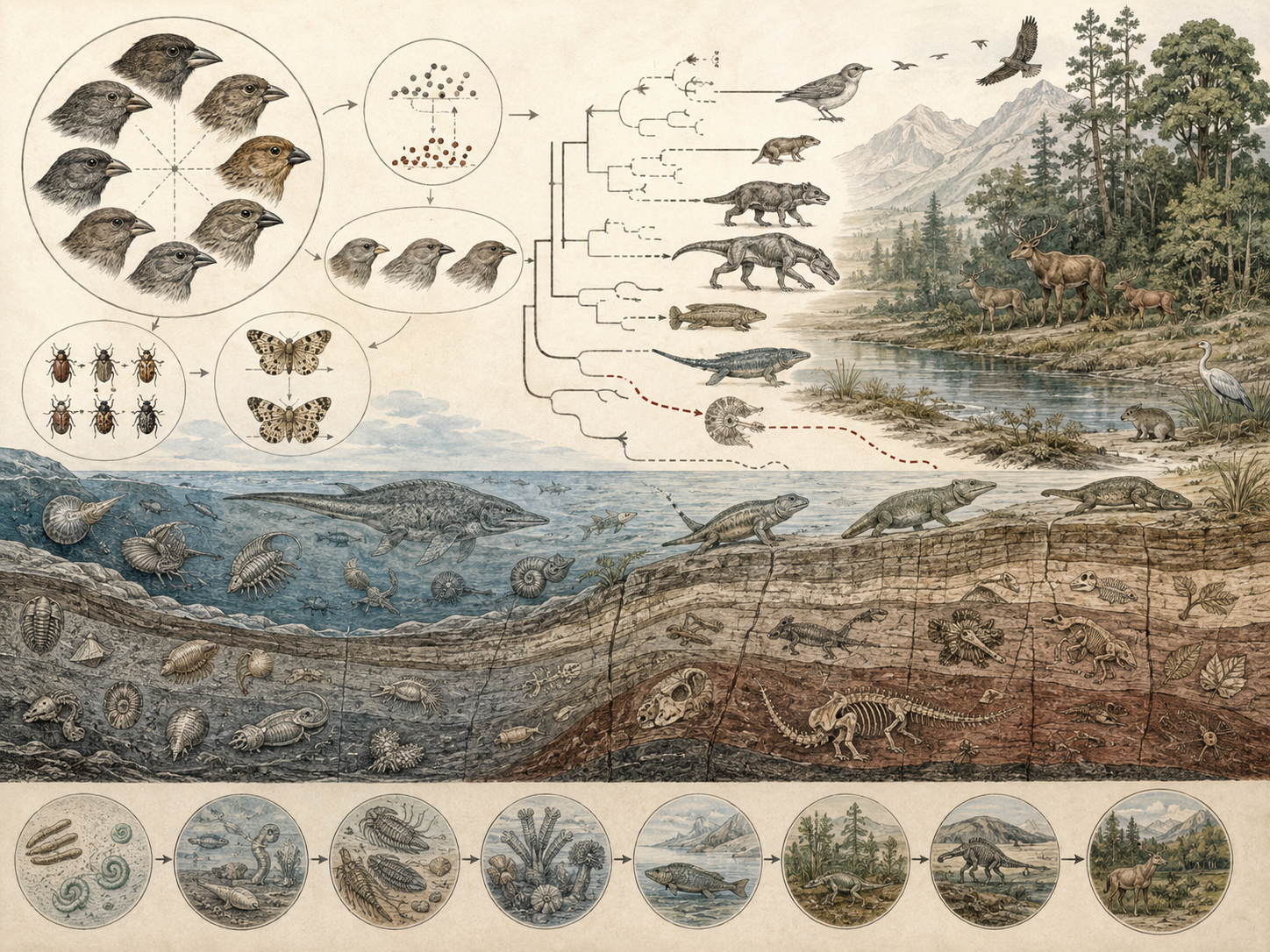
The article develops microevolution, macroevolution, and deep time across allele-frequency change, natural selection, genetic drift, mutation, migration, recombination, phylogenetic branching, fossil evidence, extinction, adaptive radiation, clade disparity, macroevolutionary turnover, major transitions, climate and niche evolution, conservation risk, disease evolution, microbial evolution, plant and animal diversification, and computational evolutionary analysis.
The article also extends evolutionary scale into quantitative and computational biology through Hardy-Weinberg expectations, genotype-specific selection updates, mutation and migration equations, Wright-Fisher drift, heterozygosity trajectories, Jukes-Cantor sequence distance, birth-death turnover, stochastic diversification screening, clade-level comparison, R workflows, Python workflows, SQL provenance structures, and a linked full-stack GitHub repository containing Python, R, Julia, Fortran, Rust, Go, C, C++, SQL, notebooks, data files, validation notes, and reproducibility documentation.
What microevolution, macroevolution, and deep time are
Microevolution refers to evolutionary change within populations, especially change in allele frequencies and inherited trait distributions across generations. This scale matters because it is where evolutionary mechanisms become directly measurable. Selection, drift, mutation, recombination, migration, demographic structure, and nonrandom mating alter which variants become more common, less common, fixed, or lost. Microevolution therefore gives evolution a process-level foundation grounded in real populations rather than abstract lineage diagrams alone.
Macroevolution refers to large-scale evolutionary patterns at or above the level of species. It concerns branching history, extinction, persistence, adaptive radiation, disparity, major transitions, and the large-scale structure of the tree of life. Macroevolution matters because biology is not only interested in how one population changes across a few generations. It is also interested in how major clades originate, why some lineages diversify while others remain species-poor, why certain body plans persist for immense intervals, and how extinction repeatedly reorganizes ecological and evolutionary possibility.
Deep time is the temporal framework that makes both scales scientifically intelligible. Without deep time, macroevolution would be almost invisible and many of biology’s most important questions would collapse into short-term observation. Without microevolution, macroevolution would lose its population-level grounding. Evolutionary biology is strongest when it sees these not as competing explanatory domains but as connected analytical levels: population process, branching history, and geological duration.
This means evolutionary scale is not merely a vocabulary lesson. It is a scientific framework for asking what kind of evidence is relevant, what kind of timescale is being studied, what kind of mechanism is being inferred, and what kind of biological pattern is being explained. A shift in allele frequency over ten generations, the origin of a new species, the diversification of a clade, and the persistence of a body plan across hundreds of millions of years are not the same problem. Yet they are connected through inherited change, lineage history, and time.
Microevolution: change within populations
Microevolution matters because evolution begins with inherited variation distributed through real populations. Selection, drift, mutation, migration, and recombination alter how common different variants become across generations. This scale is foundational because it makes evolutionary change observable and testable. Population genetics can track allele frequencies, genotype frequencies, departures from equilibrium, effective population size, and trait-associated fitness differences, allowing biology to study evolution not only as historical narrative but as an ongoing measurable process.
Microevolution is therefore not “minor” evolution in any trivial sense. It is the scale at which evolutionary mechanisms directly sort inherited difference. A change in drought tolerance, pathogen resistance, developmental timing, coloration, metabolic efficiency, dispersal tendency, immune response, or mating signal may begin as differential reproductive success among variants within a population. Whether the lineage later persists, speciates, expands, or disappears, the population-level dynamics remain indispensable.
This matters to ecology, medicine, agriculture, conservation, and disease ecology because short-term evolutionary change can alter host-pathogen interaction, resistance evolution, local adaptation, invasion dynamics, population viability, and response to environmental stress. Microevolution provides the immediate mechanistic substrate out of which larger historical patterns are eventually built.
Microevolution also clarifies why evolution can be rapid without being visually dramatic. A population may change genetically before major morphological differences are visible. A pathogen may acquire resistance before clinical outcomes fully reveal the shift. A fragmented population may lose heterozygosity long before extinction occurs. A restored population may appear established while losing adaptive capacity. Population-level evolutionary change is often hidden unless measured through genetic, demographic, or trait-based evidence.
Macroevolution: patterns across lineages
Macroevolution concerns large-scale patterns such as speciation, adaptive radiation, long intervals of relative stability, major transitions, extinction, and the uneven diversification of clades. This scale matters because biology must explain not only why traits change within populations, but why major branches of life differ so profoundly in species richness, body organization, ecological role, and historical duration.
Macroevolution therefore includes the long-range consequences of population-level processes expressed through branching lineages and deep time. Speciation partitions populations into independently evolving lineages. Extinction removes branches. Developmental and ecological constraints channel possibilities unevenly. Mass extinction, geographic fragmentation, ecological opportunity, and key innovations all help shape the large-scale pattern visible on the tree of life. In this sense, macroevolution is not detached from microevolution, but it is not exhausted by single-population reasoning either.
This broader scale also expands the evidentiary base of biology. Fossils, comparative anatomy, biogeography, phylogenetics, genomics, and trait-evolution models all become crucial because the questions are historical and large-scale. Macroevolution is the domain in which biology asks why the world contains flowering plants, mammals, insects, fungi, reef systems, parasitic radiations, microbial transformations, and major body plans at all.
Macroevolution also reminds biology that extinction is as important as origination. The present diversity of life is not simply the sum of every successful adaptation. It is the surviving result of branching and pruning. Many lineages were once diverse but are now diminished or gone. Others radiated after ecological opportunities opened. Some persisted with relatively little visible change, while others diversified rapidly. Macroevolution is therefore the study of historical pattern, not a simple extrapolation of short-term improvement.
Deep time and the scale of evolutionary history
Deep time is the immense span of Earth history across which life emerged, diversified, persisted, and repeatedly changed. It matters because many of the most important patterns in biology cannot be understood over only a few generations or within a human lifespan. The origin of major clades, the colonization of land, the evolution of photosynthesis, repeated mass extinctions, the rise of multicellularity, and the long histories of microbial transformation all depend on timescales far beyond direct experience.
Deep time is not merely a dramatic backdrop. It is part of the explanatory structure of evolutionary biology itself. Processes that appear slow or invisible at ordinary human scales become visible when placed within stratigraphic sequence, fossil succession, lineage branching, and long intervals of environmental change. Deep time also allows biology to distinguish transient change from enduring historical transformation.
This matters because scale alters interpretation. A population fluctuation over decades is not the same kind of pattern as a clade radiation over tens of millions of years. Geological time allows scientists to infer the persistence, turnover, and irreversibility of change. Without deep time, evolutionary theory would be confined largely to contemporary process and would lose access to the history that gave present life its structure.
Deep time also gives evolutionary biology a corrective against presentism. Modern organisms are not the whole story of life; they are surviving tips of a vast historical tree. Many ecosystems, organisms, and transitions have no exact modern equivalent. Fossils, stratigraphy, phylogenies, and comparative genomics make it possible to reconstruct parts of this history, but they also remind scientists that the living world is a historical remainder, not a complete archive.
From small-scale change to large-scale history
One of the central questions in evolutionary biology is how microevolutionary change relates to macroevolutionary history. The strongest modern view does not separate them into unrelated realms. Population-level processes generate the inherited differences on which selection and drift act. Over branching lineages and long timescales, those processes contribute to divergence, speciation, persistence, extinction, and large-scale historical pattern. Continuity across scale is therefore real.
At the same time, macroevolution introduces additional questions that single-population models alone do not answer fully. Speciation, extinction, clade sorting, developmental constraint, ecological incumbency, mass extinction, adaptive radiation, and fossil-record bias all shape large-scale history in ways that are not visible if analysis never moves beyond the population frame. This means that microevolution is necessary but not always sufficient for full evolutionary explanation across deep time.
Biology is strongest when it holds both truths together: macroevolution depends on microevolutionary processes, but it also requires historical, paleontological, and phylogenetic frameworks that reveal how those processes accumulate, branch, and interact over immense timescales. Evolutionary explanation becomes strongest when mechanism and history are linked rather than opposed.
This connection is especially important because different questions require different evidentiary tools. A selection coefficient may help explain allele-frequency change in a population. A phylogenetic tree may help explain branching relationships among species. A fossil sequence may document morphological transformation or extinction. A diversification model may estimate origination and loss. None of these tools replaces the others. Together, they connect short-term process with long-term history.
Stability, radiation, extinction, and major evolutionary patterns
Large-scale evolutionary history includes more than steady gradual change. It includes long intervals of relative stability, pulses of diversification, adaptive radiations, repeated extinction, convergent evolution, ecological replacement, and episodes of rapid restructuring. The history of life is therefore uneven. Some lineages remain comparatively conservative over long intervals, while others diversify rapidly when ecological opportunity opens or previous incumbents disappear.
This matters because macroevolution is not reducible to a simple narrative of continuous progress. Stability can be as historically important as change. Extinction can be as consequential as origination. Radiations can depend on prior loss, developmental flexibility, ecological release, geographic expansion, symbiotic innovation, or changes in climate and habitat. Deep history shows that lineage success is episodic, contingent, and often interrupted by crisis or constraint.
These patterns are especially important for understanding present biodiversity and its fragility. The current distribution of richness across clades and ecosystems reflects not only adaptive success but also long histories of extinction, persistence, and differential radiation. Biodiversity is therefore historical structure, not just present-day abundance.
Adaptive radiation is a particularly important macroevolutionary pattern. When ecological opportunity opens, a lineage may diversify rapidly into many forms occupying different niches. But radiation depends on context: geography, ecology, developmental potential, prior extinction, dispersal, and competition all matter. Similarly, long-term stability does not necessarily mean lack of evolution. It may reflect stabilizing selection, ecological persistence, developmental constraint, or incomplete evidence. Macroevolution requires careful interpretation because pattern alone rarely explains itself.
Fossils, phylogenies, and the evidence for evolutionary scale
Understanding evolutionary scale requires multiple kinds of evidence. Fossils document extinct forms, temporal succession, major transitions, ecological replacement, and extinction patterns across deep time. They allow scientists to see lineages that no longer exist and to reconstruct the sequence of biological transformation across stratigraphic intervals. Fossils therefore make macroevolution empirically visible rather than merely hypothetical.
Phylogenetic trees and comparative sequence data add another major evidentiary layer. They allow scientists to infer relatedness, branching order, shared ancestry, and diversification pattern among living lineages and, where possible, to integrate extinct groups into a broader historical framework. Phylogenies are not simply diagrams of similarity. They are hypotheses about branching history supported by comparative evidence.
Together, fossils and phylogenies connect short-term change to long-term history. One preserves traces in time; the other reconstructs branching relationship. Both are essential for linking microevolution to macroevolution across deep time. In the genomic era, these lines of evidence increasingly interact rather than compete, making evolutionary biology more synthetic and historically grounded.
Each line of evidence also has limits. Fossil preservation is uneven. Molecular data can be affected by rate variation, horizontal gene transfer, introgression, incomplete lineage sorting, and sampling gaps. Morphology can show convergence. Genomic similarity can reflect both ancestry and constraint. Strong evolutionary-scale inference therefore depends on convergence among evidence streams rather than overconfidence in one archive alone.
Microevolution, macroevolution, and biological form
Evolutionary scale is not only about lineage counts or durations. It also concerns the history of form, function, development, and organization. Microevolution may alter regulatory systems, timing, physiology, morphology, or behavior within populations. Over longer timescales, such shifts can contribute to broader lineage divergence, innovation, ecological specialization, and large-scale structural differences. Macroevolution therefore includes the visible history of body plans and biological organization, but that history remains rooted in populations whose inherited variation changed through time.
This matters because form is historical. Major anatomical differences across clades did not arise outside evolutionary process; they emerged through accumulated changes in development, selection, ecological interaction, and lineage sorting. At the same time, the persistence or disappearance of particular forms also depends on extinction, contingency, and ecological restructuring. Form is not merely produced. It is filtered through deep history.
This is why developmental biology, comparative morphology, paleontology, and evolutionary theory converge so strongly in modern biology. To understand form fully requires both the population-level processes that generate change and the long-term historical perspective that reveals how some changes scale into enduring biological structure.
Developmental constraint is especially important here. Not every microevolutionary change can scale into a viable macroevolutionary pattern. Some forms are easier to produce developmentally than others. Some innovations depend on regulatory shifts rather than new structures from scratch. Some body plans persist because they are developmentally robust or ecologically durable. Evolutionary scale therefore links gene regulation, development, function, and geological history.
Ecology, conservation, and systems risk
Microevolution, macroevolution, and deep time are all relevant to ecology and conservation because living systems respond to environments across multiple timescales. Populations may adapt, shift range, or decline in the short term, while lineages persist, diversify, or disappear over longer spans. Present ecosystems are therefore both immediate ecological systems and products of deep historical assembly.
This matters for conservation because current biodiversity is not merely a present inventory. It is the outcome of vast evolutionary history. When populations are fragmented, adaptive capacity reduced, or lineages lost, the damage is not only ecological but evolutionary. Conservation loss can erase not just species, but branches of the tree of life, future diversification potential, and historically accumulated functional uniqueness.
For systems thinking, this means resilience has both short-term and long-term dimensions. Some problems concern immediate adaptive response, such as disease resistance, climate sensitivity, or local adaptation. Others concern preservation of evolutionary possibility itself. Conservation biology gains depth when it connects population viability to lineage history and deep time rather than treating them as separate domains.
This also changes how environmental risk is interpreted. A small population may be vulnerable because drift and inbreeding reduce adaptive potential. A lineage may be vulnerable because it represents a long isolated branch with few close relatives. An ecosystem may be vulnerable because disturbance disrupts processes that took millions of years to assemble. Evolutionary-scale thinking reveals that sustainability is not only about keeping organisms alive in the present. It is also about protecting histories, relationships, and future evolutionary capacity.
Marine, freshwater, soil, plant, and microbial relevance
Marine biology is inseparable from deep time because oceans preserve much of the fossil and ecological history through which macroevolution is reconstructed. Marine microbes dominated early Earth history, marine invertebrates document major radiations and extinctions, and marine vertebrates illustrate repeated large-scale transitions and ecological restructuring. Modern marine systems also show microevolutionary change under warming, acidification, fishing pressure, hypoxia, disease, and shifting currents.
Freshwater systems show similar multi-scale dynamics through isolated basins, fragmentation, local adaptation, and lineage divergence. Lake radiations, river-basin isolation, wetland mosaics, and hydrologic change all link short-term population dynamics to longer-term diversification. Freshwater systems are also highly vulnerable to rapid environmental change, making population-level adaptive capacity and lineage-level history jointly important.
Soil biology and microbiology are especially important because much of life’s history is microbial, and microbial evolution continues rapidly through immense population sizes, strong selection, horizontal exchange, and ecological turnover. Microbial evolution complicates simple tree thinking while still preserving the importance of ancestry, divergence, and deep history. Microbial systems show that evolutionary scale can operate both rapidly and profoundly.
Plant science, forestry, agroecology, and restoration ecology likewise depend on connecting short-term adaptation to longer-term lineage history. Plants show microevolutionary responses to drought, disease, herbivory, temperature, and soil conditions, while also preserving deep histories of land colonization, vascular tissue evolution, seed evolution, flowering plant diversification, polyploidy, hybridization, and ecological radiation. Evolutionary scale is therefore not the property of one branch of biology. It is a cross-cutting framework across marine, freshwater, soil, plant, microbial, fungal, and animal systems.
Medical, biomedical, and disease ecology relevance
Microevolutionary and macroevolutionary thinking both matter in medicine and biomedicine. Pathogens evolve on short timescales through mutation, selection, recombination, drift, and population bottlenecks, often under intense pressure from immunity, drugs, vaccines, host behavior, and transmission dynamics. At the same time, deeper lineage history shapes host relationships, conserved biological systems, comparative inference, and the broader evolutionary context in which pathogens and hosts interact.
This matters because disease systems operate across multiple evolutionary scales at once. A microbial population may change detectably within months, yet its host range, virulence potential, and genomic architecture are also products of much longer evolutionary histories. Likewise, model organisms used in biomedical research carry deep shared ancestry that makes comparative biology informative in the first place.
In medicine and disease ecology, evolutionary scale helps connect immediate mechanism to historical ancestry. It clarifies why resistance evolves rapidly, why pathogens are constrained by lineage history, why host defenses are both ancient and dynamic, and why present disease landscapes cannot be understood outside broader biological history.
Cancer also benefits from evolutionary-scale thinking, even though somatic evolution is not identical to species evolution. Tumors may evolve rapidly within bodies through clonal expansion, selection under therapy, drift, immune pressure, and microenvironmental constraint. At the same time, the cellular systems involved in cancer are products of deep evolutionary histories of multicellularity, cell regulation, growth control, immune surveillance, and tissue organization. Evolutionary scale therefore helps connect clinical dynamics to biological history.
Phylogenomics, bioinformatics, and computational relevance
The connection between microevolution, macroevolution, and deep time has become more powerful in the genomic era because sequence comparison, phylogenetics, population-genetic inference, and macroevolutionary modeling can now be integrated computationally. Bioinformatics allows scientists to study short-term variation across many loci, infer branching relationships, compare genomes across species, estimate divergence, and test hypotheses about large-scale diversification or constraint.
This matters because evolutionary scale is one of the clearest places where classical natural history and modern computation meet. Population-genetic models quantify short-term change. Phylogenomic methods reconstruct branching history. Diversification models explore rates of speciation and extinction. Comparative methods test correlations among traits, environments, and clade outcomes. Computational biology does not replace fossils or field work; it strengthens their synthesis.
For systems-oriented readers, this makes evolutionary scale analytically rich. It combines measurable short-term process, incomplete historical evidence, branching structures, uncertainty, and multi-scale inference. Evolutionary biology becomes especially powerful when these elements are treated together rather than as separate subdisciplines.
Reproducibility is especially important here. Population-genetic inference depends on sampling, allele calling, population definitions, missing data, and demographic assumptions. Phylogenomic inference depends on alignment, model selection, taxon sampling, gene-tree conflict, and rate assumptions. Macroevolutionary inference depends on fossil calibration, lineage sampling, extinction modeling, and survivorship bias. A strong computational workflow must therefore document both data and assumptions.
Quantitative evolutionary scale: mathematics, R, and Python
Evolution across scales is not only conceptual. It can also be represented quantitatively. The aim of modeling is not to compress all of evolutionary biology into a handful of equations, but to clarify how population process, lineage divergence, survivorship, diversification, and time-dependent pattern can be analyzed in compatible mathematical terms.
At the microevolutionary level, a basic two-allele system begins with:
p+q=1
\]
Interpretation: At a biallelic locus, the two allele frequencies sum to one.
where \(p\) and \(q\) are allele frequencies. Under Hardy-Weinberg assumptions, expected genotype frequencies are:
p^2+2pq+q^2=1
\]
Interpretation: Hardy-Weinberg expectations provide a baseline for genotype frequencies under idealized assumptions.
These equations are useful because microevolution is often first described as change in such frequencies over time. They provide a baseline from which selection, drift, migration, assortative mating, population subdivision, or other departures can be detected.
For diploids with genotype fitnesses \(W_{AA}\), \(W_{Aa}\), and \(W_{aa}\), mean fitness can be written as:
\bar{W}=p^2W_{AA}+2pqW_{Aa}+q^2W_{aa}
\]
Interpretation: Mean fitness is the genotype-frequency-weighted average of genotype-specific fitness.
The next-generation allele frequency of \(A\) after genotype-specific selection is:
p’=\frac{p^2W_{AA}+pqW_{Aa}}{\bar{W}}
\]
Interpretation: Genotype-specific selection changes allele frequency according to relative reproductive contribution.
This matters because useful population-genetic modeling requires genotype-level structure rather than only a verbal claim that selection “changes frequencies.”
If allele \(A\) mutates to \(a\) at rate \(\mu\) and the reverse occurs at rate \(\nu\), then:
p’=p(1-\mu)+q\nu
\]
Interpretation: Mutation shifts allele frequency by removing copies through forward mutation and adding copies through reverse mutation.
Migration from a source population with allele frequency \(p_m\) into a focal population at fraction \(m\) can be written as:
p’=(1-m)p+mp_m
\]
Interpretation: Migration shifts the focal population toward the allele frequency in the migrant source population.
Drift adds stochasticity through finite sampling. In a Wright-Fisher population of diploid size \(N\), the number of \(A\) alleles in the next generation can be treated as:
X_{t+1}\sim\mathrm{Binomial}(2N,p_t)
\]
Interpretation: The next-generation allele count is sampled from \(2N\) allele copies with probability \(p_t\).
so that:
p_{t+1}=\frac{X_{t+1}}{2N}
\]
Interpretation: The next allele frequency is the sampled allele count divided by the total number of allele copies.
This is useful because real microevolution is rarely driven by only one mechanism at a time. Selection, mutation, migration, population size, and drift often interact.
At broader scales, comparative divergence can be simplified as sequence or trait distance between lineages. A simple proportion difference can be expressed as:
D=\frac{m}{L}
\]
Interpretation: Observed divergence is the fraction of aligned positions that differ.
where \(m\) is the number of mismatches and \(L\) is sequence length. A Jukes-Cantor correction can refine this for nucleotide data:
d_{\mathrm{JC}}=-\frac{3}{4}\ln\left(1-\frac{4D}{3}\right)
\]
Interpretation: Jukes-Cantor correction adjusts observed sequence distance for hidden substitutions under a simple model.
This matters because observed mismatches underestimate deeper divergence when multiple substitutions occur at the same site.
At macroevolutionary scale, lineage richness through time can be conceptualized through origination rate \(\lambda\) and extinction rate \(\mu\). A net diversification rate can be written as:
r=\lambda-\mu
\]
Interpretation: Net diversification is the difference between origination and extinction rates.
and expected lineage growth under a simplified constant-rate approximation becomes:
N(t)=N_0e^{rt}
\]
Interpretation: Expected lineage richness grows exponentially under a simplified constant net diversification rate.
In richer birth-death reasoning, high extinction may cancel or reverse origination even when speciation is active. This makes macroevolutionary pattern inseparable from both branching and loss.
Variables, units, and evolutionary-scale interpretation
Quantitative evolutionary-scale analysis depends on variables that connect allele frequencies, fitness, mutation, migration, stochastic drift, sequence divergence, origination, extinction, lineage richness, and biological interpretation. The table below summarizes several central quantities.
| Symbol or Term | Meaning | Typical Unit or Scale | Evolutionary-Scale Interpretation |
|---|---|---|---|
| \(p, q\) | Allele frequencies | fraction from 0 to 1 | Microevolutionary state of a two-allele locus |
| \(p^2, 2pq, q^2\) | Expected genotype frequencies | frequency or probability | Hardy-Weinberg baseline for genotype distribution |
| \(W_{AA}, W_{Aa}, W_{aa}\) | Genotype-specific fitnesses | relative fitness scale | Relative reproductive contribution of genotypes |
| \(\bar{W}\) | Mean population fitness | relative fitness | Genotype-weighted fitness across the population |
| \(p’\) | Updated allele frequency | fraction from 0 to 1 | Allele frequency after selection, mutation, migration, or another update |
| \(\mu\) | Forward mutation rate in population genetics | per generation or replication cycle | Rate at which allele \(A\) changes to allele \(a\) |
| \(\nu\) | Reverse mutation rate | per generation or replication cycle | Rate at which allele \(a\) changes to allele \(A\) |
| \(m\) | Migration fraction in population genetics | fraction from 0 to 1 | Share of genetic contribution from a migrant source population |
| \(p_m\) | Migrant-source allele frequency | fraction from 0 to 1 | Allele frequency in the source population |
| \(N\) | Diploid population size in a simple Wright-Fisher model | individuals | Population size shaping drift strength |
| \(X_{t+1}\) | Sampled allele count | count from 0 to \(2N\) | Next-generation allele count under stochastic drift |
| \(H\) | Expected heterozygosity | fraction from 0 to 1 | Compact measure of population-level genetic diversity |
| \(D\) | Observed sequence divergence | fraction from 0 to 1 | Fraction of aligned positions that differ between sequences |
| \(m\) in sequence context | Mismatch count | count | Number of differing positions in an alignment |
| \(L\) | Sequence length or aligned sites | base pairs, nucleotides, amino acids, or sites | Number of positions compared in a divergence calculation |
| \(d_{\mathrm{JC}}\) | Jukes-Cantor corrected distance | substitutions per site under a simple model | Corrected molecular distance accounting for hidden substitutions |
| \(\lambda\) | Origination or speciation rate | lineages per lineage per time | Rate at which new lineages arise |
| \(\mu\) in diversification context | Extinction rate | lineages per lineage per time | Rate at which lineages are lost |
| \(r\) | Net diversification rate | per time | Origination rate minus extinction rate |
| \(N_0\) | Initial lineage richness | number of lineages | Starting lineage count in a diversification model |
| \(N(t)\) | Lineage richness at time \(t\) | number of lineages | Expected or observed number of lineages through time |
| Deep time | Geological duration of evolutionary history | thousands to billions of years | Temporal horizon required to interpret macroevolutionary pattern |
The table shows why evolutionary-scale quantities require context. An allele-frequency change, sequence distance, diversification rate, or lineage count becomes biologically meaningful only when linked to sampling design, timescale, population size, fossil evidence, phylogenetic structure, ecological setting, and model assumptions.
Worked example: allele frequencies, sequence distance, and diversification
Suppose allele \(A\) has frequency \(p=0.8\). Then allele \(a\) has frequency:
q=1-p=1-0.8=0.2
\]
Interpretation: At a two-allele locus, knowing one allele frequency determines the other.
Expected genotype frequencies under Hardy-Weinberg assumptions are:
AA=p^2=(0.8)^2=0.64
\]
Interpretation: The expected \(AA\) genotype frequency is 0.64.
Aa=2pq=2(0.8)(0.2)=0.32
\]
Interpretation: The expected heterozygote frequency is 0.32.
aa=q^2=(0.2)^2=0.04
\]
Interpretation: The expected \(aa\) genotype frequency is 0.04.
This is useful because it gives a baseline from which microevolutionary deviation can be measured. Over longer timescales, repeated population-level changes contribute to lineage-level history, though additional processes such as speciation, extinction, lineage sorting, and fossil-record incompleteness must then be added.
For sequence divergence, suppose two aligned sequences have \(m=5\) mismatches across \(L=40\) aligned positions:
D=\frac{5}{40}=0.125
\]
Interpretation: The observed proportion difference is 0.125.
A Jukes-Cantor correction gives:
d_{\mathrm{JC}}=-\frac{3}{4}\ln\left(1-\frac{4(0.125)}{3}\right)\approx0.137
\]
Interpretation: The corrected distance is slightly larger because observed differences may hide multiple substitutions at the same site.
This helps connect molecular comparison to larger historical inference.
At macroevolutionary scale, suppose a clade begins with \(N_0=20\) lineages, with origination rate \(\lambda=0.08\) and extinction rate \(\mu=0.05\) per lineage per time unit. The net diversification rate is:
r=\lambda-\mu=0.08-0.05=0.03
\]
Interpretation: The simplified net diversification rate is 0.03 per time unit.
After \(t=30\) time units under a simplified constant-rate approximation:
N(t)=20e^{0.03(30)}=20e^{0.9}\approx49.2
\]
Interpretation: The simplified expected lineage richness is approximately 49 lineages.
This matters because large-scale diversity depends on both origination and extinction, not on adaptation or speciation alone.
R and Python workflows
Computational modeling helps make evolutionary scale explicit because population change, sequence divergence, and macroevolutionary turnover can be represented, simulated, and compared. Hardy-Weinberg calculations provide baselines. Selection, mutation, migration, and drift models represent microevolutionary change. Sequence-distance workflows connect molecular comparison to historical divergence. Birth-death models represent macroevolutionary turnover through origination and extinction. Clade-level summaries provide a compact way to compare expansion, decline, and turnover across lineages.
The selected examples below focus on compact, reusable workflows: deterministic selection, mutation, migration, Wright-Fisher drift, heterozygosity through time, pairwise divergence, Jukes-Cantor distance, distance-matrix construction, clade-level origination and extinction, and stochastic birth-death screening. The GitHub repository extends the same logic into richer workflows for SQL provenance, reproducible data files, validation notes, notebooks, and multi-language scientific-computing examples.
The purpose is not to reduce evolutionary history to code. The purpose is to make evolutionary-scale reasoning inspectable. A claim about microevolution, macroevolution, or deep time becomes stronger when allele-frequency assumptions, population size, sequence data, clade definitions, fossil intervals, origination and extinction counts, and analytical code are documented together.
R workflow: population change, sequence distance, and clade turnover
R is useful for evolutionary-scale analysis because it supports simulation, statistical summaries, tabular workflows, sequence-distance calculations, clade-level comparison, and reproducible reporting. The following workflow combines deterministic selection, mutation, migration, optional Wright-Fisher drift, sequence divergence, Jukes-Cantor distance, and clade-level turnover screening.
# Microevolution, Macroevolution, and Deep Time Workflow
#
# This workflow demonstrates three evolutionary-scale tasks:
#
#   1. Simulate population-genetic change under selection, mutation,
#      migration, and optional Wright-Fisher drift.
#   2. Compute pairwise sequence divergence and Jukes-Cantor distances.
#   3. Compare clade-level origination, extinction, turnover, and net
#      diversification across shared intervals.
#
# These examples can be adapted for evolutionary biology, paleobiology,
# conservation genetics, disease ecology, phylogenomics, marine and
# freshwater biology, microbial evolution, and biodiversity science.

library(dplyr)
library(tidyr)
library(purrr)
library(stringr)
library(tibble)

# ------------------------------------------------------------
# 1. Population-genetic simulation
# ------------------------------------------------------------

simulate_population <- function(
  generations = 120,
  p0 = 0.5,
  N = 500,
  W_AA = 1.0,
  W_Aa = 1.0,
  W_aa = 1.0,
  mu_A_to_a = 0.0,
  mu_a_to_A = 0.0,
  migration_fraction = 0.0,
  p_migrant = 0.5,
  drift = TRUE,
  seed = 123
) {
  set.seed(seed)

  p <- numeric(generations + 1)
  heterozygosity <- numeric(generations + 1)
  mean_fitness <- numeric(generations + 1)

  p[1] <- p0
  heterozygosity[1] <- 2 * p0 * (1 - p0)
  mean_fitness[1] <- NA_real_

  for (t in 1:generations) {
    pt <- p[t]
    qt <- 1 - pt

    f_AA <- pt^2
    f_Aa <- 2 * pt * qt
    f_aa <- qt^2

    wbar <- f_AA * W_AA + f_Aa * W_Aa + f_aa * W_aa

    p_sel <- (
      f_AA * W_AA + 0.5 * f_Aa * W_Aa
    ) / wbar

    p_mut <- (
      p_sel * (1 - mu_A_to_a) +
      (1 - p_sel) * mu_a_to_A
    )

    p_mig <- (
      (1 - migration_fraction) * p_mut +
      migration_fraction * p_migrant
    )

    if (drift) {
      count_A <- rbinom(1, size = 2 * N, prob = p_mig)
      p_next <- count_A / (2 * N)
    } else {
      p_next <- p_mig
    }

    p[t + 1] <- p_next
    heterozygosity[t + 1] <- 2 * p_next * (1 - p_next)
    mean_fitness[t + 1] <- wbar
  }

  tibble(
    generation = 0:generations,
    p = p,
    q = 1 - p,
    mean_fitness = mean_fitness,
    heterozygosity = heterozygosity
  )
}

scenarios <- tibble(
  scenario = c(
    "neutral_largeN",
    "positive_selection",
    "migration_balance",
    "mutation_selection"
  ),
  p0 = c(0.5, 0.2, 0.9, 0.95),
  N = c(5000, 1000, 1000, 2000),
  W_AA = c(1.0, 1.15, 1.0, 1.0),
  W_Aa = c(1.0, 1.08, 1.0, 0.98),
  W_aa = c(1.0, 1.0, 1.0, 0.92),
  mu_A_to_a = c(0.0, 0.0, 0.0, 0.001),
  mu_a_to_A = c(0.0, 0.0, 0.0, 0.0),
  migration_fraction = c(0.0, 0.0, 0.05, 0.0),
  p_migrant = c(0.5, 0.5, 0.2, 0.5),
  drift = c(TRUE, TRUE, TRUE, FALSE)
)

population_results <- scenarios %>%
  mutate(
    sim = pmap(
      list(
        p0,
        N,
        W_AA,
        W_Aa,
        W_aa,
        mu_A_to_a,
        mu_a_to_A,
        migration_fraction,
        p_migrant,
        drift
      ),
      function(
        p0,
        N,
        W_AA,
        W_Aa,
        W_aa,
        mu_A_to_a,
        mu_a_to_A,
        migration_fraction,
        p_migrant,
        drift
      ) {
        simulate_population(
          generations = 120,
          p0 = p0,
          N = N,
          W_AA = W_AA,
          W_Aa = W_Aa,
          W_aa = W_aa,
          mu_A_to_a = mu_A_to_a,
          mu_a_to_A = mu_a_to_A,
          migration_fraction = migration_fraction,
          p_migrant = p_migrant,
          drift = drift,
          seed = 123
        )
      }
    )
  ) %>%
  select(scenario, sim) %>%
  unnest(sim)

population_summary <- population_results %>%
  group_by(scenario) %>%
  summarise(
    initial_p = first(p),
    final_p = last(p),
    final_heterozygosity = last(heterozygosity),
    final_mean_fitness = last(mean_fitness),
    .groups = "drop"
  )

# ------------------------------------------------------------
# 2. Pairwise sequence divergence and Jukes-Cantor distance
# ------------------------------------------------------------

seqs <- c(
  lineage_A = "ATGCTAGCTAACGGTACCTA",
  lineage_B = "ATGCTGGCTATCGGTACCTA",
  lineage_C = "ATGATAGCTAACGGTTCCTA",
  lineage_D = "ATGCTAGTTAACGGAACCTG"
)

pairwise_distance <- function(s1, s2) {
  chars1 <- str_split(s1, "", simplify = TRUE)
  chars2 <- str_split(s2, "", simplify = TRUE)

  mismatches <- sum(chars1 != chars2)
  length_sites <- length(chars1)

  p_distance <- mismatches / length_sites

  jukes_cantor <- ifelse(
    p_distance >= 0.75,
    NA_real_,
    -(3 / 4) * log(1 - (4 / 3) * p_distance)
  )

  tibble(
    mismatches = mismatches,
    length_sites = length_sites,
    p_distance = p_distance,
    jukes_cantor = jukes_cantor
  )
}

distance_pairs <- expand.grid(
  seq1 = names(seqs),
  seq2 = names(seqs),
  stringsAsFactors = FALSE
) %>%
  as_tibble() %>%
  filter(seq1 < seq2) %>%
  mutate(
    res = map2(
      seq1,
      seq2,
      ~ pairwise_distance(seqs[[.x]], seqs[[.y]])
    )
  ) %>%
  unnest(res)

taxa <- names(seqs)

jc_matrix <- matrix(
  0,
  nrow = length(taxa),
  ncol = length(taxa),
  dimnames = list(taxa, taxa)
)

for (i in seq_len(nrow(distance_pairs))) {
  a <- distance_pairs$seq1[i]
  b <- distance_pairs$seq2[i]

  jc_matrix[a, b] <- distance_pairs$jukes_cantor[i]
  jc_matrix[b, a] <- distance_pairs$jukes_cantor[i]
}

# ------------------------------------------------------------
# 3. Clade-level macroevolutionary turnover
# ------------------------------------------------------------

clades <- tibble(
  clade = c("Clade_A", "Clade_B", "Clade_C", "Clade_D"),
  originations = c(18, 9, 25, 12),
  extinctions = c(7, 8, 10, 14),
  interval_myr = c(20, 20, 20, 20)
) %>%
  mutate(
    lambda = originations / interval_myr,
    mu = extinctions / interval_myr,
    net_diversification = lambda - mu,
    turnover = lambda + mu,
    clade_state = case_when(
      net_diversification > 0 ~ "expanding",
      net_diversification == 0 ~ "balanced",
      TRUE ~ "declining"
    )
  )

# ------------------------------------------------------------
# 4. Print compact outputs
# ------------------------------------------------------------

print(population_summary %>% mutate(across(where(is.numeric), round, 4)))

print(
  population_results %>%
    filter(generation %in% c(0, 20, 50, 80, 100, 120)) %>%
    mutate(across(where(is.numeric), round, 4))
)

print(distance_pairs %>% mutate(across(where(is.numeric), round, 4)))
print(round(jc_matrix, 4))

print(clades %>% mutate(across(where(is.numeric), round, 4)))
This R workflow is useful because it does not stop at Hardy-Weinberg arithmetic. It lets the reader compare selection, migration, mutation, and drift under reproducible scenarios, inspect heterozygosity through time, calculate sequence divergence, and screen macroevolutionary turnover across clades.
Python workflow: Wright-Fisher replicates, distance matrices, and birth-death screening
Python is useful for evolutionary-scale analysis because it supports stochastic simulation, numerical analysis, matrix construction, sequence comparison, Monte Carlo workflows, and reproducible computation. The following workflow simulates Wright-Fisher evolution with selection and drift across replicates, constructs a sequence-distance matrix with Jukes-Cantor correction, and runs simple birth-death macroevolutionary screening.
"""
Microevolution, Macroevolution, and Deep Time Workflow

This workflow demonstrates three evolutionary-scale tasks:

1. Simulate Wright-Fisher allele-frequency change with selection and drift.
2. Build pairwise sequence-distance tables and Jukes-Cantor matrices.
3. Run simple stochastic birth-death screening for macroevolutionary turnover.

The examples are compact, but the same structures can be extended to
evolutionary biology, paleobiology, conservation genetics, disease ecology,
phylogenomics, marine and freshwater biology, microbial evolution, and
biodiversity science.
"""

from __future__ import annotations

from itertools import combinations

import numpy as np
import pandas as pd


def wright_fisher_selection(
    generations: int = 200,
    N: int = 500,
    p0: float = 0.5,
    w_AA: float = 1.10,
    w_Aa: float = 1.05,
    w_aa: float = 1.00,
    replicates: int = 100,
    seed: int = 42,
) -> tuple[pd.DataFrame, pd.DataFrame, pd.DataFrame]:
    """
    Simulate allele-frequency change with selection and drift.

    Multiple replicates make drift visible and help show how selection and
    finite population size interact.
    """
    rng = np.random.default_rng(seed)

    records = []

    for replicate in range(replicates):
        p = p0

        for generation in range(generations + 1):
            records.append(
                {
                    "replicate": replicate,
                    "generation": generation,
                    "p": p,
                    "q": 1.0 - p,
                    "heterozygosity": 2.0 * p * (1.0 - p),
                }
            )

            if generation == generations:
                continue

            q = 1.0 - p

            f_AA = p**2
            f_Aa = 2.0 * p * q
            f_aa = q**2

            wbar = f_AA * w_AA + f_Aa * w_Aa + f_aa * w_aa

            p_sel = (
                f_AA * w_AA + 0.5 * f_Aa * w_Aa
            ) / wbar

            count_A = rng.binomial(2 * N, p_sel)
            p = count_A / (2.0 * N)

    df = pd.DataFrame(records)

    summary = (
        df.groupby("generation")
        .agg(
            mean_p=("p", "mean"),
            sd_p=("p", "std"),
            mean_heterozygosity=("heterozygosity", "mean"),
        )
        .reset_index()
    )

    final_generation = df["generation"].max()
    finals = df[df["generation"] == final_generation]

    final_summary = pd.DataFrame(
        {
            "fixation_probability": [np.mean(finals["p"] == 1.0)],
            "loss_probability": [np.mean(finals["p"] == 0.0)],
            "mean_final_p": [finals["p"].mean()],
            "mean_final_heterozygosity": [finals["heterozygosity"].mean()],
        }
    )

    return df, summary, final_summary


def pairwise_sequence_distance() -> tuple[pd.DataFrame, pd.DataFrame]:
    """
    Build pairwise p-distance and Jukes-Cantor corrected distance matrices.
    """
    sequences = {
        "lineage_A": "ATGCTAGCTAACGGTACCTA",
        "lineage_B": "ATGCTGGCTATCGGTACCTA",
        "lineage_C": "ATGATAGCTAACGGTTCCTA",
        "lineage_D": "ATGCTAGTTAACGGAACCTG",
    }

    def distance(seq1: str, seq2: str) -> tuple[int, float, float]:
        if len(seq1) != len(seq2):
            raise ValueError("Sequences must be equal length for this compact example.")

        mismatches = sum(a != b for a, b in zip(seq1, seq2))
        length = len(seq1)

        p_distance = mismatches / length

        if p_distance >= 0.75:
            jukes_cantor = np.nan
        else:
            jukes_cantor = -(3.0 / 4.0) * np.log(
                1.0 - (4.0 / 3.0) * p_distance
            )

        return mismatches, p_distance, jukes_cantor

    rows = []

    for taxon_1, taxon_2 in combinations(sequences.keys(), 2):
        mismatches, p_distance, jukes_cantor = distance(
            sequences[taxon_1],
            sequences[taxon_2],
        )

        rows.append(
            {
                "taxon_1": taxon_1,
                "taxon_2": taxon_2,
                "mismatches": mismatches,
                "p_distance": p_distance,
                "jukes_cantor": jukes_cantor,
            }
        )

    distance_df = pd.DataFrame(rows)

    taxa = list(sequences.keys())

    matrix = pd.DataFrame(
        np.zeros((len(taxa), len(taxa))),
        index=taxa,
        columns=taxa,
    )

    for _, row in distance_df.iterrows():
        matrix.loc[row["taxon_1"], row["taxon_2"]] = row["jukes_cantor"]
        matrix.loc[row["taxon_2"], row["taxon_1"]] = row["jukes_cantor"]

    return distance_df, matrix


def birth_death_screen(
    n_lineages: int = 20,
    intervals: int = 50,
    lambda_rate: float = 0.12,
    mu_rate: float = 0.08,
    n_iter: int = 1000,
    seed: int = 123,
) -> tuple[pd.DataFrame, pd.DataFrame]:
    """
    Simulate simple stochastic macroevolutionary turnover.
    """
    rng = np.random.default_rng(seed)

    finals = []
    peaks = []
    extinct_by_end = []

    for _ in range(n_iter):
        lineages = n_lineages
        peak = lineages

        for _ in range(intervals):
            births = rng.poisson(lambda_rate * lineages)
            deaths = rng.poisson(mu_rate * lineages)

            lineages = max(lineages + births - deaths, 0)
            peak = max(peak, lineages)

            if lineages == 0:
                break

        finals.append(lineages)
        peaks.append(peak)
        extinct_by_end.append(lineages == 0)

    runs = pd.DataFrame(
        {
            "final_lineages": finals,
            "peak_lineages": peaks,
            "extinct_by_end": extinct_by_end,
        }
    )

    summary = pd.DataFrame(
        {
            "extinction_probability": [runs["extinct_by_end"].mean()],
            "mean_surviving_richness": [runs["final_lineages"].mean()],
            "median_surviving_richness": [runs["final_lineages"].median()],
            "mean_peak_richness": [runs["peak_lineages"].mean()],
        }
    )

    return runs, summary


def clade_turnover_table() -> pd.DataFrame:
    """
    Build a compact clade-level origination-extinction comparison table.
    """
    clades = pd.DataFrame(
        {
            "clade": ["Clade_A", "Clade_B", "Clade_C", "Clade_D"],
            "originations": [18, 9, 25, 12],
            "extinctions": [7, 8, 10, 14],
            "interval_myr": [20, 20, 20, 20],
        }
    )

    clades["lambda"] = clades["originations"] / clades["interval_myr"]
    clades["mu"] = clades["extinctions"] / clades["interval_myr"]
    clades["net_diversification"] = clades["lambda"] - clades["mu"]
    clades["turnover"] = clades["lambda"] + clades["mu"]

    clades["clade_state"] = np.where(
        clades["net_diversification"] > 0,
        "expanding",
        np.where(
            clades["net_diversification"] == 0,
            "balanced",
            "declining",
        ),
    )

    return clades.sort_values("net_diversification", ascending=False)


def evolutionary_scale_condition_score() -> pd.DataFrame:
    """
    Build a compact applied evolutionary-scale screen.
    """
    systems = pd.DataFrame(
        {
            "system": [
                "fragmented_freshwater_population",
                "pathogen_under_drug_pressure",
                "relict_forest_lineage",
                "marine_climate_gradient",
                "microbial_soil_community",
            ],
            "short_term_evolutionary_pressure": [0.62, 0.95, 0.48, 0.74, 0.80],
            "population_adaptive_capacity": [0.28, 0.72, 0.35, 0.52, 0.76],
            "lineage_distinctiveness": [0.68, 0.40, 0.92, 0.55, 0.42],
            "deep_time_irreplaceability": [0.60, 0.30, 0.95, 0.50, 0.45],
            "extinction_or_failure_risk": [0.78, 0.65, 0.82, 0.58, 0.38],
        }
    )

    systems["microevolutionary_risk_score"] = (
        0.45 * systems["short_term_evolutionary_pressure"]
        + 0.35 * systems["extinction_or_failure_risk"]
        + 0.20 * (1.0 - systems["population_adaptive_capacity"])
    )

    systems["macroevolutionary_loss_score"] = (
        0.40 * systems["lineage_distinctiveness"]
        + 0.40 * systems["deep_time_irreplaceability"]
        + 0.20 * systems["extinction_or_failure_risk"]
    )

    return systems.sort_values("macroevolutionary_loss_score", ascending=False)


def main() -> None:
    """
    Run compact evolutionary-scale workflows.
    """
    _, wf_summary, wf_final = wright_fisher_selection()
    distance_df, distance_matrix = pairwise_sequence_distance()
    birth_death_runs, birth_death_summary = birth_death_screen()
    clades = clade_turnover_table()
    condition_score = evolutionary_scale_condition_score()

    print("Wright-Fisher selection summary:")
    print(wf_summary.head(15).round(4).to_string(index=False))
    print(wf_summary.tail(15).round(4).to_string(index=False))
    print(wf_final.round(4).to_string(index=False))

    print("\nPairwise sequence-distance table:")
    print(distance_df.round(4).to_string(index=False))

    print("\nJukes-Cantor distance matrix:")
    print(distance_matrix.round(4).to_string())

    print("\nBirth-death screening summary:")
    print(birth_death_summary.round(4).to_string(index=False))
    print(birth_death_runs.describe().round(4).to_string())

    print("\nClade turnover table:")
    print(clades.round(4).to_string(index=False))

    print("\nEvolutionary-scale condition score:")
    print(condition_score.round(4).to_string(index=False))


if __name__ == "__main__":
    main()
This Python workflow is useful because it treats evolutionary scale as a connected analytical problem: stochastic microevolution within populations, molecular divergence across lineages, macroevolutionary turnover through origination and extinction, and applied risk scoring across contemporary biological systems.
GitHub repository
The article body includes compact R and Python examples so the biological and scientific argument remains readable. The full repository expands those examples into a broader computational evolutionary-scale workflow, including Hardy-Weinberg expectations, deterministic selection, bidirectional mutation, migration, Wright-Fisher drift, heterozygosity tracking, sequence divergence, Jukes-Cantor distance, distance-matrix construction, clade-level turnover, birth-death screening, evolutionary-scale condition scoring, SQL provenance structures, reproducible data files, validation notes, and full-stack scientific-computing examples across Python, R, Julia, Fortran, Rust, Go, C, C++, SQL, and notebooks.
Complete Code Repository
The full code distribution for this article, including selected article examples, expanded computational workflows, reproducible data structures, provenance documentation, validation notes, and full-stack scientific-computing scaffolding, is available on GitHub.
Limits, complexity, and modern evolutionary-scale thinking
Microevolution, macroevolution, and deep time are powerful concepts, but they should not be oversimplified. Large-scale history cannot be inferred from one population alone, and small-scale change does not automatically explain every broad pattern without reference to speciation, extinction, developmental constraint, ecological incumbency, mass extinction, and incomplete evidence. Likewise, macroevolution should not be invoked as though it were detached from population process. The difficulty is not that the scales are disconnected, but that their connection is mediated by branching, loss, time, and uneven evidence.
Deep time is especially challenging because it is not directly observable as a continuous film. It must be reconstructed from fossils, stratigraphy, comparative data, phylogenies, and inference under uncertainty. Some parts of the record are rich; others are sparse or distorted by preservation bias. Modern evolutionary biology is strongest when it accepts this incompleteness without retreating from explanation. Historical inference can be rigorous without pretending to perfect continuity.
Models are useful because they clarify assumptions, expose mechanisms, and make comparison possible. But a Hardy-Weinberg calculation is not population history, a distance matrix is not a complete phylogeny, and a birth-death simulation is not the fossil record. Quantitative tools are strongest when they support biological interpretation rather than replacing it.
Contemporary evolutionary thinking is therefore strongest when it treats these scales as connected but not identical. Population process, lineage pattern, and geological timescale each contribute something distinct to biological explanation. Their proper relationship is not reduction without remainder, but structured integration.
This caution is also important for public communication. Microevolution is not “real evolution” while macroevolution is merely speculative; macroevolution is not a magical process separate from ordinary inheritance; and deep time is not an optional backdrop. Together, they form the scale architecture of evolutionary biology.
Why this matters for scientific work
For working scientists, microevolution, macroevolution, and deep time matter because many biological problems are misread when scale is collapsed. A trait shift in one population is not the same question as a clade radiation. A current disease dynamic is not the same as the deep evolutionary origin of host association. A conservation decision about one species is not the same as the loss of an entire branch of the tree of life. Biological explanation changes depending on whether the relevant scale is generational, phylogenetic, or geological.
This means evolutionary scale should often be treated as explanatory infrastructure rather than as a teaching distinction. Ecologists need it to link present interaction to historical assembly. Conservation biologists need it because present biodiversity is also stored evolutionary history. Microbiologists and disease ecologists need it because pathogens evolve quickly yet remain shaped by deep lineage constraints. Paleobiologists need it to connect fossil turnover to process. Plant scientists need it because adaptation, polyploidy, diversification, and extinction all operate across different timescales. Computational biologists need it because scale determines what models, data structures, and inference strategies are appropriate.
The scientific importance of evolutionary scale lies partly in this integrative force. It is one of the main ways biology connects immediate inherited difference to the history of life itself.
Evolutionary scale is also practically actionable. Allele frequencies can be monitored. Heterozygosity can be tracked. Resistance evolution can be modeled. Sequence distances can be estimated. Clade turnover can be compared. Fossil and phylogenetic data can be integrated. Conservation priorities can be informed by lineage distinctiveness as well as population viability. These tools connect evolutionary theory to public health, biodiversity science, restoration ecology, conservation genetics, paleobiology, and computational biology.
Conclusion
Microevolution, macroevolution, and deep time show that evolution is one continuous historical process expressed across different scales. Populations change through inherited variation and shifting allele frequencies. Lineages branch, persist, diversify, and go extinct. Earth history provides the immense temporal stage on which these processes become visible and scientifically interpretable.
To understand these scales together is therefore to understand one of biology’s deepest achievements: the ability to connect immediate genetic process with the long history of life. That is why microevolution, macroevolution, and deep time remain central not only to evolutionary biology, but also to ecology, conservation, microbiology, plant science, marine and freshwater biology, disease ecology, medicine, and biotechnology.
Evolutionary scale is thus more than a teaching distinction. It is one of the principal ways biology explains how small inherited differences become the history of life itself. Modern quantitative and computational workflows deepen that understanding by making allele-frequency change, sequence divergence, clade turnover, stochastic diversification, and evolutionary-scale provenance more transparent, reproducible, and scientifically interpretable.
Related articles
- Biology
- Evolution and the History of Life
- Natural Selection, Adaptation, and Fitness
- Population Genetics and the Mathematics of Inheritance
- Speciation, Diversity, and the Tree of Life
- Mutation, Variation, and the Sources of Novelty
- Extinction, Contingency, and Biological Transformation
- Biodiversity and the Structure of Living Systems
- Ecology and the Interdependence of Life
- Population Dynamics and Ecological Modeling
- Coevolution, Symbiosis, and the Dynamics of Mutual Change
- Genomics and the Expansion of Biological Knowledge
Further reading
- Benton, M.J. and Harper, D.A.T. (2009) Introduction to Paleobiology and the Fossil Record. Chichester: Wiley-Blackwell. Publisher information available at: https://www.wiley.com/en-us/Introduction%2Bto%2BPaleobiology%2Band%2Bthe%2BFossil%2BRecord%2C%2B2nd%2BEdition-p-9781119272854
- Futuyma, D.J. and Kirkpatrick, M. (2017) Evolution. 4th edn. Sunderland, MA: Sinauer Associates. Publisher information available at: https://global.oup.com/academic/product/evolution-9781605357409
- Gould, S.J. (2002) The Structure of Evolutionary Theory. Cambridge, MA: Belknap Press of Harvard University Press. Publisher information available at: https://www.hup.harvard.edu/books/9780674006133
- Jablonski, D. (2007) ‘Scale and hierarchy in macroevolution’, Palaeontology, 50(1), pp. 87–109. Available at: https://doi.org/10.1111/j.1475-4983.2006.00615.x
- Mayr, E. (2001) What Evolution Is. New York: Basic Books. Bibliographic information available at: https://search.worldcat.org/title/46472239
- Ridley, M. (2004) Evolution. 3rd edn. Oxford: Blackwell Publishing. Bibliographic information available at: https://search.worldcat.org/title/52259743
- Simpson, G.G. (1944) Tempo and Mode in Evolution. New York: Columbia University Press. Bibliographic information available at: https://openlibrary.org/books/OL13541163M/Tempo_and_mode_in_evolution
- Stanford Encyclopedia of Philosophy (2022) ‘Philosophy of Macroevolution’. Available at: https://plato.stanford.edu/archives/spr2022/entries/macroevolution/
- Stanley, S.M. (1979) Macroevolution: Pattern and Process. San Francisco: W.H. Freeman. Bibliographic information available at: https://search.worldcat.org/title/4495637
- Wake, D.B., Hadly, E.A. and Ackerly, D.D. (2009) ‘Biogeography, changing climates, and niche evolution’, Proceedings of the National Academy of Sciences, 106(Supplement 2), pp. 19631–19636. Available at: https://doi.org/10.1073/pnas.0911097106
- Wright, S. (1931) ‘Evolution in Mendelian populations’, Genetics, 16(2), pp. 97–159. Available at: https://pmc.ncbi.nlm.nih.gov/articles/PMC1201091/
References
- Benton, M.J. and Harper, D.A.T. (2009) Introduction to Paleobiology and the Fossil Record. Chichester: Wiley-Blackwell. Publisher information available at: https://www.wiley.com/en-us/Introduction%2Bto%2BPaleobiology%2Band%2Bthe%2BFossil%2BRecord%2C%2B2nd%2BEdition-p-9781119272854
- Futuyma, D.J. and Kirkpatrick, M. (2017) Evolution. 4th edn. Sunderland, MA: Sinauer Associates. Publisher information available at: https://global.oup.com/academic/product/evolution-9781605357409
- Gould, S.J. (2002) The Structure of Evolutionary Theory. Cambridge, MA: Belknap Press of Harvard University Press. Publisher information available at: https://www.hup.harvard.edu/books/9780674006133
- Jablonski, D. (2007) ‘Scale and hierarchy in macroevolution’, Palaeontology, 50(1), pp. 87–109. Available at: https://doi.org/10.1111/j.1475-4983.2006.00615.x
- Mayr, E. (2001) What Evolution Is. New York: Basic Books. Bibliographic information available at: https://search.worldcat.org/title/46472239
- Ridley, M. (2004) Evolution. 3rd edn. Oxford: Blackwell Publishing. Bibliographic information available at: https://search.worldcat.org/title/52259743
- Simpson, G.G. (1944) Tempo and Mode in Evolution. New York: Columbia University Press. Bibliographic information available at: https://openlibrary.org/books/OL13541163M/Tempo_and_mode_in_evolution
- Stanley, S.M. (1979) Macroevolution: Pattern and Process. San Francisco: W.H. Freeman. Bibliographic information available at: https://search.worldcat.org/title/4495637
- Wake, D.B., Hadly, E.A. and Ackerly, D.D. (2009) ‘Biogeography, changing climates, and niche evolution’, Proceedings of the National Academy of Sciences, 106(Supplement 2), pp. 19631–19636. Available at: https://doi.org/10.1073/pnas.0911097106
- Wright, S. (1931) ‘Evolution in Mendelian populations’, Genetics, 16(2), pp. 97–159. Available at: https://pmc.ncbi.nlm.nih.gov/articles/PMC1201091/