
Last Updated May 28, 2026
Extinction, contingency, and biological transformation examine how the loss of lineages reshapes the history of life, how chance and historical sequence influence evolutionary outcomes, and how biological systems are repeatedly reorganized through crises, survivals, radiations, and altered ecological possibility. Extinction is one of the central processes in biology because the history of life has been shaped not only by adaptation, diversification, and persistence, but also by disappearance, interruption, and irreversible loss. Contingency matters because evolutionary history is not fully predetermined: which lineages survive, which innovations spread, which ecological strategies persist, and which worlds become biologically possible often depend on prior accidents, timing, developmental inheritance, environmental shocks, geographic structure, and uneven exposure to crisis.
This article develops Extinction, Contingency, and Biological Transformation as a foundational article within the Biology knowledge series. It treats extinction as a rate process, a selective filter, a structural rupture, and a driver of ecological and evolutionary reorganization. It treats contingency as the path-dependent logic through which prior survival, prior loss, prior developmental architecture, and prior ecological organization shape what can happen next. For paleobiologists, evolutionary biologists, ecologists, conservation practitioners, marine and freshwater researchers, plant scientists, microbiologists, disease ecologists, restoration ecologists, systems biologists, and computational biology readers, extinction is not merely the endpoint of failed lineages. It is one of the principal mechanisms through which biological history is edited and redirected.
Main Library
Publications
Article Map
Biology
Related Topic
Earth Science
Related Topic
Ecology
Related Topic
Environmental Science
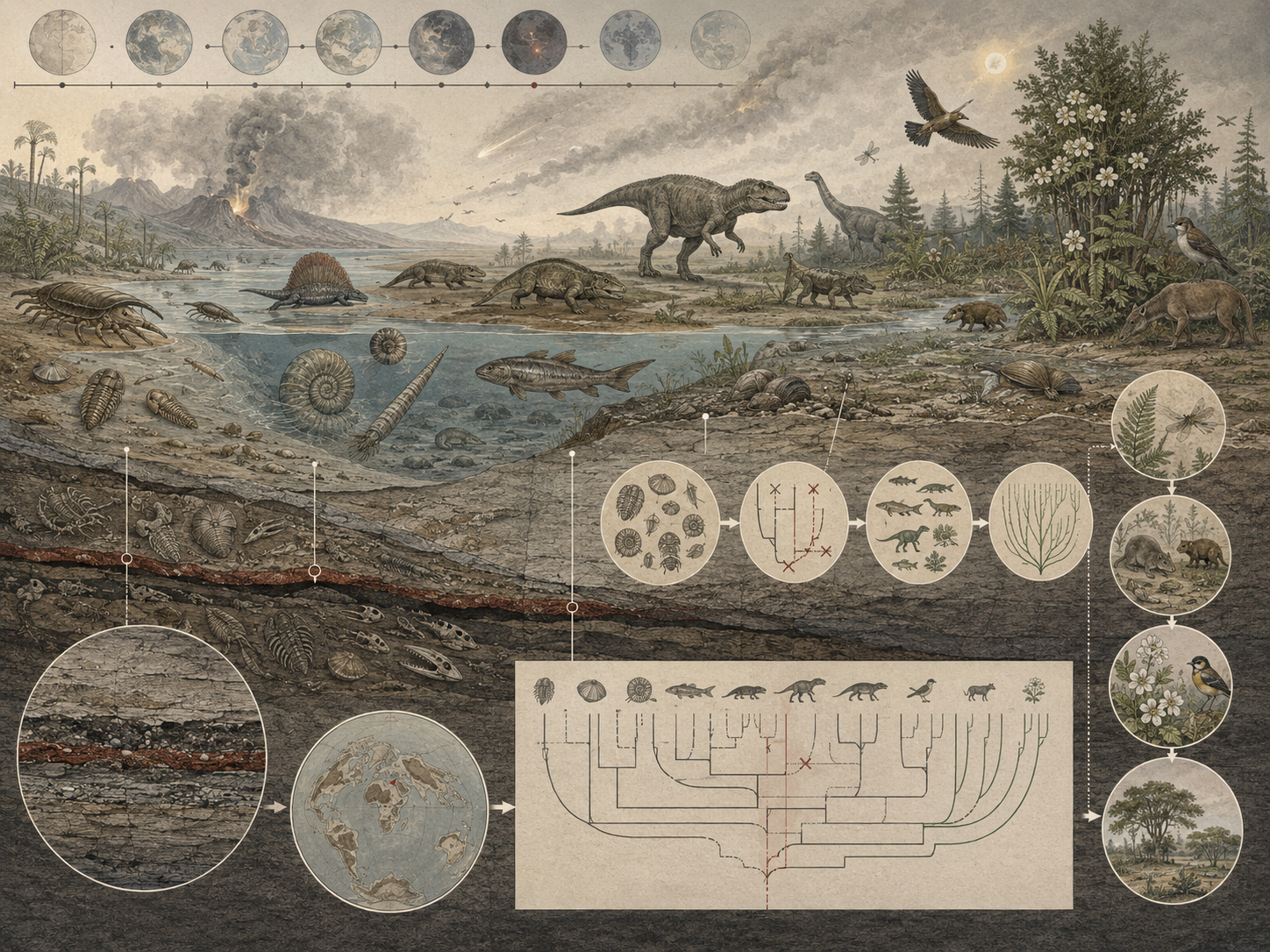
The article develops extinction, contingency, and biological transformation across lineage loss, survivorship, extinction selectivity, mass extinction, background extinction, crisis ecology, post-crisis recovery, fossil evidence, deep-time transformation, adaptive radiation, phylogenetic pruning, functional loss, conservation risk, restoration limits, disease ecology, ecosystem restructuring, and future evolutionary possibility.
The article also extends extinction biology into quantitative and computational analysis through survivorship proportions, extinction proportions, hazard models, stochastic survivorship, logistic recovery, trait-dependent risk screening, phylogenetic-loss scoring, clade-level comparison, R workflows, Python workflows, SQL provenance structures, and a linked full-stack GitHub repository containing Python, R, Julia, Fortran, Rust, Go, C, C++, SQL, notebooks, data files, validation notes, and reproducibility documentation.
What extinction, contingency, and biological transformation are
Extinction is the disappearance of a lineage, species, or larger clade from the history of life. It is not an accidental side note to evolution, but one of the fundamental processes through which biological history is shaped. The living world has been built not only by adaptation, reproduction, and diversification, but also by repeated subtraction. Every ecosystem, clade, and body plan now present exists in a world already filtered by innumerable prior losses.
Contingency refers to the dependence of outcomes on prior events, sequence, chance conditions, inherited structures, and historical pathways. In evolutionary terms, contingency means that the future of life is constrained not only by general rules of selection and heredity, but by what happened to arise earlier, what happened to survive, what environments happened to change, and what lineages happened to be exposed to disruption at the wrong moment. Evolution is lawful, but history is path-dependent.
Biological transformation is the larger reorganization that follows from these processes. When lineages disappear, ecological roles shift, trophic pathways reorganize, selective regimes change, developmental possibilities are filtered, and previously marginal groups may expand. The history of life is therefore not only a story of addition and adaptation. It is also a story of removal, interruption, and restructuring. Extinction and contingency together explain why the world after a crisis is not simply poorer, but historically different.
This distinction matters because extinction is often misunderstood as a final absence rather than an active historical force. Once a lineage disappears, the relationships it carried, the functions it performed, the developmental architecture it embodied, and the future evolutionary possibilities it might have opened are also altered. Extinction is therefore not merely the end of something. It changes the field in which future life evolves.
Extinction as a normal and extraordinary biological process
Extinction is normal in the sense that most lineages that have ever existed are no longer present. Over long timescales, disappearance is part of ordinary biological turnover. Species originate, persist for varying durations, then vanish through ecological change, competition, demographic contraction, environmental disruption, reproductive failure, or stochastic collapse. In that sense, extinction is as intrinsic to macroevolution as speciation.
At the same time, extinction can also be extraordinary. The fossil record shows episodes in which extinction rates rose dramatically across many groups within relatively short geological intervals. These events differ from ordinary turnover not only in scale, but in structural consequence. They remove a broad cross-section of ecological and phylogenetic diversity at once, disrupting the frameworks within which later lineages evolve.
Biology is therefore strongest when it understands extinction as operating on a spectrum: from the continual disappearance of individual lineages to crisis episodes that restructure the trajectory of life across the planet. That duality matters because it prevents two opposite mistakes: treating extinction as rare catastrophe alone, or treating catastrophic events as merely larger versions of ordinary loss without qualitative consequences.
Ordinary extinction may prune lineages quietly, while mass extinction may reorganize ecosystems, clade dominance, and evolutionary opportunity at planetary scale. Both matter. Background extinction helps shape long-term turnover, while mass extinction can redirect the future of life by changing which lineages remain available for later diversification. Extinction is therefore both a background rhythm and a crisis mechanism.
Background extinction and mass extinction
Background extinction refers to the lower ongoing rate at which species and lineages disappear through ordinary ecological and evolutionary processes. Mass extinction refers to episodes in which extinction rates become globally elevated and taxonomically widespread. This distinction matters because mass extinctions are not simply “more extinction.” They alter selectivity, ecological structure, biogeographic pattern, and the distribution of future evolutionary opportunity in ways that ordinary turnover often does not.
Under background conditions, extinction may reflect ordinary demographic fragility, restricted range, ecological specialization, competition, environmental fluctuation, or failure to persist under normal ecological pressures. Under mass extinction conditions, lineages may be eliminated by rapidly shifting climate, ocean chemistry, atmospheric composition, impact events, flood basalt volcanism, food-web collapse, or cascading habitat disruption that overwhelm ordinary ecological sorting. The selective filters operating under crisis may therefore differ sharply from those that dominate in ordinary times.
This distinction is important for paleobiology, conservation biology, and systems thinking alike. A mass extinction does not only reduce richness. It changes the rules under which survivorship is sorted. That is why mass extinction is historically decisive: it acts not only as loss, but as reset pressure on the structure of living systems.
In background extinction, lineages may disappear one by one while ecosystem architecture remains broadly recognizable. In mass extinction, the architecture itself may be compromised. Food webs simplify, dominant groups collapse, ecological incumbents vanish, and long-standing evolutionary trajectories may be truncated. Mass extinction is therefore not merely accelerated death. It is biological reconfiguration under crisis.
Contingency and the historical logic of evolution
Contingency is central to evolutionary thinking because history matters. Which lineages are present at a given time, which traits have already evolved, which ecological roles are occupied, which environments are disrupted, and which survivors remain after crisis all shape subsequent outcomes. The same broad mechanisms of mutation, heredity, selection, drift, and ecological interaction may operate repeatedly, but the path taken depends on prior conditions and irreversible sequence.
This means evolution is not fully predictable from general rules alone. Extinction can remove dominant groups and leave openings for others. A lineage’s survival may depend on geography, developmental flexibility, dormancy capacity, trophic position, dispersal, body size, environmental buffering, or simply differential exposure to catastrophe. Contingency does not mean anything can happen. It means what can happen next depends strongly on what has already happened and what has already been lost.
Contingency therefore gives biology a stronger historical realism. The living world is not only what had to happen. It is also what happened to survive. This insight matters not only for deep time, but for contemporary biodiversity loss, restoration, and climate risk, because future ecological worlds will be constrained by the specific lineages, interactions, and traits that remain available after present disruptions.
This is why contingency should not be treated as a denial of scientific explanation. It is an object of explanation. Biology can ask which traits increased survivorship, which environmental exposures amplified vulnerability, which geographic distributions buffered lineages, and which ecological roles became available after loss. Contingency makes evolutionary history more complex, but not less scientific.
Survival, selection, and the uneven fate of lineages
Extinction does not strike all lineages equally. Some clades are more vulnerable than others depending on ecology, geographic spread, habitat breadth, developmental robustness, trophic position, body size, life history, reproductive mode, dispersal ability, and physiological tolerance. Yet the key point is that the sorting is often historically uneven. Crisis selectivity may favor traits that were previously marginal, while eliminating clades that were once ecologically dominant.
This matters because contingency and selection interact. Some lineages survive because they are genuinely more robust under the new conditions. Others may survive because they occupy refugia, happen to be buffered by life history, or possess traits that become advantageous only after disruption. Survival is therefore biologically structured but not fully deterministic. It is neither pure luck nor pure adaptive inevitability.
The uneven fate of lineages is one of the main reasons extinction becomes transformational. It does not erase the tree of life uniformly. It prunes it selectively and historically. That pruning changes not only diversity counts, but the developmental, ecological, and functional composition of the future biosphere.
This is especially important when interpreting survivorship after crisis. A surviving lineage is not automatically “superior” in a general sense. It may have survived because its range overlapped with refugia, because its life cycle buffered disturbance, because it required fewer resources, because it was small-bodied, because it reproduced quickly, because it was ecologically flexible, or because it happened to avoid the worst effects of crisis. Survivorship is evidence, but it must be interpreted historically.
Extinction as an agent of biological transformation
Extinction transforms biology because removal changes relation as much as presence does. When dominant competitors, predators, herbivores, habitat-forming lineages, or key primary producers disappear, ecological structure is reorganized. Surviving groups encounter altered trophic webs, new opportunities, different selective pressures, and different constraints. A post-extinction world is not simply the pre-extinction world minus some species. It is a different ecological arena.
This is why extinction should not be viewed only as negative subtraction. It is unquestionably loss, but in evolutionary history it is also a source of reorganization. Major extinction events have repeatedly restructured clade fortunes, ecosystem architecture, and the accessibility of evolutionary pathways. Some lineages expand because competitors are gone. Some body plans become newly viable because previous incumbents have disappeared. Some ecological roles vanish for long intervals or are never reconstructed in the same form.
Biological transformation therefore often emerges through asymmetry: some lineages vanish, others persist, and the world that follows is no longer the same field of constraint and possibility. This is one reason extinction belongs not only to paleontology, but to evolutionary developmental biology, ecology, conservation, and systems analysis.
The transformational role of extinction should not be romanticized. Extinction is loss, and many losses are irreversible. But in deep time, the removal of lineages has repeatedly changed the future trajectory of life. That makes extinction one of the clearest examples of how absence can become causal in biology: what is gone shapes what remains and what can come next.
Mass extinction, recovery, and post-crisis radiation
Recovery after extinction is not simply a return to a previous state. Post-crisis worlds often differ fundamentally from what came before. Surviving lineages may radiate into newly open ecological roles, while some lost structures of ecosystem organization never return in the same form. Recovery is therefore part of transformation rather than its negation.
This matters because post-extinction diversification is historically structured. Which clades survive, which traits remain available, how ecosystems are simplified, and what environmental conditions persist after the event all shape the pattern of subsequent radiation. A mass extinction is thus not only a moment of loss but a filter on future innovation. Some clades become ecologically central only because previously dominant groups were removed. Others fail to expand because key interactions or environmental conditions no longer support them.
Recovery also takes time, often across multiple ecological and evolutionary scales. Population rebound, ecosystem restructuring, trophic rebuilding, geographic expansion, and clade diversification do not proceed at identical rates. That mismatch is important for both paleobiology and modern conservation, because it shows that survival of remnants does not by itself imply restoration of prior function.
A post-crisis radiation can therefore be biologically creative and historically constrained at the same time. It may generate new richness, but from a narrowed survivor pool. It may rebuild ecosystems, but not the same ecosystems. It may open evolutionary opportunities, but only for lineages that remain. Recovery is not reversal. It is a new historical trajectory after irreversible filtering.
Fossils, deep time, and the evidence of loss
Deep time makes extinction visible because fossils preserve traces of vanished worlds. Stratigraphic disappearance, turnover in assemblages, abrupt truncation of clades, changing body plans, altered abundance distributions, and post-crisis faunal replacement all provide empirical evidence of extinction and recovery. Fossils matter not because they offer perfect snapshots of the past, but because they make disappearance visible across scales too large for direct observation.
This matters because extinction is not merely inferred from missing living forms. It is documented through preserved pattern: disappearance across intervals, changes in taxonomic composition, altered morphology, spatial range shifts, and ecological reorganization in the geological record. Paleobiology therefore turns absence into evidence by reading patterned disappearance against preserved context.
Fossils also give contingency its empirical depth. They show that many once-prominent clades are gone, that ecosystems have been repeatedly remade, and that modern life is nested within a long sequence of prior losses. Without fossils, contingency would remain a philosophical possibility. With fossils, it becomes a documented feature of biological history.
The fossil record is incomplete, but incompleteness does not make it useless. Preservation bias, sampling unevenness, and stratigraphic uncertainty must be handled carefully, but large-scale patterns of origination, extinction, turnover, and recovery remain scientifically interpretable when analyzed with appropriate methods. Fossils are not a perfect archive. They are a structured archive, and the structure itself can be studied.
Extinction, contingency, and biological form
Extinction shapes not only lineage counts but also the history of biological form. Body plans, functional systems, developmental strategies, and ecological architectures can disappear entirely or become marginal. Surviving forms may then proliferate, diversify, or persist under altered selective landscapes. This is one reason extinction belongs not only to paleontology, but also to macroevolution, developmental biology, and comparative morphology.
Contingency matters here because many forms that later seem inevitable were historically dependent on prior survivorship. If certain clades had not survived earlier crises, later radiations might have been radically different. If certain developmental architectures had been lost, later organismal complexity might have taken other routes or not emerged at all. Biological form is therefore historically conditioned by what no longer remains to compete, constrain, or continue.
This gives extinction an unexpectedly creative role in the history of form. It does not produce novelty directly in the same sense as mutation or developmental innovation, but it alters the field in which novelty is retained, amplified, or suppressed. The future morphology of life depends partly on what past crises removed.
This also means that present biological form should not be interpreted as the inevitable endpoint of progress. It is the survivor-biased outcome of branching, innovation, constraint, and repeated loss. Many viable forms disappeared. Many possible trajectories were closed. Evolutionary biology becomes more historically honest when it treats form as shaped by absence as well as presence.
Ecology, conservation, and systems risk
Extinction is directly relevant to ecology and conservation because biodiversity loss alters ecosystem structure, trophic interaction, resilience, and future evolutionary possibility. Extinction is not only a matter of species counts. It is also a matter of lineage loss, functional simplification, and the erosion of relational and historical possibility. When pollinators, predators, reef builders, habitat engineers, decomposers, or dominant plants disappear, the consequences propagate through food webs, nutrient cycles, disease dynamics, and physical habitat structure.
This matters because conservation failure is often cumulative and path-dependent. Once a lineage is gone, restoration cannot fully reconstruct its evolutionary history, its ecological relationships, or the branching possibilities it carried. Even before total disappearance, functional loss and demographic collapse may alter the future trajectory of ecosystems in ways that are difficult to reverse. Conservation biology therefore needs not only abundance metrics, but historical and functional reasoning about irreplaceability.
For systems thinking, extinction is one of the clearest demonstrations that loss reorganizes future possibility. A present extinction event is not merely a local subtraction. It is a change in what later systems can become. This makes extinction central to sustainability-adjacent biology in the deepest sense: it concerns not only the present integrity of ecosystems, but the survival of future ecological and evolutionary options.
This is why extinction risk should be interpreted across multiple dimensions: taxonomic loss, functional loss, phylogenetic loss, local population collapse, ecosystem simplification, and loss of adaptive potential. A species can persist globally while disappearing from key ecosystems. A lineage can remain taxonomically present while functionally collapsing. A community can retain some species while losing the interactions that made it resilient. Extinction biology gives conservation a deeper historical and systems-level vocabulary for loss.
Marine, freshwater, soil, plant, and microbial relevance
Marine systems are especially important in extinction studies because much of the fossil record and many major extinction signatures are preserved in marine deposits. Ancient marine ecosystems provide unusually rich evidence of turnover, crisis, and reassembly. Reef systems, planktonic communities, marine invertebrates, and marine vertebrates all show how extinction can alter food webs, carbonate systems, ecological dominance, and future diversification. Modern marine systems also face warming, acidification, deoxygenation, overfishing, disease, and habitat disruption that can reorganize ecological structure long before total species disappearance.
Freshwater systems experience lineage loss through basin isolation, pollution, eutrophication, hydrologic fragmentation, invasive disruption, damming, disease, and climate stress. Freshwater organisms are often highly localized, which makes restricted ranges and fragmented dispersal especially important for extinction risk. The disappearance of freshwater mussels, fishes, amphibians, aquatic plants, and microbial or invertebrate communities can alter filtration, nutrient cycling, food webs, and water quality.
Terrestrial plant systems can be transformed by the loss of habitat-forming lineages, changes in fire regime, disease pressure, pollinator collapse, drought stress, invasive species, and trophic restructuring. Forests, grasslands, wetlands, and agroecosystems may retain visible vegetation while losing evolutionary depth, functional redundancy, seed dispersal relationships, or locally adapted lineages. Soil systems may undergo quieter but still profound functional turnover as plant, animal, fungal, and microbial communities reorganize.
Microbial relevance is especially complex. Microbial lineages can disappear locally, shift rapidly, exchange genes, or lose functional roles even when taxonomic boundaries are difficult to define. Extinction in microbial systems may be better understood through functional loss, genomic loss, ecological replacement, or collapse of specific metabolic guilds. Across marine, freshwater, soil, plant, animal, fungal, and microbial systems, extinction and contingency apply as both taxonomic disappearance and systems transformation.
Medical, biomedical, and disease ecology relevance
Extinction and contingency matter in biomedicine and disease ecology because lineages of pathogens, hosts, vectors, symbionts, and model organisms are shaped by survival, loss, and historical branching. Disease systems do not exist outside macroevolutionary history. Host shifts, pathogen disappearance, lineage diversification, ecological filtering, immune-system history, and community restructuring all affect what diseases persist, under what conditions, and in which communities.
This matters because biomedical comparison often depends on historical survivorship. Which lineages retain particular immune systems, physiological pathways, developmental architectures, or host susceptibilities are all contingent outcomes of prior evolution. Even the model organisms available for scientific inference are the products of earlier branching and extinction. Extinction therefore indirectly shapes modern biological knowledge itself by determining which lineages remain available for comparison and experimentation.
Disease ecology makes this especially visible because present transmission systems are products of earlier survival, branching, range shifts, environmental disruption, and host-community restructuring. A disease landscape is always partly an extinction landscape viewed from the present.
Contemporary biodiversity loss can also influence disease risk. Changes in host diversity, predator loss, vector habitat, community composition, and ecosystem disturbance can alter transmission pathways. Extinction biology therefore matters not only for paleontology and conservation, but also for public health, veterinary science, zoonotic disease, environmental health, and ecological medicine. The loss of lineages can change the biological context in which disease emerges.
Phylogenomics, paleobiology, and computational relevance
Modern extinction research increasingly combines fossils, stratigraphic analysis, phylogenetics, diversification modeling, and genomics. Paleobiology provides the long record of disappearance and recovery. Phylogenomics helps infer branching history, survivorship bias, and diversification patterns among living lineages. Computational approaches allow researchers to compare clade loss, estimate survivorship distributions, examine diversification before and after crises, and test alternative hypotheses about extinction selectivity.
This matters because extinction is historical but not beyond quantification. Statistical paleobiology, birth-death models, survivorship analysis, phylogenetic reconstruction, hazard estimation, and simulation all allow researchers to evaluate whether crises altered selectivity, increased cosmopolitanism, shifted ecological disparity, pruned phylogenetic diversity, or changed the balance between extinction and origination. Yet the field remains interpretively demanding because the record is incomplete, preservation is uneven, and causation is often multiscalar.
Extinction studies have therefore become increasingly quantitative without ceasing to be historical. For computational readers, they offer analytically rich problems in sampling bias, incomplete observation, branching-process inference, hazard estimation, phylogenetic loss, and post-crisis recovery modeling. For evolutionary biologists, they provide one of the strongest points of contact between deep-time evidence and general theory.
Reproducibility is especially important. Extinction analysis depends on taxonomic decisions, fossil occurrence data, stratigraphic intervals, sampling corrections, phylogenetic assumptions, range-through logic, environmental proxies, and model choices. A strong computational extinction workflow therefore documents not only code and output, but also provenance, uncertainty, and the interpretive limits of the data.
Quantitative extinction biology: mathematics, R, and Python
Extinction and survivorship can be approached quantitatively, even if no simple formula captures all of evolutionary history. The aim of modeling is not to force deep time into overly tidy mathematics, but to clarify rates, proportions, selectivity, survivorship distributions, phylogenetic loss, and post-crisis transformation in ways that support real scientific reasoning.
Survivorship and extinction proportion
A simple survivorship proportion can be written as:
S=\frac{N_{\mathrm{survivors}}}{N_{\mathrm{initial}}}
\]
Interpretation: Survivorship is the proportion of initial lineages that remain after an interval or crisis. \(N_{\mathrm{initial}}\) is the number of lineages present before an interval, and \(N_{\mathrm{survivors}}\) is the number remaining after it.
A corresponding extinction proportion is:
E=1-S
\]
Interpretation: Extinction proportion is the complement of survivorship. This relation turns lineage loss into a directly interpretable quantity and allows clades or intervals to be compared under a common frame.
Hazard and survivorship through time
Where an effective extinction hazard can be approximated, survivorship through time can be expressed as:
S(t)=e^{-\lambda t}
\]
Interpretation: Survivorship declines exponentially under a constant effective extinction hazard. \(\lambda\) is the effective extinction hazard and \(t\) is time. In real paleobiological systems, \(\lambda\) may vary through time, across lineages, and across environmental states, but the form is useful as a conceptual baseline.
Post-crisis recovery
A simple post-crisis diversification or recovery form can be written as:
\frac{dN}{dt}=rN\left(1-\frac{N}{K}\right)
\]
Interpretation: Logistic recovery represents richness rebuilding from a low value toward an effective ecological ceiling. \(N\) represents surviving or rediversifying lineages, \(r\) is post-crisis growth rate, and \(K\) is an effective ceiling imposed by ecological structure, available niche space, or other limits.
Extinction-risk screening
A transparent extinction-risk screening index can be written as:
R_i=w_1(1-G_i)+w_2(1-T_i)+w_3H_i
\]
Interpretation: A simple risk index can combine restricted range, low ecological flexibility, and high habitat dependence. \(G_i\) is scaled geographic range breadth, \(T_i\) is scaled trophic or ecological flexibility, \(H_i\) is habitat dependence or exposure, and \(w_1\), \(w_2\), and \(w_3\) are weights.
Phylogenetic loss
A simple phylogenetic loss fraction can be written as:
P_{\mathrm{loss}}=\frac{B_{\mathrm{lost}}}{B_{\mathrm{total}}}
\]
Interpretation: Phylogenetic loss can be approximated as the share of total branch length removed by extinction. \(B_{\mathrm{lost}}\) is lost branch length and \(B_{\mathrm{total}}\) is total branch length in the simplified tree or lineage set.
Variables, units, and extinction interpretation
Quantitative extinction biology depends on variables that connect survivorship, extinction, hazard, recovery, vulnerability, phylogenetic loss, and biological interpretation. The table below summarizes several central quantities.
| Symbol or term | Meaning | Typical unit or scale | Extinction interpretation |
|---|---|---|---|
| \(N_{\mathrm{initial}}\) | Initial lineage count | Number of lineages, species, genera, or clades | Richness before an interval or crisis |
| \(N_{\mathrm{survivors}}\) | Surviving lineage count | Number of lineages, species, genera, or clades | Lineages remaining after an interval or crisis |
| \(S\) | Survivorship proportion | Fraction from 0 to 1 | Share of lineages that persisted |
| \(E\) | Extinction proportion | Fraction from 0 to 1 | Share of lineages lost |
| \(S(t)\) | Survivorship through time | Fraction from 0 to 1 | Expected persistence under a hazard model |
| \(\lambda\) | Effective extinction hazard | Per time unit | Rate parameter controlling expected survivorship decline |
| \(t\) | Time | Years, thousands of years, millions of years, or interval units | Temporal scale over which survivorship or recovery is evaluated |
| \(N\) | Lineage richness during recovery | Number of lineages or richness proxy | Surviving or rediversifying richness after crisis |
| \(r\) | Recovery or growth rate | Per time unit | Rate at which richness rebuilds under a simplified recovery model |
| \(K\) | Effective ecological ceiling | Lineage richness or carrying-capacity-like proxy | Constraint imposed by ecological structure, niche space, or environmental limits |
| \(R_i\) | Risk index for lineage \(i\) | Dimensionless score | Comparative screening score for vulnerability |
| \(G_i\) | Geographic range breadth | Scaled 0 to 1 | Restricted range often increases vulnerability |
| \(T_i\) | Trophic or ecological flexibility | Scaled 0 to 1 | Low flexibility can raise extinction risk under disruption |
| \(H_i\) | Habitat dependence or exposure | Scaled 0 to 1 | High dependence can increase risk when habitats collapse |
| \(w_1,w_2,w_3\) | Risk-index weights | Dimensionless weights | Relative importance assigned to risk components |
| \(B_{\mathrm{lost}}\) | Lost branch length | Branch length, time, or phylogenetic distance units | Evolutionary history removed by extinction |
| \(B_{\mathrm{total}}\) | Total branch length | Branch length, time, or phylogenetic distance units | Total evolutionary history represented in the simplified tree or lineage set |
| \(P_{\mathrm{loss}}\) | Phylogenetic loss fraction | Fraction from 0 to 1 | Share of evolutionary history removed under a branch-length approximation |
The table shows why extinction quantities require context. A survivorship proportion, hazard estimate, recovery rate, or phylogenetic-loss fraction becomes biologically meaningful only when linked to clade definition, fossil sampling, time interval, ecological function, phylogenetic structure, conservation status, and model assumptions.
Worked example: survivorship, extinction, hazard, and recovery
Suppose a clade contains \(N_{\mathrm{initial}}=120\) lineages before a crisis and \(N_{\mathrm{survivors}}=30\) afterward. Survivorship is:
S=\frac{30}{120}=0.25
\]
Interpretation: Twenty-five percent of lineages survived the crisis.
The extinction proportion is:
E=1-0.25=0.75
\]
Interpretation: Seventy-five percent of lineages were lost. This simple calculation does not explain why extinction occurred, but it clarifies the scale of transformation.
Now suppose an effective extinction hazard is approximated as \(\lambda=0.18\) per interval and the interval length is \(t=5\). Expected survivorship under the simple exponential model is:
S(t)=e^{-0.18(5)}=e^{-0.9}\approx0.407
\]
Interpretation: Under this simplified hazard model, about 40.7 percent of lineages would be expected to persist. This helps distinguish crisis regimes with different expected persistence even when starting richness is similar.
For post-crisis recovery, suppose initial recovering richness is \(N_0=5\), recovery rate is \(r=0.14\), effective ceiling is \(K=60\), and \(t=30\). The logistic recovery solution gives:
N(t)=\frac{K}{1+\left(\frac{K-N_0}{N_0}\right)e^{-rt}}
\]
Interpretation: Logistic recovery begins slowly when richness is low, then accelerates, then slows near the effective ceiling.
Substituting values:
N(30)=\frac{60}{1+\left(\frac{60-5}{5}\right)e^{-0.14(30)}}\approx51.6
\]
Interpretation: Under this simplified recovery model, richness approaches but does not instantly reach the effective ceiling. This matters because survival of a remnant does not equal immediate ecological or evolutionary recovery.
For phylogenetic loss, suppose total branch length is \(B_{\mathrm{total}}=60\) and lost branch length is \(B_{\mathrm{lost}}=43\). Then:
P_{\mathrm{loss}}=\frac{43}{60}\approx0.717
\]
Interpretation: Approximately 71.7 percent of represented branch length has been lost. This helps show why extinction is not only a count of species. It can also remove disproportionate evolutionary history.
R and Python workflows
Computational modeling helps make extinction, contingency, and transformation explicit because extinction problems involve counts, rates, hazards, uncertainty, survivorship, phylogenetic structure, and recovery trajectories. Survivorship models compare persistence across clades. Hazard models represent loss under different crisis regimes. Stochastic simulations show uncertainty around survivor counts. Recovery curves represent post-crisis rebuilding under constraint. Trait-dependent screening structures vulnerability analysis. Phylogenetic-loss calculations show how extinction can remove deep evolutionary history rather than merely reduce richness.
The selected examples below focus on compact, reusable workflows: survivorship and extinction proportions, hazard and recovery screening, trait-dependent risk screening, stochastic survivorship under crisis, post-crisis recovery trajectories, phylogenetic-loss scoring, and applied extinction condition scoring. The GitHub repository extends the same logic into richer workflows for SQL provenance, reproducible data files, validation notes, notebooks, and multi-language scientific-computing examples.
The purpose is not to reduce extinction history to code. The purpose is to make extinction reasoning inspectable. A claim about extinction, contingency, or biological transformation becomes stronger when lineage counts, clade definitions, time intervals, trait assumptions, phylogenetic data, fossil sampling, uncertainty, and analytical code are documented together.
R workflow: survivorship, hazard, recovery, and trait-dependent risk
# Extinction, Contingency, and Biological Transformation Workflow
#
# This workflow demonstrates four quantitative extinction tasks:
#
#   1. Compare survivorship and extinction proportions across clades.
#   2. Evaluate survivorship under different hazard scenarios.
#   3. Model simplified post-crisis logistic recovery.
#   4. Screen trait-dependent vulnerability using transparent assumptions.
#
# These examples can be adapted for paleobiology, conservation biology,
# biodiversity science, restoration ecology, marine and freshwater systems,
# disease ecology, phylogenetic conservation, and computational biology.

library(dplyr)
library(tidyr)
library(purrr)
library(tibble)

# ------------------------------------------------------------
# 1. Survivorship and extinction proportions across clades
# ------------------------------------------------------------

clades <- tibble(
  clade = c("clade_A", "clade_B", "clade_C", "clade_D"),
  initial = c(120, 80, 50, 200),
  survivors = c(30, 40, 10, 110)
) %>%
  mutate(
    survivorship = survivors / initial,
    extinction = 1 - survivorship,
    loss_count = initial - survivors
  ) %>%
  arrange(desc(extinction))

# ------------------------------------------------------------
# 2. Survivorship under different extinction hazards
# ------------------------------------------------------------

time <- seq(0, 10, by = 0.1)

hazards <- tibble(
  scenario = c("background", "elevated_crisis", "severe_crisis"),
  lambda = c(0.05, 0.18, 0.35)
)

survival_results <- hazards %>%
  mutate(
    sim = map2(
      scenario,
      lambda,
      ~ tibble(
        scenario = .x,
        time = time,
        survivorship = exp(-.y * time)
      )
    )
  ) %>%
  select(scenario, sim) %>%
  unnest(sim)

survival_summary <- survival_results %>%
  group_by(scenario) %>%
  summarise(
    survivorship_end = survivorship[time == max(time)],
    .groups = "drop"
  )

# ------------------------------------------------------------
# 3. Simple post-crisis logistic recovery
# ------------------------------------------------------------

recovery_time <- seq(0, 30, by = 0.5)

recovery_scenarios <- tibble(
  scenario = c("slow_recovery", "moderate_recovery", "rapid_recovery"),
  N0 = c(5, 5, 5),
  r = c(0.08, 0.14, 0.22),
  K = c(40, 60, 80)
)

recovery <- recovery_scenarios %>%
  mutate(
    sim = pmap(
      list(scenario, N0, r, K),
      function(scenario, N0, r, K) {
        tibble(
          scenario = scenario,
          time = recovery_time,
          richness = K / (1 + ((K - N0) / N0) * exp(-r * recovery_time))
        )
      }
    )
  ) %>%
  select(scenario, sim) %>%
  unnest(sim)

recovery_summary <- recovery %>%
  group_by(scenario) %>%
  summarise(
    final_richness = richness[time == max(time)],
    .groups = "drop"
  )

# ------------------------------------------------------------
# 4. Trait-dependent extinction screening
# ------------------------------------------------------------

taxa <- tibble(
  taxon = c("taxon_1", "taxon_2", "taxon_3", "taxon_4", "taxon_5"),
  range_size = c(0.9, 0.3, 0.2, 0.7, 0.45),
  trophic_flexibility = c(0.8, 0.2, 0.4, 0.7, 0.35),
  habitat_dependence = c(0.2, 0.8, 0.9, 0.3, 0.72),
  phylogenetic_distinctiveness = c(0.35, 0.60, 0.85, 0.40, 0.78)
) %>%
  mutate(
    ecological_risk_index =
      0.4 * (1 - range_size) +
      0.3 * (1 - trophic_flexibility) +
      0.3 * habitat_dependence,
    conservation_priority_index =
      0.60 * ecological_risk_index +
      0.40 * phylogenetic_distinctiveness,
    risk_class = case_when(
      ecological_risk_index >= 0.70 ~ "high",
      ecological_risk_index >= 0.45 ~ "moderate",
      TRUE ~ "lower"
    )
  ) %>%
  arrange(desc(conservation_priority_index))

# ------------------------------------------------------------
# Print compact outputs
# ------------------------------------------------------------

print(clades %>% mutate(across(where(is.numeric), round, 4)))
print(survival_summary %>% mutate(across(where(is.numeric), round, 4)))
print(recovery_summary %>% mutate(across(where(is.numeric), round, 4)))
print(taxa %>% mutate(across(where(is.numeric), round, 4)))
This R workflow is useful because it separates several biologically different questions: how much was lost, how survivorship changes under different hazards, how recovery proceeds under constraint, and why some lineages may be more vulnerable than others under the same broad crisis regime.
Python workflow: stochastic survivorship, recovery, and phylogenetic loss
"""
Extinction, Contingency, and Biological Transformation Workflow

This workflow demonstrates five quantitative extinction tasks:

1. Compare clade-level survivorship and extinction proportions.
2. Simulate stochastic survivorship under crisis.
3. Compare post-crisis recovery trajectories.
4. Estimate phylogenetic loss from branch-length data.
5. Build an applied extinction-condition screening table.

The examples are compact, but the same structures can be extended to
paleobiology, conservation biology, restoration ecology, biodiversity science,
marine and freshwater systems, disease ecology, and computational biology.
"""

from __future__ import annotations

import numpy as np
import pandas as pd


def clade_loss_comparison() -> pd.DataFrame:
    """
    Compare survivorship and extinction across clades.
    """
    clades = {
        "clade_A": {"initial": 120, "survivors": 30},
        "clade_B": {"initial": 80, "survivors": 40},
        "clade_C": {"initial": 50, "survivors": 10},
        "clade_D": {"initial": 200, "survivors": 110},
    }

    rows = []

    for name, values in clades.items():
        survivorship = values["survivors"] / values["initial"]
        extinction = 1.0 - survivorship

        rows.append(
            {
                "clade": name,
                "initial": values["initial"],
                "survivors": values["survivors"],
                "loss_count": values["initial"] - values["survivors"],
                "survivorship": survivorship,
                "extinction": extinction,
            }
        )

    return pd.DataFrame(rows).sort_values("extinction", ascending=False)


def simulate_survival(
    initial: int = 120,
    survive_prob: float = 0.25,
    n_iter: int = 1000,
    seed: int = 42,
) -> tuple[pd.DataFrame, pd.DataFrame]:
    """
    Simulate stochastic lineage survival under crisis.
    """
    rng = np.random.default_rng(seed)

    survivors = rng.binomial(initial, survive_prob, size=n_iter)

    df = pd.DataFrame(
        {
            "survivors": survivors,
            "survivorship": survivors / initial,
            "extinction": 1.0 - (survivors / initial),
        }
    )

    summary = pd.DataFrame(
        {
            "mean_survivors": [df["survivors"].mean()],
            "median_survivors": [df["survivors"].median()],
            "p05_survivors": [np.percentile(df["survivors"], 5)],
            "p95_survivors": [np.percentile(df["survivors"], 95)],
            "mean_extinction": [df["extinction"].mean()],
        }
    )

    return df, summary


def recovery_curve(
    time: int = 30,
    N0: float = 5.0,
    r: float = 0.14,
    K: float = 60.0,
) -> pd.DataFrame:
    """
    Return a simple post-crisis logistic recovery trajectory.
    """
    t = np.arange(0, time + 1)

    richness = K / (1.0 + ((K - N0) / N0) * np.exp(-r * t))

    return pd.DataFrame(
        {
            "time": t,
            "richness": richness,
        }
    )


def compare_recovery_scenarios() -> tuple[pd.DataFrame, pd.DataFrame]:
    """
    Compare post-crisis recovery trajectories across scenarios.
    """
    scenarios = {
        "slow_recovery": {"N0": 5, "r": 0.08, "K": 40},
        "moderate_recovery": {"N0": 5, "r": 0.14, "K": 60},
        "rapid_recovery": {"N0": 5, "r": 0.22, "K": 80},
    }

    runs = []

    for name, params in scenarios.items():
        result = recovery_curve(**params)
        result["scenario"] = name
        runs.append(result)

    results = pd.concat(runs, ignore_index=True)

    summary = (
        results.groupby("scenario")
        .agg(final_richness=("richness", "last"))
        .reset_index()
    )

    return results, summary


def phylogenetic_loss_screen() -> pd.DataFrame:
    """
    Estimate branch-length loss from a simplified lineage table.
    """
    lineages = pd.DataFrame(
        [
            {"lineage": "A", "branch_length": 12.0, "status": "survived"},
            {"lineage": "B", "branch_length": 8.0, "status": "extinct"},
            {"lineage": "C", "branch_length": 15.0, "status": "extinct"},
            {"lineage": "D", "branch_length": 5.0, "status": "survived"},
            {"lineage": "E", "branch_length": 20.0, "status": "extinct"},
            {"lineage": "F", "branch_length": 6.5, "status": "survived"},
        ]
    )

    total_history = lineages["branch_length"].sum()
    lost_history = lineages.loc[
        lineages["status"] == "extinct",
        "branch_length",
    ].sum()

    retained_history = total_history - lost_history

    summary = pd.DataFrame(
        {
            "total_branch_length": [total_history],
            "lost_branch_length": [lost_history],
            "retained_branch_length": [retained_history],
            "phylogenetic_loss_fraction": [lost_history / total_history],
        }
    )

    return summary


def extinction_condition_score() -> pd.DataFrame:
    """
    Build a compact applied extinction-condition screen.
    """
    systems = pd.DataFrame(
        {
            "system": [
                "reef_builder_loss",
                "freshwater_mussel_decline",
                "relict_forest_lineage",
                "pollinator_network_collapse",
                "microbial_functional_guild_loss",
            ],
            "range_restriction": [0.72, 0.85, 0.78, 0.58, 0.35],
            "functional_irreplaceability": [0.90, 0.82, 0.76, 0.88, 0.70],
            "habitat_exposure": [0.86, 0.74, 0.68, 0.60, 0.55],
            "recovery_difficulty": [0.92, 0.80, 0.86, 0.70, 0.64],
            "phylogenetic_distinctiveness": [0.65, 0.72, 0.91, 0.42, 0.48],
        }
    )

    systems["extinction_system_risk_score"] = (
        0.25 * systems["range_restriction"]
        + 0.25 * systems["functional_irreplaceability"]
        + 0.20 * systems["habitat_exposure"]
        + 0.20 * systems["recovery_difficulty"]
        + 0.10 * systems["phylogenetic_distinctiveness"]
    )

    return systems.sort_values("extinction_system_risk_score", ascending=False)


def main() -> None:
    """
    Run compact extinction-analysis workflows.
    """
    clades = clade_loss_comparison()
    _, survival_summary = simulate_survival()
    _, recovery_summary = compare_recovery_scenarios()
    phylo_loss = phylogenetic_loss_screen()
    condition_score = extinction_condition_score()

    print("Clade-level loss comparison:")
    print(clades.round(4).to_string(index=False))

    print("\nStochastic survivorship summary:")
    print(survival_summary.round(4).to_string(index=False))

    print("\nPost-crisis recovery summary:")
    print(recovery_summary.round(4).to_string(index=False))

    print("\nPhylogenetic loss summary:")
    print(phylo_loss.round(4).to_string(index=False))

    print("\nExtinction condition score:")
    print(condition_score.round(4).to_string(index=False))


if __name__ == "__main__":
    main()
This Python workflow is useful because it treats extinction as both a count problem and a historical-structure problem. It compares proportional loss, adds stochastic uncertainty, models recovery under constraint, estimates phylogenetic loss, and screens extinction risk in systems where function, range, habitat exposure, recovery difficulty, and evolutionary distinctiveness all matter.
These workflows connect deep-time paleobiology to contemporary ecology, biodiversity science, restoration, conservation planning, and environmental health by making survivorship, loss, hazard, recovery, vulnerability, and phylogenetic history inspectable rather than implicit.
GitHub repository
The article body includes compact R and Python examples so the biological and scientific argument remains readable. The full repository expands those examples into a broader computational extinction workflow, including survivorship proportions, extinction proportions, hazard screening, stochastic crisis survivorship, post-crisis recovery, trait-dependent vulnerability, phylogenetic-loss scoring, conservation condition screening, SQL provenance structures, reproducible data files, validation notes, and full-stack scientific-computing examples across Python, R, Julia, Fortran, Rust, Go, C, C++, SQL, and notebooks.
Limits, uncertainty, and modern historical thinking
Extinction, contingency, and transformation are powerful concepts, but they resist oversimplification. Not every extinction is caused by one factor. Not every survivor persists because it was “better” in a simple adaptive sense. Not every post-extinction radiation is predictable in advance. The history of life is shaped by intersecting causal layers: environment, ecology, geography, developmental structure, lineage history, preservation bias, and chance sequence.
This is why modern work in paleobiology and macroevolution increasingly emphasizes structured contingency rather than either pure randomness or strict determinism. Crises can restructure evolutionary history without making later outcomes arbitrary. Similarly, selectivity can be real without being simple. Some lineages survive through trait advantages, some through location and timing, some through buffered ecology, and some through combinations no single-variable model captures well.
Models are useful because they clarify assumptions, expose rates, and make scenario comparison possible. But a survivorship proportion is not a full extinction explanation, a hazard model is not the fossil record, and a recovery curve is not a restored ecosystem. Quantitative tools are strongest when they support historical and biological interpretation rather than replacing it.
Modern historical biology is strongest when it treats life’s history as evidence-rich, probabilistic, path-dependent, and deeply shaped by loss as well as persistence. The scientific challenge is not to eliminate contingency from explanation, but to specify the mechanisms through which contingency becomes historically consequential.
This caution is especially important in contemporary conservation. A simplified score can help structure risk, but it cannot replace field data, Indigenous and local ecological knowledge, taxonomic expertise, genomic evidence, demographic monitoring, habitat analysis, and long-term ecological interpretation. Extinction biology is powerful because it makes loss analyzable, but it must remain humble before historical complexity.
Why this matters for scientific work
For working scientists, extinction and contingency matter because many biological questions are misread when history is treated as background rather than mechanism. A clade’s current diversity may reflect survivorship bias rather than intrinsic superiority. A seemingly stable ecosystem may sit on a long legacy of prior pruning and replacement. A conservation problem may not be reducible to present abundance if lineage loss has already removed key functions or future options. A disease landscape may reflect past extinction, host turnover, and biogeographic restructuring as much as present transmission.
This means extinction should often be treated as explanatory infrastructure rather than as the final chapter of evolution. Paleobiologists need it to interpret turnover and recovery. Ecologists need it to understand how present systems were historically assembled. Conservation biologists need it because current biodiversity loss is also future evolutionary loss. Restoration ecologists need it because some disappeared lineages, interactions, and functions cannot be fully rebuilt. Microbiologists need it because community function can be lost even when microbial abundance remains high. Computational biologists need it because extinction problems force serious engagement with incomplete observation, hazard, branching, and path dependence.
The scientific importance of extinction lies partly in this breadth. It is one of the main ways biology explains why the world after disruption is not simply reduced, but reorganized.
Extinction analysis is also practically actionable. Survivorship can be estimated. Loss can be compared across clades. Hazard scenarios can be modeled. Recovery can be screened. Vulnerability can be structured by traits and exposure. Phylogenetic loss can be estimated. Conservation priorities can consider function, lineage distinctiveness, and recovery difficulty alongside abundance. These tools connect deep-time paleobiology to contemporary ecology, biodiversity science, restoration, and environmental health.
Conclusion
Extinction, contingency, and biological transformation show that the history of life is shaped not only by what evolves and persists, but also by what disappears and by the historical sequence through which disappearance occurs. Extinction removes lineages. Contingency means the future depends on what survives, what has already been lost, and what pathways remain open. Biological transformation follows as ecosystems, clades, and evolutionary possibilities are reorganized across deep time.
To understand extinction is therefore to understand one of the deepest historical processes in biology. To understand contingency is to see that evolutionary history is path-dependent rather than mechanically inevitable. Together, these ideas explain why loss is not merely absence, but a force that reorganizes the living world. That is why extinction and contingency remain central not only to paleontology and macroevolution, but also to ecology, conservation, microbiology, plant science, marine and freshwater biology, disease ecology, medicine, and sustainability-adjacent biology more broadly.
Extinction is thus more than the end of lineages. It is one of the principal ways biology explains how the world after a crisis becomes a different world from the one before it. Modern quantitative and computational workflows deepen that understanding by making survivorship, extinction proportion, hazard, recovery, trait-dependent risk, phylogenetic loss, and provenance more transparent, reproducible, and scientifically interpretable.
Related articles
- Biology
- Evolution and the History of Life
- Microevolution, Macroevolution, and Deep Time
- Speciation, Diversity, and the Tree of Life
- Natural Selection, Adaptation, and Fitness
- Mutation, Variation, and the Sources of Novelty
- Biodiversity and the Structure of Living Systems
- Ecology and the Interdependence of Life
- Population Dynamics and Ecological Modeling
- Restoration Ecology and the Repair of Living Systems
- Biogeochemical Cycles and the Conditions of Habitability
- Coevolution, Symbiosis, and the Dynamics of Mutual Change
Further reading
- Benton, M.J. (2015) Vertebrate Palaeontology. 4th edn. Oxford: Wiley Blackwell. Publisher information available at: https://www.wiley.com/en-us/Vertebrate+Palaeontology%2C+4th+Edition-p-9781118406847
- Button, D.J., Lloyd, G.T., Ezcurra, M.D. and Butler, R.J. (2017) ‘Mass extinctions drove increased global faunal cosmopolitanism on the supercontinent Pangaea’, Nature Communications, 8, 733. Available at: https://doi.org/10.1038/s41467-017-00827-7
- Erwin, D.H. (2006) Extinction: How Life on Earth Nearly Ended 250 Million Years Ago. Princeton, NJ: Princeton University Press. Publisher excerpt available at: https://assets.press.princeton.edu/chapters/s10473.pdf
- Foote, M. (2000) ‘Origination and extinction components of taxonomic diversity: general problems’, Paleobiology, 26(sp4), pp. 74–102. Available at: https://doi.org/10.1666/0094-8373(2000)26[74:OAECOT]2.0.CO;2
- Foote, M. and Miller, A.I. (2007) Principles of Paleontology. 3rd edn. New York: W.H. Freeman. Bibliographic information available at: https://search.worldcat.org/title/Principles-of-paleontology/oclc/70292181
- IPBES (2019) Global Assessment Report on Biodiversity and Ecosystem Services. Available at: https://www.ipbes.net/node/35274
- IUCN (2026) The IUCN Red List of Threatened Species. Available at: https://www.iucnredlist.org/
- Jablonski, D. (2001) ‘Lessons from the past: evolutionary impacts of mass extinctions’, Proceedings of the National Academy of Sciences, 98(10), pp. 5393–5398. Available at: https://doi.org/10.1073/pnas.101092598
- Jablonski, D. (2005) ‘Mass extinctions and macroevolution’, Paleobiology, 31(sp5), pp. 192–210. Available at: https://doi.org/10.1666/0094-8373(2005)031[0192:MEAM]2.0.CO;2
- Raup, D.M. (1991) Extinction: Bad Genes or Bad Luck? New York: W.W. Norton. Bibliographic information available at: https://search-library.ucsd.edu/discovery/fulldisplay/alma991004544519706535/01UCS_SDI%3AUCSD
- Sepkoski, J.J. Jr. (1996) ‘Patterns of Phanerozoic extinction: a perspective from global data bases’, in Walliser, O.H. (ed.) Global Events and Event Stratigraphy. Berlin: Springer, pp. 35–51. Publisher information available at: https://link.springer.com/book/10.1007/978-3-642-79634-0
References
- Benton, M.J. (2015) Vertebrate Palaeontology. 4th edn. Oxford: Wiley Blackwell. Publisher information available at: https://www.wiley.com/en-us/Vertebrate+Palaeontology%2C+4th+Edition-p-9781118406847
- Button, D.J., Lloyd, G.T., Ezcurra, M.D. and Butler, R.J. (2017) ‘Mass extinctions drove increased global faunal cosmopolitanism on the supercontinent Pangaea’, Nature Communications, 8, 733. Available at: https://doi.org/10.1038/s41467-017-00827-7
- Erwin, D.H. (2006) Extinction: How Life on Earth Nearly Ended 250 Million Years Ago. Princeton, NJ: Princeton University Press. Publisher excerpt available at: https://assets.press.princeton.edu/chapters/s10473.pdf
- Foote, M. (2000) ‘Origination and extinction components of taxonomic diversity: general problems’, Paleobiology, 26(sp4), pp. 74–102. Available at: https://doi.org/10.1666/0094-8373(2000)26[74:OAECOT]2.0.CO;2
- Foote, M. (2000) ‘Origination and extinction components of taxonomic diversity: Paleozoic and post-Paleozoic dynamics’, Paleobiology, 26(4), pp. 578–605. Available at: https://doi.org/10.1666/0094-8373(2000)026%3C0578:OAECOT%3E2.0.CO;2
- Foote, M. and Miller, A.I. (2007) Principles of Paleontology. 3rd edn. New York: W.H. Freeman. Bibliographic information available at: https://search.worldcat.org/title/Principles-of-paleontology/oclc/70292181
- IPBES (2019) Global Assessment Report on Biodiversity and Ecosystem Services. Available at: https://www.ipbes.net/node/35274
- IUCN (2026) The IUCN Red List of Threatened Species. Available at: https://www.iucnredlist.org/
- Jablonski, D. (2001) ‘Lessons from the past: evolutionary impacts of mass extinctions’, Proceedings of the National Academy of Sciences, 98(10), pp. 5393–5398. Available at: https://doi.org/10.1073/pnas.101092598
- Jablonski, D. (2005) ‘Mass extinctions and macroevolution’, Paleobiology, 31(sp5), pp. 192–210. Available at: https://doi.org/10.1666/0094-8373(2005)031[0192:MEAM]2.0.CO;2
- Raup, D.M. (1991) Extinction: Bad Genes or Bad Luck? New York: W.W. Norton. Bibliographic information available at: https://search-library.ucsd.edu/discovery/fulldisplay/alma991004544519706535/01UCS_SDI%3AUCSD
- Sepkoski, J.J. Jr. (1996) ‘Patterns of Phanerozoic extinction: a perspective from global data bases’, in Walliser, O.H. (ed.) Global Events and Event Stratigraphy. Berlin: Springer, pp. 35–51. Publisher information available at: https://link.springer.com/book/10.1007/978-3-642-79634-0