
Last Updated May 5, 2026
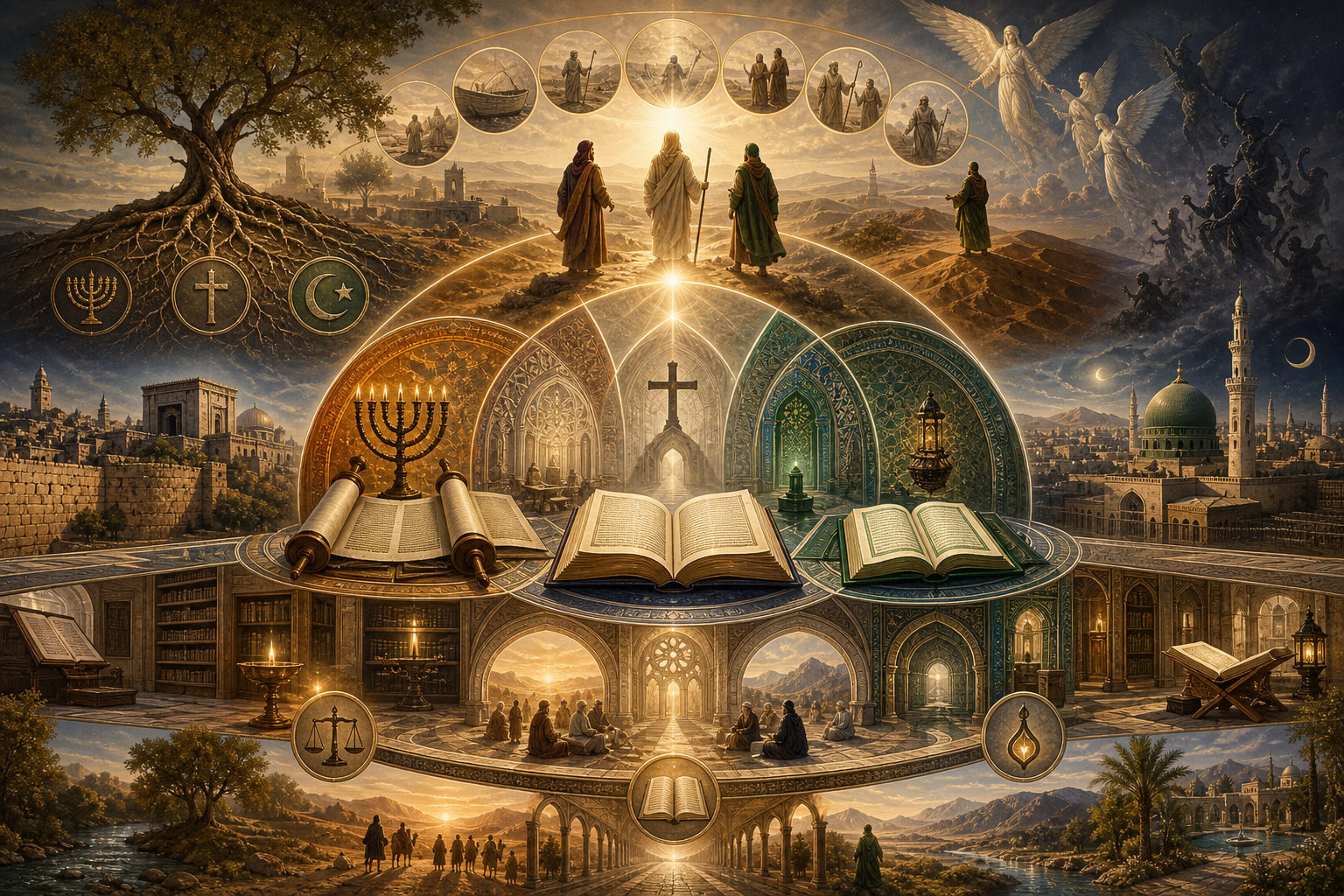
Abrahamic Traditions examines the scriptural, prophetic, theological, legal, ritual, spiritual, philosophical, cosmological, and historical worlds associated with Judaism, Christianity, and Islam through the primary texts, interpretive traditions, and civilizational forms by which these religions have understood God, revelation, covenant, prophecy, law, mercy, worship, judgment, knowledge, unseen beings, heaven, hell, and the destiny of human communities. As a major category within the Religious Studies knowledge series, it studies these traditions first through their own sacred sources, then through their internal traditions of commentary, jurisprudence, doctrine, devotion, biography, and intellectual inquiry, and only after that through modern scholarship.
The term “Abrahamic” is useful because it identifies a family of monotheistic traditions that look to Abraham as a figure of fidelity, obedience, migration, sacrifice, hospitality, divine promise, and sacred ancestry. Yet the category must be used carefully. Judaism, Christianity, and Islam are not interchangeable expressions of one religious form. Each emerged through its own revelation claims, scriptural formations, prophetic structures, liturgical practices, legal developments, theological commitments, angelic and demonic cosmologies, devotional worlds, and communal memories. Their histories include continuity and divergence, proximity and polemic, borrowing and contest, coexistence and conflict.
This pillar therefore proceeds in two directions at once. It considers the shared structures that make Abrahamic comparison meaningful: one God, revelation, prophecy, sacred history, moral accountability, prayer, judgment, angels, demons, unseen powers, resurrection, heaven, hell, and communal order. At the same time, it gives full weight to the internal particularity of each tradition. Judaism cannot be reduced to a prelude, Christianity cannot be reduced to a derivative synthesis, and Islam cannot be reduced to a late variation on earlier monotheism. Each must be encountered through its own texts, prophetic memory, interpretive methods, sacred practices, theological vocabulary, and historical self-understanding.
Primary Text
شَرَعَ لَكُم مِّنَ الدِّينِ مَا وَصَّىٰ بِهِ نُوحًا وَالَّذِي أَوْحَيْنَا إِلَيْكَ وَمَا وَصَّيْنَا بِهِ إِبْرَاهِيمَ وَمُوسَىٰ وَعِيسَىٰ أَنْ أَقِيمُوا الدِّينَ وَلَا تَتَفَرَّقُوا فِيهِHe has laid down for you the religion He enjoined upon Noah, and what We have revealed to you, and what We enjoined upon Abraham, Moses, and Jesus: establish the religion, and do not be divided concerning it.
Qur’an 42:13, Arabic text with English rendering.
This passage gives the pillar its central Abrahamic frame: revelation is one in divine source, historically carried through multiple prophets, and morally directed toward worship, order, and resistance to destructive division.
Particular emphasis is given to Islam as a revelatory, legal, intellectual, spiritual, philosophical, scientific, and civilizational tradition of exceptional scope. The Qur’an, Hadith, sīrah literature, tafsir, jurisprudence, theology, philosophy, medicine, astronomy, optics, mathematics, angelology, jinn traditions, eschatology, and Sufism are treated not as peripheral additions to an Abrahamic framework inherited from elsewhere, but as central to understanding how monotheistic revelation becomes lived order, sacred law, disciplined inquiry, spiritual refinement, beauty, memory, and world-forming civilization.
This pillar also gives special attention to Abrahamic continuity. The Arabic word Allah should not be treated as the name of a narrowly Muslim deity, but as the Arabic word for God used by Arabic-speaking Muslims, Christians, and Jews. That linguistic and theological fact matters for the whole series. It helps resist misleading “Islam versus the Judeo-Christian God” framing and instead foregrounds the shared Semitic and Abrahamic field in which Jews, Christians, and Muslims speak of the one God, even while differing over revelation, covenant, Christology, law, scripture, prophecy, religious authority, and the meaning of final judgment.
The interpretive orientation of this pillar is Qur’an-centered and Abrahamic-continuity focused, with special attention to Maulana Muhammad Ali, Lahore Ahmadiyya sources, Martin Lings, Karen Armstrong, and primary sacred texts. At the same time, the series incorporates Sunni, Shia, Jewish, Christian, and academic perspectives in a comparative and respectful way. The goal is not to erase difference, but to deepen the study of revelation, prophecy, sacred law, mercy, knowledge, angels, jinn, demons, the afterlife, and religious community through historically sensitive, textually grounded, and ethically serious comparison.
In this respect, Abrahamic Traditions links naturally to Foundations of Religion, while also extending outward to Religion and Law, Mysticism and Contemplative Traditions, Religion and Society, Comparative Sacred Themes, Philosophy, Natural Science, and Global Governance. The goal is not to force harmony where real difference exists, but to understand how these traditions have shaped some of the deepest human reflections on God, law, mercy, suffering, redemption, memory, prophecy, knowledge, sacred community, unseen agency, and the final destiny of the human soul.
Why Abrahamic Traditions Matter
Judaism, Christianity, and Islam have shaped vast worlds of meaning, law, prayer, memory, ethics, cosmology, and political imagination. They have given rise to scriptures recited across continents, institutions that ordered communal life for centuries, moral vocabularies that shaped law and conscience, and theological debates that transformed how human beings understood revelation, divine authority, obligation, suffering, salvation, the unseen world, and the fate of the soul. Even where modern secular institutions now dominate public life, the categories these traditions helped define remain deeply embedded in social order, global politics, and moral language.
These traditions matter not only because of historical scale, but because they developed extraordinarily rich internal worlds. Questions of covenant and election, prophecy and scripture, law and conscience, grace and redemption, revelation and reason, prayer and discipline, transcendence and nearness, mercy and judgment, angels and demons, heaven and hell, exile and return, and the destiny of communities under divine command have all been worked out with great intensity within the Abrahamic sphere. These are not static systems. They are internally plural, historically layered, and marked by both continuity and dispute.
For that reason, Abrahamic Traditions should not be approached as a sentimental story of unity. It is a category of disciplined comparison. It illuminates common structures of monotheism, revelation, sacred history, unseen agency, judgment, and communal order, but it must also preserve the internal self-understanding of each tradition and the fact that their histories include disagreement, supersessionist claims, reinterpretation, mutual borrowing, rivalry, and deep historical entanglement.
The Abrahamic Frame
The Abrahamic frame identifies a cluster of religions shaped by one God, revelation, prophecy, sacred text, divine command, moral accountability, and the conviction that history is charged with covenantal or revelatory meaning. Abraham functions as a figure of trust, obedience, migration, promise, sacrifice, hospitality, and sacred ancestry. The category makes possible comparison across traditions that understand themselves as standing within a history of divine-human relation rather than within an impersonal cycle of cosmic recurrence.
Yet the framework has limits. It can blur major differences between Judaism, Christianity, and Islam. It can imply a unity that erases conflict or doctrinal distinction. It can also reinforce the idea that monotheism is the normative center of religion as such. A strong pillar therefore uses the Abrahamic frame as a comparative tool, not as a total explanation. It highlights common structures without reducing any tradition to a mere expression of them.
This matters especially for Islam. Islam does not merely enter an already formed Abrahamic inheritance from the margins. It reorders that inheritance through its own account of revelation, prophecy, scripture, law, prayer, knowledge, unseen beings, eschatology, and community. Any serious Abrahamic study must therefore let Islam stand in its own revelatory and civilizational fullness.
Primary Text
וְנִבְרְכוּ בְךָ כֹּל מִשְׁפְּחֹת הָאֲדָמָהIn you shall all the families of the earth be blessed.
Genesis 12:3, Hebrew text with English rendering.
Abrahamic ancestry is particular, but not merely tribal. The blessing promised through Abraham opens outward toward the families of the earth, making Abraham a figure of both covenantal identity and universal moral horizon.
Method and Interpretive Lens
The methodology of this pillar begins with primary sources. The Hebrew Bible, New Testament, Qur’an, Hadith, sīrah, rabbinic literature, church tradition, Islamic tafsir, fiqh, kalam, angelological literature, eschatological writings, and Sufi literature are treated as living sources within communities of interpretation rather than as inert artifacts. Modern scholarship is important, but it should not replace internal religious self-understanding. The series therefore begins with scripture and tradition, then moves to historical, philosophical, legal, theological, and comparative analysis.
The primary interpretive orientation is Abrahamic continuity, Qur’anic correction and vindication of prophetic narratives, rational scriptural analysis, peaceful and liberal Islam, and historically sensitive treatment of Jesus, Muhammad, early Islam, Sufism, eschatology, law, and interfaith questions. This includes close attention to Lahore Ahmadiyya sources, especially Maulana Muhammad Ali’s Qur’an translation and commentary, works on prophetic history, and writings that emphasize reason, reform, peaceful interpretation, and the finality of Muhammad’s prophethood.
That orientation does not exclude Sunni, Shia, Jewish, Christian, or academic perspectives. On the contrary, those perspectives are essential for balance and authority. They are included to deepen comparison, preserve complexity, and prevent the pillar from collapsing into a single sectarian reading. The aim is a serious Abrahamic archive: one that honors the Qur’an, the Bible, Jewish tradition, Christian theological memory, Islamic scholarship, and modern research without flattening their differences.
The Prophetic Arc in Abrahamic Religion
One of the strongest ways to understand the Abrahamic world is through prophecy. Prophetic religion is not only a matter of isolated holy figures delivering divine messages. It is a structure of sacred history. The prophets connect creation to judgment, law to mercy, warning to hope, exile to restoration, and divine command to communal life. Through them, revelation becomes historical memory and moral direction.
In the Hebrew Bible, prophecy appears through patriarchs, lawgivers, judges, kings, and the great prophetic voices who summon Israel back to covenantal fidelity. In Christianity, prophetic inheritance is not abandoned but reread through John the Baptist, Jesus, and the apostolic witness. In Islam, the prophetic tradition is gathered, retold, purified, and culminated through the Qur’an’s retelling of earlier prophets and through Muhammad as the final messenger. This gives prophecy an unusually strong comparative role across the Abrahamic traditions.
When approached in this way, Abrahamic religion becomes more than a cluster of doctrines. It becomes a long history of divine address: from Adam to Noah, from Abraham to Moses, from David and Solomon to Elijah and Jonah, from John and Jesus to Muhammad, and in Islamic self-understanding to the final completion of prophetic revelation through the Qur’an. The prophetic arc is therefore one of the clearest ways to study both continuity and difference across the Abrahamic world.
Hadith
وَالأَنْبِيَاءُ إِخْوَةٌ لِعَلَّاتٍ، أُمَّهَاتُهُمْ شَتَّى، وَدِينُهُمْ وَاحِدٌThe prophets are brothers of one father; their mothers are different, but their religion is one.
Sahih al-Bukhari 3443, Arabic text with English rendering.
This hadith gives a compact image of unity and difference. Prophetic communities may differ historically, legally, and communally, yet the source and moral direction of prophetic religion are one.
Prophet-by-Prophet Synthesis from Adam to Muhammad
Adam (Adam) stands at the beginning of Abrahamic sacred history as the first human, the first bearer of command, and the first figure through whom disobedience, repentance, mortality, and divine mercy become thinkable. In the biblical tradition Adam marks the entrance of sin, toil, and exile from Eden into human experience. In the Qur’anic tradition Adam remains the first human and recipient of divine instruction, but the narrative leans more explicitly into repentance, guidance, and the continuing possibility of return to God.
Enoch (Idris, if identified) occupies an important place at the edge of prophetic and visionary tradition. In Jewish interpretation he often appears as a figure of ascent, righteousness, and hidden wisdom. In Islamic tradition Idris is named in the Qur’an and is frequently identified in later interpretation with Enoch, though the identification is interpretive rather than explicit in the Qur’anic text.
Noah (Nuh) gathers together warning, corruption, survival, judgment, and covenantal renewal. In the Bible he appears as the righteous man preserved through catastrophe and as the recipient of covenant after the flood. In the Qur’an he becomes one of the great early warning prophets, rejected by his people yet vindicated by divine judgment.
Abraham (Ibrahim) is the decisive patriarchal figure through whom faith, migration, obedience, hospitality, sacrifice, and covenant come into central focus. In Judaism he is the ancestor of covenantal promise. In Christianity he becomes a model of faith preceding and illuminating law. In Islam he appears as a primordial monotheist who submits wholly to God, rejects idolatry, and becomes the great exemplar of surrendered faith.
Lot (Lut) represents the prophetic confrontation with moral disorder, collective corruption, and the collapse of communal justice. His narrative functions as a warning about the social consequences of transgression and the limits of divine patience.
Ishmael (Isma‘il) should be treated in his own right, not merely as an adjunct to Isaac. In Islam he carries major genealogical and covenantal significance as the son associated with Abraham’s line in Arabia and the ancestor through whom the Abrahamic story extends toward Muhammad. Within Islamic interpretation, the sacrifice narrative is often read through Ishmael rather than Isaac, and the covenant with Abraham is understood as reaching completion through the Ishmaelite line and final Qur’anic revelation.
Isaac (Ishaq) remains central to Jewish and Christian covenantal memory as the son through whom the Israelite line proceeds. His role is foundational to biblical sacred history, yet in comparative Abrahamic study he must be distinguished from the Islamic emphasis placed on Ishmael in the unfolding of Abrahamic continuity.
Jacob (Ya‘qub) embodies struggle, blessing, naming, and the formation of communal identity. Through him the people of Israel take narrative shape. His life carries themes of conflict, vocation, and transformation, showing that election is not simple privilege but a demanding and often painful reconfiguration of human destiny.
Joseph (Yusuf) brings providence, betrayal, beauty, temptation, imprisonment, political wisdom, and reconciliation into a single prophetic narrative. In both biblical and Qur’anic traditions, Joseph’s story is among the most psychologically rich in the Abrahamic archive. He stands as one of the clearest prophetic figures of patience, dignity, and moral beauty under trial.
Moses (Musa) stands near the center of the Abrahamic prophetic world. He is lawgiver, liberator, mediator, and one who speaks directly with God in an unparalleled way. In Judaism he becomes the towering figure through whom Torah is given and communal identity is formed. In Christianity Moses remains indispensable as the lawgiver whose inheritance is reread through Christ. In Islam Musa is one of the most frequently mentioned prophets in the Qur’an and appears as a model of struggle, truth-speaking, and confrontation with tyranny.
Aaron (Harun) complements Moses by representing priestly authority, ritual leadership, and the problem of mediation within communal religion. If Moses dramatizes revelation and command, Aaron helps show how sacred order must also be maintained, embodied, and ritually administered.
David (Dawud) joins kingship, repentance, sacred memory, poetry, and covenantal rulership. In the biblical world he becomes both political founder and psalmic voice. In Islam Dawud is remembered as king, judge, and recipient of scripture.
Solomon (Sulayman) gathers wisdom, sovereignty, judgment, beauty, architecture, and symbolic kingship into one of the great civilizational figures of Abrahamic memory. In Islam Sulayman appears as a divinely favored ruler whose command extends beyond ordinary political limits, including command over forces of the unseen, making him especially significant in Qur’anic sacred history.
Elijah (Ilyas) represents confrontation, zeal, fidelity, and the prophetic refusal to accommodate idolatry and false power. He stands as the dramatic image of prophecy as crisis.
Jonah (Yunus) introduces a different prophetic form: reluctance, flight, repentance, mercy, and divine freedom. His story matters because it shows that prophetic warning can culminate not in destruction but in unexpected mercy.
Job (Ayyub), though not always classified centrally as a prophet in every tradition, remains indispensable to Abrahamic moral imagination. He is the great figure of innocent suffering, endurance, protest, and fidelity under affliction.
Zechariah (Zakariyya) and John the Baptist (Yahya) stand at the threshold between older prophetic inheritance and the new moment of gospel proclamation. John in particular becomes the liminal prophetic figure: ascetic, warning voice, baptizer, herald, and transitional witness.
Jesus (‘Isa) is one of the most consequential points of divergence among the Abrahamic traditions. In Christianity he is not merely prophet but Christ, Son, savior, and the decisive revelation through whom incarnation, redemption, resurrection, and salvation history are interpreted. In Islam he remains among the greatest prophets, born by divine sign, morally pure, miracle-working, and eschatologically significant, yet not divine and not outside the wider chain of messengers.
Muhammad (Muhammad) concludes the prophetic sequence in Islamic self-understanding as the final messenger and the completion of the Abrahamic covenantal arc. He does not erase the prophets who came before him, but gathers, confirms, and culminates their history through the final Qur’anic revelation. In this framework, the line through Abraham is not exhausted in Isaac alone. Ishmael becomes integral to the unfolding of sacred history, and the Abrahamic sacrifice is understood through the Ishmaelite line that leads ultimately to Muhammad. The prophetic chain therefore reaches its final completion not with Jesus, but with Muhammad, through whom revelation, law, worship, community, and sacred history are brought to their final comprehensive form in Islam.
Qur’anic Prophets Not Named in the Bible
Hud (Hud) is one of the major prophetic figures named in the Qur’an but not in the Bible. He is associated with the people of ‘Ad and functions as a prophet of warning, calling a powerful but arrogant people back to humility, truth, and obedience before judgment overtakes them.
Salih (Salih) is likewise a major Qur’anic prophet not named in the Bible. Sent to the people of Thamud, he stands within the Qur’anic pattern of prophetic warning, divine sign, human arrogance, and eventual destruction when truth is rejected.
Shu‘ayb (Shu‘ayb), though sometimes compared with Jethro in later interpretation, appears in the Qur’an as a distinct prophetic voice calling his people to justice, honesty in trade, and moral restraint. He is especially important because he links prophecy not only to worship but to economic ethics and the corruption of social life.
Dhu al-Kifl (Dhu al-Kifl) is named in the Qur’an and remains one of the more enigmatic prophetic figures in Islamic tradition. Later exegetes sometimes identified him with Ezekiel or with another righteous figure, but the exact identification remains uncertain. His presence in the Qur’an nevertheless expands the prophetic field beyond the better-known biblical sequence.
Idris (Idris), if treated separately from Enoch, may also be included here as a Qur’anic prophetic figure whose exact biblical counterpart is interpretively debated. In Islamic tradition he is associated with truthfulness, patience, and exalted rank.
These Qur’anic prophets matter because they show that Islamic prophetic history is not merely a repetition of the biblical archive. The Qur’an both confirms earlier prophetic memory and preserves a wider sacred geography of warning, judgment, justice, and divine guidance. Their presence makes the Islamic prophetic world broader than a simple biblical restatement.
Judaism: Prophecy, Covenant, and Sacred Memory
Judaism is the oldest of the three major Abrahamic traditions and is grounded in a complex of scripture, covenant, law, liturgy, peoplehood, land, memory, and historical endurance. The Tanakh presents creation, patriarchal promise, exodus, lawgiving, monarchy, prophecy, wisdom, exile, lament, repentance, and restoration. Yet Judaism cannot be reduced to the written text alone. Torah is not simply a record of sacred beginnings; it is instruction, obligation, and a source of ordered life. Jewish religious existence unfolds through study, prayer, halakhic reasoning, Sabbath sanctification, festival rhythm, communal memory, and interpretive continuity across generations.
One of Judaism’s defining features is the sanctification of memory. The past is not merely remembered; it is ritually inhabited. Exodus, covenant, exile, destruction, and hope become recurring structures of consciousness and communal identity. In this respect, Judaism joins text to practice, law to remembrance, and historical suffering to fidelity. It has preserved one of the world’s great traditions of textual learning and interpretive depth while also embodying a religious life ordered by prayer, dietary discipline, liturgical calendar, family structure, and communal law.
Prophecy in Judaism is inseparable from covenant. The prophets do not merely predict; they recall Israel to fidelity, justice, repentance, and remembrance of divine law. They are guardians of sacred relationship and critics of moral failure. Through them, Judaism created one of the great civilizational models of a people bound to God through law, memory, warning, and hope.
Christianity: Fulfillment, Gospel, and the Prophetic Inheritance
Christianity emerged from Jewish scripture, prophetic expectation, and messianic hope, yet reconfigured that inheritance around Jesus Christ. The Gospels, apostolic writings, and the larger New Testament place proclamation, redemption, resurrection, discipleship, and eschatological hope at the center of Christian identity. Christianity is marked by the conviction that God’s relation to humanity is decisively revealed in Christ and that salvation history is interpreted through incarnation, crucifixion, resurrection, and the formation of the church.
Within Christianity, revelation is not only textual but personal and sacramental. The church becomes a body of worship, doctrine, discipline, authority, and continuity through which scripture is read, sacraments are administered, and communal identity is formed. Christian tradition therefore developed not only biblical interpretation, but creeds, liturgies, monastic disciplines, ecclesiastical institutions, theological schools, angelologies, demonologies, and missionary structures that gave it civilizational form across late antiquity, medieval Christendom, reform movements, and global modernity.
Christianity’s prophetic inheritance is therefore both continuous and transformed. The Hebrew prophets remain central, John the Baptist stands at the threshold, and Jesus becomes the decisive figure through whom prophecy, fulfillment, redemption, and divine nearness are interpreted. A serious Abrahamic synthesis must therefore take Christianity not simply as belief in Jesus, but as a historical world of text, sacrament, theology, devotion, empire, conscience, and fulfilled prophetic memory.
Islam: Qur’anic Prophecy and the Crowning of Revelation
Islam stands as one of the great revelatory and civilizational traditions in human history. At its center is the Qur’an as divine speech: recited, memorized, interpreted, and embodied. The Prophet Muhammad is the messenger through whom this revelation is delivered, and the ummah is the community formed by response to it. Islam is built not only around doctrine, but around prayer, fasting, charity, pilgrimage, remembrance, law, intention, unseen accountability, and the ordering of life under divine guidance. It is a tradition in which revelation takes liturgical, ethical, communal, and legal form.
The Qur’an presents Allah as utterly sovereign, merciful, transcendent, and near. It re-narrates creation, prophecy, judgment, human accountability, and sacred history, while repeatedly calling human beings to remembrance, gratitude, humility, trust, repentance, justice, and submission. Abraham is not only a patriarchal ancestor but a model of primordial fidelity. The Qur’anic world is morally intense and rhetorically powerful: it addresses the heart, the conscience, the community, and the imagination at once. It creates a religious universe in which law, mercy, beauty, warning, and hope are inseparable.
Primary Text
هُوَ الَّذِي بَعَثَ فِي الْأُمِّيِّينَ رَسُولًا مِّنْهُمْ يَتْلُو عَلَيْهِمْ آيَاتِهِ وَيُزَكِّيهِمْ وَيُعَلِّمُهُمُ الْكِتَابَ وَالْحِكْمَةَHe is the One who raised among the unlettered a messenger from among themselves, reciting His signs to them, purifying them, and teaching them the Book and wisdom.
Qur’an 62:2, Arabic text with English rendering.
This verse is a strong pillar-level anchor because it shows prophecy as more than transmission. The Prophet recites, purifies, teaches scripture, and forms a community through wisdom.
Islamic religious life is structured through rhythms of devotion that join body, speech, memory, time, and community. Prayer orders the day. Fasting orders the sacred month. Charity links piety to justice. Pilgrimage ties global community to sacred geography. Recitation itself becomes worship. The Qur’an is not simply studied; it is heard, spoken, memorized, beautified, and lived. This fusion of text, sound, discipline, and collective life gives Islam a particular density of religious form.
Yet Islam’s greatness lies not only in revelation and worship, but in the extraordinary elaboration of its interpretive and intellectual traditions. Hadith sciences preserved and assessed reports concerning the Prophet. Tafsir developed into a vast literature of linguistic, legal, theological, narrative, and spiritual interpretation. Fiqh organized the moral and legal order of life through juristic reasoning, schools of law, and disciplined method. Kalam addressed questions of divine attributes, human action, reason, and theological coherence. Falsafa engaged metaphysics, logic, and philosophical inheritance. Sufism deepened the inward and transformative dimensions of remembrance, love, discipline, humility, and nearness to God.
Islam therefore presents one of the most comprehensive integrations of revelation, law, worship, intellect, and civilization. It is neither merely a legal religion nor merely a scriptural one, neither merely an ethical system nor merely a mystical path. It is a world in which divine speech becomes recitation, commentary, jurisprudence, ethics, aesthetics, philosophy, architecture, urban order, and interior life. Any serious Abrahamic pillar that gives particular emphasis to Islam must show that Islamic tradition is not simply one member of a monotheistic family, but one of the great organizing achievements of human religious history.
Muhammad and the Completion of Prophetic History
Within Islamic self-understanding, Muhammad does not simply join an existing sequence of prophets as one figure among many. He gathers and completes the prophetic history that came before him. Earlier prophets remain honored, remembered, and retold in the Qur’an, but the final revelation given through Muhammad provides the decisive and comprehensive restatement of divine guidance for humanity. This gives the prophetic tradition in Islam both continuity with earlier Abrahamic history and a culminating finality.
That culmination is not merely doctrinal. It becomes historical through prophetic biography, communal formation, law, worship, and civilizational memory. The sīrah tradition is therefore indispensable. It narrates how revelation entered lived history through struggle, migration, preaching, patience, treaty, conflict, forgiveness, governance, and the building of community. The Prophet’s life becomes not only a sequence of events, but the embodied form in which revelation is understood to have taken social, ethical, legal, and devotional shape.
This is why the final prophetic stage in Islam cannot be reduced to belief statements alone. It includes Qur’anic revelation, Prophetic example, transmission of Hadith, formation of the ummah, codification of practice, and the gradual unfolding of an entire legal and intellectual civilization. In this respect, Muhammad stands not merely at the end of a list, but at the point where prophetic memory becomes a complete sacred order.
Qur’an, Recitation, Commentary, and the Sacred Life of Revelation
The Qur’an must be approached not only as a written scripture but as a recited revelation. Its sound, rhythm, cadence, and oral preservation are central to its sacred character. Tajwīd, the disciplined science of recitation, is therefore not a secondary embellishment. It is one of the means through which the Qur’an is preserved, honored, and transmitted in its proper form. In this respect, Islam offers one of the clearest examples in world religion of how scripture can remain inseparable from sacred speech.
This matters for Abrahamic comparison because it highlights a distinct religious mode of textuality. The Qur’an is certainly read and interpreted, but it is also memorized, recited communally, beautified vocally, and internalized through disciplined oral repetition. This creates a religious relationship to scripture in which form and content, sound and meaning, devotion and philology remain closely bound.
A serious pillar should therefore treat Qur’anic recitation as a major religious phenomenon in its own right. It shows how revelation becomes embodied in breath, voice, rhythm, memory, and collective worship. It also demonstrates that the life of scripture in Islam includes beauty, precision, reverence, and disciplined sensory form, not only doctrine and law.
Islamic Spirituality and the Discipline of the Self
Islamic spirituality deepens the Abrahamic study of religion by showing how revelation and law are joined to inward refinement. The great spiritual teachers of Islam repeatedly emphasize sincerity, remembrance, humility, trust in God, repentance, purification of the heart, and discipline of desire. In this tradition, outward obedience without inward transformation remains incomplete. The moral and spiritual life requires both conformity to divine guidance and the reshaping of the inner self.
Works of Islamic spirituality, including ethical and contemplative literature associated with figures such as al-Ghazālī, Ibn al-Jawzī, Ibn al-Qayyim, Rumi, and many Sufi teachers, reveal a tradition deeply concerned with character, self-knowledge, transience, gratitude, fear, hope, and nearness to God. This literature broadens the meaning of Abrahamic religion beyond external law or doctrinal assertion. It reveals Islam as a disciplined path of ethical and spiritual formation in which the heart becomes a central site of religious life.
This is one reason Islam should connect directly to Mysticism and Contemplative Traditions. Its spiritual tradition does not stand apart from scripture and law, but grows from them. The result is a religious civilization in which revelation, legal order, devotion, and the inner life form a mutually reinforcing whole.
Islam, Philosophy, Natural Science, Medicine, and Law
The Islamic tradition is especially important for the broader architecture of this site because it bridges revelation to philosophy, natural science, medicine, and law in unusually explicit ways. Classical Islamic thought did not treat intellectual inquiry as external to religion. Rather, the pursuit of knowledge, the ordering of society, and the understanding of creation often developed within a shared civilizational framework shaped by Qur’anic revelation, prophetic memory, juristic reasoning, and philosophical reflection.
The translation movement into Arabic brought major Greek works into Islamic civilization, especially in logic, metaphysics, medicine, astronomy, and natural philosophy. But Islamic intellectual life was never a passive inheritance machine. Thinkers such as al-Farabi, Ibn Sina, al-Razi, al-Biruni, Ibn al-Haytham, Ibn Rushd, and al-Zahrawi transformed the materials they received. They worked within a world shaped by Islamic theology, legal culture, language, and metaphysical concern, even when engaging Aristotle, Galen, Ptolemy, and other Greek authorities. Islamic civilization did not merely preserve Greek learning; it selected, reorganized, criticized, extended, and transmitted it onward in new forms.
This matters for the Abrahamic pillar because Islam is one of the clearest cases in world history of a religious civilization generating sophisticated work in law, philosophy, medicine, optics, astronomy, mathematics, and scientific method while remaining deeply shaped by sacred text and religious institutions. The link between Qur’an, Hadith, tafsir, fiqh, kalam, falsafa, and scientific inquiry is not simple or uniform, but it is historically real and intellectually consequential.
Islamic medicine forms an especially important bridge between religion, natural science, and inherited Greek knowledge. Ibn Sina’s medical and philosophical synthesis, al-Razi’s clinical and theoretical contributions, and al-Zahrawi’s surgical work show how Muslim intellectual culture developed medicine as both practical science and ordered knowledge. These developments belong not only to the history of science, but to the wider history of how an Abrahamic civilization integrated revelation, law, reason, and inquiry.
Islamic law is equally central. Fiqh provided one of the most sustained attempts in human history to derive ordered life from revelation through disciplined reasoning, juristic method, analogy, consensus, and ethical obligation. This makes Islam indispensable to later work in Religion and Law. At the same time, its philosophical and scientific traditions make it a major bridge to Philosophy and Natural Science. Islam is therefore not merely one religion within the Abrahamic family. It is a gateway into one of the world’s great integrated systems of sacred, intellectual, and civilizational life.
Scripture and the Life of Interpretation
All three Abrahamic traditions are profoundly textual, but none can be understood through scripture alone. The Tanakh lives through rabbinic reading, legal reasoning, midrashic expansion, liturgical recitation, and communal memory. The Bible lives through doctrinal formation, preaching, sacrament, patristic reflection, monastic practice, and ecclesial interpretation. The Qur’an lives through recitation, memorization, Hadith, sīrah, tafsir, jurisprudence, grammar, theology, and devotional performance. In each case, revelation becomes religious life through communities of interpretation.
This is why internal interpretive traditions are indispensable. Without them, scripture risks appearing as a static artifact rather than a living source. Commentary, legal reasoning, doctrinal formulation, allegorical reading, linguistic analysis, and spiritual exegesis are not secondary ornaments. They are among the principal means through which revelation becomes habitable across time. Traditions endure not only because texts are preserved, but because they are interpreted, rehearsed, disputed, and embodied.
This dynamic is especially clear in Islam, where Qur’an, Hadith, sīrah, tafsir, fiqh, kalam, falsafa, and Sufism together show how sacred text becomes a complete civilizational order. But the principle holds across the Abrahamic world: scripture without interpretive life is abstraction, and interpretive life without anchoring revelation loses its sacred center.
Law, Prayer, and Communal Order
Judaism, Christianity, and Islam all develop relations between divine command and communal order, but they do so in different ways. Judaism gives special centrality to Torah, halakhah, and the sanctification of everyday life through commandment and practice. Christianity places strong emphasis on gospel, church, sacrament, and moral transformation, while also developing elaborate legal and institutional forms. Islam integrates worship, law, ethics, and social order in a particularly comprehensive way, making jurisprudence and disciplined practice central to the formation of Muslim life.
Law matters in the Abrahamic world because it renders visible the claim that divine truth must shape conduct, memory, and social form. Yet law is never merely regulation. It is a language of fidelity, a discipline of obedience, and a mode of negotiating justice, mercy, and continuity. Prayer matters for the same reason. These traditions do not endure through concepts alone, but through repeated devotion: Sabbath and festival, psalm and liturgy, Eucharistic worship, daily prayer, fasting, pilgrimage, repentance, and remembrance.
The ordering of community therefore takes place through calendar, body, sound, and obligation as much as through doctrine. Abrahamic religion is lived in synagogue, church, mosque, home, school, shrine, pilgrimage, and study circle. It is lived through collective rhythm. That rhythm is one of the main ways revelation becomes civilization.
Rabbinic Text
עַל שְׁלשָׁה דְבָרִים הָעוֹלָם עוֹמֵד עַל הַתּוֹרָה וְעַל הָעֲבוֹדָה וְעַל גְּמִילוּת חֲסָדִיםOn three things the world stands: on Torah, on worship, and on acts of lovingkindness.
Pirkei Avot 1:2, Hebrew text with English rendering.
This rabbinic teaching joins sacred instruction, worship, and mercy. It is especially useful on a pillar page because it condenses a whole vision of religious civilization into law, devotion, and ethical action.
Mercy, Judgment, and the Moral Imagination
One of the deepest threads running through the Abrahamic traditions is the tension and union between justice and mercy. Judaism binds covenantal fidelity, ethical command, repentance, and divine faithfulness into a morally demanding vision of life before God. Christianity intensifies themes of grace, forgiveness, redemptive suffering, and love, yet never abandons judgment, discipline, or moral seriousness. Islam repeatedly names Allah as Compassionate and Merciful, grounding obedience not only in command but in divine generosity, pardon, guidance, and patience.
This moral imagination complicates shallow portraits of monotheism as pure severity. These traditions certainly generate boundary, law, discipline, and exclusion. Yet they also cultivate almsgiving, hospitality, repentance, humility, care for the poor, restraint of ego, and responsibility toward neighbor, stranger, and community. Their highest ethical visions repeatedly join reverence for God to compassion, accountability, and care.
That is one reason Abrahamic comparison remains valuable. It reveals not only shared commitments to revelation and law, but shared struggles to discipline violence, direct power toward justice, and orient the human being away from arrogance and toward responsibility before the divine. Mercy is not incidental to these traditions. It is one of the deepest signs of their religious seriousness.
Angels, Demons, Jinn, and the Unseen World
A fully comprehensive Abrahamic pillar must include the unseen world. Angels, demons, devils, Satan, Iblis, jinn, spirits, heavenly messengers, adversarial powers, and eschatological beings are not marginal ornaments of the tradition. They belong to the core religious imagination through which Judaism, Christianity, and Islam understand revelation, temptation, protection, judgment, providence, moral testing, and the layered structure of reality. The Abrahamic world is not a flat universe of human beings and God alone. It is a creation ordered by divine sovereignty and populated by beings whose roles illuminate the relation between command, obedience, rebellion, mediation, and accountability.
Angels are especially important because they show that revelation is mediated without becoming merely human. In the biblical, Christian, and Islamic traditions, angels appear as messengers, worshipers, guardians, warriors, announcers, interpreters, and agents of divine command. They do not rival God; their significance lies precisely in their service to divine will. They announce births, deliver warnings, protect the faithful, carry revelation, praise God, execute judgment, and make visible the nearness of the unseen to historical life.
Demons and devils, by contrast, make visible the drama of temptation, rebellion, deception, spiritual danger, and moral disorder. In Jewish tradition, demonic figures, shedim, harmful spirits, and Satanic or adversarial imagery develop across biblical, Second Temple, rabbinic, mystical, and folkloric contexts. In Christianity, demons and Satan become central to accounts of temptation, possession, exorcism, spiritual warfare, sin, and Christ’s victory over evil. In Islam, Iblis, shayatin, and jinn traditions form a major part of Qur’anic and post-Qur’anic reflection on disobedience, pride, whispering temptation, unseen agency, and human moral responsibility.
Jinn deserve particular attention because they are not simply Islamic equivalents of demons. In the Qur’anic worldview, jinn are a created class of beings distinct from angels and humans. They may believe or disbelieve, obey or rebel, listen to revelation, tempt human beings, inhabit hidden spaces, and participate in the moral structure of creation. Their presence gives Islam a distinctive cosmological breadth: the divine message concerns not only humanity but a wider field of created, accountable beings. This differs from Christian demonology and from Jewish traditions of shedim, even while comparison remains useful.
Primary Text
وَمَا خَلَقْتُ الْجِنَّ وَالْإِنسَ إِلَّا لِيَعْبُدُونِI created jinn and humankind only that they might worship Me.
Qur’an 51:56, Arabic text with English rendering.
This passage clarifies why jinn belong inside Abrahamic religious study. In the Qur’anic worldview, the unseen is not mere supernatural ornament; it belongs to a wider moral creation ordered toward worship and accountability.
The unseen world therefore helps clarify one of the deepest Abrahamic claims: reality is morally and spiritually layered. Human beings act within a world shaped by divine command, angelic mediation, demonic temptation, unseen witness, and final accountability. The point is not to turn religion into supernatural inventory. It is to understand how these traditions imagine the conditions under which human freedom, revelation, obedience, danger, and judgment become meaningful.
Gabriel, Michael, Raphael, Israfil, and the Angelic Orders
Several angels are especially important across Abrahamic traditions, though their names, roles, canonical status, and theological meanings differ. Gabriel is the clearest shared figure. In Jewish and Christian scripture, Gabriel appears as a divine messenger and interpreter, especially in apocalyptic and annunciatory contexts. In Christianity, Gabriel is strongly associated with the annunciation to Mary and the announcement of Christ’s birth. In Islam, Jibril is central to revelation itself: the angel through whom the Qur’an is brought to Muhammad and through whom divine communication enters sacred history. Gabriel/Jibril therefore stands at the heart of Abrahamic revelation as messenger, announcer, and mediator of divine speech.
Michael is another major shared angelic figure. In biblical and later Jewish tradition, Michael is associated with protection, heavenly conflict, and the defense of God’s people. Christian tradition often remembers Michael as an archangelic warrior, protector, and opponent of demonic rebellion. In Islam, Mika’il is named alongside Jibril and belongs to the angelic order under God’s command. Across the traditions, Michael/Mika’il is strongly associated with protection, heavenly authority, and the defense of divine order.
Raphael occupies a somewhat different position. He appears prominently in the Book of Tobit, which is received as deuterocanonical scripture in Catholic and Orthodox Christianity but not in the Protestant canon and not in the Jewish Tanakh. Raphael is associated with healing, guidance, and protection. His importance shows how angelology differs not only among Judaism, Christianity, and Islam, but also within Christianity itself depending on canon, liturgical tradition, and ecclesial inheritance.
Israfil is especially important in Islamic tradition. Though not named in the Qur’an, he is widely known in Islamic eschatological and devotional tradition as the angel associated with the trumpet that signals cosmic transformation and resurrection. Israfil’s role belongs to the drama of the end: the moment when creation moves from history toward judgment. His presence deepens the Islamic angelic field by linking angelology directly to resurrection, accountability, and final destiny.
Other figures also matter. The Angel of Death, often associated in later Islamic tradition with the name Azrael though the Qur’an speaks of the angel of death without naming him, belongs to the sacred imagination of mortality and accountability. Malik is associated in Islamic tradition with the guardianship of Hell. In Christian and Jewish traditions, angelic hierarchies were elaborated in apocalyptic, mystical, liturgical, and theological literature, including orders such as cherubim, seraphim, thrones, dominions, powers, and principalities. These classifications differ by tradition, but they reveal a shared concern: heaven is not an empty abstraction but an ordered realm of worship, command, mediation, and divine majesty.
The common angels of Abrahamic tradition therefore serve as interpretive bridges. Gabriel/Jibril links revelation, annunciation, and sacred speech. Michael/Mika’il links protection, conflict, and heavenly order. Raphael links healing and guidance in traditions that receive Tobit. Israfil links the angelic world to resurrection and the end of history in Islamic eschatology. Together, these figures show why angelology belongs inside the Abrahamic pillar: it clarifies how divine transcendence becomes communicative, protective, and historically active without compromising the oneness of God.
Satan, Iblis, Demons, and the Drama of Temptation
The Abrahamic traditions also develop powerful accounts of adversarial beings. These figures should be treated carefully because they are not identical across traditions. In the Hebrew Bible, ha-satan often appears as an adversarial or prosecutorial figure within a divine court or testing framework. Later Jewish tradition develops richer demonological and adversarial imaginations through Second Temple literature, rabbinic sources, mystical traditions, and folklore. Christianity gives Satan a more sharply cosmic and anti-divine role as tempter, deceiver, accuser, ruler of demonic forces, and defeated enemy within the drama of Christ’s redemptive victory. Islam presents Iblis as the paradigmatic rebel who refuses God’s command to honor Adam, not because he is equal to God, but because pride corrupts obedience.
Iblis is especially important for Islamic moral psychology. His refusal is not simple unbelief in God’s existence. It is arrogance, self-exaltation, and rebellion against divine command. He sees himself as superior because of his origin and refuses the humility required by obedience. This makes the Iblis narrative one of the most powerful Abrahamic accounts of pride. The demonic is not merely monstrous. It is the spiritual logic of ego, resentment, refusal, and self-justification before God.
Christian demonology emphasizes temptation, possession, exorcism, and spiritual conflict, but it also develops a theology in which evil is ultimately defeated by God’s saving action in Christ. Demons are dangerous, but they are not sovereign. Their power is derivative, parasitic, and doomed. This distinction matters because Abrahamic traditions do not generally imagine evil as an equal divine principle. Evil is real and dangerous, but it remains subordinate to the one God.
Jewish demonological traditions are diverse and historically layered. Biblical, rabbinic, mystical, and folkloric materials contain different kinds of harmful spirits, demonic presences, night terrors, and protective practices. These materials illuminate lived religious concerns around vulnerability, childbirth, illness, purity, dreams, thresholds, and the dangers of the night. They also show that Abrahamic demonology is not only doctrine; it is also part of everyday ritual caution and domestic sacred life.
The drama of temptation links these traditions together. Satan, Iblis, demons, shayatin, and related figures help Abrahamic traditions think about why human beings turn away from God, why pride is spiritually dangerous, why deception matters, why moral vigilance is necessary, and why human freedom unfolds under conditions of testing. The deepest point is not fascination with evil for its own sake. It is moral diagnosis: the unseen adversary dramatizes the internal and external conditions under which the soul fails, resists, repents, or returns.
Heaven, Hell, Resurrection, and Final Judgment
Heaven, Hell, resurrection, and final judgment form one of the deepest shared structures of Abrahamic moral imagination, though they are understood differently across Judaism, Christianity, and Islam. These traditions do not treat human life as morally weightless. Actions matter. Worship matters. Justice matters. Mercy matters. The wronged are not finally erased by history, and the arrogant are not finally secured by worldly power. Eschatology gives history a moral horizon.
In Jewish tradition, ideas of Sheol, resurrection, the world to come, Gehenna, judgment, messianic hope, and olam ha-ba develop across biblical, Second Temple, rabbinic, mystical, and later theological sources. Judaism does not reduce religious life to afterlife speculation, yet it preserves powerful traditions of judgment, restoration, resurrection, and the future redemption of creation and community.
Christianity places resurrection and final judgment at the center of its proclamation. Heaven is not merely an abstract paradise but communion with God; Hell is not merely punishment but separation, judgment, and the catastrophic consequence of rejecting divine life. Christian traditions differ over the interpretation of Hell, purgation, universal hope, and the imagery of final destiny, but the themes of resurrection, judgment, grace, redemption, and eternal life remain central.
Islam gives especially vivid and sustained attention to the afterlife. The Qur’an repeatedly presents death, resurrection, the Day of Judgment, Paradise, Hell, accountability, scales, books of deeds, mercy, punishment, and the moral exposure of human life before Allah. Jannah is described through images of peace, gardens, rivers, nearness, reward, and divine generosity. Jahannam is described through images of fire, regret, exposure, consequence, and the collapse of arrogance. These images are not merely speculative. They function as moral address: they call human beings to remembrance, humility, justice, gratitude, and repentance.
Heaven and Hell are therefore not detachable mythological locations. They are part of the Abrahamic grammar of accountability. They ask whether justice is finally real, whether mercy is greater than despair, whether suffering has a final answer, whether evil can escape judgment, and whether human beings are more than biological events within history. Eschatology also prevents power from becoming ultimate. Pharaoh, tyrant, oppressor, hypocrite, idolater, false judge, and arrogant elite are all relativized before final judgment.
This is why the study of angels, demons, jinn, Heaven, Hell, and judgment belongs inside the Abrahamic Traditions pillar rather than outside it. These topics illuminate the unseen moral architecture of Abrahamic religion. They connect revelation to destiny, worship to accountability, spiritual beings to divine command, and sacred history to the final unveiling of truth.
Abrahamic Traditions in History
The Abrahamic traditions have never existed in isolation from one another. Their histories are intertwined through shared geographies, translation movements, empires, polemics, commerce, philosophical exchange, legal development, devotional encounter, and public competition. Jewish, Christian, and Muslim communities observed one another, argued with one another, borrowed from one another, and shaped one another in ways both creative and violent.
This shared history produced remarkable intellectual transmissions across Hebrew, Greek, Latin, Arabic, Aramaic, Syriac, Persian, and other languages. It also produced persecution, supersessionist claims, forced conversion, exclusion, hierarchy, and civilizational struggle. The Abrahamic world is therefore neither an idyll of unity nor a mere battlefield of difference. It is a zone of deep historical entanglement in which law, theology, mysticism, philosophy, medicine, politics, angelology, eschatology, and empire repeatedly crossed and collided.
A mature Abrahamic pillar must be historically honest enough to hold both dimensions at once. Only then can the category serve as a serious field of study rather than a slogan.
Abrahamic Traditions Pillar Map
The following article map is designed as a serious research agenda for the Abrahamic Traditions pillar, with special depth on the prophetic arc, Islam, sacred law, shared knowledge worlds, sacred figures beyond prophets, angels and unseen beings, eschatology, and the historical negotiation of religion, power, and community.
Abrahamic Traditions is organized to move from foundational frames and the shared prophetic arc into Judaism, Christianity, Islam, sacred law, worship, ritual time, unseen beings, eschatology, shared knowledge worlds, and interpretive diversity. The goal is a pillar that remains comparative without becoming flattened: each tradition is allowed to speak from its own scriptures, authorities, practices, and civilizational memory, while the wider architecture highlights the shared Abrahamic concerns of God, revelation, covenant, prophecy, mercy, law, worship, justice, unseen agency, judgment, and sacred history.
Foundational Frames
- What Are the Abrahamic Traditions?
Introduces Judaism, Christianity, and Islam as related but distinct traditions of monotheism, revelation, sacred history, law, and moral accountability. - Abraham, Covenant, and Sacred Ancestry
Examines Abraham/Ibrahim as a shared but differently interpreted figure of faith, promise, migration, sacrifice, and sacred lineage. - The Promise of the Abrahamic Frame: One God, Shared Revelation, and Sacred History
Explores why the Abrahamic category is useful while warning against shallow harmonization. - Monotheism, Revelation, and Sacred History
Studies how one God, divine address, and morally charged history structure Abrahamic religion. - What Is Prophecy in the Abrahamic Traditions?
Defines prophecy as divine communication, moral warning, sacred memory, and communal formation.
Shared Prophetic Arc
- Adam in the Bible and the Qur’an
Compares Adam as first human, moral agent, recipient of command, and figure of repentance. - Enoch / Idris and Early Sacred Wisdom
Explores ascent, righteousness, hidden knowledge, and debated identification across traditions. - Noah / Nuh, Judgment, and Survival
Studies warning, flood, covenant, survival, and divine judgment. - Abraham / Ibrahim as Patriarch, Model of Faith, and Friend of God
Examines Abraham as the central figure of fidelity, sacrifice, and sacred ancestry. - Lot / Lut and the Moral Order of Community
Studies prophetic warning, communal disorder, judgment, and moral collapse. - Ishmael / Isma‘il and the Ishmaelite Covenant Line
Centers Ishmael’s importance in Islamic sacred history and Abrahamic continuity. - Isaac / Ishaq and the Biblical Covenant Line
Studies Isaac’s role in Jewish and Christian covenantal memory. - Jacob / Ya‘qub, Naming, and Covenant Identity
Explores struggle, blessing, naming, and the formation of Israel. - Joseph / Yusuf and Providential History
Compares betrayal, beauty, patience, temptation, political wisdom, and reconciliation. - Moses / Musa, Law, and Liberation
Studies Moses as prophet, lawgiver, liberator, and challenger of tyranny. - Aaron / Harun and Sacred Leadership
Examines priestly authority, mediation, and ritual order. - David / Dawud, Kingship, and Sacred Memory
Studies kingship, repentance, psalmody, judgment, and sacred authority. - Solomon / Sulayman, Wisdom, Rule, and Judgment
Explores wisdom, kingship, temple memory, justice, and command over the unseen. - Elijah / Ilyas and the Prophetic Contest
Studies prophetic zeal, confrontation, and fidelity against false worship. - Jonah / Yunus, Repentance, and Mercy
Examines reluctance, repentance, mercy, and divine freedom. - Job / Ayyub and the Trial of Suffering
Studies innocent suffering, endurance, protest, and fidelity under affliction. - Zechariah / Zakariyya, John / Yahya, and the Threshold of the Gospel
Explores prophetic transition, ascetic warning, birth miracle, and sacred preparation. - Jesus / ‘Isa in Abrahamic Sacred History
Compares Jesus in Christian and Islamic memory without collapsing Christology and prophecy. - Muhammad and the Completion of Prophetic History
Studies Muhammad as the final messenger in Islamic self-understanding and the culmination of prophetic revelation.
Qur’anic Prophets Not Named in the Bible
- Hud and the People of ‘Ad
Examines warning, arrogance, judgment, and lost peoples in Qur’anic sacred history. - Salih and the People of Thamud
Studies divine sign, prophetic warning, and the rejection of guidance. - Shu‘ayb and Justice in Social Life
Connects prophecy to economic ethics, fair dealing, and social corruption. - Dhu al-Kifl and the Problem of Identification
Explores a Qur’anic figure whose identification remains debated in Islamic interpretation. - Idris in Qur’anic Sacred Memory
Studies truthfulness, exalted rank, and the debated relation between Idris and Enoch.
Judaism
- Tanakh: Torah, Prophets, Writings, and Jewish Sacred Memory
Introduces the textual structure and sacred memory of the Hebrew Bible. - Torah, Covenant, and Commandment
Studies Torah as instruction, covenant, law, and lived order. - Prophecy, Exile, and Sacred Memory
Examines prophetic warning, destruction, exile, repentance, and hope. - Mishnah, Talmud, and Rabbinic Civilization
Studies rabbinic interpretation as one of the great textual civilizations of the world. - Halakhah, Prayer, and Jewish Continuity
Explores Jewish law and prayer as structures of continuity and obligation. - Bikkur Cholim, Pikuach Nefesh, and Jewish Ethics of Care
Examines healing, visitation, life preservation, and moral obligation.
Christianity
- The Christian Bible: Old Testament, New Testament, Canon, and Sacred History
Studies Christian canon, continuity with Hebrew scripture, and the formation of sacred history. - Jesus, Gospel, and the Apostolic World
Examines Jesus, early discipleship, apostolic witness, and the emergence of the church. - Jewish Followers of Jesus Before Nicene Orthodoxy
Explores early Jewish-Christian contexts before later doctrinal consolidation. - Incarnation, Redemption, and Resurrection
Studies the central theological claims of Christian salvation history. - Church, Creed, and Sacred Authority
Examines doctrine, councils, creeds, ecclesial authority, and theological boundary-making. - Liturgy, Sacrament, and Christian Civilization
Studies worship, sacrament, church life, and Christian social formation.
Islam
- The Qur’an: Revelation, Recitation, Guidance, and Sacred History
Introduces the Qur’an as divine speech, recited scripture, guidance, and sacred history. - The History of the Prophets in the Qur’anic Tradition
Studies how the Qur’an gathers and reorders prophetic history. - The Prophet Muhammad and the Formation of the Ummah
Examines prophetic biography, revelation, migration, governance, and communal formation. - Hadith and the Preservation of Prophetic Memory
Studies Hadith as transmission, method, memory, law, and devotional authority. - Sīrah and the Sacred History of Early Islam
Explores prophetic biography as sacred history and interpretive foundation. - The Five Pillars of Islam: Witness, Prayer, Charity, Fasting, and Pilgrimage
Studies the foundational practices that order Muslim life. - Ramadan, Zakat al-Fitr, and Eid al-Fitr: Fasting, Charity, and Sacred Renewal
Examines sacred time, fasting, generosity, and communal renewal. - Tafsir and the Sciences of Qur’anic Interpretation
Studies Qur’anic commentary, grammar, law, theology, and narrative interpretation. - Tajwīd, Recitation, and the Oral Life of Revelation
Explores the sacred sound, preservation, and devotional discipline of Qur’anic recitation. - Fiqh and the Ordering of Muslim Life
Examines jurisprudence as the disciplined ordering of worship, ethics, and communal life. - Sharia, Mercy, and Moral Order
Studies divine guidance, justice, mercy, and the moral aims of law. - Kalam, Tawhid, and Islamic Theology
Explores divine unity, attributes, reason, revelation, and theological debate. - Sufism, Ihsan, and the Interior Life of Islam
Studies spiritual refinement, remembrance, love, discipline, and nearness to God. - Jihad al-Nafs: Inner Struggle, Moral Discipline, and the Greater Jihad
Centers moral discipline, ego, temptation, and the struggle for inward reform. - Islamic Aphoristic Wisdom and the Discipline of the Heart
Explores concise wisdom, self-knowledge, and spiritual formation. - Mercy, Beauty, and Discipline in the Islamic Tradition
Studies how mercy, worship, law, aesthetics, and moral discipline cohere. - Islamic Civilization, Knowledge, and World History
Places Islamic civilization within global intellectual, legal, scientific, and cultural history. - Falsafa and the Greek Inheritance in Islamic Civilization
Studies philosophy, translation, metaphysics, logic, and the transformation of Greek learning. - Islamic Medicine and the Ordering of Natural Knowledge
Examines medical science, ethics, natural philosophy, and the organization of knowledge. - Optics, Astronomy, and Scientific Inquiry in the Islamic Golden Age
Explores scientific inquiry, observation, mathematics, and the wider Islamic knowledge world.
Sacred Figures Beyond Prophets
- Mary / Maryam in Christian and Qur’anic Sacred Memory
Studies Mary as mother, sign, model of purity, and shared figure of reverence. - Luqman, Wisdom, and Moral Counsel in the Qur’an
Explores wisdom, parental instruction, humility, and moral speech. - Khidr, Hidden Knowledge, and the Limits of Human Understanding
Studies hidden knowledge, divine wisdom, and the limits of ordinary judgment. - The Queen of Sheba in Biblical and Qur’anic Sacred History
Compares wisdom, sovereignty, encounter, and conversion across traditions. - Dhu al-Qarnayn, Power, Justice, and Sacred Geography
Explores kingship, justice, boundary, and sacred geography.
Angels, Demons, Jinn, and the Unseen World
- Angels in the Abrahamic Traditions (planned)
Compares angelic mediation, worship, protection, revelation, and divine command in Judaism, Christianity, and Islam. - Gabriel / Jibril: Revelation, Annunciation, and Sacred Speech (planned)
Studies Gabriel as messenger, interpreter, announcer, and in Islam the angelic bearer of Qur’anic revelation. - Michael / Mika’il: Protection, Heavenly Conflict, and Divine Order (planned)
Examines Michael’s role in protection, heavenly struggle, and the defense of sacred order. - Raphael, Healing, and the Angelic Guide (planned)
Studies Raphael in Tobit, healing, guidance, and the role of deuterocanonical traditions. - Israfil, the Trumpet, and the Angelic Sound of Resurrection (planned)
Explores Israfil in Islamic eschatological tradition and the angelic announcement of cosmic transformation. - The Angel of Death in Jewish, Christian, and Islamic Imagination (planned)
Examines death, soul-taking, mortality, accountability, and later names such as Azrael. - Cherubim, Seraphim, Thrones, and the Heavenly Orders (planned)
Studies angelic hierarchy, worship, throne imagery, and heavenly liturgy. - Jinn in the Qur’an and Islamic Tradition (planned)
Explores jinn as created, accountable beings distinct from angels and humans. - Solomon / Sulayman, Jinn, and Command Over the Unseen (planned)
Studies Solomonic kingship, wisdom, power, unseen beings, and sacred authority. - Shedim, Demons, and Harmful Spirits in Jewish Tradition (planned)
Examines Jewish demonology, protective practice, and the layered life of unseen danger. - Demons, Exorcism, and Spiritual Warfare in Christianity (planned)
Studies demonic temptation, possession, exorcism, and the victory of Christ over evil. - Iblis, Shayatin, and the Moral Psychology of Pride (planned)
Explores Iblis as the paradigmatic figure of arrogance, refusal, and rebellion against divine command. - Satan, Accusation, Temptation, and Rebellion Across Abrahamic Traditions (planned)
Compares Satanic and adversarial figures across Jewish, Christian, and Islamic sources.
Heaven, Hell, Resurrection, and Eschatology
- Heaven, Paradise, and Jannah in Abrahamic Traditions (planned)
Compares communion with God, Garden imagery, eternal life, reward, and divine nearness. - Hell, Gehenna, Hades, and Jahannam (planned)
Studies punishment, purification, separation, fire imagery, and moral consequence. - Resurrection and the World to Come (planned)
Explores bodily resurrection, restoration, afterlife, and eschatological hope. - The Day of Judgment in Judaism, Christianity, and Islam (planned)
Studies books of deeds, divine judgment, scales, repentance, accountability, and mercy. - Messiah, Mahdi, Second Coming, and Sacred Futures (planned)
Compares messianic expectation, return, restoration, and eschatological hope. - Dajjāl, Antichrist, and End-Time Deception (planned)
Examines the figure of final deception, spiritual crisis, and apocalyptic testing. - Apocalypse, Revelation, and the End of History (planned)
Studies apocalyptic literature, symbolic visions, cosmic judgment, and divine unveiling. - Mercy, Justice, and the Moral Meaning of Hell (planned)
Explores theological debates over divine justice, punishment, mercy, purification, and final destiny.
Abrahamic Sacred Law
- Torah, Halakhah, Sharia, and Christian Moral Law
Compares legal and moral orders across Judaism, Christianity, and Islam. - Mercy, Justice, and Repentance in Abrahamic Law
Studies law as moral discipline, repentance, and divine mercy. - Purity, Prayer, and Sacred Discipline in Judaism, Christianity, and Islam
Examines bodily discipline, ritual purity, prayer, and sacred order. - Charity, Almsgiving, and the Moral Economy of Abrahamic Faith
Studies almsgiving, zakat, tzedakah, charity, and care for the vulnerable. - Marriage, Family, and Covenant in Abrahamic Law
Explores family, covenant, kinship, sexuality, and religious law. - Sabbath, Sacred Time, and the Discipline of Rest
Studies sacred time, rest, memory, and obedience. - Dietary Law, Fasting, and the Sanctification of the Body
Examines food, fasting, purity, discipline, and bodily sanctification. - Covenant, Commandment, and Conscience in Abrahamic Ethics
Studies moral obligation, divine command, and conscience. - Law, State Power, and Religious Freedom in Abrahamic History
Explores the relation between sacred law, political authority, and freedom of conscience.
Worship, Community, and Sacred Practice
- Passover, Easter, Ramadan, and the Memory of Deliverance
Compares sacred time, fasting, deliverance, remembrance, and renewal. - Sacrifice, Offering, and Atonement in Abrahamic Traditions
Studies sacrifice, repentance, atonement, offering, and divine nearness. - Priesthood, Prophethood, and Religious Authority (planned)
Compares religious office, charisma, lineage, ordination, and authority. - Scripture, Interpretation, and Sacred Authority in Judaism, Christianity, and Islam (planned)
Studies how sacred texts become authoritative through interpretation and community. - Temple, Church, Mosque, and the Architecture of Worship (planned)
Explores sacred architecture, prayer, community, and ritual space. - Exile, Diaspora, and Minority Faith in Abrahamic Memory (planned)
Studies exile, migration, minority life, and faithful endurance. - War, Peace, and the Ethics of Violence in Abrahamic Traditions (planned)
Examines moral limits, restraint, just war, jihad, martyrdom, pacifism, and violence. - Hospitality, Strangerhood, and the Ethics of Welcome (planned)
Studies stranger care, Abrahamic hospitality, migration, and moral obligation.
Sacred Time, Festival, and Ritual Rhythm
- Sabbath, Sacred Time, and the Discipline of Rest
Studies sacred rest, creation memory, covenant, and ritual rhythm. - Dietary Law, Fasting, and the Sanctification of the Body
Examines how food and abstention shape sacred discipline. - Passover, Easter, Ramadan, and the Memory of Deliverance
Compares memory, liberation, fasting, resurrection, and sacred renewal. - Eid al-Adha, Ibrahim, Isma‘il, and the Ethics of Sacrifice (planned)
Studies sacrifice, obedience, remembrance, and the Islamic reading of Abrahamic devotion. - Pilgrimage, Sacred Geography, and the Journey to God (planned)
Explores pilgrimage as movement, purification, memory, and spiritual return. - Feast, Fast, and Festival in Abrahamic Life (planned)
Studies ritual calendars, communal time, celebration, mourning, and renewal.
Shared Knowledge Worlds
- Arabic as a Shared Language of Jewish, Christian, and Muslim Knowledge
Explores Arabic as a language of theology, philosophy, medicine, law, and interreligious scholarship. - Translation Movements in Abrahamic Civilization
Studies Greek, Syriac, Arabic, Hebrew, and Latin transmission across religious worlds. - Jewish, Christian, and Muslim Physicians in the Medieval Islamic World
Examines medicine as a shared intellectual and institutional field. - Maimonides, Ibn Sina, and the Shared Philosophical World of Arabic Thought
Studies philosophy, theology, metaphysics, and Arabic intellectual culture. - Light, Wisdom, and Knowledge in Abrahamic Thought
Compares light symbolism, wisdom, revelation, and knowledge across traditions.
Sectarian and Interpretive Diversity
- Sunni, Shia, Ibadi, and Ahmadiyya Interpretive Traditions (planned)
Studies major Islamic interpretive communities and their different approaches to authority, law, and revelation. - Rabbinic, Karaite, Sephardic, Ashkenazi, and Hasidic Jewish Worlds (planned)
Explores Jewish diversity across law, liturgy, mysticism, language, and communal history. - Catholic, Orthodox, Protestant, Syriac, Coptic, and Eastern Christian Traditions (planned)
Studies Christian diversity across doctrine, liturgy, ecclesial authority, and historical memory. - Authority, Community, and Interpretation in the Abrahamic Traditions (planned)
Compares how traditions define legitimate interpretation, orthodoxy, reform, and dissent.
This structure keeps the category comparative while allowing each religion to speak first from its own texts and internal traditions. It preserves the prophetic arc from Adam to Muhammad, includes Qur’anic prophets not named in the Bible, gives Islam the fuller prophetic, juridical, biographical, spiritual, philosophical, scientific, and civilizational emphasis it deserves within the pillar, and creates future expansion paths around sacred figures, sacred law, ritual time, angels, demons, jinn, Heaven, Hell, religious authority, worship, pilgrimage, minority life, shared knowledge worlds, and interpretive diversity.
Related Reading
- Religious Studies
- Foundations of Religion
- Mysticism and Contemplative Traditions
- Religion and Law
- Religion and Society
- Religion and Ecology
- Comparative Sacred Themes
- Arabian and Levantine Myth, Folklore, and Sacred Narrative
- Yiddish Legend, Folklore, and Sacred Imagination
- Islamic Mystical Thought
- Philosophy
- Natural Science
- Global Governance
Primary Texts and Digital Libraries
- Sefaria (n.d.) Tanakh. Available at: https://www.sefaria.org/texts/Tanakh (Accessed: 28 April 2026).
- Sefaria (n.d.) Mishnah. Available at: https://www.sefaria.org/texts/Mishnah (Accessed: 28 April 2026).
- Sefaria (n.d.) Talmud. Available at: https://www.sefaria.org/texts/Talmud (Accessed: 28 April 2026).
- BibleGateway (n.d.) The Bible. Available at: https://www.biblegateway.com/ (Accessed: 28 April 2026).
- Quran.com (n.d.) The Noble Qur’an. Available at: https://quran.com/en (Accessed: 28 April 2026).
- Ali, M.M. (n.d.) The Holy Qur’an: Arabic Text with English Translation and Commentary. Available at: https://ahmadiyya.org/quran/ (Accessed: 28 April 2026).
- Ahmadiyya Anjuman Lahore Publications (n.d.) The Holy Qur’an: English Translation and Commentary by Maulana Muhammad Ali. Available at: https://alahmadiyya.org/holy-quran/ (Accessed: 28 April 2026).
- Sunnah.com (n.d.) Hadith Collections. Available at: https://sunnah.com/ (Accessed: 28 April 2026).
- The Holy See (n.d.) Catechism of the Catholic Church. Available at: https://www.vatican.va/archive/ENG0015/_INDEX.HTM (Accessed: 28 April 2026).
- The Holy See (1965) Nostra Aetate: Declaration on the Relation of the Church to Non-Christian Religions. Available at: https://www.vatican.va/archive/hist_councils/ii_vatican_council/documents/vat-ii_decl_19651028_nostra-aetate_en.html (Accessed: 28 April 2026).
- The Holy See (1965) Dignitatis Humanae: Declaration on Religious Freedom. Available at: https://www.vatican.va/archive/hist_councils/ii_vatican_council/documents/vat-ii_decl_19651207_dignitatis-humanae_en.html (Accessed: 28 April 2026).
Internal Interpretive Traditions
- Judaism: Tanakh, Mishnah, Babylonian Talmud, Jerusalem Talmud, Midrash Rabbah, Rashi, Maimonides, Nachmanides, responsa literature, halakhic codes, liturgical texts, apocalyptic literature, mystical traditions, angelological and demonological materials, and modern Jewish movements of interpretation.
- Christianity: New Testament, Apostolic Fathers, Nicene Creed, Athanasius, Augustine, John Chrysostom, Syriac and Coptic traditions, monastic literature, Thomas Aquinas, canon law, angelology, demonology, exorcism traditions, Reformation theology, Orthodox liturgical theology, Catholic social teaching, and Protestant biblical interpretation.
- Islam: Qur’an, Hadith, sīrah, tafsir, fiqh, kalam, falsafa, Sufism, angelology, jinn traditions, eschatology, al-Tabari, al-Qurtubi, Ibn Kathir, al-Ghazālī, Ibn al-Jawzī, Ibn al-Qayyim, al-Nawawi, al-Ash‘ari, al-Maturidi, al-Farabi, Ibn Sina, al-Razi, al-Biruni, Ibn al-Haytham, Ibn Rushd, al-Zahrawi, Rumi, Sunni traditions, Shia traditions, and Ahmadiyya interpretive sources.
- Prophetic history and sīrah: Ali, M.M., History of the Prophets; Lings, M., Muhammad: His Life Based on the Earliest Sources; and classical sīrah and Hadith-based materials used with source-sensitive care.
- Angels, demons, jinn, and eschatology: Biblical angelic passages, Tobit, Daniel, Revelation, Qur’anic passages concerning angels and jinn, Hadith materials concerning Jibril, Israfil, the Angel of Death, Paradise, Hell, resurrection, and the Day of Judgment, together with Jewish, Christian, and Islamic interpretive traditions that elaborate the unseen world.
- Modern internal Islamic interpretive sources: Lahore Ahmadiyya publications including Qur’an translation and commentary, works on the Prophet Muhammad, early Islam, the death of Jesus, Qur’anic prophecy, Gog and Magog, Sufism, the jinn, eschatology, and the rational and peaceful interpretation of Islam.
Modern Scholarship
- Armstrong, K. A History of God.
- Armstrong, K. Islam: A Short History.
- Brown, J.A.C. Hadith: Muhammad’s Legacy in the Medieval and Modern World.
- Bucaille, M. The Bible, the Qur’an, and Science: The Holy Scriptures Examined in the Light of Modern Knowledge.
- Davidson, G. A Dictionary of Angels, Including the Fallen Angels.
- Levenson, J.D. Inheriting Abraham: The Legacy of the Patriarch in Judaism, Christianity, and Islam.
- Lings, M. Muhammad: His Life Based on the Earliest Sources.
- Pelikan, J. The Christian Tradition: A History of the Development of Doctrine.
- Rahman, F. Islam.
- Hallaq, W.B. Sharī‘a: Theory, Practice, Transformations.
- Freidenreich, D.M. Foreigners and Their Food: Constructing Otherness in Jewish, Christian, and Islamic Law.
- Stroumsa, S. Maimonides in His World: Portrait of a Mediterranean Thinker.
- Gutas, D. Greek Thought, Arabic Culture: The Graeco-Arabic Translation Movement in Baghdad and Early Abbasid Society.
- Russell, J.B. The Devil: Perceptions of Evil from Antiquity to Primitive Christianity.
- Kelly, H.A. Satan: A Biography.
- Smith, J.I. and Haddad, Y.Y. The Islamic Understanding of Death and Resurrection.
Further Reading
- Ali, M.M. (n.d.) History of the Prophets. Lahore: Ahmadiyya Anjuman Isha‘at Islam Lahore. Available at: https://alahmadiyya.org/books-islam-ahmadiyya/english-books/history-prophets-maulana-muhammad-ali/ (Accessed: 28 April 2026).
- Ali, M.M. (n.d.) The Holy Qur’an: Arabic Text with English Translation and Commentary. Lahore: Ahmadiyya Anjuman Isha‘at Islam Lahore. Available at: https://ahmadiyya.org/quran/ (Accessed: 28 April 2026).
- Armstrong, K. (1993) A History of God: The 4,000-Year Quest of Judaism, Christianity and Islam. New York: Ballantine Books.
- Armstrong, K. (2000) Islam: A Short History. New York: Modern Library.
- Berkey, J.P. (2003) The Formation of Islam: Religion and Society in the Near East, 600–1800. Cambridge: Cambridge University Press. Available at: https://www.cambridge.org/core/books/formation-of-islam/0E8D0C7C9E9AB3643D0C2EC81D6B0C13 (Accessed: 28 April 2026).
- Boyarin, D. (2004) Border Lines: The Partition of Judaeo-Christianity. Philadelphia: University of Pennsylvania Press. Available at: https://www.pennpress.org/9780812219869/border-lines/ (Accessed: 28 April 2026).
- Brown, J.A.C. (2009) Hadith: Muhammad’s Legacy in the Medieval and Modern World. Oxford: Oneworld.
- Bucaille, M. (2003) The Bible, the Qur’an, and Science: The Holy Scriptures Examined in the Light of Modern Knowledge. Indianapolis: American Trust Publications.
- Davidson, G. (1967) A Dictionary of Angels, Including the Fallen Angels. New York: Free Press.
- Elon, M. (1994) Jewish Law: History, Sources, Principles. Philadelphia: Jewish Publication Society.
- Freidenreich, D.M. (2011) Foreigners and Their Food: Constructing Otherness in Jewish, Christian, and Islamic Law. Berkeley: University of California Press. Available at: https://www.ucpress.edu/book/9780520286276/foreigners-and-their-food (Accessed: 28 April 2026).
- Gutas, D. (1998) Greek Thought, Arabic Culture: The Graeco-Arabic Translation Movement in Baghdad and Early Abbasid Society. London: Routledge.
- Hallaq, W.B. (2009) Sharī‘a: Theory, Practice, Transformations. Cambridge: Cambridge University Press. Available at: https://www.cambridge.org/core/books/sharia/9A9701DF4F3AE2E29F10D41E2DE72F45 (Accessed: 28 April 2026).
- Kelly, H.A. (2006) Satan: A Biography. Cambridge: Cambridge University Press.
- Levenson, J.D. (2012) Inheriting Abraham: The Legacy of the Patriarch in Judaism, Christianity, and Islam. Princeton: Princeton University Press.
- Lings, M. (1983) Muhammad: His Life Based on the Earliest Sources. Rochester, VT: Inner Traditions.
- Pelikan, J. (1971–1989) The Christian Tradition: A History of the Development of Doctrine. Chicago: University of Chicago Press.
- Rahman, F. (1979) Islam. 2nd edn. Chicago: University of Chicago Press.
- Russell, J.B. (1977) The Devil: Perceptions of Evil from Antiquity to Primitive Christianity. Ithaca, NY: Cornell University Press.
- Smith, J.I. and Haddad, Y.Y. (1981) The Islamic Understanding of Death and Resurrection. Albany: State University of New York Press.
- Stroumsa, S. (2009) Maimonides in His World: Portrait of a Mediterranean Thinker. Princeton: Princeton University Press.
References
- Ahmadiyya Anjuman Lahore Publications (n.d.) The Holy Qur’an: English Translation and Commentary by Maulana Muhammad Ali. Available at: https://alahmadiyya.org/holy-quran/ (Accessed: 28 April 2026).
- Ali, M.M. (n.d.) History of the Prophets. Lahore: Ahmadiyya Anjuman Isha‘at Islam Lahore. Available at: https://alahmadiyya.org/books-islam-ahmadiyya/english-books/history-prophets-maulana-muhammad-ali/ (Accessed: 28 April 2026).
- Ali, M.M. (n.d.) The Holy Qur’an: Arabic Text with English Translation and Commentary. Lahore: Ahmadiyya Anjuman Isha‘at Islam Lahore. Available at: https://ahmadiyya.org/quran/ (Accessed: 28 April 2026).
- Armstrong, K. (1993) A History of God: The 4,000-Year Quest of Judaism, Christianity and Islam. New York: Ballantine Books.
- Armstrong, K. (2000) Islam: A Short History. New York: Modern Library.
- Berkey, J.P. (2003) The Formation of Islam: Religion and Society in the Near East, 600–1800. Cambridge: Cambridge University Press. Available at: https://www.cambridge.org/core/books/formation-of-islam/0E8D0C7C9E9AB3643D0C2EC81D6B0C13 (Accessed: 28 April 2026).
- BibleGateway (n.d.) The Bible. Available at: https://www.biblegateway.com/ (Accessed: 28 April 2026).
- Boyarin, D. (2004) Border Lines: The Partition of Judaeo-Christianity. Philadelphia: University of Pennsylvania Press. Available at: https://www.pennpress.org/9780812219869/border-lines/ (Accessed: 28 April 2026).
- Brown, J.A.C. (2009) Hadith: Muhammad’s Legacy in the Medieval and Modern World. Oxford: Oneworld.
- Bucaille, M. (2003) The Bible, the Qur’an, and Science: The Holy Scriptures Examined in the Light of Modern Knowledge. Indianapolis: American Trust Publications.
- Davidson, G. (1967) A Dictionary of Angels, Including the Fallen Angels. New York: Free Press.
- Elon, M. (1994) Jewish Law: History, Sources, Principles. Philadelphia: Jewish Publication Society.
- Freidenreich, D.M. (2011) Foreigners and Their Food: Constructing Otherness in Jewish, Christian, and Islamic Law. Berkeley: University of California Press. Available at: https://www.ucpress.edu/book/9780520286276/foreigners-and-their-food (Accessed: 28 April 2026).
- Gutas, D. (1998) Greek Thought, Arabic Culture: The Graeco-Arabic Translation Movement in Baghdad and Early Abbasid Society. London: Routledge.
- Hallaq, W.B. (2009) Sharī‘a: Theory, Practice, Transformations. Cambridge: Cambridge University Press. Available at: https://www.cambridge.org/core/books/sharia/9A9701DF4F3AE2E29F10D41E2DE72F45 (Accessed: 28 April 2026).
- Kelly, H.A. (2006) Satan: A Biography. Cambridge: Cambridge University Press.
- Levenson, J.D. (2012) Inheriting Abraham: The Legacy of the Patriarch in Judaism, Christianity, and Islam. Princeton: Princeton University Press.
- Lings, M. (1983) Muhammad: His Life Based on the Earliest Sources. Rochester, VT: Inner Traditions.
- Pelikan, J. (1971–1989) The Christian Tradition: A History of the Development of Doctrine. Chicago: University of Chicago Press.
- Quran.com (n.d.) The Noble Qur’an. Available at: https://quran.com/en (Accessed: 28 April 2026).
- Rahman, F. (1979) Islam. 2nd edn. Chicago: University of Chicago Press.
- Russell, J.B. (1977) The Devil: Perceptions of Evil from Antiquity to Primitive Christianity. Ithaca, NY: Cornell University Press.
- Sefaria (n.d.) Tanakh. Available at: https://www.sefaria.org/texts/Tanakh (Accessed: 28 April 2026).
- Sefaria (n.d.) Talmud. Available at: https://www.sefaria.org/texts/Talmud (Accessed: 28 April 2026).
- Smith, J.I. and Haddad, Y.Y. (1981) The Islamic Understanding of Death and Resurrection. Albany: State University of New York Press.
- Stroumsa, S. (2009) Maimonides in His World: Portrait of a Mediterranean Thinker. Princeton: Princeton University Press.
- Sunnah.com (n.d.) Hadith Collections. Available at: https://sunnah.com/ (Accessed: 28 April 2026).
- The Holy See (n.d.) Catechism of the Catholic Church. Available at: https://www.vatican.va/archive/ENG0015/_INDEX.HTM (Accessed: 28 April 2026).
- The Holy See (1965) Dignitatis Humanae: Declaration on Religious Freedom. Available at: https://www.vatican.va/archive/hist_councils/ii_vatican_council/documents/vat-ii_decl_19651207_dignitatis-humanae_en.html (Accessed: 28 April 2026).
- The Holy See (1965) Nostra Aetate: Declaration on the Relation of the Church to Non-Christian Religions. Available at: https://www.vatican.va/archive/hist_councils/ii_vatican_council/documents/vat-ii_decl_19651028_nostra-aetate_en.html (Accessed: 28 April 2026).
- The Qur’an, Arabic text, 42:13; 51:56; 62:2. Available at: https://quran.com/
- The Hebrew Bible / Tanakh, Genesis 12:3. Available at: https://www.sefaria.org/texts/Tanakh
- Pirkei Avot 1:2. Available at: https://www.sefaria.org/Pirkei_Avot.1.2
- Sahih al-Bukhari 3443. Available at: https://sunnah.com/bukhari:3443