
Last Updated May 5, 2026
Light, wisdom, and knowledge form one of the most powerful symbolic constellations in Abrahamic thought. In Jewish scripture and tradition, light is bound to creation, divine command, Torah, wisdom, moral path, joy, and the radiance of God’s presence. In Christianity, light becomes central to the language of creation through the Word, the Gospel of John, Christological revelation, discipleship, divine illumination, and the struggle between truth and darkness. In Islam, light becomes a major Qur’anic sign of Allah’s guidance, mercy, revelation, sovereignty, and moral illumination, especially in the famous Light Verse of Sūrat al-Nūr.
Within the Abrahamic Traditions sequence, this article belongs to the shared knowledge worlds cluster: the study of overlapping intellectual, symbolic, scriptural, philosophical, and devotional environments in which Jews, Christians, and Muslims have reflected on God, revelation, wisdom, moral clarity, and human understanding. It follows naturally from Arabic as a Shared Language of Jewish, Christian, and Muslim Knowledge, Translation Movements in Abrahamic Civilization, Maimonides, Ibn Sīnā, and the Shared Philosophical World of Arabic Thought, Luqman, Wisdom, and Moral Counsel in the Qur’an, and Khidr, Hidden Knowledge, and the Limits of Human Understanding. Those articles explored language, translation, philosophy, wisdom, hidden knowledge, and the relation between revelation and reason. This article turns to light itself: how Abrahamic traditions use illumination to speak about creation, truth, law, wisdom, and the soul’s orientation before God.
Light is not a decorative image in Abrahamic tradition. It is one of the ways sacred language speaks about what human beings cannot fully grasp directly: divine presence, created order, revelation, truth, guidance, purification, moral discernment, knowledge, hope, and judgment. Yet light does not mean exactly the same thing in every tradition. Jewish, Christian, and Islamic thought all use light to speak of God and wisdom, but they do so within different theological grammars. The task is therefore comparative without being reductive: to see the shared field without erasing difference.
A serious account of light must also resist the modern habit of separating knowledge from moral formation. Abrahamic traditions do not treat knowledge as mere information. Light exposes, guides, judges, heals, and commands. It gives sight, but it also makes evasion harder. To receive light is not simply to possess insight; it is to become accountable for what has been shown.
Current Library
Religious Studies
Article Map
Abrahamic Traditions
Related Topic
Comparative Sacred Themes
Series context: This article is part of the Abrahamic Traditions: Prophecy, Revelation, Law, and Sacred History knowledge series. For the broader category structure, return to the Religious Studies category.
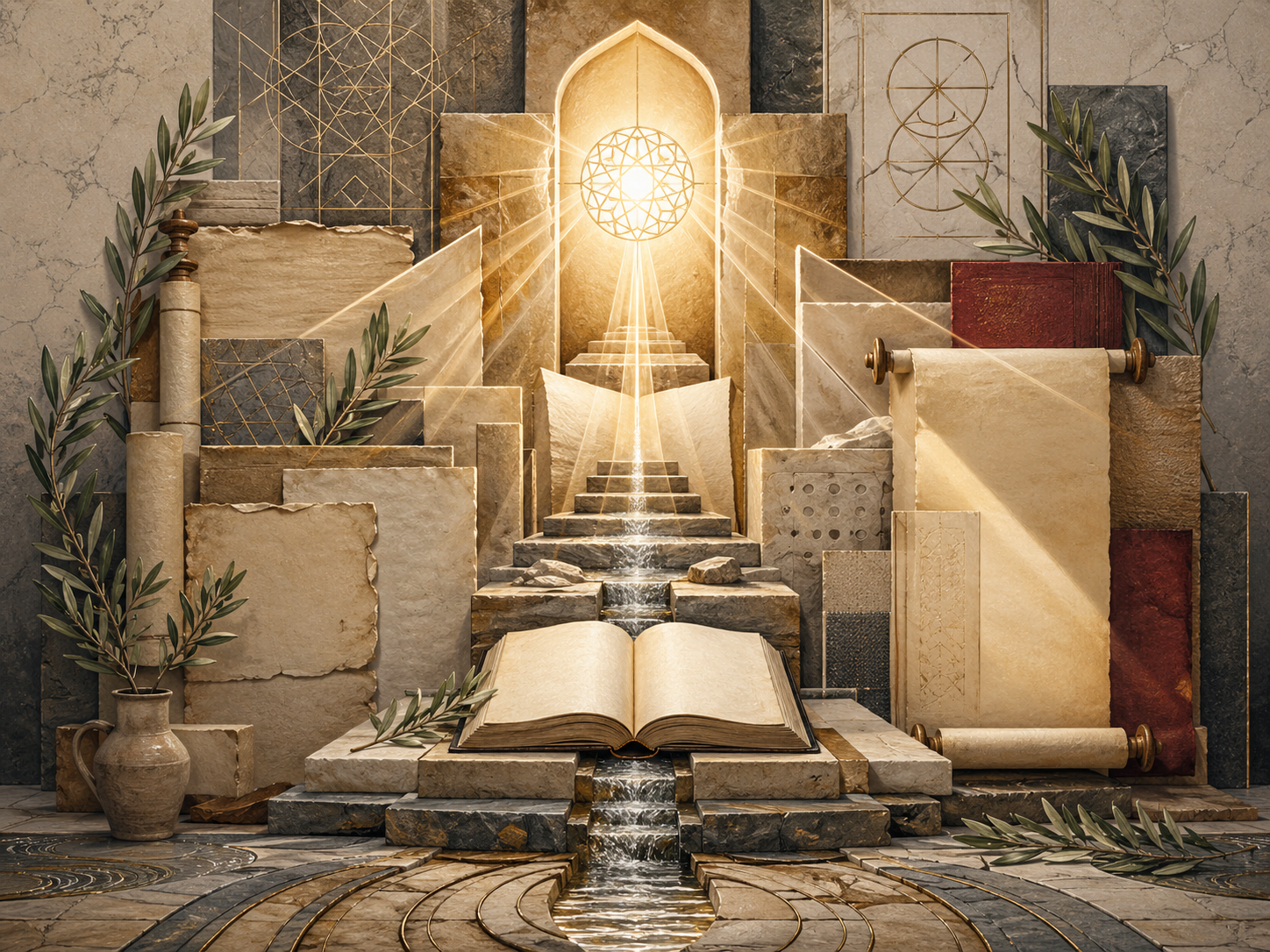
The Arabic word Allah is used by Arabic-speaking Muslims, Christians, and Jews as the word for God. This matters for the study of light because Arabic-speaking Abrahamic communities have used overlapping language to speak of divine illumination, scripture, wisdom, and guidance while preserving real theological difference. Shared language does not erase doctrine. It shows that Jewish, Christian, and Muslim reflection on light belongs to a connected Abrahamic field rather than to isolated religious universes.
Light as an Abrahamic Language of God and Truth
Light is one of the most enduring religious images because it joins visibility, life, order, warmth, orientation, and disclosure. To see is not the same as to understand, but the metaphor of sight helps sacred traditions speak about knowledge. To walk in light is to move with guidance. To be enlightened is to be freed from confusion. To receive light is to receive something not generated by the self. Light therefore becomes a natural language for revelation: truth given from beyond human manufacture.
In Abrahamic traditions, light is rarely only physical. It can refer to created light, divine presence, wisdom, law, scripture, moral clarity, prophetic guidance, the soul’s awakening, or the final hope of restoration. Its range is part of its power. Light can illuminate the cosmos, the mind, the conscience, the community, and the path.
Yet this symbolic range also requires discipline. Light can become vague if detached from scripture, law, doctrine, and ethical life. Abrahamic traditions do not usually treat light as a generalized spiritual mood. They bind it to God, creation, revelation, command, wisdom, and accountability. Light is beautiful, but it is also demanding. It exposes as well as comforts.
This exposing quality is essential. Darkness in Abrahamic texts is not always evil in a simplistic sense; night, hiddenness, mystery, and divine transcendence can also have sacred meanings. But when darkness is opposed to light morally, it often names falsehood, confusion, injustice, idolatry, heedlessness, or refusal of guidance. Light is therefore not only illumination of the mind. It is correction of the life.
This is why the metaphor remains so powerful across traditions. Human beings do not merely need more information. They need orientation. They need to know which path is true, which desire is disordered, which power is unjust, which claim is false, which community has been neglected, and which voice has been silenced. Light names the gift of seeing rightly before God.
Creation and the First Light
The opening of Genesis places light at the beginning of ordered creation. Before the full arrangement of sun, moon, stars, living creatures, and human beings, divine speech calls forth light. The point is not simply cosmological. Light marks the emergence of order from formlessness, distinction from undifferentiated darkness, and intelligibility from chaos. Creation becomes a world that can be seen, named, ordered, and judged good.
Hebrew Bible
וַיֹּאמֶר אֱלֹהִים יְהִי אוֹר וַיְהִי־אוֹרAnd God said, “Let there be light,” and there was light.Genesis 1:3. Hebrew text with poetic English rendering.
The first light appears through divine speech. Creation begins as gift, command, order, and intelligibility rather than as human achievement.
Jewish interpretation has often treated this first light as more than ordinary illumination. Later traditions distinguish between physical light and hidden, primordial, or eschatological light. Rabbinic and mystical readings sometimes treat light as a sign of divine wisdom, Torah, or the radiance reserved for the righteous. Even where interpretation varies, the opening symbolism remains foundational: God’s creative command makes a world in which light and order are linked.
For Christian readers, the creation of light becomes inseparable from later reflection on the Word. The Gospel of John deliberately echoes Genesis with its opening “in the beginning,” but reads creation through the Word and life through light. For Muslim readers, creation is also grounded in divine command. The Qur’an repeatedly presents the heavens and earth as signs, and light becomes part of the created order through which divine power and guidance are contemplated. Across the traditions, light begins not as human achievement, but as divine gift.
The first light also has moral significance. A world made by God is not an unintelligible accident. It can be known, named, received, and judged. That does not mean creation is transparent to human mastery. It means creation is ordered enough to invite wonder, science, wisdom, and praise. Light makes the world available to perception, but the world remains gift rather than possession.
This is especially important in a modern age that often treats the visible world as raw material for consumption. Abrahamic creation theology resists that reduction. The light by which creation appears is not merely a tool for extraction or control. It is a summons to gratitude, restraint, and responsibility before the Creator.
Torah, Wisdom, and the Path of Light
In Jewish thought, light is closely linked to Torah, wisdom, and moral path. The Torah is not merely a legal code in the narrow modern sense. It is instruction, covenantal guidance, sacred teaching, and a way of life before God. To describe Torah through light is to say that divine instruction makes human life navigable. It gives orientation where human desire, fear, power, and confusion might otherwise lead the soul astray.
Hebrew Bible
נֵר־לְרַגְלִי דְבָרֶךָ וְאוֹר לִנְתִיבָתִיYour word is a lamp to my feet and a light to my path.Psalm 119:105. Hebrew text with poetic English rendering.
Torah light is not abstraction. It guides a path: step, conduct, discipline, memory, and covenantal life.
Wisdom literature deepens this connection. Proverbs presents wisdom as a public, moral, and cosmic reality: wisdom calls, instructs, warns, and helps human beings live rightly. Wisdom is not merely cleverness. It is disciplined moral perception rooted in reverence for God. In this sense, wisdom is light because it lets a person see the moral shape of reality. The fool does not simply lack information; the fool lacks right perception.
Jewish tradition also binds light to joy, commandment, divine presence, and communal life. Sabbath candles, Hanukkah lights, and other ritual uses of light are not reducible to metaphor, but they participate in the same symbolic field: light remembers, sanctifies, distinguishes time, and gathers community. The light of Torah is therefore both intellectual and embodied. It is studied, recited, practiced, and ritualized.
This matters because modern readers often separate knowledge from practice. Torah light does not permit that separation. The path is illuminated so that it may be walked. Commandment is not the enemy of light; it is one of light’s forms. A person who claims insight while refusing justice, humility, mercy, and covenantal obligation has not understood what Torah light means.
Jewish light language also belongs to minority survival. Communities that have faced exile, persecution, displacement, forced conversion, antisemitism, ghettoization, and genocide have often preserved identity through study, candles, Sabbath, prayer, festivals, and transmission of Torah. Light becomes resistance to erasure. It says that sacred memory can still burn under conditions of vulnerability.
Christian Light and the Word
Christian thought develops the language of light through creation, the Word, Christology, revelation, and discipleship. The Gospel of John is central. It identifies life and light in relation to the Word and presents the light as shining in darkness. In Christian theology, this language becomes inseparable from the identity of Jesus Christ as the incarnate Word. Light is not only guidance; it is revelation in person.
New Testament
ἐν αὐτῷ ζωὴ ἦν, καὶ ἡ ζωὴ ἦν τὸ φῶς τῶν ἀνθρώπων· καὶ τὸ φῶς ἐν τῇ σκοτίᾳ φαίνει, καὶ ἡ σκοτία αὐτὸ οὐ κατέλαβεν.In him was life, and the life was the light of human beings; and the light shines in the darkness, and the darkness did not overcome it.John 1:4–5. Greek text with poetic English rendering.
John’s light language is Christological. It links creation, life, revelation, and the triumph of divine light over darkness through the Word.
This is where Christian and Islamic uses of light diverge sharply. Christianity often reads divine light through incarnation: the Word becomes flesh, and divine self-disclosure is centered in Christ. Islam honors Jesus as Messiah, word from God, messenger, and sign, but rejects incarnation and divine sonship. The difference is real. A serious comparative article must not pretend that Johannine light language and Qur’anic light language are identical.
At the same time, Christian light language is not only doctrinally abstract. It is also ethical and communal. The Sermon on the Mount uses light to speak of discipleship, public witness, and good works. The First Letter of John speaks of walking in light as a test of truth and fellowship. Christian illumination is therefore not merely an inward feeling. It is a life shaped by truth, love, repentance, and visible righteousness.
Christian light also carries a danger if separated from humility. Communities that claim to possess light can become triumphalist, especially when light is used to mark others as darkness. Christian history includes both luminous witness and serious failures: antisemitism, colonial violence, forced conversion, racial domination, and the misuse of missionary language to justify power. The Johannine light should judge these distortions rather than excuse them.
At its best, Christian light language remembers that the light shines in darkness without becoming domination. It does not need coercion to be true. It calls communities toward truth, love, mercy, repentance, and care for those whom the world keeps in shadow: the poor, sick, imprisoned, displaced, abused, colonized, and forgotten.
Qur’anic Light: Allah as the Light of the Heavens and the Earth
The Qur’an’s most famous light passage is Sūrat al-Nūr 24:35, often called the Light Verse. It declares that Allah is the Light of the heavens and the earth and gives a parable of divine light through the imagery of a niche, a lamp, glass, a shining star, a blessed olive tree, and “light upon light.” The verse is not a simple visual description of God. It is a parable, and the Qur’an itself says that Allah sets forth parables for human beings.
Qur’anic Text
اللَّهُ نُورُ السَّمَاوَاتِ وَالْأَرْضِ … نُورٌ عَلَىٰ نُورٍ ۗ يَهْدِي اللَّهُ لِنُورِهِ مَن يَشَاءُAllah is the Light of the heavens and the earth … light upon light. Allah guides to His light whom He wills.Qur’an 24:35. Arabic text with poetic English rendering.
The Light Verse speaks through parable: niche, lamp, glass, star, olive tree, and light upon light. Its meaning must be interpreted through tawḥīd, guidance, revelation, and divine transcendence.
This matters because Qur’anic light should not be handled crudely or anthropomorphically. Allah is not a physical lamp, star, flame, or created light. The imagery points toward guidance, manifestation, knowledge, mercy, and the illuminating power by which reality becomes intelligible. Allah is the source of all created light and the source of spiritual guidance. His light is not contained by the world; rather, the world depends upon Him.
Within a Qur’an-centered, Lahore Ahmadiyya-compatible interpretive lens, the Light Verse can be read with strong attention to metaphor, guidance, reason, and moral illumination. Maulana Muhammad Ali’s tradition often emphasizes the Qur’an’s rational and spiritual clarity: revelation is not a denial of reason, but a light that orders human understanding, conduct, and society. The verse therefore belongs not only to mystical contemplation, but also to moral and intellectual life. Divine light guides the human being toward purity, justice, knowledge, and disciplined worship.
Sūrat al-Nūr as a chapter also matters. The Light Verse appears within a broader Qur’anic context concerned with chastity, slander, household ethics, social order, modesty, community discipline, and moral clarity. Light is not isolated from law and conduct. The Qur’an’s light illuminates life. It exposes false accusation, protects social trust, orders desire, and forms a community accountable before Allah.
This is one of the Qur’an’s great contributions to Abrahamic reflection on knowledge. Light is not simply private illumination. It is guidance for a community: how to speak, how to guard dignity, how to resist slander, how to order desire, how to protect households, how to remember Allah, and how to live truthfully. Light becomes social ethics, not merely mystical image.
The Light Verse also resists secular reduction. The world is not self-illuminating. Human reason matters, but it does not generate the ultimate source of guidance from itself. Allah guides to His light. This does not humiliate reason; it locates reason within divine mercy and moral accountability.
Allah and Shared Monotheistic Language
Because this article compares Jewish, Christian, and Muslim uses of light, it is important to clarify the language of God. Allah is the Arabic word for God. It is used by Arabic-speaking Muslims, Christians, and Jews. It should not be treated as the name of a separate Muslim deity outside the Abrahamic field. The real differences among the traditions are theological and interpretive, not the result of worshiping unrelated gods.
Arabic-speaking Christians have used Allah to speak of God in biblical translation, prayer, and theology. Arabic-speaking Jews have also used Arabic religious language within Jewish contexts. Muslims use Allah as the name of the one God revealed in the Qur’an, creator and judge, compassionate and merciful, utterly one and without partner. The shared word does not erase difference, but it clarifies the field of comparison.
This linguistic point matters especially for light symbolism. When Arabic-speaking Christians speak of God as light, when Muslims read the Light Verse, and when Jews in Arabic-speaking worlds write about divine wisdom or illumination in Arabic or Judeo-Arabic, they are not speaking into wholly separate religious universes. They are working within a shared Semitic and Abrahamic language-world, even when their doctrines differ profoundly.
That recognition also resists a common form of anti-Muslim distortion. To say that Muslims worship “Allah” while Jews and Christians worship “God” as though these were unrelated beings is linguistically and historically misleading. It erases Arabic-speaking Christians and Jews, and it falsely pushes Islam outside the Abrahamic field. The better approach is to name real doctrinal difference while preserving Abrahamic continuity.
At the same time, the shared word should not be used to flatten theology. Christians speak of God through Trinitarian doctrine and incarnation. Muslims confess uncompromising tawḥīd and reject divine sonship and incarnation. Jews preserve their own biblical, rabbinic, philosophical, and liturgical monotheism. The word Allah can be shared while doctrines remain distinct. That is not a contradiction; it is the reality of Abrahamic language.
Wisdom, Knowledge, and Moral Discernment
Light and wisdom are closely related because both involve discernment. Knowledge gives information; wisdom orders information toward truth and the good. In Abrahamic traditions, wisdom is rarely only intellectual capacity. It involves reverence, humility, moral judgment, restraint, and right relation to God. The person who knows many things but lacks wisdom remains in darkness.
In Jewish tradition, wisdom is bound to fear of God, Torah, counsel, and disciplined life. In Christianity, wisdom is shaped by the Word, the cross, humility, love, and the Spirit. In Islam, wisdom, or ḥikmah, is connected to revelation, prophecy, gratitude, justice, and right action. The Qur’an repeatedly links knowledge with guidance and accountability. To know is to become responsible.
This is why light can be dangerous as well as beautiful. Light exposes. It reveals what was hidden. It judges falsehood. It removes excuses. In all three traditions, revelation as light does not merely comfort human beings; it calls them to repentance, obedience, justice, and truthfulness. The illuminated person is not simply the person who has had a spiritual experience. The illuminated person is the one whose perception, conduct, speech, and worship are reordered.
Wisdom is therefore not anti-intellectual, but it is also not reducible to intelligence. A technically skilled person can remain morally darkened. A scholar can know texts and still lack humility. A ruler can possess information and still govern unjustly. A community can claim revelation and still neglect the vulnerable. Abrahamic light asks whether knowledge has become moral clarity.
This distinction is vital in an age of information abundance. Search engines, artificial intelligence systems, databases, surveillance tools, and media platforms can increase visibility without producing wisdom. Not every exposure is illumination. Not every data point becomes truth. Not every claim to transparency produces justice. Abrahamic traditions ask whether knowledge has been ordered toward God, neighbor, conscience, and the protection of the vulnerable.
In that sense, wisdom is a human-rights question. The poor, displaced, colonized, disabled, imprisoned, abused, and silenced often suffer not because no one has information, but because knowledge has not become responsibility. Light becomes real only when it changes what communities do with what they know.
Illumination, Intellect, and the Knowing Soul
The language of illumination also shaped philosophical theology. In late antique, medieval Jewish, Christian, and Islamic thought, knowing was often understood through metaphors of light. The intellect receives form, sees truth, or is illuminated by a higher source. Philosophers and theologians used this language to ask how finite minds can know eternal truths, how the soul relates to God, and how divine knowledge differs from human knowledge.
Christian discussions of divine illumination are especially associated with Augustine and later medieval debates. The basic problem is epistemological and theological: if the human mind knows truth, what makes that knowing possible? Is truth merely constructed by the mind, or does the mind participate in a light beyond itself? Different Christian thinkers answered differently, but the image of divine illumination remained powerful.
Jewish and Islamic philosophical traditions also developed sophisticated accounts of intellect, prophecy, emanation, and knowledge. Thinkers such as al-Fārābī, Ibn Sīnā, al-Ghazālī, Ibn Rushd, Saadia Gaon, Maimonides, and others debated the relation between intellect, revelation, law, imagination, and divine unity. Even where they disagreed, the metaphor of light helped articulate a shared intuition: knowledge is not self-grounding. Human understanding depends upon an order of truth that exceeds the individual mind.
In this philosophical setting, light does not mean anti-rational mysticism. It often names the very condition of rationality. The mind can know because reality is ordered, because truth is not merely private preference, and because the human intellect is capable of receiving what it did not invent. Illumination points to dependence, not intellectual passivity.
At the same time, illumination must be distinguished from intellectual pride. If knowledge is received, then the knower has no right to arrogance. The more deeply one sees, the more deeply one should recognize dependence. Philosophical light should lead to humility before God, not contempt for ordinary believers, the poor, or those outside elite education.
This matters for marginalized voices because intellectual traditions often privilege literate, male, elite, and institutionally trained voices. Abrahamic illumination language can challenge that hierarchy when handled well. Wisdom may appear in scholars, but also in prophets, mothers, elders, saints, jurists, workers, poets, the poor, and those who see injustice clearly because they have suffered under it. Light is not owned by elites.
Light, Law, and Sacred Guidance
Abrahamic traditions do not usually separate light from law. Modern readers sometimes imagine light as inward spirituality and law as external constraint. Jewish, Christian, and Islamic traditions are more integrated than that. Divine guidance illuminates the path precisely by showing how to live. Law, commandment, teaching, and ethical instruction are forms of light because they make the moral world visible.
In Judaism, Torah is the central form of divine instruction. It teaches Israel how to live before God through commandment, covenant, ritual, justice, memory, and study. In Christianity, law is interpreted through Christ, Spirit, love, discipleship, and the moral demands of the Gospel. Traditions differ sharply over continuity and fulfillment, but Christian light language remains ethically binding. In Islam, Qur’anic guidance and prophetic example illuminate worship, law, family life, commerce, justice, modesty, charity, knowledge, and communal responsibility.
The Light Verse itself appears in a chapter deeply concerned with embodied social morality. This is crucial. Qur’anic light is not detached from household life, sexuality, testimony, modesty, social trust, and communal discipline. Light enters the structures of life. It is not merely a mystical glow above history; it is guidance for people who must speak truthfully, restrain desire, protect dignity, and live in accountable community.
This integrated view helps challenge Western liberal assumptions that religion becomes most acceptable when reduced to private belief. In Abrahamic traditions, guidance is communal, embodied, legal, ritual, intellectual, and moral. Light does not remain sealed inside the interior conscience. It forms households, courts, schools, rituals, calendars, obligations, and communities.
That does not mean every historical legal order should be romanticized or copied. It means law should not be treated as darkness simply because it is law. A law can be unjust; a legal system can oppress; religious authority can be abused. But commandment, discipline, and sacred guidance can also protect dignity, orient desire, restrain power, educate children, preserve communities, and defend the vulnerable. Abrahamic light often shines through law when law is rightly ordered toward justice and mercy.
Light and law therefore must be interpreted together. Law without light becomes coercion. Light without law becomes vagueness. Wisdom seeks the union of guidance and mercy, command and conscience, truth and responsibility.
Light and the Ethical Life
Light becomes ethically meaningful when it shapes conduct. A person may speak of illumination while still acting unjustly, arrogantly, or cruelly. Abrahamic traditions repeatedly resist this separation. To walk in light is to live differently. It affects speech, appetite, power, wealth, sexuality, family, neighbor, enemy, stranger, and the vulnerable.
In Jewish wisdom traditions, the path of the righteous is often contrasted with the way of the wicked. Light and darkness become moral orientations. In Christian scripture, light is tied to truth, witness, love, and visible works. In Islam, guidance is repeatedly opposed to darkness, ignorance, falsehood, and misguidance. Knowledge without humility becomes arrogance; law without mercy becomes hardness; spirituality without justice becomes illusion.
This ethical dimension is especially important for comparative study. It prevents light symbolism from becoming aesthetic rather than moral. The question is not simply which tradition has the most beautiful image of light. The question is what light demands. Does it produce truthfulness? Does it protect the vulnerable? Does it purify worship? Does it expose arrogance? Does it deepen mercy? Does it lead to responsible action before God?
Light also tests communities, not only individuals. A community can preserve luminous texts while behaving darkly. It can recite scripture while slandering minorities. It can claim wisdom while exploiting workers. It can speak of purity while humiliating women. It can claim revelation while denying the dignity of the poor, the disabled, the displaced, or the religious other. Abrahamic light exposes communal hypocrisy as much as personal sin.
For this reason, light is inseparable from repentance. Exposure without repentance becomes shame or spectacle. Knowledge without correction becomes condemnation. The purpose of light is not merely to reveal darkness, but to guide the person and community toward truth, repair, and renewed life before God.
The ethical life of light is therefore practical. It appears in truthful speech, fair judgment, care for the poor, restraint of appetite, protection from slander, humility before God, disciplined study, mercy toward the vulnerable, and refusal to use sacred language as cover for domination. Light must become conduct or it remains incomplete.
Mysticism, Contemplation, and the Language of Radiance
Light also became a major language of mystical and contemplative thought. Jewish mystical traditions developed rich accounts of divine emanation, radiance, hiddenness, and the relation between the infinite and creation. Christian mystics spoke of illumination, darkness beyond light, contemplation, transfiguration, and union with God while preserving the Creator-creature distinction in different ways. Islamic Sufi traditions reflected deeply on nūr, unveiling, the polished heart, and the illumination of the soul through remembrance of Allah.
These traditions are powerful, but they require careful handling. Mystical light language can be misunderstood if read too literally or too vaguely. It often functions as symbolic theology: language stretched toward what cannot be captured conceptually. The mystic speaks of light because ordinary language fails before divine nearness, beauty, and knowledge. Yet the best mystical traditions also insist on humility, discipline, repentance, and moral transformation.
In Islam, especially, light language must remain governed by tawḥīd, the absolute oneness of Allah. Any interpretation that dissolves the difference between Creator and creation risks theological confusion. In Christianity, light language often passes through Christological and Trinitarian doctrine. In Judaism, mystical light language is shaped by Torah, commandment, and the disciplined interpretation of divine presence. The shared symbol is real, but each tradition places boundaries around it.
Mystical light can also become ethically dangerous when separated from ordinary responsibility. A person who claims interior illumination but neglects justice, family obligations, truthfulness, prayer, law, or mercy has misunderstood the point of contemplation. The contemplative life is not an escape from the neighbor. It should deepen responsibility to the neighbor because the self is seen more truthfully before God.
The language of radiance also belongs to communities under pressure. In exile, illness, imprisonment, poverty, grief, and persecution, the image of light can sustain hope without denying suffering. It says that darkness is not absolute. Yet the best Abrahamic spirituality does not use light to silence lament. It allows the suffering to name darkness honestly while still refusing to let darkness become final.
Mysticism, then, should not be treated as vague universal spirituality. Jewish, Christian, and Islamic contemplative traditions have their own textual disciplines, theological boundaries, ritual practices, and moral demands. Their shared language of radiance invites comparison, but responsible comparison must honor the form of each path.
Light, Darkness, and Power
The language of light and darkness can be morally powerful, but it can also be politically dangerous. Communities often describe themselves as enlightened and others as darkened. Empires have used light language to justify conquest. Colonial powers described domination as civilization, education, progress, or enlightenment. Religious communities have sometimes used the language of truth to humiliate, erase, or coerce others.
A serious Abrahamic account must therefore distinguish sacred light from imperial self-flattery. Divine light is not the same as civilizational pride. Revelation is not a license for domination. Wisdom is not a weapon for contempt. A community that claims to possess light must be especially careful not to turn that claim into permission to silence others.
This caution applies across traditions. Christian empires have used light language to justify colonial missions and forced conversions. Muslim powers have sometimes used religious authority to suppress dissent, minority voices, or women’s agency. Jewish communities, especially when holding power in modern contexts, must also ask how sacred memory and divine promise are used in relation to those who are vulnerable. No community is exempt from the temptation to confuse God’s light with its own power.
Light is most faithful when it judges the community that claims it. The prophetic tradition, the Gospel’s moral demands, and the Qur’an’s insistence on accountability all resist self-congratulation. Light exposes the powerful as well as the powerless. It reveals oppression even when oppression is religiously decorated.
This matters for marginalized voices. Those forced into the shadow by dominant powers often see hypocrisy clearly. The colonized, enslaved, poor, displaced, imprisoned, disabled, racially targeted, and religiously marginalized know when a community’s claimed light does not match its conduct. Their testimony is part of moral illumination.
Light should therefore not be defined only from above — by rulers, institutions, theologians, or majority communities. It must also be heard from below: from those who ask whether light has reached the prison, the refugee camp, the exploited workplace, the occupied land, the neglected hospital, the abused household, and the silenced archive. A light that never reaches the vulnerable has been blocked by human injustice.
Marginalized Voices and the Right to Light
One of the purposes of serious religious and historical study is to give voice to those whose memories have been suppressed, distorted, or interpreted only by dominant powers. The theme of light is especially important for that purpose because knowledge itself can be unequally distributed. Some communities are allowed to define truth; others are forced to live under someone else’s description of them.
In Abrahamic history, marginalized voices include Jewish communities under exile and persecution, Eastern Christians and Arabic-speaking Christians erased by Western narratives, Muslim scholars reduced to transmitters rather than creators, women whose learning was preserved in households and oral traditions, enslaved and colonized peoples who read sacred texts from the underside of power, and minority communities whose manuscripts survive only in fragments. Their light has often been hidden not because it was weak, but because institutions failed to preserve it.
Light, in this sense, is not only a metaphor for private knowledge. It is also a question of historical justice. Who has access to education? Whose language is treated as learned? Whose archives are digitized? Whose scriptures are translated respectfully? Whose ritual lights are permitted in public? Whose wisdom is dismissed as superstition? Whose suffering is made visible? Whose testimony is believed?
Religious freedom also belongs here. Communities need the right to keep sacred time, teach children, preserve language, light candles, gather for worship, recite scripture, study law, maintain schools, and pass on wisdom. The right to light is not a modern legal phrase, but the idea captures something real: human beings and communities need access to guidance, memory, education, worship, and truth.
This approach rejects the assumption that human rights must be grounded only in Western liberal individualism. Human dignity can also be grounded in covenant, creation, divine justice, sacred law, communal obligation, mercy, education, and the right of communities to preserve their worship and wisdom. The goal is not to reject rights, but to deepen their foundation beyond one civilizational framework.
A religiously serious account of light therefore asks whether knowledge reaches those most often kept in darkness. It asks whether sacred traditions illuminate only elite minds or also protect the poor, the stranger, the widow, the orphan, the prisoner, the refugee, the disabled, the colonized, and the silenced. Light becomes truthful when it gives sight, voice, and dignity to those whom power has tried to hide.
Shared Symbol, Different Theologies
Light is shared across the Abrahamic traditions, but it is not the same in every theology. In Judaism, light is often linked to creation, Torah, wisdom, divine presence, commandment, joy, and the path of the righteous. In Christianity, light is inseparable from creation through the Word, Christological revelation, incarnation, discipleship, and the life of the church. In Islam, light is linked to Allah’s guidance, Qur’anic revelation, divine mercy, knowledge, the signs of creation, and the moral illumination of the believer and community.
The differences are not superficial. Christian theology can speak of Christ as light in a way Islam cannot accept because Islam rejects incarnation and divine sonship. Islamic theology can speak of the Qur’an as guidance and light in a way Christianity and Judaism do not share because they do not accept the Qur’an as final revelation. Jewish tradition preserves the light of Torah and covenant in ways not identical to either Christian fulfillment theology or Islamic Qur’anic correction.
Yet these differences do not erase the shared field. All three traditions treat light as more than optics. Light is truth, guidance, divine gift, moral exposure, wisdom, and hope. All three traditions warn against darkness as ignorance, falsehood, sin, confusion, or estrangement from God. All three traditions see human beings as needing light from beyond themselves. The shared symbol therefore opens a space for comparison without requiring doctrinal collapse.
This is the strongest model for Abrahamic comparison. It neither flattens nor segregates. It allows Jewish Torah light, Christian Christological light, and Qur’anic light to stand in their own integrity while recognizing that each tradition speaks from within a wider field of divine guidance, wisdom, and human dependence. Difference becomes meaningful precisely because the shared symbol is real.
Comparative work becomes weak when it says, “All religions mean the same thing.” It also becomes weak when it says, “The traditions have nothing to do with one another.” The truth is more demanding. They are related but not identical, overlapping but not interchangeable, mutually intelligible in some ways and irreducibly different in others. Light helps us see that complexity.
The goal is not to resolve theological difference. It is to understand it more truthfully. A symbol as powerful as light can become sentimental if handled lazily. But when handled with care, it reveals the depth of Abrahamic thought: creation, revelation, law, wisdom, intellect, ethics, mysticism, and the moral demand to walk rightly before God.
Modern Importance: Knowledge without Wisdom Is Not Light
The modern importance of light, wisdom, and knowledge in Abrahamic thought is considerable. Modern societies often separate knowledge from wisdom, information from formation, and technical mastery from moral responsibility. Abrahamic traditions resist that separation. They ask not only what human beings can know, but what knowledge does to the soul and community.
This matters in an age of overwhelming information. More data does not necessarily produce more wisdom. Greater visibility does not necessarily produce truth. Public exposure does not necessarily produce justice. Light in the Abrahamic sense is not mere transparency or information flow. It is rightly ordered understanding before God. It requires humility, moral discipline, and willingness to be corrected.
The theme also matters for interfaith understanding. Light is one of the few symbols that can be shared deeply without pretending that doctrines are identical. Jews, Christians, and Muslims can recognize the sacred power of light language while acknowledging real differences over Torah, Christ, Qur’an, revelation, law, and prophecy. The symbol is common enough to invite conversation and serious enough to demand precision.
It also matters for education. A society can produce skilled workers, technical experts, influencers, analysts, and political communicators without producing wise human beings. Abrahamic traditions ask whether education forms conscience, reverence, judgment, humility, and responsibility. The goal is not merely to know more, but to see more truthfully and live more justly.
It matters for media and public life as well. Modern systems often confuse visibility with illumination. A scandal can become visible without justice being done. A marginalized community can be exposed without being heard. A person can be surveilled without being understood. A society can flood itself with images while remaining morally blind. Abrahamic light demands more than exposure; it demands truthful perception ordered toward justice.
Finally, this theme matters for human rights. Communities need education, memory, language, worship, law, and moral guidance to live with dignity. Persons need truth, not only choice. The poor and marginalized need more than symbolic visibility; they need justice, care, voice, and protection. Light is not complete until it reaches those whom darkness has been used to hide.
Comparative Cautions
Several cautions are necessary. First, light should not be treated as a vague universal symbol detached from particular traditions. The Light Verse, the Gospel of John, Genesis, Proverbs, Torah, Christian illumination, and Jewish mystical radiance belong to specific textual and theological worlds.
Second, shared imagery should not be used to erase doctrinal difference. Christian light language is often Christological. Islamic light language is governed by tawḥīd and Qur’anic revelation. Jewish light language is shaped by Torah, wisdom, covenant, and later rabbinic and mystical interpretation. These frameworks overlap but are not interchangeable.
Third, mystical light language should not be read as permission for theological carelessness. Symbolic language can deepen reverence, but it can also blur boundaries if handled irresponsibly. Each tradition has developed ways to preserve divine transcendence while speaking of nearness, illumination, and guidance.
Fourth, light should not be separated from ethics. A person or community that claims light while practicing injustice, contempt, slander, cruelty, or arrogance has misunderstood the symbol. In Abrahamic thought, light exposes and judges as well as guides and comforts.
Fifth, the Arabic word Allah should be handled accurately. It is the Arabic word for God and is used by Arabic-speaking Muslims, Christians, and Jews. Theological difference should be named where it exists, but false linguistic separation should be avoided.
Sixth, light should not be confused with civilizational superiority. Empires, colonial projects, and dominant religious communities have often described themselves as bearers of light while casting others as darkness. Abrahamic traditions should challenge that arrogance, not reproduce it.
Seventh, darkness should not be used as a racialized, colonial, or cultural insult. Sacred texts use light and darkness symbolically in many ways, but modern readers must be alert to how those metaphors have been weaponized against peoples, cultures, and religions.
Eighth, knowledge should not be equated with elite education alone. Wisdom may be carried by scholars, but also by elders, parents, workers, mystics, jurists, poets, caregivers, survivors, and marginalized communities whose experience reveals what power tries to hide.
Ninth, original-language quotations should be used carefully. Hebrew, Greek, Arabic, and other sacred languages carry textual traditions, interpretive histories, and theological weight. Quotation should advance the argument, not serve as decoration.
Finally, marginalized voices should not be treated as an optional ethical add-on. Any serious account of light, wisdom, and knowledge must ask who has been denied education, whose archives have been neglected, whose language has been suppressed, whose testimony has been doubted, and whose suffering remains unseen.
Why This Article Matters
Light, wisdom, and knowledge form one of the great shared languages of Abrahamic thought. Genesis begins creation with divine command and light. Jewish tradition links light with Torah, wisdom, commandment, joy, and moral path. Christianity reads light through the Word, Christ, discipleship, divine illumination, and walking in truth. Islam gives one of the most profound light passages in sacred literature through Sūrat al-Nūr, where Allah is called the Light of the heavens and the earth and divine guidance is described as light upon light.
The shared symbolism is real, but it must be handled with theological care. Light does not mean the same thing in every tradition. Christianity’s incarnational light language, Islam’s Qur’anic and uncompromisingly monotheistic light language, and Judaism’s Torah-centered wisdom and covenantal light language each have their own integrity. The power of comparison lies in seeing both resemblance and difference.
For the Abrahamic Traditions knowledge series, this article deepens the shared-knowledge-world arc. Arabic as a Shared Language of Jewish, Christian, and Muslim Knowledge showed how language can carry overlapping religious worlds. Translation Movements in Abrahamic Civilization showed how knowledge crosses languages. Maimonides, Ibn Sīnā, and the Shared Philosophical World of Arabic Thought showed how reason, medicine, metaphysics, and revelation can occupy a shared conceptual field. This article shows how light gathers those themes into a single symbolic language of creation, revelation, wisdom, law, intellect, ethics, and hope.
For Abrahamic sacred history, light is ultimately a language of dependence. Human beings do not generate ultimate truth from themselves. They receive, interpret, resist, distort, and sometimes follow the light given by God. Wisdom is the disciplined capacity to live by that light. Knowledge is not complete until it becomes moral clarity. The illuminated life is therefore not merely a life that sees, but a life that walks rightly before the one God.
Seen from the perspective of marginalized voices, light also becomes a demand for historical justice. Communities whose languages, archives, rituals, and memories have been suppressed must be brought back into view. The poor, displaced, colonized, disabled, imprisoned, religiously marginalized, and silenced are not peripheral to the study of sacred light. They are often the ones who reveal whether a community’s claimed knowledge has become mercy and justice.
The final value of this article is that it refuses to reduce light to beauty alone. Light is beautiful, but it is also judgment, guidance, exposure, responsibility, and hope. It calls human beings to see truthfully, speak truthfully, worship humbly, protect the vulnerable, and walk with moral clarity before God. Knowledge without wisdom is not light. Light becomes true when it illumines the path of justice, mercy, and reverence.
Related Reading
- Abrahamic Traditions: Prophecy, Revelation, Law, and Sacred History
- Comparative Sacred Themes
- Arabic as a Shared Language of Jewish, Christian, and Muslim Knowledge
- Translation Movements in Abrahamic Civilization
- Maimonides, Ibn Sīnā, and the Shared Philosophical World of Arabic Thought
- Luqman, Wisdom, and Moral Counsel in the Qur’an
- Khidr, Hidden Knowledge, and the Limits of Human Understanding
- Covenant, Commandment, and Conscience in Abrahamic Ethics
- Torah, Halakhah, Sharia, and Christian Moral Law
- Mercy, Justice, and Repentance in Abrahamic Law
Further Reading
- Altmann, A. (1969) Studies in Religious Philosophy and Mysticism. Ithaca: Cornell University Press. Available through academic libraries.
- Augustine (1991) Confessions. Translated by H. Chadwick. Oxford: Oxford University Press. Available at: https://global.oup.com/academic/
- Corbin, H. (1971) En Islam iranien: Aspects spirituels et philosophiques. Paris: Gallimard. Available at: https://www.gallimard.fr/
- Fishbane, M. (2003) Biblical Myth and Rabbinic Mythmaking. Oxford: Oxford University Press. Available at: https://global.oup.com/academic/
- Gutas, D. (2014) Avicenna and the Aristotelian Tradition: Introduction to Reading Avicenna’s Philosophical Works. 2nd edn. Leiden: Brill. Available at: https://brill.com/
- Izutsu, T. (2002) Ethico-Religious Concepts in the Qur’an. Montreal: McGill-Queen’s University Press. Available at: https://www.mqup.ca/
- McGinn, B. (1991) The Foundations of Mysticism: Origins to the Fifth Century. New York: Crossroad. Available through academic libraries.
- Nasr, S.H. (1989) Knowledge and the Sacred. Albany: State University of New York Press. Available at: https://sunypress.edu/
- Nasr, S.H. et al. (eds.) (2015) The Study Quran: A New Translation and Commentary. New York: HarperOne. Available at: https://www.harpercollins.com/
- Scholem, G. (1995) Major Trends in Jewish Mysticism. New York: Schocken Books. Available at: https://www.penguinrandomhouse.com/
- Wolfson, E.R. (1994) Through a Speculum That Shines: Vision and Imagination in Medieval Jewish Mysticism. Princeton: Princeton University Press. Available at: https://press.princeton.edu/
References
- Ahmadiyya Anjuman Lahore Publications (n.d.) The Holy Quran, Chapter 24: An-Nur — The Light. Available at: https://alahmadiyya.org/holy-quran/english-translation-commentary-holy-quran-2010-maulana-muhammad-ali/chapter-24-nur-light/
- Ahmadiyya Anjuman Lahore Publications (n.d.) The Holy Quran, Chapter 24, Section 5: Manifestation of Divine Light, Verses 24:35–24:40. Available at: https://alahmadiyya.org/holy-quran/english-translation-commentary-holy-quran-2010-maulana-muhammad-ali/chapter-24-nur-light/section-5-verses-35-to-40-manifestation-divine-light/
- BibleGateway (n.d.) John 1, New Revised Standard Version Updated Edition. Available at: https://www.biblegateway.com/passage/?search=John%201&version=NRSVUE
- BibleGateway (n.d.) Matthew 5:14–16, New Revised Standard Version Updated Edition. Available at: https://www.biblegateway.com/passage/?search=Matthew%205%3A14-16&version=NRSVUE
- BibleGateway (n.d.) 1 John 1:5–2:11, New Revised Standard Version Updated Edition. Available at: https://www.biblegateway.com/passage/?search=1%20John%201%3A5-2%3A11&version=NRSVUE
- Britannica (2026) Allah. Available at: https://www.britannica.com/topic/Allah
- Britannica (2026) Tawhid. Available at: https://www.britannica.com/topic/tawhid
- Quran.com (n.d.) Surah An-Nur 24:35. Available at: https://quran.com/24/35
- Quran.com (n.d.) Surah Ibrahim 14:1. Available at: https://quran.com/14/1
- Quran.com (n.d.) Surah Al-Ma’idah 5:15–16. Available at: https://quran.com/5/15-16
- Sefaria (n.d.) Genesis 1. Available at: https://www.sefaria.org/Genesis.1
- Sefaria (n.d.) Proverbs 8. Available at: https://www.sefaria.org/Proverbs.8
- Sefaria (n.d.) Psalm 27. Available at: https://www.sefaria.org/Psalms.27
- Sefaria (n.d.) Psalm 119. Available at: https://www.sefaria.org/Psalms.119
- Stanford Encyclopedia of Philosophy (2005) Divine Illumination. Available at: https://plato.stanford.edu/entries/illumination/
- Stanford Encyclopedia of Philosophy (2016) Ibn Sina [Avicenna]. Available at: https://plato.stanford.edu/entries/ibn-sina/
- Stanford Encyclopedia of Philosophy (2023) Arabic and Islamic Philosophy of Religion. Available at: https://plato.stanford.edu/entries/arabic-islamic-religion/