
Last Updated May 5, 2026
Liturgy, sacrament, and Christian civilization show how Christian doctrine becomes embodied in worship, time, architecture, music, ritual, pastoral care, education, art, law, and public culture. Christianity is not only a set of beliefs about Jesus, the church, or salvation. It is also a civilization of prayer: baptismal water, Eucharistic bread and wine, psalms, hymns, preaching, calendar, fasting, feasting, icons, vestments, bells, incense, silence, pilgrimage, monastic rhythm, parish life, cathedral space, house churches, revival meetings, and global local worship. Through liturgy and sacrament, Christian communities remember, enact, and transmit the sacred history they confess.
Within the Christianity sequence, this article follows the articles on the Christian Bible, Jesus and the apostolic world, incarnation, redemption, resurrection, church, creed, and sacred authority. Those articles established Christianity’s scriptural, historical, doctrinal, and ecclesial foundations. This article turns to lived Christian form: how worship, sacrament, liturgical time, sacred space, devotional rhythm, pastoral care, and cultural memory carry Christian faith across generations.
The emphasis remains academically neutral and historically grounded. Christian liturgy and sacraments are described through their own scriptural, patristic, conciliar, ecclesial, and theological sources while also being studied as social, artistic, architectural, musical, political, and civilizational practices. Because Christian traditions differ substantially, this article does not assume one universal liturgical model. Roman Catholic, Eastern Orthodox, Oriental Orthodox, Anglican, Lutheran, Reformed, Baptist, Methodist, Pentecostal, evangelical, African Independent, Indigenous, and other Christian communities embody worship and sacrament in distinct ways. The shared question is how Christian sacred memory becomes repeated, public, bodily, communal, and durable.
Current Library
Religious Studies
Article Map
Abrahamic Traditions
Related Topic
Comparative Sacred Themes
Series context: This article is part of the Abrahamic Traditions: Prophecy, Revelation, Law, and Sacred History knowledge series. For the broader category structure, return to the Religious Studies category.
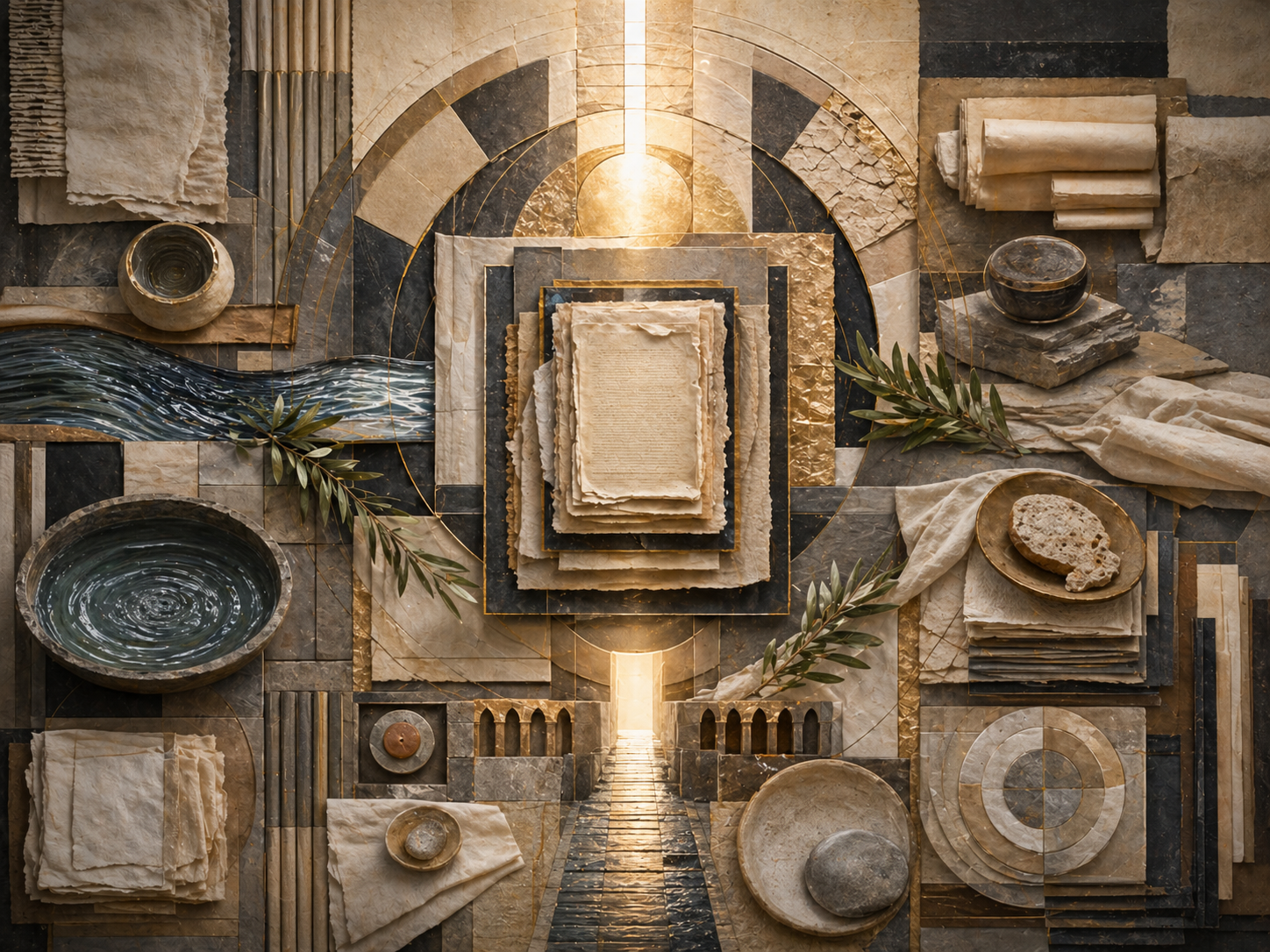
Why Liturgy, Sacrament, and Christian Civilization Matter
Liturgy, sacrament, and Christian civilization matter because Christianity is transmitted not only by texts and doctrines but by repeated forms of life. The Bible is read aloud. Creeds are recited. Water is poured. Bread is broken. Wine is blessed. Psalms are sung. The sick are anointed. The dead are buried. Festivals return. Bells ring. Candles are lit. Sermons interpret scripture. Children are taught prayers. Communities gather in buildings, homes, fields, prisons, hospitals, schools, cathedrals, monasteries, storefront churches, refugee camps, and online spaces. Christian sacred history becomes durable because it is enacted.
This is one reason liturgy is not a decorative layer added to doctrine. Liturgy teaches doctrine by giving it rhythm, gesture, sound, and communal repetition. Christmas teaches incarnation through feast, scripture, song, and memory. Holy Week teaches passion and redemption through processions, readings, lament, silence, foot washing, Eucharist, veneration, darkness, and waiting. Easter teaches resurrection through proclamation, light, baptismal renewal, alleluias, and joy. Pentecost teaches Spirit and mission through language, fire imagery, prayer, and sending.
Sacrament matters because much of Christianity refuses to separate grace from matter. Water, oil, bread, wine, hands, bodies, breath, words, and gathered community become means through which divine life is remembered, received, and enacted. Not all Christian traditions define sacrament in the same way, but most major forms of Christianity recognize that embodied practices are central to Christian identity. Even traditions that prefer the language of ordinances rather than sacraments still preserve baptism, the Lord’s Supper, prayer, preaching, and public confession as commanded practices.
Christian civilization matters because worship has shaped institutions, art, architecture, music, education, law, charity, medicine, literature, calendars, political imagination, and social order. Christianity has built monasteries, hospitals, universities, schools, orphanages, cathedrals, missions, presses, choirs, pilgrimage routes, welfare networks, and reform movements. It has also been entangled with empire, coercion, colonization, clerical abuse, anti-Judaism, patriarchy, racial hierarchy, and cultural domination. Liturgy and sacrament therefore belong to both sacred memory and historical accountability.
To study Christian worship seriously is to study how doctrine becomes body. It is also to study how bodies are arranged: who may speak, who may preside, who may receive, who may sing, who may enter, who is excluded, who is protected, whose language is used, whose suffering is remembered, and whose culture is treated as holy or disposable. Liturgy is therefore theological, social, aesthetic, and political at once.
What Is Liturgy?
The word liturgy comes from Greek language associated with public work or service. In Christian usage, it refers especially to the public worship of the church: prayer, scripture reading, preaching, Eucharist, baptism, blessing, confession, hymnody, chant, calendar, and ritual order. Liturgy is not merely ceremony. It is ordered communal worship through which the church remembers God’s saving work and is formed as a people.
In highly liturgical traditions, such as Eastern Orthodoxy, Roman Catholicism, Oriental Orthodoxy, Anglicanism, and some Lutheran traditions, liturgy is structured through inherited rites, calendars, vestments, gestures, readings, prayers, chants, and sacramental actions. In less formal Protestant, evangelical, Baptist, Pentecostal, and free church traditions, worship may be less fixed but still liturgical in a broad sense. There is still order: gathering, singing, prayer, preaching, testimony, baptism, communion, altar call, blessing, offering, or sending. Every community has a pattern of worship.
Liturgy is formative because it trains desire, memory, and perception. It teaches the community what matters by what it repeats. A congregation that hears scripture weekly is shaped by biblical language. A community that prays for the sick learns care. A church that confesses sin learns repentance. A Eucharistic community learns thanksgiving and communion. A tradition that follows a calendar learns to inhabit sacred time. A revival tradition that emphasizes testimony learns conversion, experience, and proclamation.
Liturgy also makes Christianity public. Even when worship happens in small or hidden communities, it is more than private spirituality. It gathers people into a shared act. It gives visible and audible form to faith. It binds the individual believer to the community, the present community to earlier generations, and local worship to the larger church across time and place.
Because liturgy is public, it also carries responsibility. The prayers a community repeats can deepen humility or reinforce superiority. The songs it sings can open memory or narrow it. The arrangement of space can welcome or exclude. The calendar can remember suffering or conceal it. Worship is never only “style.” It is a disciplined pattern of theological formation.
Worship as Sacred Memory
Christian worship is a practice of sacred memory. It remembers creation, covenant, prophecy, incarnation, teaching, healing, suffering, crucifixion, resurrection, ascension, Pentecost, church, judgment, and new creation. This memory is not simply recollection of past events. In liturgy, memory becomes participation. The worshiping community does not merely think about Christ; it prays, sings, eats, drinks, confesses, and hopes within the story of Christ.
The Eucharistic command “do this in remembrance of me” is central to Christian worship. Remembrance here is not only mental recall. It is ritual participation in the meaning of Christ’s self-giving. Different traditions explain this participation differently, but the basic pattern is widespread: the church remembers Jesus through a meal of thanksgiving, blessing, bread, cup, and communal communion.
Primary Christian Text
Τοῦτό μου ποιεῖτε εἰς τὴν ἐμὴν ἀνάμνησιν.Do this in remembrance of me.
1 Corinthians 11:24, Greek phrase with English rendering.
Christian liturgical memory is not passive recollection. It is enacted remembrance through bread, cup, thanksgiving, proclamation, and communal participation.
Worship also remembers scripture. The Old Testament, Psalms, Gospels, Epistles, and Revelation become living texts when read aloud in community. Lectionaries organize readings across Sundays, feast days, and seasons. Sermons interpret scripture for the present. Psalms become prayer. Biblical songs such as the Magnificat, Benedictus, Nunc Dimittis, Sanctus, and Gloria become recurring liturgical speech. The Bible becomes not only a book to study but a voice to inhabit.
Sacred memory is selective and contested. What a community remembers and how it remembers matters. Liturgy can preserve repentance, justice, and hope, but it can also preserve exclusion, triumphalism, or distorted historical narratives. Responsible worship must therefore be theologically serious and historically self-aware. Christian memory requires both reverence and repentance.
At its best, worship remembers the dead without imprisoning the living in nostalgia, remembers sin without despair, remembers mercy without cheapening justice, and remembers resurrection without denying grief. Christian liturgy is a school of memory because it teaches communities how to carry the past into the present before God.
Sacrament: Visible Signs, Grace, and Participation
A sacrament is commonly understood as an outward and visible sign of inward and spiritual grace, though definitions vary across traditions. Catholic, Orthodox, Anglican, Lutheran, Reformed, Baptist, Pentecostal, and other communities disagree about the number, nature, efficacy, and theology of sacraments. Yet the broad sacramental question is central to Christianity: how does God’s grace become present through embodied practices?
In Roman Catholic theology, the seven sacraments are baptism, confirmation, Eucharist, penance or reconciliation, anointing of the sick, holy orders, and matrimony. Eastern Orthodox traditions often speak of mysteries rather than limiting sacramental life to a rigid numerical framework, though baptism, chrismation, Eucharist, confession, anointing, marriage, and ordination are central. Anglican and Lutheran traditions often give special status to baptism and Eucharist while recognizing other sacramental rites. Reformed traditions vary, usually emphasizing baptism and the Lord’s Supper as sacraments instituted by Christ. Baptist and many evangelical communities often speak of ordinances rather than sacraments, emphasizing obedience, testimony, and symbolic participation.
Sacramental theology is inseparable from incarnation. If the Word becomes flesh, then material life can bear divine meaning. Water can signify death and new birth. Bread and wine can communicate communion with Christ. Oil can mark healing and consecration. Hands can bless and ordain. Marriage can become covenantal sign. Confession can mediate forgiveness. The sacramental imagination does not worship matter; it sees matter as capable of being received into divine promise.
Sacraments are also communal. Baptism joins a person to the church. Eucharist forms the body. Ordination orders ministry. Marriage is witnessed. Reconciliation restores communion. Anointing gathers prayer around the sick. These rites are personal, but not merely private. They place the human life cycle—birth, repentance, nourishment, vocation, illness, marriage, death—within the sacred life of the community.
Sacramental disputes are therefore not merely technical. They reveal different Christian answers to fundamental questions: How does grace act? How is Christ present? What does the church mediate? What is the role of ordained ministry? What is the relation between faith and ritual action? What makes a rite valid, faithful, or effective? These questions have shaped Christian division and Christian identity for centuries.
Baptism: Water, Death, New Life, and Community
Baptism is one of Christianity’s foundational rites. It is associated with water, repentance, forgiveness, new birth, death and resurrection with Christ, reception of the Spirit, cleansing, initiation, and incorporation into the church. The New Testament connects baptism with John the Baptist, Jesus’ own baptism, the commission to make disciples, Pentecost, Pauline participation in Christ’s death and resurrection, and the formation of Christian community.
In many Christian traditions, baptism is the sacrament of initiation that marks entry into the body of Christ. Infants may be baptized as members of the covenant community, especially in Catholic, Orthodox, Anglican, Lutheran, Methodist, and Reformed traditions. Believer’s baptism is practiced in Baptist, many evangelical, Anabaptist, Pentecostal, and free church traditions, where baptism follows personal confession of faith. The difference reflects deeper questions about covenant, grace, faith, family, church, and personal response.
Primary Christian Text
Συνετάφημεν οὖν αὐτῷ διὰ τοῦ βαπτίσματος εἰς τὸν θάνατον, ἵνα … καὶ ἡμεῖς ἐν καινότητι ζωῆς περιπατήσωμεν.We were buried with him through baptism into death, so that we too might walk in newness of life.
Romans 6:4, Greek excerpt with English rendering.
Paul gives baptism a participatory meaning: the baptized person is joined to Christ’s death and called into new life.
The mode of baptism also varies. Some traditions immerse the whole body; others pour or sprinkle water. Some use triple immersion or trinitarian formulae with particular liturgical structure. Orthodox baptism is commonly linked closely with chrismation and Eucharist. Western traditions often separate baptism, confirmation, and first communion in different ways. These variations show that baptism is shared across Christianity but interpreted through distinct ecclesial grammars.
Baptism also has ethical meaning. To be baptized into Christ is to be called into a new pattern of life. Paul connects baptism with dying to sin and walking in newness of life. Baptismal identity therefore challenges purely cultural Christianity. It is not only a ceremony of belonging; it is a claim on the body, conscience, community, and future of the baptized person.
Baptism also raises questions of memory and responsibility. In infant-baptizing traditions, the community promises formation before the child can understand the rite. In believer’s-baptism traditions, personal confession and discipleship are foregrounded. In both cases, baptism is not meant to be a decorative religious marker. It is a rite of belonging, transformation, accountability, and hope.
Eucharist: Thanksgiving, Communion, Sacrifice, and Meal
The Eucharist, also called Holy Communion, the Lord’s Supper, the Divine Liturgy, the Mass, or the breaking of bread, is one of the central acts of Christian worship. It is rooted in Jesus’ final meal with his disciples, early Christian table fellowship, apostolic practice, and the church’s ongoing remembrance of Christ’s death and resurrection. The word Eucharist comes from Greek language associated with thanksgiving.
Different Christian traditions understand Eucharistic presence and sacrifice differently. Roman Catholic theology teaches the real presence of Christ under the forms of bread and wine and speaks of the Mass as a sacramental participation in Christ’s one sacrifice. Eastern Orthodox theology emphasizes mystery, real presence, thanksgiving, offering, and participation in divine life. Lutheran theology affirms real presence while rejecting some medieval explanations. Reformed traditions often emphasize spiritual presence and communion with the risen Christ. Many Baptist and evangelical traditions emphasize memorial obedience, proclamation, and communal remembrance.
Early Christian Witness
Καὶ ἡ τροφὴ αὕτη καλεῖται παρ᾽ ἡμῖν Εὐχαριστία.And this food is called among us Eucharist.
Justin Martyr, First Apology 66, Greek phrase with English rendering.
Justin gives one of the earliest post-New Testament descriptions of Christian Eucharistic practice, showing how thanksgiving, teaching, and sacramental identity were already joined.
Despite these differences, the Eucharist carries several recurring themes: thanksgiving, remembrance, communion, forgiveness, covenant, nourishment, unity, sacrifice, proclamation, and hope. It looks backward to Jesus’ self-giving, inward to the gathered body, upward to thanksgiving before God, outward to mission, and forward to the heavenly banquet or coming kingdom. The Eucharist is therefore not only a ritual object of debate. It is a dense liturgical enactment of Christian sacred history.
The Eucharist also exposes ethical failure. Paul’s rebuke of the Corinthian church shows that the Lord’s Supper cannot be separated from justice within the community. When the wealthy humiliate the poor, the meal contradicts itself. Eucharistic theology is therefore social as well as sacramental. Communion with Christ demands recognition of the body, including the vulnerable members of the community.
This is why Eucharistic practice has often been a center of both unity and division. It is a meal of communion, but Christians have disagreed over who may receive, who may preside, what happens to the bread and wine, whether the meal is sacrifice, how Christ is present, and how ecclesial boundaries should be maintained. The Eucharist gathers Christian theology into one act—and therefore concentrates Christian disagreement as well.
Seven Sacraments, Mysteries, and Ordinances
The language of seven sacraments became especially important in Western medieval and Roman Catholic theology. Baptism, confirmation, Eucharist, penance, anointing of the sick, holy orders, and matrimony came to structure the Christian life cycle from initiation to vocation, repentance, healing, and death. This sevenfold structure remains central in Catholic teaching and influential in many other traditions even where it is not accepted in the same way.
Eastern Christianity often uses the language of holy mysteries. This language emphasizes that divine grace exceeds conceptual control. Baptism, chrismation, Eucharist, confession, anointing, marriage, and ordination are central, but sacramental life is understood within the larger mystery of the church’s worship, asceticism, icons, blessing, and participation in divine life. Mystery language can be less juridically fixed than some Western sacramental systems, though Eastern churches have their own disciplined canonical and liturgical orders.
Protestant traditions vary widely. Lutherans and Anglicans often preserve strong sacramental theology while giving special priority to baptism and Eucharist. Reformed traditions affirm baptism and the Lord’s Supper as sacraments of the covenant, though with different understandings of presence and efficacy. Baptists, many evangelicals, and some Pentecostals often prefer the term ordinance, emphasizing practices commanded by Christ rather than sacramental mediation of grace. Yet even when sacramental language is rejected, baptism and the Lord’s Supper remain major acts of Christian identity.
The diversity of sacramental theology should not be treated as a minor technicality. It affects worship, ministry, church authority, pastoral care, marriage, ordination, repentance, sickness, death, and ecclesial identity. It also shapes Christian civilization: where sacraments are central, the church often develops strong priestly, liturgical, architectural, and calendrical forms; where preaching and ordinances are central, the church often develops strong pulpit, congregational, revival, and testimonial forms.
Sacramental difference also shapes ecumenical relations. Churches may recognize one another’s baptisms while not sharing Eucharistic communion. Some traditions require ordained clergy for sacramental validity; others emphasize the gathered community and obedience to Christ’s command. These differences reveal why Christian unity is difficult: disagreement over sacraments is disagreement over how grace, church, ministry, and authority are embodied.
The Christian Calendar and the Sanctification of Time
The Christian calendar sanctifies time by organizing the year around the life of Christ, the work of the Spirit, the memory of saints, and the rhythm of fasting and feasting. The calendar is not merely scheduling. It is theological formation. It teaches the community to live through expectation, birth, manifestation, repentance, passion, death, resurrection, mission, ordinary discipleship, and final hope.
Advent prepares for the coming of Christ. Christmas celebrates the nativity and incarnation. Epiphany remembers manifestation, often associated with the Magi, baptism of Christ, or revelation to the nations. Lent forms a season of repentance, fasting, prayer, and preparation. Holy Week remembers the entry into Jerusalem, final meal, betrayal, trial, crucifixion, death, burial, and waiting. Easter proclaims resurrection. Ascension and Pentecost mark exaltation, Spirit, and mission. Ordinary Time, or equivalent non-festal periods in different calendars, forms the long discipline of discipleship.
Eastern and Western calendars differ in calculation, emphasis, saints, feasts, fasting practices, and liturgical rhythms. The date of Easter, for example, remains a major difference between many Eastern and Western churches. Some Protestant traditions simplify or reject parts of the liturgical calendar, while others recover Advent, Lent, Holy Week, and lectionary patterns. Pentecostal and evangelical traditions may structure time around revival seasons, conferences, missions, local anniversaries, and testimony rather than the historic calendar.
The calendar also civilizes memory. Public holidays, school schedules, music, art, food, markets, architecture, literature, and family customs have been shaped by Christian time. Christmas and Easter have become cultural as well as ecclesial events. This creates both opportunity and distortion. Sacred feasts can deepen public memory, but they can also be commercialized, nationalized, or detached from their theological meaning.
Liturgical time also disciplines the modern assumption that time is only productivity, consumption, or personal scheduling. Fasting interrupts appetite. Feasting interrupts scarcity. Sabbath and Sunday worship interrupt endless labor. Lent makes space for repentance. Easter refuses despair. The calendar teaches the body to move through time as sacred formation rather than mere chronology.
Daily Prayer, Psalms, and the Liturgy of the Hours
Christian worship is not limited to Sunday. Daily prayer has been central from ancient times, shaped by Jewish patterns of prayer, the Psalms, monastic discipline, cathedral offices, household devotion, and later prayer books. Morning and evening prayer, vigils, compline, and the liturgy of the hours order the day through scripture, psalmody, silence, intercession, confession, and praise.
The Psalms are especially important because they provide Christian prayer with a scriptural vocabulary of lament, praise, anger, trust, repentance, creation, kingship, enemies, sickness, pilgrimage, and hope. Christians inherited the Psalms from Jewish scripture and read them in relation to Christ, church, and personal prayer. Monastic communities often prayed the entire Psalter in regular cycles. Anglican prayer-book tradition also placed psalmody at the center of daily worship.
Primary Hebrew Text
תְּהִלָּה לְדָוִד אֲרוֹמִמְךָ אֱלוֹהַי הַמֶּלֶךְ וַאֲבָרֲכָה שִׁמְךָ לְעוֹלָם וָעֶד׃A praise of David: I will exalt You, my God, the King, and bless Your name forever and ever.
Psalm 145:1, Hebrew text with English rendering.
The Psalms form a shared scriptural inheritance. Christian daily prayer receives them from Jewish sacred tradition and prays them through Christian liturgical interpretation.
Daily prayer trains time. It interrupts productivity with praise. It gives grief a language. It turns scripture into speech. It forms communities across distance because the same prayers may be said in monasteries, homes, churches, hospitals, and prisons. Even when prayed alone, the person praying joins a larger communion of worship.
Modern Christian communities continue to adapt daily prayer. Catholic liturgy of the hours, Orthodox prayer rules, Anglican Morning and Evening Prayer, Lutheran and Reformed devotional patterns, evangelical quiet time, Pentecostal prayer meetings, Taizé prayer, contemplative practice, and online prayer communities all show different ways Christian time is ordered beyond Sunday worship.
Daily prayer also reveals how liturgy can be both disciplined and intimate. It may follow fixed texts, yet speak directly into illness, anxiety, exile, war, family life, work, grief, or joy. The repeated prayer becomes a vessel large enough to hold changing human experience.
Sacred Space: House Church, Basilica, Cathedral, Chapel, and Meetinghouse
Christian sacred space has changed across history. The earliest Christian communities often gathered in homes or adapted domestic and communal spaces. After Christianity’s legalization and imperial patronage, basilicas, martyr shrines, baptisteries, monasteries, and cathedral complexes became more prominent. Over time, Christian architecture developed extraordinary variety: Byzantine domes, Romanesque solidity, Gothic verticality, Coptic churches, Syriac monasteries, Ethiopian rock-hewn churches, Armenian churches, colonial mission churches, Protestant meetinghouses, Pentecostal storefronts, megachurch auditoriums, and house churches.
Sacred architecture is theology in stone, wood, glass, light, sound, and space. An altar-centered church expresses Eucharistic theology. A pulpit-centered meetinghouse expresses the centrality of preaching. An iconostasis expresses Orthodox liturgical and theological vision. A baptistery expresses initiation. A monastic cloister expresses prayer and ordered life. Stained glass teaches scripture and saints through color. Acoustics shape chant and sermon. Seating arrangements shape community and authority.
Christian sacred space also reflects power. Cathedrals can express beauty, civic identity, and theological aspiration. They can also reflect wealth, hierarchy, patronage, and political alliance. Mission churches can embody sincere worship and education, but also colonial imposition. Storefront churches and house churches can reflect marginalization, flexibility, and local vitality. Sacred space must therefore be studied both aesthetically and socially.
In modernity, Christian space has become increasingly diverse. Some communities worship in ancient churches; others rent schools or theaters; others gather in homes; others meet online; others worship outdoors under persecution or displacement. Theologically, the church is the gathered people, not simply the building. Historically, however, buildings have shaped Christian imagination profoundly.
Sacred space also raises questions of access. Who can enter? Who is seated where? Is the building accessible to disabled worshipers? Does the imagery represent the full people of God or only a narrow cultural ideal? Does the architecture invite participation or enforce distance? Space teaches before anyone preaches.
Music, Chant, Hymnody, and the Sound of Christian Memory
Christian civilization is unimaginable without music. Psalms, chant, hymns, spirituals, masses, motets, chorales, gospel music, praise songs, organ works, Orthodox chant, Coptic chant, Syriac hymnody, Ethiopian chant, Gregorian chant, Anglican choral tradition, Lutheran chorales, Black gospel, Pentecostal worship, and global Indigenous Christian music all show how faith becomes sound.
Music carries theology into memory. A hymn may teach doctrine more deeply than a lecture because it is sung repeatedly, emotionally, communally, and bodily. The Gloria, Sanctus, Kyrie, Agnus Dei, Te Deum, Magnificat, Trisagion, and countless hymns embed Christian language into the imagination. Chant can slow time and intensify attention. Gospel music can bear suffering, hope, protest, and joy. Congregational singing can give the whole assembly a voice.
Music also carries conflict. Churches have debated instruments, language, style, congregational participation, choirs, organs, drums, contemporary worship, traditional hymnody, chant restoration, and cultural adaptation. These debates are rarely only musical. They concern authority, identity, class, race, generation, theology, aesthetics, and mission.
The sound of Christian worship is therefore civilizational. It has shaped Western classical music, African American spiritual and gospel traditions, Byzantine and Slavic chant, Ethiopian sacred music, Latin American devotional song, Korean prayer culture, African Pentecostal worship, and countless local forms. Christian memory sings differently across the world, but it sings.
Music can also become a site of repair. Communities harmed by domination have often sung their own dignity into being: enslaved communities through spirituals, Black churches through gospel, colonized peoples through translated hymns and local rhythms, migrants through songs carried across borders, and persecuted churches through whispered or memorized worship. Song can preserve faith where institutions fail.
Icon, Image, Art, and the Visual Imagination
Christian visual culture is one of the most influential artistic traditions in world history. Icons, mosaics, frescoes, illuminated manuscripts, stained glass, sculpture, altar pieces, calligraphy, vestments, architecture, pilgrimage souvenirs, devotional prints, murals, and modern digital art have all carried Christian memory. The visual imagination has helped Christians contemplate incarnation, saints, scripture, martyrdom, sacraments, Mary, angels, judgment, resurrection, and the life of the church.
Yet images have also been contested. The Byzantine iconoclastic controversy centered on whether icons could be venerated without idolatry. The defense of icons often appealed to incarnation: because the Word became visible in flesh, matter can bear holy representation. The Second Council of Nicaea in 787 affirmed the veneration of icons while distinguishing veneration from worship due to God alone. This became central to Eastern Orthodox visual theology.
Conciliar Text
ἡ γὰρ τῆς εἰκόνος τιμὴ ἐπὶ τὸ πρωτότυπον διαβαίνει.The honor given to the image passes to the prototype.
Second Council of Nicaea, 787 CE, Greek phrase with English rendering.
The council’s defense of icons depends on a distinction between veneration and worship, and on the incarnational claim that visible representation can serve holy memory without becoming idolatry.
The Reformation produced new disputes over images. Some Protestant reformers removed images they believed encouraged idolatry or superstition. Others retained visual art under certain conditions. Reformed churches often emphasized word, pulpit, and simplicity. Lutheran and Anglican traditions varied. Catholic baroque art, in response to Reformation debates, developed powerful visual strategies for teaching, devotion, and ecclesial identity.
Christian art has produced beauty, contemplation, and theological depth. It has also served power, propaganda, colonial imagination, racialized depictions, and exclusion. A responsible account must ask whose bodies are represented, whose are erased, how sacred figures are racialized, how empire uses religious art, and how marginalized communities create counter-images of dignity, suffering, and hope.
The visual imagination remains active today. Icons, murals, digital religious art, liberationist images of Christ, Indigenous Christian art, African and Asian depictions of biblical scenes, and contemporary memorial art all show that Christian visual culture continues to interpret sacred memory. The question is not whether Christians see, but how they learn to see faithfully.
Monasticism, Ascetic Practice, and Civilizational Memory
Monasticism is one of Christianity’s most important civilizational forms. Desert mothers and fathers, cenobitic monasteries, Benedictine communities, Eastern monasticism, Celtic monasticism, mendicant orders, hesychast traditions, Cistercians, Franciscans, Dominicans, Jesuits, Anglican religious orders, and modern intentional communities all show how Christian life can be organized around prayer, discipline, poverty, celibacy, obedience, study, labor, silence, hospitality, and service.
Monastic life emerged partly as a radical response to wealth, compromise, and the desire for undivided devotion. The desert became a place of spiritual struggle. Monasteries became schools of prayer. Over time, they also became centers of manuscript preservation, agriculture, medicine, hospitality, education, mission, scholarship, and reform. Monasticism preserved Christian memory through daily offices, copying texts, teaching, and disciplined communal life.
Monastic Text
Ora et labora.Pray and work.
Traditional Benedictine summary, Latin phrase with English rendering.
The phrase summarizes a broad monastic pattern: worship, labor, study, discipline, and hospitality become one ordered life.
The Rule of Benedict became especially important in Western Christianity. Its balance of prayer, work, stability, obedience, humility, and hospitality shaped European monastic civilization for centuries. Eastern monasticism, shaped by figures such as Basil, the desert tradition, and later hesychasm, emphasized ascetic struggle, prayer of the heart, spiritual fatherhood and motherhood, liturgy, and participation in divine life.
Monasticism also reveals tensions in Christian civilization. It can produce holiness, learning, and service, but also hierarchy, withdrawal, wealth accumulation, or institutional rigidity. Reform movements repeatedly emerged when monastic communities were seen as losing their original discipline. The monastic story is therefore one of aspiration, failure, renewal, and memory.
Monasticism also matters because it preserved alternatives to ordinary power. At its best, the monastery witnesses that life need not be organized by wealth, status, reproduction, war, consumption, or ambition. It offers a different civilizational rhythm: prayer, labor, silence, hospitality, study, discipline, and remembrance of death. That witness has repeatedly renewed the wider church.
Pastoral Care, Hospitals, Charity, and Works of Mercy
Christian worship and sacrament have repeatedly generated institutions of care. The Gospels’ memory of Jesus healing, feeding, forgiving, and welcoming the vulnerable shaped Christian concern for the sick, poor, imprisoned, widowed, orphaned, dying, and grieving. The works of mercy—feeding the hungry, giving drink, welcoming strangers, clothing the naked, visiting the sick and imprisoned, burying the dead, instructing, comforting, forgiving, and praying—became central to Christian moral imagination.
Hospitals, hospices, leprosaria, orphanages, schools, poor relief systems, religious orders, parish charities, missionary clinics, and modern humanitarian organizations all belong to the history of Christian care. This history overlaps with imperial, colonial, and political structures, and it should not be romanticized. Yet Christian institutions of care have profoundly shaped medicine, nursing, social service, and public welfare in many societies.
Sacraments also support pastoral care. Baptism welcomes. Eucharist nourishes. Confession reconciles. Anointing of the sick gathers prayer around bodily and spiritual vulnerability. Marriage blesses covenantal life. Ordination orders service. Funerals commend the dead and comfort the living. Christian care is therefore not only institutional; it is liturgical and sacramental.
Pastoral care must also be accountable. Churches have sometimes failed the vulnerable, protected abusers, stigmatized illness, neglected disability, spiritualized suffering, or used charity to control. A mature Christian ethics of care must join compassion with safeguarding, justice, trauma awareness, medical responsibility, and respect for human dignity.
Pastoral care also connects Christianity with broader Abrahamic ethics of mercy. Jewish bikkur cholim, Islamic care for the sick and poor, Christian works of mercy, and other religious traditions of compassion all show that worship is tested by the treatment of vulnerable bodies. A liturgy that praises God while neglecting suffering has failed its own moral logic.
Education, Literacy, Manuscripts, and Universities
Christian civilization has deeply shaped education and literacy. Because scripture, liturgy, preaching, and doctrine required reading, copying, translation, and interpretation, Christian communities invested in schools, monasteries, manuscript culture, catechesis, theological training, and eventually universities. The Bible, Psalter, lectionary, missal, breviary, prayer book, catechism, and hymn book all became tools of religious formation and literacy.
Monasteries preserved and copied biblical, patristic, liturgical, classical, and legal texts. Cathedral schools and medieval universities developed structures of theology, philosophy, canon law, medicine, and liberal arts. Scholastic theology emerged from disciplined inquiry into scripture, doctrine, reason, and authority. The university itself cannot be reduced to Christianity, but Christian institutions played a major role in its medieval development.
The printing press transformed Christian civilization. Printed Bibles, prayer books, pamphlets, catechisms, sermons, polemics, hymnals, and devotional works accelerated reform, controversy, literacy, and confessional identity. The Reformation was inseparable from print culture. Translation of scripture into vernacular languages reshaped worship, politics, education, and personal devotion.
Education also reveals Christian ambiguity. Mission schools sometimes expanded literacy and opportunity; they also sometimes served assimilation, colonial control, and cultural erasure. Seminaries formed clergy; they also reproduced exclusions. Christian universities advanced scholarship; they also participated in social hierarchies. The educational legacy of Christian civilization is vast, creative, and morally complex.
Manuscript and educational history also show that Christian worship depends on material infrastructure. A lectionary must be copied. A choir must be trained. A preacher must learn scripture. A monastery must preserve books. A school must teach language. Civilization grows around worship because worship requires memory, and memory requires institutions.
Reformation, Modernity, and Liturgical Change
The Reformation transformed Christian worship. Reformers challenged late medieval sacramental systems, clerical mediation, indulgences, Latin-only worship, certain devotional practices, and perceived abuses. They placed new emphasis on preaching, vernacular scripture, congregational singing, simplified rites, catechesis, and justification by faith. Yet the Reformation did not produce one liturgical pattern. Lutheran, Reformed, Anglican, Anabaptist, and later Protestant traditions developed distinct forms.
Lutheran worship retained strong sacramental and liturgical elements while centering Gospel preaching and congregational hymnody. Reformed worship often simplified ritual, emphasized scripture reading and preaching, and regulated worship according to biblical norms. Anglican worship developed through the Book of Common Prayer, joining reformed theology, catholic inheritance, vernacular liturgy, and literary power. Anabaptist traditions emphasized discipleship, believers’ baptism, community discipline, and often simpler worship structures.
Modernity brought further change. Enlightenment criticism, revival movements, evangelicalism, Methodism, Holiness traditions, Pentecostalism, liturgical renewal, ecumenical dialogue, charismatic worship, liberation theology, feminist theology, Vatican II, vernacular liturgy, contemporary music, megachurches, online worship, and global migration all reshaped Christian worship. Liturgy has never been static, even in traditions that prize continuity.
Liturgical change can renew worship, recover ancient practices, expand participation, and make prayer intelligible. It can also create rupture, aesthetic loss, theological thinning, or consumer-driven worship. The question is not whether liturgy changes, but how change remains accountable to scripture, tradition, pastoral need, beauty, justice, and the integrity of the worshiping community.
Modern worship debates often reveal deeper anxieties: continuity versus accessibility, beauty versus informality, inherited form versus local expression, theological density versus emotional immediacy, clerical leadership versus lay participation, and reverence versus mission. These tensions cannot be resolved by nostalgia or novelty alone. They require careful discernment about what worship is forming people to love.
Global Christianity and Local Worship
Christianity is now a profoundly global religion. African, Latin American, Asian, Pacific, Indigenous, migrant, diasporic, and transnational Christian communities are not marginal to the story; they are central to contemporary Christianity. This global reality reshapes liturgy, sacrament, music, theology, and church life.
Local worship receives Christian tradition into particular languages, rhythms, instruments, gestures, foods, landscapes, political struggles, and communal histories. African Christianity may integrate drumming, dance, healing, prophecy, deliverance, and communal celebration in ways that challenge European norms. Latin American Christianity may join Catholic devotion, liberationist memory, Pentecostal vitality, Indigenous inheritance, and popular religion. Asian Christian communities may negotiate minority identity, ancestor memory, nationalism, persecution, and interreligious proximity. Indigenous Christians may struggle to distinguish Gospel from colonial imposition while reclaiming land, language, and ceremony.
Global Christianity also raises questions of inculturation and syncretism. When does local adaptation deepen Christian worship? When does it distort it? Who decides? Colonial missionaries often imposed European forms as though they were Christianity itself. Postcolonial and global theologians challenge that assumption by asking how the Gospel takes flesh in local cultures without becoming captive to oppressive customs or imported power.
The future of Christian civilization is therefore not simply the preservation of European forms. It is the contested, creative, multilingual, and polycentric life of communities praying, singing, baptizing, preaching, healing, and sharing communion across the world. Liturgy becomes global not by becoming uniform but by holding unity and difference in disciplined relation.
This global reality should reshape scholarship as well. Christian worship cannot be understood adequately if the default examples are only Rome, Canterbury, Geneva, Wittenberg, Constantinople, or North Atlantic evangelicalism. Addis Ababa, Alexandria, Kerala, Seoul, Lagos, Kinshasa, São Paulo, Manila, Mexico City, Beirut, Cairo, Accra, Nairobi, and countless local communities are equally part of the story.
Civilization, Power, Abuse, and Accountability
Christian civilization has produced beauty, care, scholarship, music, architecture, charity, and moral reform. It has also produced domination, coercion, exclusion, anti-Judaism, colonial complicity, clerical abuse, forced assimilation, gendered control, racial hierarchy, and spiritual manipulation. Any serious account of liturgy and sacrament must name this ambiguity. Sacred forms do not automatically protect communities from misuse of power.
Liturgy can form humility, repentance, and justice. It can also legitimize hierarchy, empire, nationalism, or silence. Sacraments can communicate grace and belonging. They can also be weaponized through exclusion, coercion, or clerical control. Christian art can reveal beauty. It can also racialize holiness. Mission can serve, educate, and heal. It can also destroy cultures and align with empire.
Primary Christian Text
ὃς ἐὰν θέλῃ ἐν ὑμῖν μέγας γενέσθαι ἔσται ὑμῶν διάκονος.Whoever wishes to become great among you shall be your servant.
Matthew 20:26, Greek phrase with English rendering.
Christian authority is judged by the pattern of service. Liturgy and sacrament lose moral credibility when they protect domination rather than form servant communities.
Accountability is therefore a theological necessity, not merely a modern administrative demand. If worship forms a people, then malformed worship can deform a people. If sacraments signify grace, then sacramental communities must protect the vulnerable. If the church remembers the crucified one, then it must not crucify victims again by denial, cover-up, or spiritualized abuse.
Reform belongs to Christian civilization because repentance belongs to Christian faith. Liturgical renewal, safeguarding, truth-telling, reparative justice, anti-racist theology, disability inclusion, ecological repentance, gender accountability, and postcolonial critique can all be understood as part of the ongoing question of whether Christian worship truthfully reflects the Gospel it proclaims.
For this reason, Christian civilization should not be narrated only through cathedrals, music, saints, universities, and hospitals. It must also be narrated through victims, dissenters, colonized communities, forced converts, silenced women, abused children, enslaved peoples, persecuted minorities, and those who had to struggle against Christian institutions in the name of justice. A truthful account of liturgy must ask not only what Christians prayed, but what their prayers formed them to do—or failed to prevent.
Scholarly Study of Liturgy, Sacrament, and Christian Civilization
Scholarly study of liturgy, sacrament, and Christian civilization draws from liturgical studies, historical theology, sacramental theology, ecclesiology, art history, musicology, anthropology, sociology, ritual studies, architecture, manuscript studies, global Christianity, and postcolonial studies. It asks how Christian worship developed, how rites changed, how communities experienced sacraments, how authority was embodied, and how worship shaped culture.
Liturgical studies examines sources such as the Didache, Justin Martyr, Hippolytus, patristic homilies, ancient church orders, sacramentaries, lectionaries, missals, euchologia, prayer books, hymnals, monastic rules, baptismal rites, funeral rites, and modern liturgical reforms. It attends to both text and performance. A liturgy written on a page is not identical to liturgy enacted by bodies in space.
Sacramental theology asks what sacraments are and how they work. Are they signs, instruments, mysteries, ordinances, pledges, means of grace, acts of obedience, or communal performances? How is Christ present? What role do faith, ministry, institution, word, matter, and Spirit play? Why do Christians disagree over baptism, Eucharist, ordination, confession, and marriage? These questions are theological, historical, and ecclesial.
Anthropology and sociology add further insight by studying lived worship. How do people actually pray? How do class, race, gender, migration, music, language, disability, and technology shape worship? How do ritual practices form identity? How do communities negotiate authority? How do local customs interact with official rites? Lived religion studies helps prevent the reduction of Christianity to formal doctrine alone.
Scholarly study should also include material culture: fonts, altars, icons, vestments, bells, incense, books, reliquaries, candles, processional objects, instruments, architecture, seating, microphones, screens, livestreams, and digital platforms. Worship is not disembodied. It is mediated through objects, spaces, bodies, and technologies that shape experience and authority.
Liturgy and Sacrament in Abrahamic Study
Liturgy and sacrament are important for Abrahamic study because they show how revelation becomes embodied practice. Judaism, Christianity, and Islam are not only traditions of scripture and belief. They are traditions of prayer, calendar, food, law, worship, community, memory, and bodily discipline. The differences are profound, but the shared seriousness of practiced faith matters.
Christian sacrament differs sharply from Jewish and Islamic ritual life because it is grounded in incarnation, Christology, and participation in Christ. Baptism and Eucharist are not simply purification and meal; they are interpreted through death and resurrection, body and blood, Spirit and church. Judaism has rich ritual structures—Sabbath, festivals, prayer, kashrut, circumcision, mourning, and mikveh—but not Christian sacramental Christology. Islam has salah, fasting, zakat, hajj, purification, Qur’anic recitation, and prophetic practice, but not Eucharist or incarnation.
Comparison with Judaism is especially important because Christian worship inherited scripture, psalms, blessings, calendar patterns, meals, and synagogue-related forms from Jewish contexts while developing distinct Christ-centered practices. Comparison with Islam is also important because both Christianity and Islam became global civilizations of prayer, architecture, law, education, charity, pilgrimage, and sacred language, but their theological structures differ deeply.
Responsible Abrahamic study should clarify without flattening. Christian liturgy and sacrament must be understood through Christ, church, Spirit, incarnation, redemption, and resurrection. Jewish practice must be understood through Torah, halakhah, prayer, calendar, and communal continuity. Islamic practice must be understood through Qur’an, Sunnah, salah, mercy, law, and submission to God. Each tradition has its own sacred grammar of embodied life.
At the same time, comparison can deepen respect. All three traditions know that sacred truth must become practice. The body bows, washes, eats, fasts, rests, sings, prays, gathers, mourns, celebrates, and remembers. The shared field is embodied devotion; the differences lie in the theological grammar that gives those practices meaning.
Why This Article Matters
Liturgy, sacrament, and Christian civilization matter because they reveal Christianity as a lived tradition of repeated sacred forms. Doctrine becomes prayer. Scripture becomes sound. Incarnation becomes feast. Redemption becomes Eucharistic memory. Resurrection becomes Easter proclamation. Church becomes assembly. Authority becomes rite. Hope becomes calendar. Care becomes pastoral practice. Civilization becomes the long material afterlife of worship.
This article also matters because worship is never neutral. It forms people. It can teach humility, mercy, courage, beauty, and repentance. It can also teach exclusion, domination, nostalgia, or uncritical obedience. The way Christians worship shapes the kind of communities they become. Liturgy is therefore spiritually, socially, and ethically consequential.
Sacrament matters because it insists that human life is not abstract. Water, bread, wine, oil, touch, voice, song, silence, architecture, bodies, illness, marriage, death, and mourning all belong to the religious life. Christianity becomes civilizational because it enters the ordinary structures of time, place, body, sound, and memory.
For the Abrahamic Traditions knowledge series, this article completes a major arc of the Christianity section. The Christian Bible gives the canon. Jesus, Gospel, and the apostolic world give the founding proclamation. Incarnation, redemption, and resurrection give the doctrinal center. Church, creed, and sacred authority give the institutional and confessional structure. Liturgy, sacrament, and Christian civilization show how all of that becomes lived, repeated, embodied, and transmitted across history.
The next natural movement is toward Christian sacred figures, devotional memory, and interreligious comparison: Mary, Jesus, saints, angels, monastic witnesses, sacred motherhood, prophetic continuity, and the ways Christian civilization remembers holiness through persons as well as rites. Liturgy is the repeated life of the community; saints and sacred figures are the remembered lives through which communities imagine holiness.
Related Reading
- Abrahamic Traditions: Prophecy, Revelation, Law, and Sacred History
- The Christian Bible: Old Testament, New Testament, Canon, and Sacred History
- Jesus, Gospel, and the Apostolic World
- Incarnation, Redemption, and Resurrection
- Church, Creed, and Sacred Authority
- Bikkur Cholim, Pikuach Nefesh, and Jewish Ethics of Care
- Comparative Sacred Themes
- Religion and Society
- Religion and Law
- Healing Traditions
Further Reading
- Bradshaw, P.F. (2002) The Search for the Origins of Christian Worship: Sources and Methods for the Study of Early Liturgy. 2nd edn. Oxford: Oxford University Press. Available at: https://global.oup.com/academic/
- Bradshaw, P.F. and Johnson, M.E. (2012) The Eucharistic Liturgies: Their Evolution and Interpretation. Collegeville: Liturgical Press. Available at: https://litpress.org/
- Cabasilas, N. (1974) A Commentary on the Divine Liturgy. Crestwood: St Vladimir’s Seminary Press. Available at: https://svspress.com/
- Chupungco, A.J. (1992) Liturgical Inculturation: Sacramentals, Religiosity, and Catechesis. Collegeville: Liturgical Press. Available at: https://litpress.org/
- Dix, G. (1945) The Shape of the Liturgy. London: Dacre Press. Available at: https://archive.org/
- Fagerberg, D.W. (2012) On Liturgical Asceticism. Washington, DC: Catholic University of America Press. Available at: https://www.cuapress.org/
- Johnson, M.E. (2007) The Rites of Christian Initiation: Their Evolution and Interpretation. Revised edn. Collegeville: Liturgical Press. Available at: https://litpress.org/
- Kavanagh, A. (1984) On Liturgical Theology. Collegeville: Liturgical Press. Available at: https://litpress.org/
- McGowan, A.B. (2014) Ancient Christian Worship: Early Church Practices in Social, Historical, and Theological Perspective. Grand Rapids: Baker Academic. Available at: https://bakeracademic.com/
- Pelikan, J. (1971) The Christian Tradition, Volume 1: The Emergence of the Catholic Tradition 100–600. Chicago: University of Chicago Press. Available at: https://press.uchicago.edu/
- Schmemann, A. (1963) For the Life of the World: Sacraments and Orthodoxy. Crestwood: St Vladimir’s Seminary Press. Available at: https://svspress.com/
- Senn, F.C. (2012) Introduction to Christian Liturgy. Minneapolis: Fortress Press. Available at: https://www.fortresspress.com/
- Taft, R.F. (1992) The Byzantine Rite: A Short History. Collegeville: Liturgical Press. Available at: https://litpress.org/
- Wainwright, G. and Westerfield Tucker, K.B. (eds.) (2006) The Oxford History of Christian Worship. Oxford: Oxford University Press. Available at: https://global.oup.com/academic/product/the-oxford-history-of-christian-worship-9780195138863
- White, J.F. (2000) Introduction to Christian Worship. 3rd edn. Nashville: Abingdon Press. Available at: https://www.abingdonpress.com/
References
- Apostolic Fathers (c. late 1st–2nd century) The Didache. Early Christian Writings. Available at: https://www.earlychristianwritings.com/text/didache-roberts.html
- BibleGateway (n.d.) New Revised Standard Version Updated Edition. Available at: https://www.biblegateway.com/versions/New-Revised-Standard-Version-Updated-Edition-NRSVue-Bible/
- Church of England (n.d.) The Book of Common Prayer. Available at: https://www.churchofengland.org/prayer-and-worship/worship-texts-and-resources/book-common-prayer
- Fordham University (n.d.) The Second Council of Nicaea, 787. Available at: https://sourcebooks.fordham.edu/basis/nicea2.asp
- Justin Martyr (c. 155 CE) First Apology. New Advent. Available at: https://www.newadvent.org/fathers/0126.htm
- New Advent (n.d.) The Seven Sacraments. Available at: https://www.newadvent.org/cathen/13295a.htm
- Orthodox Church in America (n.d.) The Divine Liturgy. Available at: https://www.oca.org/orthodoxy/the-orthodox-faith/worship/the-divine-liturgy
- Second Council of Nicaea (787 CE) Definition of the Holy Great and Ecumenical Synod, the Second of Nicaea. Fordham University Internet History Sourcebooks. Available at: https://sourcebooks.fordham.edu/basis/nicea2.asp
- Vatican (1963) Sacrosanctum Concilium: Constitution on the Sacred Liturgy. Available at: https://www.vatican.va/archive/hist_councils/ii_vatican_council/documents/vat-ii_const_19631204_sacrosanctum-concilium_en.html
- Vatican (1992) Catechism of the Catholic Church: The Seven Sacraments of the Church. Available at: https://www.vatican.va/archive/ENG0015/__P3E.HTM
- Vatican (1992) Catechism of the Catholic Church: The Sacrament of Baptism. Available at: https://www.vatican.va/archive/ENG0015/__P3G.HTM
- Vatican (1992) Catechism of the Catholic Church: The Sacrament of the Eucharist. Available at: https://www.vatican.va/archive/ENG0015/__P3W.HTM
- World Council of Churches (1982) Baptism, Eucharist and Ministry: Faith and Order Paper No. 111. Available at: https://www.oikoumene.org/resources/documents/baptism-eucharist-and-ministry-faith-and-order-paper-no-111-the-lima-text
- World Council of Churches (n.d.) Faith and Order. Available at: https://www.oikoumene.org/what-we-do/faith-and-order