
Last Updated May 5, 2026
Islamic civilization, knowledge, and world history cannot be understood as separate subjects. Islam emerged as revelation, recitation, prophecy, worship, law, mercy, theology, and moral discipline, but it also became a world-historical civilization of cities, institutions, scholarship, trade, translation, medicine, astronomy, mathematics, law, architecture, literature, governance, and global exchange. The Qur’an’s call to read, reflect, remember, judge with justice, seek wisdom, and recognize signs in creation helped form a civilization in which sacred text, language, law, reasoning, devotion, and inquiry were deeply entangled. Islamic civilization was not merely a political empire, nor merely a religious community, nor merely a repository of ancient knowledge. It was a vast moral, intellectual, and historical formation linking Arabia, the Near East, Africa, Persia, Central Asia, South Asia, the Mediterranean, and beyond.
Within the Islam sequence, this article follows The Qur’an: Revelation, Recitation, Guidance, and Sacred History, The History of the Prophets in the Qur’anic Tradition, The Prophet Muhammad and the Formation of the Ummah, Hadith and the Preservation of Prophetic Memory, Sīrah and the Sacred History of Early Islam, The Five Pillars of Islam: Witness, Prayer, Charity, Fasting, and Pilgrimage, Ramadan, Zakat al-Fitr, and Eid al-Fitr: Fasting, Charity, and Sacred Renewal, Tafsir and the Sciences of Qur’anic Interpretation, Tajwīd, Recitation, and the Oral Life of Revelation, Fiqh and the Ordering of Muslim Life, Sharia, Mercy, and Moral Order, Kalam, Tawhid, and Islamic Theology, Sufism, Ihsan, and the Interior Life of Islam, Jihad al-Nafs: Inner Struggle, Moral Discipline, and the Greater Jihad, Islamic Aphoristic Wisdom and the Discipline of the Heart, and Mercy, Beauty, and Discipline in the Islamic Tradition. Those articles established the religious, legal, theological, spiritual, and ethical foundations of the Islam sequence. This article turns outward: how those foundations shaped a civilization of knowledge and entered world history.
The emphasis remains academically neutral, Qur’an-centered, historically serious, and respectful of Islamic scholarly diversity. Islamic civilization is examined through revelation, Prophetic memory, early community formation, the caliphate, Arabic as a scholarly language, Qur’anic preservation, law, institutions, translation, philosophy, science, medicine, art, architecture, trade, plural societies, regional diversity, colonial disruption, modern reform, and world-historical transmission. The aim is not nostalgia or triumphalism. It is to understand how Islam became a civilizational matrix through which sacred memory, law, inquiry, beauty, ethics, and knowledge moved across continents.
Current Library
Religious Studies
Article Map
Abrahamic Traditions
Related Topic
Religion and Society
Series context: This article is part of the Abrahamic Traditions: Prophecy, Revelation, Law, and Sacred History knowledge series. For the broader category structure, return to the Religious Studies category.
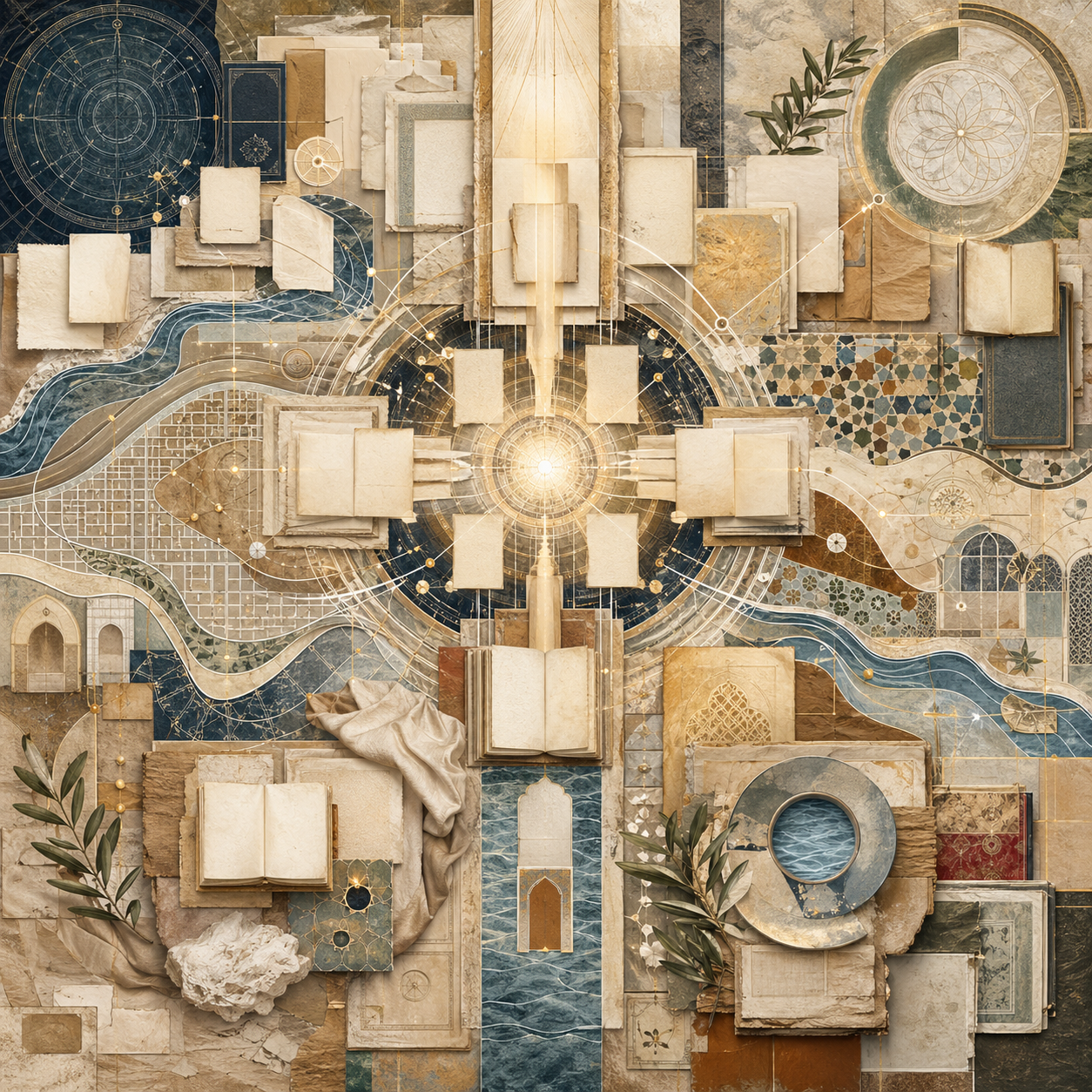
Islamic civilization should be approached as a historical world shaped by revelation but never reducible to perfection. It produced scholarship, law, hospitals, observatories, architecture, philosophy, poetry, urban life, trade networks, and devotional cultures of extraordinary depth. It also produced empire, hierarchy, enslavement, sectarian conflict, political violence, and institutional failure. A serious account must therefore avoid both triumphalist nostalgia and dismissive caricature. Islamic civilization is best studied as a human historical field under sacred moral claims: luminous because of what it carried, imperfect because human beings carried it, and world-historical because its languages, institutions, sciences, arts, and memories shaped regions far beyond Arabia.
Why Islamic Civilization Matters
Islamic civilization matters because it is one of the major formations through which religion, law, knowledge, empire, art, language, philosophy, science, commerce, and global memory were reorganized after late antiquity. It cannot be understood only as a religion in private belief, only as a political empire, only as a medieval scientific bridge, or only as a cultural identity. It is all of these and more: a civilization shaped by revelation, but extended through institutions, scholarship, cities, translation, governance, trade, art, literature, medicine, law, and spiritual discipline.
The historical scale is immense. From the Arabian Peninsula, Islamic civilization moved into Syria, Iraq, Egypt, Persia, North Africa, Central Asia, Iberia, Anatolia, the Indian Ocean world, sub-Saharan Africa, South Asia, Southeast Asia, and Europe. It produced Arabic, Persian, Turkish, Urdu, Malay, Swahili, and other Islamic literary cultures. It connected caravan routes, sea lanes, pilgrimage networks, scholarly lineages, manuscript cultures, legal schools, Sufi orders, hospitals, observatories, libraries, courts, markets, and households.
Islamic civilization also matters because it challenges simplified histories of knowledge. It did not merely “preserve Greek learning,” as if Muslim scholars were passive storage devices for later Europe. It selected, translated, criticized, expanded, reorganized, and transformed inherited knowledge from Greek, Syriac, Persian, Indian, and other traditions. Its scholars worked in medicine, optics, mathematics, astronomy, geography, pharmacology, philosophy, theology, grammar, law, history, literature, and ethics. Their work became part of world history, not as an appendix, but as a major intellectual current.
It also matters morally. Islamic civilization produced extraordinary knowledge and beauty, but it also contained political conflict, imperial ambition, hierarchy, enslavement, sectarian tension, social inequality, and institutional failure. A serious account should avoid both civilizational triumphalism and dismissive caricature. The question is not whether Islamic civilization was flawless. No civilization is. The question is how revelation, law, knowledge, and moral imagination shaped historical life, and how that inheritance can be understood with honesty, gratitude, and critique.
Islamic civilization also matters because modern global history cannot be told accurately without it. European intellectual history, African trade and scholarship, Indian Ocean mobility, Mediterranean exchange, Jewish and Christian Arabic cultures, Persianate courtly worlds, Ottoman governance, South Asian literature, and Southeast Asian Islam all bear its imprint. To study Islamic civilization is therefore not to study a sealed religious past. It is to study one of the great connective fabrics of world history.
What Is Islamic Civilization?
Islamic civilization refers to the historical worlds formed by Islam as revelation, worship, law, community, language, memory, institution, and culture. The term does not mean that every person in those worlds was Muslim, that every institution perfectly embodied Islam, or that a single uniform culture existed everywhere from Spain to India. It names a civilizational field in which the Qur’an, the Prophet, Arabic, Islamic law, ritual practice, political authority, scholarly institutions, and religious memory shaped public and private life in durable ways.
It is important to distinguish Islam as revelation from Islamic civilization as historical formation. Islam, in the theological sense, is submission to God and guidance through revelation. Islamic civilization is the historical world produced when communities attempted to live, transmit, interpret, govern, learn, build, trade, heal, teach, and remember under that guidance. The civilization is therefore both luminous and human: capable of knowledge and injustice, beauty and violence, reform and corruption, mercy and power.
Islamic civilization was also plural. Sunni, Shia, Ibadi, Sufi, philosophical, legal, theological, regional, linguistic, and political traditions developed across centuries. Arab, Persian, Berber, Turkic, Kurdish, African, South Asian, Southeast Asian, Balkan, Andalusian, and other cultures participated in it. Jews, Christians, Zoroastrians, Hindus, Buddhists, and others lived within or alongside Islamic polities in different ways depending on time and place. There was no single flat “Islamic world.” There were many Islamic worlds.
Yet the plural worlds shared certain reference points: the Qur’an, Muhammad, prayer, fasting, zakat, pilgrimage, Arabic liturgical language, legal reasoning, sacred history, moral accountability, and the memory of the ummah. These common forms allowed enormous diversity without complete fragmentation. Islamic civilization was therefore a unity of orientation, not a uniformity of culture.
The phrase “Islamic civilization” also requires ethical care because it can hide human difference. It can make elite scholarship stand in for ordinary life, court architecture stand in for poverty, imperial achievement stand in for local experience, and male scholarly archives stand in for women’s labor, patronage, learning, and vulnerability. A more responsible account asks how Islam shaped rulers and ruled, scholars and artisans, merchants and farmers, men and women, Muslims and non-Muslims, urban centers and rural worlds, formal institutions and household practices.
The Qur’anic Horizon of Knowledge
The Qur’an gives Islamic civilization its deepest horizon of knowledge. The first revelation is traditionally associated with the command to read or recite. The Qur’an repeatedly calls human beings to reflect, remember, observe, reason, travel, consider past nations, attend to signs in nature, and recognize the moral meaning of history. Knowledge is not merely technical mastery. It is the recognition of truth, guidance, justice, mercy, accountability, and the signs of God.
Qur’anic Text
اقْرَأْ بِاسْمِ رَبِّكَ الَّذِي خَلَقَ خَلَقَ الْإِنسَانَ مِنْ عَلَقٍ اقْرَأْ وَرَبُّكَ الْأَكْرَمُ الَّذِي عَلَّمَ بِالْقَلَمِ عَلَّمَ الْإِنسَانَ مَا لَمْ يَعْلَمْRead in the name of your Lord who created, created the human being from a clinging form. Read, and your Lord is most generous, who taught by the pen, taught the human being what he did not know.Qur’an 96:1–5. Arabic text with English rendering.
This passage joins recitation, creation, teaching, the pen, and human dependence on divine generosity. It gives Islamic knowledge a sacred horizon without reducing every field of inquiry to scriptural commentary.
This Qur’anic horizon shaped the civilization’s intellectual imagination. Creation became a field of signs. History became moral instruction. Law became disciplined guidance. Language became sacredly charged because revelation was recited in Arabic. Memory became a religious duty because revelation, Prophetic example, and communal practice had to be transmitted. Knowledge became an obligation because ignorance could distort worship, law, ethics, and social order.
The Qur’an also connects knowledge with humility. The knowing person is not merely the one who accumulates information, but the one who recognizes dependence on God. This matters because knowledge can become pride. Islamic civilization produced immense scholarship, but its most serious teachers repeatedly warned that knowledge without humility is spiritually dangerous. The scholar, physician, judge, theologian, philosopher, ruler, and poet all remain accountable before God.
The Qur’anic horizon therefore resists a narrow division between sacred and secular knowledge. Not every field of inquiry is scripture, and not every scientific claim is religious doctrine. But the pursuit of knowledge unfolds within a moral universe. The study of stars, bodies, numbers, language, law, history, and medicine can become part of a broader effort to understand order, benefit, responsibility, and creation.
At the same time, the Qur’anic horizon does not justify simplistic claims that all later Islamic science was directly derived from scripture. Islamic civilization learned from Greeks, Syriac Christians, Persians, Indians, Jews, local practitioners, artisans, physicians, and observational traditions. The Qur’an provided a moral and metaphysical orientation toward signs, knowledge, and accountability, while historical inquiry developed through translation, debate, experiment, commentary, institution, patronage, and craft.
Prophetic Memory and the Formation of a Knowledge Community
Islamic civilization was formed around Prophetic memory. Muhammad was not only the recipient of revelation; he was the teacher, judge, reciter, moral exemplar, community founder, and model of worship. The Qur’an came through him, but the community also remembered how he prayed, fasted, judged, forgave, taught, spoke, governed, and treated others. This memory became a foundation for law, ethics, spirituality, politics, and communal identity.
Hadith, sīrah, maghazi, legal reports, devotional memory, and scholarly transmission all emerged from the need to preserve Prophetic example. The science of hadith became one of the great knowledge disciplines of Islam because memory had to be examined, transmitted, classified, and protected from error. Chains of transmission became intellectual and spiritual structures. To know was often to know from whom one had received knowledge.
Prophetic memory also shaped the meaning of authority. The question was not only who ruled, but who transmitted the Prophet’s teaching faithfully. Jurists, hadith scholars, reciters, theologians, Sufis, historians, and teachers all claimed, in different ways, continuity with the Prophetic inheritance. Sunni and Shia traditions differed deeply over the structure of post-Prophetic authority, especially regarding the Companions, the caliphate, and the Ahl al-Bayt, but both treated Prophetic memory as indispensable.
This is why Islamic civilization was profoundly educational. The mosque, study circle, madrasa, library, household, court, hospital, Sufi lodge, and marketplace all became places where knowledge could be transmitted. Civilization formed around memory disciplined by method.
Prophetic memory also made character a form of knowledge. To know the Prophet was not only to know reports about him. It was to learn mercy, patience, justice, worship, trust, restraint, and concern for the vulnerable. The civilization’s knowledge institutions could therefore be judged by more than textual preservation. They could be judged by whether knowledge produced adab, humility, truthful speech, care for the poor, and accountability before God.
The Ummah as a Historical and Moral Community
The ummah is not simply a population. It is a moral community formed around revelation, worship, law, and responsibility. The early Muslim community in Madinah was not only a group of believers; it was a social order. It had prayer, charity, mutual obligation, treaties, conflict resolution, public trust, and norms of justice. This early community became the seed of a civilization.
The ummah also carried a universal horizon. Islam did not belong to one tribe, ethnicity, or territory. The Qur’an speaks to humanity, remembers prophets sent to different peoples, and calls human beings to know one another across nations and tribes. This universal claim helped Islam move beyond Arabia while still retaining the memory of its Arabian revelation and Prophetic origin.
Qur’anic Text
يَا أَيُّهَا النَّاسُ إِنَّا خَلَقْنَاكُم مِّن ذَكَرٍ وَأُنثَىٰ وَجَعَلْنَاكُمْ شُعُوبًا وَقَبَائِلَ لِتَعَارَفُوا ۚ إِنَّ أَكْرَمَكُمْ عِندَ اللَّهِ أَتْقَاكُمْO humankind, We created you from male and female and made you peoples and tribes so that you may know one another. Surely the most honored of you before God is the most reverent.Qur’an 49:13. Arabic text with English rendering.
The verse gives human plurality a moral horizon. Difference is not abolished; it is placed under mutual recognition and accountability before God.
Yet universal vision did not erase historical complexity. As Islam expanded, the ummah encountered older civilizations: Byzantine, Persian, Syriac, Coptic, Berber, Turkic, Indian, African, and Mediterranean worlds. Conversion was gradual and uneven. Arabic spread as a language of religion and administration in some regions, while Persian and other languages became major Islamic literary vehicles. Islamic civilization became a layered world, not a simple extension of Arabian culture.
The ummah’s moral challenge was always to join universality with justice. A community claiming revelation must not merely expand; it must govern, teach, protect, adjudicate, care, and remain accountable. The Qur’an’s moral demands do not disappear when a community becomes powerful. They become more urgent.
The ideal of the ummah also created tension between unity and diversity. Shared prayer, pilgrimage, law, and scripture gave Muslims a transregional consciousness, but local cultures, political rivalries, language differences, sectarian identities, and social hierarchies shaped lived reality. Islamic civilization grew through this tension: one orientation toward God, many historical forms of belonging.
The Early Caliphate: Governance, Qur’anic Preservation, and Public Order
The early caliphate was decisive for Islamic civilization because it connected Prophetic memory to institutions. After the death of Muhammad, the community faced questions of leadership, unity, public order, zakat, frontiers, preservation of revelation, and governance. The first generations did not merely inherit a religion; they had to organize a community under conditions of crisis, expansion, and internal strain.
One of the most important early acts was the collection and preservation of the Qur’an. The Qur’an had been recited, memorized, and written during the Prophet’s life, but the early community faced the need to preserve it in a stable written form. Later, under ‘Uthman, standard copies were sent to major centers, helping protect textual unity across a widening world. This act had enormous civilizational significance: the unity of the text helped anchor the unity of worship, law, recitation, scholarship, and memory.
The early caliphate also developed fiscal and public structures, including the collection of zakat as a central public duty. Zakat was not merely private charity. It was a religiously grounded mechanism of social solidarity, public obligation, and redistribution. The insistence that zakat remain a public duty shows how worship and social order were joined.
Governance by counsel, the position of the ruler, treatment of opponents, simplicity of life, and accountability became major themes in early Islamic political memory. Later history often fell short of these ideals, but the memory of the rightly guided caliphate remained powerful precisely because it represented a model in which leadership was supposed to serve revelation, justice, and the community rather than dynastic self-glorification.
The early caliphate also became a contested memory. Sunni and Shia traditions remembered succession, authority, the Companions, and the Ahl al-Bayt differently. These differences were not minor political details; they shaped theology, law, devotional memory, and communal identity. A serious account of Islamic civilization must therefore treat early governance as both formative and contested, a source of unity in Qur’anic preservation and a source of enduring disagreement over authority.
Arabic, Recitation, and the Scholarly Language of Civilization
Arabic became one of the central forces of Islamic civilization. It was the language of Qur’anic revelation, ritual recitation, legal reasoning, theology, grammar, commentary, and much early scholarship. Its role was not only ethnic or administrative. It was sacredly and intellectually charged. To study Arabic was to enter the language in which the Qur’an was recited and interpreted.
The rise of Arabic grammar, lexicography, rhetoric, philology, and literary criticism was therefore closely connected to revelation. Scholars studied language in order to understand scripture, preserve correct recitation, interpret law, classify poetry, and reason about meaning. Grammar was not a dry technical field detached from religion. It was part of the infrastructure of interpretation.
At the same time, Islamic civilization became multilingual. Persian developed into a major language of poetry, governance, philosophy, Sufism, historiography, and court culture. Turkish, Urdu, Malay, Swahili, Berber languages, and many others became vehicles of Islamic life. Arabic remained central for prayer and scripture, but Islamic civilization did not remain linguistically Arab alone.
This linguistic structure created a distinctive pattern: one sacred language at the center, many regional languages around it. Qur’anic Arabic unified the civilization liturgically and intellectually, while local languages allowed Islam to enter different societies with literary depth, emotional range, and cultural specificity.
Language also shaped authority. Those with Arabic learning could access scripture, law, and classical scholarship more directly, while those working in Persian, Turkish, Urdu, Malay, or Swahili translated Islamic meaning into local worlds. This movement created both richness and hierarchy. Islamic civilization’s multilingual life should therefore be studied as translation, adaptation, learning, power, poetry, and devotional expression all at once.
Law, Fiqh, Sharia, and Institutional Order
Islamic civilization was one of the great legal civilizations of world history. Fiqh developed as disciplined understanding of practical religious rulings, while sharia named the divine path of guidance. Together, law and moral order shaped worship, family, inheritance, contracts, commerce, charity, food, purity, public duties, courts, endowments, and communal life.
The legal schools preserved disciplined diversity. Hanafi, Maliki, Shafi‘i, Hanbali, Ja‘fari, Zaydi, Ibadi, and other traditions developed methods for deriving rulings from Qur’an, Sunnah, consensus, analogy, reason, custom, public interest, and transmitted authority. This legal plurality helped Islamic civilization adapt across regions while remaining tied to shared sources.
Institutions emerged around law. Judges, muftis, jurists, court officials, notaries, teachers, waqf administrators, market inspectors, and scholars all participated in the legal ordering of society. The waqf, or charitable endowment, became especially important because it funded mosques, schools, hospitals, fountains, libraries, orphan care, and public works. Law thus shaped not only courts but the physical and social fabric of cities.
Islamic law also created a civilizational ethics of ordinary life. The market was not merely economic. It was moral. Marriage was not merely private. It was contractual and ethical. Inheritance was not merely family custom. It was regulated by divine command and juristic method. Food, cleanliness, speech, debt, labor, and care for the vulnerable all entered the sphere of accountability. Civilization was built through repeated practical acts ordered by law and conscience.
At the same time, legal civilization could be uneven. Courts did not always protect the vulnerable. Patriarchal custom could distort legal ideals. Rulers could interfere with justice. Wealth could shape access to institutions. The legal tradition’s existence does not prove perfect justice in practice. It shows that Islamic civilization developed powerful tools for moral order, while human societies still had to struggle over how those tools were applied.
Cities, Mosques, Madrasas, Libraries, Hospitals, and Markets
Islamic civilization was urban as well as devotional. Cities such as Madinah, Damascus, Baghdad, Cairo, Cordoba, Kairouan, Fez, Bukhara, Samarkand, Nishapur, Isfahan, Istanbul, Delhi, Lahore, Timbuktu, and many others became centers of worship, administration, scholarship, trade, manuscript production, and cultural exchange. The city became a place where law, knowledge, worship, commerce, and social life were visibly intertwined.
The mosque was central, but it was not the only institution. It served as a place of prayer, teaching, gathering, judgment, recitation, and public memory. Madrasas became specialized institutions for legal and religious education, though their forms varied by region. Libraries preserved manuscripts. Hospitals developed as institutions of care, training, and medical practice. Markets connected local life with regional and long-distance trade.
The built environment often reflected moral and social priorities. Water systems, fountains, caravanserais, bridges, hospitals, schools, and endowments were not merely infrastructure. They were expressions of public responsibility. The waqf allowed private wealth to be dedicated to communal benefit, linking piety with durable institutions.
These institutions also show that Islamic civilization was not only a courtly or elite phenomenon. Ordinary worshipers, merchants, artisans, travelers, students, jurists, physicians, copyists, women patrons, Sufi communities, and local neighborhoods all shaped Islamic urban life. Civilization was made not only by rulers, but by repeated networks of learning, trust, labor, charity, and devotion.
The city also exposed moral contradictions. Markets could be sites of honest exchange or exploitation. Courts could protect rights or serve power. Hospitals could heal, while poverty remained. Libraries could preserve knowledge while access stayed unequal. Islamic urban history is therefore best read as moral possibility under human pressure: institutions built for worship, learning, and care, continually tested by wealth, politics, status, and social hierarchy.
The Translation Movement and the Reordering of Ancient Knowledge
The translation movement, especially associated with Abbasid Baghdad, was one of the major intellectual events in world history. Greek, Syriac, Persian, and Indian materials were translated, studied, debated, and transformed in Arabic. Works in philosophy, medicine, mathematics, astronomy, logic, natural philosophy, and other fields entered Islamic intellectual life through translation and commentary.
This was not passive preservation. Muslim, Christian, Jewish, Sabian, Persian, and other scholars participated in a multilingual intellectual world. They translated, corrected, interpreted, systematized, and expanded inherited materials. Greek authors such as Aristotle, Plato, Galen, Euclid, Ptolemy, and others entered new contexts. Indian numerals and mathematical techniques contributed to new developments. Persian administrative and cosmological traditions also played roles.
The translation movement was supported by courts, patrons, libraries, scholarly circles, and practical needs. Medicine, astronomy, administration, theology, calendrical calculation, geography, and philosophy all benefited from intellectual exchange. The resulting Arabic scholarly culture became a major engine of knowledge production.
It is important not to describe this movement as a simple bridge from Greece to Europe. That old narrative reduces Islamic civilization to a corridor. The Arabic intellectual world became a creative center in its own right. It developed questions, methods, syntheses, criticisms, and institutions that shaped knowledge internally and later influenced Latin, Hebrew, and other intellectual cultures.
The translation movement also complicates simplistic religious categories. Christian translators helped transmit Greek philosophy into Arabic. Muslim philosophers transformed inherited metaphysics. Jewish thinkers wrote in Arabic philosophical idioms. Patrons supported projects for political, practical, prestige, and intellectual reasons. Knowledge moved across boundaries because cities and courts created spaces where multiple communities, languages, and disciplines could interact, even within unequal political orders.
Falsafa, Theology, and Rational Inquiry
Falsafa, or Islamic philosophy, developed through engagement with Greek philosophical inheritance, especially Aristotle, Plato, late antique commentators, and Neoplatonic materials. Thinkers such as al-Kindi, al-Farabi, Ibn Sina, Ibn Rushd, and others explored metaphysics, logic, intellect, prophecy, ethics, political order, medicine, causality, and the structure of reality.
Falsafa did not exist outside Islamic civilization, even when some philosophers advanced claims that theologians disputed. Philosophers wrote in Arabic, debated prophecy, reason, creation, metaphysics, and the soul, and operated within a civilization shaped by Qur’an, law, theology, and political power. Their work cannot be reduced to either “Greek thought in Arabic clothing” or simple Islamic doctrine. It was a creative intellectual tradition.
Kalam and falsafa often debated one another. Theologians asked whether philosophical claims about the eternity of the world, divine knowledge, causality, or resurrection compromised revelation. Philosophers argued for the necessity of reasoned inquiry and metaphysical clarity. Al-Ghazali’s critique of the philosophers and Ibn Rushd’s defense of philosophy became famous markers of this debate, but the relationship was broader and more complex than opposition alone.
The next article, Falsafa and the Greek Inheritance in Islamic Civilization, can examine this intellectual world more fully. Here, falsafa matters because it shows Islamic civilization as a place where revelation and reason did not simply sit side by side. They argued, corrected, borrowed from, and challenged each other in ways that shaped the history of philosophy.
Falsafa also shows how Islamic civilization became a philosophical language-world. Concepts of being, necessity, possibility, intellect, soul, causality, prophecy, and happiness moved across Arabic, Persian, Hebrew, and Latin thought. The philosophical inheritance of Islam therefore belongs not only to Muslim intellectual history, but also to Jewish philosophy, Christian scholasticism, and the broader history of metaphysics.
Mathematics, Astronomy, Optics, Geography, and Scientific Inquiry
Islamic civilization produced major work in mathematics, astronomy, optics, geography, and related sciences. Scholars developed algebra, trigonometry, astronomical tables, instruments, observatories, geographical descriptions, cartographic traditions, and theories of vision. These fields were shaped by inherited knowledge, practical needs, and new inquiry.
Mathematics had practical and theoretical significance. It served inheritance calculation, commerce, architecture, astronomy, surveying, and intellectual inquiry. Algebra, associated especially with al-Khwarizmi, became one of the defining mathematical contributions of the Islamic world. The use and transmission of numerals and computational techniques helped reshape later global mathematics.
Astronomy was important for calendars, prayer times, qibla direction, astrology in some courtly contexts, and theoretical study of the heavens. Scholars created tables, improved instruments, debated Ptolemaic models, and established observatories. Islamic astronomy later influenced both Latin Europe and other regions, while also developing internal critiques and refinements.
Optics, especially through Ibn al-Haytham, became one of the most important areas of scientific inquiry. His work on vision, light, experiment, and mathematical analysis occupies a major place in the history of science. The later article on Optics, Astronomy, and Scientific Inquiry in the Islamic Golden Age can explore these developments in depth. Here, the key point is that scientific inquiry belonged to a civilizational world where mathematics, observation, philosophy, medicine, and theology all interacted.
The phrase “Islamic science” should be used carefully. It does not mean that every scientific claim was religious doctrine, or that scientific work was always motivated by theology alone. It means that scientific inquiry occurred within societies shaped by Islamic institutions, languages, patrons, practical needs, moral assumptions, and intellectual debates. The sciences were neither isolated from religion nor reducible to religion. They were part of a broader knowledge ecology.
Medicine, Healing, and the Ordering of Natural Knowledge
Medicine was one of the great knowledge traditions of Islamic civilization. It drew on Greek, Persian, Indian, Syriac, and local materials, but developed distinctive institutions, encyclopedias, pharmacology, hospitals, clinical observation, ethical reflection, and medical teaching. Physicians such as al-Razi, Ibn Sina, al-Zahrawi, Ibn al-Nafis, and others became major figures in world medical history.
Islamic medicine was not only theoretical. Hospitals, pharmacies, medical manuals, surgical instruments, case observations, and public-health concerns all played roles. Medicine existed at the intersection of natural philosophy, bodily care, moral duty, and institutional life. The physician needed knowledge, but also ethical responsibility.
Ibn Sina’s Canon of Medicine became one of the most influential medical texts in world history, studied in Islamic lands and later in Latin Europe. Al-Razi’s clinical work, al-Zahrawi’s surgery, and later developments in anatomy, pharmacology, and hospitals show that medicine was a major civilizational science, not an isolated specialty.
The later article on Islamic Medicine and the Ordering of Natural Knowledge can explore these themes more fully. In this civilizational overview, medicine matters because it shows how knowledge, care, classification, observation, and public institutions could be joined in an Islamic world shaped by both inherited science and moral responsibility.
Medicine also reveals the civilization’s practical humanism. Healing required attention to bodies, pain, diet, environment, pharmacology, surgery, mental distress, and institutional care. It was not enough to possess texts. Physicians had to observe, compare, treat, teach, and sometimes admit uncertainty. Medical knowledge therefore shows Islamic civilization at one of its most concrete points: learning ordered toward the relief of suffering.
Art, Architecture, Geometry, and the Beauty of Order
Islamic art and architecture reveal how beauty, discipline, and sacred imagination entered material form. Qur’anic manuscripts, calligraphy, geometric ornament, arabesque, ceramics, textiles, metalwork, gardens, mosques, madrasas, palaces, tombs, fountains, and urban spaces all expressed forms of order, memory, proportion, and refinement.
Calligraphy became central because revelation is recited and written. The visual treatment of script reflected reverence for the word, though calligraphy itself must not be confused with revelation. Geometry became a powerful visual language because it could suggest order, unity, multiplicity, rhythm, and infinity without depicting God. Gardens, water, and architecture often evoked mercy, paradise, shade, and rest.
Islamic art should not be reduced to aniconism alone. Different Muslim societies handled figural representation differently depending on context, medium, time, and patronage. Sacred spaces tended strongly toward non-figurative forms, while manuscripts and courtly arts sometimes included figures. The civilizational pattern is complex, and serious study should avoid simplistic claims.
Beauty in Islamic civilization was disciplined. Manuscripts required copying, geometry required mathematical order, architecture required engineering, recitation required training, and gardens required water management. Beauty was not mere decoration. It was ordered labor, craft, knowledge, and reverence given form.
Art and architecture also show how civilization forms perception. A courtyard teaches proportion. A fountain teaches mercy through water and shade. A dome draws attention upward. A manuscript trains the eye to honor the written word. A geometric field suggests order beyond the ego. These forms are not arguments, but they shape the imagination. They make beauty part of lived religious and social space.
Trade, Travel, Pilgrimage, and Global Mobility
Islamic civilization was mobile. Merchants, pilgrims, scholars, jurists, Sufis, diplomats, physicians, sailors, soldiers, artisans, and travelers connected regions across land and sea. The pilgrimage to Mecca created a recurring global gathering that linked distant communities to a shared sacred center. Trade routes connected the Mediterranean, Red Sea, Persian Gulf, Indian Ocean, East Africa, Central Asia, South Asia, Southeast Asia, and beyond.
Travel was also intellectual. Scholars traveled to hear hadith, study law, visit teachers, collect books, debate theology, learn medicine, seek patronage, or join Sufi circles. Chains of transmission were often geographic as well as intellectual. A scholar’s authority could depend on where and from whom knowledge had been received.
Trade helped spread Islam in many regions, especially where merchants and Sufi networks established trust, ethical reputation, intermarriage, patronage, and community. Conversion was often gradual, social, and regional rather than sudden. In places such as West Africa, East Africa, South Asia, and Southeast Asia, Islam entered local worlds through trade, scholarship, courts, devotional practice, and adaptation.
Mobility also produced cosmopolitanism and tension. Commercial exchange could generate wealth and knowledge, but also inequality, enslavement, and imperial competition. Pilgrimage could unify, but also expose differences. Travel opened worlds, but also carried conflict. Islamic world history must attend to both connection and contradiction.
Mobility made Islamic civilization less a single territory than a network of routes. A manuscript copied in one city might be studied in another. A scholar trained in Central Asia might teach in the Hijaz. A legal opinion might travel with merchants. A devotional practice might move through a Sufi order. A medical text might circulate through Arabic, Hebrew, and Latin. Civilization moved because people moved.
Plural Societies: Jews, Christians, Muslims, and Shared Urban Worlds
Islamic civilization often included plural religious societies. Jews, Christians, Zoroastrians, Sabians, Hindus, Buddhists, and others lived under Muslim rule in different regions and periods. Their status, rights, restrictions, opportunities, and vulnerabilities varied significantly depending on political context, legal interpretation, local custom, and social conditions.
Jews and Christians played especially important roles in many Islamic urban worlds. They participated in translation, medicine, commerce, administration, philosophy, literature, and scholarship. Syriac Christian translators were crucial in the transmission of Greek knowledge into Arabic. Jewish philosophers and physicians wrote in Arabic and participated in shared intellectual worlds. Moses Maimonides, for example, wrote major works in Judeo-Arabic and served in a Muslim-ruled context.
This does not mean that Islamic plural societies were modern liberal democracies or free of hierarchy. The dhimma system involved protection and restriction. Non-Muslims could flourish in some periods and suffer in others. The historical record includes cooperation, patronage, shared scholarship, polemic, discrimination, protection, vulnerability, and coexistence. A serious account should neither idealize nor demonize.
For Abrahamic study, the key point is that Islam did not develop in isolation from Jews and Christians. Arabic-speaking Jews, Christians, and Muslims shared language, philosophical vocabulary, scriptural debates, urban spaces, and intellectual concerns. The word Allah itself was and remains the Arabic word for God used by Arabic-speaking Muslims, Christians, and Jews. Differences were real, but so was civilizational entanglement.
Plural societies also show how knowledge depends on shared institutions. Translation circles, hospitals, courts, markets, and philosophical debates often required cooperation across religious boundaries. These collaborations did not erase inequality or polemic, but they complicate modern narratives that imagine religious civilizations as sealed camps. Islamic civilization was shaped by encounter, borrowing, debate, and proximity as much as by internal development.
Regional Worlds: Arab, Persianate, African, Ottoman, South Asian, and Southeast Asian Islam
Islamic civilization became global because it became regional. It did not remain identical everywhere. Arab Islam preserved the language and memory of revelation. Persianate Islam developed powerful traditions of poetry, court culture, philosophy, Sufism, administration, and literary refinement. Turkic Islam shaped Central Asia, Anatolia, the Ottoman world, and beyond. African Islam developed scholarly, commercial, legal, and Sufi traditions across North Africa, the Sahara, West Africa, East Africa, and the Swahili coast.
South Asian Islam produced immense intellectual, literary, legal, architectural, devotional, and political traditions, from Delhi and Lahore to Bengal and the Deccan. Urdu, Persian, Arabic, Punjabi, Bengali, Sindhi, and other languages carried Islamic knowledge and poetry. Southeast Asian Islam developed through trade, courts, scholars, Sufi networks, Malay literature, and local adaptation, becoming one of the world’s largest Muslim regions.
The Ottoman, Safavid, and Mughal worlds show how Islamic civilization took imperial forms in early modern history. Each developed distinctive relationships between law, scholarship, kingship, art, architecture, military power, religious authority, and plural populations. Their histories cannot be reduced to a single civilizational pattern.
This regional diversity matters because “Islamic civilization” is not one ethnic story. It is a network of sacred orientation and historical creativity. The Qur’an is one, but its civilizational life has moved through many languages, landscapes, legal cultures, artistic forms, and political conditions.
Regional diversity also means that Islamic civilization should not be narrated only through Baghdad, Cairo, Damascus, Cordoba, or Istanbul. Timbuktu, Bukhara, Samarkand, Delhi, Lahore, Aceh, Zanzibar, Fez, Isfahan, Sarajevo, and countless smaller centers also matter. Some regions were shaped by courts, others by trade, Sufi lodges, rural scholars, manuscript networks, or pilgrimage routes. A global account must let Islam’s many geographies speak.
Knowledge, Power, Empire, and Ethical Ambiguity
Knowledge and power were never separate in Islamic civilization. Courts patronized scholars, translators, poets, physicians, astronomers, jurists, and historians. Rulers built mosques, libraries, hospitals, madrasas, and observatories. Patronage made scholarship possible, but it also created ethical danger. Knowledge could serve truth, but it could also serve prestige, propaganda, empire, or courtly ambition.
Islamic scholars often debated the proper relationship between knowledge and rulers. Some served courts. Others avoided rulers. Some advised power. Others criticized it. The jurist, theologian, Sufi, and historian all faced the question: how can knowledge remain truthful when power offers wealth, protection, and influence?
Empire also complicates civilizational memory. Islamic empires produced institutions, art, scholarship, roads, cities, and order. They also produced war, taxation, hierarchy, coercion, enslavement, and political violence. A morally serious article must hold both realities. To study Islamic civilization is not to pretend that Muslim rule was always just. It is to ask how ideals of justice, mercy, and accountability interacted with the pressures of power.
The Qur’an’s warnings against arrogance, corruption, and injustice apply to Muslim civilizations as much as to any others. Sacred identity does not excuse abuse. Indeed, it increases accountability. Islamic civilization should be honored where it produced knowledge and mercy, critiqued where it violated justice, and studied as a human historical field under divine moral claims.
This ethical ambiguity is not a reason to dismiss the civilization. It is a reason to study it honestly. A tradition that produced legal maxims about harm, theological debates about justice, Sufi warnings against ego, and Qur’anic commands against oppression gives its own tools for critique. Civilizational loyalty should not mean denial. It should mean the courage to measure historical power against the moral claims it professed.
Transmission, Translation, and the Making of World History
Islamic civilization played a major role in the transmission and transformation of knowledge into medieval and early modern Europe. Arabic works in philosophy, medicine, mathematics, astronomy, optics, and natural philosophy were translated into Latin and Hebrew, especially through centers such as Toledo, Sicily, southern Italy, and other contact zones. European scholasticism, medicine, astronomy, and philosophy were shaped in part by Arabic and Islamic intellectual materials.
Latin readers encountered Aristotle through Arabic commentaries, medicine through Ibn Sina and al-Razi, optics through Ibn al-Haytham, philosophy through al-Farabi, Ibn Sina, and Ibn Rushd, and mathematics through Arabic developments. Jewish scholars also played major roles in translation and transmission, often moving between Arabic, Hebrew, and Latin worlds.
This transmission should not be described as Europe merely receiving a preserved Greek inheritance. Europe encountered a transformed body of knowledge: Greek materials filtered through Arabic translation, Islamic debate, original commentary, mathematical innovation, medical synthesis, and philosophical criticism. The intellectual history of Europe is therefore entangled with Islamic civilization.
World history becomes more accurate when Islamic civilization is placed at the center of Afro-Eurasian exchange rather than at the margins of a Europe-centered narrative. The movement of knowledge across Arabic, Persian, Hebrew, Latin, Sanskrit, Syriac, and other languages shows that civilization is not owned by one people. Knowledge travels, changes, and creates new worlds.
Transmission also moved in many directions, not only from Islam to Europe. Islamic civilization received from late antiquity, India, Persia, local craft traditions, and neighboring cultures; transformed those inheritances; transmitted them onward; and continued to develop internally. A mature world history does not treat civilizations as isolated containers. It studies routes, translations, arguments, institutions, and the labor of people who made knowledge portable.
Colonial Modernity, Reform, and the Question of Renewal
Modern Islamic civilization was deeply affected by colonialism, military defeat, economic restructuring, European imperial expansion, missionary polemic, modern nationalism, print culture, secular education, new legal systems, and global capitalism. The older institutional ecology of scholars, courts, waqfs, madrasas, Sufi orders, guilds, and local authorities was disrupted in many regions.
Muslim reformers responded in different ways. Some called for return to Qur’an and Sunnah. Some emphasized legal reform. Some defended tradition. Some promoted modern education and science. Some resisted colonial power through religious revival. Some reimagined political authority. Some sought interfaith dialogue. Some turned toward nationalism, Islamism, modernism, traditionalism, or spiritual renewal.
The Lahore Ahmadiyya tradition belongs within this broader modern reform landscape, especially through its emphasis on Qur’an-centered interpretation, rational scriptural analysis, defense of Islam against polemic, interfaith openness, and renewal through scholarship rather than new law-bearing revelation. Within this lens, modern Islamic renewal is not the invention of a new religion. It is a return to the Qur’an’s moral, rational, and spiritual force under modern conditions.
Modernity also raises new civilizational questions: science and faith, gender and law, democracy and authority, human rights and tradition, ecology and stewardship, finance and ethics, migration and minority life, digital knowledge and religious authority. Islamic civilization continues not as a museum of the past, but as a living field of interpretation, struggle, memory, and reform.
Colonial modernity also reshaped how Muslims and non-Muslims narrated Islamic history. European accounts often framed Islamic civilization as decline, despotism, fanaticism, or mere preservation. Some Muslim responses reversed the narrative into golden-age nostalgia. Both can obscure the complexity of actual history. Renewal requires more than pride or apology. It requires truthful scholarship, moral courage, institutional imagination, and humility before God.
Islamic Civilization in Abrahamic Study
Islamic civilization is indispensable for Abrahamic study because it shows how revelation can become a complete civilizational order: scripture, recitation, law, theology, philosophy, ethics, art, medicine, education, governance, trade, and spiritual discipline. Judaism, Christianity, and Islam all produced civilizations of text, law, commentary, worship, memory, and institution, but they did so in different ways.
Judaism developed rabbinic law, synagogue life, commentary, philosophical theology, mystical traditions, diaspora networks, and textual communities under many political conditions. Christianity developed church institutions, creeds, canon law, monasticism, universities, sacramental theology, empire, missions, and global denominations. Islam developed Qur’anic recitation, Hadith sciences, fiqh, sharia, kalam, Sufism, madrasas, translation movements, philosophy, medicine, and wide transregional networks.
Comparison should clarify without flattening. Islamic civilization is not simply “the Islamic version” of Christendom or rabbinic Judaism. It has its own center: Qur’an, Muhammad, tawhid, recitation, ummah, sharia, fiqh, and Prophetic memory. Yet it shares Abrahamic concerns with revelation, law, mercy, judgment, sacred history, worship, and the ordering of life before God.
The shared use of the word Allah among Arabic-speaking Muslims, Christians, and Jews is especially important for this series. It reminds readers that Abrahamic traditions are not sealed civilizational containers. They share languages, scriptures, debates, cities, philosophical questions, and moral concerns. Their differences matter, but they unfold within a connected field of sacred history.
Islamic civilization also helps correct a narrow “Judeo-Christian versus Islam” framing. Historically, Arabic-speaking Jews and Christians lived, wrote, prayed, debated, translated, and philosophized in Islamic lands. Muslim theologians argued with Christian doctrine, Jewish philosophers wrote in Arabic, and shared urban cultures produced both cooperation and polemic. Abrahamic study becomes richer when it studies real entanglement rather than imagined separation.
Why This Article Matters
Islamic civilization, knowledge, and world history matter because they show Islam as a complete historical force: revelatory, legal, theological, spiritual, intellectual, artistic, institutional, and global. The Qur’an was recited in Arabia, but its civilizational life moved across continents. The Prophet formed an ummah, but that ummah developed cities, schools, courts, libraries, hospitals, trade routes, manuscripts, philosophical debates, devotional traditions, and scientific inquiry.
This article also matters because Islamic civilization is often misunderstood. Some reduce it to empire and conflict. Others romanticize it as a golden age without contradiction. Some treat it as a passive transmitter of Greek knowledge. Others isolate science from religion, as if Islamic intellectual life developed despite the civilization’s sacred foundations rather than within its complex moral and institutional world. A serious account must resist these simplifications.
Islamic civilization matters for world history because it connected regions, preserved and transformed knowledge, generated institutions, shaped global trade, influenced Europe, Africa, Asia, and the Mediterranean, and created enduring traditions of law, philosophy, medicine, art, and spirituality. Its history belongs not only to Muslims, but to humanity’s shared intellectual and moral inheritance.
For the Abrahamic Traditions knowledge series, this article marks a turn from Islam’s internal foundations to Islam’s civilizational expression. The Qur’an is revelation. Hadith preserves Prophetic memory. Sīrah narrates sacred biography. Fiqh orders life. Sharia names the divine path. Kalam clarifies belief. Sufism cultivates the interior life. Mercy, beauty, and discipline synthesize the moral-spiritual grammar of Islam. Islamic civilization shows how those foundations entered cities, languages, law, sciences, arts, medicine, philosophy, institutions, and global exchange.
The next articles can move into more focused intellectual histories: Falsafa and the Greek Inheritance in Islamic Civilization, Islamic Medicine and the Ordering of Natural Knowledge, and Optics, Astronomy, and Scientific Inquiry in the Islamic Golden Age. Those articles will show in greater detail how Islamic civilization transformed philosophy, healing, mathematics, observation, and the sciences of nature.
The deepest value of this article is that it restores proportion. Islamic civilization was neither pure empire nor pure spirituality, neither mere preservation nor isolated genius, neither flawless golden age nor failure. It was a vast human effort to live, think, build, translate, govern, heal, trade, write, pray, and remember under the shadow of revelation. Its history deserves admiration, critique, and serious study because it remains one of the great knowledge formations of world history.
Related Reading
- Abrahamic Traditions: Prophecy, Revelation, Law, and Sacred History
- The Qur’an: Revelation, Recitation, Guidance, and Sacred History
- The History of the Prophets in the Qur’anic Tradition
- The Prophet Muhammad and the Formation of the Ummah
- Hadith and the Preservation of Prophetic Memory
- Sīrah and the Sacred History of Early Islam
- Fiqh and the Ordering of Muslim Life
- Sharia, Mercy, and Moral Order
- Kalam, Tawhid, and Islamic Theology
- Sufism, Ihsan, and the Interior Life of Islam
- Jihad al-Nafs: Inner Struggle, Moral Discipline, and the Greater Jihad
- Islamic Aphoristic Wisdom and the Discipline of the Heart
- Mercy, Beauty, and Discipline in the Islamic Tradition
- Falsafa and the Greek Inheritance in Islamic Civilization
- Islamic Medicine and the Ordering of Natural Knowledge
- Optics, Astronomy, and Scientific Inquiry in the Islamic Golden Age
Further Reading
- Ahmed, S. (2016) What Is Islam? The Importance of Being Islamic. Princeton: Princeton University Press. Available at: https://press.princeton.edu/
- Armstrong, K. (2000) Islam: A Short History. New York: Modern Library. Available at: https://www.penguinrandomhouse.com/
- Berkey, J.P. (2003) The Formation of Islam: Religion and Society in the Near East, 600–1800. Cambridge: Cambridge University Press. Available at: https://www.cambridge.org/
- Bulliet, R.W. (2004) The Case for Islamo-Christian Civilization. New York: Columbia University Press. Available at: https://cup.columbia.edu/
- Denny, F.M. (2015) An Introduction to Islam. 4th edn. London: Routledge. Available at: https://www.routledge.com/
- El-Rouayheb, K. and Schmidtke, S. (eds.) (2017) The Oxford Handbook of Islamic Philosophy. Oxford: Oxford University Press. Available at: https://academic.oup.com/edited-volume/28084
- Esposito, J.L. (ed.) (2000) The Oxford History of Islam. Oxford: Oxford University Press. Available at: https://global.oup.com/academic/
- Glick, T.F., Livesey, S.J. and Wallis, F. (eds.) (2014) Medieval Science, Technology, and Medicine: An Encyclopedia. London: Routledge. Available at: https://www.routledge.com/
- Gutas, D. (1998) Greek Thought, Arabic Culture: The Graeco-Arabic Translation Movement in Baghdad and Early ‘Abbasid Society. London: Routledge. Available at: https://www.routledge.com/
- Hillenbrand, R. (1994) Islamic Architecture: Form, Function and Meaning. Edinburgh: Edinburgh University Press. Available at: https://edinburghuniversitypress.com/
- Hodgson, M.G.S. (1974) The Venture of Islam: Conscience and History in a World Civilization. 3 vols. Chicago: University of Chicago Press. Available at: https://press.uchicago.edu/
- Kennedy, H. (2016) The Prophet and the Age of the Caliphates: The Islamic Near East from the Sixth to the Eleventh Century. 3rd edn. London: Routledge. Available at: https://www.routledge.com/
- Lapidus, I.M. (2014) A History of Islamic Societies. 3rd edn. Cambridge: Cambridge University Press. Available at: https://www.cambridge.org/
- Lyons, J. (2009) The House of Wisdom: How Arabic Science Saved Ancient Knowledge and Gave Us the Renaissance. New York: Bloomsbury Press. Available at: https://www.bloomsbury.com/
- Morgan, D.O. and Reid, A. (eds.) (2010) The New Cambridge History of Islam. Cambridge: Cambridge University Press. Available at: https://www.cambridge.org/core/series/new-cambridge-history-of-islam/5A8C9D88AA73B37939ED5C7F1403F660
- Nasr, S.H. (2002) The Heart of Islam: Enduring Values for Humanity. New York: HarperOne. Available at: https://www.harpercollins.com/
- Robinson, C.F. (ed.) (2010) The New Cambridge History of Islam, Volume 1: The Formation of the Islamic World, Sixth to Eleventh Centuries. Cambridge: Cambridge University Press. Available at: https://www.cambridge.org/
- Saliba, G. (2007) Islamic Science and the Making of the European Renaissance. Cambridge, MA: MIT Press. Available at: https://mitpress.mit.edu/
References
- Ali, M.M. (1999) The Early Caliphate. Columbus, OH: Ahmadiyya Anjuman Isha‘at Islam Lahore. Available at: https://www.alahmadiyya.org/books-islam-ahmadiyya/english-books/the-early-caliphate-maulana-muhammad-ali/
- Ali, M.M. (2010) English Translation of the Holy Quran with Explanatory Notes. Edited by Z. Aziz. Wembley: Ahmadiyya Anjuman Lahore Publications. Available at: https://www.alahmadiyya.org/quran/english-trans-quran-2010.pdf
- Ali, M.M. (n.d.) History of the Prophets. Ahmadiyya Anjuman Isha‘at Islam Lahore. Available at: https://alahmadiyya.org/books-islam-ahmadiyya/english-books/history-prophets-maulana-muhammad-ali/
- Al-Khwarizmi, M.I.M. (n.d.) The Compendious Book on Calculation by Completion and Balancing. Historical editions and translations available through academic libraries and archive collections.
- Al-Razi, A.B.M. (n.d.) Medical and Philosophical Works. Historical editions and translations available through academic libraries.
- Al-Zahrawi, A.Q. (n.d.) Al-Tasrif. Historical editions and translations available through academic libraries.
- Britannica (n.d.) House of Wisdom. Available at: https://www.britannica.com/topic/House-of-Wisdom
- Britannica (n.d.) Islamic World. Available at: https://www.britannica.com/place/Islamic-world
- Ibn al-Haytham, A.A. (n.d.) Kitab al-Manazir / Book of Optics. Historical editions and translations available through academic libraries.
- Ibn Sina, A.A. (n.d.) Al-Qanun fi al-Tibb / The Canon of Medicine. Historical editions and translations available through academic libraries.
- Library of Congress (n.d.) Islamic Manuscripts. Available at: https://www.loc.gov/collections/
- Metropolitan Museum of Art (n.d.) Islamic Art and the Art of the Islamic World. Heilbrunn Timeline of Art History. Available at: https://www.metmuseum.org/toah/
- Quran.com (n.d.) Surah Al-‘Alaq 96:1–5. Available at: https://quran.com/96/1-5
- Quran.com (n.d.) Surah Al-Baqarah 2:213. Available at: https://quran.com/2/213
- Quran.com (n.d.) Surah Al-Anbiya 21:107. Available at: https://quran.com/21/107
- Quran.com (n.d.) Surah Al-Nahl 16:90. Available at: https://quran.com/16/90
- Quran.com (n.d.) Surah Al-Hujurat 49:13. Available at: https://quran.com/49/13
- Quran.com (n.d.) Surah Al-Hadid 57:25. Available at: https://quran.com/57/25
- Quran.com (n.d.) Surah Al-Mujadilah 58:11. Available at: https://quran.com/58/11
- Stanford Encyclopedia of Philosophy (2023) Arabic and Islamic Philosophy. Available at: https://plato.stanford.edu/entries/arabic-islamic-philosophy/
- Sunnah.com (n.d.) Hadith of the Prophet Muhammad. Available at: https://sunnah.com/
- UNESCO (n.d.) Memory of the World Register and Islamic Manuscript Heritage Resources. Available at: https://www.unesco.org/en/memory-world