
Last Updated August 4, 2026
Freshwater change matters for development because water is not merely one sector among others. It is one of the material conditions through which food production, health, sanitation, energy, ecosystems, settlement, and economic life become possible. Development depends not only on having water somewhere in the system, but on having hydrological conditions stable enough to support households, cities, agriculture, ecosystems, and infrastructure over time. When those conditions shift through drought, flood, declining soil moisture, altered streamflow, degraded freshwater ecosystems, glacier loss, groundwater depletion, or worsening water quality, development becomes harder to secure and more vulnerable to reversal.
Freshwater change is therefore not simply a water-management concern. It is a development-risk framework. It asks whether the hydrological systems that sustain human capability, public health, food security, ecological resilience, and long-run habitability remain stable, safe, and governable enough for development to endure.
Main Library
Publications
Article Map
Sustainable Development
Related Topic
Planetary Boundaries
Related Topic
Risk & Resilience
Related Topic
Environmental Science
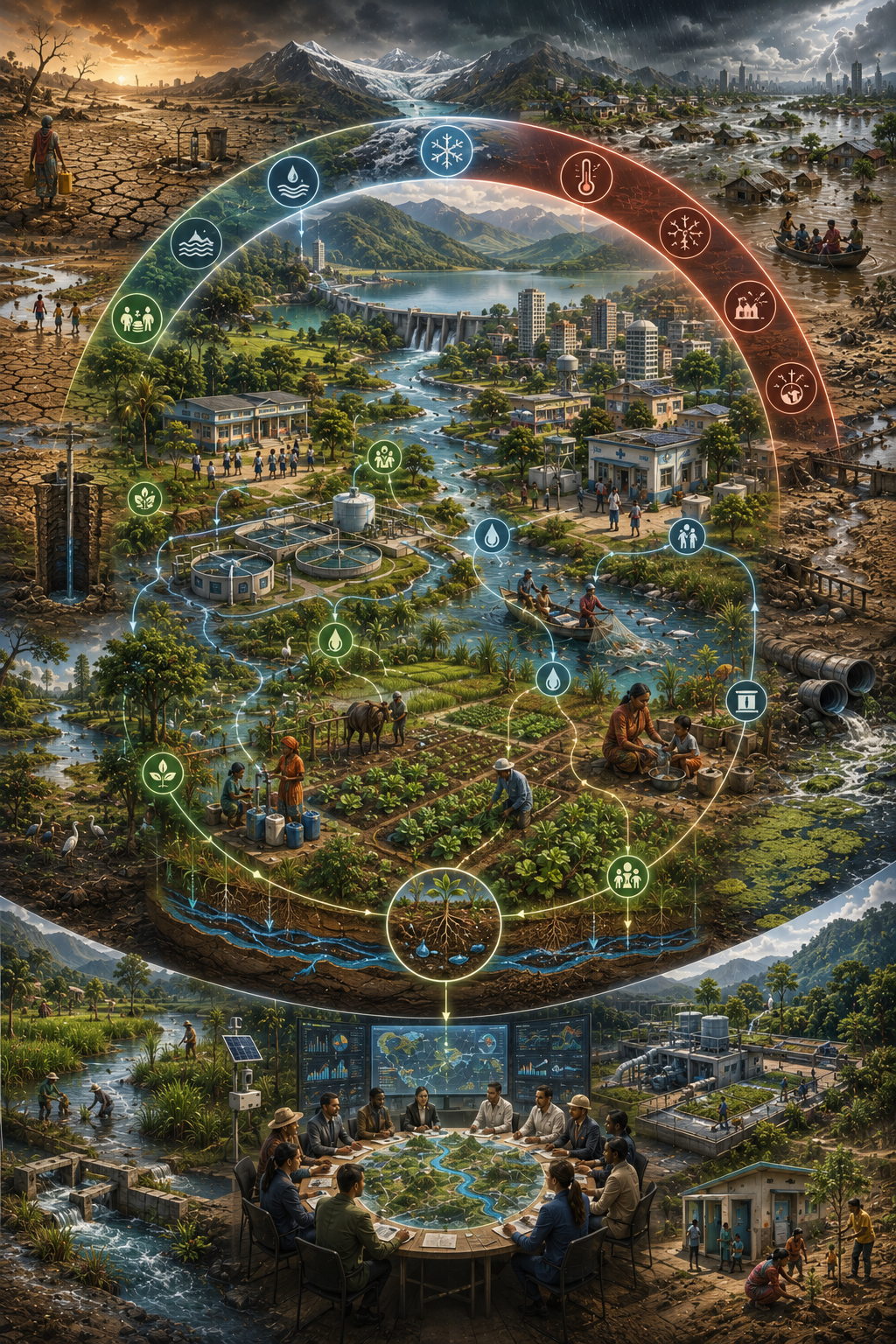
The 2030 Agenda places water near the center of sustainable development through Goal 6, which calls for ensuring availability and sustainable management of water and sanitation for all. But the broader significance of water in the Agenda extends well beyond Goal 6. Water conditions shape health, food security, cities, infrastructure, livelihoods, ecosystems, energy systems, disaster risk, and resilience across the wider SDG architecture. This matters because water cannot be treated as a self-contained service domain. It is a cross-cutting condition of human development itself.
The planetary-boundaries framework sharpens this developmental meaning. The updated freshwater boundary concluded that freshwater change is one of the transgressed planetary boundaries, and the newer framework makes clear that the problem includes both blue water and green water. Blue water refers broadly to surface water and groundwater flows, while green water concerns root-zone soil moisture available to plants. This is conceptually important because it widens the understanding of freshwater from extraction and withdrawals alone to the broader hydrological changes that shape ecosystem stability, agricultural resilience, and human development.
The latest official reporting reinforces the urgency of this broader framing. The 2026 Sustainable Development Goals assessment reports that by 2024, 74 per cent of the global population used safely managed drinking-water services, 58 per cent used safely managed sanitation, and 80 per cent had basic hygiene services. Yet around 10 per cent of the global population still lives in countries with high or critical water stress, nearly half of countries experienced declining minimum river flows during 2019–2023, and major financing and monitoring gaps continue to limit implementation. The 2026 United Nations World Water Development Report emphasizes equal rights and opportunities in water governance and reports that 2.1 billion people still lack safely managed drinking water, while women and girls spend an estimated 250 million hours each day collecting water. WMO’s latest global water-resources assessment adds that only about one third of river basins had normal conditions in 2024 and that every glacier region recorded mass loss for a third consecutive year.
What Freshwater Change Means
Freshwater change is a broader and more developmentally meaningful concept than water shortage alone. It refers not only to whether enough freshwater is withdrawn, stored, or delivered through infrastructure, but to whether the hydrological conditions that support life and society are being altered in ways that increase instability or degrade resilience. This includes changes in streamflow, groundwater systems, soil moisture, water quality, glacier-fed supply, drought intensity, flood regimes, wastewater burden, ecosystem function, and the timing and reliability of water availability.
This matters because development risk often appears not only when water disappears entirely, but when water becomes less predictable, more unevenly distributed, more polluted, or less biologically and socially usable. A society can face freshwater risk through chronic drought, recurrent flooding, falling groundwater, declining glacier mass, wastewater overload, ecosystem collapse, reduced root-zone soil moisture, or weakening institutional capacity, even if aggregate water figures appear manageable. Freshwater change therefore better captures the instability of water conditions than a narrower consumption metric alone.
Water scarcity remains important, but scarcity is only one expression of freshwater stress. Flooding can be just as developmentally destructive as drought. Polluted water can exist in abundance but remain unsafe. Groundwater can support growth for decades before depletion becomes visible. Glacier retreat can temporarily increase flows while weakening long-term reliability. Soil moisture loss can reduce agricultural resilience even where rivers still flow. Freshwater change captures this wider instability.
In development terms, the concept is powerful because it shifts attention from water as a static resource to water as a changing system condition. Development depends on water that is available, usable, reliable, safe, ecologically functional, and governed over time. It is precisely the destabilization of those conditions that makes freshwater change such a serious development risk.
Freshwater change therefore belongs inside development analysis because it affects the material setting in which households, cities, farms, ecosystems, infrastructure, and public systems operate. Water is not merely supplied to development. It helps constitute the conditions under which development can occur.
Why Water Is a Development Condition
Water is a development condition because human societies depend on it across nearly every major domain of life. Basic human needs such as drinking water, sanitation, hygiene, and disease prevention depend on reliable freshwater systems. Food production depends on rainfall, soil moisture, irrigation, groundwater, and watershed stability. Cities depend on water supply, drainage, wastewater treatment, flood protection, and infrastructure maintenance. Energy systems often depend on hydropower, cooling water, or mountain-fed flows. Industry, ecosystems, and households all operate within hydrological systems that cannot simply be assumed stable.
This is why Goal 6 cannot be understood as a narrowly technical SDG. Water availability and water governance shape the viability of many other development outcomes. Recent SDG 6 reporting is especially direct on this point: water systems are under strain from pollution, water stress, weak governance, declining freshwater ecosystems, limited transboundary cooperation, and slow progress toward sustainable water management. Water is therefore not only an output of development policy. It is one of the enabling conditions of development itself.
Water also links public systems together. Schools need safe drinking water and sanitation. Clinics need reliable supply and wastewater management. Agriculture needs moisture and irrigation. Housing needs drainage and service connections. Urban planning needs flood protection. Energy systems need water reliability. Disaster risk reduction depends on watersheds, warnings, storage, and infrastructure. The failure of water systems can therefore cascade across development systems.
This cross-cutting character is why water cannot be reduced to household access alone, even though household access is essential. Development also depends on watershed governance, ecological function, pollution control, hydrological monitoring, infrastructure maintenance, agricultural water use, climate adaptation, and transboundary cooperation. These are not separate topics; they are parts of one hydrological development system.
To understand freshwater change as development risk is therefore to recognize that hydrology is not background infrastructure alone. It is part of the material architecture through which human capability, public health, food security, economic life, and long-run resilience are secured. This section aligns naturally with Food Security, Nutrition, and Human Development and Health, Education, and Human Capability Expansion.
From Water Use to Freshwater Change
The shift from freshwater use to freshwater change marks an important conceptual advance. Earlier framings often emphasized withdrawals, consumption, river flows, and human appropriation of available freshwater. Those remain important, but the newer framework focuses not only on withdrawals but on broader hydrological disruption, including deviations in streamflow and root-zone soil moisture from earlier baseline conditions. This matters because development risk does not arise only from how much water humans remove. It also arises from how the whole freshwater system is being altered.
This broader framing matters for sustainable development because many harmful water changes are not reducible to excessive human extraction alone. Climate change, glacier loss, altered precipitation patterns, deforestation, wetland degradation, pollution, groundwater depletion, irrigation shifts, soil degradation, and land-use change all affect freshwater systems. A development model may therefore remain vulnerable even where withdrawals are moderated if wider hydrological change continues to intensify.
For example, a region may appear to manage blue-water withdrawals responsibly while still facing root-zone drying that weakens rain-fed agriculture and terrestrial ecosystems. Another region may have water infrastructure but face increasingly volatile rainfall, stronger flood pulses, or lower dry-season reliability. Another may maintain supply volumes while water quality deteriorates through untreated wastewater, industrial pollution, nutrient runoff, or ecosystem decline. In each case, the problem is not simply water use; it is system change.
The newer boundary thus better aligns water science with development reality. It asks not simply whether humans are using too much water, but whether the hydrological conditions that support life, ecosystems, agriculture, infrastructure, and social continuity are being destabilized. That is a more demanding and more useful frame for sustainable development.
The shift also has governance implications. If water risk is understood only as use, policy may focus narrowly on efficiency and supply. If it is understood as change, policy must also address climate adaptation, ecosystem protection, land systems, soil moisture, wastewater, pollution, monitoring, and long-term hydrological resilience.
Blue Water, Green Water, and Development
The distinction between blue water and green water is one of the most important features of the newer freshwater framework. Blue water refers broadly to visible and stored freshwater flows such as rivers, lakes, reservoirs, wetlands, and groundwater systems. Green water refers to root-zone soil moisture available to plants, which is especially important for terrestrial ecosystems, rain-fed agriculture, forests, rangelands, and landscape resilience.
This is developmentally significant because many societies depend not only on managed water systems but also on ecological and agricultural moisture regimes that are less visible in conventional water governance. Green water matters for crops, forests, soil health, ecosystems, carbon storage, and land resilience. Blue water matters for drinking water, sanitation, irrigation, industry, hydropower, settlement, navigation, and public systems. If development planning focuses only on visible withdrawals and reservoirs while ignoring root-zone drying and ecological moisture change, it misses a large part of the risk.
Green water is especially important for rain-fed agriculture, which supports large populations and many rural livelihoods. Root-zone soil moisture influences crop growth, pasture conditions, forest health, wildfire risk, and ecosystem function. When green water systems shift, the result may appear as lower yields, rising food insecurity, land degradation, ecosystem stress, and greater vulnerability to drought. These are development outcomes, not only hydrological signals.
Blue water remains equally central. Surface and groundwater systems support cities, sanitation, irrigation, industry, ecosystems, and energy. When streamflow becomes more erratic, groundwater declines, lakes shrink, rivers are polluted, or wetlands degrade, societies face direct pressure on public health, food production, infrastructure, and livelihoods. Blue-water stress often becomes politically visible because it affects taps, dams, treatment plants, irrigation systems, and urban services.
The inclusion of green water therefore broadens sustainable-development analysis. It reminds us that water risk is not only about pipes, dams, withdrawals, or household access, but also about the deeper hydrological conditions that sustain ecosystems and agriculture over time. A credible water-development strategy must govern both the water people extract and the moisture systems that sustain living landscapes.
Habitability and Hydrological Stability
One of the strongest ways to understand freshwater change is through the idea of habitability. Human development depends on more than institutions, income, and technology. It depends on whether the hydrological conditions that support drinking water, sanitation, food production, settlement, energy, ecosystems, and ecological buffering remain sufficiently stable for social life to continue on workable terms. When water systems become more erratic, more polluted, or less dependable, the environments in which development occurs become harder to inhabit.
This matters because development discourse often focuses on visible outputs while taking water conditions for granted. But if streamflow, glaciers, soil moisture, groundwater, wetlands, aquifers, and treatment systems are destabilized, then the field within which development occurs becomes more volatile, less predictable, and more costly to govern. Habitability is therefore not just about shelter or infrastructure. It is also about whether water systems remain functionally supportive of life.
Hydrological stability helps make settlement possible. Cities need reliable supply, drainage, wastewater systems, and flood management. Rural communities need rainfall, soil moisture, and groundwater. Coastal and delta regions need water systems that do not become overwhelmed by saltwater intrusion, flooding, pollution, or upstream disruption. Mountain regions depend on snowpack and glacier-fed flows. Where these systems become unstable, habitability weakens even if buildings and roads remain in place.
Habitability also has temporal dimensions. Development planning often assumes that past hydrological conditions provide a usable guide for future systems. Climate change and freshwater change weaken that assumption. Infrastructure designed for historical rainfall, river flows, groundwater recharge, or glacier melt may become inadequate under changing conditions. The development problem is therefore not only present water access, but future hydrological reliability.
Freshwater change becomes a development condition in the deepest sense when it is understood not merely as a resource issue, but as part of the physical setting within which enduring human development must unfold. This section connects directly to Safe Operating Space and the Conditions of Long-Run Development.
Freshwater Change and Human Capability
Freshwater change constrains human development because it constrains human capability. Human capability depends on the practical ability of people to stay healthy, secure food, avoid disease, maintain sanitation, learn, work, care for others, and live in settlements that remain habitable under stress. Water instability weakens these conditions through multiple pathways: unreliable access, contamination, drought, flood exposure, agricultural decline, disease risk, household labor burdens, displacement, and rising insecurity.
From a capability perspective, the issue is not only whether water systems fail visibly, but whether they gradually narrow what people are actually able to do and be. A household coping repeatedly with water scarcity, contamination, failing sanitation, or flood loss may retain formal rights yet lose practical freedom. Its capacity to stay healthy, send children to school, protect livelihoods, avoid debt, maintain housing, or plan for the future may contract significantly.
Water insecurity often produces hidden capability burdens. People may spend more time collecting water, pay more for unsafe or informal supply, miss school during water-related illness, lose work after floods, or reduce diet quality after drought-driven food-price increases. These effects may not appear in headline water statistics, but they shape the lived conditions of development.
Water burdens are also often gendered and unequal. In many contexts, women and girls carry disproportionate responsibility for water collection, household hygiene, caregiving during illness, and managing scarcity at home. When water systems fail, the burden does not fall only on infrastructure; it falls on bodies, time, care, and household resilience.
Freshwater change therefore matters not only because it threatens ecosystems or infrastructure, but because it narrows the substantive freedoms that development is supposed to widen. It is a capability constraint as much as a hydrological one. This section complements From Economic Growth to Human Development.
Food Systems, Livelihoods, and Hydrological Risk
Food systems are among the clearest pathways through which freshwater change becomes development risk. Agriculture depends on rainfall, soil moisture, groundwater, irrigation systems, seasonal predictability, and watershed stability. Changes in streamflow, shrinking mountain water reserves, declining soil moisture, groundwater depletion, and rising drought exposure all affect yields, crop choice, labor demand, food prices, and rural livelihoods.
Water risk also affects food systems through both abundance and timing. A region may receive enough annual rainfall but face poor seasonal distribution. Crops may fail when water arrives too early, too late, too intensely, or too briefly. Floods can destroy harvests, contaminate fields, erode soils, and damage storage and transport systems. Drought can reduce yields, deplete pasture, intensify groundwater extraction, and increase food-price volatility. Freshwater change therefore reshapes food security through instability as much as scarcity.
Livelihoods are equally implicated. Rural households dependent on farming, livestock, inland fisheries, forests, or water-intensive local economies are often directly exposed to hydrological instability. Urban livelihoods are also vulnerable through food inflation, infrastructure failures, water-service disruption, business interruption, public-health burdens, and indirect shocks across supply chains. Water risk therefore affects both the production and the social distribution of livelihoods.
Mountain and glacier-fed systems deserve special attention because they connect distant hydrological processes to downstream development. Glacier retreat and altered snowmelt can affect water timing, hydropower, irrigation, flood risk, and long-term supply reliability. For communities and economies dependent on mountain water towers, climate-driven cryosphere change is not remote; it is a development condition.
This is why freshwater change should not be understood as a technical resource issue alone. It reshapes the viability of work, subsistence, food systems, and livelihood security in ways that directly influence poverty, inequality, and social stability. This section aligns naturally with Work, Livelihoods, and Decent Employment.
Health, Sanitation, and Public Systems
Freshwater change also constrains development through health and sanitation. Water quality, wastewater treatment, hygiene, and safe sanitation are indispensable to public health. Recent SDG 6 reporting underlines how large the unfinished agenda remains: only 56 per cent of domestic wastewater is safely treated globally, billions still lack safely managed drinking water or sanitation, and major monitoring gaps continue to limit understanding of water-quality risk. Where freshwater systems are polluted, sanitation weak, and monitoring capacity low, health risks rise sharply.
This is especially important because public systems often absorb water instability before households can recover from it. Health systems must respond to waterborne disease, sanitation failures, malnutrition, contamination, and disaster-related displacement. Schools, clinics, and urban services all depend on stable water supply and safe wastewater management. Water change is therefore not simply a household inconvenience. It is a stressor across the architecture of public service delivery.
Sanitation and wastewater management are central to this challenge. Untreated or poorly treated wastewater can contaminate rivers, lakes, groundwater, soils, and coastal systems. This creates health burdens while also degrading ecosystems. A society may expand water access while failing to manage wastewater safely, producing downstream risks that undermine public health and ecological resilience.
Flooding and drought create additional health pathways. Floods can contaminate water sources, overwhelm sanitation systems, increase vector-borne disease risk, and damage clinics. Drought can reduce hygiene, concentrate pollutants, increase food insecurity, and intensify heat and dust exposure. These risks are not isolated health events; they cascade through households, schools, labor systems, and public budgets.
Where public water and sanitation systems are weak, freshwater change becomes a multiplier of vulnerability. It worsens risks already shaped by poverty, informality, infrastructure gaps, and weak governance. This section links directly to Urbanization, Housing, and Basic Services.
Ecosystems, Water Quality, and Freshwater Decline
Freshwater risk is not only about human use; it is also about ecosystem decline. Rivers, wetlands, lakes, aquifers, floodplains, headwaters, riparian forests, and associated ecosystems are not separate from development. They regulate flows, support biodiversity, filter water, buffer hazards, store carbon, sustain fisheries, recharge groundwater, and support local livelihoods. When freshwater ecosystems decline, societies lose part of the regulatory and resilience functions on which long-run development depends.
Water quality is especially important here. Pollution, untreated wastewater, agricultural runoff, industrial discharge, mining contamination, salinization, sedimentation, and weak monitoring can leave water present in quantity while increasingly unsafe or unusable in developmental terms. The development lesson is broader than scarcity alone: water systems can fail through degradation as well as depletion.
Freshwater ecosystems are among the most pressured ecological systems because they sit at the intersection of land use, agriculture, cities, industry, energy, waste, and climate change. Dams alter flow regimes. Wetland loss reduces buffering. Nutrient runoff drives eutrophication. Groundwater extraction lowers aquifers and can damage connected ecosystems. Pollution can move downstream and across borders. These pressures show why freshwater governance must be ecological as well as infrastructural.
Monitoring gaps are also development gaps. Countries with the lowest monitoring capacity are often least prepared to understand or respond to water-quality decline. If water degradation is poorly measured, it may remain invisible until health burdens, ecosystem collapse, or livelihood damage become severe. A society can possess water while losing safe, resilient, ecologically functional freshwater.
Freshwater decline therefore belongs in both environmental science and development policy. Ecosystem protection, pollution control, wastewater treatment, watershed restoration, and water-quality monitoring are not optional environmental extras. They are part of the infrastructure of long-run human wellbeing.
Inequality, Governance, and Uneven Exposure
Freshwater change raises sharp questions of inequality because hydrological risk is never distributed evenly. Poorer households, rural regions, informal settlements, smallholder farmers, displaced populations, downstream communities, Indigenous peoples, and countries with weak monitoring or treatment capacity often face more severe exposure to water stress, flood damage, contamination, service breakdown, and ecosystem decline. Water risk therefore becomes social risk through unequal protection.
This means freshwater change is not just a physical condition but a governance condition. Exposure depends on infrastructure, monitoring, treatment, storage, watershed management, land use, service delivery, transboundary cooperation, disaster preparedness, and institutional capacity. Water instability becomes a social development risk when governance systems fail to buffer it equitably.
Inequality appears in both access and burden. Some households receive treated water through reliable networks, while others rely on informal vendors, unsafe sources, distant collection, or intermittent service. Some neighborhoods have drainage and sanitation, while others flood repeatedly. Some farmers can invest in irrigation, storage, insurance, or crop shifts, while others absorb loss directly. Some countries can finance water resilience, while others face debt, weak fiscal capacity, and high climate exposure.
Transboundary water governance is also crucial. Rivers, aquifers, glaciers, and watersheds often cross political boundaries. Water stress can therefore become a problem of cooperation, trust, diplomacy, data sharing, and joint management. Where transboundary cooperation is weak, hydrological change can amplify institutional fragility and development risk.
Freshwater change as development risk must therefore be read through the lens of justice. Otherwise, water resilience language can mask who bears the heaviest burdens and who remains least protected when hydrological systems destabilize. This section complements Inequality and Inclusive Development.
Freshwater Change as a Planetary Boundary
The planetary-boundaries framework gives freshwater change a particularly powerful development meaning by treating it as one of the Earth-system processes that regulate planetary stability and resilience. The updated assessment found freshwater change to be one of the transgressed boundaries, and the expanded boundary clarifies that both streamflow and root-zone soil-moisture deviations are central to this assessment. This places water inside a broader Earth-system framework rather than treating it only as a managed resource.
This matters because it widens the meaning of water risk beyond household supply or river-basin management. Freshwater change is framed as part of the global conditions under which human societies remain within a safe operating space. Once water is understood this way, hydrological instability becomes more than a local resource problem. It becomes part of the background structure of long-run development risk.
Freshwater is also linked to other planetary boundaries. Climate change alters precipitation, drought, floods, snowpack, glacier melt, and evaporation. Land-system change affects runoff, infiltration, soil moisture, and watershed function. Biosphere integrity affects wetlands, riparian systems, forests, and ecological regulation. Biogeochemical flows affect nutrient pollution and eutrophication. Novel entities affect contamination and water safety. Freshwater change is therefore not isolated; it is woven into the wider Earth-system condition of development.
In this sense, freshwater change is not just one environmental challenge among many. It is part of the wider Earth-system context within which sustainable development must now be pursued. Hydrological systems connect human development to planetary stability through food, water, ecosystems, health, infrastructure, and resilience.
This section aligns directly with Planetary Boundaries and Sustainable Development. Water belongs inside the safe-operating-space question because stable hydrological systems are among the foundations of long-run human possibility.
Planning, Resilience, and Sustainable Development
If freshwater change matters for development, then planning becomes a practical question of how societies govern under hydrological instability. Development systems built on historical assumptions about water reliability, glacier stability, predictable runoff, stable groundwater recharge, and manageable drought or flood regimes are increasingly exposed to changing conditions. This creates a planning mismatch similar to that seen in other climate-linked development domains.
Resilience therefore requires more than more infrastructure in the abstract. It requires monitoring capacity, watershed governance, treatment systems, adaptive storage, ecosystem protection, wastewater management, demand management, floodplain planning, soil-moisture resilience, groundwater regulation, public health systems, and development planning that recognizes water as a changing system rather than a stable background input.
Water planning also requires policy coherence. Agricultural policy affects withdrawals, soil moisture, nutrient runoff, and groundwater. Urban policy affects drainage, wastewater, flood risk, and service access. Energy policy affects hydropower, cooling demand, and reservoir operations. Climate policy affects adaptation and mitigation pathways. Ecosystem policy affects wetlands, forests, watersheds, and freshwater biodiversity. Treating these as separate policy domains weakens resilience.
Public finance is also central. Treatment plants, monitoring systems, pipes, drainage, storage, watershed restoration, flood defenses, and climate adaptation all require sustained investment. Countries and communities facing the greatest water risk may also have the least fiscal space. This makes water resilience not only a technical issue, but a question of finance, equity, and institutional capacity.
Sustainable development under freshwater change means building systems capable of protecting human wellbeing under more volatile hydrological conditions while also preserving the ecological functions that make water security possible in the first place. This section connects clearly to Trade-Offs, Synergies, and Policy Coherence.
Why This Matters for Sustainable Development
Freshwater change and development risk belong together because water is not merely a sectoral input. It is part of the material infrastructure of human capability, public health, food security, ecosystems, settlement, livelihoods, and long-run resilience. A serious development framework must therefore ask not only whether water services expand, but whether hydrological conditions remain stable, safe, and ecologically functional enough to support human life and social systems over time.
This is why the shift from freshwater use to freshwater change is so important. It makes clear that development risk lies not only in overuse, but in the wider destabilization of streamflow, soil moisture, groundwater, glaciers, freshwater ecosystems, water quality, wastewater systems, and governance capacity. In a world where freshwater change is already assessed as a transgressed planetary boundary and where SDG 6 remains badly off track, this is not a future concern alone. It is part of the present structure of development vulnerability.
The issue is also one of justice. Hydrological instability does not fall on an equal social field. Those with weak infrastructure, insecure housing, low income, rural dependence, informal settlement conditions, limited public services, or low political power often face the greatest water burdens. Sustainable water governance must therefore be about more than technical efficiency. It must protect capability, dignity, health, livelihoods, ecosystems, and the right to live under conditions of water security.
To take freshwater change seriously is therefore to take sustainable development seriously. It is to recognize that long-run development depends not only on growth, infrastructure, or services in the abstract, but on whether societies can maintain the hydrological and ecological conditions that make those achievements livable, resilient, and durable across time.
Development becomes credible when water systems remain capable of sustaining life, health, food, settlement, and ecological resilience across generations.
Hydrological Variability and Nonstationarity
Freshwater planning has often relied on the assumption that observed historical patterns provide a stable basis for future design. That assumption is weakening. Nonstationarity means that the probability distribution of rainfall, river flow, soil moisture, drought, flood, snowmelt, evaporation, or recharge changes over time. A reservoir, drainage system, irrigation plan, or flood standard designed around an earlier climate may no longer provide the same level of reliability.
Variability matters independently of long-run averages. Two basins can receive similar annual precipitation while experiencing very different development risk if one receives water predictably and the other alternates between drought and extreme rainfall. Timing, intensity, duration, spatial distribution, and sequence shape whether water can be stored, absorbed, treated, delivered, and used safely.
Planning should therefore use ensembles, stress tests, seasonal analysis, and multiple plausible futures rather than one historical baseline. The central question is not only how much water is available on average, but how often the system falls outside the operating range of farms, utilities, ecosystems, households, and infrastructure.
Groundwater, Aquifers, and Hidden Depletion
Groundwater is one of the most important hidden stocks in development systems. Aquifers support household supply, irrigation, industry, drought response, and ecosystems. Because groundwater can buffer surface-water variability, it often makes development appear more secure than it is. Pumping can continue for years while water tables decline, wells deepen, energy costs rise, land subsides, springs disappear, or saltwater enters coastal aquifers.
The development risk is partly informational. Groundwater is less visible than a river or reservoir, ownership and pumping records may be fragmented, and recharge is difficult to observe directly. A region may therefore expand agriculture, housing, or industry on the basis of a stock that is being depleted faster than it is renewed.
Groundwater governance should distinguish renewable recharge from fossil or very slow-recharging reserves, protect connected wetlands and streams, monitor pumping and water levels, and consider affordability. Deepening wells can preserve access for wealthy users while excluding households and small farmers who cannot finance new infrastructure.
Mountains, Snow, Glaciers, and Water Towers
Mountain snow and glaciers regulate water timing for many downstream regions. They store precipitation and release it through seasonal melt, supporting drinking water, irrigation, hydropower, ecosystems, and cultural practices. Cryosphere change can initially increase meltwater and flood risk before long-run storage declines. This creates a dangerous interpretive problem: temporarily higher flow may coexist with weakening future reliability.
Risk varies by elevation, season, basin storage, infrastructure, and dependence. Communities close to glaciers may face lake-outburst floods and slope hazards, while distant cities and farms experience changes in dry-season supply. Hydropower systems may encounter altered timing and sediment. Mountain communities can bear ecological and cultural losses while downstream economies receive much of the water benefit.
Adaptation requires monitoring snow and ice, protecting mountain ecosystems, improving seasonal forecasting, managing reservoirs for changing timing, reducing downstream demand, and including mountain communities in decisions about water towers on which wider regions depend.
Drought, Flood, and Compound Water Risk
Drought and flood are often managed as separate hazards, but they can occur within the same basin, year, or development pathway. Drought can harden soils, reduce vegetation, concentrate pollutants, and weaken household finances. Intense rain can then produce runoff, erosion, contamination, and infrastructure failure rather than beneficial recharge. A flood can damage treatment systems and leave communities without safe water even when water is abundant.
Compound risk also emerges when water hazards interact with heat, fire, food-price shocks, energy disruption, conflict, disease, or debt. The combined consequence can exceed the sum of individual events because one shock reduces the capacity to absorb the next. Repeated moderate events may be more damaging than one extreme event when households, ecosystems, and institutions have no time to recover.
Risk analysis should examine sequences, recovery periods, cascading infrastructure failure, and correlated exposure. A basin plan that models only a single drought or flood can underestimate the pressure created by multiple connected hazards.
Water Quality, Contaminants, and Treatment Burden
Water quantity and water quality cannot be separated in development analysis. Low flows can concentrate pollutants, floods can mobilize sewage and industrial contamination, warmer water can alter ecological and treatment conditions, and groundwater depletion can increase salinity or expose naturally occurring contaminants. Water may remain physically present while becoming unsafe, expensive, or technically difficult to use.
Important pressures include untreated wastewater, pathogens, nutrients, pesticides, mining waste, industrial chemicals, salinity, sediment, pharmaceuticals, plastics, and persistent contaminants. Their significance depends on concentration, duration, mixture, exposure pathway, and treatment capacity. Monitoring gaps are therefore not neutral absences of information; they can delay action until illness, ecosystem decline, or infrastructure damage becomes severe.
Prevention is often more durable than treatment alone. Source protection, sanitation, industrial control, agricultural nutrient management, watershed restoration, and polluter accountability reduce the burden placed on utilities and households. Treatment remains essential, but a system that allows pollution to grow while continuously adding treatment complexity can become financially and institutionally fragile.
Urban Water Infrastructure and Asset Condition
Urban water security depends on networks of pipes, pumps, treatment plants, drainage, sewers, storage, power, laboratories, data systems, and skilled workers. These assets age, leak, fail, and require maintenance. Service expansion without asset renewal can create a system that reaches more people while becoming less reliable.
Infrastructure risk is shaped by interdependence. Electricity failure can stop pumping and treatment. Flooding can disable wastewater systems. Telecommunications failure can disrupt controls. Road damage can delay repair. A utility may have adequate source water but still fail because treatment chemicals, spare parts, finance, or trained operators are unavailable.
Asset management should therefore include condition, criticality, redundancy, maintenance backlog, energy dependence, cyber and physical security, and the consequences of failure. Affordability must remain visible. Raising tariffs to finance resilience can exclude low-income households unless social protection and equitable cost sharing are built into the system.
Agriculture, Irrigation, and Virtual Water
Agriculture is the largest global user of freshwater withdrawals, but the relationship between water and food cannot be understood through withdrawal volume alone. Crop choice, irrigation efficiency, soil condition, rainfall timing, energy prices, farm income, land tenure, and market incentives determine how water is used and who benefits.
Efficiency can produce rebound. If improved irrigation lowers the cost of production or makes additional land profitable, total water use may remain high or increase. Effective policy therefore pairs efficiency with basin-level withdrawal limits, groundwater rules, crop and land-use strategy, soil-moisture management, and protection of environmental flows.
Trade moves water risk indirectly through commodities. Water-intensive production in one region can support consumption elsewhere, while the producing basin absorbs depletion and pollution. Virtual-water analysis can reveal these dependencies, but it should not treat all water as interchangeable. Rain-fed production in a resilient landscape differs from irrigation based on a declining aquifer.
Environmental Flows, Wetlands, and Freshwater Biodiversity
Rivers and wetlands need water with appropriate timing, quantity, quality, and variability. Environmental flows support fish migration, sediment transport, floodplain renewal, estuaries, groundwater interaction, water quality, and cultural use. A river can maintain an annual volume while losing the seasonal pulses and low-flow conditions required for ecological function.
Wetlands, floodplains, riparian forests, and headwaters act as natural infrastructure. They store water, attenuate floods, support recharge, retain sediment and nutrients, and provide habitat. Their loss can increase engineered-infrastructure demand while removing ecological resilience.
Freshwater biodiversity decline is therefore not only a conservation issue. It signals weakening system function and the loss of options for future development. Basin governance should treat ecosystems as water users with legitimate requirements, not as residual recipients of whatever remains after withdrawals.
Transboundary Basins, Aquifers, and Cooperation
Many rivers, lakes, and aquifers cross political borders. Upstream storage, pollution, land use, and withdrawal can alter downstream risk. Climate change adds uncertainty to agreements built around historical flows, while data asymmetry can undermine trust.
Cooperation is more than the existence of a treaty. Effective arrangements require institutions, shared monitoring, data exchange, notification, dispute resolution, benefit sharing, environmental protection, drought and flood procedures, and the ability to adapt. Aquifers are especially challenging because boundaries and flows are less visible than rivers.
Water cooperation should also include affected communities and Indigenous peoples rather than operating only through central governments. Local users often detect ecological change and service failure before formal systems do. Durable cooperation links technical evidence with legitimacy and equitable burden sharing.
Water Finance, Tariffs, and Public Investment
Water systems require sustained finance for operations, maintenance, monitoring, workforce development, watershed protection, sanitation, adaptation, and renewal. Capital construction receives political attention, but neglected operating budgets can cause assets to deteriorate soon after completion.
Financing design affects justice. Tariffs can support reliability and conservation, but unaffordable charges can disconnect households or push them toward unsafe sources. General taxation, cross-subsidy, social tariffs, development finance, climate finance, polluter payments, and public borrowing each distribute costs differently.
The 2026 SDG assessment shows that implementation gaps are often financial and institutional rather than purely technical. Plans without predictable revenue, basin-level funding, procurement capacity, and skilled personnel remain aspirational. Water investment should therefore be evaluated by lifecycle cost, service quality, affordability, ecological outcome, and institutional capability—not only by the value of assets built.
Monitoring, Earth Observation, and Data Gaps
Hydrological governance depends on observing conditions that change across space and time. Gauges, wells, laboratories, weather stations, utility records, ecological surveys, remote sensing, models, and community monitoring each reveal different parts of the system. No single source is complete.
Earth observation can improve coverage of surface water, snow, soil moisture, land change, and some water-quality signals, but satellite estimates require calibration and interpretation. Groundwater quality, small streams, service reliability, informal access, and household burden often need local measurement.
Data gaps tend to be greatest where vulnerability and institutional constraints are highest. This can bias global and national assessments toward better-monitored places. Monitoring systems should document uncertainty, missingness, method changes, spatial resolution, and the populations or ecosystems not represented. Data collection should be connected to action thresholds and public accountability rather than treated as an end in itself.
Digital Water, AI, and Model Governance
Digital systems can support leak detection, forecasting, asset management, water-quality screening, irrigation scheduling, customer service, and emergency response. Machine learning can identify patterns across sensors, weather, satellite data, and maintenance records. These tools can improve decisions when data are representative, infrastructure is reliable, and human expertise remains central.
They can also create new risks. Sparse monitoring can produce confident but weak predictions. Automated allocation can privilege well-instrumented users. Proprietary systems can reduce transparency and institutional control. Cyber incidents can affect critical infrastructure. Models trained on historical conditions may perform poorly under hydrological nonstationarity.
Model governance should define validation, uncertainty, human review, cybersecurity, data rights, failure modes, documentation, and appeal. Digital capacity must include the ability to maintain, audit, and replace systems rather than only purchase them.
Water Rights, Gender, and Development Justice
Water and sanitation are human rights, but formal recognition does not guarantee safe, affordable, reliable, and culturally appropriate service. Rights analysis asks whether people can obtain sufficient water without discrimination, excessive cost, dangerous travel, coercion, or loss of dignity.
The 2026 World Water Development Report places equality at the center of water security. Women and girls often carry water collection, sanitation, hygiene, and caregiving burdens while remaining underrepresented in water institutions and technical leadership. These patterns affect education, safety, paid work, health, and political participation.
Justice also includes Indigenous and local relationships with water, displacement by infrastructure, pollution concentrated in marginalized communities, and unequal protection from drought and flood. Participation should therefore influence priorities, allocation, monitoring, and remedy—not merely validate decisions already made.
Adaptive Pathways, Thresholds, and Uncertainty
Freshwater decisions are made under uncertainty about climate, population, technology, land use, ecosystems, finance, and behavior. Large irreversible projects based on one forecast can lock regions into fragile pathways. Adaptive planning identifies actions that perform reasonably across several futures and establishes decision points for changing course.
Thresholds should be linked to response. Falling aquifer levels, rising salinity, declining environmental flows, treatment failure, affordability burden, wetland loss, or repeated service interruption can trigger demand reduction, restoration, additional monitoring, revised allocation, or a pause in development.
Uncertainty should not be used as a reason for inaction when potential harm is large or irreversible. It should shape safety margins, staged investment, reversible options, buffers, and transparent monitoring. The purpose is not to predict one exact water future, but to keep development capable of adapting without transferring unacceptable risk to vulnerable groups or ecosystems.
Worked Diagnostic: A Basin Under Urban, Agricultural, and Climate Pressure
Consider a basin containing a fast-growing city, irrigated agriculture, upstream forests, wetlands, a declining aquifer, and communities exposed to both drought and flood. Annual water availability appears adequate, but dry-season shortages, contamination, and infrastructure failures are increasing.
Step 1: Define the basin and decision boundary
The analysis includes surface water, connected groundwater, root-zone soil moisture, wastewater, ecosystems, upstream land use, downstream users, and the institutions that control allocation and investment.
Step 2: Reconstruct hydrological change
Historical flow, drought, flood, recharge, soil-moisture, groundwater, and quality data are examined for trends, variability, missingness, and changes in measurement.
Step 3: Map development dependence
The city depends on reliable treatment and distribution; farms depend on irrigation and soil moisture; wetlands need seasonal flows; low-income settlements rely on intermittent service and are highly exposed to flooding.
Step 4: Identify hidden stocks and delays
Aquifer storage, infrastructure condition, wetland capacity, utility finance, and public trust have supported the basin while slowly declining. Their depletion is only partly visible in annual supply figures.
Step 5: Test compound events
The basin is stress-tested for a multiyear drought followed by intense rainfall, power disruption, and contamination. The sequence reveals vulnerabilities missed by separate hazard plans.
Step 6: Compare adaptation pathways
Supply expansion is compared with leakage reduction, wastewater reuse, aquifer limits, soil and watershed restoration, crop transition, wetland protection, and targeted household support.
Step 7: Examine distribution and rights
The analysis identifies who receives reliable service, who pays higher prices, who loses land or livelihood, who bears pollution, and whether ecological requirements and minimum human needs are protected.
Step 8: Establish triggers and accountable governance
Aquifer, flow, quality, affordability, ecosystem, and service thresholds are assigned to named institutions with pre-agreed responses, public reporting, and review dates.
| Pathway | Short-run effect | Long-run systems implication |
|---|---|---|
| Expand supply only | Additional water reaches high-demand users. | Demand, energy use, ecological pressure, and financial exposure can continue rising. |
| Efficiency without basin limits | Lower use per unit of service or production. | Rebound may preserve total withdrawals if activity expands. |
| Integrated adaptive pathway | Combines demand, restoration, infrastructure, reuse, rights, and monitoring. | Builds resilience while keeping aquifer, ecosystem, affordability, and service thresholds visible. |
The diagnostic shows why freshwater risk cannot be reduced to a single scarcity measure. The basin’s future depends on timing, quality, groundwater, ecosystems, infrastructure, finance, governance, and distribution working together.
Mathematical Lens
Freshwater-related development burden can be clarified by thinking in terms of hydrological instability, exposure, ecological decline, and governance capacity rather than water quantity alone. Let \(D_f\) represent long-run freshwater-development risk, \(H\) hydrological instability, \(E\) social and infrastructural exposure, \(Q\) water quality and ecosystem decline, and \(G\) governance and adaptive capacity:
D_f = \alpha H + \beta E + \gamma Q – \delta G
\]
Interpretation: Freshwater-development risk rises when hydrological instability, exposure, and water-quality or ecosystem decline intensify, and falls when governance and adaptive capacity improve.
This captures the article’s core point: the danger comes not only from low water supply, but from wider instability in the hydrological conditions that support life, public systems, agriculture, ecosystems, and infrastructure.
We can also express water-system fragility as a weighted function of streamflow deviation, root-zone soil-moisture change, and wastewater-treatment deficit:
R_f = w_1 S + w_2 R + w_3 W
\]
Interpretation: Water-system fragility rises when streamflow deviation, root-zone soil-moisture stress, and wastewater-treatment deficits reinforce one another.
Here, \(S\) is streamflow deviation, \(R\) is root-zone soil-moisture stress, and \(W\) is wastewater-treatment deficit. Higher \(R_f\) means a society faces more severe hydrological and public-system pressure.
Finally, resilience can be represented as a function of monitoring capacity, infrastructure quality, and ecosystem protection:
P_f = \lambda M + \mu I + \nu E_p
\]
Interpretation: Freshwater resilience improves when monitoring capacity, water-service infrastructure, and ecosystem protection strengthen together.
Here, \(M\) is monitoring capacity, \(I\) is water-service and treatment infrastructure, and \(E_p\) is ecosystem protection and watershed integrity. This helps show why similar hydrological shocks can produce very different developmental outcomes across places.
| Term | Meaning | Interpretive role |
|---|---|---|
| \(D_f\) | Freshwater-development risk | Represents long-run development risk created by hydrological instability, exposure, water-quality decline, ecosystem decline, and weak response capacity. |
| \(H\) | Hydrological instability | Represents drought, flood, streamflow deviation, groundwater stress, soil-moisture shifts, and glacier-fed supply disruption. |
| \(E\) | Social and infrastructural exposure | Represents people, settlements, food systems, infrastructure, and livelihoods exposed to freshwater stress. |
| \(Q\) | Water quality and ecosystem decline | Represents pollution, wastewater burden, freshwater ecosystem degradation, unsafe water, and reduced ecological function. |
| \(G\) | Governance and adaptive capacity | Represents monitoring, planning, treatment systems, watershed governance, transboundary cooperation, public finance, and institutional readiness. |
| \(R_f\) | Water-system fragility | Represents interacting fragility from streamflow stress, root-zone soil-moisture stress, and wastewater-treatment deficits. |
| \(P_f\) | Freshwater resilience | Represents the strength of monitoring, infrastructure, treatment, ecosystem protection, and watershed integrity. |
The equations are conceptual rather than predictive. Their value is to make visible the structure of the problem: freshwater-development risk depends on hydrological change, exposure, water quality, ecosystem decline, governance capacity, infrastructure, monitoring, and watershed protection working together.
Advanced Python Workflow: Freshwater Change and Development Risk Scoring
This Python workflow translates the article’s core argument into a structured freshwater-risk model. Rather than treating water as a single supply variable, it scores territories across streamflow stress, soil-moisture stress, groundwater pressure, water-quality burden, wastewater-treatment deficit, freshwater ecosystem decline, food and livelihood dependence, health and sanitation exposure, governance capacity, monitoring readiness, infrastructure resilience, and watershed protection. That makes it possible to compare not only where water systems are under stress, but where freshwater change is becoming most developmentally consequential.
from __future__ import annotations

import csv
from collections import defaultdict
from pathlib import Path
from statistics import mean

ARTICLE_ROOT = Path(__file__).resolve().parents[1]
DATA_FILE = ARTICLE_ROOT / "data" / "freshwater_territories.csv"
TABLES = ARTICLE_ROOT / "outputs" / "tables"

RISK_COLUMNS = [
    "streamflow_variability_index",
    "drought_exposure_index",
    "flood_exposure_index",
    "soil_moisture_stress_index",
    "groundwater_depletion_index",
    "glacier_dependency_index",
    "water_quality_burden_index",
    "wastewater_treatment_gap_index",
    "freshwater_ecosystem_decline_index",
    "food_livelihood_dependency_index",
    "health_sanitation_exposure_index",
    "infrastructure_fragility_index",
    "social_inequality_index",
]

CAPACITY_COLUMNS = [
    "governance_capacity_index",
    "monitoring_readiness_index",
    "watershed_protection_index",
    "transboundary_cooperation_index",
    "fiscal_capacity_index",
]

def clamp(value: float, low: float = 0.0, high: float = 1.0) -> float:
    return max(low, min(high, value))

def weighted_mean(row: dict[str, object], weights: dict[str, float]) -> float:
    total = sum(weights.values())
    return sum(float(row[column]) * weight for column, weight in weights.items()) / total

def load_data(path: Path = DATA_FILE) -> list[dict[str, object]]:
    with path.open(newline="", encoding="utf-8") as handle:
        rows = list(csv.DictReader(handle))

    required = {
        "territory_name",
        "region",
        "territory_type",
        *RISK_COLUMNS,
        *CAPACITY_COLUMNS,
    }
    missing = sorted(required - set(rows[0]))
    if missing:
        raise ValueError(f"Missing columns: {missing}")

    for row in rows:
        for column in RISK_COLUMNS + CAPACITY_COLUMNS:
            value = float(row[column])
            if not 0.0 <= value <= 1.0:
                raise ValueError(f"{column} outside [0, 1]: {value}")
            row[column] = value
    return rows

def score_row(row: dict[str, object]) -> dict[str, object]:
    hydrological_change = weighted_mean(
        row,
        {
            "streamflow_variability_index": 0.18,
            "drought_exposure_index": 0.17,
            "flood_exposure_index": 0.14,
            "soil_moisture_stress_index": 0.18,
            "groundwater_depletion_index": 0.20,
            "glacier_dependency_index": 0.13,
        },
    )

    quality_ecosystem_pressure = weighted_mean(
        row,
        {
            "water_quality_burden_index": 0.34,
            "wastewater_treatment_gap_index": 0.28,
            "freshwater_ecosystem_decline_index": 0.38,
        },
    )

    development_exposure = weighted_mean(
        row,
        {
            "food_livelihood_dependency_index": 0.28,
            "health_sanitation_exposure_index": 0.28,
            "infrastructure_fragility_index": 0.20,
            "social_inequality_index": 0.24,
        },
    )

    adaptive_capacity = weighted_mean(
        row,
        {
            "governance_capacity_index": 0.22,
            "monitoring_readiness_index": 0.20,
            "watershed_protection_index": 0.22,
            "transboundary_cooperation_index": 0.16,
            "fiscal_capacity_index": 0.20,
        },
    )

    freshwater_risk = clamp(
        0.34 * hydrological_change
        + 0.22 * quality_ecosystem_pressure
        + 0.26 * development_exposure
        + 0.18 * (1.0 - adaptive_capacity)
    )

    justice_burden = clamp(
        0.42 * float(row["social_inequality_index"])
        + 0.33 * float(row["health_sanitation_exposure_index"])
        + 0.25 * float(row["food_livelihood_dependency_index"])
    )

    governance_gap = hydrological_change - adaptive_capacity
    resilience_screen = clamp(
        0.50 * adaptive_capacity
        + 0.18 * (1.0 - quality_ecosystem_pressure)
        + 0.17 * (1.0 - development_exposure)
        + 0.15 * (1.0 - hydrological_change)
    )

    if freshwater_risk >= 0.75:
        risk_band = "Extreme synthetic risk"
    elif freshwater_risk >= 0.58:
        risk_band = "High synthetic risk"
    elif freshwater_risk >= 0.40:
        risk_band = "Moderate synthetic risk"
    else:
        risk_band = "Lower synthetic risk"

    return {
        **row,
        "hydrological_change_score": round(hydrological_change, 4),
        "quality_ecosystem_pressure_score": round(quality_ecosystem_pressure, 4),
        "development_exposure_score": round(development_exposure, 4),
        "adaptive_capacity_score": round(adaptive_capacity, 4),
        "freshwater_risk_score": round(freshwater_risk, 4),
        "justice_burden_score": round(justice_burden, 4),
        "governance_gap": round(governance_gap, 4),
        "resilience_screen": round(resilience_screen, 4),
        "risk_band": risk_band,
    }

def region_summary(scored: list[dict[str, object]]) -> list[dict[str, object]]:
    grouped: dict[str, list[dict[str, object]]] = defaultdict(list)
    for row in scored:
        grouped[str(row["region"])].append(row)

    output = []
    for region, rows in sorted(grouped.items()):
        output.append({
            "region": region,
            "territories": len(rows),
            "mean_freshwater_risk": round(mean(float(r["freshwater_risk_score"]) for r in rows), 4),
            "mean_hydrological_change": round(mean(float(r["hydrological_change_score"]) for r in rows), 4),
            "mean_adaptive_capacity": round(mean(float(r["adaptive_capacity_score"]) for r in rows), 4),
            "mean_justice_burden": round(mean(float(r["justice_burden_score"]) for r in rows), 4),
            "mean_resilience_screen": round(mean(float(r["resilience_screen"]) for r in rows), 4),
        })
    return output

def dimension_summary(rows: list[dict[str, object]]) -> list[dict[str, object]]:
    output = []
    for column in RISK_COLUMNS + CAPACITY_COLUMNS:
        values = [float(row[column]) for row in rows]
        output.append({
            "dimension": column,
            "mean": round(mean(values), 4),
            "minimum": round(min(values), 4),
            "maximum": round(max(values), 4),
            "range": round(max(values) - min(values), 4),
        })
    return output

def adaptation_scenarios(base_rows: list[dict[str, object]], years: int = 20) -> list[dict[str, object]]:
    scenarios = {
        "Supply expansion only": {
            "risk_reduction": 0.002,
            "capacity_gain": 0.004,
            "ecosystem_change": 0.004,
            "inequality_change": 0.001,
        },
        "Efficiency without basin limits": {
            "risk_reduction": 0.006,
            "capacity_gain": 0.006,
            "ecosystem_change": 0.001,
            "inequality_change": 0.000,
        },
        "Integrated adaptive pathway": {
            "risk_reduction": 0.013,
            "capacity_gain": 0.012,
            "ecosystem_change": -0.010,
            "inequality_change": -0.006,
        },
        "Delayed action": {
            "risk_reduction": -0.006,
            "capacity_gain": 0.001,
            "ecosystem_change": 0.009,
            "inequality_change": 0.004,
        },
    }

    baseline = mean(score_row(dict(row))["freshwater_risk_score"] for row in base_rows)
    baseline_capacity = mean(score_row(dict(row))["adaptive_capacity_score"] for row in base_rows)
    baseline_ecosystem = mean(float(row["freshwater_ecosystem_decline_index"]) for row in base_rows)
    baseline_inequality = mean(float(row["social_inequality_index"]) for row in base_rows)

    output = []
    for scenario, settings in scenarios.items():
        risk = float(baseline)
        capacity = float(baseline_capacity)
        ecosystem = float(baseline_ecosystem)
        inequality = float(baseline_inequality)

        for year in range(years + 1):
            output.append({
                "scenario": scenario,
                "year": year,
                "freshwater_risk_index": round(clamp(risk), 4),
                "adaptive_capacity_index": round(clamp(capacity), 4),
                "ecosystem_decline_index": round(clamp(ecosystem), 4),
                "social_inequality_index": round(clamp(inequality), 4),
            })
            risk = clamp(risk - settings["risk_reduction"] + 0.004 * ecosystem)
            capacity = clamp(capacity + settings["capacity_gain"])
            ecosystem = clamp(ecosystem + settings["ecosystem_change"])
            inequality = clamp(inequality + settings["inequality_change"])
    return output

def write_csv(path: Path, rows: list[dict[str, object]]) -> None:
    path.parent.mkdir(parents=True, exist_ok=True)
    if not rows:
        raise ValueError(f"No rows for {path}")
    with path.open("w", newline="", encoding="utf-8") as handle:
        writer = csv.DictWriter(handle, fieldnames=list(rows[0].keys()))
        writer.writeheader()
        writer.writerows(rows)

def main() -> None:
    rows = load_data()
    scored = [score_row(row) for row in rows]
    scored.sort(key=lambda row: float(row["freshwater_risk_score"]), reverse=True)

    write_csv(TABLES / "freshwater_territory_diagnostics.csv", scored)
    write_csv(TABLES / "freshwater_region_summary.csv", region_summary(scored))
    write_csv(TABLES / "freshwater_dimension_summary.csv", dimension_summary(rows))
    write_csv(TABLES / "freshwater_adaptation_scenarios.csv", adaptation_scenarios(rows))

    print("Freshwater systems workflow complete.")
    print(TABLES / "freshwater_territory_diagnostics.csv")

if __name__ == "__main__":
    main()
This workflow is intentionally transparent. It does not claim that freshwater-development risk can be reduced to one objective score. Instead, it makes assumptions visible: streamflow stress, soil-moisture stress, groundwater pressure, water-quality burden, wastewater-treatment deficits, freshwater ecosystem decline, food-livelihood dependence, health-sanitation exposure, governance capacity, monitoring readiness, infrastructure resilience, and watershed protection are treated as distinct components. The value of the model is diagnostic. It helps identify where freshwater change is most likely to become a development constraint.
Advanced R Workflow: Hydrological Exposure, Water-System Burden, and Governance Gap Analysis
This R workflow is designed for the part of the article that emphasizes variation across territories, watersheds, and exposed groups. It compares settings across streamflow stress, soil-moisture stress, groundwater pressure, water-quality burden, wastewater-treatment deficits, freshwater ecosystem decline, food-livelihood dependence, health-sanitation exposure, governance capacity, monitoring readiness, infrastructure resilience, and watershed protection, then builds grouped summaries that help show where freshwater stress is strongest and where uneven burden remains developmentally costly.
# Base R freshwater diagnostics.
args <- commandArgs(trailingOnly = FALSE)
file_arg <- grep("^--file=", args, value = TRUE)

if (length(file_arg) > 0) {
  script_path <- normalizePath(sub("^--file=", "", file_arg[1]), mustWork = TRUE)
  article_root <- normalizePath(file.path(dirname(script_path), ".."), mustWork = TRUE)
} else {
  article_root <- getwd()
}

data_path <- file.path(article_root, "data", "freshwater_territories.csv")
output_path <- file.path(article_root, "outputs", "tables", "freshwater_diagnostics_r.csv")

water <- read.csv(data_path, stringsAsFactors = FALSE)

hydrological_change <- (
  0.18 * water$streamflow_variability_index +
  0.17 * water$drought_exposure_index +
  0.14 * water$flood_exposure_index +
  0.18 * water$soil_moisture_stress_index +
  0.20 * water$groundwater_depletion_index +
  0.13 * water$glacier_dependency_index
)

quality_ecosystem <- (
  0.34 * water$water_quality_burden_index +
  0.28 * water$wastewater_treatment_gap_index +
  0.38 * water$freshwater_ecosystem_decline_index
)

development_exposure <- (
  0.28 * water$food_livelihood_dependency_index +
  0.28 * water$health_sanitation_exposure_index +
  0.20 * water$infrastructure_fragility_index +
  0.24 * water$social_inequality_index
)

adaptive_capacity <- (
  0.22 * water$governance_capacity_index +
  0.20 * water$monitoring_readiness_index +
  0.22 * water$watershed_protection_index +
  0.16 * water$transboundary_cooperation_index +
  0.20 * water$fiscal_capacity_index
)

water$freshwater_risk_score <- pmin(
  1,
  pmax(
    0,
    0.34 * hydrological_change +
    0.22 * quality_ecosystem +
    0.26 * development_exposure +
    0.18 * (1 - adaptive_capacity)
  )
)

water$adaptive_capacity_score <- adaptive_capacity
water$governance_gap <- hydrological_change - adaptive_capacity

dir.create(dirname(output_path), recursive = TRUE, showWarnings = FALSE)
write.csv(water, output_path, row.names = FALSE)

cat("Base R freshwater diagnostics complete.\n")
cat(output_path, "\n")
This workflow helps distinguish hydrological stress from developmentally consequential freshwater risk. A territory may face high water stress but stronger governance, monitoring, infrastructure, and watershed protection. Another may face moderate hydrological stress but severe health-sanitation exposure, weak public systems, and high food-livelihood dependence. The workflow therefore treats freshwater change as a development condition, not as an isolated water-management variable.
GitHub Repository
The full code distribution for this article, including freshwater-development risk scoring workflows, hydrological exposure analysis, SQL materials, optional monitoring support tooling, supporting documentation, and repository structure, is available on GitHub.
A Practical Method for Assessing Freshwater Change and Development Risk
1. Define the decision and system boundary
Specify the basin, aquifer, service area, population, ecosystems, infrastructure, institutions, and time horizon relevant to the decision.
2. Distinguish water stocks, flows, quality, and timing
Separate precipitation, soil moisture, streamflow, storage, recharge, withdrawals, return flows, environmental flows, and water quality rather than treating water as one quantity.
3. Reconstruct historical and changing conditions
Examine trends, extremes, seasonality, measurement changes, missing data, and whether historical assumptions remain appropriate.
4. Map development dependencies
Identify how households, health, sanitation, food, energy, industry, ecosystems, and livelihoods depend on specific water conditions.
5. Identify exposure, vulnerability, and unequal burden
Disaggregate by place, income, gender, livelihood, service level, disability, legal status, and political power.
6. Evaluate infrastructure and institutional capacity
Assess asset condition, workforce, finance, monitoring, maintenance, governance, emergency response, and transboundary arrangements.
7. Test drought, flood, contamination, and compound events
Use sequences and concurrent shocks rather than isolated average scenarios.
8. Protect minimum human and ecological requirements
Define rights-based service floors, environmental flows, quality requirements, and critical stocks that cannot be traded away by a composite score.
9. Compare multiple intervention pathways
Include demand management, restoration, reuse, infrastructure, allocation reform, pollution prevention, social protection, and land-use change.
10. Analyze rebound, displacement, and unintended effects
Check whether efficiency expands total use, infrastructure shifts risk downstream, or adaptation protects powerful users while increasing burden elsewhere.
11. Define indicators, thresholds, and accountable owners
Connect leading indicators to named institutions, funding, response rules, public reporting, and review dates.
12. Reassess as hydrology and development change
Repeat the assessment, update assumptions, preserve decision records, and revise the pathway when thresholds, evidence, or social priorities change.
Common Pitfalls
- Reducing freshwater risk to scarcity: Flood, quality, timing, ecosystem, sanitation, and governance failures can be severe even when annual quantity appears adequate.
- Using national averages as local truth: Basin, season, aquifer, neighborhood, and livelihood conditions can diverge sharply from national indicators.
- Treating groundwater as an unlimited buffer: Pumping can conceal depletion until wells, ecosystems, affordability, or land stability fail.
- Assuming the historical baseline is stationary: Climate and land-system change can alter the probability and timing of hydrological events.
- Counting infrastructure without asset condition: Installed capacity does not guarantee reliable operation, maintenance, energy, staff, or treatment quality.
- Assuming efficiency lowers total water use: Rebound and expansion can offset savings unless basin-scale limits and incentives change.
- Ignoring environmental flows: Ecosystem requirements cannot safely be treated as whatever remains after human allocation.
- Collecting data without decision rules: Monitoring has limited value when thresholds, authority, finance, and response are undefined.
- Using one composite score as the verdict: Aggregate risk can hide rights violations, severe local exposure, critical stocks, and irreversible harm.
- Treating participation as consultation only: Affected communities need meaningful influence over priorities, allocation, monitoring, and remedy.
- Digitizing weak governance: Sensors and AI cannot compensate for poor data, absent maintenance, opaque models, or lack of accountability.
- Ending the assessment after project approval: Freshwater conditions, demand, infrastructure, and institutions change throughout implementation.
The central error is to treat water as a stable input to development rather than a changing system of stocks, flows, quality, ecosystems, institutions, and unequal human dependence.
Related Articles
- Food Security, Nutrition, and Human Development
- Health, Education, and Human Capability Expansion
- Planetary Boundaries and Sustainable Development
- Safe Operating Space and the Conditions of Long-Run Development
- Trade-Offs, Synergies, and Policy Coherence
- Nutrient Cycles, Agriculture, and Ecological Stress
- Land-System Change and Development Pathways
- Atmospheric Aerosols, Air Quality, and Public Health
- Climate Change as a Development Constraint
- Biosphere Integrity and Human Development
Further Reading
- World Meteorological Organization (2025) State of Global Water Resources 2024. Available at: https://wmo.int/resources/publication-series/state-of-global-water-resources/state-of-global-water-resources-2024
- UN-Water / UNESCO (2026) The United Nations World Water Development Report 2026: Water for All People — Equal Rights and Opportunities. Available at: https://www.unwater.org/publications/un-world-water-development-report-2026
- United Nations Statistics Division (2026) The Sustainable Development Goals Report 2026: Goal 6. Available at: https://unstats.un.org/sdgs/report/2026/Goal-06/
- United Nations (n.d.) Goal 6: Ensure availability and sustainable management of water and sanitation for all. New York: United Nations. Available at: https://sdgs.un.org/goals/goal6
- United Nations Statistics Division (2025) The Sustainable Development Goals Report 2025: Goal 6. New York: United Nations. Available at: https://unstats.un.org/sdgs/report/2025/goal-06/
- United Nations Statistics Division (2025) The Sustainable Development Goals Extended Report 2025: Goal 6. New York: United Nations. Available at: https://unstats.un.org/sdgs/report/2025/extended-report/Extended-Report-2025_Goal-6.pdf
- UN-Water / UNESCO (2025) The United Nations World Water Development Report 2025: Mountains and Glaciers — Water Towers. Geneva and Paris: UN-Water and UNESCO. Available at: https://www.unwater.org/publications/un-world-water-development-report-2025
- UNESCO (2025) Mountains and Glaciers: Water Towers. Paris: UNESCO. Available at: https://www.unesco.org/reports/wwdr/en/2025
- Stockholm Resilience Centre (2024) The new planetary boundary for freshwater change: key findings and their potential to guide water management and policy. Stockholm: Stockholm Resilience Centre. Available at: https://www.stockholmresilience.org/publications/publications/2024-10-15-the-new-planetary-boundary-for-freshwater-change-key-findings-and-their-potential-to-guide-water-management-and-policy.html
- Stockholm Resilience Centre (n.d.) Planetary boundaries. Stockholm: Stockholm Resilience Centre. Available at: https://www.stockholmresilience.org/research/planetary-boundaries.html
- Richardson, K. et al. (2023) Earth beyond six of nine planetary boundaries. Science Advances, 9(37). Available at: https://www.science.org/doi/10.1126/sciadv.adh2458
- Wang-Erlandsson, L. et al. (2022) A planetary boundary for green water. Nature Reviews Earth & Environment, 3, pp. 380–392. Available at: https://www.nature.com/articles/s43017-022-00287-8
References
- World Meteorological Organization (2025) State of Global Water Resources 2024. Available at: https://wmo.int/resources/publication-series/state-of-global-water-resources/state-of-global-water-resources-2024
- UN-Water / UNESCO (2026) The United Nations World Water Development Report 2026: Water for All People — Equal Rights and Opportunities. Available at: https://www.unwater.org/publications/un-world-water-development-report-2026
- United Nations Statistics Division (2026) The Sustainable Development Goals Report 2026: Goal 6. Available at: https://unstats.un.org/sdgs/report/2026/Goal-06/
- United Nations (2015) Transforming our world: the 2030 Agenda for Sustainable Development. New York: United Nations. Available at: https://sdgs.un.org/2030agenda
- United Nations (n.d.) Goal 6: Ensure availability and sustainable management of water and sanitation for all. New York: United Nations. Available at: https://sdgs.un.org/goals/goal6
- United Nations Statistics Division (2025) The Sustainable Development Goals Report 2025: Goal 6. New York: United Nations. Available at: https://unstats.un.org/sdgs/report/2025/goal-06/
- United Nations Statistics Division (2025) The Sustainable Development Goals Extended Report 2025: Goal 6. New York: United Nations. Available at: https://unstats.un.org/sdgs/report/2025/extended-report/Extended-Report-2025_Goal-6.pdf
- UN-Water (2025) The United Nations World Water Development Report 2025: Mountains and Glaciers — Water Towers. Geneva: UN-Water. Available at: https://www.unwater.org/publications/un-world-water-development-report-2025
- UNESCO (2025) Mountains and Glaciers: Water Towers. Paris: UNESCO. Available at: https://www.unesco.org/reports/wwdr/en/2025
- Stockholm Resilience Centre (2024) The new planetary boundary for freshwater change: key findings and their potential to guide water management and policy. Stockholm: Stockholm Resilience Centre. Available at: https://www.stockholmresilience.org/publications/publications/2024-10-15-the-new-planetary-boundary-for-freshwater-change-key-findings-and-their-potential-to-guide-water-management-and-policy.html
- Stockholm Resilience Centre (n.d.) Planetary boundaries. Stockholm: Stockholm Resilience Centre. Available at: https://www.stockholmresilience.org/research/planetary-boundaries.html
- Richardson, K., Steffen, W., Lucht, W., Bendtsen, J., Cornell, S.E., Donges, J.F., Drüke, M., Fetzer, I., Bala, G., von Bloh, W., Feulner, G., Fiedler, S., Gerten, D., Gleeson, T., Hofmann, M., Huiskamp, W., Kummu, M., Mohan, C., Nogués-Bravo, D., Petri, S., Porkka, M., Rahmstorf, S., Schaphoff, S., Thonicke, K., Tobian, A., Virkki, V., Wang-Erlandsson, L., Weber, L. and Rockström, J. (2023) Earth beyond six of nine planetary boundaries. Science Advances, 9(37). Available at: https://www.science.org/doi/10.1126/sciadv.adh2458
- Wang-Erlandsson, L., Tobian, A., van der Ent, R.J., Fetzer, I., te Wierik, S., Porkka, M., Staal, A., Jaramillo, F., Dahlmann, H., Singh, C., Greve, P., Gerten, D., Keys, P.W., Gleeson, T., Cornell, S.E., Steffen, W., Bai, X. and Rockström, J. (2022) A planetary boundary for green water. Nature Reviews Earth & Environment, 3, pp. 380–392. Available at: https://www.nature.com/articles/s43017-022-00287-8