
Last Updated May 28, 2026
Classification, taxonomy, and the ordering of life examine how biology identifies, names, compares, and organizes living beings into frameworks of relation, distinction, ancestry, evidence, and ecological meaning. Taxonomy is not merely the act of labeling organisms. It is one of the foundational practices through which biological diversity becomes scientifically intelligible. By naming organisms, comparing traits, tracing descent, organizing specimens, linking genetic data, and building shared databases, taxonomy allows biology to accumulate knowledge across places, languages, disciplines, and generations.
This article develops Classification, Taxonomy, and the Ordering of Life as a foundational subject within the Biology knowledge series. It treats the ordering of life not as a fixed inventory of forms, but as an evolving knowledge system shaped by observation, morphology, phylogeny, molecular evidence, biodiversity informatics, ecological context, and historical revision. Classification makes living diversity legible, but it also reflects scientific assumptions, institutional rules, evidentiary standards, and histories of collection, naming authority, colonial extraction, and unequal access to biological knowledge.
Main Library
Publications
Article Map
Biology
Related Topic
Chemistry
Related Topic
Earth Science
Related Topic
Environmental Science
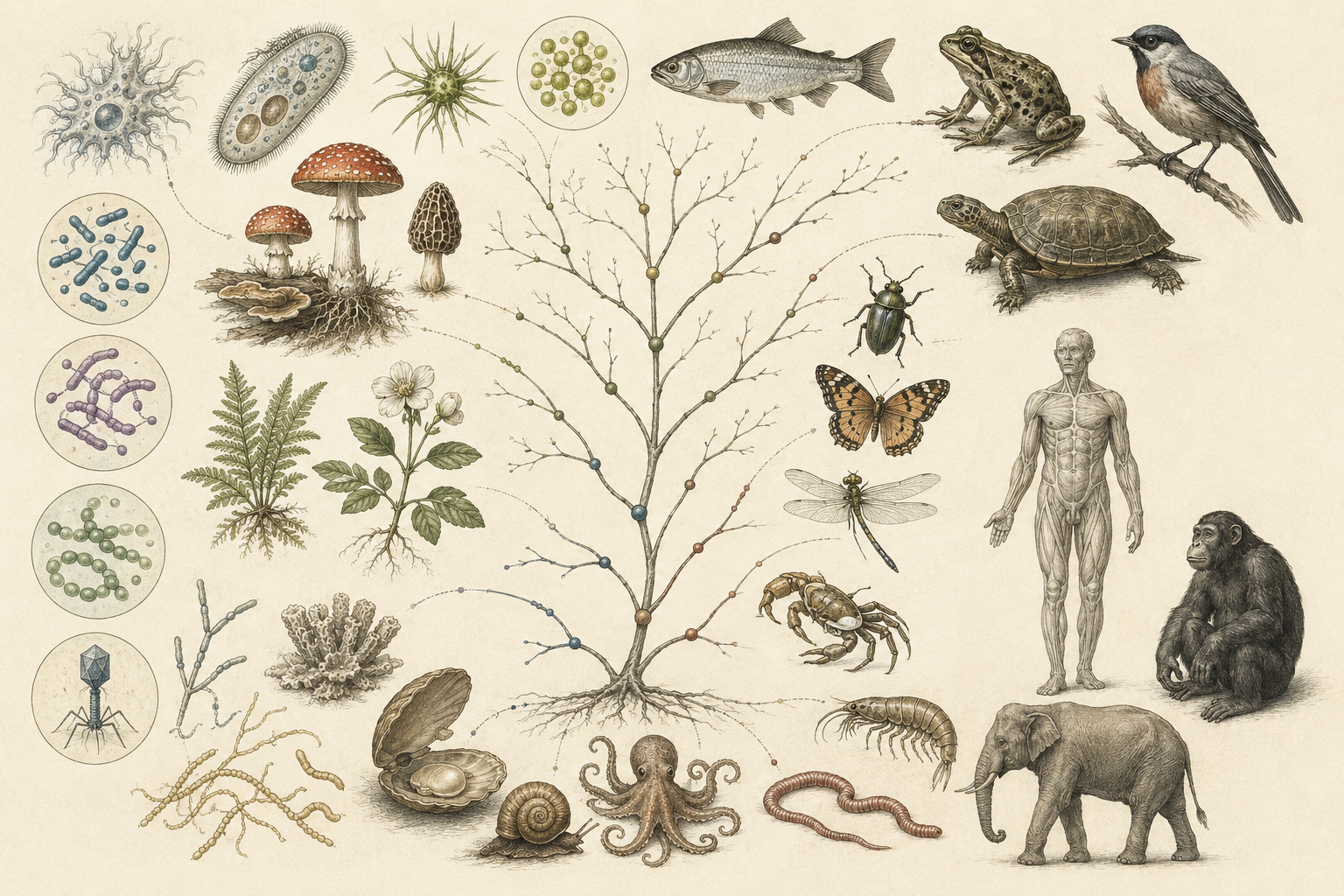
The article develops taxonomy across natural history, Linnaean nomenclature, species concepts, phylogenetics, molecular systematics, biodiversity databases, museum collections, conservation biology, microbial classification, marine biodiversity, environmental DNA, ecological monitoring, Indigenous and local knowledge, data governance, and computational biology. It shows why taxonomy remains essential in an age of biodiversity loss, genomic data, automated identification, and planetary environmental change.
The article also extends taxonomy into quantitative and computational biology through pairwise sequence distances, Jukes-Cantor correction, Shannon diversity, Bray-Curtis dissimilarity, taxonomic confidence scoring, occurrence-record summaries, phylogenetic data structures, R workflows, Python workflows, SQL provenance structures, and a linked full-stack GitHub repository containing Python, R, Julia, Fortran, Rust, Go, C, C++, SQL, notebooks, data files, validation notes, and reproducibility documentation.
Why life must be ordered
The living world presents an immense diversity of forms. Organisms differ in anatomy, physiology, behavior, habitat, reproductive strategy, ecological role, molecular composition, developmental pattern, and evolutionary history. Without some way of identifying and organizing that diversity, biology would remain an accumulation of observations without stable structure. Classification makes life intelligible by establishing patterns of resemblance, difference, descent, and ecological relation.
This need for order is not merely practical. It is scientific. Biology asks not only what living beings are, but how they are related, how they differ, how they emerged, how they interact, and how knowledge about them can be communicated consistently across time and place. Classification therefore provides the architecture through which biological knowledge becomes cumulative. Species descriptions, field guides, museum collections, conservation lists, genome databases, ecological surveys, environmental DNA libraries, and phylogenetic trees all depend on the ability to identify organisms within shared systems of order.
To classify is not simply to sort. It is to make a claim about biological pattern. A classification may claim that organisms share visible features, evolutionary ancestry, genetic similarity, ecological function, reproductive continuity, or diagnostic characters. These claims can be revised as new evidence appears. This is why classification is not a static table pasted onto nature. It is an evolving scientific practice for stabilizing knowledge while remaining open to correction.
The ordering of life is also a practical condition for conservation and public health. Unknown or unnamed organisms are harder to protect, monitor, regulate, study, or compare. A pathogen must be identified before its spread can be traced. An endangered species must be recognized before conservation policy can be designed. An invasive species must be distinguished from native relatives before management can proceed. Classification therefore links biological understanding to action.
Classification as a foundation of biology
Classification is one of the oldest practices in biological thought. Human societies have long distinguished plants, animals, edible and inedible species, domestic and wild forms, medicinal organisms, sacred organisms, pests, predators, crop relatives, poisonous species, and ecologically important beings. Scientific classification differs from everyday sorting because it aims at systematic consistency. It seeks criteria that can be stated explicitly, compared, revised, and extended to new cases.
In early natural history, classification often relied on visible features such as body form, floral structure, habitat, utility, or reproductive anatomy. These systems varied in coherence, but they reflected a real scientific ambition: to discover order in the multiplicity of living forms. Natural history created the empirical archive from which later biological theory could emerge. Classification was central to that process because it turned scattered observations into structured knowledge.
Modern biology still depends on classification at many levels. Organisms are classified into taxa; cells are classified into cell types; genes are assigned to families; proteins are grouped by domains; microbial communities are organized through operational taxonomic units or amplicon sequence variants; ecosystems are categorized through habitat types; and conservation assessments depend on recognized taxonomic units. Classification is therefore not limited to species names. It is a general practice of biological reasoning.
This makes classification foundational, but not infallible. The categories biology uses are tools for inquiry, not final mirrors of nature. A classification can be useful, provisional, contested, or overturned. Scientific order is valuable because it can be tested and revised.
Taxonomy, naming, and biological language
Taxonomy is the branch of biology concerned with naming, describing, and classifying organisms. It provides the formal language through which biological diversity is recorded and communicated. A taxonomic name does more than label an organism. It places that organism within a recognized framework of comparison, reference, and relation. Taxonomy therefore makes biological communication possible across laboratories, field sites, museums, databases, agencies, conservation organizations, and languages.
The importance of naming in biology is structural as well as practical. A stable naming system allows scientists to know that they are referring to the same organism, even when common names differ across regions or languages. Scientific names reduce ambiguity, support reproducibility, and enable the accumulation of research. They also link species descriptions, conservation assessments, genetic databases, ecological records, museum specimens, and policy documents into shared systems of reference.
Modern taxonomy is governed by formal codes that regulate nomenclature and priority. These include the International Code of Zoological Nomenclature for animals and the International Code of Nomenclature for algae, fungi, and plants. These codes do not make taxonomy simple, but they make it rule-governed rather than arbitrary. Names must be published, justified, prioritized, and interpreted through community standards.
Taxonomy is therefore institutional as well as descriptive. It depends on journals, collections, naming codes, type specimens, databases, expert judgment, and international collaboration. This institutional character is part of taxonomy’s strength, but it also means taxonomy is shaped by access, authority, geography, language, funding, and historical power.
The Linnaean system and its importance
No discussion of taxonomy can avoid Carl Linnaeus, whose classificatory work provided one of the most influential frameworks in the history of biology. Linnaeus did not invent the desire to order living beings, but he gave that ambition a more systematic and durable form. His binomial nomenclature, in which species are named through a genus and species designation, remains one of the most important contributions to biological method. The Linnaean system also organized living beings into nested ranks such as kingdom, class, order, genus, and species.
The importance of this system lay not only in its elegance but in its standardization. By giving naturalists a shared method for naming and grouping organisms, Linnaean taxonomy made biological communication more stable and comparable. It helped turn classification into a cumulative scientific enterprise rather than a patchwork of local descriptions.
Yet the Linnaean system also reflected a pre-evolutionary worldview. Organisms were grouped by morphological resemblance within a framework that did not yet fully interpret biological order in terms of common descent. This limitation does not diminish Linnaeus’s importance, but it does show that classification changes as biological understanding changes.
Modern taxonomy still uses Linnaean names and ranks, but it increasingly interprets classification through evolutionary relationship, phylogenetic evidence, molecular data, and clade-based reasoning. The result is not a simple replacement of Linnaeus. It is a layered inheritance: older naming structures remain useful, while modern systematics revises the meaning of biological order.
From fixed kinds to evolutionary relationships
One of the great transformations in biological thought came when classification ceased to be understood primarily as the ordering of fixed kinds and became increasingly tied to evolutionary relationship. Once evolutionary theory established that species are historical populations shaped by descent with modification, classification could no longer remain merely a matter of outward resemblance. It had to ask whether organisms were related through common ancestry and how classificatory systems should reflect that history.
This shift was substantial. In a pre-evolutionary framework, classification often sought natural order among stable forms. In an evolutionary framework, classification became historical. Similarity mattered, but similarity alone was not enough. Two organisms might resemble one another because of shared ancestry, convergent adaptation, parallel evolution, ecological constraint, or developmental limitation. Biology therefore needed ways of distinguishing homologous traits from analogous ones and of reconstructing branching lineages rather than simply arranging organisms by appearance.
Taxonomy was transformed by evolution just as deeply as anatomy, biogeography, paleontology, and natural history were. Classification became a way of mapping descent. The ordering of life was no longer just a catalog of beings. It became an effort to represent the history of life itself.
This evolutionary transformation also made taxonomy more dynamic. If classification reflects hypotheses of relationship, then classification must change when evidence changes. A group once thought natural may be split. A species may be reclassified. A lineage may be moved. A familiar name may become a synonym. This can frustrate non-specialists, but it is part of the scientific strength of taxonomy: it remains corrigible.
Species concepts and the problem of boundaries
Taxonomy depends heavily on species, but species are not always simple units. Different species concepts emphasize different criteria: reproductive isolation, shared ancestry, diagnosable traits, ecological role, genetic cohesion, evolutionary lineage, or phylogenetic distinctiveness. Each captures something important, but no single species concept resolves every case across all of life.
The biological species concept works well in some sexually reproducing organisms but becomes less useful for asexual microbes, fossils, hybridizing plants, ring species, and organisms with frequent horizontal gene transfer. Morphological species concepts can be useful in field biology and paleontology, but morphology may hide cryptic diversity or overstate differences caused by environment, sex, age, or developmental stage. Phylogenetic species concepts can reveal fine-scale lineages but may produce more splitting than some ecological or conservation contexts can easily absorb.
These difficulties do not make species meaningless. They make species scientifically complex. Species are real enough to matter, but they are not always bounded in the same way. Taxonomic judgment therefore requires evidence, context, and explicit criteria. It must ask what kind of biological boundary is being recognized and why.
This is especially important in conservation. Splitting or lumping species can affect legal protection, funding priorities, biodiversity estimates, restoration plans, and public understanding. Taxonomy is therefore not only a technical matter. It can shape the practical fate of living beings.
Phylogeny, systematics, and the tree of life
Modern systematics extends taxonomy by studying the diversity of organisms and the relationships among them. Its central concern is phylogeny: the evolutionary history of lineages and their branching relations through time. Phylogenetic thinking seeks to reconstruct how species and higher groups are related, often in the form of tree-like models that represent descent from common ancestors.
The idea of a tree of life gives classification a historical and explanatory structure. Organisms are not simply placed near one another because they look alike. They are situated within hypotheses about lineage, divergence, and ancestry. This allows taxonomy to reflect evolutionary process rather than static resemblance alone. It also creates a bridge between classification and broader biological fields such as evolutionary theory, comparative anatomy, genomics, ecology, biogeography, and conservation.
Phylogenetics also reveals that classification is sometimes counterintuitive. Groups long recognized by appearance may not correspond to evolutionary lineages. Similar forms may evolve independently. Some traditional categories may exclude descendants and therefore fail to reflect common ancestry. Molecular data have repeatedly revised relationships among microbes, plants, fungi, animals, and deep branches of life.
Modern phylogenetic work is supported by infrastructures such as the NCBI Taxonomy database, the Catalogue of Life, the Encyclopedia of Life, the Global Biodiversity Information Facility, and the Open Tree of Life. Classification is no longer confined to manuals or specimen drawers. It is also a global, data-rich, collaborative enterprise.
Morphology, molecules, and modern taxonomic evidence
Taxonomy today draws on multiple forms of evidence. Morphology remains essential, especially in field identification, paleontology, museum work, anatomical comparison, ecological surveys, and organismal biology. Body plans, skeletal patterns, floral characteristics, tissue organization, developmental traits, reproductive structures, and diagnostic characters continue to provide indispensable information about living forms and their relationships.
At the same time, molecular evidence has transformed taxonomy. DNA sequencing, comparative genomics, barcoding, transcriptomics, and molecular markers have revealed relationships that morphology alone could not fully resolve. Molecular systematics has reorganized major branches of life, challenged older groupings, and provided new evidence for hidden diversity, cryptic species, hybridization, introgression, microbial lineages, and deep evolutionary relationship.
Modern taxonomy is strongest when evidence converges. Morphology, development, ecology, geographic distribution, fossil evidence, behavior, reproductive data, and molecular sequences can reinforce or challenge one another, leading to better-supported classifications. Disagreement among lines of evidence is not a failure. It is often where taxonomic research becomes most scientifically productive.
This integrative approach matters because all evidence has limits. Morphology can be shaped by convergence. DNA data can be distorted by incomplete lineage sorting, hybridization, contamination, sampling bias, and database error. Ecological similarity can arise without close ancestry. Fossils may be incomplete. Taxonomic judgment requires evidence triangulation.
Biodiversity informatics and global taxonomic infrastructure
Taxonomy has become increasingly computational. Large biodiversity datasets, digital specimen records, genetic sequence repositories, phylogenetic trees, geospatial distributions, ecological metadata, citizen-science observations, and environmental DNA surveys now require tools capable of organizing and analyzing information at scale. Classification is no longer only the work of field naturalists and museum taxonomists, though their expertise remains indispensable. It is also increasingly the work of databases, statistical workflows, visualization tools, APIs, reproducible pipelines, and data-governance systems.
Biodiversity informatics links names to occurrences, specimens, sequences, traits, maps, images, ecological records, conservation statuses, and publications. This infrastructure makes it possible to ask large-scale questions: where taxa occur, how distributions shift, which lineages are threatened, where sampling gaps remain, how invasive species spread, how climate change affects ranges, and how biodiversity is distributed across regions.
Yet data infrastructure also introduces risks. Names may be outdated. Synonyms may be unresolved. Occurrence records may be misidentified, georeferenced incorrectly, duplicated, or biased toward easily sampled regions. Molecular databases may contain contaminated or misannotated sequences. Computational taxonomy therefore requires provenance, validation, expert review, uncertainty flags, and transparent workflows.
Taxonomy in the age of data is therefore both more powerful and more fragile. It can connect the world’s biodiversity knowledge, but only if its underlying names, records, assumptions, and uncertainties are carefully maintained.
Ecological, conservation, and marine relevance
Taxonomy matters to ecology because ecological systems are composed of identifiable organisms and lineages. Food webs, species interactions, population dynamics, community composition, functional diversity, invasive species, disease ecology, and ecosystem restoration all depend on knowing which organisms are present. Misidentification can distort ecological inference. Taxonomic resolution can change estimates of biodiversity, endemism, community turnover, and conservation priority.
Conservation biology depends especially strongly on taxonomy. Species, subspecies, populations, evolutionary significant units, and distinct lineages can all become objects of conservation concern. The IUCN Red List, protected-species legislation, habitat planning, restoration programs, and biodiversity targets all depend on recognized taxonomic units. When taxonomy changes, conservation categories can change with it.
Marine biology adds another layer of importance. Marine biodiversity is vast, unevenly sampled, and often difficult to observe directly. Plankton, microbial communities, deep-sea organisms, cryptic species, coral-associated symbionts, and larval forms can be difficult to identify through morphology alone. Molecular barcoding, environmental DNA, imaging, and biodiversity databases have become central to marine taxonomy and monitoring.
In the oceans, taxonomy is not merely classification for its own sake. It supports fisheries management, coral-reef monitoring, harmful algal bloom detection, invasive species surveillance, deep-sea biodiversity assessment, and climate-change research. The ordering of life becomes part of ocean governance.
Microbial taxonomy and the hidden majority of life
Microbial taxonomy presents distinctive challenges. Bacteria, archaea, protists, fungi, and microscopic eukaryotes often lack the morphological features traditionally used to classify larger organisms. Many microbes cannot easily be cultured. Horizontal gene transfer, rapid evolution, genome plasticity, and enormous hidden diversity complicate species concepts. Molecular and genomic methods have therefore transformed microbial classification.
The ribosomal RNA revolution and later whole-genome approaches reshaped the tree of life by revealing deep relationships among bacteria, archaea, and eukaryotes. Microbial taxonomy now often relies on sequence similarity, phylogenomics, average nucleotide identity, marker genes, metagenomic assemblies, ecological traits, and curated databases. This makes microbial classification computationally intensive and conceptually complex.
Microbial taxonomy matters because microbes drive much of the biosphere’s chemistry. They cycle carbon, nitrogen, sulfur, phosphorus, and metals. They shape soils, oceans, sediments, host microbiomes, disease systems, fermentation, wastewater treatment, and biotechnology. If the hidden majority of life is misclassified or underclassified, biology’s understanding of ecosystems, evolution, disease, and planetary processes remains incomplete.
This is also where taxonomy becomes sustainability-adjacent. Climate feedbacks, methane production, soil carbon, marine productivity, nutrient cycling, plant-microbe symbiosis, and disease emergence all depend on microbial lineages. Ordering microbial life is therefore part of understanding Earth systems.
Classification, power, and the politics of order
Classification is scientific, but it is never wholly innocent. To order life is also to exercise intellectual power. Taxonomic systems have emerged within historical contexts that include imperial collection, museum extraction, colonial exploration, plantation economies, missionary science, commercial botany, and unequal control over biological knowledge. The global cataloging of life often depended on asymmetries of access, labor, naming authority, specimen ownership, and institutional prestige. Many local, Indigenous, and vernacular ways of knowing living systems were marginalized as European scientific taxonomy expanded.
Recognizing this history does not invalidate taxonomy, but it complicates it. Biological classification has produced indispensable scientific infrastructure, yet it has also been shaped by institutions that did not distribute authority equally. Questions of naming, specimen repatriation, data sovereignty, benefit sharing, Indigenous ecological knowledge, colonial collections, and the relation between local knowledge and global scientific databases remain ethically and politically important.
Modern biology is strongest when it can acknowledge these histories honestly while still defending the value of rigorous classification. The ordering of life should not be romanticized as neutral bookkeeping. It is a scientific practice embedded in institutions, histories, and power relations.
A more responsible taxonomy does not abandon scientific standards. It expands accountability. It recognizes the labor behind specimens, the communities connected to landscapes, the histories behind collections, and the ethical obligations attached to biodiversity data. In an age of biodiversity crisis, taxonomy must be rigorous, transparent, inclusive, and historically aware.
Mathematical lens
Modern taxonomy is not only qualitative. It also relies on formal measures of similarity, divergence, diversity, uncertainty, abundance, and assignment confidence. These measures do not replace taxonomic expertise, field knowledge, museum experience, or organismal judgment. They make selected parts of taxonomic reasoning reproducible, scalable, and open to audit.
One of the simplest sequence-based quantities is the uncorrected p-distance between two aligned sequences:
Interpretation: Pairwise sequence distance measures the fraction of aligned sites that differ between two sequences.
where \(n_{ij}\) is the number of differing sites between sequences \(i\) and \(j\), and \(L\) is the alignment length. This measure is useful as a first approximation, but it can underestimate divergence when multiple substitutions occur at the same site.
A common correction under the Jukes-Cantor model is:
Interpretation: The Jukes-Cantor correction estimates evolutionary distance after accounting for repeated substitutions under a simple substitution model.
where \(d_{ij}\) is the corrected evolutionary distance. These distances can be used in exploratory phylogenetics, quality control, clustering, and distance-based tree-building methods.
Given relative abundances \(p_k\) of taxa in a sample, Shannon diversity is often written as:
Interpretation: Shannon diversity increases when a community has both greater richness and greater evenness.
where \(S\) is the number of observed taxa. This is useful in community ecology, metabarcoding, biodiversity monitoring, and conservation assessment.
For two ecological samples \(i\) and \(j\), Bray-Curtis dissimilarity can be written as:
Interpretation: Bray-Curtis dissimilarity compares community composition across two samples using taxon abundances.
where \(x_{ik}\) and \(x_{jk}\) are abundances of taxon \(k\) in samples \(i\) and \(j\). This is useful for comparing community composition across sites, treatments, time periods, or environmental gradients.
A transparent assignment-confidence score can be written as:
Interpretation: A taxonomic confidence score makes identification assumptions explicit by combining evidence and uncertainty terms.
where \(S\) is sequence similarity, \(M\) is morphological support, \(G\) is geographic plausibility, \(P\) is phylogenetic support, \(U\) is an uncertainty penalty, and the \(w\) terms are explicit weights. This is not a universal taxonomic rule, but it makes assumptions visible when comparing candidate identifications.
Variables, units, and taxonomic interpretation
Quantitative taxonomy depends on variables that connect sequence difference, community composition, confidence scoring, and biological interpretation. The table below summarizes several central quantities.
| Symbol or Term | Meaning | Typical Unit or Scale | Taxonomic Interpretation |
|---|---|---|---|
| \(p_{ij}\) | Uncorrected pairwise sequence distance | proportion from 0 to 1 | Fraction of aligned sites that differ between sequences \(i\) and \(j\) |
| \(n_{ij}\) | Number of differing sites | count | Observed mismatches between two aligned sequences |
| \(L\) | Alignment length | base pairs, amino acids, or aligned positions | Total number of positions used for sequence comparison |
| \(d_{ij}\) | Corrected evolutionary distance | substitutions per site or model-based distance | Estimated divergence after applying a substitution model |
| \(p_k\) | Relative abundance of taxon \(k\) | proportion from 0 to 1 | Share of a community sample represented by taxon \(k\) |
| \(S\) | Taxon richness or sequence similarity, depending on context | count or proportion | Number of observed taxa in diversity contexts; molecular similarity in assignment contexts |
| \(H’\) | Shannon diversity | dimensionless index | Community diversity measure combining richness and evenness |
| \(BC_{ij}\) | Bray-Curtis dissimilarity | proportion from 0 to 1 | Difference in community composition between samples \(i\) and \(j\) |
| \(x_{ik}\) | Abundance of taxon \(k\) in sample \(i\) | count, read count, biomass proxy, or relative abundance | Taxon-level abundance used in community comparison |
| \(Q\) | Taxonomic confidence score | dimensionless score | Transparent composite score for candidate taxonomic assignment |
| \(U\) | Uncertainty penalty | dimensionless score | Penalty term for ambiguity, weak evidence, missing data, or conflict among evidence types |
The table illustrates why computational taxonomy requires more than software. Each variable carries assumptions about alignment quality, sampling design, reference databases, abundance measurement, ecological context, and evidentiary judgment.
Worked example: pairwise sequence distance
Suppose two aligned DNA fragments each have length \(L=12\), and they differ at \(n=2\) sites. The uncorrected distance is:
Interpretation: The two sequences differ at about 16.67 percent of aligned positions.
Applying the Jukes-Cantor correction gives:
Interpretation: The correction estimates evolutionary distance under a simple equal-substitution model.
Substituting the value gives:
Interpretation: The corrected distance is slightly larger than the raw mismatch proportion.
The difference is modest here, but it becomes more important as divergence increases. For a working scientist, the point is practical: raw mismatch proportions and model-corrected evolutionary distances are not interchangeable. A taxonomic workflow should document which distance measure is used, why it was chosen, and how it affects interpretation.
Computational modeling
Computational modeling helps make modern taxonomy explicit because taxonomic work increasingly involves sequence matrices, occurrence records, abundance tables, phylogenetic hypotheses, database reconciliation, and uncertainty flags. A specimen, sequence, or observation is rarely meaningful as an isolated datum. It becomes taxonomically useful when linked to names, vouchers, metadata, geographic context, reference sequences, diagnostic traits, and transparent evidence.
The selected examples below focus on sequence-distance matrices, Jukes-Cantor correction, Shannon diversity, Bray-Curtis dissimilarity, and taxonomic confidence scoring. These examples are compact enough to appear in the article body, while the full repository can include more extensive workflows for FASTA parsing, occurrence-record validation, synonym handling, database schemas, phylogenetic tree files, environmental DNA summaries, and biodiversity informatics pipelines.
The purpose is not to replace taxonomic expertise. The purpose is to make taxonomic evidence more reproducible. Computation is strongest when it supports expert judgment, documents uncertainty, preserves provenance, and helps scientists explain why a classification or identification is credible.
R workflow: distance matrices, trees, and diversity
R is especially useful for taxonomy, ecology, and biodiversity informatics because it supports sequence analysis, phylogenetic tools, statistical summaries, and reproducible reporting. The following workflow computes raw and Jukes-Cantor distances, builds a first-pass neighbor-joining tree, and summarizes biodiversity and community dissimilarity.
# Distance Matrices, Neighbor-Joining Tree, and Biodiversity Summaries
#
# This workflow demonstrates common computational tasks in taxonomy:
#
#   1. Convert aligned DNA strings into a DNAbin object.
#   2. Estimate raw and Jukes-Cantor sequence distances.
#   3. Build a first-pass neighbor-joining tree.
#   4. Calculate Shannon diversity and Bray-Curtis dissimilarity.
#
# If needed:
# install.packages("ape")

library(ape)

# ------------------------------------------------------------
# 1. Sequence distance and neighbor-joining tree
# ------------------------------------------------------------

seqs <- c(
  taxon_A = "ATGCTAGCTAAC",
  taxon_B = "ATGCTAGCTATC",
  taxon_C = "ATGCCAGCTATC",
  taxon_D = "TTGCCAGTTATC"
)

dna_list <- strsplit(seqs, split = "")
dna <- as.DNAbin(dna_list)

dist_raw <- dist.dna(dna, model = "raw", pairwise.deletion = FALSE)
dist_jc <- dist.dna(dna, model = "JC69", pairwise.deletion = FALSE)

tree_nj <- nj(dist_jc)

print("Raw p-distance matrix:")
print(round(as.matrix(dist_raw), 4))

print("Jukes-Cantor distance matrix:")
print(round(as.matrix(dist_jc), 4))

print("Neighbor-joining tree:")
print(tree_nj)

# ------------------------------------------------------------
# 2. Shannon diversity and Bray-Curtis dissimilarity
# ------------------------------------------------------------

counts <- matrix(
  c(
    25, 18, 11, 6,
    10, 24, 15, 12,
    4,  8, 22, 30
  ),
  nrow = 3,
  byrow = TRUE
)

rownames(counts) <- c("reef_site", "estuary_site", "deep_site")
colnames(counts) <- c("taxon_A", "taxon_B", "taxon_C", "taxon_D")

shannon <- apply(counts, 1, function(x) {
  p <- x / sum(x)
  -sum(p[p > 0] * log(p[p > 0]))
})

bray_curtis <- function(x, y) {
  1 - (2 * sum(pmin(x, y))) / (sum(x) + sum(y))
}

bc_matrix <- outer(
  seq_len(nrow(counts)),
  seq_len(nrow(counts)),
  Vectorize(function(i, j) bray_curtis(counts[i, ], counts[j, ]))
)

rownames(bc_matrix) <- rownames(counts)
colnames(bc_matrix) <- rownames(counts)

print("Shannon diversity:")
print(round(shannon, 4))

print("Bray-Curtis dissimilarity matrix:")
print(round(bc_matrix, 4))
This R workflow is useful because it performs tasks scientists actually do: estimate pairwise distances, compare raw versus corrected distances, generate a first-pass tree, summarize diversity, and compare community composition. It can be extended to likelihood-based inference, support values, trait mapping, metabarcoding workflows, or comparative ecological methods.
Python workflow: sequence distance and taxonomic confidence
Python is especially useful for scalable taxonomy workflows because it supports string handling, matrix construction, data validation, API integration, database workflows, and reproducible pipelines. The following workflow computes raw and Jukes-Cantor distance matrices, then applies a transparent taxonomic confidence score.
"""
Computational Taxonomy Workflow

This workflow demonstrates two common computational tasks:

1. Compute raw p-distance and Jukes-Cantor distance matrices
   from aligned sequences.
2. Apply a transparent taxonomic confidence score that combines
   sequence similarity, morphology, geography, phylogeny, and uncertainty.

The examples are compact, but the same structure can be extended
to FASTA parsing, reference-database validation, environmental DNA,
occurrence-record review, or biodiversity informatics pipelines.
"""

from __future__ import annotations

import itertools
import math

import pandas as pd

def p_distance(seq1: str, seq2: str) -> float:
    """
    Calculate uncorrected p-distance for two aligned sequences.
    """
    if len(seq1) != len(seq2):
        raise ValueError("Sequences must be aligned and equal length.")

    differences = sum(a != b for a, b in zip(seq1, seq2))

    return differences / len(seq1)

def jukes_cantor_distance(p: float) -> float:
    """
    Calculate Jukes-Cantor corrected distance.

    The correction is undefined when p is greater than or equal to 0.75.
    """
    if p >= 0.75:
        return float("nan")

    return -0.75 * math.log(1.0 - (4.0 / 3.0) * p)

def build_distance_matrices(seqs: dict[str, str]) -> tuple[pd.DataFrame, pd.DataFrame]:
    """
    Build raw and Jukes-Cantor distance matrices.
    """
    taxa = list(seqs.keys())

    p_matrix = pd.DataFrame(index=taxa, columns=taxa, dtype=float)
    jc_matrix = pd.DataFrame(index=taxa, columns=taxa, dtype=float)

    for taxon_1, taxon_2 in itertools.product(taxa, taxa):
        p = p_distance(seqs[taxon_1], seqs[taxon_2])
        p_matrix.loc[taxon_1, taxon_2] = p
        jc_matrix.loc[taxon_1, taxon_2] = jukes_cantor_distance(p)

    return p_matrix, jc_matrix

def score_taxonomic_assignments(assignments: pd.DataFrame) -> pd.DataFrame:
    """
    Score candidate taxonomic assignments using explicit weights.
    """
    required_columns = {
        "sequence_similarity",
        "morphological_support",
        "geographic_plausibility",
        "phylogenetic_support",
        "uncertainty_penalty",
    }

    missing = required_columns.difference(assignments.columns)

    if missing:
        raise ValueError(f"Missing required columns: {sorted(missing)}")

    scored = assignments.copy()

    scored["taxonomic_confidence_score"] = (
        0.30 * scored["sequence_similarity"]
        + 0.20 * scored["morphological_support"]
        + 0.15 * scored["geographic_plausibility"]
        + 0.25 * scored["phylogenetic_support"]
        - 0.10 * scored["uncertainty_penalty"]
    )

    scored["confidence_class"] = pd.cut(
        scored["taxonomic_confidence_score"],
        bins=[-1, 0.55, 0.75, 1],
        labels=["low_confidence", "moderate_confidence", "high_confidence"],
    )

    return scored.sort_values("taxonomic_confidence_score", ascending=False)

def main() -> None:
    """
    Run compact sequence-distance and confidence-scoring examples.
    """
    sequences = {
        "taxon_A": "ATGCTAGCTAAC",
        "taxon_B": "ATGCTAGCTATC",
        "taxon_C": "ATGCCAGCTATC",
        "taxon_D": "TTGCCAGTTATC",
    }

    p_matrix, jc_matrix = build_distance_matrices(sequences)

    assignments = pd.DataFrame(
        {
            "record_id": ["obs_001", "obs_002", "obs_003", "obs_004"],
            "candidate_taxon": ["Species_A", "Species_B", "Species_C", "Species_D"],
            "sequence_similarity": [0.98, 0.91, 0.84, 0.73],
            "morphological_support": [0.90, 0.65, 0.78, 0.40],
            "geographic_plausibility": [0.88, 0.82, 0.55, 0.30],
            "phylogenetic_support": [0.94, 0.70, 0.62, 0.45],
            "uncertainty_penalty": [0.05, 0.20, 0.32, 0.55],
        }
    )

    scored_assignments = score_taxonomic_assignments(assignments)

    print("Raw p-distance matrix:")
    print(p_matrix.round(4).to_string())

    print("\nJukes-Cantor distance matrix:")
    print(jc_matrix.round(4).to_string())

    print("\nTaxonomic assignment scores:")
    print(scored_assignments.round(3).to_string(index=False))

if __name__ == "__main__":
    main()
This Python workflow makes the mathematical definitions operational. A scientist can scale it to FASTA input, add ambiguous-site handling, integrate Biopython, connect to occurrence databases, export distance matrices, or document confidence scores for biodiversity records. The confidence score is not a replacement for taxonomic expertise. It is a transparent scaffold for documenting why an identification is more or less credible.
GitHub repository
The article body includes compact R and Python examples so the biological and scientific argument remains readable. The full repository expands those examples into a more rigorous computational taxonomy workflow, including sequence-distance matrices, Jukes-Cantor correction, Shannon diversity, Bray-Curtis dissimilarity, taxonomic confidence scoring, occurrence-record summaries, biodiversity database scaffolds, SQL provenance structures, validation notes, reproducible data files, and full-stack scientific-computing examples across Python, R, Julia, Fortran, Rust, Go, C, C++, SQL, and notebooks.
Limits, revision, and modern taxonomic judgment
Taxonomy is powerful because it stabilizes biological knowledge, but it must remain open to revision. A taxonomic name can be valid yet later reinterpreted. A species can be split, lumped, synonymized, or moved to a different genus. A molecular tree can revise morphological assumptions. A new fossil can change the interpretation of a clade. A poorly sampled lineage can produce misleading confidence. Taxonomy is therefore cumulative but not final.
This revisability is not a weakness. It is a feature of scientific taxonomy. The ordering of life improves as evidence improves. But revision also has costs. Conservation policies, ecological datasets, public-health systems, museum records, and legal protections may all depend on names. Changes must therefore be handled carefully, documented transparently, and communicated clearly.
Modern taxonomic judgment must balance stability and accuracy. Too much instability can make names difficult to use. Too much resistance to revision can preserve error. The best taxonomy is neither rigid nor chaotic. It is disciplined, evidence-responsive, transparent, and aware of its practical consequences.
This is especially important in the age of biodiversity informatics. When names are changed, merged, split, or synonymized, downstream databases must be updated carefully. Occurrence records, sequence records, conservation assessments, ecological studies, and policy documents may need reconciliation. Taxonomic revision is therefore not only a scholarly act; it is also an information-management problem.
Why taxonomy still matters
Taxonomy still matters because biology still depends on knowing what living beings are and how they are related. Conservation cannot proceed without identifying species and lineages. Ecology depends on reliable species recognition. Medicine depends on accurate pathogen classification. Agriculture depends on distinguishing crops, pests, weeds, pathogens, and symbiotic organisms. Evolutionary biology depends on reconstructing relationships. Biodiversity science depends on inventories of life that are stable enough to support comparison and flexible enough to absorb revision.
Taxonomy also matters because the living world is under pressure. Habitat loss, climate change, extinction, invasive species, pollution, overharvesting, disease emergence, and biodiversity decline make the work of identifying and documenting life more urgent, not less. Organisms cannot be protected if they are not recognized, described, or tracked. Classification therefore has practical as well as conceptual significance.
In this sense, taxonomy is not an antiquarian remnant of old natural history. It remains one of the living foundations of biological science. The ordering of life is still one of the ways biology makes the world knowable and, potentially, more responsibly governed.
Conclusion
Classification, taxonomy, and the ordering of life show that biology requires more than observation of living beings in isolation. It requires structured systems for naming, comparing, grouping, and relating organisms within broader frameworks of knowledge. From natural history to Linnaean nomenclature, from morphological comparison to phylogenetic inference, taxonomy has provided one of the central architectures through which biological science becomes cumulative and coherent.
Modern biology has transformed taxonomy by linking classification to evolution, ancestry, molecular evidence, biodiversity informatics, and computational analysis. The ordering of life is no longer simply a table of visible forms. It is an ongoing effort to represent living diversity through descent, relation, evidence, uncertainty, and revision. In the age of biodiversity crisis, genomic data, environmental DNA, and global databases, taxonomy remains both foundational and dynamic.
To ask how life is classified is therefore to ask how life becomes scientifically intelligible. Taxonomy is not merely a language of labels. It is one of the ways biology learns to see order in the living world without mistaking that order for finality.
Related articles
- Biology
- What Is Biology?
- Biology and the Scientific Understanding of Living Order
- The Rise of Modern Biological Thought
- Observation, Experiment, and the Methods of Biological Inquiry
- Life, Death, and the Problem of Biological Definition
- Cell Theory and the Basic Unit of Life
- Biodiversity and the Structure of Living Systems
- Speciation, Diversity, and the Tree of Life
- Evolution and the History of Life
- Conservation Biology and the Protection of Life
Further reading
- Catalogue of Life (n.d.) Catalogue of Life. Available at: https://www.catalogueoflife.org/
- GBIF (n.d.) Global Biodiversity Information Facility. Available at: https://www.gbif.org/
- International Association for Plant Taxonomy (n.d.) International Code of Nomenclature for algae, fungi, and plants. Available at: https://www.iapt-taxon.org/nomen/main.php
- International Commission on Zoological Nomenclature (n.d.) International Code of Zoological Nomenclature. Available at: https://www.iczn.org/the-code/the-international-code-of-zoological-nomenclature/the-code-online/
- IUCN (n.d.) The IUCN Red List of Threatened Species. Available at: https://www.iucnredlist.org/
- Mayr, E. (1982) The Growth of Biological Thought: Diversity, Evolution, and Inheritance. Cambridge, MA: Harvard University Press.
- NCBI (n.d.) NCBI Taxonomy. Available at: https://www.ncbi.nlm.nih.gov/taxonomy
- OpenStax (2018) ‘Phylogenies and the history of life’, in Biology 2e. Available at: https://openstax.org/books/biology-2e/pages/20-introduction
- Open Tree of Life (n.d.) Open Tree of Life. Available at: https://tree.opentreeoflife.org/
- Wheeler, Q.D. (ed.) (2008) The New Taxonomy. Boca Raton: CRC Press.
References
- Catalogue of Life (n.d.) Catalogue of Life. Available at: https://www.catalogueoflife.org/
- GBIF (n.d.) Global Biodiversity Information Facility. Available at: https://www.gbif.org/
- International Association for Plant Taxonomy (n.d.) International Code of Nomenclature for algae, fungi, and plants. Available at: https://www.iapt-taxon.org/nomen/main.php
- International Commission on Zoological Nomenclature (n.d.) International Code of Zoological Nomenclature. Available at: https://www.iczn.org/the-code/the-international-code-of-zoological-nomenclature/the-code-online/
- IUCN (n.d.) The IUCN Red List of Threatened Species. Available at: https://www.iucnredlist.org/
- Jukes, T.H. and Cantor, C.R. (1969) ‘Evolution of protein molecules’, in Munro, H.N. (ed.) Mammalian Protein Metabolism. New York: Academic Press, pp. 21–132.
- Mayr, E. (1982) The Growth of Biological Thought: Diversity, Evolution, and Inheritance. Cambridge, MA: Harvard University Press.
- NCBI (n.d.) NCBI Taxonomy. Available at: https://www.ncbi.nlm.nih.gov/taxonomy
- OpenStax (2018) ‘Phylogenies and the history of life’, in Biology 2e. Available at: https://openstax.org/books/biology-2e/pages/20-introduction
- Open Tree of Life (n.d.) Open Tree of Life. Available at: https://tree.opentreeoflife.org/
- Shannon, C.E. (1948) ‘A mathematical theory of communication’, Bell System Technical Journal, 27(3), pp. 379–423. Available at: https://doi.org/10.1002/j.1538-7305.1948.tb01338.x
- Wheeler, Q.D. (ed.) (2008) The New Taxonomy. Boca Raton: CRC Press.