
Last Updated May 28, 2026
Conservation biology and the protection of life examine how species, populations, habitats, ecosystems, genetic lineages, and ecological processes can be sustained when the living world is under accelerating pressure from extinction risk, habitat loss, fragmentation, overexploitation, invasive species, pollution, disease, climate change, and cumulative environmental disruption. Conservation biology emerged because the protection of life could no longer be treated as passive appreciation, scenic preservation, or the management of isolated rare species. It required a crisis-oriented scientific field capable of assessing vulnerability, modeling population persistence, protecting ecological connectivity, restoring damaged systems, managing uncertainty, and making decisions when delay can produce irreversible loss.
Conservation biology is therefore not simply the biology of endangered organisms. It is the science of persistence under pressure. It asks how populations remain viable, how habitats remain connected, how ecosystems retain function, how genetic diversity supports adaptive capacity, how protected areas and restoration programs can be designed effectively, and how societies should act when biological loss is not easily reversed. Its central concern is life through time: the conditions under which organisms, lineages, communities, and ecological processes continue to endure across generations.
Main Library
Publications
Article Map
Biology
Related Topic
Environmental Science
Related Topic
Earth Science
Related Topic
Mathematical Modeling
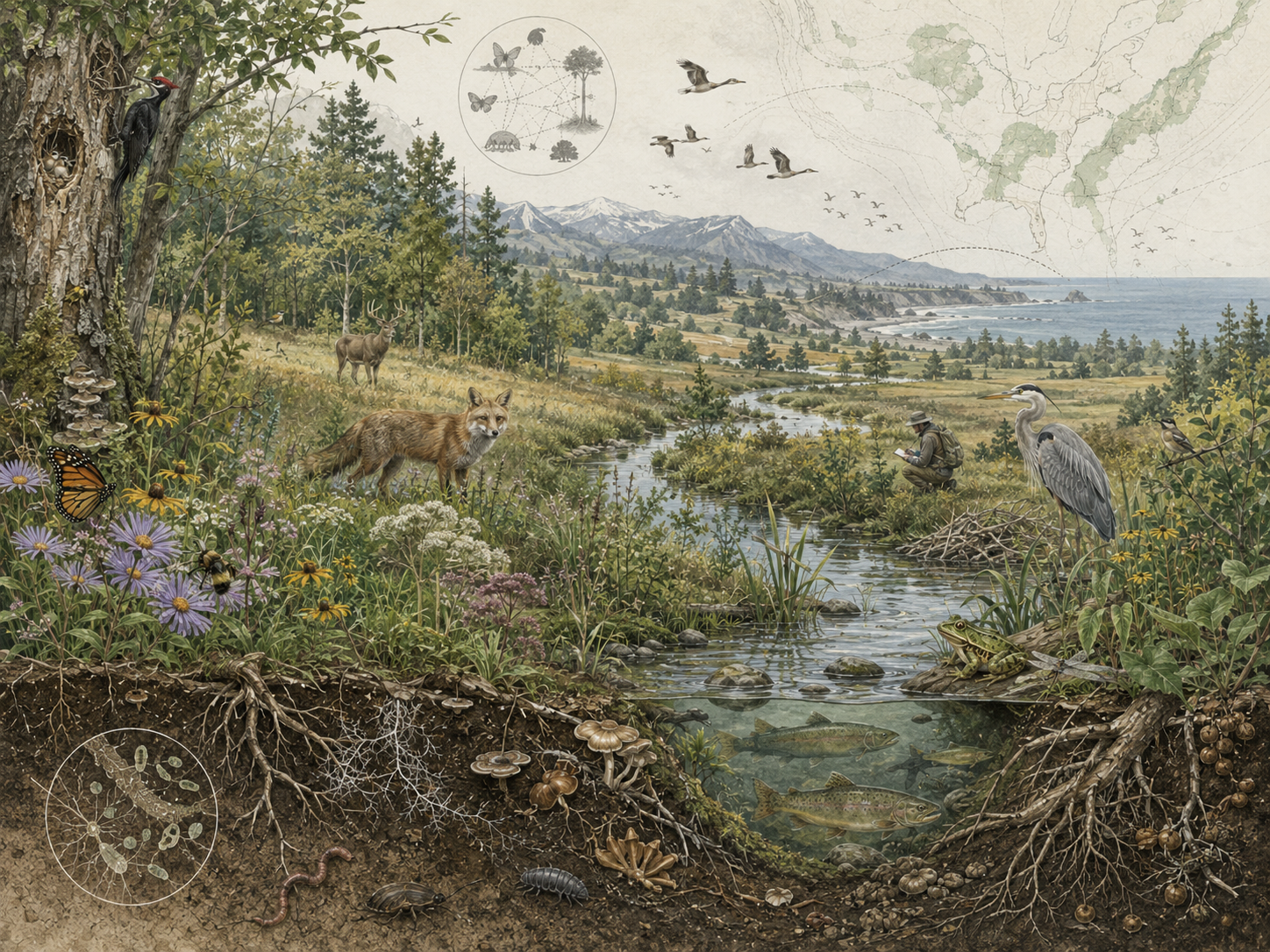
The article is written for ecologists, marine biologists, freshwater scientists, environmental-health readers, conservation practitioners, biodiversity experts, computational biologists, research biologists, and sustainability-oriented scientists who need a rigorous account of how biological protection is conceptualized, measured, modeled, governed, and constrained under real conditions of ecological change.
The article also extends conservation biology into quantitative and computational biology through stochastic population viability analysis, conservation prioritization, extinction-risk scoring, habitat-fragmentation screening, recovery-potential assessment, R workflows, Python workflows, SQL provenance structures, and a linked full-stack GitHub repository containing Python, R, Julia, Fortran, Rust, Go, C, C++, SQL, notebooks, data files, and reproducibility documentation.
What conservation biology is
Conservation biology is the scientific field concerned with preventing the loss of biological diversity and sustaining the conditions under which species, populations, communities, ecosystems, and evolutionary processes can endure. Its subject is not only decline, but persistence. It asks how extinction risk is assessed, how ecological damage accumulates, how recovery becomes possible, and how scarce conservation resources can be allocated when uncertainty, urgency, and ethical consequence are inseparable.
This makes conservation biology different from natural history alone and different from environmental ethics alone. It is empirical, comparative, population-focused, spatially aware, genetically informed, and unavoidably practical. It draws on population ecology, conservation genetics, biogeography, landscape ecology, restoration ecology, marine science, freshwater ecology, epidemiology, remote sensing, systematics, decision science, economics, law, and governance. It is also unusually explicit about irreversibility. Once a species is gone, the problem is no longer one of management but of permanent biological loss.
At the same time, conservation biology is broader than extinction prevention. A species may persist while its genetic diversity collapses. A forest may remain standing while its regeneration system fails. A wetland may still exist on a map while hydrology, nutrient cycling, and reproductive habitat have been damaged. A marine reserve may be legally designated while fishing pressure, warming, acidification, or pollution continue to weaken ecological function. Conservation biology therefore evaluates life at multiple levels: genes, individuals, populations, metapopulations, habitats, communities, ecosystems, landscapes, seascapes, and biospheric processes.
For research biologists, conservation biology matters because it turns biological knowledge toward one of the most consequential questions of the present century: how much of the living world can still be protected, repaired, connected, and allowed to continue evolving under conditions of cumulative human pressure.
Why conservation biology became a science of crisis
Conservation biology became necessary because biodiversity decline is not a hypothetical concern. Global biodiversity assessments have concluded that nature is declining across many regions and that extinction risk, habitat degradation, and ecosystem transformation are now central features of the modern biosphere. The importance of that finding is methodological as much as moral. Conservation cannot proceed as if biological change were slow, local, or easily reversible.
Scientists are often working under conditions of limited data, rapidly changing threat regimes, uncertain climate futures, uneven governance capacity, and incomplete ability to intervene. Some species are poorly studied before they become threatened. Some populations are declining before reliable demographic records exist. Some ecosystems cross thresholds before their internal dynamics are fully understood. Conservation biology therefore became a science of crisis in the precise sense that it must make judgments under time pressure while recognizing that delay itself can be a driver of loss.
This crisis orientation does not mean conservation biology abandons rigor. It means the field has to operate with a disciplined form of urgency. It must use the best available evidence while acknowledging uncertainty. It must distinguish between precaution and panic. It must decide when further research is essential and when waiting for perfect data would itself be irresponsible. That combination of evidence, uncertainty, urgency, and consequence gives conservation biology its distinctive intellectual character.
For ecologists and biodiversity scientists, this is why conservation biology cannot be reduced to advocacy alone. It is a scientific field built around high-stakes inference: estimating risk, diagnosing causes, designing interventions, evaluating outcomes, and learning from failure while the systems being studied are still changing.
Extinction risk and the logic of irreplaceability
At the center of conservation biology lies extinction risk. Systematic threat assessment exists because conservation requires a structured way to identify which species or systems are most at risk, where those risks are concentrated, and what kinds of threats are acting. Such assessments compile information on range size, population trend, habitat condition, threat exposure, reproductive biology, and conservation actions. They allow scientists, institutions, and governments to compare risk across taxa, regions, and threat categories.
The scientific force of extinction is its irreversibility. Population decline can sometimes be reversed. Habitat damage can sometimes be restored. Ecosystems can sometimes recover portions of their function. Extinction, by contrast, closes off recovery at the level of the lineage itself. This is why conservation biology places such weight on early warning, threat categorization, and the concept of irreplaceability. Some losses are not substitutable by similar species, restored habitat elsewhere, or later intervention.
Irreplaceability also has ecological and evolutionary dimensions. A species may carry unique evolutionary history, perform a distinctive ecological function, maintain a specialized interaction, or occupy a role that cannot be easily filled by another organism. The loss of a pollinator, seed disperser, apex predator, reef-building organism, foundation plant, decomposer, or ecosystem engineer can reorganize wider ecological relationships. Conservation biology therefore treats extinction as more than the disappearance of a name from a species list. It is the loss of evolutionary history, ecological work, genetic possibility, and future biological relation.
For research biologists, extinction risk assessment is therefore not a bureaucratic exercise. It is the attempt to identify where biological time is running out and where intervention may still preserve forms of life that cannot be recreated once lost.
Populations, small numbers, and viability
Conservation often becomes most difficult when populations are small. Small populations are vulnerable not only because there are fewer individuals, but because chance begins to matter more strongly. Demographic stochasticity, environmental stochasticity, catastrophes, skewed sex ratios, Allee effects, genetic drift, inbreeding, and fragmented habitat can all push small populations toward extinction even when average environmental conditions do not appear immediately fatal.
The concept of minimum viable population was influential because it turned vague concern into a structured scientific problem. Population viability analysis grew from this context as a set of methods for estimating extinction probability, identifying key risks, and comparing alternative management scenarios. Population viability analysis does not predict the future with certainty. Its value lies in making assumptions explicit: survival rates, fecundity, carrying capacity, catastrophe frequency, dispersal, age structure, genetic constraints, and management interventions.
This remains one of the field’s most important insights: endangered populations are not simply smaller versions of secure populations. They often behave differently because rarity amplifies uncertainty. A drought, disease outbreak, breeding failure, hurricane, heat wave, invasive predator, or single bad recruitment year can matter far more when population size is already low. Conservation biology therefore asks not only how many individuals remain, but whether the population has enough demographic stability, reproductive capacity, habitat support, and connectivity to persist.
For ecologists, this makes conservation biology a direct extension of population dynamics. For managers, it means that waiting until populations become critically small can make recovery dramatically harder, more expensive, and less certain.
Genetic erosion, inbreeding, and adaptive capacity
Conservation biology is never purely about numbers. Genetic erosion can undermine persistence even where abundance has not yet collapsed completely. Small, isolated populations may lose allelic diversity, accumulate inbreeding, experience reduced fitness, and lose the adaptive flexibility needed to cope with environmental change. A population can therefore appear demographically present while becoming evolutionarily fragile.
This matters especially in a time of shifting climates, novel pathogens, altered disturbance regimes, pollution, habitat fragmentation, and range shifts. Conservation has to ask not only whether a population persists now, but whether it remains capable of persisting under new conditions. Genetic diversity is one of the biological foundations of adaptive capacity. Without it, populations may have fewer options when temperature, disease pressure, precipitation, salinity, or food availability changes.
Genetic rescue, assisted gene flow, seed banking, ex situ conservation, cryopreservation, captive breeding, and genomic monitoring all emerge from this recognition that population survival and genetic integrity cannot be cleanly separated. These tools can be powerful, but they also require caution. Genetic rescue may improve fitness in some cases, but translocation can introduce disease, disrupt local adaptation, or create governance conflicts if it is poorly designed. Conservation genetics therefore requires both technical expertise and ecological judgment.
For research biologists, the genetic dimension of conservation biology clarifies a central point: protection of life is not only protection of organisms already visible in the landscape. It is also protection of evolutionary possibility.
Habitat loss, fragmentation, and connectivity
For many species, the central conservation problem is not direct mortality alone but the loss and fragmentation of habitat. When habitats are reduced, isolated, simplified, or cut off by roads, dams, land conversion, urbanization, fencing, agricultural intensification, mining, deforestation, river engineering, or coastal development, ecological systems may begin to fail even before total area loss appears catastrophic. Fragmentation alters dispersal, gene flow, metapopulation dynamics, edge effects, predator-prey relations, disturbance regimes, pollination, seed dispersal, and local extinction risk.
Connectivity is therefore one of conservation biology’s key ideas. A landscape or seascape is not defined only by how much habitat remains, but by whether organisms can move through it, recolonize patches, maintain gene flow, track environmental change, and avoid demographic isolation. Connectivity planning, corridors, stepping-stone habitats, riparian continuity, migratory flyways, protected-area networks, marine larval dispersal pathways, and cross-boundary management all arise from this basic insight.
Protection without connection can fail if isolated fragments become ecological traps or demographic dead ends. A reserve may contain habitat but remain too small, too isolated, too disturbed at the edge, or too disconnected from seasonal movement routes. A river reach may be protected locally while dams, withdrawals, or pollution disrupt upstream and downstream processes. A reef may be designated as protected while larval sources, water quality, or thermal stress undermine recovery. Conservation biology therefore treats space as dynamic ecological structure, not as empty background.
For landscape ecologists, freshwater biologists, and marine conservation scientists, connectivity is one of the bridges between biological theory and conservation design. It shows why protected places must be understood as parts of larger living systems.
Protected areas and other effective conservation measures
Protected areas remain one of the central tools of conservation, but the field has become more sophisticated in how it evaluates them. Conservation science now emphasizes that effectiveness depends on ecological representation, connectivity, management quality, equitable governance, threat reduction, monitoring, enforcement, local legitimacy, and integration with wider landscapes and seascapes. The older assumption that drawing lines on a map is enough has proven inadequate.
This broader understanding is visible in contemporary global biodiversity targets that call not only for area-based conservation, but for systems that are ecologically representative, well connected, effectively managed, and fairly governed. That wording matters because it treats conservation as a problem of quality, connectivity, representation, and governance rather than area alone. A protected area that excludes key habitats, ignores species movement, lacks management capacity, or displaces local communities without consent may fail biologically and ethically.
Other effective area-based conservation measures also complicate older protected-area thinking. Some landscapes and seascapes may deliver long-term conservation outcomes even when biodiversity protection is not their only purpose. Indigenous territories, community-managed areas, sacred natural sites, watershed protections, fisheries closures, privately conserved areas, and sustainable-use landscapes may all contribute to conservation under the right conditions. The scientific question becomes not merely whether an area has a particular legal label, but whether it produces sustained positive conservation outcomes.
For conservation biologists, protected areas are therefore necessary but not sufficient. They are instruments within a larger conservation system that must also include restoration, sustainable use, climate adaptation, rights-based governance, ecological monitoring, and connectivity across working landscapes and seascapes.
Restoration, reintroduction, and recovery
Protection alone is not enough where systems have already been degraded. Conservation biology therefore includes restoration ecology, reintroduction science, recovery planning, and assisted persistence strategies. Restoration may involve hydrological repair, invasive species removal, fire regime recovery, revegetation, reef or oyster reconstruction, wetland rebuilding, soil stabilization, riparian repair, grassland reconstruction, peatland rewetting, or the re-establishment of ecological interactions such as grazing, pollination, predation, seed dispersal, and nutrient cycling.
Reintroductions and translocations pose their own scientific challenges. The question is not simply whether organisms can be released, but whether habitat quality, threat regimes, disease risk, genetic structure, social context, and long-term ecological function make recovery plausible. A reintroduction can fail if the original threat remains. It can also fail if the released population lacks genetic diversity, reproductive success, behavioral adaptation, food resources, migration pathways, or local support.
Recovery is rarely a matter of returning to an idealized past state. It is more often the attempt to rebuild enough structure, function, and resilience for persistence under present and future conditions. In some cases, the goal may be restoration of historical composition. In others, it may be recovery of ecological function, protection of climate refugia, support for genetic adaptation, or reduction of extinction risk in a changed environment.
For research biologists, restoration and reintroduction make conservation biology experimental in the strongest sense. Interventions become hypotheses about how living systems recover. Monitoring then determines whether those hypotheses hold under field conditions.
Marine conservation and the protection of aquatic life
Marine conservation requires its own framing because aquatic systems are spatially open, strongly connected by currents, and often difficult to monitor directly. Marine and coastal conservation depends on habitat protection, fisheries regulation, bycatch reduction, nursery habitat maintenance, pollution control, enforcement, oceanographic knowledge, and the design of protected networks that reflect both ecological and fluid-dynamic structure.
Estuaries, mangroves, coral reefs, kelp forests, deltas, continental shelves, seagrass systems, deep-sea habitats, and open-ocean systems each require different forms of conservation reasoning. What unites them is the need to think in terms of connectivity, cumulative pressure, changing chemistry, trophic structure, larval dispersal, warming, acidification, deoxygenation, and large-scale fluid systems rather than discrete terrestrial patches.
Marine conservation is not an extension of terrestrial conservation into water. It is a distinct scientific and management problem with its own logic. Fish populations may move across jurisdictions. Larvae may disperse far from spawning sites. Pollution may originate upstream or on land. Coral bleaching may be driven by global heat stress rather than local management alone. A marine protected area can therefore be necessary for conservation while still insufficient if climate, fisheries, coastal development, and water-quality pressures remain unaddressed.
For marine biologists, conservation biology provides a framework for connecting organismal biology, fisheries science, oceanography, habitat structure, trophic dynamics, and governance. It shows why aquatic protection must operate across scales from local nurseries to migratory corridors and from coastal communities to global climate systems.
Freshwater conservation: rivers, wetlands, and inland waters
Freshwater conservation is especially urgent because rivers, lakes, wetlands, floodplains, groundwater systems, and headwaters are biologically rich, heavily used, and often highly altered. Dams, withdrawals, channelization, pollution, sediment disruption, invasive species, agricultural runoff, wetland drainage, mining, urbanization, and climate-driven flow change can transform freshwater habitats even when surface water remains visible.
Freshwater biodiversity depends on flow regimes, water quality, seasonal flooding, sediment transport, riparian vegetation, thermal conditions, oxygen dynamics, floodplain connectivity, and migration pathways. A river is not merely a channel carrying water. It is a dynamic ecological system linking uplands, floodplains, wetlands, groundwater, estuaries, and human communities. Conservation biology therefore treats freshwater protection as a problem of hydrology, habitat, chemistry, connectivity, and governance.
Wetlands add another dimension. They support biodiversity, filter water, store carbon, buffer floods, recharge groundwater, and provide habitat for fish, amphibians, birds, invertebrates, microbes, and plants. Their degradation can affect biodiversity, water quality, disease ecology, and climate regulation at the same time. Freshwater conservation thus sits directly at the intersection of ecology, environmental health, land systems, agriculture, urban planning, and climate resilience.
For freshwater scientists and environmental-health readers, this makes conservation biology a systems science. Protecting inland waters means protecting the living relations among water, land, organisms, nutrients, sediment, and human use.
Conservation, medicine, and environmental health
Conservation biology is also relevant to medicine and environmental health because ecological degradation alters the conditions under which vectors, hosts, reservoirs, pathogens, toxins, and exposures move through the world. Habitat fragmentation, biodiversity simplification, water contamination, wildfire smoke, harmful algal blooms, industrial pollution, land-use change, and shifting species distributions can all alter risk environments.
This does not mean conservation biology can be reduced to human health utility. The relationship is more complex. Healthy ecological systems are not always safe in every immediate sense, and degraded systems are not harmful in one single way. But it is increasingly clear that ecological integrity, disease ecology, food systems, water quality, toxic exposure, and environmental risk are connected. Conservation biology therefore contributes to a broader understanding of health as ecologically situated rather than clinically isolated.
Conservation medicine and One Health approaches are important here because they examine relationships among wildlife, livestock, humans, pathogens, environments, and institutions. Deforestation can change host-vector contact. Wetland alteration can affect waterborne disease dynamics. Wildlife trade can create pathogen spillover risk. Biodiversity loss can alter ecological regulation in ways that are context-dependent and difficult to generalize. Conservation biology does not replace medicine, but it provides ecological context for understanding how environmental change reshapes health risks.
For medical and environmental-health readers, conservation biology therefore expands the frame of prevention. Protecting life is not only about saving species elsewhere. It is also about maintaining the ecological systems that shape exposure, resilience, nutrition, water, climate buffering, and disease dynamics.
Monitoring, data, and conservation decision-making
Modern conservation depends on monitoring and data infrastructure. Threat assessments, protected-area reporting, habitat maps, remote sensing, acoustic surveys, camera traps, environmental DNA, genomic tools, telemetry, ecological sensors, field inventories, citizen science, Indigenous and community-based monitoring, and long-term research sites all contribute to how conservation decisions are made. The field increasingly relies on data systems not only to describe decline but to evaluate whether interventions are working.
This is especially important for computational and biotechnology-oriented readers. Conservation science now sits at the intersection of ecology, informatics, geospatial analysis, genomics, bioacoustics, image recognition, environmental DNA, statistical modeling, and forecasting. The challenge is no longer just the absence of information; it is also how to integrate diverse information streams into decisions that remain scientifically credible under uncertainty.
Monitoring must also be designed carefully. A conservation program can measure the wrong thing and appear successful. Counting trees planted may say little about forest regeneration. Counting protected-area hectares may say little about ecological effectiveness. Counting individuals may obscure genetic erosion or reproductive failure. Monitoring must therefore be tied to ecological mechanisms: recruitment, survival, dispersal, connectivity, habitat quality, trophic function, genetic diversity, threat reduction, and long-term resilience.
For conservation biologists, data are not just records. They are the basis for adaptive management. Interventions should be treated as testable actions, monitored over time, revised when evidence changes, and documented in ways that allow learning across sites and institutions.
Ethics, governance, and Indigenous and local knowledge
Conservation biology is scientific, but it is not politically or ethically neutral. Protected areas, restoration programs, anti-poaching regimes, biodiversity targets, reintroductions, land-use restrictions, and conservation finance all operate through governance, law, institutions, and social power. Contemporary conservation frameworks increasingly emphasize equity, Indigenous and traditional territories, and the rights of Indigenous peoples and local communities as central rather than peripheral to conservation design.
This is not simply a matter of procedural fairness, though that matters deeply. It is also a matter of scientific effectiveness. Conservation that ignores local knowledge, rights, land tenure, cultural relationships, or governance realities often fails ecologically as well as socially. Indigenous and local communities may hold long-term ecological knowledge about species behavior, fire regimes, harvest practices, seasonal change, habitat conditions, and landscape stewardship. When conservation excludes such knowledge or displaces communities in the name of protection, it can reproduce injustice while weakening conservation legitimacy.
Conservation biology has matured by recognizing that the protection of life depends not only on species-level science but on who governs landscapes and seascapes, how legitimacy is built, and whether conservation is pursued through exclusion, partnership, restoration, co-management, or shared stewardship. This requires humility from scientific institutions. Biological expertise matters, but it does not erase the need for rights, consent, accountability, and historical awareness.
For research biologists, the ethical dimension of conservation is not an external add-on. It is part of the real-world condition under which conservation knowledge becomes action.
Global biodiversity frameworks and targets
Conservation biology increasingly operates within global frameworks. Contemporary biodiversity agreements set out long-term goals and near-term targets for urgent action, including area-based conservation, restoration, sustainable use, invasive species management, pollution reduction, benefit sharing, finance, and improved stewardship across terrestrial, freshwater, coastal, and marine systems. These frameworks do not replace science, but they shape its institutional context.
The Kunming-Montreal Global Biodiversity Framework is especially important because it provides a global policy architecture for biodiversity action through 2030 and beyond. Target 3, widely associated with the “30 by 30” conservation goal, calls for at least 30 percent of terrestrial, inland water, coastal, and marine areas to be effectively conserved and managed through protected areas and other effective area-based conservation measures. But the scientific meaning of that target depends on quality: ecological representation, connectivity, governance, management effectiveness, and conservation outcomes.
Global frameworks influence funding, protected-area expansion, monitoring standards, restoration priorities, national biodiversity strategies, and reporting systems. They also expose the gap between ambition and implementation, which is itself now a major subject of conservation research. A target may be politically powerful but biologically insufficient if it is not matched by enforcement, ecological design, rights-based governance, long-term finance, and measurable outcomes.
For conservation scientists, global biodiversity frameworks matter because they turn ecological concern into operational commitments. They also create a need for transparent, reproducible, and scientifically defensible methods for tracking whether commitments are actually protecting life.
Quantitative conservation biology: mathematics, R, and Python
Conservation biology becomes most useful when it can move from concern to structured analysis. At the population level, one of the central questions is whether a population can persist under stochastic variation in survival, reproduction, carrying capacity, habitat quality, and disturbance. A simple deterministic growth curve is rarely enough for endangered systems because small populations are sensitive to chance, periodic demographic failure, and environmental volatility.
A basic stochastic logistic form can be written as:
N_{t+1}=N_t+r_tN_t\left(1-\frac{N_t}{K_t}\right)
\]
Interpretation: \(N_t\) is population size at time \(t\), \(r_t\) is a time-varying growth rate, and \(K_t\) is a time-varying carrying capacity. Real conservation problems often involve environmental volatility, declining habitat quality, climate stress, and uncertain demographic performance.
Population viability analysis often asks whether a population falls below a critical threshold:
Pr(\min(N_t)\leq Q)
\]
Interpretation: \(Q\) is a quasi-extinction threshold. Quasi-extinction does not necessarily mean literal extinction; it may mean the population has become so small that recovery is unlikely without intensive intervention.
At the decision level, conservation planning also requires comparing places, species, or interventions under multiple criteria. A simple prioritization framework might combine extinction risk, endemism, habitat threat, fragmentation pressure, and recovery potential:
P=w_1E+w_2U+w_3H+w_4F+w_5R-w_6C
\]
Interpretation: \(P\) is priority score, \(E\) is extinction risk, \(U\) is irreplaceability or uniqueness, \(H\) is habitat threat, \(F\) is fragmentation pressure, \(R\) is recovery potential, \(C\) is relative cost or implementation difficulty, and \(w_i\) are decision weights. The point is not that one formula can decide conservation, but that transparent scoring frameworks make values, assumptions, and trade-offs visible.
Worked example: quasi-extinction risk
Suppose an endangered population begins with \(N_0=120\) individuals, a mean growth rate of \(r=0.04\), a carrying capacity near \(K=250\), and periodic environmental shocks. A deterministic model might suggest slow recovery. But if annual growth varies strongly and occasional catastrophes reduce abundance, many simulated trajectories may fall below a quasi-extinction threshold of \(Q=20\). Conservation decisions should therefore examine distributions of possible futures, not just one average trajectory.
R and Python workflows
The following examples are compact article-level workflows. The full GitHub repository expands them into richer multi-language implementations with SQL provenance, validation notes, stochastic population viability analysis, conservation prioritization, habitat-fragmentation metrics, metapopulation connectivity examples, and reproducible scientific-computing scaffolding.
R example: stochastic population viability simulation
# Stochastic population viability analysis in R
#
# This example simulates many population trajectories under environmental
# variability and estimates extinction and quasi-extinction risk.
#
# It is intentionally compact for article use. A full repository workflow
# can add age structure, spatial patches, carrying-capacity change, and
# management interventions.

set.seed(42)

simulate_pva <- function(
  n0 = 120,                # initial population size
  years = 50,              # projection horizon
  n_sims = 1000,           # number of simulation runs
  r_mean = 0.04,           # mean intrinsic growth rate
  r_sd = 0.08,             # environmental variability in growth rate
  k_mean = 250,            # mean carrying capacity
  k_sd = 20,               # variability in carrying capacity
  catastrophe_prob = 0.05, # annual catastrophe probability
  catastrophe_mult = 0.65, # proportion remaining after catastrophe
  quasi_extinction = 20    # threshold below which population is functionally at risk
) {
  trajectories <- matrix(NA_real_, nrow = years + 1, ncol = n_sims)
  trajectories[1, ] <- n0

  for (sim in seq_len(n_sims)) {
    population_size <- n0

    for (year in seq_len(years)) {
      r_t <- rnorm(1, mean = r_mean, sd = r_sd)
      k_t <- max(10, rnorm(1, mean = k_mean, sd = k_sd))

      # Stochastic logistic growth.
      population_size <- population_size +
        r_t * population_size * (1 - population_size / k_t)

      # Catastrophe event such as drought, disease, wildfire, or storm impact.
      if (runif(1) < catastrophe_prob) {
        population_size <- population_size * catastrophe_mult
      }

      # Enforce biological bounds and round to individuals.
      population_size <- max(0, round(population_size))

      trajectories[year + 1, sim] <- population_size

      if (population_size == 0) {
        trajectories[(year + 1):(years + 1), sim] <- 0
        break
      }
    }
  }

  minimum_sizes <- apply(trajectories, 2, min, na.rm = TRUE)
  final_sizes <- trajectories[years + 1, ]

  list(
    trajectories = trajectories,
    extinction_risk = mean(final_sizes == 0, na.rm = TRUE),
    quasi_extinction_risk = mean(minimum_sizes <= quasi_extinction, na.rm = TRUE),
    median_final_size = median(final_sizes, na.rm = TRUE),
    mean_final_size = mean(final_sizes, na.rm = TRUE)
  )
}

results <- simulate_pva()

print(results$extinction_risk)
print(results$quasi_extinction_risk)
print(results$median_final_size)
This R workflow is more useful than a simple decline curve because it lets the reader explore extinction risk, quasi-extinction thresholds, catastrophe effects, and environmental variability. It can be adapted for endangered mammals, fish stocks, fragmented amphibian populations, threatened plants, reef-associated species, or restoration-dependent populations by changing demographic assumptions and management parameters.
Python example: conservation prioritization with fragmentation and recovery scoring
import pandas as pd
import numpy as np

# Example conservation units.
# These could represent species, habitats, watersheds, reefs, forest patches,
# restoration sites, or protected-area candidates.
conservation_units = pd.DataFrame(
    {
        "unit": ["A", "B", "C", "D", "E"],
        "extinction_risk": [0.92, 0.65, 0.40, 0.85, 0.55],
        "endemism": [0.80, 0.30, 0.25, 0.95, 0.50],
        "habitat_loss": [0.75, 0.90, 0.35, 0.60, 0.70],
        "fragmentation": [0.88, 0.70, 0.40, 0.92, 0.60],
        "recovery_potential": [0.45, 0.80, 0.70, 0.35, 0.65],
        "cost_index": [0.60, 0.45, 0.30, 0.75, 0.50],
    }
)

# Weighted scoring framework.
# Positive weights increase priority. A negative cost weight means lower cost
# modestly improves rank, while still keeping biological risk central.
weights = {
    "extinction_risk": 0.30,
    "endemism": 0.20,
    "habitat_loss": 0.20,
    "fragmentation": 0.15,
    "recovery_potential": 0.10,
    "cost_index": -0.05,
}

conservation_units["priority_score"] = (
    weights["extinction_risk"] * conservation_units["extinction_risk"]
    + weights["endemism"] * conservation_units["endemism"]
    + weights["habitat_loss"] * conservation_units["habitat_loss"]
    + weights["fragmentation"] * conservation_units["fragmentation"]
    + weights["recovery_potential"] * conservation_units["recovery_potential"]
    + weights["cost_index"] * conservation_units["cost_index"]
)

# Rank units from highest to lowest priority.
ranked = conservation_units.sort_values(
    "priority_score",
    ascending=False,
).reset_index(drop=True)

print(ranked[["unit", "priority_score"]].round(3).to_string(index=False))

# Sensitivity check:
# How much do rankings change if recovery potential receives more weight?
alternative_weights = weights.copy()
alternative_weights["recovery_potential"] = 0.20
alternative_weights["fragmentation"] = 0.10

ranked["priority_score_alt"] = (
    alternative_weights["extinction_risk"] * ranked["extinction_risk"]
    + alternative_weights["endemism"] * ranked["endemism"]
    + alternative_weights["habitat_loss"] * ranked["habitat_loss"]
    + alternative_weights["fragmentation"] * ranked["fragmentation"]
    + alternative_weights["recovery_potential"] * ranked["recovery_potential"]
    + alternative_weights["cost_index"] * ranked["cost_index"]
)

ranked["rank_default"] = ranked["priority_score"].rank(
    ascending=False,
    method="min",
)

ranked["rank_alt"] = ranked["priority_score_alt"].rank(
    ascending=False,
    method="min",
)

print(
    ranked[
        ["unit", "priority_score", "priority_score_alt", "rank_default", "rank_alt"]
    ].round(3).to_string(index=False)
)
This Python example is useful because it resembles the kind of transparent multi-criteria framework used in conservation triage, protected-area prioritization, habitat recovery planning, restoration screening, or grant allocation. It also introduces sensitivity analysis, which is important whenever rankings depend on judgment-based weights. A conservation ranking that changes dramatically under small changes in weights should be treated differently from one that remains stable across reasonable assumptions.
Python example: simple habitat-fragmentation screening
import pandas as pd

patches = pd.DataFrame(
    {
        "patch_id": ["P1", "P2", "P3", "P4", "P5"],
        "habitat_area_ha": [120, 35, 80, 15, 60],
        "edge_pressure": [0.20, 0.65, 0.35, 0.80, 0.45],
        "connectivity_score": [0.75, 0.30, 0.55, 0.15, 0.50],
        "native_cover": [0.82, 0.48, 0.70, 0.35, 0.62],
    }
)

patches["fragmentation_risk"] = (
    0.35 * (1 - patches["connectivity_score"])
    + 0.30 * patches["edge_pressure"]
    + 0.20 * (1 - patches["native_cover"])
    + 0.15 * (1 / patches["habitat_area_ha"])
)

patches["screening_class"] = pd.cut(
    patches["fragmentation_risk"],
    bins=[0, 0.25, 0.45, 1.0],
    labels=["lower-risk", "moderate-risk", "high-risk"],
)

print(
    patches[
        ["patch_id", "habitat_area_ha", "fragmentation_risk", "screening_class"]
    ].round(3).to_string(index=False)
)
This screening scaffold shows how habitat area, edge pressure, connectivity, and native cover can be combined into a transparent diagnostic index. A production conservation workflow would document data sources, spatial methods, uncertainty, species-specific movement assumptions, and ecological thresholds rather than treating one generic score as final.
These examples remain compact enough for an article, but they point toward the kinds of workflows conservation scientists and computational ecologists actually use: stochastic population modeling, threat scoring, habitat-fragmentation assessment, recovery-potential screening, sensitivity analysis, monitoring indicators, and explicit documentation of assumptions.
GitHub repository
The article body includes compact R and Python examples so the ecological and scientific argument remains readable. The full repository expands those examples into a broader computational conservation biology workflow, including stochastic population viability analysis, conservation prioritization, habitat-fragmentation metrics, metapopulation connectivity examples, SQL provenance structures, reproducible data files, notebook scaffolding, and full-stack scientific-computing examples across Python, R, Julia, Fortran, Rust, Go, C, C++, SQL, and notebooks.
Why this matters across scientific fields
Conservation biology matters across ecology, marine biology, freshwater science, environmental health, forestry, agroecology, restoration ecology, disease ecology, systems biology, and biodiversity science because each of these fields increasingly confronts damaged, fragmented, or threatened living systems. For ecologists, conservation biology offers a framework for applying population, community, and ecosystem theory under conditions of urgency. For marine biologists, it connects aquatic science to the protection of habitats, trophic structure, nursery systems, fisheries-supporting ecosystems, and climate-stressed seascapes. For freshwater scientists, it clarifies why rivers, wetlands, groundwater systems, and floodplains must be understood as dynamic ecological networks rather than isolated water bodies.
For medical and environmental-health readers, conservation biology clarifies how ecological degradation can alter exposure, vector dynamics, water quality, wildfire risk, harmful algal blooms, and environmental vulnerability. For computational and biotech readers, it shows why modern conservation depends on data integration, modeling, genomics, remote sensing, environmental DNA, sensor systems, and reproducible analysis rather than on field observation alone. For biodiversity experts and research biologists, it provides one of the most rigorous frameworks for connecting species-level protection to ecosystem function, evolutionary history, and long-term resilience.
What unites these audiences is the recognition that the protection of life is no longer an optional add-on to biology. It is one of the conditions under which biology remains empirically serious. A biology that can describe extinction but cannot help prevent it is incomplete. A biology that can map biodiversity but cannot explain how it persists through time is incomplete. A biology that can model populations but not connect models to governance, restoration, and stewardship is incomplete.
Conservation biology matters because it insists that biological knowledge carries consequence.
Conclusion
Conservation biology is the science of persistence under pressure. It asks how populations remain viable, how habitats remain connected, how ecosystems retain function, how genetic diversity supports adaptive capacity, and how biodiversity can still be protected when threats are cumulative, accelerating, and often irreversible. It is therefore a field built not on sentimentality, but on the difficult combination of evidence, uncertainty, urgency, and consequence.
To protect life scientifically is to understand that extinction, fragmentation, genetic erosion, ecosystem collapse, disease risk, climate disruption, and governance failure are not separate subjects. They are different faces of the same problem: whether the living world can continue to endure through time. Conservation biology exists because that question can no longer be assumed away.
The protection of life requires more than concern. It requires ecological theory, demographic analysis, genetic understanding, spatial planning, restoration practice, monitoring systems, ethical governance, and long-term stewardship. It requires attention to organisms and institutions, habitats and histories, data and uncertainty, science and justice. Conservation biology stands at the center of that work because it asks the hardest biological question of the present age: under what conditions can life continue?
Related articles
- Biology
- Population Dynamics and Ecological Modeling
- Populations, Communities, and Ecosystem Dynamics
- Biodiversity and the Structure of Living Systems
- Biogeochemical Cycles and the Conditions of Habitability
- The Biosphere and Planetary Life Support Systems
- Biomes, Habitats, and the Geography of Life
- Restoration Ecology and the Repair of Living Systems
Further reading
- Beissinger, S.R. and McCullough, D.R. (eds.) (2002) Population Viability Analysis. Chicago: University of Chicago Press. Publisher information available at: https://press.uchicago.edu/ucp/books/book/chicago/P/bo3626926.html
- Groom, M.J., Meffe, G.K. and Carroll, C.R. (eds.) (2006) Principles of Conservation Biology. 3rd edn. Sunderland, MA: Sinauer Associates.
- International Union for Conservation of Nature (n.d.) The IUCN Red List of Threatened Species. Available at: https://www.iucnredlist.org/
- International Union for Conservation of Nature (n.d.) About the IUCN Red List. Available at: https://www.iucnredlist.org/about
- Convention on Biological Diversity (2022) Kunming-Montreal Global Biodiversity Framework. Available at: https://www.cbd.int/gbf
- Convention on Biological Diversity (n.d.) 2030 Targets with Guidance Notes. Available at: https://www.cbd.int/gbf/targets
- IPBES (2019) Global Assessment Report on Biodiversity and Ecosystem Services. Available at: https://www.ipbes.net/global-assessment
- UNEP-WCMC and IUCN (2024) Protected Planet Report 2024. Available at: https://digitalreport.protectedplanet.net/
- Society for Conservation Biology (n.d.) Conservation Biology. Available at: https://conbio.onlinelibrary.wiley.com/journal/15231739
- Society for Conservation Biology (n.d.) Conservation Letters. Available at: https://conbio.onlinelibrary.wiley.com/journal/1755263x
References
- Beissinger, S.R. and McCullough, D.R. (eds.) (2002) Population Viability Analysis. Chicago: University of Chicago Press. Publisher information available at: https://press.uchicago.edu/ucp/books/book/chicago/P/bo3626926.html
- Caughley, G. (1994) ‘Directions in conservation biology’, Journal of Animal Ecology, 63(2), pp. 215–244. Available at: https://doi.org/10.2307/5542
- Convention on Biological Diversity (2022) Kunming-Montreal Global Biodiversity Framework. Available at: https://www.cbd.int/gbf
- Convention on Biological Diversity (n.d.) 2030 Targets with Guidance Notes. Available at: https://www.cbd.int/gbf/targets
- Convention on Biological Diversity (n.d.) Target 3: Conserve 30% of Land, Waters and Seas. Available at: https://www.cbd.int/gbf/targets/3
- Flather, C.H., Hayward, G.D., Beissinger, S.R. and Stephens, P.A. (2011) ‘Minimum viable populations’, Current Biology, 21(23), pp. R982–R984. Available at: https://research.fs.usda.gov/treesearch/download/38156.pdf
- Frankham, R., Ballou, J.D., Briscoe, D.A. and McInnes, K.H. (2010) Introduction to Conservation Genetics. 2nd edn. Cambridge: Cambridge University Press. Publisher information available at: https://www.cambridge.org/highereducation/books/introduction-to-conservation-genetics/58E2562BB9F3F078D53D9D0A6BFB6A9C
- Groom, M.J., Meffe, G.K. and Carroll, C.R. (eds.) (2006) Principles of Conservation Biology. 3rd edn. Sunderland, MA: Sinauer Associates.
- Hanski, I. (1998) ‘Metapopulation dynamics’, Nature, 396, pp. 41–49. Available at: https://doi.org/10.1038/23876
- International Union for Conservation of Nature (n.d.) The IUCN Red List of Threatened Species. Available at: https://www.iucnredlist.org/
- International Union for Conservation of Nature (n.d.) About the IUCN Red List. Available at: https://www.iucnredlist.org/about
- International Union for Conservation of Nature (n.d.) Effective Protected Areas. Available at: https://iucn.org/our-work/topic/effective-protected-areas
- IPBES (2019) Global Assessment Report on Biodiversity and Ecosystem Services. Available at: https://www.ipbes.net/global-assessment
- IPBES (2019) Summary for Policymakers of the Global Assessment Report on Biodiversity and Ecosystem Services. Available at: https://files.ipbes.net/ipbes-web-prod-public-files/inline/files/ipbes_global_assessment_report_summary_for_policymakers.pdf
- Margules, C.R. and Pressey, R.L. (2000) ‘Systematic conservation planning’, Nature, 405, pp. 243–253. Available at: https://doi.org/10.1038/35012251
- Protected Planet (n.d.) World Database on Protected Areas. Available at: https://www.protectedplanet.net/en/thematic-areas/wdpa
- Shaffer, M.L. (1981) ‘Minimum population sizes for species conservation’, BioScience, 31(2), pp. 131–134. Available at: https://doi.org/10.2307/1308256
- Soulé, M.E. (1985) ‘What is conservation biology?’, BioScience, 35(11), pp. 727–734. Available at: https://doi.org/10.2307/1310054
- UNEP-WCMC and IUCN (2024) Protected Planet Report 2024. Available at: https://digitalreport.protectedplanet.net/
“`