
Last Updated May 28, 2026
Biology is the scientific study of life across scales: molecules, cells, organisms, populations, ecosystems, the biosphere, and the evolutionary history of living systems across deep time. It asks how living systems are organized, how they function, how they reproduce and develop, how hereditary information is transmitted, how organisms interact with environments, and how life changes through evolution under changing conditions. Biology is therefore not only the study of organisms. It is the study of living order: its structure, continuity, variation, vulnerability, and transformation.
This article introduces What Is Biology? as the opening foundation for the Biology knowledge series. It explains why life is a scientific problem, why cells and evolution are foundational, how biology differs from physics and chemistry while depending on both, and why biological explanation must move across levels of organization. It also frames biology as empirical, historical, ecological, medical, molecular, quantitative, and increasingly computational. Modern biology depends on observation and experiment, but also on statistics, modeling, genomics, imaging, bioinformatics, and reproducible workflows in languages such as R and Python.
Main Library
Publications
Article Map
Biology
Related Topic
Chemistry
Related Topic
Earth Science
Related Topic
Environmental Science
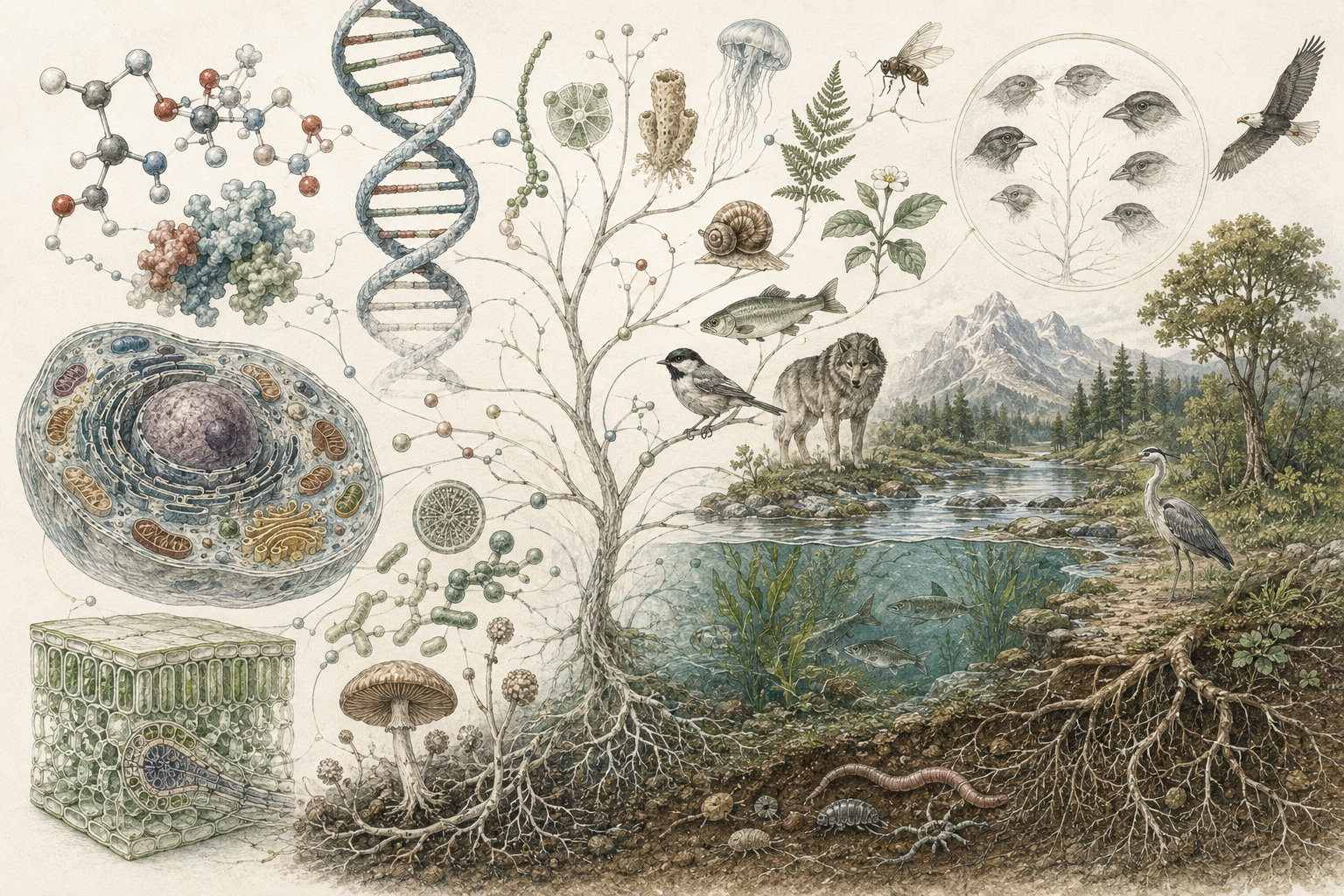
The article connects biology to cell theory, classification, evolution, heredity, ecology, biodiversity, microbiology, physiology, biotechnology, medicine, marine science, environmental systems, and planetary life-support processes. It emphasizes that life is never isolated: every organism is embedded in systems of matter, energy, inheritance, environment, relation, and history. It also extends biology into computational practice through population growth models, logistic dynamics, Hardy-Weinberg expectations, simple sequence comparison, biodiversity indicators, R workflows, Python workflows, SQL provenance structures, and a linked full-stack GitHub repository containing Python, R, Julia, Fortran, Rust, Go, C, C++, SQL, notebooks, data files, validation notes, and reproducibility documentation.
Biology as the study of life
Biology is the natural science devoted to the study of life. At its most basic level, that means biology investigates living beings: how they are structured, how they function, how they grow and reproduce, how they interact with their environments, how they vary, and how they change across time. Yet this straightforward definition quickly opens into deeper complexity because life is not a single object that can be captured by one narrow description. It includes microbes, plants, fungi, animals, ecosystems, inherited information, developmental processes, evolutionary lineages, symbioses, and planetary life-support systems.
To study biology seriously is therefore to study life not as a loose collection of organisms, but as an organized, dynamic, and relational order. Living systems maintain themselves by exchanging matter and energy with their surroundings. They reproduce, repair, regulate, adapt, and respond. They carry inherited structures shaped by earlier evolutionary processes, and they exist within ecological worlds that condition their survival. Biology seeks to understand these processes scientifically, asking how living order persists, how it fails, and how it changes.
For that reason, biology is one of the broadest of the natural sciences. It ranges from the chemistry of cells to the behavior of animals, from genetic inheritance to biodiversity, from disease processes to ecosystem stability, and from evolutionary deep time to the contemporary fragility of life under environmental disruption. Biology is not simply about naming organisms. It is about understanding the principles, mechanisms, histories, and relationships through which life becomes possible.
This breadth makes biology intellectually distinctive. It is a science of molecules, but not only molecules. It is a science of organisms, but not only organisms. It is a science of history, but not only history. It is a science of systems, but not only abstraction. Biology’s central task is to explain how living organization arises, persists, diversifies, interacts, and sometimes disappears.
What makes life a scientific problem?
The question of what life is is more difficult than it first appears. Many living systems exhibit organization, metabolism, reproduction, growth, regulation, responsiveness, and the capacity for evolutionary change, but not every individual case fits neatly into a simple checklist. A seed may remain dormant. A virus occupies an ambiguous position at the boundary of life and nonlife. Some organisms reproduce sexually, others asexually. Some organisms depend so fully on symbiotic relations that individuality itself becomes more complicated than it seems.
Biology therefore approaches life not only as a familiar reality but also as a scientific problem. What distinguishes living matter from nonliving matter? How do systems maintain organization despite entropy? How do cells coordinate the processes necessary for survival? How is hereditary information stored, copied, repaired, and expressed? How does variation arise, and why do some forms persist while others disappear? These questions reveal that life is not merely a poetic or philosophical category. It is a domain of structured processes that can be investigated through observation, experiment, theory, comparison, and increasingly through quantitative and computational analysis.
Life is also difficult to define because it is processual. A living system is not a static object but an organized activity sustained across time. Metabolism transforms matter and energy. Cells maintain boundaries while exchanging materials. Organisms develop through regulated change. Populations evolve. Ecosystems reorganize after disturbance. The object of biology is therefore not fixed matter alone, but matter organized into self-maintaining, historically shaped, relational systems.
That is part of what makes biology such a rich science. It studies objects that are at once material and historical, mechanical and relational, constrained and adaptive. Life is not inert matter arranged once and for all. It is organized activity sustained under conditions of vulnerability and change. Biology exists because this activity has regularities that can be studied, explained, modeled, and compared, even though living systems remain extraordinarily complex.
What biology studies
Biology studies living systems across many domains. It investigates cells as the basic units of life, genes as carriers of hereditary information, organisms as integrated wholes, populations as evolving groups, ecosystems as interactive networks, and the biosphere as the planetary context within which life persists. It also studies development, physiology, metabolism, reproduction, behavior, adaptation, biodiversity, disease, extinction, symbiosis, and resilience. These are not isolated topics. They form an interrelated architecture of inquiry through which biology seeks to explain life in all its forms.
Some biological questions focus on mechanism. How does a cell transport molecules across a membrane? How do enzymes regulate metabolic pathways? How does a nervous system coordinate perception and response? How does an immune cell recognize a pathogen? Other questions focus on history. How did life evolve? Why do species share traits? How did particular lineages diversify or disappear? Still others focus on relation. How do organisms interact with one another? How do populations change in response to environmental pressure? How do ecosystems stabilize, reorganize, or collapse under disturbance?
Biology is therefore both analytic and synthetic. It breaks living systems into parts in order to understand them, but it also reconnects those parts within larger wholes. A gene makes sense within a cell, a cell within an organism, an organism within an environment, and an environment within ecological and evolutionary history. Biology continually moves across these scales of explanation.
This multi-scale character is one reason biology cannot be reduced to a single method. Some questions require field observation, others controlled experiment, others historical reconstruction, others microscopy, others molecular analysis, others statistical modeling. Biology is unified not by one technique, but by its subject matter: living systems and the processes that sustain, reproduce, alter, and endanger them.
Levels of biological organization
One of the defining features of biology is that it studies life across levels of organization. At the molecular level, biology examines proteins, nucleic acids, lipids, carbohydrates, metabolites, and the biochemical interactions that make cellular life possible. At the cellular level, it studies membranes, organelles, transport, signaling, metabolism, division, and the regulation of internal processes. At the organismal level, it considers anatomy, physiology, development, reproduction, behavior, and adaptation.
Beyond the individual organism, biology studies populations, species, communities, ecosystems, and the biosphere. Populations change over generations through selection, mutation, drift, recombination, and migration. Communities reflect interactions among multiple species. Ecosystems involve the circulation of energy, nutrients, and matter across living and nonliving components. The biosphere gathers all these relationships into a planetary frame, reminding us that life depends on larger systems of climate, water, atmosphere, geology, and solar energy.
This layered structure matters because different questions arise at different levels, and no single level is sufficient by itself. Molecular detail does not eliminate the need for ecological explanation, and ecological explanation does not eliminate the need for cellular or genetic understanding. A disease may involve molecular mechanisms, cellular dysfunction, tissue damage, organismal symptoms, population transmission, and environmental drivers. An ecosystem collapse may involve physiological stress, reproductive failure, species interactions, climate change, nutrient cycling, and human disturbance.
Biology is powerful in part because it can move among these levels without reducing one entirely to another. It can explain a process mechanistically while still recognizing that higher-level organization matters. This ability to connect levels is one of the central strengths of biological thought.
Biology among the natural sciences
Biology belongs to the natural sciences, but it has a distinct place among them. Chemistry helps explain the molecular basis of living systems, and physics helps define the energetic and material constraints under which life exists. Yet biology is concerned with a form of order that is specifically living. It studies systems that maintain themselves, reproduce, inherit information, develop through time, interact with environments, and evolve across generations. These features give biology a character that is not identical with either chemistry or physics, even though it depends on both.
Biology is also distinctive because of the centrality of history. A molecule may be described without necessarily reconstructing a lineage, but an organism often bears marks of earlier evolutionary processes. Biological explanation therefore frequently requires historical reconstruction in addition to present-tense mechanism. This is why evolution is so central: it explains not only change, but the inherited structure of present life.
Biology further differs from some other sciences in the degree to which variation matters. Living systems are not identical units. Individuals vary, populations vary, species vary, environments vary, and outcomes often depend on context. Because of this, biological knowledge often relies heavily on probability, population thinking, and statistical inference rather than on simple universal uniformity. Biology does not abandon lawfulness, but it often expresses regularity through patterns, distributions, constraints, histories, and dynamic processes.
This does not make biology less rigorous. It means biological rigor must be appropriate to life’s complexity. Biology must account for variation, contingency, emergence, historical inheritance, and ecological interaction. Its explanations often combine mechanism and history, reduction and synthesis, experiment and observation, model and field evidence.
Evolution as biology’s unifying framework
Evolution provides the unifying framework of modern biology because it explains how life changes across time and how present living forms came to be. Without evolution, biology would remain a descriptive catalog of organisms and processes. With evolution, biology becomes a coherent science of inherited variation, adaptation, divergence, common ancestry, extinction, and the long transformation of life under changing conditions.
Evolution does not explain every biological question by itself, but it gives many biological observations their larger meaning. Similar structures across species make sense in light of shared ancestry. Biological diversity becomes intelligible as the outcome of variation, selection, drift, migration, and speciation. Extinction becomes part of the history of life rather than an accidental disappearance. Even traits that seem inefficient or puzzling often reflect historical pathways rather than ideal design.
Evolution links molecules, cells, organisms, populations, species, and ecosystems within a shared historical frame. It shows that life is not static. It is a branching, adaptive, contingent process shaped by inheritance, variation, struggle, cooperation, environment, and time. It also explains why biology must study both present mechanisms and past transformations.
Evolution also grounds biological humility. Living systems are not designed from scratch according to ideal plans. They are inherited and modified. Organisms bear historical constraints, tradeoffs, compromises, and remnants of earlier pathways. To understand life biologically is to understand that living order is produced through history, not imposed from outside history.
Cells, heredity, and living continuity
Cell theory and heredity are two other foundations of modern biology. Cell theory states that living organisms are composed of cells, that cells are basic units of structure and function, and that new cells arise from preexisting cells. This gives biology a shared organizational unit across microbes, plants, fungi, animals, tissues, and many forms of experimental research. The cell is where membranes, metabolism, information, signaling, growth, and division converge.
Heredity explains continuity across generations. DNA, RNA, chromosomes, genes, replication, mutation, recombination, and gene expression provide the molecular basis through which biological information is transmitted and altered. Heredity allows life to persist, but variation allows life to change. Together, heredity and variation make evolution possible.
The cell and the gene do not replace organismal or ecological biology, but they deepen it. Development depends on gene regulation and cellular differentiation. Physiology depends on coordinated cellular function. Disease often begins at cellular or molecular levels. Ecology depends on organisms whose traits are inherited, expressed, and modified under environmental pressures. Evolution depends on variation that is transmitted and filtered across generations.
Biology therefore studies living continuity at multiple levels: cellular continuity through division, genetic continuity through inheritance, organismal continuity through reproduction and development, population continuity through survival and adaptation, and ecological continuity through interaction and regeneration. Life persists by maintaining order, but it endures by changing.
Major branches of biology
Because life is so complex, biology includes many branches. Cell biology studies the structure and function of cells. Molecular biology examines the mechanisms through which genetic information is stored, expressed, and regulated. Genetics studies heredity and variation. Developmental biology explains how organisms emerge and differentiate over time. Physiology investigates how living systems function and maintain internal stability. Microbiology studies microbes, while botany and zoology focus on plant and animal life.
Evolutionary biology explores how life changes across generations. Ecology studies interactions among organisms and environments. Conservation biology addresses biodiversity loss, extinction risk, habitat fragmentation, and the protection of living systems. Systems biology investigates life as an interconnected network of relations rather than merely a collection of isolated parts. Genomics, bioinformatics, and computational biology have expanded biological inquiry further by enabling large-scale analysis of sequence data, networks, images, traits, and complex biological systems.
Other branches extend biology into applied and interdisciplinary domains. Marine biology studies life in ocean systems. Immunology studies biological defense. Neuroscience studies nervous systems and behavior. Biotechnology uses biological knowledge for intervention, production, detection, and engineering. Epidemiology studies patterns of disease across populations. Restoration ecology studies the repair of damaged living systems.
These branches are distinct but deeply connected. Genetics informs evolution. Physiology depends on cell biology and biochemistry. Ecology is shaped by evolution, behavior, and environmental constraint. Genomics intersects with medicine, agriculture, and conservation. The diversity of biological subfields reflects the diversity of life itself, but the branches remain parts of a larger scientific enterprise concerned with living organization and change.
Biology as a historical, empirical, and quantitative science
Biology is an empirical science because it depends on observation, experimentation, comparison, and evidence. It studies living systems in laboratories, fields, forests, oceans, clinics, museums, farms, wetlands, data archives, and computational environments. Biological knowledge emerges through microscopy, dissection, culturing, sequencing, measurement, ecological monitoring, controlled experimentation, field surveys, imaging, and statistical analysis.
At the same time, biology is a historical science because many of its explanations concern processes that unfold across generations or across deep time. Evolution, development, ecological succession, domestication, disease emergence, extinction, and diversification all require attention to temporal change. Biology often explains present structures by reconstructing past processes.
Modern biology is also increasingly quantitative. Population growth can be modeled mathematically. Inheritance can be analyzed probabilistically. Ecological interactions can be studied through network models and differential equations. Epidemiological spread can be simulated computationally. Genomic data can be processed at scales impossible without programming and statistical workflows. For this reason, mathematics, statistics, R, Python, SQL, and other computational tools now play growing roles in biological research and interpretation.
That computational turn does not replace traditional biological understanding. It extends it. Biology still requires careful observation, conceptual clarity, field knowledge, experimental skill, and knowledge of organisms and systems. But it now also often requires the ability to handle data, model change, visualize patterns, quantify uncertainty, build reproducible workflows, and document provenance. In that sense, biology is increasingly both a life science and a data-rich systems science.
Ecological relevance
Biology is indispensable to ecology because ecological systems are built from living organisms and their interactions. Population dynamics, species coexistence, competition, predation, symbiosis, disturbance, succession, nutrient cycling, trophic structure, and ecosystem resilience all depend on biological processes expressed at scales above the individual cell and organism. Ecology therefore extends biology outward, asking how living systems persist, interact, and transform within environments rather than in isolation.
Ecologists read biology across scales. Cellular stress responses can influence species survival under warming, drought, salinity, or acidification. Reproductive strategies affect population persistence. Evolutionary history shapes niche structure. Microbial processes regulate decomposition, carbon cycling, and nutrient availability. Plant physiology influences forest productivity. Animal behavior reshapes dispersal, predation, pollination, and community structure.
Ecology also reminds biology that organisms are never fully separate from context. A species is not merely a genetic or anatomical entity. It is also an ecological participant embedded in food webs, habitats, disturbance regimes, mutualisms, pathogens, competitors, and environmental constraints. This is why ecological biology is central to sustainability science, conservation biology, restoration ecology, climate adaptation, biodiversity research, and planetary health.
Marine biology relevance
Marine biology makes the scale-rich nature of biology especially clear. Marine systems connect microbial processes, plankton ecology, fisheries biology, symbiosis, development, physiology, and ecosystem dynamics across some of the largest and most complex environments on Earth. Salinity, temperature, oxygen availability, pH, nutrient flux, pressure, light gradients, and ocean circulation all shape how marine organisms live, reproduce, adapt, and interact.
Marine biologists rely on many of the core ideas introduced in biology as a whole: cell structure, metabolism, heredity, evolution, physiology, and ecological interaction. But marine systems also reveal how strongly biological processes are conditioned by environmental gradients and planetary-scale dynamics. Coral-algal symbiosis, marine microbial loops, larval dispersal, food-web structure, ocean acidification, hypoxia, and stress responses to warming all demonstrate that biology is deeply embedded in ocean systems.
Marine biology also shows why microbes matter. Phytoplankton, bacteria, archaea, protists, viruses, and symbiotic microorganisms shape ocean productivity, carbon cycling, nitrogen cycling, disease dynamics, and food-web structure. Much of the ocean’s biological significance lies in processes that are invisible without microscopy, sequencing, sensors, and computational analysis.
For this reason, marine biology is not a narrow specialization. It is one of the clearest examples of biology as a multi-scale science of life, environment, evolution, and planetary function.
Medical and biomedical relevance
Biology is foundational to medicine and biomedicine. Human health depends on cellular structure, molecular signaling, heredity, physiology, microbiology, immunology, development, metabolism, and the biological mechanisms through which disease emerges and spreads. Pathology, pharmacology, oncology, infectious disease, developmental medicine, neuroscience, reproductive medicine, and public health all rely on biological concepts introduced at the level of cells, genes, tissues, organisms, and populations.
Medical professionals may enter biology through disease, diagnosis, or therapy, but the underlying framework is biological: how living systems function normally, how they fail, how they respond to stress, and how variation influences susceptibility and outcome. Cancer is a disease of cells, genomes, tissue environments, immune evasion, and evolutionary selection. Infection is a biological interaction among pathogen, host, immune response, and environment. A metabolic disorder involves molecular pathways, cellular regulation, tissue function, behavior, and often social or ecological context.
Biomedical science also reveals the importance of scale. A molecular mutation can alter a protein, a protein can alter a cell, a cell can alter tissue function, tissue dysfunction can alter organismal health, and population conditions can alter disease risk. Medicine does not stand outside biology. It is one of the most consequential domains in which biological knowledge is applied, tested, and translated into practice.
Biotechnology and computational relevance
Biotechnology extends biology into applied systems of intervention, production, and analysis. Once living systems became scientifically legible in terms of cells, heredity, metabolism, signaling, evolution, and ecological function, biology could support sequencing pipelines, microbial screening, assay development, fermentation systems, synthetic biology, environmental biotechnology, biosensors, and data-driven research workflows. Biotechnology therefore depends not on a different science from biology, but on biology becoming measurable, manipulable, and reproducible.
Computational biology and bioinformatics deepen this transition by enabling large-scale sequence analysis, expression analysis, image processing, network inference, ecological modeling, evolutionary comparison, and integrative biological workflows. These tools are especially important where the scale or complexity of the data exceeds unaided interpretation. Modern biology increasingly functions both as a science of living systems and as a science of biological information.
This computational turn also raises the standards for reproducibility. Biological datasets need metadata, provenance, version control, documented assumptions, validation checks, and transparent workflows. A genomic result, ecological model, image-analysis pipeline, or assay comparison is only as trustworthy as the chain of evidence supporting it. In contemporary biology, computational infrastructure is part of scientific credibility.
Biotechnology and computational biology also make ethical responsibility more urgent. Biological knowledge can be used to heal, restore, monitor, and protect. It can also be used to manipulate, extract, surveil, or harm. Understanding biology today requires understanding both its scientific power and the responsibilities that follow from that power.
Mathematical lens
A mathematics-first treatment of introductory biology begins with the recognition that living systems change through time, vary across populations, and interact within constrained environments. Biological mathematics does not replace organismal knowledge, field observation, or laboratory evidence. Instead, it makes key patterns explicit: growth, limitation, inheritance, diversity, similarity, selection, and uncertainty.
A simple model for unconstrained population growth is:
Interpretation: Exponential growth describes population increase when per-capita growth rate remains constant and limiting factors are ignored.
where \(N(t)\) is population size at time \(t\), \(N_0\) is the initial population size, and \(r\) is the per-capita growth rate.
If growth is constrained by resources, space, waste accumulation, predation, disease, competition, or environmental stress, a logistic model is often more appropriate:
Interpretation: Logistic growth slows as population size approaches carrying capacity.
where \(K\) is the carrying capacity. This equation is useful across ecology, marine biology, microbiology, conservation biology, biotechnology, and medical contexts such as microbial or tumor growth.
Inheritance also has a quantitative structure. One of the simplest expressions in population genetics is:
Interpretation: In a two-allele model, allele frequencies sum to one.
Under Hardy-Weinberg assumptions, genotype frequencies are expected to follow:
Interpretation: Hardy-Weinberg expectations connect allele frequencies to genotype frequencies under idealized population conditions.
These formulas are historically important because they show how biology became a science of populations, distributions, and statistical expectation rather than a science of fixed kinds.
Biodiversity can also be represented mathematically. A common measure of diversity is Shannon diversity:
Interpretation: Shannon diversity increases when a community has both greater richness and greater evenness.
where \(p_i\) is the relative abundance of taxon \(i\), and \(S\) is the number of taxa. This measure is useful in ecology, conservation biology, marine biodiversity monitoring, microbiome studies, and environmental sequencing.
At the molecular scale, biological comparison can begin with sequence similarity. For two aligned molecular sequences, a simple similarity score may be written as:
Interpretation: Sequence similarity decreases as the number of differing aligned positions increases.
where \(d\) is the number of differing positions and \(L\) is the alignment length. This simple expression points toward the larger world of genomics, bioinformatics, phylogenetics, and molecular identification.
Variables, units, and biological interpretation
Biology uses variables that connect living systems to time, inheritance, abundance, diversity, similarity, and environment. The table below summarizes several central quantities that appear in introductory quantitative biology.
| Symbol or Term | Meaning | Typical Unit or Scale | Biological Interpretation |
|---|---|---|---|
| \(N\) | Population size or abundance | individuals, cells, colonies, reads, or biomass proxy | Number or measured amount of biological entities in a population or sample |
| \(N_0\) | Initial population size | same as \(N\) | Starting abundance used in growth models |
| \(t\) | Time | seconds, hours, days, years, or generations | Temporal dimension over which biological change is measured |
| \(r\) | Per-capita growth rate | per unit time | Rate at which a population increases under specified conditions |
| \(K\) | Carrying capacity | same as \(N\) | Approximate upper population size supported by limiting conditions |
| \(p, q\) | Allele frequencies | proportions from 0 to 1 | Relative frequencies of alleles in a population |
| \(p_i\) | Relative abundance of taxon \(i\) | proportion from 0 to 1 | Share of a community represented by a given taxon |
| \(S\) | Richness or sequence similarity, depending on context | count or proportion | Number of taxa in diversity contexts; similarity score in sequence comparison contexts |
| \(H’\) | Shannon diversity | dimensionless index | Ecological diversity measure combining richness and evenness |
| \(d\) | Sequence differences | count of aligned positions | Number of mismatched positions between aligned biological sequences |
| \(L\) | Alignment length | base pairs, amino acids, or aligned positions | Total number of positions compared in a sequence alignment |
The table illustrates why biology is both conceptually broad and analytically precise. A biological quantity may refer to organisms in a field plot, cells in culture, alleles in a population, taxa in a community, or nucleotide positions in a sequence. The interpretation depends on scale, measurement design, and biological context.
Worked example: logistic growth
A useful worked example is a population growing under environmental constraint. Suppose a biological population begins with \(N_0\) individuals, grows at per-capita rate \(r\), and is limited by a carrying capacity \(K\). The logistic differential equation is:
Interpretation: Population growth is fastest when the population is small relative to carrying capacity and slows as \(N\) approaches \(K\).
The term \(rN\) represents the growth that would occur without limitation. The multiplier \(\left(1-\frac{N}{K}\right)\) represents density dependence. When \(N\) is much smaller than \(K\), this multiplier is close to 1, and growth resembles exponential growth. When \(N\) approaches \(K\), the multiplier approaches 0, and growth slows.
The closed-form solution may be written as:
Interpretation: The logistic solution gives population size over time under growth with carrying-capacity limitation.
This example is biologically useful because it shows how a simple model can connect mechanism, environment, and prediction. The same mathematical structure can be adapted for microbial culture growth, invasive species spread, fisheries dynamics, laboratory cell growth, resource-limited bioreactor systems, and simplified ecological recovery scenarios.
The model is also a reminder that biological equations are not reality itself. Carrying capacity may change. Growth rates may vary with temperature, nutrients, predation, disease, or disturbance. Real populations may have age structure, spatial structure, seasonality, genetic variation, and stochastic shocks. The value of the logistic model is not that it captures all biological complexity. Its value is that it gives a transparent baseline for thinking about growth under constraint.
Computational modeling
Computational modeling helps make biology concrete because many biological systems are too complex, variable, or data-rich to understand by verbal reasoning alone. Growth curves can be estimated from time-series data. Biodiversity can be summarized from count matrices. Allele-frequency expectations can be calculated directly. Sequence similarity can be computed reproducibly. Ecological, genomic, biomedical, and environmental datasets can be stored with provenance metadata so that assumptions, transformations, and outputs remain auditable.
The selected examples below focus on growth modeling, biodiversity scoring, Hardy-Weinberg expectations, and aligned sequence comparison because they are foundational and readable. The GitHub repository extends the same logic into richer computational scaffolding: Python simulation scripts, R statistical workflows, Julia modeling examples, Fortran numerical routines, Rust validation utilities, Go command-line tools, C and C++ examples, SQL provenance structures, notebooks, documentation, sample data, and reproducibility checks.
The point is not to turn biology into programming. The point is to make biological reasoning explicit, testable, inspectable, and reproducible. In modern biology, computation is part of the evidence chain.
R workflow: growth rate and biodiversity summary
R is especially useful for biological data analysis because many biological questions involve statistical inference, sample comparison, visualization, and reproducible reporting. The following workflow estimates a growth rate from biological count data and calculates Shannon diversity for ecological samples.
# Growth Rate and Biodiversity Summary
#
# This workflow demonstrates two foundational biological analyses:
#
#   1. Estimate an exponential growth rate from count data.
#   2. Calculate Shannon diversity from ecological count data.
#
# The examples can be adapted for microbial growth, cell culture,
# marine population counts, ecological monitoring, environmental sequencing,
# or early bioreactor observations.

library(tibble)
library(dplyr)

# ------------------------------------------------------------
# 1. Estimate growth rate from biological count data
# ------------------------------------------------------------

growth_data <- tibble(
  time = c(0, 2, 4, 6, 8, 10),
  population = c(100, 149, 222, 331, 493, 735)
)

growth_model <- lm(log(population) ~ time, data = growth_data)

growth_summary <- tibble(
  estimated_growth_rate = coef(growth_model)[["time"]],
  estimated_initial_population = exp(coef(growth_model)[["(Intercept)"]]),
  doubling_time = log(2) / estimated_growth_rate,
  r_squared_log_space = summary(growth_model)$r.squared
)

growth_predictions <- growth_data %>%
  mutate(
    predicted_population = exp(predict(growth_model)),
    residual_log_scale = resid(growth_model)
  )

# ------------------------------------------------------------
# 2. Calculate Shannon diversity for ecological samples
# ------------------------------------------------------------

community_counts <- matrix(
  c(
    25, 18, 11, 6,
    10, 24, 15, 12,
    4,  8, 22, 30
  ),
  nrow = 3,
  byrow = TRUE
)

rownames(community_counts) <- c("forest_site", "wetland_site", "marine_site")
colnames community_counts <- c("taxon_A", "taxon_B", "taxon_C", "taxon_D")

shannon_diversity <- apply(community_counts, 1, function(x) {
  p <- x / sum(x)
  -sum(p[p > 0] * log(p[p > 0]))
})

diversity_summary <- tibble(
  site = rownames(community_counts),
  richness = rowSums(community_counts > 0),
  total_abundance = rowSums(community_counts),
  shannon_diversity = shannon_diversity
)

print(round(growth_summary, 5))
print(round(growth_predictions, 3))
print(round(diversity_summary, 4))
This workflow shows how biology moves from observation to quantitative interpretation. Growth through time becomes an estimated rate. Community counts become a diversity metric. The same logic can be extended to laboratory assays, ecological field data, microbiome studies, conservation monitoring, and environmental biology workflows.
Python workflow: logistic growth, inheritance, and sequence similarity
Python is especially useful for simulation, data pipelines, bioinformatics, numerical modeling, and reproducible workflow design. The following workflow computes logistic growth trajectories, Hardy-Weinberg genotype expectations, and simple aligned sequence similarity.
"""
Introductory Computational Biology Workflow

This workflow demonstrates three foundational biological operations:

1. Simulate logistic population growth.
2. Calculate Hardy-Weinberg genotype expectations.
3. Compare aligned biological sequences using a simple similarity score.

The examples are intentionally compact, but the same structure can be extended
into ecological models, microbial growth analysis, genomic comparison,
conservation workflows, or reproducible biological data pipelines.
"""

from __future__ import annotations

import numpy as np
import pandas as pd

def logistic_growth(
    time: np.ndarray,
    initial_population: float,
    growth_rate: float,
    carrying_capacity: float,
) -> np.ndarray:
    """
    Calculate a logistic growth trajectory.

    Parameters
    ----------
    time:
        Array of time values.
    initial_population:
        Starting population size.
    growth_rate:
        Per-capita growth rate.
    carrying_capacity:
        Carrying capacity of the environment.

    Returns
    -------
    np.ndarray
        Population size at each time point.
    """
    if initial_population <= 0:
        raise ValueError("Initial population must be positive.")
    if carrying_capacity <= 0:
        raise ValueError("Carrying capacity must be positive.")
    if initial_population > carrying_capacity:
        raise ValueError("Initial population should not exceed carrying capacity.")

    return carrying_capacity / (
        1.0
        + ((carrying_capacity - initial_population) / initial_population)
        * np.exp(-growth_rate * time)
    )

def hardy_weinberg(p: float) -> dict[str, float]:
    """
    Return Hardy-Weinberg genotype expectations for allele frequency p.
    """
    if p < 0 or p > 1:
        raise ValueError("Allele frequency p must be between 0 and 1.")

    q = 1.0 - p

    return {
        "AA": p**2,
        "Aa": 2.0 * p * q,
        "aa": q**2,
    }

def sequence_similarity(seq1: str, seq2: str) -> float:
    """
    Calculate simple aligned sequence similarity.

    The two sequences must already be aligned and must have equal length.
    """
    if len(seq1) != len(seq2):
        raise ValueError("Sequences must be aligned and equal length.")

    differences = sum(a != b for a, b in zip(seq1, seq2))
    return 1.0 - differences / len(seq1)

def main() -> None:
    """
    Run compact examples for growth, inheritance, and sequence comparison.
    """
    time = np.linspace(0, 20, 300)

    scenarios = {
        "baseline": {"N0": 100, "r": 0.35, "K": 2000},
        "resource_limited": {"N0": 100, "r": 0.22, "K": 900},
        "rapid_growth": {"N0": 100, "r": 0.50, "K": 2500},
    }

    growth_rows = []

    for scenario, params in scenarios.items():
        population = logistic_growth(
            time=time,
            initial_population=params["N0"],
            growth_rate=params["r"],
            carrying_capacity=params["K"],
        )

        growth_rows.append(
            pd.DataFrame(
                {
                    "scenario": scenario,
                    "time": time,
                    "population": population,
                    "growth_rate": params["r"],
                    "carrying_capacity": params["K"],
                }
            )
        )

    growth_df = pd.concat(growth_rows, ignore_index=True)

    genotype_expectations = hardy_weinberg(0.7)

    reference_sequences = {
        "reference_A": "ATGCTAGCTAAC",
        "reference_B": "ATGCTAGCTATC",
        "reference_C": "ATGCCAGCTATC",
    }

    query_sequence = "ATGCTAGCTATC"

    similarity_rows = []

    for name, sequence in reference_sequences.items():
        similarity_rows.append(
            {
                "reference": name,
                "similarity": sequence_similarity(query_sequence, sequence),
            }
        )

    similarity_df = pd.DataFrame(similarity_rows).sort_values(
        "similarity",
        ascending=False,
    )

    print("Logistic growth sample:")
    print(growth_df.head(12).round(3).to_string(index=False))

    print("\nHardy-Weinberg genotype expectations:")
    for genotype, value in genotype_expectations.items():
        print(genotype, round(value, 4))

    print("\nAligned sequence similarity:")
    print(similarity_df.round(4).to_string(index=False))

if __name__ == "__main__":
    main()
This Python workflow shows how biological processes become modelable without losing biological interpretation. A working scientist could adapt the growth model for bioreactor growth, fish populations, plankton blooms, microbial cultures, or resource-limited cellular systems. The Hardy-Weinberg function demonstrates how heredity and variation become explicit population-level expectations. The sequence comparison function shows how biological comparison can operate at the molecular level, forming a bridge to genomics, bioinformatics, microbial identification, and phylogenetic analysis.
GitHub repository
The article body includes selected R and Python examples so the scientific argument remains readable. The full repository expands those examples into a more rigorous computational biology foundation, including growth modeling, logistic simulation, Hardy-Weinberg genotype expectations, biodiversity scoring, sequence similarity, multi-scale biological organization tables, SQL provenance structures, validation notes, reproducible data files, and full-stack scientific-computing examples across Python, R, Julia, Fortran, Rust, Go, C, C++, SQL, and notebooks.
Ethics, power, and the future of living systems
Biology is not ethically neutral in its consequences. The science of life gives human beings knowledge about organisms, ecosystems, disease, heredity, reproduction, development, aging, extinction, and environmental vulnerability. That knowledge can support medicine, conservation, restoration, food security, ecological monitoring, and public health. It can also support manipulation, extraction, surveillance, eugenics, ecological harm, and unequal control over biological data or biological resources.
This does not mean biology should retreat from knowledge. It means biological knowledge must be governed responsibly. The power to sequence genomes, edit genes, engineer organisms, manipulate ecosystems, classify species, monitor populations, and intervene in disease systems carries ethical obligations. Biological literacy must therefore include not only concepts and methods, but also questions of responsibility, consent, equity, ecological impact, and long-term consequence.
Biology also has a history shaped by unequal power. Natural history, taxonomy, specimen collection, medicine, agriculture, and genetics have all developed within institutions that sometimes excluded or exploited the people and communities whose knowledge, bodies, lands, or ecosystems were involved. A responsible biology must acknowledge these histories while building more transparent, accountable, and inclusive forms of knowledge.
The future of biology will likely be more computational, more molecular, more ecological, and more interventionist. That makes the ethical question more urgent: not only what can biology explain, but what should biological knowledge be used to protect, repair, or transform?
Why biology matters
Biology matters because life matters. The science of life shapes medicine, public health, agriculture, biodiversity protection, environmental monitoring, biotechnology, conservation, food systems, climate adaptation, and many of the most consequential decisions facing contemporary societies. Questions of disease, habitat loss, ecological disruption, antimicrobial resistance, genetic intervention, extinction, invasive species, and planetary habitability all depend on biological understanding.
Biology also matters because it makes human beings less isolated from the rest of life. Humans are biological organisms. Human bodies depend on cells, tissues, organs, microbes, metabolism, development, heredity, and evolution. Human societies depend on crops, pollinators, forests, fisheries, soils, freshwater systems, animals, microorganisms, and planetary ecological stability. Biology reveals that human life is embedded in living systems rather than standing outside them.
That insight has practical consequences. A society that misunderstands biology will misunderstand disease, food, ecosystems, reproduction, heredity, environmental risk, and biodiversity loss. A society that understands biology more deeply is better equipped to protect health, sustain ecosystems, manage biotechnology, restore damaged landscapes, and make responsible decisions about the living world.
Biology is therefore not only a school subject or a research domain. It is a form of literacy for life in a century defined by ecological change, biomedical power, data-intensive science, and planetary vulnerability.
Biology and human self-understanding
Biology also changes how human beings understand themselves. It shows that humans are continuous with other living systems through ancestry, cellular organization, genetic inheritance, metabolism, development, and ecological dependence. Human uniqueness may still be discussed in terms of language, culture, morality, technology, art, symbolic thought, and political organization, but biology places those features within the broader history of life rather than outside it.
This does not reduce human life to molecules or genes. A mature biological perspective avoids both denial and reductionism. Humans are biological organisms, but they are not only biological mechanisms. Human beings are also cultural, ethical, historical, symbolic, and social creatures. Biology helps explain the living conditions under which human capacities arise, but it does not exhaust the meaning of those capacities.
The strongest biological self-understanding is therefore integrative. It recognizes that bodies matter, environments matter, heredity matters, development matters, social conditions matter, and history matters. It also recognizes that human power over living systems creates responsibility. To understand ourselves biologically is to recognize both kinship and obligation: kinship with the rest of life, and obligation toward the living systems that sustain us.
Related articles
- Biology
- Biology and the Scientific Understanding of Living Order
- The Rise of Modern Biological Thought
- Observation, Experiment, and the Methods of Biological Inquiry
- Classification, Taxonomy, and the Ordering of Life
- Cell Theory and the Basic Unit of Life
- Life, Death, and the Problem of Biological Definition
- Evolution and the History of Life
- Ecology and the Interdependence of Life
- Biodiversity and the Structure of Living Systems
- The Biosphere and Planetary Life Support Systems
Further reading
- Mayr, E. (1982) The Growth of Biological Thought: Diversity, Evolution, and Inheritance. Cambridge, MA: Harvard University Press.
- Jacob, F. (1977) ‘Evolution and tinkering’, Science, 196(4295), pp. 1161–1166. Available at: https://doi.org/10.1126/science.860134
- Margulis, L. (1998) Symbiotic Planet: A New Look at Evolution. New York: Basic Books.
- Carroll, S.B. (2005) Endless Forms Most Beautiful: The New Science of Evo Devo. New York: W.W. Norton.
- Odum, E.P. and Barrett, G.W. (2005) Fundamentals of Ecology. 5th edn. Belmont, CA: Brooks/Cole.
- Alberts, B. et al. (2022) Molecular Biology of the Cell. 7th edn. New York: W.W. Norton.
References
- Altschul, S.F. et al. (1990) ‘Basic local alignment search tool’, Journal of Molecular Biology, 215(3), pp. 403–410. Available at: https://doi.org/10.1016/S0022-2836(05)80360-2
- Darwin, C. (1859) On the Origin of Species by Means of Natural Selection. London: John Murray. Darwin Online. Available at: https://darwin-online.org.uk/
- Hardy, G.H. (1908) ‘Mendelian proportions in a mixed population’, Science, 28(706), pp. 49–50. Available at: https://doi.org/10.1126/science.28.706.49
- IPBES (2019) Global Assessment Report on Biodiversity and Ecosystem Services. Bonn: Intergovernmental Science-Policy Platform on Biodiversity and Ecosystem Services. Available at: https://doi.org/10.5281/zenodo.3831673
- Schleiden, M.J. (1838) ‘Beiträge zur Phytogenesis’, Archiv für Anatomie, Physiologie und wissenschaftliche Medicin, pp. 137–176.
- Schwann, T. (1839) Mikroskopische Untersuchungen über die Übereinstimmung in der Struktur und dem Wachstum der Tiere und Pflanzen. Berlin: Sander.
- Shannon, C.E. (1948) ‘A mathematical theory of communication’, Bell System Technical Journal, 27(3), pp. 379–423. Available at: https://doi.org/10.1002/j.1538-7305.1948.tb01338.x
- Watson, J.D. and Crick, F.H.C. (1953) ‘Molecular structure of nucleic acids: A structure for deoxyribose nucleic acid’, Nature, 171, pp. 737–738. Available at: https://doi.org/10.1038/171737a0
- Weinberg, W. (1908) ‘Über den Nachweis der Vererbung beim Menschen’, Jahreshefte des Vereins für vaterländische Naturkunde in Württemberg, 64, pp. 368–382.
- Woese, C.R. and Fox, G.E. (1977) ‘Phylogenetic structure of the prokaryotic domain: The primary kingdoms’, Proceedings of the National Academy of Sciences, 74(11), pp. 5088–5090. Available at: https://doi.org/10.1073/pnas.74.11.5088