
Last Updated May 7, 2026
Boundary transgression matters for sustainable development because development becomes fragile when the ecological conditions that support human life, production, health, infrastructure, and institutional stability are pushed beyond relatively safe operating ranges. Development gains in food systems, public health, livelihoods, poverty reduction, infrastructure, and social capability do not rest only on policy ambition, finance, or institutional design. They also depend on climatic, hydrological, ecological, and biogeochemical systems remaining stable enough to support social and economic life.
When those systems are destabilized, development becomes more exposed to disruption, reversal, and rising adaptation costs. Boundary transgression is therefore not only an environmental condition. It is a development condition: a form of systemic pressure that narrows the margin within which societies can sustain human wellbeing, protect infrastructure, absorb shocks, and govern long-term change.
Main Library
Publications
Article Map
Sustainable Development
Related Topic
Planetary Boundaries
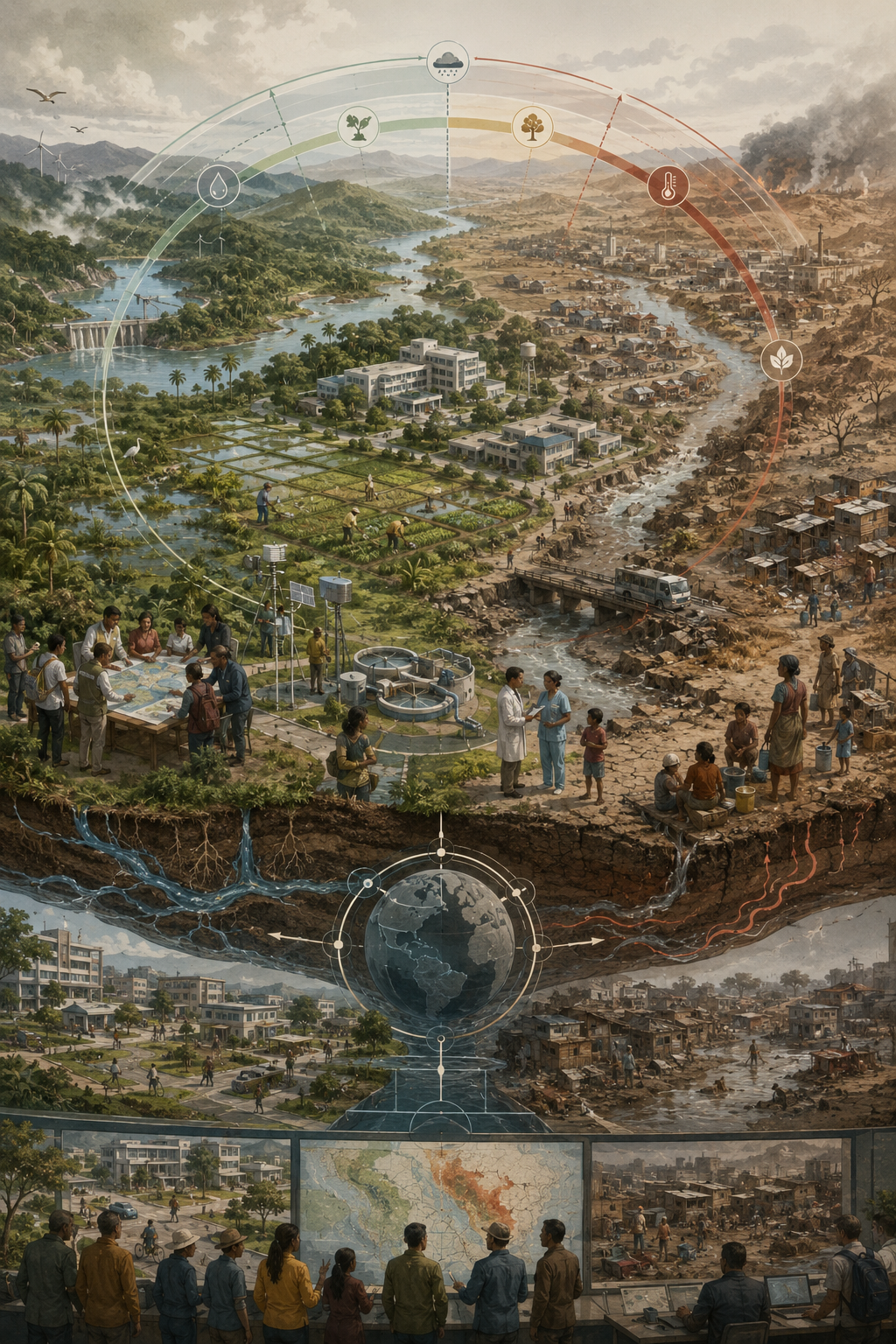
The deeper reason boundary transgression matters is that sustainable development is never pursued against an empty environmental backdrop. It unfolds within Earth-system processes that regulate climate, freshwater, biodiversity, nutrient cycles, land systems, and the wider ecological conditions of human flourishing. Once these systems are pushed too far, they do not simply generate isolated environmental problems. They alter the operating conditions under which societies produce food, secure water, absorb shocks, protect health, sustain infrastructure, and preserve institutional legitimacy.
Fragility should therefore not be understood only in political, fiscal, humanitarian, or security terms. Development fragility can also be ecological and systemic. It emerges when environmental overshoot interacts with social inequality, institutional weakness, infrastructure vulnerability, economic dependence, public-health exposure, and fiscal constraint in ways that make development gains easier to reverse and harder to defend.
What Boundary Transgression Means
Boundary transgression refers to the crossing of limits within major Earth-system processes beyond which the risk of destabilizing the conditions that support human societies increases. The idea is not that catastrophe begins at a single instant once a line is crossed. Rather, it is that the probability of nonlinear, compounding, and potentially irreversible change rises as human pressure moves farther beyond relatively safe ranges.
This distinction matters. A boundary is not a cliff edge in the simplest sense. It is better understood as a risk threshold within a complex system. Moving beyond it does not automatically produce immediate social collapse, but it increases the likelihood that ecological systems will behave in ways that are less predictable, less stable, and less supportive of long-run development. The further human systems move into overshoot, the more development must operate under degraded and unstable conditions.
The developmental meaning of boundary transgression lies not only in environmental degradation as such, but in the erosion of the conditions that make stable development possible. Climate stability, freshwater availability, biosphere integrity, land-system resilience, and nutrient balance are not external to development. They help determine whether agriculture remains viable, whether public-health systems face manageable burdens, whether infrastructure performs under stress, and whether economies can reproduce themselves without escalating damage.
To ask what boundary transgression means is therefore to ask when environmental pressure becomes systemic developmental risk. That is the point at which sustainability stops being a secondary concern and becomes central to development strategy itself. Boundaries become developmentally meaningful when they are interpreted not as abstract ecological thresholds, but as conditions of long-run social, institutional, and economic viability.
This framing aligns directly with Planetary Boundaries and How Sustainable Development Is Measured, because boundary transgression becomes governable only when ecological pressure is measured, interpreted, and linked to the systems through which people live.
Why Boundary Transgression Matters for Development
Boundary transgression matters because sustainable development depends on biophysical stability as well as institutional and economic capacity. A country may improve incomes, expand services, reduce poverty, build infrastructure, or increase educational access while the ecological systems underpinning those gains become more volatile, depleted, or stressed. Development can therefore appear to advance while its foundations become less secure.
Many development models still treat ecological degradation as an externality or downstream problem. But when environmental systems are pushed too far, the costs are no longer marginal or local. They begin to alter the durability of progress itself. Development becomes less about expanding capability in an open field and more about defending gains against increasingly unstable conditions.
This has consequences for nearly every major development domain. Food systems become more exposed to rainfall volatility, soil degradation, heat stress, and pollinator decline. Water systems become more expensive to manage as scarcity, contamination, and seasonal variability intensify. Public-health systems face rising burdens from heat, disease, malnutrition, displacement, and air-quality stress. Infrastructure must withstand conditions it was not designed for. Public finance becomes more strained as adaptation, repair, and disaster response costs rise.
Boundary transgression therefore changes the meaning of development progress. A road, school, clinic, water network, or irrigation system is not only a service asset. It is an asset embedded in ecological conditions. If those conditions become more unstable, the cost of maintaining service rises and the probability of disruption increases. Development gains become more fragile because the systems supporting them become less reliable.
Sustainable development therefore becomes more fragile as boundary transgression intensifies, because the room for error narrows and the cost of preserving social and economic stability rises. This is one reason the argument pairs strongly with Risk, Shock, and Fragility in Development Systems, Climate Change as a Development Constraint, and Resilience Thinking and Sustainable Development.
From Environmental Stress to Development Fragility
Environmental stress becomes development fragility when ecological disruption weakens the systems through which people secure food, water, health, income, energy, mobility, housing, and institutional support. Fragility, in this sense, is not only exposure to shock. It is the condition in which development gains become easier to reverse because the systems sustaining them are under pressure from multiple directions at once.
Fragility is cumulative. Water stress can intensify food insecurity. Food insecurity can heighten poverty, malnutrition, and political strain. Biodiversity loss can weaken ecosystem services, pollination, disease regulation, and livelihood systems. Heat and flooding can damage infrastructure while increasing fiscal pressure. These are not separate threats. They form interacting pathways through which boundary transgression moves into development systems.
Environmental stress also becomes fragility through time. A single drought, flood, heat wave, crop failure, or disease outbreak may be managed if institutions, savings, infrastructure, and social support are strong enough. But repeated stress weakens buffers. Households sell assets. Governments divert budgets from long-term investment to emergency response. Infrastructure deteriorates faster. Insurance becomes more expensive. Trust weakens if institutions cannot respond. What begins as environmental stress becomes developmental erosion.
This is why fragility cannot be understood only as crisis. It often accumulates before formal crisis is declared. Ecological overshoot can make ordinary governance harder, maintenance more expensive, livelihoods less predictable, and public systems more reactive. The system may continue functioning, but with less margin, higher cost, and greater vulnerability to the next shock.
Development fragility is therefore best understood as systemic exposure under conditions of ecological overshoot. The issue is not just more environmental pressure, but weaker capacity to preserve gains once pressure becomes persistent and interconnected. This section also connects closely to Development Under Deep Uncertainty and Scenario Planning for Sustainable Futures, because fragility emerges most sharply where uncertainty, delayed effects, and interacting pressures make ordinary planning assumptions unreliable.
Planetary Boundaries and the Safe Operating Space
The planetary boundaries perspective matters for development because it provides a way of thinking about the Earth-system conditions within which human development can proceed with lower systemic risk. The point of the framework is not to offer a single prediction of collapse. It is to clarify that there are limits to how much stress major Earth processes can absorb before instability becomes more likely.
This matters because the idea of a safe operating space reframes sustainability from a moral add-on into a condition of strategic viability. Development strategies that assume ecological systems can absorb unlimited pressure are effectively strategies that borrow stability from the future while increasing fragility in the present. A safe operating space is not merely an environmental preference. It is the biophysical room within which agriculture, public health, infrastructure, production, governance, and social stability can function with lower systemic risk.
Planetary boundaries are especially important because they shift attention from isolated environmental damages to interacting Earth-system processes. Climate change, biosphere integrity, freshwater change, land-system change, and nutrient cycles are not separate from development systems. They are part of the environmental foundation upon which development systems depend. When several boundaries are under stress at once, the resulting risk is not simply additive. It becomes systemic.
The value of the framework is therefore diagnostic. It helps show that environmental overshoot is not merely a matter of “more damage” in a linear sense. It is a matter of entering a more unstable operating domain for development itself. This makes boundary transgression a governance problem, not only a scientific finding.
This section should sit in strong conversation with Planetary Boundaries, Freshwater Change and Development Risk, and Land-System Change and Development Pathways, because each of those pieces addresses a different route through which safe operating space becomes developmentally consequential.
Fragility as Systemic Exposure
Fragility should be understood as a condition of systemic exposure, not simply a label for countries already in crisis. Boundary transgression can increase fragility even in places that appear institutionally stable if infrastructure, food systems, insurance systems, health systems, fiscal systems, or water supplies become harder to sustain under accumulating stress.
This matters because fragility is often recognized too late. Development systems can absorb pressure for a time, masking cumulative deterioration until adaptation costs, fiscal burdens, service failures, or social tensions become much harder to manage. Ecological overshoot therefore does not only affect the poorest or weakest states, though it often affects them first and hardest. It alters the operating conditions of development more broadly.
Systemic exposure also means that vulnerability is distributed through networks. A city may depend on distant watersheds, food supplies, energy systems, logistics corridors, and public-finance arrangements. A rural region may depend on rainfall, soil fertility, market access, public health, credit, and infrastructure maintenance. Boundary transgression can move through these networks in ways that are not immediately visible from a single indicator.
This is why ecological fragility must be read relationally. A system is fragile not only because it faces pressure, but because pressure interacts with dependence, inequality, institutional limits, and weak buffers. The same ecological stress can produce different outcomes depending on how social systems are organized. But even strong systems become more expensive to defend when boundary pressure rises.
Sustainable development requires seeing fragility before it becomes visible as crisis. Boundary transgression matters because it shifts societies closer to those crisis conditions even when headline indicators have not yet collapsed. This is also why the argument belongs alongside Why Institutions Matter for Sustainable Development and Local Governance, Cities, and Territorial Development: fragility is filtered through the quality of institutions, territorial planning, and public systems rather than simply imposed from outside them.
Food, Water, Health, and the Nexus of Risk
Boundary transgression becomes especially serious when it moves through interdependent systems rather than isolated sectors. Food systems depend on water, climate stability, soils, pollination, disease regulation, energy, transport, and labor. Public health depends on food quality, water security, ecosystem integrity, air quality, housing, and livable climatic conditions. These systems do not fail independently of one another.
This matters because development institutions are often still organized in sectoral silos. Agriculture ministries, health agencies, water utilities, infrastructure departments, climate offices, planning authorities, and finance ministries may each manage part of the problem. But ecological overshoot increases the degree to which failure in one domain propagates into others. Water insecurity affects agriculture and health. Biodiversity decline affects food systems and disease risk. Climate instability intensifies all of them simultaneously.
The food-water-health nexus makes development fragility visible because it shows how quickly ecological stress becomes social stress. Crop failure can become income loss. Income loss can become food insecurity. Food insecurity can become malnutrition. Malnutrition can increase health burdens and reduce learning. Health burdens can reduce household resilience. Household vulnerability can become political pressure. Each step is mediated by institutions, infrastructure, markets, and social protection.
This is why boundary transgression cannot be governed through environmental policy alone. It requires coordination across sectors that are often institutionally separated but materially intertwined. A drought policy that ignores food prices, health systems, and social protection will be incomplete. A health strategy that ignores water, heat, and ecosystem change will be fragile. A food strategy that ignores climate and biodiversity will be short-sighted.
Sustainable development therefore depends on governing these interlinkages more effectively. Where boundaries are transgressed, the food-water-health-climate nexus becomes more unstable and less forgiving of fragmented policy. This section should link especially strongly to Water, Sanitation, and Public Infrastructure Systems, Food Systems and Agricultural Transformation, Health, Education, and Human Capability Expansion, and Policy Coordination Across Complex Systems.
Boundary Transgression and Unequal Vulnerability
Boundary transgression does not produce equal risk across populations. The same Earth-system pressure can generate very different developmental outcomes depending on poverty, infrastructure quality, livelihood dependence, geographic exposure, racialized and gendered exclusion, public-service access, land tenure, social protection, and institutional strength.
This matters because ecological overshoot often amplifies preexisting inequalities. Rural populations dependent on rain-fed agriculture, low-income urban residents in heat-exposed settlements, indigenous communities defending degraded ecosystems, women carrying water and care burdens, regions with weak public infrastructure, and communities reliant on climate-sensitive livelihoods often bear more immediate costs. Boundary transgression therefore interacts with inequality rather than sitting outside it.
Unequal vulnerability also affects political visibility. Groups most exposed to boundary pressure may have the least power to make that exposure visible in planning, budgeting, media, or official indicators. Communities living with water stress, land degradation, flooding, heat exposure, or biodiversity loss may experience development fragility long before it appears in national averages.
This makes boundary transgression an issue of justice as well as risk. The people least responsible for ecological overshoot often face the most direct burdens, while more powerful actors may be better able to buffer, insure, relocate, or externalize costs. Development fragility is therefore distributed through social power.
Sustainable development requires treating vulnerability as socially distributed. The developmental meaning of boundary transgression lies partly in how it makes already unequal systems more unequal still. This section should be tied directly to Inequality and Inclusive Development, Gender, Exclusion, and Development Justice, and Participation, Voice, and Community-Led Development, since unequal vulnerability is not only ecological but also social, administrative, and political.
Institutional Capacity and the Politics of Adaptation
Boundary transgression matters politically because it increases the demands placed on institutions. Governments must manage more frequent and more interconnected risks, often under fiscal pressure and social inequality. Adaptation becomes not just a technical challenge but a governance challenge involving priority-setting, coordination, conflict management, public trust, and legitimacy.
This matters because adaptation capacity is uneven. Institutions may be asked to protect water systems, stabilize food supplies, strengthen health surveillance, redesign infrastructure, support displaced communities, regulate land use, and manage livelihood loss at once. Where public capacity is weak, ecological overshoot can translate more quickly into fragility because institutions cannot absorb and govern the resulting pressures effectively.
The politics of adaptation also determines who receives protection. Adaptation investments can favor visible assets, wealthy districts, strategic infrastructure, or politically powerful constituencies while leaving marginalized communities underprotected. Flood defenses, heat plans, water allocation, relocation policy, insurance systems, and agricultural support all distribute benefits and burdens. Adaptation is therefore never simply a technical response to risk. It is a political process of deciding whose security matters.
Institutional capacity also determines whether adaptation remains anticipatory or becomes reactive. Strong institutions can monitor risk, plan ahead, coordinate agencies, maintain infrastructure, protect vulnerable groups, and learn from events. Weak institutions may rely on emergency response after damage has already occurred. Under boundary transgression, the difference between anticipatory and reactive governance becomes developmentally decisive.
Sustainable development therefore depends not only on reducing environmental pressure, but on strengthening institutions capable of acting under increasingly complex ecological conditions. This section should link clearly to Why Institutions Matter for Sustainable Development, State Capacity, Public Administration, and Delivery Systems, and Law, Rights, and Sustainable Development, because adaptation is shaped by institutional reach, legal frameworks, and the credibility of public authority.
Infrastructure, Settlements, and Escalating Development Costs
Boundary transgression raises the cost of development because infrastructure and settlements must operate under more unstable environmental conditions. Heat, flooding, water stress, ecosystem degradation, coastal risk, soil instability, and other pressures can shorten asset life, raise maintenance burdens, reduce reliability, and increase the cost of service delivery.
This matters because development strategies built under assumptions of relatively stable environmental baselines may become progressively more expensive to maintain. Roads, power systems, irrigation networks, health facilities, schools, housing, urban drainage, transport corridors, and water infrastructure all face rising strain when ecological instability intensifies. Development then becomes more fiscally demanding even before visible collapse occurs.
Infrastructure fragility is especially important because infrastructure connects systems. A flooded road can disrupt access to hospitals, schools, food markets, jobs, and emergency services. A failing water system can create health burdens, gendered labor burdens, and economic loss. A heat-stressed power grid can undermine cooling, health care, communications, and public administration. Infrastructure failure rarely stays inside one sector.
Settlements also reflect past development choices. Informal settlements, floodplain expansion, heat-vulnerable housing, coastal development, deforestation, and poorly planned urban growth can lock populations into exposure. Boundary transgression makes these settlement choices more consequential because environmental baselines shift around them. What once seemed manageable can become structurally unsafe or unaffordable to maintain.
Sustainable development is weakened when more resources must be used to defend existing gains against escalating instability rather than to widen capability and inclusion. This section should connect strongly to Infrastructure as the Material Basis of Development, Transport, Mobility, and Spatial Inclusion, Water, Sanitation, and Public Infrastructure Systems, and Local Governance, Cities, and Territorial Development.
Path Dependence, Thresholds, and Development Lock-In
Boundary transgression also matters because it can create path dependence. Once ecological degradation, water depletion, biodiversity loss, soil erosion, climate exposure, or hazardous settlement patterns become embedded in production systems and infrastructure, future adaptation becomes harder and more expensive.
This matters because development fragility can become self-reinforcing. Underinvestment in resilience today can deepen losses tomorrow. Ecological stress can reduce fiscal room. Reduced fiscal room can delay adaptation further. Delayed adaptation can increase exposure and repair costs. In that sense, fragility is not just a result of overshoot but part of the mechanism through which overshoot hardens into persistent developmental constraint.
Thresholds are important because systems may appear stable until they are not. A watershed may support agriculture until extraction and rainfall change push it into chronic scarcity. A food system may absorb climate variability until repeated shocks exhaust household and institutional buffers. A public budget may manage disaster response until repair and adaptation costs crowd out long-term investment. Thresholds are not always visible in advance, but they shape the risk structure of development.
Lock-in also operates through technology and infrastructure. Fossil-intensive energy systems, water-wasteful agriculture, car-dependent urban form, deforestation-driven land use, and poorly regulated extraction can create development pathways that are difficult to reverse even after their ecological risks are understood. The longer transformation is delayed, the more costly and politically difficult it becomes.
Sustainable development therefore depends on acting before transgression deepens into development lock-in. Once fragility becomes structurally embedded, recovery becomes slower, costlier, and more unequal. This section should be tied directly to Development Under Deep Uncertainty, Scenario Planning for Sustainable Futures, and Sustainable Finance and Development Investment, because lock-in operates through time, uncertainty, and the shrinking affordability of delayed response.
Why Resilience Without Boundary Reduction Is Insufficient
Resilience matters, but resilience alone is not enough if boundary pressures continue to rise. Societies can adapt to some stress, buffer some risk, and redesign some systems, but adaptation becomes progressively harder as ecological overshoot intensifies across multiple domains at once.
This matters because resilience can sometimes be interpreted too narrowly as a strategy of coping while preserving the drivers of overshoot. Boundary transgression challenges that logic. If the underlying pressures on climate, freshwater, biosphere integrity, land systems, and nutrient cycles continue to intensify, then resilience investments may increasingly function as expensive defensive measures rather than pathways to durable stability.
There is also a danger of unequal resilience. Wealthier groups, firms, cities, and countries may invest in private buffers while systemic pressures continue to worsen. Air conditioning, insurance, water imports, fortified infrastructure, relocation, and private services can protect some people temporarily while leaving others more exposed. Resilience without boundary reduction can become a strategy for managing unequal exposure rather than transforming its causes.
Boundary reduction therefore matters because it addresses the source of rising fragility. Climate mitigation, biodiversity protection, freshwater stewardship, sustainable land use, nutrient management, circular production, and ecosystem restoration are not separate from resilience. They are conditions for making resilience durable rather than endlessly defensive.
Sustainable development therefore requires both resilience-building and boundary reduction. Fragility cannot be governed sustainably if the ecological conditions producing it remain on worsening trajectories. This section should link strongly to Resilience Thinking and Sustainable Development, Risk, Shock, and Fragility in Development Systems, and Future Directions in Sustainable Development Thought, since the argument points beyond adaptation alone toward a deeper rethinking of developmental strategy.
Fragility, Not Collapse
It is important to distinguish fragility from collapse. Boundary transgression does not imply that all development systems fail at once or that every society experiences immediate breakdown. Development fragility is a subtler and often more analytically useful idea. It describes the condition in which gains become easier to reverse, shocks become harder to absorb, and long-run stability becomes more expensive to maintain.
This matters because waiting for dramatic collapse as the only meaningful threshold is analytically misleading. By the time collapse is obvious, the underlying fragility has usually been accumulating for years. The more relevant developmental question is how much margin societies retain before ordinary governance, infrastructure, service delivery, and welfare provision begin to weaken under compound ecological pressure.
Fragility is also measurable in partial signals: rising maintenance costs, declining water reliability, repeated crop losses, increasing heat mortality, shrinking insurance availability, higher disaster spending, public-finance stress, localized displacement, institutional overload, and widening inequality in exposure. These signals may appear fragmented, but together they reveal declining development resilience.
This distinction is important for public communication. Collapse narratives can produce fatalism or sensationalism. Fragility analysis focuses attention on risk accumulation, system margins, institutional capacity, and preventable pathways. It allows sustainable development to be framed not as a binary between safety and disaster, but as an ongoing struggle to preserve and widen the conditions of durable human flourishing.
Sustainable development should therefore be judged not only by whether societies are functioning now, but by whether their gains remain durable under rising systemic stress. This section also resonates with How Sustainable Development Is Measured and SDG Indicators: Strengths, Gaps, and Political Uses, because fragility often accumulates before conventional measurement systems register full breakdown.
Why This Matters for Sustainable Development
Boundary transgression and development fragility belong together because sustainable development depends not only on institutions, investment, and policy ambition, but on whether the Earth-system conditions that support social and economic life remain stable enough to sustain those efforts. When boundaries are transgressed, development becomes less secure, more expensive to defend, and more vulnerable to reversal.
This is why boundary transgression matters so much. It reveals a central truth that narrower development narratives often miss: ecological overshoot is not just an environmental problem adjacent to development. It is a condition that can make development itself more fragile, more unequal, and less governable across time.
The issue is also one of justice. Boundary transgression does not distribute harm evenly. The people and communities least responsible for ecological overshoot often face the most immediate burdens through heat exposure, water stress, food insecurity, disease risk, displacement, infrastructure failure, and livelihood loss. Sustainable development cannot be credible if it treats ecological instability as a background condition while vulnerable communities bear the costs of destabilized systems.
To take boundary transgression seriously is therefore to take development fragility seriously. Long-run progress depends not only on expanding human capability, but on reducing the systemic ecological pressures that increasingly destabilize the conditions under which that capability can endure.
Development becomes credible when resilience-building is paired with boundary reduction, when adaptation is governed as a question of justice, when ecological overshoot is treated as a development constraint, and when the durability of human wellbeing is measured against the stability of the Earth systems that make it possible.
Mathematical Lens
Boundary transgression can be clarified by expressing development fragility as a relationship between ecological pressure and adaptive capacity. Let \(B\) represent aggregate boundary pressure and \(A\) represent adaptive and institutional capacity:
F = \frac{B}{A}
\]
Interpretation: Development fragility rises when ecological pressure grows faster than societies can buffer, govern, and transform in response.
This is not a universal law, but it captures the article’s central logic: boundary transgression becomes developmentally dangerous when pressure grows faster than capacity.
We can also think in threshold terms. Let \(p_i\) represent stress on a specific Earth-system domain and let \(\theta_i\) represent a safer operating threshold for that domain. Overshoot can be represented as:
O_i = \max(0, p_i – \theta_i)
\]
Interpretation: Overshoot appears when pressure in a specific Earth-system domain exceeds a safer operating threshold.
Total overshoot across domains can then be represented as:
O = \sum_{i=1}^{n} w_i O_i
\]
Interpretation: Aggregate overshoot depends on domain-specific pressures and the developmental significance or exposure weight assigned to each domain.
This matters because overshoot is rarely uniform. Some forms of pressure matter more to particular development systems than others, depending on geography, livelihood structure, infrastructure dependence, and institutional capacity.
Fragility becomes more severe when overshoots interact rather than add linearly. A simple interaction form is:
F^{*} = O + \sum_{i \neq j}\phi_{ij}(O_i, O_j)
\]
Interpretation: Compounded fragility rises when overshoots interact across domains, such as water stress and food insecurity or land-system change and biodiversity decline.
| Term | Meaning | Interpretive role |
|---|---|---|
| \(F\) | Development fragility | Represents pressure on development systems relative to adaptive and institutional capacity. |
| \(B\) | Aggregate boundary pressure | Represents combined ecological pressure across relevant Earth-system domains. |
| \(A\) | Adaptive and institutional capacity | Represents the ability of societies to buffer, govern, adapt, and transform under stress. |
| \(p_i\) | Domain-specific pressure | Represents stress on a specific boundary domain such as climate, freshwater, biosphere integrity, land systems, or nutrient cycles. |
| \(\theta_i\) | Safer operating threshold | Represents a threshold beyond which systemic risk is expected to rise. |
| \(O_i\) | Domain-specific overshoot | Represents the amount by which a specific domain exceeds a safer operating threshold. |
| \(O\) | Aggregate overshoot | Represents the weighted sum of overshoot across domains. |
| \(F^{*}\) | Compounded fragility | Represents fragility after interaction effects across overshoot domains are considered. |
The equations are conceptual rather than predictive. Their value is to make visible the structure of the problem: ecological pressure becomes development fragility most powerfully when it propagates through coupled systems rather than remaining isolated in one domain.
Advanced Python Workflow: Boundary Pressure, Ecological Overshoot, and Development Fragility Scoring
This Python workflow translates the article’s argument into a structured analytical model. Rather than treating ecological overshoot as a purely descriptive condition, it scores how boundary pressure interacts with adaptive capacity, infrastructure resilience, equity protection, and institutional capacity to generate development fragility. That makes it possible to compare countries, regions, or sectors more systematically and identify where ecological pressure is most likely to destabilize development gains.
from __future__ import annotations

import pandas as pd
import numpy as np

INPUT_FILE = "boundary_pressure_fragility_data.csv"
OUTPUT_FILE = "boundary_pressure_fragility_scores.csv"


def load_data(path: str) -> pd.DataFrame:
    """Load ecological pressure and development fragility data from CSV."""
    df = pd.read_csv(path)

    required_columns = [
        "country",
        "region",
        "climate_pressure_index",
        "freshwater_pressure_index",
        "biosphere_pressure_index",
        "land_system_pressure_index",
        "nutrient_pressure_index",
        "adaptive_capacity_index",
        "infrastructure_resilience_index",
        "equity_protection_index",
        "institutional_capacity_index",
    ]

    missing = [col for col in required_columns if col not in df.columns]

    if missing:
        raise ValueError(f"Missing required columns: {missing}")

    return df


def validate_indices(df: pd.DataFrame) -> pd.DataFrame:
    """Ensure normalized index fields are complete and fall between 0 and 1."""
    index_columns = [
        "climate_pressure_index",
        "freshwater_pressure_index",
        "biosphere_pressure_index",
        "land_system_pressure_index",
        "nutrient_pressure_index",
        "adaptive_capacity_index",
        "infrastructure_resilience_index",
        "equity_protection_index",
        "institutional_capacity_index",
    ]

    for col in index_columns:
        if df[col].isna().any():
            raise ValueError(f"Column '{col}' contains missing values.")

        if ((df[col] < 0) | (df[col] > 1)).any():
            raise ValueError(f"Column '{col}' contains values outside [0, 1].")

    return df


def compute_boundary_pressure(df: pd.DataFrame) -> pd.DataFrame:
    """Compute a weighted aggregate boundary pressure score."""
    df = df.copy()

    df["boundary_pressure_score"] = (
        0.25 * df["climate_pressure_index"] +
        0.20 * df["freshwater_pressure_index"] +
        0.20 * df["biosphere_pressure_index"] +
        0.20 * df["land_system_pressure_index"] +
        0.15 * df["nutrient_pressure_index"]
    ).clip(lower=0, upper=1)

    return df


def compute_capacity_score(df: pd.DataFrame) -> pd.DataFrame:
    """Compute an aggregate adaptive and institutional capacity score."""
    df = df.copy()

    df["capacity_score"] = (
        0.35 * df["adaptive_capacity_index"] +
        0.25 * df["institutional_capacity_index"] +
        0.20 * df["infrastructure_resilience_index"] +
        0.20 * df["equity_protection_index"]
    ).clip(lower=0, upper=1)

    return df


def compute_fragility_score(df: pd.DataFrame) -> pd.DataFrame:
    """Compute ecological fragility as boundary pressure relative to capacity."""
    df = df.copy()

    df["pressure_capacity_gap"] = (
        df["boundary_pressure_score"] -
        df["capacity_score"]
    )

    df["ecological_fragility_score"] = (
        0.70 * df["boundary_pressure_score"] -
        0.50 * df["capacity_score"]
    ).clip(lower=0, upper=1)

    df["compounding_risk_score"] = (
        df["climate_pressure_index"] *
        df["freshwater_pressure_index"] *
        0.30 +
        df["freshwater_pressure_index"] *
        df["land_system_pressure_index"] *
        0.25 +
        df["biosphere_pressure_index"] *
        df["land_system_pressure_index"] *
        0.25 +
        df["nutrient_pressure_index"] *
        df["freshwater_pressure_index"] *
        0.20
    ).clip(lower=0, upper=1)

    df["combined_fragility_score"] = (
        0.75 * df["ecological_fragility_score"] +
        0.25 * df["compounding_risk_score"]
    ).clip(lower=0, upper=1)

    df["fragility_band"] = np.select(
        [
            df["combined_fragility_score"] >= 0.65,
            df["combined_fragility_score"] >= 0.45,
            df["combined_fragility_score"] >= 0.25,
        ],
        [
            "Severe fragility",
            "Elevated fragility",
            "Moderate fragility",
        ],
        default="Lower fragility",
    )

    return df


def build_summary(df: pd.DataFrame) -> pd.DataFrame:
    """Build a summary table sorted by fragility severity."""
    summary_columns = [
        "country",
        "region",
        "boundary_pressure_score",
        "capacity_score",
        "pressure_capacity_gap",
        "ecological_fragility_score",
        "compounding_risk_score",
        "combined_fragility_score",
        "fragility_band",
    ]

    summary = df[summary_columns].copy()

    return summary.sort_values(
        by=["combined_fragility_score", "boundary_pressure_score"],
        ascending=[False, False],
    )


def main() -> None:
    df = load_data(INPUT_FILE)
    df = validate_indices(df)
    df = compute_boundary_pressure(df)
    df = compute_capacity_score(df)
    df = compute_fragility_score(df)

    summary = build_summary(df)
    summary.to_csv(OUTPUT_FILE, index=False)

    print("Boundary pressure fragility scoring complete.")
    print(summary.to_string(index=False))


if __name__ == "__main__":
    main()
This workflow is intentionally transparent. It does not collapse a complex Earth-system reality into a single definitive number. It creates a reproducible scoring logic for comparing relative fragility under ecological overshoot. In practice, it can support work on climate stress, freshwater risk, biosphere decline, or coupled food-water-health vulnerability where the key question is not simply how much pressure exists, but how development systems absorb or fail under that pressure.
Advanced R Workflow: Boundary Pressure and Ecological Fragility Analysis
This R workflow is designed for comparative analysis across countries or regions where ecological overshoot must be tracked as a multidimensional development problem rather than a single environmental indicator. It summarizes boundary pressure across several Earth-system domains, estimates the relationship between ecological pressure and institutional buffering, and produces both country-level and regional summaries.
library(readr)
library(dplyr)

input_file <- "ecological_fragility_panel.csv"
country_output_file <- "ecological_fragility_country_summary.csv"
region_output_file <- "ecological_fragility_region_summary.csv"

fragility_df <- read_csv(input_file, show_col_types = FALSE)

required_cols <- c(
  "country",
  "region",
  "year",
  "climate_pressure_index",
  "freshwater_pressure_index",
  "biosphere_pressure_index",
  "land_system_pressure_index",
  "nutrient_pressure_index",
  "adaptive_capacity_index",
  "institutional_capacity_index"
)

missing_cols <- setdiff(required_cols, names(fragility_df))

if (length(missing_cols) > 0) {
  stop(paste("Missing required columns:", paste(missing_cols, collapse = ", ")))
}

index_cols <- names(fragility_df)[grepl("_index$", names(fragility_df))]

invalid_index_cols <- index_cols[
  vapply(
    fragility_df[index_cols],
    function(x) any(is.na(x) | x < 0 | x > 1),
    logical(1)
  )
]

if (length(invalid_index_cols) > 0) {
  stop(
    paste(
      "Index columns must be complete and normalized to [0, 1]:",
      paste(invalid_index_cols, collapse = ", ")
    )
  )
}

fragility_df <- fragility_df %>%
  mutate(
    multidimensional_boundary_pressure = (
      climate_pressure_index +
        freshwater_pressure_index +
        biosphere_pressure_index +
        land_system_pressure_index +
        nutrient_pressure_index
    ) / 5,
    institutional_buffer_score = (
      adaptive_capacity_index +
        institutional_capacity_index
    ) / 2,
    pressure_capacity_gap = (
      multidimensional_boundary_pressure -
        institutional_buffer_score
    ),
    compounding_pressure_proxy = (
      climate_pressure_index * freshwater_pressure_index +
        freshwater_pressure_index * land_system_pressure_index +
        biosphere_pressure_index * land_system_pressure_index +
        nutrient_pressure_index * freshwater_pressure_index
    ) / 4
  )

country_summary <- fragility_df %>%
  group_by(country) %>%
  summarise(
    avg_boundary_pressure = mean(multidimensional_boundary_pressure, na.rm = TRUE),
    min_boundary_pressure = min(multidimensional_boundary_pressure, na.rm = TRUE),
    max_boundary_pressure = max(multidimensional_boundary_pressure, na.rm = TRUE),
    avg_institutional_buffer = mean(institutional_buffer_score, na.rm = TRUE),
    avg_pressure_capacity_gap = mean(pressure_capacity_gap, na.rm = TRUE),
    avg_compounding_pressure = mean(compounding_pressure_proxy, na.rm = TRUE),
    observations = n(),
    .groups = "drop"
  ) %>%
  mutate(
    fragility_band = case_when(
      avg_pressure_capacity_gap >= 0.30 ~ "Severe ecological fragility",
      avg_pressure_capacity_gap >= 0.15 ~ "Elevated ecological fragility",
      avg_pressure_capacity_gap >= 0.05 ~ "Moderate ecological fragility",
      TRUE ~ "Lower ecological fragility"
    )
  ) %>%
  arrange(desc(avg_pressure_capacity_gap))

region_summary <- fragility_df %>%
  group_by(region) %>%
  summarise(
    avg_boundary_pressure = mean(multidimensional_boundary_pressure, na.rm = TRUE),
    avg_climate_pressure = mean(climate_pressure_index, na.rm = TRUE),
    avg_freshwater_pressure = mean(freshwater_pressure_index, na.rm = TRUE),
    avg_biosphere_pressure = mean(biosphere_pressure_index, na.rm = TRUE),
    avg_land_system_pressure = mean(land_system_pressure_index, na.rm = TRUE),
    avg_nutrient_pressure = mean(nutrient_pressure_index, na.rm = TRUE),
    avg_institutional_buffer = mean(institutional_buffer_score, na.rm = TRUE),
    avg_pressure_capacity_gap = mean(pressure_capacity_gap, na.rm = TRUE),
    observations = n(),
    .groups = "drop"
  ) %>%
  arrange(desc(avg_boundary_pressure))

write_csv(country_summary, country_output_file)
write_csv(region_summary, region_output_file)

cat("Country ecological fragility summary exported to:", country_output_file, "\n")
print(country_summary)

cat("\nRegion ecological fragility summary exported to:", region_output_file, "\n")
print(region_summary)
R is especially useful here because ecological fragility analysis often involves structured comparison across many units and years, with attention to averages, gaps, and relative profiles rather than single-case description alone. The workflow calculates a multidimensional boundary-pressure proxy, estimates a pressure-capacity gap, and supports resilience-oriented reporting on where ecological overshoot is most likely to destabilize development systems.
Advanced Go Workflow: Lightweight Ecological Fragility Scoring Service
This Go workflow is useful when the article’s ecological-fragility logic needs to move from analysis into a lightweight operational service. Python and R are strong for diagnostics and comparative summaries, but Go is a good fit for a compact utility that can ingest regional or country-level records and return boundary-pressure, capacity, and fragility scores quickly. In practical terms, this kind of service could sit behind a monitoring dashboard, internal planning tool, or early-warning workflow.
package main

import (
	"encoding/csv"
	"fmt"
	"os"
	"strconv"
)

type FragilityRecord struct {
	Country                  string
	Region                   string
	ClimatePressure          float64
	FreshwaterPressure       float64
	BiospherePressure        float64
	LandSystemPressure       float64
	NutrientPressure         float64
	AdaptiveCapacity         float64
	InfrastructureResilience float64
	EquityProtection         float64
	InstitutionalCapacity    float64
}

func parseIndex(value string) (float64, error) {
	parsed, err := strconv.ParseFloat(value, 64)
	if err != nil {
		return 0, err
	}

	if parsed < 0 || parsed > 1 {
		return 0, fmt.Errorf("index value outside [0, 1]: %f", parsed)
	}

	return parsed, nil
}

func parseRecord(row []string) (FragilityRecord, error) {
	if len(row) != 11 {
		return FragilityRecord{}, fmt.Errorf("invalid record length: expected 11 columns")
	}

	values := make([]float64, 9)

	for i, col := range row[2:] {
		value, err := parseIndex(col)
		if err != nil {
			return FragilityRecord{}, err
		}
		values[i] = value
	}

	return FragilityRecord{
		Country:                  row[0],
		Region:                   row[1],
		ClimatePressure:          values[0],
		FreshwaterPressure:       values[1],
		BiospherePressure:        values[2],
		LandSystemPressure:       values[3],
		NutrientPressure:         values[4],
		AdaptiveCapacity:         values[5],
		InfrastructureResilience: values[6],
		EquityProtection:         values[7],
		InstitutionalCapacity:    values[8],
	}, nil
}

func clamp01(x float64) float64 {
	if x < 0 {
		return 0
	}

	if x > 1 {
		return 1
	}

	return x
}

func boundaryPressure(record FragilityRecord) float64 {
	return clamp01(
		0.25*record.ClimatePressure +
			0.20*record.FreshwaterPressure +
			0.20*record.BiospherePressure +
			0.20*record.LandSystemPressure +
			0.15*record.NutrientPressure,
	)
}

func capacityScore(record FragilityRecord) float64 {
	return clamp01(
		0.35*record.AdaptiveCapacity +
			0.25*record.InstitutionalCapacity +
			0.20*record.InfrastructureResilience +
			0.20*record.EquityProtection,
	)
}

func compoundingRisk(record FragilityRecord) float64 {
	return clamp01(
		0.30*record.ClimatePressure*record.FreshwaterPressure +
			0.25*record.FreshwaterPressure*record.LandSystemPressure +
			0.25*record.BiospherePressure*record.LandSystemPressure +
			0.20*record.NutrientPressure*record.FreshwaterPressure,
	)
}

func fragilityScore(record FragilityRecord) float64 {
	pressure := boundaryPressure(record)
	capacity := capacityScore(record)
	compounding := compoundingRisk(record)

	baseFragility := clamp01(0.70*pressure - 0.50*capacity)

	return clamp01(0.75*baseFragility + 0.25*compounding)
}

func fragilityBand(score float64) string {
	switch {
	case score >= 0.65:
		return "Severe fragility"
	case score >= 0.45:
		return "Elevated fragility"
	case score >= 0.25:
		return "Moderate fragility"
	default:
		return "Lower fragility"
	}
}

func main() {
	file, err := os.Open("boundary_pressure_fragility_data_service.csv")
	if err != nil {
		fmt.Println("Error opening CSV:", err)
		return
	}
	defer file.Close()

	reader := csv.NewReader(file)

	rows, err := reader.ReadAll()
	if err != nil {
		fmt.Println("Error reading CSV:", err)
		return
	}

	for i, row := range rows {
		if i == 0 {
			continue
		}

		record, err := parseRecord(row)
		if err != nil {
			fmt.Println("Parse error:", err)
			continue
		}

		pressure := boundaryPressure(record)
		capacity := capacityScore(record)
		compounding := compoundingRisk(record)
		fragility := fragilityScore(record)

		fmt.Printf(
			"country=%s region=%s boundary_pressure=%.3f capacity=%.3f compounding=%.3f fragility=%.3f band=%s\n",
			record.Country,
			record.Region,
			pressure,
			capacity,
			compounding,
			fragility,
			fragilityBand(fragility),
		)
	}
}
The point is not to build a full Earth-system monitoring platform inside the article. The point is to show how the logic of boundary pressure, adaptive capacity, compounding interaction, and development fragility can be operationalized cleanly: validate normalized inputs, compute pressure and capacity scores, estimate compounding risk, and return a readable fragility band. That gives the article’s systems argument a practical service layer while keeping the code compact and auditable.
GitHub Repository
Complete Code Repository
The full code distribution for this article, including ecological fragility scoring workflows, boundary-pressure diagnostics, compounding-risk analysis, SQL materials, optional scoring-service tooling, supporting documentation, and repository structure, is available on GitHub.
Related Articles
- Sustainable Development
- Planetary Boundaries
- Climate Change as a Development Constraint
- Resilience Thinking and Sustainable Development
- Freshwater Change and Development Risk
- Risk, Shock, and Fragility in Development Systems
- Development Under Deep Uncertainty
- Scenario Planning for Sustainable Futures
- Food Systems and Agricultural Transformation
- Water, Sanitation, and Public Infrastructure Systems
Further Reading
- Intergovernmental Science-Policy Platform on Biodiversity and Ecosystem Services (2024) Thematic Assessment Report on the Interlinkages among Biodiversity, Water, Food and Health. Available at: https://www.ipbes.net/nexus-assessment
- Stockholm Resilience Centre (2024) Earth beyond six of nine planetary boundaries. Available at: https://www.stockholmresilience.org/publications/publications/2024-10-12-earth-beyond-six-of-nine-planetary-boundaries.html
- Stockholm Resilience Centre (n.d.) Planetary boundaries. Available at: https://www.stockholmresilience.org/research/planetary-boundaries.html
- United Nations Development Programme (2025) Development at Risk: Protecting Gains and Unleashing Opportunities Amid Crisis. Available at: https://www.undp.org/publications/development-risk-protecting-gains-and-unleashing-opportunities-amid-crisis
- Stockholm Resilience Centre (2025) Connecting planetary boundaries and planetary health. Available at: https://www.stockholmresilience.org/publications/publications/2025-11-28-connecting-planetary-boundaries-and-planetary-health-a-resilient-and-stable-earth-system-is-crucial-for-human-health.html
References
- Intergovernmental Science-Policy Platform on Biodiversity and Ecosystem Services (2024) Thematic Assessment Report on the Interlinkages among Biodiversity, Water, Food and Health. Available at: https://www.ipbes.net/nexus-assessment
- Intergovernmental Science-Policy Platform on Biodiversity and Ecosystem Services (2024) Nexus Assessment Primer. Available at: https://files.ipbes.net/ipbes-web-prod-public-files/2024-10/20240829%20Nexus%20Primer%20ENGLISH%20%281%29.pdf
- Stockholm Resilience Centre (n.d.) Planetary boundaries. Available at: https://www.stockholmresilience.org/research/planetary-boundaries.html
- Stockholm Resilience Centre (2024) Earth beyond six of nine planetary boundaries. Available at: https://www.stockholmresilience.org/publications/publications/2024-10-12-earth-beyond-six-of-nine-planetary-boundaries.html
- Stockholm Resilience Centre (2019) It’s all about the safe operating space. Available at: https://www.stockholmresilience.org/research/research-news/2019-07-25-its-all-about-the-safe-operating-space.html
- United Nations Development Programme (2025) Development at Risk: Protecting Gains and Unleashing Opportunities Amid Crisis. Available at: https://www.undp.org/publications/development-risk-protecting-gains-and-unleashing-opportunities-amid-crisis