
Last Updated May 28, 2026
Microbiology and the hidden majority of life examine the organisms, processes, and unseen systems through which microbes sustain biogeochemical cycles, shape ecosystems, regulate health and disease, drive evolution, and constitute much of the living activity of the biosphere. Microbes are central to biology because most of life’s metabolic diversity, much of its numerical abundance, and many of its deepest evolutionary innovations are microbial. Bacteria, archaea, microscopic eukaryotes, many fungi, and viruses interacting with cellular life together comprise a living world through which organic matter is decomposed, nutrients are recycled, pathogens emerge, symbioses are sustained, soils are formed, oceans remain productive, and biochemical transformation continues across nearly every environment on Earth.
Microbiology is therefore not a narrow subfield concerned only with germs, culture plates, or clinical infection. It is one of the principal sciences of living transformation. Microbes regulate carbon flow, nitrogen availability, methane production, sulfur chemistry, mineral weathering, host digestion, immune training, disease emergence, wastewater treatment, fermentation, bioremediation, and the early evolutionary history of life. They operate across soil pores, rhizospheres, sediments, rivers, wetlands, oceans, animal guts, plant tissues, biofilms, aquifers, glaciers, atmosphere, and built environments.
Main Library
Publications
Article Map
Biology
Related Topic
Chemistry
Related Topic
Ecology
Related Topic
Environmental Science
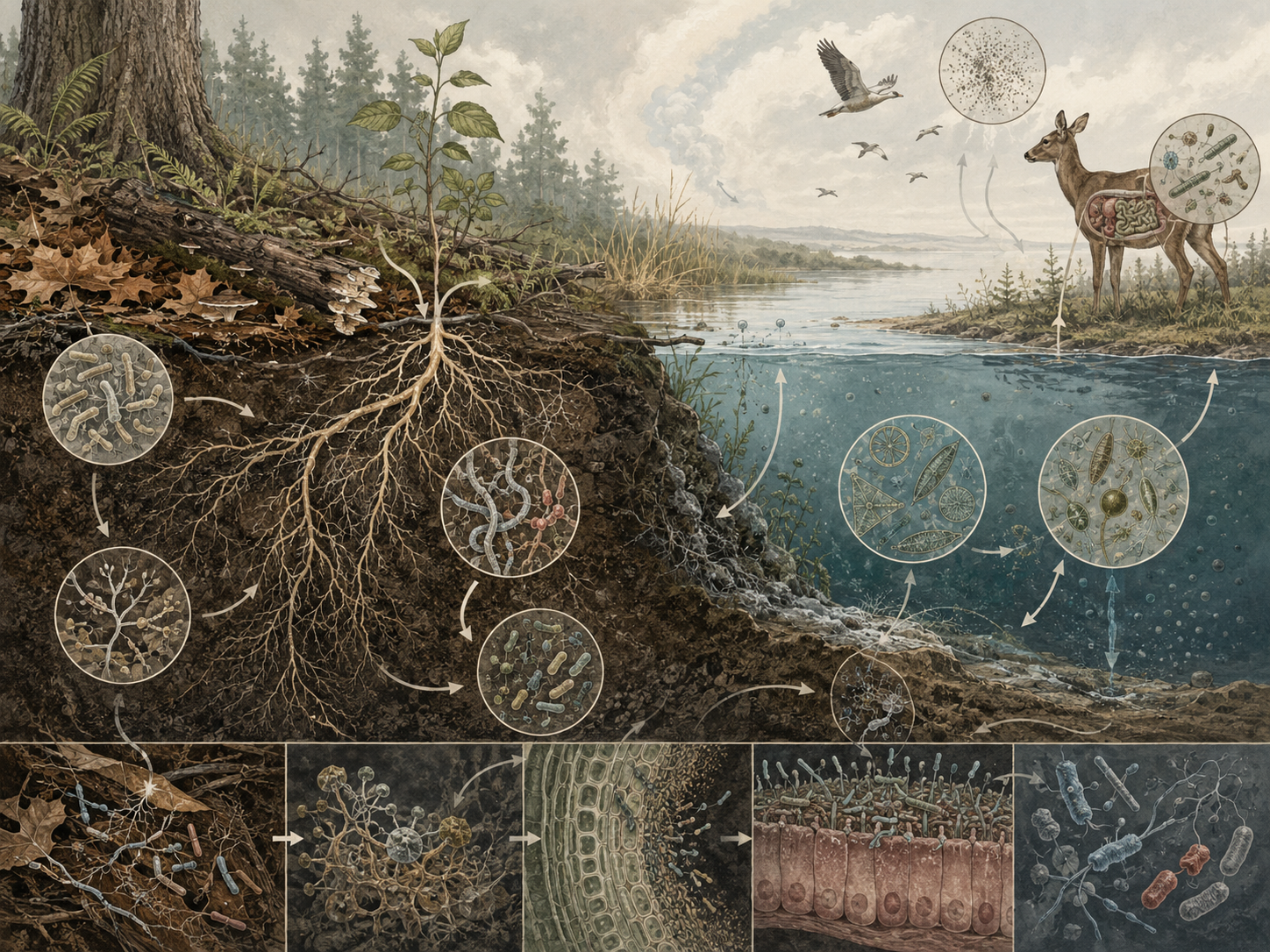
This article approaches microbiology as a scientist-facing field. It treats microbes not merely as tiny organisms but as agents of rate processes, community assembly, horizontal exchange, host interaction, chemical transformation, and planetary-scale feedback. It examines microbial diversity, bacteria, archaea, microbial eukaryotes, viruses, cell structure, metabolism, growth, population dynamics, biogeochemical cycles, microbial ecology, soil microbiomes, marine microbiology, freshwater microbiology, host-associated microbiomes, symbiosis, decomposition, pathogens, immunity, environmental change, agriculture, restoration, genomics, bioinformatics, systems microbiology, and computational modeling.
The article is written for microbiologists, ecologists, marine biologists, freshwater scientists, soil scientists, medical and environmental-health readers, computational biology readers, biotech researchers, biodiversity experts, conservation planners, restoration practitioners, agroecologists, forestry researchers, systems biologists, and research biologists who need a rigorous account of how microbial systems organize living transformation at microscopic, organismal, ecological, and planetary scales.
The article also extends microbiology into quantitative and computational biology through exponential growth, logistic growth, Monod kinetics, substrate-limited transformation, community recovery after disturbance, microbial condition scoring, uncertainty screening, R workflows, Python workflows, SQL provenance structures, and a linked full-stack GitHub repository containing Python, R, Julia, Fortran, Rust, Go, C, C++, SQL, notebooks, data files, and reproducibility documentation.
What microbiology studies
Microbiology is the study of microscopic life and of biological systems whose activity is often inaccessible without microscopy, cultivation, sequencing, physiological assays, chemical measurements, or computational reconstruction. It includes bacteria, archaea, many protists, microscopic fungi, and the larger biological consequences of viruses in relation to cellular hosts. Properly understood, microbiology is not a niche extension of organismal biology. It is one of the principal ways biology explains metabolism, decomposition, symbiosis, pathogenesis, ecosystem turnover, and the deep history of life.
This matters because many of the processes most decisive for life on Earth are microbial in scale even when their consequences are planetary. Nitrogen turnover in soils, carbon fixation in oceans, fermentation, methanogenesis, nitrification, denitrification, host-associated digestion, toxin transformation, wastewater treatment, and many infectious diseases all depend on microbial activity. The visible world of forests, wetlands, coral systems, agricultural landscapes, animal bodies, and aquatic food webs rests partly on a much larger unseen substrate of microbial transformation.
Microbiology therefore belongs at the center of biological reasoning. It reveals that life is not defined only by visible plants and animals, but by immense populations of small organisms whose biochemical and ecological activity sustains whole systems. This is why microbiology belongs near the foundation of any serious account of ecology, medicine, conservation, environmental change, biotechnology, or biological systems modeling.
Why microbes are the hidden majority of life
Microbes can be described as the hidden majority of life for several overlapping reasons. They dominate many habitats numerically. They account for vast fractions of metabolic diversity. They occupy nearly every niche where energy gradients and chemical substrates make transformation possible. And for most of Earth’s history, life was overwhelmingly microbial before large multicellular forms emerged and diversified.
This matters because a visible-centered image of life is historically and scientifically misleading. Soil aggregates, root zones, hydrothermal systems, glacier surfaces, sediments, estuaries, deep ocean waters, animal guts, plant tissues, biofilms on rock, and atmospheric aerosols all contain microbial systems whose activity shapes larger biological outcomes. Even where microbes are not visually dominant, they often remain functionally central. A forest may appear botanically defined yet depend on microbial mineralization, rhizosphere exchange, decomposition, and disease regulation. A marine food web may appear planktonic and animal-centered while resting on microbial primary production, recycling, and viral turnover.
Microbiology therefore corrects a deep distortion in biological imagination. The biosphere is not mainly a stage for large organisms with microbes at the margins. Much of life’s innovation, persistence, and transformation occurs at microbial scale. The hidden majority of life is hidden not because it is marginal, but because its spatial scale, chemical activity, and community organization often exceed ordinary perception.
Bacteria, archaea, microbial eukaryotes, and the scope of microbial diversity
Microbial diversity is broader than bacteria alone. Bacteria and archaea represent the major prokaryotic domains, but microbiology also includes many unicellular or microscopic eukaryotes such as yeasts, protists, and numerous algae. This broader framing matters because microbial life is not one kind of organism miniaturized. It is a phylogenetically deep, functionally heterogeneous assemblage of lineages with different evolutionary histories, cell structures, ecologies, and metabolic strategies.
Archaea are especially important because they ended the older assumption that all prokaryotes belong to one undifferentiated category. Their distinctive ribosomal, membrane, and informational systems transformed understanding of the tree of life and the early history of cellular evolution. They are also metabolically consequential, particularly in methane production, ammonia oxidation, and life in chemically or thermally extreme environments. Bacteria remain foundational because of their enormous ecological breadth, rapid evolutionary dynamics, and centrality to nutrient cycling, symbiosis, and disease. Microbial eukaryotes matter because photosynthesis, predation, parasitism, motility, and cellular elaboration also flourish in microscopic worlds.
Microbiology is therefore strongest when it treats microbial diversity as evolutionary infrastructure rather than as a loose collection of “germs.” Serious microbial science requires taxonomic and phylogenetic precision because ecological role, metabolic capacity, and evolutionary potential are not evenly distributed across the microbial world.
Viruses, phages, and the boundaries of microbial life
Viruses occupy a difficult but essential place in microbiology. They are not cellular organisms, but they profoundly shape cellular microbial life through infection, mortality, gene transfer, population control, and evolutionary pressure. Bacteriophages influence bacterial abundance and diversity. Marine viruses participate in microbial turnover and the release of organic matter. Viral infection can redirect host metabolism, alter community structure, and affect biogeochemical flows. In clinical settings, viruses shape disease, immunity, epidemiology, and host-microbiome interactions.
This matters because microbial systems cannot be understood only by counting cells. Viral processes can lyse hosts, move genes, alter selection, and shift nutrient pathways. In marine systems, viral lysis contributes to the microbial loop by redirecting cellular biomass into dissolved and particulate organic matter. In bacterial evolution, phages can influence virulence, resistance, horizontal gene transfer, and genome structure. In host-associated microbiomes, viral communities interact with bacteria, immune systems, and tissue environments in ways that remain scientifically complex.
Viruses therefore complicate organism-centered biology in a productive way. They remind us that life’s organization includes entities and processes that are not neatly contained within autonomous cells. Microbial biology is not only cell biology at small scale. It is a field of interaction, parasitism, gene exchange, ecological turnover, and boundary cases that force biology to refine its categories.
Microbial cells, structure, and the organization of small life
Microbial cells are small, but they are not biologically simple in any trivial sense. Bacterial and archaeal cells maintain membranes, transport nutrients, regulate osmotic state, replicate and repair genomes, sense gradients, coordinate metabolism, and respond to rapidly changing environmental conditions. Many also form spores, capsules, sheaths, magnetosomes, storage granules, pili, flagella, or extracellular matrices that support persistence, dispersal, adhesion, or interaction.
This matters because the organization of microbial life shows that sophistication does not require large body size. A microbial cell may integrate chemical gradients, switch metabolic pathways, regulate stress responses, alter gene expression at high speed, and move between dormant and active states depending on local conditions. Some microbes form multicellular-like arrangements or biofilms with collective behavior, division of labor, and altered tolerance to environmental stress or antimicrobial treatment. Spatial organization at microscopic scale can therefore generate macroscopic biological consequence.
Microbiology complicates simplistic equations of size with complexity. Small life can be extraordinarily responsive, structurally inventive, and ecologically strategic. This is part of why microbial systems are so powerful in biogeochemistry, medicine, and evolution: they couple physical smallness with chemical versatility, rapid reproduction, and population-level force.
Metabolism, energy, and biochemical invention
One of the deepest reasons microbes matter is that they embody much of life’s biochemical inventiveness. Microbial metabolism includes fermentation, aerobic respiration, anaerobic respiration, oxygenic and anoxygenic photosynthesis, sulfur oxidation, sulfate reduction, nitrification, denitrification, anammox, methanogenesis, methane oxidation, iron cycling, hydrogen metabolism, acetogenesis, and many other pathways through which matter and energy are transformed.
This matters because metabolism is one of the great foundations of biology, and microbial systems reveal its full breadth. Many of the processes that link life to rocks, atmosphere, sediments, oceans, aquifers, and soils are microbial before they are anything else. Microbes show that life is not only inherited structure but active chemistry under ecological constraint. Their metabolisms determine which redox gradients are exploited, which compounds are detoxified or mobilized, which nutrients become available, and which environments remain habitable.
This is one reason microbiology belongs closely with Metabolism, Energy, and Biological Function. The hidden majority of life is also a large part of the hidden chemistry of life. From the standpoint of systems biology and Earth-system science, microbial metabolism is one of the interfaces through which ecology becomes geochemistry and geochemistry becomes biology.
Microbes and the major biogeochemical cycles
Microbes are central to the carbon, nitrogen, sulfur, phosphorus, iron, methane, and trace-element cycles because they mediate decomposition, mineralization, fixation, oxidation, reduction, mobilization, immobilization, and transformation across ecosystems. Carbon enters food webs partly through photosynthetic microbes in aquatic systems and returns through respiration and decomposition. Nitrogen becomes biologically available or unavailable through microbial transformations such as fixation, nitrification, denitrification, ammonification, and anammox. Sulfur compounds are cycled through microbial redox processes in sediments, soils, wetlands, and aquatic systems.
This matters because ecosystems do not merely contain nutrient cycles as abstract diagrams. They enact them through living organisms, and microbial communities are often the principal agents of those transformations. Without microbial mediation, organic matter would accumulate differently, nutrient limitation would intensify, oxygen balances would shift, methane and nitrous oxide fluxes would change, and many ecosystems would become biologically unrecognizable.
Microbiology is therefore indispensable to ecological and environmental reasoning. It belongs directly alongside Biogeochemical Cycles and the Conditions of Habitability because microbial transformations determine not only nutrient availability but also greenhouse-gas emissions, contaminant fate, water quality, soil fertility, and the resilience or fragility of ecosystem function under disturbance.
Microbial growth, reproduction, and population dynamics
Microbial populations can grow rapidly under favorable conditions, but that growth is always shaped by nutrient availability, waste accumulation, predation, viral lysis, temperature, pH, salinity, oxygen availability, host defenses, antibiotic exposure, toxin accumulation, and competition. Microbiology often begins with growth curves, doubling times, and population phases not because microbes are trivial, but because their abundance and activity can change dramatically over short time scales.
This matters because microbial ecology is highly dynamic. Blooms, collapses, taxonomic turnover, resistance emergence, biofilm expansion, dormancy shifts, and metabolic switching can happen far faster than the demographic changes familiar from many plant or animal populations. These dynamics matter in disease outbreaks, harmful algal blooms, fermentation systems, wastewater treatment, gut dysbiosis, litter decay, and pathogen colonization. A microbial population is therefore never only a count. It is a rate process coupled to environmental conditions, resource fluxes, and interaction structure.
Population thinking is central because the biological significance of microbes often emerges not from one cell but from vast and rapidly changing populations. This is why microbiology connects naturally to Population Dynamics and Ecological Modeling and to quantitative systems analysis more broadly.
Microbes, evolution, and the history of life
Microbial life is central to the history of life because early Earth was microbial for immense stretches of geological time. Long before animals, forests, flowering plants, or vertebrate-dominated ecosystems, microbial lineages were shaping sediments, oceans, atmospheric chemistry, and the conditions under which later life would evolve. The evolution of oxygenic photosynthesis in cyanobacteria, for example, altered Earth’s redox state profoundly and helped create the conditions for more oxygen-demanding forms of life.
This matters because evolutionary history cannot be told truthfully from a purely multicellular perspective. Microbes are not an afterthought in the history of life. They are the deep foundation of it. Many evolutionary innovations in metabolism, gene regulation, environmental sensing, and persistence emerged in microbial contexts. Horizontal gene transfer, rapid mutation, massive population sizes, dormancy, biofilm formation, phage interaction, and strong selection across chemical gradients make microbial evolution especially important for understanding adaptation and contingency.
This article therefore connects closely to Evolution and the History of Life, Microevolution, Macroevolution, and Deep Time, and Mutation, Variation, and the Sources of Novelty. To understand life historically is to understand its microbial depth.
Microbial ecology, communities, and the logic of invisible ecosystems
Microbes usually do not live as isolated cells distributed randomly through the world. They form communities structured by gradients, surfaces, host tissues, nutrient flows, oxygen conditions, pH, temperature, moisture, and interspecies interaction. Biofilms, mats, sediments, rhizospheres, detrital particles, coral-associated microbiomes, wetland sediments, activated sludge, and gut communities all show that microbial life is often collective, spatially organized, and chemically mediated.
This matters because invisible ecosystems are still ecosystems. Cooperation, competition, predation, signaling, quorum sensing, cross-feeding, dormancy, antagonism, phage-driven mortality, syntrophy, and spatial exclusion all occur in microbial worlds. The logic of ecological community extends to microscopic scale, often with even greater chemical and temporal intensity than in macroscopic systems. A gram of soil or milliliter of seawater can contain complex assemblages with shifting metabolic interactions and strong consequences for larger ecological processes.
Microbiology is strongest when it treats microbes as participants in communities rather than as isolated laboratory strains. This community perspective is especially important when interpreting sequence data, microbiome studies, and environmental response, because abundance alone does not fully reveal interaction, function, activity, or resilience.
Soil, marine, freshwater, and host-associated microbiomes
Microbial life varies profoundly across environments. Soil microbiology concerns decomposition, nutrient turnover, rhizosphere interaction, mineral-organic microsites, and the extraordinary heterogeneity of pore structure and substrate distribution. Marine microbiology concerns planktonic systems, carbon export, microbial loops, viral dynamics, symbioses, and biogeochemical transformation across the water column. Freshwater microbiology addresses lakes, rivers, wetlands, sediments, eutrophication, hypoxia, and hydrologically structured microbial change. Host-associated microbiology concerns guts, skin, mucosa, reproductive systems, immune interaction, and microbial residence within animals and plants.
This matters because the hidden majority of life is not one ecosystem but many. The microbial world changes across salinity, oxygen, light, depth, carbon source, host association, pollutant exposure, and disturbance regime. Microbiology therefore belongs directly to Plant Biology and the Life of Primary Producers, Animal Biology and the Organization of Complex Life, Fungi and the Networks of Decomposition and Exchange, and wider ecosystem science.
For sustainability-adjacent biology, this means that soil fertility, ocean productivity, wetland function, plant resilience, animal health, water quality, and environmental recovery all depend partly on microbial systems. In many cases, microbiology provides the missing mechanism that explains why superficially similar habitats diverge in productivity, stability, or recovery potential.
Symbiosis, decomposition, and the relational world of microbes
Microbes are among the most important partners in symbiosis and among the most important agents of decomposition. Many plants depend on root-associated bacteria or fungi for nutrient acquisition, hormone signaling, nitrogen fixation, disease resistance, or stress response. Many animals depend on gut microbes for digestion, vitamin synthesis, immune development, colonization resistance, or metabolic regulation. At the same time, decomposer microbes break down organic matter, return nutrients to ecosystems, and mediate the transition from once-living structure back into biogeochemical availability.
This matters because microbial life is deeply relational. Microbes rarely fit one stable role across all contexts. They may be mutualists in one host, decomposers in soil, competitors in another community, and opportunistic pathogens under altered conditions. Their ecological identity is often context-sensitive and interaction-dependent, which makes reductionist classification difficult but biologically revealing.
Microbiology therefore belongs closely with Coevolution, Symbiosis, and the Dynamics of Mutual Change. Much of life’s hidden majority is also life’s hidden web of association. This is especially important for restoration biology, conservation practice, agriculture, and disease ecology because recovery, resistance, and collapse often hinge on whether beneficial or destabilizing microbial associations dominate under changed conditions.
Pathogens, immunity, and disease ecology
Microbiology is indispensable to medicine and disease ecology because many infectious diseases are microbial in origin. Bacteria, protozoa, fungi, and viruses interacting with cellular hosts can shape morbidity, mortality, immunity, demographic change, and ecological disruption. Yet pathogens are only one part of microbiology. The same field that studies sepsis, cholera, tuberculosis, malaria, candidiasis, antimicrobial resistance, or viral infection also studies beneficial microbes, nutrient cycling, fermentation, and microbial resilience.
This matters because a pathogen-centered view of microbes is incomplete. It obscures the far larger world in which microbial life supports health as well as threatens it. Host defense, immune tolerance, microbial competition, colonization resistance, inflammatory dysregulation, biofilm behavior, antimicrobial selection, and microbiome imbalance are all part of the same microbial landscape. Disease often emerges not from one organism alone but from a changing interaction among host, environment, microbial community, immune state, and exposure pathway.
This places microbiology in direct relation to Immunology and Biological Defense, Physiology and the Regulation of Living Systems, and environmental-health science. For clinicians, public-health readers, and disease ecologists, microbes are not only agents of infection but markers of ecological instability, therapeutic challenge, and changing environmental risk.
Microbiology, agriculture, restoration, and environmental change
Microbiology is central to agriculture, restoration, waste treatment, nutrient recovery, soil regeneration, and environmental repair because these systems depend on microbial processes whether practitioners recognize them or not. Cropping systems rely on decomposition, nutrient mineralization, nitrogen fixation, disease suppression, rhizosphere dynamics, composting, and microbial mediation of soil structure. Restoration projects often succeed or fail partly because microbial communities are absent, degraded, chemically stressed, or mismatched to the target vegetation and hydrologic regime. Wastewater treatment, anaerobic digestion, bioremediation, and nutrient recovery all depend on microbial transformation.
This matters because many environmental problems are microbial problems in disguised form. Dead soils, nutrient leakage, methane emissions, harmful blooms, acidified sediments, contaminant persistence, pathogen emergence, and failed ecosystem regeneration often involve altered microbial process. A restored wetland without a functioning microbial redox regime is not yet biogeochemically restored. A replanted forest without compatible rhizosphere and decomposer communities may remain structurally present but functionally incomplete.
Microbiology is therefore one of the strongest bridges between cellular biology and ecosystem repair. It belongs directly to Restoration Ecology and the Repair of Living Systems, to agroecology, to forest ecology, to water-quality science, and to broader environmental management under conditions of climate change, nutrient disruption, pollution, and exposure stress.
Genomics, bioinformatics, and computational microbiology
Modern microbiology has been transformed by sequencing, metagenomics, amplicon profiling, single-cell genomics, genome-resolved ecology, transcriptomics, metabolomics, proteomics, and computational inference. Many microbial systems cannot be understood through cultivation alone because numerous organisms remain difficult to culture, exist in strong dependency networks, or behave differently in isolation than in community context. Bioinformatics now makes it possible to compare microbial genomes, reconstruct community composition, infer metabolic potential, detect strain-level variation, and track pathogen evolution or environmental response across large datasets.
This matters because the hidden majority of life is often accessible only through data-intensive methods. Computational microbiology helps make invisible systems legible, revealing diversity, abundance, co-occurrence, functional potential, ecological connection, and evolutionary structure at scales impossible through microscopy or standard culturing alone. Yet these tools also require interpretive discipline. Taxonomic assignment does not guarantee functional expression. Relative abundance is not the same as biomass. A metagenome suggests potential, not always realized flux. A marker-gene survey can miss activity, absolute abundance, or strain-level difference.
Microbiology therefore stands at the intersection of classical laboratory science, field ecology, and contemporary computational biology. For systems biologists and computational readers, microbial communities are especially rich because they combine tractable population dynamics with chemically sophisticated and ecologically consequential interaction networks.
Quantitative microbiology: mathematics, R, and Python
Microbiology is deeply quantitative because microbial abundance, growth, decay, mutation, colonization, substrate use, recovery, and community change can often be represented mathematically. The goal of modeling is not to decorate the subject with equations, but to clarify rates, thresholds, carrying limits, interaction terms, recovery trajectories, and environmental sensitivity in ways that support real scientific reasoning.
Growth, limitation, and environmental sensitivity
A simple population-growth model begins with exponential growth under unconstrained conditions:
N(t)=N_0e^{rt}
\]
Interpretation: \(N_0\) is the initial population size, \(r\) is the intrinsic growth rate, and \(t\) is time. This is useful because microbial populations can increase rapidly when nutrients are abundant and constraints are low.
Exponential growth is typically transient. Where limits matter, a logistic model is often more realistic:
\frac{dN}{dt}=rN\left(1-\frac{N}{K}\right)
\]
Interpretation: \(K\) is the effective carrying capacity of the environment. In microbial systems, \(K\) reflects substrate limitation, space, toxicity, predation, immune activity, or inhibitory byproducts.
Growth may also depend explicitly on substrate concentration \(S\), as in Monod kinetics:
\mu(S)=\mu_{max}\frac{S}{K_s+S}
\]
Interpretation: \(\mu(S)\) is the realized growth rate, \(\mu_{max}\) is the maximum growth rate, and \(K_s\) is the half-saturation constant. This formulation matters because many microbial systems are substrate-limited rather than purely density-limited.
Biogeochemical process rates
Microbial process modeling often concerns chemical transformation rather than just cell counts. A simple first-order decomposition or contaminant-removal model can be written as:
\frac{dC}{dt}=-kC
\]
Interpretation: \(C\) is the concentration of an organic substrate or contaminant, and \(k\) is the effective removal constant.
More mechanistically, microbial uptake can be linked to biomass \(B\):
\frac{dC}{dt}=-vBC
\]
Interpretation: \(v\) represents biomass-specific transformation efficiency. This is useful in wastewater systems, decomposition studies, fermentation, and bioremediation screening because microbial activity determines the pace of chemical decline.
Community recovery and disturbance
After antibiotic treatment, salinity shock, nutrient loading, pH stress, drought, thermal stress, contamination, or habitat disturbance, microbial communities may recover incompletely or shift to alternative states. A simple recovery form can be written as:
\frac{dB}{dt}=rB\left(1-\frac{B}{K}\right)-mB+I(t)
\]
Interpretation: \(B\) is biomass or functional microbial abundance, \(r\) is the recovery rate, \(K\) is post-disturbance capacity, \(m\) is chronic mortality or stress loss, and \(I(t)\) is an intervention term such as inoculation or substrate amendment. This structure is biologically useful because restoration, probiotic intervention, or habitat repair often work by altering \(r\), \(K\), or both rather than simply adding cells.
Worked example: exponential growth
Suppose a microbial population begins at \(N_0=1000\) cells and grows with rate \(r=0.4\) over \(t=5\) time units. Then:
N(5)=1000e^{0.4\cdot5}=1000e^2\approx7389
\]
Interpretation: This illustrates how rapidly microbial populations can increase under favorable conditions. Yet even this simple example is analytically useful because it shows why nutrient limitation, immune suppression, antimicrobial pressure, oxygen limitation, or toxic accumulation quickly become important in real microbial systems.
R and Python workflows
The following examples are compact article-level workflows. The full GitHub repository expands them into richer multi-language implementations with SQL provenance, validation notes, exponential and logistic growth, Monod kinetics, substrate-limited growth, environmental modifiers, microbial condition indexing, community recovery after disturbance, Monte Carlo uncertainty screening, and reproducible computational microbiology scaffolding.
R example: growth curves, treatment comparison, and environmental screening
# Quantitative microbiology workflow in R
#
# This workflow compares logistic growth under multiple environmental
# conditions and screens treatment effects on microbial population trajectories.
#
# It is a teaching scaffold, not a calibrated clinical or ecosystem model.

library(dplyr)
library(tidyr)
library(purrr)

logistic_curve <- function(t, N0, r, K) {
  K / (1 + ((K - N0) / N0) * exp(-r * t))
}

temp_response <- function(temp, tref = 20, q10 = 2) {
  q10 ^ ((temp - tref) / 10)
}

ph_response <- function(ph, ph_opt = 7, width = 1.2) {
  exp(-((ph - ph_opt)^2) / (2 * width^2))
}

simulate_population <- function(
  days = 0:48,
  N0 = 1e4,
  r0 = 0.35,
  K = 1e8,
  temp = 20,
  ph = 7
) {
  r_eff <- r0 * temp_response(temp) * ph_response(ph)

  tibble(
    day = days,
    abundance = logistic_curve(days, N0, r_eff, K),
    r_eff = r_eff
  )
}

scenarios <- tibble(
  environment = c("reference", "acid_stress", "warm_enriched", "cool_limited"),
  temp = c(20, 20, 28, 12),
  ph = c(7.0, 5.5, 7.2, 7.0),
  K = c(1e8, 7e7, 1.5e8, 5e7)
)

results <- scenarios %>%
  mutate(
    sim = pmap(
      list(temp, ph, K),
      ~ simulate_population(temp = ..1, ph = ..2, K = ..3)
    )
  ) %>%
  select(environment, sim) %>%
  unnest(sim)

summary_tbl <- results %>%
  group_by(environment) %>%
  summarise(
    effective_growth_rate = first(r_eff),
    abundance_day_24 = abundance[day == 24],
    abundance_day_48 = abundance[day == 48],
    .groups = "drop"
  )

print(summary_tbl)

interventions <- tibble(
  treatment = c("none", "carbon_addition", "ph_buffer", "combined"),
  temp = c(18, 18, 18, 18),
  ph = c(5.8, 5.8, 6.8, 6.8),
  K = c(6e7, 8e7, 7e7, 1.0e8)
)

intervention_results <- interventions %>%
  mutate(
    sim = pmap(
      list(temp, ph, K),
      ~ simulate_population(days = 0:72, temp = ..1, ph = ..2, K = ..3)
    ),
    final_abundance = map_dbl(sim, ~ dplyr::last(.x$abundance)),
    r_eff = map_dbl(sim, ~ unique(.x$r_eff))
  )

print(intervention_results %>% select(treatment, r_eff, final_abundance))
This R workflow is useful because it moves beyond a toy growth curve into treatment comparison, environmental sensitivity, and log-scale population reasoning. It is easily extensible to replicated microcosm data, nonlinear regression, Bayesian parameter estimation, fermentation monitoring, or restoration monitoring.
R example: community condition screening for restoration or water-quality monitoring
# Simple microbial condition index for applied ecological screening.
#
# This example is useful for restoration teams, limnologists, and
# environmental-health readers who need transparent site comparison.

library(dplyr)

sites <- tibble(
  site = c(
    "reference_wetland",
    "restored_marsh",
    "eutrophic_pond",
    "agricultural_drainage"
  ),
  functional_richness = c(0.82, 0.67, 0.39, 0.45),
  nitrification_potential = c(0.74, 0.58, 0.33, 0.49),
  denitrification_balance = c(0.71, 0.60, 0.29, 0.43),
  pathogen_signal = c(0.10, 0.16, 0.31, 0.27),
  organic_overload = c(0.18, 0.25, 0.77, 0.61)
)

sites <- sites %>%
  mutate(
    microbial_condition_index =
      0.30 * functional_richness +
      0.20 * nitrification_potential +
      0.20 * denitrification_balance +
      0.15 * (1 - pathogen_signal) +
      0.15 * (1 - organic_overload)
  ) %>%
  arrange(desc(microbial_condition_index))

print(sites)
This kind of screening index is not a substitute for direct microbial process measurement, but it is analytically useful for comparing sites, prioritizing intervention, and making assumptions explicit.
Python example: Monod growth, scenario analysis, and uncertainty screening
import numpy as np
import pandas as pd

def simulate_monod(
    days=48,
    dt=0.1,
    N0=1e4,
    S0=100.0,
    mu_max=0.8,
    Ks=20.0,
    yield_coeff=1e6,
):
    """Simulate substrate-limited microbial growth using Monod kinetics."""

    time = np.arange(0, days + dt, dt)
    abundance = np.zeros_like(time, dtype=float)
    substrate = np.zeros_like(time, dtype=float)

    abundance[0] = N0
    substrate[0] = S0

    for index in range(1, len(time)):
        mu = (
            mu_max * substrate[index - 1] /
            (Ks + substrate[index - 1])
        )
        d_abundance = mu * abundance[index - 1] * dt
        d_substrate = -(d_abundance / yield_coeff)

        abundance[index] = max(abundance[index - 1] + d_abundance, 0.0)
        substrate[index] = max(substrate[index - 1] + d_substrate, 0.0)

    return pd.DataFrame(
        {
            "time": time,
            "abundance": abundance,
            "substrate": substrate,
        }
    )

scenarios = {
    "rich_media": {"S0": 150.0, "mu_max": 0.9, "Ks": 15.0},
    "poor_media": {"S0": 50.0, "mu_max": 0.6, "Ks": 25.0},
    "stress_condition": {"S0": 50.0, "mu_max": 0.3, "Ks": 30.0},
}

runs = []

for name, params in scenarios.items():
    result = simulate_monod(
        S0=params["S0"],
        mu_max=params["mu_max"],
        Ks=params["Ks"],
    )
    result["scenario"] = name
    runs.append(result)

results = pd.concat(runs, ignore_index=True)

summary = (
    results.groupby("scenario")
    .agg(
        final_abundance=("abundance", "last"),
        remaining_substrate=("substrate", "last"),
        peak_abundance=("abundance", "max"),
    )
    .reset_index()
)

print(summary.round(3))

# Uncertainty screening with Monte Carlo sampling.
rng = np.random.default_rng(42)

def monte_carlo_final_abundance(
    n_iter=1000,
    S0=100.0,
    mu_max=0.8,
    Ks=20.0,
):
    """Return final abundance under parameter uncertainty."""

    finals = []

    for _ in range(n_iter):
        sampled_mu = max(rng.normal(mu_max, 0.08), 0.01)
        sampled_Ks = max(rng.normal(Ks, 3.0), 0.1)
        sampled_S0 = max(rng.normal(S0, 10.0), 1.0)

        sim = simulate_monod(
            S0=sampled_S0,
            mu_max=sampled_mu,
            Ks=sampled_Ks,
        )
        finals.append(sim["abundance"].iloc[-1])

    return np.array(finals)

mc = monte_carlo_final_abundance(S0=80.0, mu_max=0.7, Ks=18.0)

print("Mean final abundance:", round(mc.mean(), 3))
print("5th percentile:", round(np.percentile(mc, 5), 3))
print("95th percentile:", round(np.percentile(mc, 95), 3))
This Python workflow is useful because it couples substrate limitation to growth rather than treating abundance as unconstrained. It supports comparative reasoning about media quality, stress, and uncertainty, and is readily adaptable to fermentation, pathogen expansion, enrichment experiments, or environmental-growth screens.
Python example: community recovery after disturbance
import numpy as np
import pandas as pd

def community_recovery(
    days=120,
    dt=1.0,
    B0=10.0,
    r=0.08,
    K=100.0,
    m=0.02,
    pulse_day=None,
    pulse_size=0.0,
):
    """Simulate microbial community recovery after disturbance."""

    time = np.arange(0, days + dt, dt)
    biomass = np.zeros_like(time, dtype=float)
    biomass[0] = B0

    for index in range(1, len(time)):
        intervention = (
            pulse_size
            if pulse_day is not None and abs(time[index] - pulse_day) < 1e-9
            else 0.0
        )

        d_biomass = (
            r * biomass[index - 1] *
            (1 - biomass[index - 1] / K)
            - m * biomass[index - 1]
            + intervention
        ) * dt

        biomass[index] = max(biomass[index - 1] + d_biomass, 0.0)

    return pd.DataFrame({"day": time, "biomass": biomass})

scenarios = {
    "disturbed_no_intervention": {
        "B0": 8,
        "r": 0.05,
        "K": 60,
        "m": 0.03,
        "pulse_day": None,
        "pulse_size": 0.0,
    },
    "carbon_amendment": {
        "B0": 8,
        "r": 0.06,
        "K": 75,
        "m": 0.025,
        "pulse_day": None,
        "pulse_size": 0.0,
    },
    "inoculated": {
        "B0": 8,
        "r": 0.06,
        "K": 75,
        "m": 0.025,
        "pulse_day": 14,
        "pulse_size": 5.0,
    },
    "inoculated_plus_habitat_repair": {
        "B0": 8,
        "r": 0.075,
        "K": 95,
        "m": 0.018,
        "pulse_day": 14,
        "pulse_size": 8.0,
    },
}

runs = []

for name, params in scenarios.items():
    result = community_recovery(**params)
    result["scenario"] = name
    runs.append(result)

recovery = pd.concat(runs, ignore_index=True)

summary = (
    recovery.groupby("scenario")
    .agg(
        final_biomass=("biomass", "last"),
        peak_biomass=("biomass", "max"),
    )
    .reset_index()
)

summary["meets_target"] = summary["final_biomass"] >= 70

print(summary.round(3))
This recovery workflow supports a line of reasoning common in restoration ecology, microbiome intervention, wastewater process recovery, and environmental repair: whether a disturbed microbial system merely rebounds partially or crosses into a more stable and functionally sufficient state after treatment.
These examples remain compact enough for an article, but they point toward the kinds of workflows scientists actually use: growth-curve comparison, environmental sensitivity screening, Monod kinetics, substrate-limited growth, uncertainty analysis, microbial condition scoring, and disturbance-recovery modeling rather than one illustrative curve alone.
GitHub repository
The article body includes compact R and Python examples so the biological and scientific argument remains readable. The full repository expands those examples into a broader computational microbiology workflow, including exponential and logistic growth, Monod kinetics, substrate-limited growth, environmental modifiers, microbial condition indexing, community recovery after disturbance, Monte Carlo uncertainty screening, SQL provenance structures, reproducible data files, and full-stack scientific-computing examples across Python, R, Julia, Fortran, Rust, Go, C, C++, SQL, and notebooks.
Limits, uncertainty, and modern microbial thinking
Microbiology is foundational, but it should not be oversimplified. Not all microbes are bacteria. Not all microbial communities can be inferred accurately from one method alone. Not all abundance corresponds directly to function. Some microbes are dormant, rare, uncultured, cryptic, host-dependent, or metabolically flexible in ways that complicate simple interpretation. Viruses further complicate the picture by shaping microbial mortality, gene transfer, biogeochemical release, and ecological turnover without fitting neatly into older organism-centered frameworks.
This is why modern microbial thinking increasingly integrates cultivation, microscopy, sequencing, transcriptomics, metabolomics, isotope tracing, field ecology, physiological measurement, and systems analysis. The hidden majority of life is not merely unseen because it is small. It is also difficult because it is diverse, dynamic, relational, and chemically powerful. Many of the strongest scientific questions in microbiology concern uncertainty itself: who is active, under what conditions, at what rate, with what interaction partners, and with what consequences across time?
Models are useful because they clarify assumptions, expose rates, and make scenario comparison possible. But a growth equation is not a microbial community, a condition index is not a full ecosystem diagnosis, and a metagenomic profile is not the same thing as measured biogeochemical flux. Quantitative tools are strongest when they support biological interpretation rather than replacing it.
Biology is strongest when it treats microbial systems not as an add-on to visible life but as one of the principal ways life operates at planetary scale. That framing is both more accurate and more scientifically useful than narrowing microbiology to pathogens or lab isolates alone.
Why this matters for scientific work
For working scientists, microbes matter because they are often the load-bearing mechanisms hidden inside broader biological questions. A lake may shift to chronic hypoxia because microbial respiration overwhelms oxygen renewal. A restoration site may fail because soil microbial communities do not support nutrient release or plant establishment. A disease problem may resist simple treatment because community context, biofilm formation, antimicrobial resistance, or host immune state alters microbial behavior. A climate-sensitive wetland may shift in methane emissions because microbial redox pathways reorganize under warming or altered hydrology.
This means microbiology should often be treated as explanatory infrastructure rather than as a specialist add-on. Ecologists need microbiology to understand decomposition, nutrient turnover, and trophic support. Marine and freshwater researchers need it to interpret productivity, carbon export, eutrophication, hypoxia, and microbial loop dynamics. Medical professionals need it to understand colonization, resistance, pathogenesis, and microbial-host interaction. Conservation biologists need it because biodiversity without microbial function is an incomplete picture of ecosystem persistence. Computational biologists need microbial systems because they offer analytically powerful models of rapid evolution, community turnover, metabolic exchange, and threshold behavior under uncertainty.
The scientific importance of microbiology lies partly in this generality. Microbes are not background noise beneath visible life. They are among the main ways life remains chemically, ecologically, and evolutionarily active.
Conclusion
Microbiology and the hidden majority of life show that the biosphere is sustained by countless microscopic organisms whose activities shape decomposition, nutrient cycling, disease, symbiosis, ocean productivity, soil formation, and the long history of evolution. Microbes are central not only because they are abundant, but because they mediate some of the most decisive biochemical and ecological processes on Earth.
To understand microbiology is therefore to understand one of the deepest foundations of living systems. Microbes are not merely small organisms occupying marginal niches. They are major agents of transformation, connection, and persistence across the planet. That is why microbiology remains central not only to medicine and molecular biology, but also to ecology, conservation, soil biology, marine biology, freshwater biology, plant science, animal biology, restoration, biotechnology, and sustainability-adjacent science more broadly.
Microbes are thus more than the unseen background of life. They are one of the principal ways the Earth remains biologically active.
Related articles
- Biology
- Ecology and the Interdependence of Life
- Biogeochemical Cycles and the Conditions of Habitability
- Fungi and the Networks of Decomposition and Exchange
- Plant Biology and the Life of Primary Producers
- Animal Biology and the Organization of Complex Life
- Coevolution, Symbiosis, and the Dynamics of Mutual Change
- Population Dynamics and Ecological Modeling
- Restoration Ecology and the Repair of Living Systems
- Immunology and Biological Defense
- Physiology and the Regulation of Living Systems
- Metabolism, Energy, and Biological Function
- Evolution and the History of Life
Further reading
- Falkowski, P.G., Fenchel, T. and DeLong, E.F. (2008) ‘The microbial engines that drive Earth’s biogeochemical cycles’, Science, 320(5879), pp. 1034–1039. Available at: https://doi.org/10.1126/science.1153213
- Madigan, M.T., Bender, K.S., Buckley, D.H., Sattley, W.M. and Stahl, D.A. (2021) Brock Biology of Microorganisms. 16th edn. New York: Pearson. Publisher information available at: https://www.pearson.com/en-us/subject-catalog/p/brock-biology-of-microorganisms/P200000003831
- Prosser, J.I. et al. (2007) ‘The role of ecological theory in microbial ecology’, Nature Reviews Microbiology, 5(5), pp. 384–392. Available at: https://doi.org/10.1038/nrmicro1643
- Whitman, W.B., Coleman, D.C. and Wiebe, W.J. (1998) ‘Prokaryotes: the unseen majority’, Proceedings of the National Academy of Sciences, 95(12), pp. 6578–6583. Available at: https://www.pnas.org/doi/10.1073/pnas.95.12.6578
- Widder, S. et al. (2016) ‘Challenges in microbial ecology: building predictive understanding of community function and dynamics’, The ISME Journal, 10, pp. 2557–2568. Available at: https://doi.org/10.1038/ismej.2016.45
- Woese, C.R., Kandler, O. and Wheelis, M.L. (1990) ‘Towards a natural system of organisms: proposal for the domains Archaea, Bacteria, and Eucarya’, Proceedings of the National Academy of Sciences, 87(12), pp. 4576–4579. Available at: https://pubmed.ncbi.nlm.nih.gov/2112744/
- Hug, L.A. et al. (2016) ‘A new view of the tree of life’, Nature Microbiology, 1, 16048. Available at: https://www.nature.com/articles/nmicrobiol201648
- Lloyd-Price, J., Abu-Ali, G. and Huttenhower, C. (2016) ‘The healthy human microbiome’, Genome Medicine, 8, 51. Available at: https://pmc.ncbi.nlm.nih.gov/articles/PMC4848870/
- Shade, A. et al. (2012) ‘Fundamentals of microbial community resistance and resilience’, Frontiers in Microbiology, 3, 417. Available at: https://www.frontiersin.org/articles/10.3389/fmicb.2012.00417/full
- Centers for Disease Control and Prevention (2026) About Antimicrobial Resistance. Available at: https://www.cdc.gov/antimicrobial-resistance/about/index.html
- National Human Genome Research Institute (n.d.) Human Microbiome Project. Available at: https://www.genome.gov/27549400/the-human-microbiome-project
- NOAA Ocean Exploration (n.d.) What are marine microbes? Available at: https://oceanexplorer.noaa.gov/ocean-fact/marinemicrobes/
References
- Allison, S.D. and Martiny, J.B.H. (2008) ‘Resistance, resilience, and redundancy in microbial communities’, Proceedings of the National Academy of Sciences, 105(Supplement 1), pp. 11512–11519. Available at: https://doi.org/10.1073/pnas.0801925105
- Centers for Disease Control and Prevention (2026) About Antimicrobial Resistance. Available at: https://www.cdc.gov/antimicrobial-resistance/about/index.html
- Falkowski, P.G., Fenchel, T. and DeLong, E.F. (2008) ‘The microbial engines that drive Earth’s biogeochemical cycles’, Science, 320(5879), pp. 1034–1039. Available at: https://doi.org/10.1126/science.1153213
- Fuhrman, J.A. (2009) ‘Microbial community structure and its functional implications’, Nature, 459, pp. 193–199. Available at: https://doi.org/10.1038/nature08058
- Hall, B.G., Acar, H., Nandipati, A. and Barlow, M. (2014) ‘Growth rates made easy’, Molecular Biology and Evolution, 31(1), pp. 232–238. Available at: https://doi.org/10.1093/molbev/mst187
- Hug, L.A. et al. (2016) ‘A new view of the tree of life’, Nature Microbiology, 1, 16048. Available at: https://www.nature.com/articles/nmicrobiol201648
- Kuzyakov, Y. and Blagodatskaya, E. (2015) ‘Microbial hotspots and hot moments in soil: concept and review’, Soil Biology and Biochemistry, 83, pp. 184–199. Available at: https://doi.org/10.1016/j.soilbio.2015.01.025
- Lloyd-Price, J., Abu-Ali, G. and Huttenhower, C. (2016) ‘The healthy human microbiome’, Genome Medicine, 8, 51. Available at: https://pmc.ncbi.nlm.nih.gov/articles/PMC4848870/
- Madigan, M.T., Bender, K.S., Buckley, D.H., Sattley, W.M. and Stahl, D.A. (2021) Brock Biology of Microorganisms. 16th edn. New York: Pearson. Publisher information available at: https://www.pearson.com/en-us/subject-catalog/p/brock-biology-of-microorganisms/P200000003831
- National Human Genome Research Institute (n.d.) Human Microbiome Project. Available at: https://www.genome.gov/27549400/the-human-microbiome-project
- NOAA Ocean Exploration (n.d.) What are marine microbes? Available at: https://oceanexplorer.noaa.gov/ocean-fact/marinemicrobes/
- Prosser, J.I. et al. (2007) ‘The role of ecological theory in microbial ecology’, Nature Reviews Microbiology, 5(5), pp. 384–392. Available at: https://doi.org/10.1038/nrmicro1643
- Shade, A. et al. (2012) ‘Fundamentals of microbial community resistance and resilience’, Frontiers in Microbiology, 3, 417. Available at: https://doi.org/10.3389/fmicb.2012.00417
- Whitman, W.B., Coleman, D.C. and Wiebe, W.J. (1998) ‘Prokaryotes: the unseen majority’, Proceedings of the National Academy of Sciences, 95(12), pp. 6578–6583. Available at: https://www.pnas.org/doi/10.1073/pnas.95.12.6578
- Widder, S. et al. (2016) ‘Challenges in microbial ecology: building predictive understanding of community function and dynamics’, The ISME Journal, 10, pp. 2557–2568. Available at: https://doi.org/10.1038/ismej.2016.45
- Woese, C.R., Kandler, O. and Wheelis, M.L. (1990) ‘Towards a natural system of organisms: proposal for the domains Archaea, Bacteria, and Eucarya’, Proceedings of the National Academy of Sciences, 87(12), pp. 4576–4579. Available at: https://pubmed.ncbi.nlm.nih.gov/2112744/