
Last Updated May 28, 2026
Behavior, communication, and biological strategy examine how organisms perceive the world, act under uncertainty, exchange information, coordinate with others, compete for resources, avoid danger, pursue reproduction, and deploy evolved patterns of response that shape survival, fitness, ecological success, and social order. Behavior is central to biology because organisms do not merely exist as structures, genomes, metabolic systems, or physiological machines. They move, choose, forage, court, hide, flee, display, cooperate, compete, parent, learn, signal, defend, migrate, investigate, and adjust their actions to changing conditions. Communication matters because many of these actions depend on information moving across bodies through sound, posture, color, motion, touch, vibration, chemicals, electrical fields, or multimodal signaling. Strategy matters because behavior is not random motion. It is organized response shaped by evolution, development, neurobiology, physiology, perception, learning, social context, and ecological constraint.
Behavioral biology is therefore one of the places where life becomes visible in real time. Anatomy gives organisms form; physiology regulates their internal condition; neurobiology organizes perception and response; ecology creates opportunity and danger; evolution shapes inherited tendencies; and behavior is where these systems become action. To study behavior is to study how organisms engage the world as active agents within environments that are uncertain, competitive, social, and changing.
Main Library
Publications
Article Map
Biology
Related Topic
Neurobiology
Related Topic
Ecology
Related Topic
Evolution
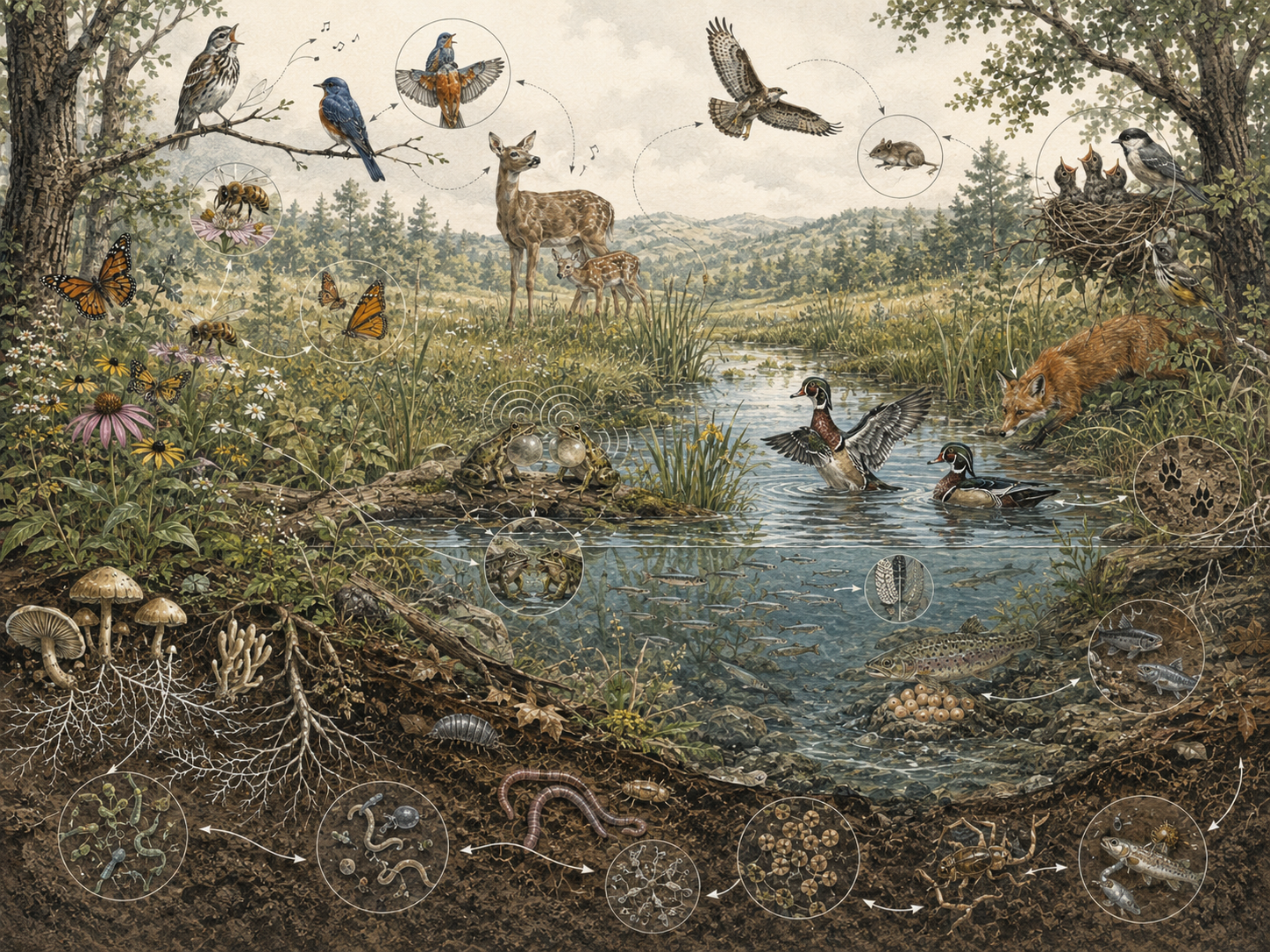
This article develops behavior, communication, and biological strategy as a scale-spanning framework for understanding action in living systems. It examines ethology, behavioral ecology, sensory ecology, signals and cues, communication, display, ritualization, decision-making, preference, choice, cooperation, conflict, predation risk, mating strategy, parental care, social behavior, neurobiology, disease ecology, conservation behavior, environmental disruption, computational ethology, and game-theoretic modeling.
The article is written for behavioral ecologists, ethologists, neurobiologists, ecologists, marine biologists, freshwater scientists, medical and environmental-health readers, computational biology readers, biodiversity experts, conservation planners, animal biologists, systems biologists, and research biologists who need a rigorous account of how organisms perceive, decide, signal, coordinate, compete, and act under real conditions of uncertainty, competition, and opportunity.
The article also extends behavioral biology into quantitative and computational biology through payoff logic, probabilistic choice models, sender-receiver signaling models, Hawk-Dove conflict structure, risk-sensitive behavioral scenarios, social-interaction matrices, R workflows, Python workflows, SQL provenance structures, and a linked full-stack GitHub repository containing Python, R, Julia, Fortran, Rust, Go, C, C++, SQL, notebooks, data files, and reproducibility documentation.
What behavior studies
Behavior studies how organisms act, respond, and adjust under real conditions of life. The scientific study of behavior emerged from the recognition that animal actions are complex, patterned, and best understood through close observation in natural settings as well as under controlled experimental conditions. Ethology developed with strong ties to ecology, evolution, neurobiology, and natural history, while later behavioral ecology, cognitive ecology, sensory ecology, and neuroethology expanded the field’s reach.
This matters because organisms do not survive through anatomy alone. They must feed, evade danger, reproduce, navigate social relationships, regulate exposure, select habitats, respond to environmental fluctuation, and coordinate movement through a world full of uncertainty. Behavior is therefore one of the most visible outcomes of integrated biology. It is where nervous systems, endocrine states, morphology, ecological context, developmental history, and evolutionary inheritance become organized action.
Behavior can be immediate and flexible, but it is also historically shaped. Some behaviors are strongly canalized by inherited mechanisms; others are learned, plastic, or context-dependent. Many combine inherited predisposition with experience, developmental conditions, social exposure, and ecological feedback. Behavioral biology is therefore strongest when it avoids the false opposition between instinct and learning. Organisms often act through systems that are simultaneously evolved, embodied, developmental, and responsive.
For research biologists, behavior remains especially important because it sits at the boundary between internal mechanism and ecological consequence. It is often the first level at which biological organization becomes visible as strategy.
Communication as information in biological systems
Animal communication can be understood as the process by which one organism produces, transmits, or exposes information that influences the behavior, state, or decision-making of another organism. Signals may include sound, color pattern, posture, movement, electrical discharge, vibration, touch, odor, pheromones, chemical trails, or combinations of modalities. Communication helps regulate mating, territoriality, dominance, affiliation, warning, group cohesion, parental care, predator avoidance, and collective behavior.
This matters because communication is not noise layered on top of behavior. It is one of the principal ways organisms alter one another’s actions. Signalers shape receivers; receivers interpret signalers; and the exchange affects mating, aggression, cooperation, avoidance, deception, coordination, and social order. Communication is therefore a central mechanism through which biology becomes social and strategic.
The deeper implication is that information itself becomes biologically consequential. Communication is one of the main ways organisms transform the behavior of others without direct physical force. A bird song can defend territory, attract a mate, or identify species membership. A chemical trail can coordinate movement. A warning call can alter vigilance. A display can reduce the need for combat. A courtship signal can influence reproductive choice. A microbial chemical signal can alter population-level behavior.
Communication therefore links behavior to information theory, sensory ecology, neurobiology, evolution, and social systems. It is not simply expression. It is biologically consequential information exchange under constraints of production, transmission, reception, interpretation, and response.
Behavior as adaptive response
Behavior is often adaptive in the sense that it helps organisms respond advantageously to ecological conditions. Behaviors are favored when they help individuals obtain resources, avoid predators, select mates, care for offspring, defend territories, coordinate with kin or group members, or occupy safer and more productive environments. Behavioral strategy therefore includes movement, timing, allocation, attention, risk management, information use, and social positioning.
This matters because biological strategy often appears first in behavior. An organism may alter foraging, vigilance, courtship, nest placement, migration timing, grouping, or social alignment before morphology changes across evolutionary time. Behavior can be a flexible interface between immediate ecological challenge and longer evolutionary pattern. It can buffer organisms against environmental variation, expose them to new selection pressures, or alter how populations interact with changing habitats.
Behavior is also costly. Movement uses energy. Vigilance can reduce feeding. Signaling can attract predators. Aggression can cause injury. Mate search can increase exposure. Parental care can reduce future reproductive opportunities. Learning takes time and may involve error. Strategy therefore emerges from trade-offs rather than from simple maximization.
For research biologists, behavior is one of the most dynamic parts of the phenotype. It can reveal both constraint and flexibility at once. It also shows how biological systems act before they are counted as population change, community reorganization, or evolutionary divergence.
Tinbergen’s four questions and the explanation of behavior
One of ethology’s most important contributions was the insistence that behavior requires multiple complementary explanations. Tinbergen famously distinguished questions of mechanism, development, adaptive function, and evolutionary history. A behavior can be explained by asking what immediate neural or physiological processes produce it, how it develops during the organism’s life, what function it serves in survival or reproduction, and how it evolved over phylogenetic time.
This framework remains important because it prevents reductionism. A bird’s song, a fish’s courtship display, a mammal’s grooming behavior, an insect’s dance, or a cephalopod’s camouflage pattern cannot be fully explained by mechanism alone or by adaptive function alone. Neural control, developmental experience, ecological benefit, and evolutionary history may all matter at once.
For example, a mating display may depend mechanistically on sensory processing and motor control, developmentally on maturation and social exposure, functionally on mate attraction or rival deterrence, and evolutionarily on inherited signal systems shaped by sexual selection. These explanations are not competitors. They answer different questions.
For behavioral biology, this remains a powerful model of integrative explanation. Behavior is not merely what an organism does. It is the living intersection of cause, development, function, and history.
Signals, cues, and the evolution of communication
Communication evolves through the modification of preexisting structures, physiological processes, and ordinary behaviors rather than appearing from nowhere. Signal evolution often begins from ancestral raw materials or protosignals, while ritualization transforms ordinary actions into stylized signals carrying more specific information. A movement, posture, odor, sound, color patch, electrical pattern, or chemical emission can become communicative when receivers detect it and respond in ways that affect fitness.
This matters because communication is historically built. A posture, sound, color trait, or chemical emission becomes a signal when it reliably influences receiver behavior and when selection shapes its production, reception, or interpretation. Signal form is therefore shaped by habitat, medium, sensory system, social function, predation pressure, energetic cost, and receiver psychology, not only by internal design.
The distinction between signals and cues is especially important. Signals are traits shaped, at least in part, because they influence receivers. Cues may be informative without having evolved for communication. A predator may use the rustle of prey movement as a cue. A flower scent may be a signal to pollinators. A chemical byproduct may become informative to another organism even if it did not evolve for that receiver. Modern behavioral biology is strongest when it keeps that distinction conceptually clear.
Communication also creates the possibility of deception, exaggeration, honest signaling, costly signaling, receiver resistance, sensory exploitation, and arms races between signalers and receivers. The evolution of communication is therefore not a simple march toward clarity. It is a strategic and ecological process shaped by aligned and conflicting interests.
Sensory ecology and the worlds organisms inhabit
Behavior depends on perception, and perception depends on the sensory worlds organisms inhabit. Sensory systems transform environmental energies into internal signals, and species differ greatly in how they perceive ecologically relevant stimuli. Chemical plumes, polarized light, vibrational cues, electric fields, ultrasonic calls, magnetic information, pressure changes, thermal gradients, and substrate-borne signals may structure action for one species while remaining almost nonexistent to another.
This matters because behavior cannot be understood from a human perceptual viewpoint alone. Strategy is always strategy-in-a-perceptual-world. The environment organisms act in is partly physical, but it is also filtered through sensory design. A moth, bat, shark, bee, fish, bird, mole, nematode, octopus, bacterium, or primate does not inhabit the same effective world, even when occupying the same physical space.
Sensory ecology explains why signal form and behavior are matched to environments. Sound behaves differently in forests, grasslands, water, and open air. Chemical signals disperse differently in turbulent water, soil, and atmosphere. Visual signals depend on light, background, motion, color sensitivity, and habitat structure. Vibrational signals depend on substrate. Electrical communication depends on conductivity and medium. Communication is therefore constrained by physics as much as by social function.
For research biologists, sensory ecology is one of the strongest reminders that behavior is always embodied. Organisms do not choose among abstract options. They choose among options as their sensory systems render them.
Display, ritualization, and social order
Display behavior plays a major role in organizing social life. Ritualized behavior can provide information about aggression, submission, mating intent, rank, readiness, territory occupancy, reproductive condition, or group membership. Communication can therefore stabilize relationships, maintain cohesion, reduce uncertainty, and structure interaction among individuals.
This matters because direct conflict is costly. Ritualized displays can communicate aggression, submission, mating intent, rank, or readiness without requiring full physical escalation. In group-living organisms, such signaling can sustain hierarchy, affiliation, and coordination while reducing unnecessary injury. Even where conflict remains, display can regulate when combat occurs, how severe it becomes, and whether withdrawal is possible.
Displays are also important because they often integrate multiple biological systems. Color, posture, movement, sound, odor, hormones, muscle control, sensory perception, and social context can all converge in a single display. A display is therefore not superficial ornament. It is often a concentrated expression of physiology, morphology, reproductive state, and ecological condition.
This is one reason why display is so important to behavioral strategy. It converts potentially costly force into structured information exchange.
Decision-making, preference, and choice
Behavior is strategic partly because organisms choose among alternatives. Preferences reflect differences in motivational strength among options, and observable choice behavior allows inference about underlying evaluation. This means behavior is often the outcome of comparative selection among possibilities, not merely automatic response.
This matters because foraging, mate selection, refuge choice, migration, timing, nest placement, habitat selection, social affiliation, and territorial behavior often involve trade-offs rather than one obvious best option. Organisms must balance energy gain, predation risk, competition, reproductive value, time, physiological state, and environmental uncertainty. Strategy therefore includes valuation as much as movement.
Choice behavior also reveals the limits of simple optimality. Organisms may use heuristics, show biases, learn from experience, respond to context, make errors, or behave probabilistically. A choice can be adaptive on average without being perfect in every instance. A behavior can be shaped by selection while still depending on perception, memory, development, and state.
For research biologists, this makes behavior analytically rich. Choice can be measured, modeled, experimentally manipulated, and linked to ecological or evolutionary consequence. It also makes behavior a natural bridge between biology, statistics, decision theory, and computational modeling.
Cooperation, conflict, and social strategy
Social behavior is shaped by both the costs and benefits of interaction. Sociality is best understood by considering how aggregation, kinship, reciprocity, mutualism, dominance, coercion, coordination, and competition affect the fitness of the individuals involved. Cooperation, dominance, affiliation, territoriality, mating competition, parental care, alarm calling, grooming, food sharing, collective defense, and group movement all emerge from this interplay.
This matters because biological strategy is rarely solitary for long in social species. Individuals must navigate alliances, submission, competition, reciprocity, kin structure, group membership, recognition, and coordination. Signaling systems become part of the architecture of strategy by stabilizing expectations among interacting individuals.
Hamilton’s work on social behavior made clear that the fitness consequences of behavior may extend beyond direct individual reproduction when relatives are affected. Game theory later helped formalize conflict, escalation, restraint, and strategy under conditions where outcomes depend on what others do. These frameworks matter because social behavior is relational. The payoff to one behavior often depends on the behavior of another individual.
For research biologists, cooperation and conflict remain fundamental because they show that behavior is often strategic in explicitly relational rather than purely individual terms.
Predation risk, mating, and the strategic economy of behavior
Many behavioral strategies arise under the dual pressures of avoiding death and securing reproduction. Predation risk imposes strong selective pressure, leading to behavioral strategies for concealment, vigilance, escape, dilution, alarm calling, timing shifts, grouping, habitat choice, and threat detection. At the same time, mating and social competition often depend on conspicuous signaling, display, movement, sound, or exposure.
This matters because behavior is often an economy of competing demands. A bright display may attract mates but also predators. A loud call may communicate effectively but expose the caller. A cautious hiding strategy may reduce risk but lower feeding or mating success. A bold foraging strategy may increase energy intake but also mortality. A territorial strategy may improve access to mates or resources but increase injury risk. Organisms therefore deploy behavior strategically within trade-offs rather than maximizing a single objective in isolation.
This trade-off logic is central to behavioral ecology. Many behaviors make sense only when benefits and costs are analyzed together. A behavior that looks inefficient under one criterion may be adaptive under another. A quiet signal may be less attractive but safer. A risky display may be favored when reproductive stakes are high. A social behavior may be costly in the short term but beneficial through kin, reciprocity, coalition, or long-term access.
This is why behavioral ecology so often centers on costs, benefits, context, and conflicting demands. Strategy emerges where not all objectives can be maximized at once.
Behavior, neurobiology, and the organization of response
Behavior is inseparable from neurobiology because sensory signals must be detected, transduced, processed, integrated, and converted into motor or physiological outputs. Sensory stimulation, neural transmission, synaptic integration, endocrine modulation, learning, memory, motor patterning, and muscular action form one of the core chains by which behavior becomes possible.
This matters because strategy is not a purely ecological abstraction. It is implemented through nervous systems, endocrine states, sensory structures, and bodily coordination. Action is biology made visible. The same ecological situation can lead to different behaviors depending on internal state, developmental history, hormonal condition, prior experience, sensory thresholds, and neural architecture.
Behavior therefore connects directly to Neurobiology and the Organization of Living Response and Physiology and the Regulation of Living Systems. A signal is not complete when produced; it must be perceived. A choice is not complete when options exist; they must be evaluated. A strategy is not complete when it is adaptive in theory; it must be implemented by a body.
For research biologists, this is one of the most important bridges in the field: behavior joins mechanism to function.
Marine, freshwater, soil, and terrestrial behavioral worlds
Behavior takes different forms across physical media and habitats. Sensory ecology makes clear that animals inhabit perceptual worlds shaped by environment, which means behavioral strategy differs across air, water, sediment, canopy, underground, soil, reef, river, pelagic, intertidal, and social spaces. Signal form and reception are shaped by the medium through which signals travel.
This matters because a vibration-sensitive soil organism, a reef fish using color and movement, a freshwater insect relying on flow cues, a bat using echolocation, a shark detecting chemical and electrical gradients, a bird using song, and a terrestrial mammal using odor and posture all solve the problem of action and communication under different material constraints. Behavior is therefore ecologically situated from the outset.
For marine and freshwater biologists especially, the medium is not a passive setting. Water changes sound transmission, light, chemical dispersal, pressure, conductivity, movement, and sensory range. In soil systems, darkness, moisture, substrate, and chemical gradients shape communication and movement. In terrestrial systems, visual fields, acoustic environments, wind, vegetation structure, and seasonal change shape behavior.
For research biologists, behavioral worlds must therefore be interpreted through medium, scale, and sensory ecology. Behavior cannot be understood by extracting organisms from the physical and informational structure of their environments.
Communication, disease ecology, and host-microbe context
Behavior also shapes microbial and disease dynamics. Animal behavior can strongly affect how microbes, parasites, and pathogens are shared, and therefore influence the health of animal communities. Communication, spacing, affiliation, grooming, mating, aggregation, dominance, territoriality, nesting, parental care, and resource-sharing can all alter exposure pathways.
This matters because biological strategy includes not only predators, mates, and resources, but also pathogens and microbial partners. Social behavior can facilitate transmission, but it can also organize avoidance, care, cleaning, grooming, quarantine-like behavior, habitat shifts, or compensatory strategies. Behavior therefore belongs directly to disease ecology and host-microbe interaction.
Communication itself can also be affected by disease. Illness may change odor, sound, movement, display intensity, social behavior, or mate attractiveness. Receivers may detect cues of infection and adjust behavior. Social animals may reduce contact, increase care, avoid sick individuals, or alter group structure. Behavioral ecology therefore contributes directly to understanding transmission, exposure, and vulnerability.
For medical and environmental-health readers, this makes behavior relevant not only to ethology, but to transmission ecology, exposure risk, host defense, social structure, and systems of biological vulnerability.
Conservation, systems thinking, and behavioral adaptation
Behavior is central to conservation because animals often respond behaviorally to environmental change before demographic collapse becomes obvious. Altered soundscapes, light pollution, heat, habitat fragmentation, chemical pollution, changed predator regimes, invasive species, shifting seasonal cues, human disturbance, and resource loss can all become behavioral problems before they become extinction problems.
This matters because transformed environments are often first encountered as transformed information worlds. A species may still be present numerically while failing behaviorally: unable to detect predators, locate mates, find breeding sites, respond to cues, navigate migration routes, coordinate with conspecifics, or use habitat effectively. Conservation is therefore partly about whether organisms can still perceive, decide, communicate, and act effectively in altered systems.
Behavioral traps illustrate this problem. Organisms may respond to formerly reliable cues that now mislead them. Artificial lights can attract or disorient animals. Altered habitats may appear suitable while reducing survival. Human noise can mask communication. Chemical pollutants can disrupt signaling or navigation. Climate change can shift timing cues. In such cases, ecological disruption becomes informational disruption.
For research biologists, this is a powerful reminder that behavioral adaptation and behavioral disruption are both central to long-horizon ecological persistence. Conservation biology cannot protect organisms only as bodies or populations. It must also protect the conditions under which behavior remains functional.
Genomics, ethology, and computational relevance
Modern behavioral biology integrates field ethology, neurobiology, genomics, bioacoustics, tracking technology, machine learning, comparative biology, and computational analysis. Choice, learning, preference, response, movement, communication, and social interaction can be analyzed experimentally and increasingly linked to broader biological mechanisms. Ethology remains crucial because behavior still requires observation in real ecological context.
This matters because behavior is multiscale. Genes may influence developmental pathways and neural circuits. Circuits shape perception and action. Action alters social and ecological conditions. Ecology feeds back into selection. Development and experience modify response. Communication depends on sender, receiver, medium, and context. Computational approaches help formalize choice, signaling, movement, interaction dynamics, and behavioral classification, but they remain strongest when anchored in natural history.
Modern tools now allow researchers to record movement paths, vocalizations, social proximity, posture, gaze, group dynamics, neural activity, hormones, and environmental conditions at scales that were previously impossible. But richer data do not remove the need for biological interpretation. A model can classify behavior without explaining its function. A movement track can measure action without identifying motivation. A neural signal can correlate with behavior without capturing ecological meaning.
For research biologists, behavior is one of the clearest domains where genomic, physiological, ecological, computational, and observational science must genuinely speak to one another.
Quantitative behavior: mathematics, R, and Python
Behavior can often be represented quantitatively through payoff logic. A minimal way to express strategic value is:
W=B-C
\]
Interpretation: \(W\) is net payoff, \(B\) is expected benefit, and \(C\) is expected cost. This is useful because many behavioral decisions involve balancing gain against risk, energy use, opportunity cost, social conflict, or exposure.
Real behavioral biology usually requires more structure. A simple choice model can be written in probabilistic form:
P_i=\frac{e^{\beta U_i}}{\sum_j e^{\beta U_j}}
\]
Interpretation: \(P_i\) is the probability of choosing option \(i\), \(U_i\) is its utility or payoff, and \(\beta\) controls how strongly utility differences influence choice. This is useful because organisms often do not behave as perfectly deterministic maximizers. They show graded preference, error, noise, state dependence, and context sensitivity.
For signaling systems, a basic receiver-response expression can be written as:
R=f(S,E,H)
\]
Interpretation: Response \(R\) depends on signal properties \(S\), environmental context \(E\), and the receiver’s internal state or history \(H\). Communication is not contained in the signal alone. It is produced by interaction among signal, medium, receiver, and context.
For conflict, a simple Hawk-Dove payoff matrix can be written as:
\begin{pmatrix}
\frac{V-C}{2} & V \\
0 & \frac{V}{2}
\end{pmatrix}
\]
Interpretation: \(V\) is the value of the contested resource and \(C\) is the cost of escalated conflict. This compact structure captures one of behavioral ecology’s central insights: the value of a strategy depends on what others do.
Worked example: safe versus risky foraging
Suppose one option provides benefit \(B=10\) and cost \(C=3\). Then:
W=10-3=7
\]
Interpretation: The safe option has a net payoff of 7 under this simplified benefit-cost frame.
If another option provides benefit \(B=14\) but cost \(C=9\), then:
W=14-9=5
\]
Interpretation: The risky option has a lower net payoff despite the larger gross benefit. This captures the general biological logic of strategic trade-offs: larger rewards do not automatically produce better strategies when risk, energy, exposure, and future opportunity are included.
R and Python workflows
The following examples are compact article-level workflows. The full GitHub repository expands them into richer multi-language implementations with SQL provenance, validation notes, payoff models, softmax choice, signaling strategy screening, receiver-state response models, environmental noise scenarios, Hawk-Dove conflict modeling, social-interaction matrices, and reproducible computational behavioral-biology scaffolding.
R example: behavioral choice under risk with a softmax decision rule
# Behavioral choice model in R
#
# This example:
# - compares behavioral options under benefit, energetic cost, and predation risk
# - computes utility and softmax choice probabilities
# - compares baseline and high-predator-risk scenarios
#
# It is a compact behavioral ecology scaffold, not a calibrated animal model.

softmax <- function(x, beta = 1) {
  ex <- exp(beta * (x - max(x)))
  ex / sum(ex)
}

behavior_options <- data.frame(
  option = c(
    "safe_foraging",
    "risky_foraging",
    "territorial_display",
    "mate_search"
  ),
  benefit = c(8, 14, 10, 12),
  energetic_cost = c(2, 5, 4, 6),
  predation_risk = c(1, 6, 3, 5)
)

# Weighted utility function.
behavior_options$utility <- with(
  behavior_options,
  benefit - 0.8 * energetic_cost - 1.2 * predation_risk
)

behavior_options$choice_probability <- softmax(
  behavior_options$utility,
  beta = 1.1
)

print(behavior_options)

# Scenario: increased predator pressure.
behavior_options$utility_high_risk <- with(
  behavior_options,
  benefit - 0.8 * energetic_cost - 1.8 * predation_risk
)

behavior_options$choice_probability_high_risk <- softmax(
  behavior_options$utility_high_risk,
  beta = 1.1
)

print(
  behavior_options[, c(
    "option",
    "utility",
    "choice_probability",
    "utility_high_risk",
    "choice_probability_high_risk"
  )]
)

barplot(
  behavior_options$choice_probability,
  names.arg = behavior_options$option,
  las = 2,
  ylab = "Choice probability",
  main = "Behavioral Choice Under Baseline Risk"
)
This R workflow is more useful than a simple payoff subtraction because it introduces multiple cost components, probabilistic choice, and a scenario shift in predation pressure. A research biologist could adapt it for mate choice, foraging under risk, signaling intensity, habitat selection, territorial behavior, or behavioral response to altered disturbance regimes.
Python example: signaling strategy, receiver state, and scenario screening
import numpy as np
import pandas as pd

# Example signaling strategies with sender-side benefits and costs.
# Values are synthetic and scaled for demonstration.
signals = pd.DataFrame({
    "strategy": [
        "quiet_signal",
        "loud_signal",
        "multimodal_signal",
        "cryptic_display"
    ],
    "mate_benefit": [6, 12, 10, 4],
    "energetic_cost": [1, 5, 4, 1],
    "predator_exposure": [1, 7, 4, 0.5],
    "receiver_detectability": [0.45, 0.90, 0.85, 0.30]
})

# Sender-side utility.
signals["sender_utility"] = (
    signals["mate_benefit"]
    - 0.8 * signals["energetic_cost"]
    - 1.1 * signals["predator_exposure"]
)

# Receiver response probability as a function of detectability and receiver state.
# Receiver state could reflect attention, motivation, sensory condition,
# reproductive readiness, or prior experience.
receiver_state = 0.75

signals["receiver_response"] = 1 / (
    1 + np.exp(
        -6 * (signals["receiver_detectability"] * receiver_state - 0.35)
    )
)

# Combined strategic score.
signals["combined_score"] = (
    signals["sender_utility"] * signals["receiver_response"]
)

# Scenario: noisier environment reduces detectability.
signals["receiver_detectability_noisy"] = (
    signals["receiver_detectability"] - 0.20
).clip(lower=0)

signals["receiver_response_noisy"] = 1 / (
    1 + np.exp(
        -6 * (
            signals["receiver_detectability_noisy"] *
            receiver_state -
            0.35
        )
    )
)

signals["combined_score_noisy"] = (
    signals["sender_utility"] * signals["receiver_response_noisy"]
)

signals["delta_noisy"] = (
    signals["combined_score_noisy"] - signals["combined_score"]
)

print(signals.round(3))
This Python workflow is more useful because it treats communication as a sender-receiver system rather than a one-sided payoff table. It includes sender utility, receiver detectability, nonlinear response, and a scenario in which environmental noise changes communication efficiency. That makes it adaptable to behavioral ecology, sensory ecology, conservation signaling problems, comparative strategy analysis, and environmental-change scenarios.
Python example: Hawk-Dove conflict and strategy frequency screening
import numpy as np
import pandas as pd

def hawk_dove_payoffs(resource_value, conflict_cost, hawk_frequency):
    """Expected payoffs for Hawk and Dove strategies."""
    V = resource_value
    C = conflict_cost
    p = hawk_frequency

    hawk_vs_hawk = (V - C) / 2
    hawk_vs_dove = V
    dove_vs_hawk = 0
    dove_vs_dove = V / 2

    expected_hawk = p * hawk_vs_hawk + (1 - p) * hawk_vs_dove
    expected_dove = p * dove_vs_hawk + (1 - p) * dove_vs_dove

    return expected_hawk, expected_dove

rows = []

for hawk_frequency in np.linspace(0, 1, 11):
    hawk_payoff, dove_payoff = hawk_dove_payoffs(
        resource_value=10,
        conflict_cost=18,
        hawk_frequency=hawk_frequency
    )

    rows.append({
        "hawk_frequency": hawk_frequency,
        "expected_hawk_payoff": hawk_payoff,
        "expected_dove_payoff": dove_payoff,
        "favored_strategy": (
            "hawk" if hawk_payoff > dove_payoff
            else "dove" if dove_payoff > hawk_payoff
            else "equal"
        )
    })

summary = pd.DataFrame(rows)

print(summary.round(3).to_string(index=False))
This conflict scaffold shows why behavior often depends on frequency, social context, and opponent strategy. A production workflow could extend it with mixed strategies, repeated encounters, individual state, resource asymmetry, kinship, dominance hierarchy, injury risk, or empirical data from territorial contests.
These examples remain compact enough for an article, but they now move closer to the kinds of workflows scientists actually use: probabilistic choice, receiver-dependent signaling, multi-component cost structure, game-theoretic conflict logic, social-context screening, and explicit scenario testing.
GitHub repository
The article body includes compact R and Python examples so the biological and scientific argument remains readable. The full repository expands those examples into a broader computational behavioral-biology workflow, including payoff models, softmax choice, signaling strategy screening, receiver-state response models, environmental noise scenarios, Hawk-Dove conflict modeling, SQL provenance structures, reproducible data files, and full-stack scientific-computing examples across Python, R, Julia, Fortran, Rust, Go, C, C++, SQL, and notebooks.
Complete Code RepositoryThe full code distribution for this article, including selected article examples, expanded computational workflows, reproducible data structures, provenance documentation, and full-stack scientific-computing scaffolding, is available on GitHub.
Limits, complexity, and modern behavioral thinking
Behavioral biology is foundational, but it should not be reduced to crude instinct theory, simplistic optimization slogans, or detached computational models. Both environment and genetic makeup influence behavior, and ethology emphasizes the need for field observation, natural history, experimental context, and ecological interpretation. Communication likewise depends on receiver perception, habitat, social structure, multimodal interaction, developmental history, and environmental context.
This matters because real behavior is historically shaped, context-dependent, and often plastic. Not every act is fully rigid, not every choice is perfectly optimal, and not every signal is interpreted identically by all receivers. Some behaviors are adaptive under one condition and harmful under another. Some signals are honest; others are deceptive or exploit receiver biases. Some choices reflect evolved heuristics that work well in ancestral conditions but fail under altered environments.
Models are useful because they clarify assumptions, expose trade-offs, and make strategic structure visible. But models can also mislead if they erase sensory context, developmental history, embodied mechanism, ecological uncertainty, or observation-based reality. A payoff table is not an animal. A softmax function is not a nervous system. A signaling score is not a full communication ecology. These tools are strongest when they help researchers ask better biological questions.
For research biologists, this means behavioral models are most useful when they clarify complexity without pretending to eliminate it. Modern behavioral thinking is strongest when it integrates evolution, neurobiology, development, communication, ecology, uncertainty, and careful observation.
Why this matters for scientific work
Behavior, communication, and biological strategy matter across ethology, behavioral ecology, neurobiology, animal biology, physiology, conservation biology, restoration ecology, disease ecology, marine biology, freshwater biology, environmental health, biodiversity science, and computational biology because behavior is where organisms actively engage the world. For ethologists and behavioral ecologists, the value is direct: behavior reveals how action is organized under ecological pressure. For neurobiologists, it provides the functional context in which circuits, sensation, and motor output matter. For ecologists, behavior links individual action to population dynamics, species interactions, and ecosystem change.
For conservation and restoration scientists, behavior can reveal failure before population collapse becomes obvious. Animals may stop breeding effectively, fail to respond to cues, avoid restored habitat, choose ecological traps, or lose communication efficiency in noisy environments. For medical and environmental-health readers, behavior shapes exposure, transmission, avoidance, care, and social vulnerability. For marine and freshwater scientists, signal propagation, movement, flow, sound, light, and chemical cues are often central to behavioral survival.
For computational readers, behavior provides a natural domain for choice modeling, movement analysis, signal detection, game theory, state-dependent decision-making, social network analysis, machine learning classification, and reproducible scenario workflows. But its computational treatment remains strongest when tied to observation, natural history, mechanism, and ecological interpretation.
Behavior is therefore more than movement. It is biological strategy in action.
Conclusion
Behavior, communication, and biological strategy show that life is organized not only through structure, metabolism, physiology, inheritance, and development, but through action, information, and decision. Organisms perceive worlds, exchange signals, navigate trade-offs, coordinate with others, avoid danger, seek mates, compete for resources, respond to uncertainty, and deploy strategies shaped by evolution, physiology, development, and ecology. Communication gives behavior social reach. Strategy gives it adaptive direction.
To understand behavior is therefore to understand one of biology’s most visible yet conceptually deep domains: the way living systems engage reality in real time. Behavior connects mechanism to function, perception to ecology, communication to social order, and individual action to evolutionary consequence. That is why behavioral biology remains central not only to ethology and communication research, but also to neurobiology, ecology, conservation, disease biology, environmental health, and systems-oriented biology more broadly.
Behavior is thus more than movement. It is one of the principal ways biology explains how life acts at all.
Related articles
- Biology
- Neurobiology and the Organization of Living Response
- Animal Biology and the Organization of Complex Life
- Physiology and the Regulation of Living Systems
- Ecology and the Interdependence of Life
- Coevolution, Symbiosis, and the Dynamics of Mutual Change
- Population Dynamics and Ecological Modeling
- Immunology and Biological Defense
- Reproduction, Life Cycles, and Biological Continuity
- Natural Selection, Adaptation, and Fitness
Further reading
- Tinbergen, N. (1963) ‘On aims and methods of ethology’, Zeitschrift für Tierpsychologie, 20, pp. 410–433. Available at: https://doi.org/10.1111/j.1439-0310.1963.tb01161.x
- Hamilton, W.D. (1964) ‘The genetical evolution of social behaviour. I’, Journal of Theoretical Biology, 7(1), pp. 1–16. Available at: https://doi.org/10.1016/0022-5193(64)90038-4
- Hamilton, W.D. (1964) ‘The genetical evolution of social behaviour. II’, Journal of Theoretical Biology, 7(1), pp. 17–52. Available at: https://doi.org/10.1016/0022-5193(64)90039-6
- Maynard Smith, J. and Price, G.R. (1973) ‘The logic of animal conflict’, Nature, 246, pp. 15–18. Available at: https://doi.org/10.1038/246015a0
- Maynard Smith, J. (1982) Evolution and the Theory of Games. Cambridge: Cambridge University Press. Publisher information available at: https://www.cambridge.org/core/books/evolution-and-the-theory-of-games/44F80273A40E10D7B8BD17D3A7BA0B47
- Krebs, J.R. and Davies, N.B. (1993) An Introduction to Behavioural Ecology. 3rd edn. Oxford: Blackwell Scientific Publications. Bibliographic information available at: https://archive.org/details/introductiontobe00kreb
- Bradbury, J.W. and Vehrencamp, S.L. (2011) Principles of Animal Communication. 2nd edn. Sunderland, MA: Sinauer Associates. Bibliographic information available at: https://search.worldcat.org/title/Principles-of-animal-communication/oclc/747947250
- Searcy, W.A. and Nowicki, S. (2005) The Evolution of Animal Communication: Reliability and Deception in Signaling Systems. Princeton, NJ: Princeton University Press. Publisher information available at: https://press.princeton.edu/books/paperback/9780691070957/the-evolution-of-animal-communication
- Nature Education (n.d.) An Introduction to Animal Communication. Available at: https://www.nature.com/scitable/knowledge/library/an-introduction-to-animal-communication-23648715/
- Nature Education (n.d.) Perceptual Worlds and Sensory Ecology. Available at: https://www.nature.com/scitable/knowledge/library/perceptual-worlds-and-sensory-ecology-22141730/
- Nature Education (n.d.) Behavior Under Risk: How Animals Avoid Becoming Dinner. Available at: https://www.nature.com/scitable/knowledge/library/behavior-under-risk-how-animals-avoid-becoming-23646978/
- National Research Council (1989) ‘The nervous system and behavior’, in Opportunities in Biology. Washington, DC: National Academies Press. Available at: https://www.ncbi.nlm.nih.gov/books/NBK217810/
References
- Bradbury, J.W. and Vehrencamp, S.L. (2011) Principles of Animal Communication. 2nd edn. Sunderland, MA: Sinauer Associates. Bibliographic information available at: https://search.worldcat.org/title/Principles-of-animal-communication/oclc/747947250
- Britannica (n.d.) Animal Communication. Available at: https://www.britannica.com/science/animal-communication
- Britannica (2026) Ethology. Available at: https://www.britannica.com/science/ethology
- Hamilton, W.D. (1964) ‘The genetical evolution of social behaviour. I’, Journal of Theoretical Biology, 7(1), pp. 1–16. Available at: https://doi.org/10.1016/0022-5193(64)90038-4
- Hamilton, W.D. (1964) ‘The genetical evolution of social behaviour. II’, Journal of Theoretical Biology, 7(1), pp. 17–52. Available at: https://doi.org/10.1016/0022-5193(64)90039-6
- Krebs, J.R. and Davies, N.B. (1993) An Introduction to Behavioural Ecology. 3rd edn. Oxford: Blackwell Scientific Publications. Bibliographic information available at: https://archive.org/details/introductiontobe00kreb
- Maynard Smith, J. (1982) Evolution and the Theory of Games. Cambridge: Cambridge University Press. Publisher information available at: https://www.cambridge.org/core/books/evolution-and-the-theory-of-games/44F80273A40E10D7B8BD17D3A7BA0B47
- Maynard Smith, J. and Price, G.R. (1973) ‘The logic of animal conflict’, Nature, 246, pp. 15–18. Available at: https://doi.org/10.1038/246015a0
- National Research Council (1989) ‘The nervous system and behavior’, in Opportunities in Biology. Washington, DC: National Academies Press. Available at: https://www.ncbi.nlm.nih.gov/books/NBK217810/
- Nature Education (n.d.) An Introduction to Animal Communication. Available at: https://www.nature.com/scitable/knowledge/library/an-introduction-to-animal-communication-23648715/
- Nature Education (n.d.) Behavior Under Risk: How Animals Avoid Becoming Dinner. Available at: https://www.nature.com/scitable/knowledge/library/behavior-under-risk-how-animals-avoid-becoming-23646978/
- Nature Education (n.d.) Both Environment and Genetic Makeup Influence Behavior. Available at: https://www.nature.com/scitable/knowledge/library/both-environment-and-genetic-makeup-influence-behavior-13907840/
- Nature Education (n.d.) Measuring Animal Preferences and Choice Behavior. Available at: https://www.nature.com/scitable/knowledge/library/measuring-animal-preferences-and-choice-behavior-23590718/
- Nature Education (n.d.) Perceptual Worlds and Sensory Ecology. Available at: https://www.nature.com/scitable/knowledge/library/perceptual-worlds-and-sensory-ecology-22141730/
- Nature Education (n.d.) What Functions of Living Systems Underlie Behavior?. Available at: https://www.nature.com/scitable/knowledge/library/what-functions-of-living-systems-underlie-behavior-13883114/
- Searcy, W.A. and Nowicki, S. (2005) The Evolution of Animal Communication: Reliability and Deception in Signaling Systems. Princeton, NJ: Princeton University Press. Publisher information available at: https://press.princeton.edu/books/paperback/9780691070957/the-evolution-of-animal-communication
- Tinbergen, N. (1963) ‘On aims and methods of ethology’, Zeitschrift für Tierpsychologie, 20, pp. 410–433. Available at: https://doi.org/10.1111/j.1439-0310.1963.tb01161.x