
Last Updated May 28, 2026
Environmental chemistry studies the chemical conditions that make air breathable, water drinkable, soils fertile, ecosystems resilient, infrastructure usable, food systems viable, and human settlement possible. It does not treat the environment as a passive container into which substances are released. It treats the atmosphere, hydrosphere, lithosphere, pedosphere, biosphere, and built environment as chemically active systems in which matter is transported, transformed, partitioned, accumulated, diluted, degraded, immobilized, remobilized, and sometimes amplified into risk.
The central thesis of environmental chemistry is that habitability depends on chemical boundaries. Life persists within ranges of pH, salinity, oxygen availability, nutrient supply, trace-metal concentration, redox potential, temperature, radiation, moisture, and contaminant exposure. These ranges are not fixed in a simplistic way. They differ across organisms, ecosystems, regions, media, life stages, infrastructures, and social contexts. Yet every habitable system has chemical limits. When those limits are crossed, chemistry becomes visible as disease, eutrophication, corrosion, acidification, toxicity, biodiversity loss, atmospheric forcing, drinking-water failure, soil degradation, or the collapse of ecological function.
Environmental chemistry is therefore one of the most important bridges between molecular science and public life. It connects analytical measurements to environmental justice, pollutant fate to governance, water chemistry to public health, atmospheric chemistry to climate, soil chemistry to food systems, and chemical design to responsibility. It asks not only what chemicals are present, but what forms they take, where they move, how long they persist, who is exposed, what systems are vulnerable, and what evidence is strong enough to prevent harm.
Main Library
Publications
Article Map
Chemistry
Related Topic
Environmental Science
Related Topic
Earth Science
Related Topic
Risk & Resilience
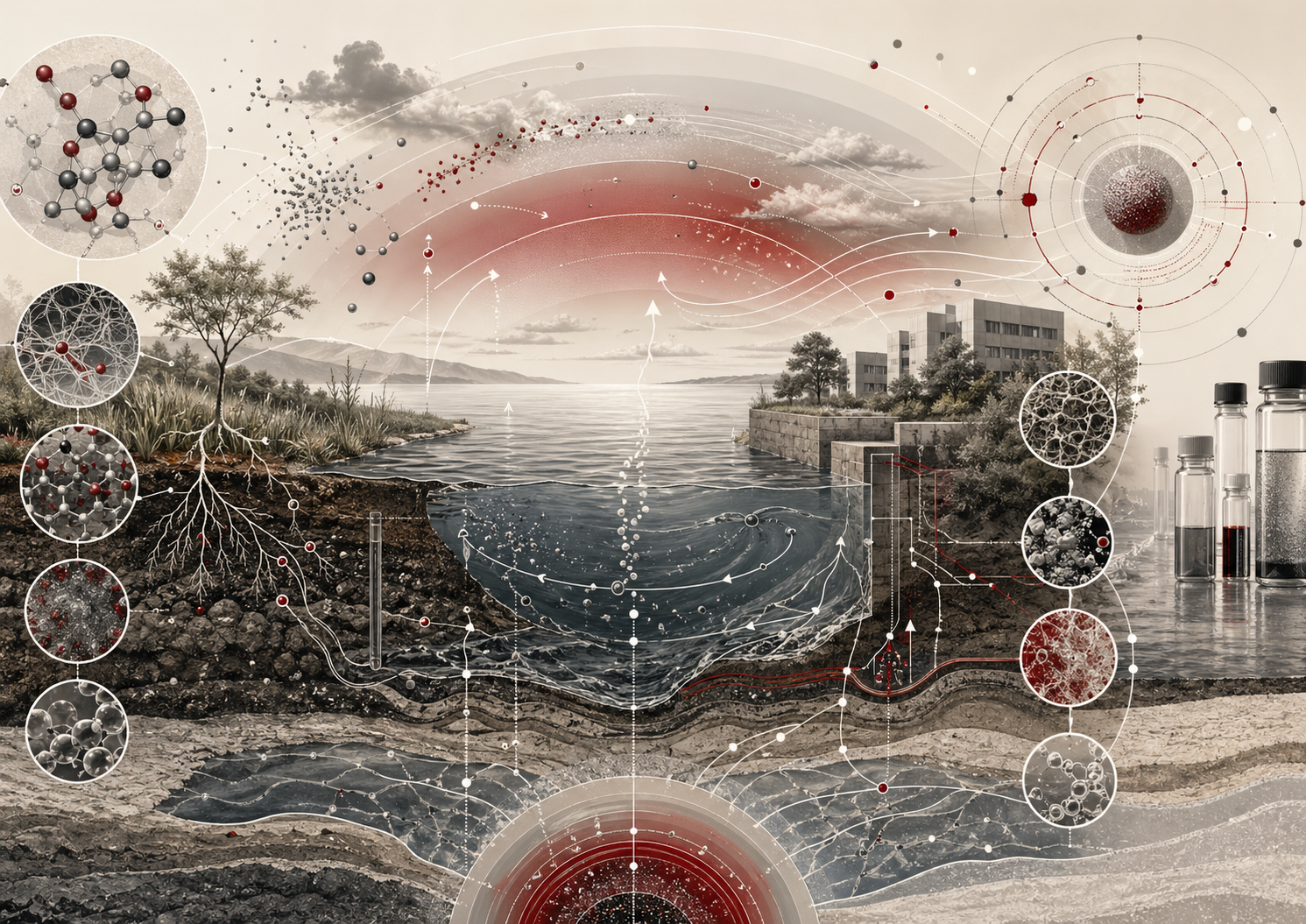
Why Habitability Is Chemical
Habitability is often discussed through climate, ecology, infrastructure, food systems, or public health. Environmental chemistry shows that all of these are also chemical conditions. The oxygen content of air, the carbonate buffering of oceans, the nitrogen and phosphorus status of soils and waters, the solubility of metals, the persistence of synthetic organic compounds, the acidity of rain and surface water, the photochemistry of tropospheric ozone, the redox state of sediments, and the chemical stability of drinking-water infrastructure all help determine whether a place can sustain life and social organization.
A habitable environment is not chemically pure. Natural systems contain metals, organic compounds, aerosols, salts, nutrients, acids, bases, radicals, colloids, minerals, dissolved gases, microbial metabolites, and particulate matter. The question is not whether chemicals are present. The question is whether chemical concentrations, forms, rates, pathways, mixtures, exposures, and transformations remain compatible with biological function, ecological resilience, public health, and social use.
This distinction matters. A trace element may be essential at low concentration and toxic at high concentration. Nitrogen and phosphorus are necessary nutrients, but excessive loading can contribute to eutrophication, harmful algal blooms, hypoxia, and ecosystem disruption. Carbon dioxide is a natural atmospheric constituent and a central molecule in Earth’s carbon cycle, but increasing atmospheric concentrations alter radiative forcing and ocean carbonate chemistry. Oxygen supports aerobic life, but reactive oxygen species can damage cells. Environmental chemistry is therefore a science of ranges, transformations, thresholds, and contexts.
Habitability also depends on maintaining chemical gradients. Oxygenated water differs from anoxic sediment. Freshwater differs from saline water. Fertile soil differs from contaminated soil. Indoor air differs from outdoor air. Treated drinking water differs from source water. Ecological function often depends not on uniform chemical conditions, but on the right chemical structure across space and time. Wetlands, soils, rivers, estuaries, forests, farms, aquifers, and cities all depend on chemical gradients that can be disrupted by pollution, land-use change, climate stress, or infrastructure failure.
For researchers and scientists, the chemical framing of habitability requires integrated evidence. Air, water, soil, sediment, food, buildings, bodies, and ecosystems cannot be evaluated by isolated measurements alone. Environmental chemistry asks how chemical conditions interact across media, pathways, timescales, species, communities, and decision systems.
What Environmental Chemistry Studies
Environmental chemistry examines the sources, reactions, transport, effects, and fates of chemical species in air, water, soil, sediments, organisms, products, waste streams, and built environments. It includes natural processes, anthropogenic releases, legacy contamination, industrial emissions, agricultural runoff, atmospheric reactions, groundwater chemistry, wastewater treatment, stormwater transport, combustion products, mineral weathering, and chemical transformations driven by sunlight, microbes, temperature, pressure, pH, salinity, and redox conditions.
The field connects several levels of analysis. Molecular identity asks what chemical species are present and in what forms. Concentration asks how much of each species is present in a given medium. Speciation asks which protonation state, oxidation state, complex, ion pair, mineral phase, or organic association dominates. Transport asks how substances move through air, water, soil, food webs, infrastructure, and bodies. Transformation asks how substances are degraded, oxidized, reduced, hydrolyzed, photolyzed, metabolized, or converted into other compounds.
Environmental chemistry also asks exposure and effect questions. Exposure asks who or what comes into contact with a substance, at what intensity, frequency, route, and duration. Effect asks what biological, ecological, material, or social consequences follow from exposure. Governance asks what evidence, uncertainty, standards, monitoring systems, substitution strategies, engineering controls, and policy decisions are needed to reduce harm.
This makes environmental chemistry both a fundamental chemical science and an applied interpretive discipline. It translates molecular knowledge into decisions about drinking water, air quality, waste management, land restoration, industrial safety, food systems, agriculture, climate mitigation, ecological resilience, public health, chemical substitution, and environmental justice.
The discipline is strongest when it does not collapse complexity into one category called “pollution.” A pollutant may be a gas, ion, particle, metal, organic molecule, nutrient, radionuclide, acid, base, salt, transformation product, microbial metabolite, or mixture. Its significance depends on medium, chemical form, dose, exposure route, receptor, duration, degradation, mobility, and context. Environmental chemistry gives researchers the conceptual tools to distinguish presence from risk, detection from harm, and chemical identity from environmental behavior.
Media, Compartments, and Boundaries
Environmental chemicals rarely remain in one place. A substance released to air may deposit onto soil or water. A compound applied to land may volatilize, bind to organic matter, leach into groundwater, degrade into transformation products, or enter food webs. A contaminant discharged to a river may partition into sediments, dilute downstream, bioaccumulate in aquatic organisms, or react with sunlight and dissolved organic matter. A material used indoors may emit volatile compounds, adsorb to dust, react with oxidants, or enter wastewater.
For this reason, environmental chemistry often uses compartmental thinking. The atmosphere contains gases, aerosols, oxidants, radicals, particulate matter, volatile organic compounds, nitrogen oxides, sulfur compounds, greenhouse gases, and photochemical reaction products. The hydrosphere includes rivers, lakes, wetlands, groundwater, drinking-water systems, oceans, wastewater, stormwater, dissolved ions, nutrients, trace metals, organic contaminants, and suspended particles. The lithosphere and pedosphere include minerals, soils, sediments, clay surfaces, organic matter, porewater, redox gradients, sorption sites, and contaminant reservoirs.
The biosphere includes organisms, microbiomes, food webs, plant uptake, metabolism, biomagnification, and biochemical transformation. The built environment includes pipes, buildings, industrial sites, landfills, treatment systems, roads, products, packaging, storage systems, indoor air, construction materials, and consumer products. These compartments are useful, but they are not sealed containers. They exchange matter continuously.
The most important environmental chemistry often occurs at boundaries: air-water interfaces, sediment-water interfaces, soil-root zones, particle surfaces, biofilms, membranes, clouds, aerosols, wetlands, estuaries, corrosion films, pipe scales, wastewater treatment barriers, and engineered filters. These interfaces concentrate reactions. They determine which species become mobile, which become immobilized, which become bioavailable, which degrade, and which enter exposure pathways.
Boundary chemistry is one reason environmental chemistry is difficult. A contaminant concentration in bulk water may not describe the concentration at a biofilm surface. A metal concentration in bulk sediment may not describe porewater exposure. An indoor air measurement may miss compounds sorbed to dust or surfaces. A soil test may not describe root-zone bioavailability. Environmental chemistry requires researchers to ask where the relevant reaction or exposure actually occurs.
Sources, Sinks, Fate, and Transport
A chemically rigorous environmental analysis begins with a source-pathway-receptor model. A source releases or generates a substance. A pathway carries it through an environmental medium. A receptor is the organism, ecosystem, community, aquifer, crop, building, infrastructure system, or worker population that may be affected. This model is simple, but it forces environmental chemistry to remain connected to evidence and exposure rather than abstract hazard alone.
Sources may be point sources, such as industrial discharge pipes, smokestacks, contaminated sites, wastewater outfalls, leaking tanks, mine drainage, landfills, or accidental releases. They may also be nonpoint sources, such as agricultural runoff, road dust, atmospheric deposition, urban stormwater, consumer-product residues, fertilizer losses, wildfire smoke, septic leakage, construction erosion, or diffuse legacy contamination. Many environmental problems are difficult precisely because the source is distributed, intermittent, chemically mixed, historically accumulated, or poorly monitored.
Sinks are processes or reservoirs that remove, store, transform, or dilute a substance. These may include degradation, deposition, sorption, volatilization, sediment burial, biological uptake, filtration, chemical precipitation, advective export, photolysis, hydrolysis, microbial metabolism, or atmospheric oxidation. A sink is not always a solution. Sediment burial may temporarily reduce water-column exposure while creating a long-term reservoir. Sorption to soil organic matter may reduce immediate mobility but preserve a contaminant that can later be remobilized by erosion, pH change, flooding, land disturbance, or redox shifts.
Environmental fate asks what happens to a substance after release. Transport asks where it goes. Fate and transport together determine whether a chemical remains local or becomes regional, transient or persistent, diluted or concentrated, harmless or hazardous. A volatile solvent may move from groundwater into indoor air through vapor intrusion. A hydrophobic organic compound may bind to sediment and enter benthic food webs. A nutrient may move through tile drainage into rivers. A persistent atmospheric compound may become globally mixed. A metal may become immobilized under one redox condition and remobilized under another.
For researchers, fate and transport require process-based thinking. The same concentration at the source can produce very different exposure outcomes depending on flow, soil texture, organic carbon, temperature, light, microbial activity, pH, redox state, hydrology, volatilization, dilution, and degradation. Environmental chemistry becomes decision-useful when it links source strength to exposure pathway and receptor vulnerability.
Speciation, Partitioning, and Bioavailability
In environmental chemistry, knowing the total amount of an element or compound is often not enough. Chemical form matters. Chromium in one oxidation state behaves differently from chromium in another. Mercury can exist in inorganic and organic forms with different mobility and toxicity. Ammonia and ammonium are linked by acid-base equilibrium but differ in biological availability and toxicity. Dissolved metals may be present as free ions, inorganic complexes, organic complexes, colloid-associated species, or precipitated mineral phases.
Speciation refers to the distribution of an element or compound among chemical forms. Speciation depends on pH, redox potential, ionic strength, temperature, ligands, competing ions, mineral surfaces, organic matter, and microbial activity. Environmental toxicity, transport, and treatment often depend more on speciation than on total concentration. For example, the free-ion form of some metals may be more bioavailable than organic-bound forms; the un-ionized form of ammonia is generally more toxic to aquatic organisms than ammonium; and methylmercury has different bioaccumulation behavior than inorganic mercury.
Partitioning describes how a substance distributes among phases such as air, water, organic matter, mineral surfaces, sediments, and biological tissues. A volatile organic compound may move from water to air. A hydrophobic organic compound may bind to sediment organic carbon. A metal may sorb to iron or manganese oxides. A weak acid or base may change charge state with pH, altering mobility and membrane permeability. Partitioning determines whether a chemical remains dissolved, becomes particle-bound, volatilizes, enters biota, or accumulates in a reservoir.
Bioavailability is the fraction of a chemical that is accessible for uptake by organisms. It is not identical to total concentration. A contaminant tightly bound in a mineral lattice may be less available than the same element dissolved in porewater. A hydrophobic contaminant stored in sediments may become more available when sediments are resuspended. A nutrient may be abundant in total form but unavailable to organisms if locked in a refractory mineral or organic phase.
Bioavailability also depends on organism and exposure route. Plant roots, fish gills, microbial membranes, human lungs, digestive systems, skin, and sediment-dwelling organisms all encounter chemicals differently. A soil lead result may have different implications for a toddler, an adult gardener, a plant root, and a soil microorganism. Environmental chemistry therefore connects chemical form to exposure biology.
For researchers and practitioners, speciation and bioavailability are essential safeguards against misleading interpretation. Total concentration can overstate risk when a substance is tightly bound and inaccessible, but it can also understate risk when transformation produces more toxic forms or when exposure pathways concentrate the chemical. Strong environmental chemistry asks which form matters for the decision.
Air, Water, Soil, and Sediment Chemistry
Environmental chemistry becomes practical when it is tied to specific media. Air chemistry governs atmospheric composition, greenhouse gases, ozone, fine particulate matter, acid deposition, indoor exposure, wildfire smoke, and oxidant chemistry. Water chemistry governs drinking-water safety, aquatic ecosystems, groundwater quality, wastewater treatment, nutrient transport, salinity, dissolved oxygen, metal mobility, and contaminant loads. Soil chemistry governs fertility, nutrient retention, contaminant fate, organic carbon storage, pH, salinity, cation exchange, and plant availability. Sediment chemistry governs benthic exposure, nutrient recycling, metal release, contaminant burial, and historical records of pollution.
Each medium has distinct measurement and interpretation challenges. Air concentrations may change by the minute with emissions, meteorology, photochemistry, and boundary-layer height. Water concentrations may change with flow, storm events, stratification, temperature, and sampling depth. Soil concentrations may vary across centimeters because of texture, roots, organic matter, historical land use, and microtopography. Sediments may store decades of contaminant history while interacting dynamically with overlying water and benthic organisms.
Media also exchange chemicals. Atmospheric deposition supplies nitrogen, sulfur, mercury, particles, and persistent organic pollutants to land and water. Rivers carry dissolved and particulate matter to lakes, estuaries, and oceans. Flooding can remobilize contaminated soil and sediment. Dry soils can emit dust and ammonia. Wetlands can remove nitrate while emitting methane. Wastewater discharge can alter river chemistry. Drinking-water pipes can release metals into treated water. These exchanges make environmental chemistry a multi-media science.
Different media require different benchmarks and governance systems. An air-quality standard is not a drinking-water standard. A sediment guideline is not a soil cleanup value. A groundwater screening level may not protect aquatic life. A total metal value may not match a dissolved aquatic criterion. Environmental chemistry must preserve the medium, fraction, exposure route, averaging period, and decision context for each measurement.
For researchers, the lesson is that environmental chemistry cannot be reduced to an analyte list. A nitrate result in groundwater, surface water, soil porewater, wastewater effluent, and atmospheric deposition has different meaning. The chemical identity is the same; the environmental interpretation is not.
Nutrients, Eutrophication, and Oxygen Depletion
Nitrogen and phosphorus are essential nutrients, but excessive loading can destabilize aquatic systems. Nutrient enrichment can stimulate algal blooms, harmful algal toxins, aquatic plant overgrowth, turbidity, taste and odor problems, oxygen depletion, fish kills, biodiversity loss, and coastal hypoxia. Eutrophication is therefore a chemical and ecological process: nutrient inputs alter primary production, organic matter production, microbial respiration, oxygen dynamics, and food-web structure.
Nitrogen occurs in multiple forms, including nitrate, nitrite, ammonium, dissolved organic nitrogen, particulate organic nitrogen, nitrogen gas, nitrous oxide, nitric oxide, and ammonia. These forms differ in mobility, biological availability, toxicity, and transformation pathways. Nitrate is often mobile in groundwater and tile drainage. Ammonium can sorb to exchange sites but may convert to nitrate through nitrification. Under low-oxygen conditions, nitrate may be converted to gaseous nitrogen species through denitrification.
Phosphorus occurs as orthophosphate, dissolved organic phosphorus, particulate phosphorus, mineral-bound phosphorus, and sediment-associated phosphorus. In many freshwater systems, phosphorus is the limiting nutrient, so relatively small increases in bioavailable phosphorus can cause large ecological changes. Phosphorus can bind to iron oxides under oxygenated conditions and be released under reducing conditions, creating internal loading from sediments even after external inputs are reduced.
Oxygen depletion links nutrient chemistry to redox chemistry. When algae or organic matter decompose, microbes consume oxygen. If oxygen demand exceeds reaeration and photosynthetic production, hypoxia can develop. Under low oxygen, chemical conditions shift: iron and manganese oxides can dissolve, phosphorus can be released from sediments, nitrate can be reduced, sulfate reduction may occur, and methane production can increase. Eutrophication is therefore not only a surface-water problem; it can reorganize sediment and water-column chemistry.
For researchers and policymakers, nutrient management requires concentration, load, timing, hydrology, and ecological sensitivity. A high concentration in a small flow may deliver less mass than a moderate concentration in a large river. Storm pulses may dominate annual loads. Legacy phosphorus in soil or sediment may sustain impairment after inputs decline. Environmental chemistry helps distinguish source control, transport control, internal loading, and ecosystem response.
Metals, Redox Chemistry, and Contaminant Mobility
Metals and metalloids are central to environmental chemistry because they can be nutrients, tracers, toxicants, or geochemical indicators depending on form and concentration. Iron, manganese, zinc, copper, molybdenum, cobalt, nickel, and selenium can be biologically important at low concentrations. Lead, cadmium, mercury, arsenic, chromium, and other elements can pose serious risks depending on speciation, exposure, and vulnerability. Total concentration is often insufficient because chemical form determines mobility, bioavailability, and toxicity.
Redox chemistry is especially important. Under oxygenated conditions, iron and manganese may form oxides that sorb metals, phosphate, and organic compounds. Under reducing conditions, those oxides may dissolve and release associated substances. Arsenic mobility in groundwater can be strongly influenced by redox processes, iron minerals, organic matter, microbial activity, and aquifer conditions. Mercury can be transformed into methylmercury under certain microbial and environmental conditions, increasing bioaccumulation concern. Chromium speciation can shift between forms with different mobility and toxicity.
pH also shapes metal behavior. Acidic conditions often increase the solubility of many metals, which is why acid mine drainage can mobilize iron, aluminum, manganese, copper, zinc, and other elements. Alkaline conditions may precipitate some metals but mobilize others as oxyanions. Organic ligands can either immobilize metals through strong binding or increase mobility by forming soluble complexes. Particles, colloids, clay minerals, carbonates, sulfides, and oxides all influence metal partitioning.
Metal contamination is often long-lived because elements do not degrade. They can change form, move, precipitate, sorb, dissolve, or become buried, but the atoms remain in the system unless physically removed or transported elsewhere. Remediation therefore often focuses on immobilization, excavation, stabilization, pH control, redox control, hydraulic containment, or exposure prevention rather than destruction.
For researchers and communities, metal chemistry highlights the importance of environmental justice. Legacy lead in urban soils, arsenic in groundwater, mercury in fish, mining waste, smelter emissions, contaminated sediments, and industrial corridors often create exposure burdens that persist long after the original activity. Environmental chemistry can identify and characterize these burdens, but protection requires governance, remediation, and community-centered decision-making.
Organic Contaminants, Persistence, and Transformation Products
Organic contaminants include pesticides, solvents, petroleum hydrocarbons, plastic additives, pharmaceuticals, personal-care products, flame retardants, surfactants, industrial chemicals, disinfection byproducts, combustion products, PFAS, and transformation products. Their environmental behavior depends on molecular structure, volatility, solubility, hydrophobicity, ionization, degradability, sorption, reactivity, and biological uptake.
Persistence is a central concern. A persistent compound resists degradation long enough to travel, accumulate, or sustain exposure. Persistence does not always mean high toxicity, but persistent toxic compounds are especially concerning because they can spread beyond the release site and remain after emissions are reduced. Persistence also complicates governance because monitoring, cleanup, and substitution may lag behind chemical use.
Partitioning is especially important for organic contaminants. Hydrophobic compounds may bind to organic carbon in soils and sediments. Volatile compounds may move between water, soil gas, indoor air, and the atmosphere. Ionizable compounds may change behavior with pH. Some compounds degrade into products that are less toxic; others transform into products that are more mobile, persistent, or toxic. A parent compound may disappear while environmental concern remains through transformation products.
Environmental transformation pathways include photolysis, hydrolysis, oxidation, reduction, biodegradation, metabolism, chlorination, ozonation, and advanced oxidation. These transformations can occur in sunlight-exposed surface water, groundwater, wastewater treatment systems, soils, sediments, air, organisms, and engineered treatment processes. The products depend on environmental conditions and reaction pathways.
For researchers, organic contaminant chemistry requires more than target analysis of known compounds. Non-target screening, suspect screening, high-resolution mass spectrometry, transformation product identification, mixture analysis, and effect-based bioassays are increasingly important because environmental systems contain thousands of chemicals that may not be captured by traditional monitoring lists.
Emerging Contaminants, Mixtures, and Cumulative Burden
Emerging contaminants are not always newly invented chemicals. Many are newly detected, newly prioritized, newly regulated, newly understood, or newly widespread. PFAS, pharmaceuticals, endocrine-active compounds, microplastics-associated chemicals, tire-wear transformation products, algal toxins, nanomaterials, flame retardants, disinfectant byproducts, and industrial substitutes all illustrate the difficulty of governing chemical systems that evolve faster than monitoring and regulation.
Mixtures are the normal condition of environmental exposure. Air contains mixtures of gases and particles. Water contains mixtures of nutrients, metals, organic matter, salts, microorganisms, and contaminants. Soil contains mineral, organic, and anthropogenic chemicals. Human bodies and ecosystems encounter multiple substances over time. Yet many benchmarks and regulations are developed chemical by chemical, pathway by pathway, and medium by medium.
Mixture effects can be additive, synergistic, antagonistic, or independent depending on mechanism, dose, timing, organism, and endpoint. Chemicals affecting the same target organ, biological pathway, or ecological process may create cumulative concern even if each individual concentration appears modest. Nonchemical stressors such as heat, poverty, poor housing, occupational exposure, limited healthcare, flooding, and psychosocial stress can also shape vulnerability.
Cumulative burden is therefore both chemical and social. Communities near industrial corridors, ports, mines, highways, refineries, concentrated animal feeding operations, waste sites, aging infrastructure, or flood-prone contaminated land may experience overlapping exposures. Averages can hide these burdens. Environmental chemistry becomes more protective when it measures distribution, not only central tendency.
For researchers and policymakers, emerging contaminants and mixtures demand humility. Absence from a monitoring list is not absence from the environment. Nondetection does not mean zero. A replacement chemical is not safer simply because it is newer. A concentration below a benchmark may still matter in a mixture or for a vulnerable population. Environmental chemistry must combine measurement innovation with precautionary design and transparent governance.
Measurement, Monitoring, and Chemical Evidence
Environmental chemistry is inseparable from sampling design. A measured concentration is not merely a property of a chemical. It is also a property of where, when, how, and why the sample was collected. A water-quality result may depend on storm timing, season, flow rate, depth, filtration, preservation, container material, holding time, analytical method, detection limit, and calibration. A soil result may depend on sampling depth, particle size, moisture, organic matter, heterogeneity, and extraction procedure. An air-quality result may depend on averaging time, meteorology, instrument calibration, local sources, vertical mixing, and sensor placement.
Monitoring programs must answer several questions. What environmental medium is being monitored? Which analytes are relevant to the decision? What spatial and temporal resolution is needed? What detection limits are required? What reference materials, blanks, duplicates, spikes, and calibration standards are used? How are censored values below detection limits handled? Which benchmark or threshold is appropriate for interpretation? How are uncertainty, bias, drift, matrix effects, and contamination controlled?
The answer depends on purpose. A compliance monitoring program, restoration study, public-health investigation, watershed nutrient assessment, contaminated-site investigation, climate-chemistry observing network, and community exposure study require different designs. Environmental chemistry becomes decision-useful only when the analytical method, sampling design, data structure, and interpretive framework match the decision being made.
Traceability is especially important. Environmental data should preserve sample identifiers, coordinates, dates, media, analytes, units, methods, detection limits, qualifiers, laboratory information, calibration status, quality-control flags, and interpretation notes. Without provenance, chemical measurements become difficult to audit, compare, or reuse.
Modern environmental monitoring also spans technologies. Field sensors can provide high-frequency data. Laboratory instruments can detect trace contaminants with high specificity. Remote sensing can map atmospheric gases, aerosols, algal blooms, thermal anomalies, land cover, and water color. Community monitoring can reveal local concerns and exposure patterns. Integrated systems are strongest when they connect all of these data streams while preserving uncertainty and method differences.
For researchers, the measurement lesson is simple but demanding: no environmental concentration is self-explanatory. A number becomes evidence only when attached to method, medium, unit, time, place, fraction, uncertainty, and decision context.
Risk, Exposure, and Habitability
Environmental chemistry helps distinguish hazard from risk. A hazard is the capacity of a substance or stressor to cause harm. Risk depends on hazard, exposure, dose-response relationships, receptor vulnerability, timing, frequency, route, and uncertainty. A toxic chemical sealed in an inaccessible container does not create the same risk as the same chemical dissolved in drinking water, volatilized into indoor air, deposited onto crops, inhaled as dust, accumulated in fish tissue, or present in a workplace.
Human exposure pathways include ingestion, inhalation, dermal contact, occupational exposure, food-chain transfer, drinking water, indoor air, dust, soil contact, consumer products, and medical or household use. Ecological exposure pathways include water-column exposure, sediment contact, root uptake, trophic transfer, atmospheric deposition, habitat alteration, reproductive toxicity, and developmental effects. Exposure must be understood by route, duration, frequency, life stage, and context.
Habitability requires more than keeping individual chemical concentrations below isolated thresholds. It requires the maintenance of life-supporting chemical regimes. These include breathable air, safe water, functioning soils, non-toxic food webs, stable nutrient cycling, tolerable heat and humidity, materials that do not fail through corrosion or chemical degradation, and built systems that do not concentrate exposure burdens in vulnerable communities.
Environmental chemistry is therefore a bridge between molecular science and environmental justice. Chemical burdens are not evenly distributed. Industrial corridors, waste sites, agricultural regions, informal settlements, poorly ventilated housing, aging water infrastructure, and communities near highways, ports, refineries, mines, landfills, or combustion sources may experience disproportionate exposure. A chemically habitable environment must be evaluated not only by average concentration, but also by who bears the exposure and who benefits from the activity that produced it.
For researchers, risk interpretation should be precise. Detection is not the same as harm. Nondetection is not proof of absence. A benchmark exceedance is not a complete diagnosis. A value below a benchmark is not always full reassurance. Chemical risk depends on evidence quality, exposure scenario, mixture context, receptor sensitivity, uncertainty, and social vulnerability. Environmental chemistry is strongest when it communicates these distinctions clearly.
Environmental Chemistry and Earth-System Change
Environmental chemistry is now central to understanding Earth-system change. Atmospheric chemistry connects emissions, oxidants, aerosols, greenhouse gases, air pollution, and climate forcing. Ocean chemistry connects carbon dioxide uptake, pH, alkalinity, carbonate saturation, marine ecosystems, and biogeochemical cycling. Soil chemistry connects fertility, carbon storage, nutrient retention, mineral weathering, contamination, salinity, and land-use change. Water chemistry connects drinking-water safety, aquatic ecosystems, wastewater treatment, stormwater, dissolved oxygen, nutrient loading, and toxic contaminants.
Many environmental crises are chemical in both cause and consequence. Climate change involves radiatively active gases and aerosol chemistry. Ocean acidification involves carbonate equilibria. Eutrophication involves nutrient loading, microbial respiration, oxygen depletion, and redox change. Toxic contamination involves persistence, exposure, and dose-response. Biodiversity loss can involve pesticides, metals, pharmaceuticals, acidification, salinity, and endocrine-active compounds. Infrastructure decay can involve corrosion, scaling, leaching, disinfectant byproducts, and material incompatibility.
Environmental chemistry therefore provides a language for linking planetary processes with local measurements. A global chemical pressure, such as atmospheric carbon dioxide, becomes locally meaningful through pH, alkalinity, oxygen, temperature, species vulnerability, and ecosystem context. A local contaminant release becomes regionally meaningful through transport, persistence, bioaccumulation, and exposure pathways. Chemistry connects scale.
Climate change also changes environmental chemistry. Warming alters reaction rates, oxygen solubility, volatilization, biogenic emissions, wildfire chemistry, algal blooms, stratification, contaminant degradation, and microbial activity. Extreme rainfall can mobilize nutrients, sediments, sewage, and contaminants. Drought can concentrate salts and pollutants. Sea-level rise can salinize aquifers and mobilize coastal contamination. Permafrost thaw can release carbon and change metal mobility. Environmental chemistry must therefore be understood as dynamic under climate stress.
For researchers, Earth-system environmental chemistry demands integration across disciplines. A carbonate equilibrium calculation may matter for shellfish. A nutrient load may matter for hypoxia. A soil redox transition may matter for methane. A wildfire plume may matter for health hundreds of miles downwind. The chemical conditions of habitability are increasingly coupled across atmosphere, water, land, infrastructure, and climate.
Governance, Responsibility, and Chemical Power
Modern societies depend on chemical production. Fertilizers, medicines, polymers, semiconductors, disinfectants, batteries, construction materials, water treatment chemicals, refrigerants, fuels, catalysts, coatings, solvents, and analytical reagents all support human wellbeing. The problem is not chemistry itself. The problem is chemical power without sufficient responsibility, monitoring, substitution, containment, transparency, or end-of-life design.
Environmental chemistry helps govern chemical power by making molecular consequences visible. It can reveal a contaminant plume, identify an exposure pathway, detect a transformation product, quantify a nutrient load, trace an emission source, evaluate a treatment system, or show when a chemical assumed to be controlled remains persistent and mobile. It also reveals uncertainty: unknown mixtures, unmonitored compounds, detection-limit problems, transformation products, data gaps, cumulative exposures, and sensitive populations.
Responsible environmental chemistry should therefore support prevention as well as remediation. It should ask not only how to measure contamination after release, but how to design chemicals, processes, products, materials, and infrastructures that reduce hazardous persistence, unnecessary exposure, waste, and ecological disruption from the beginning.
Governance also requires evidence systems. Standards, permits, cleanup levels, environmental impact assessments, product regulations, chemical inventories, emissions reporting, drinking-water rules, air-quality standards, wastewater permits, pesticide approvals, and waste-management policies all depend on chemical data. Weak monitoring produces weak accountability. Strong measurement makes harm harder to hide.
Chemical governance must also confront unequal power. Some communities receive the benefits of chemical production while others receive the waste, emissions, risk, and uncertainty. Environmental chemistry should not frame these burdens as accidental background conditions. It should help identify exposure patterns, legacy contamination, cumulative burdens, and institutional failures so that protection can become more than an average-value claim.
For researchers and institutions, the ethical responsibility is clear: environmental chemistry should make chemical risk visible, auditable, and preventable. It should strengthen public accountability, not merely technical expertise.
Mathematical Lens: Concentration, Persistence, Partitioning, and Thresholds
Environmental chemistry depends on measurement, but measurement becomes more powerful when linked to mathematical structure. The simplest unit of environmental interpretation is concentration:
C = \frac{m}{V}
\]
Interpretation: \(C\) is concentration, \(m\) is mass of a substance, and \(V\) is the volume of the medium. Water and air concentrations are often expressed per volume, such as mg/L, µg/L, ppm, ppb, or µg/m³.
For soils and sediments, concentration is often expressed relative to dry mass:
C_s = \frac{m}{M_s}
\]
Interpretation: \(C_s\) is solid-phase concentration and \(M_s\) is the dry mass of soil or sediment. Units often include mg/kg or µg/kg.
A simple mass balance for a well-mixed environmental compartment is:
\frac{dM}{dt} = I – O – kM
\]
Interpretation: \(M\) is chemical mass in the compartment, \(I\) is input rate, \(O\) is output rate, and \(kM\) represents first-order removal through degradation, transformation, volatilization, settling, or other loss processes.
If output is proportional to mass, the equation can be simplified as:
\frac{dM}{dt} = I – (k + q)M
\]
Interpretation: \(q\) represents proportional advective or physical removal. This compact form shows how chemical transformation and physical transport can combine.
For a pulse input with no continuing source, first-order decay is:
C(t) = C_0e^{-kt}
\]
Interpretation: \(C_0\) is initial concentration, \(k\) is the first-order rate constant, and \(t\) is time. Photolysis, biodegradation, hydrolysis, volatilization, and radioactive decay may each be approximated as first-order under defined assumptions.
The half-life is:
t_{1/2} = \frac{\ln(2)}{k}
\]
Interpretation: Half-life is the time required for concentration to decline by half under ideal first-order conditions. Environmental half-lives can change with temperature, light, microbes, pH, moisture, and matrix conditions.
Partitioning can be represented by a distribution coefficient:
K_d = \frac{C_s}{C_w}
\]
Interpretation: \(C_s\) is concentration associated with the solid phase and \(C_w\) is concentration in water. Higher \(K_d\) often indicates stronger association with solids, although interpretation depends on the chemical, matrix, pH, organic matter, mineralogy, and redox state.
For a weak acid, pH controls the ratio of ionized and neutral forms:
\frac{[A^-]}{[HA]} = 10^{pH – pK_a}
\]
Interpretation: Ionization affects volatility, sorption, membrane permeability, toxicity, and treatment behavior. Weak acids and bases can change environmental mobility as pH changes.
A simple screening hazard quotient can be written as:
HQ = \frac{C}{B}
\]
Interpretation: \(C\) is measured concentration and \(B\) is a relevant benchmark, guideline, standard, background value, or screening value. \(HQ > 1\) indicates that a measured concentration exceeds the selected benchmark, but does not by itself prove harm.
For a simple environmental load calculation:
L = CQ
\]
Interpretation: \(L\) is chemical load, \(C\) is concentration, and \(Q\) is flow. Load connects chemistry to hydrology by estimating how much mass moves through a system over time.
These equations are not substitutes for site-specific modeling, toxicology, hydrology, or regulatory interpretation. They are conceptual tools that make assumptions visible: how much is present, how fast it changes, where it partitions, how it moves, and how it compares with a decision-relevant reference value.
Computational Workflows for Environmental Chemistry
Computational environmental chemistry can make monitoring and interpretation more transparent. A workflow can track sample location, medium, analyte, concentration, unit, fraction, method, detection limit, benchmark, quality flag, uncertainty, hydrologic context, exposure route, environmental compartment, transformation rate, partition coefficient, and interpretation notes. This structure matters because environmental conclusions often depend on metadata that are lost in informal spreadsheets.
Useful workflows include benchmark screening, first-order fate modeling, half-life estimation, load calculation, concentration trend analysis, nondetect handling, mixture hazard screening, source-pathway-receptor mapping, contaminant plume summaries, nutrient export estimation, sediment-water partitioning, air-quality exceedance screening, environmental justice burden mapping, and quality-control dashboards. Advanced workflows may integrate geospatial analysis, laboratory information management systems, sensor networks, remote sensing, chemical transport models, hydrologic models, toxicological databases, and Bayesian uncertainty analysis.
For researchers, computational workflows should preserve units and chemical basis. Nitrate as nitrogen is not the same as nitrate as nitrate. Dissolved metals are not the same as total recoverable metals. A soil result in mg/kg is not directly comparable to a water result in mg/L. A sediment benchmark may not protect drinking-water exposure. A benchmark based on chronic exposure should not be applied casually to a short-term event. Environmental data require explicit context.
Computational workflows should also avoid false precision. A model may calculate many decimal places, but the underlying sampling design, analytical uncertainty, hydrologic variability, and benchmark assumptions may justify only broad screening interpretation. Transparent code should make uncertainty more visible, not hide it behind polished outputs.
The examples below use synthetic data and simplified thresholds. They do not determine regulatory compliance, diagnose health risk, evaluate real contamination, certify remediation, or replace professional environmental chemistry, toxicology, hydrology, engineering, legal, or public-health review. They demonstrate how environmental chemistry reasoning can be structured, audited, and communicated responsibly.
Python Example: Environmental Fate, Threshold Screening, and Half-Life
The following Python example models first-order decay after a pulse release and screens measured concentrations against illustrative benchmarks. The workflow is educational and does not replace site-specific fate-and-transport modeling, calibrated hydrology, toxicological assessment, or regulatory interpretation.
from dataclasses import dataclass
from typing import Dict, List
import math


@dataclass
class EnvironmentalObservation:
    """Synthetic educational environmental chemistry observation.

    Benchmarks are illustrative and must not be treated as regulatory
    standards, health-based determinations, ecological criteria, or
    site-specific cleanup values.
    """

    site: str
    medium: str
    analyte: str
    concentration: float
    benchmark: float
    unit: str
    fraction: str
    method_context: str


def hazard_quotient(observation: EnvironmentalObservation) -> float:
    """Calculate concentration-to-benchmark screening ratio."""
    if observation.benchmark <= 0:
        return 0.0

    return observation.concentration / observation.benchmark


def screening_flag(observation: EnvironmentalObservation) -> str:
    """Return a simple benchmark-screening label."""
    if hazard_quotient(observation) > 1:
        return "exceeds illustrative benchmark"
    return "below illustrative benchmark"


def first_order_decay(initial_concentration: float, rate_constant: float, time: float) -> float:
    """Calculate first-order concentration after a pulse release."""
    if initial_concentration < 0 or rate_constant < 0 or time < 0:
        return 0.0

    return initial_concentration * math.exp(-rate_constant * time)


def half_life(rate_constant: float) -> float:
    """Calculate first-order half-life."""
    if rate_constant <= 0:
        return float("inf")

    return math.log(2) / rate_constant


def distribution_coefficient(solid_concentration: float, water_concentration: float) -> float:
    """Calculate a simple solid-water distribution coefficient."""
    if water_concentration <= 0:
        return float("inf")

    return solid_concentration / water_concentration


def summarize_observation(observation: EnvironmentalObservation) -> Dict[str, object]:
    """Return an auditable environmental screening summary."""
    return {
        "site": observation.site,
        "medium": observation.medium,
        "analyte": observation.analyte,
        "concentration": observation.concentration,
        "benchmark": observation.benchmark,
        "unit": observation.unit,
        "fraction": observation.fraction,
        "hazard_quotient": round(hazard_quotient(observation), 3),
        "screening_flag": screening_flag(observation),
        "method_context": observation.method_context,
    }


observations: List[EnvironmentalObservation] = [
    EnvironmentalObservation(
        "River-A",
        "surface_water",
        "nitrate_as_N",
        7.8,
        10.0,
        "mg/L",
        "dissolved",
        "illustrative nutrient monitoring result",
    ),
    EnvironmentalObservation(
        "River-A",
        "surface_water",
        "phosphate_as_P",
        0.18,
        0.10,
        "mg/L",
        "dissolved",
        "illustrative nutrient monitoring result",
    ),
    EnvironmentalObservation(
        "Wetland-B",
        "sediment",
        "lead",
        42.0,
        35.0,
        "mg/kg",
        "bulk_sediment",
        "illustrative sediment screening result",
    ),
    EnvironmentalObservation(
        "Urban-C",
        "air",
        "ozone",
        0.071,
        0.070,
        "ppm",
        "ambient_air",
        "illustrative air-quality screening result",
    ),
    EnvironmentalObservation(
        "Urban-C",
        "air",
        "PM2.5",
        18.5,
        15.0,
        "ug/m3",
        "ambient_air",
        "illustrative fine-particle screening result",
    ),
]

for observation in observations:
    print(summarize_observation(observation))


initial_concentration = 100.0
rate_constant_per_day = 0.08
days = list(range(0, 61, 5))

decay_curve = [
    {
        "day": day,
        "concentration_ug_L": round(
            first_order_decay(initial_concentration, rate_constant_per_day, day),
            3
        ),
    }
    for day in days
]

print({
    "initial_concentration_ug_L": initial_concentration,
    "rate_constant_per_day": rate_constant_per_day,
    "estimated_half_life_days": round(half_life(rate_constant_per_day), 2),
    "decay_curve": decay_curve,
})

kd_example = distribution_coefficient(
    solid_concentration=42.0,
    water_concentration=0.014
)

print({
    "solid_concentration_mg_kg": 42.0,
    "water_concentration_mg_L": 0.014,
    "distribution_coefficient_L_kg": round(kd_example, 1),
    "interpretation_limit": (
        "Kd is matrix-specific and depends on pH, organic matter, mineralogy, "
        "redox state, and chemical form."
    ),
})
This workflow illustrates four environmental chemistry habits. First, concentration must be interpreted relative to a benchmark, standard, guideline, background value, or ecological context. Second, persistence depends on transformation rates, not merely initial release. Third, partitioning depends on matrix and chemical form. Fourth, simplified screening tools should be treated as early warning systems, not final judgments.
R Example: Monitoring Summaries and Exceedance Screening
The following R example summarizes synthetic monitoring results by medium and analyte. It uses base R so the workflow remains portable across simple teaching environments.
site <- c("River-A", "River-A", "Wetland-B", "Urban-C", "Urban-C")
medium <- c("surface_water", "surface_water", "sediment", "air", "air")
analyte <- c("nitrate_as_N", "phosphate_as_P", "lead", "ozone", "PM2.5")
concentration <- c(7.8, 0.18, 42.0, 0.071, 18.5)
benchmark <- c(10.0, 0.10, 35.0, 0.070, 15.0)
unit <- c("mg/L", "mg/L", "mg/kg", "ppm", "ug/m3")
fraction <- c("dissolved", "dissolved", "bulk_sediment", "ambient_air", "ambient_air")

monitoring <- data.frame(
  site,
  medium,
  analyte,
  concentration,
  benchmark,
  unit,
  fraction
)

monitoring$hazard_quotient <- monitoring$concentration / monitoring$benchmark

monitoring$screening_flag <- ifelse(
  monitoring$hazard_quotient > 1,
  "exceeds illustrative benchmark",
  "below illustrative benchmark"
)

medium_summary <- aggregate(
  hazard_quotient ~ medium,
  data = monitoring,
  FUN = function(x) c(mean = mean(x), max = max(x), n = length(x))
)

medium_summary_flat <- data.frame(
  medium = medium_summary$medium,
  mean_hazard_quotient = medium_summary$hazard_quotient[, "mean"],
  max_hazard_quotient = medium_summary$hazard_quotient[, "max"],
  n = medium_summary$hazard_quotient[, "n"]
)

exceedance_count <- as.data.frame(
  table(monitoring$medium, monitoring$screening_flag)
)

names(exceedance_count) <- c("medium", "screening_flag", "count")

initial_concentration <- 100.0
rate_constant_per_day <- 0.08
days <- seq(0, 60, by = 5)

decay_curve <- data.frame(
  day = days,
  concentration_ug_L = initial_concentration * exp(-rate_constant_per_day * days)
)

half_life_days <- log(2) / rate_constant_per_day

print(monitoring)
print(medium_summary_flat)
print(exceedance_count)
print(paste("Estimated half-life:", round(half_life_days, 2), "days"))
print(decay_curve)
In a production workflow, this kind of analysis would be expanded with units handling, detection-limit logic, censored-data treatment, spatial coordinates, time-series structure, calibration metadata, quality-control flags, uncertainty intervals, method provenance, and links to laboratory records. The purpose of the example is to show the conceptual movement from measurement to screening interpretation.
SQL Example: Environmental Chemistry Evidence Register
Environmental chemistry interpretation becomes more reliable when samples, methods, units, detection limits, benchmarks, media, fractions, and quality flags are traceable. A simple evidence register can preserve the metadata needed to interpret monitoring results responsibly.
CREATE TABLE environmental_site (
    site_id TEXT PRIMARY KEY,
    site_name TEXT NOT NULL,
    latitude REAL,
    longitude REAL,
    watershed TEXT,
    land_use_context TEXT,
    community_context TEXT,
    site_description TEXT
);

CREATE TABLE environmental_sample (
    sample_id TEXT PRIMARY KEY,
    site_id TEXT NOT NULL,
    sample_datetime TEXT NOT NULL,
    medium TEXT NOT NULL,
    sample_type TEXT,
    depth_m REAL CHECK (depth_m >= 0),
    field_conditions TEXT,
    sampling_design TEXT,
    preservation_method TEXT,
    chain_of_custody_id TEXT,
    FOREIGN KEY (site_id) REFERENCES environmental_site(site_id)
);

CREATE TABLE chemical_result (
    result_id INTEGER PRIMARY KEY,
    sample_id TEXT NOT NULL,
    analyte TEXT NOT NULL,
    fraction TEXT,
    concentration REAL,
    unit TEXT NOT NULL,
    detection_limit REAL,
    reporting_limit REAL,
    method_code TEXT,
    laboratory_name TEXT,
    quality_flag TEXT,
    qualifier_notes TEXT,
    FOREIGN KEY (sample_id) REFERENCES environmental_sample(sample_id)
);

CREATE TABLE benchmark_reference (
    benchmark_id INTEGER PRIMARY KEY,
    analyte TEXT NOT NULL,
    medium TEXT NOT NULL,
    fraction TEXT,
    benchmark_value REAL NOT NULL,
    unit TEXT NOT NULL,
    benchmark_name TEXT,
    benchmark_basis TEXT,
    exposure_duration TEXT,
    source_reference TEXT
);

CREATE TABLE environmental_interpretation (
    interpretation_id INTEGER PRIMARY KEY,
    result_id INTEGER NOT NULL,
    indicator_name TEXT NOT NULL,
    indicator_value REAL,
    interpretation_label TEXT,
    calculation_notes TEXT,
    uncertainty_notes TEXT,
    confidence_score REAL CHECK (confidence_score BETWEEN 0 AND 1),
    review_status TEXT,
    FOREIGN KEY (result_id) REFERENCES chemical_result(result_id)
);

SELECT
    s.site_name,
    e.medium,
    r.analyte,
    r.fraction,
    r.concentration,
    r.unit,
    b.benchmark_value,
    b.benchmark_name,
    ROUND(r.concentration / NULLIF(b.benchmark_value, 0), 3) AS hazard_quotient,
    CASE
        WHEN r.concentration > b.benchmark_value THEN 'exceeds selected benchmark'
        ELSE 'below selected benchmark'
    END AS screening_result,
    r.quality_flag
FROM chemical_result r
JOIN environmental_sample e
    ON r.sample_id = e.sample_id
JOIN environmental_site s
    ON e.site_id = s.site_id
JOIN benchmark_reference b
    ON r.analyte = b.analyte
    AND e.medium = b.medium
    AND r.unit = b.unit
ORDER BY s.site_name, e.sample_datetime, r.analyte;
The purpose of this register is to keep environmental interpretation attached to evidence. A nitrate result should preserve whether it is reported as nitrogen or nitrate. A metal result should preserve whether it is dissolved, total recoverable, or particulate. A soil contaminant result should preserve sampling depth. A benchmark comparison should preserve the benchmark basis. Environmental data become stronger when provenance is part of the record.
GitHub Repository
The companion repository for this article can support reproducible workflows for environmental monitoring, threshold screening, first-order fate modeling, half-life calculation, partitioning examples, media-specific benchmarks, monitoring summaries, SQL provenance, and responsible environmental-chemistry interpretation.
Complete Code Repository
The full code distribution for this article, including selected environmental chemistry examples, expanded computational workflows, reproducible data structures, provenance documentation, fate-and-transport screening, benchmark comparisons, SQL evidence registers, and scientific-computing scaffolding, is available on GitHub.
Limits, Uncertainty, and Responsible Interpretation
Environmental chemical interpretation must be careful. A single measurement may not represent a system. A benchmark may not protect every species, life stage, exposure route, or vulnerable community. A nondetect does not mean absence; it may mean the concentration is below the reporting limit. A total concentration may hide important speciation differences. A laboratory method may miss transformation products. A simplified model may omit sorption, hydrology, photochemistry, microbial activity, episodic events, or mixture interactions.
Uncertainty appears in several forms. Measurement uncertainty involves sampling, preservation, calibration, detection limits, contamination, matrix effects, and analytical precision. Model uncertainty involves missing processes, simplified assumptions, parameter choices, and boundary conditions. Natural variability involves weather, hydrology, seasonality, land use, biological activity, and episodic events. Policy uncertainty involves deciding what level of risk is acceptable, who is protected, and what action is justified when evidence is incomplete.
Uncertainty is not a reason to avoid action. It is a reason to characterize evidence honestly. Good environmental chemistry distinguishes measurement uncertainty, model uncertainty, parameter uncertainty, natural variability, analytical bias, and policy judgment. It also distinguishes scientific interpretation from regulatory decision-making. A chemical result can inform a decision, but it does not automatically determine one. Values, law, equity, feasibility, precaution, and public accountability also matter.
The computational examples associated with this article are synthetic and educational. They do not determine regulatory compliance, diagnose health risk, evaluate real contamination, certify remediation, validate cleanup levels, or replace professional environmental chemistry, toxicology, hydrology, engineering, legal, or public-health review. They are designed to show how environmental-chemistry reasoning can be structured and audited.
Responsible interpretation should avoid both alarmism and complacency. Detection does not always mean danger, but uncertainty does not prove safety. A benchmark exceedance should be investigated, not sensationalized. A value below a benchmark should be contextualized, not used to dismiss community concern automatically. Environmental chemistry serves the public best when it makes both evidence and uncertainty visible.
Conclusion
Environmental chemistry shows that habitability is chemically maintained. Breathable air, usable water, fertile soil, functioning ecosystems, safe food, resilient infrastructure, and public health all depend on chemical conditions that remain within workable ranges. These ranges are shaped by reactions, equilibria, transport, degradation, partitioning, exposure, monitoring, and governance.
The field is powerful because it connects molecular detail to lived consequence. It can move from nitrate in runoff to hypoxia, from sulfur dioxide to acid deposition, from carbon dioxide to carbonate chemistry, from lead corrosion to drinking-water exposure, from pesticide use to ecological risk, from volatile organics to indoor air, from PFAS persistence to groundwater concern, and from chemical production to planetary responsibility.
Environmental chemistry is therefore not a marginal application of chemistry. It is one of the central ways chemistry becomes a science of life-support systems. It asks whether the chemical organization of the world remains compatible with human and ecological flourishing, and it supplies the measurements, models, concepts, and evidence needed to answer that question with rigor.
Related articles
- Atmospheric Chemistry and Climate Processes
- Water Chemistry and Environmental Monitoring
- Soil Chemistry, Nutrient Cycles, and Land Systems
- Ocean Chemistry and the Carbonate System
- Geochemistry and the Chemical History of Earth
- Toxicology, Exposure, and Chemical Risk
- Green Chemistry, Responsibility, and Sustainable Transformation
- Chemical Metrology, Standards, and Reference Materials
- Analytical Chemistry and the Identification of Matter
- Laboratory Automation, Chemical Data, and Instrument Workflows
- Reaction Networks and Chemical Systems Modeling
Further reading
- Manahan, S.E. (2017) Environmental Chemistry. 10th edn. Boca Raton: CRC Press.
- Morel, F.M.M. and Hering, J.G. (1993) Principles and Applications of Aquatic Chemistry. New York: Wiley.
- Schwarzenbach, R.P., Gschwend, P.M. and Imboden, D.M. (2016) Environmental Organic Chemistry. 3rd edn. Hoboken, NJ: Wiley.
- Seinfeld, J.H. and Pandis, S.N. (2016) Atmospheric Chemistry and Physics: From Air Pollution to Climate Change. 3rd edn. Hoboken, NJ: Wiley.
- Sparks, D.L. (2003) Environmental Soil Chemistry. 2nd edn. San Diego: Academic Press.
- Stumm, W. and Morgan, J.J. (1996) Aquatic Chemistry: Chemical Equilibria and Rates in Natural Waters. 3rd edn. New York: Wiley.
- National Academies of Sciences, Engineering, and Medicine (2012) Exposure Science in the 21st Century: A Vision and a Strategy. Washington, DC: National Academies Press. Available at: https://nap.nationalacademies.org/catalog/13507/exposure-science-in-the-21st-century-a-vision-and-a
References
- Agency for Toxic Substances and Disease Registry (n.d.) Toxicological Profiles. Available at: https://www.atsdr.cdc.gov/toxicological-profiles/
- European Environment Agency (n.d.) Chemicals. Available at: https://www.eea.europa.eu/en/topics/in-depth/chemicals
- Intergovernmental Panel on Climate Change (2021) Climate Change 2021: The Physical Science Basis, Chapter 6: Short-Lived Climate Forcers. Available at: https://www.ipcc.ch/report/ar6/wg1/chapter/chapter-6/
- International Union of Pure and Applied Chemistry (n.d.) Compendium of Chemical Terminology, the Gold Book. Available at: https://publications.iupac.org/compendium/
- National Institute of Standards and Technology (n.d.) NIST Chemistry WebBook. Available at: https://webbook.nist.gov/chemistry/
- National Oceanic and Atmospheric Administration (n.d.) What Is Ocean Acidification? Available at: https://oceanservice.noaa.gov/facts/acidification.html
- United Nations Environment Programme (2019) Global Chemicals Outlook II. Available at: https://www.unep.org/resources/report/global-chemicals-outlook-ii-legacies-innovative-solutions
- United States Environmental Protection Agency (n.d.) Conducting a Human Health Risk Assessment. Available at: https://www.epa.gov/risk/conducting-human-health-risk-assessment
- United States Environmental Protection Agency (n.d.) Nutrient Pollution. Available at: https://www.epa.gov/nutrientpollution
- United States Environmental Protection Agency (n.d.) Water Quality Standards Handbook. Available at: https://www.epa.gov/wqs-tech/water-quality-standards-handbook
- United States Geological Survey (n.d.) Water-Quality Benchmarks for Contaminants. Available at: https://www.usgs.gov/mission-areas/water-resources/science/water-quality-benchmarks-contaminants
- United States Geological Survey (n.d.) Nutrients. Available at: https://www.usgs.gov/labs/national-water-quality-laboratory/science/science-topics/nutrients
- World Health Organization (n.d.) Air Pollution. Available at: https://www.who.int/health-topics/air-pollution
- World Health Organization (2022) Guidelines for Drinking-Water Quality. Available at: https://www.who.int/publications/i/item/9789240045064