
Last Updated May 28, 2026
Physical chemistry interprets matter through energy, structure, motion, probability, measurement, and mathematical law. Where descriptive chemistry names substances and reactions, physical chemistry asks why those substances have the properties they do, why reactions proceed or fail, why equilibrium has a particular composition, why temperature changes chemical behavior, why molecules absorb light, why gases exert pressure, why liquids mix or separate, why electrons occupy quantized states, and why microscopic molecular motion produces macroscopic thermodynamic behavior.
The central thesis of this article is that physical chemistry makes chemical matter interpretable. It connects atoms and molecules to measurable properties; microscopic states to thermodynamic laws; reaction pathways to rate equations; quantum structure to spectra; molecular interactions to phases; charge transfer to electrochemical work; and computation to experimentally testable chemical insight.
Physical chemistry is not one topic. It is a framework that connects thermodynamics, kinetics, quantum chemistry, statistical mechanics, spectroscopy, electrochemistry, transport, phase behavior, molecular structure, computational chemistry, and chemical systems modeling. It gives chemistry its deepest quantitative language.
Main Library
Publications
Article Map
Chemistry
Related Topic
Physics
Related Topic
Mathematical Modeling
Related Topic
Data Systems & Analytics
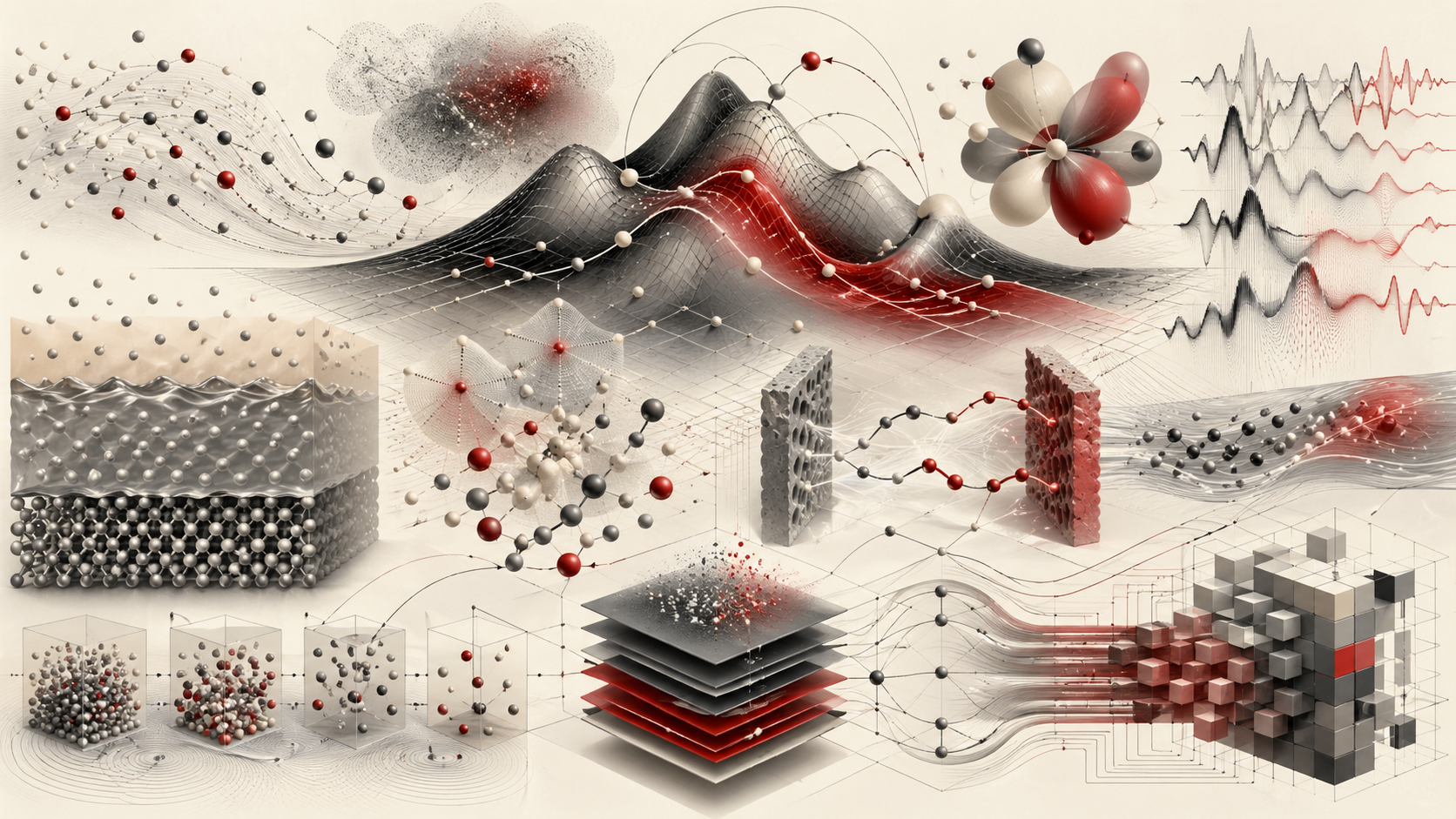
Why Physical Chemistry Matters
Physical chemistry matters because chemistry is not only a catalog of substances. It is a science of matter under physical constraint. Molecules move, rotate, vibrate, collide, absorb light, exchange energy, distribute among states, cross barriers, form phases, respond to fields, transfer electrons, and participate in equilibria. Physical chemistry provides the conceptual and mathematical tools needed to understand those behaviors.
It explains why gases expand, why liquids boil, why salts dissolve, why proteins fold, why catalysts lower barriers, why batteries produce voltage, why spectra identify molecules, why temperature changes equilibrium, why reaction rates depend on concentration, why solutions deviate from ideality, and why molecular interactions scale into macroscopic properties.
Physical chemistry also makes chemistry predictive. A physical chemist does not only ask what happened in an experiment. They ask what the governing variables were: temperature, pressure, composition, energy, entropy, chemical potential, rate constant, activity, partition function, diffusion coefficient, electric potential, quantum state, or molecular interaction.
This makes physical chemistry foundational for materials research, electrochemistry, catalysis, biochemistry, environmental chemistry, atmospheric chemistry, spectroscopy, chemical engineering, pharmaceutical science, computational chemistry, molecular simulation, and chemical systems modeling.
Its importance also lies in intellectual discipline. Physical chemistry forces chemical claims to be expressed in units, variables, assumptions, boundary conditions, equations, and measurable consequences. It helps prevent chemical explanation from becoming metaphor. A reaction is not merely “favored”; it has a free-energy change under specified conditions. A process is not merely “fast”; it has a rate law and mechanism. A molecule does not merely “absorb light”; it undergoes transitions between quantized states.
For researchers and scientists, physical chemistry is the interpretive core of chemical science. It connects chemical observation to the physical laws that make observation meaningful.
Chemical Matter as Physical System
Every chemical system is also a physical system. It has composition, energy, structure, motion, temperature, pressure, volume, phase, and measurable properties. A beaker of solution, a crystal, a gas mixture, an enzyme active site, a battery electrode, a catalyst surface, an aerosol particle, a polymer film, and a membrane are all chemical systems governed by physical relationships.
Physical chemistry often begins by identifying the system and surroundings. The system is the part of the universe being studied. The surroundings are everything else that can exchange energy or matter with it.
A system may be:
- isolated, exchanging neither matter nor energy;
- closed, exchanging energy but not matter;
- open, exchanging both matter and energy.
This distinction matters because thermodynamic laws, mass balance, energy balance, and transport equations depend on how the system is defined. A sealed reaction vessel, a flowing reactor, a living cell, an atmospheric plume, and an electrochemical battery all require different system boundaries.
Chemical systems are rarely simple. They may contain multiple phases, charged species, surfaces, gradients, reactions, fields, and transport processes. A catalyst pellet may involve surface reactions and internal diffusion. A protein solution may involve folding, aggregation, hydration, protonation, and ionic strength. A battery electrolyte may involve redox chemistry, ion transport, electrode interfaces, and phase changes.
Physical chemistry gives these complexities a disciplined language. It asks which variables define the state, which constraints apply, which processes exchange energy or matter, which assumptions are valid, and which measurements can test the model.
For researchers, matter is interpreted not only by formula, but by state, energy, distribution, motion, and constraint.
Thermodynamics and Chemical Possibility
Thermodynamics studies energy, heat, work, entropy, equilibrium, and spontaneity. In chemistry, it helps answer whether a reaction or process is favorable under specified conditions.
The first law of thermodynamics expresses conservation of energy:
\Delta U = q + w
\]
Interpretation: \(\Delta U\) is change in internal energy, \(q\) is heat, and \(w\) is work. Energy is not created or destroyed; it is transferred or transformed.
For many chemical systems at constant pressure, enthalpy is useful:
H = U + pV
\]
Interpretation: Enthalpy \(H\) combines internal energy \(U\) with pressure-volume work. It is especially useful for reactions and phase changes at constant pressure.
A reaction enthalpy can indicate heat absorbed or released, but enthalpy alone does not determine spontaneity. Entropy and temperature matter too. Gibbs free energy combines enthalpy and entropy:
G = H – TS
\]
Interpretation: Gibbs free energy \(G\) combines enthalpy \(H\), temperature \(T\), and entropy \(S\). It is central for predicting thermodynamic favorability at constant temperature and pressure.
At constant temperature and pressure, a process is thermodynamically favorable when:
\Delta G < 0
\]
Interpretation: A negative Gibbs free-energy change indicates thermodynamic favorability under the specified conditions. It does not guarantee rapid reaction.
This distinction is essential. Thermodynamics describes possibility and direction; kinetics describes rate. A reaction may be thermodynamically favorable but kinetically slow, as with diamond converting to graphite under ordinary conditions. A process may be thermodynamically possible but inaccessible without a catalyst, high temperature, light, electrochemical potential, or a pathway with a manageable barrier.
Thermodynamics also governs phase changes, dissolution, binding, folding, adsorption, redox reactions, acid-base equilibria, osmotic pressure, and chemical partitioning. It provides a way to compare processes that look different but share a common free-energy logic.
For researchers, physical chemistry separates “can happen” from “how fast it happens,” and that distinction prevents many errors in chemical interpretation.
Entropy and the Statistical View of Matter
Entropy is one of the most important and misunderstood concepts in physical chemistry. It is not simply disorder. It is related to the number of microscopic arrangements compatible with a macroscopic state.
Boltzmann’s relation connects entropy to microscopic multiplicity:
S = k_B \ln W
\]
Interpretation: \(S\) is entropy, \(k_B\) is Boltzmann’s constant, and \(W\) is the number of accessible microstates. Entropy connects microscopic possibilities to macroscopic thermodynamic behavior.
This matters chemically because molecules have translational, rotational, vibrational, electronic, conformational, and configurational states. Temperature changes the population of these states. Phase changes, mixing, dissolution, folding, adsorption, and reaction all involve changes in accessible states.
Entropy helps explain why gases expand, why mixing often occurs, why phase transitions depend on temperature, why macromolecules explore conformational ensembles, and why binding processes involve tradeoffs between enthalpy and entropy.
In solution chemistry, entropy often appears in subtle ways. When a ligand binds a protein, translational and rotational entropy may be lost, while water molecules released from binding surfaces may gain entropy. When a polymer folds, conformational entropy may decrease, while solvent entropy may increase. When salts dissolve, ion separation and hydration reshape the balance among lattice energy, solvation enthalpy, and entropy.
Entropy also resists oversimplified explanation. More “disorder” is not always a useful description. A crystal, solution, folded protein, or adsorbed layer must be analyzed in terms of accessible states, constraints, and thermodynamic context.
For researchers, entropy gives chemistry a bridge between microscopic possibility and macroscopic behavior. It is one of the reasons physical chemistry is fundamentally statistical, not merely descriptive.
Gibbs Free Energy and Chemical Potential
Gibbs free energy is central to chemical equilibrium and chemical transformation. For a reacting system at constant temperature and pressure, the sign and magnitude of \(\Delta G\) indicate thermodynamic driving force.
Chemical potential is the partial molar Gibbs free energy of a species in a mixture. It measures how the Gibbs energy changes when the amount of that species changes while temperature, pressure, and other composition variables are held constant:
\mu_i = \left(\frac{\partial G}{\partial n_i}\right)_{T,p,n_{j\neq i}}
\]
Interpretation: \(\mu_i\) is the chemical potential of species \(i\). It describes how adding that species changes Gibbs free energy under specified constraints.
Chemical potential is one of the deepest concepts in chemistry because it explains why matter moves, reacts, diffuses, dissolves, evaporates, precipitates, equilibrates, or transfers between phases. Matter tends to move or transform in ways that reduce appropriate free-energy gradients.
For an ideal solution or gas-like form, chemical potential often appears in logarithmic concentration or activity relationships:
\mu_i = \mu_i^\circ + RT \ln a_i
\]
Interpretation: \(\mu_i^\circ\) is standard chemical potential, \(R\) is the gas constant, \(T\) is temperature, and \(a_i\) is activity. Composition enters thermodynamics through activity rather than simple concentration in nonideal systems.
This is why concentration affects equilibrium, voltage, osmotic pressure, phase behavior, and reaction direction. Chemical potential turns composition into thermodynamic force.
In real systems, activity matters. Concentration alone may not describe chemical driving force when solutions are nonideal, ions interact strongly, solvents change activity coefficients, polymers crowd the system, or surfaces influence local composition. Physical chemistry therefore distinguishes ideal models from real systems.
For researchers, chemical potential is the language of transfer and transformation. It explains why species move between phases, why reactions proceed toward equilibrium, why electrochemical cells generate voltage, and why gradients matter.
Equilibrium as Constraint and Balance
Chemical equilibrium occurs when the thermodynamic driving force for net change vanishes. For a reaction:
aA + bB \rightleftharpoons cC + dD
\]
Interpretation: A reversible reaction can proceed in both forward and reverse directions. Equilibrium depends on activities, temperature, pressure, and system constraints.
The reaction quotient is:
Q = \frac{a_C^c a_D^d}{a_A^a a_B^b}
\]
Interpretation: \(Q\) compares product and reactant activities at the current composition. It determines how far the system is from equilibrium.
The Gibbs free energy change under nonstandard conditions is:
\Delta G = \Delta G^\circ + RT\ln Q
\]
Interpretation: \(\Delta G\) depends on standard free energy and current composition. Reaction direction changes as \(Q\) changes.
At equilibrium:
\Delta G = 0
\]
Interpretation: At equilibrium, the net thermodynamic driving force for reaction is zero under the imposed conditions.
This gives:
\Delta G^\circ = -RT\ln K
\]
Interpretation: The standard free-energy change is related to the equilibrium constant \(K\). A larger \(K\) corresponds to more product-favored equilibrium under standard-state assumptions.
Equilibrium is dynamic, not static. Forward and reverse molecular processes continue, but their rates balance. Equilibrium composition depends on temperature, pressure, activities, phase, solvent, ionic strength, and coupled reactions.
Equilibrium also applies beyond simple reactions. Phase equilibrium governs boiling, melting, crystallization, vapor pressure, and solubility. Binding equilibrium governs protein-ligand complexes, receptor occupancy, supramolecular assembly, and adsorption. Acid-base equilibrium governs proton transfer and pH. Redox equilibrium governs electrochemical potentials.
For researchers, physical chemistry interprets equilibrium as constrained free-energy minimization. The system does not simply “stop.” It reaches a condition where net macroscopic change is no longer favored under the imposed constraints.
Kinetics and the Time Structure of Chemical Change
Chemical kinetics studies reaction rates and mechanisms. It answers questions that thermodynamics cannot answer: how fast a reaction occurs, what path it follows, what intermediates appear, and what conditions control the rate.
A simple rate law may be written:
r = k[A]^m[B]^n
\]
Interpretation: \(r\) is reaction rate, \(k\) is the rate constant, and \(m\) and \(n\) are reaction orders determined experimentally or mechanistically.
Temperature dependence is often modeled with the Arrhenius equation:
k = Ae^{-E_a/(RT)}
\]
Interpretation: \(A\) is the pre-exponential factor, \(E_a\) is activation energy, \(R\) is the gas constant, and \(T\) is temperature. Higher temperature generally increases rate constants by increasing the probability of crossing barriers.
Kinetics connects chemistry to time. It explains why reactions speed up at higher temperature, why catalysts work, why concentration matters, why mechanisms can be inferred from rate laws, why intermediates may accumulate, and why competing pathways produce selectivity.
Kinetics also reveals that chemical change is structured. Reactions proceed through elementary steps, transition states, intermediates, diffusion limits, surface events, chain reactions, or catalytic cycles. A measured rate law may hide a multi-step mechanism, and a plausible mechanism must reproduce the observed kinetic behavior.
Catalysis is a kinetic phenomenon. A catalyst lowers the activation barrier or changes the reaction pathway; it does not change the equilibrium constant for the overall reaction. This distinction is central in catalysis, enzyme chemistry, industrial reaction engineering, and environmental chemistry.
For researchers, kinetics turns chemical change into time-dependent molecular evidence. It asks not only what products form, but how, how fast, under what conditions, and through what mechanism.
Quantum Chemistry and Electronic Structure
Quantum chemistry explains the electronic structure of atoms and molecules. Electrons do not behave like tiny classical planets orbiting nuclei. They occupy quantized states described by wavefunctions, density, orbitals, or related quantum descriptions.
The time-independent Schrödinger equation is often written:
\hat{H}\psi = E\psi
\]
Interpretation: \(\hat{H}\) is the Hamiltonian operator, \(\psi\) is the wavefunction, and \(E\) is energy. The equation states that allowed quantum states have defined energies under the Hamiltonian.
For chemistry, quantum mechanics explains atomic orbitals, molecular orbitals, bonding, antibonding, electron density, hybridization, spectroscopy, magnetism, aromaticity, charge transfer, and reaction barriers.
Chemical bonding becomes interpretable through electronic structure. A covalent bond reflects electron sharing and orbital overlap. An ionic interaction reflects electrostatic attraction between charged species. Metallic bonding reflects delocalized electrons. Molecular geometry reflects electronic and nuclear energy minimization.
Quantum chemistry also explains why molecules absorb and emit light at specific energies, why bond lengths and angles have preferred values, why radicals and closed-shell molecules behave differently, why transition metals have complex spin states, and why electron transfer depends on energy alignment and coupling.
Modern physical chemistry often uses quantum chemistry computationally. Density functional theory, wavefunction methods, semiempirical models, and electronic-structure calculations allow researchers to estimate geometry, energy, orbitals, spectra, redox properties, and reaction pathways. But quantum calculations remain model-dependent and require careful method selection.
For researchers, quantum chemistry is not merely abstract physics imported into chemistry. It is the foundation for understanding why molecules have shape, spectra, stability, and reactivity.
Spectroscopy and the Measurement of Molecular States
Spectroscopy studies how matter interacts with electromagnetic radiation. It gives physical chemistry a way to observe molecular energy levels and structural environments.
Different spectroscopies probe different transitions:
- microwave spectroscopy probes rotational transitions;
- infrared spectroscopy probes vibrational transitions;
- UV-visible spectroscopy probes electronic transitions;
- NMR spectroscopy probes nuclear spin environments;
- photoelectron spectroscopy probes electronic binding energies;
- Raman spectroscopy probes molecular vibrations and polarizability changes.
Photon energy is given by:
E = h\nu
\]
Interpretation: \(E\) is photon energy, \(h\) is Planck’s constant, and \(\nu\) is frequency. Spectroscopic transitions correspond to energy differences between molecular states.
Spectroscopy matters because molecules do not reveal themselves directly. They reveal themselves through interactions: absorption, emission, scattering, resonance, splitting, relaxation, and transition probability.
Physical chemistry gives spectroscopy its interpretive framework. A spectrum is not just a pattern of peaks. It is evidence of quantized molecular states, structure, bonding, motion, symmetry, and environment.
Spectroscopy is also one of the most important bridges between theory and experiment. Quantum calculations can predict vibrational frequencies, electronic transitions, rotational constants, NMR chemical shifts, or photoelectron spectra. Experimental spectra can then confirm, challenge, or refine the model.
For researchers, spectral interpretation requires both measurement and theory. Peaks must be assigned, baselines understood, transitions identified, selection rules considered, environments accounted for, and uncertainty acknowledged.
Intermolecular Forces and Phase Behavior
Matter exists as gases, liquids, solids, solutions, colloids, crystals, glasses, gels, membranes, and complex phases because molecules interact. Intermolecular forces include dispersion forces, dipole-dipole interactions, hydrogen bonding, ion-dipole interactions, electrostatic interactions, metal coordination, hydrophobic effects, and packing constraints.
Phase behavior depends on the balance between molecular motion and intermolecular attraction. At high temperature, thermal motion may overcome attractions and favor gas-like behavior. At lower temperature or higher pressure, molecules may condense into liquids or solids.
Phase transitions occur when one phase becomes more stable than another under specified conditions. The Clausius-Clapeyron relationship connects vapor pressure and temperature for phase transitions in a simplified form:
\frac{d\ln P}{dT} = \frac{\Delta H_{\mathrm{vap}}}{RT^2}
\]
Interpretation: Vapor pressure changes with temperature according to the enthalpy of vaporization under simplified assumptions. The relationship links phase equilibrium to thermodynamics.
Physical chemistry interprets phases as collective behavior. A liquid is not merely many molecules close together. It is a dynamic, interacting ensemble. A crystal is not merely a solid object. It is an ordered arrangement shaped by symmetry, bonding, defects, and thermodynamics.
Solutions also require physical-chemical interpretation. Ideal solutions are useful models, but real solutions can show activity effects, ion pairing, solvation structure, phase separation, micelle formation, aggregation, salting-in, salting-out, and nonideal mixing behavior.
Phase behavior is central in materials chemistry, pharmaceuticals, atmospheric aerosols, polymers, batteries, food chemistry, biochemistry, geochemistry, and environmental systems. Solubility, crystallization, glass transition, polymorphism, viscosity, and phase separation can determine whether a material or molecule is useful.
For researchers, phase behavior shows how molecular interactions become macroscopic properties.
Electrochemistry and Charge Transfer
Electrochemistry connects chemical change to electrical work. It studies redox reactions, electrodes, ions, potentials, batteries, fuel cells, corrosion, electrolysis, sensors, and charge-transfer interfaces.
For a cell reaction transferring \(n\) moles of electrons per mole of reaction:
\Delta G = -nFE
\]
Interpretation: \(\Delta G\) is Gibbs free-energy change, \(n\) is moles of electrons transferred, \(F\) is Faraday’s constant, and \(E\) is cell potential. Electrochemical potential converts chemical driving force into electrical work.
The Nernst equation relates cell potential to composition:
E = E^\circ – \frac{RT}{nF}\ln Q
\]
Interpretation: Cell potential depends on standard potential and reaction quotient. Composition, activity, and temperature affect electrochemical driving force.
Electrochemistry is physical chemistry because it links thermodynamics, kinetics, transport, interfacial structure, electron transfer, ion movement, and material surfaces. A battery is not only a redox reaction. It is a coupled system of electrodes, electrolytes, interfaces, diffusion, phase changes, side reactions, and electrical circuits.
Charge transfer reveals matter as both chemical and electrical. Ions move through solution or solids. Electrons move through conductors or redox centers. Potentials measure energy per unit charge.
Electrochemical kinetics can differ from bulk reaction kinetics because reactions occur at interfaces. Electron-transfer rates can depend on overpotential, electrode material, surface structure, double-layer organization, reactant adsorption, ion transport, and solvent reorganization. Electrochemical systems therefore require both thermodynamic and kinetic interpretation.
For researchers, electrochemistry is essential for understanding batteries, corrosion, sensors, electrocatalysis, biological redox systems, environmental remediation, and energy conversion.
Transport, Diffusion, and Nonequilibrium Systems
Many chemical systems are not at equilibrium. Gradients of concentration, temperature, pressure, charge, or chemical potential drive transport.
Diffusion is often described by Fick’s first law:
J = -D\frac{dc}{dx}
\]
Interpretation: \(J\) is flux, \(D\) is diffusion coefficient, and \(dc/dx\) is concentration gradient. The negative sign indicates movement down the concentration gradient.
Fick’s second law describes time-dependent concentration change:
\frac{\partial c}{\partial t} = D\frac{\partial^2 c}{\partial x^2}
\]
Interpretation: Concentration changes over time according to curvature in the concentration profile. This equation models diffusion under simplified assumptions.
Transport matters in catalysis, electrochemistry, membranes, atmospheric chemistry, environmental systems, cells, soils, porous materials, reactors, and biological tissues. A reaction may be fast, but if reactants cannot reach the active site, the observed process may be transport-limited.
Nonequilibrium systems can maintain steady flows, gradients, oscillations, waves, or dissipative structures. Life itself depends on nonequilibrium chemistry: ion gradients, redox chains, metabolic flux, membrane potentials, and energy dissipation.
Transport is also central to technology. Battery performance depends on ion transport. Drug delivery depends on diffusion and partitioning. Catalysts depend on reactant access. Membranes depend on selective transport. Environmental fate depends on diffusion, advection, sorption, and reaction.
For researchers, physical chemistry interprets matter not only at equilibrium, but in motion. Nonequilibrium behavior is often where chemical systems become useful, fragile, or complex.
Statistical Mechanics and Molecular Ensembles
Statistical mechanics connects microscopic molecular states to macroscopic thermodynamic properties. It explains why temperature, pressure, heat capacity, entropy, and equilibrium emerge from many molecular motions and energy levels.
The Boltzmann distribution gives the relative population of states:
p_i = \frac{e^{-E_i/(k_BT)}}{Z}
\]
Interpretation: \(p_i\) is probability of state \(i\), \(E_i\) is state energy, \(k_B\) is Boltzmann’s constant, \(T\) is temperature, and \(Z\) is the partition function.
The partition function is:
Z = \sum_i e^{-E_i/(k_BT)}
\]
Interpretation: The partition function summarizes accessible states and their statistical weights. Thermodynamic quantities can be derived from it.
The partition function is powerful because it encodes the accessible states of a system. From it, thermodynamic quantities can be derived.
Statistical mechanics makes chemistry molecular. It shows how heat capacity comes from energy storage modes, how equilibrium constants relate to molecular energies, how conformational populations depend on energy, and how macroscopic laws emerge from microscopic probabilities.
Ensembles are central to this interpretation. A canonical ensemble represents systems at fixed particle number, volume, and temperature. A microcanonical ensemble represents fixed particle number, volume, and energy. A grand canonical ensemble allows particle number to fluctuate. These ensembles are idealized tools, but they clarify what constraints are being modeled.
For researchers, statistical mechanics bridges two scales: individual molecular states and bulk chemical behavior. It is the conceptual foundation for molecular simulation, thermodynamic modeling, and many interpretations of entropy and equilibrium.
Surfaces, Colloids, and Interfaces
Many chemical processes occur at interfaces. A surface is not merely the edge of a material. It is a region with distinct structure, energy, composition, and reactivity. Catalysis, corrosion, adsorption, wetting, crystal growth, battery degradation, sensor response, membrane transport, aerosol chemistry, and biological recognition often depend on surfaces and interfaces.
Surface free energy helps explain why droplets form, why solids wet or repel liquids, why particles aggregate, why emulsions require stabilizers, and why nanoscale materials can behave differently from bulk materials. At small size, surface area becomes large relative to volume, making surface chemistry dominant.
Colloids are dispersed systems containing particles, droplets, bubbles, or macromolecular assemblies with dimensions large compared with molecules but small enough to remain suspended or structured by interfacial forces. Colloids include emulsions, aerosols, foams, sols, gels, micelles, nanoparticles, and many biological assemblies.
Interfacial physical chemistry depends on adsorption, surface charge, double layers, van der Waals forces, electrostatic repulsion, steric stabilization, capillarity, wetting, and Brownian motion. Small changes in pH, salt concentration, surfactant concentration, or surface chemistry can dramatically alter colloidal stability.
Interfaces are also where measurement can become difficult. A bulk concentration may not represent surface composition. A surface-sensitive method may not represent the interior. Adsorbed species may reorganize over time. Nanoparticles may aggregate during sampling or measurement.
For researchers, surfaces and colloids show that chemical matter cannot always be interpreted as uniform bulk material. Interfaces often control function, failure, reactivity, and measurement.
Physical Chemistry in Biological and Environmental Systems
Physical chemistry is essential for interpreting biological and environmental systems because both are governed by energy, gradients, transport, reaction networks, phase behavior, and molecular interactions.
In biological systems, physical chemistry helps explain protein folding, ligand binding, enzyme kinetics, membrane potentials, ion gradients, molecular diffusion, allostery, molecular recognition, photosynthesis, respiration, redox chemistry, osmotic pressure, and metabolic flux.
Biomolecular binding is not only a structural event. It is a thermodynamic and kinetic process involving enthalpy, entropy, solvent, conformational change, diffusion, association rate, dissociation rate, and concentration. Protein folding is not merely a sequence finding a shape; it is an ensemble process shaped by free-energy landscapes, solvent, entropy, hydrogen bonding, hydrophobic effects, and kinetic traps.
In environmental systems, physical chemistry helps explain atmospheric reactions, aerosol formation, gas-liquid partitioning, pollutant sorption, contaminant transport, mineral dissolution, ocean carbonate chemistry, photochemistry, climate-relevant spectroscopy, and chemical fate.
Environmental chemistry often depends on nonideal mixtures, heterogeneous surfaces, variable temperature, changing pH, sunlight, biological activity, and transport across air, water, soil, sediment, and organisms. A pollutant’s risk may depend not only on total amount, but on speciation, partitioning, volatility, reactivity, degradation rate, and mobility.
For researchers, physical chemistry provides a unifying language across laboratory chemistry, living systems, and environmental processes. It explains how local molecular interactions scale into system behavior.
Computational Physical Chemistry
Computational physical chemistry uses models, numerical methods, and simulations to interpret chemical systems. It includes thermodynamic calculations, kinetic simulations, quantum chemistry, molecular dynamics, Monte Carlo methods, spectral modeling, diffusion simulations, electrochemical modeling, and statistical analysis.
A reproducible computational physical chemistry workflow should document:
- system definition;
- state variables;
- units;
- constants;
- equations used;
- parameter values and sources;
- initial conditions;
- boundary conditions;
- solver choice;
- numerical tolerances;
- validation data;
- uncertainty and limitations.
Physical chemistry is especially suited to computational workflows because it already treats chemistry as a set of relationships among variables. Equilibrium constants can be computed from free energies. Rate constants can be modeled as functions of temperature. Populations can be estimated from Boltzmann weights. Diffusion profiles can be simulated. Electrochemical potentials can be calculated from composition. Spectral transitions can be linked to energy gaps.
But computation is not a substitute for judgment. A model can be precise and wrong if its assumptions are inappropriate. A differential equation may represent a simplified geometry. A quantum calculation may use an unsuitable functional. A kinetic model may omit a key intermediate. A diffusion simulation may ignore convection or boundary reactions. A thermodynamic model may treat a nonideal solution as ideal.
Good computational physical chemistry connects mathematical form, chemical meaning, numerical stability, experimental evidence, and transparent reproducibility.
For researchers, computation should make the physical assumptions clearer, not hide them behind code or software output.
Mathematical Lens: Physical Chemistry
Physical chemistry is built from equations that connect energy, matter, probability, time, and measurement. The first law of thermodynamics is:
\Delta U = q + w
\]
Interpretation: Internal energy changes through heat and work. This is the conservation-of-energy foundation for chemical thermodynamics.
Enthalpy is:
H = U + pV
\]
Interpretation: Enthalpy is useful for constant-pressure processes, including many chemical reactions and phase changes.
Gibbs free energy is:
G = H – TS
\]
Interpretation: Gibbs free energy combines enthalpy and entropy to evaluate thermodynamic favorability at constant temperature and pressure.
Chemical potential is:
\mu_i = \left(\frac{\partial G}{\partial n_i}\right)_{T,p,n_{j\neq i}}
\]
Interpretation: Chemical potential describes how Gibbs free energy changes when species \(i\) is added to the system.
The free-energy relationship for nonstandard conditions is:
\Delta G = \Delta G^\circ + RT\ln Q
\]
Interpretation: Reaction favorability depends on standard free energy and current composition through the reaction quotient.
Standard free energy and equilibrium constant are related by:
\Delta G^\circ = -RT\ln K
\]
Interpretation: Equilibrium constants encode standard thermodynamic driving force.
The Arrhenius equation is:
k = Ae^{-E_a/(RT)}
\]
Interpretation: The rate constant depends on temperature, activation energy, and the pre-exponential factor.
The Schrödinger equation is:
\hat{H}\psi = E\psi
\]
Interpretation: Quantum states and energies arise from the Hamiltonian operator acting on the wavefunction.
Photon energy is:
E = h\nu
\]
Interpretation: Light interacts with matter through quantized energy exchange.
Boltzmann entropy is:
S = k_B \ln W
\]
Interpretation: Entropy connects macroscopic thermodynamics to the number of accessible microstates.
The Boltzmann distribution is:
p_i = \frac{e^{-E_i/(k_BT)}}{Z}
\]
Interpretation: State populations depend on energy and temperature through statistical weighting.
Diffusive flux is:
J = -D\frac{dc}{dx}
\]
Interpretation: Flux follows concentration gradients under Fickian diffusion assumptions.
Electrochemical free energy is:
\Delta G = -nFE
\]
Interpretation: Chemical free energy and electrical potential are linked through electron transfer.
The Nernst equation is:
E = E^\circ – \frac{RT}{nF}\ln Q
\]
Interpretation: Electrochemical potential depends on standard potential, temperature, electron number, and composition.
These equations show why physical chemistry is the interpretive core of chemical science. It connects measurable matter to energy, probability, structure, motion, and change.
Computational Workflows for Physical Chemistry
Computational workflows can make physical chemistry more transparent. A workflow can track constants, units, equations, thermodynamic parameters, kinetic parameters, state variables, initial conditions, boundary conditions, solver choices, model assumptions, validation data, and output artifacts.
Useful workflows include equilibrium constants from standard free energy, Arrhenius temperature dependence, Boltzmann populations, diffusion profiles, electrochemical free-energy relationships, Nernst potentials, phase-transition tables, uncertainty scaffolds, and SQL evidence registers for model provenance.
For researchers, physical chemistry workflows should preserve four distinctions:
- Thermodynamics versus kinetics: favorability is not the same as rate.
- Ideal model versus real system: ideal gases, ideal solutions, and simplified diffusion are approximations.
- Equation versus interpretation: a correct equation can still be applied to the wrong system.
- Computation versus evidence: a model output becomes scientific evidence only when assumptions, units, validation, and uncertainty are visible.
The examples below use synthetic educational data. They do not validate real thermodynamic constants, predict real reaction rates, certify electrochemical performance, or replace professional physical-chemical review. They demonstrate how physical chemistry reasoning can be structured, audited, and communicated responsibly.
Python Example: Equilibrium, Arrhenius Kinetics, Boltzmann Populations, and Provenance
The following Python example uses synthetic educational data. It calculates equilibrium constants from standard Gibbs free energies, Arrhenius rate constants across temperature, Boltzmann populations from relative energy states, and writes provenance outputs. In real physical chemistry, such workflows should preserve units, parameter sources, experimental validation, uncertainty estimates, and model assumptions.
from pathlib import Path
from typing import Dict, List
import json
import math
import platform
import sys

import numpy as np
import pandas as pd


# Synthetic physical chemistry workflow.
# Educational example only; not for engineering design,
# safety-critical use, validated thermodynamic modeling,
# or regulatory decisions.


def require_columns(data: pd.DataFrame, required: List[str], table_name: str) -> None:
    """Raise an error if required columns are missing."""
    missing = [column for column in required if column not in data.columns]
    if missing:
        raise ValueError(f"{table_name} is missing required columns: {missing}")


R_J_mol_K = 8.314462618
kB_J_K = 1.380649e-23
T_K = 298.15

systems = pd.DataFrame({
    "system": ["favorable_demo", "near_neutral_demo", "unfavorable_demo"],
    "delta_g_standard_kj_mol": [-20.0, 0.0, 20.0],
})

require_columns(
    systems,
    ["system", "delta_g_standard_kj_mol"],
    "systems",
)

systems["equilibrium_constant_K"] = systems["delta_g_standard_kj_mol"].apply(
    lambda dg: math.exp(-(dg * 1000.0) / (R_J_mol_K * T_K))
)

systems["log10_K"] = systems["equilibrium_constant_K"].apply(math.log10)

systems["thermodynamic_review"] = np.select(
    [
        systems["delta_g_standard_kj_mol"] < -5,
        systems["delta_g_standard_kj_mol"] > 5,
    ],
    [
        "product-favored under standard-state assumptions",
        "reactant-favored under standard-state assumptions",
    ],
    default="near-neutral under standard-state assumptions",
)

temperatures = pd.DataFrame({
    "temperature_K": [280.0, 298.15, 320.0, 350.0, 400.0],
})

A_s_inv = 1.0e12
Ea_kj_mol = 75.0

temperatures["rate_constant_s_inv"] = temperatures["temperature_K"].apply(
    lambda temp: A_s_inv * math.exp(
        -(Ea_kj_mol * 1000.0) / (R_J_mol_K * temp)
    )
)

temperatures["log10_rate_constant"] = temperatures["rate_constant_s_inv"].apply(
    math.log10
)

states = pd.DataFrame({
    "state": ["state_1", "state_2", "state_3", "state_4"],
    "relative_energy_kj_mol": [0.0, 2.5, 6.0, 12.0],
})

states["boltzmann_weight"] = states["relative_energy_kj_mol"].apply(
    lambda energy: math.exp(
        -(energy * 1000.0) / (R_J_mol_K * T_K)
    )
)

states["population"] = states["boltzmann_weight"] / states["boltzmann_weight"].sum()

output_dir = Path("outputs")
output_dir.mkdir(exist_ok=True)

systems.to_csv(output_dir / "synthetic_equilibrium_constants.csv", index=False)
temperatures.to_csv(output_dir / "synthetic_arrhenius_rates.csv", index=False)
states.to_csv(output_dir / "synthetic_boltzmann_populations.csv", index=False)

manifest: Dict[str, object] = {
    "workflow": "synthetic_physical_chemistry_workflow",
    "data_type": "synthetic educational physical chemistry records",
    "temperature_K": T_K,
    "gas_constant_J_mol_K": R_J_mol_K,
    "boltzmann_constant_J_K": kB_J_K,
    "arrhenius_A_s_inv": A_s_inv,
    "arrhenius_Ea_kj_mol": Ea_kj_mol,
    "equations": [
        "K = exp(-delta_G_standard / (R*T))",
        "k = A * exp(-Ea / (R*T))",
        "p_i = exp(-E_i / (R*T)) / sum_j exp(-E_j / (R*T))",
    ],
    "python_version": sys.version,
    "platform": platform.platform(),
    "numpy_version": np.__version__,
    "pandas_version": pd.__version__,
    "output_files": [
        "outputs/synthetic_equilibrium_constants.csv",
        "outputs/synthetic_arrhenius_rates.csv",
        "outputs/synthetic_boltzmann_populations.csv",
        "outputs/physical_chemistry_manifest.json",
    ],
    "responsible_use": [
        "Synthetic educational data only.",
        "Real physical chemistry workflows require validated constants, parameter provenance, unit checks, uncertainty estimates, experimental comparison, and expert review.",
    ],
}

with (output_dir / "physical_chemistry_manifest.json").open(
    "w",
    encoding="utf-8"
) as file:
    json.dump(manifest, file, indent=2)

print("Equilibrium constants from standard free energy")
print("-----------------------------------------------")
print(systems.round(6).to_string(index=False))

print("\nArrhenius temperature dependence")
print("--------------------------------")
print(temperatures.round(6).to_string(index=False))

print("\nBoltzmann populations")
print("---------------------")
print(states.round(8).to_string(index=False))
This workflow demonstrates physical-chemistry evidence discipline rather than real modeling validation. It separates thermodynamic equilibrium, kinetic temperature dependence, and statistical populations, while preserving constants, units, equations, outputs, and responsible-use notes. A real workflow would add uncertainty propagation, parameter sources, sensitivity analysis, experimental comparison, and model-domain review.
R Example: Diffusion, Electrochemical Free Energy, and Thermodynamic Tables
The following R example uses synthetic educational data to calculate a one-dimensional diffusion profile, electrochemical free energy from cell potential, and a small thermodynamic state table. In real physical chemistry, these calculations should be tied to validated parameters, boundary conditions, units, numerical stability checks, and experimental context.
# Synthetic physical chemistry scaffold.
# Educational example only; not for engineering design,
# validated electrochemical modeling, or safety-critical use.

R <- 8.314462618
F <- 96485.33212
T <- 298.15

n_grid <- 21
dx <- 1.0
dt <- 0.05
D <- 0.5

c <- rep(0, n_grid)
c[ceiling(n_grid / 2)] <- 1.0

stability_ratio <- D * dt / dx^2

if (stability_ratio > 0.5) {
  warning("Finite-difference diffusion step may be unstable.")
}

for (step in 1:20) {
  c_new <- c

  for (i in 2:(n_grid - 1)) {
    c_new[i] <- c[i] + stability_ratio * (
      c[i + 1] - 2 * c[i] + c[i - 1]
    )
  }

  c <- c_new
}

diffusion_profile <- data.frame(
  position = 1:n_grid,
  concentration = c
)

electrochemical_cases <- data.frame(
  case = c("cell_A", "cell_B", "cell_C"),
  electron_number = c(1, 2, 2),
  cell_potential_V = c(0.35, 1.10, -0.25)
)

electrochemical_cases$delta_g_kj_mol <-
  -electrochemical_cases$electron_number *
  F *
  electrochemical_cases$cell_potential_V / 1000

thermodynamic_cases <- data.frame(
  process = c("process_A", "process_B", "process_C"),
  delta_h_kj_mol = c(-40, 15, 25),
  delta_s_j_mol_K = c(-80, 45, -20)
)

thermodynamic_cases$delta_g_kj_mol <-
  thermodynamic_cases$delta_h_kj_mol -
  T * thermodynamic_cases$delta_s_j_mol_K / 1000

thermodynamic_cases$spontaneous_at_298K <-
  thermodynamic_cases$delta_g_kj_mol < 0

dir.create("outputs", showWarnings = FALSE)

write.csv(
  diffusion_profile,
  file = "outputs/r_diffusion_profile.csv",
  row.names = FALSE
)

write.csv(
  electrochemical_cases,
  file = "outputs/r_electrochemical_free_energy.csv",
  row.names = FALSE
)

write.csv(
  thermodynamic_cases,
  file = "outputs/r_thermodynamic_state_table.csv",
  row.names = FALSE
)

sink("outputs/r_physical_chemistry_report.txt")
cat("Synthetic Physical Chemistry Scaffold Report\n")
cat("============================================\n\n")
cat("Diffusion stability ratio:\n")
print(stability_ratio)
cat("\nDiffusion profile:\n")
print(diffusion_profile)
cat("\nElectrochemical free energy cases:\n")
print(electrochemical_cases)
cat("\nThermodynamic state table:\n")
print(thermodynamic_cases)
cat("\nResponsible-use note:\n")
cat("Synthetic educational data only. Real physical chemistry requires validated parameters, boundary conditions, uncertainty estimates, unit review, numerical stability checks, and experimental comparison.\n")
sink()

print(diffusion_profile)
print(electrochemical_cases)
print(thermodynamic_cases)
This scaffold shows how R can support physical chemistry summaries, finite-difference diffusion, electrochemical free energy, and thermodynamic state review. The central issue is not the language but the evidence chain. A calculation should remain connected to units, assumptions, constants, boundary conditions, and validation evidence.
SQL Example: Physical Chemistry Evidence Register
Physical chemistry becomes more reliable when systems, parameters, equations, constants, experimental measurements, computational models, uncertainty estimates, and interpretation claims are traceable. A simple evidence register can preserve the context needed to audit physical-chemical results.
CREATE TABLE physical_chemical_system (
    system_id TEXT PRIMARY KEY,
    system_name TEXT NOT NULL,
    system_type TEXT,
    phase_description TEXT,
    composition_description TEXT,
    temperature_K REAL,
    pressure_bar REAL,
    boundary_condition_description TEXT,
    system_notes TEXT
);

CREATE TABLE physical_constant_record (
    constant_id TEXT PRIMARY KEY,
    constant_name TEXT NOT NULL,
    symbol TEXT,
    value REAL,
    unit TEXT,
    source_uri TEXT,
    constant_review_status TEXT
);

CREATE TABLE model_equation_record (
    equation_id TEXT PRIMARY KEY,
    equation_name TEXT NOT NULL,
    equation_family TEXT,
    equation_expression TEXT,
    assumption_notes TEXT,
    validity_domain TEXT,
    equation_source_uri TEXT,
    equation_review_status TEXT
);

CREATE TABLE physical_parameter_record (
    parameter_id TEXT PRIMARY KEY,
    system_id TEXT NOT NULL,
    parameter_name TEXT,
    parameter_symbol TEXT,
    parameter_value REAL,
    parameter_unit TEXT,
    parameter_source TEXT,
    uncertainty_value REAL,
    uncertainty_unit TEXT,
    parameter_review_status TEXT,
    FOREIGN KEY (system_id) REFERENCES physical_chemical_system(system_id)
);

CREATE TABLE experimental_measurement_record (
    measurement_id TEXT PRIMARY KEY,
    system_id TEXT NOT NULL,
    measurement_type TEXT,
    measured_quantity TEXT,
    measured_value REAL,
    measured_unit TEXT,
    measurement_method TEXT,
    instrument_or_source TEXT,
    measurement_temperature_K REAL,
    measurement_pressure_bar REAL,
    measurement_uncertainty REAL,
    uncertainty_unit TEXT,
    measurement_review_status TEXT,
    FOREIGN KEY (system_id) REFERENCES physical_chemical_system(system_id)
);

CREATE TABLE computational_model_run (
    model_run_id TEXT PRIMARY KEY,
    system_id TEXT NOT NULL,
    equation_id TEXT NOT NULL,
    run_type TEXT,
    input_file_uri TEXT,
    output_file_uri TEXT,
    software_name TEXT,
    software_version TEXT,
    solver_name TEXT,
    tolerance_description TEXT,
    validation_status TEXT,
    model_notes TEXT,
    FOREIGN KEY (system_id) REFERENCES physical_chemical_system(system_id),
    FOREIGN KEY (equation_id) REFERENCES model_equation_record(equation_id)
);

CREATE TABLE physical_chemistry_result (
    result_id TEXT PRIMARY KEY,
    system_id TEXT NOT NULL,
    model_run_id TEXT,
    measurement_id TEXT,
    result_quantity TEXT,
    result_value REAL,
    result_unit TEXT,
    expanded_uncertainty REAL,
    coverage_factor REAL,
    comparison_to_reference TEXT,
    result_review_status TEXT,
    FOREIGN KEY (system_id) REFERENCES physical_chemical_system(system_id),
    FOREIGN KEY (model_run_id) REFERENCES computational_model_run(model_run_id),
    FOREIGN KEY (measurement_id) REFERENCES experimental_measurement_record(measurement_id)
);

CREATE TABLE physical_chemistry_claim (
    claim_id TEXT PRIMARY KEY,
    system_id TEXT NOT NULL,
    result_id TEXT,
    claim_text TEXT,
    claim_type TEXT,
    confidence_level TEXT,
    limitation_notes TEXT,
    review_status TEXT,
    FOREIGN KEY (system_id) REFERENCES physical_chemical_system(system_id),
    FOREIGN KEY (result_id) REFERENCES physical_chemistry_result(result_id)
);

SELECT
    s.system_id,
    s.system_name,
    s.system_type,
    s.temperature_K,
    s.pressure_bar,
    e.equation_name,
    e.equation_family,
    p.parameter_name,
    p.parameter_value,
    p.parameter_unit,
    m.measurement_type,
    m.measured_quantity,
    m.measured_value,
    m.measured_unit,
    r.result_quantity,
    r.result_value,
    r.result_unit,
    r.expanded_uncertainty,
    c.claim_type,
    c.confidence_level,
    CASE
        WHEN s.temperature_K IS NULL
            THEN 'temperature review required'
        WHEN e.equation_review_status IS NOT NULL
             AND e.equation_review_status != 'pass'
            THEN 'equation review required'
        WHEN p.parameter_review_status IS NOT NULL
             AND p.parameter_review_status != 'pass'
            THEN 'parameter review required'
        WHEN m.measurement_review_status IS NOT NULL
             AND m.measurement_review_status != 'pass'
            THEN 'measurement review required'
        WHEN r.expanded_uncertainty IS NULL
            THEN 'uncertainty review required'
        WHEN r.result_review_status IS NOT NULL
             AND r.result_review_status != 'pass'
            THEN 'result review required'
        WHEN c.review_status IS NOT NULL
             AND c.review_status != 'reviewed'
            THEN 'interpretation review required'
        ELSE 'standard review'
    END AS physical_chemistry_review_status
FROM physical_chemical_system s
LEFT JOIN physical_parameter_record p
    ON s.system_id = p.system_id
LEFT JOIN experimental_measurement_record m
    ON s.system_id = m.system_id
LEFT JOIN physical_chemistry_result r
    ON s.system_id = r.system_id
LEFT JOIN computational_model_run run
    ON r.model_run_id = run.model_run_id
LEFT JOIN model_equation_record e
    ON run.equation_id = e.equation_id
LEFT JOIN physical_chemistry_claim c
    ON s.system_id = c.system_id
ORDER BY physical_chemistry_review_status, s.system_id;
The purpose of this register is to keep physical-chemical interpretation attached to evidence. A physical chemistry result should preserve system definition, state variables, constants, equations, assumptions, parameters, measurements, computational model runs, uncertainty estimates, validation status, and interpretation review. Physical chemistry becomes stronger when its evidence trail is structured.
GitHub Repository
The companion repository for this article can support reproducible workflows for thermodynamic state functions, equilibrium calculations, Arrhenius kinetics, Boltzmann populations, diffusion scaffolds, electrochemical free-energy relationships, phase-behavior tables, uncertainty records, SQL evidence registers, and responsible physical-chemical interpretation.
Complete Code Repository
The full code distribution for this article, including selected physical chemistry examples, expanded computational workflows, reproducible data structures, provenance documentation, thermodynamic calculations, kinetic simulations, statistical-mechanics scaffolds, diffusion profiles, electrochemical summaries, SQL evidence registers, and scientific-computing infrastructure, is available on GitHub.
Limits, Uncertainty, and Responsible Interpretation
Physical chemistry is powerful, but it is not self-interpreting. A correct equation can be misapplied. A thermodynamic model can ignore nonideality. A kinetic fit can hide multiple mechanisms. A quantum calculation can use an unsuitable approximation. A diffusion model can omit convection, reaction, or geometry. An electrochemical potential can be interpreted incorrectly if activities, interfaces, or overpotentials are ignored.
Uncertainty enters physical chemistry at many levels: experimental measurement, parameter estimation, temperature control, pressure control, concentration preparation, activity coefficients, rate-law assumptions, instrument calibration, numerical solver tolerances, boundary conditions, and model form.
Physical chemistry also depends on scale. Molecular models may not capture macroscopic heterogeneity. Bulk thermodynamics may not capture interfacial structure. Ideal-gas equations may fail at high pressure. Ideal-solution equations may fail in concentrated electrolytes. A rate law measured under one condition may not apply under another. A diffusion coefficient measured in dilute solution may not apply in crowded media.
Responsible interpretation requires matching model to purpose. A teaching model can simplify. A research model should state assumptions. A design model should be validated. A safety-critical model should quantify uncertainty and failure modes. A computational prediction should be compared with experiment or trusted reference data when possible.
The computational examples associated with this article are synthetic and educational. They do not validate real thermodynamic constants, predict real reaction rates, certify battery performance, establish environmental fate, or replace professional physical-chemical review. They are designed to show how physical chemistry reasoning can be structured and audited.
Responsible physical chemistry should avoid both equation worship and equation avoidance. Equations are powerful because they clarify relationships among variables, but their meaning depends on assumptions, domains, units, and evidence.
Conclusion
Physical chemistry and the chemical interpretation of matter give chemistry its quantitative foundation. Thermodynamics explains possibility and equilibrium. Kinetics explains time and pathway. Quantum chemistry explains electronic structure. Spectroscopy connects energy levels to measurement. Statistical mechanics connects microstates to macroscopic properties. Electrochemistry links chemical change to electrical work. Transport theory explains gradients, fluxes, and nonequilibrium behavior.
Physical chemistry does not replace descriptive chemistry, organic chemistry, inorganic chemistry, analytical chemistry, or biochemistry. It deepens them. It explains why chemical systems behave as they do and gives chemists the tools to predict, measure, model, and interpret matter across scales.
Modern chemical problems increasingly require physical-chemical reasoning. Battery performance depends on thermodynamics, transport, interfacial kinetics, phase behavior, and electrochemistry. Climate chemistry depends on spectroscopy, kinetics, atmospheric reactions, aerosols, thermodynamics, and transport. Drug development depends on binding free energy, solubility, conformational populations, kinetics, and molecular interactions. Materials discovery depends on quantum structure, defects, phase stability, transport, and simulation.
To understand physical chemistry is to see chemistry not as disconnected facts, but as an integrated interpretation of matter through energy, structure, motion, probability, and change.
Related articles
- What Is Chemistry?
- Mathematics for Chemistry and Molecular Systems
- Chemical Thermodynamics and Energetics
- Chemical Kinetics and Reaction Mechanisms
- Equilibrium and the Dynamics of Reversible Systems
- Quantum Chemistry and Electronic Structure
- Spectroscopy and the Measurement of Molecular Structure
- Intermolecular Forces and the Chemistry of Condensed Matter
- Oxidation, Reduction, and Electron Transfer
- Reaction Networks and Chemical Systems Modeling
- Computational Chemistry and Molecular Modeling
- Molecular Dynamics and Chemical Simulation
Further reading
- Atkins, P., de Paula, J. and Keeler, J. (2018) Atkins’ Physical Chemistry. 11th edn. Oxford: Oxford University Press. Available at: https://global.oup.com/academic/product/atkins-physical-chemistry-9780198769866
- Engel, T. and Reid, P. (2012) Physical Chemistry. 3rd edn. Boston: Pearson. Available at: https://www.pearson.com/en-us/subject-catalog/p/physical-chemistry/P200000006893
- McQuarrie, D.A. and Simon, J.D. (1997) Physical Chemistry: A Molecular Approach. Sausalito: University Science Books. Available at: https://uscibooks.aip.org/books/physical-chemistry-a-molecular-approach/
- McQuarrie, D.A. (2000) Statistical Mechanics. Sausalito: University Science Books. Available at: https://uscibooks.aip.org/books/statistical-mechanics/
- Laidler, K.J. (1987) Chemical Kinetics. 3rd edn. New York: Harper & Row. Available at: https://archive.org/details/chemicalkinetics0000laid
- Bard, A.J. and Faulkner, L.R. (2001) Electrochemical Methods: Fundamentals and Applications. 2nd edn. New York: Wiley. Available at: https://www.wiley.com/en-us/Electrochemical+Methods%3A+Fundamentals+and+Applications%2C+2nd+Edition-p-9780471043720
- MIT OpenCourseWare (2008) Thermodynamics & Kinetics. Available at: https://ocw.mit.edu/courses/5-60-thermodynamics-kinetics-spring-2008/
- MIT OpenCourseWare (2014) Principles of Chemical Science. Available at: https://ocw.mit.edu/courses/5-111sc-principles-of-chemical-science-fall-2014/
- National Institute of Standards and Technology (n.d.) NIST Chemistry WebBook. Available at: https://webbook.nist.gov/chemistry/
- National Institute of Standards and Technology (n.d.) Fundamental Physical Constants from NIST. Available at: https://physics.nist.gov/cuu/Constants/
References
- Atkins, P., de Paula, J. and Keeler, J. (2018) Atkins’ Physical Chemistry. 11th edn. Oxford: Oxford University Press. Available at: https://global.oup.com/academic/product/atkins-physical-chemistry-9780198769866
- Bard, A.J. and Faulkner, L.R. (2001) Electrochemical Methods: Fundamentals and Applications. 2nd edn. New York: Wiley. Available at: https://www.wiley.com/en-us/Electrochemical+Methods%3A+Fundamentals+and+Applications%2C+2nd+Edition-p-9780471043720
- Engel, T. and Reid, P. (2012) Physical Chemistry. 3rd edn. Boston: Pearson. Available at: https://www.pearson.com/en-us/subject-catalog/p/physical-chemistry/P200000006893
- International Union of Pure and Applied Chemistry (n.d.) Compendium of Chemical Terminology. Available at: https://goldbook.iupac.org/
- International Union of Pure and Applied Chemistry (n.d.) Compendium of Chemical Terminology: Chemical Potential. Available at: https://goldbook.iupac.org/terms/view/C01032
- International Union of Pure and Applied Chemistry (n.d.) Compendium of Chemical Terminology: Standard Chemical Potential. Available at: https://goldbook.iupac.org/terms/view/S05908
- Laidler, K.J. (1987) Chemical Kinetics. 3rd edn. New York: Harper & Row. Available at: https://archive.org/details/chemicalkinetics0000laid
- McQuarrie, D.A. and Simon, J.D. (1997) Physical Chemistry: A Molecular Approach. Sausalito: University Science Books. Available at: https://uscibooks.aip.org/books/physical-chemistry-a-molecular-approach/
- MIT OpenCourseWare (2008) Thermodynamics & Kinetics. Available at: https://ocw.mit.edu/courses/5-60-thermodynamics-kinetics-spring-2008/
- MIT OpenCourseWare (2014) Unit V: Chemical Kinetics. Available at: https://ocw.mit.edu/courses/5-111sc-principles-of-chemical-science-fall-2014/pages/unit-v-chemical-kinetics/
- National Institute of Standards and Technology (n.d.) Fundamental Physical Constants from NIST. Available at: https://physics.nist.gov/cuu/Constants/
- National Institute of Standards and Technology (2025) CODATA Recommended Values of the Fundamental Physical Constants: 2022. Available at: https://www.nist.gov/publications/codata-recommended-values-fundamental-physical-constants-2022
- National Institute of Standards and Technology (n.d.) NIST Chemistry WebBook. Available at: https://webbook.nist.gov/chemistry/