
Last Updated May 28, 2026
Evolutionary medicine explains disease by asking not only how biological mechanisms fail, but why bodies, pathogens, cells, immune systems, reproductive strategies, aging processes, and ecological relationships evolved in ways that create vulnerability to illness. Conventional biomedical explanation often focuses on proximate mechanisms: mutations, inflammation, infection, metabolic dysfunction, immune activation, tissue injury, hormonal imbalance, or cellular dysregulation. Evolutionary medicine adds a second layer of explanation: natural selection, trade-offs, mismatch, coevolution, life-history allocation, genetic conflict, pathogen adaptation, somatic evolution, and inherited constraints.
This article introduces evolutionary medicine as a framework for understanding disease biologically. It does not replace molecular biology, physiology, pathology, epidemiology, or clinical medicine. Instead, it helps explain why disease vulnerabilities exist in the first place: why bodies are susceptible to cancer, why pathogens evolve resistance, why fever exists, why immune systems are both protective and damaging, why reproductive strategies shape health risks, why aging occurs, and why modern environments can produce disease from traits that were once adaptive.
Main Library
Publications
Article Map
Biology
Related Topic
Environmental Science
Related Topic
Earth Science
Related Topic
Chemistry
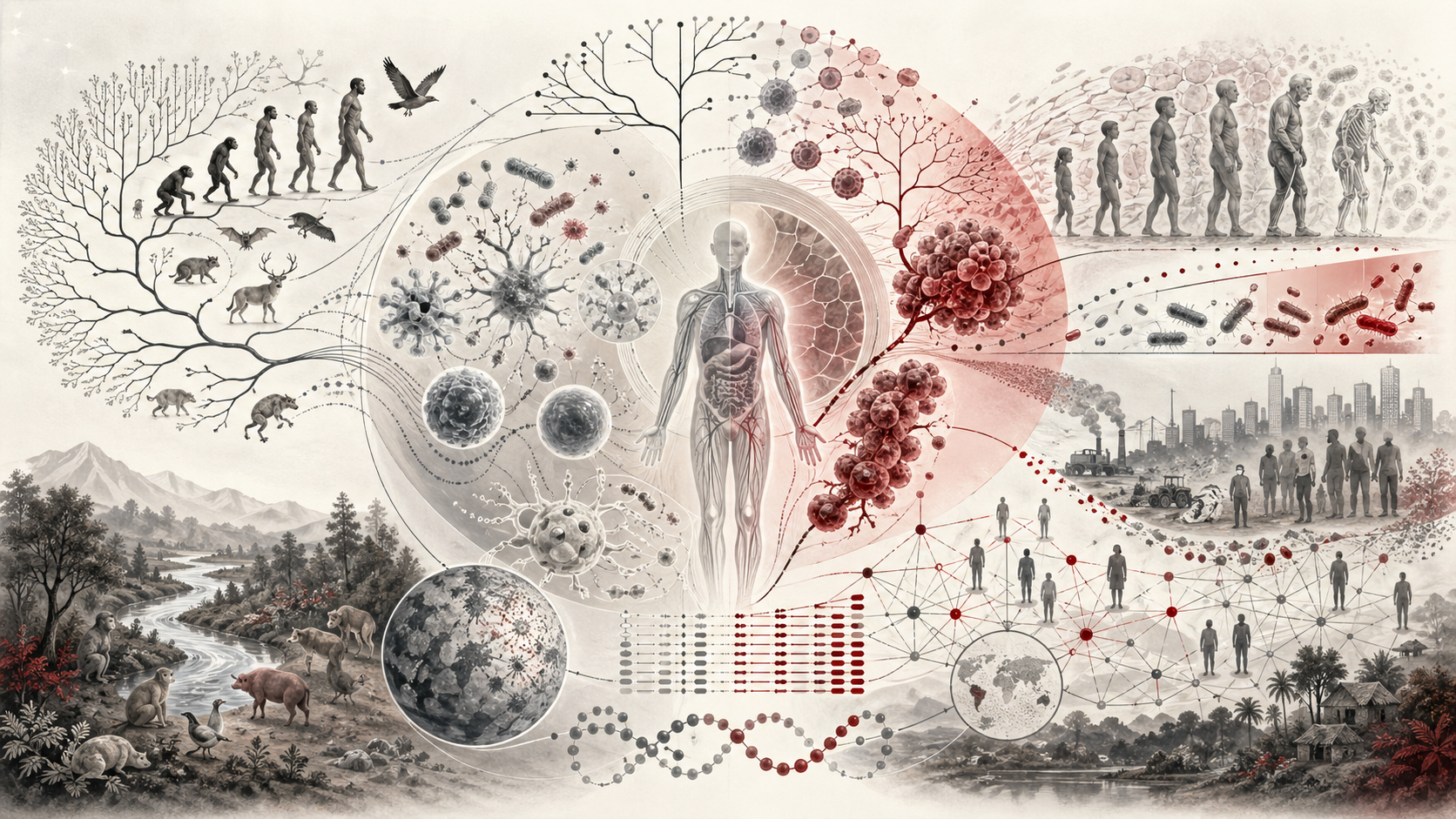
The central argument is that disease is not simply biological malfunction. Many illnesses arise from evolved systems operating under constraints: defenses that cause symptoms, adaptations that carry costs, bodies shaped for reproductive fitness rather than perfect health, pathogens evolving under selection, cancer cells competing within tissues, and modern environments creating mismatches with ancestral biology.
This article is written for biologists, medical and environmental-health readers, evolutionary biologists, ecologists, computational biologists, biomedical researchers, public-health researchers, systems biologists, epidemiologists, biodiversity scientists, and readers interested in how evolutionary reasoning deepens the biological understanding of disease.
Why evolutionary medicine matters
Evolutionary medicine matters because living bodies are products of evolutionary history, not engineered objects optimized for health, longevity, or comfort. Natural selection does not design perfect organisms. It favors traits that improve reproductive success under particular ecological conditions, constrained by ancestry, development, physiology, trade-offs, mutation, genetic drift, and environmental change.
This distinction changes how disease is interpreted. A fever may be uncomfortable, but it can also be part of an evolved defense against infection. Pain can be disabling, but it can also protect injured tissues from further damage. Inflammation can fight pathogens, but it can also damage host tissue. Sickle-cell trait can protect against severe malaria in heterozygotes while causing severe disease in homozygotes. Cancer arises from cellular evolution within the body. Antibiotic resistance arises because antimicrobial use creates selection pressure. Type 2 diabetes, cardiovascular disease, obesity, allergy, and autoimmune conditions may involve mismatches between evolved physiology and modern environments.
Evolutionary medicine therefore asks a different kind of question. Instead of asking only, “What mechanism caused this disease?” it also asks, “Why did vulnerability to this condition evolve or persist?”
That second question does not make disease adaptive. Many diseases are harmful by definition. The evolutionary question is why natural selection did not eliminate the vulnerability, why a trait has costs as well as benefits, why a defense creates symptoms, why pathogens evolve, or why modern environments reveal weaknesses in evolved systems.
Proximate and evolutionary explanations
Biology often distinguishes proximate explanations from evolutionary explanations. Proximate explanations ask how a trait, disease, or mechanism works in an individual organism. Evolutionary explanations ask why that trait or vulnerability exists in the history of a lineage.
In medicine, proximate explanation might describe how insulin resistance affects glucose metabolism, how a virus enters cells, how inflammatory pathways damage tissue, how a tumor accumulates mutations, or how a gene variant alters protein function. These explanations are essential. Without them, treatment would be impossible.
Evolutionary explanation adds a deeper layer. Why does the body store energy so efficiently? Why do pathogens evolve virulence or resistance? Why does the immune system tolerate some risks of autoimmunity? Why do reproductive hormones influence disease risk? Why does aging increase disease susceptibility? Why are some defenses excessive or poorly matched to current conditions?
Both levels are necessary. A clinician treating pneumonia needs proximate knowledge of pathogens, symptoms, diagnostics, and antimicrobial therapy. A public-health researcher confronting antimicrobial resistance also needs evolutionary knowledge of selection, transmission, population structure, prescribing behavior, and ecological reservoirs.
Evolutionary medicine does not replace mechanistic medicine. It expands causal understanding.
Natural selection, fitness, and vulnerability
A central principle of evolutionary medicine is that natural selection acts on fitness, not health. Fitness refers to reproductive success in particular environments. Health, comfort, and long life may contribute to fitness, but they are not identical to it.
This helps explain why bodies remain vulnerable. A trait may increase reproductive success early in life while increasing disease risk later. A defense may reduce immediate mortality while causing tissue damage. A gene variant may be beneficial in one environment and harmful in another. A physiological system may be “good enough” for survival and reproduction, even if it is not optimal for modern longevity.
Evolution also works with existing materials. It modifies inherited structures rather than designing from scratch. The human spine, birth canal, immune system, reproductive system, airway, knee, retina, and metabolic regulation all reflect evolutionary compromise. Bodies are historically assembled systems, not clean-sheet engineering designs.
Disease vulnerabilities can persist for many reasons:
- Trade-offs: one biological advantage carries another biological cost.
- Mismatch: environments change faster than bodies evolve.
- Constraints: evolution can only modify inherited structures.
- Selection timing: traits harmful later in life may persist if their costs appear after reproduction.
- Frequency-dependent selection: a trait’s advantage depends on how common it is.
- Pathogen evolution: microbes adapt rapidly under selection.
- Genetic drift: some variation persists by chance.
- Balancing selection: a variant may be maintained because it has both benefits and costs.
The body is not poorly designed. It is evolved under constraints.
Defenses, symptoms, and pathology
Evolutionary medicine distinguishes symptoms that are pathological damage from symptoms that may be evolved defenses. This distinction is clinically important because suppressing a defense can sometimes be helpful and sometimes harmful.
Fever, pain, cough, vomiting, diarrhea, fatigue, inflammation, iron sequestration, and anxiety-like responses can all have defensive aspects in some contexts. Fever can make the host environment less favorable for pathogens. Cough can clear airways. Vomiting and diarrhea can expel toxins or infectious agents. Pain protects injured tissue. Fatigue can reduce activity during infection and conserve energy. Inflammation recruits immune activity to injury or infection.
But defenses can become harmful. Fever can be dangerous when extreme. Inflammation can damage tissue. Pain can become chronic and maladaptive. Immune responses can cause sepsis, allergy, autoimmunity, or inflammatory disease. Anxiety responses can become disproportionate to current risk.
This creates a central clinical tension: the presence of a symptom does not automatically indicate whether it should be suppressed. A symptom may be damage, defense, both, or a defense that has become excessive. Evolutionary thinking encourages careful interpretation rather than reflexive suppression or romantic acceptance.
The same principle applies beyond individual symptoms. Sickle-cell trait, inflammatory responses, reproductive hormones, appetite regulation, and stress physiology may all involve evolved systems with both protective and harmful consequences.
Mismatch and modern disease
Evolutionary mismatch occurs when traits shaped in one environment encounter conditions for which they are poorly suited. Human bodies evolved under environments that differed from many modern settings in diet, physical activity, pathogen exposure, sleep patterns, social structure, reproductive timing, environmental toxins, light exposure, and built environments.
Mismatch is often discussed in relation to obesity, type 2 diabetes, cardiovascular disease, myopia, allergy, autoimmune disease, mental health, sleep disruption, and musculoskeletal problems. The basic idea is not that ancestral life was healthy or ideal. It was dangerous in many ways. The point is that rapid environmental change can expose vulnerabilities in evolved systems.
Examples include:
- energy-storage systems encountering calorie-dense food environments;
- appetite regulation shaped by scarcity encountering constant availability;
- immune systems shaped by diverse microbial exposure encountering altered hygiene, antibiotics, and urban environments;
- visual development shaped by outdoor light exposure encountering prolonged indoor near work;
- circadian systems shaped by natural light-dark cycles encountering artificial light and shift work;
- stress-response systems shaped for acute threats encountering chronic social, economic, or institutional stress.
Mismatch is not a single explanation for all disease. It can be overused if applied vaguely. A rigorous mismatch argument must identify the evolved trait, the ancestral or historical selection context, the modern environmental change, the mechanism connecting mismatch to disease, and evidence that the mismatch contributes to risk.
Trade-offs, life history, and health
Life-history theory examines how organisms allocate energy and resources among growth, maintenance, reproduction, immune defense, repair, and survival. Because resources are limited, biological systems face trade-offs. More investment in one function may reduce investment in another.
In medicine, life-history thinking helps explain why health is not simply maximized. The body allocates resources under constraints. Reproduction may compete with somatic maintenance. Immune activation may compete with growth. Early-life stress may alter development in ways that prepare the body for one environment but increase disease risk in another. Hormonal systems may influence fertility, cancer risk, immune function, bone density, and metabolism.
Trade-offs are central to many disease vulnerabilities:
- Immune defense versus tissue damage: strong inflammation may control pathogens but harm the host.
- Growth versus cancer risk: cell proliferation supports development and repair but can increase opportunities for malignant transformation.
- Reproduction versus maintenance: energy invested in reproduction may reduce investment in long-term repair.
- Coagulation versus thrombosis: clotting prevents bleeding but can create dangerous blockages.
- Iron availability versus pathogen control: iron is needed by host cells and many pathogens, creating conflict over nutrient access.
Evolutionary medicine therefore frames disease not only as failure, but as the outcome of biological allocation under constraint.
Pathogens, coevolution, and antimicrobial resistance
Infectious disease is inherently evolutionary. Pathogens reproduce rapidly, generate variation, and experience strong selection. Hosts evolve defenses. Pathogens evolve counterstrategies. This produces coevolutionary dynamics: immune evasion, virulence evolution, antigenic variation, host resistance, tolerance, vector adaptation, and drug resistance.
Antimicrobial resistance is one of the clearest examples of evolution in medicine. When antimicrobial drugs kill susceptible microbes, resistant variants may survive and reproduce. Resistance can arise through mutation, horizontal gene transfer, selection within patients, transmission across populations, agricultural use, environmental reservoirs, and global movement of people, animals, food, and genes.
Evolutionary medicine changes the interpretation of antimicrobial use. Antibiotics are not merely drugs acting on infections. They are also ecological interventions that impose selection pressure on microbial populations. Treatment strategies, dosing, duration, diagnostics, stewardship, infection control, vaccination, sanitation, animal agriculture, and environmental contamination all affect evolutionary outcomes.
Virulence also has evolutionary dimensions. A pathogen’s harm to the host may be shaped by transmission mode, host density, immune pressure, within-host competition, vector transmission, and environmental survival. Reduced virulence is not guaranteed. Some conditions select for more harmful pathogens.
Public health therefore needs evolutionary literacy. Pathogen evolution can undermine therapies, vaccines, diagnostics, and control strategies when selection pressures are ignored.
Cancer as somatic evolution
Cancer is often described as a genetic disease, but it is also an evolutionary process within the body. Cells acquire mutations and epigenetic changes. Some variants gain advantages in proliferation, survival, immune evasion, invasion, metabolism, or treatment resistance. Tumors become populations of competing and cooperating cell lineages.
This somatic evolution helps explain tumor heterogeneity. A cancer is not a uniform mass of identical cells. It may contain multiple subclones with different mutations, phenotypes, growth rates, sensitivities, and resistance mechanisms. Treatment can act as a selective pressure, killing sensitive cells while allowing resistant clones to expand.
Evolutionary thinking therefore reshapes cancer biology and therapy. It encourages attention to clonal diversity, selection pressure, adaptive therapy, microenvironment, immune surveillance, resistance evolution, and early detection. It also raises questions about how tissue architecture, aging, inflammation, stem-cell dynamics, and repair mechanisms shape the probability of malignant evolution.
Cancer evolution does not imply that cancer is beneficial to the organism. It means that malignant cells can evolve within the ecosystem of the body. The patient and the tumor operate under different selection pressures.
Immune systems, inflammation, and autoimmunity
The immune system is an evolved defense system, but it is not a simple protective shield. It must distinguish self from non-self, tolerate beneficial microbes, respond to pathogens, avoid excessive damage, remember past exposures, and operate under energetic constraints. These demands create trade-offs.
A weak immune response can allow infection. A strong immune response can damage tissue. A highly sensitive immune system may detect threats quickly but increase risk of allergy or autoimmunity. A tolerant immune system may reduce inflammatory damage but allow pathogen persistence or cancer escape.
Inflammation illustrates the problem. Acute inflammation can protect the host by recruiting immune cells, increasing vascular permeability, and coordinating repair. Chronic inflammation can contribute to cardiovascular disease, cancer, metabolic disease, neurodegeneration, autoimmune disease, and tissue damage.
Evolutionary medicine also helps interpret immune variation. Genetic diversity in immune genes can be beneficial at population scale because pathogens vary. But immune variation also means different individuals have different risks of infection, autoimmunity, allergy, and inflammatory disease.
The immune system is not designed to minimize symptoms. It is shaped to manage risk under uncertainty.
Aging, senescence, and reproductive constraint
Aging is one of the deepest problems in evolutionary medicine. If natural selection favors survival and reproduction, why do bodies deteriorate with age? Evolutionary theories of aging explain senescence through declining force of selection with age, mutation accumulation, antagonistic pleiotropy, disposable soma theory, and trade-offs between reproduction and maintenance.
The basic idea is that selection is often stronger on traits affecting early survival and reproduction than on traits affecting late-life health. A gene variant that improves early reproductive success may persist even if it increases disease risk later. Energy allocated to reproduction may reduce investment in long-term repair. Mutations with late-life effects may be less efficiently removed by selection.
Aging increases vulnerability to many diseases: cancer, cardiovascular disease, neurodegeneration, immune dysfunction, frailty, osteoporosis, metabolic disease, and chronic inflammation. Evolutionary medicine does not treat aging as one disease with one cause. It views aging as a multidimensional process shaped by repair limits, accumulated damage, cellular senescence, somatic evolution, immune change, metabolic regulation, and life-history trade-offs.
Understanding aging evolutionarily can improve biological insight, but it should not encourage simplistic claims that aging is “programmed” for the good of the species. Evolutionary explanations require precision.
Evolutionary medicine, public health, and environment
Evolutionary medicine connects individual disease to public health, ecology, and environment. Antimicrobial resistance depends on microbial ecology and drug use. Zoonotic disease depends on land use, wildlife contact, livestock systems, climate, biodiversity disruption, and global mobility. Chronic disease depends on food systems, work patterns, built environments, inequality, pollution, and stress exposure. Vector-borne disease depends on climate, habitat, pathogen evolution, host immunity, and vector ecology.
This makes evolutionary medicine sustainability-adjacent. Human health is not separate from ecosystems, food systems, land systems, microbial communities, biodiversity, and biogeochemical cycles. Disease emerges from relationships among organisms and environments.
Evolutionary public health can support:
- antimicrobial stewardship;
- vaccination strategies that consider pathogen evolution;
- cancer treatment strategies that consider resistance evolution;
- urban and environmental design that reduces mismatch;
- diet and activity interventions grounded in physiology and ecology;
- infectious-disease surveillance that tracks evolutionary change;
- One Health approaches linking humans, animals, and environments;
- ecological prevention of zoonotic spillover.
Evolutionary medicine therefore belongs not only in clinics, but also in public health, environmental health, conservation, agriculture, and systems biology.
Mathematical lens: evolutionary medicine
Several mathematical ideas help clarify evolutionary medicine. These expressions do not replace clinical judgment, mechanistic biology, ecological interpretation, or public-health evidence. They help make evolutionary assumptions explicit across selection, resistance, mismatch, trade-offs, life-history allocation, clonal expansion, and defense activation.
Selection coefficient
s = \frac{w_A-w_a}{w_a}
\]
Interpretation: The selection coefficient \(s\) compares the fitness values of two variants, \(w_A\) and \(w_a\). A positive value indicates a relative advantage for variant \(A\) in the modeled environment.
Allele frequency change
p_{t+1}=\frac{p_t w_A}{\bar{w}}
\]
Interpretation: Allele frequency at the next time step depends on current frequency \(p_t\), variant fitness \(w_A\), and mean population fitness \(\bar{w}\). This provides a simplified way to represent how selection can shift biological variation over time.
Antimicrobial resistance growth
R_{t+1}=R_t(1+r-s_c)
\]
Interpretation: Resistant-strain frequency \(R_t\) changes according to growth advantage under antimicrobial selection \(r\) and the fitness cost of resistance \(s_c\). The equation highlights why antimicrobial use is also an evolutionary pressure.
Mismatch risk
M = |E_{\text{current}}-E_{\text{adapted}}|
\]
Interpretation: Mismatch risk is represented conceptually as the distance between present environmental exposure and the exposure range under which a trait was shaped. This is not a universal clinical metric; it is a way to clarify the structure of a mismatch argument.
Trade-off function
H = B(x)-C(x)
\]
Interpretation: A biological investment \(x\) may produce benefits \(B(x)\) and costs \(C(x)\). Health outcomes often reflect this balance rather than simple optimization.
Life-history allocation
E = G + R + M
\]
Interpretation: Available energy \(E\) is allocated among growth \(G\), reproduction \(R\), and maintenance \(M\). The allocation frame helps explain why organisms face trade-offs among development, repair, survival, and reproduction.
Clonal expansion in cancer
N_t=N_0 e^{rt}
\]
Interpretation: Clone size \(N_t\) grows from an initial size \(N_0\) according to net growth rate \(r\) over time \(t\). In cancer biology, such simplified models can help illustrate somatic evolution, clonal expansion, and selection within tissues.
Defense activation threshold
D =
\begin{cases}
1, & \text{if } T \geq \tau \\
0, & \text{if } T < \tau
\end{cases}
\]
Interpretation: A defense activates when perceived threat \(T\) exceeds threshold \(\tau\). Too low a threshold can create false alarms; too high a threshold can miss danger.
Python and R workflows
The following compact examples illustrate how evolutionary medicine concepts can be represented computationally. The full GitHub repository expands these examples into a broader reproducible workflow with Python, R, Julia, Fortran, Rust, Go, C, C++, SQL, notebooks, synthetic data, antimicrobial-resistance scenarios, mismatch scoring, life-history trade-offs, somatic-evolution scaffolds, provenance documentation, and reproducibility notes.
Python example: antimicrobial resistance under selection
"""
Simulate resistant-strain frequency under antimicrobial selection.

This is a conceptual educational model, not a clinical or public-health
forecasting tool.
"""

import pandas as pd

def simulate_resistance(
    initial_frequency: float,
    selection_advantage: float,
    fitness_cost: float,
    steps: int,
) -> pd.DataFrame:
    """Simulate bounded resistant-strain frequency over time."""
    frequency = initial_frequency
    rows = []

    for step in range(steps + 1):
        rows.append({"step": step, "resistant_frequency": frequency})

        growth_factor = 1 + selection_advantage - fitness_cost
        frequency = frequency * growth_factor

        # Keep the simplified frequency in a biologically interpretable range.
        frequency = max(0.0, min(frequency, 1.0))

    return pd.DataFrame(rows)

trajectory = simulate_resistance(
    initial_frequency=0.02,
    selection_advantage=0.18,
    fitness_cost=0.04,
    steps=20,
)

print(trajectory.round(4).to_string(index=False))
Python example: evolutionary mismatch risk table
"""
Create a conceptual mismatch-risk table.

The values are synthetic and only illustrate the structure of reasoning.
"""

import pandas as pd

exposures = pd.DataFrame(
    {
        "trait_system": [
            "energy_storage",
            "circadian_regulation",
            "immune_calibration",
            "visual_development",
        ],
        "current_exposure": [0.90, 0.82, 0.25, 0.88],
        "adapted_exposure_reference": [0.45, 0.35, 0.70, 0.40],
        "evidence_confidence": [0.70, 0.65, 0.55, 0.60],
    }
)

exposures["mismatch_distance"] = (
    exposures["current_exposure"] - exposures["adapted_exposure_reference"]
).abs()

exposures["weighted_mismatch_score"] = (
    exposures["mismatch_distance"] * exposures["evidence_confidence"]
)

print(exposures.sort_values("weighted_mismatch_score", ascending=False).round(3).to_string(index=False))
R example: life-history allocation trade-off
# Conceptual life-history allocation table.
# Synthetic values are used for demonstration only.

allocation <- data.frame(
  scenario = c("high_growth", "high_reproduction", "high_maintenance"),
  growth = c(0.50, 0.25, 0.25),
  reproduction = c(0.25, 0.55, 0.20),
  maintenance = c(0.25, 0.20, 0.55)
)

allocation$total_energy <- with(
  allocation,
  growth + reproduction + maintenance
)

allocation$maintenance_risk_index <- 1 - allocation$maintenance

print(round(allocation, 3))
R example: simple somatic evolution scenario
# Conceptual clonal expansion model for somatic evolution.
# This is not a cancer prediction model.

time <- 0:20
initial_clone_size <- 100
growth_rate <- 0.12

clone_size <- initial_clone_size * exp(growth_rate * time)

trajectory <- data.frame(
  time = time,
  clone_size = clone_size
)

print(round(trajectory, 2))GitHub repository
The companion repository provides a reproducible technical scaffold for the article’s computational examples, including antimicrobial-resistance scenarios, mismatch scoring, life-history trade-offs, somatic-evolution examples, provenance documentation, and responsible-use notes.
Limits, ethics, and responsible interpretation
Evolutionary medicine must be used carefully. A trait’s evolutionary history does not determine what should be done clinically, ethically, or socially. Explaining why a vulnerability exists is not the same as justifying suffering, inequality, disease burden, or neglect.
Several cautions are essential.
First, evolutionary explanations must not become just-so stories. A rigorous explanation requires evidence, mechanism, comparative reasoning, population data, phylogenetic context, or testable prediction.
Second, evolutionary medicine should not imply genetic determinism. Disease risk arises from genes, development, environment, behavior, social conditions, pathogens, institutions, and ecological systems.
Third, mismatch explanations can be misused if they ignore poverty, racism, occupational exposure, food systems, environmental injustice, healthcare access, and structural inequality. Modern disease is not only a mismatch between bodies and lifestyles. It is also shaped by power, policy, industry, and unequal exposure to risk.
Fourth, evolutionary explanations of sex differences, reproduction, behavior, or mental health require particular care. They can be misused to naturalize stereotypes or social inequities. Responsible evolutionary medicine distinguishes biological hypotheses from moral claims.
Fifth, clinical application requires evidence. Evolutionary reasoning can generate hypotheses, improve interpretation, and guide research, but treatment decisions require clinical data, patient context, ethical judgment, and professional standards.
Evolutionary medicine is powerful when it deepens biological understanding without flattening social reality.
Why this matters now
Evolutionary medicine matters now because many major health challenges are evolutionary or ecological in structure. Antimicrobial resistance reflects microbial adaptation under selection pressure. Cancer therapy resistance reflects somatic evolution. Emerging infectious diseases reflect host-pathogen ecology, spillover, land-use change, wildlife contact, and global connectivity. Chronic inflammatory and metabolic diseases often involve interactions among evolved physiology, modern environments, inequality, and institutional systems.
Medicine that ignores evolution can treat disease as isolated malfunction. Medicine informed by evolution sees disease as a process shaped by history, ecology, selection, constraint, and adaptation.
This matters for research, education, public health, and clinical reasoning. Evolutionary medicine can help train scientists and clinicians to ask deeper questions: why vulnerability exists, when symptoms are defenses, how treatment changes selection, why resistance emerges, how environments shape risk, and why bodies are built around trade-offs rather than perfection.
The future of medicine will need molecular precision, computational power, public-health infrastructure, ecological awareness, and evolutionary reasoning.
Conclusion
Evolutionary medicine provides a biological framework for understanding disease as more than mechanical failure. It asks why bodies are vulnerable, why defenses cause symptoms, why pathogens adapt, why cancer evolves, why aging occurs, and why modern environments can produce illness from evolved traits.
Its value lies in connecting proximate mechanisms with evolutionary history. Molecular biology explains how disease works. Evolutionary biology helps explain why disease vulnerabilities exist. Public health and environmental science show how those vulnerabilities interact with social and ecological systems.
The body is not a machine designed for perfect health. It is a living, evolved system shaped by trade-offs, constraints, defenses, conflicts, and changing environments. Evolutionary medicine helps make that complexity intelligible.
Related articles
- Biology
- Systems Biology and Complexity in Living Networks
- Machine Learning in the Life Sciences
- Computational Notebooks and Reproducible Biological Research
- Biotechnology, Intervention, and the Power to Alter Life
- Synthetic Biology and the Engineering of Biological Systems
- Modeling Disease, Epidemiology, and Biological Spread
- Genomics, Sequence Analysis, and Biological Data
- Nonlinearity, Feedback, and Biological Regulation
Further reading
- International Society for Evolution, Medicine, and Public Health (n.d.) Evolution, Medicine, and Public Health. Available at: https://academic.oup.com/emph
- Nesse, R.M. and Williams, G.C. (1994) Why We Get Sick: The New Science of Darwinian Medicine. New York: Times Books. Available at: https://global.oup.com/academic/product/why-we-get-sick-9780679746744
- Stearns, S.C. and Medzhitov, R. (2016) Evolutionary Medicine. Oxford: Oxford University Press. Available at: https://global.oup.com/academic/product/evolutionary-medicine-9780199665479
- WHO (2023) Antimicrobial Resistance. World Health Organization. Available at: https://www.who.int/news-room/fact-sheets/detail/antimicrobial-resistance
- CDC (2025) Antimicrobial Resistance Facts and Stats. Centers for Disease Control and Prevention. Available at: https://www.cdc.gov/antimicrobial-resistance/data-research/facts-stats/index.html
References
- Brüne, M. and Hochberg, Z. (2013) ‘Evolutionary medicine: The quest for a better understanding of health, disease and prevention’, BMC Medicine, 11, 116. Available at: https://bmcmedicine.biomedcentral.com/articles/10.1186/1741-7015-11-116
- CDC (2025) Antimicrobial Resistance Facts and Stats. Centers for Disease Control and Prevention. Available at: https://www.cdc.gov/antimicrobial-resistance/data-research/facts-stats/index.html
- Gluckman, P.D., Low, F.M., Buklijas, T., Hanson, M.A. and Beedle, A.S. (2011) ‘How evolutionary principles improve the understanding of human health and disease’, Evolutionary Applications, 4(2), pp. 249–263. Available at: https://pmc.ncbi.nlm.nih.gov/articles/PMC3352556/
- Jablonka, E., Lamb, M.J. and Zeligowski, A. (2014) Evolution in Four Dimensions. Revised edn. Cambridge, MA: MIT Press. Available at: https://mitpress.mit.edu/9780262525848/evolution-in-four-dimensions/
- Merlo, L.M.F., Pepper, J.W., Reid, B.J. and Maley, C.C. (2006) ‘Cancer as an evolutionary and ecological process’, Nature Reviews Cancer, 6, pp. 924–935. Available at: https://www.nature.com/articles/nrc2013
- Nature (n.d.) Cancer Evolution. Nature Portfolio Collection. Available at: https://www.nature.com/collections/yhyydzgkfk
- Nesse, R.M. (2018) ‘Tinbergen’s four questions, organized: A response to Bateson and Laland’, Trends in Ecology & Evolution, 33(9), pp. 681–682. Available at: https://pmc.ncbi.nlm.nih.gov/articles/PMC6343817/
- Stearns, S.C. (2010) ‘Evolutionary medicine: Its scope, interest and potential’, Proceedings of the National Academy of Sciences, 107(suppl. 1), pp. 1691–1697. Available at: https://www.pnas.org/doi/10.1073/pnas.0914475107
- Tinbergen, N. (1963) ‘On aims and methods of ethology’, Zeitschrift für Tierpsychologie, 20(4), pp. 410–433. Available at: https://doi.org/10.1111/j.1439-0310.1963.tb01161.x
- Turajlic, S., Sottoriva, A. and Swanton, C. (2019) ‘Resolving genetic heterogeneity in cancer’, Nature Reviews Genetics, 20, pp. 404–416. Available at: https://www.nature.com/articles/s41576-019-0114-6
- WHO (2023) Antimicrobial Resistance. World Health Organization. Available at: https://www.who.int/news-room/fact-sheets/detail/antimicrobial-resistance
- Williams, G.C. (1957) ‘Pleiotropy, natural selection, and the evolution of senescence’, Evolution, 11(4), pp. 398–411. Available at: https://doi.org/10.2307/2406060