
Last Updated May 28, 2026
Modeling disease, epidemiology, and biological spread gives life scientists a rigorous way to connect pathogens, hosts, populations, behavior, networks, surveillance data, uncertainty, interventions, and reproducible computation into structured evidence about how disease moves through living systems. Disease spread is biological, social, ecological, spatial, temporal, and informational at the same time. It depends on organisms, environments, contacts, immunity, mobility, diagnostics, reporting systems, health infrastructure, inequality, and public trust.
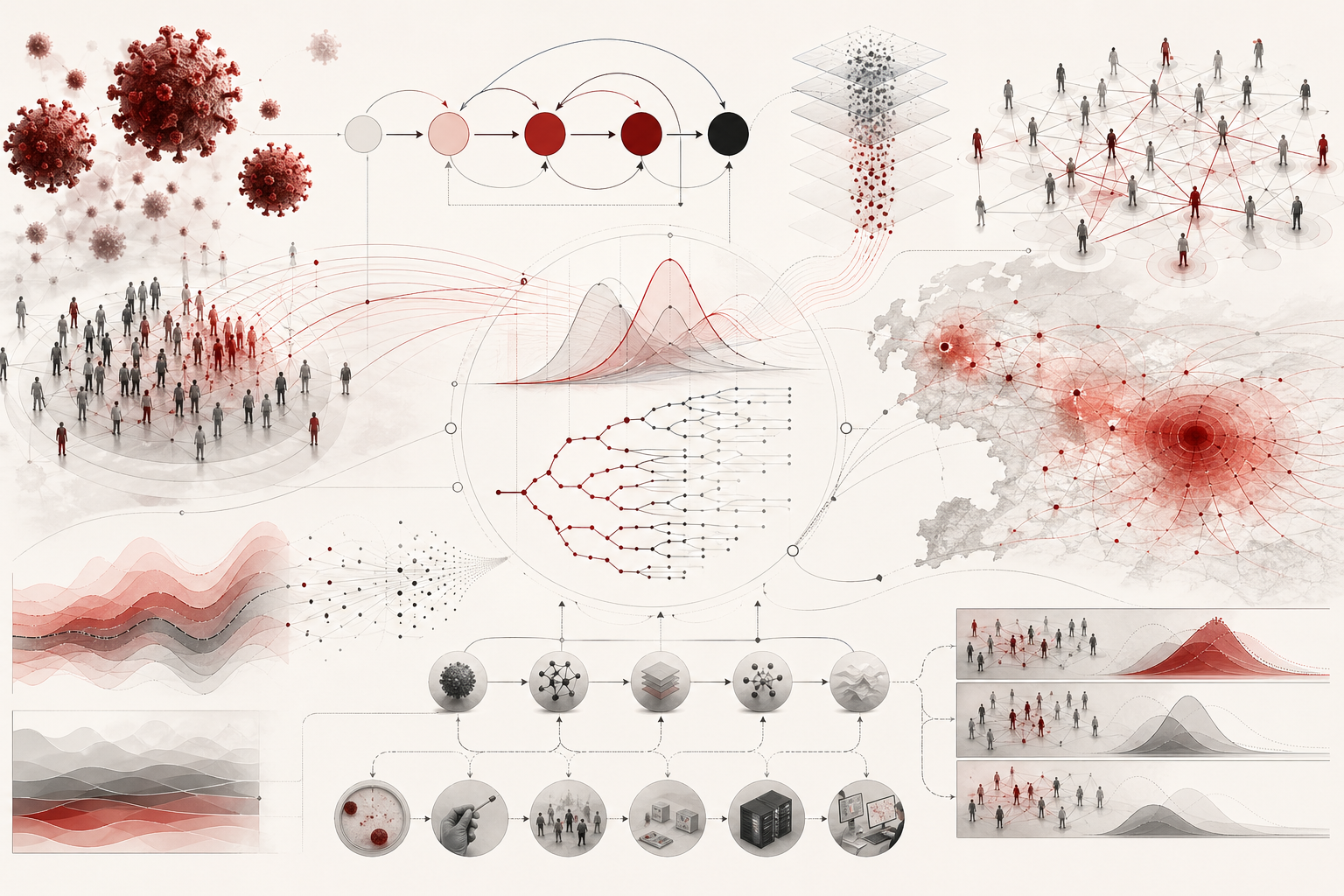
This article introduces epidemiological modeling as a core method for understanding biological spread. It explains how models such as SIR, SEIR, compartment systems, branching processes, network models, spatial models, nowcasting, forecasting, and scenario analysis help researchers examine transmission, susceptibility, infection, recovery, immunity, exposure, reporting delay, uncertainty, and intervention effects. The goal is not to treat models as prediction machines, but as disciplined tools for reasoning about dynamic biological risk.
Main Library
Publications
Article Map
Biology
Related Topic
Environmental Science
Related Topic
Earth Science
Related Topic
Chemistry
The article is written for biologists, epidemiologists, ecologists, biomedical researchers, public-health analysts, computational biologists, data scientists, systems biologists, environmental health researchers, biotechnology teams, scientific software developers, and engineers. It emphasizes biological mechanism, surveillance data, assumptions, uncertainty, model validation, ethical limits, reproducibility, and responsible interpretation.
The article also extends the discussion into reproducible computational practice through Python and R examples, SIR and SEIR models, effective reproduction number scaffolds, outbreak-growth summaries, branching-process simulations, network-spread logic, nowcasting-style reporting delay adjustment, SQL-backed provenance, validation metrics, and a linked full-stack GitHub repository containing Python, R, Julia, Fortran, Rust, Go, C, C++, SQL, notebooks, data files, validation notes, and reproducibility documentation.
Why disease modeling matters
Disease modeling matters because biological spread is dynamic. Infections do not occur as isolated events. They emerge through chains of exposure, transmission, susceptibility, contact, immunity, behavior, reporting, environment, and intervention. A pathogen may spread quickly in one population and slowly in another because social structure, biology, immunity, mobility, seasonality, diagnostics, or reporting systems differ.
A model helps make these relationships explicit. It can ask how transmission changes when susceptibility declines, how reporting delays distort current case counts, how an intervention might alter future incidence, how contact networks influence spread, or how uncertainty changes the interpretation of an outbreak curve.
Models are not replacements for epidemiological judgment, laboratory evidence, clinical knowledge, field investigation, or public-health practice. They are structured tools for organizing evidence under uncertainty. They can clarify assumptions, compare scenarios, test mechanisms, estimate hidden states, and support better questions.
The central issue is not whether a model is “right” in some absolute sense. The issue is whether the model is useful, transparent, validated, appropriately scoped, and honest about uncertainty.
Disease spread as a biological and social process
Disease spread is biological because pathogens replicate, mutate, invade host tissues, encounter immune systems, and move through modes of transmission such as respiratory droplets, aerosols, bodily fluids, vectors, food, water, surfaces, sexual contact, vertical transmission, or environmental reservoirs. It is social because human behavior, work, housing, care systems, mobility, inequality, trust, and institutions shape exposure and response.
This dual nature makes epidemiological modeling difficult. A model that includes only pathogen biology may miss the contact structures that drive spread. A model that includes only social contact may miss incubation, infectiousness, immunity, pathogen evolution, or diagnostic sensitivity. A model that ignores reporting systems may confuse observed cases with actual infections.
Epidemiological models therefore operate at the boundary between biology and society. They must account for the fact that observed data are not the epidemic itself. Case counts, hospitalizations, deaths, wastewater signals, serology, syndromic reports, genomic surveillance, and contact-tracing records are partial observations of an underlying process.
A good model respects that distinction. It separates the disease process from the observation process.
Compartment models and epidemic structure
Compartment models organize individuals into disease states. In the classic SIR model, individuals are susceptible, infected, or recovered. In the SEIR model, an exposed compartment is added for individuals who have been infected but are not yet infectious or symptomatic depending on the disease interpretation. Other models may include hospitalized, vaccinated, asymptomatic, quarantined, deceased, waned immunity, vector, environmental, or age-structured compartments.
Compartment models are useful because they convert biological assumptions into dynamic equations. They ask how people move between states over time. Susceptible individuals become infected. Exposed individuals become infectious. Infected individuals recover or die. Recovered individuals may remain immune, lose immunity, or be removed from transmission. These flows encode assumptions about infection, incubation, infectiousness, recovery, immunity, and intervention.
The simplicity of compartment models is both a strength and a limitation. They clarify core dynamics, but they often assume homogeneous mixing unless extended. Real populations are structured by age, household, school, work, geography, behavior, immunity, occupation, health status, and access to care.
Compartment models are best treated as starting points. They reveal the logic of transmission, but real public-health modeling often requires additional structure.
R0, Rt, and transmission potential
The basic reproduction number, \(R_0\), is commonly interpreted as the expected number of secondary infections caused by a typical infectious individual in a fully susceptible population under specified conditions. The effective reproduction number, \(R_t\), changes over time as susceptibility, behavior, interventions, seasonality, immunity, and population structure change.
These quantities are useful because they summarize transmission potential. When \(R_t\) is greater than 1, infections tend to increase. When \(R_t\) is less than 1, infections tend to decline. But reproduction numbers are not fixed biological constants. They depend on pathogen biology, contact patterns, environmental conditions, immunity, interventions, and measurement assumptions.
Estimating \(R_t\) requires data and assumptions. Case counts may lag infection. Reporting practices may change. Testing may expand or contract. Hospitalizations and deaths reflect severe outcomes, not total infections. Genomic or wastewater data may provide additional signals but also have their own biases.
Reproduction numbers are therefore interpretive tools, not magic numbers. They are most useful when paired with uncertainty intervals, data-quality review, and clear explanation of estimation assumptions.
Surveillance data, reporting delay, and observation
Surveillance is the structured collection, analysis, interpretation, and communication of health data for public-health action. Disease models depend on surveillance, but surveillance data are imperfect. They reflect who is tested, who seeks care, what is reported, how laboratories process results, how definitions change, and how health systems capture information.
Reporting delay is a major problem. Infections occur before symptoms, symptoms occur before testing, testing occurs before reporting, and reporting may be revised later. Current case counts may therefore underestimate current infections. Nowcasting attempts to adjust for reporting delays and estimate more recent disease burden.
Different surveillance streams measure different aspects of disease. Case counts may reflect testing. Hospitalizations may reflect severity and healthcare access. Deaths lag infections and reflect both severity and reporting. Wastewater signals may detect community-level viral shedding but require calibration. Genomic surveillance tracks variants but depends on sequencing coverage and sampling strategy.
Epidemiological modeling must therefore include observation logic. A model that treats reported cases as exact infections risks serious error.
Nowcasting, forecasting, and scenario analysis
Nowcasting estimates what is happening now when direct reporting lags behind reality. Forecasting estimates near-future outcomes under uncertainty. Scenario analysis explores conditional futures under different assumptions. These are related but distinct modeling activities.
A nowcast might estimate current infections, hospitalizations, or deaths after accounting for delays. A forecast might estimate likely case trajectories over the next few weeks. A scenario model might ask what could happen under different assumptions about immunity, behavior, seasonality, vaccination, variant growth, or intervention timing.
Scenario analysis is especially important because public-health decisions often require “what if” thinking. What if transmission increases? What if vaccine uptake declines? What if a variant spreads? What if testing changes? What if schools reopen? What if mobility rises? Scenario models do not predict one certain future; they compare structured possibilities.
Good modeling distinguishes these tasks clearly. A nowcast is not a long-term forecast. A scenario is not a prediction. A forecast is not a guarantee.
Networks, spatial structure, and contact patterns
Disease spread depends on who contacts whom. Homogeneous mixing models assume everyone mixes evenly, but real contacts are structured. Households, schools, workplaces, hospitals, long-term care facilities, prisons, shelters, transport systems, social networks, and geographic movement all shape transmission.
Network models represent individuals or groups as nodes and contacts as edges. They can show how clustering, superspreading, high-degree nodes, bridges, and community structure influence outbreaks. A pathogen may spread slowly in a fragmented network or rapidly when highly connected hubs link many groups.
Spatial models add geography. Transmission may depend on distance, mobility, environmental conditions, vector habitat, population density, healthcare access, or regional connectivity. Spatial structure matters for vector-borne disease, waterborne disease, zoonotic spillover, respiratory spread, livestock outbreaks, and environmental exposure.
Network and spatial models are useful because they reveal that average transmission can hide important structure. A population with the same average contact rate can produce very different outbreaks depending on how contacts are arranged.
Heterogeneity, immunity, and intervention effects
Populations are heterogeneous. Individuals differ in age, immunity, exposure, susceptibility, infectiousness, health status, occupation, behavior, household size, mobility, access to care, and ability to isolate. These differences shape disease dynamics.
Immunity is also heterogeneous. Some people may be immune through prior infection, vaccination, maternal antibodies, or cross-protection. Immunity may reduce infection risk, transmission, symptoms, severe disease, or duration. It may wane over time. A model must specify which aspect of immunity is being represented.
Interventions also work through different mechanisms. Vaccination may reduce susceptibility, severity, or transmission. Isolation may reduce contacts after detection. Testing may reduce time to diagnosis. Ventilation may reduce exposure. Vector control may reduce mosquito populations. Water treatment may reduce environmental transmission. Treatment may reduce infectious duration or mortality.
Modeling intervention effects requires mechanism. A model should not simply insert an “intervention factor” without explaining what biological or social process it changes.
Zoonotic, environmental, and ecological spread
Not all disease spread is human-to-human. Zoonotic diseases involve transmission between animals and humans. Vector-borne diseases involve organisms such as mosquitoes, ticks, or flies. Environmental transmission may involve water, soil, surfaces, food systems, or built environments. Plant, animal, and wildlife diseases may spread across ecological networks, farms, forests, oceans, and landscapes.
These systems often require ecological modeling. Vector abundance may depend on temperature, rainfall, humidity, habitat, and season. Wildlife disease may depend on movement, population density, landscape fragmentation, and species interaction. Waterborne disease may depend on sanitation, hydrology, rainfall, infrastructure, and microbial survival. Livestock disease may depend on farm networks, trade, biosecurity, and transport.
Biological spread is therefore broader than clinical epidemiology. It connects microbiology, ecology, environmental science, veterinary medicine, agriculture, climate, infrastructure, and social systems.
This is why epidemiological modeling belongs inside a broader biology knowledge system. Disease spread is a living-system problem.
Uncertainty, validation, and model comparison
Epidemiological models contain uncertainty from many sources: underreporting, reporting delay, diagnostic sensitivity, behavioral change, parameter estimation, model structure, population heterogeneity, stochastic transmission, immunity assumptions, spatial aggregation, and future interventions. Responsible modeling makes this uncertainty visible.
Validation compares model output with observations not used to fit or construct the model. A forecast can be evaluated against later data. A hospitalization model can be compared against hospital records. A nowcast can be revised and scored. A scenario model can be assessed for plausibility and sensitivity. A surveillance model can be checked for consistency across data streams.
Model comparison is also important. Different models may make different assumptions and produce different results. Ensemble approaches can combine multiple models, but ensembles also require interpretation. Agreement does not guarantee truth, and disagreement can be scientifically informative.
A model is strongest when its assumptions, uncertainty, and validation record are visible.
Reproducibility, provenance, and public-health modeling
Epidemiological modeling can influence public action, resource allocation, clinical planning, school policy, travel decisions, vaccination strategy, emergency response, and public communication. That makes reproducibility essential.
A reproducible disease-modeling workflow should preserve input data, data dictionaries, reporting dates, model assumptions, parameter values, scripts, outputs, figures, validation metrics, scenario definitions, and provenance. It should distinguish infection date, symptom onset date, test date, report date, and revision date when possible. It should document whether data are simulated, provisional, confirmed, aggregated, anonymized, or derived.
Version control, structured repositories, SQL-backed provenance, notebooks, scripts, workflow manifests, and validation reports help preserve the evidence chain. These practices do not make a model correct, but they make it inspectable.
In public-health modeling, inspectability is part of trust.
Mathematical lens: epidemiological modeling
Several mathematical ideas are central to disease modeling and biological spread. These expressions do not replace field investigation, public-health judgment, ecological context, or clinical evidence. They help clarify how transmission, susceptibility, infection, recovery, growth, branching, severity, and prediction error can be represented formally.
SIR model
\frac{dS}{dt}=-\beta\frac{SI}{N}
\]
Interpretation: The susceptible population \(S\) declines as susceptible and infected individuals interact. The transmission rate \(\beta\) controls how quickly susceptible individuals move toward infection under the model’s assumptions.
\frac{dI}{dt}=\beta\frac{SI}{N}-\gamma I
\]
Interpretation: The infected population \(I\) increases through new infections and decreases through recovery or removal. The recovery rate \(\gamma\) controls the flow out of the infected compartment.
\frac{dR}{dt}=\gamma I
\]
Interpretation: The recovered or removed population \(R\) grows as infected individuals leave the infectious state. In this simple form, recovered individuals do not return to susceptibility.
SEIR model
\frac{dS}{dt}=-\beta\frac{SI}{N}
\]
Interpretation: Susceptible individuals move toward exposure through transmission. The equation preserves the same transmission logic as SIR while adding an exposed state.
\frac{dE}{dt}=\beta\frac{SI}{N}-\sigma E
\]
Interpretation: The exposed compartment \(E\) grows through new exposure and shrinks as exposed individuals progress toward infectiousness. The parameter \(\sigma\) controls progression from exposed to infectious.
\frac{dI}{dt}=\sigma E-\gamma I
\]
Interpretation: The infected compartment grows as exposed individuals become infectious and declines as infected individuals recover or are removed.
\frac{dR}{dt}=\gamma I
\]
Interpretation: The recovered or removed compartment grows as infected individuals leave the infectious state.
Basic reproduction number
R_0=\frac{\beta}{\gamma}
\]
Interpretation: In the simplest homogeneous SIR model, the basic reproduction number is the ratio of transmission rate to recovery rate. In real settings, \(R_0\) depends on contact structure, immunity assumptions, environment, and model definition.
Effective reproduction number
R_t=R_0\frac{S_t}{N}
\]
Interpretation: A simple susceptible-depletion approximation reduces transmission potential as the susceptible fraction declines. More realistic estimates may incorporate behavior, interventions, seasonality, reporting delay, and population structure.
Exponential growth
I_t=I_0e^{rt}
\]
Interpretation: Early outbreak growth can sometimes be approximated by exponential change, where \(r\) is the growth rate. This approximation is most useful over limited periods before depletion, behavior change, or interventions alter dynamics.
Doubling time
T_d=\frac{\ln(2)}{r}
\]
Interpretation: When growth rate \(r\) is positive, doubling time estimates how long it takes for cases or infections to double under exponential growth assumptions.
Branching process
Z_{t+1}=\sum_{i=1}^{Z_t} X_i
\]
Interpretation: The number of infections in the next generation depends on the secondary infections produced by current cases. Branching-process models are useful for early outbreak dynamics, extinction probability, and superspreading logic.
Case fatality ratio
CFR=\frac{\text{reported deaths}}{\text{reported cases}}
\]
Interpretation: Case fatality ratio compares reported deaths with reported cases. It is sensitive to testing, reporting delay, severity, healthcare access, case definitions, and under-ascertainment.
Mean absolute error
MAE=\frac{1}{n}\sum_{i=1}^{n}|y_i-\hat{y}_i|
\]
Interpretation: Mean absolute error summarizes average absolute prediction error. It is useful for evaluating forecasts or model outputs against observed data while preserving the original units of the outcome.
Python and R workflows
The following examples are compact article-level workflows. The full GitHub repository expands them into richer full-stack implementations with SQL provenance, cross-language validation, SIR and SEIR simulations, outbreak-growth summaries, network-spread scaffolds, nowcasting-style reporting delay adjustment, scenario tables, validation metrics, and reproducible documentation.
Python example: SIR model simulation
import pandas as pd

def simulate_sir(
    population: float,
    initial_infected: float,
    initial_recovered: float,
    beta: float,
    gamma: float,
    dt: float,
    steps: int,
) -> pd.DataFrame:
    """Simulate a simple SIR model using Euler approximation."""
    susceptible = population - initial_infected - initial_recovered
    infected = initial_infected
    recovered = initial_recovered
    rows = []

    for step in range(steps + 1):
        rows.append(
            {
                "step": step,
                "time": step * dt,
                "susceptible": susceptible,
                "infected": infected,
                "recovered": recovered,
            }
        )

        new_infections = beta * susceptible * infected / population
        new_recoveries = gamma * infected

        susceptible = max(susceptible - dt * new_infections, 0.0)
        infected = max(infected + dt * (new_infections - new_recoveries), 0.0)
        recovered = min(recovered + dt * new_recoveries, population)

    return pd.DataFrame(rows)

trajectory = simulate_sir(
    population=10000,
    initial_infected=10,
    initial_recovered=0,
    beta=0.32,
    gamma=0.10,
    dt=0.25,
    steps=240,
)

print(trajectory.tail().round(4).to_string(index=False))
Python example: SEIR scenario comparison
import pandas as pd

def simulate_seir(population, initial_exposed, initial_infected, beta, sigma, gamma, dt, steps):
    susceptible = population - initial_exposed - initial_infected
    exposed = initial_exposed
    infected = initial_infected
    recovered = 0.0
    rows = []

    for step in range(steps + 1):
        rows.append(
            {
                "step": step,
                "susceptible": susceptible,
                "exposed": exposed,
                "infected": infected,
                "recovered": recovered,
            }
        )

        force = beta * susceptible * infected / population
        progression = sigma * exposed
        recovery = gamma * infected

        susceptible = max(susceptible - dt * force, 0.0)
        exposed = max(exposed + dt * (force - progression), 0.0)
        infected = max(infected + dt * (progression - recovery), 0.0)
        recovered = min(recovered + dt * recovery, population)

    return pd.DataFrame(rows)

scenarios = pd.DataFrame(
    {
        "scenario": ["baseline", "reduced_transmission", "faster_recovery"],
        "beta": [0.32, 0.22, 0.32],
        "sigma": [0.20, 0.20, 0.20],
        "gamma": [0.10, 0.10, 0.16],
    }
)

summary_rows = []

for _, row in scenarios.iterrows():
    result = simulate_seir(
        population=10000,
        initial_exposed=20,
        initial_infected=10,
        beta=row["beta"],
        sigma=row["sigma"],
        gamma=row["gamma"],
        dt=0.25,
        steps=240,
    )

    summary_rows.append(
        {
            "scenario": row["scenario"],
            "peak_infected": result["infected"].max(),
            "final_recovered": result["recovered"].iloc[-1],
        }
    )

summary = pd.DataFrame(summary_rows)
print(summary.round(4).to_string(index=False))
Python example: effective reproduction number scaffold
import pandas as pd

incidence = pd.DataFrame(
    {
        "day": list(range(1, 11)),
        "reported_cases": [12, 15, 18, 21, 25, 31, 38, 46, 51, 60],
    }
)

generation_interval_days = 4.0

incidence["growth_rate"] = (
    incidence["reported_cases"].apply(lambda x: None)
)

incidence["growth_rate"] = (
    incidence["reported_cases"]
    .rolling(window=3)
    .apply(lambda x: (x.iloc[-1] - x.iloc[0]) / max(x.iloc[0], 1), raw=False)
)

incidence["rt_proxy"] = 1 + incidence["growth_rate"] * generation_interval_days

print(incidence.round(4).to_string(index=False))
Python example: branching-process outbreak scaffold
import random
import pandas as pd

def simulate_branching_process(
    initial_cases: int,
    reproduction_mean: float,
    generations: int,
    seed: int = 42,
) -> pd.DataFrame:
    """Simulate a simple branching process with Poisson-like secondary cases."""
    random.seed(seed)
    current_cases = initial_cases
    rows = []

    for generation in range(generations + 1):
        rows.append({"generation": generation, "cases": current_cases})

        next_cases = 0
        for _ in range(current_cases):
            # Simple teaching scaffold using rounded stochastic variation.
            secondary = max(0, round(random.gauss(reproduction_mean, reproduction_mean ** 0.5)))
            next_cases += secondary

        current_cases = next_cases

    return pd.DataFrame(rows)

outbreak = simulate_branching_process(
    initial_cases=5,
    reproduction_mean=1.3,
    generations=10,
    seed=7,
)

print(outbreak.to_string(index=False))
Python example: reporting delay adjustment scaffold
import pandas as pd

reported = pd.DataFrame(
    {
        "report_day": [1, 2, 3, 4, 5],
        "reported_cases": [10, 14, 18, 12, 7],
        "estimated_reporting_completeness": [1.00, 0.95, 0.80, 0.55, 0.30],
    }
)

reported["nowcast_cases"] = (
    reported["reported_cases"] / reported["estimated_reporting_completeness"]
)

print(reported.round(4).to_string(index=False))
Python example: forecast validation metrics
import math
import pandas as pd

validation = pd.DataFrame(
    {
        "week": [1, 2, 3, 4, 5],
        "observed_cases": [120, 145, 162, 150, 138],
        "predicted_cases": [110, 152, 158, 171, 132],
    }
)

errors = validation["observed_cases"] - validation["predicted_cases"]

metrics = pd.DataFrame(
    {
        "metric": ["MAE", "RMSE", "Bias"],
        "value": [
            errors.abs().mean(),
            math.sqrt((errors ** 2).mean()),
            errors.mean(),
        ],
    }
)

print(metrics.round(4).to_string(index=False))
R example: compact SIR cross-check
# Compact SIR cross-check in R.

simulate_sir <- function(population, initial_infected, beta, gamma, dt, steps) {
  susceptible <- population - initial_infected
  infected <- initial_infected
  recovered <- 0

  rows <- data.frame(
    step = integer(),
    time = numeric(),
    susceptible = numeric(),
    infected = numeric(),
    recovered = numeric()
  )

  for (step in 0:steps) {
    rows <- rbind(
      rows,
      data.frame(
        step = step,
        time = step * dt,
        susceptible = susceptible,
        infected = infected,
        recovered = recovered
      )
    )

    new_infections <- beta * susceptible * infected / population
    new_recoveries <- gamma * infected

    susceptible <- max(susceptible - dt * new_infections, 0)
    infected <- max(infected + dt * (new_infections - new_recoveries), 0)
    recovered <- min(recovered + dt * new_recoveries, population)
  }

  rows
}

trajectory <- simulate_sir(
  population = 10000,
  initial_infected = 10,
  beta = 0.32,
  gamma = 0.10,
  dt = 0.25,
  steps = 240
)

print(round(tail(trajectory), 4))GitHub repository
The article body includes compact Python and R examples so the scientific argument remains readable. The full repository expands those examples into a rigorous workflow for modeling disease, epidemiology, and biological spread, including SIR and SEIR models, scenario comparison, effective reproduction number scaffolds, branching-process simulations, network-spread logic, reporting-delay adjustment, forecast validation metrics, surveillance-style input tables, provenance records, SQL audit structures, notebook documentation, cross-language validation helpers, and full-stack scientific-computing examples across Python, R, Julia, Fortran, Rust, Go, C, C++, SQL, and notebooks.
The full code distribution for this article, including selected article examples, expanded computational workflows, reproducible data structures, provenance documentation, validation notes, and full-stack scientific-computing scaffolding, is available on GitHub.
Limits, ethics, and responsible interpretation
Epidemiological models can inform public-health reasoning, but they can also mislead when treated as certainty. A model may appear precise while depending on weak assumptions. A forecast may fail when behavior changes. A scenario may be mistaken for a prediction. A reported case curve may reflect testing access more than infection burden. A reproduction number may be overinterpreted without uncertainty or context.
Ethics are central because disease models can influence decisions that affect health, livelihoods, education, mobility, access to care, and public trust. Models can help allocate resources, but they can also reinforce inequities if data are biased or if vulnerable populations are undercounted. Surveillance can protect communities, but it can also raise privacy, stigma, and governance concerns. Genomic surveillance can track variants, but it requires responsible communication and careful data stewardship.
Responsible epidemiological modeling requires transparency, validation, uncertainty communication, domain review, community context, and humility. Models should support public-health judgment, not replace it.
Why epidemiological modeling matters today
Epidemiological modeling matters today because biological spread remains one of the most important interfaces between life science, public health, ecology, infrastructure, and society. Respiratory infections, vector-borne diseases, zoonotic spillover, antimicrobial resistance, foodborne outbreaks, hospital-acquired infections, livestock disease, wildlife disease, and plant pathogens all require structured ways to reason about spread.
Models help connect early signals to possible trajectories. They help examine uncertainty before full evidence is available. They help compare interventions, identify surveillance gaps, assess vulnerability, and communicate risk. They also reveal what is not known: missing data, weak assumptions, poor observability, and fragile infrastructure.
The deeper value of epidemiological modeling is not prediction alone. It is disciplined preparedness. It helps make biological spread more visible, testable, auditable, and actionable.
Conclusion
Modeling disease, epidemiology, and biological spread gives biology a structured way to study transmission, surveillance, uncertainty, intervention, and public-health risk. It connects pathogen biology with population structure, contact networks, environmental conditions, immunity, reporting systems, and computational workflows.
The strongest models are not the most complicated. They are the clearest about their purpose, assumptions, data, scale, uncertainty, validation, and limits. They help scientists and decision-makers ask better questions about how disease spreads and how evidence should be interpreted.
Used responsibly, epidemiological modeling does not turn uncertainty into certainty. It makes uncertainty visible enough to reason with.
Related articles
- Biology
- Computational Ecology and Environmental Modeling
- Python for Biological Modeling and Automation
- Python for Simulation, Bioinformatics, and Scientific Workflows
- Mathematical Biology and the Logic of Living Systems
- Differential Equations in Population and Physiological Modeling
- Nonlinearity, Feedback, and Biological Regulation
- Networks, Systems, and Biological Complexity
- Probability, Variation, and Biological Inference
- Statistics, Uncertainty, and Measurement in Biology
- Data, Measurement, and Reproducibility in the Life Sciences
Further reading
- CDC Center for Forecasting and Outbreak Analytics (2025) Infectious Disease Transmission Models. Available at: https://www.cdc.gov/cfa-modeling-and-forecasting/about/explainer-transmission-models.html
- CDC Center for Forecasting and Outbreak Analytics (2026) Overview: Infectious Disease Modeling for Decision-Making. Available at: https://www.cdc.gov/cfa-modeling-and-forecasting/modeling-handbook/mh-overview.html
- CDC Center for Forecasting and Outbreak Analytics (2025) Behind the Model: Nowcasting. Available at: https://www.cdc.gov/cfa-behind-the-model/php/data-research/nowcasting.html
- CDC Center for Forecasting and Outbreak Analytics (2024) Behind the Model: CDC’s Tools to Assess Epidemic Trends. Available at: https://www.cdc.gov/cfa-behind-the-model/php/data-research/rt-estimates/index.html
- WHO (n.d.) Surveillance in Emergencies. Available at: https://www.who.int/emergencies/surveillance
- WHO (n.d.) Outbreak Toolkit. Available at: https://www.who.int/emergencies/outbreak-toolkit
- WHO (n.d.) The Epidemic Intelligence from Open Sources Initiative. Available at: https://www.who.int/initiatives/eios
- ECDC (2023) Surveillance Atlas of Infectious Diseases. Available at: https://www.ecdc.europa.eu/en/surveillance-atlas-infectious-diseases
- van den Driessche, P. (2017) ‘Reproduction numbers of infectious disease models’, Infectious Disease Modelling. Available at: https://pmc.ncbi.nlm.nih.gov/articles/PMC6002118/
- Grassly, N.C. and Fraser, C. (2008) ‘Mathematical models of infectious disease transmission’, Nature Reviews Microbiology. Available at: https://pmc.ncbi.nlm.nih.gov/articles/PMC7097581/
References
- CDC Center for Forecasting and Outbreak Analytics (2025) Infectious Disease Transmission Models. Available at: https://www.cdc.gov/cfa-modeling-and-forecasting/about/explainer-transmission-models.html
- CDC Center for Forecasting and Outbreak Analytics (2026) Overview: Infectious Disease Modeling for Decision-Making. Available at: https://www.cdc.gov/cfa-modeling-and-forecasting/modeling-handbook/mh-overview.html
- CDC Center for Forecasting and Outbreak Analytics (2025) Behind the Model: Nowcasting. Available at: https://www.cdc.gov/cfa-behind-the-model/php/data-research/nowcasting.html
- CDC Center for Forecasting and Outbreak Analytics (2024) Behind the Model: CDC’s Tools to Assess Epidemic Trends. Available at: https://www.cdc.gov/cfa-behind-the-model/php/data-research/rt-estimates/index.html
- ECDC (2023) Surveillance Atlas of Infectious Diseases. Available at: https://www.ecdc.europa.eu/en/surveillance-atlas-infectious-diseases
- Grassly, N.C. and Fraser, C. (2008) ‘Mathematical models of infectious disease transmission’, Nature Reviews Microbiology. Available at: https://pmc.ncbi.nlm.nih.gov/articles/PMC7097581/
- van den Driessche, P. (2017) ‘Reproduction numbers of infectious disease models’, Infectious Disease Modelling. Available at: https://pmc.ncbi.nlm.nih.gov/articles/PMC6002118/
- WHO (n.d.) Outbreak Toolkit. Available at: https://www.who.int/emergencies/outbreak-toolkit
- WHO (n.d.) Surveillance in Emergencies. Available at: https://www.who.int/emergencies/surveillance
- WHO (n.d.) The Epidemic Intelligence from Open Sources Initiative. Available at: https://www.who.int/initiatives/eios