
Last Updated May 28, 2026
Plant biology and the life of primary producers examine how photosynthetic organisms capture energy, fix carbon, build biomass, regulate atmospheric exchange, structure ecosystems, and sustain the trophic, hydrological, and biogeochemical foundations of life on Earth. Plants are central to biology because primary producers do not merely occupy one ecological category among others. They form the energetic and material base upon which most ecosystems depend. Through photosynthesis, primary producers convert light energy, carbon dioxide, water, and mineral nutrients into organic matter that supports food webs, drives carbon cycling, influences climate, shapes soils, regulates water exchange, and creates the living architecture of terrestrial and many aquatic systems.
Plant biology is therefore not only the study of vegetation. It is the study of one of the main ways the Earth becomes biologically productive and ecologically habitable. Plants reveal how light becomes living matter, how carbon becomes tissue, how roots and leaves coordinate water and nutrient exchange, how soil and microbial systems are organized around primary production, and how ecosystems recover or fail under drought, heat, nutrient stress, disturbance, disease, and land-use change.
Main Library
Publications
Article Map
Biology
Related Topic
Ecology
Related Topic
Environmental Science
Related Topic
Earth Science
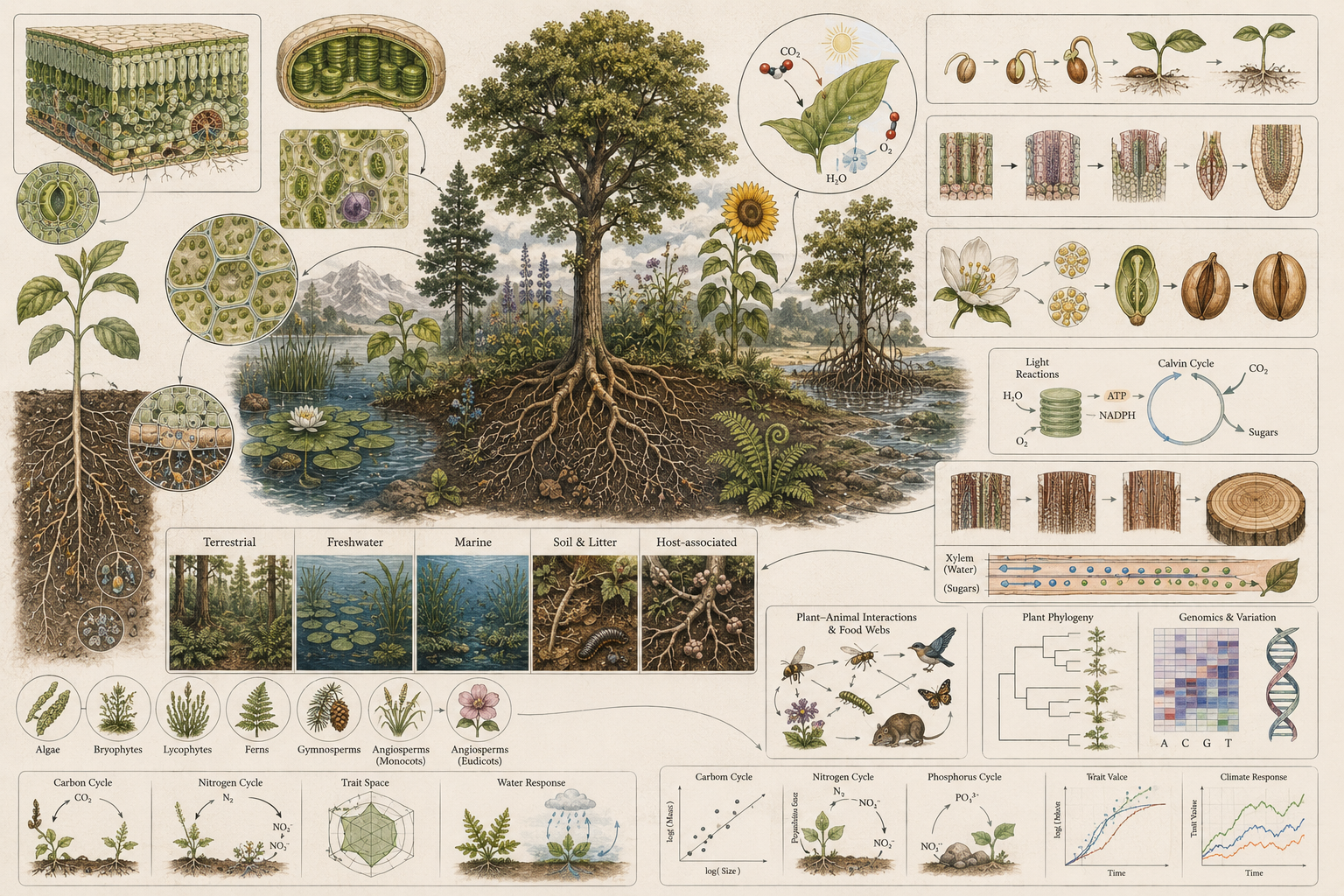
This article develops plant biology as a scale-spanning framework for understanding primary producers. It examines photosynthesis, carbon fixation, gross primary productivity, net primary productivity, plant development, roots, leaves, stems, water relations, nutrient uptake, plant physiology, terrestrial and aquatic producers, plant-soil-microbe systems, mycorrhizal exchange, agroecology, forestry, restoration, plant disease, bioinformatics, remote sensing, Earth observation, and computational modeling.
The article is written for plant biologists, ecologists, plant physiologists, marine biologists, freshwater scientists, agroecologists, foresters, conservation practitioners, restoration ecologists, soil scientists, disease ecologists, environmental-health readers, remote-sensing analysts, computational biology readers, biodiversity experts, and systems biologists who need a rigorous account of how primary producers organize energy, carbon, water, nutrients, habitat, and ecological resilience.
The article also extends plant biology into quantitative and computational biology through productivity equations, light-response curves, biomass recovery models, drought-sensitivity screening, canopy productivity analysis, carbon-balance comparison, R workflows, Python workflows, SQL provenance structures, and a linked full-stack GitHub repository containing Python, R, Julia, Fortran, Rust, Go, C, C++, SQL, notebooks, data files, and reproducibility documentation.
What primary producers are
Primary producers are organisms that generate organic matter from inorganic inputs and thereby form the energetic foundation of ecosystems. In most of Earth’s biosphere, this role is played by photosynthetic organisms that capture light and convert carbon dioxide into organic compounds. That broad category includes land plants, algae, phytoplankton, cyanobacteria, and other photoautotrophs. Yet plant biology remains central because plants dominate terrestrial primary production and because many of the major questions surrounding carbon balance, biomass accumulation, land cover, water regulation, and habitat structure are fundamentally plant questions.
This matters because primary producers do not simply feed herbivores. They create the first major biological entry point for energy and fixed carbon into ecosystems. They convert atmospheric and aquatic carbon dioxide into organic compounds that become leaves, stems, wood, roots, seeds, litter, detritus, dissolved organic matter, and eventually the metabolic substrate for most heterotrophic life. In that sense, plant biology is inseparable from the study of life’s material basis. To understand primary producers is to understand how ecosystems begin energetically, structurally, and biochemically.
Plant biology therefore cannot be reduced to descriptive botany. It is also a science of flux. The relevant questions are not only what plants are, but how much carbon they fix, how they allocate biomass, how they regulate water loss, how they respond to nutrient limits, how they shape soil and microbial systems, and how they recover or fail under stress. Primary producers are foundational because they mediate the conversion of planetary energy into living matter.
Plants as the basis of terrestrial life
Land plants are the dominant primary producers of terrestrial ecosystems. Forests, grasslands, shrublands, wetlands, croplands, tundra systems, and many urban ecological mosaics depend on plant growth for carbon input, habitat structure, nutrient capture, and trophic support. This gives plants a uniquely foundational role in terrestrial biology. They are not merely one clade among many; they are a major mechanism through which land ecosystems become productive, physically structured, and climatically interactive.
This matters because terrestrial ecosystems are not only collections of species. They are plant-structured systems. Forest canopies regulate light regimes, humidity, and thermal buffering. Root systems alter soil stability, infiltration, and belowground carbon input. Leaves drive gas exchange with the atmosphere. Reproductive structures influence animal movement, pollination, and seed dispersal networks. Vegetation creates the physical and energetic conditions under which many other organisms live.
Plants therefore shape terrestrial life at multiple levels at once: biochemical, ecological, climatic, hydrological, and architectural. They are not passive background organisms. They are the living framework of land ecosystems. That is why plant decline, canopy loss, crop failure, drought stress, salinization, or regeneration failure often signal deeper system instability rather than isolated botanical problems.
Photosynthesis and the conversion of light into living matter
Photosynthesis is the core process through which most primary producers capture solar energy and convert it into chemically usable organic matter. In biochemical terms, it couples light harvesting, electron transport, and carbon fixation to produce sugars and related organic compounds from carbon dioxide and water. In ecological terms, it links planetary physics to biology by turning solar radiation into tissue, food, habitat, litter, and long-term carbon storage.
This matters because photosynthesis is not only a biochemical pathway. It is one of the most consequential processes in Earth history. It contributes to atmospheric oxygen, drives carbon uptake, and makes most large-scale food webs possible. Its historical significance extends far beyond land plants, as photosynthetic microbes reshaped atmospheric conditions long before forests emerged. But in the context of contemporary terrestrial and many freshwater systems, plants remain one of the dominant photosynthetic interfaces between the atmosphere and the biosphere.
Plant biology begins here because plants are not simply green organisms occupying habitats. They are living biochemical systems that transform light into matter and ecological possibility. Yet photosynthesis is always physiologically costly and environmentally constrained. Light capture must be balanced against photodamage, stomatal opening against water loss, and carbon gain against nutrient limitation. That tension is one of the main reasons plant biology remains such a rich scientific field.
Gross primary productivity, net primary productivity, and carbon balance
Primary production is often analyzed through the distinction between gross primary productivity and net primary productivity. Gross primary productivity, or GPP, represents the total amount of carbon fixed during photosynthesis. Net primary productivity, or NPP, represents GPP minus the portion used in autotrophic respiration. This distinction is crucial because ecosystems depend not on total carbon fixed alone, but on how much remains available for growth, reproduction, storage, herbivores, detrital systems, and longer-term carbon retention.
This matters because carbon balance lies near the center of plant biology, ecosystem science, and climate reasoning. High photosynthetic activity does not automatically translate into high biomass accumulation if respiration costs are also high or if tissues turn over rapidly. Likewise, high productivity does not guarantee long-term carbon storage if disturbance, herbivory, decomposition, or fire rapidly return carbon to the atmosphere. NPP is therefore not just an accounting metric. It is a bridge concept connecting physiology, growth, trophic support, and ecosystem carbon dynamics.
Plant biology is especially strong when it treats carbon balance as dynamic rather than static. GPP, respiration, NPP, litter production, root exudation, tissue turnover, and disturbance losses all matter. This makes plant science central to Biogeochemical Cycles and the Conditions of Habitability, to ecosystem productivity analysis, and to any serious conversation about climate response, restoration, or land-use change.
Plant form, growth, and development
Plants are primary producers, but they are also developmental organisms with highly structured growth, morphology, and life-history strategies. Growth in plants depends on cell division, elongation, meristematic activity, tissue differentiation, source-sink relationships, and the integration of light, water, nutrient, and hormonal signals. Plant form is therefore dynamic rather than static, and plant productivity is inseparable from developmental organization.
This matters because a plant is not merely a photosynthetic surface. A leaf is a specialized organ for light capture, gas exchange, and temperature regulation. A root is not simply an anchor but a foraging and exchange system embedded in soil heterogeneity and microbial interaction. A stem is not only support but also a transport pathway, storage axis, and architectural organizer. Reproductive structures mediate lineage continuation, dispersal, and ecological timing. Growth patterns shape biomass allocation, stress tolerance, reproductive scheduling, competitive ability, and ecosystem engineering capacity.
Plant biology is strongest when it integrates physiology and ecology with development. Primary producers are built organisms, not just biochemical factories. This places the subject in direct relation to Development, Differentiation, and the Making of Organisms, because complex ecological function depends on how plant structure is developmentally made and modulated through time.
Roots, leaves, stems, and the organization of plant life
The organization of plant life depends on differentiated structures with distinct but integrated ecological and physiological roles. Leaves capture light and exchange gases. Roots acquire water and nutrients while interacting with soils, fungi, and microbes. Stems provide support, transport, storage, and positioning in light space. Reproductive tissues govern mating systems, seed production, and dispersal. This structural division of labor matters because plant success depends on coordination among organs rather than on photosynthesis in isolation.
Water lost through leaves must be replaced by roots. Carbon fixed in leaves must be transported and allocated to stems, roots, developing seeds, and storage tissues. Stems position tissues relative to light, wind, and herbivory while linking root and shoot systems into one integrated organism. Damage or constraint in one organ system often cascades through the rest of the plant. Hydraulic failure, nutrient limitation, defoliation, phloem disruption, root pathogen pressure, or reproductive stress all demonstrate that plant form is also plant vulnerability.
Primary production therefore depends on morphology as much as chemistry. Plant structure is ecological strategy embodied in form. This is why trait-based ecology, plant architecture, hydraulic biology, and reproductive ecology all remain central to modern plant science.
Plant physiology, water, nutrients, and environmental response
Plant physiology is shaped by the need to balance energy capture with water management, nutrient uptake, temperature stress, tissue defense, and environmental variability. Photosynthesis requires gas exchange with the atmosphere, but stomatal opening increases the risk of water loss. Nutrient acquisition depends on root growth, mycorrhizal partnership, soil chemistry, and microbial turnover. Light capture depends on canopy architecture, leaf area, pigment systems, and developmental plasticity. Plant life is therefore a constant negotiation among partially competing demands.
This is one reason plant biology cannot be reduced to photosynthesis alone. Primary producers must continuously negotiate trade-offs among carbon gain, water conservation, nutrient limitation, defense, growth timing, and reproductive investment. Their physiology is therefore central to ecosystem response under drought, warming, salinity, eutrophication, nutrient depletion, pollution, and disturbance. Physiological stress is often the immediate mechanism through which climate change, poor soil condition, pathogen burden, or hydrologic disruption become biologically meaningful.
For plant ecophysiologists, crop scientists, foresters, and restoration biologists, this makes plant physiology central to food security, regeneration, resilience, and long-term habitability. It also links plant science directly to Physiology and the Regulation of Living Systems, though plants solve the problem of regulation under very different structural and ecological constraints than animals do.
Plants, ecology, and the architecture of ecosystems
Plants shape ecosystems not only by producing biomass, but by creating habitat, altering microclimate, stabilizing soils, influencing hydrology, modulating fire, structuring trophic pathways, and shaping community composition. Ecosystems are often plant-structured systems in a very literal sense. Forest canopies determine light and humidity gradients. Grasslands mediate belowground carbon allocation and grazing dynamics. Wetland vegetation modifies water flow, sediment retention, and redox conditions. Shrublands alter fire behavior and regenerative pathways.
This matters because ecosystems cannot be understood as abstract networks detached from their primary producers. Plant communities influence both the energy base and the physical architecture of living environments. They shape the conditions under which animals forage, microbes decompose, fungi exchange nutrients, pathogens persist, and disturbance propagates. Plant loss can therefore reorganize entire systems, not merely reduce local greenness.
Plant biology is thus inseparable from ecology in the strongest sense. To study plants is to study how living environments are built, maintained, and destabilized. This is why plant science belongs near the center of conservation biology, landscape ecology, agroecology, forest ecology, and restoration practice.
Terrestrial and aquatic primary producers
Although land plants dominate terrestrial primary production, primary producers also include algae, phytoplankton, cyanobacteria, and other photoautotrophs in aquatic systems. Ocean productivity largely depends on phytoplankton, which provide organic carbon to diverse heterotrophs and drive major fractions of global carbon fixation. Lakes, rivers, wetlands, estuaries, and coastal zones are likewise sustained by varied assemblages of photoautotrophs whose abundance, productivity, and community structure are shaped by light availability, stratification, turbidity, nutrient supply, grazing, and hydrology.
This broader view matters because plant biology sits within a wider biology of primary producers. Many of the core ecological functions associated with plants on land are performed in aquatic systems by very different kinds of organisms. Primary production is therefore a planetary phenomenon with multiple biological forms, different residence times, different trophic efficiencies, and different pathways of export, recycling, and storage.
For marine biologists, limnologists, freshwater ecologists, and environmental scientists, this means oceans, lakes, rivers, wetlands, and estuaries must be understood not as secondary cases but as major primary-producing worlds in their own right. Plant biology gains depth when it is placed in this broader producer framework rather than being confined narrowly to terrestrial vascular plants alone.
Plants, soils, microbes, and symbiotic life
Plants do not function alone. Soil carbon, nutrient cycling, decomposition, nitrogen availability, mycorrhizal exchange, rhizosphere interaction, and microbial feedback all tie plant biology to belowground systems. Plant carbon input and microbial turnover are tightly coupled. Root-associated microbes and fungi alter nutrient uptake, stress tolerance, disease resistance, growth rate, and soil aggregation. Plants, in turn, shape microbial communities through exudates, litter chemistry, canopy effects, and patterns of carbon allocation belowground.
This matters because plant life is inseparable from soils and symbiosis. A plant is not simply an autotrophic individual rooted in inert substrate. It is part of a coupled aboveground-belowground system linking atmospheric carbon uptake to soil food webs, microbial transformation, fungal exchange, and long-term ecosystem development. Primary production becomes ecologically meaningful only because plants are embedded in these relational networks.
Plant biology is therefore deeply connected to Microbiology and the Hidden Majority of Life, Fungi and the Networks of Decomposition and Exchange, and Coevolution, Symbiosis, and the Dynamics of Mutual Change. This is especially important for restoration ecology, agroecology, and forestry, where poor outcomes often reflect not only failed planting but also failed reconstruction of belowground ecological function.
Agroecology, forestry, restoration, and environmental change
Plant biology is central to agriculture, forestry, habitat restoration, carbon storage, watershed integrity, and climate adaptation because food systems, forests, and recovery trajectories all depend on primary producers. Agricultural systems rely on plant growth, nutrient-use efficiency, root architecture, water relations, phenology, and resistance to stress. Forest systems regulate carbon storage, hydrology, habitat complexity, and long-term landscape stability. Restoration ecology depends on reestablishing plant communities capable of rebuilding ecological function through time, not merely producing short-term cover.
This matters because many environmental and sustainability problems are plant problems in disguised form: degraded soils, collapsing pollination systems, drought sensitivity, canopy loss, failed regeneration, nutrient depletion, salinization, invasive takeover, and declining productivity under climate stress. Primary producers lie at the heart of these issues because they mediate the conversion of environmental resources into living structure, trophic support, and system persistence.
Plant biology is thus one of the strongest bridges between basic biology and large-scale environmental stewardship. It belongs directly to Restoration Ecology and the Repair of Living Systems, to agroecology, to forestry, and to broader climate and resilience science. In many cases, successful recovery depends not just on reintroducing species, but on restoring the physiological and ecological conditions under which plants can persist, reproduce, and rebuild coupled systems.
Medical, biomedical, and disease ecology relevance
Plant biology also matters beyond ecology in any narrow sense. Plant-derived compounds shape nutrition, pharmacology, toxicology, and human exposure pathways. Plant pathogens shape disease ecology in agricultural and wild systems, with consequences for food security, biodiversity, and landscape function. Plant productivity influences food quality, micronutrient availability, and ecosystem conditions that affect broader health outcomes. Vegetation structure can also influence host distributions, vector habitat, humidity regimes, and pathogen persistence in landscapes.
This matters because primary producers affect health both indirectly and directly. They feed populations, generate medically significant compounds, and structure environments through which disease systems operate. Plant decline can alter dust exposure, smoke burden, nutritional adequacy, and habitat suitability for vectors or wildlife reservoirs. Agricultural disease in plants can cascade into human and animal systems through crop failure, toxin production, or land-use change.
Biology is strongest here when it sees plants as part of coupled systems of food, environment, immunity, and public health. Plant science is not peripheral to health. It is one of the background conditions through which health and disease become spatially and materially organized.
Bioinformatics, remote sensing, and computational relevance
Modern plant biology increasingly depends on computation, remote sensing, trait databases, eddy-covariance systems, imaging, genome analysis, transcriptomics, phenomics, and landscape-scale ecological data. Productivity can be estimated from canopy signals, climate variables, biomass inventories, flux towers, spectral indices, and process-based models. Stress response can be studied through gene expression, metabolite profiling, thermal imaging, and trait-environment inference. The study of primary producers is now deeply connected to Earth observation and quantitative ecosystem science.
This matters because plant biology operates across scales from chloroplast metabolism to global carbon flux. Remote sensing helps infer canopy behavior, productivity, water status, and disturbance over landscapes. Bioinformatics helps analyze plant genomes, signaling networks, and stress-response pathways. Systems approaches help link physiology to climate, land use, nutrient status, pathogen pressure, and recovery potential. Plants are therefore central not only to field botany and ecology but also to data-rich environmental science.
For computational readers, plant systems are especially valuable because they combine measurable fluxes, visible structure, scalable landscape signatures, and strong ecological consequence. That makes plant biology one of the clearest domains in which organismal biology, Earth-system science, and computational modeling converge.
Quantitative plant biology: mathematics, R, and Python
Plant biology and primary production are deeply quantitative because growth, carbon fixation, respiration, transpiration, biomass change, survival, recovery, and canopy response can all be represented mathematically. The point of modeling is not to decorate plant science with equations, but to clarify rates, trade-offs, thresholds, and comparative dynamics that matter for real biological reasoning.
Carbon balance and productivity
A simple productivity framing begins with the distinction between gross primary productivity and respiration:
NPP=GPP-R_a
\]
Interpretation: \(NPP\) is net primary productivity, \(GPP\) is gross primary productivity, and \(R_a\) is autotrophic respiration. This is useful because it captures the basic logic that not all carbon fixed by photosynthesis remains available for growth or storage.
In more complete ecosystem carbon accounting, net ecosystem productivity can be written as:
NEP=GPP-(R_a+R_h)
\]
Interpretation: \(R_h\) is heterotrophic respiration. This matters because plant-driven carbon gain cannot be understood without the microbial and detrital processes that return carbon to the atmosphere.
Light response and saturation
At the leaf or canopy level, photosynthetic response to light is often nonlinear. A simple rectangular hyperbola can be written as:
A(I)=\frac{\alpha I A_{max}}{\alpha I+A_{max}}-R_d
\]
Interpretation: \(A(I)\) is net assimilation at irradiance \(I\), \(\alpha\) is the initial quantum-use efficiency, \(A_{max}\) is the asymptotic photosynthetic maximum, and \(R_d\) is dark respiration. This is useful because plant productivity does not increase indefinitely with light. Saturation, photoprotection, heat, and water stress all shape realized carbon gain.
Biomass growth under limitation
A simple growth model for standing biomass \(B\) can be written as:
\frac{dB}{dt}=NPP-L
\]
Interpretation: \(L\) is loss through senescence, herbivory, mortality, disturbance, or harvest. This compact balance is useful because biomass change depends on both production and loss.
If recovery is density-limited after disturbance, a logistic biomass form may be useful:
\frac{dB}{dt}=rB\left(1-\frac{B}{K}\right)-mB+I(t)
\]
Interpretation: \(r\) is intrinsic regrowth rate, \(K\) is site carrying capacity under current conditions, \(m\) is chronic loss or stress mortality, and \(I(t)\) is an intervention term such as planting, irrigation, or hydrologic repair. This is especially useful in restoration ecology, forestry, and drought-recovery analysis.
Worked example: net primary productivity
Suppose a plant community fixes \(GPP=1800\) units of carbon over a given interval and uses \(R_a=700\) units in autotrophic respiration. Then:
NPP=1800-700=1100
\]
Interpretation: This means 1100 units remain as net primary productivity available for growth, reproduction, storage, or entry into food webs. Even this simple calculation is analytically useful because it distinguishes total fixation from biologically retained carbon.
R and Python workflows
The following examples are compact article-level workflows. The full GitHub repository expands them into richer multi-language implementations with SQL provenance, validation notes, carbon-balance comparison, GPP/NPP/NEP accounting, light-response curves, drought-sensitivity screening, plant biomass recovery, canopy productivity analysis, restoration scenario comparison, and reproducible computational plant-biology scaffolding.
R example: carbon balance and site comparison
# Quantitative plant biology workflow in R
#
# This workflow compares carbon balance across sites and estimates
# net primary productivity and net ecosystem productivity.
#
# It is a teaching scaffold, not a calibrated carbon-accounting model.

library(dplyr)

sites <- tibble(
  site = c(
    "temperate_forest",
    "grassland",
    "wetland",
    "restoration_site"
  ),
  GPP = c(2200, 1450, 1800, 1300),
  Ra = c(900, 600, 760, 620),
  Rh = c(700, 500, 680, 710)
) %>%
  mutate(
    NPP = GPP - Ra,
    NEP = GPP - (Ra + Rh),
    carbon_balance_class = case_when(
      NEP > 250 ~ "strong_net_sink",
      NEP > 0 ~ "weak_net_sink",
      TRUE ~ "net_source_or_unstable"
    )
  )

print(sites)
This workflow is useful because it moves beyond a one-line productivity calculation into comparative carbon-balance reasoning. It can be extended to seasonal time series, flux-tower data, disturbance comparisons, or restoration assessment.
R example: light response and drought-sensitivity screening
# Light-response and drought-sensitivity screening.
#
# This workflow compares plant carbon assimilation under different
# physiological stress scenarios.

library(dplyr)
library(tidyr)
library(purrr)

light_response <- function(I, alpha = 0.05, Amax = 18, Rd = 1.5) {
  (alpha * I * Amax) / (alpha * I + Amax) - Rd
}

irradiance <- seq(0, 2000, by = 25)

scenarios <- tibble(
  scenario = c("well_watered", "moderate_drought", "severe_drought"),
  alpha = c(0.055, 0.045, 0.030),
  Amax = c(20, 15, 9),
  Rd = c(1.5, 1.8, 2.2)
)

results <- scenarios %>%
  mutate(
    sim = pmap(
      list(scenario, alpha, Amax, Rd),
      function(scenario, alpha, Amax, Rd) {
        tibble(
          scenario = scenario,
          irradiance = irradiance,
          assimilation = light_response(irradiance, alpha, Amax, Rd)
        )
      }
    )
  ) %>%
  select(scenario, sim) %>%
  unnest(sim)

summary_tbl <- results %>%
  group_by(scenario) %>%
  summarise(
    max_assimilation = max(assimilation),
    assimilation_at_1000 = assimilation[irradiance == 1000],
    .groups = "drop"
  )

print(summary_tbl)
This workflow is useful for plant ecophysiologists and restoration practitioners because it translates stress into altered light-use performance rather than treating photosynthesis as fixed. It can be extended with temperature, vapor-pressure deficit, leaf traits, or species comparisons.
Python example: productivity across multiple sites and recovery screening
import pandas as pd

sites = {
    "forest": {"GPP": 2200, "Ra": 900, "Rh": 700},
    "grassland": {"GPP": 1400, "Ra": 600, "Rh": 500},
    "wetland": {"GPP": 1800, "Ra": 750, "Rh": 680},
    "restoration_site": {"GPP": 1250, "Ra": 610, "Rh": 700},
}

rows = []

for name, values in sites.items():
    npp = values["GPP"] - values["Ra"]
    nep = values["GPP"] - (values["Ra"] + values["Rh"])

    rows.append(
        {
            "site": name,
            "GPP": values["GPP"],
            "Ra": values["Ra"],
            "Rh": values["Rh"],
            "NPP": npp,
            "NEP": nep,
            "carbon_balance_class": (
                "strong_net_sink"
                if nep > 250
                else "weak_net_sink"
                if nep > 0
                else "net_source_or_unstable"
            ),
        }
    )

df = pd.DataFrame(rows)

print(df)
This Python example provides a compact way to compare how productivity and whole-ecosystem carbon balance diverge across sites. It is useful when a system appears productive but remains a weak or negative net carbon sink.
Python example: plant biomass recovery after disturbance
import numpy as np
import pandas as pd

def biomass_recovery(
    days=365,
    dt=1.0,
    B0=50.0,
    r=0.01,
    K=300.0,
    m=0.002,
    pulse_day=None,
    pulse_size=0.0,
):
    """Simulate plant biomass recovery after disturbance."""

    time = np.arange(0, days + dt, dt)
    biomass = np.zeros_like(time, dtype=float)
    biomass[0] = B0

    for index in range(1, len(time)):
        intervention = (
            pulse_size
            if pulse_day is not None and abs(time[index] - pulse_day) < 1e-9
            else 0.0
        )

        d_biomass = (
            r * biomass[index - 1] * (1 - biomass[index - 1] / K)
            - m * biomass[index - 1]
            + intervention
        ) * dt

        biomass[index] = max(biomass[index - 1] + d_biomass, 0.0)

    return pd.DataFrame({"day": time, "biomass": biomass})

scenarios = {
    "unassisted_recovery": {
        "B0": 40,
        "r": 0.008,
        "K": 180,
        "m": 0.003,
        "pulse_day": None,
        "pulse_size": 0,
    },
    "soil_repair": {
        "B0": 40,
        "r": 0.010,
        "K": 220,
        "m": 0.0025,
        "pulse_day": None,
        "pulse_size": 0,
    },
    "replanting": {
        "B0": 40,
        "r": 0.010,
        "K": 220,
        "m": 0.0025,
        "pulse_day": 30,
        "pulse_size": 15,
    },
    "replanting_plus_hydrology_repair": {
        "B0": 40,
        "r": 0.013,
        "K": 280,
        "m": 0.0020,
        "pulse_day": 30,
        "pulse_size": 20,
    },
}

runs = []

for name, params in scenarios.items():
    result = biomass_recovery(**params)
    result["scenario"] = name
    runs.append(result)

results = pd.concat(runs, ignore_index=True)

summary = (
    results.groupby("scenario")
    .agg(
        final_biomass=("biomass", "last"),
        peak_biomass=("biomass", "max"),
    )
    .reset_index()
)

print(summary.round(3))
This recovery workflow is useful because it captures a common restoration logic: plant recovery depends not only on planting effort but on whether site conditions shift enough to change growth rate, carrying capacity, and chronic stress loss.
Python example: simple canopy productivity screening
import numpy as np
import pandas as pd

def light_response(I, alpha=0.05, Amax=18, Rd=1.5):
    """Return net assimilation from a simple light-response curve."""

    return (alpha * I * Amax) / (alpha * I + Amax) - Rd

irradiance = np.arange(0, 2001, 100)

scenarios = {
    "reference_canopy": {"alpha": 0.055, "Amax": 20, "Rd": 1.5},
    "nutrient_limited": {"alpha": 0.045, "Amax": 15, "Rd": 1.8},
    "drought_stressed": {"alpha": 0.030, "Amax": 9, "Rd": 2.2},
}

rows = []

for name, params in scenarios.items():
    for I in irradiance:
        rows.append(
            {
                "scenario": name,
                "irradiance": I,
                "assimilation": light_response(I, **params),
            }
        )

df = pd.DataFrame(rows)

summary = (
    df.groupby("scenario")
    .agg(
        max_assimilation=("assimilation", "max"),
        mean_assimilation=("assimilation", "mean"),
    )
    .reset_index()
)

print(summary.round(3))
This screening workflow is useful for comparative canopy physiology and can be expanded into response-surface analysis with temperature, moisture, vapor-pressure deficit, or stomatal conductance parameters.
These examples remain compact enough for an article, but they point toward the kinds of workflows scientists actually use: carbon-balance comparison, light-response modeling, drought-sensitivity screening, biomass recovery, restoration scenario analysis, canopy productivity screening, and explicit tracking of how production, respiration, stress, and loss shape plant system performance.
GitHub repository
The article body includes compact R and Python examples so the biological and scientific argument remains readable. The full repository expands those examples into a broader computational plant-biology workflow, including carbon-balance comparison, GPP/NPP/NEP accounting, light-response curves, drought-sensitivity screening, plant biomass recovery, canopy productivity analysis, restoration scenario comparison, SQL provenance structures, reproducible data files, and full-stack scientific-computing examples across Python, R, Julia, Fortran, Rust, Go, C, C++, SQL, and notebooks.
Limits, uncertainty, and modern plant thinking
Plant biology is foundational, but primary production should not be oversimplified. Not all primary producers are terrestrial plants. Not all productivity is equally accessible to food webs. Not all high-productivity systems store carbon effectively. Productivity depends on climate, nutrient constraint, water availability, disturbance, decomposition, community composition, and timescale of measurement. A productive canopy can still sit within a system that is unstable, stressed, or losing long-term biomass. A carbon-rich ecosystem can still be vulnerable to drought, heat, pests, salinization, hydrologic disruption, or failed regeneration.
This is why modern plant thinking increasingly integrates physiology, ecology, climate science, soil systems, hydrology, genomics, remote sensing, and systems analysis. Plants are not reducible to “green biomass.” They are dynamic living systems embedded in nutrient cycles, microbial interactions, trophic webs, water budgets, disturbance regimes, and atmospheric feedback. Scientific seriousness in plant biology therefore requires resisting simplistic narratives of plants as passive carbon sponges or passive background scenery.
Models are useful because they clarify assumptions, expose rates, and make scenario comparison possible. But a productivity equation is not an ecosystem, a light-response curve is not a canopy, and a satellite index is not a complete diagnosis of plant function. Quantitative tools are strongest when they support biological interpretation rather than replacing it.
Biology is strongest when it treats primary producers not as scenery, but as the central living interface between energy, matter, ecosystem organization, and environmental change. That framing is both more accurate and more scientifically useful.
Why this matters for scientific work
For working scientists, plant biology matters because plants are often the load-bearing variables hidden inside broader questions of ecosystem function, climate response, restoration success, agricultural resilience, and biodiversity change. A watershed problem may be partly a vegetation problem. A soil problem may be partly a root and litter problem. A carbon accounting problem may depend on whether canopy productivity is sustained, whether respiration rises under heat stress, whether mortality accelerates, and whether regeneration occurs after disturbance. A disease-ecology problem may turn on habitat structure created by plants.
This means plant biology should often be treated as explanatory infrastructure rather than as a specialized botanical layer. Ecologists need it to understand trophic support, habitat structure, nutrient cycling, and succession. Marine and freshwater researchers need it to interpret aquatic productivity and producer-grazer dynamics. Restoration practitioners need it because recovery depends on primary-producer establishment, stress tolerance, and long-term regeneration. Computational biologists and remote-sensing analysts need it because plants provide tractable yet ecologically decisive systems for linking physiological mechanism to landscape pattern.
The scientific importance of plant biology lies partly in this integrative force. Plants are not scenery beneath ecology. They are one of the main ways energy, matter, structure, and resilience enter living systems.
Conclusion
Plant biology and the life of primary producers show that photosynthetic life is foundational to the biosphere because it captures energy, fixes carbon, builds biomass, structures habitats, supports food webs, and helps regulate the atmosphere, water cycle, and climate. Plants dominate terrestrial primary production, while phytoplankton and other aquatic photoautotrophs sustain major aquatic systems. Together, these organisms make most large-scale life possible.
To understand plant biology is therefore to understand one of the deepest material foundations of living systems. Primary producers do not merely support ecosystems from below. They actively create the conditions under which ecosystems function at all. That is why plant biology remains central not only to botany and ecology, but also to conservation, soil biology, marine biology, agroecology, forestry, restoration, disease ecology, Earth observation, and sustainability-adjacent science more broadly.
Plants are thus more than one branch of life among others. They are one of the principal ways the Earth becomes biologically productive.
Related articles
- Biology
- Ecology and the Interdependence of Life
- Biogeochemical Cycles and the Conditions of Habitability
- Microbiology and the Hidden Majority of Life
- Fungi and the Networks of Decomposition and Exchange
- Animal Biology and the Organization of Complex Life
- Coevolution, Symbiosis, and the Dynamics of Mutual Change
- Development, Differentiation, and the Making of Organisms
- Metabolism, Energy, and Biological Function
- Restoration Ecology and the Repair of Living Systems
- Biodiversity and the Structure of Living Systems
- Population Dynamics and Ecological Modeling
Further reading
- Lambers, H., Chapin, F.S. III and Pons, T.L. (2008) Plant Physiological Ecology. 2nd edn. New York: Springer. Publisher information available at: https://link.springer.com/book/10.1007/978-0-387-78341-3
- Taiz, L., Zeiger, E., Møller, I.M. and Murphy, A. (2015) Plant Physiology and Development. 6th edn. Sunderland, MA: Sinauer Associates. Publisher information available at: https://global.oup.com/ushe/product/plant-physiology-and-development-9781605357454
- Chapin, F.S. III, Matson, P.A. and Vitousek, P.M. (2011) Principles of Terrestrial Ecosystem Ecology. 2nd edn. New York: Springer. Publisher information available at: https://link.springer.com/book/10.1007/978-1-4419-9504-9
- Field, C.B. and Raupach, M.R. (eds.) (2004) The Global Carbon Cycle: Integrating Humans, Climate, and the Natural World. Washington, DC: Island Press. Publisher information available at: https://islandpress.org/books/global-carbon-cycle
- Jones, H.G. (2014) Plants and Microclimate: A Quantitative Approach to Environmental Plant Physiology. 3rd edn. Cambridge: Cambridge University Press. Publisher information available at: https://www.cambridge.org/core/books/plants-and-microclimate/2F9934E96233C32B1442ACF79769132D
- Field, C.B., Behrenfeld, M.J., Randerson, J.T. and Falkowski, P. (1998) ‘Primary production of the biosphere: integrating terrestrial and oceanic components’, Science, 281(5374), pp. 237–240. Available at: https://doi.org/10.1126/science.281.5374.237
- Beer, C. et al. (2010) ‘Terrestrial gross carbon dioxide uptake: global distribution and covariation with climate’, Science, 329(5993), pp. 834–838. Available at: https://doi.org/10.1126/science.1184984
- Running, S.W. et al. (2004) ‘A continuous satellite-derived measure of global terrestrial primary production’, BioScience, 54(6), pp. 547–560. Available at: https://academic.oup.com/bioscience/article/54/6/547/294347
- Wardle, D.A. et al. (2004) ‘Ecological linkages between aboveground and belowground biota’, Science, 304(5677), pp. 1629–1633. Available at: https://pubmed.ncbi.nlm.nih.gov/15192218/
References
- Beer, C., Reichstein, M., Tomelleri, E., Ciais, P., Jung, M., Carvalhais, N., Rödenbeck, C., Arain, M.A., Baldocchi, D., Bonan, G.B., Bondeau, A., Cescatti, A., Lasslop, G., Lindroth, A., Lomas, M., Luyssaert, S., Margolis, H., Oleson, K.W., Roupsard, O., Veenendaal, E., Viovy, N., Williams, C., Woodward, F.I. and Papale, D. (2010) ‘Terrestrial gross carbon dioxide uptake: global distribution and covariation with climate’, Science, 329(5993), pp. 834–838. Available at: https://doi.org/10.1126/science.1184984
- Bonan, G.B. (2008) ‘Forests and climate change: forcings, feedbacks, and the climate benefits of forests’, Science, 320(5882), pp. 1444–1449. Available at: https://doi.org/10.1126/science.1155121
- Chapin, F.S. III, Matson, P.A. and Vitousek, P.M. (2011) Principles of Terrestrial Ecosystem Ecology. 2nd edn. New York: Springer. Publisher information available at: https://link.springer.com/book/10.1007/978-1-4419-9504-9
- Field, C.B., Behrenfeld, M.J., Randerson, J.T. and Falkowski, P. (1998) ‘Primary production of the biosphere: integrating terrestrial and oceanic components’, Science, 281(5374), pp. 237–240. Available at: https://doi.org/10.1126/science.281.5374.237
- Flexas, J. and Medrano, H. (2002) ‘Drought-inhibition of photosynthesis in C3 plants: stomatal and non-stomatal limitations revisited’, Annals of Botany, 89(2), pp. 183–189. Available at: https://doi.org/10.1093/aob/mcf027
- Lambers, H., Chapin, F.S. III and Pons, T.L. (2008) Plant Physiological Ecology. 2nd edn. New York: Springer. Publisher information available at: https://link.springer.com/book/10.1007/978-0-387-78341-3
- Reich, P.B. (2014) ‘The world-wide “fast–slow” plant economics spectrum: a traits manifesto’, Journal of Ecology, 102(2), pp. 275–301. Available at: https://doi.org/10.1111/1365-2745.12211
- Running, S.W., Nemani, R.R., Heinsch, F.A., Zhao, M., Reeves, M. and Hashimoto, H. (2004) ‘A continuous satellite-derived measure of global terrestrial primary production’, BioScience, 54(6), pp. 547–560. Available at: https://academic.oup.com/bioscience/article/54/6/547/294347
- Taiz, L., Zeiger, E., Møller, I.M. and Murphy, A. (2015) Plant Physiology and Development. 6th edn. Sunderland, MA: Sinauer Associates. Publisher information available at: https://global.oup.com/ushe/product/plant-physiology-and-development-9781605357454
- Trenberth, K.E., Fasullo, J.T. and Kiehl, J. (2009) ‘Earth’s global energy budget’, Bulletin of the American Meteorological Society, 90(3), pp. 311–323. Available at: https://doi.org/10.1175/2008BAMS2634.1
- Wardle, D.A., Bardgett, R.D., Klironomos, J.N., Setälä, H., van der Putten, W.H. and Wall, D.H. (2004) ‘Ecological linkages between aboveground and belowground biota’, Science, 304(5677), pp. 1629–1633. Available at: https://pubmed.ncbi.nlm.nih.gov/15192218/