
Last Updated May 28, 2026
Natural selection, adaptation, and fitness examine how inherited variation affects survival and reproduction, how populations change through time under environmental pressures, and how biological traits become fitted, often imperfectly, to particular ecological conditions. Natural selection is one of the core mechanisms of evolution because it links heritable variation to differential reproductive success, allowing some traits, combinations, and lineages to become more common across generations. But for serious biological work, selection is not a slogan about “survival of the fittest.” It is a population-level process that must be understood quantitatively, historically, developmentally, physiologically, and ecologically.
This article develops Natural Selection, Adaptation, and Fitness as a foundational article within the Biology knowledge series. It treats adaptation not as vague biological improvement, but as the historically contingent outcome of differential reproduction under real ecological conditions. It treats fitness not as strength, health, superiority, or complexity in an everyday sense, but as relative reproductive contribution to future generations. And it treats selection as inseparable from mutation, drift, migration, recombination, development, physiological constraint, demographic structure, ecological interaction, and environmental heterogeneity.
The article develops natural selection, adaptation, and fitness across heritable variation, differential reproduction, genotype fitness, relative fitness, adaptation, exaptation, trade-offs, stabilizing selection, directional selection, disruptive selection, balancing selection, frequency-dependent selection, sexual selection, purifying selection, quantitative traits, adaptive mismatch, conservation risk, pathogen evolution, tumor evolution, ecological filtering, plant and microbial adaptation, and computational evolutionary analysis.
The article also extends selection biology into quantitative and computational analysis through Hardy-Weinberg baselines, relative fitness scaling, genotype-specific selection, mean fitness, allele-frequency updates, selection coefficients, quantitative-trait gradients, breeder’s equation logic, selection-drift simulations, variable-environment selection, time-series frequency screening, R workflows, Python workflows, SQL provenance structures, and a linked full-stack GitHub repository containing Python, R, Julia, Fortran, Rust, Go, C, C++, SQL, notebooks, data files, validation notes, and reproducibility documentation.
What Natural Selection Is
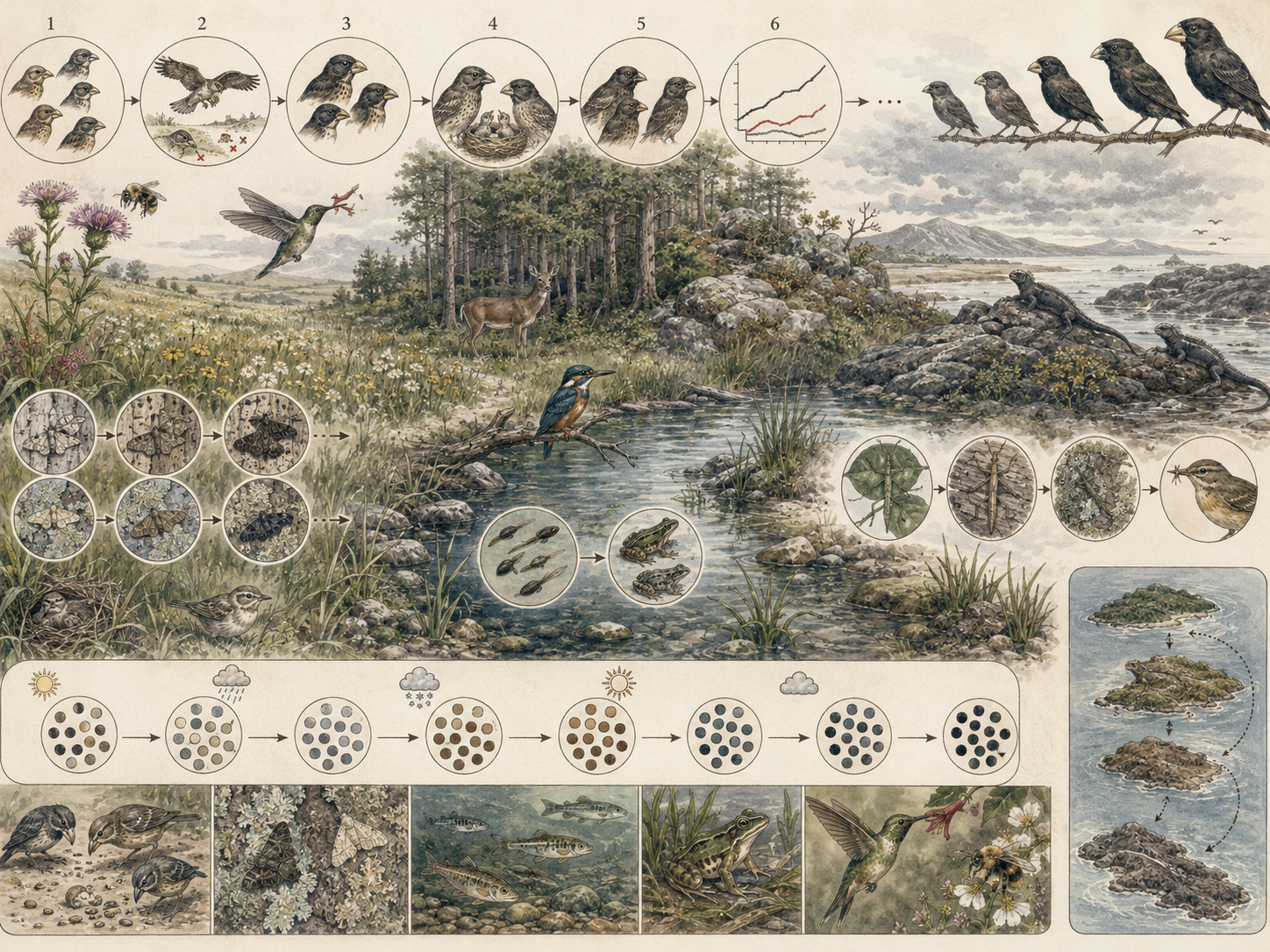
Natural selection is one of the basic mechanisms of evolution. It occurs when heritable variation affects survival or reproductive success, causing some variants to become more common across generations than others. The core logic is simple, but its implications are profound: populations are not static, and the traits most common in future generations depend partly on which inherited differences leave more descendants under real environmental conditions.
This matters because natural selection provides a non-mystical account of biological fit. Organisms need not have been designed all at once for current environments. Instead, traits can accumulate historically when their bearers leave relatively more offspring than competing variants. Selection therefore explains how adaptation can emerge without foresight, intention, or perfection.
Natural selection is therefore central not only to evolutionary theory, but to biology more broadly. It explains why populations change, why organisms often appear fitted to ecological roles, why resistance evolves, why local adaptation can emerge, and why the diversity of life has a directional though historically contingent relation to environment. At the same time, selection is never the whole story. It acts through developmental systems, ecological networks, and demographic realities that may amplify, dampen, constrain, or redirect its effects.
Selection is also a population process rather than an individual moral judgment. Individual organisms survive, die, reproduce, or fail to reproduce, but natural selection becomes evolution only when these differences alter the inherited composition of populations across generations. This distinction is essential. Selection does not make an individual stronger during its lifetime in the evolutionary sense. It changes the distribution of inherited variants through reproductive history.
Variation, Inheritance, and Differential Reproduction
Natural selection requires three broad conditions: variation among individuals, some degree of heredity, and differences in survival or reproductive output associated with that variation. Without variation, there is nothing for selection to sort. Without heredity, advantageous differences cannot persist beyond one generation. Without differential reproduction, variation remains evolutionarily inert.
This is one reason selection must always be understood at the population level. Individual organisms live and die, but evolution by natural selection occurs when inherited differences alter the composition of populations across generations. Selection does not try to improve single individuals in isolation. It changes the relative frequency of variants through historical time.
Variation also matters because populations are never identical collections of copies. Real organisms differ in size, physiology, timing, resistance, behavior, development, morphology, metabolism, reproduction, and environmental tolerance. Some of those differences are environmentally induced and not strongly heritable, while others have inherited components that make them evolutionarily consequential. Selection depends on that distinction. In practical research, one of the hardest problems is disentangling phenotypic plasticity, demographic noise, environmental covariance, and truly heritable difference that can respond to ongoing selection.
This distinction is especially important in ecology, conservation, agriculture, disease ecology, and biomedical interpretation. A population may show a trait shift because selection changed inherited frequencies, because individuals plastically adjusted to the environment, because different cohorts survived, or because sampling captured different subpopulations. Natural selection is powerful, but careful evidence is needed to show that it is the process responsible for observed change.
What Fitness Means in Evolutionary Biology
In evolutionary biology, fitness refers to relative reproductive success, not physical strength, health in the everyday sense, moral superiority, complexity, or athletic performance. This definition is crucial because it anchors fitness in historical reproductive outcome rather than appearance or intuition. A genotype, phenotype, lineage, or life-history strategy is fitter only insofar as it contributes more effectively to future generations than alternatives under relevant conditions.
This matters because organisms that seem impressive to human observers are not necessarily the most evolutionarily fit. A smaller, less conspicuous, less aggressive, or less “advanced-looking” organism may leave more surviving descendants under a given set of ecological conditions. Fitness is therefore always relational and context-dependent. It depends on environment, competitors, predators, mates, pathogens, mutualists, climate, disturbance, population density, resource availability, and the larger web of ecological and evolutionary pressures shaping reproduction.
Fitness is also not static. A variant that is advantageous in one environment may become neutral or harmful in another. This is one reason adaptation must be understood historically rather than as a permanent badge of superiority. Selection favors what works well enough under current or recent conditions, not what is universally best under all imaginable circumstances. Scientists therefore often distinguish absolute fitness, relative fitness, lifetime reproductive success, inclusive fitness, and components of fitness such as survival, mating success, fecundity, offspring viability, and recruitment, because different biological questions require different operational definitions.
This contextual definition of fitness is especially important for sustainability-adjacent biology. A locally adapted population may be highly fit under historical conditions but vulnerable under future climate regimes. A pathogen variant may have high fitness under drug pressure but lower fitness when treatment is absent. A plant genotype may be drought-tolerant but less competitive in wetter environments. Fitness is therefore not a universal property of an organism; it is a relationship among organism, trait, environment, and reproductive consequence.
Adaptation and the Problem of Biological Design
An adaptation is a feature that arose and was favored by natural selection for a function. This distinction is important because many traits may be useful now without having originally evolved for that same purpose. Biology gains explanatory precision when it distinguishes true adaptation from exaptation, developmental by-product, phylogenetic legacy, plastic response, neutral trait persistence, and constrained compromise.
Adaptation therefore raises the problem of biological design in a precise scientific way. Organisms often appear organized for function: wings for flight, leaves for light capture, kidneys for filtration, roots for resource uptake, microbial enzymes for nutrient use, immune systems for biological defense, and pigments for protection or signaling. Darwin’s great achievement was to explain this apparent design without requiring an external designer. Natural selection explains adaptive organization by preserving and promoting traits that improve reproductive success in particular contexts.
This does not mean every trait is an adaptation. Some traits are by-products, constraints, inherited relics, neutral features, or trade-offs. Biology is strongest when it asks carefully whether a trait qualifies as an adaptation rather than assuming that every visible characteristic must have been optimized by selection. This caution is especially important in comparative biology, evolutionary medicine, psychology, disease ecology, conservation, and behavioral interpretation, where adaptive storytelling can become too easy if not disciplined by evidence.
Adaptation also needs historical framing. A trait can be adaptive under one environment, maladaptive under another, or maintained because its benefits and costs vary across life stages. A thick shell may protect against predators but slow growth. A drought-tolerant plant may sacrifice yield under wet conditions. A pathogen variant may resist treatment but replicate more slowly without it. Adaptation is therefore not perfection; it is historically contingent functional fit under constraint.
Selection Is Not Perfection
One of the most important corrections to popular misunderstandings is that natural selection does not produce perfection. Organisms do not have to be perfect, only good enough to leave descendants under particular conditions. This is crucial because many real biological systems are constrained, compromised, historically burdened, or only partially well matched to current environments.
This matters for at least three reasons. First, selection works with available variation, not with ideal engineering from scratch. Second, traits often involve trade-offs, so improvement in one dimension may reduce performance in another. Third, environments change, meaning past adaptations may become maladaptive or only partially effective later. Gains in one context may be accompanied by deterioration in others, especially where thermal stress, nutrient limitation, pathogen burden, pollution, habitat fragmentation, or ecological novelty alters the fitness landscape.
Selection is therefore historically constrained, developmentally filtered, and ecologically conditional. Organisms are not perfect solutions. They are workable historical outcomes. That is why evolutionary explanation often requires attention to mismatch, lag, maladaptation, pleiotropy, drift, linkage, developmental constraint, demographic collapse, and compromise rather than only to functional success.
This perspective matters in applied science. Conservation plans can fail when they assume that current populations are well adapted to future environments. Medical interventions can fail when they unintentionally favor resistant variants. Restoration efforts can fail when source populations are mismatched to target conditions. Selection theory is practical precisely because adaptation is imperfect, conditional, and historically situated.
Types of Selection and Patterns of Change
Natural selection can take different forms depending on how environments reward variation. Directional selection favors one end of a distribution. Stabilizing selection favors intermediate states. Disruptive selection can favor extremes over intermediates. These patterns matter because they show that selection is not one uniform force pushing all populations in the same way. It can conserve, shift, or split trait distributions depending on ecological context.
Selection can also be frequency-dependent, sexually mediated, density-dependent, temporally fluctuating, spatially heterogeneous, or life-stage specific. Some variants do well because they are rare. Others do well because they improve mating success. Others succeed because ecological context changes with population structure, disturbance, seasonal conditions, disease pressure, or resource availability. This is one reason evolutionary biology resists overly simple slogans. Selection is real, but the forms it takes are varied and often interacting.
The resulting evolutionary change may be rapid or slow, obvious or subtle, steady or episodic. In some systems selection maintains relative stability; in others it drives continual turnover. In host-pathogen systems, agriculture, marine climate gradients, freshwater disturbance regimes, restoration contexts, and microbial communities, multiple kinds of selection may operate simultaneously across different life stages and spatial scales.
Balancing selection is especially important because it shows that selection does not always drive one variant to fixation. Heterozygote advantage, frequency-dependent selection, spatial variation, and fluctuating environments can help maintain diversity. Purifying selection is also important because it removes deleterious variants and preserves functional systems across time. Selection can therefore produce change, maintain stability, remove harmful variation, or preserve polymorphism depending on ecological and genetic context.
Selection Across Levels: Genes, Organisms, Populations, and Ecosystems
Natural selection is usually introduced through organismal survival and reproduction, but selection can be analyzed across multiple biological levels. Genes can spread because they improve transmission. Cells within a body can be selected in cancer or immune development. Organisms differ in reproductive success. Populations and lineages may persist or disappear depending on traits that affect extinction and diversification. These levels are related but not interchangeable.
This matters because biological success at one level can conflict with success at another. A cancer cell lineage may increase within a body while harming the organism. A selfish genetic element may spread despite costs to organismal fitness. A trait beneficial to individual reproduction may reduce population stability under some conditions. Evolutionary biology therefore often requires careful specification of the level at which fitness differences are being measured.
For most ecological and evolutionary questions, organismal reproduction remains central, but multi-level thinking helps clarify complex systems. Host-pathogen interactions, social organisms, microbial communities, cancer evolution, plant-microbe symbioses, and ecosystem engineering all involve interactions among different levels of selection and consequence. The point is not to collapse all biology into selection at every level, but to specify where differential persistence and reproduction are actually operating.
This is especially useful for systems biology and sustainability science. A trait may benefit short-term individual fitness while undermining long-term ecological resilience. A microbial pathway may improve one strain’s growth while altering nutrient cycles. A management intervention may impose selection at the pathogen level while trying to protect host populations. Selection is therefore not only a population-genetic abstraction; it is a logic of differential persistence embedded in living systems.
Natural Selection in Development, Physiology, and Biological Function
Natural selection acts on organisms as integrated systems, which means development, physiology, and function all matter. Selection does not “see” genes in isolation; it acts through phenotypes produced by developmental and physiological processes. A trait must be developmentally viable and functionally expressed before it can contribute to relative fitness.
This is why adaptation cannot be understood only at the level of external appearance. Metabolic pathways, thermal tolerance, immune response, reproductive timing, growth allocation, developmental plasticity, stress signaling, endocrine regulation, and resource-use efficiency can all be targets of selection. Many of the most important adaptations are physiological or regulatory rather than visibly dramatic. Organisms may be selected for robustness of development, flexibility under fluctuating environments, or the ability to maintain function across stress gradients rather than for a single conspicuous structure.
Development also constrains selection. Not every theoretically useful trait can arise easily from existing developmental architecture. Selection therefore works through historically evolved organisms, not through unconstrained possibility. This is especially important in evolutionary developmental biology, physiology, and trait-based ecology, where functional possibility is often shaped as much by developmental accessibility as by ecological desirability.
Physiology adds another layer because fitness depends on performance under real conditions. Thermal tolerance, water balance, oxygen transport, immune cost, nutrient use, reproductive allocation, and stress response can all determine whether a trait improves survival or reproduction. Selection therefore links molecular systems to organismal function and ecological outcome. It is a mechanism of evolution, but it operates through living bodies under environmental constraint.
Ecology, Conservation, and Sustainability-Adjacent Biology
Natural selection is inseparable from ecology because selection occurs in environments structured by resources, predators, competitors, pathogens, mutualists, climate, disturbance, and demographic density. Ecological context determines which traits matter, which variants reproduce more successfully, and which populations are pushed toward persistence or collapse. Adaptation is therefore always ecological as well as evolutionary.
This matters for sustainability-adjacent biology because modern environmental pressures alter selection regimes directly. Climate change, habitat fragmentation, pollution, land-use change, invasive species, disease pressure, harvest pressure, altered hydrology, and changing disturbance regimes can shift which traits are advantageous and whether populations can adapt quickly enough. Conservation biology therefore depends partly on whether populations retain sufficient variation and demographic stability for selection to operate without being overwhelmed by decline.
Selection is thus part of long-horizon ecological stewardship. It helps explain both resilience and failure under environmental change. A population may persist numerically yet lose adaptive potential; another may decline rapidly because environmental change outruns selection’s capacity to track it. Selection theory becomes practical wherever scientists need to ask whether adaptation is possible, too slow, constrained by trade-offs, or blocked by demography, fragmentation, or ecological novelty.
This is especially important for restoration ecology. A restored population is not simply a set of organisms placed into a site. It is a population entering a selective environment. Source material, genetic diversity, local adaptation, disease pressure, soil conditions, hydrology, climate trajectory, and disturbance regime all shape whether restored organisms can survive, reproduce, and adapt. Natural selection therefore belongs directly in restoration design, not only in evolutionary theory.
Marine, Freshwater, Soil, Plant, and Microbial Relevance
Marine systems make natural selection especially visible because organisms experience strong gradients in salinity, temperature, oxygen, acidity, predation, light, pressure, and nutrient availability. Selection can shape thermal tolerance in fish, calcification response in marine invertebrates, symbiotic performance in corals, and metabolic strategies in microbial communities. Under warming, acidification, hypoxia, overfishing, and shifting food webs, selection may favor some variants while pushing others toward decline.
Freshwater systems show similar processes under eutrophication, pollution, flow alteration, warming, invasive pressure, drought, and habitat fragmentation. Selection can act on thermal tolerance, dispersal ability, reproductive timing, pollutant resistance, oxygen tolerance, and disease response. Because freshwater habitats are often fragmented, selection may occur in small, isolated populations where drift, inbreeding, and demographic risk interact strongly with adaptive response.
Soil biology and microbiology are equally selection-rich because microbial populations can respond rapidly to shifts in resource availability, toxins, moisture, redox conditions, and host interaction. Selection influences decomposition, nutrient cycling, symbiosis, disease suppression, carbon turnover, antibiotic resistance, and biogeochemical function in these systems. Microbial evolution is therefore both ecologically immediate and globally consequential.
Plant science, agroecology, and forestry likewise depend strongly on selection. Drought tolerance, disease resistance, flowering time, nutrient-use strategies, seed dispersal, root architecture, symbiosis, and competitive performance are all shaped by selection across generations. In managed and restored systems, understanding adaptation is often essential to long-term resilience. The same logic applies across marine, freshwater, soil, plant, and microbial biology: environmental context does not merely surround selection. It constitutes the field in which selection operates.
Medical, Biomedical, and Disease Ecology Relevance
Natural selection is foundational to medicine and biomedicine because pathogens evolve under selection, tumors evolve under selection, and host populations differ in traits affecting susceptibility and response. Drug resistance, immune escape, virulence change, tumor progression, treatment failure, vaccine escape, and vector adaptation all make little sense without evolutionary fitness differences among competing variants.
Selection also matters because treatments themselves can impose selective pressures. Antimicrobials, antivirals, chemotherapy, immunotherapy, vaccines, pesticides, and ecological interventions may alter which variants survive and expand. Biomedical reasoning therefore increasingly benefits from explicit evolutionary thinking rather than purely static models of disease. A therapy that eliminates most pathogen genotypes but strongly favors a resistant minority is a selective event, not just a clinical outcome.
Disease ecology adds still another scale, since selection acts across host-pathogen-environment systems rather than only within isolated bodies. Adaptation is therefore clinically and ecologically consequential at once. Selection theory helps explain why resistance can spread rapidly, why virulence may increase or decrease under different transmission structures, and why evolutionary change remains central to public health, wildlife disease, aquaculture, environmental medicine, and antimicrobial stewardship.
Cancer evolution is especially important because selection occurs among somatic cell lineages. Tumor cells vary, compete, respond to tissue environments, and may be selected by treatment. This does not make cancer evolution identical to organismal evolution, but it makes evolutionary logic indispensable. Clonal expansion, resistance, dormancy, immune escape, and relapse are all better understood when cell populations are treated as changing systems under selective pressure.
Biotechnology, Bioinformatics, and Computational Relevance
Biotechnology depends strongly on selection and adaptation. Directed evolution, selective breeding, microbial strain improvement, resistance monitoring, protein engineering, crop improvement, and adaptive screening all use the logic of differential survival or performance under controlled conditions. In these settings, natural selection becomes not only an explanatory principle but an operational tool.
Bioinformatics is equally important because adaptation can now be studied through comparative genomics, population genomics, phylogenetic analysis, experimental evolution datasets, and variant tracking. Selection leaves signatures in frequencies, linkage patterns, divergence, gene expression, and branching structure that can be detected computationally. Modern methods increasingly attempt to infer which loci or genomic regions have likely experienced positive selection, balancing selection, purifying selection, or relaxation of constraint.
This makes natural selection one of the clearest bridges between classical evolutionary theory and data-rich modern biology. Computational methods do not replace ecological reasoning. They sharpen it by helping scientists distinguish stochastic change from structured response across many loci, many populations, and many generations.
Reproducibility matters here. Selection inference can be affected by sampling design, population structure, demographic history, reference genomes, sequencing depth, phenotype measurement, environmental covariance, and model assumptions. A selection signal is strongest when population data, ecological context, experimental evidence, quantitative modeling, and biological interpretation converge.
Mathematical Lens
Natural selection is deeply quantitative because differences in survival and reproduction can be represented through frequencies, relative fitness values, selection coefficients, trait gradients, and generational change. This does not reduce selection to mathematics alone, but it makes selective dynamics more explicit, testable, and reproducible.
At a locus with two alleles, the basic frequency relation is:
p+q=1
\]
Interpretation: In a two-allele model, the allele frequencies sum to one.
Under Hardy-Weinberg assumptions, expected genotype frequencies are:
p^2+2pq+q^2=1
\]
Interpretation: Hardy-Weinberg expectations provide a baseline for genotype frequencies before selection or other evolutionary forces are modeled.
These equations are useful because evolutionary change is often first described as a departure from baseline expectations.
A simple way to represent genotype-specific fitness differences is:
w_{AA},\quad w_{Aa},\quad w_{aa}
\]
Interpretation: These values represent the relative reproductive success of each genotype.
If one genotype is scaled as the best performer, selection coefficients can be defined by:
w_i=1-s_i
\]
Interpretation: The selection coefficient \(s_i\) represents relative disadvantage compared with the reference fitness of 1.
This is useful because it turns reproductive difference into a standardized framework for comparing selective disadvantage.
For diploid genotype fitnesses \(w_{AA}\), \(w_{Aa}\), and \(w_{aa}\), mean fitness is:
\bar{w}=p^2w_{AA}+2pqw_{Aa}+q^2w_{aa}
\]
Interpretation: Mean fitness is the genotype-frequency-weighted average of relative fitness.
The next-generation allele frequency of \(A\) is:
p’=\frac{p^2w_{AA}+pqw_{Aa}}{\bar{w}}
\]
Interpretation: Genotype-specific selection changes allele frequency according to relative reproductive success.
This matters because it formalizes how differential genotype success changes allele frequencies across generations.
For continuous traits, a simple linear approximation is:
w(z)=\alpha+\beta z
\]
Interpretation: Fitness can be approximated as a function of trait value \(z\), with \(\beta\) representing a selection gradient.
If heritability is \(h^2\) and the selection differential is \(S\), the breeder’s equation gives:
R=h^2S
\]
Interpretation: The expected evolutionary response depends on heritability and the strength of selection on the trait.
where \(R\) is the expected response to selection. This is useful because many ecological and evolutionary traits are quantitative rather than single-locus states.
A simple representation of expected heterozygosity at a biallelic locus is:
H=2p(1-p)
\]
Interpretation: Heterozygosity is highest when allele frequencies are balanced and lower when one allele dominates.
This is useful because selection can either erode diversity, preserve it, or reshape it depending on the fitness regime.
In a finite diploid population, selection and drift can be combined by first updating the allele frequency through selection and then sampling the next generation:
X_{t+1}\sim\mathrm{Binomial}(2N,p_{\mathrm{sel}})
\]
Interpretation: After selection, finite populations still experience stochastic sampling of allele copies.
p_{t+1}=\frac{X_{t+1}}{2N}
\]
Interpretation: The next allele frequency is the sampled allele count divided by the total number of allele copies.
This matters because real selection is often modified by population size, chance, and demographic structure.
Variables, Units, and Selection Interpretation
Quantitative selection biology depends on variables that connect allele frequencies, genotype frequencies, reproductive success, trait values, heritability, selection gradients, drift, and biological interpretation. The table below summarizes several central quantities.
| Symbol or Term | Meaning | Typical Unit or Scale | Selection Interpretation |
|---|---|---|---|
| \(p, q\) | Allele frequencies | fraction from 0 to 1 | Relative frequency of two alleles in a population or sample |
| \(p^2, 2pq, q^2\) | Expected genotype frequencies | frequency or probability | Baseline genotype expectations under Hardy-Weinberg assumptions |
| \(w_{AA}, w_{Aa}, w_{aa}\) | Genotype-specific relative fitnesses | relative fitness scale | Expected reproductive contribution of each genotype relative to alternatives |
| \(w_i\) | Relative fitness of type \(i\) | relative fitness scale | Scaled reproductive success of a genotype, phenotype, or class |
| \(s_i\) | Selection coefficient against type \(i\) | dimensionless relative disadvantage | Strength of selective disadvantage when \(w_i=1-s_i\) |
| \(\bar{w}\) | Mean population fitness | relative fitness | Average genotype-weighted fitness of the population |
| \(p’\) | Next-generation allele frequency | fraction from 0 to 1 | Allele frequency after selection or other evolutionary update |
| \(z\) | Trait value | trait-specific units | Continuous phenotype under selection, such as size, timing, tolerance, or performance |
| \(\alpha\) | Intercept in a fitness function | fitness units | Baseline fitness level in a simple trait-fitness model |
| \(\beta\) | Selection gradient | fitness change per trait unit | Direction and approximate strength of selection on a continuous trait |
| \(h^2\) | Narrow-sense heritability | fraction from 0 to 1 | Share of phenotypic variance attributable to additive genetic variance |
| \(S\) | Selection differential | trait units | Difference between selected mean trait value and original population mean |
| \(R\) | Response to selection | trait units | Expected change in trait mean across generations under breeder’s equation logic |
| \(H\) | Expected heterozygosity | fraction from 0 to 1 | Compact measure of genetic diversity at a biallelic locus |
| \(N\) | Diploid population size | individuals | Population size shaping the strength of drift relative to selection |
| \(X_{t+1}\) | Sampled allele count in next generation | count from 0 to \(2N\) | Allele-copy count after stochastic sampling in finite populations |
| \(p_{\mathrm{sel}}\) | Allele frequency after deterministic selection | fraction from 0 to 1 | Allele frequency before drift sampling is applied |
| \(\Delta p\) | Allele-frequency change | fractional change per time step or generation | Observed or modeled change in allele frequency through time |
The table shows why selection quantities require context. A fitness value, selection coefficient, response estimate, or allele-frequency shift becomes biologically meaningful only when linked to trait measurement, environmental condition, population size, inheritance, demographic structure, ecological process, and sampling design.
Worked Example: Relative Fitness, Allele Change, and Quantitative Response
Suppose three genotypes leave the following average numbers of surviving offspring:
AA=8,\quad Aa=10,\quad aa=5
\]
Interpretation: These values represent average reproductive output or surviving offspring for each genotype.
If the highest value is scaled to 1, relative fitness becomes:
w_{AA}=\frac{8}{10}=0.8
\]
Interpretation: Genotype \(AA\) has 80 percent of the reproductive success of the best-performing genotype.
w_{Aa}=\frac{10}{10}=1.0
\]
Interpretation: Genotype \(Aa\) is the reference best-performing genotype in this example.
w_{aa}=\frac{5}{10}=0.5
\]
Interpretation: Genotype \(aa\) has 50 percent of the reproductive success of the best-performing genotype.
This is useful because it turns reproductive difference into a comparable selection framework.
Now suppose allele \(A\) has frequency \(p=0.4\), so \(q=0.6\). With \(w_{AA}=1.10\), \(w_{Aa}=1.02\), and \(w_{aa}=1.00\), mean fitness is:
\bar{w}=p^2w_{AA}+2pqw_{Aa}+q^2w_{aa}
\]
Interpretation: Mean fitness weights each genotype fitness by its expected genotype frequency.
Substituting:
\bar{w}=0.16(1.10)+0.48(1.02)+0.36(1.00)=1.0256
\]
Interpretation: The genotype-weighted mean fitness is 1.0256.
The next-generation allele frequency after selection is:
p’=\frac{0.16(1.10)+(0.4)(0.6)(1.02)}{1.0256}\approx0.4100
\]
Interpretation: Selection increases allele \(A\) from 0.4000 to approximately 0.4100 under this model.
The frequency change is therefore:
\Delta p=p’-p\approx0.4100-0.4000=0.0100
\]
Interpretation: The allele increases by approximately 0.01 in one generation under the specified fitness regime.
This is useful because it shows how even modest fitness differences can produce measurable frequency change through time.
For a continuous trait, suppose the original population mean is \(0.0\), the selected weighted mean is \(0.35\), and heritability is \(h^2=0.40\). The selection differential is:
S=0.35-0.0=0.35
\]
Interpretation: The selected individuals have a mean trait value 0.35 units above the original population mean.
The expected response to selection is:
R=h^2S=0.40(0.35)=0.14
\]
Interpretation: The expected next-generation trait mean shifts by 0.14 units under breeder’s equation logic.
This matters because many ecologically important traits are continuous rather than single-locus genotype categories.
Computational Modeling
Computational modeling helps make selection explicit because fitness differences, allele-frequency change, quantitative traits, variable environments, and stochastic drift can all be simulated and compared. Genotype-based selection models show how relative fitness changes allele frequencies. Quantitative-trait models show how selection gradients and heritability predict response. Variable-environment models show why fitness is context-dependent. Selection-drift simulations show how finite population size can alter deterministic expectations. Time-series frequency screening helps structure repeated-sampling data.
The selected examples below focus on compact, reusable workflows: genotype-specific selection, directional selection, heterozygote advantage, heterozygote disadvantage, purifying selection, quantitative-trait response, breeder’s equation screening, spatiotemporally variable selection, finite-population selection-drift simulations, and allele-frequency time-series screening. The GitHub repository extends the same logic into richer workflows for SQL provenance, reproducible data files, validation notes, notebooks, and multi-language scientific-computing examples.
The purpose is not to reduce natural selection to code. The purpose is to make selective reasoning inspectable. A selection claim becomes stronger when fitness assumptions, environmental context, trait measurements, population size, heritability estimates, sampling design, time-series data, and analytical code are documented together.
R Workflow: Genotype Selection, Quantitative Traits, and Variable Environments
R is useful for selection biology because it supports simulation, statistical summaries, tabular workflows, quantitative-trait analysis, and reproducible reporting. The following workflow compares genotype-based selection regimes, estimates a quantitative-trait response using breeder’s equation logic, and simulates variable selection across alternating habitats.
# Natural Selection, Adaptation, and Fitness Workflow
#
# This workflow demonstrates three quantitative selection tasks:
#
#   1. Simulate allele-frequency change under genotype-specific selection.
#   2. Estimate quantitative-trait response using breeder's equation logic.
#   3. Simulate spatiotemporally variable selection across habitats.
#
# These examples can be adapted for evolutionary biology, ecology,
# conservation biology, pathogen evolution, crop improvement, restoration
# ecology, disease ecology, experimental evolution, and computational biology.

library(dplyr)
library(tidyr)
library(purrr)
library(tibble)

# ------------------------------------------------------------
# 1. Genotype-based selection across fitness regimes
# ------------------------------------------------------------

simulate_selection <- function(
  generations = 150,
  p0 = 0.4,
  w_AA = 1.0,
  w_Aa = 0.9,
  w_aa = 0.7
) {
  p <- numeric(generations + 1)
  q <- numeric(generations + 1)
  mean_w <- numeric(generations + 1)
  Hexp <- numeric(generations + 1)

  p[1] <- p0
  q[1] <- 1 - p0
  mean_w[1] <- NA_real_
  Hexp[1] <- 2 * p0 * (1 - p0)

  for (t in 1:generations) {
    pt <- p[t]
    qt <- 1 - pt

    wbar <- pt^2 * w_AA + 2 * pt * qt * w_Aa + qt^2 * w_aa

    p_next <- (
      pt^2 * w_AA + pt * qt * w_Aa
    ) / wbar

    p[t + 1] <- p_next
    q[t + 1] <- 1 - p_next
    mean_w[t + 1] <- wbar
    Hexp[t + 1] <- 2 * p_next * (1 - p_next)
  }

  tibble(
    generation = 0:generations,
    p = p,
    q = q,
    mean_fitness = mean_w,
    expected_heterozygosity = Hexp
  )
}

selection_scenarios <- tibble(
  scenario = c(
    "directional_for_A",
    "heterozygote_advantage",
    "heterozygote_disadvantage",
    "purifying_against_A"
  ),
  p0 = c(0.20, 0.20, 0.50, 0.70),
  w_AA = c(1.15, 0.90, 1.00, 0.75),
  w_Aa = c(1.08, 1.00, 0.70, 0.92),
  w_aa = c(1.00, 0.80, 0.95, 1.00)
)

selection_results <- selection_scenarios %>%
  mutate(
    sim = pmap(
      list(p0, w_AA, w_Aa, w_aa),
      function(p0, w_AA, w_Aa, w_aa) {
        simulate_selection(
          generations = 180,
          p0 = p0,
          w_AA = w_AA,
          w_Aa = w_Aa,
          w_aa = w_aa
        )
      }
    )
  ) %>%
  select(scenario, sim) %>%
  unnest(sim)

selection_summary <- selection_results %>%
  group_by(scenario) %>%
  summarise(
    initial_p = first(p),
    final_p = last(p),
    final_mean_fitness = last(mean_fitness),
    final_H = last(expected_heterozygosity),
    .groups = "drop"
  )

# ------------------------------------------------------------
# 2. Quantitative trait selection and breeder's equation
# ------------------------------------------------------------

set.seed(42)

n <- 2500

trait_population <- tibble(
  individual = 1:n,
  trait = rnorm(n, mean = 0, sd = 1)
) %>%
  mutate(
    relative_fitness = exp(0.55 * trait),
    relative_fitness = relative_fitness / mean(relative_fitness)
  )

mean_trait_before <- mean(trait_population$trait)

selected_weighted_mean <- weighted.mean(
  trait_population$trait,
  w = trait_population$relative_fitness
)

selection_differential_S <- selected_weighted_mean - mean_trait_before
heritability_h2 <- 0.45
response_R <- heritability_h2 * selection_differential_S
predicted_next_generation_mean <- mean_trait_before + response_R

quantitative_trait_summary <- tibble(
  mean_before_selection = mean_trait_before,
  selected_weighted_mean = selected_weighted_mean,
  selection_differential_S = selection_differential_S,
  heritability_h2 = heritability_h2,
  response_R = response_R,
  predicted_next_generation_mean = predicted_next_generation_mean
)

# ------------------------------------------------------------
# 3. Variable selection across alternating environments
# ------------------------------------------------------------

simulate_variable_selection <- function(
  generations = 120,
  p0 = 0.5,
  env_cycle = c("habitat1", "habitat2"),
  fit_table = list(
    habitat1 = c(w_AA = 1.10, w_Aa = 1.00, w_aa = 0.85),
    habitat2 = c(w_AA = 0.80, w_Aa = 1.00, w_aa = 1.10)
  )
) {
  p <- numeric(generations + 1)
  q <- numeric(generations + 1)
  env <- character(generations + 1)
  wbar_vec <- numeric(generations + 1)

  p[1] <- p0
  q[1] <- 1 - p0
  env[1] <- "start"
  wbar_vec[1] <- NA_real_

  for (t in 1:generations) {
    current_env <- env_cycle[((t - 1) %% length(env_cycle)) + 1]
    env[t + 1] <- current_env

    w <- fit_table[[current_env]]

    pt <- p[t]
    qt <- 1 - pt

    wbar <- pt^2 * w["w_AA"] + 2 * pt * qt * w["w_Aa"] + qt^2 * w["w_aa"]

    p[t + 1] <- (
      pt^2 * w["w_AA"] + pt * qt * w["w_Aa"]
    ) / wbar

    q[t + 1] <- 1 - p[t + 1]
    wbar_vec[t + 1] <- wbar
  }

  tibble(
    generation = 0:generations,
    p = p,
    q = q,
    environment = env,
    mean_fitness = wbar_vec,
    expected_heterozygosity = 2 * p * (1 - p)
  )
}

variable_selection <- simulate_variable_selection()

# ------------------------------------------------------------
# Print compact outputs
# ------------------------------------------------------------

print(selection_summary %>% mutate(across(where(is.numeric), round, 4)))

print(
  selection_results %>%
    filter(generation %in% c(0, 20, 50, 100, 150, 180)) %>%
    mutate(across(where(is.numeric), round, 4))
)

print(quantitative_trait_summary %>% mutate(across(where(is.numeric), round, 4)))

print(
  variable_selection %>%
    slice_head(n = 12) %>%
    mutate(across(where(is.numeric), round, 4))
)

print(
  variable_selection %>%
    slice_tail(n = 12) %>%
    mutate(across(where(is.numeric), round, 4))
)
This R workflow is useful because it distinguishes several biologically important regimes: directional selection, balancing selection through heterozygote advantage, disruptive instability through heterozygote disadvantage, purifying selection, quantitative-trait response, and variable environmental selection. It helps readers see that selection is not one generic force but a family of trait-sorting dynamics.
Python Workflow: Selection-Drift Replicates, Quantitative Response, and Time-Series Screening
Python is useful for selection biology because it supports stochastic simulation, numerical analysis, matrix operations, time-series screening, pipeline design, and reproducible computation. The following workflow simulates allele-frequency change under selection and drift, estimates quantitative-trait response to selection, and screens repeated allele-frequency observations for selection-like change through time.
"""
Natural Selection, Adaptation, and Fitness Workflow

This workflow demonstrates three quantitative selection tasks:

1. Simulate allele-frequency change under selection and drift across
   replicate populations.
2. Estimate quantitative-trait response using breeder's equation logic.
3. Screen time-series allele frequencies for directional change.

The examples are compact, but the same structures can be extended to
evolutionary biology, ecology, conservation biology, pathogen evolution,
crop improvement, restoration ecology, disease ecology, experimental
evolution, and computational biology.
"""

from __future__ import annotations

import numpy as np
import pandas as pd


def simulate_selection_drift(
    generations: int = 200,
    N: int = 300,
    p0: float = 0.4,
    w_AA: float = 1.10,
    w_Aa: float = 1.02,
    w_aa: float = 1.00,
    replicates: int = 200,
    seed: int = 42,
) -> tuple[pd.DataFrame, pd.DataFrame, pd.DataFrame]:
    """
    Simulate allele-frequency change under genotype-specific selection and drift.
    """
    rng = np.random.default_rng(seed)

    records = []

    for replicate in range(replicates):
        p = p0

        for generation in range(generations + 1):
            records.append(
                {
                    "replicate": replicate,
                    "generation": generation,
                    "p": p,
                    "q": 1.0 - p,
                    "heterozygosity": 2.0 * p * (1.0 - p),
                }
            )

            if generation == generations:
                continue

            q = 1.0 - p

            f_AA = p**2
            f_Aa = 2.0 * p * q
            f_aa = q**2

            mean_fitness = f_AA * w_AA + f_Aa * w_Aa + f_aa * w_aa

            p_after_selection = (
                f_AA * w_AA + 0.5 * f_Aa * w_Aa
            ) / mean_fitness

            count_A = rng.binomial(2 * N, p_after_selection)
            p = count_A / (2.0 * N)

    df = pd.DataFrame(records)

    generation_summary = (
        df.groupby("generation")
        .agg(
            mean_p=("p", "mean"),
            sd_p=("p", "std"),
            mean_heterozygosity=("heterozygosity", "mean"),
        )
        .reset_index()
    )

    final_generation = df["generation"].max()
    finals = df[df["generation"] == final_generation]

    final_summary = pd.DataFrame(
        {
            "fixation_probability": [np.mean(finals["p"] == 1.0)],
            "loss_probability": [np.mean(finals["p"] == 0.0)],
            "mean_final_p": [finals["p"].mean()],
            "mean_final_heterozygosity": [finals["heterozygosity"].mean()],
        }
    )

    return df, generation_summary, final_summary


def quantitative_trait_response(
    n: int = 5000,
    heritability: float = 0.40,
    seed: int = 7,
) -> tuple[pd.DataFrame, pd.DataFrame]:
    """
    Simulate selection on a continuous trait and estimate predicted response.
    """
    rng = np.random.default_rng(seed)

    trait = rng.normal(loc=0.0, scale=1.0, size=n)

    # Example continuous fitness surface favoring intermediate positive values.
    fitness = np.exp(0.5 * trait - 0.15 * trait**2)
    fitness = fitness / np.mean(fitness)

    mean_before = trait.mean()
    selected_mean = np.average(trait, weights=fitness)

    selection_differential = selected_mean - mean_before
    response = heritability * selection_differential
    predicted_next_mean = mean_before + response

    individual_df = pd.DataFrame(
        {
            "trait": trait,
            "relative_fitness": fitness,
        }
    )

    summary = pd.DataFrame(
        {
            "mean_before": [mean_before],
            "selected_mean": [selected_mean],
            "selection_differential_S": [selection_differential],
            "heritability_h2": [heritability],
            "response_R": [response],
            "predicted_next_mean": [predicted_next_mean],
        }
    )

    return individual_df, summary


def allele_frequency_time_series_screen() -> pd.DataFrame:
    """
    Screen repeated allele-frequency observations for directional change.
    """
    timepoints = np.array([0, 5, 10, 15, 20, 25, 30], dtype=float)
    frequencies = np.array([0.18, 0.21, 0.29, 0.37, 0.49, 0.61, 0.73], dtype=float)

    df = pd.DataFrame(
        {
            "time": timepoints,
            "allele_frequency": frequencies,
        }
    )

    df["delta_p"] = df["allele_frequency"].diff()
    df["delta_p_per_time"] = df["delta_p"] / df["time"].diff()

    eps = 1e-9

    df["logit_p"] = np.log(
        (df["allele_frequency"] + eps)
        / (1.0 - df["allele_frequency"] + eps)
    )

    # A simple linear slope on logit frequency is a screening statistic,
    # not by itself proof of selection.
    slope, intercept = np.polyfit(df["time"], df["logit_p"], 1)

    df["screening_logit_slope"] = slope
    df["screening_logit_intercept"] = intercept

    return df


def selection_condition_score() -> pd.DataFrame:
    """
    Build a compact applied selection-condition screen.
    """
    systems = pd.DataFrame(
        {
            "system": [
                "fragmented_freshwater_population",
                "pathogen_under_drug_pressure",
                "restored_grassland_seed_mix",
                "marine_fishery_population",
                "drought_stressed_tree_seedlings",
            ],
            "standing_variation": [0.30, 0.75, 0.55, 0.40, 0.48],
            "selection_pressure": [0.55, 0.95, 0.40, 0.70, 0.80],
            "effective_population_size": [0.22, 0.80, 0.60, 0.35, 0.42],
            "environmental_mismatch": [0.70, 0.60, 0.35, 0.58, 0.76],
            "gene_flow": [0.15, 0.45, 0.50, 0.30, 0.25],
        }
    )

    systems["adaptive_capacity_score"] = (
        0.35 * systems["standing_variation"]
        + 0.25 * systems["effective_population_size"]
        + 0.20 * systems["gene_flow"]
        + 0.20 * (1.0 - systems["environmental_mismatch"])
    )

    systems["selection_risk_score"] = (
        0.45 * systems["selection_pressure"]
        + 0.30 * systems["environmental_mismatch"]
        + 0.25 * (1.0 - systems["effective_population_size"])
    )

    return systems.sort_values("selection_risk_score", ascending=False)


def main() -> None:
    """
    Run compact natural-selection workflows.
    """
    _, selection_summary, selection_final = simulate_selection_drift()
    _, trait_summary = quantitative_trait_response()
    time_series = allele_frequency_time_series_screen()
    condition_score = selection_condition_score()

    print("Selection-drift generation summary:")
    print(selection_summary.head(15).round(4).to_string(index=False))
    print(selection_summary.tail(15).round(4).to_string(index=False))
    print(selection_final.round(4).to_string(index=False))

    print("\nQuantitative trait response:")
    print(trait_summary.round(4).to_string(index=False))

    print("\nAllele-frequency time-series screen:")
    print(time_series.round(4).to_string(index=False))

    print("\nApplied selection-condition score:")
    print(condition_score.round(4).to_string(index=False))


if __name__ == "__main__":
    main()
This Python workflow is useful because selection in real populations is not perfectly deterministic. Finite population size adds stochasticity, many traits are continuous rather than single-locus, and contemporary datasets often come from repeated sampling rather than idealized one-step theoretical exercises. The workflow therefore connects population-genetic theory to practical evolutionary inference.
GitHub Repository
The companion repository extends the article’s compact examples into a broader computational selection workflow, including Hardy-Weinberg baselines, genotype-specific selection, mean fitness, relative fitness scaling, selection coefficients, directional selection, balancing selection, purifying selection, quantitative-trait selection, breeder’s equation screening, variable-environment selection, selection-drift replicate simulations, time-series allele-frequency screening, applied selection-condition scoring, SQL provenance structures, reproducible data files, validation notes, and full-stack scientific-computing examples across Python, R, Julia, Fortran, Rust, Go, C, C++, SQL, and notebooks.
Complete Code Repository
The full code distribution for this article, including selected article examples, expanded computational workflows, reproducible data structures, provenance documentation, validation notes, and full-stack scientific-computing scaffolding, is available on GitHub.
Limits, Constraints, and Modern Evolutionary Thinking
Natural selection is foundational, but it is not all-powerful. Drift, mutation, gene flow, recombination, developmental constraint, pleiotropy, trade-offs, historical contingency, demographic collapse, and ecological instability all matter. Selection does not produce perfection. This caution is essential because many traits reflect compromise, inertia, constraint, or historical baggage as much as optimal fit.
This is why modern evolutionary thinking increasingly emphasizes integration rather than simplistic selection-only narratives. Adaptation is real, but so are limits. Fitness is meaningful, but always relative. Selection matters, but always through inherited variation distributed in populations under real historical conditions. A trait can be favored and still remain costly in another context. A population can be under strong selection and still fail because demography collapses faster than adaptation proceeds.
Models are useful because they clarify assumptions, expose mechanisms, and make comparison possible. But a fitness value is not a whole life history, a selection coefficient is not a full ecology, and a genotype-frequency update is not a complete evolutionary explanation. Quantitative tools are strongest when they support biological interpretation rather than replacing it.
In that sense, natural selection provides one of the clearest examples of modern biology itself: evidence-based, population-centered, historically contingent, computationally tractable, and resistant to naive simplification. Its strength lies not in claiming that every trait is optimized, but in explaining how inherited difference becomes historically consequential through differential reproduction.
This caution matters especially in public communication. “Fittest” does not mean strongest. “Adaptive” does not mean perfect. “Selected” does not mean intentional. “Natural” does not mean morally good. Selection is a scientific process, not a value judgment. Keeping those distinctions clear is part of responsible evolutionary explanation.
Why This Matters for Scientific Work
For working scientists, natural selection matters because many biological problems are misread if adaptation is treated as a vague idea rather than a measurable historical process. A conservation problem may hinge on whether local populations are adapted to current or past conditions. A disease problem may depend on selective regimes imposed by treatment, immunity, or environmental transmission. A restoration problem may fail if source populations are mismatched to the selective conditions of the target site. A marine or freshwater monitoring problem may require distinguishing plastic response from true evolutionary change.
This means natural selection should often be treated as explanatory infrastructure rather than as a generic mechanism named once and left behind. Ecologists need it to understand trait-environment matching. Conservation biologists need it to evaluate adaptive capacity. Microbiologists and disease ecologists need it because resistance and virulence evolve under strong selective pressures. Plant scientists and agroecologists need it to reason about crop resilience, drought tolerance, and pathogen response. Medical researchers need it because therapy, immunity, and tumor evolution impose selection. Computational biologists need it because selection signatures are central to inference from modern genomic data.
The scientific importance of natural selection lies partly in this breadth. It is one of the principal ways biology explains how inherited variation becomes ecologically consequential through time.
Natural selection is also practically actionable. Fitness differences can be measured. Allele-frequency trajectories can be monitored. Selection gradients can be estimated. Resistance risk can be modeled. Source populations can be evaluated for restoration. Trait-environment mismatch can be assessed. These tools connect evolutionary theory to conservation, restoration ecology, agriculture, biotechnology, marine and freshwater management, disease ecology, and public health.
Conclusion
Natural selection, adaptation, and fitness show that biological change is not random in its outcomes, even though variation may arise without foresight. Selection sorts inherited differences through real ecological conditions, making some variants more successful than others in leaving descendants. Adaptation emerges from that historical process, and fitness measures its relative reproductive consequences.
To understand natural selection is therefore to understand one of the deepest mechanisms of biological fit and change. It explains why organisms can become well suited, though never perfectly suited, to environments; why populations evolve; why ecological context matters so profoundly for the future of life; and why adaptation is always historical, conditional, and constrained.
Natural selection is thus more than a mechanism among others. It is one of the principal ways biology explains how life becomes historically fitted to the world it inhabits. Modern quantitative and computational workflows deepen that understanding by making fitness, allele-frequency change, quantitative-trait response, selection-drift interaction, and evolutionary provenance more transparent, reproducible, and scientifically interpretable.
Related articles
- Biology
- Evolution and the History of Life
- Mutation, Variation, and the Sources of Novelty
- Genes, Inheritance, and the Principles of Heredity
- Development, Differentiation, and the Making of Organisms
- Population Genetics and the Mathematics of Inheritance
- Speciation, Diversity, and the Tree of Life
- Microevolution, Macroevolution, and Deep Time
- Extinction, Contingency, and Biological Transformation
- Ecology and the Interdependence of Life
- Population Dynamics and Ecological Modeling
- Biodiversity and the Structure of Living Systems
- Physiology and the Regulation of Living Systems
Further reading
- Ayala, F.J. (2007) ‘Darwin’s greatest discovery: design without designer’, in Avise, J.C. and Ayala, F.J. (eds) In the Light of Evolution. Washington, DC: National Academies Press. Available at: https://www.ncbi.nlm.nih.gov/books/NBK254313/
- Charlesworth, B. and Charlesworth, D. (2010) Elements of Evolutionary Genetics. Greenwood Village, CO: Roberts and Company. Bibliographic information available at: https://www.research.ed.ac.uk/en/publications/elements-of-evolutionary-genetics/
- Darwin, C. (1859) On the Origin of Species. London: John Murray. Digitized edition available at: https://www.gutenberg.org/ebooks/1228
- Endler, J.A. (1986) Natural Selection in the Wild. Princeton, NJ: Princeton University Press. Bibliographic information available at: https://search-library.ucsd.edu/discovery/fulldisplay?context=L&docid=alma991013660819706535&vid=01UCS_SDI%3AUCSD
- Futuyma, D.J. and Kirkpatrick, M. (2017) Evolution. 4th edn. Sunderland, MA: Sinauer Associates. Publisher information available at: https://global.oup.com/academic/product/evolution-9781605357409
- Gillespie, J.H. (2004) Population Genetics: A Concise Guide. 2nd edn. Baltimore, MD: Johns Hopkins University Press. Publisher information available at: https://www.press.jhu.edu/books/title/3466/population-genetics
- Lande, R. and Arnold, S.J. (1983) ‘The measurement of selection on correlated characters’, Evolution, 37(6), pp. 1210–1226. Available at: https://doi.org/10.1111/j.1558-5646.1983.tb00236.x
- Wadgymar, S.M., Sheth, S.N., Josephs, E.B., DeMarche, M.L. and Anderson, J.T. (2024) ‘Defining fitness in evolutionary ecology’, Philosophical Transactions of the Royal Society B, 379, 20230142. Available at: https://pmc.ncbi.nlm.nih.gov/articles/PMC11257499/
- Wright, S. (1931) ‘Evolution in Mendelian populations’, Genetics, 16(2), pp. 97–159. Available at: https://pmc.ncbi.nlm.nih.gov/articles/PMC1201091/
References
- Ayala, F.J. (2007) ‘Darwin’s greatest discovery: design without designer’, in Avise, J.C. and Ayala, F.J. (eds) In the Light of Evolution. Washington, DC: National Academies Press. Available at: https://www.ncbi.nlm.nih.gov/books/NBK254313/
- Charlesworth, B. and Charlesworth, D. (2010) Elements of Evolutionary Genetics. Greenwood Village, CO: Roberts and Company. Bibliographic information available at: https://www.research.ed.ac.uk/en/publications/elements-of-evolutionary-genetics/
- Darwin, C. (1859) On the Origin of Species. London: John Murray. Digitized edition available at: https://www.gutenberg.org/ebooks/1228
- Endler, J.A. (1986) Natural Selection in the Wild. Princeton, NJ: Princeton University Press. Bibliographic information available at: https://search-library.ucsd.edu/discovery/fulldisplay?context=L&docid=alma991013660819706535&vid=01UCS_SDI%3AUCSD
- Futuyma, D.J. and Kirkpatrick, M. (2017) Evolution. 4th edn. Sunderland, MA: Sinauer Associates. Publisher information available at: https://global.oup.com/academic/product/evolution-9781605357409
- Gillespie, J.H. (2004) Population Genetics: A Concise Guide. 2nd edn. Baltimore, MD: Johns Hopkins University Press. Publisher information available at: https://www.press.jhu.edu/books/title/3466/population-genetics
- Lande, R. and Arnold, S.J. (1983) ‘The measurement of selection on correlated characters’, Evolution, 37(6), pp. 1210–1226. Available at: https://doi.org/10.1111/j.1558-5646.1983.tb00236.x
- Wadgymar, S.M., Sheth, S.N., Josephs, E.B., DeMarche, M.L. and Anderson, J.T. (2024) ‘Defining fitness in evolutionary ecology’, Philosophical Transactions of the Royal Society B, 379, 20230142. Available at: https://pmc.ncbi.nlm.nih.gov/articles/PMC11257499/
- Wright, S. (1931) ‘Evolution in Mendelian populations’, Genetics, 16(2), pp. 97–159. Available at: https://pmc.ncbi.nlm.nih.gov/articles/PMC1201091/