
Last Updated May 11, 2026
Future directions in sustainable development thought matter because the idea of development is being forced to change. It can no longer be understood only as economic growth moderated by social inclusion and environmental protection. It is increasingly being reshaped by planetary instability, persistent inequality, institutional fragility, digital transformation, technological concentration, data asymmetries, geopolitical fragmentation, and long-horizon uncertainty. Sustainable development thought is therefore moving toward a broader and more demanding framework: one concerned not only with growth and poverty reduction, but with resilience, Earth-system limits, governance capacity, technological power, institutional legitimacy, and the conditions under which human flourishing can remain viable over time.
The deeper reason this matters is that older assumptions about development are under visible strain. Development can no longer be treated as a linear process of incremental improvement unfolding against a stable background. Ecological overshoot, uneven progress, debt pressure, conflict risk, infrastructure fragility, compute inequality, and widening technological dependence are forcing the field to rethink what progress means, how it should be measured, and what kinds of systems are capable of sustaining it over time. What is emerging is not a minor adjustment to the inherited development paradigm, but a more systemic, more political, more biophysical, and more uncertainty-aware reorientation of the field itself.
Main Library
Publications
Article Map
Sustainable Development
Related Topic
Risk & Resilience
Related Topic
Institutions & Governance
Related Topic
Artificial Intelligence Systems
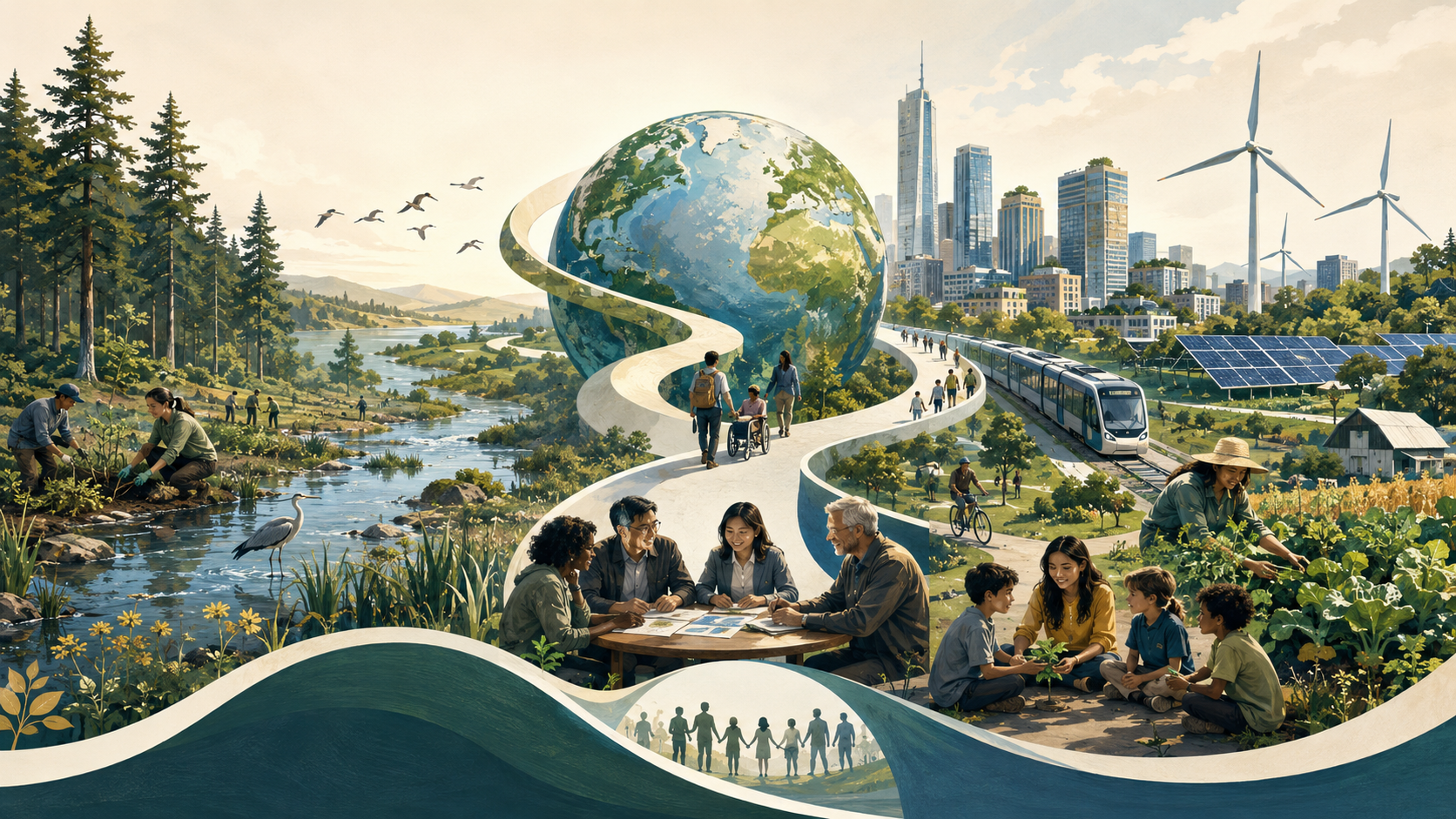
Within the Sustainable Development knowledge series, this topic matters because it clarifies where the field is heading intellectually. Many of the themes already developed across growth and limits, resilience, institutions, infrastructure, inequality, measurement, planetary boundaries, digital systems, and development governance are no longer adjacent issues. They are converging into the core architecture of future development thought.
This article therefore functions as a reorientation point. It gathers together arguments developed across the series and asks what kind of development framework remains adequate in an age of ecological instability, AI, weak institutions, transition conflict, technological dependence, and deep uncertainty. The answer is not simply a more ambitious version of the old model. It is a shift from development as expansion toward development as the just and governable maintenance of viable futures.
From Growth-Centered Development to Systemic Viability
A major future direction is the movement away from development understood primarily as output expansion toward development understood as systemic viability. Earlier paradigms often treated growth as the central engine, with social and environmental concerns added as constraints, corrections, or secondary goals. That frame is weakening because economic expansion no longer appears sufficient to secure durable wellbeing under conditions of ecological overshoot, institutional fragility, widening inequality, technological dependence, and rising systemic risk.
This matters because sustainable development thought is increasingly asking not only how societies expand production, but whether their ecological, social, institutional, technological, and political systems remain viable enough to support flourishing over time. Viability, in this broader sense, includes resilience, legitimacy, environmental integrity, public capability, adaptive capacity, and the durability of social trust rather than output alone. A country may raise aggregate income while deepening ecological dependence, weakening institutional trust, intensifying debt vulnerability, or exposing itself to fragility that conventional growth metrics obscure.
The shift does not mean that material improvement has become unimportant. It means that growth is being re-situated inside a wider evaluative frame. Development is increasingly judged by whether it produces systems capable of enduring disturbance and remaining legitimate under pressure, not simply by whether it raises aggregate output. In that sense, this article grows directly out of From Economic Growth to Human Development and Growth, Limits, and the Problem of Overshoot, both of which point toward a broader conception of progress than output alone can provide.
Planetary Boundaries and the Biophysical Turn
One of the most important intellectual shifts is the biophysical turn. Sustainable development thought is moving toward a stronger recognition that development unfolds within Earth-system conditions that cannot be treated as passive background. Climate disruption, biodiversity loss, freshwater stress, nutrient loading, land-use change, pollution, ocean change, and biosphere degradation are increasingly understood not as adjacent environmental concerns but as constitutive conditions of development possibility itself.
This matters because it changes the status of environmental limits in development theory. Biophysical instability is no longer something to be weighed after growth strategies have already been chosen. It is becoming foundational to the field’s understanding of justice, planning, and long-run viability. Development thought is therefore being pushed to ask harder questions: development for whom, by what means, with what distribution of harm, and within what ecological envelope?
Future sustainable development thought is likely to treat planetary processes less as “constraints on growth” in a narrow economic sense and more as the underlying conditions of social possibility. This is where the field now converges with Planetary Boundaries and Sustainable Development, as well as with work on freshwater change and development fragility. Together, these themes make clear that ecological instability is increasingly inseparable from the core question of what development can still mean on a stressed planet.
The biophysical turn also deepens the justice question. It is not enough to ask whether humanity as a whole remains within safe Earth-system conditions. The distribution of exposure, protection, responsibility, and adaptive capacity matters. A planetary boundary can be crossed globally, but harm is experienced unequally. Future development thought will therefore need to link ecological stability to social justice, not treat them as separate agendas.
Resilience, Fragility, and Development Under Stress
Another major direction is the growing centrality of resilience and fragility. Development is increasingly being understood not only as improvement under favorable conditions, but as the capacity to preserve gains under disturbance. Climate shocks, conflict, food insecurity, debt pressure, public-health stress, infrastructure failure, supply-chain disruption, and institutional breakdown continue to expose how brittle development gains can be when systems are optimized for ordinary conditions rather than prepared for disruption.
Earlier development frameworks often assumed that once gains were achieved they could largely be extended and consolidated in an orderly way. That assumption has become harder to defend. Development now appears more contingent, more reversible, and more exposed to interacting shocks than many older models allowed. The future of the field is therefore likely to give more attention to buffering capacity, redundancy, public learning, institutional repair, fiscal resilience, social protection, and system renewal.
This is why the field increasingly draws on arguments developed more fully in Resilience Thinking and Sustainable Development and Risk, Shock, and Fragility in Development Systems. Both help explain why progress must now be judged by durability under strain, not by improvement in ordinary conditions alone.
The deeper point is that resilience is not simply the ability to “bounce back.” In development terms, bouncing back to an unjust, ecologically destructive, or institutionally fragile system may preserve the very conditions that produced vulnerability. Future sustainable development thought is therefore likely to distinguish resilience as persistence from resilience as transformation. The question is not only whether systems survive shocks, but whether they learn, repair, adapt, and become more just after disruption.
From Linearity to Complexity
Sustainable development thought is also becoming more explicitly complexity-oriented. The older image of development as a staged and largely linear sequence of improvements is giving way to a view of development as a complex systems process shaped by feedback, nonlinearity, thresholds, delays, path dependence, and cross-sector interaction. This shift is visible in resilience science, nexus thinking, Earth-system analysis, strategic foresight, systems modeling, and public policy work that treats coordination as more difficult and more consequential than earlier planning models assumed.
This matters because complexity changes both diagnosis and action. Progress in one domain may undermine viability in another. Delayed effects may matter more than immediate gains. Apparent stability may conceal threshold behavior. Policies may generate rebound effects, displacement effects, or political backlash. Once development is understood in these terms, sectoral planning and isolated policy logic become less convincing. The field must then pay greater attention to interactions among energy, food, water, housing, infrastructure, institutions, finance, digital systems, and political legitimacy.
Future development thought is therefore likely to emphasize systems modeling, feedback awareness, institutional learning, and integrative governance more strongly than earlier paradigms did. This movement is already visible in Sustainable Development as a Systems Problem and Policy Coordination Across Complex Systems, where the central issue is no longer how to optimize separate sectors, but how to govern the interactions among them.
A complexity-oriented development framework is also more humble. It recognizes that policies operate inside changing systems, not laboratory conditions. This does not mean giving up on planning. It means planning with feedback, monitoring, adaptation, contingency, and democratic correction built into the process from the beginning.
Deep Uncertainty, Foresight, and Plural Futures
A further direction is the movement from confidence in linear planning toward governance under deep uncertainty. Scenario planning, anticipatory governance, robust decision-making, and adaptive pathways are gaining prominence because many development choices must now be made long before the future becomes knowable with confidence. This is especially true where climate, technology, demographic change, conflict risk, migration, infrastructure lock-in, and macroeconomic instability interact.
This matters because future sustainable development thought is likely to become less prediction-centered and more concerned with robustness, reversibility, option preservation, and plural futures. The central question is no longer merely what development should aim at in the abstract, but how societies should choose intelligently when the future is structurally uncertain and when policy lock-in can magnify long-run harm.
That shift is already explicit in Scenario Planning for Sustainable Futures and Development Under Deep Uncertainty, both of which point beyond static planning models toward strategies that remain usable across multiple futures. Future sustainable development thought is likely to absorb this plural-futures logic more deeply into the field’s core rather than treating it as a specialized foresight technique at the margins.
Plural futures also matter politically. Futures are not merely technical possibilities. They are sites of conflict, imagination, exclusion, and power. Whose future is modeled, whose vulnerability is assumed, whose pathway is funded, whose loss is normalized, and whose knowledge counts are all development questions. Future-oriented sustainable development must therefore combine foresight with justice.
AI, Data Systems, and the Digital Recasting of Development
The digital transformation of development thought is another major frontier. Artificial intelligence, data infrastructures, digital public systems, algorithmic classification, remote sensing, automated decision support, and platform-mediated service delivery are becoming too important to be treated as optional technological appendages to the “real” business of development. They are increasingly part of how states identify populations, allocate benefits, monitor compliance, plan infrastructure, manage risk, target services, and govern public life.
This matters because future sustainable development thought is unlikely to treat AI as just another technology sector. It will increasingly have to address data governance, digital public infrastructure, algorithmic power, compute inequality, model opacity, public trust, surveillance risk, digital exclusion, and the concentration of technical capability in a small number of firms and countries. Development thought is therefore becoming more explicitly sociotechnical. The question is no longer whether digital systems matter, but what kind of institutional order they create and who gets to shape that order.
This direction is already clear in Digital Infrastructure and Development Capacity and AI, Data Systems, and the Future of Development Governance, where the issue is not whether digital systems exist, but what forms of asymmetry, dependence, coordination, opacity, or public capability they produce. Future sustainable development thought will likely make these questions central rather than peripheral.
The development question is not whether AI can increase productivity in the abstract. It is whether AI systems strengthen human capability, democratic accountability, public goods, ecological transition, and institutional trust—or whether they deepen dependence, automate exclusion, extract data without accountability, and concentrate power over classification, knowledge, and infrastructure.
Governance Capacity and the Return of the State
A notable shift is the renewed importance of governance capacity. Sustainable development thought is moving away from the idea that markets, incentives, or civil-society energy alone can deliver transition at the needed scale. Public capability, institutional coordination, administrative competence, regulatory legitimacy, fiscal capacity, and state capacity are returning to the center of the field.
This matters because the challenges now defining sustainable development—climate transition, digital governance, social protection under stress, industrial transformation, infrastructure adaptation, public-health resilience, energy transition, housing security, and systemic risk—cannot be governed effectively without institutions capable of acting across time and across sectors. The state is therefore being reconsidered not merely as a regulator of market failure, but as a coordinator of transition, a builder of capability, a guarantor of rights, and a steward of public goods.
This trajectory was already implied in Why Institutions Matter for Sustainable Development and State Capacity, Public Administration, and Delivery Systems. What is changing now is the scale of the demand placed on governance itself. Future development thought is likely to give governance capacity a more foundational role than many recent growth-centered paradigms did.
The return of the state should not be romanticized. States can coordinate, protect, invest, and regulate; they can also exclude, surveil, repress, misallocate, and entrench elite power. The future of sustainable development thought will therefore need a double frame: public capacity is indispensable, but public power must be accountable, participatory, rights-based, and constrained by democratic legitimacy.
Inequality, Power, and the Politics of Transition
Future sustainable development thought is also becoming more political in its treatment of inequality and transition. The central question is no longer only whether development can be greener, smarter, or more efficient, but who bears transition costs, who controls infrastructure and knowledge, who defines the metrics, who owns the platforms, who receives protection, and who benefits from new technological and ecological arrangements.
This matters because future development thinking will likely focus more directly on asymmetries of power: between countries with and without compute capacity, between citizens and data-driven states, between communities protected from transition risk and those exposed to it, between firms that control infrastructure and users dependent on it, and between actors able to shape standards and those forced to live under them. Questions of justice are moving from the margins toward the center of sustainable development thought.
This is one reason pieces such as Inequality and Inclusive Development, Gender, Exclusion, and Development Justice, and Law, Rights, and Sustainable Development increasingly feel less like distinct subtopics and more like core components of future development theory itself.
The politics of transition cannot be separated from the legitimacy of transition. Ecological policy that ignores workers, communities, Indigenous rights, debt burdens, energy access, gendered labor, and unequal exposure will face moral and political limits. Future sustainable development thought will therefore need to treat justice not as compensation after the fact, but as a design principle of transformation itself.
From SDG Monitoring to New Metrics of Flourishing
Another future direction concerns measurement. The SDGs remain the central global monitoring architecture, but they are increasingly being supplemented by broader thinking about how to measure what really counts as development. Future sustainable development thought is likely to move beyond both GDP and conventional dashboard logic toward richer architectures that capture resilience, ecological integrity, institutional quality, vulnerability, distribution, care, public trust, and the relational dimensions of human wellbeing.
This matters because the future of the field will depend in part on whether measurement becomes more aligned with the actual complexity of development rather than remaining tied to what is easiest to count. That means more attention to hidden fragility, ecological thresholds, distributional inequality, informal work, care work, public trust, institutional quality, and forms of harm that are not reducible to output measures. It also means asking more explicitly what kinds of flourishing, viability, dignity, and relationship to nature ought to count in the first place.
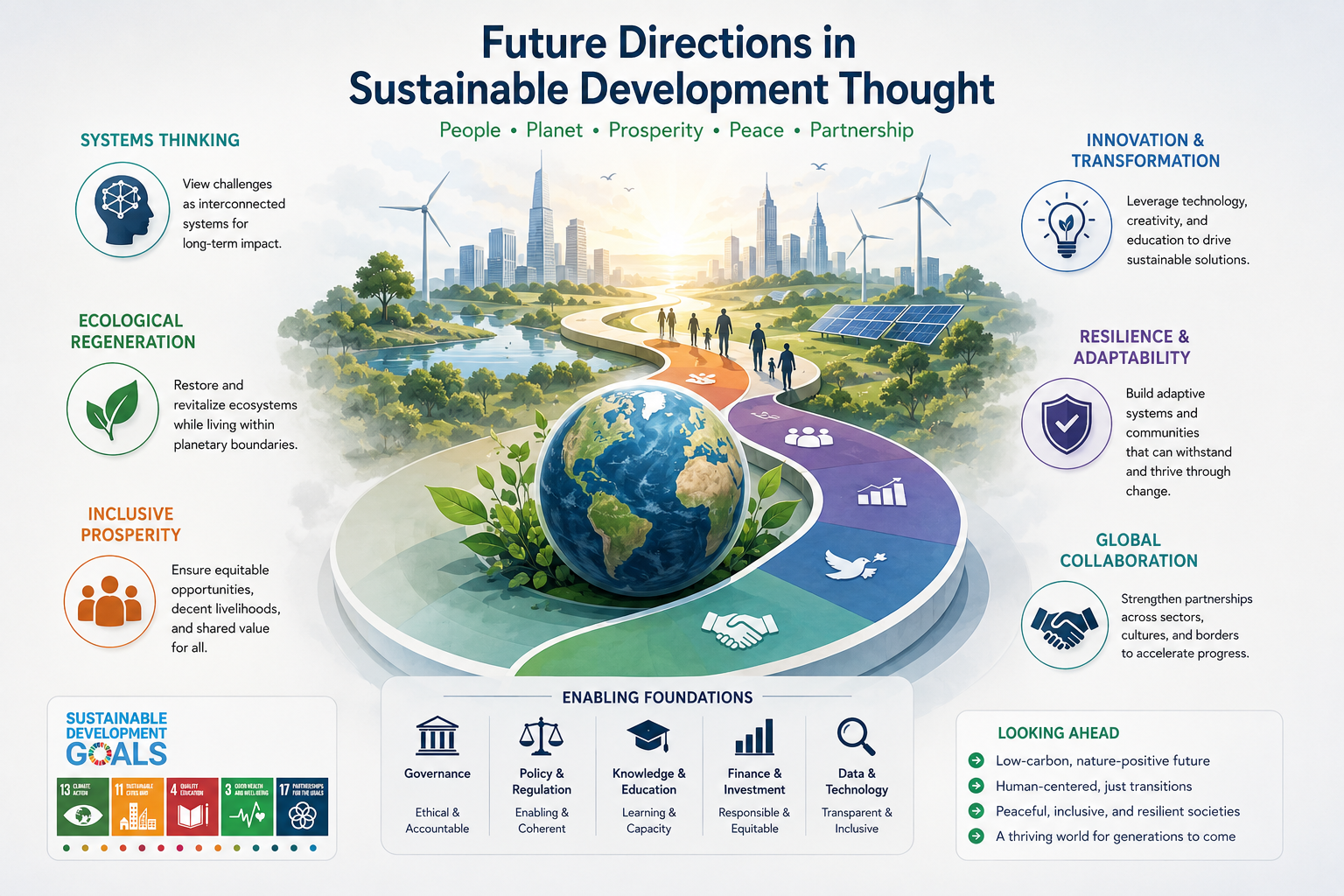
This widening of measurement logic is already visible in How Sustainable Development Is Measured and SDG Indicators: Strengths, Gaps, and Political Uses. Future sustainable development thought is likely to move further in this direction by treating measurement as a contested and constitutive part of development itself rather than as a neutral technical afterthought.
The measurement question is therefore also a power question. Indicators do not merely observe reality. They help organize institutional attention, funding, accountability, and legitimacy. Future development measurement must be more transparent about what it includes, what it excludes, who designs it, and how it can be challenged.
Knowledge Pluralism and Broader Futures Thinking
A further shift is toward greater knowledge pluralism. Sustainable development thought is increasingly opening to wider epistemologies, including participatory foresight, plural forms of expertise, community-led planning, Indigenous futures thinking, local institutional memory, and lived experience. This matters because future development thought cannot rely only on technocratic modeling or elite strategic planning if it is to remain legitimate, responsive, and attentive to lived vulnerability.
Broader futures thinking expands whose futures count and what forms of knowledge are treated as relevant in shaping them. It does not eliminate the need for technical analysis, but it challenges the idea that technical analysis alone can define the future of development. In practice, this means a field more willing to treat situated knowledge, historical memory, local institutional experience, and participatory imagination as substantive inputs into governance rather than as symbolic consultations appended to predetermined plans.
This movement complements Participation, Voice, and Community-Led Development and deepens the arguments in Scenario Planning for Sustainable Futures. The future of sustainable development thought is likely to be shaped not only by better models, but by broader participation in imagining and governing futures.
Knowledge pluralism also matters because development has often been shaped by hierarchical knowledge systems: expert over community, global North over global South, formal data over lived experience, economic measurement over ecological relation, technocratic planning over democratic voice. Future development thought will need to repair those hierarchies if it is to become more truthful and more legitimate.
Science, Technology, and Capability-Building as Core Development Questions
Future sustainable development thought is also likely to place greater emphasis on capability-building in science, technology, and innovation. The field is becoming less satisfied with a simple diffusion model in which innovation happens elsewhere and poorer countries merely adopt it. Capability, not just access, is becoming a central developmental category again.
This matters because inequality in technological capability increasingly shapes who can participate in new development trajectories and who remains dependent on external platforms, standards, models, infrastructures, or intellectual-property regimes. The future of sustainable development thought is therefore likely to treat scientific capability, institutional learning, digital sovereignty, industrial competence, technical education, research capacity, and public innovation systems as central to autonomy, resilience, and long-run transformation rather than as specialized industrial-policy questions alone.
This direction is already visible in Innovation, Technology Transfer, and Leapfrogging and Industrial Policy and Sustainable Structural Transformation. What changes in the future-oriented frame is that capability-building becomes one of the field’s core conditions of viability rather than merely a route to faster catch-up growth.
The crucial distinction is between technology consumption and technology capability. A society can consume digital services, import renewable technologies, or use AI tools while still lacking the institutional and scientific capability to shape, govern, repair, adapt, or democratize those systems. Future sustainable development thought will need to make that distinction central.
Mathematical Lens
The future direction of sustainable development thought can be clarified through a simple viability framework. Let \(V_t\) represent system viability at time \(t\). Rather than treating development as a function of output alone, viability can be expressed conceptually as a function of multiple interdependent dimensions:
V_t = f(Y_t, E_t, R_t, G_t, T_t, J_t)
\]
Interpretation: Viability \(V_t\) depends on material output or income \(Y_t\), ecological integrity \(E_t\), resilience capacity \(R_t\), governance capability \(G_t\), technological capability \(T_t\), and justice or distributional equity \(J_t\). The framework makes clear that development cannot be inferred from output alone.
One reason this matters is that development systems can improve in one dimension while deteriorating in another. A more dynamic expression makes the point more sharply:
\frac{dV}{dt} =
\alpha \frac{dY}{dt}
+ \beta \frac{dE}{dt}
+ \gamma \frac{dR}{dt}
+ \delta \frac{dG}{dt}
+ \epsilon \frac{dT}{dt}
+ \zeta \frac{dJ}{dt}
\]
Interpretation: If output rises while ecological integrity collapses, justice declines, or governance erodes, the net direction of viability may be ambiguous or negative. Future development thought turns on this multidimensional logic.
A threshold framing is also helpful. Suppose a society faces a critical ecological or institutional threshold \(\theta\). If pressure \(P_t\) exceeds that threshold, losses may become nonlinear:
L_t =
\begin{cases}
0, & P_t < \theta \\
\lambda (P_t – \theta)^2, & P_t \geq \theta
\end{cases}
\]
Interpretation: Below the threshold, losses may be limited or manageable. Once pressure exceeds \(\theta\), losses can accelerate. This captures why development under planetary instability and institutional fragility cannot assume smooth or reversible change.
A scenario stress-test can compare pathways across dimensions:
S_i = \sum_{k=1}^{n} w_k x_{ik} – L_i
\]
Interpretation: Scenario score \(S_i\) combines weighted indicators \(x_{ik}\) and subtracts nonlinear losses \(L_i\) when ecological or institutional thresholds are crossed. This kind of model supports structured comparison without pretending to predict the future.
A justice-aware viability measure should also inspect the weakest component:
M_i = \min(Y_i, E_i, R_i, G_i, T_i, J_i)
\]
Interpretation: The minimum component score \(M_i\) prevents strong performance in one dimension from hiding severe failure in another. This is especially important when high average scores conceal ecological breakdown, institutional weakness, or exclusion.
The purpose of these equations is not to reduce sustainable development to a single score. It is to make the field’s future orientation explicit: progress must be evaluated across interacting systems, under uncertainty, with attention to thresholds, distribution, institutions, and long-run viability.
Python Workflow: Scenario and Indicator Stress-Testing for Future Development Pathways
This Python workflow demonstrates how future-oriented sustainable development analysis can move beyond static benchmarking into scenario and stress-testing logic. Rather than simply reporting current indicator values, the script models a small set of development dimensions across alternative futures and produces a composite viability score with nonlinear threshold penalties.
from __future__ import annotations

import pandas as pd

INPUT_FILE = "future_development_scenarios.csv"
OUTPUT_FILE = "future_development_viability_scores.csv"

WEIGHTS = {
    "income_index": 0.16,
    "ecological_integrity_index": 0.22,
    "resilience_index": 0.18,
    "governance_capacity_index": 0.16,
    "technology_capability_index": 0.13,
    "justice_equity_index": 0.15,
}


def load_data(path: str) -> pd.DataFrame:
    """Load scenario-level sustainable development data."""
    df = pd.read_csv(path)

    required_columns = list(WEIGHTS.keys()) + [
        "scenario",
        "planetary_pressure_index",
        "institutional_stress_index",
    ]

    missing = [column for column in required_columns if column not in df.columns]
    if missing:
        raise ValueError(f"Missing required columns: {missing}")

    return df


def validate_index_columns(df: pd.DataFrame) -> pd.DataFrame:
    """Validate that normalized index columns fall between 0 and 1."""
    index_columns = [
        column for column in df.columns
        if column.endswith("_index")
    ]

    for column in index_columns:
        invalid = (df[column] < 0) | (df[column] > 1)
        if invalid.any():
            raise ValueError(f"Column '{column}' contains values outside [0, 1].")

    return df


def nonlinear_loss(
    pressure: float,
    threshold: float,
    lambda_loss: float,
) -> float:
    """Apply a threshold penalty when pressure exceeds a critical level."""
    if pressure < threshold:
        return 0.0

    return lambda_loss * (pressure - threshold) ** 2


def compute_viability_score(df: pd.DataFrame) -> pd.DataFrame:
    """Compute base and threshold-adjusted viability scores."""
    df["base_viability_score"] = 0.0

    for column, weight in WEIGHTS.items():
        df["base_viability_score"] += weight * df[column]

    df["ecological_threshold_loss"] = df["planetary_pressure_index"].apply(
        lambda value: nonlinear_loss(value, threshold=0.65, lambda_loss=1.40)
    )

    df["institutional_threshold_loss"] = df["institutional_stress_index"].apply(
        lambda value: nonlinear_loss(value, threshold=0.70, lambda_loss=1.20)
    )

    df["adjusted_viability_score"] = (
        df["base_viability_score"]
        - df["ecological_threshold_loss"]
        - df["institutional_threshold_loss"]
    ).clip(lower=0, upper=1)

    df["minimum_component_score"] = df[list(WEIGHTS.keys())].min(axis=1)

    df["risk_classification"] = pd.cut(
        df["adjusted_viability_score"],
        bins=[-0.01, 0.55, 0.75, 1.01],
        labels=["High Concern", "Medium Viability", "High Viability"],
    )

    return df


def main() -> None:
    df = load_data(INPUT_FILE)
    df = validate_index_columns(df)
    df = compute_viability_score(df)

    df = df.sort_values(
        by=["adjusted_viability_score", "minimum_component_score"],
        ascending=False,
    )

    df.to_csv(OUTPUT_FILE, index=False)

    print("Scenario viability scoring complete.")
    print(df.to_string(index=False))


if __name__ == "__main__":
    main()
This workflow illustrates a key future-facing analytical principle: development pathways should not be ranked by average improvement alone. A pathway with high income growth but severe ecological loss, weak justice, or institutional stress may have a lower adjusted viability score than its output trajectory suggests.
R Workflow: Tracking Viability, Inequality, and Institutional Resilience Indicators
This R workflow is designed for analysts working with longitudinal development indicators who want to compare the evolution of viability-related metrics across countries or regions. It illustrates a more future-oriented monitoring logic by combining resilience, ecological, governance, technological, and equity variables into a compact analytical pipeline.
library(readr)
library(dplyr)

input_file <- "development_viability_panel.csv"
output_file <- "development_viability_summary.csv"

dev_df <- read_csv(input_file, show_col_types = FALSE)

required_cols <- c(
  "country",
  "year",
  "income_index",
  "ecological_integrity_index",
  "resilience_index",
  "governance_capacity_index",
  "technology_capability_index",
  "justice_equity_index",
  "planetary_pressure_index",
  "institutional_stress_index"
)

missing_cols <- setdiff(required_cols, names(dev_df))

if (length(missing_cols) > 0) {
  stop(paste("Missing required columns:", paste(missing_cols, collapse = ", ")))
}

dev_df <- dev_df %>%
  mutate(
    viability_proxy =
      0.16 * income_index +
      0.22 * ecological_integrity_index +
      0.18 * resilience_index +
      0.16 * governance_capacity_index +
      0.13 * technology_capability_index +
      0.15 * justice_equity_index,
    system_pressure =
      0.55 * planetary_pressure_index +
      0.45 * institutional_stress_index,
    viability_gap = 1 - viability_proxy
  )

summary_df <- dev_df %>%
  group_by(country) %>%
  summarise(
    avg_viability_proxy = mean(viability_proxy, na.rm = TRUE),
    min_viability_proxy = min(viability_proxy, na.rm = TRUE),
    max_viability_proxy = max(viability_proxy, na.rm = TRUE),
    avg_system_pressure = mean(system_pressure, na.rm = TRUE),
    latest_year = max(year, na.rm = TRUE),
    observations = n(),
    .groups = "drop"
  ) %>%
  arrange(desc(avg_viability_proxy))

write_csv(summary_df, output_file)

cat("Development viability summary exported to:", output_file, "\n")
print(summary_df)
This workflow reinforces the article’s core argument: future sustainable development monitoring should track the co-evolution of ecological integrity, resilience, governance capacity, technological capability, and justice—not only income or aggregate SDG progress.
SQL Workflow: Longitudinal Development Dashboard Architecture
A SQL dashboard layer can support durable, auditable monitoring of future development pathways. The following example creates a scenario table and a longitudinal panel table, then queries both for viability scores and threshold flags.
CREATE TABLE IF NOT EXISTS scenario_scores (
    scenario TEXT PRIMARY KEY,
    income_index REAL NOT NULL CHECK (income_index BETWEEN 0 AND 1),
    ecological_integrity_index REAL NOT NULL CHECK (ecological_integrity_index BETWEEN 0 AND 1),
    resilience_index REAL NOT NULL CHECK (resilience_index BETWEEN 0 AND 1),
    governance_capacity_index REAL NOT NULL CHECK (governance_capacity_index BETWEEN 0 AND 1),
    technology_capability_index REAL NOT NULL CHECK (technology_capability_index BETWEEN 0 AND 1),
    justice_equity_index REAL NOT NULL CHECK (justice_equity_index BETWEEN 0 AND 1),
    planetary_pressure_index REAL NOT NULL CHECK (planetary_pressure_index BETWEEN 0 AND 1),
    institutional_stress_index REAL NOT NULL CHECK (institutional_stress_index BETWEEN 0 AND 1)
);

CREATE TABLE IF NOT EXISTS development_panel (
    country TEXT NOT NULL,
    year INTEGER NOT NULL,
    income_index REAL NOT NULL CHECK (income_index BETWEEN 0 AND 1),
    ecological_integrity_index REAL NOT NULL CHECK (ecological_integrity_index BETWEEN 0 AND 1),
    resilience_index REAL NOT NULL CHECK (resilience_index BETWEEN 0 AND 1),
    governance_capacity_index REAL NOT NULL CHECK (governance_capacity_index BETWEEN 0 AND 1),
    technology_capability_index REAL NOT NULL CHECK (technology_capability_index BETWEEN 0 AND 1),
    justice_equity_index REAL NOT NULL CHECK (justice_equity_index BETWEEN 0 AND 1),
    planetary_pressure_index REAL NOT NULL CHECK (planetary_pressure_index BETWEEN 0 AND 1),
    institutional_stress_index REAL NOT NULL CHECK (institutional_stress_index BETWEEN 0 AND 1),
    PRIMARY KEY (country, year)
);

SELECT
    scenario,
    ROUND(
        0.16 * income_index +
        0.22 * ecological_integrity_index +
        0.18 * resilience_index +
        0.16 * governance_capacity_index +
        0.13 * technology_capability_index +
        0.15 * justice_equity_index,
        4
    ) AS viability_score,
    planetary_pressure_index,
    institutional_stress_index,
    CASE
        WHEN planetary_pressure_index >= 0.65
          OR institutional_stress_index >= 0.70
        THEN 'threshold_review'
        WHEN (
            0.16 * income_index +
            0.22 * ecological_integrity_index +
            0.18 * resilience_index +
            0.16 * governance_capacity_index +
            0.13 * technology_capability_index +
            0.15 * justice_equity_index
        ) < 0.55
        THEN 'high_concern'
        ELSE 'monitor'
    END AS review_status
FROM scenario_scores
ORDER BY viability_score DESC;
The point of the SQL layer is institutional: future development monitoring should be queryable, reproducible, documented, and auditable. Dashboards without durable schemas and transparent logic can create the appearance of measurement without the discipline of evidence.
GitHub Repository
This article can be paired with a companion code workflow that supports scenario stress-testing, viability scoring, threshold-risk modeling, longitudinal indicator monitoring, reproducible dashboards, and policy-lever simulation for future-oriented sustainable development analysis.
Complete Code RepositoryThe companion repository provides synthetic scenario datasets, longitudinal development indicators, Python stress-testing workflows, R panel summaries, SQL dashboard architecture, Julia threshold-loss modeling, methodological notes, scenario-review checklists, reproducibility documentation, and CI smoke-test scaffolding for future-oriented sustainable development analysis.
What These Shifts Mean for Sustainable Development Thought
Taken together, these shifts suggest that future sustainable development thought will be more integrative, more political, more biophysical, more digital, and more uncertainty-aware than earlier versions. It will likely be less confident that development can be delivered by growth alone, less willing to separate human progress from Earth-system stability, and more attentive to how governance, resilience, AI, power, measurement, and capability shape long-term viability.
This matters because the future of sustainable development thought is not simply the extension of existing frameworks. It is a reconfiguration of them under pressure from realities that no longer fit older assumptions. The central object of thought is shifting from development as expansion to development as the just and governable maintenance of viable futures.
This does not mean abandoning the older concerns of poverty reduction, health, education, infrastructure, and social inclusion. It means re-situating them inside a wider frame in which progress must also be ecologically viable, institutionally durable, digitally governable, technologically capable, socially legitimate, and resilient under uncertainty. The emerging field is therefore not narrower than earlier sustainable development thought. It is more demanding because it must integrate more conditions of viability at once.
The result is a field that can no longer be organized around a single master variable. GDP is too narrow. SDG dashboards are necessary but incomplete. Technology adoption is insufficient without capability and governance. Ecological metrics are indispensable but must be linked to justice. Resilience is essential but must be transformative, not merely preservative. Future sustainable development thought will therefore be defined by integration: development as a systems problem, a justice problem, a governance problem, a technological problem, and a planetary problem at once.
Conclusion
Future directions in sustainable development thought are likely to be shaped by a convergence of planetary constraints, resilience concerns, digital transformation, new governance demands, plural futures, and richer metrics of progress. The field is moving toward a more systemic and more demanding conception of development, one that treats viability, justice, adaptability, capability, and institutional capacity as central rather than secondary.
This is why the future of sustainable development thought matters so much. It will shape not only how development is described, but how it is governed, measured, contested, and imagined. The challenge ahead is not merely to update an old model, but to build a framework capable of thinking clearly about human flourishing on a disturbed planet in an age of AI, ecological instability, and deep uncertainty.
To think seriously about sustainable development now is therefore to think across systems, across scales, across time horizons, and across forms of knowledge. The future of the field lies in that widened frame. Read within the broader series, this article functions less as a conclusion than as a reorientation point: it gathers together arguments developed across growth and limits, institutions and infrastructure, fragility and resilience, AI and governance, justice and measurement, and asks what kind of development thought is still adequate to the century now unfolding.
Related articles
- Sustainable Development
- From Economic Growth to Human Development
- Growth, Limits, and the Problem of Overshoot
- Planetary Boundaries and Sustainable Development
- Resilience Thinking and Sustainable Development
- Development Under Deep Uncertainty
- AI, Data Systems, and the Future of Development Governance
- State Capacity, Public Administration, and Delivery Systems
- How Sustainable Development Is Measured
- Participation, Voice, and Community-Led Development
Further reading
- Organisation for Economic Co-operation and Development (2025) Foresight Toolkit for Resilient Public Policy: A Comprehensive Foresight Methodology to Support Sustainable and Future-Ready Public Policy. Paris: OECD. Available at: https://www.oecd.org/content/dam/oecd/en/publications/reports/2025/01/foresight-toolkit-for-resilient-public-policy_9ad1cd60/bcdd9304-en.pdf
- Raworth, K. (2017) Doughnut Economics: Seven Ways to Think Like a 21st-Century Economist. London: Random House.
- Rockström, J. and Gaffney, O. (2024) Breaking Boundaries: The Science of Our Planet. London: Penguin.
- United Nations Conference on Trade and Development (2025) Technology and Innovation Report 2025: Inclusive Artificial Intelligence for Development. Geneva: UNCTAD. Available at: https://unctad.org/system/files/official-document/tir2025_en.pdf
- United Nations Development Programme (2025) Human Development Report 2025: A Matter of Choice: People and Possibilities in the Age of AI. New York: UNDP. Available at: https://hdr.undp.org/system/files/documents/global-report-document/hdr2025reporten.pdf
- World Bank (2025) Digital Progress and Trends Report 2025: AI Foundations. Washington, DC: World Bank. Available at: https://www.worldbank.org/en/publication/dptr2025-ai-foundations
References
- Earth Commission (2023) Safe and Just Earth System Boundaries. Available at: https://earthcommission.org/safe-and-just-earth-system-boundaries/
- Organisation for Economic Co-operation and Development (n.d.) Strategic Foresight. Available at: https://www.oecd.org/en/about/programmes/strategic-foresight.html
- Organisation for Economic Co-operation and Development (2025) Foresight Toolkit for Resilient Public Policy: A Comprehensive Foresight Methodology to Support Sustainable and Future-Ready Public Policy. Paris: OECD. Available at: https://www.oecd.org/content/dam/oecd/en/publications/reports/2025/01/foresight-toolkit-for-resilient-public-policy_9ad1cd60/bcdd9304-en.pdf
- Rockström, J., Gupta, J., Qin, D. et al. (2023) ‘Safe and just Earth system boundaries’, Nature, 619, pp. 102–111. Available at: https://www.nature.com/articles/s41586-023-06083-8
- Rockström, J., Donges, J.F., Fetzer, I. et al. (2024) ‘Planetary Boundaries guide humanity’s future on Earth’, Nature Reviews Earth & Environment, 5, pp. 773–788. Available at: https://www.stockholmresilience.org/publications/publications/2025-01-26-planetary-boundaries-guide-humanitys-future-on-earth.html
- Stockholm Resilience Centre (n.d.) Planetary Boundaries. Available at: https://www.stockholmresilience.org/research/planetary-boundaries.html
- United Nations Conference on Trade and Development (2025) Technology and Innovation Report 2025: Inclusive Artificial Intelligence for Development. Geneva: UNCTAD. Available at: https://unctad.org/system/files/official-document/tir2025_en.pdf
- United Nations Conference on Trade and Development (2025) Global Collaboration for Inclusive and Equitable AI. In: Technology and Innovation Report 2025. Geneva: UNCTAD. Available at: https://unctad.org/system/files/official-document/tir2025ch5_en.pdf
- United Nations Development Programme (2025) Human Development Report 2025: A Matter of Choice: People and Possibilities in the Age of AI. New York: UNDP. Available at: https://hdr.undp.org/content/human-development-report-2025
- United Nations Development Programme (2025) Human Development Report 2025: A Matter of Choice: People and Possibilities in the Age of AI. New York: UNDP. Available at: https://hdr.undp.org/system/files/documents/global-report-document/hdr2025reporten.pdf
- United Nations Statistics Division (2025) The Sustainable Development Goals Report 2025. New York: United Nations. Available at: https://unstats.un.org/sdgs/report/2025/
- World Bank (2025) Digital Progress and Trends Report 2025: AI Foundations. Washington, DC: World Bank. Available at: https://www.worldbank.org/en/publication/dptr2025-ai-foundations