
Last Updated May 6, 2026
Pollution matters for development because development does not only expand production, infrastructure, and consumption. It also expands the material residues, chemical by-products, wastes, and synthetic substances that circulate through bodies, soils, waters, ecosystems, and public systems over time. Some of these substances support useful social purposes. Others create slow, cumulative, and unevenly distributed harms that can outlast the immediate gains they helped produce. When pollution accumulates and novel entities proliferate faster than societies can assess, regulate, contain, or remediate them, development begins to undermine the conditions of its own durability.
Pollution is therefore not simply an environmental side effect. It is a long-run development problem. Sustainable development must ask not only what societies produce, build, consume, and innovate, but what material afterlives those systems leave behind: toxic exposures, waste burdens, chemical residues, contaminated waters, degraded soils, persistent substances, and institutional liabilities passed forward into the future.
Main Library
Publications
Article Map
Sustainable Development
Related Topic
Planetary Boundaries
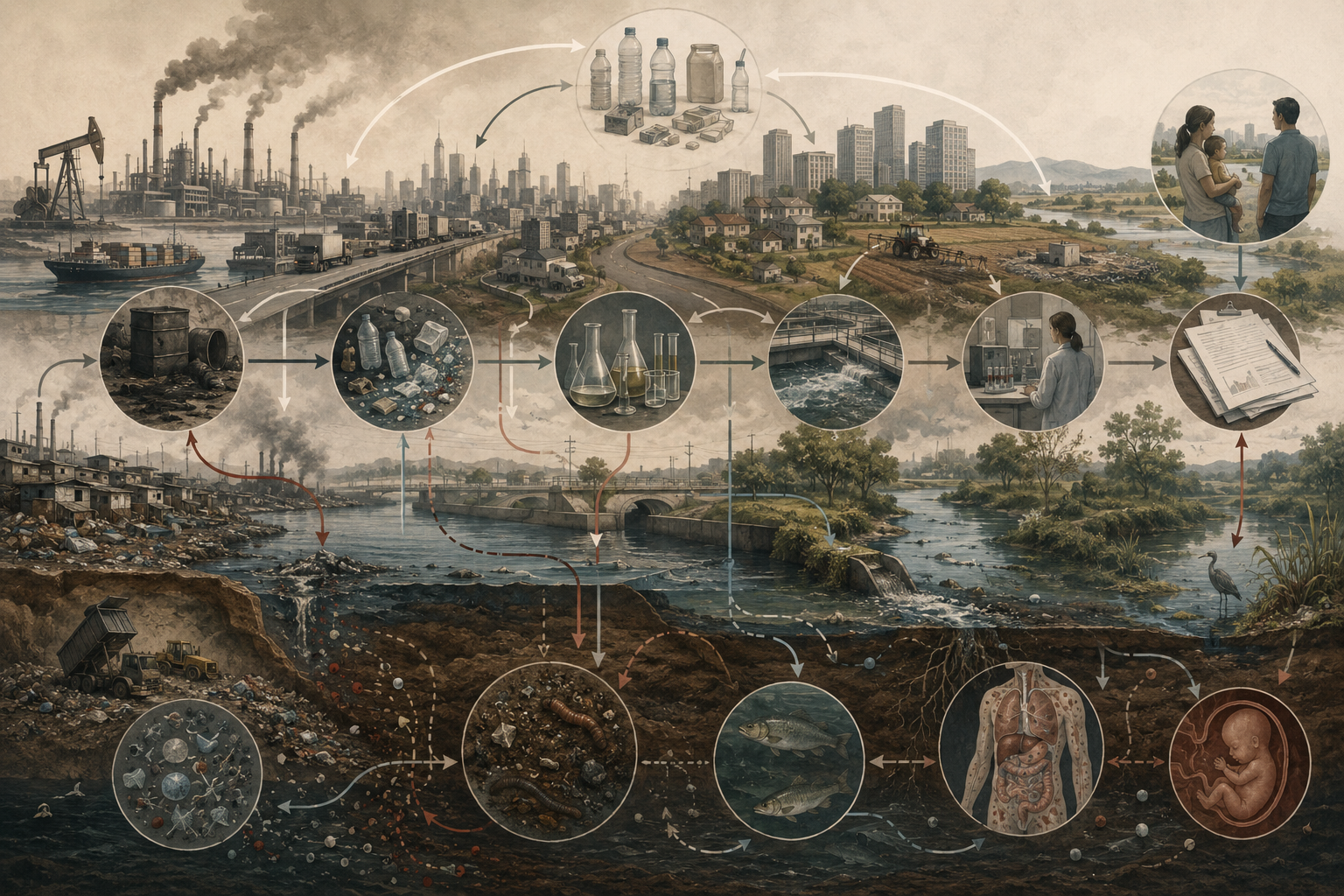
The 2030 Agenda places this issue inside sustainable development through multiple channels. Goal 12 addresses the environmentally sound management of chemicals and wastes throughout their life cycle, while the wider UN chemicals-and-waste agenda connects hazardous waste reduction, prevention, reuse, recycling, recovery, and sound management to human health, environmental protection, and sustainable development more broadly. This matters because pollution is not treated as a specialized technical issue separate from development. It is treated as part of the wider challenge of how societies produce, consume, dispose, and govern material flows over time.
The planetary-boundaries framework sharpens the developmental meaning of this issue by identifying novel entities as one of the Earth-system processes relevant to long-run stability and resilience. Novel entities include synthetic chemicals, plastics, engineered materials, heavy metals, radioactive materials, and other human-made substances that alter Earth-system functioning. The significance of this category is that it captures not only visible pollution, but the expanding material complexity of modern development itself. Pollution is not only about waste after production. It is also about the cumulative consequences of the substances development chooses to circulate.
Current global governance efforts reinforce this broader framing. Pollution, chemicals, and waste are increasingly understood as structural policy challenges linked to health, wellbeing, ecological resilience, production systems, urbanization, consumption, and long-run prosperity. The creation of an intergovernmental science-policy process for chemicals, waste, and pollution reflects a growing recognition that societies need stronger scientific advice, monitoring, and institutional capacity to manage material risks before they become diffuse, persistent, and difficult to reverse.
What Pollution and Novel Entities Mean
Pollution is often understood too narrowly as visible contamination: smoke, sewage, litter, dirty water, or industrial discharge. But developmentally, pollution is broader. It refers to the introduction, concentration, persistence, or circulation of substances and wastes in forms that damage human health, ecological function, or social systems. Pollution may be visible or invisible, acute or chronic, localized or transboundary, temporary or persistent. Its developmental significance lies not only in the presence of contaminants, but in the way they alter the conditions under which people, ecosystems, and institutions must function.
Novel entities broaden this problem further. They include synthetic chemicals, plastics, engineered materials, heavy metals, radioactive substances, and other human-made interventions that did not previously circulate through Earth systems at comparable scale or in comparable forms. Some novel entities are intentionally produced for useful purposes. Others arise as by-products, residues, wastes, degradation products, or unintended consequences of production systems. In both cases, they reflect the expanding material universe of modern development.
This distinction matters because modern development increasingly generates risks that are not always immediate or visible. Some pollutants are persistent, bioaccumulative, mobile across air, water, soil, and organisms, or capable of interacting with other substances in poorly understood ways. Some are released in small concentrations over large areas. Others accumulate in specific communities, occupations, watersheds, waste sites, or ecological niches. The harm may not appear as a single disaster, but as a distributed background condition of exposure.
Novel entities are especially important because they are not simply “more pollution.” They represent the growing complexity of human-made substances whose cumulative effects can be difficult to measure, regulate, and reverse. A chemical, plastic, additive, engineered particle, or industrial compound may enter global circulation long before its full ecological or health effects are understood. Once dispersed, it may be expensive or impossible to recall fully from soils, waters, sediments, food chains, buildings, bodies, or waste systems.
In development terms, pollution and novel entities expose a central contradiction: production and innovation can expand human possibility while also creating material residues that narrow future possibility. Sustainable development must therefore examine not only the benefits of production, but the long-run burdens of what production leaves behind.
Why Pollution Is a Development Question
Pollution is a development question because it directly affects the conditions under which people can live healthy, secure, and productive lives. Polluted air weakens health, cognition, labor capacity, and everyday wellbeing. Polluted water undermines sanitation, food safety, disease prevention, agriculture, fisheries, and household security. Toxic wastes burden communities, ecosystems, public agencies, and future budgets. Waste mismanagement raises disease risk, infrastructure pressure, informal labor burdens, and governance costs. These harms cut across public health, urban systems, agriculture, labor, housing, ecosystems, and long-run resilience.
This matters because development models often measure success through production, access, infrastructure, consumption, and income while undercounting the slow costs of contamination and material overload. A society may industrialize, urbanize, and expand consumption while also increasing chronic toxic exposure, waste burdens, ecological degradation, and cleanup liabilities. If these costs are invisible in the main development indicators, development may appear more successful than it actually is.
Pollution also changes the meaning of infrastructure. Roads, ports, factories, energy systems, housing, sanitation, waste facilities, and industrial zones are not only development assets. They are also systems that channel material flows. If they are designed without adequate safeguards, they can move contaminants into air, water, soil, homes, workplaces, and bodies. Development therefore depends not only on building infrastructure, but on governing the residues and risks that infrastructure helps produce.
Pollution is also deeply linked to public capacity. Effective pollution governance requires monitoring, inspection, legal enforcement, waste infrastructure, treatment facilities, scientific assessment, public transparency, health systems, remediation capacity, and participation from affected communities. Where these capacities are weak, pollution becomes a sign not only of environmental stress but of institutional fragility. Societies may produce and consume at a scale that exceeds their ability to govern the resulting material flows safely.
To treat pollution as a development question is therefore to reject the idea that environmental harm is external to human progress. Pollution affects the real conditions of life: whether children breathe safe air, whether households drink safe water, whether workers are protected, whether ecosystems remain functional, whether public budgets are consumed by cleanup, and whether future generations inherit environments that remain habitable.
From Waste to Long-Run Material Risk
One of the most important conceptual shifts in environmental-development thinking has been the movement from treating pollution as a localized waste problem to treating it as long-run material risk. Waste once appeared as something that could be removed from view, transported elsewhere, buried, burned, diluted, or discharged into larger systems. But modern material throughput has made that assumption progressively less credible. The scale, diversity, persistence, and mobility of contemporary waste streams mean that material residues often remain part of development systems long after their immediate economic use has ended.
This is developmentally significant because material residues do not simply disappear after use. They can accumulate across time, move across jurisdictions, interact with social vulnerability, and create liabilities that are poorly governed. Plastics fragment into smaller particles. Chemicals persist in soils and sediments. Heavy metals can remain hazardous across generations. Hazardous wastes may move through unequal global disposal chains. Wastewater carries chemical, biological, and nutrient burdens. Electronic waste concentrates toxic materials and informal labor exposure. What is called “waste” may therefore be better understood as deferred developmental cost.
The shift from waste to material risk also changes the time horizon of development. A product may generate immediate benefit, but its residues may create long-term burdens in disposal, recycling, exposure, remediation, or ecological damage. A chemical may support agricultural yield, industrial production, or consumer convenience while creating health or ecosystem risks that emerge slowly. A waste stream may be economically convenient in the short run while imposing cleanup costs on public systems later. Development gains can therefore be financed by material liabilities shifted onto future communities, downstream ecosystems, or less protected populations.
Long-run material risk also reveals the limitations of disposal-centered thinking. Waste governance cannot be only about where to put residues after production. It must also ask what materials are produced in the first place, how products are designed, whether substances are recoverable, whether safer alternatives exist, whether hazards are disclosed, and whether circular systems can reduce the creation of persistent burdens. Prevention matters because remediation after dispersal is often slower, more expensive, and less complete.
Development becomes materially responsible when it treats waste not as an afterthought but as a signal about the design of the whole system. A society that produces more than it can safely assess, recover, recycle, regulate, or remediate is not only facing a waste problem. It is facing a development-governance problem.
Novel Entities and the Problem of Unknowable Scale
Novel entities are especially important because they expose a distinctive kind of developmental uncertainty. They include a vast and expanding range of human-made substances and materials whose combined impacts are difficult to measure. Development institutions are often built to regulate known hazards, but the novel-entities problem concerns proliferating uncertainty: new chemicals, materials, mixtures, uses, degradation products, and exposure pathways appear faster than societies can assess their cumulative consequences.
This does not mean every novel entity is harmful. Many synthetic materials and chemical innovations support medicine, sanitation, food production, infrastructure, communication, energy systems, and everyday life. The problem is not novelty itself. The problem is scale, speed, opacity, persistence, and weak governance. When production and release expand faster than testing, monitoring, transparency, and regulation, development systems begin to generate exposure before long-run safety is established.
The resulting challenge is not simply one of regulation, but of governability under uncertainty. Chemical-by-chemical assessment can be overwhelmed by the scale of production and the complexity of mixtures. Exposure may occur through food, packaging, consumer products, building materials, water, air, dust, workplaces, waste sites, and ecosystems simultaneously. Some substances may interact with others in ways that are not well captured by single-substance assessment. Some harms may only become clear after years of exposure, long-distance movement, bioaccumulation, or ecological interaction.
Novel entities therefore raise a deep development question: how should societies govern innovation when the benefits of new substances may be immediate but the harms may be delayed, cumulative, uncertain, and unevenly distributed? If the burden of proof falls too heavily on exposed communities and ecosystems, development becomes an experiment conducted on people and places without meaningful consent or adequate protection.
A sustainable-development approach must therefore treat uncertainty as a governance condition, not as an excuse for inaction. Precaution, transparency, safer design, stronger testing, extended producer responsibility, public right-to-know systems, exposure monitoring, and independent science-policy capacity all become essential. Novel entities reveal that development is not only about making new things possible; it is also about ensuring that new material possibilities remain governable.
Habitability, Health, and Human Development
Pollution constrains development because it constrains habitability. Human development depends on more than income, formal rights, infrastructure, and service access. It depends on whether people can inhabit environments that are sufficiently safe to support health, child development, work, learning, care, reproduction, social continuity, and ordinary life. When air, water, soils, homes, workplaces, schools, food systems, and public spaces become chronically burdened by contaminants, the environments of everyday life become harder to inhabit well.
This matters because many pollution harms are cumulative rather than spectacular. Exposure may be chronic rather than catastrophic. Developmental effects may appear through illness, impaired learning, reduced resilience, reproductive harm, neurological harm, respiratory burden, cancer risk, endocrine disruption, or rising background disease burdens. Pollution can therefore narrow capability gradually. A society may remain economically active while becoming less healthy, less secure, and less developmentally durable.
Children are especially important in this analysis because exposure can shape development across the life course. Polluted air, contaminated water, toxic housing materials, industrial exposure, unsafe waste sites, and hazardous consumer products can affect learning, health, growth, and future capability. Pollution therefore becomes intergenerational, not only because contaminants persist, but because exposure can shape human development before people have any meaningful capacity to protect themselves.
Workplaces also reveal the human-development significance of pollution. Workers may face exposures that consumers and policymakers rarely see: solvents, dust, fumes, pesticides, heavy metals, plastics additives, electronic waste, mining residues, industrial chemicals, or hazardous waste streams. Development that depends on unsafe exposure is not simply producing goods; it is transferring risk into bodies. Occupational exposure must therefore be part of pollution justice and development planning.
Habitability also includes psychological and social security. Communities living near contaminated sites, waste facilities, polluted waterways, industrial corridors, or toxic land may experience uncertainty, stigma, fear, declining property security, and loss of trust in public institutions. Pollution can therefore damage the social conditions of development as well as the biological ones. A habitable society is one in which people can live without being forced to absorb the hidden toxic costs of production and consumption.
Ecosystems, Toxicity, and Slow Violence
Pollution also matters because ecosystems absorb a large share of the material stress generated by development. Contaminants accumulate in soils, sediments, waterways, organisms, and food webs. Some effects are immediate; others unfold as a form of slow violence: diffuse, cumulative, difficult to attribute to a single moment, but deeply consequential over time. Plastics, chemical mixtures, heavy metals, persistent contaminants, pesticides, industrial residues, and waste streams can alter reproductive systems, habitat quality, species interactions, water quality, soil function, and ecosystem resilience even where no single event appears decisive.
This is developmentally significant because ecosystem decline feeds back into human systems. Toxic stress can affect fisheries, water purification, soil integrity, biodiversity, pollination, food safety, flood buffering, and broader ecological regulation. What first appears as contamination “out there” often returns as weakened food systems, degraded ecosystems, public-health burdens, and reduced resilience within the societies that generated the pollutants.
Slow pollution harms are especially difficult to govern because they can be spatially and temporally dispersed. A contaminant may be produced in one place, used in another, discarded elsewhere, transported through air or water, deposited in sediments, taken up by organisms, and eventually concentrated in human food chains. This movement across scales makes accountability difficult. The harm is real, but the pathway may be long, complex, and contested.
Ecosystem toxicity also exposes the limits of single-medium thinking. A substance released into air may settle into soil or water. A chemical applied to land may move into rivers or groundwater. Plastics discarded on land may enter oceans. Pollutants in sediments may re-enter food webs. Environmental systems do not observe administrative boundaries, and contaminants often move across the categories through which institutions try to manage them.
For sustainable development, this means pollution control must be ecological as well as technical. It must consider life cycles, mixtures, persistence, mobility, cumulative burden, and ecosystem function. The goal is not only to prevent dramatic contamination events, but to prevent the slow erosion of the ecological systems that make long-run human development possible.
Pollution as an Inequality Problem
Pollution is never distributed evenly. Exposure depends on where people live, what work they do, what protections they have, how strong local regulation is, how much political power they can exercise, and whether institutions treat their lives as fully visible. Poorer communities, informal settlements, waste workers, industrial workers, Indigenous peoples, racialized or marginalized groups, migrants, children, and countries with weaker monitoring and disposal capacity often face heavier burdens from contamination and waste. Pollution is therefore not only a technical management problem. It is also a justice problem.
This matters because development gains can be unequal not only in how benefits are distributed, but in how harms are externalized. Some groups gain from industrial production, chemical-intensive agriculture, mining, consumer convenience, or rising consumption, while others bear toxic residues, degraded water, unmanaged waste, unsafe labor, contaminated land, and cleanup deficits. Development can therefore appear successful in aggregate while becoming more unequal in embodied material terms.
Waste systems reveal this inequality clearly. Formal consumers may discard products without seeing the labor and exposure involved in sorting, recycling, burning, dismantling, dumping, or transporting waste. Informal waste workers may provide essential recovery services while facing injury, toxic exposure, low pay, and weak protection. Communities near landfills, incinerators, industrial facilities, ports, refineries, mines, or contaminated waterways may bear cumulative burdens that are invisible to those who benefit from the goods produced.
Pollution inequality is also global. Hazardous wastes, discarded electronics, plastic residues, shipbreaking materials, chemical wastes, and polluting industries can move through global chains that separate consumption from exposure. Wealthier consumers and economies may externalize material burdens into poorer regions with weaker regulatory capacity or lower political power. This is not an accident at the margins of development; it is often built into the geography of production, consumption, and disposal.
A just development framework must therefore ask who is exposed, who benefits, who decides, who has data, who receives protection, and who pays for cleanup. Pollution governance must include affected communities, not merely regulate them from above. The right to live free from toxic burden belongs inside development justice.
State Capacity, Regulation, and the Knowledge Gap
Pollution and novel entities also expose the limits of state capacity. Regulation requires monitoring, scientific assessment, legal standards, enforcement, waste infrastructure, cross-border cooperation, transparent data, independent expertise, public participation, and the ability to act under uncertainty. But the novel-entities problem is defined partly by the fact that many substances enter circulation before adequate safety knowledge exists. This creates a knowledge gap that becomes a governance gap.
This is why pollution is not only an environmental-management issue. It is also a test of institutional competence. Development depends not only on innovation and production, but on the ability to know what is being produced, where it goes, whom it affects, how it behaves across time, and how it can be governed before harms become diffuse and entrenched. Where this capacity is weak, societies end up governing after exposure rather than before it.
The knowledge gap has several dimensions. Toxicological evidence may lag behind market deployment. Exposure data may be incomplete. Companies may hold proprietary information that public agencies and communities cannot access easily. Environmental monitoring may be underfunded. Mixtures and cumulative exposures may be poorly assessed. Waste flows may cross borders. Informal labor may remain invisible. Communities may report harms long before official systems recognize them. In each case, the absence of knowledge protects the system that creates risk more than the people exposed to it.
Regulation also requires enforcement. A law without inspection, monitoring, penalties, remediation funding, and public accountability may provide formal protection without practical security. Many pollution burdens persist not because no rule exists, but because enforcement is weak, fragmented, underfunded, captured, delayed, or politically contested. State capacity therefore includes the ability to confront powerful economic interests when public health and ecological integrity are at stake.
Under conditions of uncertainty, precaution becomes central. Waiting for full proof after widespread exposure can turn unknown risk into irreversible harm. Sustainable development requires institutions that can act before all damage is complete: requiring safer design, restricting high-risk substances, improving disclosure, funding independent science, and shifting the burden of safety demonstration toward those who profit from material circulation.
Novel Entities as a Planetary Boundary
The planetary-boundaries framework gives pollution a particularly strong long-run development meaning by treating novel entities as one of the Earth-system processes relevant to stability and resilience. This matters because it widens the meaning of pollution beyond local contamination or waste overload. It positions material proliferation itself as part of the wider Earth-system pressures within which development must now be pursued.
In this sense, novel entities are not just one environmental concern among many. They are a marker of whether development remains materially governable. A development pathway that continually multiplies poorly understood substances may expand economic possibility while narrowing ecological and institutional control. If production and release outpace assessment and monitoring capacity, then societies are not merely producing more; they are producing uncertainty faster than they can govern it.
The planetary-boundaries lens is useful because it connects local exposure to global material systems. A contaminated site matters locally, but the broader pattern of chemical production, plastic proliferation, persistent pollutants, engineered materials, and waste streams matters systemically. Novel entities move through trade, supply chains, rivers, oceans, soils, bodies, landfills, sediments, and atmospheric pathways. Their significance cannot be captured only through local cleanup or single-product regulation.
This boundary also interacts with other planetary processes. Chemical pollution and plastics can affect biosphere integrity. Waste and contaminants can degrade freshwater systems and ocean systems. Industrial substances can influence atmospheric chemistry, public health, and ecosystem resilience. Agricultural chemicals can interact with nutrient cycles, land systems, and biodiversity. Pollution therefore operates through the same interconnected Earth-system logic as climate, land, water, biosphere integrity, and biogeochemical flows.
For sustainable development, the implication is direct: material innovation must be governed within ecological limits and institutional capacity. The question is not only whether a substance has a market use, but whether its life cycle remains compatible with health, ecosystems, transparency, remediation, and democratic accountability. Novel entities force development to confront the material consequences of its own inventiveness.
Toward Materially Responsible Development
If pollution and novel entities are structural development issues, then governance must do more than clean up after harm appears. It must organize material innovation, chemicals management, product design, waste infrastructure, testing requirements, circularity, transparency, and precaution in ways that reduce the generation of long-run liabilities in the first place. Materially responsible development asks not only whether goods can be produced, but whether their full material pathways remain compatible with health, ecological resilience, and institutional control.
This requires stronger attention to source prevention. The safest waste is often the waste never created; the safest toxic exposure is often the chemical never widely dispersed; the safest remediation burden is often the contamination prevented upstream. Prevention does not mean halting all innovation. It means designing materials, products, and systems so that harm is less likely, recovery is easier, disclosure is stronger, and exposure does not fall silently on communities with the least power.
Circularity matters, but it must be understood carefully. Recycling and recovery can reduce material extraction and waste burdens, but they cannot make hazardous substances harmless by definition. A circular economy that recirculates toxic materials without adequate safeguards can reproduce exposure. Material responsibility therefore requires safer chemistry, better product design, clear labeling, extended producer responsibility, worker protection, high-quality recovery systems, and transparent monitoring.
Waste infrastructure is also essential. Collection, sorting, treatment, hazardous-waste management, wastewater systems, landfill controls, recycling facilities, remediation funds, and monitoring networks are all part of public-development capacity. Societies cannot consume and produce at high levels while leaving waste workers, informal settlements, local governments, and ecosystems to absorb the resulting burdens without adequate protection.
Materially responsible development also requires democratic accountability. Communities exposed to pollution need data, participation, legal remedy, and institutional recognition. Pollution governance should not be reduced to technical compliance between regulators and firms. It must include the people whose air, water, soil, workplaces, homes, and bodies carry the consequences of material decisions.
The central development question is therefore one of design and responsibility: how can societies innovate, produce, build, and consume without multiplying hazardous material afterlives faster than public systems, ecosystems, and communities can safely govern them?
Why This Matters for Sustainable Development
Pollution, novel entities, and long-run development belong together because modern development has expanded not only useful production, but also persistent residues, synthetic substances, toxic exposures, and poorly governed material complexity. A serious development framework must therefore ask not only what production achieves in the present, but what kinds of chemical, waste, health, ecological, and institutional burdens it leaves for the future.
This is why novel entities matter so much for sustainable development. They reveal a central truth that development theory can overlook: development can become self-undermining when it multiplies material novelties faster than health systems, ecosystems, communities, and institutions can absorb and govern them. Pollution is not a marginal side effect. It is part of the present structure of long-run development risk.
The issue is also one of justice. Pollution burdens often fall most heavily on those with the least power to prevent exposure: poorer communities, workers, children, informal settlements, Indigenous peoples, marginalized groups, downstream communities, and countries with weaker monitoring or disposal capacity. Sustainable development cannot be credible if it improves aggregate production while shifting toxic costs onto people and places that are treated as disposable.
To take pollution seriously is therefore to take sustainable development seriously. It is to recognize that long-run human development depends not only on expanding output and consumption, but on governing the material afterlives of development in ways that keep future societies healthy, habitable, and capable of acting within environments they still meaningfully control.
Development becomes credible when it can produce, innovate, and consume without overwhelming the bodies, ecosystems, waste systems, and institutions that make future development possible.
Mathematical Lens
Pollution-driven development burden can be clarified by thinking in terms of material throughput, toxicity, persistence, exposure inequality, and governance capacity rather than visible contamination alone. Let \(D_p\) represent long-run pollution-development burden, \(T\) material throughput, \(X\) toxicity and persistence, \(E\) exposure inequality, and \(G\) governance capacity:
D_p = \alpha T + \beta X + \gamma E – \delta G
\]
Interpretation: Pollution-development burden rises when material throughput, toxic persistence, and unequal exposure intensify, and falls when governance capacity improves.
This captures the article’s core claim: the danger comes not only from pollutants existing, but from how material flows, toxic qualities, unequal exposure, and weak regulation interact across time.
We can also express novel-entity pressure as a weighted function of production intensity, assessment lag, and release persistence:
N_e = w_1 P + w_2 A + w_3 R
\]
Interpretation: Novel-entity pressure rises when production intensity, assessment lag, and persistent release reinforce one another.
Here, \(P\) is production and circulation intensity, \(A\) is assessment lag, and \(R\) is environmental persistence and mobility. Higher \(N_e\) means a society is introducing material novelty faster than knowledge and governance systems can safely absorb.
Finally, pollution fragility can be represented as a function of waste overload, weak monitoring, and delayed remediation:
F_p = \lambda W + \mu M + \nu L
\]
Interpretation: Pollution fragility rises when waste-system overload, monitoring weakness, and remediation lag reinforce one another.
Here, \(W\) is waste-system overload, \(M\) is monitoring weakness, and \(L\) is remediation lag. This helps show why development can remain visibly productive while accumulating hidden long-run liabilities.
| Term | Meaning | Interpretive role |
|---|---|---|
| \(D_p\) | Pollution-development burden | Represents long-run development burden created by material throughput, toxic persistence, exposure inequality, and weak governance. |
| \(T\) | Material throughput | Represents the scale of production, consumption, waste, chemicals, synthetic materials, and residues moving through society. |
| \(X\) | Toxicity and persistence | Represents hazardous qualities, environmental persistence, bioaccumulation, mobility, and difficulty of safe containment. |
| \(E\) | Exposure inequality | Represents uneven exposure across communities, workers, ecosystems, regions, and generations. |
| \(G\) | Governance capacity | Represents monitoring, regulation, enforcement, waste infrastructure, disclosure, remediation, and institutional readiness. |
| \(N_e\) | Novel-entity pressure | Represents pressure created when production intensity, assessment lag, and persistent release outpace governance. |
| \(F_p\) | Pollution fragility | Represents fragility from waste overload, monitoring weakness, and delayed remediation. |
The equations are conceptual rather than predictive. Their value is to make visible the structure of the problem: pollution-driven development burden depends on material throughput, toxic persistence, unequal exposure, assessment lag, waste overload, monitoring, remediation, and governance capacity working together.
Advanced Python Workflow: Pollution and Novel-Entities Development Risk Scoring
This Python workflow translates the article’s core argument into a structured pollution-risk model. Rather than treating pollution as an isolated waste variable, it scores territories across hazardous-material throughput, waste-system overload, persistence and mobility risk, assessment lag, exposure inequality, governance capacity, remediation readiness, ecosystem toxicity, public-health burden, monitoring readiness, circularity capacity, and regulatory transparency. That makes it possible to compare not only where pollution burdens are high, but where novel-entities pressures are becoming most developmentally consequential.
from __future__ import annotations

import pandas as pd
import numpy as np

INPUT_FILE = "pollution_novel_entities_panel.csv"
OUTPUT_FILE = "pollution_novel_entities_development_scores.csv"


def load_data(path: str) -> pd.DataFrame:
    """
    Load a territory-level pollution and novel-entities development dataset.

    All *_index columns should be normalized to [0, 1].
    Higher values should mean more of the named property.

    Examples:
      - hazardous_material_throughput_index: higher = greater hazardous material throughput
      - assessment_lag_index: higher = larger gap between production and safety assessment
      - governance_capacity_index: higher = stronger pollution governance capacity
      - circularity_capacity_index: higher = stronger material recovery and safer circularity capacity
    """
    df = pd.read_csv(path)

    required_columns = [
        "territory_name",
        "country_or_region",
        "territory_type",
        "hazardous_material_throughput_index",
        "waste_system_overload_index",
        "persistence_mobility_risk_index",
        "assessment_lag_index",
        "exposure_inequality_index",
        "governance_capacity_index",
        "remediation_readiness_index",
        "ecosystem_toxicity_index",
        "public_health_burden_index",
        "monitoring_readiness_index",
        "circularity_capacity_index",
        "regulatory_transparency_index",
    ]

    missing = [col for col in required_columns if col not in df.columns]

    if missing:
        raise ValueError(f"Missing required columns: {missing}")

    return df


def validate_indices(df: pd.DataFrame) -> pd.DataFrame:
    """Validate that all *_index fields are complete and normalized to [0, 1]."""
    index_columns = [col for col in df.columns if col.endswith("_index")]

    for col in index_columns:
        if df[col].isna().any():
            raise ValueError(f"Column '{col}' contains missing values.")

        if ((df[col] < 0) | (df[col] > 1)).any():
            raise ValueError(f"Column '{col}' contains values outside [0, 1].")

    return df


def compute_scores(df: pd.DataFrame) -> pd.DataFrame:
    """
    Compute material risk, novel-entities pressure,
    governance readiness, and constrained pollution-development risk.

    Material risk rises with hazardous throughput, waste-system overload,
    persistence and mobility, ecosystem toxicity, and public-health burden.

    Governance readiness rises with governance capacity, remediation readiness,
    monitoring readiness, circularity capacity, and regulatory transparency.
    """
    df = df.copy()

    df["material_risk_score"] = (
        0.22 * df["hazardous_material_throughput_index"] +
        0.18 * df["waste_system_overload_index"] +
        0.20 * df["persistence_mobility_risk_index"] +
        0.20 * df["ecosystem_toxicity_index"] +
        0.20 * df["public_health_burden_index"]
    ).clip(lower=0, upper=1)

    df["novel_entities_pressure_score"] = (
        0.36 * df["assessment_lag_index"] +
        0.26 * df["persistence_mobility_risk_index"] +
        0.22 * df["hazardous_material_throughput_index"] +
        0.16 * (1 - df["regulatory_transparency_index"])
    ).clip(lower=0, upper=1)

    df["governance_readiness_score"] = (
        0.24 * df["governance_capacity_index"] +
        0.22 * df["remediation_readiness_index"] +
        0.20 * df["monitoring_readiness_index"] +
        0.18 * df["circularity_capacity_index"] +
        0.16 * df["regulatory_transparency_index"]
    ).clip(lower=0, upper=1)

    df["constrained_pollution_development_score"] = (
        0.38 * df["material_risk_score"] +
        0.24 * df["novel_entities_pressure_score"] +
        0.18 * df["exposure_inequality_index"] +
        0.12 * (1 - df["governance_readiness_score"]) +
        0.08 * (1 - df["remediation_readiness_index"])
    ).clip(lower=0, upper=1)

    df["pollution_governance_gap"] = (
        df["material_risk_score"] -
        df["governance_readiness_score"]
    )

    df["risk_band"] = np.select(
        [
            df["constrained_pollution_development_score"] >= 0.80,
            df["constrained_pollution_development_score"] >= 0.60,
            df["constrained_pollution_development_score"] >= 0.40,
        ],
        [
            "Extreme pollution-development risk",
            "High pollution-development risk",
            "Moderate pollution-development risk",
        ],
        default="Lower pollution-development risk",
    )

    df["pollution_warning"] = np.select(
        [
            df["pollution_governance_gap"] >= 0.35,
            df["pollution_governance_gap"] >= 0.20,
            df["pollution_governance_gap"] >= 0.05,
        ],
        [
            "Severe pollution governance gap",
            "High pollution governance gap",
            "Moderate pollution governance gap",
        ],
        default="Lower governance gap or stronger pollution readiness",
    )

    return df


def build_summary(df: pd.DataFrame) -> pd.DataFrame:
    """Return a ranked summary table for review or reporting."""
    columns = [
        "territory_name",
        "country_or_region",
        "territory_type",
        "material_risk_score",
        "novel_entities_pressure_score",
        "governance_readiness_score",
        "constrained_pollution_development_score",
        "pollution_governance_gap",
        "risk_band",
        "pollution_warning",
    ]

    summary = df[columns].copy()

    summary = summary.sort_values(
        by=[
            "constrained_pollution_development_score",
            "material_risk_score",
            "novel_entities_pressure_score",
        ],
        ascending=[False, False, False],
    ).reset_index(drop=True)

    return summary


def main() -> None:
    df = load_data(INPUT_FILE)
    df = validate_indices(df)
    scored = compute_scores(df)
    summary = build_summary(scored)

    summary.to_csv(OUTPUT_FILE, index=False)

    print("Pollution and novel-entities development risk scoring complete.")
    print(summary.to_string(index=False))


if __name__ == "__main__":
    main()
This workflow is intentionally transparent. It does not claim that pollution-development risk can be reduced to one objective score. Instead, it makes assumptions visible: hazardous throughput, waste overload, persistence and mobility, assessment lag, exposure inequality, governance capacity, remediation readiness, ecosystem toxicity, public-health burden, monitoring readiness, circularity capacity, and regulatory transparency are treated as distinct components. The value of the model is diagnostic. It helps identify where pollution and novel entities are most likely to become long-run development constraints.
Advanced R Workflow: Waste Burden, Toxic Inequality, and Governance Gap Analysis
This R workflow is designed for the part of the article that emphasizes variation across territories, groups, and waste systems. It compares settings across hazardous throughput, waste overload, persistence risk, assessment lag, exposure inequality, ecosystem toxicity, public-health burden, monitoring readiness, remediation readiness, circularity capacity, regulatory transparency, and governance capacity, then builds grouped summaries that help show where pollution burdens are strongest and where unequal exposure remains developmentally costly.
library(readr)
library(dplyr)

input_file <- "pollution_novel_entities_country_panel.csv"
region_output_file <- "cross_region_pollution_summary.csv"
territory_output_file <- "cross_territory_pollution_summary.csv"

poll_df <- read_csv(input_file, show_col_types = FALSE)

required_cols <- c(
  "territory_name",
  "country_or_region",
  "territory_type",
  "hazardous_material_throughput_index",
  "waste_system_overload_index",
  "persistence_mobility_risk_index",
  "assessment_lag_index",
  "exposure_inequality_index",
  "governance_capacity_index",
  "remediation_readiness_index",
  "ecosystem_toxicity_index",
  "public_health_burden_index",
  "monitoring_readiness_index",
  "circularity_capacity_index",
  "regulatory_transparency_index"
)

missing_cols <- setdiff(required_cols, names(poll_df))

if (length(missing_cols) > 0) {
  stop(paste("Missing required columns:", paste(missing_cols, collapse = ", ")))
}

index_cols <- names(poll_df)[grepl("_index$", names(poll_df))]

invalid_index_cols <- index_cols[
  vapply(
    poll_df[index_cols],
    function(x) any(is.na(x) | x < 0 | x > 1),
    logical(1)
  )
]

if (length(invalid_index_cols) > 0) {
  stop(
    paste(
      "Index columns must be complete and normalized to [0, 1]:",
      paste(invalid_index_cols, collapse = ", ")
    )
  )
}

poll_df <- poll_df %>%
  mutate(
    material_risk_proxy = (
      hazardous_material_throughput_index +
      waste_system_overload_index +
      persistence_mobility_risk_index +
      ecosystem_toxicity_index +
      public_health_burden_index
    ) / 5,
    novel_entities_pressure_proxy = (
      assessment_lag_index +
      persistence_mobility_risk_index +
      hazardous_material_throughput_index +
      (1 - regulatory_transparency_index)
    ) / 4,
    governance_readiness_proxy = (
      governance_capacity_index +
      remediation_readiness_index +
      monitoring_readiness_index +
      circularity_capacity_index +
      regulatory_transparency_index
    ) / 5,
    pollution_development_risk_proxy = (
      material_risk_proxy +
      novel_entities_pressure_proxy +
      exposure_inequality_index +
      public_health_burden_index +
      (1 - governance_readiness_proxy)
    ) / 5,
    pollution_governance_gap = material_risk_proxy - governance_readiness_proxy,
    risk_band = case_when(
      pollution_development_risk_proxy >= 0.75 ~ "Extreme pollution-development risk",
      pollution_development_risk_proxy >= 0.55 ~ "High pollution-development risk",
      pollution_development_risk_proxy >= 0.35 ~ "Moderate pollution-development risk",
      TRUE ~ "Lower pollution-development risk"
    )
  )

region_summary <- poll_df %>%
  group_by(country_or_region) %>%
  summarise(
    avg_pollution_development_risk_proxy = mean(pollution_development_risk_proxy, na.rm = TRUE),
    avg_material_risk_proxy = mean(material_risk_proxy, na.rm = TRUE),
    avg_novel_entities_pressure_proxy = mean(novel_entities_pressure_proxy, na.rm = TRUE),
    avg_governance_readiness_proxy = mean(governance_readiness_proxy, na.rm = TRUE),
    avg_hazardous_material_throughput = mean(hazardous_material_throughput_index, na.rm = TRUE),
    avg_waste_system_overload = mean(waste_system_overload_index, na.rm = TRUE),
    avg_persistence_mobility_risk = mean(persistence_mobility_risk_index, na.rm = TRUE),
    avg_assessment_lag = mean(assessment_lag_index, na.rm = TRUE),
    avg_exposure_inequality = mean(exposure_inequality_index, na.rm = TRUE),
    avg_ecosystem_toxicity = mean(ecosystem_toxicity_index, na.rm = TRUE),
    avg_public_health_burden = mean(public_health_burden_index, na.rm = TRUE),
    avg_monitoring_readiness = mean(monitoring_readiness_index, na.rm = TRUE),
    avg_remediation_readiness = mean(remediation_readiness_index, na.rm = TRUE),
    avg_circularity_capacity = mean(circularity_capacity_index, na.rm = TRUE),
    avg_regulatory_transparency = mean(regulatory_transparency_index, na.rm = TRUE),
    avg_governance_capacity = mean(governance_capacity_index, na.rm = TRUE),
    avg_pollution_governance_gap = mean(pollution_governance_gap, na.rm = TRUE),
    observations = n(),
    .groups = "drop"
  ) %>%
  mutate(
    regional_risk_band = case_when(
      avg_pollution_development_risk_proxy >= 0.75 ~ "Extreme pollution-development risk",
      avg_pollution_development_risk_proxy >= 0.55 ~ "High pollution-development risk",
      avg_pollution_development_risk_proxy >= 0.35 ~ "Moderate pollution-development risk",
      TRUE ~ "Lower pollution-development risk"
    )
  ) %>%
  arrange(desc(avg_pollution_development_risk_proxy))

territory_summary <- poll_df %>%
  group_by(territory_type) %>%
  summarise(
    avg_pollution_development_risk_proxy = mean(pollution_development_risk_proxy, na.rm = TRUE),
    avg_material_risk_proxy = mean(material_risk_proxy, na.rm = TRUE),
    avg_novel_entities_pressure_proxy = mean(novel_entities_pressure_proxy, na.rm = TRUE),
    avg_governance_readiness_proxy = mean(governance_readiness_proxy, na.rm = TRUE),
    avg_hazardous_material_throughput = mean(hazardous_material_throughput_index, na.rm = TRUE),
    avg_waste_system_overload = mean(waste_system_overload_index, na.rm = TRUE),
    avg_persistence_mobility_risk = mean(persistence_mobility_risk_index, na.rm = TRUE),
    avg_assessment_lag = mean(assessment_lag_index, na.rm = TRUE),
    avg_exposure_inequality = mean(exposure_inequality_index, na.rm = TRUE),
    avg_ecosystem_toxicity = mean(ecosystem_toxicity_index, na.rm = TRUE),
    avg_public_health_burden = mean(public_health_burden_index, na.rm = TRUE),
    avg_monitoring_readiness = mean(monitoring_readiness_index, na.rm = TRUE),
    avg_remediation_readiness = mean(remediation_readiness_index, na.rm = TRUE),
    avg_circularity_capacity = mean(circularity_capacity_index, na.rm = TRUE),
    avg_regulatory_transparency = mean(regulatory_transparency_index, na.rm = TRUE),
    avg_governance_capacity = mean(governance_capacity_index, na.rm = TRUE),
    avg_pollution_governance_gap = mean(pollution_governance_gap, na.rm = TRUE),
    observations = n(),
    .groups = "drop"
  ) %>%
  arrange(desc(avg_pollution_development_risk_proxy))

write_csv(region_summary, region_output_file)
write_csv(territory_summary, territory_output_file)

cat("Cross-region pollution summary exported to:", region_output_file, "\n")
print(region_summary)

cat("\nCross-territory pollution summary exported to:", territory_output_file, "\n")
print(territory_summary)
This workflow helps distinguish pollution presence from developmentally consequential pollution risk. A territory may have high material throughput but stronger monitoring, circularity, remediation, and governance capacity. Another may have moderate material throughput but severe exposure inequality, weak regulatory transparency, and high public-health burden. The workflow therefore treats pollution and novel entities as development conditions, not isolated waste-management variables.
GitHub Repository
Complete Code Repository
The full code distribution for this article, including pollution-risk scoring workflows, novel-entities diagnostics, SQL materials, optional monitoring support tooling, supporting documentation, and repository structure, is available on GitHub.
Related Articles
- Planetary Boundaries and Sustainable Development
- Atmospheric Aerosols, Air Quality, and Public Health
- Freshwater Change and Development Risk
- Health, Education, and Human Capability Expansion
- Urbanization, Housing, and Basic Services
- Biosphere Integrity and Human Development
- Inequality and Inclusive Development
- Trade-Offs, Synergies, and Policy Coherence
- Nutrient Cycles, Agriculture, and Ecological Stress
- Risk, Shock, and Fragility in Development Systems
Further Reading
- United Nations (2015) Transforming our world: the 2030 Agenda for Sustainable Development. New York: United Nations. Available at: https://sdgs.un.org/2030agenda
- United Nations Department of Economic and Social Affairs (n.d.) Goal 12: Ensure sustainable consumption and production patterns. New York: United Nations. Available at: https://sdgs.un.org/goals/goal12
- United Nations Department of Economic and Social Affairs (n.d.) Chemicals and waste. New York: United Nations. Available at: https://sdgs.un.org/topics/chemicals-and-waste
- United Nations Department of Economic and Social Affairs (n.d.) Sustainable consumption and production. New York: United Nations. Available at: https://sdgs.un.org/topics/sustainable-consumption-and-production
- United Nations Environment Programme (n.d.) Chemicals and pollution action. Nairobi: UNEP. Available at: https://www.unep.org/topics/chemicals-and-pollution-action
- United Nations Environment Programme (n.d.) Intergovernmental Science-Policy Panel on Chemicals, Waste and Pollution. Nairobi: UNEP. Available at: https://www.unep.org/isp-cwp
- Stockholm Resilience Centre (n.d.) Planetary boundaries. Stockholm: Stockholm Resilience Centre. Available at: https://www.stockholmresilience.org/research/planetary-boundaries.html
- Stockholm Resilience Centre (n.d.) Table of the nine planetary boundaries. Stockholm: Stockholm Resilience Centre. Available at: https://www.stockholmresilience.org/research/planetary-boundaries/quantitative-evolution-of-boundaries.html
- Persson, L. et al. (2022) Outside the Safe Operating Space of the Planetary Boundary for Novel Entities. Environmental Science & Technology, 56(3), pp. 1510–1521. Available at: https://pubs.acs.org/doi/10.1021/acs.est.1c04158
References
- United Nations (2015) Transforming our world: the 2030 Agenda for Sustainable Development. New York: United Nations. Available at: https://sdgs.un.org/2030agenda
- United Nations Department of Economic and Social Affairs (n.d.) Goal 12: Ensure sustainable consumption and production patterns. New York: United Nations. Available at: https://sdgs.un.org/goals/goal12
- United Nations Department of Economic and Social Affairs (n.d.) Chemicals and waste. New York: United Nations. Available at: https://sdgs.un.org/topics/chemicals-and-waste
- United Nations Department of Economic and Social Affairs (n.d.) Sustainable consumption and production. New York: United Nations. Available at: https://sdgs.un.org/topics/sustainable-consumption-and-production
- United Nations Environment Programme (n.d.) Chemicals and pollution action. Nairobi: UNEP. Available at: https://www.unep.org/topics/chemicals-and-pollution-action
- United Nations Environment Programme (n.d.) Intergovernmental Science-Policy Panel on Chemicals, Waste and Pollution. Nairobi: UNEP. Available at: https://www.unep.org/isp-cwp
- United Nations Environment Programme (n.d.) About the Intergovernmental Science-Policy Panel on Chemicals, Waste and Pollution. Nairobi: UNEP. Available at: https://www.unep.org/isp-cwp/about
- United Nations Environment Programme (2025) Nations come together to establish new Intergovernmental Science-Policy Panel on Chemicals, Waste and Pollution. Nairobi: UNEP. Available at: https://www.unep.org/news-and-stories/press-release/nations-come-together-establish-new-intergovernmental-science-policy
- Stockholm Resilience Centre (n.d.) Planetary boundaries. Stockholm: Stockholm Resilience Centre. Available at: https://www.stockholmresilience.org/research/planetary-boundaries.html
- Stockholm Resilience Centre (n.d.) Table of the nine planetary boundaries. Stockholm: Stockholm Resilience Centre. Available at: https://www.stockholmresilience.org/research/planetary-boundaries/quantitative-evolution-of-boundaries.html
- Rockström, J., Steffen, W., Noone, K., Persson, Å., Chapin, F.S. III, Lambin, E.F., Lenton, T.M., Scheffer, M., Folke, C., Schellnhuber, H.J., Nykvist, B., de Wit, C.A., Hughes, T., van der Leeuw, S., Rodhe, H., Sörlin, S., Snyder, P.K., Costanza, R., Svedin, U., Falkenmark, M., Karlberg, L., Corell, R.W., Fabry, V.J., Hansen, J., Walker, B., Liverman, D., Richardson, K., Crutzen, P. and Foley, J.A. (2009) A safe operating space for humanity. Nature, 461, pp. 472–475. Available at: https://www.nature.com/articles/461472a
- Steffen, W., Richardson, K., Rockström, J., Cornell, S.E., Fetzer, I., Bennett, E.M., Biggs, R., Carpenter, S.R., de Vries, W., de Wit, C.A., Folke, C., Gerten, D., Heinke, J., Mace, G.M., Persson, L.M., Ramanathan, V., Reyers, B. and Sörlin, S. (2015) Planetary Boundaries: Guiding Human Development on a Changing Planet. Science, 347(6223). Available at: https://www.science.org/doi/10.1126/science.1259855
- Richardson, K., Steffen, W., Lucht, W., Bendtsen, J., Cornell, S.E., Donges, J.F., Drüke, M., Fetzer, I., Bala, G., von Bloh, W., Feulner, G., Fiedler, S., Gerten, D., Gleeson, T., Hofmann, M., Huiskamp, W., Kummu, M., Mohan, C., Nogués-Bravo, D., Petri, S., Porkka, M., Rahmstorf, S., Schaphoff, S., Thonicke, K., Tobian, A., Virkki, V., Wang-Erlandsson, L., Weber, L. and Rockström, J. (2023) Earth beyond six of nine planetary boundaries. Science Advances, 9(37). Available at: https://www.science.org/doi/10.1126/sciadv.adh2458
- Persson, L., Carney Almroth, B.M., Collins, C.D., Cornell, S., de Wit, C.A., Diamond, M.L., Fantke, P., Hassellöv, M., MacLeod, M., Ryberg, M.W., Søgaard Jørgensen, P., Villarrubia-Gómez, P., Wang, Z. and Hauschild, M.Z. (2022) Outside the Safe Operating Space of the Planetary Boundary for Novel Entities. Environmental Science & Technology, 56(3), pp. 1510–1521. Available at: https://pubs.acs.org/doi/10.1021/acs.est.1c04158