
Last Updated May 12, 2026
Internet of Things sensor architectures examine how sensing devices, communications links, gateways, edge runtimes, cloud services, management systems, and security controls are organized into operational sensor networks at scale. In embedded and edge systems, IoT sensing is not simply the addition of connectivity to a sensor node. It is the architectural problem of making distributed sensing identifiable, transportable, secure, manageable, observable, updateable, and interpretable across heterogeneous devices, networks, trust boundaries, and environments.
The rise of the Internet of Things changed the role of embedded sensing. A sensor no longer functions only as a local measurement point or as a closed subsystem inside one device. In IoT systems, a sensor node may become one participant in a larger architecture that includes device onboarding, identity management, credential rotation, telemetry transport, local buffering, gateway aggregation, edge inference, remote configuration, software updates, alerting, fleet observability, incident reconstruction, and long-term analytics.
This broader architecture matters because connected sensing introduces new dependencies. Local measurement quality still depends on calibration, timing, analog design, firmware, and sensor interfaces, but operational usefulness now also depends on whether devices can connect reliably, authenticate correctly, recover from interruption, preserve data lineage, expose health state, and remain governable over time. A sensor value may be physically valid and operationally useless if the system cannot identify its source, distinguish live from delayed telemetry, verify trust state, preserve timestamp semantics, or connect it to the correct device, firmware, configuration, and calibration context.
IoT sensor architecture is therefore best understood as a systems-integration and lifecycle-governance problem. It must connect the physical world to digital infrastructure without losing meaning at either end. The central design question is not merely how to get a sensor online, but how to organize sensing, transport, computation, identity, trust, local authority, lifecycle control, and data contracts so that distributed measurements remain secure, timely, interpretable, and actionable at scale.
Main Library
Publications
Article Map
Embedded & Edge Systems
Related Topic
Data Systems & Analytics
Related Topic
Environmental Monitoring
Related Topic
Intelligent Infrastructure
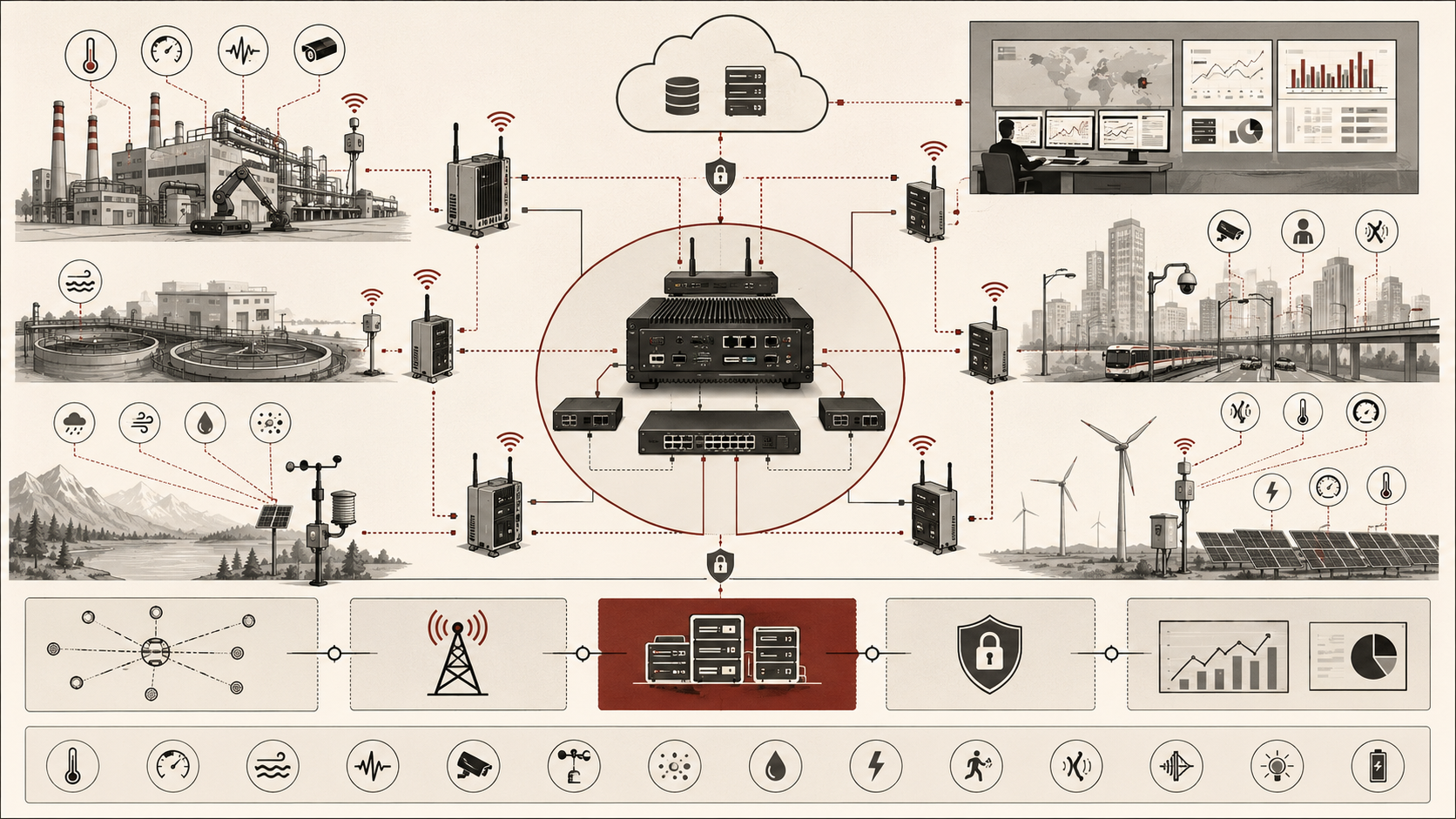
For engineers, the central issue is that an IoT sensor system is not a single device with a network connection. It is a distributed operating environment. Every reading depends on the endpoint, the acquisition path, the local clock, the device identity, the transport path, the broker or gateway, the ingestion layer, the schema, the data-quality contract, and the management plane that keeps the fleet under control. Strong IoT sensor architecture preserves these relationships instead of reducing sensor networks to disconnected payloads.
Engineering Problem
The engineering problem is how to design a sensor network that remains trustworthy after sensing becomes distributed, networked, heterogeneous, and remotely managed. A local embedded sensor interface may produce a valid reading, but an IoT architecture must answer additional questions: which device produced the value, how was it authenticated, when was it acquired, how fresh is it, what transport path carried it, what happened during outage, what firmware and configuration were active, what quality state qualifies it, and what downstream systems are allowed to do with it?
This problem becomes difficult because IoT sensor systems combine constraints from multiple engineering domains. Endpoint devices may be power-limited, memory-limited, bandwidth-limited, compute-limited, or intermittently connected. Gateways may translate between protocols and mediate trust boundaries. Cloud or service layers may handle fleet policy, ingestion, storage, analytics, and alerting. Management planes may update firmware, rotate credentials, apply configuration, and decommission devices. A defect in any layer can compromise the meaning of the measurement.
Weak architectures treat IoT as a connectivity problem. Strong architectures treat IoT as a distributed evidence system. They preserve device identity, acquisition time, transport status, telemetry schema, calibration and firmware context, quality flags, replay semantics, lifecycle state, and trust state. The result is not merely a network of sensors, but a sensor fleet that can be operated, audited, debugged, updated, and interpreted.
The practical engineering question is therefore: can the architecture preserve sensor meaning, device trust, operational freshness, lifecycle control, command safety, and fleet governability as the system grows in scale, device diversity, environmental exposure, and operational complexity?
Reference Architecture
A practical IoT sensor architecture separates responsibilities across endpoint devices, local buses, network transports, gateways, edge runtimes, brokers, cloud services, management planes, data platforms, and operational observability. The layers may be physically collapsed in small systems, but the responsibilities still exist. Treating them explicitly prevents hidden coupling between sensing, transport, security, management, and analytics.
| Layer | Engineering Role | Integrity Risk | Evidence Artifact |
|---|---|---|---|
| Sensor and acquisition layer | Measures physical variables, applies local validation, timestamps acquisition | Uncalibrated values, bad timestamps, missing quality flags | Sensor inventory, calibration status, acquisition record |
| Endpoint firmware | Packages telemetry, handles local queues, applies configuration, manages sleep/wake cycles | Silent drops, stale configuration, broken retries, poor local state handling | Firmware manifest, queue policy, local health record |
| Device identity layer | Provides device identity, authentication material, and provisioning state | Impersonation, credential reuse, orphaned devices, unverifiable data source | Identity registry, certificate record, provisioning log |
| Communications layer | Transports telemetry through constrained, local, or wide-area networks | Packet loss, retransmission ambiguity, duplicated events, missing delay metadata | Transport log, delivery metadata, retry record |
| Gateway layer | Aggregates, translates, buffers, filters, and supervises local devices | Opaque transformation, gateway single point of failure, lost lineage | Gateway manifest, transformation log, buffer ledger |
| Edge runtime | Executes local rules, analytics, dashboards, and short-horizon coordination | Unauthorized local decisions, hidden summarization, stale local policy | Rule version, model version, decision log, local authority policy |
| Broker or ingestion layer | Receives, routes, authenticates, and normalizes messages | Schema drift, duplicate ingestion, topic misuse, unqualified events | Topic map, ingestion schema, idempotency key, validation result |
| Cloud service layer | Stores telemetry, supports analytics, fleet policy, alerting, and dashboards | Overcentralization, stale assumptions, poor lifecycle linkage | Telemetry store, fleet state, policy registry, alert history |
| Management plane | Handles provisioning, configuration, OTA updates, credential rotation, retirement | Uncontrolled updates, inconsistent configuration, orphaned assets | Device twin/shadow, update ledger, configuration version, retirement record |
| Observability layer | Tracks connectivity, freshness, queue depth, version skew, trust, quality, and incidents | Fleet appears healthy while measurements degrade | Fleet dashboard, health metrics, incident reconstruction record |
This reference architecture makes clear that IoT sensor networks are not merely pipelines. They are operational systems that must preserve meaning across device, network, edge, cloud, security, lifecycle, and management boundaries.
Implementation Pattern
A rigorous IoT sensor implementation begins by defining the measurement model, the device identity model, the telemetry schema, the topic or resource hierarchy, the transport protocol, the buffering policy, the gateway responsibilities, the edge/cloud split, the security posture, the update mechanism, the command-authority model, and the observability contract.
| Artifact | Purpose | Typical Format |
|---|---|---|
| Sensor fleet inventory | Maps device ID, sensor type, location, firmware, calibration, owner, and lifecycle state | CSV, SQL, JSON, asset registry |
| Device identity manifest | Defines identity scheme, credentials, certificate status, provisioning state, and trust anchors | YAML, PKI record, registry export |
| Telemetry schema | Defines payload fields, units, timestamps, quality flags, firmware version, and provenance | JSON Schema, protobuf, Avro, SQL |
| Topic or resource map | Organizes device messages, command topics, state topics, and event classes | YAML, broker policy, API contract |
| Buffering and replay policy | Defines local queues, drop rules, backfill, replay ordering, and idempotency behavior | YAML, firmware config, gateway config |
| Gateway transformation manifest | Documents protocol translation, filtering, aggregation, unit normalization, and lineage preservation | YAML, code manifest, edge rule config |
| Security control profile | Defines authentication, authorization, encryption, credential rotation, secure update, and revocation | YAML, policy document, device-management config |
| Command authority policy | Defines which commands can be issued, by whom, under what trust state, and with what local safety checks | YAML, safety case, access policy |
| OTA and configuration policy | Defines rollout rings, rollback, configuration versioning, compatibility, and device-state checks | YAML, CI/CD manifest, management-plane export |
| Observability schema | Defines fleet health, freshness, connectivity, queue depth, version skew, trust, and data-quality metrics | JSON Schema, SQL, metrics registry |
| Incident reconstruction policy | Defines what evidence must exist to replay, debug, and explain behavior after failure | Markdown, YAML, audit log specification |
The implementation goal is to make the fleet governable. Engineers should be able to identify each device, validate its trust state, understand its telemetry semantics, detect stale or delayed data, reconstruct outages, manage software and configuration versions, enforce command authority, and preserve enough context that downstream systems do not mistake transport success for measurement trust.
Formal Model: IoT Sensor Architecture as a Managed Evidence System
IoT sensor architecture can be modeled as a mapping from physical measurements to qualified distributed records. Let \(m_i(t)\) represent a measurement acquired by device \(i\) at event time \(t\), and let \(r_i\) represent the record consumed by downstream systems.
r_i = F(m_i, d_i, \tau_i, q_i, s_i, v_i, p_i)
\]
Interpretation: A usable IoT record depends not only on measurement \(m_i\), but also on device identity \(d_i\), timestamp semantics \(\tau_i\), quality state \(q_i\), security/trust state \(s_i\), version state \(v_i\), and transport provenance \(p_i\).
L_{\mathrm{e2e}} = L_{\mathrm{sense}} + L_{\mathrm{queue}} + L_{\mathrm{network}} + L_{\mathrm{gateway}} + L_{\mathrm{ingest}} + L_{\mathrm{process}}
\]
Interpretation: End-to-end latency includes sensing, queueing, network transport, gateway handling, ingestion, and processing. A value can be technically delivered but operationally stale.
F_{\mathrm{fresh}} = t_{\mathrm{now}} – t_{\mathrm{event}}
\]
Interpretation: Freshness depends on event time, not merely arrival time. Backfilled data can be valuable for history while still inappropriate for real-time control.
A_{\mathrm{fleet}} = \frac{N_{\mathrm{healthy}}}{N_{\mathrm{registered}}}
\]
Interpretation: Fleet availability measures how many registered devices are healthy enough to report usable data, not merely how many devices exist in an asset registry.
V_{\mathrm{skew}} = \frac{N_{\mathrm{noncompliant\ versions}}}{N_{\mathrm{fleet}}}
\]
Interpretation: Version skew measures the share of the fleet running non-approved firmware, configuration, schema, rule, or model versions.
T_{\mathrm{device}} = T_{\mathrm{identity}} \cdot T_{\mathrm{boot}} \cdot T_{\mathrm{credential}} \cdot T_{\mathrm{update}} \cdot T_{\mathrm{telemetry}}
\]
Interpretation: Device trust depends on identity, boot integrity, credential status, update integrity, and trustworthy telemetry. Failure in one dimension weakens the whole chain.
This model helps prevent a common IoT mistake: treating telemetry as trustworthy simply because it arrived. In a mature architecture, telemetry is qualified by identity, time, trust, lifecycle, and quality evidence.
What Are Internet of Things Sensor Architectures?
Internet of Things sensor architectures are the structural arrangements through which sensor-equipped devices collect measurements and exchange them with broader digital systems. The architecture typically includes sensing hardware, embedded firmware, local buses, communications stacks, identity schemes, upstream services, management systems, and data models that make measurements usable outside the device itself.
What distinguishes IoT sensor architecture from a simpler embedded sensing design is the presence of networked system relationships. A local sensor read becomes part of a larger operational fabric that may include publish/subscribe messaging, request/response interactions, remote management, telemetry ingestion, rules engines, data retention, fleet supervision, and security enforcement.
In practice, these architectures vary widely. Some connect constrained battery-powered nodes directly to cloud services. Others place gateways between sensor devices and distant services. Some rely on request/response interactions, while others revolve around event-driven or publish/subscribe messaging. Some systems emphasize low-power duty cycling, while others emphasize high-frequency industrial telemetry, edge inference, or safety-critical local response.
The architectural task is to choose the arrangement that matches device constraints, network conditions, operational goals, security requirements, and lifecycle demands. A design that works for a laboratory prototype may fail when scaled to thousands of devices with different firmware versions, signal quality, network conditions, trust states, and maintenance histories.
Sensor Nodes as Constrained IoT Endpoints
Most IoT sensing begins with a constrained endpoint: a device that measures something locally while operating under limits of power, memory, bandwidth, cost, computation, or duty cycle. These constraints matter because IoT architecture is often shaped less by ideal system design than by what the smallest devices can sustain.
A sensor node in this context is not only a measurement source. It is a network participant that must decide when to wake, when to sample, how to timestamp, when to publish, how long to buffer, what to drop under pressure, how to receive configuration, and what identity or trust relationship it presents to the larger system. Even before cloud or platform questions arise, the architecture has already become a negotiation among sensing, timing, transport, power, memory, and survivability.
| Endpoint Constraint | Architectural Effect | Engineering Response |
|---|---|---|
| Battery or energy limit | Constrains sampling, radio use, cryptographic operations, and update windows | Duty-cycle design, local summarization, efficient protocols, wake scheduling |
| Memory limit | Constrains local buffering, certificate handling, queue depth, and logging | Bounded queues, compact telemetry, explicit drop policy, local compression |
| Bandwidth limit | Constrains payload richness and reporting frequency | Adaptive telemetry, event-driven reporting, gateway aggregation |
| Compute limit | Constrains local encryption, inference, filtering, and validation | Hardware acceleration, gateway offload, lightweight validation |
| Intermittent connectivity | Creates delayed reporting, duplicate messages, and backfill ambiguity | Event-time preservation, replay policy, idempotency keys |
| Field exposure | Creates drift, failure, maintenance complexity, and physical attack risk | Health telemetry, tamper signals, ruggedization, lifecycle records |
This is why node minimalism is not the same thing as architectural simplicity. A small endpoint may still carry a significant burden: cryptographic identity, local queueing, retry policy, timestamping, configuration management, and enough observability to remain governable after deployment.
The IoT Sensor Stack: Device, Gateway, Edge, Cloud, and Management Plane
One of the clearest ways to understand IoT sensor architecture is as a layered stack. At the device layer, sensors are sampled, locally validated, timestamped, and packaged. At the gateway layer, traffic may be normalized, buffered, filtered, fused, or translated across protocols. At the edge runtime layer, local rules, dashboards, inference, and short-horizon coordination may operate near the physical environment. At the cloud or service layer, telemetry may be stored, routed, visualized, scored, or linked to alerting and analytics. Across all of these layers, a management plane handles onboarding, configuration, credential rotation, software updates, decommissioning, and fleet state.
This layered view matters because different responsibilities belong at different levels. Sensor excitation, conversion, and immediate plausibility checks are local concerns. Cross-device correlation, store-and-forward behavior, local resilience, and protocol bridging often sit more naturally at gateways or edge nodes. Long-term retention, fleet management, rules orchestration, and broader analytics tend to sit upstream.
| Responsibility | Device | Gateway | Edge Runtime | Cloud / Service | Management Plane |
|---|---|---|---|---|---|
| Sensor acquisition | Primary | None or pass-through | None or derived | None | Configuration only |
| Timestamping | Acquisition time | Receive/replay time | Local processing time | Ingestion time | Clock-policy state |
| Protocol translation | Limited | Primary | Possible | Ingestion adaptation | Policy configuration |
| Buffering | Minimum viable | Primary during outage | Local operational history | Long-term storage | Retention policy |
| Analytics | Simple validation | Filtering/aggregation | Local rules and inference | Fleet analytics | Model/rule lifecycle |
| Security | Identity and local trust | Boundary enforcement | Local authorization | Policy and monitoring | Credentials and revocation |
| Updates | Apply update | Stage/update local devices | Update services/models | Coordinate rollout | Primary control |
Architectural failure often occurs when these layers are confused. A constrained sensor node may be asked to do management work better handled by a gateway. A cloud service may assume timing precision the endpoint cannot guarantee. A gateway may filter data without preserving lineage. Strong IoT sensor architectures separate responsibilities without losing traceability across layers.
Protocols and Messaging Models
IoT sensor systems depend heavily on their messaging model. MQTT is widely used because it supports publish/subscribe interaction and fits many telemetry workflows. CoAP occupies a different position in the design space, often aligning more naturally with constrained nodes and constrained networks. HTTP, WebSockets, AMQP, LoRaWAN, BLE, Zigbee, Thread, Modbus, OPC UA, and other protocols may also appear depending on deployment context.
These protocol choices are not interchangeable abstractions. Publish/subscribe models privilege event distribution and decoupled telemetry flows. Request/response models privilege direct resource access. Brokered telemetry may simplify fan-out and ingestion, while constrained protocols may reduce endpoint burden. Industrial protocols may preserve existing field-system investments but require gateway translation before data can enter broader analytics and management systems.
| Messaging Model | Typical Use | Architectural Strength | Engineering Risk |
|---|---|---|---|
| Publish/subscribe | Telemetry streams, event distribution, decoupled consumers | Scales well for many producers and consumers | Topic sprawl, weak schema discipline, unclear command boundaries |
| Request/response | Resource access, configuration, status polling | Clear interaction and resource semantics | Polling overhead, freshness ambiguity, device wake constraints |
| Store-and-forward | Intermittent links, offline gateways, constrained networks | Improves resilience during outages | Backfill ambiguity, duplicate records, stale operational state |
| Command/acknowledgment | Remote configuration, actuator commands, device control | Supports managed operations | Authority and safety risks if identity, state, and replay are weak |
| Gateway-mediated translation | Heterogeneous field protocols | Integrates legacy and constrained devices | Transformation may hide semantics unless lineage is preserved |
Protocol choice also shapes observability. A system built around event publication behaves differently from one built around periodic polling or command-oriented exchange. Good architecture therefore asks not only whether a protocol can transport data, but what kind of operational relationship it establishes among sensors, gateways, brokers, and consumers.
Gateways, Translation, and Edge Coordination
Gateways are often the most underappreciated layer in IoT sensor systems. They sit between local devices and wider networks, translating protocols, aggregating traffic, buffering data during outages, enforcing local policy, and sometimes applying local analytics. In practice, gateways are often what make heterogeneous sensor fleets manageable.
Gateways can reduce complexity at the device, but they also introduce dependencies. A gateway failure can isolate many healthy nodes. A gateway that transforms or summarizes data without clear lineage can degrade trust. A gateway that becomes the only place where local state exists can make incident reconstruction difficult. Good gateway design therefore emphasizes translation without epistemic loss, local resilience without hidden state, and coordination without becoming an opaque single point of interpretation.
| Gateway Function | Engineering Benefit | Risk if Poorly Designed | Required Evidence |
|---|---|---|---|
| Protocol translation | Integrates heterogeneous devices and field protocols | Semantic loss, unit mismatch, missing source context | Translation manifest, source protocol, normalized schema |
| Buffering | Preserves data during upstream outage | Duplicate replay, stale operational state, hidden drops | Buffer ledger, event time, upload time, drop reason |
| Aggregation | Reduces bandwidth and simplifies upstream ingestion | Loss of raw evidence or quality variation | Aggregation rule version, raw-retention policy, quality propagation |
| Local policy | Enables site-level resilience and local response | Unauthorized local decisions or stale rules | Policy version, local authority boundary, decision log |
| Device supervision | Tracks local fleet health, connectivity, and queues | Gateway appears healthy while child devices fail | Child-device heartbeat, queue depth, link state, retry count |
| Security boundary | Separates local field network from upstream systems | Gateway compromise expands blast radius | Credential state, access policy, attestation, update state |
A strong gateway is therefore not merely a relay. It is a disciplined boundary layer. It mediates differences among field protocols, local device assumptions, and upstream service expectations while keeping those transformations auditable.
Device Identity, Provisioning, and Lifecycle Management
Connected sensors are not operationally useful unless the system can identify, provision, and manage them over time. This includes initial onboarding, credential or certificate management, software and configuration lifecycle, trust rotation, transfer of ownership, decommissioning, and replacement.
This means IoT sensor architecture is never only about telemetry. It is also about lifecycle control. A sensor architecture that can ingest data but cannot securely onboard devices, rotate trust, or distinguish authentic nodes from impostors is incomplete. Identity is not an accessory to sensing. It is one of the conditions under which sensor data become operationally usable.
| Lifecycle Phase | Identity / Management Requirement | Failure Risk | Evidence to Preserve |
|---|---|---|---|
| Manufacturing or staging | Device identity assigned and bound to hardware | Untracked or duplicated device identity | Serial, key/certificate record, hardware revision |
| Provisioning | Device registered, authorized, and placed into correct tenant/site | Device reports under wrong site or owner | Provisioning event, site assignment, owner record |
| Normal operation | Credentials valid, telemetry accepted, health monitored | Silent trust decay or unobserved device failure | Heartbeat, credential state, telemetry validation result |
| Configuration update | Policy, sampling, topic, and threshold versions controlled | Fleet inconsistency or incompatible configuration | Configuration version, rollout ring, rollback state |
| Firmware update | Signed update applied and verified | Bricked devices, version skew, compromised update path | Firmware manifest, signature, update log, rollback record |
| Credential rotation | Secrets or certificates renewed without losing fleet control | Orphaned devices or credential reuse | Rotation log, credential expiry, revocation state |
| Retirement | Device deauthorized and removed from active fleet | Ghost devices, spoofed telemetry, asset confusion | Decommission record, credential revocation, asset closure |
Lifecycle design determines whether the fleet remains governable as it grows. A handful of manually provisioned devices may be manageable; a large estate of fielded sensors is not. Good architectures therefore treat onboarding, credential rotation, reprovisioning, update, replacement, and retirement as first-class operating flows rather than background administrative tasks.
Telemetry Models, State, and Digital Representation
IoT sensor systems do not only move values; they represent state. A temperature reading may be accompanied by timestamp, unit, calibration status, battery state, signal quality, firmware version, configuration version, device identity, and freshness metadata. More complex systems may represent derived state, alarms, shadow state, command acknowledgments, or inferred status alongside direct measurement.
This is why telemetry modeling is architectural. A narrow payload may reduce bandwidth but discard interpretive context. A richer payload may improve traceability but increase transport cost and storage load. The system has to decide what the digital representation of a sensor actually is: a number, a timestamped event, a state update, a quality-qualified record, or part of a richer digital representation.
| Telemetry Field | Purpose | Risk if Missing |
|---|---|---|
device_id |
Identifies the source of telemetry | Cannot attribute measurement or enforce device policy |
sensor_id |
Identifies the measurement source within the device | Cannot distinguish channels or calibration state |
event_time |
Preserves acquisition time | Arrival time may be mistaken for measurement time |
ingestion_time |
Records when the platform received the data | Transport delay and backfill behavior become invisible |
unit |
Defines measurement scale | Aggregation or comparison may become invalid |
quality_state |
Qualifies measurement fitness | Low-confidence values may be treated as valid |
firmware_version |
Connects telemetry to code state | Version-related defects become difficult to trace |
configuration_version |
Connects telemetry to sampling and reporting policy | Fleet behavior appears inconsistent without explanation |
calibration_version |
Connects measurement to calibration state | Data quality cannot be interpreted correctly |
sequence_number |
Supports gap and duplicate detection | Drops and replays may be invisible |
idempotency_key |
Prevents duplicate ingestion during replay | Backfilled data may be double-counted |
Strong architectures preserve enough state to keep distributed sensing interpretable. Weak ones optimize message transport while quietly discarding the context that made the reading meaningful. A well-designed telemetry model should make explicit what was measured, when it was measured, where it came from, how recent it is, what qualified it, and under what assumptions it should be interpreted.
Time, Freshness, Event Time, and Replay Semantics
Time semantics are central to IoT sensor architecture. In networked sensing, the time a value is acquired, transmitted, received, processed, stored, and displayed may all differ. Treating these timestamps as interchangeable creates operational risk. A value can arrive successfully and still be too old for control, too delayed for alarm logic, or too ambiguous for incident reconstruction.
Strong IoT systems preserve multiple time fields: acquisition time, device time, gateway receive time, upload time, broker receive time, ingestion time, processing time, and display time where appropriate. Not every system needs every field, but systems with buffering, intermittent connectivity, gateways, or replay should preserve enough time evidence to distinguish live telemetry from delayed historical records.
| Time Concept | Meaning | Why It Matters |
|---|---|---|
| Event time | When the physical measurement occurred | Defines measurement freshness and sequence |
| Device time | Endpoint’s local clock value | May be wrong if clock sync is weak |
| Gateway receive time | When the gateway saw the message | Reveals local transport delay |
| Upload time | When buffered data left the gateway or device | Distinguishes live data from backfill |
| Ingestion time | When the platform accepted the record | Supports platform monitoring and replay audit |
| Processing time | When rules or analytics used the record | Supports operational decision traceability |
| Freshness | Difference between now and event time | Determines eligibility for real-time use |
| Replay batch | Group of delayed records uploaded after outage | Supports idempotency, ordering, and incident reconstruction |
Time architecture is not only a database concern. It determines whether the system can safely use a value for control, alarms, model features, dashboards, compliance reporting, or historical analysis.
Security, Trust, and Architectural Exposure
IoT sensor architectures expand the attack surface of embedded systems because they expose devices, identities, protocols, gateways, update paths, and management channels to wider networks. Security in this context is architectural rather than add-on. It includes how devices authenticate, how trust is established, how network access is mediated, how software updates are controlled, how telemetry is accepted or rejected, and how sensing continues or fails under partial compromise.
Every connection path is also a trust path. Every onboarding process is also an authorization decision. Every remote management feature is also a potential exposure point. A design that routes everything centrally may simplify some oversight while increasing the blast radius of upstream errors. A design that delegates heavily to edge tiers may reduce latency and dependence on remote services, but it can also make trust boundaries harder to reason about.
| Security Dimension | Architectural Question | Failure Risk | Control Pattern |
|---|---|---|---|
| Device identity | Can the system verify which device produced the data? | Spoofed telemetry, asset confusion | Unique identity, certificate, secure provisioning |
| Credential lifecycle | Can trust material be rotated and revoked? | Long-lived compromised credentials | Credential expiry, rotation, revocation list |
| Secure update | Can firmware/configuration updates be authenticated? | Malicious or corrupted code deployment | Signed updates, rollout rings, rollback |
| Transport security | Can messages be protected in transit? | Interception, tampering, replay | TLS/DTLS or equivalent protection, replay controls |
| Authorization | Can devices, gateways, and users do only what they are permitted to do? | Privilege escalation, unsafe commands | Least privilege, scoped topics, command authorization |
| Telemetry validation | Can the ingestion layer reject malformed or untrusted records? | Poisoned data, schema drift, invalid analytics | Schema validation, trust-state validation, quarantine |
| Gateway trust | Can a gateway be trusted to transform and forward data? | Opaque tampering or data loss | Gateway identity, attestation, transformation logs |
Good IoT sensor architecture therefore resists the temptation to think of connectivity as purely functional. Connectivity changes the threat model. The system must preserve trust as deliberately as it preserves telemetry.
Command, Control, and Local Authority Boundaries
IoT sensor architectures often begin as telemetry systems and gradually acquire control features: configuration updates, sampling changes, threshold updates, local actuator commands, gateway rules, firmware updates, and edge-model deployment. Once commands enter the architecture, the system is no longer only observing the physical world. It can change device behavior, local policy, and sometimes physical outcomes.
Command authority therefore requires explicit boundaries. A remote platform may be allowed to change reporting frequency but not disable a safety-relevant local check. A gateway may be allowed to buffer and aggregate telemetry but not issue high-consequence actuator commands without local validation. A cloud service may distribute a model but not override local fail-safe logic. These boundaries should be documented, enforced, logged, and tested.
| Command Type | Risk | Required Control | Evidence to Preserve |
|---|---|---|---|
| Configuration update | Changes sampling, thresholds, reporting, or local logic | Versioned configuration, compatibility checks, staged rollout | Config version, issuer, device acknowledgment, rollback path |
| Firmware update | Changes executable behavior | Signed artifact, health gate, rollout ring, rollback | Firmware manifest, signature check, install log |
| Gateway rule update | Changes aggregation, filtering, routing, or local policy | Rule version, lineage preservation, staged deployment | Rule manifest, transformation log, affected devices |
| Sampling-rate change | Changes data density, power use, and comparability | Policy bounds, battery check, data-contract update | Sampling policy version, command source, applied time |
| Remote actuation | Can affect physical process or safety state | Local safety interlock, authorization, freshness check | Command log, local decision log, safety-state evidence |
| Credential revocation | Can isolate devices or gateways | Revocation policy, recovery path, staged trust update | Revocation record, recovery record, orphaned-device check |
This is where IoT architecture overlaps with safety engineering. The system should not treat every authenticated command as safe. A command should be evaluated against trust state, device state, freshness, local authority, configuration compatibility, and the consequences of failure. Command channels need schemas, authorization, replay protection, acknowledgments, and audit trails just as telemetry channels do.
Buffering, Offline Behavior, and Store-and-Forward Design
IoT sensors often operate intermittently by design. Battery-powered devices may sleep most of the time. Constrained links may fail. Gateways may backfill after outages. Field sites may lose internet connectivity while local sensing continues. This means offline behavior should be expected, not treated as exceptional.
The system needs to preserve acquisition time, transport delay, backfill status, replay batch, and any distinction between live telemetry and delayed reporting. Buffering policy is equally important. A strong IoT sensor architecture specifies what gets buffered locally, what is dropped under pressure, how backfill is sequenced, how duplicates are prevented, and how stale but valuable historical data are distinguished from operationally current state.
| Offline Design Question | Engineering Decision | Evidence to Preserve |
|---|---|---|
| What gets buffered? | Raw values, quality-qualified events, alarms, summaries, or priority records | Buffer policy, priority class, retention limit |
| What gets dropped? | Low-priority data, redundant summaries, or noncritical telemetry under pressure | Drop reason, queue depth, pressure threshold |
| How is replay ordered? | By event time, sequence number, priority, or ingestion policy | Sequence number, replay batch ID, ordering rule |
| How are duplicates handled? | Idempotency keys, sequence windows, or deduplication rules | Idempotency key, duplicate flag, ingestion result |
| How is stale data marked? | Freshness threshold, quality state, backfill flag | Event time, upload time, ingestion time, freshness age |
| What local behavior continues? | Sampling, local alarms, emergency rules, buffering, diagnostics | Offline-mode policy, local authority boundary, decision log |
This is especially important for mixed-use systems where the same telemetry may support both near-real-time operations and longer-term analysis. The architecture should not force those uses into one ambiguous time model.
Interoperability and Heterogeneous Sensor Fleets
Most meaningful IoT sensor systems are heterogeneous. They mix different hardware vendors, protocols, firmware versions, sensing rates, calibration states, quality characteristics, and lifecycle policies. Interoperability is therefore more than protocol compatibility. It includes data normalization, metadata alignment, lifecycle consistency, and enough abstraction that the system can reason across unlike devices without pretending they are identical.
A fleet that contains fixed reference nodes, constrained battery sensors, gateway-aggregated clusters, industrial controllers, and edge AI devices cannot be supervised well with one undifferentiated model. Strong IoT sensor architectures manage heterogeneity explicitly. They expose differences in trust, freshness, calibration, role, update status, and data quality while still allowing unified monitoring and control where appropriate.
| Interoperability Layer | What Must Align | Failure Risk |
|---|---|---|
| Protocol | Transport, topic/resource model, QoS, retry behavior | Devices connect but behave inconsistently |
| Schema | Field names, units, timestamp semantics, quality states | Data are ingested but misinterpreted |
| Identity | Device IDs, asset IDs, site IDs, ownership | Telemetry cannot be tied to assets |
| Lifecycle | Firmware, configuration, calibration, credential state | Fleet drift becomes invisible |
| Observability | Health, connectivity, queue depth, battery, trust, version skew | Heterogeneous failures cannot be compared |
| Semantics | Meaning of events, alarms, state transitions, and derived values | Common dashboards hide different device meanings |
In practice, this often means treating heterogeneity as a designed feature rather than a cleanup problem. The architecture should assume that the fleet will diversify over time and that the system must remain legible even as devices, protocols, and sensing roles proliferate.
Edge–Cloud Partitioning and Operational Responsibility
One of the hardest IoT design questions is where responsibility should live. Some functions belong naturally on the device: direct sensing, local validation, immediate timestamps, and minimum viable buffering. Some belong at the edge or gateway: protocol normalization, local retry handling, batching, local health supervision, and short-horizon coordination. Others belong in the cloud or service layer: long-term storage, cross-site analytics, fleet-scale policy, identity governance, and broader alerting logic.
Bad architectures often confuse these responsibilities. They push too much cloud dependence into devices that must survive offline, or they burden edge layers with opaque logic that should remain centrally governed. Good architectures partition responsibility according to latency needs, trust boundaries, compute limits, bandwidth constraints, and operational consequences of disconnection.
| Function | Prefer Device When… | Prefer Gateway / Edge When… | Prefer Cloud When… |
|---|---|---|---|
| Validation | Immediate plausibility and safety checks are needed | Cross-device comparison is needed | Fleet-wide validation rules are updated centrally |
| Buffering | Minimum continuity is required during short disconnection | Site-level outage resilience is required | Long-term retention and analytics are needed |
| Analytics | Simple local thresholds or TinyML inference are sufficient | Site-level inference or aggregation is needed | Fleet-wide model training or historical analysis is needed |
| Security | Identity and secure boot are local requirements | Local network boundary must be enforced | Policy, rotation, and monitoring require central control |
| Updates | Device applies signed firmware/configuration | Gateway stages updates for local fleet | Cloud coordinates rollout, rollback, and compatibility |
| Alarms | Immediate local response is safety-critical | Site-level coordination is required | Cross-site escalation or analytics are required |
The point is not to maximize edge or cloud capability in the abstract. It is to ensure that each layer carries the responsibilities it can sustain without making the rest of the system more brittle or more opaque.
Fleet Observability and Operational Signals
IoT sensor architecture must make the fleet observable. A system that only reports sensor values cannot distinguish measurement failures from transport failures, firmware failures, configuration drift, credential problems, queue pressure, battery exhaustion, or gateway isolation. Fleet observability should therefore include device, network, measurement, trust, lifecycle, and data-quality signals.
| Operational Signal | What It Reveals | Why Engineers Need It |
|---|---|---|
| Heartbeat age | How long since the device last reported health | Detects silent device or network failure |
| Telemetry freshness | Age of the measurement relative to event time | Separates live telemetry from delayed backfill |
| Queue depth | Local or gateway buffering pressure | Detects outage, bandwidth, or ingestion bottlenecks |
| Battery or power state | Energy risk and duty-cycle constraints | Supports maintenance and sampling policy |
| Firmware version | Active code state | Detects version skew and update risk |
| Configuration version | Active sampling/reporting policy | Detects inconsistent behavior across fleet |
| Credential state | Authentication and trust validity | Detects expired, revoked, or suspect devices |
| Calibration version | Measurement qualification state | Connects telemetry to sensor integrity |
| Quality state | Measurement fitness for use | Prevents low-confidence data from driving decisions |
| Gateway child count | Number of devices supervised by a gateway | Detects gateway isolation and local fleet loss |
| Replay batch count | Backfilled records after outage | Supports incident reconstruction and deduplication |
| Drop reason | Why data were not forwarded or retained | Prevents silent data loss |
Observability should not be retrofitted after a fleet becomes difficult to operate. It should be part of the architecture from the beginning, because the first major field failure often reveals what the telemetry model failed to preserve.
Device Management, OTA Updates, and Configuration Control
IoT sensor fleets require continuous management. Firmware updates, configuration changes, sampling adjustments, certificate rotation, model updates, gateway rule changes, and decommissioning events all change the behavior of the sensor system. If these changes are not controlled, the fleet becomes difficult to interpret. Two devices may report similar payloads while running different firmware, using different sampling intervals, applying different calibration coefficients, or publishing under different topic policies.
OTA updating is therefore not simply a convenience feature. It is a lifecycle-control mechanism. A mature architecture should define rollout rings, compatibility checks, rollback paths, update windows, update evidence, device health gates, and version-compliance monitoring.
| Management Concern | Required Control | Failure Mode Prevented |
|---|---|---|
| Firmware update | Signed artifact, rollout ring, health gate, rollback | Compromised update, bricked fleet, uncontrolled version skew |
| Configuration update | Versioned config, compatibility checks, staged deployment | Inconsistent sampling and reporting behavior |
| Credential rotation | Rotation window, expiry tracking, revocation | Stale credentials and orphaned trust |
| Schema evolution | Backward compatibility, validation, schema version | Broken ingestion or silently misread telemetry |
| Gateway rule update | Transformation manifest and rule version | Opaque filtering or aggregation changes |
| Device retirement | Credential revocation and asset closure | Ghost devices and spoofed telemetry acceptance |
Configuration deserves special attention. A sampling interval, alarm threshold, buffer limit, topic map, quality rule, or edge-filter setting can change the meaning of telemetry as much as firmware can. Strong architectures version and observe configuration as carefully as code.
Data Contracts, Schemas, and Quality Flags
IoT systems fail when telemetry is treated as informal JSON rather than as a contract. A schema defines what fields exist. A data contract defines what those fields mean, how they are produced, what assumptions qualify them, and what consumers are allowed to infer from them.
A strong IoT telemetry contract should include identity, time, unit, value, quality, version, lineage, and trust fields. It should also define what counts as missing, stale, delayed, inferred, low-confidence, duplicate, or replayed data. Without those conventions, downstream systems may silently build analytics on weak or inconsistent records.
| Contract Element | Example Field | Purpose |
|---|---|---|
| Identity | device_id, sensor_id, site_id |
Attributes telemetry to source and context |
| Time | event_time, ingestion_time, replay_batch_id |
Preserves freshness and backfill semantics |
| Measurement | value, unit, measurement_type |
Defines what was measured and how to interpret scale |
| Quality | quality_state, confidence, drop_reason |
Qualifies use of the record |
| Lifecycle | firmware_version, configuration_version, calibration_version |
Connects data to active system state |
| Transport | sequence_number, idempotency_key, duplicate_flag |
Supports replay and deduplication |
| Trust | credential_state, trust_state, attestation_state |
Prevents untrusted telemetry from being treated as normal |
| Lineage | gateway_id, transformation_version, schema_version |
Documents transformations between field and platform |
Data contracts are especially important when multiple teams consume the same telemetry. Operations, analytics, compliance, engineering, and machine-learning workflows may all use the same records differently. The contract prevents each consumer from inventing its own interpretation of the same sensor stream.
Worked Example: Environmental and Industrial IoT Sensor Fleet
Consider a mixed IoT sensor fleet deployed across industrial sites and outdoor environmental monitoring stations. The fleet includes battery-powered environmental nodes, wired industrial vibration sensors, gateway-attached temperature probes, and edge nodes running local anomaly rules. Telemetry flows through site gateways, then to a cloud ingestion layer, then into dashboards, alerts, and analytics.
In this system, the architecture must preserve more than measurement values. It must preserve identity, freshness, trust, quality, lifecycle state, and command boundaries.
| Scenario | Architectural Risk | Required Design Response |
|---|---|---|
| Outdoor node sleeps for power savings | Cloud dashboard may mistake intermittent reporting for failure | Duty-cycle-aware heartbeat and expected reporting schedule |
| Gateway loses upstream connectivity | Backfilled records may appear live after reconnect | Event time, upload time, replay batch, freshness flag |
| Industrial vibration sensor changes firmware | Feature semantics may change without downstream awareness | Firmware version, feature schema version, rollout record |
| Battery sensor quality degrades | Low-quality data may feed analytics | Quality state, signal-strength metadata, allowed-use rules |
| Gateway aggregates local sensor data | Raw evidence may disappear | Aggregation manifest, raw-retention policy, transformation version |
| Device certificate expires | Telemetry may fail or become untrusted | Credential-expiry monitoring and rotation workflow |
| Configuration rollout changes sampling interval | Trend comparisons become invalid | Configuration version and sampling policy in telemetry |
| Replay duplicates records after outage | Analytics may double-count events | Idempotency keys and duplicate detection |
| Remote threshold update is issued | Local alarm behavior may change without field context | Command authority policy, staged rollout, acknowledgment, rollback |
The architecture succeeds only if the system can distinguish live from delayed data, trusted from untrusted devices, valid from low-confidence measurements, current from stale configuration, authorized from unsafe commands, and direct measurements from gateway-derived summaries. In other words, the IoT architecture must preserve operational meaning, not just connectivity.
Deployment Readiness Gate
An engineering-grade IoT sensor fleet should pass a deployment readiness gate before field rollout. The gate should verify that the system can preserve identity, telemetry meaning, offline continuity, security, lifecycle control, local authority, and observability under realistic operating conditions.
| Readiness Check | Pass Condition | Why It Matters |
|---|---|---|
| Sensor inventory complete | Device, sensor, site, owner, firmware, calibration, and lifecycle records exist | Prevents unmanaged assets and ambiguous telemetry |
| Device identity provisioned | Each device has unique identity and authenticated onboarding path | Prevents spoofed or unattributed telemetry |
| Telemetry schema validated | Payload includes required identity, time, unit, quality, version, and lineage fields | Prevents downstream misinterpretation |
| Protocol and topic map reviewed | Publish, subscribe, command, and state paths are documented and authorized | Prevents topic sprawl and unsafe control paths |
| Offline behavior tested | Buffering, drop policy, replay, idempotency, and freshness marking are verified | Prevents outage ambiguity |
| Gateway transformations documented | Translation, filtering, aggregation, and summarization preserve lineage | Prevents semantic loss at boundary layers |
| Security controls verified | Authentication, authorization, encryption, credential rotation, and update signing exist | Protects device and fleet trust |
| Command authority bounded | Remote configuration, update, and actuation paths have authorization and local safety checks | Prevents unsafe remote control and policy drift |
| OTA and configuration rollout tested | Rollout rings, health gates, compatibility checks, and rollback are defined | Prevents fleet-wide failure during updates |
| Observability implemented | Heartbeat, freshness, queue depth, battery, trust, version skew, and quality states are visible | Allows engineers to operate the fleet |
| Incident reconstruction ready | Logs and records can reconstruct device, gateway, transport, command, and ingestion behavior | Supports debugging and accountability after failure |
This readiness gate separates a connected prototype from a fieldable IoT sensor architecture.
Mathematical Lens: Latency, Freshness, Reliability, Trust, and Fleet Governability
A practical mathematical lens for IoT sensor architecture focuses on how well the fleet preserves usable telemetry under constraints.
L_{\mathrm{e2e}} = L_{\mathrm{sense}} + L_{\mathrm{queue}} + L_{\mathrm{network}} + L_{\mathrm{gateway}} + L_{\mathrm{ingest}} + L_{\mathrm{process}}
\]
Interpretation: End-to-end latency includes sensing, local queueing, network transport, gateway handling, platform ingestion, and processing. The largest term may shift depending on outage, duty cycle, or gateway pressure.
F_{\mathrm{fresh}} = t_{\mathrm{now}} – t_{\mathrm{event}}
\]
Interpretation: Freshness is the age of the measurement relative to event time. It determines whether a record is eligible for real-time use.
R_{\mathrm{delivery}} = \frac{N_{\mathrm{delivered}}}{N_{\mathrm{expected}}}
\]
Interpretation: Delivery reliability compares delivered records to expected records. It should be interpreted with freshness and quality, not alone.
Q_{\mathrm{usable}} = \frac{N_{\mathrm{valid, fresh, trusted}}}{N_{\mathrm{received}}}
\]
Interpretation: Usable telemetry rate measures the share of received records that are valid, fresh, and trusted enough for their intended use.
B_{\mathrm{pressure}} = \frac{Q_{\mathrm{current}}}{Q_{\mathrm{capacity}}}
\]
Interpretation: Buffer pressure compares current queue depth to buffer capacity. High pressure indicates outage, transport bottleneck, or ingestion failure.
G_{\mathrm{fleet}} = w_1 A_{\mathrm{fleet}} + w_2 Q_{\mathrm{usable}} + w_3 T_{\mathrm{verified}} + w_4 V_{\mathrm{compliant}} + w_5 O_{\mathrm{observable}} + w_6 C_{\mathrm{bounded}}
\]
Interpretation: Fleet governability can combine availability, usable telemetry, verified trust, version compliance, observability coverage, and bounded command authority.
The purpose of these formulas is not to reduce IoT architecture to a single score. It is to make key architectural properties measurable: latency, freshness, delivery, buffer pressure, trust, version skew, observability, and governability.
Python Workflow: IoT Sensor Fleet Architecture and Telemetry Analysis
The companion Python workflow should model an IoT sensor fleet across devices, gateways, telemetry events, trust states, firmware versions, configuration versions, freshness, quality flags, buffering, replay, idempotency, and version skew. It can score fleet governability, identify stale telemetry, detect duplicate replay, summarize gateway pressure, and flag devices that require lifecycle intervention.
# Python Workflow: IoT Sensor Fleet Architecture and Telemetry Analysis

fleet["firmware_compliant"] = fleet["active_firmware"] == fleet["approved_firmware"]
fleet["configuration_compliant"] = fleet["active_config"] == fleet["approved_config"]
fleet["trusted"] = fleet["trust_state"] == "verified"
fleet["online"] = fleet["connectivity_state"] == "online"

telemetry["freshness_seconds"] = (
    telemetry["processing_time"] - telemetry["event_time"]
).dt.total_seconds()

telemetry["fresh"] = telemetry["freshness_seconds"] <= freshness_threshold_seconds
telemetry["usable"] = (
    telemetry["fresh"]
    & (telemetry["quality_state"] == "valid")
    & (telemetry["trust_state"] == "verified")
    & (~telemetry["duplicate_detected"])
)

fleet_governability = {
    "fleet_assets": len(fleet),
    "online_rate": fleet["online"].mean(),
    "trust_verified_rate": fleet["trusted"].mean(),
    "firmware_compliance_rate": fleet["firmware_compliant"].mean(),
    "configuration_compliance_rate": fleet["configuration_compliant"].mean(),
    "mean_gateway_buffer_pressure": gateways["buffer_pressure"].mean(),
    "usable_telemetry_rate": telemetry["usable"].mean(),
    "stale_telemetry_rate": (~telemetry["fresh"]).mean(),
    "duplicate_replay_rate": telemetry["duplicate_detected"].mean(),
}
This workflow is useful because it makes IoT architecture measurable. Engineers can see whether a fleet is merely connected or actually governable. A high message count may hide low freshness, poor trust coverage, version skew, stale configuration, duplicate replay, or gateway buffer pressure. The workflow surfaces those conditions directly.
For production systems, the same analysis can connect to device registries, broker logs, gateway buffers, time-series stores, certificate inventories, firmware-update ledgers, command logs, and observability metrics.
R Workflow: Fleet Reporting and Sensor Architecture Health
The companion R workflow should focus on fleet-level reporting: online rate, trusted-device rate, firmware compliance, configuration compliance, stale telemetry rate, usable telemetry rate, gateway buffer pressure, duplicate replay rate, command acknowledgment rate, and quality-state prevalence by site, device class, gateway, and sensor family.
# R Workflow: IoT Sensor Fleet Health Reporting

fleet_summary <- telemetry_records |>
  dplyr::group_by(site_id, gateway_id, sensor_family) |>
  dplyr::summarise(
    devices = dplyr::n_distinct(device_id),
    telemetry_records = dplyr::n(),
    usable_telemetry_rate = mean(usable == TRUE, na.rm = TRUE),
    stale_telemetry_rate = mean(fresh == FALSE, na.rm = TRUE),
    duplicate_replay_rate = mean(duplicate_detected == TRUE, na.rm = TRUE),
    valid_quality_rate = mean(quality_state == "valid", na.rm = TRUE),
    trusted_rate = mean(trust_state == "verified", na.rm = TRUE),
    firmware_compliance_rate = mean(active_firmware == approved_firmware, na.rm = TRUE),
    configuration_compliance_rate = mean(active_config == approved_config, na.rm = TRUE),
    mean_freshness_seconds = mean(freshness_seconds, na.rm = TRUE),
    p95_freshness_seconds = quantile(freshness_seconds, 0.95, na.rm = TRUE),
    .groups = "drop"
  )
This reporting layer helps engineers separate different kinds of failure. A site may be online but stale. A gateway may be healthy while child devices are failing. A device may be reporting regularly but running outdated firmware. A telemetry stream may be high-volume but low-quality. A fleet-level report makes these distinctions visible.
For embedded and edge sensor systems, this kind of reporting is essential because connectivity metrics alone are not enough. Operational health requires trusted, fresh, version-compliant, quality-qualified telemetry.
Systems Code: C, C++, Rust, Go, MicroPython, TinyML, PYNQ, HDL, SQL, Bash, and Configuration
The companion repository should be useful to engineers because IoT sensor architecture crosses the full embedded and edge stack. It touches endpoint firmware, gateway logic, transport semantics, telemetry schemas, quality flags, trust-state validation, lifecycle control, device management, local buffering, replay, observability, command authority, and hardware/software co-design.
| Folder | Engineering Role | IoT Sensor Architecture Use |
|---|---|---|
python/ |
Fleet analytics and architecture scoring | Analyzes freshness, version skew, trust, delivery reliability, usable telemetry, replay, and gateway pressure |
r/ |
Fleet reporting and health dashboards | Summarizes IoT architecture health by site, gateway, sensor family, and device class |
sql/ |
Queryable device and telemetry evidence | Stores device inventory, telemetry records, gateway state, identity state, update logs, command logs, and incident records |
c/ |
Firmware-adjacent endpoint behavior | Implements local queue state, heartbeat, quality flagging, and retry logic |
cpp/ |
Device/gateway state-machine abstraction | Models online, degraded, offline, provisioning, updating, replay, and retired states |
rust/ |
Safe validation of telemetry and device records | Checks required fields, trust state, schema version, timestamp semantics, and lifecycle state |
go/ |
Telemetry routing and lightweight services | Routes stale, duplicate, low-quality, untrusted, command, and version-skew events to appropriate handlers |
micropython/ |
Constrained endpoint prototype | Emits heartbeat, local queue status, sensor payload, and quality state from a microcontroller-class device |
tinyml/ |
Local event or quality classification | Classifies local sensor state before upstream transport when bandwidth or latency constraints require it |
pynq/ |
Gateway acceleration and low-latency stream handling | Validates accelerated timestamping, event extraction, and quality-frame generation |
hdl/ |
Hardware/software co-design | Implements timestamp capture, event triggers, heartbeat framing, queue signals, and telemetry frame generation |
bash/ |
Repeatable workflow execution | Runs manifest validation, analytics workflows, tests, and output inventory generation |
config/ |
Machine-readable architecture assumptions | Stores device identity, topic maps, schemas, buffering, replay, security, update, command, and readiness policies |
This stack matters because IoT architecture is not produced by a single cloud service or a single protocol. It is produced by the interaction among firmware, identity, transport, gateways, schemas, management, observability, authority boundaries, and operations.
Testing and Validation
IoT sensor architecture should be tested under the conditions that actually threaten field deployments: intermittent links, power loss, device sleep, gateway outage, credential expiration, firmware rollback, schema drift, duplicate replay, stale telemetry, topic misuse, queue pressure, unsafe command issuance, and partial compromise.
A practical validation suite should answer these questions:
- Can every telemetry record be attributed to a known device, sensor, site, firmware version, configuration version, and trust state?
- Can the system distinguish event time, upload time, ingestion time, processing time, and display time?
- Does the system mark stale, replayed, duplicate, delayed, low-quality, or untrusted telemetry?
- Do devices continue essential local behavior during network outage?
- Does buffering preserve priority, ordering, drop reasons, and idempotency keys?
- Can gateways translate and aggregate data without losing lineage?
- Are commands and configuration changes authorized, versioned, bounded, and acknowledged?
- Can credentials be rotated and revoked without orphaning the fleet?
- Can firmware and configuration updates be rolled out gradually and rolled back safely?
- Can the system detect firmware skew, configuration skew, schema drift, and stale lifecycle state?
- Can engineers reconstruct an incident across device, gateway, broker, ingestion, command, cloud, and management layers?
Testing should include negative cases: device identity mismatch, expired certificate, bad schema version, duplicate message, missing timestamp, stale replay, gateway buffer overflow, partial update failure, unauthorized command, unsafe command under stale telemetry, and offline-to-online transition. An IoT system that cannot fail visibly will eventually fail silently.
Common Failure Modes
IoT sensor architectures fail in predictable ways. The most serious failures often arise not from total outage, but from ambiguity: data arrive, but their meaning, source, freshness, trust, command state, or lifecycle state is unclear.
- Connectivity mistaken for architecture: devices publish messages, but identity, lifecycle, quality, and observability are weak.
- Arrival time mistaken for event time: delayed telemetry is treated as live operational state.
- Gateways hide transformations: aggregation or protocol translation changes data meaning without preserving lineage.
- Topic sprawl: publish/subscribe systems grow without disciplined naming, authorization, or schema governance.
- Schema drift: payloads change without compatible consumers or versioned contracts.
- Firmware skew: devices report under the same data model while running different code versions.
- Configuration skew: sampling intervals, thresholds, or buffer policies vary without visibility.
- Credential lifecycle failure: expired, duplicated, or unrecoverable credentials create trust gaps.
- Replay ambiguity: buffered records are backfilled without idempotency keys or freshness flags.
- Silent drop behavior: devices or gateways discard data under pressure without preserving drop reasons.
- Fleet observability gap: dashboards show values but not device health, queue depth, battery, trust, or version state.
- Overcentralization: local systems become unusable during cloud or network outage.
- Uncontrolled remote authority: commands or configuration changes exceed safe local boundaries.
A mature IoT sensor architecture assumes these failures are possible and makes them visible, bounded, testable, and recoverable.
Trade-Offs in IoT Sensor Architecture
IoT sensor architectures are shaped by trade-offs that cannot all be optimized at once. Direct cloud connectivity reduces gateway dependence but may increase device burden. Gateways improve local resilience but create concentration points. Rich telemetry improves traceability but increases bandwidth and storage cost. Aggressive edge summarization saves transport but can reduce transparency. Strong security and lifecycle controls improve trust but add operational overhead. More frequent reporting improves freshness but consumes power and bandwidth. More local autonomy improves resilience but increases the burden of local safety, audit, and policy management.
The right architecture depends on purpose. Low-cost environmental monitoring, industrial telemetry, building operations, connected agriculture, logistics, consumer IoT, and high-assurance infrastructure all impose different demands on transport, identity, trust, buffering, update control, and interpretability.
The central design question is therefore not how to connect sensors most quickly, but how to build a sensing architecture that remains manageable, trustworthy, and operationally coherent once the fleet grows beyond a handful of devices.
Applications in Embedded and Edge Systems
Industrial IoT. Sensor fleets monitor equipment, vibration, temperature, pressure, energy use, and production state. Architectures must preserve freshness, reliability, gateway lineage, local resilience, and secure lifecycle control.
Environmental monitoring. Distributed sensors measure air, water, soil, weather, biodiversity, or infrastructure conditions. Systems often face intermittent connectivity, power limits, harsh environments, and the need for defensible measurement provenance.
Smart buildings and infrastructure. Sensors track occupancy, energy, environmental conditions, safety systems, and equipment health. Architectures must handle protocol heterogeneity, retrofits, lifecycle management, and operational dashboards.
Connected agriculture. Soil, weather, irrigation, livestock, and equipment sensors require low-power operation, wide-area connectivity, buffering, and interpretable data under variable field conditions.
Logistics and asset tracking. Mobile sensors report location, shock, temperature, humidity, and custody state. Architectures must handle intermittent networks, freshness, replay, device identity, and chain-of-custody evidence.
Energy systems. Distributed sensors support grid monitoring, renewable systems, storage assets, microgrids, and equipment maintenance. Architecture must balance local resilience, secure telemetry, and cross-site analytics.
What unites these applications is not one protocol or vendor platform, but the need to turn constrained sensing endpoints into a governable system that can survive growth, heterogeneity, lifecycle change, and imperfect connectivity.
Engineer Checklist
- Define device, sensor, gateway, site, and ownership identifiers before telemetry design.
- Separate event time, upload time, ingestion time, and processing time where buffering or replay can occur.
- Include firmware version, configuration version, calibration version, schema version, and quality state in telemetry where relevant.
- Define topic, resource, command, and state models explicitly; do not let them emerge informally.
- Design device onboarding, credential rotation, revocation, update, rollback, and retirement as first-class lifecycle flows.
- Specify local buffering, priority, drop policy, replay order, idempotency keys, and duplicate detection.
- Preserve gateway transformations through manifests, rule versions, and lineage fields.
- Bound remote command authority with authorization, local safety checks, freshness requirements, and rollback behavior.
- Test the system under network outage, gateway failure, expired credentials, stale configuration, unsafe commands, and firmware rollback.
- Monitor freshness, queue depth, version skew, trust state, heartbeat age, battery state, and data-quality state.
- Use schemas and data contracts so downstream systems know what telemetry means and how it may be used.
- Partition responsibilities according to latency, bandwidth, compute, trust boundary, and outage consequences.
- Make incident reconstruction possible across device, gateway, broker, ingestion, command, cloud, and management layers.
This checklist is intentionally practical. A connected sensor fleet becomes trustworthy only when engineers can explain where data came from, when it was measured, how it moved, what qualified it, what version state produced it, and what downstream systems are allowed to infer from it.
GitHub Repository
This article is supported by a companion workflow that models IoT sensor fleet architecture, telemetry freshness, device identity, gateway buffering, replay, trust state, firmware/configuration skew, schema validation, data quality, command authority, and deployment readiness using reproducible engineering artifacts.
Complete Code Repository
The companion repository includes Python, R, SQL, C, C++, Rust, Go, MicroPython, TinyML, PYNQ, HDL, Bash, YAML/JSON configuration, notebooks, device inventories, telemetry schemas, topic maps, buffering and replay policies, identity manifests, security-control profiles, gateway transformation manifests, command-authority policies, OTA rollout policies, observability schemas, deployment-readiness checks, and tests for IoT sensor architecture in embedded and edge systems.
View the Full GitHub Repository
Where This Fits in the Series
This article extends the foundation established in Embedded Systems Architecture, Environmental Sensor Networks, Data Acquisition and Embedded Sensor Interfaces, Distributed Monitoring Systems, and Calibration, Noise, and Measurement Integrity in Sensor Systems by focusing on how sensor systems become networked, managed, and governable across gateways, edge layers, cloud services, and lifecycle-management systems.
It also connects directly to Edge Computing Architectures, Reliability and Fault Tolerance in Embedded Devices, Privacy and Local Data Processing at the Edge, Standards, Interoperability, and Governance in Edge Infrastructure, and Device Lifecycle Management and Over-the-Air Updating, where identity, transport, security, update control, local autonomy, and interoperability determine whether distributed sensor fleets remain trustworthy over time.
Conclusion
Internet of Things sensor architectures are not simply networks that carry sensor values outward. They are systems that must connect measurement, identity, messaging, gateway behavior, lifecycle control, security, observability, command authority, and data interpretation into one governable structure. The strongest architectures are therefore not those that connect the most devices the fastest, but those that preserve device meaning, fleet coherence, operational resilience, and interpretability as the sensing system grows in scale and heterogeneity.
A mature IoT sensor architecture treats telemetry as qualified evidence, not as isolated payload. It preserves where a value came from, when it was measured, how fresh it is, how it moved, what transformed it, what device and firmware produced it, whether it can be trusted, and what uses it can safely support. Without that structure, connected sensors can produce enormous volumes of data while weakening operational understanding. With it, IoT sensor fleets become durable infrastructure for trustworthy embedded and edge intelligence.
Related articles
- Embedded and Edge Systems: Real-Time Computing in Devices, Sensors, and Infrastructure
- Embedded Systems Architecture
- Environmental Sensor Networks
- Data Acquisition and Embedded Sensor Interfaces
- Distributed Monitoring Systems
- Calibration, Noise, and Measurement Integrity in Sensor Systems
- Edge Computing Architectures
- Reliability and Fault Tolerance in Embedded Devices
- Device Lifecycle Management and Over-the-Air Updating
Further reading
- AWS (n.d.) Device communication protocols – AWS IoT Core. Available at: https://docs.aws.amazon.com/iot/latest/developerguide/protocols.html
- Google Cloud (2024) IoT platform product architecture. Available at: https://docs.cloud.google.com/architecture/connected-devices/iot-platform-product-architecture
- IETF (2014) RFC 7252: The Constrained Application Protocol (CoAP). Available at: https://datatracker.ietf.org/doc/html/rfc7252
- IETF (2024) RFC 9556: Internet of Things (IoT) Edge Challenges and Functions. Available at: https://datatracker.ietf.org/doc/html/rfc9556
- NIST (n.d.) Cybersecurity for IoT Program. Available at: https://www.nist.gov/itl/applied-cybersecurity/nist-cybersecurity-iot-program
- NIST NCCoE (2024) Trusted IoT Device Network-Layer Onboarding and Lifecycle Management. Available at: https://www.nccoe.nist.gov/sites/default/files/2024-05/nist-sp-1800-36-draft.pdf
- OASIS (2019) MQTT Version 5.0. Available at: https://docs.oasis-open.org/mqtt/mqtt/v5.0/mqtt-v5.0.html
- Zephyr Project (n.d.) Networking Samples. Available at: https://docs.zephyrproject.org/latest/samples/net/net.html
References
- AWS (n.d.) Device communication protocols – AWS IoT Core. Available at: https://docs.aws.amazon.com/iot/latest/developerguide/protocols.html
- AWS (n.d.) AWS IoT Core Features. Available at: https://aws.amazon.com/iot-core/features/
- Google Cloud (2024) IoT platform product architecture. Available at: https://docs.cloud.google.com/architecture/connected-devices/iot-platform-product-architecture
- IETF (2014) RFC 7252: The Constrained Application Protocol (CoAP). Available at: https://datatracker.ietf.org/doc/html/rfc7252
- IETF (2024) RFC 9556: Internet of Things (IoT) Edge Challenges and Functions. Available at: https://datatracker.ietf.org/doc/html/rfc9556
- NIST (n.d.) Cybersecurity for IoT Program. Available at: https://www.nist.gov/itl/applied-cybersecurity/nist-cybersecurity-iot-program
- NIST (2025) Foundational Cybersecurity Activities for IoT Product Manufacturers. Available at: https://nvlpubs.nist.gov/nistpubs/ir/2025/NIST.IR.8259r1.ipd.pdf
- NIST NCCoE (2024) Trusted IoT Device Network-Layer Onboarding and Lifecycle Management. Available at: https://www.nccoe.nist.gov/sites/default/files/2024-05/nist-sp-1800-36-draft.pdf
- OASIS (2019) MQTT Version 5.0. Available at: https://docs.oasis-open.org/mqtt/mqtt/v5.0/mqtt-v5.0.html
- Zephyr Project (n.d.) Networking Samples. Available at: https://docs.zephyrproject.org/latest/samples/net/net.html