
Last Updated June 2, 2026
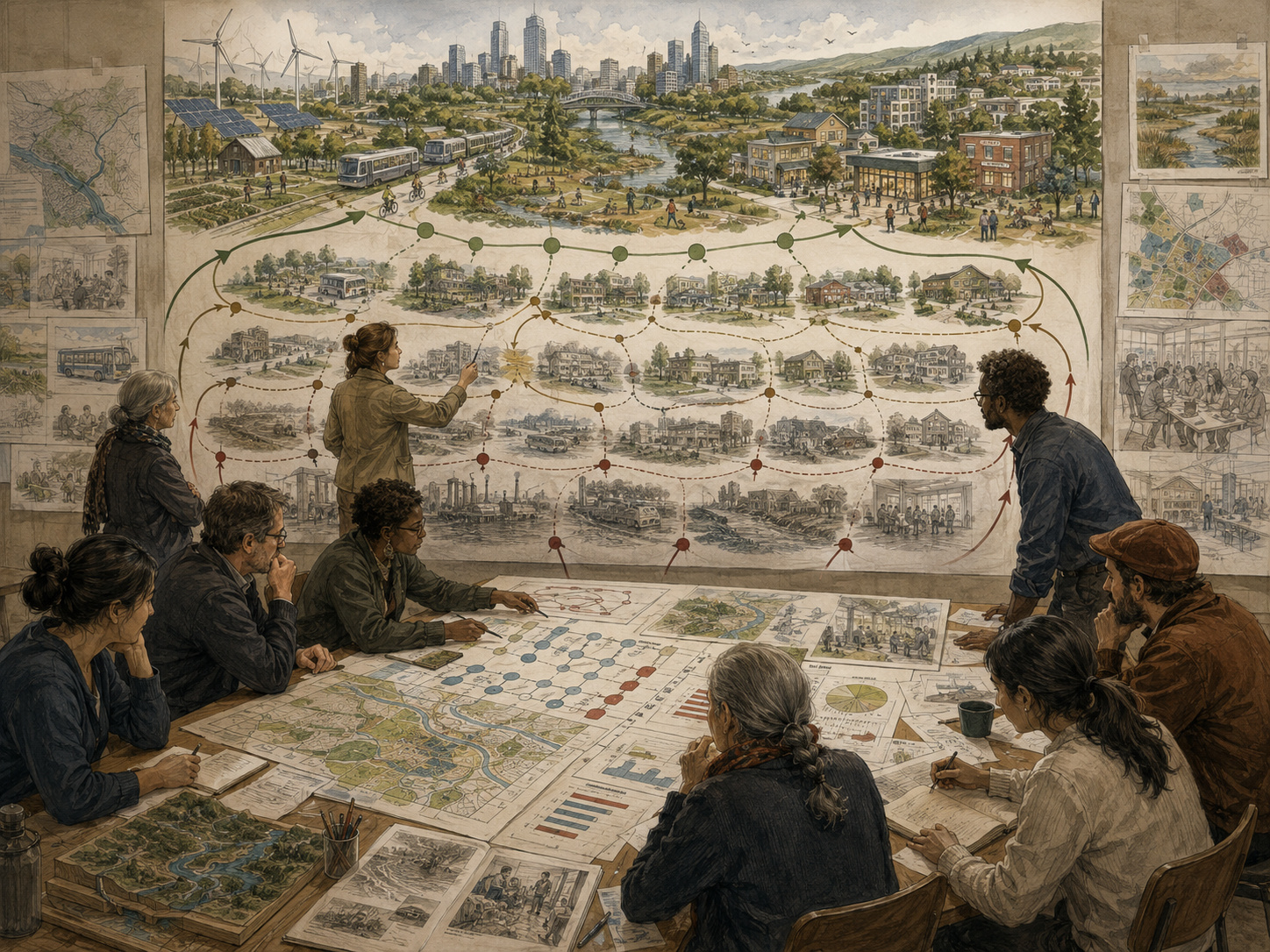
Backcasting is a strategic planning method that begins with a desired future and works backward to identify the decisions, capacities, investments, reforms, and transition pathways required to reach it. Unlike forecasting, which projects present trends forward, backcasting starts from a future condition judged to be necessary, desirable, legitimate, or ethically required, then asks what must change in the present to make that future possible.
This makes backcasting especially valuable when current trajectories are inadequate. Climate stabilization, ecological restoration, resilient infrastructure, public-health preparedness, just energy transition, institutional reform, democratic renewal, care-system redesign, and sustainable development cannot always be achieved by extending existing patterns. In many cases, the present path is precisely what must be changed.
At its deepest level, backcasting represents a shift from predictive reasoning to normative design. It does not ask only what is likely to happen. It asks what future should exist, what conditions would make that future viable, what barriers stand in the way, and what sequence of actions could move a system from current conditions toward a preferred state.
Backcasting is therefore one of the most important bridges between futures thinking and strategy. Scenario planning explores alternative futures. Horizon scanning and weak signal analysis identify emerging change. Trend analysis and megatrends clarify long-term structural forces. Backcasting then turns future-oriented insight into pathway design: a structured attempt to connect long-range purpose to present-day action.
Main Library
Publications
Article Map
Futures Thinking
Related Topic
Systems Modeling
Related Topic
Resilience Thinking
Related Topic
Sustainable Development
What Is Backcasting?
Backcasting is a planning and foresight method that starts with a defined future state and works backward to identify the actions required to reach that state. It is most useful when the desired future cannot be reached by simply extending current trends or making small incremental adjustments. Instead of asking what the future is likely to be, backcasting asks what future should be pursued and what present decisions would make it possible.
The method begins with a normative or strategic target. That target may be a low-carbon energy system, a resilient food and water system, a just housing future, a decarbonized transportation network, a public-health system prepared for climate stress, a regenerative land-use pattern, a democratic technology governance framework, or an institution capable of long-term responsibility. Once the future target is defined, the analyst works backward to identify the necessary preconditions, milestones, policies, investments, behavioral shifts, institutional reforms, and monitoring systems.
Backcasting is often used in sustainability science, transition studies, public policy, infrastructure planning, organizational strategy, and long-range governance. It is especially valuable when a future goal is clear enough to orient action, but the pathway toward it is uncertain, politically difficult, institutionally fragmented, or blocked by current system dynamics.
This makes backcasting different from ordinary goal setting. A goal says what should be achieved. Backcasting asks what must be true before that goal becomes achievable. It examines the gap between present reality and desired future conditions, then decomposes that gap into stages of action.
| Backcasting Question | Strategic Purpose |
|---|---|
| What future state is desired, necessary, or ethically required? | Defines the normative or strategic target. |
| What must be true for that future to exist? | Identifies required conditions and capabilities. |
| What separates the present from that future? | Clarifies the strategic gap. |
| What barriers, lock-ins, and constraints prevent movement? | Identifies friction and resistance. |
| What actions must happen in sequence? | Builds pathways, phases, and milestones. |
| What should be monitored as conditions change? | Supports adaptive revision and learning. |
Backcasting turns a preferred future from an abstract aspiration into a structured pathway problem.
Backcasting vs Forecasting
Backcasting and forecasting are complementary, but they reason in opposite directions. Forecasting begins with present data and trends, then projects forward. Backcasting begins with a desired future, then reasons backward to the present. Forecasting is especially useful when systems are relatively stable, historical patterns are informative, and the goal is to estimate likely outcomes. Backcasting is especially useful when existing trajectories are inadequate, undesirable, unjust, unstable, or incapable of producing the required future.
| Dimension | Forecasting | Backcasting |
|---|---|---|
| Starting Point | Present trends, historical data, and current conditions. | Desired, necessary, or preferred future condition. |
| Direction of Reasoning | Forward from the present. | Backward from the future. |
| Main Question | What is likely to happen? | What should happen, and how can it be made possible? |
| Core Logic | Projection, estimation, trend continuation, probability. | Normative design, pathway construction, strategic sequencing. |
| Best Use Case | Stable or partially stable systems. | Transformational change, sustainability transitions, institutional reform. |
| Strategic Risk | May reproduce current assumptions or path dependencies. | May underestimate political, institutional, or material constraints. |
| Relationship to Uncertainty | Attempts to estimate future outcomes under assumptions. | Builds pathways toward goals while adapting under uncertainty. |
The distinction matters because many long-term challenges cannot be solved by better projection alone. If present trends are leading toward ecological instability, infrastructure failure, deepening inequality, institutional distrust, or unsustainable resource use, then projecting those trends forward may clarify the problem but not solve it. Backcasting asks how the system must be changed.
That does not mean forecasting is useless. Forecasts can help identify the consequences of current trajectories. They can show why transformation is necessary. But backcasting adds a different kind of reasoning: not “where are we headed?” but “what must we do to move somewhere better?”
Forecasting clarifies probable direction. Backcasting clarifies necessary transformation.
Why Backcasting Matters
Backcasting matters because many of the most important future-oriented problems are not problems of prediction alone. They are problems of transformation. Climate stabilization, biodiversity recovery, public health resilience, equitable infrastructure, sustainable cities, just energy transition, responsible technology governance, institutional legitimacy, and long-term social wellbeing all require intentional design rather than passive extrapolation.
In such contexts, the present is not a neutral starting point. It is a structured system of incentives, infrastructures, laws, capital stocks, habits, institutions, political interests, cultural assumptions, and path dependencies. Existing arrangements often reproduce themselves. They make some futures easier and others harder. Backcasting helps reveal what must change if a different future is to become plausible.
The method is especially important under conditions of lock-in. Energy systems are locked in through infrastructure, regulation, investment, land use, industrial interests, and consumer practices. Transportation systems are locked in through roads, zoning, vehicle dependence, financing, and cultural expectations. Institutions are locked in through rules, professional identities, budgets, accountability systems, and power relations. Backcasting asks what sequence of changes can loosen or redirect these structures.
| Why Backcasting Matters | Strategic Value |
|---|---|
| Current trajectories may be unacceptable. | Creates a method for moving beyond inherited momentum. |
| Long-term goals require present action. | Connects future outcomes to decisions made now. |
| Systems are path-dependent. | Identifies lock-in, inertia, and intervention points. |
| Transformation requires sequencing. | Builds milestones, phases, and transition pathways. |
| Preferred futures are contested. | Requires deliberation about values, justice, and legitimacy. |
| Implementation is constrained. | Forces attention to capacity, power, funding, law, and institutions. |
Backcasting matters because it converts long-term responsibility into present-day strategic design.
Core Process of Backcasting
Backcasting usually follows a structured sequence. In practice, the process is iterative rather than mechanical: future goals may be revised, constraints may be reinterpreted, and pathways may change as new evidence emerges. Still, the sequence below captures the core logic of the method.
1. Define the Desired Future
The process begins by specifying a preferred, necessary, or ethically required future state. This future should be concrete enough to guide analysis but not so narrow that it becomes a rigid blueprint. It may include measurable targets, qualitative principles, institutional characteristics, social outcomes, ecological thresholds, technological conditions, and justice commitments.
2. Analyze Present Conditions
Backcasting requires a clear understanding of current system dynamics. This includes existing capabilities, constraints, infrastructures, laws, resources, incentives, power relations, behavioral patterns, institutional capacities, and path dependencies. Without a serious present-state analysis, backcasting becomes wishful thinking.
3. Identify the Strategic Gap
The strategic gap is the distance between current conditions and the desired future. It may involve emissions, infrastructure, equity, governance, finance, legitimacy, technology, labor, public capacity, ecological resilience, or institutional learning. Gap analysis clarifies what must change.
4. Identify Necessary Conditions
Analysts then identify the conditions that must exist for the desired future to be viable. These conditions may include policy reforms, new infrastructure, public trust, technical capabilities, institutional coordination, funding mechanisms, social acceptance, ecological recovery, and legal authority.
5. Map Barriers and Lock-Ins
Backcasting must examine what prevents movement toward the desired future. Barriers include political resistance, incumbent interests, regulatory fragmentation, limited public capacity, cultural opposition, capital stock turnover, workforce constraints, financing gaps, technological uncertainty, and unequal risk distribution.
6. Build Transition Pathways
Pathways translate desired futures into sequenced action. They identify early steps, enabling investments, institutional reforms, policy packages, milestones, dependencies, decision points, and possible alternatives. Strong pathways are not wish lists; they are structured theories of change.
7. Stress-Test Pathways
Because the future remains uncertain, pathways should be tested against scenarios, shocks, political constraints, resource limitations, and changing system conditions. Stress testing reveals which pathways are brittle, which are robust, and where adaptive flexibility is needed.
8. Monitor, Learn, and Revise
Backcasting should not end with a static plan. It requires monitoring indicators, trigger points, review cycles, and institutional learning. As conditions change, the pathway may need revision while the desired future remains a guiding orientation.
| Backcasting Step | Core Question | Typical Output |
|---|---|---|
| Define desired future | What future should exist? | Future vision, target condition, success criteria. |
| Analyze present conditions | Where are we now? | System map, baseline assessment, capability review. |
| Identify strategic gap | What separates present from future? | Gap analysis, transition needs. |
| Identify necessary conditions | What must be true for the future to exist? | Preconditions, enabling factors. |
| Map barriers and lock-ins | What prevents movement? | Constraint map, political-economy analysis. |
| Build transition pathways | What sequence of actions could close the gap? | Milestones, phases, action pathway. |
| Stress-test pathways | What could make the pathway fail? | Scenario stress test, robustness review. |
| Monitor and revise | How should the pathway adapt? | Indicators, triggers, learning cycle. |
The backcasting process is strongest when it treats future vision, present constraints, political reality, and adaptive learning as parts of one pathway architecture.
Backcasting and Strategic Foresight
Backcasting is closely linked to strategic foresight because it turns future-oriented analysis into pathway design. Foresight methods help actors understand possible futures, emerging signals, uncertainties, risks, opportunities, and structural change. Backcasting then asks how a preferred or necessary future could be built from the present.
The relationship is especially clear when backcasting is combined with scenario planning. Scenario planning explores multiple plausible contexts. Backcasting can then be used to identify pathways toward a preferred outcome across those contexts. A pathway that works only under one scenario may be fragile. A pathway that remains viable across several plausible futures is more strategically robust.
Horizon scanning and weak signal analysis also strengthen backcasting. They help identify early developments that may create opportunities, barriers, risks, or inflection points along the pathway. Trend analysis and megatrends provide the structural context within which the desired future must be pursued. Together, these methods prevent backcasting from becoming detached from actual system change.
| Foresight Method | Contribution to Backcasting |
|---|---|
| Horizon scanning | Identifies emerging developments that may affect the pathway. |
| Weak signals analysis | Shows early signs of opportunity, resistance, disruption, or lock-in. |
| Trend analysis | Clarifies long-term patterns that shape feasibility and timing. |
| Megatrend analysis | Frames structural conditions affecting the desired future. |
| Scenario planning | Tests whether pathways remain viable under multiple plausible futures. |
| Strategic foresight methods | Provide the wider architecture for moving from insight to action. |
Without backcasting, foresight can remain interpretive. With backcasting, foresight becomes actionable.
Backcasting and Systems Thinking
Backcasting requires systems thinking because desired futures usually depend on interactions among many components. Infrastructure, institutions, finance, law, technology, behavior, culture, ecology, labor, power, and public legitimacy rarely change independently. A pathway that treats them as separate variables may fail even if each component appears plausible in isolation.
Systems thinking helps backcasting identify feedback loops, delays, reinforcing dynamics, balancing constraints, thresholds, path dependency, bottlenecks, and leverage points. For example, an energy transition pathway is not simply a question of replacing one technology with another. It involves grid capacity, permitting, land use, labor skills, mineral supply chains, public trust, affordability, regulatory design, storage, demand management, finance, and community consent.
Backcasting also benefits from understanding slow variables and delays. Infrastructure turnover may take decades. Institutional reform may lag public need. Cultural norms may shift slowly, then suddenly. Ecological systems may absorb stress until thresholds are crossed. These dynamics shape the timing and sequencing of pathways.
| Systems Concept | Backcasting Relevance |
|---|---|
| Feedback loops | Identify dynamics that may reinforce or resist transition. |
| Delays | Account for time lags between action and effect. |
| Path dependency | Reveal how inherited infrastructure and institutions constrain options. |
| Leverage points | Identify interventions that can shift system behavior. |
| Thresholds | Recognize points where delayed action may become irreversible or costly. |
| Emergence | Anticipate outcomes produced by interaction rather than single actions. |
| Adaptive capacity | Preserve flexibility as conditions change. |
Backcasting is not merely a planning tool. It is a method for designing system transformation under constraint.
Backcasting and Socio-Technical Transitions
Backcasting is widely used in sustainability science and transition studies because many desired futures require socio-technical change. Socio-technical systems include not only technologies, but also institutions, infrastructures, skills, markets, regulations, cultural meanings, user practices, supply chains, and political coalitions. Energy, mobility, housing, food, water, health, and digital systems are all socio-technical systems.
Transition theory often distinguishes among niches, regimes, and landscape pressures. Niches are experimental spaces where alternatives develop. Regimes are dominant systems of rules, practices, infrastructures, and interests. Landscape pressures are wider forces such as climate change, demographic transition, geopolitical disruption, ecological stress, or cultural change. Backcasting helps identify how niche innovations might scale, how regimes might be reformed or destabilized, and how landscape pressures create openings for transition.
This perspective is important because desired futures rarely emerge from technical innovation alone. A low-carbon energy future requires not only renewable generation, but grid modernization, storage, demand flexibility, industrial policy, environmental justice, community consent, financing, labor transition, permitting reform, public legitimacy, and governance capacity. A resilient public-health future requires not only medical technology, but prevention, care work, surveillance ethics, climate adaptation, workforce investment, trust, and equitable access.
| Transition Layer | Meaning | Backcasting Question |
|---|---|---|
| Niches | Experimental innovations, practices, or alternative models. | Which alternatives must be protected, tested, or scaled? |
| Regimes | Dominant institutions, infrastructures, norms, and interests. | What must be reformed, redirected, or phased out? |
| Landscape pressures | Broad contextual forces shaping transition conditions. | Which external pressures create urgency or opportunity? |
| Transition pathways | Sequences connecting present systems to desired futures. | What actions must happen when, and in what order? |
Backcasting is especially powerful when the future requires system transition rather than incremental optimization.
Pathways, Milestones, and Transition Logic
Backcasting becomes practical when it translates a desired future into pathways and milestones. A pathway describes the sequence of changes required over time. A milestone marks a condition that must be achieved by a particular phase. Together, pathways and milestones prevent the future vision from remaining abstract.
Good milestones are not merely symbolic. They represent necessary conditions. For a climate-resilient city, milestones may include updated heat-risk maps, public cooling infrastructure, housing retrofits, tree canopy expansion, grid reliability improvements, public-health staffing, tenant protections, insurance reform, and emergency-response coordination. For a responsible AI governance system, milestones may include procurement standards, audit capacity, public accountability rules, worker protections, data governance, civil-rights review, and appeals mechanisms.
Transition logic matters because some steps depend on others. Workforce training may need to precede technology deployment. Public trust may need to precede major infrastructure siting. Legal authority may need to precede implementation. Monitoring systems may need to precede adaptive regulation. If the sequence is wrong, the pathway may fail even if each individual action is reasonable.
| Pathway Element | Function | Example |
|---|---|---|
| Target future | Defines the desired end condition. | A climate-resilient, equitable, low-carbon regional infrastructure system. |
| Preconditions | Identify what must exist for the target to be viable. | Funding authority, public trust, technical capacity, governance coordination. |
| Milestones | Break the pathway into measurable or observable phases. | Retrofit targets, policy deadlines, capacity-building benchmarks. |
| Dependencies | Show which steps must precede others. | Workforce training before full infrastructure deployment. |
| Trigger points | Identify when the pathway should shift or accelerate. | New risk threshold, funding window, technology maturity, policy mandate. |
| Monitoring indicators | Track whether the system is moving toward the desired future. | Emissions, exposure, affordability, reliability, public trust, equity metrics. |
Backcasting is not only about working backward from the future. It is about building a credible sequence of forward action.
Constraints, Power, and Political Economy
Backcasting is not a purely technical exercise. It operates in systems shaped by power, money, law, institutional incentives, political conflict, public legitimacy, and unequal exposure to risk. A desired future may be technically possible but politically contested, financially constrained, institutionally fragmented, or opposed by actors who benefit from current arrangements.
This is especially important in sustainability transitions. Incumbent industries may resist change. Public agencies may lack capacity. Communities may distrust planning processes because of past harm. Workers may fear displacement. Investors may resist stranded assets. Governments may face short election cycles. Regulatory systems may be fragmented. Transition costs may fall unevenly on those least able to bear them.
Backcasting becomes more realistic when it treats these conditions as central rather than secondary. A pathway that does not account for power is not a strategy. It is a diagram. Effective backcasting must examine who benefits from the current system, who would bear transition costs, who has veto power, who is excluded from decision-making, what coalitions are needed, and what forms of compensation, protection, or redistribution are required for legitimacy.
| Political-Economy Question | Why It Matters | Backcasting Response |
|---|---|---|
| Who benefits from the current system? | Incumbents may resist transition. | Map interests, incentives, and likely resistance. |
| Who bears transition costs? | Unjust transitions can undermine legitimacy. | Include compensation, protection, and equity safeguards. |
| Who has decision authority? | Pathways require governance capacity. | Identify legal mandates, institutional roles, and coordination needs. |
| Who is excluded from defining the future? | Preferred futures can reproduce power imbalance. | Use participatory and affected-community processes. |
| What resources are missing? | Goals fail without capacity and funding. | Identify financing, workforce, institutional, and technical gaps. |
| What creates legitimacy? | Implementation depends on public trust and fairness. | Design transparent, accountable, and just transition pathways. |
Backcasting becomes credible only when it treats constraint, conflict, and power as part of the pathway.
Participation, Legitimacy, and Preferred Futures
Because backcasting begins with a desired future, it must ask who defines that future. Preferred futures are not neutral. They reflect values, priorities, institutional interests, public needs, ethical commitments, and political choices. A future that appears desirable to one group may impose burdens on another. A transition that appears efficient from a technical standpoint may be unjust if it ignores workers, tenants, Indigenous peoples, disabled people, caregivers, low-income communities, or those already exposed to environmental harm.
Participation matters because preferred futures require legitimacy. If affected groups are excluded from defining the future, the pathway may reproduce inequality or fail in implementation. Participation also improves the quality of backcasting. Communities often understand barriers, risks, and practical constraints that formal models miss. Workers understand implementation realities. Local governments understand capacity limits. Youth understand intergenerational stakes. Frontline communities understand exposure and harm before aggregate indicators reflect them.
Participatory backcasting should influence the target future, the criteria for success, the identification of barriers, the sequencing of actions, the distribution of costs and benefits, and the monitoring of outcomes. Participation that does not alter the pathway is not meaningful participation. It is consultation without power.
| Participation Question | Why It Matters | Backcasting Practice |
|---|---|---|
| Who defines the desired future? | Future visions reflect values and power. | Use inclusive deliberation before setting targets. |
| Whose risks are prioritized? | Transitions distribute burdens unevenly. | Include vulnerability, equity, and justice criteria. |
| Whose knowledge shapes the pathway? | Implementation barriers are often locally known. | Combine technical, community, worker, and institutional knowledge. |
| Who controls revision? | Pathways must adapt as conditions change. | Build participatory review and accountability cycles. |
| Who benefits from success? | Preferred futures should not entrench advantage. | Track distributional outcomes and public value. |
Backcasting is strongest when the preferred future is not imposed from above, but built through legitimate, informed, and accountable deliberation.
Applications of Backcasting
Backcasting is used across many domains because it is useful wherever long-term goals require present-day transformation. It is especially common in sustainability planning, but its logic applies more broadly to public policy, institutional reform, infrastructure strategy, organizational change, technology governance, public health, education, and community resilience.
| Domain | Backcasting Use | Example Question |
|---|---|---|
| Sustainability and climate | Design pathways toward decarbonization, adaptation, and ecological restoration. | What must change by 2030, 2040, and 2050 to reach a resilient low-carbon future? |
| Energy systems | Sequence grid modernization, storage, demand flexibility, and just transition. | What institutions, infrastructure, and workforce capacity are needed for clean energy reliability? |
| Urban planning | Align housing, mobility, heat adaptation, land use, and infrastructure investment. | What city conditions must exist for equitable climate resilience? |
| Public health | Plan for prevention, preparedness, care capacity, workforce resilience, and trust. | What health system must exist before future shocks arrive? |
| Technology governance | Design accountable pathways for AI, data systems, and digital public infrastructure. | What safeguards must be in place before high-risk systems scale? |
| Institutional reform | Translate long-term public value into governance redesign. | What institutional capabilities are needed for long-term responsibility? |
| Business strategy | Align innovation, capabilities, supply chains, and risk management with future conditions. | What must the organization build now to remain useful under future constraints? |
| Education and research | Design learning systems for uncertain futures and civic capacity. | What should people know and be able to do in a future shaped by climate, AI, and institutional change? |
In each domain, backcasting shifts planning from vague aspiration to staged transition design. Its usefulness depends on whether future targets are legitimate, pathways are realistic, and institutions are willing to revise strategy as conditions change.
Strengths and Limitations
Backcasting has several major strengths. It aligns present strategy with long-term purpose. It helps institutions escape path dependency. It supports transformation rather than mere optimization. It encourages systems thinking, sequencing, and cross-domain integration. It also creates a practical structure for turning values into action.
But backcasting also has limitations. Desired futures may be contested or vague. Pathways may underestimate uncertainty, political resistance, institutional fragmentation, funding constraints, technological limits, or implementation capacity. Backcasting can become idealistic if it does not account for power, conflict, and material conditions. It can also become technocratic if experts define preferred futures without meaningful participation.
| Strength | Strategic Value |
|---|---|
| Future-oriented | Starts from long-term purpose rather than present momentum. |
| Transformational | Supports change beyond incremental adjustment. |
| Pathway-focused | Turns goals into milestones, actions, and sequencing. |
| Systems-aware | Can integrate infrastructure, institutions, behavior, policy, and ecology. |
| Strategically practical | Links vision to present-day decisions and capabilities. |
| Limitation | Risk | Corrective Practice |
|---|---|---|
| Vague desired future | Pathways lack direction. | Define success criteria, principles, and measurable conditions. |
| Technocratic visioning | Preferred futures reproduce elite assumptions. | Use participatory and affected-community deliberation. |
| Underestimated constraints | Pathways become unrealistic. | Include political-economy, capacity, and feasibility analysis. |
| Linear pathway thinking | Plans fail under uncertainty. | Use scenarios, adaptive pathways, and monitoring triggers. |
| No implementation linkage | Backcasting remains a workshop exercise. | Assign ownership, funding, milestones, and governance mechanisms. |
| No revision cycle | Pathways become outdated. | Build review, learning, and adaptive revision into the process. |
Backcasting is strongest when it is treated not as a fixed blueprint, but as an adaptive pathway discipline.
A Practical Backcasting Workflow
A practical backcasting workflow should move from future definition to system diagnosis, gap analysis, pathway design, stress testing, implementation, and learning. The workflow below can be adapted for public agencies, organizations, universities, civic institutions, sustainability teams, infrastructure planners, and strategy groups.
| Phase | Purpose | Guiding Questions | Outputs |
|---|---|---|---|
| 1. Frame the decision context | Clarify the system, time horizon, stakeholders, and decision need. | What future-oriented decision requires backcasting? | Backcasting brief, scope, stakeholder map. |
| 2. Define the desired future | Specify the target condition and success criteria. | What future should exist, and why? | Future vision, target indicators, normative principles. |
| 3. Diagnose the present system | Understand current conditions, capabilities, constraints, and lock-ins. | Where are we now, and what keeps the system on its current path? | System map, baseline assessment, constraint map. |
| 4. Identify the strategic gap | Clarify what separates present conditions from the desired future. | What must change? | Gap analysis, transition needs. |
| 5. Build pathway options | Create possible sequences of action toward the future. | What pathways could close the gap? | Pathway maps, milestones, dependencies. |
| 6. Evaluate feasibility and justice | Assess power, resources, capacity, legitimacy, and distributional effects. | Who benefits, who bears costs, and what makes the pathway legitimate? | Political-economy review, equity assessment. |
| 7. Stress-test pathways | Test pathways under plausible future conditions and shocks. | What could cause the pathway to fail? | Robustness matrix, scenario stress test. |
| 8. Implement and monitor | Connect the pathway to real decisions, owners, budgets, and review cycles. | What must happen next, and how will we know whether progress is real? | Action plan, monitoring dashboard, review triggers. |
A practical backcasting process should be rigorous enough to shape decisions and flexible enough to adapt. The desired future provides direction; the pathway provides structure; monitoring provides learning.
The method works best when it combines long-term ambition with present-day accountability.
Mathematical Lens: Pathways from Desired Futures to Present Action
A simple stylized representation of backcasting treats a desired future state \(F^*\) as the target and the current state \(S_0\) as the starting point:
G = F^* – S_0
\]
Interpretation: \(G\) represents the strategic gap between the desired future and current conditions. In practice, this gap may involve emissions, infrastructure, public capacity, governance, equity, resilience, technology, labor, law, legitimacy, or ecological condition.
A sequenced pathway can be represented as a set of staged interventions:
P = \sum_{t=1}^{T} a_t
\]
Interpretation: \(P\) is the full transition pathway and \(a_t\) represents the action set at stage \(t\). The expression is simplified, but it captures a central idea: long-term transformation must be decomposed into staged, cumulative action.
Under uncertainty, backcasting often works with multiple possible pathways toward the same target future:
\Pi = \{P_1, P_2, \dots, P_n\}
\]
Interpretation: \(\Pi\) is the set of plausible transition pathways. The desired future may remain stable as a directional anchor, while the route toward it changes as conditions, constraints, and opportunities evolve.
A pathway viability score can combine feasibility, alignment, resilience, speed, and political friction:
V_i = w_fF_i + w_aA_i + w_rR_i + w_sS_i – w_pP_i
\]
Interpretation: \(V_i\) is the viability of pathway \(i\), \(F_i\) is feasibility, \(A_i\) is stakeholder alignment, \(R_i\) is resilience, \(S_i\) is transition speed, and \(P_i\) is political or institutional friction. The weights should reflect the decision context.
Adaptive backcasting can also be represented using trigger points:
P_{t+1} =
\begin{cases}
P_t, & \text{if } M_t < \theta \\ P_t', & \text{if } M_t \geq \theta \end{cases} \]
Interpretation: \(M_t\) is a monitoring indicator and \(\theta\) is a threshold that triggers pathway revision. This captures why backcasting should not be static: when evidence changes, the pathway may need to change too.
These equations are conceptual tools. They do not reduce transformation to mathematics. They clarify the logic of strategic gap analysis, pathway design, pathway comparison, and adaptive revision.
Computational Modeling for Backcasting
Computational modeling can support backcasting by making future targets, present conditions, strategic gaps, pathway options, milestones, constraints, and monitoring indicators more transparent. It should not replace public deliberation, political judgment, institutional knowledge, or ethical reasoning. The purpose is to support pathway reasoning, not automate transformation.
A useful computational backcasting workflow may include:
- Target future profiles: structured descriptions of desired outcomes, principles, thresholds, and indicators.
- Baseline datasets: present-state indicators describing current system conditions.
- Gap analysis: comparison between current state and target future.
- Pathway libraries: possible sequences of action, milestones, dependencies, and enabling conditions.
- Constraint scoring: assessment of political, institutional, financial, technical, and social barriers.
- Pathway viability scoring: comparison of alternative pathways across feasibility, alignment, resilience, speed, and friction.
- Scenario stress testing: evaluation of pathways under different plausible futures.
- Monitoring dashboards: review indicators that show whether the transition remains on track.
Computational backcasting should document assumptions clearly. It should show how targets were defined, how pathways were scored, what constraints were included, whose values shaped the preferred future, and how results should be revised as conditions change.
The goal is not to mechanize transformation. The goal is to make pathway assumptions visible, testable, and accountable.
Advanced R Workflow: Comparing Backcasting Pathways Across Strategic Futures
The R workflow below compares several stylized backcasting pathways toward a desired future across feasibility, institutional difficulty, transition speed, stakeholder alignment, resilience, justice, and adaptability. It is designed as an evergreen illustration of how alternative routes to the same future can differ substantially in profile and viability.
# ------------------------------------------------------------
# R Workflow: Comparing Backcasting Pathways
# Purpose:
#   Build stylized pathway profiles toward a desired future
#   using feasibility, institutional difficulty, transition speed,
#   stakeholder alignment, resilience, justice, and adaptability.
#
# Optional dependency:
#   install.packages(c("tidyverse"))
# ------------------------------------------------------------

library(tidyverse)

pathways <- tibble(
  pathway = c(
    "Rapid Top-Down Transition",
    "Incremental Coordinated Transition",
    "Innovation-Led Transition",
    "Participatory Just Transition",
    "Crisis-Driven Accelerated Transition"
  ),
  feasibility = c(0.46, 0.71, 0.58, 0.64, 0.39),
  institutional_difficulty = c(0.78, 0.49, 0.56, 0.62, 0.82),
  transition_speed = c(0.84, 0.55, 0.68, 0.52, 0.88),
  stakeholder_alignment = c(0.38, 0.74, 0.51, 0.86, 0.33),
  resilience = c(0.52, 0.79, 0.61, 0.82, 0.47),
  justice = c(0.36, 0.68, 0.54, 0.90, 0.40),
  adaptability = c(0.42, 0.76, 0.64, 0.80, 0.38)
)

pathways <- pathways %>%
  mutate(
    backcasting_profile =
      0.18 * feasibility -
      0.16 * institutional_difficulty +
      0.14 * transition_speed +
      0.18 * stakeholder_alignment +
      0.16 * resilience +
      0.12 * justice +
      0.14 * adaptability,
    pathway_class = case_when(
      backcasting_profile >= 0.62 ~ "Strong adaptive pathway",
      backcasting_profile >= 0.50 ~ "Potential pathway with constraints",
      TRUE ~ "Fragile or high-risk pathway"
    )
  ) %>%
  arrange(desc(backcasting_profile))

print(pathways)

pathways_long <- pathways %>%
  pivot_longer(
    cols = c(
      feasibility,
      institutional_difficulty,
      transition_speed,
      stakeholder_alignment,
      resilience,
      justice,
      adaptability
    ),
    names_to = "dimension",
    values_to = "value"
  )

ggplot(pathways_long, aes(x = dimension, y = value, fill = pathway)) +
  geom_col(position = "dodge") +
  labs(
    title = "Stylized Backcasting Pathway Dimensions",
    x = "Dimension",
    y = "Value",
    fill = "Pathway"
  ) +
  theme_minimal(base_size = 12) +
  coord_flip()

ggplot(pathways, aes(x = reorder(pathway, backcasting_profile), y = backcasting_profile)) +
  geom_col() +
  coord_flip() +
  labs(
    title = "Stylized Backcasting Pathway Profile",
    x = "Pathway",
    y = "Profile Score"
  ) +
  theme_minimal(base_size = 12)

dir.create("outputs", showWarnings = FALSE)

write_csv(pathways, "outputs/backcasting_pathway_profiles.csv")
write_csv(pathways_long, "outputs/backcasting_pathway_profiles_long.csv")
This workflow is not a claim that pathway design can be reduced to a score. It is a transparent way to compare assumptions, expose tradeoffs, and support structured discussion about which transition pathway deserves further development.
Advanced Python Workflow: Simulating Transition Pathways from a Desired Future
The Python workflow below simulates stylized transition pathways toward a desired future under different assumptions about institutional capacity, coordination, transition speed, friction, and adaptive revision. It is useful for showing why pathways to the same future can diverge sharply in viability.
# ------------------------------------------------------------
# Python Workflow: Simulating Backcasting Pathways
# Purpose:
#   Compare stylized pathways toward a desired future under
#   different institutional, coordination, speed, and friction
#   assumptions.
#
# Optional dependencies:
#   pip install pandas numpy matplotlib
# ------------------------------------------------------------

from pathlib import Path

import numpy as np
import pandas as pd
import matplotlib.pyplot as plt

OUTPUT_DIR = Path("outputs")
OUTPUT_DIR.mkdir(exist_ok=True)

time_steps = np.arange(1, 37)

pathways = [
    {
        "pathway": "Coordinated Transition",
        "capacity": 0.76,
        "coordination": 0.74,
        "speed": 0.62,
        "friction": 0.34,
        "adaptability": 0.72
    },
    {
        "pathway": "Fragmented Transition",
        "capacity": 0.48,
        "coordination": 0.39,
        "speed": 0.58,
        "friction": 0.64,
        "adaptability": 0.42
    },
    {
        "pathway": "Participatory Just Transition",
        "capacity": 0.68,
        "coordination": 0.70,
        "speed": 0.52,
        "friction": 0.38,
        "adaptability": 0.82
    },
    {
        "pathway": "Crisis-Driven Transition",
        "capacity": 0.52,
        "coordination": 0.44,
        "speed": 0.86,
        "friction": 0.72,
        "adaptability": 0.36
    }
]

def simulate_pathway(
    capacity,
    coordination,
    speed,
    friction,
    adaptability,
    initial_gap=1.0
):
    gap = np.zeros(len(time_steps))
    gap[0] = initial_gap

    for t in range(1, len(time_steps)):
        progress = (
            0.24 * capacity +
            0.24 * coordination +
            0.18 * speed +
            0.18 * adaptability
        )

        friction_penalty = 0.18 * friction
        review_bonus = 0.035 if (t + 1) % 6 == 0 else 0.0
        shock_penalty = 0.025 if (t + 1) % 8 != 0 else 0.085

        gap[t] = (
            gap[t - 1]
            - progress / 4
            + friction_penalty / 4
            - review_bonus
            + shock_penalty
        )

        gap[t] = max(0, gap[t])

    return gap

rows = []

for pathway in pathways:
    path = simulate_pathway(
        pathway["capacity"],
        pathway["coordination"],
        pathway["speed"],
        pathway["friction"],
        pathway["adaptability"]
    )

    for time, value in zip(time_steps, path):
        rows.append({
            "pathway": pathway["pathway"],
            "time": time,
            "remaining_gap": value
        })

df = pd.DataFrame(rows)

summary = (
    df.groupby("pathway")["remaining_gap"]
    .agg(
        final_gap="last",
        mean_gap="mean",
        max_gap="max"
    )
    .reset_index()
    .sort_values("final_gap", ascending=True)
)

print("\nBackcasting transition pathway summary:")
print(summary)

df.to_csv(OUTPUT_DIR / "backcasting_transition_paths.csv", index=False)
summary.to_csv(OUTPUT_DIR / "backcasting_transition_summary.csv", index=False)

plt.figure(figsize=(10, 6))
for pathway_name in df["pathway"].unique():
    subset = df[df["pathway"] == pathway_name]
    plt.plot(
        subset["time"],
        subset["remaining_gap"],
        marker="o",
        linewidth=1.5,
        label=pathway_name
    )

plt.xlabel("Time Step")
plt.ylabel("Remaining Strategic Gap")
plt.title("Backcasting Pathways Toward a Desired Future")
plt.legend()
plt.tight_layout()
plt.savefig(OUTPUT_DIR / "backcasting_transition_paths.png", dpi=150)
plt.close()

plt.figure(figsize=(10, 6))
plt.barh(summary["pathway"], summary["final_gap"])
plt.xlabel("Final Remaining Gap")
plt.title("Final Strategic Gap by Backcasting Pathway")
plt.tight_layout()
plt.savefig(OUTPUT_DIR / "backcasting_final_gap_summary.png", dpi=150)
plt.close()
This workflow demonstrates a central lesson of backcasting: pathways do not succeed only because the desired future is compelling. They succeed when capacity, coordination, legitimacy, adaptability, and friction are addressed together.
GitHub Repository
The companion repository for this article contains computational examples for backcasting, strategic gap analysis, pathway comparison, transition milestones, feasibility scoring, scenario stress testing, and adaptive pathway monitoring.
Complete Code Repository
The companion code includes Python, R, Julia, SQL, Rust, Go, C++, Fortran, C, documentation, synthetic datasets, outputs, and notebook placeholders for applied backcasting and strategic planning workflows.
Why This Matters
Backcasting provides a practical way to translate futures thinking into action. It allows organizations, governments, communities, and institutions to move beyond understanding possible futures toward actively shaping preferred ones. In a world defined by uncertainty, lock-in, ecological risk, technological acceleration, institutional stress, and long-term public responsibility, the ability to design pathways toward desired outcomes is a critical strategic capability.
The method matters because many of the futures worth pursuing will not arrive by default. Sustainable infrastructure, accountable technology, resilient public systems, ecological restoration, just transition, and long-term social wellbeing require choices that current trajectories may not produce. Backcasting helps actors ask what must change now for those futures to become possible.
Its strongest use is not as a rigid master plan, but as an adaptive pathway discipline. It combines vision with constraint, ambition with sequencing, ethics with implementation, and long-term responsibility with present action.
Backcasting is the bridge between foresight and execution: a method for turning desired futures into accountable pathways of change.
Related Articles
- Futures Thinking
- What Is Futures Thinking?
- Forecasting, Foresight, and Futures Studies
- Futures Literacy and Anticipatory Capacity
- Possible, Plausible, Probable, and Preferable Futures
- Scenario Planning
- Strategic Foresight Methods
- Trend Analysis and Megatrends
- Horizon Scanning
- Weak Signals and Early Indicators
- Systems Modeling
- Resilience Thinking
Further Reading
- Dreborg, K.H. (1996) ‘Essence of backcasting’, Futures, 28(9), pp. 813–828.
- Holmberg, J. and Robèrt, K.-H. (2000) ‘Backcasting from non-overlapping sustainability principles: A framework for strategic planning’, International Journal of Sustainable Development & World Ecology, 7(4), pp. 291–308.
- Robinson, J. (1990) ‘Futures under glass: A recipe for people who hate to predict’, Futures, 22(8), pp. 820–842.
- Robinson, J. (2003) ‘Future subjunctive: backcasting as social learning’, Futures, 35(8), pp. 839–856.
- Quist, J. and Vergragt, P. (2006) ‘Past and future of backcasting: The shift to stakeholder participation and a proposal for a methodological framework’, Futures, 38(9), pp. 1027–1045.
- Vergragt, P.J. and Quist, J. (2011) ‘Backcasting for sustainability: Introduction to the special issue’, Technological Forecasting and Social Change, 78(5), pp. 747–755.
- Geels, F.W. (2002) ‘Technological transitions as evolutionary reconfiguration processes: A multi-level perspective and a case-study’, Research Policy, 31(8–9), pp. 1257–1274.
- Geels, F.W. and Schot, J. (2007) ‘Typology of sociotechnical transition pathways’, Research Policy, 36(3), pp. 399–417.
- Organisation for Economic Co-operation and Development (OECD) (2021) Strategic Foresight for Better Policies: Building Effective Governance in the Face of Uncertain Futures. Paris: OECD Publishing. Available at: OECD.
- United Nations Development Programme (UNDP) (2018) Foresight Manual: Empowered Futures for the 2030 Agenda. New York: UNDP. Available at: UNDP.
References
- Dreborg, K.H. (1996) ‘Essence of backcasting’, Futures, 28(9), pp. 813–828.
- Geels, F.W. (2002) ‘Technological transitions as evolutionary reconfiguration processes: A multi-level perspective and a case-study’, Research Policy, 31(8–9), pp. 1257–1274.
- Geels, F.W. and Schot, J. (2007) ‘Typology of sociotechnical transition pathways’, Research Policy, 36(3), pp. 399–417.
- Government Office for Science (2024) The Futures Toolkit: Tools for Futures Thinking and Foresight Across UK Government. London: Government Office for Science. Available at: UK Government.
- Government Office for Science (2025) A Brief Guide to Futures Thinking and Foresight. London: Government Office for Science. Available at: UK Government.
- Holmberg, J. and Robèrt, K.-H. (2000) ‘Backcasting from non-overlapping sustainability principles: A framework for strategic planning’, International Journal of Sustainable Development & World Ecology, 7(4), pp. 291–308.
- Organisation for Economic Co-operation and Development (OECD) (no date) Strategic Foresight. Available at: OECD.
- Organisation for Economic Co-operation and Development Observatory of Public Sector Innovation (OECD OPSI) (no date) Futures & Foresight. Available at: OECD OPSI.
- Organisation for Economic Co-operation and Development (OECD) (2021) Strategic Foresight for Better Policies: Building Effective Governance in the Face of Uncertain Futures. Paris: OECD Publishing. Available at: OECD.
- Organisation for Economic Co-operation and Development (OECD) (2025) Foresight Toolkit for Resilient Public Policy. Paris: OECD Publishing. Available at: OECD.
- Quist, J. and Vergragt, P. (2006) ‘Past and future of backcasting: The shift to stakeholder participation and a proposal for a methodological framework’, Futures, 38(9), pp. 1027–1045.
- Robinson, J. (1990) ‘Futures under glass: A recipe for people who hate to predict’, Futures, 22(8), pp. 820–842.
- Robinson, J. (2003) ‘Future subjunctive: backcasting as social learning’, Futures, 35(8), pp. 839–856.
- United Nations Development Programme (UNDP) (2018) Foresight Manual: Empowered Futures for the 2030 Agenda. New York: UNDP. Available at: UNDP.
- United Nations Educational, Scientific and Cultural Organization (UNESCO) (no date) Futures Literacy & Foresight. Available at: UNESCO.
- Vergragt, P.J. and Quist, J. (2011) ‘Backcasting for sustainability: Introduction to the special issue’, Technological Forecasting and Social Change, 78(5), pp. 747–755.