
Last Updated May 27, 2026
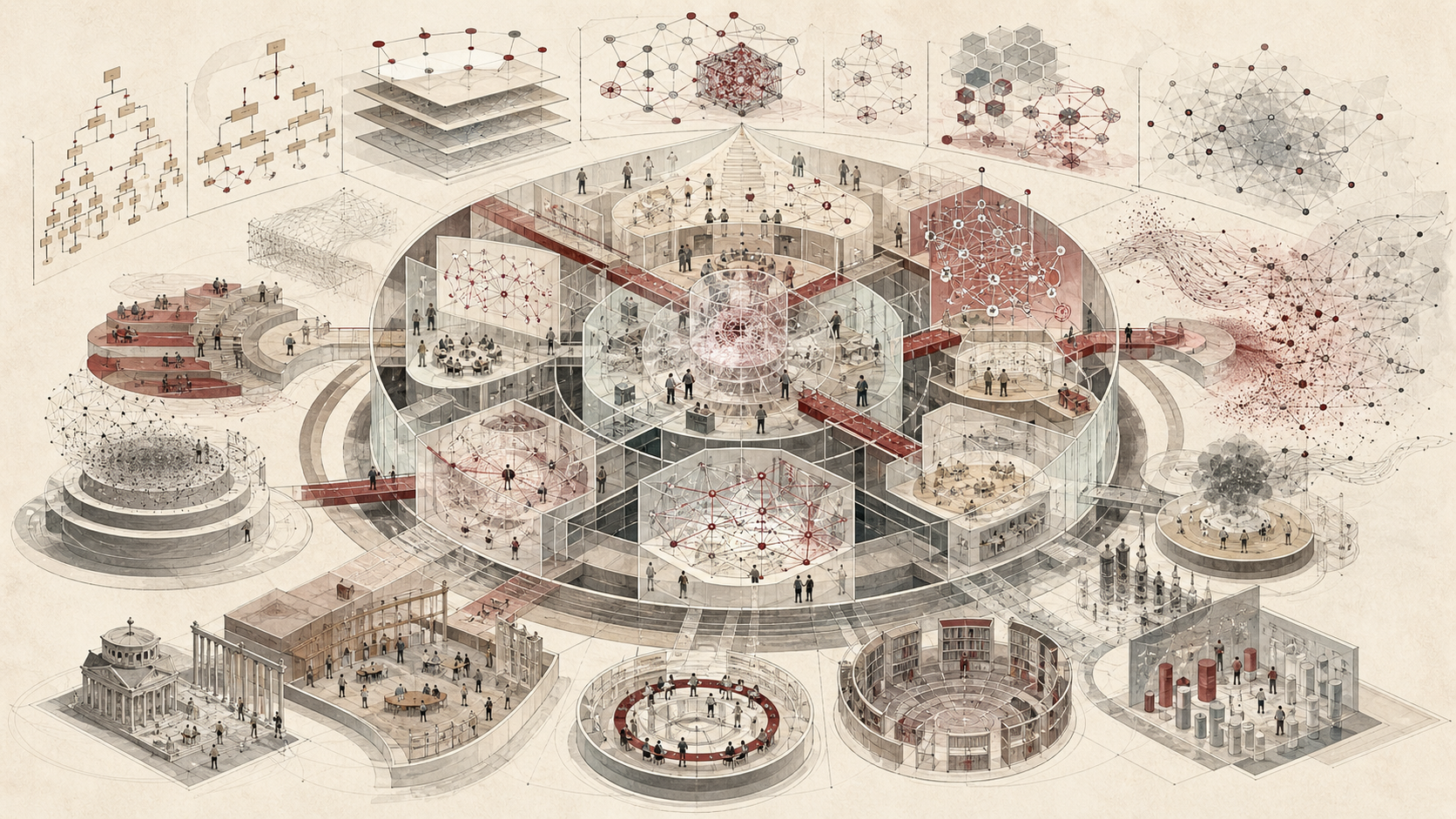
Knowledge architecture examines how complex information is structured into frameworks, taxonomies, hierarchies, ontologies, semantic networks, conceptual systems, research pathways, and governed knowledge environments that support understanding, navigation, collaboration, and decision-making. It studies how ideas are classified, related, sequenced, connected, maintained, revised, and made usable across growing bodies of knowledge. In its strongest sense, knowledge architecture is not merely content organization, menu design, tagging, or information management. It is the design of intellectual infrastructure.
This article map brings together the major domains through which knowledge architecture organizes complexity. It treats knowledge not as a pile of documents, posts, datasets, categories, or isolated facts, but as a structured system of concepts, relationships, levels of abstraction, disciplinary boundaries, interpretive models, research pathways, semantic links, and decision contexts. Across taxonomy design, ontology modeling, information architecture, research frameworks, digital libraries, knowledge graphs, interdisciplinary synthesis, systems thinking, scientific collaboration, governance knowledge, sustainability science, AI-assisted organization, educational design, and scalable platform design, knowledge architecture provides an indispensable language for building coherent intellectual systems at scale.
As knowledge environments grow, architecture becomes more important rather than less. Large bodies of work need more than publication volume. They need metadata, taxonomies, internal links, article maps, repository structures, version records, review practices, semantic relationships, and long-term stewardship. This page serves as the central article map for the Knowledge Architecture knowledge series.
GitHub Repository
The Knowledge Architecture knowledge series is supported by a companion code repository with article-level folders, reproducible examples, synthetic datasets, taxonomy models, ontology schemas, semantic-network workflows, knowledge-graph examples, concept-map analysis, research-architecture scaffolds, and scientific-computing examples across Python, R, Julia, C++, Fortran, C, Rust, SQL, Go, and notebooks where appropriate.
Complete Code Repository
This repository supports the Knowledge Architecture article map and companion articles with reproducible knowledge-system examples, metadata diagnostics, taxonomy workflows, graph modeling, semantic-relationship analysis, and article-specific research scaffolds.
Knowledge Architecture as a Foundational Discipline
Knowledge architecture occupies a foundational place within research, education, strategy, digital publishing, and institutional knowledge systems because it determines whether information remains usable as it expands. Any small body of knowledge can survive through informal memory, ad hoc labels, or loose navigation. But as domains grow, informal organization begins to fail. Concepts overlap, categories drift, relationships disappear, older material becomes difficult to retrieve, and users lose the ability to understand how one idea relates to another.
This foundational role does not mean that knowledge architecture replaces information architecture, library science, data modeling, ontology engineering, content strategy, taxonomy design, systems thinking, or epistemology. Rather, it connects them. Information architecture helps users navigate digital environments. Library science provides traditions of classification, retrieval, and indexing. Ontology engineering formalizes entities and relationships. Content strategy plans publication and governance. Knowledge architecture asks how all of these structures support intellectual coherence across a living body of thought.
The field matters because modern knowledge environments are expanding faster than ordinary navigational systems can handle. Websites, research platforms, learning systems, repositories, archives, AI-assisted tools, institutional knowledge bases, and interdisciplinary publications all require architectures capable of preserving meaning across scale. Knowledge architecture is therefore not a decorative layer added after content is produced. It is part of the intellectual design of the system itself.
Knowledge Architecture as Intellectual Infrastructure
Knowledge architecture may be understood as intellectual infrastructure. Roads, bridges, and grids make physical movement possible; knowledge architectures make conceptual movement possible. They determine how a reader, researcher, student, analyst, policymaker, or machine agent can move from one idea to another without losing context. A strong architecture makes a domain navigable, cumulative, and expandable. A weak architecture leaves even excellent content stranded.
This makes knowledge architecture different from simple categorization. Categories group things. Architectures explain how groupings relate, why they matter, what level of abstraction they occupy, how they connect to other domains, and how the system should evolve. A category label may tell users where something sits. A knowledge architecture tells users what kind of intellectual system they are entering.
Knowledge architecture is therefore both structural and epistemic. It is structural because it designs taxonomies, hierarchies, maps, metadata, ontologies, and relationships. It is epistemic because it shapes what counts as a concept, what counts as a connection, which distinctions are preserved, which bridges are made visible, and how knowledge can be interpreted across contexts. In interdisciplinary work, this becomes especially important because the same term may carry different meanings in different fields.
Knowledge Architecture as a Quantitative and Computational Practice
Knowledge architecture is often described conceptually through taxonomies, frameworks, maps, and navigation systems. Those remain central. Yet modern knowledge architecture increasingly involves quantitative and computational practice. Large knowledge systems can be represented as graphs, trees, matrices, semantic triples, metadata schemas, vector spaces, topic clusters, or networks of concepts and documents.
This does not mean that knowledge architecture becomes a purely technical field. Rather, it means that intellectual structure can be made visible, testable, and maintainable. A knowledge architect may design a taxonomy, model concept relationships, evaluate category depth, identify orphaned topics, detect overgrown clusters, map interdisciplinary bridge nodes, measure semantic density, store relationships in SQL, document assumptions in notebooks, and interpret the results through epistemology, editorial judgment, research strategy, and user needs.
For that reason, this series treats mathematics, graph theory, statistics, semantic modeling, R, Python, SQL metadata, reproducible notebooks, and open code repositories as increasingly useful parts of knowledge architecture literacy. Some articles remain primarily conceptual, philosophical, editorial, or strategic. Others naturally require taxonomy metrics, ontology schemas, knowledge graph analysis, semantic-network modeling, research-platform data structures, or reproducible code. The aim is not to reduce knowledge to computation, but to make knowledge systems more transparent, navigable, and durable.
What Knowledge Architecture Studies
Knowledge architecture studies the structures that make knowledge usable. At the conceptual level, it examines frameworks, models, categories, definitions, abstractions, distinctions, and relationships between ideas. At the organizational level, it examines taxonomies, hierarchies, topic clusters, pillar pages, article maps, navigation systems, learning pathways, metadata systems, archives, and research repositories. At the semantic level, it examines ontologies, entity relationships, knowledge graphs, controlled vocabularies, semantic networks, and linked data.
At the interdisciplinary level, knowledge architecture studies how concepts travel across domains without losing meaning. Sustainability science, for example, must hold together ecology, economics, governance, ethics, law, infrastructure, public health, systems modeling, and technology. Without architecture, these areas remain adjacent but disconnected. With architecture, they become part of a structured intellectual environment.
Knowledge architecture further studies knowledge-system governance. A taxonomy can decay. Categories can become too broad. Tags can multiply without control. Ontologies can become too rigid. Users can become lost. AI systems can amplify poorly structured assumptions. A mature knowledge architecture therefore includes maintenance, revision, documentation, versioning, editorial governance, and interpretive accountability.
What This Article Map Covers
This article map brings together the major domains through which knowledge architecture structures complex information. It includes conceptual frameworks, intellectual systems, taxonomy design, hierarchical knowledge organization, ontologies, semantic networks, knowledge maps, conceptual models, information architecture, knowledge graphs, interdisciplinary knowledge design, digital knowledge platforms, research institutions, sustainability science, governance systems, systems thinking, education, digital libraries, AI and knowledge organization, scientific collaboration, future knowledge platforms, and scalable knowledge systems.
These domains differ in method and emphasis, but together they form a coherent intellectual project: the attempt to design knowledge environments that remain coherent as they grow. Knowledge architecture is therefore not only a support discipline for content management. It is a strategic discipline for research platforms, educational systems, public knowledge, institutional memory, and interdisciplinary synthesis.
The series also treats knowledge architecture as a bridge between conceptual creativity and structural order. Strategic ideation generates and develops ideas. Knowledge architecture organizes those ideas into durable systems. A concept becomes more useful when it can be placed inside a framework, connected to adjacent concepts, retrieved through navigation, and extended without breaking the system. In that sense, knowledge architecture is the structural counterpart to creative thought.
Mathematics, Computation, and Modeling in Knowledge Architecture
Mathematics provides part of the formal language through which knowledge architecture can clarify structure, connectivity, coherence, redundancy, semantic density, and conceptual drift. These models do not replace human judgment. They make knowledge-system properties visible.
A simple model of knowledge-system coherence can be written as:
KQ = \beta_1 C + \beta_2 R + \beta_3 N + \beta_4 S + \beta_5 G – \beta_6 D
\]
Interpretation: Knowledge-system quality rises with conceptual coherence, relationship clarity, navigability, semantic consistency, and governance strength, while drift, redundancy, and fragmentation reduce expected quality.
In this model, \(C\) represents conceptual coherence, \(R\) relationship clarity, \(N\) navigability, \(S\) semantic consistency, \(G\) governance strength, and \(D\) drift or fragmentation.
A knowledge graph can be represented as:
G = (V, E)
\]
Interpretation: A knowledge graph consists of nodes \(V\), representing concepts, documents, entities, or categories, and edges \(E\), representing semantic, hierarchical, causal, evidentiary, or navigational relationships.
The centrality of a concept can be represented through degree centrality:
C_D(v) = \frac{deg(v)}{|V|-1}
\]
Interpretation: Degree centrality estimates how directly connected a concept is within a knowledge system, helping identify bridge concepts, overloaded hubs, and potentially important navigation points.
Taxonomy depth can be modeled as a path from root concept to leaf concept:
Depth(c_i) = length(path(root, c_i))
\]
Interpretation: Taxonomy depth measures how far a concept sits from the root of the system, helping evaluate abstraction levels, navigation burden, and category granularity.
A broader semi-formal model treats knowledge architecture as a function of classification, hierarchy, ontology, semantic linkage, metadata quality, user navigation, and governance:
KA = f(CL, HI, ON, SL, MQ, UN, GV)
\]
Interpretation: Knowledge architecture depends on classification logic, hierarchical structure, ontology design, semantic linkage, metadata quality, user navigation, and governance over time.
These formulations do not reduce knowledge to graphs or metrics. They clarify a central architectural insight: knowledge systems fail not only when they lack information, but when they lack structure, relationships, navigability, and maintenance.
Computation is especially valuable where knowledge systems become large. R supports taxonomy analysis, graph summaries, cluster visualization, metadata audits, and reproducible reporting. Python supports knowledge-graph modeling, semantic-network analysis, ontology workflows, similarity analysis, classification diagnostics, and AI-assisted research scaffolds. SQL supports structured concept tables, article records, category hierarchies, relationship triples, metadata provenance, versioning, and governance logs. Julia, C++, Fortran, C, Rust, and Go can support simulation, command-line tools, graph utilities, search infrastructure, and reproducible computational systems where appropriate.
Major Domains of Knowledge Architecture
Knowledge architecture includes a wide range of major domains, each of which illuminates a different layer of intellectual structure. Taxonomy design studies how concepts are classified into categories, subcategories, and controlled vocabularies. Hierarchical organization studies how levels of abstraction are arranged from broad domains to narrower topics. Conceptual frameworks study how ideas relate inside explanatory models.
Ontology design studies entities, relationships, properties, constraints, and formal domain models. Semantic networks study meaningful links among concepts, documents, datasets, and entities. Knowledge mapping studies how knowledge is distributed across fields, where gaps exist, which concepts bridge domains, and how research can be navigated. Information architecture studies user-facing navigation, labeling, search, and digital structure.
Digital knowledge platforms study how knowledge systems are implemented in websites, repositories, databases, learning environments, knowledge bases, and research infrastructure. Interdisciplinary knowledge design studies how distinct fields are brought into relation without collapsing their differences. AI and knowledge organization study how machine-assisted systems depend on structured, traceable, and governed knowledge environments.
Why Knowledge Architecture Matters
Knowledge architecture matters because modern research environments generate more information than people can meaningfully navigate without structure. Information alone does not produce understanding. A thousand articles, datasets, notes, or categories can still fail if users cannot see relationships, sequence, hierarchy, context, or purpose.
The field also matters because interdisciplinary research depends on conceptual translation. Ideas move across domains, but they do not always mean the same thing in each context. “Resilience,” “risk,” “system,” “value,” “agency,” “sustainability,” “governance,” and “development” all change meaning depending on disciplinary location. Knowledge architecture helps preserve distinctions while making connections visible.
Finally, knowledge architecture matters because it supports long-term institutional memory. Without architecture, platforms become archives of disconnected work. With architecture, they become evolving intellectual systems. Categories, frameworks, ontologies, and knowledge graphs allow institutions, researchers, educators, and readers to build cumulatively rather than repeatedly starting over.
Knowledge Architecture and Intellectual Self-Understanding
Knowledge architecture changes how people understand their own thinking because it shows that ideas are never only individual. They exist inside structures: disciplines, categories, metaphors, frameworks, traditions, datasets, institutions, and navigation systems. The way knowledge is organized shapes what becomes easy to notice, difficult to retrieve, or impossible to connect.
The field also changes how knowledge platforms understand growth. Scale is not only a matter of producing more material. It is a matter of preserving coherence as material expands. A platform with hundreds or thousands of articles needs more than publication volume. It needs conceptual infrastructure: article maps, internal links, taxonomies, semantic relationships, code repositories, documentation, and governance practices that keep the system intelligible.
For that reason, knowledge architecture has philosophical as well as practical significance. It raises enduring questions about classification, meaning, abstraction, memory, authority, interpretation, interdisciplinarity, and the politics of organization. A serious Knowledge Architecture article map should therefore not end with taxonomy lists alone. It should clarify the wider implications of structuring knowledge for research, education, governance, sustainability, AI, and public understanding.
Knowledge Architecture Article Map
The map below organizes the Knowledge Architecture knowledge series into conceptual domains, moving from foundations and conceptual frameworks toward taxonomies, ontologies, semantic networks, knowledge graphs, interdisciplinary research, institutions, sustainability, governance, systems thinking, education, digital libraries, AI, collaboration, future knowledge platforms, and scalable knowledge systems.
The Knowledge Architecture article map is organized to move from foundational definitions and intellectual systems into conceptual frameworks, taxonomy design, hierarchical structures, ontologies, semantic networks, knowledge mapping, information architecture, knowledge graphs, interdisciplinary knowledge design, research institutions, digital platforms, sustainability science, policy research, complex systems, decision-making, governance systems, education, digital libraries, AI-assisted organization, scientific collaboration, future platforms, and scalable knowledge systems. Mathematics, R, Python, Julia, C++, Fortran, C, Rust, SQL, Go, and computational notebooks are integrated where they deepen understanding, especially in areas such as taxonomy metrics, graph centrality, semantic relationships, ontology schemas, concept drift, knowledge gap analysis, research-platform structure, and reproducible knowledge-system workflows.
Foundations and Core Architecture
- Foundations of Knowledge Architecture — An opening article on why complex information requires frameworks, classification, conceptual relationships, and structural governance.
- What Is Knowledge Architecture? — A field overview defining knowledge architecture as the design of intellectual systems that organize concepts, relationships, and research pathways.
- Conceptual Frameworks in Research — An article on how frameworks structure interpretation, define relationships, guide inquiry, and support cumulative research.
- Research Frameworks and Analytical Models — A treatment of the models, matrices, diagrams, and conceptual structures used to organize research questions and analytical pathways.
Taxonomies, Hierarchies, Ontologies, and Semantic Structure
- Taxonomy Design for Knowledge Systems — An article on category logic, controlled vocabularies, hierarchical classification, scalability, and taxonomy governance.
- Hierarchical Knowledge Structures — A study of abstraction levels, parent-child relationships, article maps, subdomains, and navigational depth.
- Ontologies and Semantic Networks — An article on formal entities, properties, relationships, semantic modeling, and machine-readable conceptual structure.
- Knowledge Graphs and Semantic Relationships — A treatment of nodes, edges, triples, entity relationships, graph centrality, semantic links, and knowledge navigation.
- Knowledge Mapping and Conceptual Models — An article on mapping fields, identifying knowledge gaps, visualizing relationships, and building conceptual models for interdisciplinary research.
Information Architecture, Digital Platforms, and Research Infrastructure
- Information Architecture vs. Knowledge Architecture — A comparative article distinguishing navigation, labeling, and findability from deeper conceptual and semantic structure.
- Digital Knowledge Platforms — A study of websites, repositories, knowledge bases, research platforms, and digital environments that organize complex knowledge systems.
- Knowledge Systems in Research Institutions — An article on how universities, think tanks, laboratories, public agencies, and research centers structure institutional knowledge.
- Intellectual Infrastructure for Research Platforms — A treatment of metadata, documentation, indexing, versioning, internal linking, reproducibility, and research-platform governance.
- Knowledge Architecture in Digital Libraries — An article on cataloging, classification, controlled vocabularies, archives, digital collections, and long-term discoverability.
Interdisciplinary Research, Systems, Sustainability, and Governance
- Structuring Interdisciplinary Knowledge — An article on how knowledge architecture supports translation across fields while preserving disciplinary distinctions.
- Knowledge Architecture in Sustainability Science — A treatment of how ecological, economic, governance, ethical, technological, and social knowledge can be organized into integrated sustainability frameworks.
- Framework Design in Policy Research — An article on structuring policy evidence, stakeholder categories, causal assumptions, implementation pathways, and decision frameworks.
- Conceptual Modeling in Complex Systems — A systems-oriented article on representing feedback, interdependence, scale, uncertainty, and causal complexity.
- Knowledge Systems and Decision-Making — A study of how structured knowledge supports strategic, scientific, institutional, and public decision-making.
- Knowledge Architecture in Governance Systems — An article on how public institutions organize evidence, rules, policy domains, accountability structures, and administrative memory.
- Knowledge Architecture and Systems Thinking — A bridge article connecting knowledge maps, system boundaries, feedback, hierarchy, network structure, and interdisciplinary synthesis.
Education, AI, Collaboration, Future Platforms, and Scale
- Designing Knowledge Systems for Education — An article on learning pathways, curriculum architecture, prerequisite structures, concept sequencing, and educational knowledge maps.
- AI and Knowledge Organization — A critical article on how AI systems depend on structured knowledge, metadata, ontologies, retrieval systems, and human-governed interpretation.
- Knowledge Systems and Scientific Collaboration — A treatment of shared repositories, research networks, collaborative annotation, reproducible infrastructure, and interdisciplinary coordination.
- Future Knowledge Platforms — A forward-looking article on semantic platforms, AI-assisted research environments, dynamic knowledge graphs, and public knowledge infrastructures.
- Designing Scalable Knowledge Systems — A capstone-style article on growth, governance, category drift, architecture maintenance, platform scale, and long-term coherence.
Methods, Measurement, and Knowledge-System Practice
One of knowledge architecture’s central challenges is that structure is often invisible until it fails. Users notice missing pages, confusing menus, poor search results, duplicate categories, inconsistent tags, or disconnected articles. They may not see the deeper architectural causes: unclear taxonomies, weak metadata, missing semantic relationships, inconsistent hierarchy, poor governance, or conceptual drift.
This matters because knowledge systems require maintenance. A taxonomy that worked at fifty articles may fail at five hundred. A topic cluster may become too broad. An article map may need to split into sub-maps. A controlled vocabulary may need governance rules. A semantic network may require versioning. Knowledge architecture is therefore not only design at launch. It is ongoing stewardship.
Modern knowledge-system practice benefits from both qualitative and quantitative evaluation. Qualitative review can assess conceptual clarity, user meaning, interdisciplinary fit, and interpretive coherence. Quantitative analysis can identify orphaned nodes, overloaded hubs, missing links, excessive taxonomy depth, duplicate labels, weak internal linking, and uneven metadata coverage. A serious Knowledge Architecture article map should treat both forms of evaluation as essential.
Knowledge Architecture, Technology, and the Modern World
Knowledge architecture has become increasingly important because digital systems now mediate how people find, trust, interpret, and synthesize knowledge. Search engines, recommendation systems, AI assistants, semantic search, vector databases, research repositories, learning platforms, content management systems, and digital libraries all depend on underlying knowledge structures.
Technology can strengthen knowledge architecture when it improves retrieval, semantic linkage, metadata quality, versioning, graph navigation, accessibility, and reproducible documentation. It can also weaken knowledge architecture when it encourages content sprawl, generates shallow summaries, hides provenance, duplicates concepts, or replaces human conceptual judgment with automated association.
A mature knowledge architecture of technology must therefore ask not only whether information can be stored or searched, but whether it is structured, governed, interpretable, trustworthy, and connected to a coherent intellectual model. The future of knowledge architecture will increasingly depend on the relationship between human classification, machine retrieval, AI-assisted synthesis, and accountable semantic infrastructure.
Knowledge Architecture, Computation, and Semantic-System Modeling
Computation has become valuable for knowledge architecture because large knowledge systems behave like networks. Some concepts become hubs. Some domains become isolated. Some categories become overloaded. Some pathways become too deep. Some article clusters remain underlinked. Some semantic relationships are implied but not explicit. Modeling helps make these conditions visible.
Semantic-system modeling allows researchers, editors, designers, and platform builders to formalize assumptions about how knowledge is organized. A model can test whether a taxonomy is too shallow or too deep, whether related concepts are connected, whether knowledge gaps exist between domains, whether article clusters are balanced, or whether certain categories dominate the structure.
For that reason, this article map treats computation as a supporting discipline of knowledge architecture, not as a substitute for conceptual judgment. Graph metrics can reveal structure, but they cannot decide meaning by themselves. Semantic similarity can identify possible relationships, but it cannot replace interpretation. The strongest form of computational knowledge architecture is auditable intellectual infrastructure: structured, documented, explainable, revisable, and accountable.
R Section: Modeling Taxonomy Coherence and Knowledge-System Structure
The R workflow below creates a synthetic taxonomy and evaluates basic architecture measures such as taxonomy depth, domain distribution, link density, and potential orphan concepts. It is educational only, but it illustrates how knowledge architecture can become analytically explicit.
# Synthetic knowledge architecture analysis in R
# Educational example only.

# install.packages(c("tidyverse", "igraph"))
library(tidyverse)
library(igraph)

# -------------------------------------------------------------------
# Synthetic concept nodes.
# -------------------------------------------------------------------

concepts <- tibble(
  concept_id = paste0("C", 1:16),
  label = c(
    "Knowledge Architecture",
    "Taxonomy Design",
    "Ontology Modeling",
    "Semantic Networks",
    "Knowledge Graphs",
    "Information Architecture",
    "Interdisciplinary Research",
    "Sustainability Science",
    "Governance Systems",
    "Digital Libraries",
    "AI Knowledge Organization",
    "Conceptual Frameworks",
    "Systems Thinking",
    "Research Platforms",
    "Metadata Governance",
    "Decision Support"
  ),
  domain = c(
    "root",
    "structure",
    "structure",
    "semantic",
    "semantic",
    "navigation",
    "research",
    "research",
    "governance",
    "platform",
    "technology",
    "framework",
    "systems",
    "platform",
    "governance",
    "decision"
  ),
  depth = c(0, 1, 1, 1, 1, 1, 1, 2, 2, 2, 2, 1, 2, 2, 2, 2)
)

# -------------------------------------------------------------------
# Synthetic semantic and hierarchical relationships.
# -------------------------------------------------------------------

edges <- tribble(
  ~from, ~to, ~relationship,
  "Knowledge Architecture", "Taxonomy Design", "includes",
  "Knowledge Architecture", "Ontology Modeling", "includes",
  "Knowledge Architecture", "Semantic Networks", "includes",
  "Knowledge Architecture", "Information Architecture", "related_to",
  "Semantic Networks", "Knowledge Graphs", "supports",
  "Taxonomy Design", "Metadata Governance", "requires",
  "Ontology Modeling", "AI Knowledge Organization", "supports",
  "Knowledge Graphs", "Decision Support", "supports",
  "Interdisciplinary Research", "Sustainability Science", "applies_to",
  "Interdisciplinary Research", "Governance Systems", "applies_to",
  "Systems Thinking", "Sustainability Science", "supports",
  "Research Platforms", "Digital Libraries", "related_to",
  "Research Platforms", "Metadata Governance", "requires",
  "Conceptual Frameworks", "Interdisciplinary Research", "supports",
  "Conceptual Frameworks", "Systems Thinking", "supports",
  "AI Knowledge Organization", "Knowledge Graphs", "uses"
)

# -------------------------------------------------------------------
# Build graph.
# -------------------------------------------------------------------

g <- graph_from_data_frame(edges, directed = TRUE, vertices = concepts)

# Basic graph metrics.
node_metrics <- tibble(
  label = V(g)$name,
  degree = degree(g, mode = "all"),
  indegree = degree(g, mode = "in"),
  outdegree = degree(g, mode = "out"),
  betweenness = betweenness(g),
  closeness = closeness(g, mode = "all")
) %>%
  left_join(concepts, by = "label") %>%
  arrange(desc(degree))

print(node_metrics)

# Domain balance.
domain_summary <- concepts %>%
  count(domain, name = "concept_count") %>%
  arrange(desc(concept_count))

print(domain_summary)

# Orphan check: nodes with no relationships.
orphan_nodes <- node_metrics %>%
  filter(degree == 0)

print(orphan_nodes)

# Taxonomy depth summary.
depth_summary <- concepts %>%
  summarize(
    max_depth = max(depth),
    mean_depth = mean(depth),
    median_depth = median(depth)
  )

print(depth_summary)

# Export architecture diagnostics.
dir.create("outputs", showWarnings = FALSE, recursive = TRUE)
write_csv(node_metrics, file.path("outputs", "knowledge_architecture_node_metrics.csv"))
write_csv(domain_summary, file.path("outputs", "knowledge_architecture_domain_summary.csv"))
write_csv(depth_summary, file.path("outputs", "knowledge_architecture_depth_summary.csv"))
This workflow can be extended with real article metadata, WordPress category exports, internal-link graphs, semantic similarity scores, knowledge gap analysis, ontology triples, and versioned taxonomy reviews.
Python Section: Simulating Knowledge Graphs and Conceptual Pathways
The Python workflow below builds a small synthetic knowledge graph and calculates centrality, shortest paths, and bridge concepts. It demonstrates how computational modeling can help identify important concepts, weak connections, and possible pathways through a knowledge system.
# Synthetic knowledge architecture graph analysis in Python
# Educational example only.

# Install packages if needed:
# pip install pandas networkx matplotlib

import pandas as pd
import networkx as nx
import matplotlib.pyplot as plt

# ---------------------------------------------------------------------
# Synthetic concept relationships.
# ---------------------------------------------------------------------

edges = [
    ("Knowledge Architecture", "Taxonomy Design", "includes"),
    ("Knowledge Architecture", "Ontology Modeling", "includes"),
    ("Knowledge Architecture", "Semantic Networks", "includes"),
    ("Knowledge Architecture", "Information Architecture", "related_to"),
    ("Semantic Networks", "Knowledge Graphs", "supports"),
    ("Taxonomy Design", "Metadata Governance", "requires"),
    ("Ontology Modeling", "AI Knowledge Organization", "supports"),
    ("Knowledge Graphs", "Decision Support", "supports"),
    ("Interdisciplinary Research", "Sustainability Science", "applies_to"),
    ("Interdisciplinary Research", "Governance Systems", "applies_to"),
    ("Systems Thinking", "Sustainability Science", "supports"),
    ("Research Platforms", "Digital Libraries", "related_to"),
    ("Research Platforms", "Metadata Governance", "requires"),
    ("Conceptual Frameworks", "Interdisciplinary Research", "supports"),
    ("Conceptual Frameworks", "Systems Thinking", "supports"),
    ("AI Knowledge Organization", "Knowledge Graphs", "uses"),
    ("Knowledge Architecture", "Conceptual Frameworks", "includes"),
    ("Knowledge Architecture", "Research Platforms", "supports"),
    ("Governance Systems", "Decision Support", "requires"),
]

# ---------------------------------------------------------------------
# Build graph.
# ---------------------------------------------------------------------

G = nx.DiGraph()

for source, target, relation in edges:
    G.add_edge(source, target, relationship=relation)

# ---------------------------------------------------------------------
# Calculate graph metrics.
# ---------------------------------------------------------------------

degree_centrality = nx.degree_centrality(G)
betweenness = nx.betweenness_centrality(G)
pagerank = nx.pagerank(G)

metrics = pd.DataFrame({
    "concept": list(G.nodes()),
    "degree_centrality": [degree_centrality[node] for node in G.nodes()],
    "betweenness": [betweenness[node] for node in G.nodes()],
    "pagerank": [pagerank[node] for node in G.nodes()]
}).sort_values("degree_centrality", ascending=False)

print("Knowledge architecture node metrics:")
print(metrics)

# ---------------------------------------------------------------------
# Find conceptual pathway between two domains.
# ---------------------------------------------------------------------

source = "Conceptual Frameworks"
target = "Decision Support"

try:
    path = nx.shortest_path(G, source=source, target=target)
    print(f"\nShortest conceptual pathway from {source} to {target}:")
    print(" -> ".join(path))
except nx.NetworkXNoPath:
    print(f"No path found from {source} to {target}")

# ---------------------------------------------------------------------
# Identify weakly connected components.
# ---------------------------------------------------------------------

components = list(nx.weakly_connected_components(G))
print("\nWeakly connected components:")
for i, component in enumerate(components, start=1):
    print(f"Component {i}: {sorted(component)}")

# ---------------------------------------------------------------------
# Visualize the graph.
# ---------------------------------------------------------------------

plt.figure(figsize=(12, 8))
pos = nx.spring_layout(G, seed=42)

nx.draw_networkx_nodes(G, pos, node_size=1300)
nx.draw_networkx_edges(G, pos, arrows=True, arrowstyle="->", arrowsize=15)
nx.draw_networkx_labels(G, pos, font_size=8)

plt.title("Synthetic Knowledge Architecture Graph")
plt.axis("off")
plt.tight_layout()
plt.show()

# ---------------------------------------------------------------------
# Export results.
# ---------------------------------------------------------------------

metrics.to_csv("knowledge_architecture_graph_metrics.csv", index=False)
This workflow can be extended into article recommendation systems, internal linking diagnostics, ontology construction, semantic search preparation, research-pathway design, and AI-assisted knowledge-graph governance.
Interpretive Limits and Architectural Cautions
Knowledge architecture is powerful, but it can also overreach. Not every concept belongs neatly in one category. Not every field can be organized hierarchically without distortion. Not every semantic relationship should be formalized. Some knowledge remains contested, provisional, plural, or context-dependent. A strong architecture must preserve complexity rather than pretending to eliminate it.
Analysts and platform builders should therefore be careful not to confuse classification with truth, hierarchy with value, visibility with importance, centrality with authority, or machine-readable structure with human understanding. A knowledge graph may show relationships, but it does not settle interpretation. A taxonomy may improve navigation, but it can also hide alternative perspectives. An ontology may clarify a domain, but it can also impose rigid assumptions.
The field is strongest when it combines structure with humility. Knowledge architecture should make complex domains more usable without flattening disagreement, erasing marginalized perspectives, or turning living inquiry into static classification. It should support intellectual growth while remaining open to revision.
Knowledge Architecture in a Wider Intellectual Context
Knowledge architecture belongs not only to digital publishing or knowledge management, but to the broader history of human thought about classification, memory, libraries, encyclopedias, disciplines, archives, education, science, and public knowledge. Human beings have always needed ways to organize what they know: through oral traditions, tables of contents, taxonomies, catalogs, diagrams, maps, indexes, libraries, curricula, ontologies, and databases.
The field changes the imagination of knowledge work. It shows that publishing more is not the same as knowing more. Understanding requires relationships, levels, pathways, definitions, and structures that allow ideas to become cumulative. Knowledge architecture is therefore not merely a backend concern. It is part of how knowledge becomes public, teachable, searchable, governable, and strategically useful.
For that reason, knowledge architecture should be understood as both a technical and humanistic achievement. It brings together classification, interpretation, design, technology, research, education, systems thinking, and institutional memory in a sustained effort to make knowledge navigable and meaningful at scale.
Related Reading
- Strategic Ideation
- Content Frameworks
- Systems Thinking
- Systems Modeling
- Design Thinking
- Sustainable Development
- Institutions & Governance
- Economic Systems
- Psychology
- Futures Thinking
- Data Systems & Analytics
Further Reading
- Aitchison, J., Gilchrist, A. and Bawden, D. (2000) Thesaurus Construction and Use: A Practical Manual. 4th edn. London: Aslib.
- Allemang, D. and Hendler, J. (2011) Semantic Web for the Working Ontologist: Effective Modeling in RDFS and OWL. 2nd edn. Amsterdam: Morgan Kaufmann.
- Broughton, V. (2015) Essential Classification. 2nd edn. London: Facet Publishing.
- Hodge, G. (2000) Systems of Knowledge Organization for Digital Libraries: Beyond Traditional Authority Files. Washington, DC: Council on Library and Information Resources. Available at: https://www.clir.org/pubs/reports/pub91/
- Lambe, P. (2007) Organising Knowledge: Taxonomies, Knowledge and Organisational Effectiveness. Oxford: Chandos Publishing.
- Morville, P. and Rosenfeld, L. (2006) Information Architecture for the World Wide Web. 3rd edn. Sebastopol, CA: O’Reilly.
- Ranganathan, S.R. (1931) The Five Laws of Library Science. Madras: Madras Library Association.
- Rowley, J. and Hartley, R. (2017) Organizing Knowledge: An Introduction to Managing Access to Information. 4th edn. London: Routledge.
- Sowa, J.F. (2000) Knowledge Representation: Logical, Philosophical, and Computational Foundations. Pacific Grove, CA: Brooks/Cole.
- W3C (2012) OWL 2 Web Ontology Language Document Overview. Available at: https://www.w3.org/TR/owl2-overview/
- W3C (2014) RDF 1.1 Concepts and Abstract Syntax. Available at: https://www.w3.org/TR/rdf11-concepts/
References
- Aitchison, J., Gilchrist, A. and Bawden, D. (2000) Thesaurus Construction and Use: A Practical Manual. 4th edn. London: Aslib.
- Allemang, D. and Hendler, J. (2011) Semantic Web for the Working Ontologist: Effective Modeling in RDFS and OWL. 2nd edn. Amsterdam: Morgan Kaufmann.
- Broughton, V. (2015) Essential Classification. 2nd edn. London: Facet Publishing.
- Hodge, G. (2000) Systems of Knowledge Organization for Digital Libraries: Beyond Traditional Authority Files. Washington, DC: Council on Library and Information Resources. Available at: https://www.clir.org/pubs/reports/pub91/
- Lambe, P. (2007) Organising Knowledge: Taxonomies, Knowledge and Organisational Effectiveness. Oxford: Chandos Publishing.
- Morville, P. and Rosenfeld, L. (2006) Information Architecture for the World Wide Web. 3rd edn. Sebastopol, CA: O’Reilly.
- Ranganathan, S.R. (1931) The Five Laws of Library Science. Madras: Madras Library Association.
- Rowley, J. and Hartley, R. (2017) Organizing Knowledge: An Introduction to Managing Access to Information. 4th edn. London: Routledge.
- Sowa, J.F. (2000) Knowledge Representation: Logical, Philosophical, and Computational Foundations. Pacific Grove, CA: Brooks/Cole.
- W3C (2012) OWL 2 Web Ontology Language Document Overview. Available at: https://www.w3.org/TR/owl2-overview/
- W3C (2014) RDF 1.1 Concepts and Abstract Syntax. Available at: https://www.w3.org/TR/rdf11-concepts/