
Last Updated May 27, 2026
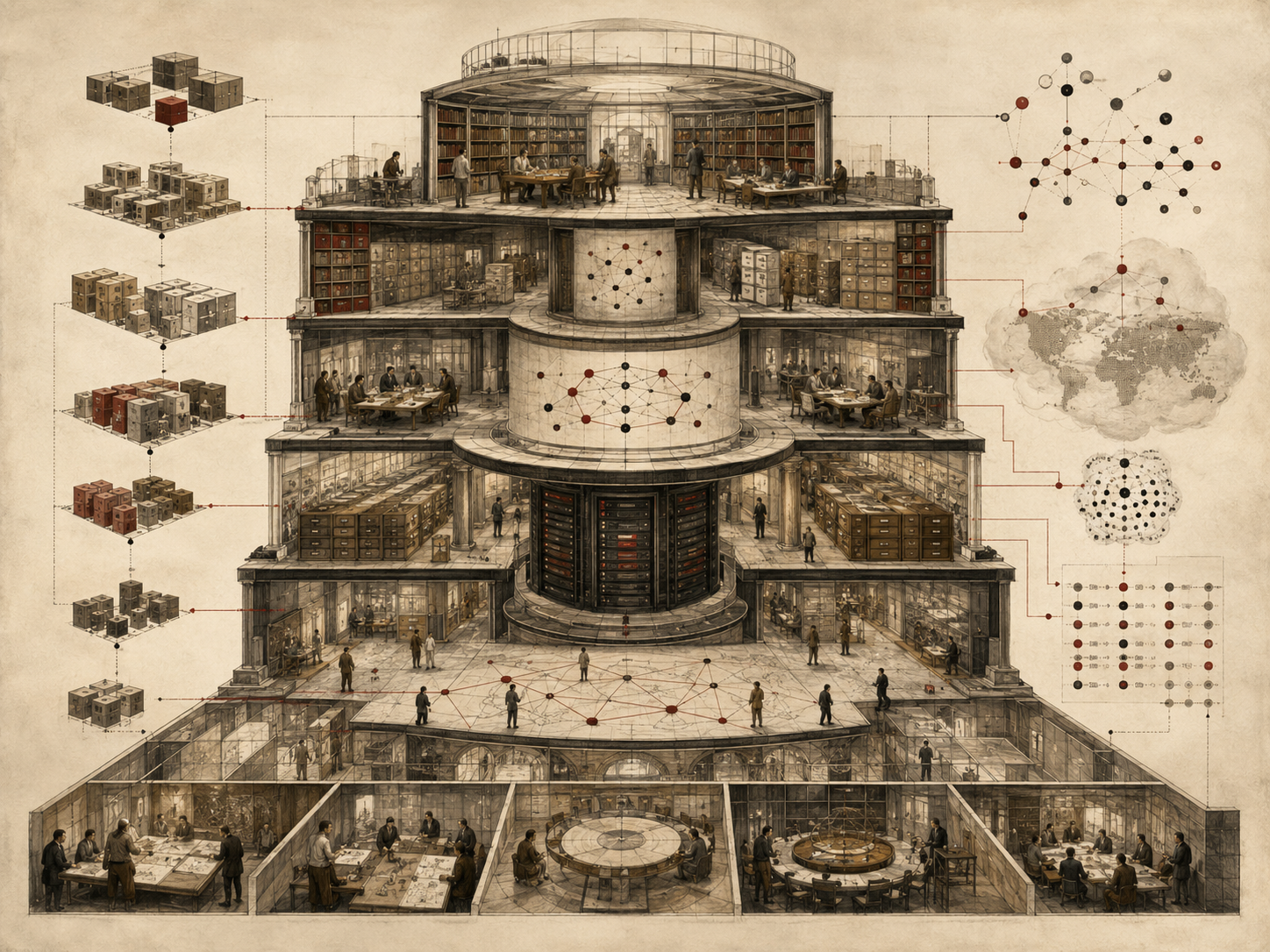
Designing scalable knowledge systems means building intellectual infrastructure that can grow in volume, complexity, audience, technology, and institutional responsibility without losing coherence, trust, accessibility, or governance. A knowledge system may begin as a small collection of articles, documents, datasets, notes, repositories, or teaching materials. But as it expands, scale changes the problem. What worked for a handful of pages may fail when the system contains hundreds of articles, thousands of relationships, multiple contributors, AI retrieval layers, reusable code, external references, governance records, and diverse public audiences.
Scalability in knowledge systems is not only a technical question. It is also an architectural, editorial, semantic, institutional, ethical, and governance question. A scalable system must preserve meaning across growth. It must help users find what they need, understand how ideas connect, evaluate source quality, reuse materials responsibly, and trust that the system is maintained. Without clear architecture, growth produces fragmentation: duplicated categories, inconsistent metadata, broken links, orphaned articles, inaccessible media, outdated references, unreviewed AI outputs, and knowledge that becomes harder to use as the platform expands.
Within knowledge architecture, the central question is how to design systems that can expand without collapsing into disorder. This article examines modular architecture, metadata, taxonomies, ontologies, knowledge graphs, repositories, AI-assisted retrieval, governance, interoperability, performance, accessibility, equity, resilience, and long-term stewardship. A scalable knowledge system is not merely a larger system. It is a system designed so that growth strengthens rather than weakens understanding.
Article Map
Knowledge Architecture
Related Topic
Artificial Intelligence Systems
What Are Scalable Knowledge Systems?
A scalable knowledge system is a structured environment that can expand while preserving intelligibility, navigability, trust, and reuse. It may include articles, documents, datasets, code repositories, models, references, taxonomies, ontologies, knowledge graphs, learning pathways, governance records, AI retrieval logs, correction histories, and user feedback. The system becomes scalable when these objects can grow without becoming disconnected, inconsistent, or unmanageable.
Scale can mean many things. A knowledge system may scale in content volume, topic breadth, technical complexity, contributor count, audience size, language coverage, repository depth, AI use, institutional responsibility, or governance burden. Each form of scale creates different design requirements.
A small knowledge system can rely on memory and manual organization. A larger one cannot. Once a platform grows, informal structure breaks down. Users need navigation. Editors need standards. AI systems need metadata. Repositories need folder patterns. Articles need internal links. References need maintenance. Images need accessibility records. Governance needs review cycles. The platform needs a coherent architecture that can absorb growth.
SKS = f(C, M, R, G, A, S)
\]
Interpretation: A scalable knowledge system \(SKS\) can be understood as a function of content \(C\), metadata \(M\), relationships \(R\), governance \(G\), access systems \(A\), and stewardship \(S\).
Scalability does not mean making everything larger. It means designing the structure so that expansion remains meaningful.
Why Scale Changes the Knowledge Problem
Scale changes the knowledge problem because every new object creates relationships, maintenance obligations, and interpretive risks. Adding one article may require links to related articles, metadata, image assets, references, repository folders, taxonomy placement, accessibility review, and future updates. Adding one category may require governance over naming, hierarchy, overlap, and public navigation. Adding AI retrieval creates new requirements for provenance, source ranking, and error correction.
At small scale, inconsistency may be tolerable. At larger scale, inconsistency becomes infrastructure. A slightly different naming pattern repeated across hundreds of articles becomes a navigation problem. A missing metadata field becomes an AI retrieval problem. An unreviewed relationship becomes a trust problem. A broken repository convention becomes a reproducibility problem.
| Growth Pressure | What Changes at Scale | Architecture Requirement |
|---|---|---|
| More content | Users need structured discovery. | Article maps, taxonomies, search, and internal linking. |
| More topics | Categories overlap and drift. | Controlled vocabularies, governance, and scope notes. |
| More contributors | Style, metadata, and review consistency weaken. | Templates, editorial standards, and review workflows. |
| More repositories | Code and data become difficult to maintain. | Scaffold patterns, README standards, runbooks, and tests. |
| More AI use | Retrieval and summaries require accountability. | Source grounding, AI review status, and correction logs. |
| More audiences | Different users need different pathways. | Learning levels, accessibility, summaries, and advanced references. |
Scale reveals whether a knowledge system has architecture or only accumulation. A scalable system must turn growth into structure.
From Collections to Architecture
A collection becomes a knowledge system when its objects are organized into meaningful relationships. A folder of documents is not yet architecture. A list of articles is not yet a platform. A large database is not automatically usable. Architecture appears when knowledge objects are typed, described, sequenced, connected, reviewed, and governed.
This shift matters because collections often grow opportunistically. New pages are added when needed. New tags appear when convenient. New folders are created for immediate tasks. Over time, these local choices create global disorder. Architecture provides durable patterns so that each new object enters the system in a predictable way.
| Collection Pattern | Architecture Pattern | Scalability Gain |
|---|---|---|
| Pages grouped loosely by topic | Article maps with defined scope and internal pathways. | Users can understand the whole knowledge area. |
| Tags added ad hoc | Controlled vocabulary and taxonomy governance. | Terms remain consistent across growth. |
| Links added manually | Relationship rules and internal-linking patterns. | Connections become more predictable and maintainable. |
| Code attached informally | Repository scaffolds with standard folders and documentation. | Reusable assets become easier to inspect. |
| Updates made silently | Revision records and review status. | Users can trust maintenance history. |
Scalable knowledge systems are designed for future growth before growth becomes chaotic. They do not require perfect prediction. They require modular patterns that can be extended, corrected, and governed.
Modularity and Layered System Design
Modularity is one of the foundations of scalability. A modular knowledge system separates content, metadata, navigation, repositories, governance, accessibility, and AI retrieval into connected but distinct layers. This prevents every change from requiring a full redesign.
Layered design allows the system to grow at different speeds. Articles may expand weekly. Repositories may expand when technical assets are needed. Metadata standards may mature gradually. AI retrieval may be added later. Governance rules may evolve as the platform becomes more public. A layered architecture allows each part to improve without destroying the whole.
| Layer | Function | Scalability Requirement |
|---|---|---|
| Content layer | Articles, pages, summaries, references, and media. | Consistent templates, headings, excerpts, and navigation. |
| Semantic layer | Metadata, taxonomies, ontologies, and relationships. | Stable schemas and governance over terms. |
| Repository layer | Code, data, methods, outputs, and documentation. | Reusable folder structures and runbooks. |
| Governance layer | Review, revision, correction, access, and responsibility. | Visible review status and maintenance workflows. |
| AI layer | Retrieval, summaries, recommendations, and metadata assistance. | Grounding, source hierarchy, evaluation, and human review. |
| Stewardship layer | Backups, migration, link checking, and long-term preservation. | Resilience routines and documentation. |
Modularity does not fragment the system. It makes integration possible because each layer has a role and a maintenance logic.
Metadata as Scalability Infrastructure
Metadata is one of the most important scalability tools in a knowledge system. It allows people and machines to know what a knowledge object is, where it belongs, who created it, when it was updated, what sources it uses, which audience it serves, what review status it has, what repository supports it, and whether any reuse restrictions apply.
At small scale, metadata may feel unnecessary because creators remember the context. At larger scale, memory fails. Metadata becomes infrastructure. It supports search, filtering, AI retrieval, citation, accessibility, reuse, review, and migration.
| Metadata Field | Purpose | Scalability Value |
|---|---|---|
| Object type | Identifies whether the object is an article, map, dataset, repository, image, or governance record. | Supports filtering, templates, and AI retrieval. |
| Series or pillar | Places the object within a larger knowledge area. | Supports article maps and navigation. |
| Review status | Signals draft, active, reviewed, needs review, deprecated, or archived state. | Supports trust and maintenance. |
| Source provenance | Records where claims, data, or assets came from. | Supports auditability and reuse. |
| Repository link | Connects prose to code, data, and methods. | Supports reproducible knowledge. |
| Accessibility status | Records alt text, captions, transcripts, and semantic structure. | Supports inclusive public use. |
| Reuse condition | Defines license, attribution, sensitivity, and access limits. | Supports open knowledge with stewardship. |
MetadataCoverage = \frac{|K_M|}{|K|}
\]
Interpretation: Metadata coverage measures the share of knowledge objects \(K\) with required metadata \(K_M\). Low coverage signals future scalability risk.
Metadata is not clerical decoration. It is the system’s memory.
Taxonomies, Ontologies, and Knowledge Graphs at Scale
Taxonomies, ontologies, and knowledge graphs help knowledge systems scale because they organize relationships. A taxonomy gives users a structured way to browse. An ontology defines object types and relationship types. A knowledge graph connects objects so that the system can support semantic navigation, AI retrieval, and cross-domain reasoning.
At scale, categories need governance. Without governance, taxonomies drift. Similar categories multiply. Broad categories become overloaded. Narrow categories become orphaned. Interdisciplinary objects may be forced into the wrong place. A scalable taxonomy should include scope notes, related concepts, parent-child relationships, and a review process.
Knowledge graphs become especially important when a platform contains many types of knowledge: articles, datasets, code repositories, methods, sources, governance records, images, models, learning pathways, and AI outputs. Graph relationships can show that one article explains a concept, another applies it, a repository supports it, a dataset provides evidence, and a governance record defines review conditions.
| Semantic Structure | Purpose | Scalability Risk if Missing |
|---|---|---|
| Taxonomy | Organizes topics and article maps. | Users cannot browse large content areas coherently. |
| Controlled vocabulary | Standardizes labels and terms. | Duplicate or inconsistent tags weaken discovery. |
| Ontology | Defines object and relationship types. | The system cannot distinguish evidence, explanation, model, code, or governance. |
| Knowledge graph | Connects objects through typed relationships. | AI and users depend only on keyword search or manual navigation. |
| Provenance graph | Tracks sources, versions, and evidence paths. | Trust becomes difficult to verify. |
KG = (V, E, R, P)
\]
Interpretation: A scalable knowledge graph \(KG\) includes vertices \(V\), edges \(E\), relationship types \(R\), and provenance records \(P\).
Scalable knowledge systems need semantic structure because growth multiplies relationships faster than it multiplies pages.
Repositories, Code, and Reusable Knowledge Assets
Scalable knowledge systems increasingly need repositories. Articles explain ideas, but repositories can preserve code, data, methods, examples, scripts, schemas, outputs, and documentation. This is especially important for domains involving analytics, modeling, AI, sustainability, economics, scientific research, policy evaluation, and systems engineering.
A repository should not be a loose attachment. It should follow a predictable structure. Standard folders, README files, data dictionaries, runbooks, sample datasets, expected outputs, and license notes make repositories easier to inspect and maintain across many articles.
| Repository Component | Purpose | Scalability Value |
|---|---|---|
| README | Explains purpose, structure, and use. | Helps new users understand the folder quickly. |
| Data dictionary | Defines fields, variables, and units. | Supports reuse and reduces ambiguity. |
| Runbook | Explains how to execute workflows. | Improves reproducibility. |
| Expected outputs | Shows what successful execution should produce. | Supports validation. |
| Language folders | Separates Python, R, SQL, Julia, and systems-language examples. | Allows domain-specific growth. |
| License and citation | Defines reuse and attribution. | Supports responsible open knowledge. |
Repositories make knowledge systems more scalable when they are standardized enough to maintain but flexible enough to fit different domains.
AI-Assisted Retrieval and Semantic Search
AI-assisted retrieval can help users navigate large knowledge systems, but only if the platform has enough structure to support grounding. Semantic search can retrieve conceptually related materials. Retrieval-augmented generation can summarize or answer questions using platform content. AI can suggest links, metadata, summaries, and article relationships. But AI can also amplify weak structure if the underlying knowledge system is poorly organized.
Scalable AI use requires metadata, source hierarchy, review status, citations, provenance, and feedback loops. AI should know whether a document is current, whether a source is primary or secondary, whether an article is introductory or advanced, whether an output has been reviewed, and whether a relationship is provisional.
| AI Function | Scalability Benefit | Required Control |
|---|---|---|
| Semantic search | Finds conceptually related material across large collections. | Metadata filters, source ranking, and retrieval evaluation. |
| AI summaries | Helps users understand long or complex materials. | Source grounding and human review. |
| Metadata drafting | Speeds classification and description. | Controlled vocabulary and editor approval. |
| Relationship suggestions | Identifies possible links across content. | Provisional status and review workflow. |
| Gap detection | Finds missing topics, orphaned articles, or weak pathways. | Editorial judgment and revision tracking. |
AIRetrievalQuality = f(Metadata, Provenance, SourceRank, Review, Feedback)
\]
Interpretation: AI retrieval quality depends on metadata, provenance, source ranking, review status, and feedback mechanisms.
AI does not replace architecture. At scale, AI makes architecture more important.
Governance, Review, and Quality Control
Governance is the difference between growth and drift. It defines how content is created, reviewed, revised, deprecated, linked, classified, archived, and corrected. In a small system, governance may be informal. In a scalable system, governance must be explicit enough to maintain quality over time.
Quality control should include editorial review, source review, metadata review, accessibility review, repository review, AI-output review, taxonomy review, and periodic content review. These review types may not all happen at once, but the system should be able to record them.
| Governance Area | Review Question | Scalability Function |
|---|---|---|
| Editorial quality | Is the article accurate, coherent, and useful? | Maintains trust as content grows. |
| Source quality | Are sources authoritative, current, and appropriate? | Prevents weak evidence from scaling. |
| Metadata quality | Are required fields complete and consistent? | Supports search, AI, and reuse. |
| Taxonomy quality | Are categories coherent and non-duplicative? | Prevents category drift. |
| Repository quality | Are code, data, and outputs documented? | Supports reproducible knowledge. |
| AI quality | Are AI outputs grounded and reviewed? | Prevents automation from becoming unaccountable authority. |
| Accessibility quality | Can users with different needs access the system? | Prevents exclusion from scaling. |
Governance should not be treated as friction. It is what allows a knowledge system to grow without becoming unreliable.
Interoperability, Portability, and Standards
Scalable knowledge systems should avoid being trapped inside one interface, tool, database, or platform convention. Interoperability allows knowledge to move across systems. Portability allows knowledge to be exported, archived, migrated, and reused.
Standards support scalability because they reduce custom interpretation. Metadata standards, semantic vocabularies, accessible HTML, repository conventions, citation formats, structured data, APIs, and exportable records all help knowledge survive growth and migration.
| Standardization Area | Example | Scalability Benefit |
|---|---|---|
| Metadata | Dublin Core, schema.org, domain metadata schemas. | Improves discovery and portability. |
| Knowledge organization | SKOS, controlled vocabularies, taxonomies. | Supports reusable semantic structure. |
| Repositories | README, LICENSE, CITATION, data dictionaries, runbooks. | Improves reuse and reproducibility. |
| Accessibility | Semantic headings, alt text, captions, transcripts. | Supports inclusive access. |
| Data exchange | CSV, JSON, SQL, RDF, APIs. | Allows systems to integrate and migrate. |
| Archiving | Versioned exports, backups, persistent identifiers. | Supports long-term preservation. |
Interoperability is not only a technical convenience. It is a protection against fragility, lock-in, and institutional memory loss.
Accessibility, Equity, and Public Use
A knowledge system that scales without accessibility scales exclusion. Public knowledge platforms must be usable by people with different abilities, devices, bandwidth, educational backgrounds, languages, and levels of prior knowledge. Accessibility is not a late-stage compliance layer. It is part of scalable design.
Equity also matters because scale can amplify dominant voices and marginalize others. Taxonomies, source rankings, AI retrieval, and article maps can shape which knowledge is visible. A scalable system should include review processes for representation, sensitive knowledge, community context, and harmful classifications.
| Public-Use Requirement | Design Response | Risk if Missing |
|---|---|---|
| Readable structure | Semantic headings, clear sections, and consistent navigation. | Large pages become difficult to use. |
| Media accessibility | Alt text, captions, transcripts, and descriptions. | Visual or audio content excludes users. |
| Learning pathways | Foundational, intermediate, and advanced routes. | Users are dropped into complexity without orientation. |
| Representation review | Source diversity, category review, and marginalized perspectives. | Scale reproduces narrow knowledge structures. |
| Contestability | Correction and feedback pathways. | Errors become durable infrastructure. |
Scalable knowledge systems should help more people access deeper knowledge without flattening complexity or erasing context.
Resilience, Maintenance, and Long-Term Stewardship
Scalability is not only about growth. It is also about survival. Knowledge systems decay. Links break. References age. Software dependencies fail. Taxonomies drift. Images lose metadata. AI retrieval behavior changes. Editors leave. Hosting environments change. Without maintenance, scale becomes fragility.
A scalable system therefore needs stewardship routines: link checks, repository tests, metadata audits, content reviews, dependency updates, accessibility checks, backups, exports, version records, and migration plans. These routines may be lightweight at first, but they should be part of the architecture.
| Maintenance Risk | Effect at Scale | Stewardship Response |
|---|---|---|
| Broken links | Source trails and trust weaken across many pages. | Link checking and replacement records. |
| Outdated references | Old evidence appears current. | Review dates and update cycles. |
| Repository decay | Code examples stop working. | Tests, runbooks, and dependency review. |
| Taxonomy drift | Navigation becomes inconsistent. | Taxonomy governance and change logs. |
| AI drift | Retrieval results or summaries change behavior. | Evaluation sets and AI audit records. |
| Institutional memory loss | Future maintainers cannot understand design decisions. | Documentation, governance notes, and runbooks. |
Long-term stewardship is what turns a knowledge system from a publication project into durable intellectual infrastructure.
Mathematical and Computational Modeling
Scalable knowledge systems can be modeled as graphs of knowledge objects, relationships, metadata, repositories, governance records, and AI retrieval events. These models help identify orphaned objects, weak metadata, missing provenance, low review coverage, and fragile sections of the system.
KSG = (V_K, V_M, V_R, V_G, E)
\]
Interpretation: A knowledge-system graph \(KSG\) can include knowledge objects \(V_K\), metadata objects \(V_M\), repository objects \(V_R\), governance objects \(V_G\), and relationships \(E\).
RelationshipDensity = \frac{|E|}{|V|}
\]
Interpretation: Relationship density measures the number of relationships \(E\) relative to knowledge objects \(V\). Very low density may indicate orphaned or poorly connected knowledge.
ReviewCoverage = \frac{|K_R|}{|K|}
\]
Interpretation: Review coverage measures the share of knowledge objects \(K\) with review records \(K_R\).
ScalabilityReadiness = f(Metadata, Relationships, Governance, Reuse, Accessibility, Resilience)
\]
Interpretation: Scalability readiness depends on metadata, relationship structure, governance, reuse infrastructure, accessibility, and resilience.
These metrics do not replace editorial judgment. They help reveal structural weaknesses before the system becomes too large to repair easily.
Python Section: Auditing Scalable Knowledge-System Readiness
The following Python example models a small scalable knowledge system and audits metadata coverage, provenance coverage, review coverage, reuse readiness, relationship traceability, repository links, AI grounding, orphaned objects, and review needs.
# scalable_knowledge_system_audit.py
# Lightweight audit for designing scalable knowledge systems.

from pathlib import Path
import csv
from collections import Counter, defaultdict

ROOT = Path(".")
OUTPUTS = ROOT / "outputs"
OUTPUTS.mkdir(exist_ok=True)

objects = [
    {"id": "article_map", "label": "Article Map", "type": "article_map", "metadata": True, "provenance": True, "reuse": True, "review": True},
    {"id": "article", "label": "Core Article", "type": "article", "metadata": True, "provenance": True, "reuse": True, "review": True},
    {"id": "dataset", "label": "Dataset Record", "type": "dataset", "metadata": True, "provenance": True, "reuse": True, "review": True},
    {"id": "repository", "label": "Code Repository", "type": "repository", "metadata": True, "provenance": True, "reuse": True, "review": True},
    {"id": "taxonomy", "label": "Taxonomy", "type": "taxonomy", "metadata": True, "provenance": True, "reuse": True, "review": True},
    {"id": "knowledge_graph", "label": "Knowledge Graph", "type": "graph", "metadata": True, "provenance": False, "reuse": False, "review": True},
    {"id": "ai_retrieval", "label": "AI Retrieval Record", "type": "ai_retrieval", "metadata": True, "provenance": True, "reuse": False, "review": False},
    {"id": "ai_summary", "label": "AI Summary", "type": "ai_output", "metadata": False, "provenance": True, "reuse": False, "review": False},
    {"id": "accessibility_record", "label": "Accessibility Record", "type": "accessibility", "metadata": True, "provenance": True, "reuse": True, "review": True},
    {"id": "governance_record", "label": "Governance Record", "type": "governance", "metadata": True, "provenance": True, "reuse": True, "review": True},
    {"id": "resilience_record", "label": "Resilience Record", "type": "resilience", "metadata": True, "provenance": True, "reuse": True, "review": True}
]

relationships = [
    {"source": "article_map", "target": "article", "type": "organizes", "provenance": "editorial_architecture"},
    {"source": "article", "target": "dataset", "type": "usesEvidence", "provenance": "article_reference"},
    {"source": "article", "target": "repository", "type": "supportedByRepository", "provenance": "github_link"},
    {"source": "taxonomy", "target": "article_map", "type": "structures", "provenance": "taxonomy_review"},
    {"source": "knowledge_graph", "target": "article", "type": "connects", "provenance": "graph_build_log"},
    {"source": "ai_retrieval", "target": "article", "type": "retrieves", "provenance": "retrieval_trace"},
    {"source": "ai_summary", "target": "ai_retrieval", "type": "groundedBy", "provenance": "rag_trace"},
    {"source": "governance_record", "target": "ai_summary", "type": "requiresReview", "provenance": "ai_governance_policy"},
    {"source": "accessibility_record", "target": "article", "type": "reviewsAccessibilityOf", "provenance": "accessibility_audit"},
    {"source": "resilience_record", "target": "repository", "type": "stewards", "provenance": "maintenance_plan"},
    {"source": "knowledge_graph", "target": "ai_retrieval", "type": "related", "provenance": ""}
]

degree = defaultdict(int)
relationship_types = Counter()
traceable = 0
underspecified = 0
repository_links = 0
ai_grounding_links = 0
governance_links = 0
resilience_links = 0

for rel in relationships:
    degree[rel["source"]] += 1
    degree[rel["target"]] += 1
    relationship_types[rel["type"]] += 1
    if rel["provenance"].strip():
        traceable += 1
    if rel["type"] in {"related", "sameAs", ""}:
        underspecified += 1
    if rel["type"] == "supportedByRepository":
        repository_links += 1
    if rel["type"] in {"retrieves", "groundedBy"}:
        ai_grounding_links += 1
    if rel["type"] in {"requiresReview", "reviewsAccessibilityOf"}:
        governance_links += 1
    if rel["type"] == "stewards":
        resilience_links += 1

object_rows = []
for obj in objects:
    row = {
        "id": obj["id"],
        "label": obj["label"],
        "type": obj["type"],
        "has_metadata": obj["metadata"],
        "has_provenance": obj["provenance"],
        "has_reuse_context": obj["reuse"],
        "has_review_context": obj["review"],
        "degree": degree[obj["id"]],
        "is_orphan": degree[obj["id"]] == 0,
        "needs_review": not obj["metadata"] or not obj["provenance"] or not obj["review"]
    }
    object_rows.append(row)

with (OUTPUTS / "scalable_knowledge_system_object_diagnostics.csv").open("w", newline="", encoding="utf-8") as f:
    writer = csv.DictWriter(
        f,
        fieldnames=[
            "id", "label", "type", "has_metadata", "has_provenance",
            "has_reuse_context", "has_review_context", "degree", "is_orphan", "needs_review"
        ]
    )
    writer.writeheader()
    writer.writerows(object_rows)

with (OUTPUTS / "scalable_knowledge_system_relationships.csv").open("w", newline="", encoding="utf-8") as f:
    writer = csv.DictWriter(f, fieldnames=["source", "target", "type", "provenance"])
    writer.writeheader()
    writer.writerows(relationships)

object_type_counts = Counter(obj["type"] for obj in objects)

summary = {
    "object_count": len(objects),
    "relationship_count": len(relationships),
    "metadata_coverage": round(sum(obj["metadata"] for obj in objects) / len(objects), 3),
    "provenance_coverage": round(sum(obj["provenance"] for obj in objects) / len(objects), 3),
    "reuse_context_coverage": round(sum(obj["reuse"] for obj in objects) / len(objects), 3),
    "review_context_coverage": round(sum(obj["review"] for obj in objects) / len(objects), 3),
    "relationship_traceability": round(traceable / len(relationships), 3),
    "underspecified_relationship_risk": round(underspecified / len(relationships), 3),
    "relationship_density": round(len(relationships) / len(objects), 3),
    "repository_link_count": repository_links,
    "ai_grounding_link_count": ai_grounding_links,
    "governance_link_count": governance_links,
    "resilience_link_count": resilience_links,
    "orphan_count": sum(row["is_orphan"] for row in object_rows),
    "review_needed_count": sum(row["needs_review"] for row in object_rows),
    "object_type_count": len(object_type_counts),
    "relationship_type_count": len(relationship_types)
}

with (OUTPUTS / "scalable_knowledge_system_summary.csv").open("w", newline="", encoding="utf-8") as f:
    writer = csv.writer(f)
    writer.writerow(["metric", "value"])
    for key, value in summary.items():
        writer.writerow([key, value])

print("Wrote scalable knowledge-system diagnostics to outputs/")
This example can be extended to a full platform audit across article maps, repositories, metadata exports, AI retrieval logs, accessibility records, and governance workflows.
R Section: Coverage, Connectivity, and Review Diagnostics
The following R example summarizes object types, metadata coverage, provenance coverage, reuse readiness, review coverage, relationship traceability, orphaned objects, and review needs.
# scalable_knowledge_system_diagnostics.R
# Lightweight diagnostics for scalable knowledge-system readiness.

objects <- data.frame(
  id = c(
    "article_map", "article", "dataset", "repository", "taxonomy",
    "knowledge_graph", "ai_retrieval", "ai_summary",
    "accessibility_record", "governance_record", "resilience_record"
  ),
  type = c(
    "article_map", "article", "dataset", "repository", "taxonomy",
    "graph", "ai_retrieval", "ai_output",
    "accessibility", "governance", "resilience"
  ),
  has_metadata = c(TRUE, TRUE, TRUE, TRUE, TRUE, TRUE, TRUE, FALSE, TRUE, TRUE, TRUE),
  has_provenance = c(TRUE, TRUE, TRUE, TRUE, TRUE, FALSE, TRUE, TRUE, TRUE, TRUE, TRUE),
  has_reuse_context = c(TRUE, TRUE, TRUE, TRUE, TRUE, FALSE, FALSE, FALSE, TRUE, TRUE, TRUE),
  has_review_context = c(TRUE, TRUE, TRUE, TRUE, TRUE, TRUE, FALSE, FALSE, TRUE, TRUE, TRUE)
)

relationships <- data.frame(
  source = c(
    "article_map", "article", "article", "taxonomy", "knowledge_graph",
    "ai_retrieval", "ai_summary", "governance_record",
    "accessibility_record", "resilience_record", "knowledge_graph"
  ),
  target = c(
    "article", "dataset", "repository", "article_map", "article",
    "article", "ai_retrieval", "ai_summary",
    "article", "repository", "ai_retrieval"
  ),
  relationship_type = c(
    "organizes", "usesEvidence", "supportedByRepository", "structures",
    "connects", "retrieves", "groundedBy", "requiresReview",
    "reviewsAccessibilityOf", "stewards", "related"
  ),
  has_provenance = c(TRUE, TRUE, TRUE, TRUE, TRUE, TRUE, TRUE, TRUE, TRUE, TRUE, FALSE)
)

dir.create("outputs", showWarnings = FALSE)

object_type_summary <- as.data.frame(table(objects$type))
names(object_type_summary) <- c("object_type", "count")

relationship_type_summary <- as.data.frame(table(relationships$relationship_type))
names(relationship_type_summary) <- c("relationship_type", "count")

relationship_ids <- c(relationships$source, relationships$target)

degree_table <- data.frame(
  id = objects$id,
  type = objects$type,
  has_metadata = objects$has_metadata,
  has_provenance = objects$has_provenance,
  has_reuse_context = objects$has_reuse_context,
  has_review_context = objects$has_review_context,
  degree = sapply(objects$id, function(x) sum(relationship_ids == x))
)

degree_table$is_orphan <- degree_table$degree == 0
degree_table$needs_review <- !degree_table$has_metadata |
  !degree_table$has_provenance |
  !degree_table$has_review_context |
  degree_table$is_orphan

coverage_summary <- data.frame(
  object_count = nrow(objects),
  relationship_count = nrow(relationships),
  metadata_coverage = mean(objects$has_metadata),
  provenance_coverage = mean(objects$has_provenance),
  reuse_context_coverage = mean(objects$has_reuse_context),
  review_context_coverage = mean(objects$has_review_context),
  relationship_traceability = mean(relationships$has_provenance),
  underspecified_relationship_risk = mean(relationships$relationship_type %in% c("related", "sameAs", "")),
  relationship_density = nrow(relationships) / nrow(objects),
  repository_link_count = sum(relationships$relationship_type == "supportedByRepository"),
  ai_grounding_link_count = sum(relationships$relationship_type %in% c("retrieves", "groundedBy")),
  governance_link_count = sum(relationships$relationship_type %in% c("requiresReview", "reviewsAccessibilityOf")),
  resilience_link_count = sum(relationships$relationship_type == "stewards"),
  orphan_count = sum(degree_table$is_orphan),
  review_needed_count = sum(degree_table$needs_review)
)

write.csv(object_type_summary, "outputs/scalable_knowledge_object_type_summary.csv", row.names = FALSE)
write.csv(relationship_type_summary, "outputs/scalable_knowledge_relationship_type_summary.csv", row.names = FALSE)
write.csv(degree_table, "outputs/scalable_knowledge_degree_table.csv", row.names = FALSE)
write.csv(coverage_summary, "outputs/scalable_knowledge_coverage_summary.csv", row.names = FALSE)

print(object_type_summary)
print(relationship_type_summary)
print(coverage_summary)
R is useful for scalable knowledge-system diagnostics because it can quickly summarize whether a platform has enough metadata, provenance, review coverage, and relationship structure to support growth.
SQL Section: Scalable Knowledge System Schema
SQL can support scalable knowledge systems by storing knowledge objects, metadata fields, relationships, repositories, AI retrieval records, governance records, accessibility records, revision records, and resilience checks.
-- scalable_knowledge_system_schema.sql
-- Minimal schema for designing scalable knowledge systems.

CREATE TABLE IF NOT EXISTS knowledge_objects (
  object_id TEXT PRIMARY KEY,
  title TEXT NOT NULL,
  object_type TEXT NOT NULL,
  slug TEXT,
  series TEXT,
  status TEXT DEFAULT 'active',
  review_status TEXT DEFAULT 'provisional',
  created_at DATE,
  updated_at DATE
);

CREATE TABLE IF NOT EXISTS metadata_fields (
  field_id TEXT PRIMARY KEY,
  label TEXT NOT NULL,
  definition TEXT,
  required INTEGER DEFAULT 0,
  field_type TEXT,
  governance_note TEXT
);

CREATE TABLE IF NOT EXISTS object_metadata_values (
  object_id TEXT NOT NULL,
  field_id TEXT NOT NULL,
  value_text TEXT,
  provenance_note TEXT,
  PRIMARY KEY (object_id, field_id),
  FOREIGN KEY (object_id) REFERENCES knowledge_objects(object_id),
  FOREIGN KEY (field_id) REFERENCES metadata_fields(field_id)
);

CREATE TABLE IF NOT EXISTS relationship_types (
  relationship_type_id TEXT PRIMARY KEY,
  label TEXT NOT NULL,
  definition TEXT,
  inverse_label TEXT,
  review_status TEXT DEFAULT 'provisional'
);

CREATE TABLE IF NOT EXISTS knowledge_relationships (
  relationship_id INTEGER PRIMARY KEY,
  source_object_id TEXT NOT NULL,
  relationship_type_id TEXT NOT NULL,
  target_object_id TEXT NOT NULL,
  provenance_note TEXT,
  uncertainty_note TEXT,
  review_status TEXT DEFAULT 'provisional',
  FOREIGN KEY (source_object_id) REFERENCES knowledge_objects(object_id),
  FOREIGN KEY (relationship_type_id) REFERENCES relationship_types(relationship_type_id),
  FOREIGN KEY (target_object_id) REFERENCES knowledge_objects(object_id)
);

CREATE TABLE IF NOT EXISTS repositories (
  repository_id TEXT PRIMARY KEY,
  object_id TEXT,
  repository_url TEXT,
  repository_type TEXT,
  license_note TEXT,
  readme_status TEXT,
  reproducibility_status TEXT,
  review_status TEXT DEFAULT 'provisional',
  FOREIGN KEY (object_id) REFERENCES knowledge_objects(object_id)
);

CREATE TABLE IF NOT EXISTS ai_retrieval_records (
  retrieval_id TEXT PRIMARY KEY,
  query_text TEXT,
  retrieved_object_id TEXT,
  rank_position INTEGER,
  grounding_note TEXT,
  reviewed INTEGER DEFAULT 0,
  created_at DATE,
  FOREIGN KEY (retrieved_object_id) REFERENCES knowledge_objects(object_id)
);

CREATE TABLE IF NOT EXISTS governance_records (
  governance_id TEXT PRIMARY KEY,
  object_type TEXT NOT NULL,
  object_id TEXT NOT NULL,
  governance_type TEXT,
  governance_note TEXT,
  review_status TEXT DEFAULT 'provisional',
  reviewed_at DATE
);

CREATE TABLE IF NOT EXISTS accessibility_records (
  accessibility_id TEXT PRIMARY KEY,
  object_id TEXT,
  has_alt_text INTEGER DEFAULT 0,
  has_captions INTEGER DEFAULT 0,
  has_transcript INTEGER DEFAULT 0,
  semantic_structure_status TEXT,
  review_status TEXT DEFAULT 'provisional',
  FOREIGN KEY (object_id) REFERENCES knowledge_objects(object_id)
);

CREATE TABLE IF NOT EXISTS revision_records (
  revision_id TEXT PRIMARY KEY,
  object_id TEXT,
  revision_type TEXT,
  prior_status TEXT,
  revised_status TEXT,
  revision_note TEXT,
  changed_at DATE,
  reviewed_by TEXT,
  FOREIGN KEY (object_id) REFERENCES knowledge_objects(object_id)
);

CREATE TABLE IF NOT EXISTS resilience_checks (
  resilience_id TEXT PRIMARY KEY,
  object_id TEXT,
  check_type TEXT,
  check_status TEXT,
  risk_note TEXT,
  stewardship_action TEXT,
  checked_at DATE,
  FOREIGN KEY (object_id) REFERENCES knowledge_objects(object_id)
);
This schema separates objects, metadata, relationships, repositories, AI retrieval, governance, accessibility, revisions, and resilience. That separation allows the system to grow without forcing every concern into one overloaded table or workflow.
GitHub Repository
This article is supported by a companion repository folder with reproducible examples, small synthetic datasets, documentation, and language-specific modeling scaffolds for designing scalable knowledge systems.
Complete Code Repository
This folder contains companion research and code assets for the Designing Scalable Knowledge Systems article, including Python, R, Julia, SQL, Rust, Go, C++, Fortran, C, documentation, data, and generated outputs.
The repository structure mirrors the article’s scalability argument. Python supports metadata, provenance, reuse, relationship, AI, governance, and resilience diagnostics. R supports platform coverage and review summaries. SQL supports knowledge objects, metadata, relationships, repositories, AI retrieval records, governance records, accessibility records, revision records, and resilience checks. Systems-language folders provide space for validation utilities, graph-processing experiments, and reproducible tooling.
Quality Criteria for Scalable Knowledge Systems
A scalable knowledge system should be modular, semantic, governed, accessible, interoperable, reusable, AI-ready, and resilient. It should become easier to maintain as patterns mature, not harder to use as content grows.
| Quality Criterion | Evaluation Question | Warning Sign |
|---|---|---|
| Modularity | Are content, metadata, repositories, governance, and AI layers separable? | Every change requires manual repair across the system. |
| Metadata completeness | Do objects include required metadata? | Search, reuse, and AI retrieval become unreliable. |
| Relationship quality | Are relationships typed and provenance-backed? | The system depends on vague “related” links. |
| Governance | Are review, revision, correction, and deprecation records maintained? | Growth produces unmanaged drift. |
| Reuse readiness | Are repositories, licenses, data dictionaries, and runbooks available where needed? | Knowledge is readable but not reusable. |
| AI readiness | Can AI retrieval use metadata, source hierarchy, and review status? | AI outputs become plausible but poorly grounded. |
| Accessibility | Can different users navigate and use the system? | Scale increases exclusion. |
| Resilience | Can the system survive decay, migration, and institutional change? | Knowledge depends on undocumented routines. |
The test of scalability is not whether a system can contain more. It is whether the system remains useful, trustworthy, and maintainable as it grows.
Interpretive Cautions and Ethical Limits
Scalability can become a misleading ideal if growth is treated as inherently good. A larger knowledge system is not automatically better. It can become more confusing, more extractive, more biased, more fragile, or more difficult to govern. Scale should serve understanding, not replace it.
There is also a risk of over-standardization. Templates, metadata schemas, and taxonomies are useful, but they can become rigid. Some knowledge requires ambiguity, plural interpretation, local context, or community governance. Scalable systems should preserve flexibility where the knowledge itself demands it.
AI introduces additional caution. AI can help large systems remain navigable, but it can also create false coherence. Automated summaries, generated tags, and suggested relationships may appear authoritative even when they are provisional. Human review, provenance, and correction pathways remain essential.
Finally, scalable systems can reproduce unequal visibility. Dominant sources may become more dominant. Marginalized perspectives may be included but buried. Sensitive knowledge may be exposed in the name of openness. Responsible scalability requires equity review, source diversity, access governance, and public accountability.
The goal is not endless expansion. The goal is responsible growth: knowledge systems that become deeper, clearer, more reusable, and more accountable over time.
Why Scalability Belongs to Knowledge Architecture
Scalability belongs at the center of knowledge architecture because growth exposes whether the system has structure. A small knowledge system can survive with informal memory. A larger system needs architecture: metadata, relationships, templates, governance, repositories, review cycles, accessibility standards, and stewardship routines.
Designing for scale means designing for future users, future editors, future technologies, and future questions. It means recognizing that today’s article, dataset, repository, image, or taxonomy term may become part of a much larger intellectual system.
A scalable knowledge system does not merely accumulate content. It preserves pathways through complexity. It helps users move from broad maps to specific articles, from articles to data, from data to code, from code to outputs, from outputs to evidence, and from evidence to revised understanding.
At its best, scalable knowledge architecture turns growth into infrastructure. It allows knowledge to expand without losing meaning, trust, accessibility, or responsibility. That is why designing scalable knowledge systems is not only a technical concern. It is one of the core disciplines of durable public knowledge.
Related Articles
- Future Knowledge Platforms
- Digital Knowledge Platforms
- Knowledge Architecture and Systems Thinking
- AI and Knowledge Organization
- Knowledge Graphs and Semantic Relationships
- Taxonomy Design for Knowledge Systems
- Knowledge Systems and Scientific Collaboration
- Intellectual Infrastructure for Research Platforms
Further Reading
- Borgman, C.L. (2015) Big Data, Little Data, No Data: Scholarship in the Networked World. Cambridge, MA: MIT Press.
- Dublin Core Metadata Initiative (2012) Dublin Core Metadata Element Set, Version 1.1.
- Glushko, R.J. (ed.) (2016) The Discipline of Organizing. Cambridge, MA: MIT Press.
- NIST (2023) Artificial Intelligence Risk Management Framework (AI RMF 1.0). Gaithersburg, MD: National Institute of Standards and Technology.
- UNESCO (2021) Recommendation on Open Science. Paris: UNESCO.
- W3C (2009) SKOS Simple Knowledge Organization System Reference. W3C Recommendation.
- Wilkinson, M.D. et al. (2016) ‘The FAIR Guiding Principles for scientific data management and stewardship’, Scientific Data, 3, 160018.
- Zeng, M.L. and Mayr, P. (2018) ‘Knowledge Organization Systems (KOS) in the Semantic Web: A Multi-Dimensional Review’, International Journal on Digital Libraries.
References
- Borgman, C.L. (2015) Big Data, Little Data, No Data: Scholarship in the Networked World. Cambridge, MA: MIT Press. Available at: https://mitpress.mit.edu/9780262529914/big-data-little-data-no-data/
- Dublin Core Metadata Initiative (2012) Dublin Core Metadata Element Set, Version 1.1. Available at: https://www.dublincore.org/documents/dces/
- Glushko, R.J. (ed.) (2016) The Discipline of Organizing. Cambridge, MA: MIT Press. Available at: https://mitpress.mit.edu/9780262528559/the-discipline-of-organizing/
- NIST (2023) Artificial Intelligence Risk Management Framework (AI RMF 1.0). National Institute of Standards and Technology. Available at: https://www.nist.gov/itl/ai-risk-management-framework
- UNESCO (2021) Recommendation on Open Science. Paris: UNESCO. Available at: https://www.unesco.org/en/open-science/about
- W3C (2009) SKOS Simple Knowledge Organization System Reference. W3C Recommendation. Available at: https://www.w3.org/TR/skos-reference/
- W3C (n.d.) SKOS Simple Knowledge Organization System. Available at: https://www.w3.org/2004/02/skos/
- Wilkinson, M.D. et al. (2016) ‘The FAIR Guiding Principles for scientific data management and stewardship’, Scientific Data, 3, 160018. Available at: https://doi.org/10.1038/sdata.2016.18
- Zeng, M.L. and Mayr, P. (2018) ‘Knowledge Organization Systems (KOS) in the Semantic Web: A Multi-Dimensional Review’, International Journal on Digital Libraries. Available at: https://arxiv.org/abs/1801.04479