
Last Updated May 27, 2026
Knowledge architecture in sustainability science is the design of the intellectual structures that help researchers, institutions, communities, policymakers, and public audiences understand complex relationships among ecological systems, social systems, economies, technologies, governance institutions, and ethical responsibilities. Sustainability science does not study a single object from a single disciplinary perspective. It studies coupled human–environment systems, long-term risks, planetary limits, development pathways, justice claims, resilience, adaptation, transformation, and the practical question of how knowledge can support responsible action.
Because sustainability science is deeply interdisciplinary, knowledge architecture is not optional. A platform or research institution working in this field must organize concepts, datasets, models, case studies, indicators, policies, community knowledge, scenarios, geospatial evidence, institutional records, and ethical frameworks into structures that remain findable, interpretable, reusable, and accountable over time. Without architecture, sustainability knowledge becomes scattered across disciplines, reports, dashboards, repositories, policy documents, and local experiences.
Knowledge architecture in sustainability science therefore asks how climate models relate to social vulnerability, how biodiversity data relates to land-use governance, how economic indicators relate to wellbeing, how local knowledge relates to institutional science, how Sustainable Development Goals interact, how planetary-boundary research informs risk and resilience, and how knowledge can move from research to action without becoming simplistic, extractive, or politically detached.
Article Map
Knowledge Architecture
Related Topic
Systems Thinking
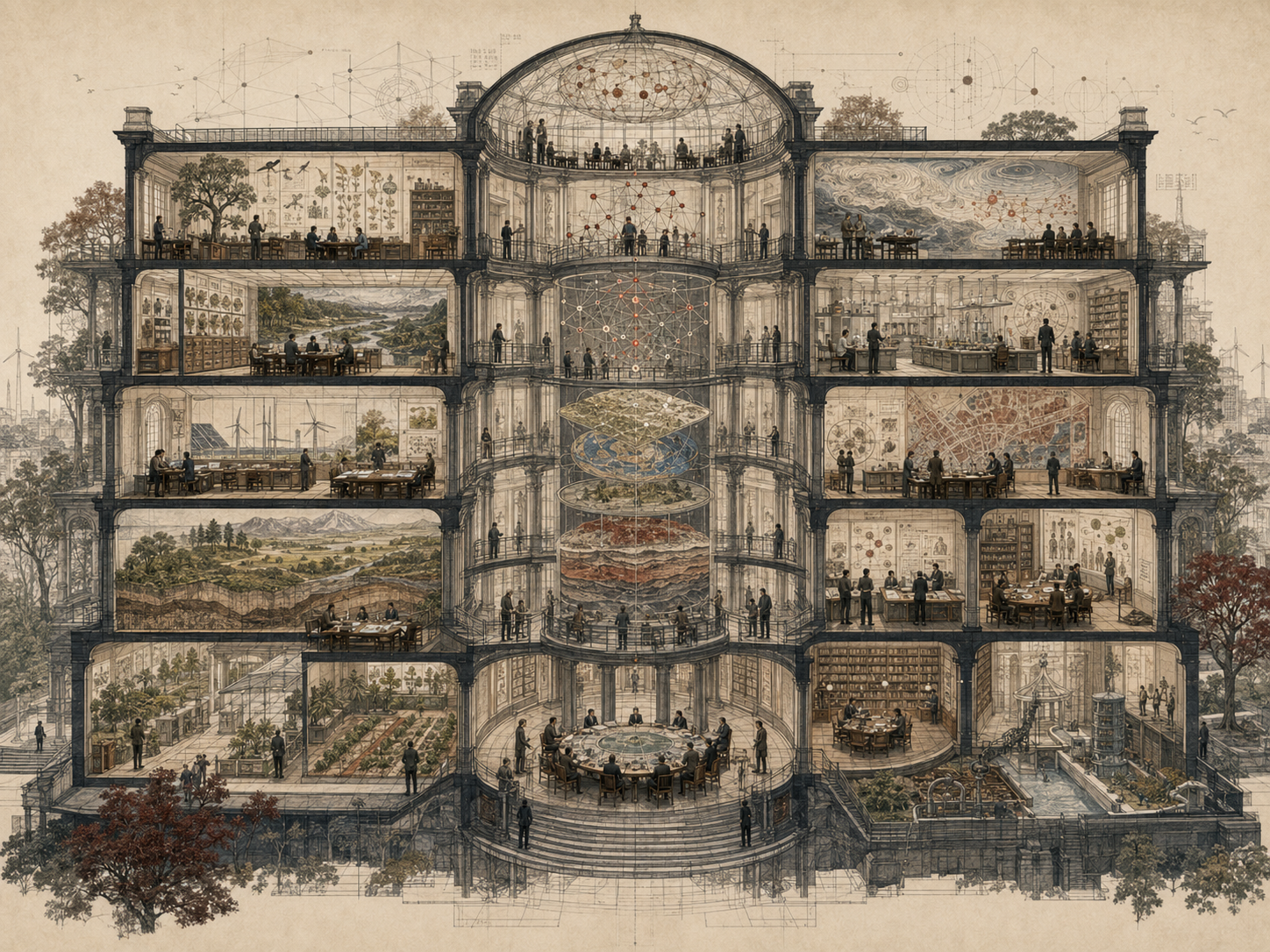
What Is Knowledge Architecture in Sustainability Science?
Knowledge architecture in sustainability science is the deliberate organization of sustainability knowledge into coherent, traceable, reusable, and ethically governed structures. It includes concepts, frameworks, indicators, datasets, models, geospatial layers, scenarios, policy documents, community records, case studies, institutional reports, repositories, metadata, taxonomies, ontologies, knowledge graphs, and decision-support pathways.
Sustainability science differs from many fields because it is problem-oriented, use-inspired, systems-oriented, and often transdisciplinary. It does not merely ask how ecological systems work or how economies grow or how institutions govern. It asks how human societies can sustain wellbeing, justice, ecological integrity, and resilience within biophysical constraints and historical inequalities.
This creates a major knowledge-architecture challenge. Sustainability science must connect climate, biodiversity, water, land, food, energy, cities, health, technology, economics, law, institutions, ethics, culture, and community experience. It must do so without reducing all knowledge to a single metric or a single worldview.
KA_{SS} = f(S, E, I, D, M, G, J)
\]
Interpretation: Knowledge architecture in sustainability science \(KA_{SS}\) can be understood as a function of social systems \(S\), ecological systems \(E\), institutions \(I\), data \(D\), models \(M\), governance \(G\), and justice \(J\).
The architectural goal is not simply to classify sustainability topics. It is to preserve relationships: climate risks to public health, biodiversity loss to food systems, infrastructure to social vulnerability, economic growth to ecological limits, governance to legitimacy, and knowledge production to power. A strong sustainability knowledge architecture makes those relationships visible, reviewable, and usable.
Why Sustainability Science Needs Knowledge Architecture
Sustainability science needs knowledge architecture because sustainability problems are complex, interconnected, and contested. They involve multiple systems, time scales, spatial scales, stakeholders, values, uncertainties, and forms of evidence. Climate adaptation cannot be understood without infrastructure, public health, land use, economic capacity, governance, community trust, and historical vulnerability. Biodiversity cannot be understood without habitat, agriculture, law, markets, Indigenous stewardship, species monitoring, and cultural meaning.
Without knowledge architecture, sustainability research fragments into disconnected reports, indicators, models, maps, datasets, dashboards, articles, and policy briefs. Users may find individual objects but lose the relationships among them. A dataset may be visible but not interpretable. A model may produce outputs but hide assumptions. A policy framework may cite science without preserving uncertainty. A dashboard may display indicators without explaining trade-offs.
Knowledge architecture helps sustainability science preserve context. It records what a dataset measures, what scale it uses, what population or ecosystem it represents, what assumptions a model makes, what evidence supports a claim, what communities are affected, what governance rules apply, and what uncertainties remain.
It also supports action. Sustainability science is often judged not only by explanation but by whether knowledge can guide decisions. For knowledge to guide decisions responsibly, it must be organized in ways that distinguish evidence from values, uncertainty from ignorance, risk from vulnerability, global indicators from local experience, and technical options from political choices.
| Challenge | Sustainability Problem | Knowledge-Architecture Response |
|---|---|---|
| Interdependence | Climate, biodiversity, water, health, food, energy, and institutions interact. | Use typed relationships, systems maps, and knowledge graphs. |
| Scale mismatch | Global models and local impacts operate at different scales. | Record spatial scale, temporal scale, and unit of analysis. |
| Evidence plurality | Data, models, case studies, legal records, and community knowledge differ. | Represent evidence type and method context. |
| Uncertainty | Future pathways, thresholds, and tipping risks are uncertain. | Preserve uncertainty metadata, assumptions, and scenario context. |
| Justice | Benefits and harms are distributed unequally. | Include vulnerability, rights, participation, and historical context. |
| Action orientation | Research must inform policy, institutions, and practice. | Build knowledge-to-action pathways with governance review. |
In this sense, knowledge architecture is part of sustainability science itself. It shapes whether knowledge can remain coherent enough to support responsible interpretation and action.
Sustainability Science as a Knowledge System
Sustainability science is not a conventional discipline with a single method, canon, or object of study. It is a knowledge system organized around problems of long-term human wellbeing, ecological integrity, social justice, institutional capacity, and transformation. It draws from ecology, economics, geography, public health, engineering, climate science, sociology, political science, law, ethics, anthropology, data science, and community knowledge.
Because it is a knowledge system rather than a narrow discipline, sustainability science requires structures that can hold multiple forms of expertise. A sustainability platform may need to organize peer-reviewed research, remote-sensing data, Indigenous knowledge, policy documents, energy models, climate scenarios, water-quality measurements, land-use maps, oral histories, infrastructure inventories, legal standards, and community vulnerability assessments.
Each knowledge object has different status. A satellite dataset is not the same as a local testimony. A climate projection is not the same as a historical record. A rights claim is not the same as an economic forecast. A governance framework is not the same as a biophysical threshold. A knowledge architecture should preserve these distinctions while connecting them responsibly.
| Knowledge Object | Sustainability Function | Architectural Need |
|---|---|---|
| Dataset | Measures environmental, social, or economic conditions. | Metadata, provenance, scale, uncertainty, access rules. |
| Model | Represents mechanisms, pathways, scenarios, or risks. | Assumptions, parameters, validation, limitations, outputs. |
| Indicator | Summarizes system status or progress. | Definition, method, interpretation, trade-offs, source. |
| Case study | Documents place-based experience and institutional context. | Location, actors, history, methods, transfer limits. |
| Policy document | Frames governance goals, rules, commitments, or programs. | Jurisdiction, authority, date, implementation status. |
| Community knowledge | Preserves lived experience, local expertise, and contextual interpretation. | Consent, attribution, access conditions, governance, care. |
| Conceptual framework | Organizes relationships among systems, risks, values, and actions. | Definitions, scope notes, evidence links, revision history. |
A sustainability knowledge system becomes useful when these objects are not isolated. The architecture should show how they relate, where they disagree, what scale they address, and what decision contexts they can responsibly inform.
Coupled Human–Environment Systems
One of the core ideas in sustainability science is that human and environmental systems are coupled. Economic activity changes land, climate, water, biodiversity, pollution, and resource flows. Environmental change affects health, livelihoods, infrastructure, migration, conflict, food systems, and institutions. Governance systems mediate these interactions, sometimes reducing harm and sometimes reproducing inequality.
Knowledge architecture must therefore avoid treating “environment” and “society” as separate libraries of content. Sustainability systems are relational. A drought is not only a hydrological event. It may involve agricultural policy, energy demand, food prices, public health, groundwater governance, indigenous water rights, insurance markets, infrastructure maintenance, and household vulnerability.
Coupled systems also involve feedback loops. Land-use decisions affect biodiversity and carbon storage. Climate change affects crop yields. Crop failures affect food prices. Food prices affect political stability. Political instability affects institutional capacity. Institutional capacity affects adaptation. The architecture must support feedback relationships, not only topic categories.
HES_t = f(E_t, S_t, I_t, T_t, K_t)
\]
Interpretation: A human–environment system at time \(t\), \(HES_t\), depends on ecological conditions \(E_t\), social conditions \(S_t\), institutions \(I_t\), technologies \(T_t\), and knowledge systems \(K_t\).
This has practical implications for platform design. An article about climate risk should connect to infrastructure, public health, migration, economic resilience, governance, and justice where relevant. A dataset about land cover should connect to agriculture, biodiversity, carbon, policy, and local land rights. A knowledge graph should support relationships such as affects, dependsOn, governedBy, mediatedBy, createsTradeoffWith, and requiresCommunityReview.
Concepts, Frameworks, and Research Pathways
Sustainability science depends on major concepts that travel across disciplines: resilience, vulnerability, adaptation, mitigation, transformation, governance, stewardship, ecosystem services, planetary boundaries, safe operating space, social-ecological systems, justice, wellbeing, sustainable development, circular economy, decoupling, risk, exposure, sensitivity, adaptive capacity, and transition pathways.
These concepts need architecture because they are often used differently across fields. “Resilience” in ecology is not identical to resilience in psychology or infrastructure. “Adaptation” in climate governance is not identical to adaptation in evolutionary biology. “Value” in economics differs from value in ethics, ecology, culture, and law. “Development” may be a policy aspiration, an economic category, a historical process, or a contested political project.
Frameworks help structure these concepts. A sustainability framework may connect drivers, pressures, states, impacts, responses, feedbacks, institutions, rights, and outcomes. A resilience framework may distinguish disturbance, exposure, sensitivity, adaptive capacity, recovery, transformation, and learning. A justice framework may distinguish distribution, recognition, procedure, capabilities, and historical responsibility.
| Concept | Common Sustainability Use | Knowledge-Architecture Need |
|---|---|---|
| Resilience | Capacity to absorb disturbance, recover, adapt, or transform. | Discipline-specific scope notes and system scale. |
| Vulnerability | Exposure, sensitivity, and limited adaptive capacity. | Social, ecological, infrastructural, and health contexts. |
| Transformation | Structural change in systems, institutions, values, or practices. | Governance context and normative assumptions. |
| Stewardship | Care, responsibility, and long-term management of systems. | Ethical, institutional, ecological, and community meanings. |
| Planetary boundaries | Earth-system limits associated with global stability. | Boundary definitions, indicators, uncertainty, and scale. |
| Sustainable development | Development that addresses social, economic, and environmental goals. | Trade-offs, justice, implementation, and indicator governance. |
| Just transition | Transition pathways that protect workers, communities, and vulnerable groups. | Labor, energy, climate, rights, and distributional context. |
Research pathways help users move through these concepts. A sustainability knowledge platform should guide readers from foundational concepts to frameworks, then to methods, indicators, models, case studies, governance, justice, and implementation. The pathway should be intellectual, not merely chronological.
Planetary Boundaries, SDGs, and Safe Operating Spaces
The planetary-boundaries framework and the Sustainable Development Goals represent two different but related forms of sustainability knowledge architecture. Planetary boundaries organize knowledge around Earth-system processes and the conditions associated with a safe operating space for humanity. The SDGs organize knowledge around globally negotiated development goals covering poverty, health, education, inequality, water, energy, climate, biodiversity, institutions, and partnerships.
Both frameworks are powerful because they structure complexity. They provide categories, indicators, relationships, and public language. But both require careful interpretation. Planetary boundaries operate at Earth-system scale and should not be reduced to simple local policy checklists. SDG indicators support monitoring and comparison, but they can also hide trade-offs, local meanings, data gaps, and political struggles over implementation.
Knowledge architecture can help by distinguishing framework type, scale, indicator source, method, uncertainty, governance status, and relationship to action. It can map SDG interactions, boundary interactions, trade-offs, synergies, and justice concerns. It can connect global frameworks to regional and local knowledge without pretending that global indicators fully capture lived experience.
| Framework | Primary Organizing Logic | Knowledge-Architecture Caution |
|---|---|---|
| Planetary boundaries | Earth-system processes and global stability conditions. | Requires scale awareness, uncertainty, and boundary-specific interpretation. |
| SDGs | Global development goals, targets, and indicators. | Requires attention to trade-offs, data gaps, implementation, and justice. |
| Social-ecological systems | Interacting ecological, social, institutional, and economic systems. | Requires relationship modeling and multi-scale evidence. |
| Doughnut economics | Social foundation and ecological ceiling. | Requires normative clarity, indicator selection, and place-based interpretation. |
| Just transition | Equity-centered transformation of energy and economic systems. | Requires labor, distributional, historical, and community context. |
SustainabilitySpace = f(SocialFoundation, EcologicalCeiling, Governance, Justice)
\]
Interpretation: Sustainability space can be understood as the interaction between social foundations, ecological ceilings, governance capacity, and justice. Frameworks help organize this space but do not remove the need for interpretation.
A knowledge platform should treat these frameworks as structured lenses, not final answers. They help organize inquiry, but responsible use requires metadata, context, evidence, and governance.
Data, Models, Indicators, and Evidence Architecture
Sustainability science uses many evidence forms: climate observations, remote sensing, biodiversity surveys, socioeconomic data, health records, land-use maps, emissions inventories, infrastructure data, energy models, integrated assessment models, qualitative interviews, policy records, historical archives, and community knowledge. A knowledge architecture must preserve how these evidence forms differ and how they relate.
Indicators are especially important because they simplify complex systems into measurable signals. Carbon emissions, water stress, poverty rates, species abundance, energy intensity, food insecurity, heat exposure, green space access, and institutional trust can all function as sustainability indicators. But indicators are not neutral. They reflect choices about what matters, what can be measured, what data exists, and what scale is visible.
Models also require architectural care. A model output should not be detached from assumptions, input data, parameters, validation, uncertainty, and scenario context. Users need to know whether a model is descriptive, predictive, exploratory, mechanistic, statistical, optimization-based, or scenario-based. They also need to know what it excludes.
| Evidence Object | Use in Sustainability Science | Required Metadata |
|---|---|---|
| Indicator | Tracks status, risk, progress, or pressure. | Definition, source, unit, scale, method, limitations. |
| Dataset | Provides empirical observations or measurements. | Provenance, coverage, resolution, quality, access, uncertainty. |
| Model | Represents system behavior, scenarios, or interventions. | Assumptions, parameters, validation, outputs, domain limits. |
| Scenario | Explores possible futures or pathways. | Narrative, assumptions, drivers, time horizon, plausibility. |
| Case study | Provides place-based or institutional insight. | Location, actors, method, history, transferability limits. |
| Policy record | Documents commitments, rules, programs, or governance decisions. | Jurisdiction, authority, date, implementation status, enforcement. |
| Community knowledge | Preserves lived experience, local expertise, and interpretation. | Consent, context, attribution, access restrictions, governance. |
Evidence architecture helps prevent misuse. It allows users to see what kind of evidence is being used, what it can support, and where its limits lie. This is especially important when evidence travels from research into policy, media, education, and AI-assisted summaries.
Knowledge-to-Action and Transdisciplinary Translation
Sustainability science is often described as knowledge-to-action oriented. It aims to produce knowledge that can help societies understand and respond to complex sustainability challenges. This requires more than communication. It requires translation across researchers, institutions, governments, communities, practitioners, funders, and publics.
Transdisciplinary sustainability work includes knowledge produced with stakeholders and communities, not merely knowledge transferred to them after research is complete. This changes the architecture. Community questions, local priorities, governance constraints, lived experience, and implementation realities must become part of the knowledge system rather than external commentary.
Knowledge-to-action pathways should preserve relationship and responsibility. A research article may connect to a policy brief, a dataset, a community report, a model, a dashboard, a repository, a decision-support tool, and a governance checklist. Each translation changes the audience and form of knowledge. The architecture should preserve what changed and what limits remain.
| Translation Pathway | Purpose | Architectural Requirement |
|---|---|---|
| Research article → policy brief | Translate findings into institutional decision context. | Preserve evidence, uncertainty, jurisdiction, and implementation limits. |
| Dataset → dashboard | Make indicators visible for users. | Preserve definitions, update frequency, scale, and caveats. |
| Model → scenario narrative | Explain possible futures. | Preserve assumptions, drivers, uncertainty, and plausibility boundaries. |
| Community knowledge → planning process | Inform place-based decisions. | Preserve consent, attribution, governance, and sensitivity. |
| Article → repository | Support reproducibility and technical extension. | Preserve code, data, documentation, outputs, and limitations. |
| Research platform → AI retrieval | Support discovery and synthesis. | Preserve metadata, provenance, status, and access controls. |
Knowledge-to-action architecture should not pretend that science automatically produces policy. Action depends on institutions, values, power, legitimacy, law, finance, public trust, and political choice. A responsible architecture distinguishes scientific evidence from decision authority.
Local Knowledge, Governance, and Justice
Sustainability science must account for local knowledge, Indigenous knowledge, community experience, and histories of unequal power. Many sustainability problems are experienced unevenly. Communities facing pollution, climate risk, displacement, water insecurity, food insecurity, or land loss often possess knowledge that is essential for understanding the problem. That knowledge is not merely anecdotal. It may reveal system failures that official data misses.
But knowledge architecture must handle local and community knowledge carefully. Not all knowledge should be extracted, digitized, opened, or repurposed. Some knowledge is sacred, sensitive, place-specific, politically vulnerable, or community-governed. Some communities have been harmed by research institutions. Responsible architecture must preserve consent, attribution, access limits, governance agreements, and context.
Justice also affects indicators and categories. A sustainability dashboard may show average progress while hiding unequal burdens. A climate-risk map may identify hazard but not political abandonment. An economic indicator may show growth while ignoring displacement. A biodiversity dataset may show species decline while omitting Indigenous stewardship or land rights.
| Justice Dimension | Knowledge-Architecture Question | Risk if Ignored |
|---|---|---|
| Distribution | Who bears costs and who receives benefits? | Average indicators hide unequal harm. |
| Recognition | Whose knowledge, identity, and experience are acknowledged? | Communities are described by outsiders or omitted. |
| Procedure | Who participates in defining problems and solutions? | Knowledge supports decisions without legitimacy. |
| Historical responsibility | How did past decisions create present vulnerability? | Current risk is treated as natural rather than produced. |
| Community governance | Who controls access, interpretation, and reuse? | Knowledge is extracted or exposed without consent. |
A sustainability knowledge architecture should therefore include justice metadata: affected communities, distributional effects, participation status, rights implications, historical context, access restrictions, and review requirements. Without this layer, sustainability science can become technically sophisticated while ethically thin.
Metadata, Taxonomies, and Knowledge Graphs
Metadata, taxonomies, ontologies, and knowledge graphs are core tools for sustainability knowledge architecture. Metadata preserves context. Taxonomies classify domains. Ontologies define entities and relationships. Knowledge graphs connect specific objects: articles, indicators, datasets, models, policies, places, species, communities, institutions, risks, and interventions.
A sustainability taxonomy might include climate, biodiversity, water, food systems, energy systems, cities, public health, institutions, economics, justice, resilience, risk, and transformation. But taxonomy alone is not enough. The most important knowledge often lies in relationships among categories: climate affects water; water affects food; food affects health; health affects labor; labor affects economic security; economic security affects adaptive capacity.
A knowledge graph can represent these relationships explicitly. It can connect an article to a concept, a concept to an indicator, an indicator to a dataset, a dataset to a place, a place to a community, a community to a governance agreement, a model to a scenario, and a scenario to a policy pathway.
| Semantic Structure | Sustainability Function | Example |
|---|---|---|
| Taxonomy | Organizes sustainability domains. | Climate, biodiversity, water, energy, cities, health, justice. |
| Ontology | Defines object types and relationships. | Dataset, Indicator, Model, Policy, Place, Risk, Community. |
| Knowledge graph | Connects objects across systems. | Heat Risk → affects → Public Health → mediatedBy → Housing. |
| Metadata schema | Preserves context for each object. | Scale, method, source, uncertainty, status, governance. |
| Crosswalk | Maps terms across disciplines and frameworks. | SDG target to article topic, indicator, or policy pathway. |
| Governance record | Controls quality, access, and revision. | Community review, data sensitivity, AI retrieval rules. |
These structures are especially important for AI-assisted retrieval. Without them, AI systems may retrieve sustainability material by textual similarity while missing scale, uncertainty, evidence type, or justice context. With them, AI retrieval can become more grounded, though still requiring human review.
AI-Assisted Sustainability Knowledge Systems
AI can support sustainability science by helping organize literature, classify documents, summarize reports, detect relationships, extract entities, compare indicators, generate metadata, identify data gaps, and support scenario exploration. But sustainability knowledge is high-stakes. AI-assisted systems must be governed carefully because they can amplify error, bias, false certainty, and extractive knowledge practices.
AI retrieval can be useful when a researcher asks for material connecting heat risk, housing, health, and urban planning. It can surface related articles, datasets, policies, and case studies. But without metadata, it may fail to distinguish global model output from local testimony, peer-reviewed evidence from advocacy material, official policy from proposed policy, or synthetic examples from empirical data.
AI-assisted sustainability platforms need structured context: discipline, method, evidence type, spatial scale, temporal scale, source status, uncertainty, access condition, affected communities, governance status, and review history. AI-generated links and summaries should be treated as provisional until reviewed.
AI_{SS} = f(Text, Data, M, S, U, P, G)
\]
Interpretation: AI-assisted sustainability knowledge systems \(AI_{SS}\) depend on text, data, metadata \(M\), scale \(S\), uncertainty \(U\), provenance \(P\), and governance \(G\).
AI should not become the authority over sustainability knowledge. It should function as a tool within a governed architecture that preserves evidence, uncertainty, justice, and accountability. The more complex the sustainability problem, the more important the architecture becomes.
Governance, Stewardship, and Institutional Memory
Sustainability knowledge systems require governance because they are dynamic. Data changes. Indicators are updated. Models are revised. Policies expire. Communities challenge descriptions. Scientific understanding evolves. New risks emerge. Old assumptions become outdated. A knowledge architecture must support revision without losing memory.
Governance includes metadata standards, repository rules, data sensitivity review, source review, model documentation, scenario versioning, indicator definitions, community agreements, article-map maintenance, AI retrieval policy, and revision logs. These are not administrative extras. They are part of the intellectual infrastructure that keeps sustainability knowledge trustworthy.
Institutional memory matters because sustainability problems unfold over long time horizons. A city, watershed, forest, food system, or energy transition cannot be understood only through current data. Historical land use, prior policy, infrastructure decisions, social exclusion, colonial histories, industrial pollution, and institutional failures often shape present sustainability conditions.
| Governance Area | Stewardship Question | Risk if Neglected |
|---|---|---|
| Metadata governance | Are definitions, scales, sources, and methods documented? | Users cannot interpret or compare knowledge objects. |
| Data governance | Are access, sensitivity, licensing, and provenance clear? | Data may be misused or detached from context. |
| Model governance | Are assumptions, parameters, and limitations preserved? | Model outputs may be treated as neutral predictions. |
| Community governance | Are consent, attribution, and local authority respected? | Knowledge may be extracted or exposed. |
| Indicator governance | Are indicator definitions and revisions tracked? | Progress measures become misleading. |
| AI governance | Are retrieval, summarization, and generated metadata reviewed? | AI may create false coherence or expose sensitive knowledge. |
| Revision governance | Are changes documented over time? | The platform loses institutional memory. |
Sustainability stewardship is therefore both technical and ethical. It involves maintaining files, but also preserving meaning, context, responsibility, and trust.
Mathematical and Computational Modeling
Sustainability knowledge architecture can be modeled as a graph of objects, concepts, systems, scales, evidence types, and governance relationships. Computational modeling can help audit metadata coverage, relationship traceability, scale coverage, justice coverage, evidence diversity, and AI retrieval readiness.
SSG = (V_O, V_C, V_S, V_E, E_R, G)
\]
Interpretation: A sustainability science graph \(SSG\) can include object nodes \(V_O\), concept nodes \(V_C\), system nodes \(V_S\), evidence nodes \(V_E\), relationship edges \(E_R\), and governance records \(G\).
ContextCoverage = \frac{|O_M|}{|O|}
\]
Interpretation: Context coverage measures the share of sustainability knowledge objects \(O\) with sufficient metadata \(O_M\), including source, method, scale, uncertainty, and governance status.
JusticeCoverage = \frac{|O_J|}{|O|}
\]
Interpretation: Justice coverage measures the share of knowledge objects \(O\) that include relevant justice context \(O_J\), such as affected communities, distributional effects, participation, rights, or historical vulnerability.
Traceability = \frac{|R_P|}{|R|}
\]
Interpretation: Traceability measures the share of relationships \(R\) with provenance \(R_P\). Sustainability knowledge requires traceable relationships among systems, indicators, data, models, policies, and communities.
These metrics are review tools, not final judgments. A high score does not prove that a sustainability knowledge system is just, accurate, or complete. It only suggests that certain architectural supports are present. Human, institutional, and community review remain essential.
Python Section: Auditing Sustainability Knowledge Architecture
The following Python example models a small sustainability knowledge system and audits metadata coverage, scale coverage, justice context, relationship traceability, and review needs.
# sustainability_knowledge_architecture_audit.py
# Lightweight audit for knowledge architecture in sustainability science.

from pathlib import Path
import csv
from collections import Counter, defaultdict

ROOT = Path(".")
OUTPUTS = ROOT / "outputs"
OUTPUTS.mkdir(exist_ok=True)

objects = [
    {"id": "climate_risk_article", "label": "Climate Risk Article", "type": "article", "metadata": True, "scale": "regional", "justice": True},
    {"id": "heat_dataset", "label": "Urban Heat Dataset", "type": "dataset", "metadata": True, "scale": "local", "justice": True},
    {"id": "biodiversity_indicator", "label": "Biodiversity Indicator", "type": "indicator", "metadata": True, "scale": "global", "justice": False},
    {"id": "water_policy", "label": "Water Governance Policy", "type": "policy", "metadata": True, "scale": "regional", "justice": True},
    {"id": "community_report", "label": "Community Vulnerability Report", "type": "community_record", "metadata": False, "scale": "local", "justice": True},
    {"id": "scenario_model", "label": "Sustainability Scenario Model", "type": "model", "metadata": True, "scale": "national", "justice": False},
    {"id": "repository", "label": "Article Repository Folder", "type": "repository", "metadata": True, "scale": "platform", "justice": False},
    {"id": "governance_checklist", "label": "Governance Checklist", "type": "governance_record", "metadata": True, "scale": "platform", "justice": True}
]

relationships = [
    {"source": "climate_risk_article", "target": "heat_dataset", "type": "usesDataset", "provenance": "article_methods"},
    {"source": "heat_dataset", "target": "community_report", "type": "requiresJusticeContext", "provenance": "equity_review"},
    {"source": "water_policy", "target": "community_report", "type": "affectsCommunity", "provenance": "policy_review"},
    {"source": "scenario_model", "target": "climate_risk_article", "type": "supportsScenario", "provenance": "model_documentation"},
    {"source": "biodiversity_indicator", "target": "scenario_model", "type": "informsModel", "provenance": "indicator_metadata"},
    {"source": "repository", "target": "heat_dataset", "type": "containsDataset", "provenance": "repository_readme"},
    {"source": "repository", "target": "scenario_model", "type": "containsModel", "provenance": "repository_readme"},
    {"source": "governance_checklist", "target": "community_report", "type": "governsAccess", "provenance": "governance_review"},
    {"source": "biodiversity_indicator", "target": "water_policy", "type": "related", "provenance": ""}
]

degree = defaultdict(int)
relationship_types = Counter()
traceable = 0
underspecified = 0

for rel in relationships:
    degree[rel["source"]] += 1
    degree[rel["target"]] += 1
    relationship_types[rel["type"]] += 1
    if rel["provenance"].strip():
        traceable += 1
    if rel["type"] in {"related", "sameAs", ""}:
        underspecified += 1

object_rows = []
for obj in objects:
    row = {
        "id": obj["id"],
        "label": obj["label"],
        "type": obj["type"],
        "has_metadata": obj["metadata"],
        "scale": obj["scale"],
        "has_justice_context": obj["justice"],
        "degree": degree[obj["id"]],
        "is_orphan": degree[obj["id"]] == 0,
        "needs_review": not obj["metadata"] or degree[obj["id"]] == 0
    }
    object_rows.append(row)

with (OUTPUTS / "sustainability_object_diagnostics.csv").open("w", newline="", encoding="utf-8") as f:
    writer = csv.DictWriter(
        f,
        fieldnames=["id", "label", "type", "has_metadata", "scale", "has_justice_context", "degree", "is_orphan", "needs_review"]
    )
    writer.writeheader()
    writer.writerows(object_rows)

with (OUTPUTS / "sustainability_relationships.csv").open("w", newline="", encoding="utf-8") as f:
    writer = csv.DictWriter(f, fieldnames=["source", "target", "type", "provenance"])
    writer.writeheader()
    writer.writerows(relationships)

with (OUTPUTS / "sustainability_relationship_type_summary.csv").open("w", newline="", encoding="utf-8") as f:
    writer = csv.writer(f)
    writer.writerow(["relationship_type", "count"])
    for rel_type, count in relationship_types.items():
        writer.writerow([rel_type, count])

scale_counts = Counter(obj["scale"] for obj in objects)
with (OUTPUTS / "sustainability_scale_summary.csv").open("w", newline="", encoding="utf-8") as f:
    writer = csv.writer(f)
    writer.writerow(["scale", "count"])
    for scale, count in scale_counts.items():
        writer.writerow([scale, count])

summary = {
    "object_count": len(objects),
    "relationship_count": len(relationships),
    "metadata_coverage": round(sum(obj["metadata"] for obj in objects) / len(objects), 3),
    "justice_context_coverage": round(sum(obj["justice"] for obj in objects) / len(objects), 3),
    "relationship_traceability": round(traceable / len(relationships), 3),
    "underspecified_relationship_risk": round(underspecified / len(relationships), 3),
    "orphan_count": sum(row["is_orphan"] for row in object_rows),
    "review_needed_count": sum(row["needs_review"] for row in object_rows),
    "scale_count": len(scale_counts),
    "relationship_type_count": len(relationship_types)
}

with (OUTPUTS / "sustainability_knowledge_architecture_summary.csv").open("w", newline="", encoding="utf-8") as f:
    writer = csv.writer(f)
    writer.writerow(["metric", "value"])
    for key, value in summary.items():
        writer.writerow([key, value])

print("Wrote sustainability knowledge architecture diagnostics to outputs/")
This example can be extended to real sustainability article maps, SDG indicators, planetary-boundary indicators, geospatial layers, repository manifests, model metadata, policy records, and community-governed datasets. Its purpose is to make sustainability knowledge more inspectable and governable.
R Section: Sustainability Concept and Evidence Diagnostics
The following R example summarizes object types, scales, metadata coverage, justice context, relationship traceability, and review needs for a simplified sustainability knowledge system.
# sustainability_knowledge_architecture_diagnostics.R
# Lightweight sustainability knowledge architecture diagnostics.

objects <- data.frame(
  id = c(
    "climate_risk_article",
    "heat_dataset",
    "biodiversity_indicator",
    "water_policy",
    "community_report",
    "scenario_model",
    "repository",
    "governance_checklist"
  ),
  label = c(
    "Climate Risk Article",
    "Urban Heat Dataset",
    "Biodiversity Indicator",
    "Water Governance Policy",
    "Community Vulnerability Report",
    "Sustainability Scenario Model",
    "Article Repository Folder",
    "Governance Checklist"
  ),
  type = c(
    "article",
    "dataset",
    "indicator",
    "policy",
    "community_record",
    "model",
    "repository",
    "governance_record"
  ),
  has_metadata = c(TRUE, TRUE, TRUE, TRUE, FALSE, TRUE, TRUE, TRUE),
  scale = c("regional", "local", "global", "regional", "local", "national", "platform", "platform"),
  has_justice_context = c(TRUE, TRUE, FALSE, TRUE, TRUE, FALSE, FALSE, TRUE)
)

relationships <- data.frame(
  source = c(
    "climate_risk_article",
    "heat_dataset",
    "water_policy",
    "scenario_model",
    "biodiversity_indicator",
    "repository",
    "repository",
    "governance_checklist",
    "biodiversity_indicator"
  ),
  target = c(
    "heat_dataset",
    "community_report",
    "community_report",
    "climate_risk_article",
    "scenario_model",
    "heat_dataset",
    "scenario_model",
    "community_report",
    "water_policy"
  ),
  relationship_type = c(
    "usesDataset",
    "requiresJusticeContext",
    "affectsCommunity",
    "supportsScenario",
    "informsModel",
    "containsDataset",
    "containsModel",
    "governsAccess",
    "related"
  ),
  has_provenance = c(TRUE, TRUE, TRUE, TRUE, TRUE, TRUE, TRUE, TRUE, FALSE)
)

dir.create("outputs", showWarnings = FALSE)

object_type_summary <- as.data.frame(table(objects$type))
names(object_type_summary) <- c("object_type", "count")

scale_summary <- as.data.frame(table(objects$scale))
names(scale_summary) <- c("scale", "count")

relationship_type_summary <- as.data.frame(table(relationships$relationship_type))
names(relationship_type_summary) <- c("relationship_type", "count")

relationship_ids <- c(relationships$source, relationships$target)

degree_table <- data.frame(
  id = objects$id,
  label = objects$label,
  type = objects$type,
  has_metadata = objects$has_metadata,
  scale = objects$scale,
  has_justice_context = objects$has_justice_context,
  degree = sapply(objects$id, function(x) sum(relationship_ids == x))
)

degree_table$is_orphan <- degree_table$degree == 0
degree_table$needs_review <- !degree_table$has_metadata | degree_table$is_orphan

coverage_summary <- data.frame(
  object_count = nrow(objects),
  relationship_count = nrow(relationships),
  metadata_coverage = mean(objects$has_metadata),
  justice_context_coverage = mean(objects$has_justice_context),
  relationship_traceability = mean(relationships$has_provenance),
  underspecified_relationship_risk = mean(relationships$relationship_type %in% c("related", "sameAs", "")),
  orphan_count = sum(degree_table$is_orphan),
  review_needed_count = sum(degree_table$needs_review),
  scale_count = length(unique(objects$scale))
)

write.csv(object_type_summary, "outputs/sustainability_object_type_summary.csv", row.names = FALSE)
write.csv(scale_summary, "outputs/sustainability_scale_summary.csv", row.names = FALSE)
write.csv(relationship_type_summary, "outputs/sustainability_relationship_type_summary.csv", row.names = FALSE)
write.csv(degree_table, "outputs/sustainability_degree_table.csv", row.names = FALSE)
write.csv(coverage_summary, "outputs/sustainability_coverage_summary.csv", row.names = FALSE)

print(object_type_summary)
print(scale_summary)
print(coverage_summary)
R is useful for sustainability knowledge diagnostics because it can summarize scale coverage, evidence distribution, metadata gaps, relationship quality, and review needs. In a larger platform, these diagnostics can support article-map maintenance, data governance, and sustainability knowledge stewardship.
SQL Section: Sustainability Knowledge Architecture Schema
SQL can support sustainability knowledge architecture by storing systems, concepts, indicators, datasets, models, policies, communities, places, relationships, governance records, and revisions. A relational schema can provide a practical registry even when graph databases or semantic-web systems are added later.
-- sustainability_knowledge_architecture_schema.sql
-- Minimal schema for sustainability science knowledge architecture.

CREATE TABLE IF NOT EXISTS sustainability_objects (
  object_id TEXT PRIMARY KEY,
  title TEXT NOT NULL,
  object_type TEXT NOT NULL,
  slug TEXT,
  status TEXT DEFAULT 'active',
  created_at DATE,
  updated_at DATE,
  last_reviewed DATE
);

CREATE TABLE IF NOT EXISTS systems (
  system_id TEXT PRIMARY KEY,
  name TEXT NOT NULL,
  system_type TEXT,
  scope_note TEXT,
  scale TEXT,
  status TEXT DEFAULT 'active'
);

CREATE TABLE IF NOT EXISTS concepts (
  concept_id TEXT PRIMARY KEY,
  preferred_label TEXT NOT NULL,
  definition TEXT,
  scope_note TEXT,
  primary_system_id TEXT,
  status TEXT DEFAULT 'active',
  FOREIGN KEY (primary_system_id) REFERENCES systems(system_id)
);

CREATE TABLE IF NOT EXISTS evidence_objects (
  evidence_id TEXT PRIMARY KEY,
  object_id TEXT,
  evidence_type TEXT NOT NULL,
  method_note TEXT,
  source_note TEXT,
  uncertainty_note TEXT,
  scale TEXT,
  FOREIGN KEY (object_id) REFERENCES sustainability_objects(object_id)
);

CREATE TABLE IF NOT EXISTS indicators (
  indicator_id TEXT PRIMARY KEY,
  name TEXT NOT NULL,
  definition TEXT,
  unit TEXT,
  source TEXT,
  scale TEXT,
  update_frequency TEXT,
  limitation_note TEXT
);

CREATE TABLE IF NOT EXISTS models (
  model_id TEXT PRIMARY KEY,
  name TEXT NOT NULL,
  model_type TEXT,
  assumptions TEXT,
  parameters_note TEXT,
  validation_note TEXT,
  limitation_note TEXT
);

CREATE TABLE IF NOT EXISTS places (
  place_id TEXT PRIMARY KEY,
  name TEXT NOT NULL,
  place_type TEXT,
  spatial_scale TEXT,
  governance_context TEXT,
  vulnerability_note TEXT
);

CREATE TABLE IF NOT EXISTS communities (
  community_id TEXT PRIMARY KEY,
  name TEXT NOT NULL,
  description TEXT,
  access_condition TEXT,
  governance_note TEXT,
  sensitivity_level TEXT
);

CREATE TABLE IF NOT EXISTS relationship_types (
  relationship_type_id TEXT PRIMARY KEY,
  label TEXT NOT NULL,
  definition TEXT,
  status TEXT DEFAULT 'active'
);

CREATE TABLE IF NOT EXISTS sustainability_relationships (
  relationship_id INTEGER PRIMARY KEY,
  source_object_id TEXT NOT NULL,
  relationship_type_id TEXT NOT NULL,
  target_object_id TEXT NOT NULL,
  provenance_note TEXT,
  uncertainty_note TEXT,
  review_status TEXT DEFAULT 'provisional',
  FOREIGN KEY (source_object_id) REFERENCES sustainability_objects(object_id),
  FOREIGN KEY (relationship_type_id) REFERENCES relationship_types(relationship_type_id),
  FOREIGN KEY (target_object_id) REFERENCES sustainability_objects(object_id)
);

CREATE TABLE IF NOT EXISTS governance_records (
  governance_id TEXT PRIMARY KEY,
  object_id TEXT,
  governance_type TEXT NOT NULL,
  access_condition TEXT,
  sensitivity_level TEXT,
  justice_note TEXT,
  review_status TEXT,
  review_date DATE,
  FOREIGN KEY (object_id) REFERENCES sustainability_objects(object_id)
);

CREATE TABLE IF NOT EXISTS sustainability_revisions (
  revision_id INTEGER PRIMARY KEY,
  object_id TEXT,
  revision_type TEXT NOT NULL,
  revision_note TEXT,
  changed_at DATE,
  FOREIGN KEY (object_id) REFERENCES sustainability_objects(object_id)
);
This schema separates sustainability objects, systems, concepts, evidence, indicators, models, places, communities, relationships, governance records, and revisions. That separation matters because sustainability knowledge must preserve context. A model is not a dataset. An indicator is not a policy. A community record is not just another data point. A relationship is not trustworthy unless its provenance, uncertainty, and review status are visible.
GitHub Repository
This article is supported by a companion repository folder with reproducible examples, small synthetic datasets, documentation, and language-specific modeling scaffolds for sustainability-science knowledge architecture.
Complete Code Repository
This folder contains companion research and code assets for the Knowledge Architecture in Sustainability Science article, including Python, R, Julia, SQL, Rust, Go, C++, Fortran, C, documentation, data, and generated outputs.
The repository structure mirrors the article’s sustainability-science argument. Python supports metadata, justice, scale, relationship, and review diagnostics. R supports coverage summaries and sustainability-system review. SQL supports sustainability objects, systems, concepts, evidence, indicators, models, places, communities, governance records, relationships, and revisions. Systems-language folders provide space for validation utilities, graph-processing experiments, and reproducible tooling. Documentation, data, and outputs preserve the relationship between sustainability science, computational review, and long-term knowledge governance.
Quality Criteria for Sustainability Knowledge Architecture
Strong sustainability knowledge architecture should be systems-aware, scale-aware, evidence-aware, justice-aware, traceable, reusable, governed, and action-oriented without becoming simplistic. It should support research and decision-making while preserving uncertainty, context, and responsibility.
| Quality Criterion | Evaluation Question | Warning Sign |
|---|---|---|
| Systems awareness | Are social, ecological, technical, and institutional relationships represented? | Topics are isolated into disconnected categories. |
| Scale awareness | Are spatial, temporal, and institutional scales documented? | Global indicators are applied locally without context. |
| Evidence awareness | Are datasets, models, policies, and community records distinguished? | Different evidence types are treated interchangeably. |
| Justice awareness | Are distribution, recognition, participation, and historical context included? | Average indicators hide unequal burdens. |
| Traceability | Can users follow claims to sources, methods, data, models, and governance records? | Relationships are asserted without provenance. |
| Reusability | Can data, code, and model assets be reused responsibly? | Repository assets lack documentation or access conditions. |
| Governance | Are revisions, sensitivity, access, and AI retrieval reviewed? | Knowledge changes without memory or accountability. |
| Action orientation | Are knowledge-to-action pathways explicit and responsible? | Evidence is presented as if it automatically determines policy. |
Quality should be assessed across the whole knowledge system. A platform may have strong data but weak justice context. It may have strong narratives but weak metadata. It may have sophisticated models but poor governance. Sustainability knowledge architecture requires these layers to work together.
Interpretive Cautions and Ethical Limits
Sustainability knowledge architecture can clarify complex systems, but it can also create false confidence. A clean dashboard, taxonomy, model, or knowledge graph may make sustainability problems appear more settled than they are. Indicators may simplify contested values. Models may hide assumptions. Global frameworks may obscure local histories. AI retrieval may flatten uncertainty.
There is also a risk of extractive integration. Sustainability platforms may gather knowledge from communities, Indigenous peoples, local practitioners, or vulnerable groups without adequate governance, reciprocity, or consent. Knowledge architecture should not treat every knowledge object as freely reusable simply because it can be digitized or linked.
Some sustainability knowledge requires protection. Sensitive ecological locations, Indigenous knowledge, sacred knowledge, vulnerable-community data, health data, household vulnerability data, and politically sensitive records may require restricted access or community governance. Open science and open data must be balanced with responsibility.
Equity also requires attention to absence. Data gaps may reflect historical exclusion, underfunding, lack of monitoring, language barriers, inaccessible archives, or political suppression. A platform should not treat missing data as missing reality. It should document uncertainty, silence, and structural invisibility where possible.
The goal is not to build a perfect sustainability knowledge system. The goal is to build an accountable one: structured, transparent, revisable, justice-aware, and open to critique.
Why Sustainability Science Belongs to Knowledge Architecture
Sustainability science belongs at the center of knowledge architecture because it tests whether knowledge systems can handle complexity, uncertainty, justice, and action at the same time. It requires more than classification. It requires relationship design, evidence architecture, governance, scale awareness, and ethical stewardship.
Knowledge architecture helps sustainability science connect concepts, indicators, datasets, models, policies, communities, places, institutions, and repositories. It helps users move from article maps to evidence, from evidence to action, from global frameworks to local context, and from technical analysis to justice and governance.
For research platforms, sustainability science is a demanding case because its knowledge objects are diverse and high-stakes. Climate, biodiversity, water, food, energy, health, cities, infrastructure, economics, law, and community knowledge all need to be connected without being flattened. AI-assisted retrieval makes this even more urgent because weak structure can quickly become misleading synthesis.
At its best, knowledge architecture in sustainability science turns scattered sustainability knowledge into durable intellectual infrastructure. It preserves relationships, context, evidence, uncertainty, justice, and stewardship so that knowledge can remain findable, meaningful, reusable, and accountable across disciplines, institutions, and generations.
Related Articles
- Foundations of Knowledge Architecture
- What Is Knowledge Architecture?
- Structuring Interdisciplinary Knowledge
- Digital Knowledge Platforms
- Knowledge Systems in Research Institutions
- Intellectual Infrastructure for Research Platforms
- Knowledge Mapping and Conceptual Models
- Knowledge Graphs and Semantic Relationships
- Taxonomy Design for Knowledge Systems
Further Reading
- Berkes, F., Colding, J. and Folke, C. (eds.) (2003) Navigating Social-Ecological Systems: Building Resilience for Complexity and Change. Cambridge: Cambridge University Press.
- Clark, W.C. and Dickson, N.M. (2003) ‘Sustainability Science: The Emerging Research Program’, Proceedings of the National Academy of Sciences, 100(14), pp. 8059–8061.
- Future Earth (n.d.) Global Research Networks and Sustainability Research.
- Kates, R.W. (2011) ‘What Kind of a Science Is Sustainability Science?’, Proceedings of the National Academy of Sciences, 108(49), pp. 19449–19450.
- Ostrom, E. (2009) ‘A General Framework for Analyzing Sustainability of Social-Ecological Systems’, Science, 325(5939), pp. 419–422.
- Rockström, J. et al. (2009) ‘A Safe Operating Space for Humanity’, Nature, 461, pp. 472–475.
- Richardson, K. et al. (2023) ‘Earth beyond Six of Nine Planetary Boundaries’, Science Advances, 9(37), eadh2458.
- Wilkinson, M.D. et al. (2016) ‘The FAIR Guiding Principles for Scientific Data Management and Stewardship’, Scientific Data, 3, 160018.
References
- Berkes, F., Colding, J. and Folke, C. (eds.) (2003) Navigating Social-Ecological Systems: Building Resilience for Complexity and Change. Cambridge: Cambridge University Press. Available at: https://doi.org/10.1017/CBO9780511541957
- Clark, W.C. and Dickson, N.M. (2003) ‘Sustainability Science: The Emerging Research Program’, Proceedings of the National Academy of Sciences, 100(14), pp. 8059–8061. Available at: https://www.pnas.org/doi/10.1073/pnas.1231333100
- Future Earth (n.d.) Future Earth Networks. Available at: https://futureearth.org/networks/
- Kates, R.W. et al. (2001) ‘Sustainability Science’, Science, 292(5517), pp. 641–642. Available at: https://doi.org/10.1126/science.1059386
- Kates, R.W. (2011) ‘What Kind of a Science Is Sustainability Science?’, Proceedings of the National Academy of Sciences, 108(49), pp. 19449–19450. Available at: https://www.pnas.org/doi/10.1073/pnas.1116097108
- Ostrom, E. (2009) ‘A General Framework for Analyzing Sustainability of Social-Ecological Systems’, Science, 325(5939), pp. 419–422. Available at: https://doi.org/10.1126/science.1172133
- Richardson, K. et al. (2023) ‘Earth beyond Six of Nine Planetary Boundaries’, Science Advances, 9(37), eadh2458. Available at: https://www.science.org/doi/10.1126/sciadv.adh2458
- Rockström, J. et al. (2009) ‘A Safe Operating Space for Humanity’, Nature, 461, pp. 472–475. Available at: https://doi.org/10.1038/461472a
- United Nations (2015) Transforming Our World: The 2030 Agenda for Sustainable Development. Available at: https://sdgs.un.org/2030agenda
- UNESCO (2021) UNESCO Recommendation on Open Science. Paris: UNESCO. Available at: https://unesdoc.unesco.org/ark:/48223/pf0000379949
- Wilkinson, M.D. et al. (2016) ‘The FAIR Guiding Principles for Scientific Data Management and Stewardship’, Scientific Data, 3, 160018. Available at: https://doi.org/10.1038/sdata.2016.18