
Last Updated May 27, 2026
Knowledge architecture in digital libraries is the design of the intellectual structures that make digital collections findable, meaningful, interoperable, preservable, and reusable over time. A digital library is not only a searchable collection of digitized objects. It is a knowledge environment made of records, metadata, classification systems, authority files, vocabularies, collection histories, preservation workflows, rights information, institutional memory, user pathways, and interpretive context.
Information architecture helps digital library users browse, search, filter, and navigate collections. Knowledge architecture goes deeper. It asks how objects are described, how concepts are controlled, how works relate to expressions and manifestations, how subjects are represented, how provenance is preserved, how communities are named, how collections are governed, how metadata travels across systems, and how digital objects remain intelligible after their original technical and institutional contexts change.
Within knowledge architecture, digital libraries are especially important because they sit at the intersection of memory, access, classification, preservation, scholarship, technology, and power. They reveal that knowledge systems are never only technical systems. They are also cultural, institutional, semantic, historical, and ethical systems.
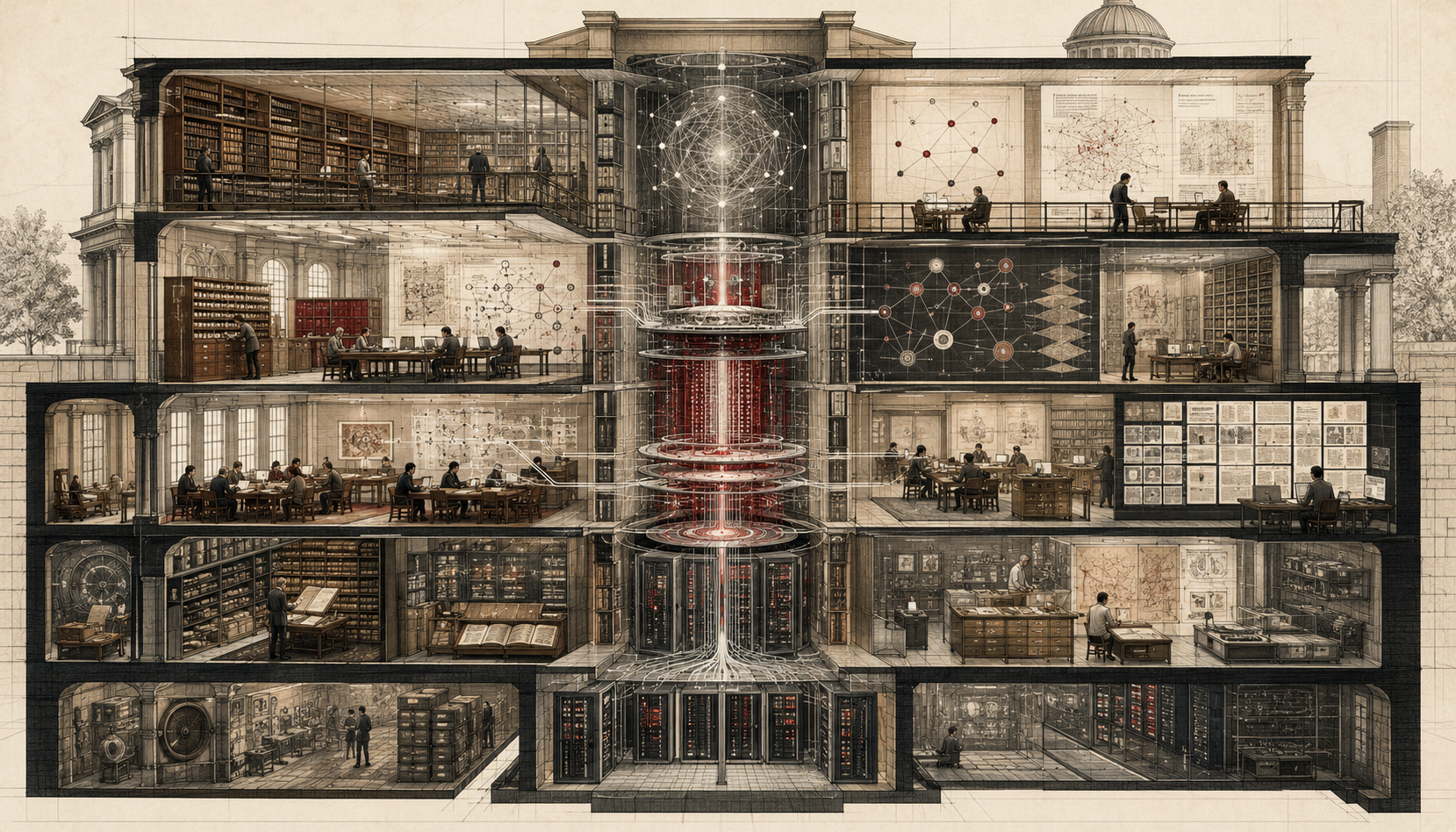
What Is Knowledge Architecture in Digital Libraries?
Knowledge architecture in digital libraries is the deliberate design of the structures that organize digital collections as meaningful knowledge systems. It includes metadata, cataloging models, classification schemes, controlled vocabularies, authority files, subject headings, linked-data structures, preservation metadata, rights metadata, collection descriptions, access pathways, and governance practices.
A digital library object may be a book, photograph, manuscript, map, oral history, dataset, newspaper issue, audio file, video, website capture, government document, thesis, software artifact, institutional record, or born-digital archive. Knowledge architecture asks how that object is represented: what it is, who created it, what it is about, where it came from, what collection it belongs to, what rights apply, what version it is, what language it uses, what communities it concerns, what related objects exist, and how future users should interpret it.
The architectural task is not simply to store objects. It is to preserve relationships. A manuscript may belong to a collection, reference a person, originate from a place, use a language, belong to a historical period, cite another work, appear in multiple editions, or require sensitive cultural handling. These relationships are part of the object’s meaning.
DL_{KA} = f(O, M, C, A, R, P, G)
\]
Interpretation: Digital library knowledge architecture \(DL_{KA}\) can be understood as a function of objects \(O\), metadata \(M\), collections \(C\), authority structures \(A\), relationships \(R\), preservation context \(P\), and governance \(G\).
Knowledge architecture helps a digital library become more than a search box. It helps the library become a structured environment for discovery, interpretation, preservation, and responsible reuse.
Why Digital Libraries Need Knowledge Architecture
Digital libraries need knowledge architecture because digital abundance creates new forms of disorder. Digitization can make materials visible, but visibility alone does not create understanding. A scanned image without metadata is difficult to find. A record without subject terms is difficult to connect. A collection without provenance is difficult to interpret. A digital object without rights metadata is difficult to reuse responsibly.
Digital libraries also need architecture because collections are heterogeneous. A single library may contain manuscripts, books, photographs, newspapers, oral histories, maps, datasets, audiovisual records, web archives, institutional documents, and community materials. These objects require different forms of description, preservation, access, and ethical care.
The challenge is not only retrieval. It is meaning. Users need to know whether an item is an original, reproduction, edition, translation, derivative, archival record, metadata-only record, digitized surrogate, or born-digital object. They need to know whether subject terms are contemporary, historical, institutional, contested, or harmful. They need to know whether access is open, restricted, culturally sensitive, copyrighted, or uncertain.
Knowledge architecture also supports interoperability. Digital libraries increasingly share records across catalogs, institutional repositories, consortia, national libraries, linked-data environments, discovery layers, aggregators, and research platforms. Metadata and vocabularies must travel across systems without losing too much meaning.
Finally, digital libraries need knowledge architecture because they are memory institutions. They do not merely provide access to content. They preserve the conditions under which future users can understand, evaluate, reinterpret, and responsibly reuse that content.
Digital Libraries as Knowledge Systems
A digital library is a knowledge system when its objects, records, collections, metadata, classifications, interfaces, preservation workflows, and governance practices work together. The system includes technical infrastructure, but also intellectual labor: cataloging, archival description, subject analysis, metadata normalization, authority control, collection development, digitization selection, rights review, preservation planning, and community consultation.
Digital libraries often combine several traditions. Library cataloging emphasizes bibliographic description, authority control, subject access, and resource discovery. Archival description emphasizes provenance, original order, context, and collection-level relationships. Digital preservation emphasizes bit-level integrity, file formats, fixity, migration, emulation, and long-term access. Knowledge organization emphasizes classification, thesauri, vocabularies, ontologies, and semantic relationships.
Knowledge architecture connects these traditions. It asks how bibliographic records, archival finding aids, digital objects, repository metadata, preservation records, and subject vocabularies can form a coherent system. It also asks where coherence should be limited: some materials require local context, community description, contested terminology, or restricted access.
| Digital Library Layer | Components | Knowledge-Architecture Function |
|---|---|---|
| Object layer | Books, images, manuscripts, recordings, datasets, maps, born-digital files. | Defines what the library preserves and makes accessible. |
| Metadata layer | Descriptive, administrative, technical, preservation, rights, and structural metadata. | Preserves context, discovery, access, and stewardship information. |
| Collection layer | Collections, series, fonds, subseries, exhibits, institutional repositories. | Preserves grouping, provenance, and interpretive context. |
| Semantic layer | Subjects, authority files, controlled vocabularies, ontologies, linked data. | Supports relationships, interoperability, and discovery across systems. |
| Interface layer | Search, browse, filters, item pages, collection pages, related records. | Makes the knowledge structure usable for people. |
| Preservation layer | Fixity, formats, checksums, migration plans, preservation metadata. | Maintains long-term access and authenticity. |
| Governance layer | Cataloging policies, rights review, community protocols, revision workflows. | Maintains accountability, quality, and ethical stewardship. |
A digital library’s architecture is strongest when these layers reinforce each other. Item records should connect to collections. Collection descriptions should preserve provenance. Subject terms should connect to controlled vocabularies. Rights statements should govern access and reuse. Preservation metadata should support long-term trust. Interfaces should expose enough structure for users to navigate meaningfully.
Collections, Records, and Knowledge Objects
Digital libraries contain objects, but users often encounter records. A record is a representation of an object. It may include title, creator, date, subject, description, identifier, language, format, rights, relation, collection, and provenance fields. A record is not the object itself. It is an interpretive and administrative structure that makes the object findable and intelligible.
Knowledge architecture treats records as knowledge objects. They are not neutral containers. They encode choices about description, naming, classification, relationship, emphasis, and omission. They decide which creator names are authoritative, which subject terms are used, which dates matter, which relationships are visible, and which contextual notes are included.
Digital libraries also contain collection-level knowledge. Some objects cannot be understood in isolation. A letter may matter because of the correspondence series it belongs to. A photograph may need collection context to identify its event, place, or creator. A dataset may require project context. An oral history may require consent, community, and interview context. A web archive may require capture context.
| Knowledge Object | Description Need | Architectural Risk if Missing |
|---|---|---|
| Item record | Object-level metadata and access information. | The object becomes difficult to find or interpret. |
| Collection record | Provenance, scope, history, arrangement, and restrictions. | Objects lose their broader context. |
| Authority record | Controlled identity for person, organization, place, or subject. | Names fragment across variants and spellings. |
| Subject record | Controlled topic or concept with relationships. | Search becomes inconsistent and conceptually shallow. |
| Rights record | Access, licensing, copyright, donor restrictions, cultural protocols. | Reuse becomes legally or ethically risky. |
| Preservation record | File formats, checksums, migrations, technical events. | Long-term authenticity and usability weaken. |
The digital library is therefore built from relationships among objects and records. Knowledge architecture helps make those relationships explicit, governed, and usable.
Metadata as Library Memory
Metadata is one of the central forms of memory in a digital library. It preserves information that the object alone cannot reliably communicate: who created it, what it is, what it is about, when it was created, where it came from, what format it uses, what rights apply, how it relates to other objects, and how it has been preserved.
Different metadata types support different responsibilities. Descriptive metadata supports discovery and interpretation. Administrative metadata supports management. Technical metadata supports file handling. Preservation metadata supports long-term stewardship. Rights metadata supports access and reuse. Structural metadata shows how parts relate within compound objects, such as pages in a book or files in a digital archive.
| Metadata Type | Primary Function | Digital Library Example |
|---|---|---|
| Descriptive metadata | Supports discovery and interpretation. | Title, creator, subject, description, date, language. |
| Administrative metadata | Supports management and stewardship. | Accession number, donor, processing status, repository location. |
| Technical metadata | Describes digital file properties. | File format, resolution, duration, codec, checksum. |
| Preservation metadata | Documents long-term preservation actions. | Fixity checks, migration events, preservation level. |
| Rights metadata | Defines access and reuse conditions. | Copyright status, license, restrictions, cultural protocols. |
| Structural metadata | Shows parts and order. | Page sequence, compound objects, file bundles, collection hierarchy. |
Metadata quality determines whether digital library objects can survive their original context. A file may remain technically accessible, but if its metadata is weak, future users may not understand what it is, where it came from, or how it may be used. Metadata is therefore not clerical decoration. It is intellectual infrastructure.
MetadataCoverage = \frac{|O_M|}{|O|}
\]
Interpretation: Metadata coverage measures the share of objects \(O\) with sufficient metadata \(O_M\). In a digital library, low metadata coverage weakens discovery, interpretation, preservation, and reuse.
Strong digital library knowledge architecture treats metadata as a living system. Records may need revision as terminology changes, rights are clarified, communities provide better descriptions, or linked-data models mature.
Cataloging, Authority, and Controlled Vocabularies
Cataloging and authority control are central to digital library knowledge architecture. Cataloging describes resources. Authority control manages names, subjects, titles, and identities so that users can find related materials even when names vary. Controlled vocabularies reduce inconsistency by establishing preferred terms, alternate labels, broader terms, narrower terms, and related terms.
Authority control matters because names are unstable. A person may publish under multiple names. A place may have colonial, Indigenous, historical, and contemporary names. An organization may change its name. A subject may be described through older terminology that is now harmful or contested. Authority structures help manage variation, but they also require ethical review.
Controlled vocabularies improve retrieval by connecting synonymous or related terms. They can help users find materials across spelling variants, language variants, historical terminology, and subject hierarchies. But they can also encode institutional bias. A subject heading may reflect outdated assumptions. A classification scheme may marginalize certain fields. A controlled term may be efficient for retrieval but harmful in description.
| Structure | Function | Knowledge-Architecture Concern |
|---|---|---|
| Authority file | Controls names and identities. | Must manage variants, aliases, historical names, and community-preferred names. |
| Controlled vocabulary | Standardizes terms. | Must balance retrieval consistency with ethical description. |
| Thesaurus | Defines broader, narrower, and related terms. | Supports semantic navigation and subject expansion. |
| Classification scheme | Places resources in a structured order. | Can reveal or reproduce disciplinary hierarchies. |
| Subject heading system | Assigns topical access points. | Requires revision when terms are outdated, harmful, or incomplete. |
Knowledge architecture does not reject cataloging authority. It makes authority inspectable. It asks who defines preferred names, how variant names are handled, how contested terms are documented, how harmful language is revised, and how users can understand the history of description.
Classification, Subjects, and Semantic Structure
Classification systems and subject structures are semantic infrastructure for digital libraries. They help users discover materials by topic, field, period, genre, place, person, language, format, or community. They also organize collections into meaningful relationships.
Subject access is not simply a search feature. It reflects an interpretation of what a resource is about. A photograph might be classified by place, person, event, social movement, creator, date, material culture, or community significance. A book might be classified by discipline, genre, author, historical period, or theme. Different classification choices produce different discovery pathways.
Semantic structure becomes especially important when digital libraries connect to linked data. A subject term can be represented as a concept, linked to broader and narrower terms, connected to authority records, mapped to other vocabularies, and reused across systems. This allows digital libraries to become part of wider knowledge networks.
SubjectAccess = f(T, V, R, C)
\]
Interpretation: Subject access depends on terms \(T\), vocabularies \(V\), relationships \(R\), and collection context \(C\). Search quality depends not only on text, but on semantic structure.
The challenge is that classification is never perfect. Some subjects are interdisciplinary. Some objects resist stable classification. Some terms change across time. Some categories are contested. Some collections contain materials created under unequal power. A strong digital library knowledge architecture should preserve semantic structure while allowing revision, scope notes, alternate labels, and critical description.
Linked Data, BIBFRAME, and Semantic Interoperability
Linked data has become an important direction for digital library knowledge architecture because it allows library descriptions to move beyond isolated records. Instead of treating a catalog record as a closed unit, linked data represents entities and relationships: works, instances, items, persons, organizations, subjects, places, identifiers, collections, and events.
BIBFRAME is one major initiative in this transition. It was developed as a linked-data-oriented framework for bibliographic description and as a pathway beyond MARC-based record exchange. In knowledge architecture terms, BIBFRAME shifts attention from record storage toward entity relationships: works, instances, items, agents, subjects, and relationships among them.
W3C standards such as RDF and SKOS also matter because they provide general models for expressing resources and knowledge organization systems as machine-readable data. SKOS is especially useful for thesauri, taxonomies, classification schemes, and subject heading systems. Dublin Core remains widely important for interoperable metadata terms across digital repositories and library contexts.
| Standard or Model | Role in Digital Libraries | Knowledge-Architecture Contribution |
|---|---|---|
| Dublin Core | Provides widely used metadata terms. | Supports basic interoperable description across repositories. |
| RDF | Represents resources through subject-predicate-object statements. | Supports machine-readable relationships and linked data. |
| SKOS | Models knowledge organization systems. | Supports controlled vocabularies, thesauri, taxonomies, and subject concepts. |
| BIBFRAME | Models bibliographic resources in linked-data form. | Supports entity-based bibliographic description beyond flat records. |
| IFLA LRM | Conceptual model for bibliographic information. | Clarifies entities and relationships in bibliographic description. |
| PREMIS | Supports preservation metadata. | Documents preservation events, agents, rights, and objects. |
Semantic interoperability does not happen automatically. Standards must be implemented consistently. Mappings must be documented. Local metadata must be normalized carefully. Legacy records must be transformed with attention to meaning. Linked data can improve discovery, but only when the underlying knowledge architecture is coherent and governed.
Digital Preservation and Long-Term Context
Digital preservation is part of knowledge architecture because preserving files is not the same as preserving knowledge. A file can remain intact while its meaning becomes unclear. A checksum can confirm that bits have not changed, but it cannot explain provenance, rights, subject context, community significance, or collection history.
Long-term preservation requires technical and intellectual context. Technical preservation includes fixity checks, file format monitoring, migration planning, storage redundancy, and preservation metadata. Intellectual preservation includes descriptive metadata, provenance, collection context, rights, restrictions, documentation, and interpretive notes.
Born-digital materials make this especially important. Email archives, websites, software, databases, digital photographs, audiovisual files, and research data may depend on obsolete formats, software environments, directory structures, or external links. Preservation metadata must document not only the object, but the environment needed to interpret or render it.
| Preservation Concern | Technical Question | Knowledge-Architecture Question |
|---|---|---|
| File integrity | Have the bits changed? | What does this file represent and why does it matter? |
| Format sustainability | Can the file still be opened? | What context is needed to interpret it correctly? |
| Migration | Was the object transformed into a new format? | What changed during transformation? |
| Rights | Can the object be accessed or reproduced? | What ethical, legal, donor, or community restrictions apply? |
| Provenance | Where did the object come from? | How does origin shape interpretation? |
Digital preservation therefore belongs inside knowledge architecture, not outside it. Preservation without description protects files but risks losing meaning. Description without preservation protects meaning temporarily but risks losing access. A durable digital library needs both.
User Pathways, Search, and Discovery
User pathways are the visible expression of digital library knowledge architecture. Users encounter the architecture through search boxes, facets, collection pages, item records, subject links, related objects, browse lists, exhibitions, finding aids, thumbnails, citations, and download options. These interface structures should reflect the deeper architecture of metadata, collections, and semantic relationships.
Search is not only a technical function. It is shaped by metadata quality, indexing rules, subject vocabularies, authority control, OCR quality, transcription quality, language support, rights metadata, and interface design. A search system can only retrieve what the architecture has made searchable.
Browse pathways remain important even in search-heavy systems. Browsing allows users to discover collections, subjects, creators, time periods, places, formats, and related materials they did not know to search for. Digital libraries should support both known-item searching and exploratory discovery.
| Discovery Pathway | User Need | Knowledge-Architecture Requirement |
|---|---|---|
| Keyword search | Find known terms or names. | High-quality text, metadata, OCR, indexing, and alternate labels. |
| Faceted search | Narrow results by structured attributes. | Consistent metadata fields and controlled values. |
| Subject browse | Explore topical relationships. | Controlled vocabularies, broader/narrower terms, related concepts. |
| Collection browse | Understand provenance and grouping. | Collection-level description and hierarchy. |
| Related items | Move across meaningful connections. | Typed relationships and semantic links. |
| Exhibits or guides | Interpret collections through curated pathways. | Editorial context and documented selection logic. |
Discovery systems should not hide uncertainty. Users should be able to see when metadata is incomplete, terms are historical, rights are unclear, OCR is imperfect, or descriptions are under revision. Trust grows when the architecture is transparent.
Archives, Special Collections, and Provenance
Archives and special collections make provenance central. In archival description, context is often as important as item content. Who created the records? For what purpose? Under what institutional or personal circumstances? How were the records arranged? What relationships exist among files, series, fonds, creators, and custodial histories?
Digital library systems sometimes flatten archival context by presenting digitized items as isolated objects. Knowledge architecture should resist that flattening. A digitized letter, photograph, or notebook should connect to its collection, series, creator, date range, arrangement, restrictions, and provenance notes where possible.
Special collections also raise interpretive and ethical questions. Materials may include donor restrictions, culturally sensitive content, colonial records, personal papers, sacred materials, or documentation of harmed communities. Making such materials digital does not remove obligations of context, care, and governance.
Provenance is therefore more than a historical note. It is a structural relationship. It tells users how an object came to be in the library, what collection it belongs to, who shaped its survival, and what limitations apply to its interpretation.
AI-Assisted Digital Libraries
AI-assisted digital libraries can support search, transcription, translation, summarization, subject suggestion, entity extraction, image description, OCR correction, metadata enrichment, duplicate detection, and recommendation. These tools can expand access, but they also increase the importance of knowledge architecture.
AI systems depend on structured context. A model may generate a summary, but it needs metadata to know what object it is summarizing. It may suggest subjects, but it needs controlled vocabularies and human review. It may extract names, but it needs authority control. It may recommend related objects, but it needs relationship types and provenance. It may describe images, but it must avoid inventing certainty where the record is incomplete.
AI-assisted description also raises ethical concerns. Automated systems may misidentify people, impose inappropriate categories, reproduce biased training data, misread historical documents, mistranslate names, or normalize harmful terminology. AI-generated metadata should be labeled, reviewed, and governed.
AI_{DL} = f(Text, Image, M, V, A, P, G)
\]
Interpretation: AI-assisted digital library work \(AI_{DL}\) depends not only on text and images, but also metadata \(M\), vocabularies \(V\), authority structures \(A\), provenance \(P\), and governance \(G\).
The strongest use of AI in digital libraries is not to replace librarians, archivists, catalogers, or community knowledge holders. It is to assist them within governed workflows. AI may suggest, cluster, transcribe, or flag; human and community review remain essential for meaning, sensitivity, and accountability.
Equity, Description, and Epistemic Justice
Digital library knowledge architecture must confront the politics of description. Libraries and archives have often inherited classification systems, subject headings, accession histories, and descriptive practices shaped by unequal power. Some communities were described by outsiders. Some materials were collected under colonial or extractive conditions. Some names were imposed. Some forms of knowledge were excluded, underfunded, or treated as marginal.
Equity in digital libraries is not only a question of access. It is also a question of description. What terms are used? Who chooses them? Are harmful historical terms retained, revised, contextualized, or replaced? Are community-preferred names included? Are archival silences documented? Are users told when descriptions are legacy records? Can communities contest or contribute metadata?
Epistemic justice asks whether the library’s knowledge architecture recognizes the authority of people and communities whose knowledge has historically been ignored, misnamed, extracted, or controlled. This may require reparative description, community metadata, culturally responsive access rules, content warnings, alternate labels, consultation processes, and governance structures that extend beyond institutional staff.
Digital access can democratize discovery, but it can also intensify harm when sensitive materials are exposed without context. Knowledge architecture must therefore balance access, care, and accountability.
Mathematical and Computational Modeling
Digital library knowledge architecture can be modeled as a network of objects, records, collections, concepts, authorities, rights statements, preservation events, and user pathways. Computational modeling can help audit metadata coverage, relationship traceability, subject distribution, orphaned records, rights completeness, and preservation risk.
DLG = (O, R, M, C, A)
\]
Interpretation: A digital library graph \(DLG\) can be represented as objects \(O\), relationships \(R\), metadata \(M\), collections \(C\), and authority structures \(A\).
SubjectCoverage = \frac{|O_S|}{|O|}
\]
Interpretation: Subject coverage measures the share of objects \(O\) with subject metadata \(O_S\). Low coverage weakens topical discovery and semantic navigation.
RightsCoverage = \frac{|O_R|}{|O|}
\]
Interpretation: Rights coverage measures the share of objects \(O\) with rights metadata \(O_R\). Low rights coverage increases legal and ethical uncertainty around access and reuse.
Traceability = \frac{|L_P|}{|L|}
\]
Interpretation: Traceability measures the share of links or relationships \(L\) with provenance \(L_P\). Digital libraries need traceable relationships among objects, collections, creators, subjects, and rights.
Metrics should guide review, not replace judgment. A record may have a subject heading but still be poorly described. A rights field may exist but remain ambiguous. A highly connected authority record may reflect institutional prominence rather than cultural importance. Computational diagnostics become most useful when combined with librarian, archivist, scholar, and community review.
Python Section: Auditing Digital Library Knowledge Architecture
The following Python example models a small digital library and audits metadata coverage, subject coverage, rights coverage, relationship traceability, and orphaned objects.
# digital_library_knowledge_architecture_audit.py
# Lightweight audit for digital library knowledge architecture.

from pathlib import Path
import csv
from collections import Counter, defaultdict

ROOT = Path(".")
OUTPUTS = ROOT / "outputs"
OUTPUTS.mkdir(exist_ok=True)

objects = [
    {"id": "book_001", "label": "Digitized Monograph", "type": "book", "metadata": True, "subject": True, "rights": True},
    {"id": "photo_001", "label": "Historical Photograph", "type": "image", "metadata": True, "subject": True, "rights": False},
    {"id": "map_001", "label": "Digitized Map", "type": "map", "metadata": True, "subject": True, "rights": True},
    {"id": "oral_history_001", "label": "Oral History Recording", "type": "audio", "metadata": True, "subject": False, "rights": True},
    {"id": "web_archive_001", "label": "Archived Website", "type": "web_archive", "metadata": False, "subject": False, "rights": False},
    {"id": "collection_001", "label": "Community History Collection", "type": "collection", "metadata": True, "subject": True, "rights": True},
    {"id": "creator_001", "label": "Creator Authority Record", "type": "authority", "metadata": True, "subject": False, "rights": True},
    {"id": "subject_001", "label": "Migration History", "type": "subject", "metadata": True, "subject": True, "rights": True}
]

relationships = [
    {"source": "book_001", "target": "collection_001", "type": "belongsToCollection", "provenance": "collection_record"},
    {"source": "photo_001", "target": "collection_001", "type": "belongsToCollection", "provenance": "collection_record"},
    {"source": "map_001", "target": "collection_001", "type": "belongsToCollection", "provenance": "collection_record"},
    {"source": "oral_history_001", "target": "collection_001", "type": "belongsToCollection", "provenance": "collection_record"},
    {"source": "book_001", "target": "creator_001", "type": "createdBy", "provenance": "catalog_record"},
    {"source": "photo_001", "target": "creator_001", "type": "createdBy", "provenance": ""},
    {"source": "book_001", "target": "subject_001", "type": "hasSubject", "provenance": "subject_analysis"},
    {"source": "oral_history_001", "target": "subject_001", "type": "relatedToSubject", "provenance": "curatorial_note"}
]

degree = defaultdict(int)
relationship_types = Counter()
traceable = 0

for rel in relationships:
    degree[rel["source"]] += 1
    degree[rel["target"]] += 1
    relationship_types[rel["type"]] += 1
    if rel["provenance"].strip():
        traceable += 1

object_rows = []
for obj in objects:
    object_rows.append({
        "id": obj["id"],
        "label": obj["label"],
        "type": obj["type"],
        "has_metadata": obj["metadata"],
        "has_subject": obj["subject"],
        "has_rights": obj["rights"],
        "degree": degree[obj["id"]],
        "is_orphan": degree[obj["id"]] == 0,
        "needs_review": not obj["metadata"] or not obj["rights"] or degree[obj["id"]] == 0
    })

with (OUTPUTS / "digital_library_object_diagnostics.csv").open("w", newline="", encoding="utf-8") as f:
    writer = csv.DictWriter(
        f,
        fieldnames=["id", "label", "type", "has_metadata", "has_subject", "has_rights", "degree", "is_orphan", "needs_review"]
    )
    writer.writeheader()
    writer.writerows(object_rows)

with (OUTPUTS / "digital_library_relationships.csv").open("w", newline="", encoding="utf-8") as f:
    writer = csv.DictWriter(f, fieldnames=["source", "target", "type", "provenance"])
    writer.writeheader()
    writer.writerows(relationships)

with (OUTPUTS / "digital_library_relationship_type_summary.csv").open("w", newline="", encoding="utf-8") as f:
    writer = csv.writer(f)
    writer.writerow(["relationship_type", "count"])
    for rel_type, count in relationship_types.items():
        writer.writerow([rel_type, count])

summary = {
    "object_count": len(objects),
    "relationship_count": len(relationships),
    "metadata_coverage": round(sum(obj["metadata"] for obj in objects) / len(objects), 3),
    "subject_coverage": round(sum(obj["subject"] for obj in objects) / len(objects), 3),
    "rights_coverage": round(sum(obj["rights"] for obj in objects) / len(objects), 3),
    "relationship_traceability": round(traceable / len(relationships), 3),
    "orphan_count": sum(row["is_orphan"] for row in object_rows),
    "review_needed_count": sum(row["needs_review"] for row in object_rows)
}

with (OUTPUTS / "digital_library_knowledge_architecture_summary.csv").open("w", newline="", encoding="utf-8") as f:
    writer = csv.writer(f)
    writer.writerow(["metric", "value"])
    for key, value in summary.items():
        writer.writerow([key, value])

print("Wrote digital library knowledge architecture diagnostics to outputs/")
This example can be extended to real library exports, Dublin Core records, MARC-to-BIBFRAME transformations, SKOS vocabularies, IIIF manifests, preservation metadata, rights statements, and collection-level finding aids. The point is to make descriptive and semantic gaps visible enough for review.
R Section: Metadata and Subject Coverage Diagnostics
The following R example summarizes object types, metadata coverage, subject coverage, rights coverage, relationship traceability, and review needs for a simplified digital library model.
# digital_library_knowledge_architecture_diagnostics.R
# Lightweight metadata, subject, and rights coverage diagnostics.

objects <- data.frame(
  id = c(
    "book_001",
    "photo_001",
    "map_001",
    "oral_history_001",
    "web_archive_001",
    "collection_001",
    "creator_001",
    "subject_001"
  ),
  label = c(
    "Digitized Monograph",
    "Historical Photograph",
    "Digitized Map",
    "Oral History Recording",
    "Archived Website",
    "Community History Collection",
    "Creator Authority Record",
    "Migration History"
  ),
  type = c(
    "book",
    "image",
    "map",
    "audio",
    "web_archive",
    "collection",
    "authority",
    "subject"
  ),
  has_metadata = c(TRUE, TRUE, TRUE, TRUE, FALSE, TRUE, TRUE, TRUE),
  has_subject = c(TRUE, TRUE, TRUE, FALSE, FALSE, TRUE, FALSE, TRUE),
  has_rights = c(TRUE, FALSE, TRUE, TRUE, FALSE, TRUE, TRUE, TRUE)
)

relationships <- data.frame(
  source = c(
    "book_001",
    "photo_001",
    "map_001",
    "oral_history_001",
    "book_001",
    "photo_001",
    "book_001",
    "oral_history_001"
  ),
  target = c(
    "collection_001",
    "collection_001",
    "collection_001",
    "collection_001",
    "creator_001",
    "creator_001",
    "subject_001",
    "subject_001"
  ),
  relationship_type = c(
    "belongsToCollection",
    "belongsToCollection",
    "belongsToCollection",
    "belongsToCollection",
    "createdBy",
    "createdBy",
    "hasSubject",
    "relatedToSubject"
  ),
  has_provenance = c(TRUE, TRUE, TRUE, TRUE, TRUE, FALSE, TRUE, TRUE)
)

dir.create("outputs", showWarnings = FALSE)

object_type_summary <- as.data.frame(table(objects$type))
names(object_type_summary) <- c("object_type", "count")

relationship_type_summary <- as.data.frame(table(relationships$relationship_type))
names(relationship_type_summary) <- c("relationship_type", "count")

relationship_ids <- c(relationships$source, relationships$target)

degree_table <- data.frame(
  id = objects$id,
  label = objects$label,
  type = objects$type,
  has_metadata = objects$has_metadata,
  has_subject = objects$has_subject,
  has_rights = objects$has_rights,
  degree = sapply(objects$id, function(x) sum(relationship_ids == x))
)

degree_table$is_orphan <- degree_table$degree == 0
degree_table$needs_review <- !degree_table$has_metadata | !degree_table$has_rights | degree_table$is_orphan

coverage_summary <- data.frame(
  object_count = nrow(objects),
  relationship_count = nrow(relationships),
  metadata_coverage = mean(objects$has_metadata),
  subject_coverage = mean(objects$has_subject),
  rights_coverage = mean(objects$has_rights),
  relationship_traceability = mean(relationships$has_provenance),
  orphan_count = sum(degree_table$is_orphan),
  review_needed_count = sum(degree_table$needs_review)
)

write.csv(object_type_summary, "outputs/digital_library_object_type_summary.csv", row.names = FALSE)
write.csv(relationship_type_summary, "outputs/digital_library_relationship_type_summary.csv", row.names = FALSE)
write.csv(degree_table, "outputs/digital_library_degree_table.csv", row.names = FALSE)
write.csv(coverage_summary, "outputs/digital_library_coverage_summary.csv", row.names = FALSE)

print(object_type_summary)
print(relationship_type_summary)
print(coverage_summary)
R is useful for digital library diagnostics because it can quickly summarize descriptive gaps, subject coverage, rights coverage, and relationship quality. In a production library, these diagnostics should be combined with cataloger, archivist, rights, preservation, and community review.
SQL Section: Digital Library Knowledge Architecture Schema
SQL can support digital library knowledge architecture by storing objects, collections, metadata fields, authority records, subject terms, relationships, rights statements, preservation events, and revision history. A relational schema can serve as a practical registry even when linked-data exports or graph systems are added later.
-- digital_library_knowledge_architecture_schema.sql
-- Minimal schema for objects, collections, metadata, authority, subjects, rights, preservation, and governance.

CREATE TABLE IF NOT EXISTS digital_objects (
  object_id TEXT PRIMARY KEY,
  title TEXT NOT NULL,
  object_type TEXT NOT NULL,
  identifier TEXT,
  status TEXT DEFAULT 'active',
  created_at DATE,
  updated_at DATE,
  last_reviewed DATE
);

CREATE TABLE IF NOT EXISTS collections (
  collection_id TEXT PRIMARY KEY,
  title TEXT NOT NULL,
  scope_note TEXT,
  provenance_note TEXT,
  access_note TEXT,
  status TEXT DEFAULT 'active'
);

CREATE TABLE IF NOT EXISTS object_collection_links (
  object_id TEXT NOT NULL,
  collection_id TEXT NOT NULL,
  relationship_role TEXT DEFAULT 'member',
  PRIMARY KEY (object_id, collection_id),
  FOREIGN KEY (object_id) REFERENCES digital_objects(object_id),
  FOREIGN KEY (collection_id) REFERENCES collections(collection_id)
);

CREATE TABLE IF NOT EXISTS metadata_fields (
  field_id TEXT PRIMARY KEY,
  label TEXT NOT NULL,
  field_type TEXT,
  required INTEGER DEFAULT 0,
  definition TEXT
);

CREATE TABLE IF NOT EXISTS object_metadata (
  object_id TEXT NOT NULL,
  field_id TEXT NOT NULL,
  value TEXT,
  provenance_note TEXT,
  PRIMARY KEY (object_id, field_id),
  FOREIGN KEY (object_id) REFERENCES digital_objects(object_id),
  FOREIGN KEY (field_id) REFERENCES metadata_fields(field_id)
);

CREATE TABLE IF NOT EXISTS authority_records (
  authority_id TEXT PRIMARY KEY,
  preferred_label TEXT NOT NULL,
  authority_type TEXT,
  alternate_labels TEXT,
  source_vocab TEXT,
  scope_note TEXT,
  status TEXT DEFAULT 'active'
);

CREATE TABLE IF NOT EXISTS object_authority_links (
  object_id TEXT NOT NULL,
  authority_id TEXT NOT NULL,
  relationship_type TEXT NOT NULL,
  provenance_note TEXT,
  PRIMARY KEY (object_id, authority_id, relationship_type),
  FOREIGN KEY (object_id) REFERENCES digital_objects(object_id),
  FOREIGN KEY (authority_id) REFERENCES authority_records(authority_id)
);

CREATE TABLE IF NOT EXISTS subject_terms (
  subject_id TEXT PRIMARY KEY,
  preferred_label TEXT NOT NULL,
  broader_subject_id TEXT,
  scope_note TEXT,
  source_vocab TEXT,
  status TEXT DEFAULT 'active',
  FOREIGN KEY (broader_subject_id) REFERENCES subject_terms(subject_id)
);

CREATE TABLE IF NOT EXISTS object_subject_links (
  object_id TEXT NOT NULL,
  subject_id TEXT NOT NULL,
  assignment_type TEXT DEFAULT 'aboutness',
  provenance_note TEXT,
  PRIMARY KEY (object_id, subject_id),
  FOREIGN KEY (object_id) REFERENCES digital_objects(object_id),
  FOREIGN KEY (subject_id) REFERENCES subject_terms(subject_id)
);

CREATE TABLE IF NOT EXISTS rights_records (
  rights_id TEXT PRIMARY KEY,
  rights_label TEXT NOT NULL,
  rights_uri TEXT,
  access_condition TEXT,
  reuse_condition TEXT,
  sensitivity_note TEXT
);

CREATE TABLE IF NOT EXISTS object_rights_links (
  object_id TEXT NOT NULL,
  rights_id TEXT NOT NULL,
  rights_role TEXT DEFAULT 'access_and_reuse',
  PRIMARY KEY (object_id, rights_id),
  FOREIGN KEY (object_id) REFERENCES digital_objects(object_id),
  FOREIGN KEY (rights_id) REFERENCES rights_records(rights_id)
);

CREATE TABLE IF NOT EXISTS preservation_events (
  event_id TEXT PRIMARY KEY,
  object_id TEXT NOT NULL,
  event_type TEXT NOT NULL,
  event_date DATE,
  agent TEXT,
  outcome TEXT,
  notes TEXT,
  FOREIGN KEY (object_id) REFERENCES digital_objects(object_id)
);

CREATE TABLE IF NOT EXISTS description_revisions (
  revision_id INTEGER PRIMARY KEY,
  object_id TEXT,
  revision_type TEXT NOT NULL,
  revision_note TEXT,
  changed_at DATE,
  changed_by TEXT,
  FOREIGN KEY (object_id) REFERENCES digital_objects(object_id)
);
This schema separates objects, collections, metadata, authority records, subject terms, rights records, preservation events, and revision history. That separation is essential. A digital object is not the same as its metadata. A subject term is not the same as an authority record. A rights statement is not the same as an access pathway. A preservation event is not merely a technical note. Each layer preserves a different part of library meaning.
GitHub Repository
This article is supported by a companion repository folder with reproducible examples, small synthetic datasets, documentation, and language-specific modeling scaffolds for digital library knowledge architecture analysis.
Complete Code Repository
This folder contains companion research and code assets for the Knowledge Architecture in Digital Libraries article, including Python, R, Julia, SQL, Rust, Go, C++, Fortran, C, documentation, data, and generated outputs.
The repository structure mirrors the article’s digital-library argument. Python supports metadata, subject, rights, and relationship diagnostics. R supports coverage summaries and descriptive-quality review. SQL supports digital objects, collections, metadata, authority records, subject terms, rights records, preservation events, and description revisions. Systems-language folders provide space for validation utilities, graph-processing experiments, and reproducible tooling. Documentation, data, and outputs preserve the relationship between digital library design, computational review, and long-term stewardship.
Quality Criteria for Digital Library Knowledge Architecture
A strong digital library knowledge architecture should be discoverable, descriptive, contextual, interoperable, preservable, rights-aware, ethically governed, and revisable. It should help users find materials while also preserving the relationships that make those materials meaningful.
| Quality Criterion | Evaluation Question | Warning Sign |
|---|---|---|
| Discoverability | Can users find objects through search, browse, subjects, names, and collections? | Objects exist but lack searchable metadata or pathways. |
| Description quality | Do records provide sufficient context? | Metadata is sparse, inconsistent, or purely technical. |
| Collection context | Are objects connected to provenance and collection structure? | Digitized items appear as isolated fragments. |
| Semantic structure | Are subjects, names, and relationships controlled and meaningful? | Terms are inconsistent, vague, or disconnected from vocabularies. |
| Rights clarity | Are access and reuse conditions documented? | Users cannot tell whether materials may be reused. |
| Preservation context | Are technical and preservation records maintained? | Files remain available but authenticity and sustainability are unclear. |
| Ethical governance | Are sensitive, harmful, contested, or community-governed descriptions handled responsibly? | Legacy descriptions are exposed without context or revision pathways. |
| Revisability | Can records, vocabularies, and relationships be updated transparently? | Description changes are ad hoc or invisible. |
Quality should be evaluated across both technical and intellectual layers. A digital library can be visually polished but semantically weak. It can be searchable but poorly contextualized. It can be open but ethically careless. It can preserve files while losing meaning. Knowledge architecture requires a whole-system view.
Interpretive Cautions and Ethical Limits
Digital libraries can expand access, but they can also reproduce harm. Digitization may make materials available to wider audiences, but it may also expose sensitive records, sacred materials, private information, colonial archives, or images of vulnerable people without sufficient context. Access is not always justice. Sometimes responsible stewardship requires restriction, mediation, community governance, or contextual framing.
Description can also harm. Legacy metadata may use racist, colonial, sexist, ableist, or otherwise harmful terminology. Removing such terms may erase historical evidence; leaving them without context may reproduce injury. Knowledge architecture should support layered description: preferred contemporary terms, historical terms where necessary, content notes, revision histories, and community consultation.
Digital library systems must also avoid treating metadata as complete truth. Records are partial. Some collections are over-described because they were institutionally valued. Others are under-described because communities were marginalized, materials were underfunded, or languages were unsupported. Search results can reflect descriptive inequality.
AI-assisted discovery can amplify these problems. Automated subject assignment, image labeling, OCR, and summarization may misrepresent materials if not governed carefully. AI-generated metadata should be labeled, reviewed, and treated as provisional.
The goal is not to avoid digital access or description. The goal is accountable access: structured, contextual, revisable, and attentive to the unequal histories through which collections were created and described.
Why Digital Libraries Belong to Knowledge Architecture
Digital libraries belong at the center of knowledge architecture because they show how knowledge becomes durable through structure. They organize objects, records, collections, subjects, names, rights, preservation events, and user pathways into systems of memory and discovery.
They also show that knowledge architecture is never only technical. A digital library’s structure carries interpretive and ethical weight. Metadata shapes what users find. Classification shapes what appears related. Authority records shape who is named and how. Rights metadata shapes what can be reused. Preservation records shape what survives. Interface design shapes what becomes visible.
For research platforms, digital libraries offer powerful lessons. A platform needs metadata, provenance, subject structure, linked relationships, preservation thinking, and governance if it wants to remain meaningful over time. It also needs humility about description, authority, and access.
At their best, digital libraries turn collections into living knowledge systems. They preserve objects, but also relationships. They provide access, but also context. They support discovery, but also accountability. They allow knowledge to remain findable, interpretable, interoperable, preservable, and ethically governed across generations.
Related Articles
- Foundations of Knowledge Architecture
- What Is Knowledge Architecture?
- Digital Knowledge Platforms
- Knowledge Systems in Research Institutions
- Intellectual Infrastructure for Research Platforms
- Information Architecture vs. Knowledge Architecture
- Taxonomy Design for Knowledge Systems
- Ontologies and Semantic Networks
- Knowledge Graphs and Semantic Relationships
Further Reading
- Borgman, C.L. (2007) Scholarship in the Digital Age: Information, Infrastructure, and the Internet. Cambridge, MA: MIT Press.
- Borgman, C.L. (2015) Big Data, Little Data, No Data: Scholarship in the Networked World. Cambridge, MA: MIT Press.
- Hodge, G. (2000) Systems of Knowledge Organization for Digital Libraries: Beyond Traditional Authority Files. Washington, DC: Council on Library and Information Resources.
- IFLA (2017) IFLA Library Reference Model: A Conceptual Model for Bibliographic Information.
- Library of Congress (2016) Overview of the BIBFRAME 2.0 Model.
- National Information Standards Organization (2010) Guidelines for the Construction, Format, and Management of Monolingual Controlled Vocabularies.
- W3C (2009) SKOS Simple Knowledge Organization System Reference.
- W3C (2014) RDF 1.1 Concepts and Abstract Syntax.
References
- Dublin Core Metadata Initiative (2020) DCMI Metadata Terms. Available at: https://www.dublincore.org/specifications/dublin-core/dcmi-terms/
- Hodge, G. (2000) Systems of Knowledge Organization for Digital Libraries: Beyond Traditional Authority Files. Washington, DC: Council on Library and Information Resources. Available at: https://www.clir.org/pubs/reports/pub91/
- IFLA (2017) IFLA Library Reference Model: A Conceptual Model for Bibliographic Information. Available at: https://repository.ifla.org/items/214c74cb-c075-4428-a138-39f8d06c55aa
- Library of Congress (2016) Overview of the BIBFRAME 2.0 Model. Available at: https://www.loc.gov/bibframe/docs/bibframe2-model.html
- Library of Congress (n.d.) Bibliographic Framework Initiative. Available at: https://www.loc.gov/bibframe/
- National Information Standards Organization (2010) Guidelines for the Construction, Format, and Management of Monolingual Controlled Vocabularies. Available at: https://www.niso.org/publications/ansiniso-z3919-2005-r2010
- RDF Working Group (2014) RDF 1.1 Concepts and Abstract Syntax. W3C Recommendation. Available at: https://www.w3.org/TR/rdf11-concepts/
- SKOS Working Group (2009) SKOS Simple Knowledge Organization System Reference. W3C Recommendation. Available at: https://www.w3.org/TR/skos-reference/
- PREMIS Editorial Committee (2015) PREMIS Data Dictionary for Preservation Metadata, Version 3.0. Available at: https://www.loc.gov/standards/premis/
- RightsStatements.org (n.d.) Rights Statements for Cultural Heritage Institutions. Available at: https://rightsstatements.org/