
Last Updated May 27, 2026
Foundations of knowledge architecture begin with a simple problem: knowledge does not remain usable merely because it exists. As ideas, documents, datasets, disciplines, categories, archives, platforms, and research pathways expand, they require structure. Without architecture, knowledge fragments into disconnected pages, labels, files, notes, taxonomies, references, datasets, and interpretations. With architecture, it becomes navigable, cumulative, interpretable, auditable, and capable of supporting learning, research, strategy, governance, and decision-making.
Knowledge architecture is the design of intellectual infrastructure. It asks how concepts are defined, how categories are formed, how relationships are made visible, how frameworks organize inquiry, how metadata preserves context, how ontologies formalize meaning, how knowledge graphs connect entities, how repositories support reproducibility, and how platforms can grow without losing coherence. This foundation matters because every serious knowledge system eventually faces the same challenge: how to organize complexity without flattening it.
The foundations of knowledge architecture therefore belong at the intersection of classification, interpretation, systems thinking, information science, digital infrastructure, metadata practice, research design, and institutional memory. The field does not reduce knowledge to menus, tags, or database records. It studies the structures that allow ideas to remain meaningful across scale: concepts, categories, hierarchies, relationships, vocabularies, evidence pathways, models, documents, data, and the governance practices that keep them aligned over time.
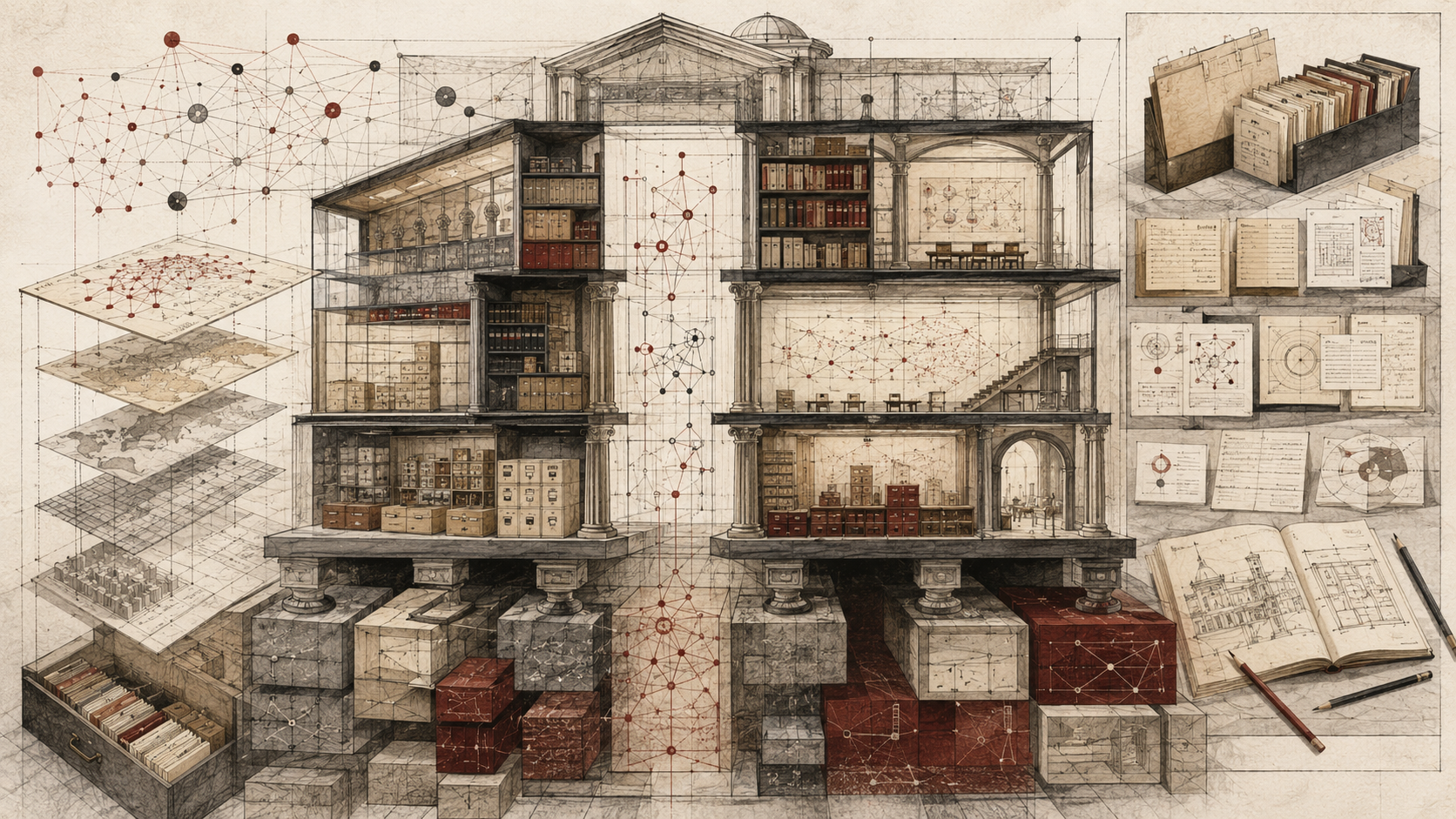
To speak of foundations is to ask what must be in place before a knowledge system can become durable. A platform can publish without foundations, but it cannot grow coherently without them. A database can store records without foundations, but it cannot explain what those records mean. A library can hold documents without foundations, but it cannot always show how one text, topic, method, or research path connects to another. Knowledge architecture provides the missing layer: the intellectual design that makes stored information usable as structured knowledge.
Why Knowledge Architecture Needs Foundations
Knowledge architecture needs foundations because knowledge systems fail in recognizable ways. A website becomes difficult to navigate. A research archive becomes hard to search. A taxonomy becomes too broad in some areas and too fragmented in others. A knowledge base accumulates duplicate topics. A digital library stores documents but loses conceptual pathways. An organization produces reports but lacks institutional memory. A scholarly platform publishes articles but cannot show how its ideas connect.
These failures are not only technical. They are architectural. They arise when a knowledge environment lacks clear categories, meaningful relationships, governed metadata, stable naming conventions, conceptual hierarchy, navigational pathways, and revision practices. The problem is not simply that users cannot find information. The deeper problem is that the system does not preserve the relationships that make information intelligible.
A knowledge system may have a powerful search function and still lack architecture. Search retrieves what a user already knows how to ask for. Architecture helps users discover what they did not yet know they needed. It makes visible the broader domain, the neighboring concepts, the levels of abstraction, the prior assumptions, the methods, the evidence base, and the pathways through which knowledge can be extended.
Knowledge architecture begins by treating knowledge as structured. It assumes that ideas do not exist as isolated fragments. They exist inside conceptual fields, interpretive traditions, disciplinary vocabularies, methods, evidence systems, institutions, and practical contexts. A strong architecture makes these relationships visible enough that readers, researchers, educators, designers, analysts, and machine systems can move through them without losing meaning.
The foundation is therefore not a folder structure alone. It is a disciplined account of how knowledge is organized, named, related, governed, and revised. Folder structures, article maps, database schemas, ontologies, metadata fields, and code repositories are implementations. The architecture is the deeper intellectual pattern that explains why those structures exist and how they support inquiry.
From Information to Intellectual Infrastructure
Information becomes useful when it can be interpreted. Interpretation becomes durable when it is supported by structure. This is why knowledge architecture should be understood as intellectual infrastructure rather than decorative organization. Infrastructure does not merely store things. It enables movement, connection, reuse, coordination, maintenance, and accountability.
In physical systems, infrastructure includes roads, bridges, grids, ports, pipes, and communication networks. In intellectual systems, infrastructure includes taxonomies, ontologies, article maps, metadata schemas, conceptual frameworks, knowledge graphs, controlled vocabularies, indexes, documentation, internal links, research repositories, and governance rules. These structures make it possible to move from one concept to another, to understand where an idea belongs, and to see how a body of knowledge can expand coherently.
A simple category list is not yet a knowledge architecture. A menu is not yet a knowledge architecture. A set of tags is not yet a knowledge architecture. These may be useful components, but architecture begins when the system explains why categories exist, how they relate, what level of abstraction they occupy, how they are maintained, and how they support future growth.
Intellectual infrastructure is most visible when it fails. Users may experience failure as confusion, repetition, poor search results, abandoned pages, unclear pathways, inconsistent terminology, or disconnected bodies of work. But beneath those symptoms are deeper structural problems: weak classification logic, missing relationships, unstable metadata, ambiguous scope boundaries, absent governance, and poor integration between conceptual design and technical implementation.
| Layer | Basic Question | Architectural Function |
|---|---|---|
| Concept | What idea is being represented? | Defines the unit of meaning. |
| Category | Where does the idea belong? | Groups related concepts into usable domains. |
| Hierarchy | What is broader or narrower? | Organizes levels of abstraction. |
| Relationship | How does one idea connect to another? | Preserves semantic, causal, disciplinary, methodological, or navigational links. |
| Metadata | What context should travel with the object? | Supports retrieval, provenance, filtering, reuse, and auditing. |
| Governance | How is the system maintained over time? | Prevents drift, duplication, inconsistency, and decay. |
These layers work together. A concept without a category may be difficult to locate. A category without relationships may become a silo. A relationship without metadata may be difficult to interpret. Metadata without governance may decay. Governance without conceptual clarity may become bureaucratic rather than architectural. Foundations matter because the system depends on the coherence of the whole stack.
The Basic Unit of Knowledge Architecture
The basic unit of knowledge architecture is not the page, file, post, database row, tag, or menu item. Those are implementation objects. The deeper unit is the concept: an idea that can be defined, related, classified, retrieved, interpreted, and reused. A concept may appear in an article, dataset, diagram, code repository, policy framework, curriculum, ontology, or institutional report, but it remains more than any single representation.
This distinction matters because many knowledge systems confuse containers with meaning. A page is a container. A document is a container. A database table is a container. A category is often a container. Knowledge architecture asks what intellectual object is being contained, what relationships it has, and what structure is needed for that object to remain meaningful across contexts.
For example, “resilience” can be a topic, a theory, a metric, a policy goal, an ecological property, a psychological construct, an engineering design principle, or a governance concern. A weak architecture treats the word as a label. A stronger architecture identifies the domains in which the concept appears, the meanings it carries, the relationships it has, and the contexts in which it should or should not be merged with adjacent ideas.
The same problem appears across many complex fields. “System” may refer to a mathematical model, an ecological network, an institution, a software platform, a social order, an infrastructure network, or a philosophical whole. “Value” may mean market price, ethical worth, measurement output, cultural meaning, public benefit, or stakeholder priority. “Knowledge” itself may mean information, justified belief, institutional memory, codified expertise, lived experience, data, interpretation, or wisdom. Knowledge architecture does not erase these differences. It designs structures capable of preserving them.
A concept-centered architecture asks a different set of questions from a content-centered architecture. It does not ask only, “Where should this page go?” It asks: What concept is this page developing? What broader domain does it belong to? What concepts does it depend on? What concepts does it support? What evidence, methods, and interpretive traditions does it draw upon? What future articles, datasets, models, or learning pathways should connect to it?
Classification, Abstraction, and Relationship
The foundations of knowledge architecture rest on three recurring acts: classification, abstraction, and relationship design. Classification asks how things are grouped. Abstraction asks what level of generality is being used. Relationship design asks how ideas connect across the system.
Classification is necessary because users need stable ways to locate and compare material. Yet classification is never neutral in a simplistic sense. It reflects intellectual decisions about similarity, difference, authority, scope, and purpose. A classification scheme can clarify a domain, but it can also obscure alternative interpretations if it becomes too rigid.
Abstraction is equally important. A knowledge architecture must distinguish broad domains from subdomains, concepts from examples, methods from applications, and theories from cases. If the abstraction level is too high, users encounter vague categories. If it is too low, they encounter fragmentation. A mature architecture manages granularity: the system remains detailed enough to be useful and broad enough to stay navigable.
Relationship design prevents knowledge from becoming a set of isolated boxes. Some relationships are hierarchical: one concept is broader than another. Some are associative: two concepts belong near each other. Some are causal, evidentiary, temporal, methodological, disciplinary, or practical. Knowledge architecture becomes powerful when these relationships are explicit enough to support navigation, synthesis, and interpretation.
KA = f(C, A, R, M, G)
\]
Interpretation: Knowledge architecture can be understood as a function of classification \(C\), abstraction \(A\), relationship design \(R\), metadata \(M\), and governance \(G\). The model is conceptual rather than predictive, but it clarifies that architecture depends on multiple interacting dimensions.
These dimensions are interdependent. Classification without abstraction becomes a flat list. Abstraction without classification becomes vague theory. Relationship design without metadata becomes difficult to audit. Metadata without governance becomes inconsistent. Governance without relationship design can maintain order while failing to support discovery. Foundations matter because they allow these dimensions to reinforce one another instead of competing for attention.
| Architectural Act | Core Design Question | Common Failure Mode |
|---|---|---|
| Classification | What belongs together, and why? | Categories become arbitrary, duplicated, or politically invisible. |
| Abstraction | What level of generality is appropriate? | Domains become too vague or too fragmented. |
| Relationship design | How should concepts connect? | Knowledge becomes siloed, underlinked, or misleadingly associated. |
| Metadata design | What context must be preserved? | Objects become hard to retrieve, evaluate, reuse, or govern. |
| Governance | How will the structure evolve? | Architecture decays as the system grows. |
Taxonomies, Ontologies, and Frameworks
Taxonomies, ontologies, and frameworks are foundational tools of knowledge architecture, but they are not interchangeable. Each organizes knowledge differently.
A taxonomy classifies. It arranges concepts into categories, subcategories, hierarchies, or controlled vocabularies. A taxonomy is useful when a system needs stable grouping, navigation, filtering, and category governance. It answers questions such as: What belongs under this topic? What is the parent category? What is the sibling category? What terms should be used consistently?
An ontology formalizes. It defines entities, properties, relationships, and constraints inside a domain. Ontologies are especially important when knowledge needs to be machine-readable, interoperable, or logically structured. They answer questions such as: What kinds of things exist in this domain? What relationships can connect them? What properties can they have? What rules govern their interpretation?
A framework interprets. It gives a structure for understanding a problem, field, process, or system. Frameworks often organize assumptions, dimensions, variables, mechanisms, and analytical pathways. They answer questions such as: How should this problem be understood? What factors matter? What relationships should guide inquiry? What model helps organize the evidence?
| Structure | Primary Purpose | Typical Use |
|---|---|---|
| Taxonomy | Classification | Categories, menus, article maps, controlled vocabularies, topic hierarchies. |
| Ontology | Formal semantic modeling | Entities, properties, relationships, constraints, linked data, machine-readable meaning. |
| Framework | Interpretive organization | Research models, analytical structures, policy frameworks, conceptual maps. |
| Knowledge graph | Networked representation | Nodes, edges, semantic relationships, entity networks, pathway discovery. |
A knowledge architecture may use all of these at once. A pillar page may present a taxonomy. A research model may use a framework. A semantic layer may depend on an ontology. A graph may connect articles, concepts, datasets, authors, methods, and policy areas. The architectural task is to make these layers work together rather than allowing them to become separate systems.
The differences matter in practice. A taxonomy may place “knowledge graphs” under “semantic structure,” but an ontology may define knowledge graphs as entities composed of nodes, edges, triples, labels, predicates, provenance records, and validation constraints. A framework may explain how knowledge graphs support research navigation, while a repository may implement the graph as data, code, and documentation. Each layer supports the others, but none replaces the others.
Foundational knowledge architecture therefore requires a plural toolkit. It should be able to classify, interpret, formalize, model, document, and govern. The right tool depends on the question. When the problem is findability, taxonomy and information architecture may matter most. When the problem is interoperability, ontology and metadata may matter most. When the problem is interdisciplinary synthesis, conceptual frameworks and knowledge graphs may matter most. When the problem is long-term coherence, governance becomes essential.
Metadata, Context, and Traceability
Metadata is often treated as a technical afterthought, but it is one of the foundations of knowledge architecture. Metadata carries context. It describes what an object is, where it belongs, who created it, when it was updated, what topics it covers, what sources it depends on, what relationships it has, and how it should be retrieved or interpreted.
Without metadata, knowledge systems become brittle. A document may exist, but its status is unclear. A dataset may be stored, but its provenance is missing. An article may be published, but its relationship to the larger series is invisible. A category may appear in navigation, but its scope is undocumented. Metadata prevents these failures by making context portable.
Traceability is especially important in research environments. Users need to know not only what a claim says, but where it came from, how it changed, what evidence supports it, and how it relates to other claims. In knowledge architecture, traceability connects metadata to governance. A structured system should make revision, provenance, and intellectual lineage easier to inspect.
MQ = c + p + r + s + v
\]
Interpretation: Metadata quality \(MQ\) improves when context \(c\), provenance \(p\), relationships \(r\), status \(s\), and versioning \(v\) are documented. This is a simplified conceptual model for thinking about metadata as interpretive infrastructure.
Metadata should not be confused with mere administrative labeling. In serious knowledge systems, metadata is a form of intellectual accountability. It can show whether a source is primary or secondary, whether a dataset is synthetic or empirical, whether an article is introductory or advanced, whether a concept belongs to one domain or bridges several, whether a model is illustrative or operational, and whether a document is current, superseded, or archival.
Traceability also matters for future machine systems. AI-assisted retrieval, semantic search, recommender systems, and automated summarization are all more reliable when underlying knowledge objects carry structured context. Poor metadata makes automated systems more likely to flatten distinctions, merge incompatible concepts, obscure provenance, or retrieve content without interpretive boundaries. Strong metadata does not solve every problem, but it gives human and machine systems better architecture to work with.
| Metadata Field | Architectural Purpose | Example Question |
|---|---|---|
| Title | Identifies the object. | What is this knowledge object called? |
| Slug or identifier | Provides stable retrieval. | How can this object be located consistently? |
| Series or domain | Places the object in a broader architecture. | What knowledge system does it belong to? |
| Status | Clarifies maturity and reliability. | Is it draft, published, revised, deprecated, or archival? |
| Relationships | Connects the object to other objects. | What does it depend on, support, extend, or critique? |
| Provenance | Preserves source and revision context. | Where did this claim, dataset, or model come from? |
Knowledge Graphs and Networked Understanding
Knowledge graphs extend the architectural imagination from categories to networks. Instead of representing knowledge only as a tree, a graph represents concepts, entities, documents, datasets, people, institutions, methods, and events as nodes connected by relationships. This allows the architecture to show cross-domain connections that a hierarchy alone may hide.
A hierarchy is useful for broad-to-narrow organization. A graph is useful for relationship-rich navigation. For example, an article on governance may connect to law, economics, ecology, ethics, data systems, and public institutions. A strict hierarchy may force the article into one place. A graph can show that it belongs to multiple interpretive pathways.
Knowledge graphs are especially important for interdisciplinary systems because they preserve plural relationships. A concept may be part of one taxonomy, related to another field, dependent on a method, supported by a dataset, and contested by a different interpretive tradition. Graph structures allow these relationships to be modeled explicitly.
G = (V, E)
\]
Interpretation: A knowledge graph \(G\) consists of nodes \(V\), representing concepts, documents, entities, or categories, and edges \(E\), representing relationships among them.
C_D(v) = \frac{deg(v)}{|V|-1}
\]
Interpretation: Degree centrality estimates how directly connected a node is within a graph. In knowledge architecture, this can help identify bridge concepts, overloaded hubs, and important navigation points.
Graph metrics do not decide meaning by themselves. A highly connected concept is not automatically more important, more accurate, or more ethically significant. But graph analysis can reveal structural patterns that human editors, researchers, and platform designers should examine.
The value of a knowledge graph depends on the quality of its nodes and relationships. A graph built from vague entities and careless edges produces a false sense of sophistication. A graph built from well-defined concepts, documented relationship types, reliable metadata, and governed vocabularies can become a powerful map of intellectual structure. The graph does not replace interpretation; it gives interpretation a structure that can be inspected.
For research platforms, knowledge graphs can support discovery, internal linking, article sequencing, prerequisite mapping, concept-gap analysis, evidence tracing, and interdisciplinary navigation. For educational systems, they can model learning pathways. For institutional knowledge systems, they can preserve connections between documents, decisions, policies, teams, and historical context. For AI-assisted systems, they can help retrieval remain grounded in structured relationships rather than loose similarity alone.
Governance and Architectural Maintenance
Knowledge architecture is not a one-time design exercise. It requires maintenance. As a knowledge system grows, categories drift, tags multiply, hierarchies become uneven, links decay, metadata becomes inconsistent, and older assumptions become outdated. Governance is the practice of keeping the architecture coherent over time.
Governance does not mean freezing the system. A rigid architecture can become just as harmful as an unstructured one. Good governance preserves coherence while allowing revision. It documents naming conventions, category rules, article-map updates, metadata requirements, ontology changes, internal-link practices, archival policies, and review cycles.
Maintenance is especially important when a knowledge platform serves multiple audiences. A researcher may need methodological precision. A student may need a learning pathway. A policymaker may need evidence organized by decision context. A general reader may need conceptual orientation. A machine system may need structured metadata. Governance keeps these needs from pulling the architecture apart.
| Architectural Risk | Typical Symptom | Governance Response |
|---|---|---|
| Category drift | Categories expand beyond their original scope. | Document scope rules and review category boundaries. |
| Tag sprawl | Duplicate or inconsistent labels multiply. | Use controlled vocabularies and naming conventions. |
| Orphaned content | Important material lacks internal links or pathways. | Audit relationships and strengthen article-map integration. |
| Hierarchy imbalance | Some domains become too deep while others remain shallow. | Review abstraction levels and reorganize where necessary. |
| Metadata decay | Status, provenance, or topical information becomes unreliable. | Maintain metadata schemas and revision logs. |
Architectural maintenance should be treated as a normal part of publishing and research infrastructure. A strong knowledge system needs periodic audits: Are categories still meaningful? Are article maps accurate? Are outdated links corrected? Are new topics integrated into the structure? Are related articles actually connected? Are definitions stable enough for reuse? Are minority perspectives, contested interpretations, and alternative traditions being preserved rather than silently excluded?
Governance is where knowledge architecture becomes ethically serious. Classification shapes visibility. Metadata shapes retrieval. Article maps shape learning pathways. Ontologies shape what a system treats as real. Search and recommendation systems shape what users encounter. A governed architecture should therefore ask not only whether the system is efficient, but whether it is transparent, accountable, revisable, and attentive to what might otherwise be hidden.
Architectural Levels of a Knowledge System
A mature knowledge architecture operates across several levels at once. The visible level is the interface: menus, article maps, search, links, headings, and user pathways. Beneath that is the editorial level: categories, topic clusters, definitions, style rules, source standards, and publication logic. Beneath that is the semantic level: concepts, entities, relationships, metadata fields, controlled vocabularies, and ontologies. Beneath that is the computational level: databases, repositories, scripts, schemas, validation tools, graph models, and reproducible workflows.
Weak architectures often treat these levels separately. Designers handle navigation. Editors handle content. Developers handle databases. Researchers handle sources. Data teams handle schemas. But knowledge architecture becomes powerful when these layers are aligned. The article map should reflect the conceptual framework. The metadata schema should support retrieval and governance. The repository should match the article structure. The code should produce outputs that support interpretation. The navigation should help users move through the intellectual model.
| Level | Primary Materials | Architectural Question |
|---|---|---|
| Interface level | Menus, links, pages, article maps, search, visual pathways. | Can users move through the system meaningfully? |
| Editorial level | Titles, categories, excerpts, references, related articles, series context. | Does published material preserve conceptual coherence? |
| Semantic level | Concepts, relationships, controlled vocabularies, ontologies, metadata. | Are meanings and relationships explicit enough to be reused? |
| Computational level | Repositories, datasets, schemas, scripts, notebooks, validation tools. | Can structure be inspected, reproduced, and maintained? |
| Governance level | Revision logs, naming conventions, review cycles, versioning, stewardship. | Can the system evolve without losing integrity? |
This layered view helps prevent a common mistake: reducing knowledge architecture to user navigation alone. Navigation is important, but it is only the visible expression of deeper order. If the underlying concepts, relationships, metadata, and governance practices are weak, navigation eventually becomes cosmetic. Users may see links and categories, but those structures will not reliably support understanding.
Mathematical and Computational Foundations
Knowledge architecture can be practiced conceptually, editorially, and institutionally, but modern knowledge systems increasingly benefit from computational support. Large article collections, research repositories, digital libraries, semantic platforms, and AI-assisted tools can be analyzed as structured systems.
Mathematics and computation help make architectural properties visible. A taxonomy can be examined for depth. A graph can be examined for centrality. A metadata system can be audited for missing fields. A concept network can be checked for orphaned nodes. A document collection can be analyzed for topic clusters. A repository can be tested for structural consistency.
These methods should support human interpretation rather than replace it. Computational models can reveal that a concept is central, a category is overloaded, or a cluster is isolated. They cannot determine by themselves whether the structure is intellectually justified. The strongest knowledge architecture joins computational visibility with editorial judgment, disciplinary understanding, ethical awareness, and governance.
Depth(c_i) = length(path(root, c_i))
\]
Interpretation: Taxonomy depth measures how far a concept sits from the root of a system. This can help evaluate navigational burden, abstraction levels, and category granularity.
KQ = \beta_1 C + \beta_2 R + \beta_3 N + \beta_4 S + \beta_5 G – \beta_6 D
\]
Interpretation: Knowledge-system quality \(KQ\) can be conceptualized as increasing with coherence \(C\), relationship clarity \(R\), navigability \(N\), semantic consistency \(S\), and governance \(G\), while decreasing with drift or fragmentation \(D\).
A computational approach can also help distinguish different kinds of architectural problems. A node with high degree centrality may be a bridge concept, but it may also be overloaded. A taxonomy with high average depth may support precision, but it may also create navigation burden. A cluster with few external links may represent a coherent specialized field, or it may represent a silo. Metrics provide signals, not conclusions.
For this reason, knowledge architecture benefits from reproducible workflows rather than isolated dashboards. Reproducible code allows the system to be audited over time. A repository can store article lists, concept tables, relationship files, taxonomy snapshots, metadata schemas, and outputs. These assets help transform knowledge architecture from informal editorial intuition into a documented practice that can be revised, tested, and extended.
Python Section: Modeling Concept Relationships
The following Python example uses a small synthetic concept network to calculate a simple degree summary. It is intentionally lightweight so the basic architectural idea remains clear: concepts can be represented as nodes, relationships can be represented as edges, and structure can be inspected rather than merely assumed.
# foundations_knowledge_architecture_graph.py
# Synthetic concept-relationship example for knowledge architecture.

from pathlib import Path
import csv

ROOT = Path(".")
DATA = ROOT / "data"
OUTPUTS = ROOT / "outputs"
OUTPUTS.mkdir(exist_ok=True)

concepts = [
    {"concept": "Knowledge Architecture", "domain": "root"},
    {"concept": "Taxonomy Design", "domain": "classification"},
    {"concept": "Ontology Modeling", "domain": "semantics"},
    {"concept": "Metadata Governance", "domain": "governance"},
    {"concept": "Knowledge Graphs", "domain": "network"},
    {"concept": "Research Frameworks", "domain": "interpretation"},
    {"concept": "Digital Knowledge Platforms", "domain": "infrastructure"},
]

relationships = [
    ("Knowledge Architecture", "Taxonomy Design", "uses"),
    ("Knowledge Architecture", "Ontology Modeling", "uses"),
    ("Knowledge Architecture", "Metadata Governance", "requires"),
    ("Ontology Modeling", "Knowledge Graphs", "supports"),
    ("Research Frameworks", "Knowledge Architecture", "inform"),
    ("Digital Knowledge Platforms", "Metadata Governance", "require"),
    ("Digital Knowledge Platforms", "Knowledge Graphs", "can_use"),
]

degree = {row["concept"]: 0 for row in concepts}

for source, target, relationship in relationships:
    degree[source] = degree.get(source, 0) + 1
    degree[target] = degree.get(target, 0) + 1

output_path = OUTPUTS / "concept_degree_summary.csv"

with output_path.open("w", newline="", encoding="utf-8") as f:
    writer = csv.writer(f)
    writer.writerow(["concept", "degree"])
    for concept, value in sorted(degree.items(), key=lambda x: x[1], reverse=True):
        writer.writerow([concept, value])

print(f"Wrote {output_path}")
This example can be extended with article metadata, internal links, taxonomy terms, ontology triples, graph centrality, semantic similarity, and repository-level audits. The point is not that every knowledge architecture must become a graph. The point is that complex intellectual systems benefit when their relationships can be inspected, documented, and revised.
A more advanced implementation could use NetworkX, RDFLib, a vector database, a relational database, or a graph database. But the foundation remains the same: define concepts, define relationships, document assumptions, generate outputs, and interpret the results through the purpose of the knowledge system.
R Section: Taxonomy Depth and Coherence
The following R example summarizes taxonomy depth and category distribution for a small synthetic knowledge architecture. It illustrates how basic measurement can support editorial and architectural review.
# foundations_knowledge_architecture_taxonomy.R
# Synthetic taxonomy diagnostics for knowledge architecture.

concepts <- data.frame(
  concept = c(
    "Knowledge Architecture",
    "Taxonomy Design",
    "Ontology Modeling",
    "Knowledge Graphs",
    "Metadata Governance",
    "Research Frameworks",
    "Digital Knowledge Platforms"
  ),
  domain = c(
    "root",
    "classification",
    "semantics",
    "network",
    "governance",
    "interpretation",
    "infrastructure"
  ),
  depth = c(0, 1, 1, 2, 2, 1, 1)
)

relationships <- data.frame(
  source = c(
    "Knowledge Architecture",
    "Knowledge Architecture",
    "Knowledge Architecture",
    "Ontology Modeling",
    "Digital Knowledge Platforms"
  ),
  target = c(
    "Taxonomy Design",
    "Ontology Modeling",
    "Metadata Governance",
    "Knowledge Graphs",
    "Metadata Governance"
  ),
  relationship = c(
    "uses",
    "uses",
    "requires",
    "supports",
    "requires"
  )
)

dir.create("outputs", showWarnings = FALSE)

depth_summary <- data.frame(
  concept_count = nrow(concepts),
  relationship_count = nrow(relationships),
  max_depth = max(concepts$depth),
  mean_depth = mean(concepts$depth),
  median_depth = median(concepts$depth)
)

domain_summary <- as.data.frame(table(concepts$domain))
names(domain_summary) <- c("domain", "concept_count")

write.csv(depth_summary, "outputs/taxonomy_depth_summary.csv", row.names = FALSE)
write.csv(domain_summary, "outputs/domain_summary.csv", row.names = FALSE)

print(depth_summary)
print(domain_summary)
In a larger system, similar workflows can be used to identify categories with excessive depth, isolated domains, uneven coverage, redundant labels, missing metadata, and underdeveloped article clusters. These diagnostics should always be interpreted in context. A deep category is not automatically bad, and a shallow category is not automatically weak. The question is whether the structure supports the purpose of the knowledge system.
R is especially useful for diagnostics, summaries, reporting, and reproducible review. A knowledge architecture workflow might import article metadata, calculate category depth, summarize topic distribution, identify missing fields, and produce tables for editorial review. This makes maintenance less dependent on memory and more dependent on documented evidence.
SQL Section: Concept and Relationship Schemas
SQL provides a simple way to formalize concepts, relationships, article records, metadata, and revision status. Even when a knowledge system eventually uses graphs or semantic web standards, relational schemas remain useful for audits, exports, validation, and stable editorial workflows.
-- foundations_knowledge_architecture_schema.sql
-- Minimal relational schema for knowledge architecture concepts.

CREATE TABLE IF NOT EXISTS concepts (
  concept_id TEXT PRIMARY KEY,
  label TEXT NOT NULL,
  domain TEXT NOT NULL,
  abstraction_level INTEGER,
  definition TEXT,
  status TEXT DEFAULT 'active'
);

CREATE TABLE IF NOT EXISTS relationships (
  relationship_id INTEGER PRIMARY KEY,
  source_concept_id TEXT NOT NULL,
  target_concept_id TEXT NOT NULL,
  relationship_type TEXT NOT NULL,
  evidence_note TEXT,
  FOREIGN KEY (source_concept_id) REFERENCES concepts(concept_id),
  FOREIGN KEY (target_concept_id) REFERENCES concepts(concept_id)
);

CREATE TABLE IF NOT EXISTS article_metadata (
  article_id TEXT PRIMARY KEY,
  title TEXT NOT NULL,
  slug TEXT NOT NULL,
  series TEXT NOT NULL,
  domain TEXT,
  status TEXT DEFAULT 'draft',
  last_reviewed DATE
);

CREATE TABLE IF NOT EXISTS article_concepts (
  article_id TEXT NOT NULL,
  concept_id TEXT NOT NULL,
  role TEXT,
  PRIMARY KEY (article_id, concept_id),
  FOREIGN KEY (article_id) REFERENCES article_metadata(article_id),
  FOREIGN KEY (concept_id) REFERENCES concepts(concept_id)
);
This schema expresses an important architectural principle: articles and concepts are not the same thing. An article may discuss many concepts, and a concept may appear across many articles. By separating article metadata from concept records and relationship tables, the system can support internal linking, article maps, knowledge graphs, taxonomy audits, and future semantic modeling.
SQL also makes governance visible. Status fields, review dates, relationship types, and concept definitions can support editorial review. A system can query for unreviewed articles, concepts without definitions, relationships without evidence notes, or article folders lacking metadata. In this way, database structure becomes part of intellectual stewardship.
GitHub Repository
This article is supported by a companion repository folder with reproducible examples, small synthetic datasets, documentation, and language-specific modeling scaffolds for knowledge-system analysis.
Complete Code Repository
This folder contains companion research and code assets for the Foundations of Knowledge Architecture article, including Python, R, Julia, SQL, Rust, Go, C++, Fortran, C, documentation, data, and generated outputs.
The repository structure is designed to mirror the article’s intellectual architecture. Python and R support concept-network analysis and taxonomy diagnostics. SQL supports concept, article, and relationship schemas. Systems-language folders provide space for lower-level graph utilities, validation tools, and performance-oriented examples. Documentation, data, and outputs preserve the connection between argument, model, evidence, and reproducible artifacts.
Knowledge Architecture and AI-Assisted Systems
AI-assisted systems make knowledge architecture more important, not less. Large language models, retrieval systems, semantic search tools, recommendation engines, and automated summarization workflows all depend on the quality of the knowledge structures beneath them. When the underlying architecture is weak, AI systems can retrieve fragments without context, merge incompatible concepts, obscure provenance, or generate confident summaries from poorly organized material.
Strong knowledge architecture improves AI-assisted work by clarifying what concepts mean, where they belong, how they relate, what sources support them, and what boundaries should be respected. Metadata helps retrieval systems filter and rank material. Taxonomies help organize scope. Ontologies help formalize relationships. Knowledge graphs help surface pathways. Governance helps prevent outdated, duplicated, or poorly structured material from becoming the substrate for automated outputs.
This does not mean that knowledge architecture should be designed only for machines. The human purpose remains central. A machine-readable ontology that humans cannot interpret is incomplete. A search system that retrieves documents without showing their conceptual context is inadequate. A generative system that summarizes without provenance is risky. The aim is not automation for its own sake, but accountable intellectual infrastructure in which human judgment and machine assistance can operate within a coherent structure.
For this reason, the future of knowledge architecture will likely depend on hybrid systems: human-defined categories, machine-assisted retrieval, governed metadata, semantic models, reproducible repositories, editorial review, and transparent update practices. The foundation remains the same: knowledge must be structured before it can be responsibly scaled.
Interpretive Cautions
Knowledge architecture can clarify complex systems, but it can also distort them if it becomes too rigid. Not every idea belongs neatly in one category. Not every knowledge tradition should be forced into the same hierarchy. Not every relationship can be captured by a graph edge. Not every form of understanding is reducible to metadata, taxonomy, or computational structure.
This caution is especially important for interdisciplinary, cultural, historical, ethical, and political knowledge. Classification systems can reproduce institutional power. Archives can preserve some voices while marginalizing others. Metadata can privilege dominant categories. Ontologies can impose assumptions that appear neutral only because they have been formalized. A serious knowledge architecture must therefore be attentive not only to structure, but to what structure makes visible or invisible.
The goal is not to eliminate ambiguity. The goal is to build systems that remain usable while preserving interpretive complexity. A strong architecture creates pathways without pretending that every pathway is final. It supports order without denying plurality. It enables retrieval without reducing knowledge to search results. It makes knowledge more navigable while remaining open to revision.
This is why knowledge architecture should include practices of critique as well as design. It should ask whose categories are being used, whose knowledge is indexed, whose terminology is treated as authoritative, whose archives are preserved, whose concepts are translated, and whose perspectives remain outside the system. Architecture can support intellectual justice only when it recognizes that structure is never merely technical.
The strongest architectures are therefore both structured and revisable. They provide enough order to support navigation, but enough humility to admit contestation. They preserve relationships without pretending that every relationship is settled. They support knowledge at scale without mistaking scale for wisdom.
Why the Foundations Matter
The foundations of knowledge architecture matter because every large knowledge system eventually becomes a test of intellectual order. It is not enough to publish more, store more, tag more, or automate more. A system must help people understand where they are, what they are seeing, how one idea relates to another, and how the whole body of knowledge can continue to grow.
Knowledge architecture provides the discipline for that work. It joins classification with interpretation, metadata with context, ontology with meaning, graph structure with conceptual movement, and governance with long-term stewardship. It gives platforms, institutions, researchers, educators, and readers a way to preserve coherence across scale.
In this sense, knowledge architecture is not merely a technical specialty. It is a practice of intellectual responsibility. It asks whether knowledge systems are navigable, transparent, durable, revisable, and capable of supporting serious inquiry. The foundation is simple: knowledge becomes more powerful when its relationships are made visible, its context is preserved, and its structure is maintained with care.
Those foundations also clarify why knowledge architecture belongs beside strategy, research, education, governance, and systems thinking. It is the discipline that allows a body of thought to become more than accumulation. It turns content into pathways, categories into frameworks, metadata into memory, repositories into evidence systems, and platforms into durable environments for inquiry.
The work is never finished. As knowledge grows, architecture must grow with it. New concepts appear. Old categories strain. Relationships change. Technologies shift. Audiences expand. Evidence develops. Governance must adapt. The foundation is not a fixed blueprint but a disciplined practice: structure, interpret, document, test, revise, and preserve meaning across scale.
Related Articles
- What Is Knowledge Architecture?
- Conceptual Frameworks in Research
- Research Frameworks and Analytical Models
- Taxonomy Design for Knowledge Systems
- Knowledge Graphs and Semantic Relationships
Further Reading
- Aitchison, J., Gilchrist, A. and Bawden, D. (2000) Thesaurus Construction and Use: A Practical Manual. 4th edn. London: Aslib.
- Allemang, D. and Hendler, J. (2011) Semantic Web for the Working Ontologist: Effective Modeling in RDFS and OWL. 2nd edn. Amsterdam: Morgan Kaufmann.
- Broughton, V. (2015) Essential Classification. 2nd edn. London: Facet Publishing.
- Lambe, P. (2007) Organising Knowledge: Taxonomies, Knowledge and Organisational Effectiveness. Oxford: Chandos Publishing.
- Morville, P. and Rosenfeld, L. (2006) Information Architecture for the World Wide Web. 3rd edn. Sebastopol, CA: O’Reilly.
- Rowley, J. and Hartley, R. (2017) Organizing Knowledge: An Introduction to Managing Access to Information. 4th edn. London: Routledge.
- Sowa, J.F. (2000) Knowledge Representation: Logical, Philosophical, and Computational Foundations. Pacific Grove, CA: Brooks/Cole.
References
- Hodge, G. (2000) Systems of Knowledge Organization for Digital Libraries: Beyond Traditional Authority Files. Washington, DC: Council on Library and Information Resources. Available at: https://www.clir.org/pubs/reports/pub91/
- International Organization for Standardization (2011) ISO 25964-1: Information and Documentation — Thesauri and Interoperability with Other Vocabularies — Part 1: Thesauri for Information Retrieval. Available at: https://www.iso.org/standard/53657.html
- International Organization for Standardization (2013) ISO 25964-2: Information and Documentation — Thesauri and Interoperability with Other Vocabularies — Part 2: Interoperability with Other Vocabularies. Available at: https://www.iso.org/standard/53658.html
- Library of Congress (n.d.) Library of Congress Subject Headings. Available at: https://www.loc.gov/aba/cataloging/subject/
- National Information Standards Organization (2010) Guidelines for the Construction, Format, and Management of Monolingual Controlled Vocabularies. Available at: https://www.niso.org/publications/ansiniso-z3919-2005-r2010
- W3C (2012) OWL 2 Web Ontology Language Document Overview. Available at: https://www.w3.org/TR/owl2-overview/
- W3C (2014) RDF 1.1 Concepts and Abstract Syntax. Available at: https://www.w3.org/TR/rdf11-concepts/
- W3C (2014) RDF Schema 1.1. Available at: https://www.w3.org/TR/rdf-schema/
- W3C (2014) SKOS Simple Knowledge Organization System Reference. Available at: https://www.w3.org/TR/skos-reference/