
Last Updated May 27, 2026
Conceptual frameworks in research organize the intellectual structure of inquiry. They clarify what a study is trying to understand, which concepts matter, how those concepts relate, what assumptions guide interpretation, and how evidence should be connected to a broader problem. A research project without a conceptual framework may still collect information, cite sources, or apply methods, but it often lacks a coherent account of what the inquiry is actually about.
A conceptual framework is not merely a diagram, outline, literature review, or theoretical name-drop. It is the architecture of a research question. It connects concepts, variables, mechanisms, assumptions, evidence, and interpretive commitments into a structured model. In strong research, the conceptual framework helps readers understand why the study is organized the way it is, why certain relationships are being examined, and how the findings should be interpreted.
Within knowledge architecture, conceptual frameworks matter because they turn scattered ideas into structured inquiry. They help a research platform, article series, policy analysis, scientific investigation, or interdisciplinary project explain how its parts fit together. They provide intellectual scaffolding: not the final answer, but the structure that makes serious inquiry possible.
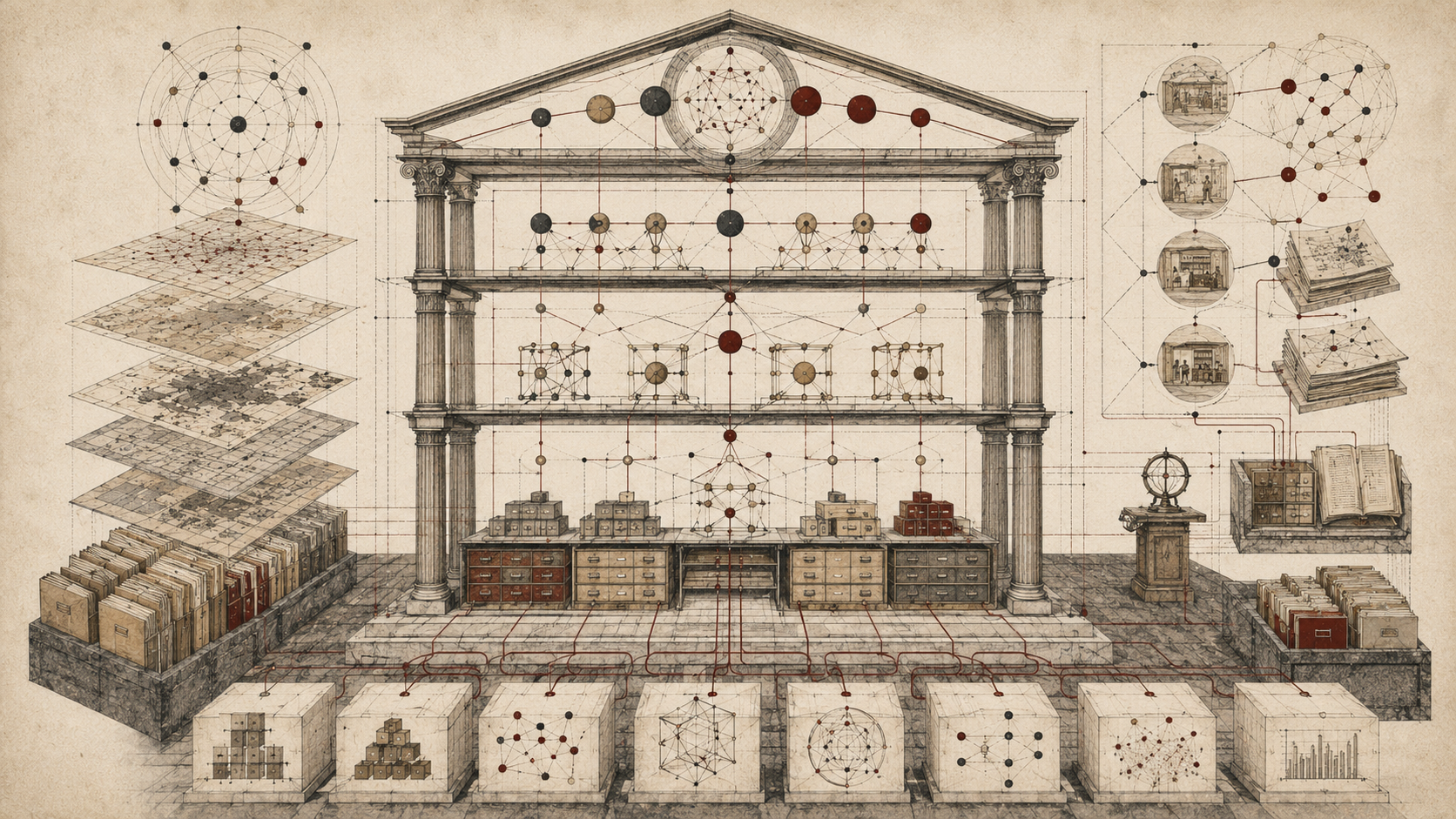
What Is a Conceptual Framework?
A conceptual framework is a structured account of the main concepts, assumptions, relationships, mechanisms, and interpretive pathways that organize a research project. It shows how a researcher understands the problem before, during, and after investigation. It can appear as prose, a diagram, a model, a table, a logic map, a causal pathway, or a set of defined relationships among concepts.
The purpose of a conceptual framework is not to decorate a study with abstract language. Its purpose is to make the structure of inquiry visible. A strong framework explains what the research is trying to understand, why certain concepts are included, how those concepts relate, what prior scholarship informs the model, and what kind of evidence could support, refine, or challenge the interpretation.
For example, a study of institutional trust might include concepts such as legitimacy, transparency, procedural fairness, public accountability, prior experience, perceived competence, information quality, and social norms. A conceptual framework would not merely list those concepts. It would explain how they are expected to relate. Does transparency strengthen legitimacy? Does procedural fairness mediate trust? Does historical exclusion shape public perception? Does information quality affect institutional credibility? The framework makes those intellectual relationships explicit.
CF = f(C, R, A, E, M)
\]
Interpretation: A conceptual framework \(CF\) can be understood as a function of concepts \(C\), relationships \(R\), assumptions \(A\), evidence \(E\), and methods \(M\). The expression is conceptual rather than predictive, but it clarifies that frameworks organize inquiry through multiple interacting elements.
In knowledge architecture, a conceptual framework functions as a middle layer between raw information and formal structure. It is more interpretive than a taxonomy, less formal than an ontology, and more intellectually directional than a simple outline. It helps transform a research problem into a navigable system of concepts and relationships.
Why Conceptual Frameworks Matter in Research
Conceptual frameworks matter because research questions do not interpret themselves. Data do not explain their own significance. Sources do not automatically form an argument. Methods do not determine meaning without a conceptual structure that explains what is being studied and why.
A conceptual framework helps prevent research from becoming a pile of observations. It gives the project an intellectual spine. It clarifies how the literature is being used, which concepts are central, which relationships are being examined, what assumptions shape the inquiry, and how findings should be interpreted. Without such a framework, even technically competent research can become unfocused.
Frameworks also support transparency. Readers should be able to see how a study moves from problem to concept, from concept to relationship, from relationship to evidence, from evidence to interpretation, and from interpretation to conclusion. A conceptual framework makes that pathway visible. It allows readers to evaluate not only the findings, but the structure of reasoning that produced them.
In interdisciplinary research, conceptual frameworks are especially important because the same term may carry different meanings across fields. “Resilience,” “risk,” “justice,” “value,” “agency,” “adaptation,” “learning,” “development,” and “governance” all shift meaning depending on disciplinary context. A framework clarifies how a study is using such concepts and how it connects them across domains.
Frameworks also help researchers avoid accidental scope creep. A research project can expand endlessly if its conceptual boundaries are unclear. A good framework explains what is included, what is excluded, what is adjacent, and what belongs outside the present inquiry. It helps a study remain open to complexity without losing coherence.
Concepts, Constructs, Variables, and Relationships
Conceptual frameworks require careful attention to the basic units of research thinking. Concepts are general ideas used to organize understanding. Constructs are more deliberately defined concepts, often used in social science, psychology, education, management, and health research. Variables are measurable or operationalized elements that can vary across cases, observations, or conditions. Relationships describe how concepts, constructs, or variables are connected.
These distinctions matter because research often fails when they are blurred. A concept may be rich, interpretive, and multidimensional. A variable may be narrower and measurable. A construct may require a validated scale, a definition, or a set of indicators. A relationship may be causal, correlational, mediating, moderating, hierarchical, temporal, or interpretive. A framework should clarify which kind of object is being used.
| Term | Research Function | Example |
|---|---|---|
| Concept | Organizes meaning at a general level. | Trust, resilience, governance, learning, vulnerability. |
| Construct | Defines a concept for analytical or empirical use. | Institutional trust measured through confidence, perceived fairness, and legitimacy. |
| Variable | Represents a measurable or coded element. | Survey score, income level, exposure category, response time, publication count. |
| Relationship | Connects concepts, constructs, or variables. | Procedural fairness increases perceived legitimacy. |
| Mechanism | Explains how or why a relationship may occur. | Transparent communication reduces uncertainty and increases trust. |
| Context | Shapes how relationships operate. | Historical exclusion, institutional capacity, legal environment, ecological setting. |
A strong conceptual framework does not simply name these elements. It defines them, relates them, and explains their role in the inquiry. It distinguishes what is central from what is peripheral, what is assumed from what is tested, what is theoretical from what is operational, and what is included from what remains outside the scope.
In knowledge architecture, this distinction supports better metadata, stronger article maps, clearer taxonomies, and more coherent research repositories. If a system knows whether an item is a concept, construct, variable, method, framework, or evidence source, it can organize knowledge more intelligently than if everything is treated as a generic topic.
Conceptual Frameworks and Theoretical Frameworks
Conceptual frameworks and theoretical frameworks are related, but they are not identical. A theoretical framework is usually anchored in one or more established theories. It uses existing theoretical traditions to guide interpretation. A conceptual framework may draw from theory, but it is often more synthetic, problem-specific, and design-oriented. It may combine several theories, empirical findings, policy categories, disciplinary concepts, and practical relationships into a model tailored to the research question.
For example, a study of organizational learning might use a theoretical framework drawn from organizational psychology, institutional theory, or systems theory. A conceptual framework might combine psychological safety, feedback loops, leadership behavior, institutional memory, incentive structures, and communication channels into a model of how learning occurs inside organizations.
| Framework Type | Main Basis | Primary Function |
|---|---|---|
| Theoretical framework | Established theory or theories. | Positions the study within a recognized explanatory tradition. |
| Conceptual framework | Concepts, relationships, assumptions, evidence, and problem structure. | Organizes the specific inquiry and clarifies how its parts connect. |
| Analytical framework | Categories, dimensions, indicators, or evaluation criteria. | Guides analysis, comparison, coding, or assessment. |
| Logic model | Inputs, activities, outputs, outcomes, and impacts. | Clarifies program theory, implementation pathways, or evaluation design. |
| Causal framework | Mechanisms, pathways, assumptions, and confounders. | Clarifies hypothesized cause-effect relationships. |
The distinction should not be treated rigidly. In practice, a strong research design may use all of these. A theoretical framework may inform the conceptual framework. A conceptual framework may generate an analytical framework. An analytical framework may guide coding or measurement. A causal framework may clarify mechanisms and evidence requirements. The important point is that each framework has a role.
Confusion arises when researchers treat “framework” as a generic label. A framework should do intellectual work. It should organize the research problem, clarify relationships, guide evidence selection, and support interpretation. If a framework does not help answer what the study is examining, how it is examining it, and why the relationships matter, it is not yet functioning as a framework.
Frameworks as Knowledge Architecture
Conceptual frameworks are a form of knowledge architecture because they structure meaning. They determine which concepts are central, how those concepts relate, what pathways guide inquiry, and how evidence enters interpretation. A framework is not merely a research accessory; it is an architecture for thinking.
Within a research platform, conceptual frameworks also help connect individual articles into a larger intellectual system. An article on taxonomy design, an article on ontologies, an article on knowledge graphs, and an article on metadata may each stand alone. But a conceptual framework can show how those articles belong together inside the broader field of knowledge architecture.
This is especially important in interdisciplinary work. Without frameworks, interdisciplinary research can become a loose collection of adjacent perspectives. With frameworks, different fields can be brought into relation while preserving their differences. A sustainability framework might connect ecological thresholds, social equity, economic systems, governance capacity, technological infrastructure, and ethical responsibility. A governance framework might connect law, institutions, legitimacy, accountability, administrative capacity, and public trust.
Frameworks are also important because they help knowledge systems avoid flatness. A flat system treats all topics as equivalent entries in a list. A framework gives the system hierarchy, relationship, direction, and interpretive structure. It shows which concepts are foundational, which are derived, which are contextual, which are operational, and which are contested.
I = g(P, C, R, E)
\]
Interpretation: Interpretation \(I\) depends on the research problem \(P\), concepts \(C\), relationships \(R\), and evidence \(E\). A conceptual framework organizes these elements so that findings can be understood in context.
For knowledge architecture, the value of frameworks is therefore structural and interpretive. They are structural because they organize elements. They are interpretive because they shape meaning. A strong knowledge system needs both.
Building a Conceptual Framework
Building a conceptual framework begins with a research problem, not with a diagram. The researcher must first clarify what needs to be understood. What is the central issue? What makes it complex? What concepts are required to explain it? What relationships appear important? What prior literature informs the inquiry? What assumptions need to be made explicit?
The next step is concept selection. A framework should include enough concepts to represent the problem, but not so many that it becomes unreadable. Concept selection requires judgment. Some concepts are central. Some are contextual. Some are mechanisms. Some are outcomes. Some are conditions. Some are indicators. A framework should distinguish among these roles.
After concept selection comes relationship design. The framework should show how the concepts connect. These relationships may be causal, conditional, temporal, reciprocal, hierarchical, evidentiary, or interpretive. A simple diagram may use arrows, but arrows are not enough. The relationship itself should be named or explained. Does one concept influence another? Does it mediate, moderate, enable, constrain, classify, operationalize, or contextualize?
The framework should then be linked to evidence and method. If a concept is included, what evidence supports it? If a relationship is proposed, how might it be studied? If a construct is central, how will it be defined or measured? If the research is qualitative, how will the framework guide interpretation without forcing the data into predetermined categories? If the research is quantitative, how will the framework inform variables, hypotheses, and model structure?
| Step | Design Question | Output |
|---|---|---|
| Define the research problem | What needs to be understood? | Problem statement and scope boundary. |
| Identify core concepts | What ideas are necessary to explain the problem? | Concept list with definitions. |
| Clarify concept roles | Which concepts are causes, mechanisms, contexts, outcomes, or indicators? | Role map or framework table. |
| Map relationships | How do the concepts connect? | Diagram, matrix, graph, or relational model. |
| Link evidence and methods | How will the framework guide inquiry? | Evidence plan, coding scheme, measurement strategy, or analytical model. |
| Revise iteratively | What changes as the research develops? | Updated framework with documented assumptions. |
A conceptual framework should remain flexible enough to be revised. Early frameworks are often provisional. They guide inquiry, but they should also learn from it. As evidence is gathered, concepts may be refined, relationships may change, and assumptions may need revision. A strong framework is stable enough to organize research and open enough to be improved by research.
Framework Design Across Disciplines
Conceptual frameworks appear across disciplines, but they differ in emphasis. In social science, frameworks often organize constructs, mechanisms, variables, and social contexts. In public policy, they may connect stakeholders, institutions, evidence, implementation pathways, and outcomes. In health research, they may organize biological, behavioral, social, and environmental determinants. In education, they may connect learning goals, instructional design, assessment, motivation, and development. In sustainability science, they may integrate ecology, economics, governance, technology, justice, and long-term resilience.
These disciplinary differences matter because frameworks carry assumptions about what counts as evidence, what counts as explanation, and what kinds of relationships matter. A framework in ecology may emphasize feedback, thresholds, and system dynamics. A framework in psychology may emphasize constructs, mechanisms, measurement, and individual differences. A framework in law may emphasize doctrines, institutions, rights, obligations, and interpretive authority. A framework in economics may emphasize incentives, constraints, tradeoffs, institutions, and distribution.
Interdisciplinary frameworks are especially demanding because they must connect concepts across fields without erasing differences. A concept such as “resilience” may mean recovery after shock in one field, adaptive capacity in another, psychological persistence in another, ecological stability in another, and infrastructure continuity in another. A serious framework must specify which meaning is being used and how other meanings are being related.
Framework design across disciplines is therefore an act of translation. It brings concepts into relation while protecting them from careless merging. It must make bridges visible, but it must also preserve boundaries. The goal is not to collapse disciplines into one vocabulary. The goal is to create an architecture in which different vocabularies can be compared, connected, and interpreted responsibly.
Visual Models, Diagrams, and Research Maps
Conceptual frameworks are often represented visually because diagrams can show relationships more quickly than prose alone. A diagram may show concepts as boxes, mechanisms as arrows, feedback loops as cycles, contexts as surrounding layers, and outcomes as downstream effects. Visual models can help researchers test whether their framework is coherent.
However, visual clarity is not the same as conceptual clarity. A clean diagram can hide weak definitions, vague relationships, or unsupported assumptions. Arrows can imply causality without evidence. Boxes can make fluid concepts appear fixed. Layers can create a false sense of hierarchy. A visual framework should therefore be accompanied by prose that explains each element and relationship.
Research maps are broader than diagrams. They may show literature clusters, conceptual domains, evidence pathways, methodological approaches, or article sequences. In knowledge architecture, research maps can support navigation across a body of work. They can show how introductory articles relate to methods articles, how conceptual articles relate to applied cases, and how repository assets support reproducible analysis.
| Representation | Strength | Risk |
|---|---|---|
| Box-and-arrow diagram | Shows hypothesized relationships clearly. | May imply causal certainty where only association or interpretation exists. |
| Matrix | Compares concepts, dimensions, cases, or evidence types. | May flatten dynamic relationships into static categories. |
| Layered model | Shows levels such as individual, institutional, system, and environment. | May overstate hierarchy or understate cross-level feedback. |
| Network map | Shows many-to-many relationships and bridge concepts. | May become visually complex without clear relationship definitions. |
| Logic model | Shows inputs, activities, outputs, outcomes, and impacts. | May oversimplify uncertainty and feedback. |
The best visual frameworks are not decorative illustrations. They are research instruments. They help clarify assumptions, expose gaps, support communication, and guide revision. A diagram should make the framework more accountable, not merely more attractive.
Frameworks, Evidence, and Methods
A conceptual framework should shape the relationship between evidence and method. If the framework proposes causal relationships, the methods should be capable of examining causality or at least carefully discussing causal limits. If the framework is interpretive, the methods should support close reading, coding, comparison, or qualitative analysis. If the framework includes measurable constructs, the methods should explain operational definitions, indicators, and validity concerns.
Frameworks help researchers decide what evidence matters. In a study of digital knowledge platforms, relevant evidence might include metadata structures, navigation pathways, article maps, repository design, user behavior, search logs, citation patterns, and governance documents. In a study of policy implementation, relevant evidence might include statutes, administrative rules, stakeholder interviews, budget data, program outputs, institutional capacity, and historical context.
A framework also helps prevent method from becoming detached from meaning. A statistical model, qualitative coding scheme, comparative case study, or simulation should not float independently from the research question. The framework explains why the method is appropriate and how its outputs should be interpreted.
The relationship between framework and method should be reciprocal. The framework guides method selection, but evidence can also challenge the framework. If the data reveal unexpected relationships, missing concepts, or inappropriate assumptions, the framework should be revised. Research frameworks are strongest when they support disciplined inquiry rather than forcing evidence into predetermined conclusions.
Q = h(F, E, M, I)
\]
Interpretation: Research quality \(Q\) depends partly on the alignment among framework \(F\), evidence \(E\), method \(M\), and interpretation \(I\). A mismatch among these elements weakens the study even when individual components appear strong.
Mathematical and Computational Modeling
Conceptual frameworks can be modeled computationally when their concepts and relationships are made explicit. A framework can be represented as a graph, a matrix, a table of concepts, a set of causal pathways, a taxonomy, an ontology, or a relational database schema. These representations do not replace conceptual judgment. They help make structure inspectable.
A framework graph can show which concepts are central, which concepts act as bridges, and which areas are underconnected. A matrix can show how concepts relate to evidence types, methods, cases, or outcomes. A taxonomy can show levels of abstraction. A database schema can distinguish concepts, articles, evidence sources, and relationships. An ontology can formalize entity types and relationship types.
G_F = (V_C, E_R)
\]
Interpretation: A conceptual framework graph \(G_F\) can be represented as concept nodes \(V_C\) and relationship edges \(E_R\). This allows the framework to be inspected as a structured network.
Coverage = \frac{|C_E|}{|C_F|}
\]
Interpretation: Framework coverage can be approximated as the share of framework concepts \(C_F\) that are supported by evidence-linked concepts \(C_E\). This simplified metric helps identify concepts that have been proposed but not yet supported by evidence or documentation.
Computational framework modeling should be used carefully. A graph can show structural relationships, but it cannot determine whether the relationships are theoretically justified. A coverage metric can identify unsupported concepts, but it cannot decide whether a concept should remain in the framework for exploratory reasons. A database schema can improve traceability, but it cannot replace interpretation. Models help researchers see the structure of their thinking; they do not remove the responsibility to think.
Python Section: Modeling a Conceptual Framework as a Directed Network
The following Python example represents a conceptual framework as a directed network of concepts and relationship types. It calculates a simple degree summary and identifies concepts that may function as central organizing nodes.
# conceptual_framework_network.py
# Lightweight conceptual-framework model without external dependencies.

from pathlib import Path
import csv

ROOT = Path(".")
OUTPUTS = ROOT / "outputs"
OUTPUTS.mkdir(exist_ok=True)

concepts = [
    {"concept": "Research Problem", "role": "starting_point"},
    {"concept": "Core Concepts", "role": "conceptual"},
    {"concept": "Assumptions", "role": "interpretive"},
    {"concept": "Relationships", "role": "structural"},
    {"concept": "Evidence", "role": "empirical"},
    {"concept": "Methods", "role": "methodological"},
    {"concept": "Interpretation", "role": "analytical"},
    {"concept": "Revision", "role": "governance"},
]

relationships = [
    ("Research Problem", "Core Concepts", "defines_scope"),
    ("Core Concepts", "Relationships", "are_connected_by"),
    ("Assumptions", "Relationships", "shape"),
    ("Relationships", "Evidence", "guide_selection_of"),
    ("Methods", "Evidence", "produce_or_analyze"),
    ("Evidence", "Interpretation", "supports"),
    ("Interpretation", "Revision", "may_require"),
    ("Revision", "Core Concepts", "refines"),
]

degree = {row["concept"]: 0 for row in concepts}

for source, target, relation in relationships:
    degree[source] = degree.get(source, 0) + 1
    degree[target] = degree.get(target, 0) + 1

with (OUTPUTS / "conceptual_framework_degree_summary.csv").open("w", newline="", encoding="utf-8") as f:
    writer = csv.writer(f)
    writer.writerow(["concept", "degree"])
    for concept, value in sorted(degree.items(), key=lambda item: item[1], reverse=True):
        writer.writerow([concept, value])

with (OUTPUTS / "conceptual_framework_edges.csv").open("w", newline="", encoding="utf-8") as f:
    writer = csv.writer(f)
    writer.writerow(["source", "target", "relationship"])
    writer.writerows(relationships)

print("Wrote framework summaries to outputs/")
This example is intentionally simple. In a larger research platform, the same idea could be extended with NetworkX, RDF, graph databases, article metadata, source records, evidence tables, and repository validation scripts. The important architectural move is to make the framework explicit enough that it can be inspected, revised, and connected to evidence.
R Section: Auditing Framework Coverage and Concept Balance
The following R example treats a conceptual framework as a table of concepts, roles, and evidence status. It summarizes how many concepts are supported by evidence, which roles are represented, and where the framework may need revision.
# conceptual_framework_audit.R
# Lightweight framework coverage and concept-balance audit.

concepts <- data.frame(
  concept = c(
    "Research Problem",
    "Core Concepts",
    "Assumptions",
    "Relationships",
    "Evidence",
    "Methods",
    "Interpretation",
    "Revision"
  ),
  role = c(
    "starting_point",
    "conceptual",
    "interpretive",
    "structural",
    "empirical",
    "methodological",
    "analytical",
    "governance"
  ),
  evidence_linked = c(TRUE, TRUE, FALSE, TRUE, TRUE, TRUE, TRUE, FALSE)
)

dir.create("outputs", showWarnings = FALSE)

role_summary <- as.data.frame(table(concepts$role))
names(role_summary) <- c("role", "concept_count")

coverage_summary <- data.frame(
  total_concepts = nrow(concepts),
  evidence_linked_concepts = sum(concepts$evidence_linked),
  coverage_rate = mean(concepts$evidence_linked)
)

unsupported_concepts <- concepts[concepts$evidence_linked == FALSE, ]

write.csv(role_summary, "outputs/framework_role_summary.csv", row.names = FALSE)
write.csv(coverage_summary, "outputs/framework_coverage_summary.csv", row.names = FALSE)
write.csv(unsupported_concepts, "outputs/framework_unsupported_concepts.csv", row.names = FALSE)

print(role_summary)
print(coverage_summary)
print(unsupported_concepts)
Framework coverage should not be interpreted mechanically. Some concepts may remain exploratory. Some assumptions may be theoretical rather than directly evidenced. Some concepts may require future research. But the audit makes the structure visible. It helps researchers distinguish between supported concepts, provisional assumptions, underdeveloped areas, and framework elements that may require revision.
SQL Section: Concept, Relationship, and Evidence Schema
SQL can support conceptual framework design by distinguishing concepts, relationships, evidence sources, and framework versions. This is useful for research platforms, systematic reviews, policy analysis, and interdisciplinary projects where frameworks evolve over time.
-- conceptual_framework_schema.sql
-- Minimal schema for concepts, relationships, evidence, and framework versions.

CREATE TABLE IF NOT EXISTS frameworks (
  framework_id TEXT PRIMARY KEY,
  title TEXT NOT NULL,
  research_problem TEXT,
  version TEXT,
  status TEXT DEFAULT 'draft',
  created_at DATE,
  updated_at DATE
);

CREATE TABLE IF NOT EXISTS concepts (
  concept_id TEXT PRIMARY KEY,
  framework_id TEXT NOT NULL,
  label TEXT NOT NULL,
  role TEXT,
  definition TEXT,
  evidence_status TEXT DEFAULT 'provisional',
  FOREIGN KEY (framework_id) REFERENCES frameworks(framework_id)
);

CREATE TABLE IF NOT EXISTS relationships (
  relationship_id INTEGER PRIMARY KEY,
  framework_id TEXT NOT NULL,
  source_concept_id TEXT NOT NULL,
  target_concept_id TEXT NOT NULL,
  relationship_type TEXT NOT NULL,
  assumption_note TEXT,
  FOREIGN KEY (framework_id) REFERENCES frameworks(framework_id),
  FOREIGN KEY (source_concept_id) REFERENCES concepts(concept_id),
  FOREIGN KEY (target_concept_id) REFERENCES concepts(concept_id)
);

CREATE TABLE IF NOT EXISTS evidence_sources (
  evidence_id TEXT PRIMARY KEY,
  citation TEXT NOT NULL,
  source_type TEXT,
  url TEXT,
  notes TEXT
);

CREATE TABLE IF NOT EXISTS concept_evidence (
  concept_id TEXT NOT NULL,
  evidence_id TEXT NOT NULL,
  evidence_role TEXT,
  PRIMARY KEY (concept_id, evidence_id),
  FOREIGN KEY (concept_id) REFERENCES concepts(concept_id),
  FOREIGN KEY (evidence_id) REFERENCES evidence_sources(evidence_id)
);
This schema reflects a central principle: frameworks should be traceable. A concept should have a definition. A relationship should have a type. An assumption should be documented. Evidence should be linked to the concept or relationship it supports. Framework versions should be preserved so that revisions can be understood rather than hidden.
In knowledge architecture, this kind of schema can support article maps, literature reviews, repository documentation, research pathways, and AI-assisted retrieval. It also helps prevent frameworks from becoming loose diagrams detached from evidence and governance.
GitHub Repository
This article is supported by a companion repository folder with reproducible examples, small synthetic datasets, documentation, and language-specific modeling scaffolds for conceptual framework analysis.
Complete Code Repository
This folder contains companion research and code assets for the Conceptual Frameworks in Research article, including Python, R, Julia, SQL, Rust, Go, C++, Fortran, C, documentation, data, and generated outputs.
The repository structure mirrors the article’s argument. Python supports framework-network modeling. R supports coverage audits and concept-balance summaries. SQL supports concepts, relationships, evidence sources, and framework versions. Systems-language folders provide space for validation utilities and graph-processing tools. Documentation, data, and outputs preserve the connection between conceptual explanation, analytical model, and reproducible artifact.
Framework Quality and Evaluation
A conceptual framework should be evaluated by how well it supports inquiry. A good framework is clear, coherent, relevant, bounded, evidence-aware, methodologically aligned, and open to revision. It should help researchers ask better questions, organize literature, design methods, interpret findings, and communicate the structure of their reasoning.
Clarity means that the framework’s concepts are defined well enough to be understood. Coherence means that the relationships among concepts make sense. Relevance means that the framework addresses the research problem rather than displaying unrelated concepts. Boundaries mean that the framework explains what is inside and outside the inquiry. Evidence awareness means that concepts and relationships are linked to sources, data, or theoretical justification. Methodological alignment means that the framework connects to the study’s methods. Revision means that the framework can be improved as inquiry develops.
| Quality Criterion | Evaluation Question | Warning Sign |
|---|---|---|
| Clarity | Are the main concepts defined? | The framework uses important terms vaguely. |
| Coherence | Do the relationships among concepts make sense? | The framework lists concepts without explaining connections. |
| Relevance | Does the framework address the research problem? | The framework includes impressive but unnecessary concepts. |
| Boundary control | Is the scope clear? | The framework expands without limit. |
| Evidence alignment | Are concepts and relationships supported? | The framework asserts relationships without sources or data. |
| Method alignment | Does the framework guide the method? | The method does not examine what the framework claims is important. |
| Revisability | Can the framework change when evidence requires it? | The framework becomes a rigid template rather than an inquiry tool. |
The strongest frameworks do not pretend to settle every question in advance. They organize inquiry while leaving room for discovery. They make assumptions visible without making them immune to revision. They guide interpretation without forcing evidence into a predetermined shape.
Interpretive Cautions and Limits
Conceptual frameworks are powerful, but they can also mislead. A framework can make a weak argument appear structured. It can impose false order on contested knowledge. It can privilege certain concepts while excluding others. It can treat relationships as fixed when they are uncertain. It can turn a living research problem into a rigid diagram.
Frameworks can also reproduce the assumptions of dominant institutions or disciplines. A policy framework may privilege administrative categories over lived experience. A development framework may reduce communities to indicators. A psychological framework may individualize problems shaped by social conditions. A technical framework may ignore power, history, and exclusion. A serious framework should therefore be transparent about its assumptions and attentive to what it leaves out.
Interdisciplinary frameworks require particular care. They should connect fields without flattening them. They should not treat all concepts as interchangeable. They should preserve differences in evidence, method, language, and interpretive tradition. A framework that makes everything fit too neatly may be hiding the very tensions the research needs to examine.
The best frameworks are structured but humble. They make inquiry possible, but they do not replace inquiry. They clarify assumptions, but they do not make assumptions true. They organize evidence, but they do not predetermine interpretation. They help researchers see more clearly, including the limits of their own model.
Why Conceptual Frameworks Belong to Knowledge Architecture
Conceptual frameworks belong to knowledge architecture because they organize the meaning of research. They define the conceptual field, map relationships, guide evidence selection, support interpretation, and make inquiry navigable. They are not merely part of research design. They are part of the infrastructure through which knowledge becomes coherent.
For a single study, a conceptual framework helps organize the research question. For a research platform, frameworks help organize entire bodies of work. They connect article maps, code repositories, datasets, metadata, taxonomies, ontologies, and knowledge graphs. They allow individual publications to become part of a cumulative system rather than isolated outputs.
This is why conceptual frameworks matter for digital knowledge systems, scholarly platforms, public knowledge projects, policy research, AI-assisted retrieval, and interdisciplinary inquiry. They help users move from information to understanding. They provide the structure that makes evidence interpretable. They show how concepts relate across scale.
At their best, conceptual frameworks are acts of intellectual responsibility. They make the researcher’s structure of thought visible. They allow others to examine, challenge, revise, and extend that structure. In this sense, they are not just tools for organizing research. They are tools for making knowledge more transparent, navigable, and accountable.
Related Articles
- Foundations of Knowledge Architecture
- What Is Knowledge Architecture?
- Research Frameworks and Analytical Models
- Taxonomy Design for Knowledge Systems
- Knowledge Mapping and Conceptual Models
- Framework Design in Policy Research
Further Reading
- Maxwell, J.A. (2013) Qualitative Research Design: An Interactive Approach. 3rd edn. Thousand Oaks, CA: SAGE.
- Miles, M.B., Huberman, A.M. and Saldaña, J. (2014) Qualitative Data Analysis: A Methods Sourcebook. 3rd edn. Thousand Oaks, CA: SAGE.
- Ravitch, S.M. and Riggan, M. (2017) Reason & Rigor: How Conceptual Frameworks Guide Research. 2nd edn. Thousand Oaks, CA: SAGE.
- Rocco, T.S. and Plakhotnik, M.S. (2009) ‘Literature Reviews, Conceptual Frameworks, and Theoretical Frameworks: Terms, Functions, and Distinctions’, Human Resource Development Review, 8(1), pp. 120–130.
- Saldaña, J. (2021) The Coding Manual for Qualitative Researchers. 4th edn. Thousand Oaks, CA: SAGE.
- Vaughan, D. (1992) ‘Theory Elaboration: The Heuristics of Case Analysis’, in Ragin, C.C. and Becker, H.S. (eds.) What Is a Case? Exploring the Foundations of Social Inquiry. Cambridge: Cambridge University Press.
References
- Jabareen, Y. (2009) ‘Building a Conceptual Framework: Philosophy, Definitions, and Procedure’, International Journal of Qualitative Methods, 8(4), pp. 49–62. Available at: https://journals.sagepub.com/doi/10.1177/160940690900800406
- Maxwell, J.A. (2013) Qualitative Research Design: An Interactive Approach. 3rd edn. Thousand Oaks, CA: SAGE.
- Miles, M.B., Huberman, A.M. and Saldaña, J. (2014) Qualitative Data Analysis: A Methods Sourcebook. 3rd edn. Thousand Oaks, CA: SAGE.
- Ravitch, S.M. and Riggan, M. (2017) Reason & Rigor: How Conceptual Frameworks Guide Research. 2nd edn. Thousand Oaks, CA: SAGE.
- Rocco, T.S. and Plakhotnik, M.S. (2009) ‘Literature Reviews, Conceptual Frameworks, and Theoretical Frameworks: Terms, Functions, and Distinctions’, Human Resource Development Review, 8(1), pp. 120–130. Available at: https://journals.sagepub.com/doi/10.1177/1534484309332617
- W3C (2014) RDF 1.1 Concepts and Abstract Syntax. Available at: https://www.w3.org/TR/rdf11-concepts/
- W3C (2014) SKOS Simple Knowledge Organization System Reference. Available at: https://www.w3.org/TR/skos-reference/