
Last Updated May 28, 2026
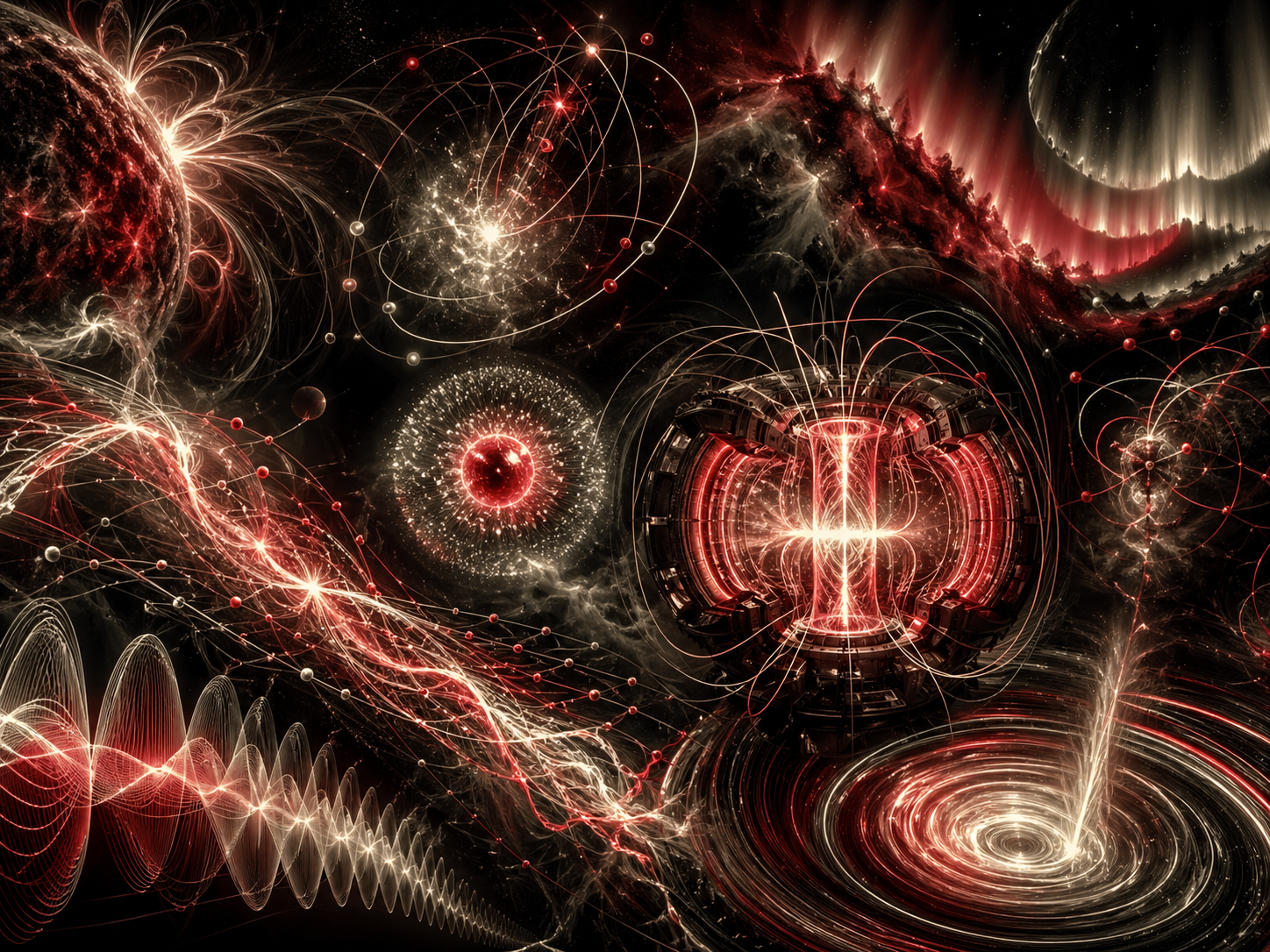
Plasma physics studies ionized matter whose charged particles move collectively under electric and magnetic fields, creating waves, shielding, currents, instabilities, turbulence, confinement behavior, radiation, and nonlinear dynamics that do not appear in ordinary neutral gases. Plasma is often called the fourth state of matter because it differs from solids, liquids, and neutral gases in a fundamental way: some fraction of its atoms or molecules has been ionized, producing free electrons and ions. These charged particles interact through long-range electromagnetic forces, so the behavior of the whole system cannot be understood by following isolated particles alone.
Plasma is not rare in the universe. Stars, solar wind, nebulae, magnetospheres, ionospheres, auroras, lightning, fusion experiments, electric discharges, semiconductor-processing plasmas, plasma thrusters, fluorescent lamps, and high-energy-density laboratory systems all involve ionized matter. Some plasmas are extremely hot, such as those in stellar cores and fusion devices. Others are relatively cool in their neutral-gas temperature but electronically active, such as many low-temperature industrial plasmas. What unites them is not temperature alone, but collective electromagnetic behavior.
This article develops Plasma Physics and the Fourth State of Matter as a research-grade introduction within the Physics knowledge series. It explains ionization, quasi-neutrality, Debye shielding, plasma frequency, collective oscillation, charged-particle motion in magnetic fields, gyrofrequency, gyroradius, drifts, fluid plasma models, kinetic plasma models, magnetohydrodynamics, plasma waves, Alfvén waves, Langmuir waves, instabilities, turbulence, magnetic confinement, inertial confinement, fusion plasmas, space plasmas, astrophysical plasmas, low-temperature plasmas, plasma diagnostics, and computational plasma modeling. Selected R and Python workflows appear here, while the full GitHub repository contains expanded computational resources for Debye length, plasma frequency, gyrofrequency, gyroradius, plasma beta, magnetic confinement scales, particle orbits, drift motion, MHD diagnostics, uncertainty propagation, SQL metadata, C/C++/Fortran/Rust examples, and reproducible plasma-physics workflows.
Main Library
Publications
Article Map
Physics
Related Topic
Mathematics
Related Topic
Data Systems & Analytics
Related Topic
Astronomy
Why Plasma Physics Matters
Plasma physics matters because much of the visible universe is plasma and many of the most important technological frontiers depend on controlling ionized matter. Stars are plasmas. Solar wind is plasma. Earth’s magnetosphere and ionosphere are plasma environments. Fusion energy research seeks to confine or compress plasma at extreme conditions. Semiconductor fabrication uses low-temperature plasmas for etching, deposition, and surface modification. Plasma thrusters propel spacecraft. Lightning, auroras, arcs, and discharges are plasma phenomena. High-energy-density plasma experiments help study matter under extreme pressure and temperature.
Plasma physics also matters because it is one of the richest examples of collective behavior. A neutral gas can often be modeled through collisions among atoms and molecules. A plasma contains charged particles that interact through electric and magnetic fields over long ranges. A local charge imbalance can generate fields. Fields can accelerate particles. Moving particles generate currents. Currents modify magnetic fields. Magnetic fields guide particle motion. The resulting system supports oscillations, waves, shocks, reconnection, turbulence, instabilities, and self-organized structures.
The field therefore bridges many parts of physics: electromagnetism, statistical mechanics, fluid dynamics, kinetic theory, thermodynamics, quantum processes, radiation, nonlinear dynamics, computational simulation, and astrophysics. It is also a field where scale matters. The same fundamental principles help explain laboratory discharges measured in centimeters, fusion devices measured in meters, magnetospheres measured in planetary radii, and astrophysical plasmas spanning enormous cosmic distances.
For the Physics knowledge series, plasma physics is a natural continuation of Electromagnetism and the Unification of Fields, Fluid Dynamics and the Physics of Flow, Statistical Physics and the Emergence of Macroscopic Order, Nonlinear Dynamics, Chaos, and Complex Physical Systems, and Computational Physics and Scientific Simulation. It shows how matter and fields become inseparable in ionized systems.
What Makes Plasma Different?
A plasma is often described as an ionized gas, but that phrase can be misleading if it suggests that plasma is merely a gas with some charged particles added. A plasma is defined by collective electromagnetic behavior. If charged particles are present but too few, too collision-dominated, or too strongly bounded by the system size to behave collectively, the system may not exhibit plasma behavior in the useful physical sense.
Several criteria are commonly used to identify plasma behavior. The system size \(L\) should be much larger than the Debye length \(\lambda_D\):
L \gg \lambda_D
\]
Interpretation: A plasma system must usually be much larger than its electrostatic shielding length.
The number of particles inside a Debye sphere should be much greater than one:
N_D \gg 1
\]
Interpretation: Debye shielding should involve many particles so that shielding is collective rather than a small-number effect.
Collective electromagnetic response should also dominate over ordinary collisional damping on the relevant time scale. A common way to express this is that the plasma frequency should exceed the relevant collision frequency:
\omega_p \gg \nu_{\mathrm{coll}}
\]
Interpretation: Collective plasma oscillations should occur faster than collisional damping on the scale of interest.
These criteria are not decorative. They identify whether the system can shield electric fields, support collective oscillations, and behave as a plasma rather than a dilute collection of unrelated charged particles.
Plasma also differs from ordinary matter because it is highly responsive to electromagnetic fields. Electric fields accelerate charged particles. Magnetic fields bend their trajectories. Charge separation creates fields. Currents generate magnetic structure. Plasma behavior is therefore strongly nonlinear: fields shape particles, and particles reshape fields.
Ionization and Quasi-Neutrality
Ionization occurs when electrons are removed from atoms or molecules, producing ions and free electrons. A simple singly ionized plasma contains ions with charge \(+e\) and electrons with charge \(-e\). More complex plasmas may contain multiply charged ions, negative ions, dust grains, neutral particles, molecules, radicals, and radiation fields.
Although plasma contains charged particles, many plasmas are approximately quasi-neutral over length scales larger than the Debye length. Quasi-neutrality means that positive and negative charge densities nearly balance:
n_e \approx Z n_i
\]
Interpretation: Electron density approximately balances ion charge density in the plasma bulk.
where \(n_e\) is electron density, \(n_i\) is ion density, and \(Z\) is ion charge state. This does not mean there are no electric fields. It means that large-scale charge separation is energetically costly and tends to be shielded by particle motion.
Small deviations from neutrality are often dynamically important. They generate electric fields that restore balance, drive waves, accelerate particles, and shape sheaths near boundaries. Plasma is therefore nearly neutral in bulk, but not electrically inert.
Ionization fraction also matters. A fully ionized plasma contains almost no neutral particles. A weakly ionized plasma may contain many neutrals and relatively few charged particles. Low-temperature industrial plasmas are often weakly ionized, yet still extremely useful because electrons can be energetic enough to drive chemistry while the neutral gas remains comparatively cool.
Debye Shielding
Debye shielding is one of the defining properties of plasma. If a test charge is introduced into a plasma, electrons and ions rearrange themselves to reduce the electric potential produced by that charge. The shielding distance is the Debye length:
\lambda_D
=
\sqrt{
\frac{\epsilon_0 k_B T_e}{n_e e^2}
}
\]
Interpretation: Debye length is the characteristic scale over which a plasma shields electrostatic potentials.
where \(\epsilon_0\) is vacuum permittivity, \(k_B\) is Boltzmann’s constant, \(T_e\) is electron temperature, \(n_e\) is electron number density, and \(e\) is the elementary charge.
The electrostatic potential around a test charge is no longer the unscreened Coulomb potential alone. In a simple linearized treatment, the screened potential has the form:
\Phi(r)
\propto
\frac{1}{r}
\exp\left(-\frac{r}{\lambda_D}\right)
\]
Interpretation: Debye shielding modifies the Coulomb potential by exponentially suppressing it beyond the Debye length.
This exponential factor shows that the influence of a charge is reduced over distances larger than \(\lambda_D\). Debye shielding is why plasma can remain quasi-neutral over macroscopic scales while still allowing local charge separation over small scales.
The Debye length decreases when density increases and increases when electron temperature rises. Dense, cool plasmas shield over short distances. Hot, diffuse plasmas shield over longer distances. A meaningful plasma normally contains many particles inside a Debye sphere:
N_D
=
\frac{4\pi}{3}n_e\lambda_D^3
\gg 1
\]
Interpretation: A large Debye number means shielding involves many particles and can be treated statistically.
This ensures that shielding is a collective effect involving many particles, not a small-number fluctuation.
Plasma Frequency and Collective Oscillation
The plasma frequency is the natural oscillation frequency of electrons displaced relative to ions. If electrons are shifted slightly from the ion background, electrostatic forces pull them back, producing collective oscillation. The electron plasma angular frequency is:
\omega_{pe}
=
\sqrt{
\frac{n_e e^2}{\epsilon_0 m_e}
}
\]
Interpretation: Electron plasma frequency is the natural angular frequency of collective electron oscillation against the ion background.
where \(m_e\) is electron mass. The corresponding frequency is:
f_{pe}
=
\frac{\omega_{pe}}{2\pi}
\]
Interpretation: Ordinary plasma frequency in hertz is angular plasma frequency divided by \(2\pi\).
Plasma frequency is central because it marks a natural time scale for charge response. Electromagnetic waves with frequencies below the plasma frequency may be reflected or strongly modified in an unmagnetized plasma, while waves above it can propagate more readily, depending on conditions.
Ion plasma frequency is analogous but usually lower because ions are much heavier:
\omega_{pi}
=
\sqrt{
\frac{Z^2 n_i e^2}{\epsilon_0 m_i}
}
\]
Interpretation: Ion plasma frequency is lower than electron plasma frequency for comparable densities because ions are much heavier.
Plasma oscillations show that plasma is not merely a set of independent particles. It has collective normal modes. These collective modes are foundational for radio propagation, space plasma diagnostics, fusion heating, laser-plasma interaction, and plasma-wave instabilities.
Charged-Particle Motion in Magnetic Fields
Charged particles moving in electromagnetic fields obey the Lorentz force law:
m\frac{d\mathbf{v}}{dt}
=
q
\left(
\mathbf{E}
+
\mathbf{v}\times\mathbf{B}
\right)
\]
Interpretation: The Lorentz force law gives acceleration from electric and magnetic fields acting on a charged particle.
where \(q\) is particle charge, \(m\) is mass, \(\mathbf{v}\) is velocity, \(\mathbf{E}\) is electric field, and \(\mathbf{B}\) is magnetic field.
In a uniform magnetic field with no electric field, the component of velocity parallel to \(\mathbf{B}\) remains unchanged, while the perpendicular component rotates around the magnetic field line. The result is helical motion. The angular gyrofrequency is:
\Omega_c
=
\frac{|q|B}{m}
\]
Interpretation: Gyrofrequency is the angular frequency of charged-particle rotation around a magnetic field line.
The sign of charge determines the direction of rotation. Electrons and ions gyrate in opposite senses, and because electrons are much lighter, electron gyrofrequencies are much larger than ion gyrofrequencies at the same magnetic field.
This simple helical motion is the basis of magnetic confinement. A magnetic field can restrict cross-field motion by forcing charged particles into tight gyro-orbits. But confinement is never perfect. Gradients, curvature, collisions, turbulence, electric fields, and instabilities can all produce transport across magnetic fields.
Gyroradius, Gyrofrequency, and Magnetic Moment
The gyroradius, or Larmor radius, is the radius of circular motion perpendicular to a magnetic field:
r_L
=
\frac{m v_\perp}{|q|B}
\]
Interpretation: Larmor radius gives the size of a charged particle’s gyro-orbit around a magnetic field line.
where \(v_\perp\) is the velocity perpendicular to the magnetic field. A smaller gyroradius means tighter magnetic control. Stronger magnetic fields reduce gyroradius. Higher perpendicular particle energy increases it.
The cyclotron frequency is:
f_c
=
\frac{\Omega_c}{2\pi}
=
\frac{|q|B}{2\pi m}
\]
Interpretation: Cyclotron frequency is the gyrofrequency expressed in cycles per second.
Magnetized plasma behavior depends on whether particle gyroradii are small compared with system scales. If:
r_L \ll L
\]
Interpretation: Small gyroradius relative to system scale indicates strong magnetization.
then particles are strongly tied to magnetic-field geometry on the scale \(L\). If gyroradii are comparable to system size, magnetic confinement or magnetized-fluid approximations may fail.
For slowly varying magnetic fields, the magnetic moment is an adiabatic invariant:
\mu
=
\frac{m v_\perp^2}{2B}
\]
Interpretation: Magnetic moment is approximately conserved when magnetic fields vary slowly compared with gyro-motion.
This invariant helps explain mirror motion, magnetic bottles, trapped particles in planetary magnetospheres, and certain confinement concepts. It also shows how single-particle dynamics can produce large-scale plasma behavior.
Plasma Drifts
Charged particles in magnetic fields often drift across field lines when additional forces are present. One of the most important drifts is the \(\mathbf{E}\times\mathbf{B}\) drift:
\mathbf{v}_{E}
=
\frac{\mathbf{E}\times\mathbf{B}}{B^2}
\]
Interpretation: The \(\mathbf{E}\times\mathbf{B}\) drift moves charged particles perpendicular to both electric and magnetic fields.
This drift is independent of particle charge and mass, so electrons and ions drift together. It therefore moves plasma without directly creating large charge separation.
Magnetic-field gradients produce gradient-\(B\) drift. Curved magnetic fields produce curvature drift. Gravitational, inertial, pressure-gradient, and polarization drifts can also matter depending on the system. In confined fusion plasmas, drifts influence transport, orbit confinement, neoclassical effects, and instability behavior. In space plasmas, drifts shape radiation belts, magnetospheric currents, and particle distributions.
Drifts show why magnetic confinement is subtle. A charged particle may gyrate tightly around a magnetic field line, but its guiding center can still move. Plasma confinement depends on controlling not just gyration but the drift and collective behavior of many particles.
Fluid Models of Plasma
Fluid plasma models treat plasma species as continuous fluids with density, velocity, pressure, and temperature. Separate electron and ion fluids can be modeled with continuity, momentum, and energy equations. A simple continuity equation is:
\frac{\partial n_s}{\partial t}
+
\nabla\cdot(n_s\mathbf{u}_s)
=
S_s
\]
Interpretation: The continuity equation tracks density change through flow divergence and sources or losses.
where \(n_s\) is density of species \(s\), \(\mathbf{u}_s\) is fluid velocity, and \(S_s\) represents sources and losses.
A simplified momentum equation is:
m_s n_s
\left(
\frac{\partial \mathbf{u}_s}{\partial t}
+
\mathbf{u}_s\cdot\nabla\mathbf{u}_s
\right)
=
q_s n_s
(\mathbf{E}+\mathbf{u}_s\times\mathbf{B})
–
\nabla p_s
+
\mathbf{R}_s
\]
Interpretation: Plasma momentum balance includes electromagnetic force, pressure gradients, and collisional momentum exchange.
where \(p_s\) is pressure and \(\mathbf{R}_s\) represents collisions or momentum exchange.
Fluid models are powerful because they reduce enormous particle populations to field variables. They are widely used for plasma waves, magnetohydrodynamics, transport, shocks, fusion confinement, and low-temperature plasma systems. Their limitation is that they may miss kinetic effects such as velocity-space anisotropy, Landau damping, particle trapping, non-Maxwellian distributions, and collisionless processes.
Kinetic Models of Plasma
Kinetic models describe plasma through distribution functions in phase space. A distribution function \(f_s(\mathbf{x},\mathbf{v},t)\) gives the density of particles of species \(s\) near position \(\mathbf{x}\) and velocity \(\mathbf{v}\) at time \(t\).
In a collisionless plasma, the Vlasov equation is:
\frac{\partial f_s}{\partial t}
+
\mathbf{v}\cdot\nabla_{\mathbf{x}}f_s
+
\frac{q_s}{m_s}
(\mathbf{E}+\mathbf{v}\times\mathbf{B})
\cdot
\nabla_{\mathbf{v}}f_s
=
0
\]
Interpretation: The Vlasov equation describes collisionless evolution of a plasma distribution function in phase space.
Fields are determined self-consistently through Maxwell’s equations. A kinetic model therefore tracks how particles move in phase space while fields evolve from charge and current distributions.
Kinetic effects are essential when collisions are rare or when velocity distributions are not close to Maxwellian equilibrium. Landau damping, beams, two-stream instability, collisionless shocks, wave-particle resonance, runaway electrons, and many space-plasma phenomena require kinetic treatment.
Kinetic models are computationally demanding because phase space is high-dimensional. Particle-in-cell methods approximate the distribution using computational particles. Continuum Vlasov solvers discretize phase space directly. Hybrid models treat ions kinetically and electrons as a fluid, or use other approximations depending on scale.
Magnetohydrodynamics
Magnetohydrodynamics, or MHD, treats plasma as an electrically conducting fluid coupled to magnetic fields. It is especially useful when the plasma is sufficiently collisional or magnetized that fluid approximations are appropriate at large scales.
A simplified MHD momentum equation is:
\rho
\left(
\frac{\partial \mathbf{u}}{\partial t}
+
\mathbf{u}\cdot\nabla\mathbf{u}
\right)
=
-\nabla p
+
\mathbf{J}\times\mathbf{B}
\]
Interpretation: MHD momentum balance combines fluid inertia, pressure gradients, and magnetic Lorentz force.
where \(\rho\) is mass density, \(\mathbf{u}\) is fluid velocity, \(p\) is pressure, \(\mathbf{J}\) is current density, and \(\mathbf{B}\) is magnetic field.
The magnetic field evolves through an induction equation. In ideal MHD, magnetic field lines are often described as “frozen” into the plasma flow. This is an approximation, but it is powerful for understanding large-scale plasma behavior in stars, solar wind, fusion devices, and astrophysical systems.
MHD introduces important quantities such as plasma beta:
\beta
=
\frac{p_{\mathrm{plasma}}}{p_{\mathrm{magnetic}}}
=
\frac{2\mu_0 p}{B^2}
\]
Interpretation: Plasma beta compares plasma pressure with magnetic pressure.
where \(p_{\mathrm{magnetic}}=B^2/(2\mu_0)\). Low-\(\beta\) plasmas are strongly magnetically dominated. High-\(\beta\) plasmas have plasma pressure comparable to or larger than magnetic pressure. Plasma beta is central to fusion confinement, solar physics, and space plasma dynamics.
Plasma Waves
Plasmas support many wave modes because particles and fields are coupled. Langmuir waves are high-frequency electron plasma oscillations. Ion acoustic waves involve ion motion and electron pressure. Alfvén waves propagate along magnetic fields through the restoring force of magnetic tension. Magnetosonic waves combine magnetic and compressional effects.
A simple electron plasma oscillation has frequency near:
\omega \approx \omega_{pe}
\]
Interpretation: Langmuir waves occur near the electron plasma frequency in simple limits.
An Alfvén wave has characteristic speed:
v_A
=
\frac{B}{\sqrt{\mu_0 \rho}}
\]
Interpretation: Alfvén speed measures the propagation speed of magnetic-tension disturbances in a conducting plasma.
where \(\rho\) is mass density. This speed is central in magnetized plasma because it describes how magnetic tension and plasma inertia interact.
Plasma waves can transport energy and momentum, heat particles, scatter distributions, create instabilities, and communicate disturbances across a system. They are used in fusion heating, plasma diagnostics, space plasma interpretation, radio propagation, and laboratory plasma control.
Wave-particle interaction is especially important. Particles moving at resonant velocities can exchange energy with waves. This can damp waves, drive instabilities, accelerate particles, or modify distribution functions. In plasma, waves are not merely disturbances; they are active channels of energy exchange.
Instabilities and Turbulence
Plasma instabilities occur when free energy in gradients, flows, currents, beams, anisotropies, or magnetic geometry drives the growth of perturbations. A small disturbance can grow if it extracts energy from the plasma configuration.
Examples include two-stream instability, drift waves, interchange instability, Kelvin–Helmholtz instability, tearing modes, kink modes, ballooning modes, firehose instability, mirror instability, and many others. Some instabilities are fluid-like; others are kinetic. Some are harmful in confinement devices; others are essential to natural plasma dynamics.
Turbulence is widespread in plasma systems. It can enhance transport, scatter particles, cascade energy across scales, and generate intermittent structures. In fusion plasmas, turbulence can move heat and particles across magnetic surfaces, reducing confinement. In space plasmas, turbulence shapes solar wind spectra, particle heating, and energy dissipation. In astrophysical plasmas, turbulence contributes to magnetic-field amplification, accretion behavior, and cosmic-ray transport.
Plasma turbulence is difficult because it combines nonlinear fluid motion, electromagnetic fields, kinetic effects, anisotropy, and multiscale coupling. This is why plasma physics is deeply computational.
Fusion Plasmas and Confinement
Fusion occurs when light nuclei combine to form heavier nuclei, releasing energy when the final nuclear configuration is more tightly bound. Fusion energy research seeks to create conditions in which fusion reactions occur at useful rates in a controlled plasma.
For deuterium-tritium fusion:
D + T
\rightarrow
{}^4He + n + 17.6\ \mathrm{MeV}
\]
Interpretation: Deuterium-tritium fusion produces helium, a neutron, and 17.6 MeV of released energy.
Achieving fusion requires high temperature, sufficient density, and adequate confinement time. A simplified way to express the challenge is through the triple product:
nT\tau_E
\]
Interpretation: The fusion triple product summarizes density, temperature, and energy confinement time.
where \(n\) is density, \(T\) is temperature, and \(\tau_E\) is energy confinement time. The required values depend on fuel, confinement concept, losses, and engineering constraints.
Magnetic confinement uses strong magnetic fields to keep plasma away from material walls. Tokamaks and stellarators are major magnetic-confinement concepts. Inertial confinement uses rapid compression and heating so fusion occurs before the fuel disassembles. Other approaches explore magnetized target fusion, field-reversed configurations, z-pinches, mirrors, and alternative configurations.
Fusion plasma physics is difficult because the plasma must be hot enough for fusion, confined long enough for energy gain, stable enough to avoid disruptive instabilities, and compatible with material boundaries that cannot directly tolerate the hottest plasma. Heating, fueling, impurity control, turbulence, alpha-particle confinement, plasma-wall interaction, and exhaust all matter.
Space and Astrophysical Plasmas
Space and astrophysical plasmas include the solar corona, solar wind, planetary magnetospheres, ionospheres, auroras, interstellar medium, accretion disks, jets, supernova remnants, nebulae, and galaxy-cluster plasmas. These systems are often collisionless or weakly collisional, magnetized, turbulent, and strongly multiscale.
The solar wind is a plasma flowing outward from the Sun. It interacts with planetary magnetic fields, producing bow shocks, magnetopauses, radiation belts, auroras, and geomagnetic storms. Earth’s magnetosphere is a natural plasma laboratory where particles, fields, waves, and currents interact across vast scales.
Astrophysical plasmas often involve extreme conditions not easily reproduced on Earth: enormous magnetic fields, relativistic particles, high-energy radiation, strong shocks, gravitational collapse, and cosmic-scale turbulence. Yet the same core ideas appear: Debye shielding, collective waves, magnetized motion, reconnection, instabilities, turbulence, and radiation.
Space plasma physics therefore expands plasma physics beyond laboratory devices. It shows how ionized matter shapes planetary environments, stellar activity, cosmic structure, and high-energy astrophysical phenomena.
Low-Temperature and Industrial Plasmas
Not all plasmas are fusion-hot. Low-temperature plasmas can have energetic electrons while ions and neutral gas remain much cooler. This nonequilibrium structure is extremely useful. Energetic electrons can ionize, dissociate, excite, and activate chemical species without heating the whole gas to extreme temperatures.
Industrial plasmas are used in semiconductor etching, thin-film deposition, surface modification, sterilization, lighting, materials processing, combustion assistance, environmental remediation, and plasma medicine. In semiconductor fabrication, plasma etching and deposition are central to nanoscale pattern transfer and materials engineering.
Low-temperature plasma physics involves electron energy distributions, ionization, recombination, sheaths, surface charging, secondary electron emission, plasma chemistry, radio-frequency power coupling, and boundary interaction. These systems are often partially ionized, chemically complex, and strongly influenced by surfaces.
This makes low-temperature plasma physics a bridge between fundamental plasma science and manufacturing. It connects charged-particle kinetics, electromagnetics, gas chemistry, materials science, and process control.
Plasma Diagnostics and Measurement
Plasma diagnostics measure quantities such as density, temperature, electric fields, magnetic fields, flow velocity, impurity content, radiation, fluctuations, wave spectra, and particle distributions. Because plasma can be hot, reactive, tenuous, fast, or inaccessible, diagnostics are often indirect.
Common diagnostics include Langmuir probes, magnetic probes, microwave interferometry, Thomson scattering, spectroscopy, bolometry, reflectometry, laser-induced fluorescence, charge-exchange recombination spectroscopy, visible imaging, x-ray diagnostics, neutron diagnostics, and particle analyzers. Each diagnostic has assumptions and limitations.
For example, a Langmuir probe can estimate electron temperature and density in some low-temperature plasmas, but it may perturb the plasma and becomes difficult in very hot or magnetized conditions. Spectroscopy can infer composition, temperature, flow, and excitation, but interpretation depends on atomic physics and radiative models. Magnetic diagnostics can infer currents and instabilities, but reconstruction may require inverse modeling.
Plasma measurement is therefore model-dependent. The diagnostic signal is not automatically the plasma property itself. It must be interpreted through calibration, geometry, response functions, uncertainty, and physical assumptions.
Measurement, Units, and SI Interpretation
Plasma physics uses SI units, electronvolts, and sometimes cgs-derived traditions. Density is commonly expressed in \(\mathrm{m^{-3}}\) or \(\mathrm{cm^{-3}}\). Temperature is often expressed in electronvolts, especially for electrons and ions. The conversion between electronvolts and kelvin is based on:
k_B T = E
\]
Interpretation: Temperature expressed as energy per particle uses \(k_BT\) as the thermal-energy scale.
so a temperature of \(1\ \mathrm{eV}\) corresponds to approximately:
T \approx 11604\ \mathrm{K}
\]
Interpretation: One electronvolt of thermal energy corresponds to roughly 11,604 kelvin.
Magnetic field is measured in tesla. Electric field is measured in volts per meter. Plasma frequency is measured in radians per second or hertz. Debye length, gyroradius, inertial length, and mean free path are lengths. Pressure is measured in pascals, though plasma pressure is often computed from density and temperature:
p = n k_B T
\]
Interpretation: Ideal plasma pressure is density multiplied by thermal energy per particle.
When temperature is expressed in electronvolts, pressure can be written using energy per particle converted to joules:
p = n T_{\mathrm{eV}} e
\]
Interpretation: Electronvolt temperature must be converted to joules per particle when computing pressure in pascals.
where \(e\) is the elementary charge in joules per electronvolt.
Unit consistency is essential because plasma formulas often combine \(n_e\), \(T_e\), \(B\), \(m_i\), \(Z\), \(\epsilon_0\), \(\mu_0\), \(e\), and \(k_B\). Confusing \(\mathrm{cm^{-3}}\) with \(\mathrm{m^{-3}}\), hertz with radians per second, or electronvolts with kelvin can produce large errors.
Mathematical Lens
A mathematics-first view of plasma physics begins with characteristic scales. The Debye length is:
\lambda_D
=
\sqrt{
\frac{\epsilon_0 k_B T_e}{n_e e^2}
}
\]
Interpretation: Debye length gives the electrostatic shielding scale.
The electron plasma frequency is:
\omega_{pe}
=
\sqrt{
\frac{n_e e^2}{\epsilon_0 m_e}
}
\]
Interpretation: Electron plasma frequency gives the collective electron oscillation scale.
The cyclotron frequency is:
\Omega_c
=
\frac{|q|B}{m}
\]
Interpretation: Cyclotron frequency gives the angular gyro-motion rate in a magnetic field.
The Larmor radius is:
r_L
=
\frac{m v_\perp}{|q|B}
\]
Interpretation: Larmor radius gives the spatial scale of gyro-motion perpendicular to the magnetic field.
The thermal speed is often estimated as:
v_{th}
=
\sqrt{
\frac{k_B T}{m}
}
\]
Interpretation: Thermal speed estimates particle speed from thermal energy and mass.
The Alfvén speed is:
v_A
=
\frac{B}{\sqrt{\mu_0\rho}}
\]
Interpretation: Alfvén speed measures propagation of magnetic-tension disturbances through plasma inertia.
Plasma beta is:
\beta
=
\frac{2\mu_0 p}{B^2}
\]
Interpretation: Plasma beta compares thermal plasma pressure with magnetic pressure.
The Lorentz force is:
m\frac{d\mathbf{v}}{dt}
=
q
\left(
\mathbf{E}
+
\mathbf{v}\times\mathbf{B}
\right)
\]
Interpretation: Charged-particle motion is governed by electric acceleration and magnetic deflection.
The Vlasov equation is:
\frac{\partial f_s}{\partial t}
+
\mathbf{v}\cdot\nabla_{\mathbf{x}}f_s
+
\frac{q_s}{m_s}
(\mathbf{E}+\mathbf{v}\times\mathbf{B})
\cdot\nabla_{\mathbf{v}}f_s
=
0
\]
Interpretation: The Vlasov equation evolves a collisionless distribution function under self-consistent fields.
This mathematical lens shows that plasma physics is organized around scales, fields, distribution functions, collective modes, and conservation laws. The most important question is often not only “what is the temperature?” or “what is the density?” but whether the relevant scale is larger or smaller than the Debye length, gyroradius, inertial length, mean free path, or wave period.
Variables, Units, and Physical Interpretation
Plasma physics depends on variables that connect charged particles, fields, collective response, and transport. The table below summarizes several central quantities.
| Symbol or Term | Meaning | Typical Unit | Physical Interpretation |
|---|---|---|---|
| \(n_e\) | Electron density | m⁻³ | Number of free electrons per unit volume |
| \(T_e\) | Electron temperature | K or eV | Characteristic electron kinetic energy |
| \(\lambda_D\) | Debye length | m | Shielding scale for electrostatic potentials |
| \(\omega_{pe}\) | Electron plasma angular frequency | rad/s | Natural collective electron oscillation frequency |
| \(\Omega_c\) | Cyclotron angular frequency | rad/s | Gyration frequency in a magnetic field |
| \(r_L\) | Larmor radius | m | Radius of charged-particle gyro-orbit |
| \(v_A\) | Alfvén speed | m/s | Characteristic speed of magnetic-tension waves |
| \(\beta\) | Plasma beta | dimensionless | Ratio of plasma pressure to magnetic pressure |
| \(\nu_{\mathrm{coll}}\) | Collision frequency | s⁻¹ | Rate of collisional momentum or energy exchange |
| \(f_s\) | Distribution function | varies by convention | Phase-space density of plasma species |
Note: Plasma quantities often mix SI units, electronvolts, angular frequencies, ordinary frequencies, and density conventions. Explicit unit conversion is essential for reproducible calculations.
The table illustrates why plasma physics is scale-rich. A plasma cannot be characterized by density and temperature alone. Its behavior also depends on fields, frequencies, lengths, collisions, boundaries, and collective modes.
Worked Example: Debye Length and Plasma Frequency
Consider a simple electron-ion plasma with electron density:
n_e = 10^{18}\ \mathrm{m^{-3}}
\]
Interpretation: This density is representative of a moderately dense laboratory plasma.
and electron temperature:
T_e = 10\ \mathrm{eV}
\]
Interpretation: Electron temperature is often expressed directly as energy per particle in electronvolts.
First convert electron temperature to joules per particle:
k_B T_e = 10e
\]
Interpretation: Ten electronvolts corresponds to ten times the elementary charge in joules per particle.
where \(e=1.602176634\times10^{-19}\ \mathrm{C}\) also gives the joule value of one electronvolt. The Debye length is:
\lambda_D
=
\sqrt{
\frac{\epsilon_0 k_B T_e}{n_e e^2}
}
\]
Interpretation: Debye length combines electron thermal energy, density, and charge strength.
Substituting values:
\lambda_D
=
\sqrt{
\frac{
(8.854\times10^{-12})(10)(1.602\times10^{-19})
}{
(10^{18})(1.602\times10^{-19})^2
}
}
\]
Interpretation: The numerical substitution uses SI units with electronvolt temperature converted to joules.
This gives approximately:
\lambda_D \approx 2.35\times10^{-5}\ \mathrm{m}
\]
Interpretation: The shielding length is about twenty-three micrometers for this example.
or about:
23.5\ \mu\mathrm{m}
\]
Interpretation: Micrometer scale shielding is small compared with many laboratory plasma dimensions.
The electron plasma angular frequency is:
\omega_{pe}
=
\sqrt{
\frac{n_e e^2}{\epsilon_0 m_e}
}
\]
Interpretation: Electron plasma frequency increases with electron density.
Using \(m_e=9.109\times10^{-31}\ \mathrm{kg}\):
\omega_{pe}
\approx
5.64\times10^{10}\ \mathrm{rad\,s^{-1}}
\]
Interpretation: The plasma responds collectively on an extremely fast angular-frequency scale.
and:
f_{pe}
=
\frac{\omega_{pe}}{2\pi}
\approx
8.98\times10^9\ \mathrm{Hz}
\]
Interpretation: The corresponding ordinary frequency is in the gigahertz range.
This worked example shows two defining features of plasma. First, electric potentials are shielded over a finite scale rather than extending indefinitely. Second, the plasma has a very fast natural collective response. Together, \(\lambda_D\) and \(\omega_{pe}\) help determine whether the system behaves as a plasma on the scales and times of interest.
Computational Modeling
Computational modeling helps turn plasma physics into reproducible analysis. A parameter model can compute Debye length, plasma frequency, cyclotron frequency, gyroradius, plasma beta, and Alfvén speed. A single-particle model can integrate Lorentz-force motion. A fluid model can solve continuity and momentum equations. An MHD model can simulate large-scale magnetized flow. A kinetic model can evolve distribution functions. A particle-in-cell model can couple computational particles to self-consistent fields. A metadata system can preserve plasma parameters, units, assumptions, boundary conditions, and diagnostic provenance.
The selected examples below focus on plasma parameter sensitivity and charged-particle gyration because they are foundational, readable, and directly reusable. The GitHub repository extends the same logic into richer computational resources: R plasma parameter tables, Python Lorentz-force integration, Debye length and plasma frequency sweeps, gyrofrequency and gyroradius models, plasma beta diagnostics, Alfvén speed calculations, drift motion, MHD parameter checks, uncertainty propagation, Julia plasma calculations, C++ parameter sweeps, Fortran plasma tables, SQL plasma metadata, Rust command-line utilities, C examples, documentation, and reproducible sample data.
R Workflow: Plasma Parameter Sensitivity
R is useful for parameter sweeps, sensitivity summaries, and reproducible plasma diagnostics. The following workflow computes Debye length, electron plasma frequency, electron cyclotron frequency, and plasma beta for selected density, temperature, and magnetic-field cases.
# Plasma Parameter Sensitivity
#
# This workflow computes several foundational plasma quantities:
#
#   Debye length:
#     lambda_D = sqrt(epsilon_0 k_B T_e / (n_e e^2))
#
#   Electron plasma frequency:
#     omega_pe = sqrt(n_e e^2 / (epsilon_0 m_e))
#
#   Electron cyclotron frequency:
#     Omega_ce = e B / m_e
#
#   Plasma beta:
#     beta = 2 mu_0 p / B^2
#
# Temperature is supplied in electronvolts and converted to joules
# per particle using the elementary charge.

library(tibble)
library(dplyr)
library(tidyr)

epsilon_0_f_m <- 8.8541878128e-12
mu_0_h_m <- 4 * pi * 1e-7
elementary_charge_c <- 1.602176634e-19
electron_mass_kg <- 9.1093837015e-31

parameter_grid <- crossing(
  electron_density_m3 = c(1e14, 1e16, 1e18, 1e20),
  electron_temperature_ev = c(1, 10, 100),
  magnetic_field_t = c(0.01, 0.1, 1.0, 5.0)
) %>%
  mutate(
    electron_temperature_j = electron_temperature_ev * elementary_charge_c,
    debye_length_m =
      sqrt(
        epsilon_0_f_m *
          electron_temperature_j /
          (electron_density_m3 * elementary_charge_c^2)
      ),
    electron_plasma_angular_frequency_rad_s =
      sqrt(
        electron_density_m3 *
          elementary_charge_c^2 /
          (epsilon_0_f_m * electron_mass_kg)
      ),
    electron_plasma_frequency_hz =
      electron_plasma_angular_frequency_rad_s / (2 * pi),
    electron_cyclotron_angular_frequency_rad_s =
      elementary_charge_c * magnetic_field_t / electron_mass_kg,
    electron_cyclotron_frequency_hz =
      electron_cyclotron_angular_frequency_rad_s / (2 * pi),
    plasma_pressure_pa =
      electron_density_m3 * electron_temperature_j,
    magnetic_pressure_pa =
      magnetic_field_t^2 / (2 * mu_0_h_m),
    plasma_beta =
      plasma_pressure_pa / magnetic_pressure_pa
  )

summary_table <- parameter_grid %>%
  group_by(electron_density_m3, electron_temperature_ev) %>%
  summarise(
    min_debye_length_m = min(debye_length_m),
    max_debye_length_m = max(debye_length_m),
    min_plasma_beta = min(plasma_beta),
    max_plasma_beta = max(plasma_beta),
    plasma_frequency_hz = first(electron_plasma_frequency_hz),
    .groups = "drop"
  )

print(parameter_grid)
print(summary_table)
This workflow shows how plasma behavior changes across density, temperature, and magnetic field. Debye length decreases with density and increases with temperature. Plasma frequency increases with density. Cyclotron frequency increases with magnetic field. Plasma beta decreases as magnetic pressure grows.
Python Workflow: Charged Particle Gyration in a Magnetic Field
Python is useful for numerical integration, field-particle dynamics, parameter sweeps, and reproducible computational physics. The following workflow integrates a charged particle’s motion in a uniform magnetic field using the Lorentz force.
"""
Charged Particle Gyration in a Uniform Magnetic Field

This workflow integrates the Lorentz force equation:

    m dv/dt = q (E + v x B)

for a single charged particle in a uniform magnetic field.

The example uses an electron in a magnetic field directed along z.
With E = 0 and B uniform, the particle follows helical motion:
    - circular motion perpendicular to B
    - constant velocity parallel to B

This is a single-particle teaching example, not a self-consistent plasma simulation.
"""

import numpy as np
import pandas as pd
from scipy.integrate import solve_ivp

ELEMENTARY_CHARGE_C = 1.602176634e-19
ELECTRON_MASS_KG = 9.1093837015e-31

PARTICLE_CHARGE_C = -ELEMENTARY_CHARGE_C
PARTICLE_MASS_KG = ELECTRON_MASS_KG

ELECTRIC_FIELD_V_M = np.array([0.0, 0.0, 0.0])
MAGNETIC_FIELD_T = np.array([0.0, 0.0, 0.01])

INITIAL_POSITION_M = np.array([0.0, 0.0, 0.0])
INITIAL_VELOCITY_M_S = np.array([1.0e5, 0.0, 2.0e4])

def lorentz_rhs(time_s: float, state: np.ndarray) -> np.ndarray:
    """
    Return derivatives for position and velocity.

    state = [x, y, z, vx, vy, vz]
    """
    velocity = state[3:6]

    acceleration = (
        PARTICLE_CHARGE_C / PARTICLE_MASS_KG
    ) * (
        ELECTRIC_FIELD_V_M + np.cross(velocity, MAGNETIC_FIELD_T)
    )

    return np.concatenate([velocity, acceleration])

def main() -> None:
    """
    Integrate charged-particle gyration and summarize orbital diagnostics.
    """
    cyclotron_angular_frequency = (
        abs(PARTICLE_CHARGE_C)
        * np.linalg.norm(MAGNETIC_FIELD_T)
        / PARTICLE_MASS_KG
    )

    cyclotron_period_s = 2.0 * np.pi / cyclotron_angular_frequency

    initial_perpendicular_speed = np.linalg.norm(INITIAL_VELOCITY_M_S[:2])

    larmor_radius_m = (
        PARTICLE_MASS_KG
        * initial_perpendicular_speed
        / (abs(PARTICLE_CHARGE_C) * np.linalg.norm(MAGNETIC_FIELD_T))
    )

    initial_state = np.concatenate([INITIAL_POSITION_M, INITIAL_VELOCITY_M_S])

    time_values_s = np.linspace(0.0, 5.0 * cyclotron_period_s, 1000)

    solution = solve_ivp(
        lorentz_rhs,
        (time_values_s[0], time_values_s[-1]),
        initial_state,
        t_eval=time_values_s,
        rtol=1e-9,
        atol=1e-12,
    )

    if not solution.success:
        raise RuntimeError(solution.message)

    output = pd.DataFrame(
        {
            "time_s": solution.t,
            "x_m": solution.y[0],
            "y_m": solution.y[1],
            "z_m": solution.y[2],
            "vx_m_s": solution.y[3],
            "vy_m_s": solution.y[4],
            "vz_m_s": solution.y[5],
        }
    )

    output["perpendicular_radius_m"] = np.sqrt(output["x_m"]**2 + output["y_m"]**2)
    output["speed_m_s"] = np.sqrt(
        output["vx_m_s"]**2 + output["vy_m_s"]**2 + output["vz_m_s"]**2
    )

    diagnostics = pd.DataFrame(
        [
            {
                "magnetic_field_t": np.linalg.norm(MAGNETIC_FIELD_T),
                "cyclotron_angular_frequency_rad_s": cyclotron_angular_frequency,
                "cyclotron_frequency_hz": cyclotron_angular_frequency / (2.0 * np.pi),
                "cyclotron_period_s": cyclotron_period_s,
                "initial_perpendicular_speed_m_s": initial_perpendicular_speed,
                "estimated_larmor_radius_m": larmor_radius_m,
                "parallel_speed_m_s": INITIAL_VELOCITY_M_S[2],
            }
        ]
    )

    print("Trajectory sample:")
    print(output.iloc[::100, :].round(10).to_string(index=False))

    print("\nDiagnostics:")
    print(diagnostics.round(10).to_string(index=False))

if __name__ == "__main__":
    main()
This workflow shows why magnetic fields can guide charged particles. The particle does not travel straight across the magnetic field. Its perpendicular motion becomes gyromotion, while its parallel velocity carries it along the field direction. In a real plasma, collective fields, collisions, gradients, turbulence, and self-consistent currents make the problem far richer.
GitHub Repository
The article body includes only selected computational examples so the conceptual and mathematical argument remains readable. The full repository contains the expanded computational infrastructure: R plasma parameter sensitivity workflows, Python Lorentz-force integration, Debye length and plasma frequency sweeps, gyrofrequency and gyroradius models, Alfvén speed calculations, plasma beta diagnostics, drift motion, MHD parameter checks, uncertainty propagation, Julia plasma calculations, C++ parameter sweeps, Fortran plasma tables, SQL plasma-physics metadata, Rust command-line utilities, C examples, documentation, and reproducible sample data.
Complete Code Repository
The full code distribution for this article, including selected article examples and expanded computational resources for Debye shielding, plasma frequency, gyrofrequency, gyroradius, plasma beta, Alfvén speed, charged-particle motion, magnetic confinement scales, plasma diagnostics metadata, reproducibility documentation, and performance-oriented scientific computing, is available on GitHub.
From Plasma Physics to Complex Electromagnetic Systems
Plasma physics shows how matter becomes inseparable from electromagnetic fields. Ionization creates free charges. Free charges move under fields. Moving charges create currents. Currents reshape magnetic fields. Fields drive collective motion. Collective motion generates waves, shocks, instabilities, reconnection, turbulence, and confinement behavior.
Within the Physics knowledge series, this article belongs after Electromagnetism and the Unification of Fields, Fluid Dynamics and the Physics of Flow, Statistical Physics and the Emergence of Macroscopic Order, Nonlinear Dynamics, Chaos, and Complex Physical Systems, and Computational Physics and Scientific Simulation. It also connects naturally to Nuclear Physics and the Energetics of the Atomic Nucleus through fusion and to Climate Physics and Planetary Energy Balance through solar radiation, space weather, and planetary plasma environments.
The next conceptual steps are natural. Semiconductor Physics and Electronic Materials connects plasma science to manufacturing and electronic materials processing. Quantum Fields, Particles, and the Standard Model connects plasma to high-energy and early-universe contexts. Earth Science and Astronomy connect plasma to ionospheres, magnetospheres, solar activity, stars, and cosmic structure.
Related Articles
- Physics
- What Is Physics?
- Measurement, Mathematics, and the Structure of Physical Inquiry
- Electromagnetism and the Unification of Fields
- Fluid Dynamics and the Physics of Flow
- Statistical Physics and the Emergence of Macroscopic Order
- Nonlinear Dynamics, Chaos, and Complex Physical Systems
- Computational Physics and Scientific Simulation
- Nuclear Physics and the Energetics of the Atomic Nucleus
- Climate Physics and Planetary Energy Balance
- Semiconductor Physics and Electronic Materials
- Quantum Fields, Particles, and the Standard Model
- Calculus for Systems Modeling
- Statistics for Systems Modeling
- Systems Modeling
- Earth Science
- Astronomy
- Natural Science
Further Reading
- Chen, F.F. (2016) Introduction to Plasma Physics and Controlled Fusion, 3rd edn. Cham: Springer. Available at: https://link.springer.com/book/10.1007/978-3-319-22309-4 (Accessed: 25 April 2026).
- DOE Office of Science (2026) Fusion Energy Sciences. Available at: https://www.energy.gov/science/fes/fusion-energy-sciences (Accessed: 25 April 2026).
- DOE Office of Science (2026) DOE Explains… Fusion Energy Science. Available at: https://www.energy.gov/science/doe-explainsfusion-energy-science (Accessed: 25 April 2026).
- DOE Office of Science (2026) DOE Explains… Plasma Confinement. Available at: https://www.energy.gov/science/doe-explainsplasma-confinement (Accessed: 25 April 2026).
- Freidberg, J.P. (2014) Ideal MHD. Cambridge: Cambridge University Press. Available at: https://www.cambridge.org/core/books/ideal-mhd/0E7399731379D1D74F2465403797CF7A (Accessed: 25 April 2026).
- Huba, J.D. (2023) NRL Plasma Formulary. Washington, DC: Naval Research Laboratory. Available at: https://www.nrl.navy.mil/Our-Work/Areas-of-Research/Plasma-Physics/NRL-Plasma-Formulary/ (Accessed: 25 April 2026).
- IAEA (2026) Magnetic Fusion Confinement with Tokamaks and Stellarators. Available at: https://www.iaea.org/bulletin/magnetic-fusion-confinement-with-tokamaks-and-stellarators (Accessed: 25 April 2026).
- ITER Organization (2026) Plasma Physics at ITER: Making It Work. Available at: https://www.iter.org/fusion-energy/making-it-work (Accessed: 25 April 2026).
- ITER Organization (2026) What Is a Tokamak? Available at: https://www.iter.org/machine/what-tokamak (Accessed: 25 April 2026).
- NASA Goddard Space Flight Center (2023) What Is Plasma? Available at: https://svs.gsfc.nasa.gov/14299/ (Accessed: 25 April 2026).
- Princeton Plasma Physics Laboratory (2026) About Plasmas and Fusion. Available at: https://www.pppl.gov/about/about-plasmas-and-fusion (Accessed: 25 April 2026).
- Princeton Program in Plasma Physics (2026) Courses. Available at: https://plasma.princeton.edu/courses (Accessed: 25 April 2026).
- Stix, T.H. (1992) Waves in Plasmas. New York: American Institute of Physics. Publisher information available at: https://link.springer.com/book/9780883188590 (Accessed: 25 April 2026).
References
- DOE Office of Science (2026) Fusion Energy Sciences. Available at: https://www.energy.gov/science/fes/fusion-energy-sciences (Accessed: 25 April 2026).
- DOE Office of Science (2026) DOE Explains… Fusion Energy Science. Available at: https://www.energy.gov/science/doe-explainsfusion-energy-science (Accessed: 25 April 2026).
- DOE Office of Science (2026) DOE Explains… Plasma Confinement. Available at: https://www.energy.gov/science/doe-explainsplasma-confinement (Accessed: 25 April 2026).
- Huba, J.D. (2023) NRL Plasma Formulary. Washington, DC: Naval Research Laboratory. Available at: https://www.nrl.navy.mil/Our-Work/Areas-of-Research/Plasma-Physics/NRL-Plasma-Formulary/ (Accessed: 25 April 2026).
- IAEA (2026) Magnetic Fusion Confinement with Tokamaks and Stellarators. Available at: https://www.iaea.org/bulletin/magnetic-fusion-confinement-with-tokamaks-and-stellarators (Accessed: 25 April 2026).
- ITER Organization (2026) Plasma Physics at ITER: Making It Work. Available at: https://www.iter.org/fusion-energy/making-it-work (Accessed: 25 April 2026).
- NASA Goddard Space Flight Center (2023) What Is Plasma? Available at: https://svs.gsfc.nasa.gov/14299/ (Accessed: 25 April 2026).
- Princeton Plasma Physics Laboratory (2026) About Plasmas and Fusion. Available at: https://www.pppl.gov/about/about-plasmas-and-fusion (Accessed: 25 April 2026).
- Princeton Program in Plasma Physics (2026) Courses. Available at: https://plasma.princeton.edu/courses (Accessed: 25 April 2026).