
Last Updated May 29, 2026
An archetype, in the strongest sense of analytical psychology, is not a stock character, a branding shortcut, a personality category, or a mystical label for anything that feels powerful. It is a recurrent organizing pattern of psychic life that becomes visible through images, narratives, affects, symbolic forms, relational structures, and transformative dramas. Jung introduced the concept to explain why certain motifs seem to reappear across dreams, myths, religions, literature, ritual, fantasy, and visionary experience with a persistence that exceeds the biography of any one individual. The archetype, in this sense, is not itself the image that appears. It is the structuring potential that gives rise to families of images, dramas, and symbolic configurations.
This distinction matters because archetypal language is often flattened. In popular usage, archetypes become personality types, brand identities, cinematic tropes, mythic costumes, or simplified figures such as “the hero,” “the lover,” “the ruler,” or “the rebel.” That flattening obscures Jung’s actual claim. He did not mean that the psyche contains a ready-made catalogue of inherited story characters waiting to be discovered like costumes in storage. He meant something more difficult and more interesting: that psychic life exhibits recurrent formal tendencies, that certain symbolic structures reappear with unusual force, and that these structures shape not only myth and imagination but also the inner life of the person.
Main Library
Publications
Article Map
Analytical Psychology
Related Topic
Personality Psychology
Related Topic
Cognitive Psychology
Related Topic
Developmental Psychology
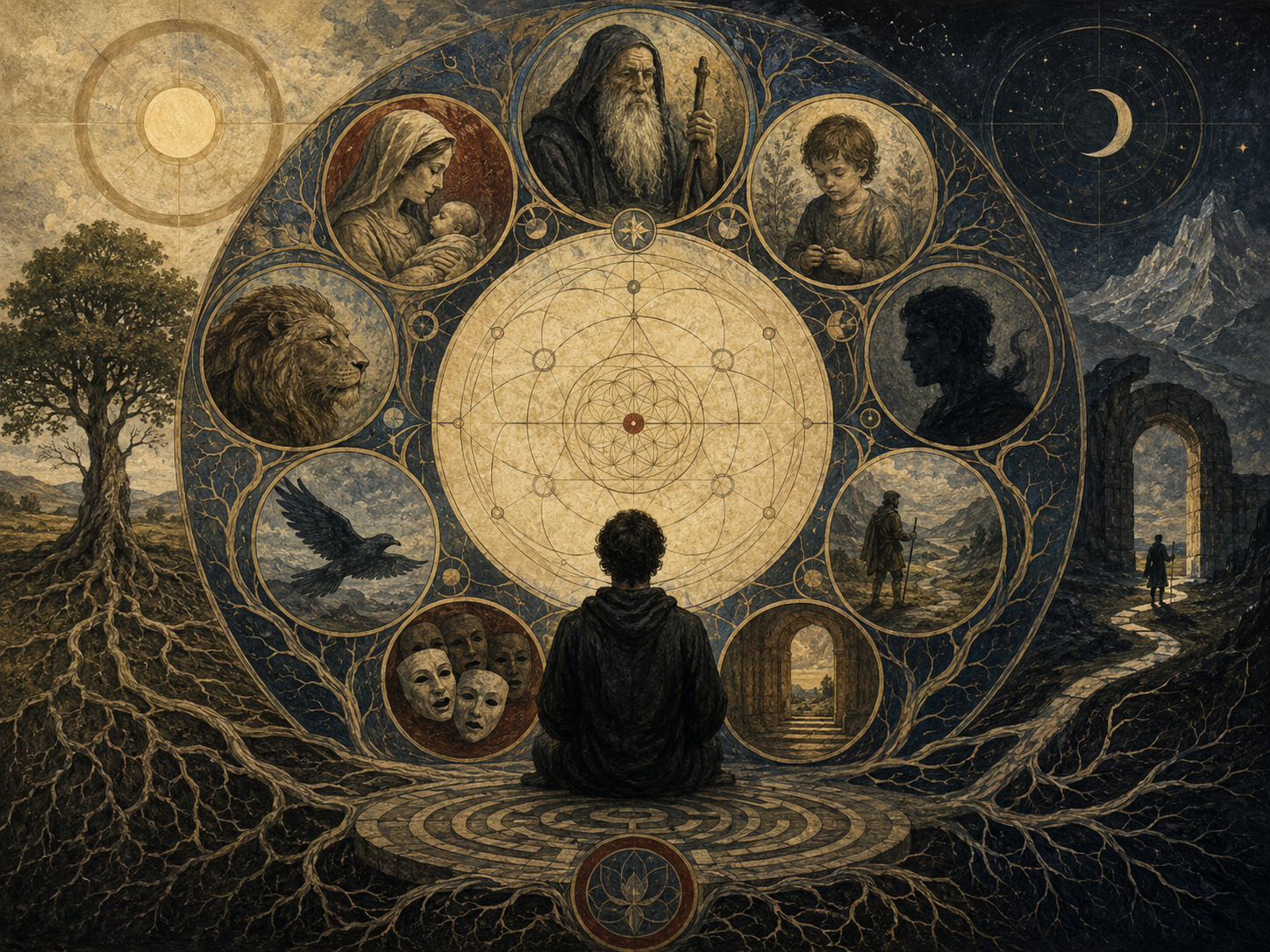
An archetype therefore belongs to the borderland between psychology and symbolic interpretation. It concerns how the psyche organizes experience into forms that can be felt, imagined, narrated, feared, revered, projected, defended against, and transformed. The mother, the child, the trickster, the hero, the shadow, the wise guide, the devouring force, the threshold, the descent, the rebirth, the double, the sacrifice, the sacred center: these are not simply narrative ornaments. They are recurring symbolic patterns through which psychic conflict, dependency, fear, aspiration, integration, loss, danger, renewal, and transformation become representable.
Yet the theory of archetypes is also one of the most criticized elements of Jungian thought. It can become vague, universalizing, historically careless, culturally flattening, gender-essentialist, or interpretively inflated if handled without discipline. A responsible account must therefore hold two things together: the explanatory power of recurrent symbolic form and the need for caution about culture, history, embodiment, language, power, transmission, and evidence. Archetypes are most useful when treated neither as literal inherited pictures nor as empty metaphors, but as hypotheses about recurrent psychic patterning that become visible only in concrete symbolic life.
This article examines what an archetype is, how it differs from an image or symbol, how archetypal forms manifest in myth and dream, why Jung believed they mattered, how archetypes shape personal psychic life, why archetypal interpretation can become inflated, and why the concept remains both influential and controversial. It approaches archetypes as serious problems in the study of psychic structure, imagination, symbolic recurrence, and meaning-making rather than as decorative terms for vague spirituality or branding psychology.
Why Archetypes Matter
Archetypes matter because they address a real problem in symbolic life: recurrence. Human beings repeatedly generate stories, images, figures, scenes, and dramatic structures that seem to cluster around durable forms. Across times and traditions one finds conflict between order and chaos, journeys through darkness, sacrificial deaths, dangerous mothers, miraculous children, tricksters who disrupt structure, doubles who reveal the hidden self, wise elders who guide transformation, descents that precede renewal, monsters at thresholds, sacred centers, broken worlds, and return from the underworld. These similarities may not mean identical meanings, but they do suggest that symbolic life is not random.
Jung’s theory of archetypes matters because it tries to explain why symbolic recurrence has psychological force. It proposes that recurring images do not merely echo cultural fashion but express deeper structuring potentials in psychic life. Whether one accepts that explanation fully or not, the question remains important. Why do certain symbolic patterns return so persistently? Why do they feel charged when they appear? Why do they organize imagination so effectively across personal dreams, collective myths, religious forms, popular narratives, and moments of psychic crisis?
The concept also matters because it resists a purely private account of psychic life. A dream may be rooted in personal biography, but its images may take forms that seem larger than the immediate situation. A person undergoing grief may dream of descent, burial, winter, broken houses, dark water, or a guide through an unfamiliar terrain. A person confronting moral failure may dream of a double, shadowy pursuer, trial, wound, or exposure. A person approaching transformation may dream of birth, child, threshold, fire, vessel, tree, or center. Archetypal theory asks why psychic crises so often organize themselves in symbolic forms that are both personal and transpersonal.
Archetypes also matter because they provide a disciplined way to think about symbolic depth without reducing everything to literal biography. Personal history remains indispensable, but it does not exhaust the meaning of symbolic form. A mother image in a dream may refer to the actual mother, family memory, attachment pattern, body, care, danger, origin, nature, nourishment, containment, or devouring dependency. Archetypal thinking helps keep interpretation open to layered meaning while still requiring attention to context.
The concept is especially important for analytical psychology because it links dream interpretation, myth, religion, personality, imagination, and individuation. Archetypes are not separate curiosities. They are part of Jung’s larger claim that the psyche organizes experience symbolically, that consciousness is not the whole mind, and that psychological development involves encounter with patterns larger than the ego’s preferred self-description.
| Why archetypes matter | Psychological issue | Interpretive caution |
|---|---|---|
| Symbolic recurrence | Certain forms recur across dreams, myths, stories, rituals, and fantasies | Recurrence does not automatically prove sameness of meaning |
| Psychic intensity | Some images carry affective force larger than ordinary description | Intensity does not justify interpretive inflation |
| Pattern recognition | Archetypes help identify recurrent structures of conflict, transformation, and relation | Patterns must be tested against context, not imposed mechanically |
| Personal and collective meaning | Images may be rooted in biography while also drawing from wider symbolic forms | Neither biography nor archetype should erase the other |
| Individuation | Archetypal forms often appear during psychic transition, crisis, and transformation | Archetypal language should support responsibility, not grandiosity |
Archetypes matter, then, because they attempt to explain why imagination has form, why symbolic life repeats, and why certain images seem to speak from a depth that cannot be reduced to surface description alone.
What an Archetype Is
An archetype is best understood as a recurrent formal tendency in the psyche: a pattern of relation, conflict, transformation, expectation, or symbolic organization that is not identical with any single image yet gives rise to many images. It is a structuring principle rather than a finished representation. One might say that the archetype is to symbolic life what grammar is to speech: not the spoken sentence itself, but a generative pattern that helps make certain kinds of utterance possible.
This means an archetype is not directly visible in pure form. What appears in dreams, myths, artworks, fantasies, symptoms, rituals, religious forms, and stories are archetypal expressions. A child in a dream, a divine infant in myth, a sacred child in religion, and a narrative of vulnerable emergence in literature may all be related to a child archetype, but none of them exhausts it. The archetype is inferred from recurrent patterns across symbolic manifestations. It is therefore always known indirectly.
Jung often described archetypes as forms without fixed content. This language is crucial. It prevents the archetype from being confused with a mental photograph, inherited picture, or universal story image. The archetype does not mean that every culture imagines the same mother, hero, child, trickster, or divine figure in the same way. It means that psychic life may be organized by recurring possibilities of form: origin, dependency, danger, nourishment, separation, trial, guidance, deceit, transformation, death, rebirth, union, center, and return.
Archetypes are also dynamic. They are not merely static symbols but patterns of movement. The hero archetype is not simply a heroic figure; it is a drama of separation, ordeal, confrontation, risk, and return. The shadow is not simply a dark figure; it is a drama of disowned material, projection, moral anxiety, and recognition. The child is not simply a small figure; it is a drama of vulnerability, futurity, emergence, promise, dependency, and threatened becoming. The Self is not merely a mandala or center image; it is a pattern of ordering, totality, integration, and psychic centering.
For this reason, archetypal interpretation should ask not only “What image appears?” but “What pattern is being constellated?” A snake, tree, cave, mother, guide, animal, city, or child does not have one fixed meaning. Its archetypal relevance depends on its function within a symbolic drama: what it does, what affect it carries, what relation it has to the dreamer or narrative, what context surrounds it, and whether it participates in a recurring pattern of psychic organization.
| Common misunderstanding | More precise formulation | Why it matters |
|---|---|---|
| An archetype is a stock character | An archetype is a recurrent structuring tendency that may generate many figures | Prevents archetypal theory from becoming trope cataloguing |
| An archetype is an inherited image | An archetype is a form or potential, not a fixed picture | Avoids crude biological literalism |
| An archetype has one universal meaning | Archetypal forms manifest differently through culture, history, biography, and context | Protects interpretation from cultural flattening |
| An archetype is visible directly | Archetypes are inferred from patterned symbolic manifestations | Clarifies the concept’s indirect and interpretive nature |
| An archetype is always profound | Archetypal force depends on context, affect, recurrence, and symbolic function | Prevents inflated interpretation |
An archetype, then, is not a thing hidden inside the psyche like an object in a box. It is a patterning potential that becomes visible only when symbolic life takes form.
Archetype, Image, and Symbol
One of the most important distinctions in Jungian theory is the distinction between an archetype, an image, and a symbol. An image is the concrete representation: the tree, serpent, cave, mother, king, child, flood, masked figure, broken tower, dark water, animal, old woman, wounded body, or hidden room. A symbol is an image or configuration that carries psychic meaning beyond what consciousness can immediately define. It mediates between what is known and what is not yet fully known. An archetype is the deeper structuring potential that makes certain symbolic forms recur with recognizable force.
This triad prevents archetypal theory from collapsing into dream-dictionary thinking. A snake is not automatically “the archetype” of anything in a fixed sense. It is an image that may become symbolic in a particular psychic economy, and that symbolic charge may relate to broader archetypal patterns of danger, transformation, instinct, renewal, sexuality, healing, poison, knowledge, chthonic life, or rebirth depending on context. Archetypal interpretation is therefore not code-breaking. It is patterned inference constrained by context, affect, form, and recurrence.
The distinction also protects against confusing the universal and the particular. The image is particular. The symbol is charged and mediating. The archetype is latent and formal. A mother image may be shaped by an actual mother, a grandmother, cultural mythology, religious symbolism, bodily memory, attachment history, ecological imagery, and archetypal patterns of origin, nourishment, containment, danger, and engulfment. No responsible interpretation can reduce all of this to a single formula.
A symbol is especially important because it does not simply point to an already known meaning. In Jungian thought, a living symbol carries something the ego does not yet fully understand. It is not merely a sign. A stop sign means “stop.” A living symbol means more than consciousness can immediately translate. It invites attention because it mediates between conscious identity and unconscious meaning. Archetypal images are often symbolic in this sense: they gather more meaning than can be paraphrased without loss.
This is why archetypal interpretation must remain patient. If the interpreter names the archetype too quickly, the symbol may die into a label. “That is the mother archetype,” “that is the hero,” “that is the shadow,” or “that is the Self” may sound impressive while closing interpretation prematurely. The better question is how the image functions, what psychic tension it holds, what it reveals and conceals, and how it transforms across a dream series, narrative, ritual, or life situation.
| Concept | Definition | Example | Interpretive rule |
|---|---|---|---|
| Image | Concrete representation appearing in dream, fantasy, art, myth, or narrative | A snake, tree, cave, child, flood, mask, guide, or dark figure | Describe first; do not interpret too quickly |
| Symbol | Image or configuration carrying meaning beyond immediate conscious definition | A recurring dream tree that seems to hold ancestry, growth, death, and renewal | Ask what tension or unknown meaning the image mediates |
| Archetype | Latent structuring potential inferred from recurring symbolic forms | Patterns of descent, rebirth, shadow encounter, sacred center, or guiding figure | Infer cautiously from recurrence, function, affect, and context |
| Motif | Recurring narrative or imaginal element | Journey, threshold, double, sacrifice, flood, test, lost child | Track recurrence without assuming universal sameness |
| Complex | Affectively charged psychic pattern rooted in personal unconscious life | Mother complex, authority complex, inferiority complex | Distinguish personal affective pattern from broader archetypal form |
The archetype-image-symbol distinction is the foundation of responsible archetypal interpretation. Without it, Jungian language becomes vague. With it, archetypes can be treated as latent patterns, images as concrete manifestations, and symbols as living mediators of psychic meaning.
Psychic Structure and Recurrent Form
Jung argued that archetypes belong to psychic structure rather than to private memory alone. They are not produced simply because a particular person once had a particular experience, though individual experiences often constellate archetypal material in concrete ways. Archetypes help organize how psychic life takes form under shared human conditions: dependence, birth, mortality, rivalry, fear, sexuality, kinship, loss, danger, initiation, authority, transgression, suffering, care, separation, and the search for order.
This is why archetypal forms tend to be dynamic rather than static. The hero is not merely a brave figure. The heroic archetypal pattern involves ordeal, struggle, separation, confrontation, danger, and return. The shadow is not just “the bad side.” It concerns disowned psychic material, feared alterity, moral ambivalence, and the destabilizing encounter with what consciousness rejects. The trickster is not merely a comic figure. It concerns boundary disruption, inversion, ambiguity, deception, creativity, and the breakdown of rigid order.
Recurrent form does not mean identical content. A descent into the underworld, a journey through wilderness, a night sea voyage, a cave initiation, a pilgrimage, and a depression marked by dreams of dark water may share structural similarities without being the same phenomenon. The archetypal claim concerns patterned form, not interchangeable content. This distinction is essential because irresponsible archetypal interpretation often treats similarity as equivalence.
Psychic structure also involves affect. Archetypal images are not merely visual or narrative patterns. They often carry numinosity, dread, fascination, awe, grief, terror, longing, or sacred intensity. Jung’s interest in archetypes was partly driven by this affective charge. Certain images do not simply appear; they seize attention. They organize emotional life. They seem to come with an authority or depth that the ego does not invent voluntarily.
At the same time, recurrent form must be interpreted historically. Human beings share bodies, dependency, mortality, sexuality, kinship, vulnerability, and exposure to natural forces, but they do not symbolize these conditions in identical ways. The recurrence of the mother, child, death, journey, or flood does not cancel differences among cultures, religions, languages, rituals, and political histories. Archetypal theory becomes strongest when it treats recurrence and difference together.
| Shared condition | Possible archetypal pattern | Concrete symbolic forms may include |
|---|---|---|
| Birth and emergence | Child, dawn, seed, egg, vessel, new fire | Divine infant, hidden child, sprouting tree, miraculous birth, new city |
| Danger and confrontation | Hero, monster, ordeal, weapon, threshold | Dragon combat, trial, battle, labyrinth, night journey, dangerous crossing |
| Mortality and loss | Descent, underworld, burial, winter, dark water | Cave, grave, sea, wasteland, ghost, ancestral realm, broken house |
| Transformation | Death-rebirth, fire, alchemy, metamorphosis | Phoenix, crucible, initiation, molting serpent, new name, healing wound |
| Orientation and order | Center, mandala, mountain, tree, city, sacred enclosure | Axis mundi, temple, circle, garden, throne, holy mountain, radiant center |
| Disruption and ambiguity | Trickster, double, mask, inversion, boundary crossing | Fool, thief, shapeshifter, clown, animal-human hybrid, deceiving guide |
Psychic structure and recurrent form are the core of archetypal theory. The archetype is not a fixed symbol floating above history. It is a structuring possibility that becomes visible only through embodied, cultural, personal, and symbolic manifestation.
Major Archetypal Patterns
Some archetypal patterns recur so frequently in Jungian thought that they have become almost canonical: the mother, father, child, hero, trickster, shadow, wise old figure, anima, animus, Self, rebirth, sacrifice, sacred marriage, descent, transformation, double, threshold, and center. These should not be treated as a closed official list. Jung’s work suggests a field of recurrent patterns rather than a final taxonomy. What matters is the recurrence of form, not the memorization of a finite set of labels.
Among these, some are more structural than others. The shadow concerns disowned material and feared alterity. The child concerns emergence, vulnerability, latency, futurity, and unrealized wholeness. The hero concerns struggle, differentiation, and confrontation with danger. The Self concerns totality, center, and psychic integration. The anima and animus concern symbolic otherness, projection, and the historically gendered mediation of psychic difference. These patterns are psychologically important not because they are exotic, but because they repeatedly shape how the psyche imagines conflict and resolution.
The mother archetype, for example, is not reducible to one’s actual mother. It may organize images of nourishment, body, origin, containment, earth, nature, protection, engulfment, dependency, fertility, and death. The father archetype may organize authority, law, distance, naming, structure, judgment, tradition, sky, command, or absence. But these patterns must not become crude gender essences. They are symbolic structures shaped by culture and biography. A mother image can be protective, devouring, absent, wounded, sacred, terrifying, political, ecological, or historical. A father image can be lawgiving, oppressive, guiding, fragile, absent, absurd, or sacrificial. The archetype does not cancel the image’s specificity.
The trickster is especially important because it shows that archetypes are not always morally elevated. Trickster figures break rules, cross boundaries, expose hypocrisy, create confusion, release energy, deceive authority, and sometimes bring transformation through disorder. Trickster material warns against imagining archetypes only as noble or spiritual. The psyche also uses ambiguity, foolishness, inversion, and disruption to transform rigid forms.
The Self is central in Jung’s mature thought because it names the pattern of psychic totality and ordering beyond the ego. Self imagery often appears through mandalas, circles, centers, quaternities, sacred cities, divine figures, radiant stones, trees, or images of wholeness. Yet even here, caution is necessary. To identify the ego with Self imagery is to risk inflation. The image of totality is not permission for the ego to become grandiose.
| Archetypal pattern | Core psychological drama | Common symbolic forms | Interpretive caution |
|---|---|---|---|
| Mother | Origin, containment, nourishment, dependency, engulfment | Mother, earth, cave, vessel, sea, garden, womb, devouring figure | Do not reduce actual women or mothers to archetypal function |
| Child | Emergence, vulnerability, futurity, unrealized wholeness | Infant, seed, egg, hidden child, divine child, small animal | Do not sentimentalize vulnerability |
| Hero | Separation, ordeal, confrontation, differentiation, return | Warrior, traveler, dragon-slayer, pilgrim, initiand | Do not turn every conflict into heroic destiny |
| Shadow | Disowned selfhood, projection, feared alterity, moral ambiguity | Double, enemy, monster, dark figure, intruder, criminal, animal | Do not reduce real others to projections |
| Trickster | Disruption, boundary crossing, inversion, creative disorder | Fool, clown, thief, animal, shapeshifter, deceiver | Do not romanticize deceit or harm |
| Wise guide | Orientation, counsel, teaching, symbolic mediation | Old woman, old man, animal guide, teacher, ancestor, hermit | Do not surrender responsibility to the guide image |
| Self | Totality, center, ordering, integration, wholeness | Mandala, circle, stone, tree, city, deity, radiant center | Do not identify the ego with totality |
Major archetypal patterns are best treated as recurring symbolic grammars rather than fixed dictionary entries. They help name deep patterns, but only responsible interpretation can determine how a specific image functions in a specific psychic, cultural, or narrative context.
Archetypes in Dreams, Myth, and Religion
Archetypes manifest most visibly in dreams, myths, religious imagery, ritual forms, folklore, and literary narratives. A dream may stage a descent into a cave, an encounter with a dark stranger, a protective child, a guiding elder, a threatening flood, a wounded animal, a luminous center, or a dangerous crossing. Myth may tell similar patterns on a civilizational scale. Religious narratives may give them sacred form. Literature may refract them through historical and psychological particularity.
Jung believed these recurrences indicate that archetypes organize symbolic production across both individual and collective life. Still, the content of archetypal manifestation is never culturally neutral. A flood in one tradition is not interchangeable with a flood in another. A mother image in one symbolic system may carry different ethical and cosmological meanings than a similar image elsewhere. A trickster in one mythology may not serve the same function as a fool in another literary tradition. The recurrence of form does not cancel the specificity of context.
Dreams are especially important because they show archetypal forms arising within individual psychic life. A dreamer may not consciously know a mythic tradition yet dream in forms that resemble descent, sacrifice, rebirth, shadow encounter, or guiding figure. This does not automatically prove direct inheritance of mythic content, but it does raise the problem Jung wanted to explain: why does the psyche, under pressure, so often organize experience through symbolic dramas rather than plain statements?
Myth gives archetypal pattern public and narrative form. It does not simply decorate collective life. It gives shape to origin, suffering, death, kinship, law, transgression, fertility, kingship, divine order, chaos, sacrifice, and renewal. Archetypal interpretation is useful when it identifies recurring symbolic structures in myth while respecting the religious, linguistic, ritual, and historical specificity of each tradition.
Religion intensifies the issue because archetypal images may become sacred images. The mother becomes divine mother, the child becomes savior or sacred infant, the center becomes temple or holy city, the descent becomes harrowing of hell or mystical passage, the sacrifice becomes covenant, redemption, or cosmic order. Jungian interpretation can illuminate symbolic form, but it must not reduce religion to psychology. Religious traditions have their own theological, liturgical, doctrinal, ethical, and communal meanings that exceed psychological explanation.
| Domain | How archetypal pattern appears | Responsible interpretive practice |
|---|---|---|
| Dreams | Images and dramas arise in individual psychic life with symbolic force | Interpret through association, affect, dream sequence, biography, and archetypal form |
| Myth | Collective narratives organize origin, danger, law, death, renewal, and order | Respect historical and cultural specificity; avoid flattening traditions |
| Religion | Sacred figures and rituals give ultimate form to symbolic patterns | Do not reduce theology or worship to psychology alone |
| Ritual | Embodied symbolic action enacts transition, purification, sacrifice, initiation, or return | Interpret symbolically while respecting social and religious function |
| Literature | Narratives transform recurring motifs through character, language, and history | Distinguish archetypal pattern from genre convention and authorial craft |
| Popular culture | Mass narratives recycle heroic, shadow, trickster, apocalypse, and rebirth forms | Analyze without assuming popularity equals depth |
Archetypes in dreams, myth, and religion demonstrate the central challenge of Jungian interpretation: symbolic forms recur, but they never recur in an abstract vacuum. They always enter a living field of culture, language, body, history, memory, and belief.
Archetypes and the Person
Archetypes do not exist only in grand myths or religious systems. They also shape the inner life of persons. An individual may become identified with a heroic pattern of ordeal and conquest, overwhelmed by shadow material, fascinated by a wise guide, seized by fantasies of rebirth, bound to a sacrificial role, psychically organized around a child image of vulnerability and unrealized possibility, or drawn toward images of center and totality during a period of transformation. Archetypal patterns can structure dreams, symptoms, aspirations, projections, relationships, and self-understanding.
This is one reason archetypes matter clinically. They help explain why some psychic material feels larger than personal memory. A patient may bring a dream whose imagery far exceeds the apparent scale of the immediate situation. Analytical psychology treats this enlargement seriously. The psyche sometimes speaks in forms whose symbolic force cannot be reduced to surface biography alone, even though biography remains indispensable for interpretation.
Archetypal patterns can also organize identity. A person may live as if caught inside a hero story, always needing obstacles and enemies in order to feel real. Another may live inside a martyr pattern, finding meaning only through sacrifice. Another may be caught by the orphaned child, experiencing the world as abandonment and searching endlessly for protection. Another may identify with the wise guide, becoming inflated by the role of teacher or rescuer. Another may be possessed by trickster energy, constantly disrupting boundaries while calling it freedom.
Such patterns can be meaningful, but they become dangerous when the ego identifies with them completely. Archetypal identification gives ordinary life an enlarged mythic intensity. This may bring energy and meaning, but it can also distort proportion. A workplace disagreement becomes a battle with evil. A romance becomes sacred destiny. A personal failure becomes cosmic exile. A creative project becomes divine mission. A moral conflict becomes apocalyptic struggle. The archetype expands the field, and the ego may become inflated by the expansion.
Individuation involves learning to relate to archetypal patterns without being possessed by them. The person must discover that archetypal images belong to psychic life but do not erase ordinary reality. The dream guide may be meaningful, but it does not remove responsibility. The shadow figure may reveal projection, but it does not make the other person unreal. The hero pattern may energize struggle, but it does not justify grandiosity. The Self may appear in symbols of totality, but the ego is not the Self.
| Personal archetypal pattern | Possible value | Possible danger |
|---|---|---|
| Hero pattern | Courage, differentiation, endurance, confrontation with danger | Need for enemies, grandiosity, inability to rest, contempt for dependence |
| Child pattern | Renewal, vulnerability, possibility, future orientation | Infantilization, helplessness, refusal of responsibility, idealized innocence |
| Shadow pattern | Self-knowledge, moral complexity, projection withdrawal | Fascination with darkness, projection, shame collapse, acting out |
| Wise guide pattern | Orientation, teaching, symbolic mediation, counsel | Inflation, guru fantasy, surrender of personal judgment |
| Martyr pattern | Devotion, sacrifice, moral seriousness | Self-erasure, resentment, moral superiority, refusal of mutuality |
| Trickster pattern | Creativity, boundary disruption, exposure of rigidity | Deceit, irresponsibility, contempt for consequence |
| Self pattern | Centering, integration, symbolic totality | Ego inflation, spiritual grandiosity, premature claims of wholeness |
Archetypes and the person meet wherever symbolic patterns shape lived identity. The clinical and ethical question is whether the person can relate to the pattern consciously, or whether the pattern has begun to live through the person unconsciously.
Archetypal Inflation and Interpretive Danger
The power of archetypal language is also its danger. Once interpreters become accustomed to seeing recurrent patterns, they may begin seeing archetypes everywhere, whether the evidence warrants it or not. This is archetypal inflation: the expansion of symbolic claims beyond their interpretive support. Ordinary conflict becomes cosmic battle, every difficult mother becomes the Great Mother, every failure becomes heroic descent, every confusion becomes initiation, every attraction becomes sacred marriage, and every recurring image is granted false universality.
Archetypal inflation can happen in interpretation, clinical work, personal spirituality, cultural criticism, and public storytelling. It occurs whenever symbolic grandeur outruns disciplined attention. The interpreter becomes fascinated by the large pattern and loses contact with the concrete situation. The person’s actual life disappears under mythic language. The cultural object is treated as proof of a universal pattern before its history has been understood. The dream is interpreted as archetypal before the dreamer’s associations have been heard.
Inflation is especially dangerous because archetypal language feels profound. It can create the impression of depth even when it has skipped the hard work of interpretation. To call something “the hero’s journey,” “the shadow,” “the mother archetype,” or “the Self” can sound authoritative, but the naming may do little more than impose a prefabricated frame. Archetypal language becomes responsible only when it increases precision rather than replacing it.
There is also the danger of ego inflation. The person may identify with an archetypal role and feel enlarged by it. A teacher becomes the wise old figure. A leader becomes the savior. A lover becomes the destined beloved. A political movement becomes the force of redemption. A personal crisis becomes a sacred mission. Analytical psychology is particularly cautious here because archetypal material can be numinous. It can feel larger than the ego, and the ego may mistake that largeness as its own.
Responsible interpretation therefore requires deflation as well as amplification. Amplification places an image in wider symbolic context. Deflation returns the image to human scale. Both are needed. A dream of descent may resonate with mythic patterns, but it may also concern depression, grief, avoidance, family history, bodily illness, or ordinary fear. A guide figure may resemble a wise archetypal pattern, but it may also carry parental memory, dependency, transference, or a need for authority. Archetypal interpretation must enlarge without swallowing the particular.
| Inflated use | Problem | Responsible correction |
|---|---|---|
| Every conflict becomes archetypal battle | Ordinary reality is mythologized beyond proportion | Ask what is actually happening before enlarging the frame |
| Every mother image becomes the Great Mother | Specific biography and culture are erased | Distinguish actual mother, mother complex, symbolic mother, and archetypal pattern |
| Every descent becomes initiation | Suffering is romanticized | Consider depression, trauma, grief, crisis, and material conditions |
| Every attraction becomes sacred union | Projection is spiritualized | Differentiate person, fantasy, desire, and archetypal charge |
| Every mandala means Self-realization | Symbolic form is overinterpreted | Track sequence, affect, context, and ego relation to the image |
| Every public struggle becomes mythic destiny | Political and ethical reality becomes inflated narrative | Combine symbolic analysis with historical and institutional analysis |
A responsible account of archetypes requires restraint. Not every strong image is archetypal. Not every recurring story proves deep psychic inheritance. Not every symbolic resonance has the same level of psychological or cultural significance. Archetypal thinking is strongest when it sharpens attention to form without erasing specificity, and weakest when it turns symbolic interpretation into a rhetoric of grandeur.
Why Jung Thought Archetypes Were Necessary
Jung thought archetypes were necessary because personal history alone did not seem sufficient to explain the scope, resonance, and recurrence of symbolic life. He encountered dreams and fantasies whose imagery appeared mythic, cosmological, or ritualized beyond what the dreamer’s conscious experience seemed to provide. He also saw similar symbolic structures recurring in comparative materials from religion, alchemy, folklore, literature, and visionary experience. To account for this, he posited deeper psychic structuring tendencies that shape symbolic expression across persons and traditions.
His argument was not simply that similar images recur. It was that these images often recur with psychological charge and structural similarity. Dreams do not merely contain objects; they arrange them into dramas. Myths do not merely list symbols; they organize transformation. Religious images do not merely decorate doctrine; they mediate ultimate concern, fear, guilt, renewal, sacrifice, law, and salvation. Jung believed that the recurrence of charged symbolic form pointed to the existence of organizing structures in the collective unconscious.
Jung’s clinical experience mattered here. He did not develop archetypal theory only as comparative mythology. He encountered symbolic images in patients whose fantasies and dreams seemed to exceed the personal situation. Whether his interpretation of those experiences is accepted or challenged, the clinical problem remains: psychic life sometimes produces forms that feel larger than private memory. Archetypal theory was Jung’s way of taking that largeness seriously without reducing it to pathology.
Jung also needed archetypes because of his broader account of the psyche. If the unconscious is not merely a storehouse of repressed personal material, then it may include formal tendencies that shape psychic life. The personal unconscious contains forgotten, repressed, or subliminal material related to the individual’s life. The collective unconscious, in Jung’s theory, contains archetypal structures that organize symbolic possibilities shared across human life. Archetypes are therefore foundational to the distinction between the personal and collective unconscious.
Whether one accepts that explanation depends partly on what alternatives one finds more persuasive. Some may prefer developmental, anthropological, evolutionary, cognitive, psychoanalytic, literary, theological, or cultural-transmission accounts. Yet Jung’s proposal remains important because it foregrounds the problem: symbolic life is recurrent, and those recurrences often carry psychological force that is not easily dismissed as decorative coincidence.
| Reason Jung needed archetypes | Underlying problem | Contemporary question |
|---|---|---|
| Mythic dream imagery | Dreams sometimes appear in forms larger than personal memory | How should psychology interpret symbolic enlargement? |
| Comparative recurrence | Similar motifs appear across myth, religion, folklore, and fantasy | How much recurrence is due to shared psyche, transmission, or shared human conditions? |
| Collective unconscious | Jung needed formal structures beyond personal unconscious material | Can recurrent form be theorized without crude universalism? |
| Clinical intensity | Some images carry numinous affect and transformative force | How can intensity be interpreted without inflation? |
| Symbolic transformation | Psychic development often unfolds through patterned symbolic sequences | How do narrative and image shape psychological change? |
Jung thought archetypes were necessary because he believed psychology needed a theory of symbolic form. The continuing question is whether that theory can be refined, criticized, historicized, and responsibly used without losing the problem it was designed to address.
Criticisms of Archetypal Theory
Archetypal theory has been criticized on several serious grounds. First, the concept is difficult to operationalize and test in strict empirical terms. If archetypes are latent forms known only through images, how does one distinguish disciplined inference from interpretive projection? How can competing explanations be compared? What counts as evidence for an archetype rather than for cultural transmission, genre convention, developmental pattern, evolutionary pressure, or interpreter bias?
Second, Jung and some later followers sometimes moved too quickly across traditions, treating symbolic resemblance as proof of deep equivalence. This is a major problem. Similar images do not necessarily mean the same thing. A serpent in one context may symbolize danger, healing, wisdom, temptation, rebirth, fertility, underworld power, or divine presence. A flood in one tradition may be judgment, cleansing, chaos, ecological memory, divine grief, political myth, or ritual pattern. Comparative interpretation becomes weak when it ignores language, ritual, doctrine, history, and power.
Third, archetypal theory can encourage universalizing claims that obscure cultural specificity. The desire to find recurring patterns can become an interpretive habit of flattening differences. This is especially concerning when traditions from marginalized, colonized, or non-Western communities are treated as raw material for a universal psychological system. The interpreter must be careful not to extract symbols from living traditions and convert them into evidence for a preexisting theory.
Fourth, archetypal categories have sometimes been entangled with outdated assumptions about gender, culture, hierarchy, and civilization. Classical Jungian writing sometimes relies on gendered oppositions such as masculine logos and feminine eros, or on comparative language that can sound evolutionary, hierarchical, or civilizationally biased. Contemporary use of archetypes must revise these assumptions rather than repeat them.
Fifth, archetypal theory risks confirmation bias. Once the interpreter expects to find archetypes, everything becomes evidence. Differences are minimized, similarities are highlighted, and ambiguous material is recruited into the pattern. This is not a reason to abandon archetypal thought, but it is a reason to make the method more explicit, more cautious, and more accountable.
| Criticism | Why it matters | Responsible response |
|---|---|---|
| Difficult to test empirically | Latent structures can become unfalsifiable | Treat archetypes as interpretive hypotheses and compare alternative explanations |
| Overgeneralization | Symbolic resemblance can erase difference | Interpret recurrence through culture, history, language, and function |
| Cultural flattening | Living traditions may be reduced to psychological examples | Respect religious, ritual, political, and historical specificity |
| Gender essentialism | Symbolic categories may reproduce outdated binaries | Separate symbolic coding from claims about gender essence |
| Interpretive inflation | Ordinary events become grand mythic claims | Use evidence, proportion, context, and restraint |
| Confirmation bias | The interpreter finds what they expected to find | Document method, include counterexamples, and test rival interpretations |
These criticisms are serious, and any contemporary use of archetypes must respond to them directly. The concept remains useful only if it can be handled without triumphalism, without cultural extraction, and without collapsing symbolic comparison into interpretive laziness.
Responsible Uses of the Concept
A responsible use of archetypal theory begins by treating archetypes as recurrent structuring possibilities, not fixed meanings. It also insists that archetypal recurrence must be interpreted through context: biography, genre, ritual setting, cultural tradition, historical moment, religious language, social position, and affective force. Similarity of form does not eliminate difference of function.
Responsible archetypal interpretation should begin with description. What image appears? What happens? Who acts? What is threatened? What is transformed? What affect is present? What is the dreamer’s or text’s relation to the image? Only after careful description should interpretation move toward symbolic and archetypal inference. This protects the material from premature naming.
Second, responsible interpretation distinguishes personal, cultural, and archetypal layers. A dream father may involve one’s actual father, authority complex, social experience of law or judgment, religious father imagery, and archetypal father pattern. These layers may interact, but they should not be collapsed. The archetypal layer does not make the personal layer irrelevant. The personal layer does not exhaust the symbolic field.
Third, responsible use requires historical humility. Jungian interpretation should not treat other cultures’ symbols as detachable proof-texts for universal psychology. Traditions speak from within languages, rituals, theological worlds, political histories, ecological conditions, and communities of practice. Archetypal comparison should be dialogical and careful rather than extractive.
Fourth, responsible use requires clinical caution. Archetypal interpretation can be powerful, but it can also destabilize, inflate, or overwhelm. Not every patient benefits from mythic amplification. Sometimes the task is grounding, containment, grief work, trauma care, relational repair, or ordinary moral accountability. Archetypal language should serve the person’s psychic integration, not the interpreter’s fascination.
Fifth, responsible use requires ethical realism. Archetypes should not be used to excuse harm, spiritualize domination, romanticize suffering, or turn political violence into symbolic drama. A dragon may be archetypal, but real oppression is also real oppression. A shadow projection may be active, but an aggressor may still be aggressive. Symbolic analysis must deepen reality, not replace it.
| Responsible practice | What it requires | What it prevents |
|---|---|---|
| Describe before interpreting | Attend to image, action, affect, sequence, and context | Premature archetypal labeling |
| Distinguish layers | Separate personal, cultural, historical, and archetypal dimensions | Reduction of the whole image to one meaning |
| Respect cultural specificity | Read symbols within traditions, languages, rituals, and histories | Universalizing flattening or symbolic extraction |
| Use amplification carefully | Compare motifs without erasing difference | Grandiose analogy |
| Maintain clinical proportion | Match interpretation to the person’s needs and stability | Inflation, destabilization, or symbolic overwhelm |
| Preserve ethical reality | Keep material, social, and moral conditions in view | Using archetypes to excuse harm or avoid accountability |
Used this way, archetypes become tools for identifying patterned symbolic organization rather than excuses for flattening everything into the same myth. They help explain why certain forms keep returning while reminding the interpreter that each return is historically situated, mediated, and transformed by particular symbolic worlds.
Archetypes and Contemporary Thought
Contemporary thought does not usually endorse archetypes in Jung’s strongest classical sense, but related questions persist across many fields. Narrative theory studies recurring story structures. Cognitive linguistics examines conceptual metaphors and recurrent schemas. Anthropology studies ritual forms and symbolic systems. Comparative literature tracks durable motifs while stressing historical transmission and transformation. Developmental and evolutionary accounts ask whether shared human conditions generate recurrent imaginative patterns. Cognitive science asks how embodied minds form recurring categories, metaphors, and scripts.
These approaches do not simply replicate Jung, but they show that the problem of recurrent symbolic form remains alive. Archetypal theory, at minimum, continues to function as a provocative framework for asking why imagination is patterned the way it is and why some images seem to carry disproportionate psychic depth.
Narrative theory is especially relevant because archetypes often appear not only as images but as plots. Descent, quest, exile, return, sacrifice, initiation, discovery, and transformation are not isolated symbols. They are sequences. They organize expectation, tension, and resolution. Jungian theory can be enriched by narrative analysis because it clarifies the dramatic structure of archetypal form.
Cognitive linguistics contributes the idea that human thought is shaped by embodied metaphors and recurring schemas: container, path, balance, center, force, up/down, light/dark, journey, source, and goal. These schemas do not prove Jung’s theory, but they provide a contemporary way to think about why certain symbolic forms recur. Human beings share embodied conditions, and those conditions may help generate recurrent imaginative patterns.
Developmental psychology also matters. Human beings share experiences of dependency, separation, attachment, fear, care, rivalry, vulnerability, loss, and maturation. Archetypal patterns may reflect not only inherited psychic forms but also recurring developmental situations. The child, mother, father, sibling, stranger, authority, monster, and guide may recur because certain relational conditions recur across human development.
Anthropology and religious studies add necessary caution. Symbols do not float freely. They live within rituals, institutions, oral traditions, sacred histories, social hierarchies, ecological settings, and communal practices. Archetypal theory becomes stronger when it learns from these disciplines rather than treating them as mere sources of examples.
| Contemporary field | Relevant problem | Contribution to archetypal theory |
|---|---|---|
| Narrative theory | Recurring plot structures and character functions | Clarifies archetypes as dramas, not only images |
| Cognitive linguistics | Embodied metaphors and recurrent schemas | Offers non-mystical accounts of recurring symbolic forms |
| Developmental psychology | Shared human situations of care, dependency, separation, and maturation | Grounds symbolic recurrence in developmental experience |
| Anthropology | Ritual, myth, kinship, and symbolic systems | Protects against abstract universalism |
| Comparative literature | Motif recurrence, genre, intertextuality, and transformation | Distinguishes archetypal recurrence from textual borrowing and convention |
| Religious studies | Sacred narrative, doctrine, ritual, and theological meaning | Prevents reduction of religious symbols to psychology alone |
| Network and corpus analysis | Patterned recurrence across large textual datasets | Makes symbolic recurrence more explicit, comparable, and testable |
Archetypes and contemporary thought meet most fruitfully when neither side claims total victory. Jungian theory brings depth, symbolic attention, and a powerful language of recurring psychic form. Contemporary disciplines bring method, historical caution, empirical restraint, and attention to transmission, embodiment, and power. Together, they make archetypal theory more careful and more useful.
Mathematical Lens
Archetypes can be modeled as latent generators of recurrent symbolic outputs rather than as visible contents themselves. Let \(Y_{ij}\) be the symbolic output of person or text \(i\) in context \(j\). A stylized factor-style model might be written as:
Y_{ij} = \alpha + \lambda_1 A_1 + \lambda_2 A_2 + \cdots + \lambda_k A_k + \beta C_j + \gamma P_i + \varepsilon_{ij}
\]
Interpretation: \(A_1 \ldots A_k\) are latent archetypal factors, \(C_j\) is cultural context, and \(P_i\) is personal history. On this model, archetypes are not observed directly. They are inferred from recurring covariance among symbolic features across different settings. The same latent factor may manifest through different images depending on culture and biography.
A graph model can make the same point differently. Suppose motifs such as child, flood, shadow, threshold, guide, descent, and rebirth form nodes in a large semantic network. If certain motif clusters recur with high stability across corpora, one may hypothesize an underlying structuring pattern:
G_t = (V_t,E_t), \quad R_c = f(S_c, W_c, K_c)
\]
Interpretation: \(G_t\) is a motif network at time or corpus \(t\), \(S_c\) is cluster stability, \(W_c\) is weighted co-occurrence strength, and \(K_c\) is cross-context recurrence. \(R_c\) represents the recurrence strength of a symbolic cluster. High recurrence does not prove Jung’s theory, but it makes symbolic patterning more formally intelligible.
Archetypal recurrence can also be modeled as a tension between latent form and contextual variation:
M_{m,c} = \theta_m + \phi_c + \psi_{m,c} + \eta_{m,c}
\]
Interpretation: \(M_{m,c}\) is the manifestation of motif \(m\) in context \(c\), \(\theta_m\) is the motif’s recurring formal tendency, \(\phi_c\) is the cultural or historical context, and \(\psi_{m,c}\) is the interaction between motif and context. This prevents recurrence from being mistaken for sameness.
A responsible computational approach would compare archetypal hypotheses against alternatives. Let \(H_A\) represent an archetypal recurrence hypothesis, \(H_T\) a cultural-transmission hypothesis, \(H_G\) a genre-convention hypothesis, and \(H_D\) a developmental-condition hypothesis:
P(H_A \mid D) \propto P(D \mid H_A)P(H_A)
\]
Interpretation: Evidence \(D\) may support an archetypal hypothesis only in comparison with plausible alternatives. Recurrence alone is not enough. The pattern must be evaluated against transmission, genre, developmental, ecological, theological, and historical explanations.
The key point is that archetypes, if they exist as meaningful explanatory concepts, should be understood as latent structural regularities inferred from patterned manifestation rather than as directly visible psychic objects. Mathematical language does not settle the metaphysical question. It clarifies what kind of claim archetypal theory is making and what kinds of evidence would strengthen or weaken it.
R Workflow: Detecting Recurrent Symbolic Clusters in Narrative Corpora
The following R workflow sketches how a researcher might detect recurring symbolic clusters across a corpus of myths, dreams, narratives, or literary texts. The aim is not to prove archetypes in a simplistic sense, but to identify recurring motifs and co-occurrence patterns in a reproducible way. The workflow uses a synthetic fallback corpus if no file is present, so the structure remains runnable as a methods demonstration.
# ============================================================
# What Is an Archetype? Pattern, Image, and Psychic Structure
# R Workflow: Detecting recurrent symbolic clusters
# ============================================================
#
# Responsible-use note:
# This workflow is for synthetic-data demonstration and symbolic-pattern
# research methods. It does not prove archetypes, diagnose people,
# interpret private dreams, or replace scholarly interpretation.

library(tidyverse)
library(tidytext)
library(igraph)
library(ggraph)

set.seed(2026)

# ------------------------------------------------------------
# 1. Load or create a narrative corpus
# ------------------------------------------------------------

corpus_path <- "data/raw/archetypal_corpus.csv"

if (file.exists(corpus_path)) {
  texts <- read_csv(corpus_path, show_col_types = FALSE)
} else {
  texts <- tibble(
    doc_id = paste0("doc_", 1:12),
    source_type = rep(c("dream", "myth", "literary", "ritual"), each = 3),
    culture_group = rep(c("synthetic_a", "synthetic_b", "synthetic_c"), times = 4),
    text = c(
      "A child crossed a threshold and found a tree beside dark water.",
      "A shadow followed the traveler into a cave below the city.",
      "A guide appeared with fire and led the dreamer toward rebirth.",
      "The king lost his crown after a flood covered the old road.",
      "A snake circled the tree while the mother searched for the child.",
      "The hero descended into a cave and returned with a broken stone.",
      "At the threshold, a masked figure offered moonlight and fire.",
      "A lonely child met an elder guide under the sun and tree.",
      "A double walked through the city carrying a dark mirror.",
      "The ritual began with water, descent, silence, and return.",
      "The mother placed a seed in a vessel beneath the moon.",
      "A trickster stole fire from the king and opened the gate."
    )
  )

  dir.create("data/raw", recursive = TRUE, showWarnings = FALSE)
  write_csv(texts, corpus_path)
}

# ------------------------------------------------------------
# 2. Tokenize and clean
# ------------------------------------------------------------

tokens <- texts |>
  unnest_tokens(word, text) |>
  anti_join(stop_words, by = "word")

motif_terms <- c(
  "mother", "child", "shadow", "guide", "king", "journey",
  "threshold", "flood", "fire", "death", "rebirth", "snake",
  "tree", "cave", "sun", "moon", "descent", "return",
  "double", "mask", "water", "city", "stone", "vessel",
  "trickster", "hero", "gate", "mirror", "seed"
)

motif_counts <- tokens |>
  filter(word %in% motif_terms) |>
  count(doc_id, source_type, culture_group, word, name = "count")

# ------------------------------------------------------------
# 3. Motif prevalence by source and context
# ------------------------------------------------------------

motif_summary <- motif_counts |>
  group_by(source_type, culture_group, word) |>
  summarize(total = sum(count), .groups = "drop") |>
  arrange(desc(total), source_type, culture_group)

print(motif_summary)

# ------------------------------------------------------------
# 4. Co-occurrence network by document
# ------------------------------------------------------------

doc_motifs <- motif_counts |>
  group_by(doc_id) |>
  summarize(motifs = list(unique(word)), .groups = "drop")

cooc_edges <- doc_motifs |>
  mutate(pairs = map(motifs, ~ {
    if (length(.x) < 2) {
      tibble(from = character(), to = character())
    } else {
      as_tibble(t(combn(sort(.x), 2)), .name_repair = "minimal") |>
        rename(from = V1, to = V2)
    }
  })) |>
  select(doc_id, pairs) |>
  unnest(pairs) |>
  count(from, to, name = "weight") |>
  filter(weight >= 1)

nodes <- tibble(name = unique(c(cooc_edges$from, cooc_edges$to)))

motif_graph <- graph_from_data_frame(
  d = cooc_edges,
  vertices = nodes,
  directed = FALSE
)

# ------------------------------------------------------------
# 5. Network metrics
# ------------------------------------------------------------

metrics <- tibble(
  motif = V(motif_graph)$name,
  degree = degree(motif_graph),
  strength = strength(motif_graph, weights = E(motif_graph)$weight),
  betweenness = betweenness(motif_graph, weights = 1 / E(motif_graph)$weight)
) |>
  arrange(desc(betweenness), desc(strength))

print(metrics)

# ------------------------------------------------------------
# 6. Cluster detection
# ------------------------------------------------------------

communities <- cluster_louvain(motif_graph, weights = E(motif_graph)$weight)

cluster_table <- tibble(
  motif = V(motif_graph)$name,
  cluster = membership(communities)
) |>
  arrange(cluster, motif)

print(cluster_table)

# ------------------------------------------------------------
# 7. Visualization
# ------------------------------------------------------------

dir.create("outputs/figures", recursive = TRUE, showWarnings = FALSE)
dir.create("outputs/tables", recursive = TRUE, showWarnings = FALSE)

plot_obj <- ggraph(motif_graph, layout = "fr") +
  geom_edge_link(aes(width = weight), alpha = 0.25) +
  geom_node_point(size = 4) +
  geom_node_text(aes(label = name), repel = TRUE, size = 3) +
  scale_edge_width(range = c(0.3, 2.5)) +
  labs(
    title = "Synthetic Motif Co-Occurrence Network",
    subtitle = "Recurring symbolic motifs form interpretable clusters, but clusters require contextual interpretation"
  ) +
  theme_void()

ggsave(
  filename = "outputs/figures/motif_cooccurrence_network.png",
  plot = plot_obj,
  width = 10,
  height = 7,
  dpi = 300
)

write_csv(motif_summary, "outputs/tables/motif_summary.csv")
write_csv(metrics, "outputs/tables/motif_network_metrics.csv")
write_csv(cluster_table, "outputs/tables/motif_clusters.csv")
write_csv(cooc_edges, "outputs/tables/motif_cooccurrence_edges.csv")

# ------------------------------------------------------------
# 8. Interpretation guardrails
# ------------------------------------------------------------

cat("\nInterpretive guardrails:\n")
cat("- Co-occurrence is not proof of archetypal universality.\n")
cat("- Motif recurrence must be compared against genre, transmission, culture, and context.\n")
cat("- Network clusters support interpretation; they do not replace it.\n")
cat("- Similar motifs may perform different symbolic functions in different traditions.\n")
This kind of workflow helps clarify whether symbolic clusters recur in patterned ways across different datasets. It does not eliminate the need for interpretation, but it does make recurrent structure more explicit and more comparable across corpora. It also allows archetypal claims to be treated as hypotheses rather than impressions.
Python Workflow: Modeling Archetypal Motifs as Semantic Networks
The following Python workflow models archetypal motifs as a semantic co-occurrence network. It is useful for exploring which motifs function as bridges, which clusters remain stable, and whether similar symbolic neighborhoods appear across texts from different sources. The workflow uses a synthetic fallback corpus if no source file is available and exports tables that can support further interpretation.
# ============================================================
# What Is an Archetype? Pattern, Image, and Psychic Structure
# Python Workflow: Archetypal motifs as semantic networks
# ============================================================
#
# Responsible-use note:
# This workflow is for synthetic-data demonstration and symbolic-pattern
# research methods. It does not prove archetypes, diagnose people,
# interpret private dreams, or replace scholarly interpretation.

from pathlib import Path
from collections import Counter
from itertools import combinations
import re

import pandas as pd
import networkx as nx

ARTICLE_DIR = Path("articles/what-is-an-archetype-pattern-image-and-psychic-structure")
DATA_DIR = ARTICLE_DIR / "data/raw"
OUTPUT_TABLES = ARTICLE_DIR / "outputs/tables"
OUTPUT_TABLES.mkdir(parents=True, exist_ok=True)
DATA_DIR.mkdir(parents=True, exist_ok=True)

corpus_path = DATA_DIR / "archetypal_corpus.csv"

# ------------------------------------------------------------
# 1. Load or create a synthetic corpus
# ------------------------------------------------------------

if corpus_path.exists():
    df = pd.read_csv(corpus_path)
else:
    df = pd.DataFrame(
        [
            {
                "doc_id": "doc_1",
                "source_type": "dream",
                "culture_group": "synthetic_a",
                "text": "A child crossed a threshold and found a tree beside dark water.",
            },
            {
                "doc_id": "doc_2",
                "source_type": "dream",
                "culture_group": "synthetic_a",
                "text": "A shadow followed the traveler into a cave below the city.",
            },
            {
                "doc_id": "doc_3",
                "source_type": "dream",
                "culture_group": "synthetic_b",
                "text": "A guide appeared with fire and led the dreamer toward rebirth.",
            },
            {
                "doc_id": "doc_4",
                "source_type": "myth",
                "culture_group": "synthetic_b",
                "text": "The king lost his crown after a flood covered the old road.",
            },
            {
                "doc_id": "doc_5",
                "source_type": "myth",
                "culture_group": "synthetic_c",
                "text": "A snake circled the tree while the mother searched for the child.",
            },
            {
                "doc_id": "doc_6",
                "source_type": "myth",
                "culture_group": "synthetic_c",
                "text": "The hero descended into a cave and returned with a broken stone.",
            },
            {
                "doc_id": "doc_7",
                "source_type": "literary",
                "culture_group": "synthetic_a",
                "text": "At the threshold, a masked figure offered moonlight and fire.",
            },
            {
                "doc_id": "doc_8",
                "source_type": "literary",
                "culture_group": "synthetic_b",
                "text": "A lonely child met an elder guide under the sun and tree.",
            },
            {
                "doc_id": "doc_9",
                "source_type": "literary",
                "culture_group": "synthetic_c",
                "text": "A double walked through the city carrying a dark mirror.",
            },
            {
                "doc_id": "doc_10",
                "source_type": "ritual",
                "culture_group": "synthetic_a",
                "text": "The ritual began with water, descent, silence, and return.",
            },
            {
                "doc_id": "doc_11",
                "source_type": "ritual",
                "culture_group": "synthetic_b",
                "text": "The mother placed a seed in a vessel beneath the moon.",
            },
            {
                "doc_id": "doc_12",
                "source_type": "ritual",
                "culture_group": "synthetic_c",
                "text": "A trickster stole fire from the king and opened the gate.",
            },
        ]
    )
    df.to_csv(corpus_path, index=False)

motif_terms = {
    "mother",
    "child",
    "shadow",
    "guide",
    "king",
    "journey",
    "threshold",
    "flood",
    "fire",
    "death",
    "rebirth",
    "snake",
    "tree",
    "cave",
    "sun",
    "moon",
    "descent",
    "return",
    "double",
    "mask",
    "masked",
    "water",
    "city",
    "stone",
    "vessel",
    "trickster",
    "hero",
    "gate",
    "mirror",
    "seed",
}

def tokenize(text: str) -> list[str]:
    """Lowercase and tokenize text using a simple alphabetic regex."""
    return re.findall(r"[a-z]+", str(text).lower())

# ------------------------------------------------------------
# 2. Document-level motif extraction
# ------------------------------------------------------------

doc_rows = []

for _, row in df.iterrows():
    tokens = tokenize(row["text"])
    motif_counts = Counter(token for token in tokens if token in motif_terms)

    for motif, count in motif_counts.items():
        doc_rows.append(
            {
                "doc_id": row["doc_id"],
                "source_type": row["source_type"],
                "culture_group": row["culture_group"],
                "motif": motif,
                "count": count,
            }
        )

motif_df = pd.DataFrame(doc_rows)

if motif_df.empty:
    raise ValueError("No motif terms were found in the corpus.")

motif_df.to_csv(OUTPUT_TABLES / "motif_document_counts.csv", index=False)

# ------------------------------------------------------------
# 3. Motif frequency by source and culture group
# ------------------------------------------------------------

summary_df = (
    motif_df.groupby(["source_type", "culture_group", "motif"], as_index=False)["count"]
    .sum()
    .sort_values(["count", "source_type", "culture_group"], ascending=[False, True, True])
)

summary_df.to_csv(OUTPUT_TABLES / "motif_summary_by_context.csv", index=False)

# ------------------------------------------------------------
# 4. Build co-occurrence graph
# ------------------------------------------------------------

G = nx.Graph()

for _, row in df.iterrows():
    tokens = tokenize(row["text"])
    present_terms = sorted(set(token for token in tokens if token in motif_terms))

    for motif in present_terms:
        if not G.has_node(motif):
            G.add_node(motif)

    for source, target in combinations(present_terms, 2):
        if G.has_edge(source, target):
            G[source][target]["weight"] += 1
        else:
            G.add_edge(source, target, weight=1)

# ------------------------------------------------------------
# 5. Compute graph metrics
# ------------------------------------------------------------

degree_centrality = nx.degree_centrality(G)
betweenness_centrality = nx.betweenness_centrality(G, weight="weight")
weighted_degree = dict(G.degree(weight="weight"))

metrics_df = pd.DataFrame(
    {
        "motif": list(G.nodes()),
        "degree_centrality": [degree_centrality[m] for m in G.nodes()],
        "betweenness_centrality": [betweenness_centrality[m] for m in G.nodes()],
        "weighted_degree": [weighted_degree[m] for m in G.nodes()],
    }
).sort_values(
    ["betweenness_centrality", "weighted_degree"],
    ascending=[False, False],
)

metrics_df.to_csv(OUTPUT_TABLES / "motif_network_metrics.csv", index=False)

# ------------------------------------------------------------
# 6. Connected components as motif neighborhoods
# ------------------------------------------------------------

component_rows = []

for component_id, component in enumerate(nx.connected_components(G), start=1):
    for motif in sorted(component):
        component_rows.append({"component_id": component_id, "motif": motif})

components_df = pd.DataFrame(component_rows)
components_df.to_csv(OUTPUT_TABLES / "motif_components.csv", index=False)

# ------------------------------------------------------------
# 7. Edge export
# ------------------------------------------------------------

edges_df = nx.to_pandas_edgelist(G)
edges_df.to_csv(OUTPUT_TABLES / "motif_network_edges.csv", index=False)

# ------------------------------------------------------------
# 8. Context comparison
# ------------------------------------------------------------

context_matrix = (
    motif_df.pivot_table(
        index="motif",
        columns="source_type",
        values="count",
        aggfunc="sum",
        fill_value=0,
    )
    .reset_index()
)

context_matrix.to_csv(OUTPUT_TABLES / "motif_by_source_matrix.csv", index=False)

print("\nMotif metrics")
print(metrics_df)

print("\nMotif summary by context")
print(summary_df)

print("\nConnected motif components")
print(components_df)

print("\nInterpretive guardrails:")
print("- Co-occurrence is not proof of archetypal universality.")
print("- Motif recurrence must be compared against genre, transmission, culture, and context.")
print("- Network clusters support interpretation; they do not replace it.")
print("- Similar motifs may perform different symbolic functions in different traditions.")
A richer version could use embeddings or graph comparison methods to identify recurring symbolic neighborhoods even when the exact lexical surface differs. That would not establish a final theory of archetypes, but it would make the study of recurrent symbolic form more rigorous and less dependent on impressionistic analogy alone.
GitHub Repository
The companion repository extends this article’s argument into reproducible, multi-language research scaffolding. It supports synthetic narrative-corpus examples, motif-frequency analysis, symbolic-cluster modeling, archetypal motif networks, semantic co-occurrence workflows, latent-pattern documentation, SQL schemas, and reusable methods for examining how recurrent symbolic forms can be studied without reducing archetypes to fixed images or treating recurrence as proof of universal sameness.
| Repository area | Purpose | Use in this article context |
|---|---|---|
python |
Semantic network modeling and motif co-occurrence analysis | Models archetypal motifs as networked symbolic neighborhoods and exports centrality, component, and context tables |
r |
Corpus workflow, motif detection, visualization, and cluster analysis | Detects recurrent symbolic clusters across synthetic dream, myth, literary, and ritual corpora |
sql |
Structured schema and query examples | Stores documents, motifs, co-occurrence edges, cluster assignments, and responsible-use notes |
julia |
Numerical motif recurrence and matrix analysis | Can extend recurrence modeling into graph matrices, motif similarity, and stability measures |
c, cpp, fortran, go, rust |
Compiled-language examples and computational scaffolds | Provide simple reproducibility and systems-modeling examples for recurrence strength, motif co-occurrence, and cluster scoring |
data, notebooks, outputs, docs |
Inputs, notebooks, generated figures/tables, and documentation | Keep synthetic corpora, exploratory notebooks, outputs, method notes, validation plans, and responsible-use documentation organized |
These materials are for synthetic-data research, methods demonstration, conceptual modeling, symbolic-process analysis, corpus exploration, institutional learning, and reproducible workflows. They are not intended for diagnosis, therapy, psychological assessment, private dream interpretation, religious reductionism, cultural extraction, employment screening, workplace surveillance, individual performance management, or individual evaluation.
Complete Code Repository
Access the full companion repository for this article, including reproducible analysis materials, synthetic narrative-corpus data, symbolic motif detection workflows, semantic network models, archetypal cluster examples, SQL schemas, responsible-use documentation, and multi-language code scaffolding for analytical psychology research.
Conclusion
An archetype is not a stock image, a personality quiz category, a branding persona, or a vague mythic mood. In analytical psychology, it is a recurrent structuring potential of psychic life that becomes visible only through concrete symbolic forms. Images and narratives carry archetypal force not because they are universal in any crude sense, but because they participate in recurring patterns of conflict, relation, danger, transformation, and integration that seem to exceed individual biography alone.
That claim remains difficult, powerful, and controversial. It is most useful when approached with precision: archetypes as latent patterns, symbols as mediating forms, images as concrete manifestations, and interpretation as a disciplined act rather than a loose associative game. Used this way, archetypal theory remains one of the most suggestive attempts to understand why human symbolic life returns, again and again, to certain forms through which the psyche imagines itself and its world.
The future of archetypal theory depends on restraint. Archetypes should not be used to flatten culture, ignore history, spiritualize suffering, impose gender essence, or inflate ordinary conflict into cosmic drama. They should be used as careful hypotheses about recurrent symbolic organization, always tested against context, biography, transmission, genre, ritual, language, and lived reality.
At its best, archetypal interpretation does not reduce the world to myth. It helps us recognize when psychic life has taken symbolic form, when an image carries more than conscious explanation can immediately hold, and when a person, dream, story, or culture is organizing experience through patterns of descent, emergence, ordeal, shadow, guidance, sacrifice, rebirth, or center. The archetype is not the answer to every symbol. It is a way of asking why symbols return with such power.
In that sense, archetypal theory remains worth thinking with, but only when it is handled with humility. It asks us to take symbolic recurrence seriously without surrendering historical specificity, empirical caution, cultural respect, or ethical judgment. The psyche may speak in ancient forms, but every form arrives somewhere, through someone, in a world that must still be read carefully.
Related articles
- What Is Analytical Psychology?
- The Collective Unconscious: Meaning, Scope, and Controversy
- The Personal Unconscious and the Theory of Complexes
- Complexes, Affect, and Repetition in Analytical Psychology
- The Shadow and the Psychology of Disowned Selfhood
- Anima, Animus, and the Problem of Gendered Symbolism
- The Self in Jungian Thought: Totality, Center, and Symbol
- Individuation and the Development of the Depth Self
- Dream Interpretation in Analytical Psychology
- Dreams, Compensation, and the Prospective Function
- Active Imagination and the Practice of Symbolic Dialogue
- Myth, Symbol, and the Archetypal Imagination
- Analytical Psychology, Symbolism & the Depth Mind
Further reading
- Henderson, J.L. (1964) ‘Ancient myths and modern man’, in Jung, C.G. (ed.) Man and His Symbols. London: Aldus Books. Available via W.W. Norton.
- Hillman, J. (1975) Re-Visioning Psychology. New York: Harper & Row. Available via HarperCollins.
- Jung, C.G. (1968) The Archetypes and the Collective Unconscious, trans. R.F.C. Hull. 2nd edn. Princeton, NJ: Princeton University Press. Available at: https://press.princeton.edu/books/hardcover/9780691097565/the-archetypes-and-the-collective-unconscious.
- Jung, C.G. (1969) Symbols of Transformation, trans. R.F.C. Hull. 2nd edn. Princeton, NJ: Princeton University Press. Available at: https://press.princeton.edu/books/hardcover/9780691097756/symbols-of-transformation.
- Knox, J. (2003) Archetype, Attachment, Analysis: Jungian Psychology and the Emergent Mind. Hove: Brunner-Routledge. Available via Routledge.
- Nagy, M. (1991) Philosophical Issues in the Psychology of C.G. Jung. Albany, NY: State University of New York Press. Available via SUNY Press.
- Samuels, A. (1985) Jung and the Post-Jungians. London: Routledge. Available via Routledge.
- Shamdasani, S. (2003) Jung and the Making of Modern Psychology: The Dream of a Science. Cambridge: Cambridge University Press. Available via Cambridge University Press.
- Stevens, A. (2002) Archetype Revisited: An Updated Natural History of the Self. London: Routledge. Available via Routledge.
- Young-Eisendrath, P. and Dawson, T. (eds.) (2008) The Cambridge Companion to Jung. 2nd edn. Cambridge: Cambridge University Press. Available at: https://www.cambridge.org/core/books/cambridge-companion-to-jung/DCC16E7952C1749A08BAC3F5C7181EC6.
References
- Henderson, J.L. (1964) ‘Ancient myths and modern man’, in Jung, C.G. (ed.) Man and His Symbols. London: Aldus Books. Available via W.W. Norton.
- Hillman, J. (1975) Re-Visioning Psychology. New York: Harper & Row. Available via HarperCollins.
- Jung, C.G. (1960) The Structure and Dynamics of the Psyche, trans. R.F.C. Hull. 2nd edn. Princeton, NJ: Princeton University Press. Available at: https://press.princeton.edu/books/hardcover/9780691098005/the-structure-and-dynamics-of-the-psyche.
- Jung, C.G. (1968) The Archetypes and the Collective Unconscious, trans. R.F.C. Hull. 2nd edn. Princeton, NJ: Princeton University Press. Available at: https://press.princeton.edu/books/hardcover/9780691097565/the-archetypes-and-the-collective-unconscious.
- Jung, C.G. (1969) Symbols of Transformation, trans. R.F.C. Hull. 2nd edn. Princeton, NJ: Princeton University Press. Available at: https://press.princeton.edu/books/hardcover/9780691097756/symbols-of-transformation.
- Jung, C.G. (1971) Psychological Types, trans. R.F.C. Hull. Princeton, NJ: Princeton University Press. Available at: https://press.princeton.edu/books/hardcover/9780691018133/psychological-types.
- Knox, J. (2003) Archetype, Attachment, Analysis: Jungian Psychology and the Emergent Mind. Hove: Brunner-Routledge. Available via Routledge.
- Nagy, M. (1991) Philosophical Issues in the Psychology of C.G. Jung. Albany, NY: State University of New York Press. Available via SUNY Press.
- Samuels, A. (1985) Jung and the Post-Jungians. London: Routledge. Available via Routledge.
- Samuels, A., Shorter, B. and Plaut, F. (1986) A Critical Dictionary of Jungian Analysis. London: Routledge. Available at: https://www.routledge.com/A-Critical-Dictionary-of-Jungian-Analysis/Samuels-Shorter-Plaut/p/book/9780415059107.
- Shamdasani, S. (2003) Jung and the Making of Modern Psychology: The Dream of a Science. Cambridge: Cambridge University Press. Available via Cambridge University Press.
- Stein, M. (1998) Jung’s Map of the Soul: An Introduction. Chicago, IL: Open Court. Available at: https://opencourtbooks.com/products/jungs-map-of-the-soul.
- Stevens, A. (2002) Archetype Revisited: An Updated Natural History of the Self. London: Routledge. Available via Routledge.
- Young-Eisendrath, P. and Hall, J.A. (eds.) (1991) Jung’s Self Psychology: A Constructivist Perspective. New York: Guilford Press. Available via Guilford Press.
- Young-Eisendrath, P. and Dawson, T. (eds.) (2008) The Cambridge Companion to Jung. 2nd edn. Cambridge: Cambridge University Press. Available at: https://www.cambridge.org/core/books/cambridge-companion-to-jung/DCC16E7952C1749A08BAC3F5C7181EC6.