
Last Updated May 28, 2026
Ocean chemistry studies seawater as a chemically active planetary medium. The ocean is not only a reservoir of water. It is a vast solution of salts, gases, nutrients, metals, organic matter, particles, microorganisms, acids, bases, minerals, and reactive interfaces. Its chemistry shapes climate, marine ecosystems, biological calcification, carbon storage, nutrient cycling, oxygen distribution, trace-metal availability, sediment formation, and the long-term habitability of Earth.
The central thesis of ocean chemistry is that seawater habitability depends on chemical buffering. The carbonate system—linking dissolved carbon dioxide, carbonic acid, bicarbonate, carbonate ions, pH, alkalinity, dissolved inorganic carbon, calcium carbonate saturation, and air-sea exchange—is one of the most important chemical systems on Earth. It governs how the ocean absorbs atmospheric carbon dioxide, how pH changes, how marine organisms build shells and skeletons, how sediments dissolve or accumulate, and how the ocean participates in climate regulation over human and geological time scales.
Ocean chemistry is therefore chemistry at planetary scale. It connects molecular equilibria to coral reefs, shellfish hatcheries, deep-ocean carbon storage, oxygen minimum zones, nutrient limitation, carbon burial, climate feedbacks, coastal monitoring, and environmental justice. The chemistry of seawater is not an abstract equilibrium problem. It is one of the central ways Earth remains habitable—and one of the clearest ways human activity is changing the conditions of life in the sea.
Main Library
Publications
Article Map
Chemistry
Related Topic
Environmental Science
Related Topic
Earth Science
Related Topic
Biology
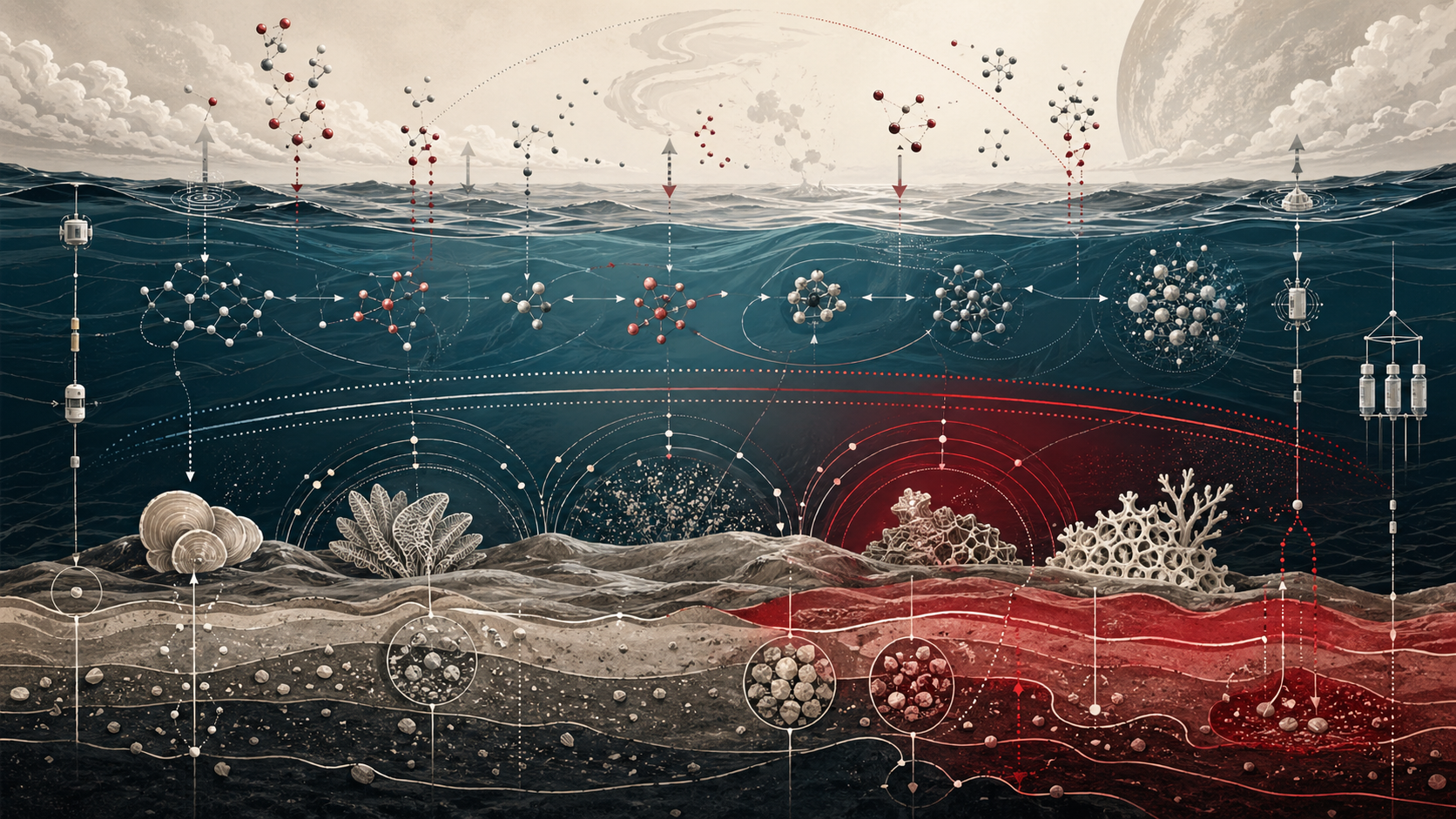
The Ocean as a Chemical System
The ocean is Earth’s largest active fluid reservoir and one of its most important chemical systems. It dissolves atmospheric gases, transports heat and solutes, reacts with rocks and sediments, supports marine life, stores carbon, exchanges material with the atmosphere, receives river inputs, interacts with hydrothermal systems, and records changes in climate and land systems. Ocean chemistry therefore connects atmosphere, geosphere, biosphere, cryosphere, and human activity.
Seawater chemistry is shaped by multiple processes operating at different time scales. River inflow delivers dissolved ions, nutrients, organic matter, and weathering products. Hydrothermal circulation exchanges elements between seawater and oceanic crust. Biological uptake removes nutrients and carbon from surface waters. Respiration releases carbon dioxide and consumes oxygen at depth. Calcium carbonate shells and skeletons form, sink, dissolve, or accumulate in sediments. Gas exchange moves carbon dioxide, oxygen, nitrogen, and other gases across the sea surface. Circulation transports chemical signals across basins and depths.
Because the ocean is chemically connected to climate, its composition is not merely a marine concern. Ocean chemistry affects atmospheric carbon dioxide, marine food webs, fisheries, coral reefs, shellfish, oxygen minimum zones, nutrient availability, trace-metal limitation, coastal water quality, sediment formation, and the long-term regulation of Earth’s surface environment.
For researchers and scientists, ocean chemistry is also a discipline of coupled measurement. A seawater sample can be analyzed for pH, total alkalinity, dissolved inorganic carbon, pCO2, salinity, temperature, oxygen, nutrients, trace metals, dissolved organic carbon, isotopes, particles, and biological signals. None of these variables is fully isolated. Ocean chemistry is a system of interacting equilibria, fluxes, organisms, particles, and physical transport.
Seawater Composition and Major Ions
Seawater is dominated by major ions, especially chloride, sodium, sulfate, magnesium, calcium, potassium, bicarbonate, bromide, borate, strontium, and fluoride. These ions give seawater its salinity, conductivity, density behavior, buffering capacity, and mineral saturation properties. Although salinity varies regionally through evaporation, precipitation, freezing, melting, river input, and mixing, the relative proportions of many major ions in open-ocean seawater are comparatively stable.
This stability allows salinity to serve as a key oceanographic variable. It influences density, stratification, circulation, gas solubility, carbonate equilibrium constants, biological stress, and the interpretation of chemical measurements. Coastal and estuarine systems are more variable because freshwater mixing, sediment interaction, biological activity, groundwater discharge, pollution, and local hydrology can strongly alter chemical composition.
Major ions are not chemically passive. Calcium and carbonate determine calcium carbonate saturation. Magnesium influences carbonate mineral behavior and seawater hardness. Sulfate participates in microbial reduction under anoxic conditions. Bicarbonate and carbonate dominate alkalinity. Borate contributes to buffering. Sodium and chloride influence ionic strength and activity coefficients. In seawater, chemical equilibrium must be interpreted in a high-ionic-strength solution, not in dilute pure water.
Minor and trace constituents also matter. Iron can limit productivity in some ocean regions. Copper can be nutrient or toxicant depending on form and concentration. Iodine, manganese, zinc, cobalt, nickel, molybdenum, cadmium, and rare earth elements can serve as nutrients, tracers, redox indicators, or records of ocean processes. Organic ligands alter metal availability. Particles remove some elements by adsorption and scavenging. Ocean chemistry is therefore not only the chemistry of saltwater, but the chemistry of a complex reactive solution in motion.
Salinity, Density, and Ionic Strength
Salinity links chemical composition to physical oceanography. Together with temperature and pressure, salinity helps determine seawater density. Density controls stratification, mixing, deep-water formation, thermohaline circulation, and the vertical transport of dissolved gases, nutrients, carbon, oxygen, heat, and particles. A chemical signal in the ocean is therefore also a physical transport signal.
Ionic strength matters because seawater is not a dilute laboratory solution. Activity coefficients, equilibrium constants, dissociation behavior, ion pairing, complexation, and gas solubility differ from pure water. Carbonate chemistry calculations therefore require seawater-specific constants and pH scales. A pH value measured or interpreted without attention to seawater scale and temperature basis can be misleading.
Salinity also varies in ways that reveal environmental processes. Evaporation raises salinity. Precipitation and river inflow lower it. Sea-ice formation rejects brine and can increase salinity in surrounding water. Ice melt freshens surface waters. Estuaries mix freshwater and seawater across strong gradients. These changes affect carbonate chemistry, gas exchange, calcium carbonate saturation, and organismal stress.
For researchers, salinity is not a background variable to record casually. It is a core chemical and physical descriptor. It affects calculations, calibrations, density corrections, sampling interpretation, and comparisons across regions. Ocean carbon observations without temperature and salinity context are incomplete.
The Carbonate System
The carbonate system is the central acid-base buffer of seawater. When carbon dioxide enters the ocean, it dissolves and participates in a sequence of equilibria involving aqueous carbon dioxide, carbonic acid, bicarbonate, carbonate, and hydrogen ions. These reactions determine pH, buffering capacity, carbonate ion availability, and calcium carbonate saturation.
A simplified carbonate sequence is:
CO_2(g) \rightleftharpoons CO_2(aq)
\]
Interpretation: Atmospheric carbon dioxide can dissolve into seawater, creating the starting point for carbonate-system chemistry.
CO_2(aq) + H_2O \rightleftharpoons H_2CO_3
\]
Interpretation: Dissolved carbon dioxide interacts with water to form carbonic acid, though in seawater \(CO_2^*\) often represents dissolved carbon dioxide plus carbonic acid.
H_2CO_3 \rightleftharpoons H^+ + HCO_3^-
\]
Interpretation: Carbonic acid can release a proton and form bicarbonate, increasing hydrogen ion concentration.
HCO_3^- \rightleftharpoons H^+ + CO_3^{2-}
\]
Interpretation: Bicarbonate can release another proton and form carbonate ion, the species needed for calcium carbonate saturation.
In seawater, much dissolved inorganic carbon exists as bicarbonate. Carbonate ion concentration is much smaller but critically important because carbonate combines with calcium to form calcium carbonate minerals such as calcite and aragonite. Carbon dioxide and carbonic acid are smaller fractions but strongly influence pH and air-sea exchange.
The carbonate system is powerful because it buffers pH. If the ocean were pure water, adding carbon dioxide would cause much larger pH changes. In seawater, alkalinity and carbonate equilibria absorb part of the chemical perturbation. But buffering is not infinite. As more carbon dioxide enters seawater, hydrogen ion concentration increases, pH declines, carbonate ion concentration decreases, and calcium carbonate saturation state falls.
Alkalinity, DIC, pH, and pCO₂
Ocean carbonate chemistry is commonly described by four measurable carbon-system parameters: pH, dissolved inorganic carbon, total alkalinity, and the partial pressure or fugacity of carbon dioxide. Any two of these, together with temperature, salinity, pressure, nutrients, and equilibrium constants, can be used to calculate the others in a carbonate-system model.
Dissolved inorganic carbon, often abbreviated DIC, is the total concentration of dissolved carbon dioxide species:
DIC = [CO_2^*] + [HCO_3^-] + [CO_3^{2-}]
\]
Interpretation: DIC measures the total inorganic carbon pool, but it does not by itself specify how that carbon is distributed among carbonate species.
Total alkalinity is a measure of seawater’s acid-neutralizing capacity. In practical ocean chemistry, alkalinity reflects the excess of proton acceptors over proton donors in seawater. Carbonate alkalinity is dominated by bicarbonate and carbonate contributions, but borate, hydroxide, phosphate, silicate, organic bases, and other species can contribute. IUPAC defines alkalinity as the capacity of aqueous media to react with hydrogen ions.
pH measures hydrogen ion activity or concentration on a defined scale. Marine pH measurement requires careful scale specification because seawater chemistry differs from dilute solutions. Ocean chemistry commonly uses seawater-specific pH scales, and comparisons must avoid mixing incompatible pH scales.
pCO2 represents the partial pressure of carbon dioxide in equilibrium with seawater. It is central to air-sea exchange because the direction of carbon dioxide flux depends on the difference between seawater and atmospheric carbon dioxide partial pressure, adjusted for gas-transfer conditions.
These four variables are linked, but not interchangeable. A rise in DIC can have different pH consequences depending on alkalinity. A pH value can be difficult to interpret without knowing alkalinity and DIC. A seawater sample can have the same pH as another sample but different buffering capacity. A monitoring system must therefore preserve enough information to reconstruct the carbonate state, not merely record one convenient number.
Air-Sea CO₂ Exchange
The ocean exchanges carbon dioxide with the atmosphere through the sea surface. If surface seawater pCO2 is lower than atmospheric pCO2, carbon dioxide tends to enter the ocean. If surface seawater pCO2 is higher, carbon dioxide tends to outgas to the atmosphere. The flux depends on the pCO2 difference, gas-transfer velocity, wind, turbulence, temperature, salinity, surfactants, sea ice, biological activity, and mixing.
A simplified flux expression is:
F = kK_0(pCO_{2,\mathrm{water}} – pCO_{2,\mathrm{air}})
\]
Interpretation: \(F\) is air-sea carbon dioxide flux, \(k\) is gas-transfer velocity, \(K_0\) is carbon dioxide solubility, and the pCO2 difference determines the direction of exchange. Sign conventions vary and must be stated.
Air-sea exchange is not uniform. Cold waters generally dissolve more carbon dioxide than warm waters. Upwelling can bring carbon-rich deep water to the surface, raising pCO2 and lowering pH. Biological production can draw down carbon dioxide in surface waters, while respiration at depth increases DIC and lowers oxygen. Sea ice can restrict gas exchange, while melting and stratification can alter surface chemistry. Coastal systems can be especially variable because rivers, wetlands, estuaries, sediments, biological activity, and human nutrient inputs affect carbonate chemistry.
Air-sea exchange is also temporally variable. Seasonal warming, cooling, blooms, storms, mixing events, upwelling pulses, river discharge, and sea-ice dynamics can change surface pCO2 and flux direction. A region may act as a carbon sink during one season and a source during another. Long-term interpretation therefore requires repeated measurements, not isolated snapshots.
For researchers, air-sea CO2 flux is a boundary problem: it depends on chemistry, physics, biology, and meteorology. A flux estimate without wind, temperature, salinity, gas-transfer assumptions, and pCO2 measurement context is incomplete.
Calcium Carbonate Saturation
Calcium carbonate saturation state expresses whether seawater is chemically favorable for calcium carbonate precipitation or dissolution. For a calcium carbonate mineral phase, saturation state can be written as:
\Omega = \frac{[Ca^{2+}][CO_3^{2-}]}{K_{sp}}
\]
Interpretation: \(\Omega\) is saturation state, \([Ca^{2+}]\) is calcium ion concentration, \([CO_3^{2-}]\) is carbonate ion concentration, and \(K_{sp}\) is the solubility product for the mineral phase.
Aragonite and calcite have different solubility products. Aragonite is generally more soluble than calcite and is therefore often more vulnerable to decreasing carbonate ion concentrations. When \(\Omega > 1\), seawater is supersaturated with respect to that mineral, and precipitation is thermodynamically favored, although biological and kinetic factors matter. When \(\Omega < 1\), seawater is undersaturated, and dissolution is favored.
Many calcifying organisms experience stress before undersaturation because building and maintaining shells or skeletons becomes energetically more difficult as saturation state declines. Biological calcification depends not only on external saturation, but also on internal pH regulation, ion transport, organic matrices, metabolic energy, food availability, temperature, oxygen, and species-specific physiology.
The saturation horizon is the depth at which \(\Omega = 1\). Above it, water is supersaturated; below it, water is undersaturated. Ocean acidification can shoal saturation horizons, exposing shallower ecosystems and sediments to more corrosive conditions. This matters for pteropods, corals, shellfish, foraminifera, coccolithophores, carbonate sediments, and reef frameworks.
Ocean Acidification
Ocean acidification is the chemical change caused when the ocean absorbs carbon dioxide from the atmosphere. The added carbon dioxide increases dissolved inorganic carbon, increases hydrogen ion concentration, lowers pH, reduces carbonate ion concentration, and lowers calcium carbonate saturation state. The ocean remains alkaline in the everyday sense, but it becomes less alkaline and more acidic relative to its previous state.
The phrase “acidification” can be misunderstood. It does not mean the ocean has become acidic in the sense of having pH below 7. It means the pH has decreased and hydrogen ion concentration has increased. Because pH is logarithmic, seemingly small pH changes can represent substantial changes in hydrogen ion concentration.
Ocean acidification is not chemically isolated from other stressors. Warming reduces gas solubility and increases stratification in many regions. Deoxygenation changes redox-sensitive chemistry and habitat conditions. Nutrient pollution can intensify coastal acidification through respiration of organic matter. Freshwater input, upwelling, sea-ice change, river alkalinity, coastal metabolism, and local pollution can all affect carbonate chemistry. Marine organisms experience carbonate chemistry as part of a broader environmental matrix that includes temperature, oxygen, food, salinity, disease, pollutants, and ecological interactions.
The chemistry is well established: added carbon dioxide shifts carbonate equilibria. The ecological consequences are more variable and depend on species, life stage, adaptive capacity, local environment, co-stressors, food-web structure, and exposure history. Ocean acidification should therefore be understood as both a global chemical trend and a regional ecological problem.
Biological Calcification and Marine Ecosystems
Many marine organisms build structures from calcium carbonate. Corals, oysters, clams, mussels, pteropods, foraminifera, coccolithophores, calcareous algae, echinoderms, and other organisms depend directly or indirectly on carbonate chemistry. Their responses to ocean acidification vary by species, life stage, habitat, adaptation capacity, energy supply, food availability, and co-occurring stressors.
Biological calcification is not simply inorganic precipitation. Organisms regulate internal chemistry, transport ions, build organic matrices, control nucleation sites, and expend energy to form shells or skeletons. Still, external carbonate saturation state matters because it affects the chemical gradient against which organisms calcify and maintain calcium carbonate structures.
Coral reefs are especially important because they are both biological communities and carbonate geological structures. Reef growth depends on calcification exceeding erosion, dissolution, storm damage, bioerosion, and physical breakdown. Lower carbonate saturation can reduce calcification rates, weaken reef accretion, and interact with warming-driven bleaching, pollution, overfishing, sedimentation, and disease.
Shellfish hatcheries and coastal fisheries also illustrate the social relevance of carbonate chemistry. Larval shellfish can be sensitive to low pH and low aragonite saturation. Monitoring pH, alkalinity, pCO2, temperature, salinity, and dissolved oxygen can support adaptive management, early warning, and water-treatment decisions in vulnerable coastal systems.
For researchers, calcification studies should distinguish organismal response from mineral thermodynamics. Saturation state provides a chemical context, but biological outcomes depend on physiology, genetics, life stage, food availability, thermal stress, oxygen, disease, and local adaptation. Good ocean chemistry does not reduce marine ecosystems to one carbonate variable; it uses carbonate chemistry to clarify one central constraint among many.
Nutrients, Oxygen, and Trace Metals
The carbonate system is central, but ocean chemistry includes far more than carbon. Nutrients such as nitrate, phosphate, silicate, ammonium, and iron support marine productivity. Oxygen reflects gas exchange, photosynthesis, respiration, circulation, and organic matter decomposition. Trace metals such as iron, zinc, copper, manganese, cobalt, nickel, cadmium, and molybdenum influence enzyme systems, productivity, toxicity, and redox reactions.
Marine nutrients are shaped by biological uptake at the surface and remineralization at depth. Phytoplankton use nutrients and carbon dioxide to produce organic matter. Some organic matter is consumed near the surface; some sinks and is decomposed in deeper water, releasing nutrients and carbon dioxide while consuming oxygen. This biological pump helps store carbon below the surface ocean and creates vertical chemical gradients.
Oxygen minimum zones form where oxygen demand from respiration is high and ventilation is limited. Deoxygenation can alter nitrogen cycling, trace-metal solubility, habitat availability, and greenhouse-gas production. Under low-oxygen conditions, nitrate reduction, denitrification, anammox, manganese and iron reduction, sulfate reduction, and methane cycling can become more important.
Trace-metal chemistry is affected by ligand binding, redox state, particles, biological uptake, dust deposition, hydrothermal inputs, rivers, sediments, and scavenging. Iron is especially important because it limits productivity in some high-nutrient, low-chlorophyll regions. Ocean chemistry therefore links micronutrient availability to carbon uptake, ecosystem structure, and climate feedbacks.
For researchers, nutrient and trace-metal chemistry requires attention to speciation. Total concentration may not indicate biological availability. Dissolved, particulate, colloidal, organic-bound, inorganic, reduced, oxidized, and ligand-complexed forms can behave differently. Analytical methods must therefore be matched to the chemical question.
Sediments, Carbon Burial, and Deep-Time Chemistry
Ocean sediments preserve chemical records of water-column conditions, biological production, weathering, climate, tectonics, and redox state. Carbonate sediments accumulate where calcium carbonate production and preservation exceed dissolution. Siliceous sediments accumulate where diatoms, radiolarians, or sponges contribute silica. Organic-rich sediments form where organic production and preservation are high relative to oxygen exposure and decomposition.
Carbon burial is central to Earth’s long-term carbon cycle. Organic carbon burial removes reduced carbon from the short-term surface system and can influence atmospheric oxygen over geological time. Carbonate burial stores inorganic carbon and alkalinity relationships in sediments. Subduction, metamorphism, volcanism, weathering, and uplift return buried carbon to active cycles over long time scales.
The carbonate compensation depth is the depth below which calcium carbonate dissolves faster than it accumulates. It depends on pressure, temperature, carbonate ion concentration, circulation, productivity, sedimentation rate, and ocean chemistry. Changes in ocean acidity, circulation, and biological production can shift carbonate preservation patterns in sediments.
Ocean sediments therefore act as both chemical sinks and historical archives. They preserve isotope ratios, trace metals, microfossils, mineral assemblages, organic biomarkers, and carbonate content that help reconstruct past ocean chemistry, climate, productivity, oxygenation, and acidification events.
Deep-time ocean chemistry also reminds researchers that the ocean is dynamic across geological history. Carbonate saturation, alkalinity, oxygenation, nutrient availability, and sediment preservation have changed through Earth history. Modern ocean acidification is unusual not because the ocean has never changed, but because the rate and ecological context of present change matter profoundly.
Coastal Systems, Estuaries, and Local Variability
Coastal ocean chemistry is often more variable than open-ocean chemistry. Estuaries mix river water and seawater across gradients of salinity, alkalinity, dissolved organic matter, nutrients, particles, oxygen, temperature, and biological activity. Coastal wetlands, seagrass beds, mangroves, shellfish reefs, sediments, groundwater, and urban runoff can strongly affect local carbonate chemistry.
Local acidification can be intensified by nutrient enrichment. Excess nutrients can stimulate algal blooms. When organic matter is respired, carbon dioxide increases and oxygen declines, lowering pH and sometimes contributing to hypoxia. In these settings, ocean acidification, eutrophication, deoxygenation, and warming can interact. Coastal organisms experience these stressors together rather than in isolation.
Upwelling systems also create strong carbonate variability. Deep waters enriched in DIC and nutrients can rise to the surface, supporting productivity while also exposing coastal ecosystems to lower pH and lower saturation state. These natural processes can be amplified or altered by anthropogenic carbon, warming, changing winds, and coastal land use.
For researchers and managers, coastal carbonate chemistry requires high-frequency monitoring and local context. A monthly bottle sample may miss daily, tidal, storm-driven, or biological variability. Sensors, moorings, gliders, shore stations, ships, and community monitoring can help reveal the temporal structure of exposure. Coastal chemistry is not only a mean condition; it is a pattern of extremes, variability, and biological timing.
Ocean Chemistry and Climate Regulation
Ocean chemistry is central to climate regulation because the ocean absorbs, stores, transports, and releases carbon dioxide and heat. The solubility pump moves carbon into the ocean where cold waters absorb carbon dioxide and circulation transports it into the interior. The biological pump moves carbon from the surface to depth through biological production, sinking particles, respiration, and burial. The carbonate pump forms calcium carbonate, which affects alkalinity, pCO2, and sediment chemistry.
These pumps are chemical and biological as well as physical. Solubility depends on temperature and salinity. Biological carbon export depends on nutrients, light, food webs, iron availability, ecosystem structure, and remineralization. Calcium carbonate production depends on saturation state, organism physiology, alkalinity, and ecological conditions. Ocean circulation determines how long carbon remains isolated from the atmosphere.
The ocean’s carbon uptake reduces the fraction of emitted carbon dioxide remaining in the atmosphere, but it also changes seawater chemistry. This is the central tradeoff of ocean carbon buffering: the ocean protects the atmosphere from even higher carbon dioxide concentrations while exposing marine systems to acidification and saturation-state decline.
Climate change also feeds back into ocean chemistry. Warming reduces oxygen solubility, alters stratification, changes circulation, affects biological productivity, and can intensify marine heatwaves. Ice melt changes salinity and stratification. Deoxygenation alters redox chemistry. Sea-level rise affects coastal wetlands and carbon burial. Ocean chemistry is therefore not only a passive response to climate change; it is a mediator of Earth-system feedbacks.
Measurement, Monitoring, and Ocean Carbon Evidence
Ocean carbonate chemistry requires disciplined measurement because the variables are tightly coupled and method-sensitive. The major measurable carbon-system parameters are pH, DIC, total alkalinity, and pCO2. Temperature, salinity, pressure, oxygen, nutrients, calcium, magnesium, and quality-control metadata are also important for interpretation.
Measurements can come from research cruises, CTD rosette sampling, Niskin bottles, autonomous floats, moorings, gliders, underway systems, buoys, ship-of-opportunity programs, laboratory titrations, spectrophotometric pH measurements, infrared carbon dioxide systems, coulometry, and certified reference materials. Each approach has strengths and limitations. Bottle samples can be highly accurate but sparse. Sensors can provide high-frequency data but require calibration, drift correction, and validation.
Ocean carbonate data must preserve method, scale, temperature, salinity, pressure, calibration, uncertainty, reference materials, sample handling, poison preservation where relevant, analysis date, instrument identifier, and quality flags. A pH value without its scale, method, temperature basis, and calibration context is incomplete. An alkalinity value without titration method and reference material context is difficult to compare. DIC and pCO2 measurements require careful gas handling, calibration, and sample preservation.
The best ocean-carbon evidence comes from networks, repeated observations, intercalibrated methods, and transparent data systems. Long-term time series and repeated hydrographic sections are especially important because carbonate chemistry changes slowly in some regions, rapidly in others, and seasonally in coastal or high-latitude systems.
For researchers, the measurement system is part of the science. Ocean carbon data are only as strong as their calibration, metadata, intercomparison, quality control, and uncertainty reporting. A carbonate-system calculation that appears precise can still be scientifically weak if the input data are poorly constrained.
Mathematical Lens: Carbonate Equilibria, Alkalinity, and Saturation
Ocean carbonate chemistry is quantitative. The system is governed by acid-base equilibria, mass balance, charge balance, gas exchange, solubility, and mineral saturation.
Dissolved inorganic carbon can be written as:
DIC = [CO_2^*] + [HCO_3^-] + [CO_3^{2-}]
\]
Interpretation: DIC is the sum of dissolved carbon dioxide species. It describes the size of the inorganic carbon pool, not its full chemical distribution.
The first and second dissociation constants of carbonic acid in seawater can be represented as:
K_1 = \frac{[H^+][HCO_3^-]}{[CO_2^*]}
\]
Interpretation: \(K_1\) describes the first dissociation step from dissolved carbon dioxide/carbonic acid toward bicarbonate.
K_2 = \frac{[H^+][CO_3^{2-}]}{[HCO_3^-]}
\]
Interpretation: \(K_2\) describes the second dissociation step from bicarbonate toward carbonate ion.
If \(H = [H^+]\), the fractional distribution of carbonate species can be approximated as:
\alpha_0 = \frac{H^2}{H^2 + K_1H + K_1K_2}
\]
Interpretation: \(\alpha_0\) is the approximate fraction of DIC present as \(CO_2^*\).
\alpha_1 = \frac{K_1H}{H^2 + K_1H + K_1K_2}
\]
Interpretation: \(\alpha_1\) is the approximate fraction of DIC present as bicarbonate.
\alpha_2 = \frac{K_1K_2}{H^2 + K_1H + K_1K_2}
\]
Interpretation: \(\alpha_2\) is the approximate fraction of DIC present as carbonate ion. In real seawater, constants depend on temperature, salinity, pressure, and pH scale.
A simplified carbonate alkalinity expression is:
A_C = [HCO_3^-] + 2[CO_3^{2-}]
\]
Interpretation: Carbonate alkalinity reflects bicarbonate and carbonate contributions. Total alkalinity includes additional acid-base systems, including borate, hydroxide, phosphate, silicate, and other minor contributors.
Calcium carbonate saturation state is:
\Omega = \frac{[Ca^{2+}][CO_3^{2-}]}{K_{sp}}
\]
Interpretation: \(\Omega\) indicates whether seawater is supersaturated or undersaturated with respect to a calcium carbonate mineral phase.
A simplified Revelle factor can be represented conceptually as:
R = \frac{\Delta pCO_2 / pCO_2}{\Delta DIC / DIC}
\]
Interpretation: The Revelle factor expresses how sensitively seawater pCO2 responds to a change in DIC. A higher Revelle factor means that adding DIC produces a larger relative increase in pCO2.
Air-sea carbon dioxide flux can be represented as:
F = kK_0\Delta pCO_2
\]
Interpretation: \(F\) is carbon dioxide flux, \(k\) is gas-transfer velocity, \(K_0\) is solubility, and \(\Delta pCO_2\) is the ocean-atmosphere carbon dioxide gradient. Sign convention must be stated.
These equations make carbonate chemistry tractable, but research-grade seawater calculations require validated constants, pH-scale consistency, temperature and salinity corrections, pressure corrections, nutrient contributions, certified reference materials, and uncertainty propagation.
Computational Workflows for Ocean Chemistry
Computational ocean chemistry can make carbonate-system reasoning transparent and reproducible. A workflow can track station, depth, temperature, salinity, pressure, pH scale, DIC, total alkalinity, pCO2, oxygen, nutrients, calcium, magnesium, measurement method, certified reference material status, uncertainty, quality flags, carbonate speciation, saturation state, and trend summaries.
Useful workflows include carbonate-system calculation, pH-scale conversion, aragonite and calcite saturation screening, air-sea CO2 flux estimation, time-series monitoring, coastal acidification early warning, uncertainty propagation, sensor calibration checks, data-quality flagging, nutrient-oxygen-carbon coupling, and station-level comparison. Advanced workflows may integrate autonomous sensor networks, bottle-sample validation, machine learning gap filling, biogeochemical models, glider missions, and remote-sensing products.
For researchers, computational workflows should preserve metadata and assumptions. A calculated saturation state should record input pair, equilibrium constants, pH scale, temperature, salinity, pressure, calcium assumption, nutrient corrections, and software version. A plot of ocean acidification without methodological context can become visually persuasive but scientifically weak.
The examples below use synthetic data and simplified constants. They are not substitutes for full carbonate-system software, certified ocean carbon measurements, formal monitoring systems, or professional oceanographic interpretation.
Python Example: Carbonate Speciation and Saturation Screening
The following Python example estimates simplified carbonate species fractions from pH and calculates a simplified aragonite saturation screen. It is educational. It is not a substitute for full carbonate-system software, certified measurements, or research-grade seawater calculations.
from dataclasses import dataclass
from typing import Dict, List


@dataclass
class OceanCarbonSample:
    """Synthetic educational ocean-carbon sample.

    This example uses simplified constants for teaching only. It does not
    replace full carbonate-system software, certified ocean-carbon
    measurements, professional monitoring, or research-grade seawater
    calculations.
    """

    station: str
    temperature_c: float
    salinity: float
    ph_total_scale: float
    dic_umol_kg: float
    calcium_mmol_kg: float


# Simplified constants for teaching only.
# Real constants depend on temperature, salinity, pressure, and pH scale.
K1 = 10 ** -6.0
K2 = 10 ** -9.1
KSP_ARAGONITE = 6.5e-7


def carbonate_fractions(ph: float) -> Dict[str, float]:
    """Return simplified alpha fractions for CO2*, HCO3-, and CO3--."""
    h_concentration = 10 ** (-ph)
    denominator = h_concentration**2 + K1 * h_concentration + K1 * K2

    if denominator <= 0:
        return {"alpha_co2_star": 0.0, "alpha_hco3": 0.0, "alpha_co3": 0.0}

    return {
        "alpha_co2_star": h_concentration**2 / denominator,
        "alpha_hco3": K1 * h_concentration / denominator,
        "alpha_co3": K1 * K2 / denominator,
    }


def aragonite_saturation(sample: OceanCarbonSample) -> Dict[str, object]:
    """Calculate simplified carbonate concentration and aragonite saturation."""
    fractions = carbonate_fractions(sample.ph_total_scale)

    dic_mol_kg = sample.dic_umol_kg * 1e-6
    carbonate_mol_kg = fractions["alpha_co3"] * dic_mol_kg
    calcium_mol_kg = sample.calcium_mmol_kg * 1e-3

    omega_aragonite = calcium_mol_kg * carbonate_mol_kg / KSP_ARAGONITE

    return {
        "station": sample.station,
        "pH_total_scale": round(sample.ph_total_scale, 3),
        "carbonate_umol_kg": round(carbonate_mol_kg * 1e6, 2),
        "omega_aragonite_simplified": round(omega_aragonite, 3),
        "saturation_flag": (
            "low saturation attention"
            if omega_aragonite < 2
            else "higher saturation screen"
        ),
    }


samples: List[OceanCarbonSample] = [
    OceanCarbonSample("Open-Ocean-A", 22.0, 35.0, 8.10, 2050, 10.3),
    OceanCarbonSample("Upwelling-B", 10.5, 34.2, 7.78, 2240, 10.1),
    OceanCarbonSample("Reef-C", 27.8, 36.1, 8.02, 1980, 10.5),
    OceanCarbonSample("Estuary-D", 18.2, 28.5, 7.62, 2300, 8.4),
]

for sample in samples:
    print(aragonite_saturation(sample))
This example illustrates the structure of carbonate-system reasoning: pH affects carbonate speciation; carbonate ion concentration affects saturation state; saturation state affects calcification and dissolution risk. A full implementation would use validated carbonate-system libraries, temperature- and salinity-dependent constants, pressure corrections, pH-scale conversions, nutrient corrections, certified reference materials, and uncertainty propagation.
R Example: Ocean Carbon Monitoring Summary
The following R example summarizes synthetic ocean carbonate observations and flags low saturation conditions using simplified calculations. It uses base R for portability.
station <- c("Open-Ocean-A", "Upwelling-B", "Reef-C", "Estuary-D")
temperature_c <- c(22.0, 10.5, 27.8, 18.2)
salinity <- c(35.0, 34.2, 36.1, 28.5)
pH_total_scale <- c(8.10, 7.78, 8.02, 7.62)
DIC_umol_kg <- c(2050, 2240, 1980, 2300)
calcium_mmol_kg <- c(10.3, 10.1, 10.5, 8.4)

ocean <- data.frame(
  station,
  temperature_c,
  salinity,
  pH_total_scale,
  DIC_umol_kg,
  calcium_mmol_kg
)

# Simplified teaching constants only.
K1 <- 10^-6.0
K2 <- 10^-9.1
Ksp_aragonite <- 6.5e-7

carbonate_fraction <- function(pH) {
  H <- 10^(-pH)
  denominator <- H^2 + K1 * H + K1 * K2
  alpha2 <- K1 * K2 / denominator
  return(alpha2)
}

ocean$alpha_CO3 <- sapply(ocean$pH_total_scale, carbonate_fraction)
ocean$carbonate_umol_kg <- ocean$alpha_CO3 * ocean$DIC_umol_kg

# Convert calcium from mmol/kg to mol/kg and carbonate from umol/kg to mol/kg.
ocean$omega_aragonite_simplified <- (
  (ocean$calcium_mmol_kg * 1e-3) *
    (ocean$carbonate_umol_kg * 1e-6)
) / Ksp_aragonite

ocean$saturation_flag <- ifelse(
  ocean$omega_aragonite_simplified < 2,
  "low saturation attention",
  "higher saturation screen"
)

summary_table <- aggregate(
  cbind(
    pH_total_scale,
    DIC_umol_kg,
    carbonate_umol_kg,
    omega_aragonite_simplified
  ) ~ saturation_flag,
  data = ocean,
  FUN = mean
)

print(ocean)
print(summary_table)
The workflow shows how carbonate chemistry becomes computational evidence. Even a simplified model requires pH, DIC, calcium, equilibrium assumptions, unit conversion, and careful interpretation. Research-grade workflows require substantially more rigor.
SQL Example: Ocean Carbon Evidence Register
Ocean carbon observations become more credible when measurements, methods, scales, calibration context, and uncertainty are traceable. A simple evidence register can preserve carbonate-system observations, quality flags, and calculation assumptions.
CREATE TABLE ocean_carbon_sample (
    sample_id INTEGER PRIMARY KEY,
    station TEXT NOT NULL,
    sample_datetime TEXT,
    latitude REAL,
    longitude REAL,
    depth_m REAL CHECK (depth_m >= 0),
    temperature_c REAL,
    salinity REAL CHECK (salinity >= 0),
    ph_value REAL,
    ph_scale TEXT,
    dic_umol_kg REAL CHECK (dic_umol_kg >= 0),
    total_alkalinity_umol_kg REAL CHECK (total_alkalinity_umol_kg >= 0),
    pco2_uatm REAL CHECK (pco2_uatm >= 0),
    oxygen_umol_kg REAL CHECK (oxygen_umol_kg >= 0),
    nitrate_umol_kg REAL CHECK (nitrate_umol_kg >= 0),
    phosphate_umol_kg REAL CHECK (phosphate_umol_kg >= 0),
    quality_flag TEXT,
    uncertainty_notes TEXT
);

CREATE TABLE carbonate_calculation_metadata (
    calculation_id INTEGER PRIMARY KEY,
    sample_id INTEGER NOT NULL,
    carbonate_software TEXT,
    equilibrium_constants TEXT,
    ph_scale_used TEXT,
    calcium_assumption TEXT,
    nutrient_correction_notes TEXT,
    omega_aragonite REAL,
    omega_calcite REAL,
    carbonate_umol_kg REAL,
    confidence_score REAL CHECK (confidence_score BETWEEN 0 AND 1),
    FOREIGN KEY (sample_id) REFERENCES ocean_carbon_sample(sample_id)
);

SELECT
    station,
    sample_datetime,
    depth_m,
    ph_value,
    ph_scale,
    dic_umol_kg,
    total_alkalinity_umol_kg,
    pco2_uatm,
    quality_flag
FROM ocean_carbon_sample
WHERE quality_flag IN ('good', 'review')
ORDER BY station, sample_datetime;
The purpose of this register is to keep carbonate-system interpretation attached to evidence. A saturation-state value should not be detached from the pH scale, input variables, constants, software version, calibration status, sample handling, and uncertainty notes that produced it.
GitHub Repository
The companion repository for this article can support reproducible workflows for carbonate speciation, saturation-state screening, air-sea CO2 flux scenarios, pH and alkalinity monitoring, quality-control metadata, SQL provenance, and responsible ocean-carbon interpretation.
Complete Code Repository
The full code distribution for this article, including selected ocean chemistry examples, carbonate-system workflows, reproducible data structures, saturation-state screening, monitoring summaries, SQL evidence registers, provenance documentation, and scientific-computing scaffolding, is available on GitHub.
Limits, Uncertainty, and Responsible Interpretation
Ocean carbonate chemistry is well established in principle, but difficult in practice. Equilibrium constants vary with temperature, salinity, pressure, and pH scale. pH measurement is method-sensitive. Alkalinity includes more than carbonate alkalinity. DIC and pCO2 require careful sampling and calibration. Coastal systems can deviate from open-ocean assumptions because of organic alkalinity, freshwater input, sediments, biological metabolism, eutrophication, and variable ionic composition.
Models also contain uncertainty. Carbonate-system calculations depend on selected constants and input pairs. Ocean carbon models depend on circulation, mixing, gas exchange, biological export, particle sinking, remineralization, sediment interaction, and future emissions. Regional impacts depend on local ecology, adaptation, food webs, fisheries, nutrient loads, oxygen, temperature, and social vulnerability.
Uncertainty does not weaken the core conclusion that added carbon dioxide changes seawater carbonate chemistry. It clarifies where interpretation must be careful: pH scale, measurement method, local variability, biological response, saturation thresholds, and regional exposure. Good ocean chemistry reports uncertainty rather than hiding it.
The computational examples associated with this article are synthetic and educational. They do not perform certified carbonate-system calculations, determine regulatory compliance, validate sensor networks, assess real ecosystem risk, replace laboratory measurement, or substitute for professional oceanographic interpretation. They are designed to show how carbonate reasoning can be structured, audited, and communicated responsibly.
Responsible interpretation also requires attention to people and place. Ocean acidification affects ecosystems, fisheries, shellfish aquaculture, coastal economies, Indigenous and local food systems, and communities with different capacities to adapt. Ocean chemistry should therefore be communicated with scientific precision and public accountability.
Conclusion
Ocean chemistry and the carbonate system show how a planetary fluid reservoir buffers climate while undergoing chemical change. The ocean absorbs carbon dioxide, redistributes carbon, supports life, builds sediments, regulates pH, and records environmental history. Its carbonate chemistry links molecular equilibria to reefs, shellfish, sediments, climate feedbacks, and Earth-system habitability.
The field’s importance lies in connection. Atmospheric carbon dioxide becomes dissolved inorganic carbon. Dissolved inorganic carbon becomes bicarbonate, carbonate, and hydrogen ions. Hydrogen ions change pH. Carbonate ions control saturation state. Saturation state affects calcification and dissolution. Biological production changes carbon and oxygen. Sediments preserve chemical history. Circulation moves chemical signals through the global ocean.
Ocean chemistry is therefore not a specialized corner of marine science. It is one of the central chemical systems of Earth. To understand climate, carbon cycling, marine ecosystems, acidification, and the long-term habitability of the planet, the carbonate system must be understood as chemistry at planetary scale.
Related articles
- Environmental Chemistry and the Chemical Conditions of Habitability
- Atmospheric Chemistry and Climate Processes
- Water Chemistry and Environmental Monitoring
- Soil Chemistry, Nutrient Cycles, and Land Systems
- Geochemistry and the Chemical History of Earth
- Acids, Bases, and Proton Transfer
- Equilibrium and the Dynamics of Reversible Systems
- Chemical Thermodynamics and Energetics
- Astrochemistry and the Molecular Universe
- Green Chemistry, Responsibility, and Sustainable Transformation
Further reading
- Broecker, W.S. and Peng, T.-H. (1982) Tracers in the Sea. Palisades, NY: Lamont-Doherty Geological Observatory.
- Dickson, A.G., Sabine, C.L. and Christian, J.R. (eds.) (2007) Guide to Best Practices for Ocean CO₂ Measurements. PICES Special Publication 3. Available at: https://www.ncei.noaa.gov/access/ocean-carbon-acidification-data-system/oceans/Handbook_2007.html
- Millero, F.J. (2013) Chemical Oceanography. 4th edn. Boca Raton: CRC Press.
- Pilson, M.E.Q. (2013) An Introduction to the Chemistry of the Sea. 2nd edn. Cambridge: Cambridge University Press.
- Zeebe, R.E. and Wolf-Gladrow, D. (2001) CO₂ in Seawater: Equilibrium, Kinetics, Isotopes. Amsterdam: Elsevier.
- Riebesell, U., Fabry, V.J., Hansson, L. and Gattuso, J.-P. (eds.) (2011) Guide to Best Practices for Ocean Acidification Research and Data Reporting. Luxembourg: Publications Office of the European Union. Available at: https://www.iaea.org/sites/default/files/18/06/oa-guide-to-best-practices.pdf
References
- Dickson, A.G., Sabine, C.L. and Christian, J.R. (eds.) (2007) Guide to Best Practices for Ocean CO₂ Measurements. PICES Special Publication 3. Available at: https://www.ncei.noaa.gov/access/ocean-carbon-acidification-data-system/oceans/Handbook_2007.html
- International Union of Pure and Applied Chemistry (n.d.) Alkalinity. Available at: https://goldbook.iupac.org/terms/view/09034
- National Institute of Standards and Technology (n.d.) NIST Chemistry WebBook. Available at: https://webbook.nist.gov/chemistry/
- National Oceanic and Atmospheric Administration (n.d.) What Is Ocean Acidification? Available at: https://oceanacidification.noaa.gov/what-is-ocean-acidification/
- National Oceanic and Atmospheric Administration (n.d.) Ocean Acidification. Available at: https://www.noaa.gov/education/resource-collections/ocean-coasts/ocean-acidification
- National Oceanic and Atmospheric Administration Ocean Acidification Program (n.d.) Ocean Acidification Monitoring. Available at: https://oceanacidification.noaa.gov/ocean-acidification-research/ocean-acidification-monitoring/
- National Oceanic and Atmospheric Administration Pacific Marine Environmental Laboratory (n.d.) Laboratory Analysis. Available at: https://www.pmel.noaa.gov/co2/story/Laboratory%2BAnalysis
- National Oceanic and Atmospheric Administration National Centers for Environmental Information (n.d.) Ocean Carbon and Acidification Data System. Available at: https://www.ncei.noaa.gov/access/ocean-carbon-acidification-data-system/
- National Oceanic and Atmospheric Administration National Centers for Environmental Information (n.d.) Ocean Carbon and Acidification Data System Products. Available at: https://www.ncei.noaa.gov/products/ocean-carbon-acidification-data-system
- National Oceanic and Atmospheric Administration (n.d.) Ocean Carbon & Biogeochemistry. Available at: https://globalocean.noaa.gov/the-ocean/ocean-carbon-biogeochemistry/
- United States Geological Survey (2012) Studying Ocean Acidification in the Arctic Ocean. Available at: https://pubs.usgs.gov/fs/2012/3058/
- United States Geological Survey (n.d.) Unprecedented Rate and Scale of Ocean Acidification Found in the Arctic. Available at: https://www.usgs.gov/programs/cmhrp/news/unprecedented-rate-and-scale-ocean-acidification-found-arctic