
Last Updated May 28, 2026
Colloids, soft matter, and complex fluids occupy the chemical territory between molecules and bulk materials. They include suspensions, emulsions, foams, gels, sols, aerosols, micelles, vesicles, surfactant systems, protein solutions, polymer solutions, pastes, creams, paints, inks, foods, biological fluids, slurries, and many industrial formulations. These systems are chemically important because their behavior is not determined by composition alone. It depends on particle size, interfaces, surface charge, Brownian motion, aggregation, crowding, flow, deformation, microstructure, and time.
The central thesis of this article is that colloidal and soft-matter systems are not “messy exceptions” to ordinary chemistry. They are a major form of chemical organization. Many of the materials that humans use, consume, manufacture, breathe, apply, inject, pump, print, coat, clean, eat, and release into the environment are not simple liquids or simple solids. They are structured fluids and soft materials whose properties emerge from dispersed phases, continuous phases, interfacial forces, soft networks, dynamic rearrangement, and flow history.
Colloid and soft-matter chemistry therefore connects molecular forces to practical material behavior. It explains why paint spreads but does not immediately drip, why toothpaste holds shape until squeezed, why milk appears uniform despite dispersed fat droplets, why aerosols remain suspended, why gels can be mostly water yet behave like solids, why sludge can resist pumping, why battery slurries depend on rheology, and why formulations can fail through aggregation, coalescence, creaming, sedimentation, aging, or microbial contamination. To understand colloids is to understand chemistry organized at the mesoscale.
Main Library
Publications
Article Map
Chemistry
Related Topic
Physics
Related Topic
Biology
Related Topic
Environmental Science
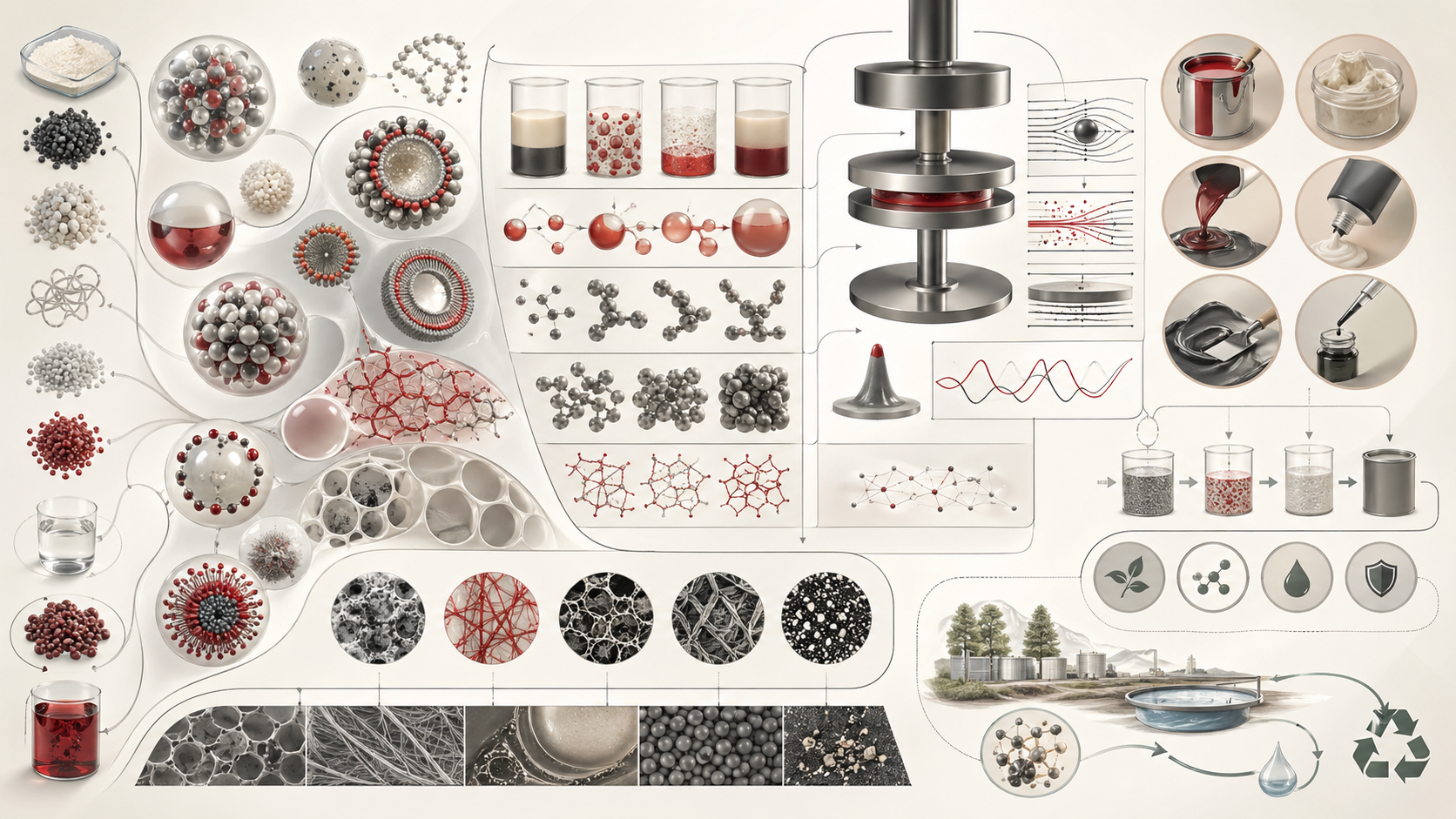
What Colloids and Soft Matter Study
Colloid science studies systems in which small particles, droplets, bubbles, aggregates, polymers, micelles, vesicles, or other mesoscale structures are dispersed in another phase. Soft matter studies materials that are easily deformed by thermal energy, mechanical stress, flow, fields, or interfacial forces. Complex fluids are fluids whose internal microstructure gives them behavior more complicated than that of simple liquids such as water or ethanol.
The overlap among these fields is large. A paint is a colloidal suspension of pigments, binders, additives, and solvents. A mayonnaise-like material is an emulsion stabilized by interfacial chemistry. A shampoo may contain surfactant micelles, polymers, salts, fragrances, droplets, and rheology modifiers. A hydrogel is a swollen polymer or particle network. Blood is a complex biological fluid containing cells, proteins, salts, and plasma. Wastewater sludge, cement paste, drilling mud, ceramic slurry, and battery electrode ink are all chemically structured complex fluids.
Colloids and soft materials are important because they often behave as systems rather than simple substances. They may flow under some stresses but behave like solids under others. They may age, gel, phase-separate, sediment, coalesce, cream, flocculate, shear-thin, shear-thicken, fracture, recover, or self-assemble. Their properties depend not only on molecules but on organization across nanometer, micrometer, and macroscopic scales.
This makes colloid and soft-matter chemistry central to formulation science. Many useful materials are not designed by choosing one compound with one property. They are designed by tuning particle size, droplet size, surfactant coverage, polymer architecture, pH, salt concentration, solvent quality, volume fraction, network strength, interfacial tension, and rheological response. Their function emerges from interactions among components.
For researchers and scientists, the key shift is that composition alone is insufficient. A formulation with the same ingredients can behave differently depending on mixing order, shear history, temperature, aging, particle-size distribution, pH, ionic strength, contamination, and storage conditions. Colloid science is chemistry plus structure plus history.
The Colloidal Scale
The colloidal scale is often described as roughly between molecular dimensions and ordinary visible particles. IUPAC describes “colloidal” as a state of subdivision in which molecules or polymolecular particles dispersed in a medium have at least one dimension roughly between \(1\ \mathrm{nm}\) and \(1\ \mu\mathrm{m}\), or where discontinuities occur at distances of that order. This range matters because thermal motion, surface forces, interfacial area, and gravitational settling compete differently than they do for either small molecules or large particles.
At the colloidal scale, Brownian motion can keep particles suspended. Surface charge can prevent aggregation. Polymer layers can create steric stabilization. Salt can screen electrostatic repulsion and promote flocculation. Droplets can coalesce if their interfacial films fail. Particles can jam at high concentration. Soft particles can deform, squeeze, and pack. The result is a field where chemistry, physics, and materials science are inseparable.
Colloidal systems may appear macroscopically uniform even when they are microscopically heterogeneous. Milk looks like a fluid, but it contains fat droplets, proteins, minerals, and water. Ink may appear as a smooth liquid, but its performance depends on pigment dispersion, solvent evaporation, binder chemistry, particle size, and flow. A gel may appear solid, but it contains liquid trapped in a soft network.
Surface area is one reason the colloidal scale is chemically powerful. A small mass of finely divided particles can expose enormous surface area. Reactions, adsorption, charge accumulation, dissolution, catalytic activity, protein binding, polymer adsorption, and contaminant transport can all be dominated by surfaces. At this scale, interfaces are not minor boundaries; they are functional parts of the material.
The colloidal scale also creates slow dynamics. Sedimentation, ripening, aggregation, aging, network restructuring, phase separation, and drainage may occur over minutes, months, or years. A formulation that seems stable immediately after preparation may fail during storage, shipping, dilution, freeze-thaw cycling, pumping, spraying, heating, or exposure to contaminants. Time is part of colloidal chemistry.
Dispersed Phases and Continuous Phases
A colloidal dispersion contains a dispersed component and a continuous phase. The dispersed phase may be solid particles, liquid droplets, gas bubbles, polymer coils, micelles, aggregates, or biological structures. The continuous phase may be water, oil, air, polymer melt, solvent mixture, electrolyte, biological fluid, or another material phase.
Different combinations create different systems:
- Solid in liquid: suspensions, sols, inks, pigment dispersions, clay suspensions, slurries.
- Liquid in liquid: emulsions such as oil-in-water or water-in-oil systems.
- Gas in liquid: foams, whipped products, flotation systems, bubble dispersions.
- Liquid or solid in gas: aerosols, mists, smoke, atmospheric particles.
- Polymer or surfactant assemblies in liquid: micelles, vesicles, wormlike micelles, gels.
- Networks swollen with liquid: hydrogels, organogels, particle gels, biological matrices.
The continuous phase is not passive. Its viscosity, polarity, pH, ionic strength, solvent quality, temperature, density, and composition influence particle motion, interfacial tension, aggregation, phase separation, and flow. A stable dispersion in one medium may collapse in another. A polymer that stabilizes particles in pure water may fail in salt water. A surfactant that stabilizes droplets at room temperature may desorb or phase-separate at elevated temperature.
Dispersed phases are also chemically active. Particles can dissolve, swell, adsorb molecules, release ions, catalyze reactions, carry charge, degrade, or bind proteins. Droplets can exchange material by diffusion, undergo coalescence, or ripen through solubility differences. Bubbles can shrink, coarsen, or rupture. Soft particles can deform, deswell, or fuse. A dispersion is therefore not merely a mixture of phases. It is an evolving chemical architecture.
For researchers, identifying dispersed and continuous phases is only the first step. The next questions are: What stabilizes the interface? What forces act between dispersed units? What happens under dilution, shear, temperature change, pH shift, salt addition, drying, or aging? What is the relevant length scale for measurement and use?
Major Colloidal and Soft-Matter Systems
Suspensions and Sols
Suspensions contain solid particles dispersed in a fluid. The particles may be minerals, pigments, nanoparticles, cells, polymers, ceramics, catalysts, clays, carbon black, metal oxides, or food particles. Suspensions are important in paints, coatings, ceramics, batteries, pharmaceuticals, water treatment, soils, cement, and environmental transport.
A sol is a fluid colloidal system. Sols can include gold sols, silica sols, protein sols, surfactant solutions above the critical micelle concentration, and other fluid colloidal dispersions. Sol stability depends on particle interactions, solvent conditions, surface charge, steric layers, concentration, and time.
Emulsions
Emulsions contain droplets of one liquid dispersed in another immiscible liquid. Oil-in-water emulsions are common in foods, cosmetics, pharmaceuticals, and coatings. Water-in-oil emulsions are important in foods, fuels, personal care, and chemical processing. Multiple emulsions, such as water-in-oil-in-water systems, contain nested droplet structures.
Emulsions require interfacial stabilization. Surfactants, proteins, particles, polymers, or natural amphiphiles can adsorb at droplet interfaces and reduce coalescence. Emulsion stability may be affected by droplet size, interfacial tension, density difference, viscosity, surfactant concentration, temperature, salt, pH, and mechanical processing.
Foams
Foams contain gas bubbles dispersed in a liquid or solid matrix. Liquid foams are stabilized by surfactants, proteins, polymers, or particles at gas-liquid interfaces. Solid foams include polymer foams, aerogels, foamed metals, and porous ceramics. Foam behavior depends on bubble size, drainage, coarsening, film rupture, elasticity, viscosity, and interfacial stabilization.
Micelles, Vesicles, and Surfactant Assemblies
Surfactants contain both hydrophilic and hydrophobic regions. Above certain concentrations and under suitable conditions, they can self-assemble into micelles, vesicles, bilayers, wormlike micelles, liquid-crystalline phases, and other structures. These assemblies are important in detergency, drug delivery, membrane science, cosmetics, food systems, enhanced oil recovery, and biological chemistry.
Micelles can solubilize hydrophobic molecules. Vesicles can encapsulate aqueous interiors. Wormlike micelles can create viscoelastic fluids. Surfactant phase behavior depends on molecular shape, concentration, salt, temperature, oil, cosurfactants, and additives.
Gels and Soft Networks
Gels contain a network that traps a continuous phase. The network may be formed by polymers, particles, proteins, surfactants, colloids, fibers, or supramolecular assemblies. Hydrogels contain water; organogels contain organic liquids. Gels can be elastic, brittle, viscoelastic, self-healing, responsive, adhesive, injectable, or degradable.
Gels are central to foods, tissues, wound dressings, drug delivery, soft robotics, batteries, sensors, filtration, cosmetics, and biological systems. Their behavior depends on network connectivity, crosslink density, solvent quality, swelling, charge, pore size, and mechanical history.
Pastes, Slurries, and Concentrated Dispersions
Concentrated colloidal systems can become pastes, slurries, creams, inks, or yield-stress fluids. At high particle volume fraction, particles crowd, interact, jam, or form networks. Such systems may not flow until a sufficient stress is applied. Toothpaste, cement paste, ceramic slurry, battery electrode ink, drilling mud, food pastes, and concentrated pigment dispersions are examples.
These systems are often technologically difficult because they must satisfy conflicting demands. A slurry may need to remain stable during storage but flow during coating. A paste may need to hold shape but spread under stress. A foam may need to be stable long enough for use but collapse during cleaning or digestion. A gel may need to be strong but injectable. Soft-matter design is often the design of controlled contradiction.
Forces, Stability, and Aggregation
Colloidal stability is governed by a balance of attractive and repulsive interactions. Attractive interactions include van der Waals forces, depletion attraction, hydrophobic interactions, capillary forces, bridging flocculation, and specific binding. Repulsive interactions include electrostatic repulsion, steric stabilization, hydration forces, osmotic repulsion, and mechanical barriers created by adsorbed polymers or surfactants.
Aggregation occurs when particles stick together. Flocculation can produce loose, reversible clusters. Coagulation often implies stronger, less reversible aggregation. Emulsions can destabilize by creaming, sedimentation, flocculation, coalescence, Ostwald ripening, or phase inversion. Foams can destabilize by drainage, coarsening, coalescence, and film rupture. Suspensions can sediment, cake, gel, or jam.
Salt concentration often matters because ions screen electrostatic repulsion. A charged particle dispersion may be stable at low ionic strength but aggregate when salt is added. pH can alter surface charge. Surfactants can stabilize droplets but may also create phase transitions at different concentrations. Polymers can stabilize particles sterically at one concentration and bridge particles at another.
Stability is therefore context-dependent. A dispersion that is stable in a bottle may destabilize during pumping, dilution, freezing, heating, drying, spraying, centrifugation, sterilization, or storage. A formulation that works in deionized water may fail in hard water. A nanoparticle dispersion stable in buffer may aggregate in blood serum because proteins, salts, and biomolecules change the surface environment.
Stability can also be kinetic rather than thermodynamic. Many colloids are not equilibrium systems. They persist because the pathway to separation, aggregation, or coalescence is slow. This means apparent stability may depend on observation time. A product that remains stable for one day may fail over a month. A test that accelerates stress may reveal failure mechanisms that are invisible in short-term observation.
For researchers, stability analysis should identify the failure mode. Sedimentation, creaming, flocculation, coalescence, gelation, ripening, phase inversion, microbial growth, viscosity drift, and chemical degradation are different problems requiring different solutions. “Unstable” is not a diagnosis. It is the beginning of one.
Interfacial Chemistry, Surfactants, and Surface Charge
Colloids and soft matter are dominated by interfaces. A small droplet, particle, bubble, or vesicle may have a large surface area relative to its volume. That surface can adsorb molecules, carry charge, bind polymers, react with ions, catalyze transformations, or reorganize under stress. Interfacial chemistry often determines whether a system remains dispersed, aggregates, wets a surface, foams, emulsifies, spreads, or flows.
Surfactants are central because they lower interfacial tension and organize at boundaries between incompatible phases. A surfactant molecule typically contains a region with affinity for water and a region with affinity for oil, air, or nonpolar environments. This amphiphilic structure allows surfactants to stabilize droplets, bubbles, micelles, vesicles, films, and interfaces.
Surface charge is another major stabilizing mechanism. Particles may acquire charge through ionization of surface groups, adsorption of ions, lattice substitution, pH-dependent protonation, or dissociation of surface species. Charged surfaces attract counterions and repel similarly charged particles. The resulting electrostatic interactions depend strongly on ionic strength, pH, multivalent ions, and surface chemistry.
Steric stabilization occurs when adsorbed or grafted polymers create a protective layer around particles or droplets. When two coated surfaces approach, polymer layers resist overlap through entropic and osmotic effects. Steric stabilization can be effective in high-salt media where electrostatic repulsion is screened, but it depends on polymer architecture, solvent quality, adsorption strength, and coverage.
Interfacial chemistry also explains why some particles act as stabilizers. Pickering emulsions are stabilized by particles adsorbed at liquid-liquid interfaces. The particles can form a mechanical barrier to coalescence. Their effectiveness depends on wettability, particle size, surface chemistry, shape, roughness, concentration, and interfacial attachment energy.
For researchers, surface and interfacial measurements are often as important as bulk composition. Zeta potential, contact angle, interfacial tension, adsorption isotherms, surface spectroscopy, microscopy, and rheology can reveal why a formulation works or fails. The interface is frequently where the system’s real chemistry lives.
Rheology and Complex-Fluid Flow
Rheology is the study of flow and deformation. For colloids and soft matter, rheology is essential because microstructure controls how a material responds to stress and strain. Water has a nearly constant viscosity under ordinary conditions. Many complex fluids do not. Their viscosity may depend on shear rate, time, temperature, concentration, particle interactions, and flow history.
Common rheological behaviors include:
- Newtonian flow: viscosity is approximately independent of shear rate.
- Shear thinning: apparent viscosity decreases as shear rate increases.
- Shear thickening: apparent viscosity increases as shear rate increases.
- Yield stress: material behaves solid-like until stress exceeds a threshold.
- Thixotropy: viscosity decreases over time under shear and recovers when resting.
- Viscoelasticity: material shows both elastic and viscous response.
- Jamming: crowded particles resist flow because rearrangement becomes constrained.
Rheology links formulation to use. Paint must flow under brushing or spraying but resist dripping after application. Toothpaste must stay on the brush but flow under squeezing. Battery electrode slurries must coat uniformly but maintain particle networks. Foods must feel acceptable during chewing and swallowing. Injectable gels must flow through a needle but recover afterward. Cement paste must be pumpable before setting. Rheology turns colloidal chemistry into practical performance.
Rheology is also method-sensitive. Apparent viscosity may depend on geometry, gap size, wall slip, sample loading, evaporation, temperature, pre-shear, rest time, shear ramp, and measurement duration. A single viscosity value is rarely enough. Flow curves, oscillatory tests, creep tests, recovery tests, yield-stress protocols, and aging tests may all be needed depending on the application.
For researchers, rheology should be treated as a structural measurement. Flow behavior reveals how the microstructure responds to stress. A shear-thinning fluid may contain aligned polymers, broken networks, or disrupted aggregates. A yield stress may reflect a particle network, emulsion crowding, gel structure, or jammed packing. Rheology is not only a processing tool; it is a window into mesoscale organization.
Gels, Networks, and Yield-Stress Materials
Many colloidal and soft-matter systems form networks. Networks may arise from polymer crosslinking, particle attraction, fiber entanglement, surfactant assembly, protein gelation, crystallization, phase separation, or jamming. A network can give a material elasticity, yield stress, shape retention, self-healing, or slow release.
Yield-stress materials behave like soft solids at low stress and flow like fluids above a critical stress. This behavior is common in concentrated emulsions, particle gels, foams, pastes, muds, creams, food materials, and many industrial suspensions. The yield stress is not a single universal property; it can depend on measurement protocol, sample history, aging, wall slip, temperature, and shear preconditioning.
Soft networks can also age. A colloidal gel may become stiffer over time as particles rearrange. A protein gel may strengthen as bonds continue forming. A clay suspension may rebuild structure after shear. A surfactant network may break and reform under flow. Time dependence is a central feature of soft matter.
Gels are especially important because they can combine high solvent content with solid-like behavior. A hydrogel may be mostly water but still support mechanical load. A biological tissue may behave as a hydrated polymer network reinforced by cells and extracellular matrix. A battery gel electrolyte may conduct ions while reducing leakage. A food gel may control texture, release, and mouthfeel. Gels show that “solid” and “liquid” are not always separate categories.
Network design requires attention to connectivity. Crosslink density, particle attraction, polymer entanglement, reversible bonds, ionic interactions, hydrogen bonding, hydrophobic association, crystallites, and physical constraints all shape mechanical behavior. Reversible networks can self-heal or respond to stimuli; permanent networks may provide strength but less adaptability.
For researchers, gel and yield-stress behavior must be interpreted through both chemistry and history. How a sample was prepared, rested, sheared, aged, and loaded can determine what it appears to be. Soft matter remembers.
Biological Soft Matter and Crowded Living Fluids
Biological systems are full of colloids and soft matter. Blood, mucus, cytoplasm, extracellular matrix, synovial fluid, saliva, tears, milk, biofilms, protein condensates, cell membranes, lipid vesicles, chromosomes, tissues, and microbial suspensions all contain soft, hydrated, crowded, interfacial structures. Living systems are not dilute solutions of isolated molecules. They are structured chemical environments.
Crowding changes chemistry because molecules, polymers, proteins, membranes, and particles occupy space and interact. Diffusion can slow. Phase separation can occur. Proteins can aggregate. Vesicles can fuse. Cells can deform. Mucus can trap particles. Biofilms can create gradients in oxygen, nutrients, pH, and antibiotics. Soft-matter chemistry helps explain why biological function depends on physical organization as well as molecular identity.
Protein solutions are colloidal in many practical contexts. They can aggregate, gel, phase-separate, adsorb to interfaces, denature under shear, or respond to salt and pH. This matters for biotechnology, pharmaceuticals, diagnostics, food science, and disease. Protein aggregation can be a manufacturing problem, a storage problem, or a biological pathology depending on context.
Biological soft matter also informs materials design. Hydrogels can mimic tissue environments. Vesicles and nanoparticles can deliver drugs. Responsive polymers can change swelling, charge, or permeability. Microgels can behave like soft colloidal particles. Bioinspired materials often work because they borrow principles from living soft matter: hierarchical structure, water-rich networks, reversible bonds, dynamic interfaces, and stimuli responsiveness.
For researchers, biological soft matter is a reminder that chemistry in living systems is not only reaction chemistry. It is transport, mechanics, interfaces, crowding, phase behavior, and dynamic organization. Life is chemically soft.
Industrial Formulations, Processing, and Manufacturing
Many industrial products are formulations rather than pure substances. Paints, coatings, inks, adhesives, detergents, shampoos, lotions, pharmaceuticals, foods, agrochemicals, cement, ceramics, drilling fluids, polishing slurries, battery electrode inks, and wastewater-treatment streams all require control over colloidal and soft-matter behavior. The product must be chemically stable, processable, usable, and safe under real conditions.
Formulation design often involves several coupled goals: disperse particles, stabilize droplets, prevent sedimentation, control viscosity, tune yield stress, improve wetting, manage drying, prevent microbial growth, deliver active ingredients, minimize odor, resist temperature cycling, reduce solvent burden, and maintain performance after storage. Changing one ingredient can alter several properties at once.
Processing matters because colloidal systems are history-dependent. Mixing order, shear intensity, milling time, homogenization pressure, temperature, pH adjustment, salt addition, polymer hydration, surfactant addition, and degassing can change final microstructure. A formulation that looks identical on a label may behave differently if made by a different process.
Manufacturing scale can reveal failures that laboratory tests miss. Large tanks may mix less uniformly than small beakers. Pumps may shear droplets or break networks. Filters may clog. Air entrainment may produce foam. Storage tanks may encourage sedimentation. Coating lines may expose rheological defects. Spray systems may aerosolize particles. Drying may concentrate salts, polymers, or surfactants and trigger phase separation.
For researchers and manufacturers, formulation science requires connecting chemistry to processing windows. The question is not only whether a formulation can be made once. It is whether it can be made reproducibly, stored safely, shipped, used, cleaned, disposed of, and tested under realistic conditions.
Environmental Colloids, Aerosols, and Transport
Colloids are environmentally important because they move through air, water, soils, sediments, and organisms. Atmospheric aerosols affect climate, visibility, air quality, cloud formation, and respiratory exposure. Soil colloids transport nutrients, organic matter, metals, pathogens, and contaminants. Riverine colloids carry phosphorus, organic carbon, metals, and microplastics. Wastewater contains colloidal organic matter, sludge particles, emulsified oils, surfactants, polymers, and biological aggregates.
Environmental colloids can increase or decrease contaminant mobility. A metal sorbed to immobile soil particles may be retained locally, while the same metal associated with mobile colloids may travel through groundwater or surface water. Hydrophobic organic contaminants may bind to organic colloids or microplastics. Nanoparticles may aggregate, dissolve, transform, or interact with natural organic matter. Colloid-facilitated transport is therefore important in environmental chemistry and risk assessment.
Aerosols are colloidal systems in air. They include dust, smoke, sea salt, sulfate, nitrate, organic aerosol, soot, biological particles, and droplets. Their behavior depends on size, composition, hygroscopicity, charge, optical properties, coagulation, deposition, and atmospheric chemistry. Aerosol particles can scatter light, absorb radiation, serve as cloud condensation nuclei, carry toxic compounds, and penetrate different regions of the respiratory tract depending on size.
Environmental colloids also interact with governance. Water treatment often relies on coagulation and flocculation to remove colloids. Air-quality policy monitors particulate matter. Wastewater treatment depends on sludge floc structure. Soil conservation depends on clay and organic matter behavior. Microplastic and nanoparticle concerns require understanding particle persistence, transport, exposure, and recovery.
For researchers, environmental colloids show that “dissolved” and “particulate” are not always simple categories. Colloids occupy the middle: mobile enough to move, large enough to carry surfaces, and reactive enough to alter fate. They are often where environmental chemistry becomes transport chemistry.
Characterization and Measurement
Colloids and complex fluids require multiple characterization methods because size, structure, stability, and flow are linked. A formulation may need particle size analysis, microscopy, zeta potential, scattering, rheology, sedimentation tests, interfacial tension, surface chemistry, conductivity, pH, density, thermal analysis, and aging studies.
Common methods include:
- dynamic light scattering for hydrodynamic size;
- laser diffraction for particle-size distributions;
- microscopy for droplet, particle, foam, or network structure;
- small-angle X-ray or neutron scattering for mesoscale organization;
- zeta potential for electrokinetic behavior;
- rheometry for viscosity, yield stress, viscoelasticity, and flow curves;
- interfacial-tension measurement for emulsions and surfactant systems;
- centrifugation, sedimentation, creaming, and accelerated aging tests;
- spectroscopy for surface chemistry, surfactant adsorption, or composition;
- microfluidic and imaging methods for droplet formation and local flow.
Measurement must match the question. A droplet-size distribution is not the same as emulsion stability. Zeta potential does not fully predict aggregation in complex media. Viscosity at one shear rate may not describe pumping, spraying, spreading, swallowing, or settling. A stable formulation under static storage may fail under freeze-thaw cycling or high shear.
Sample preparation can strongly influence results. Diluting a sample before particle-size analysis can change aggregation state. Filtering can remove the very structures being studied. Sonication can break aggregates or droplets. Centrifugation can force separations that would not occur during storage. Drying can create artifacts in microscopy. Rheology can be distorted by wall slip, evaporation, loading history, or particle migration.
For researchers, strong characterization combines methods. Particle size, microscopy, rheology, zeta potential, and aging data together can explain behavior better than any one metric alone. Colloid science is often evidence-by-convergence because microstructure, forces, and flow cannot be fully inferred from one measurement.
Stability Testing, Aging, and Failure Modes
Stability testing asks whether a colloidal or soft-matter system maintains its intended structure and function over time. Because these systems are metastable, dynamic, and history-dependent, stability must be tested under realistic storage, transport, processing, and use conditions.
Important stability tests include static storage, accelerated centrifugation, thermal cycling, freeze-thaw cycling, humidity exposure, light exposure, microbial challenge where relevant, dilution testing, salt challenge, pH challenge, shear testing, pump-loop testing, spray testing, vibration testing, evaporation testing, and long-term aging. The right test depends on the failure mode of concern.
Failure modes include sedimentation, creaming, caking, flocculation, coagulation, coalescence, Ostwald ripening, drainage, foam collapse, syneresis, gelation, viscosity drift, phase inversion, crystallization, microbial growth, chemical degradation, odor formation, color change, particle growth, aggregation, and loss of active ingredient.
Accelerated tests require caution. A centrifuge may exaggerate sedimentation but not predict network aging. High temperature may accelerate chemical degradation but also create phase behavior not present at room temperature. Freeze-thaw testing may be relevant for shipping in cold climates but not for all applications. Accelerated tests are useful when they are tied to mechanisms, not when used as generic shortcuts.
For researchers and formulators, stability is not one property. It is preservation of the relevant microstructure and performance over the relevant time scale. A stable shampoo, vaccine suspension, food emulsion, coating, battery slurry, and wastewater sludge are stable in different senses. Stability must be defined by use.
Applications of Colloids and Complex Fluids
Colloids and soft matter are everywhere because they connect chemical composition to usable form. Many products must be stable enough to store but responsive enough to use. Many biological systems are soft, hydrated, crowded, dynamic, and interfacial. Many manufacturing processes depend on controlling particles, droplets, bubbles, polymers, and networks under flow.
Important application areas include:
- paints, coatings, inks, and pigments;
- foods, beverages, foams, emulsions, and gels;
- cosmetics, creams, shampoos, lotions, and personal-care formulations;
- pharmaceutical suspensions, emulsions, and delivery systems;
- biological fluids, protein solutions, and biomedical gels;
- water treatment, wastewater sludge, soils, and environmental colloids;
- battery electrode slurries and energy-material inks;
- cement, concrete admixtures, ceramics, and construction materials;
- enhanced oil recovery, drilling fluids, and mineral processing;
- microfluidics, printing, spraying, extrusion, and additive manufacturing.
In each case, the chemical challenge is not only to choose ingredients. It is to control microstructure, stability, flow, aging, interfaces, and performance under realistic conditions. A material that is chemically correct but rheologically unusable may fail. A formulation that performs initially but separates during storage may fail. A suspension that is stable but impossible to clean, recycle, or treat may create downstream burdens.
Applications also show why colloid science is interdisciplinary. Food scientists care about texture and shelf life. Environmental scientists care about particle transport and exposure. Pharmaceutical scientists care about stability, delivery, and bioavailability. Engineers care about pumping, coating, filtration, and clogging. Chemists care about interfaces, forces, and formulation. Soft matter sits across all of these fields because dispersed systems are common to all of them.
For researchers, the application question should always specify the performance environment. Does the material need to sit, flow, spread, spray, gel, break, recover, foam, coat, release, suspend, settle, filter, inject, print, or degrade? The answer determines what “good chemistry” means.
Sustainability, Exposure, and Responsible Formulation
Colloids and complex fluids raise sustainability questions because they often involve surfactants, polymers, particles, solvents, preservatives, pigments, oils, additives, and dispersed materials that move through manufacturing, use, wastewater, air, soil, packaging, and waste systems. A formulation that works well technically may create persistence, toxicity, microplastic release, difficult recycling, solvent emissions, or aquatic exposure concerns.
Responsible formulation design includes:
- selecting safer surfactants, solvents, polymers, pigments, and preservatives where possible;
- reducing persistent or bioaccumulative additives;
- understanding how dispersed particles behave during use, cleaning, wastewater treatment, and disposal;
- avoiding unsupported claims about biodegradability, non-toxicity, or environmental safety;
- designing concentrated formulations to reduce packaging and transport burdens when safe and practical;
- testing stability under realistic storage, dilution, temperature, shear, and contamination conditions;
- considering worker exposure during powder handling, spraying, aerosolization, mixing, and cleaning;
- connecting formulation chemistry to lifecycle, recovery, reuse, and environmental fate.
The ethical strength of colloid and soft-matter chemistry lies in responsible control of dispersed systems. These materials shape how chemicals are delivered, applied, consumed, washed away, inhaled, absorbed, released, recycled, or degraded. Their chemistry is inseparable from their behavior in real environments.
Responsible formulation also requires attention to particle release. Nanoparticles, pigments, microgels, polymer particles, droplets, and aerosols may move beyond the intended product. A sunscreen, paint, coating, cleaner, spray, food additive, or industrial slurry can create exposure through skin, inhalation, ingestion, wastewater, occupational handling, or disposal. The relevant question is not only whether the ingredients are approved or useful, but how they behave as dispersed systems through the full lifecycle.
For researchers and institutions, sustainability in colloids should be evidence-based. Claims should be supported by composition, degradation, stability, exposure, particle release, wastewater behavior, toxicity, and recovery data where relevant. A “natural” formulation is not automatically safe. A “synthetic” formulation is not automatically harmful. Responsible design depends on evidence, not labels.
Mathematical Lens: Brownian Motion, Diffusion, Volume Fraction, and Viscosity
Colloidal behavior is often governed by competition between thermal motion, gravity, interparticle forces, and flow. For a spherical particle in a dilute fluid, the Stokes-Einstein equation approximates diffusion:
D = \frac{k_B T}{3\pi \eta d_h}
\]
Interpretation: \(D\) is diffusion coefficient, \(k_B\) is Boltzmann’s constant, \(T\) is temperature, \(\eta\) is dynamic viscosity, and \(d_h\) is hydrodynamic diameter. Larger hydrodynamic diameter or higher viscosity reduces diffusion.
Particle volume fraction is central in suspensions:
\phi = \frac{V_{\mathrm{particles}}}{V_{\mathrm{total}}}
\]
Interpretation: \(\phi\) is particle volume fraction. As \(\phi\) increases, particles interact more frequently, viscosity rises, and the system may become crowded, structured, or jammed.
For a very dilute suspension of hard spheres, Einstein’s viscosity relation gives:
\eta = \eta_0(1 + 2.5\phi)
\]
Interpretation: \(\eta\) is suspension viscosity and \(\eta_0\) is the continuous-phase viscosity. This equation is limited to dilute, idealized systems. Concentrated real suspensions often show nonlinear viscosity increases, shear thinning, shear thickening, yield stress, or jamming.
A simple sedimentation velocity for an isolated sphere under Stokes flow is:
v = \frac{2a^2(\rho_p-\rho_f)g}{9\eta}
\]
Interpretation: \(v\) is settling velocity, \(a\) is particle radius, \(\rho_p\) and \(\rho_f\) are particle and fluid densities, \(g\) is gravitational acceleration, and \(\eta\) is viscosity. Smaller particles and more viscous fluids settle more slowly.
A simple power-law model for non-Newtonian flow is:
\tau = K\dot{\gamma}^{n}
\]
Interpretation: \(\tau\) is shear stress, \(K\) is consistency index, \(\dot{\gamma}\) is shear rate, and \(n\) is flow behavior index. If \(n < 1\), the material is shear-thinning. If \(n > 1\), it is shear-thickening. If \(n = 1\), the model reduces to Newtonian-like proportionality between stress and shear rate.
For yield-stress fluids, the Herschel-Bulkley model adds a yield stress:
\tau = \tau_y + K\dot{\gamma}^{n}
\]
Interpretation: \(\tau_y\) is yield stress. This model is useful for pastes, gels, creams, suspensions, and other soft materials, but parameters depend on measurement protocol and sample history.
A simple Péclet number compares flow-driven transport with diffusion:
Pe = \frac{\dot{\gamma}a^2}{D}
\]
Interpretation: \(Pe\) compares shear-driven rearrangement to Brownian diffusion for particles of radius \(a\). When \(Pe\) is large, flow dominates over thermal diffusion.
These equations are useful because they reveal why colloids behave differently from simple fluids. Size, viscosity, thermal motion, concentration, gravity, and shear history all matter. The equations are not complete descriptions of real formulations, but they make the controlling variables visible.
Computational Workflows for Colloids and Complex Fluids
Computational workflows can make colloidal and soft-matter interpretation more transparent. A workflow can track formulation identity, system type, dispersed phase, continuous phase, particle or droplet size, size distribution, zeta potential, pH, ionic strength, volume fraction, low-shear viscosity, high-shear viscosity, yield stress, aging condition, salt sensitivity, sedimentation behavior, temperature, measurement method, and review flags.
Useful workflows include particle-size trend analysis, stability flagging, rheology screening, shear-thinning classification, yield-stress review, sedimentation estimates, salt-challenge comparison, pH-stability screening, aging trend analysis, formulation-replicate summaries, and quality-control dashboards. More advanced workflows may integrate microscopy image analysis, rheometer files, scattering data, accelerated stability instruments, microfluidic droplet data, machine-learning formulation design, and lifecycle exposure records.
For researchers, computational workflows should preserve protocol. Viscosity at one shear rate is not comparable to viscosity at another. Zeta potential depends on medium, pH, ionic strength, and measurement method. Particle-size values depend on method and model. A stability score without stress conditions is weak. A formulation database should store preparation history and measurement context, not only ingredient lists.
The examples below use synthetic data. They do not qualify products, establish food safety, determine medical suitability, validate environmental claims, or replace professional formulation testing. They demonstrate how colloid and soft-matter reasoning can be structured, audited, and communicated responsibly.
Python Example: Colloidal Stability and Rheology Screening
The following Python example uses synthetic educational data to screen colloidal formulations for particle stability, salt sensitivity, viscosity behavior, and yield-stress review. Real formulation work requires validated methods, replicate measurements, aging studies, temperature control, contamination control, and application-specific testing.
from pathlib import Path
from typing import Dict, List
import json
import math

import pandas as pd


# Synthetic colloids and complex fluids workflow.
# Educational example only; not for product qualification, food safety,
# medical, environmental, or manufacturing claims.


def screen_colloidal_systems(systems: pd.DataFrame) -> pd.DataFrame:
    """Calculate simple colloidal stability and rheology screening metrics.

    This model is illustrative. Real colloid and complex-fluid evaluation
    requires validated particle-size measurements, rheology protocols,
    aging studies, temperature control, contamination control, and
    application-specific testing.
    """

    systems = systems.copy()

    k_B = 1.380649e-23
    temperature_K = 298.15
    water_viscosity_Pa_s = 0.00089

    systems["hydrodynamic_diameter_m"] = (
        systems["particle_or_droplet_size_nm"] * 1e-9
    )

    systems["diffusion_m2_s"] = (
        k_B * temperature_K
        / (
            3.0
            * math.pi
            * water_viscosity_Pa_s
            * systems["hydrodynamic_diameter_m"]
        )
    )

    systems["shear_thinning_ratio"] = (
        systems["low_shear_viscosity_Pa_s"]
        / systems["high_shear_viscosity_Pa_s"]
    )

    systems["electrostatic_stability_review"] = (
        systems["zeta_potential_mV"].abs() < 20.0
    )

    systems["aggregation_review"] = (
        systems["salt_aggregation_index"] > 0.30
    )

    systems["yield_stress_review"] = (
        systems["yield_stress_Pa"] > 10.0
    )

    systems["high_crowding_review"] = (
        systems["volume_fraction"] > 0.25
    )

    systems["high_shear_thinning_review"] = (
        systems["shear_thinning_ratio"] > 8.0
    )

    systems["formulation_review_required"] = (
        systems["electrostatic_stability_review"]
        | systems["aggregation_review"]
        | systems["yield_stress_review"]
        | systems["high_crowding_review"]
        | systems["high_shear_thinning_review"]
    )

    # Lower score indicates fewer stability and handling concerns.
    systems["screening_score"] = (
        1.2 * systems["salt_aggregation_index"]
        + 0.8 * systems["volume_fraction"]
        + 0.01 * systems["yield_stress_Pa"]
        + 0.04 * systems["shear_thinning_ratio"]
        + 0.25 * systems["electrostatic_stability_review"].astype(int)
    )

    ranked = systems.sort_values("screening_score").copy()
    ranked["rank"] = range(1, len(ranked) + 1)

    ranked.attrs["temperature_K"] = temperature_K
    ranked.attrs["continuous_phase_viscosity_Pa_s"] = water_viscosity_Pa_s

    return ranked


systems = pd.DataFrame({
    "formulation_id": ["col_A", "col_B", "col_C", "col_D", "col_E"],
    "system_type": [
        "silica_sol",
        "oil_in_water_emulsion",
        "particle_gel",
        "surfactant_micelles",
        "clay_suspension",
    ],
    "particle_or_droplet_size_nm": [80.0, 450.0, 300.0, 8.0, 900.0],
    "zeta_potential_mV": [-42.0, -18.0, -12.0, -5.0, -35.0],
    "volume_fraction": [0.04, 0.22, 0.35, 0.02, 0.28],
    "low_shear_viscosity_Pa_s": [0.012, 0.85, 18.0, 0.006, 5.4],
    "high_shear_viscosity_Pa_s": [0.010, 0.19, 1.2, 0.005, 0.82],
    "yield_stress_Pa": [0.0, 4.2, 85.0, 0.0, 36.0],
    "salt_aggregation_index": [0.08, 0.22, 0.48, 0.05, 0.31],
})

ranked = screen_colloidal_systems(systems)

output_dir = Path("outputs")
output_dir.mkdir(exist_ok=True)

ranked.to_csv(
    output_dir / "colloid_complex_fluid_screening_ranked.csv",
    index=False,
)

manifest: Dict[str, object] = {
    "workflow": "synthetic_colloid_complex_fluid_screening",
    "temperature_K": ranked.attrs["temperature_K"],
    "continuous_phase_viscosity_Pa_s": ranked.attrs[
        "continuous_phase_viscosity_Pa_s"
    ],
    "best_candidate": ranked.iloc[0]["formulation_id"],
    "responsible_use": [
        "Synthetic educational data only.",
        "Real colloid and complex-fluid evaluation requires validated particle-size, stability, rheology, aging, and application-specific testing.",
    ],
}

with (output_dir / "colloid_soft_matter_manifest.json").open(
    "w",
    encoding="utf-8"
) as file:
    json.dump(manifest, file, indent=2)

print(ranked[[
    "formulation_id",
    "system_type",
    "particle_or_droplet_size_nm",
    "volume_fraction",
    "shear_thinning_ratio",
    "diffusion_m2_s",
    "screening_score",
    "rank",
    "formulation_review_required",
]])
This workflow shows how colloidal systems can be screened as both stability problems and flow problems. A formulation may be stable but too viscous, flowable but prone to aggregation, or useful in storage but difficult to pump, spread, spray, inject, or process. The purpose is not the synthetic ranking itself, but the transparent structure: size, charge, volume fraction, viscosity, yield stress, and salt sensitivity are interpreted together.
R Example: Replicate Rheology and Stability Flags
The following R example uses synthetic replicate measurements to summarize viscosity, yield stress, and aggregation stability. In real work, rheological results depend strongly on instrument geometry, loading, pre-shear, rest time, temperature, evaporation, wall slip, particle migration, and measurement protocol.
# Synthetic colloid and complex-fluid replicate workflow.
# Educational example only; not for product qualification or safety claims.

replicates <- data.frame(
  formulation_id = c(
    "col_A", "col_A", "col_A",
    "col_B", "col_B", "col_B",
    "col_C", "col_C", "col_C"
  ),
  replicate = c(1, 2, 3, 1, 2, 3, 1, 2, 3),
  low_shear_viscosity_Pa_s = c(
    0.012, 0.011, 0.013,
    0.85, 0.91, 0.82,
    18.0, 19.4, 17.6
  ),
  high_shear_viscosity_Pa_s = c(
    0.010, 0.010, 0.011,
    0.19, 0.20, 0.18,
    1.2, 1.4, 1.1
  ),
  yield_stress_Pa = c(
    0.0, 0.0, 0.0,
    4.2, 4.8, 3.9,
    85.0, 91.0, 82.0
  ),
  salt_aggregation_index = c(
    0.08, 0.09, 0.07,
    0.22, 0.24, 0.21,
    0.48, 0.52, 0.45
  )
)

summary_table <- aggregate(
  cbind(
    low_shear_viscosity_Pa_s,
    high_shear_viscosity_Pa_s,
    yield_stress_Pa,
    salt_aggregation_index
  ) ~ formulation_id,
  data = replicates,
  FUN = function(x) c(mean = mean(x), sd = sd(x))
)

summary_clean <- data.frame(
  formulation_id = summary_table$formulation_id,
  mean_low_shear_viscosity_Pa_s =
    summary_table$low_shear_viscosity_Pa_s[, "mean"],
  sd_low_shear_viscosity_Pa_s =
    summary_table$low_shear_viscosity_Pa_s[, "sd"],
  mean_high_shear_viscosity_Pa_s =
    summary_table$high_shear_viscosity_Pa_s[, "mean"],
  sd_high_shear_viscosity_Pa_s =
    summary_table$high_shear_viscosity_Pa_s[, "sd"],
  mean_yield_stress_Pa =
    summary_table$yield_stress_Pa[, "mean"],
  sd_yield_stress_Pa =
    summary_table$yield_stress_Pa[, "sd"],
  mean_salt_aggregation_index =
    summary_table$salt_aggregation_index[, "mean"],
  sd_salt_aggregation_index =
    summary_table$salt_aggregation_index[, "sd"]
)

summary_clean$shear_thinning_ratio <- (
  summary_clean$mean_low_shear_viscosity_Pa_s /
    summary_clean$mean_high_shear_viscosity_Pa_s
)

summary_clean$review_required <- (
  summary_clean$mean_yield_stress_Pa > 10 |
    summary_clean$mean_salt_aggregation_index > 0.30 |
    summary_clean$shear_thinning_ratio > 10
)

dir.create("outputs", showWarnings = FALSE)

write.csv(
  summary_clean,
  file = "outputs/colloid_rheology_replicate_summary.csv",
  row.names = FALSE
)

sink("outputs/colloid_soft_matter_report.txt")
cat("Synthetic Colloid and Soft Matter Report\n")
cat("=======================================\n\n")
cat("Replicate rheology and stability summary:\n")
print(summary_clean)
cat("\nResponsible-use note:\n")
cat("Synthetic educational data only. Real colloid and complex-fluid evaluation requires validated particle-size, stability, rheology, aging, and application-specific testing.\n")
sink()

print(summary_clean)
This workflow reinforces an important measurement principle: complex-fluid properties are not single fixed numbers. They are responses to protocols, histories, stresses, times, and environments. Replicate measurements help distinguish formulation behavior from measurement noise, sample handling, or uncontrolled preparation differences.
SQL Example: Colloid and Soft-Matter Evidence Register
Colloid and soft-matter interpretation becomes more reliable when formulation composition, preparation history, particle-size data, rheology protocols, stability tests, and review flags are traceable. A simple evidence register can preserve the context needed to audit formulation performance and failure modes.
CREATE TABLE colloid_formulation (
    formulation_id TEXT PRIMARY KEY,
    formulation_name TEXT NOT NULL,
    system_type TEXT,
    dispersed_phase TEXT,
    continuous_phase TEXT,
    preparation_method TEXT,
    mixing_history TEXT,
    pH REAL,
    ionic_strength_mM REAL CHECK (ionic_strength_mM >= 0),
    responsible_use_notes TEXT
);

CREATE TABLE particle_size_measurement (
    size_measurement_id INTEGER PRIMARY KEY,
    formulation_id TEXT NOT NULL,
    measurement_datetime TEXT,
    method_name TEXT,
    particle_or_droplet_size_nm REAL CHECK (particle_or_droplet_size_nm >= 0),
    polydispersity_index REAL CHECK (polydispersity_index >= 0),
    dilution_factor REAL CHECK (dilution_factor >= 0),
    temperature_c REAL,
    quality_flag TEXT,
    FOREIGN KEY (formulation_id) REFERENCES colloid_formulation(formulation_id)
);

CREATE TABLE rheology_measurement (
    rheology_id INTEGER PRIMARY KEY,
    formulation_id TEXT NOT NULL,
    measurement_datetime TEXT,
    instrument_geometry TEXT,
    temperature_c REAL,
    pre_shear_protocol TEXT,
    rest_time_min REAL CHECK (rest_time_min >= 0),
    low_shear_viscosity_pa_s REAL CHECK (low_shear_viscosity_pa_s >= 0),
    high_shear_viscosity_pa_s REAL CHECK (high_shear_viscosity_pa_s >= 0),
    yield_stress_pa REAL CHECK (yield_stress_pa >= 0),
    quality_flag TEXT,
    FOREIGN KEY (formulation_id) REFERENCES colloid_formulation(formulation_id)
);

CREATE TABLE stability_test (
    stability_test_id INTEGER PRIMARY KEY,
    formulation_id TEXT NOT NULL,
    test_type TEXT,
    stress_condition TEXT,
    test_duration_days REAL CHECK (test_duration_days >= 0),
    salt_aggregation_index REAL CHECK (salt_aggregation_index >= 0),
    phase_separation_observed INTEGER CHECK (phase_separation_observed IN (0, 1)),
    viscosity_drift_percent REAL,
    failure_mode TEXT,
    review_status TEXT,
    FOREIGN KEY (formulation_id) REFERENCES colloid_formulation(formulation_id)
);

CREATE TABLE formulation_interpretation (
    interpretation_id INTEGER PRIMARY KEY,
    formulation_id TEXT NOT NULL,
    indicator_name TEXT NOT NULL,
    indicator_value REAL,
    unit TEXT,
    calculation_notes TEXT,
    confidence_score REAL CHECK (confidence_score BETWEEN 0 AND 1),
    review_status TEXT,
    FOREIGN KEY (formulation_id) REFERENCES colloid_formulation(formulation_id)
);

SELECT
    f.formulation_id,
    f.system_type,
    s.particle_or_droplet_size_nm,
    r.low_shear_viscosity_pa_s,
    r.high_shear_viscosity_pa_s,
    ROUND(
        r.low_shear_viscosity_pa_s / NULLIF(r.high_shear_viscosity_pa_s, 0),
        2
    ) AS shear_thinning_ratio,
    r.yield_stress_pa,
    t.salt_aggregation_index,
    t.failure_mode,
    CASE
        WHEN r.yield_stress_pa > 10 THEN 'yield stress review required'
        WHEN t.salt_aggregation_index > 0.30 THEN 'aggregation review required'
        WHEN t.phase_separation_observed = 1 THEN 'phase separation review required'
        WHEN r.low_shear_viscosity_pa_s / NULLIF(r.high_shear_viscosity_pa_s, 0) > 10
            THEN 'rheology review required'
        ELSE 'standard review'
    END AS screening_result
FROM colloid_formulation f
JOIN particle_size_measurement s
    ON f.formulation_id = s.formulation_id
JOIN rheology_measurement r
    ON f.formulation_id = r.formulation_id
LEFT JOIN stability_test t
    ON f.formulation_id = t.formulation_id
ORDER BY f.system_type, screening_result;
The purpose of this register is to keep colloid interpretation attached to evidence. A particle-size value should preserve method and dilution. A viscosity result should preserve rheometer protocol. A stability claim should preserve stress condition and duration. A failure mode should be linked to observed evidence. Colloid and soft-matter data become stronger when provenance is part of the record.
GitHub Repository
The companion repository for this article can support reproducible workflows for colloidal stability screening, diffusion estimates, rheology summaries, shear-thinning classification, yield-stress review, replicate analysis, stability flags, SQL provenance, and responsible formulation interpretation.
Complete Code Repository
The full code distribution for this article, including selected colloid, soft-matter, and complex-fluid examples, expanded computational workflows, reproducible data structures, provenance documentation, rheology summaries, stability screening, SQL evidence registers, and scientific-computing scaffolding, is available on GitHub.
Limits, Uncertainty, and Responsible Interpretation
Colloids and complex fluids are difficult to generalize because their properties are path-dependent. Two samples with the same composition may behave differently if they were mixed differently, sheared differently, aged differently, stored differently, or measured differently. Sample history is part of the material.
Measurement uncertainty is also significant. Dynamic light scattering can be biased toward larger particles. Zeta potential may not predict stability in complex media. Microscopy can be affected by drying, dilution, and field-of-view selection. Rheology can be affected by wall slip, evaporation, temperature, pre-shear, and instrument geometry. Accelerated stability testing can reveal mechanisms but may also create unrealistic failure pathways.
Colloidal systems also challenge simple categories. A material may be stable by one criterion and unstable by another. An emulsion may resist coalescence but cream. A suspension may avoid aggregation but sediment. A gel may hold shape but synerese. A slurry may be stable at rest but fail under pumping. A product may be safe in bulk but hazardous when aerosolized. Interpretation must specify the relevant performance question.
Sustainability claims require caution. A formulation described as biodegradable, non-toxic, natural, green, safe, or low-impact should be supported by evidence about ingredients, dispersed structures, degradation products, particle release, wastewater behavior, exposure pathways, and lifecycle context. Soft matter can carry chemicals into places where bulk materials would not go. Delivery is part of impact.
The computational examples associated with this article are synthetic and educational. They do not qualify products, establish food safety, validate pharmaceutical use, certify environmental claims, determine occupational exposure, predict long-term stability, or replace professional formulation, toxicological, environmental, manufacturing, or regulatory review. They are designed to show how colloid and soft-matter reasoning can be structured and audited.
Responsible interpretation should avoid treating colloids as either trivial mixtures or mysterious black boxes. They are chemically structured systems. Their complexity can be studied, measured, modeled, and governed when evidence is preserved and assumptions are stated clearly.
Conclusion
Colloids, soft matter, and complex fluids show that chemistry does not end with molecules or crystalline solids. Much of the material world is organized between these extremes: droplets dispersed in water, particles suspended in fluids, bubbles stabilized by interfaces, polymers forming networks, surfactants assembling into micelles, proteins crowding into biological fluids, and concentrated pastes resisting flow until stress is applied.
The field’s central lesson is that function emerges from mesoscale organization. Particle size, interface chemistry, surface charge, polymer layers, droplet stability, volume fraction, flow history, network formation, and aging can matter as much as molecular composition. A formulation is not only what it contains. It is how its components are organized, how that organization responds to stress, and how it changes over time.
For chemistry as a discipline, colloids and soft matter are essential because they connect molecular forces to real-world materials. They explain why foods, paints, medicines, biological fluids, environmental particles, energy slurries, cleaning products, gels, foams, aerosols, and industrial formulations behave as they do. They also show that responsible chemistry must consider not only ingredients, but dispersed structures, exposure pathways, stability, flow, lifecycle, and release.
Related articles
- What Is Chemistry?
- Intermolecular Forces and the Properties of Matter
- Chemical Thermodynamics and Energetics
- Surface Chemistry, Interfaces, and Catalysis
- Polymer Chemistry and Macromolecular Materials
- Nanochemistry and Molecular-Scale Materials
- Materials Chemistry and the Design of Function
- Analytical Chemistry and the Identification of Matter
- Laboratory Automation, Chemical Data, and Instrument Workflows
- Environmental Chemistry and the Chemical Conditions of Habitability
- Green Chemistry, Responsibility, and Sustainable Transformation
Further reading
- Butt, H.-J., Graf, K. and Kappl, M. (2013) Physics and Chemistry of Interfaces. 3rd edn. Weinheim: Wiley-VCH.
- Evans, D.F. and Wennerström, H. (1999) The Colloidal Domain: Where Physics, Chemistry, Biology, and Technology Meet. 2nd edn. New York: Wiley-VCH.
- Goodwin, J.W. (2004) Colloids and Interfaces with Surfactants and Polymers. Chichester: Wiley.
- Hunter, R.J. (2001) Foundations of Colloid Science. 2nd edn. Oxford: Oxford University Press.
- Larson, R.G. (1999) The Structure and Rheology of Complex Fluids. New York: Oxford University Press.
- Mewis, J. and Wagner, N.J. (2012) Colloidal Suspension Rheology. Cambridge: Cambridge University Press.
- Russel, W.B., Saville, D.A. and Schowalter, W.R. (1989) Colloidal Dispersions. Cambridge: Cambridge University Press.
- Israelachvili, J.N. (2011) Intermolecular and Surface Forces. 3rd edn. Waltham, MA: Academic Press.
References
- International Union of Pure and Applied Chemistry (n.d.) Colloid. Available at: https://goldbook.iupac.org/terms/view/C01171
- International Union of Pure and Applied Chemistry (n.d.) Colloidal. Available at: https://goldbook.iupac.org/terms/view/C01172
- International Union of Pure and Applied Chemistry (n.d.) Colloidal Dispersion. Available at: https://goldbook.iupac.org/terms/view/C01174
- International Union of Pure and Applied Chemistry (n.d.) Sol. Available at: https://goldbook.iupac.org/terms/view/S05727
- International Union of Pure and Applied Chemistry (1972) Manual of Symbols and Terminology for Physicochemical Quantities and Units: Appendix II, Colloid and Surface Chemistry. Available at: https://publications.iupac.org/pac/1972/pdf/3104×0577.pdf
- National Institute of Standards and Technology (n.d.) Polymers and Complex Fluids Group. Available at: https://www.nist.gov/mml/materials-science-and-engineering-division/polymers-and-complex-fluids-group
- National Institute of Standards and Technology (n.d.) Fluid Suspensions and Emulsions. Available at: https://www.nist.gov/programs-projects/fluid-suspensions-and-emulsions
- National Institute of Standards and Technology (n.d.) Rheology. Available at: https://www.nist.gov/itl/math/rheology
- National Institute of Standards and Technology (n.d.) Micro-rheometry. Available at: https://www.nist.gov/programs-projects/micro-rheometry
- Stokes, J.R. and Telford, J.H. (2004) ‘Measuring the yield behaviour of structured fluids’, Journal of Non-Newtonian Fluid Mechanics, 124(1–3), pp. 137–146.
- Weitz, D.A. and Pine, D.J. (1993) ‘Diffusing-wave spectroscopy’, in Brown, W. (ed.) Dynamic Light Scattering. Oxford: Oxford University Press.