
Last Updated May 28, 2026
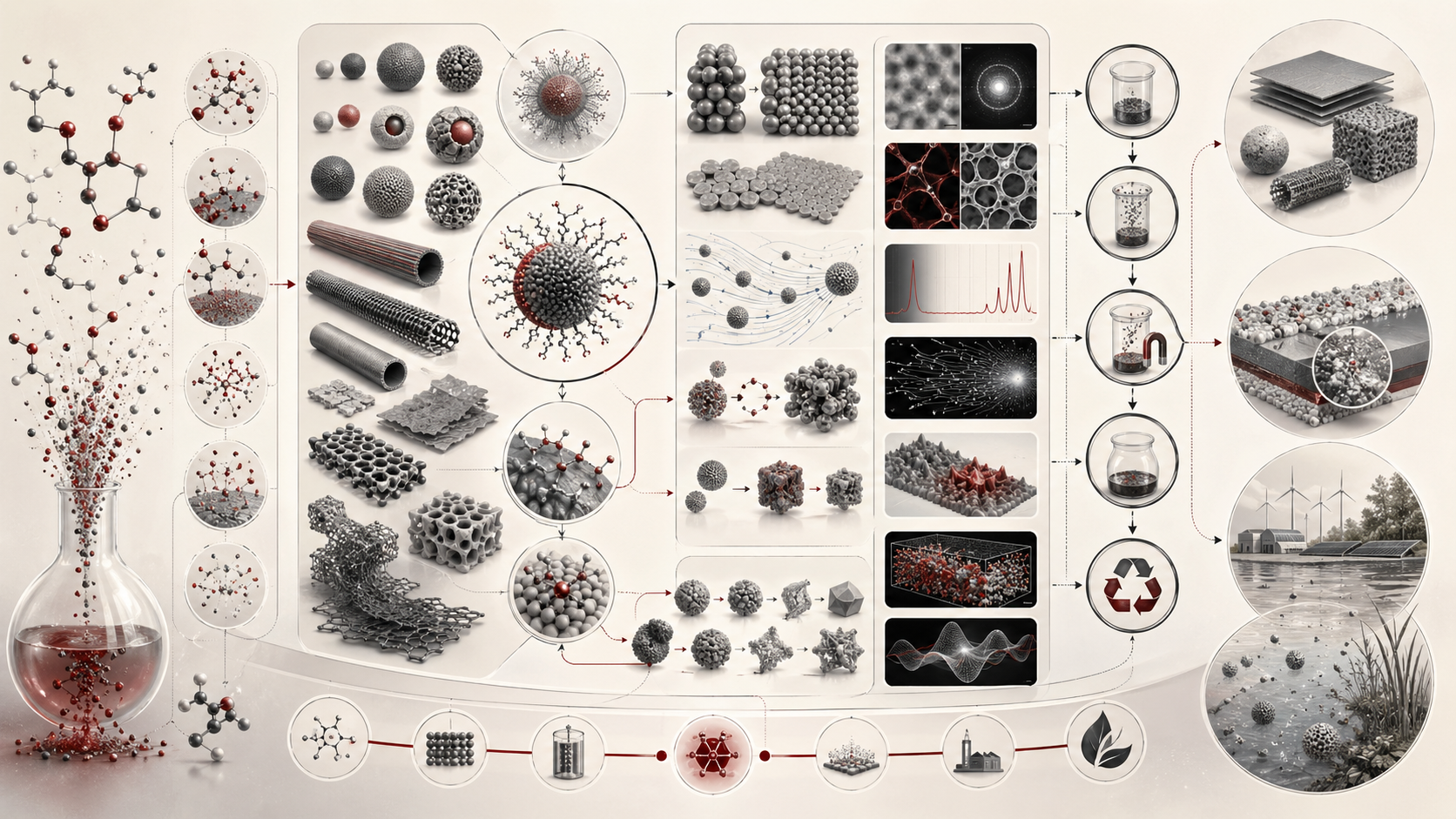
Nanochemistry studies chemical systems whose structure, reactivity, assembly, and function are shaped by dimensions on the nanometer scale. At this scale, matter can behave differently from the same substance in bulk form because surface atoms, quantum confinement, curvature, defects, interfaces, charge, ligand shells, aggregation, and local environment become unusually important. Nanochemistry is not merely chemistry made small. It is chemistry in a regime where molecular structure, surface chemistry, particle size, and collective organization become inseparable.
The central thesis of this article is that nanomaterials cannot be understood from chemical composition alone. Their behavior depends on size distribution, shape, surface chemistry, ligand coverage, aggregation state, defects, crystallinity, environment, and the measurement method used to characterize them. A gold nanoparticle is not simply a small piece of gold. A semiconductor quantum dot is not simply a small crystal. A nanostructured catalyst is not simply a high-surface-area version of a bulk catalyst. At the nanoscale, structure, surface, and context become part of chemical identity.
Nanochemistry is therefore a bridge between molecular design and functional materials. It connects nanoparticles, quantum dots, nanowires, nanosheets, nanotubes, porous nanostructures, nanocomposites, self-assembled systems, nanocatalysts, nanosensors, nanomedicine platforms, and nanoscale interfaces into a field concerned with controlled matter at small dimensions. Its promise is substantial, but so is its responsibility: nanoscale materials require careful characterization, exposure-aware design, transparent measurement, and lifecycle thinking because their behavior can change across media, organisms, devices, and environments.
Main Library
Publications
Article Map
Chemistry
Related Topic
Physics
Related Topic
Biology
Related Topic
Environmental Science
What Nanochemistry Studies
Nanochemistry studies chemical systems whose relevant dimensions are typically measured in nanometers. A nanometer is \(10^{-9}\) meters. In many practical definitions, nanoscale materials are discussed in the approximate range of 1 to 100 nanometers, but the scientific importance is not the number alone. The importance is that properties may change when particles, pores, films, wires, sheets, domains, or interfaces become small enough that surface, confinement, and molecular organization dominate behavior.
A gold nanoparticle is not simply a small piece of gold. Its color, catalytic activity, melting behavior, surface reactivity, optical response, and biological interactions may differ from bulk gold. A semiconductor quantum dot is not merely a small crystal. Its optical absorption and emission can depend on particle size because electronic states are confined. A nanoscale catalyst may expose more active sites than a bulk material. A nanostructured membrane may separate molecules through pore size, surface chemistry, and transport pathways. A nanoparticle in water may behave differently depending on ligand shell, pH, salt, proteins, natural organic matter, and aggregation.
Nanochemistry therefore asks several linked questions:
- What is the size, shape, structure, and composition of the nanoscale object?
- What surface atoms, defects, ligands, charges, coatings, or contaminants are present?
- Is the nanomaterial dispersed, aggregated, dissolved, transformed, embedded, or immobilized in a matrix?
- How does nanoscale structure alter optical, electronic, magnetic, catalytic, mechanical, transport, or biological behavior?
- Which measurement method defines the reported size, surface, concentration, or activity?
- Can the material be synthesized, characterized, handled, scaled, recovered, and used responsibly?
Nanochemistry is not limited to deliberately engineered nanomaterials. Natural and incidental nanoscale materials also matter. Mineral nanoparticles, soot, atmospheric aerosols, volcanic particles, biogenic nanostructures, protein assemblies, viruses, extracellular vesicles, clay particles, and combustion-derived particles all occupy nanoscale or near-nanoscale regimes. The field therefore connects engineered materials, environmental particles, biological interfaces, industrial processes, and analytical science.
For researchers and scientists, the central discipline is specificity. A nanomaterial should not be described only by nominal composition. It should be described by size distribution, shape, surface chemistry, crystal structure, aggregation state, medium, method, concentration basis, and relevant transformation pathways. Without those details, “nano” becomes a vague label rather than a usable scientific description.
Why the Nanoscale Is Chemically Different
The nanoscale is chemically distinctive because the ratio of surface atoms to interior atoms increases as objects get smaller. In a macroscopic solid, most atoms reside in the bulk. In a nanoparticle, a large fraction of atoms may be at or near the surface. Surface atoms often have different coordination, electronic structure, bonding, mobility, and reactivity than interior atoms.
Size also affects transport. Nanoparticles diffuse, aggregate, sediment, adsorb, dissolve, and interact with interfaces differently from larger particles. Curvature can change surface energy and ligand packing. Small pores can impose molecular sieving or confinement. Thin films can behave differently from thick films because interfaces influence the whole structure. Nanowires and nanosheets can create directional electrical, optical, thermal, or mechanical behavior.
Quantum effects can also appear. Semiconductor nanoparticles may show size-dependent optical properties. Metallic nanoparticles may show localized surface plasmon resonance. Magnetic nanoparticles may exhibit size-dependent magnetic behavior. Nanoscale materials may also have altered melting temperatures, phase stability, catalytic activity, and mechanical response compared with larger materials of the same composition.
The nanoscale is also chemically different because surfaces are dynamic. Ligands exchange. Proteins adsorb. Oxides form. Nanoparticles dissolve, ripen, aggregate, charge, discharge, foul, or become coated by organic matter. A nanoscale material may have one identity after synthesis, another after purification, another after storage, and another after entering biological fluid, wastewater, soil porewater, or a polymer matrix.
These differences create both opportunity and risk. Nanochemistry can enable precise sensors, catalysts, coatings, delivery systems, solar materials, batteries, membranes, medical imaging agents, and environmental monitoring technologies. But nanomaterials also require careful measurement and safety evaluation because size, surface chemistry, exposure route, persistence, and transformation can affect behavior in biological and environmental systems.
For researchers, the practical lesson is that nanoscale function is conditional. A material’s behavior may depend on the specific medium, concentration, surface state, aggregation condition, and measurement history. The same nanoparticle can behave differently in pure water, saline solution, blood serum, organic solvent, polymer melt, soil extract, wastewater, or air.
Major Classes of Nanoscale Materials
Nanoparticles and Colloids
Nanoparticles are nanoscale particles that may be metallic, oxide, polymeric, semiconductor, carbon-based, lipid-based, silica-based, ceramic, hybrid, or composite. In colloidal systems, nanoparticles are dispersed in a continuous medium. Their stability depends on surface charge, ligand shell, solvent, ionic strength, pH, steric stabilization, electrostatic repulsion, van der Waals attraction, and aggregation kinetics.
Gold nanoparticles, silver nanoparticles, iron oxide nanoparticles, silica nanoparticles, titanium dioxide nanoparticles, polymer nanoparticles, lipid nanoparticles, and carbon nanoparticles illustrate the diversity of nanoparticle chemistry. Each class has different synthesis routes, surface chemistries, applications, degradation pathways, and risk considerations.
Quantum Dots and Semiconductor Nanocrystals
Quantum dots are semiconductor nanocrystals whose optical and electronic behavior can depend strongly on size. Smaller quantum dots often have larger effective band gaps than larger dots of the same material. Their emission wavelength, brightness, stability, and toxicity depend on core composition, shell structure, surface ligands, defects, and environment.
Quantum dots are used or studied in displays, lighting, solar energy, imaging, sensing, and photonic materials. Responsible quantum-dot design must consider composition, heavy-metal content, stability, degradation, encapsulation, and lifecycle.
Nanowires, Nanotubes, and One-Dimensional Materials
One-dimensional nanomaterials include nanowires, nanotubes, nanorods, nanofibers, and filamentous assemblies. Their properties may be directional because electrons, phonons, ions, or molecules can move preferentially along a long axis. Carbon nanotubes, semiconductor nanowires, metal nanowires, and polymer nanofibers are important in electronics, sensors, composites, filtration, energy storage, and structural materials.
One-dimensional materials also raise special questions about aspect ratio, entanglement, alignment, inhalation exposure, mechanical reinforcement, percolation networks, and dispersion. A high-aspect-ratio material may be useful in composites or conductors but difficult to disperse, process, or evaluate toxicologically.
Nanosheets and Two-Dimensional Materials
Two-dimensional materials include graphene, transition-metal dichalcogenides, layered oxides, clays, boron nitride sheets, MXenes, and other atomically or molecularly thin structures. Their large surface area, exposed basal planes, edge chemistry, interlayer spacing, and electronic structure create applications in catalysis, energy storage, membranes, electronics, coatings, and composites.
Two-dimensional materials are especially sensitive to defects, edges, functional groups, oxidation, interlayer water, restacking, and substrate interactions. A nanosheet’s properties depend not only on chemical formula but on layer number, lateral size, surface termination, flake distribution, and assembly state.
Porous Nanomaterials and Frameworks
Nanoporous materials contain pores on the nanoscale. Zeolites, mesoporous silica, activated carbons, metal-organic frameworks, covalent organic frameworks, aerogels, and nanoporous membranes can adsorb, separate, catalyze, store, or release molecules. Their function depends on pore size distribution, connectivity, surface chemistry, stability, and transport.
Porous nanomaterials illustrate the importance of accessible structure. A material may have a high theoretical surface area but limited practical performance if pores are blocked, inaccessible, unstable, or incompatible with the operating medium. Adsorption, diffusion, fouling, swelling, and framework stability must be evaluated together.
Nanocomposites and Hybrid Materials
Nanocomposites combine nanoscale components with polymers, ceramics, metals, glasses, hydrogels, or biological matrices. A small amount of a nanofiller can change mechanical strength, conductivity, barrier behavior, flame resistance, optical properties, or thermal stability if it is well dispersed and chemically compatible with the matrix. Poor dispersion, weak interfaces, or aggregation can reduce performance.
Hybrid materials can also combine organic and inorganic functions. A polymer matrix may provide flexibility while nanoparticles provide conductivity, antimicrobial behavior, mechanical reinforcement, catalytic activity, optical response, or barrier properties. The interface between nanofiller and matrix often determines whether a nanocomposite succeeds.
For researchers, classifying a nanomaterial is useful but insufficient. A “silica nanoparticle,” “quantum dot,” “carbon nanotube,” or “metal-organic framework” is a family label, not a full description. The material’s real behavior depends on synthesis, surface, size distribution, medium, processing, and use conditions.
Nanomaterial Synthesis and Molecular Control
Nanochemistry depends on synthesis routes that control nucleation, growth, stabilization, and transformation. In solution-phase nanoparticle synthesis, precursor concentration, reducing agent, solvent, temperature, pH, ligand identity, mixing, reaction time, and purification can influence size distribution and shape. In sol-gel chemistry, hydrolysis and condensation form networks, particles, or films. In vapor deposition, atoms or molecules assemble on surfaces. In self-assembly, molecular interactions guide organization into nanoscale structures.
Common nanomaterial synthesis and processing routes include:
- colloidal nanoparticle synthesis;
- sol-gel synthesis;
- hydrothermal and solvothermal synthesis;
- microemulsion methods;
- seed-mediated growth;
- atomic layer deposition;
- chemical vapor deposition;
- electrochemical deposition;
- template-directed synthesis;
- polymerization-induced self-assembly;
- mechanochemical and sonochemical methods;
- biomimetic and bio-mediated synthesis.
Nanomaterial synthesis is often a competition between nucleation and growth. Many small nuclei can produce many small particles. Fewer nuclei followed by sustained growth can produce larger particles. Ligands may bind certain crystal faces and promote anisotropic growth, producing rods, plates, wires, cubes, stars, or more complex shapes. Purification and storage also matter because nanoparticles can aggregate, oxidize, dissolve, ripen, exchange ligands, adsorb contaminants, or transform after synthesis.
Molecular control is difficult because small changes can have large effects. A slightly different ligand concentration can change size or shape. A trace impurity can seed unwanted nucleation. Mixing rate can affect supersaturation. Temperature history can change crystallinity. Oxygen, water, chloride, sulfate, phosphate, or dissolved organic matter can alter surface chemistry. A synthesis protocol is therefore part of the material’s identity.
Scale-up adds another layer of complexity. A nanomaterial synthesis that works in a vial may not produce the same size distribution in a liter reactor. Heat transfer, mixing, residence time, concentration gradients, feed addition, purification, filtration, drying, and storage can all change outcomes. Nanochemistry at scale requires process understanding, not only bench success.
For researchers, synthesis should be reported with enough detail to support reproducibility: precursor identity, concentration, solvent, ligands, pH, temperature, order of addition, mixing, time, atmosphere, purification, drying, storage, and characterization after each important stage. Without process detail, nanomaterial claims become difficult to reproduce.
Surface Chemistry, Ligands, and Colloidal Stability
Surface chemistry often determines whether a nanomaterial is useful. Ligands, surfactants, polymers, proteins, ions, oxide shells, and functional groups can stabilize nanoparticles, tune solubility, control aggregation, provide recognition sites, alter charge, change optical response, affect toxicity, or enable assembly.
Colloidal stability is especially important. A nanoparticle may be stable in pure water but aggregate in salt solution. It may be stable in buffer but change in blood serum because proteins adsorb to form a corona. It may disperse in an organic solvent but precipitate in a polymer matrix. It may remain suspended at low concentration but aggregate during drying, centrifugation, dialysis, filtration, or storage.
Surface chemistry also affects measurement. Dynamic light scattering may report a larger hydrodynamic size than electron microscopy because it includes solvent and ligand shell effects and is sensitive to aggregates. Zeta potential may suggest electrostatic stability but not fully predict behavior in complex media. Surface composition measured by one method may differ from bulk composition measured by another.
Ligand coverage is rarely just a decorative layer. It can determine solubility, receptor binding, catalytic access, immune recognition, membrane interaction, photoluminescence, electron transfer, aggregation resistance, and toxicity. A ligand can passivate surface defects, but it can also block active sites. It can improve colloidal stability, but it may reduce electronic coupling. It can enable biological targeting, but it may exchange in biological media.
Surface transformations are especially important. Nanoparticles may acquire a protein corona in biological fluids, a natural organic matter coating in environmental water, an oxide shell in air, a sulfide layer in wastewater, or a polymer layer in a composite. The “as-synthesized” surface may not be the surface that determines performance or exposure.
For researchers, surface chemistry should be characterized in the medium relevant to the claim. A nanoparticle stable in deionized water may not be stable in saline, serum, wastewater, soil extract, cell culture media, or polymer resin. Stability is not a universal property; it is a condition-specific behavior.
Self-Assembly and Molecular-Scale Organization
Self-assembly is the spontaneous organization of components into structured arrangements through noncovalent interactions, coordination, hydrophobic effects, electrostatics, hydrogen bonding, \(\pi\)-stacking, van der Waals forces, host-guest recognition, or ligand-directed binding. In nanochemistry, self-assembly can create micelles, vesicles, monolayers, bilayers, colloidal crystals, block-copolymer domains, DNA nanostructures, supramolecular fibers, nanoparticle superlattices, and responsive materials.
Self-assembly is powerful because it allows structure to emerge from molecular design. But it is also sensitive to conditions. Concentration, solvent, pH, salt, temperature, surface chemistry, impurities, kinetics, and processing history can determine whether a system forms ordered structures, metastable aggregates, gels, precipitates, or disordered mixtures.
Self-assembled nanostructures are important in drug delivery, membranes, sensors, soft robotics, templated synthesis, photonic materials, catalysis, and biological interfaces. Their reproducibility depends on preserving preparation details and characterizing both final structure and assembly pathway.
Self-assembly also shows why nanochemistry is not only particle chemistry. Many nanoscale structures are dynamic. Micelles exchange molecules. Vesicles fuse or rupture. DNA nanostructures fold through sequence-specific interactions. Block copolymers phase-separate into nanoscale domains. Nanoparticles assemble into ordered lattices or disordered aggregates depending on ligand shells and solvent conditions.
For researchers, self-assembly should be interpreted through energy landscape and pathway. The final structure may reflect thermodynamic preference, kinetic trapping, drying artifacts, templating, evaporation, confinement, or processing history. A well-ordered image does not necessarily describe the full sample population. Quantitative characterization of distribution and reproducibility is essential.
Nanocatalysis and Reactive Surface Design
Nanocatalysis uses nanoscale structure to control reaction rates, selectivity, and active-site exposure. Nanoparticles, clusters, supported metals, metal oxides, carbons, zeolites, metal-organic frameworks, single-atom catalysts, and porous nanostructures can all provide catalytic function. Their behavior depends on size, shape, surface facets, oxidation state, support interactions, defects, ligands, porosity, mass transfer, and reaction environment.
Nanocatalysts can be powerful because small particles expose many surface atoms. But surface area alone does not determine catalytic quality. The identity of active sites, electronic structure, adsorption strength, reactant access, product desorption, poisoning resistance, sintering resistance, and support stability all matter. A high-surface-area material can still be a poor catalyst if its sites are inaccessible, unstable, or unselective.
Nanocatalysts also change under reaction conditions. Particles can sinter, oxidize, reduce, leach, reconstruct, coke, dissolve, aggregate, or become covered by adsorbates. Ligands that stabilize nanoparticles during synthesis may block catalytic sites. Supports may donate charge, stabilize particles, or participate in the reaction. The active catalyst may not be identical to the as-prepared catalyst.
For researchers, nanocatalysis requires operando thinking. Characterization before and after reaction is useful, but the catalyst’s working state may differ from both. Strong studies connect synthesis, surface structure, catalytic data, selectivity, turnover metrics, deactivation, mass balance, and stability under realistic conditions.
Nanocatalysis also has responsible-design implications. Precious metals, critical elements, nanoparticle release, catalyst recovery, solvent choice, reaction conditions, and waste reduction all matter. A nanocatalyst should be evaluated not only by activity, but by durability, selectivity, recoverability, toxicity, and whether it meaningfully improves the overall process.
Nano-Bio Interfaces, Corona Formation, and Biological Context
Nanomaterials interact with biological systems through surfaces. When nanoparticles enter biological fluids, proteins, lipids, metabolites, salts, and other biomolecules can adsorb onto their surfaces. This adsorbed layer is often called a corona. The corona can change size, charge, aggregation, receptor recognition, cellular uptake, immune response, circulation time, and toxicity.
This means that biological identity can differ from synthetic identity. A nanoparticle designed with a particular ligand may present a different surface after exposure to serum, mucus, lung fluid, gastrointestinal fluid, or intracellular environments. Biological media can also dissolve, oxidize, reduce, aggregate, or transform nanomaterials.
Nanomedicine and delivery systems illustrate both promise and difficulty. Lipid nanoparticles, polymer nanoparticles, inorganic nanoparticles, micelles, dendrimers, and vesicles can alter drug solubility, release, biodistribution, imaging, and targeting. But performance depends on stability, dose, route, immune response, clearance, tissue distribution, degradation, manufacturing consistency, and safety.
Nanoscale biological interaction is also relevant outside medicine. Workers may inhale powders during manufacturing. Consumers may encounter aerosols, cosmetics, coatings, or sprays. Environmental organisms may encounter nanoparticles in water, soil, sediment, or food webs. Biological exposure depends on route, size, surface, dose metric, persistence, dissolution, and transformation.
For researchers, nano-bio claims require careful controls. A targeting claim should distinguish ligand design from actual biodistribution. A toxicity claim should distinguish particle effects from dissolved ions, endotoxin contamination, solvent residues, aggregation, or assay interference. Nanomaterials can interfere with optical, fluorescence, colorimetric, and enzymatic assays. Measurement artifacts are common and must be controlled.
Environmental Nanochemistry and Transformation
Nanomaterials can enter environmental systems through production, product use, abrasion, washing, wastewater, disposal, combustion, spills, agriculture, remediation, or degradation of larger materials. Once released, their behavior depends on medium, pH, ionic strength, natural organic matter, sunlight, redox state, mineral surfaces, biological activity, and competing particles.
Environmental transformation can include aggregation, dissolution, oxidation, sulfidation, photochemical change, coating by organic matter, adsorption to sediments, uptake by organisms, heteroaggregation with natural colloids, and incorporation into sludge. These transformations can reduce mobility, increase mobility, change toxicity, alter bioavailability, or make the original engineered form difficult to detect.
Environmental nanochemistry also includes naturally occurring nanoscale materials. Iron oxides, manganese oxides, clays, organic colloids, viruses, biogenic particles, soot, and mineral nanoparticles can transport nutrients, contaminants, metals, pathogens, and organic matter. Engineered nanomaterials enter an environment already full of colloids and reactive surfaces.
Monitoring environmental nanomaterials is difficult because concentrations may be low, backgrounds complex, transformations rapid, and size distributions broad. Distinguishing engineered particles from natural particles may require elemental fingerprints, isotopic signatures, microscopy, single-particle mass spectrometry, field-flow fractionation, or careful sample preparation.
For researchers, environmental nanochemistry requires moving beyond “particle present” to “particle transformed.” A nanoparticle’s environmental significance may depend less on its original form and more on what it becomes in wastewater, soil, sediment, atmospheric aerosol, or biological tissue.
Nanomaterial Characterization and Measurement
Nanomaterial characterization is difficult because size, shape, surface, composition, aggregation, and environment all matter. A single method rarely provides enough evidence. Electron microscopy can show particle shape and core size but may require drying or vacuum conditions. Dynamic light scattering can estimate hydrodynamic size in suspension but is sensitive to large aggregates and assumes simplified scattering behavior. X-ray diffraction can reveal crystal structure and crystallite size but may average across populations. Spectroscopy can probe bonding, optical properties, ligands, and chemical states. Surface-area analysis can measure accessible area but may not describe dispersion in liquid or biological media.
Common nanomaterial characterization methods include:
- transmission electron microscopy;
- scanning electron microscopy;
- atomic force microscopy;
- dynamic light scattering;
- nanoparticle tracking analysis;
- zeta-potential measurement;
- X-ray diffraction;
- small-angle X-ray or neutron scattering;
- UV-visible spectroscopy;
- fluorescence spectroscopy;
- Raman and infrared spectroscopy;
- X-ray photoelectron spectroscopy;
- inductively coupled plasma mass spectrometry;
- single-particle ICP-MS;
- field-flow fractionation;
- thermogravimetric analysis;
- surface-area and porosity analysis.
Good nanomaterial characterization should state what is being measured: core diameter, hydrodynamic diameter, crystallite size, aggregate size, primary particle size, surface charge, ligand coverage, mass concentration, particle number concentration, active surface area, or dissolved ion concentration. These are not interchangeable. A nanomaterial can have a 10 nm inorganic core, a 20 nm hydrodynamic diameter, and a 200 nm aggregate population under certain conditions.
Measurement should also preserve sample state. Was the material measured dry, suspended, diluted, sonicated, filtered, centrifuged, freeze-dried, embedded, stained, or exposed to salts, proteins, organic matter, or light? Was the concentration reported by mass, particle number, surface area, molarity of atoms, or active ingredient? Was the reported size number-weighted, intensity-weighted, volume-weighted, or manually measured from images?
For researchers, characterization should be application-specific. A quantum dot for optical emission needs size, composition, photoluminescence, surface state, and stability. A nanoparticle for environmental remediation needs dispersion, reactivity, transport, transformation, and recovery. A nanomedicine platform needs biological media stability, sterility, dose metric, corona behavior, release, and biodistribution. Measurement should serve the claim.
Quality, Reproducibility, and Reference Materials
Nanochemistry faces a reproducibility challenge because small changes in synthesis, purification, storage, measurement, or medium can alter results. Two laboratories may report different behavior for nominally similar nanoparticles because size distribution, surface ligands, aggregation, impurity profile, pH, salt, concentration, or measurement protocol differ.
Quality control should therefore include batch records, replicate measurements, reference materials where available, calibration, uncertainty estimates, instrument settings, sample preparation notes, and stability checks over time. A single measurement is often insufficient. Nanomaterial reporting is strongest when multiple methods converge: microscopy for primary size and shape, scattering for hydrodynamic size, spectroscopy for optical behavior, surface analysis for ligands and chemical state, and chemical analysis for concentration.
Reference materials and standardized protocols are important because they allow laboratories to compare methods and detect bias. Dynamic light scattering, electron microscopy, zeta potential, surface area, and single-particle analysis all require method discipline. Without method transparency, nanomaterial data can look precise while being difficult to reproduce.
Data quality also requires clarity about population. Nanoparticle samples are distributions. A mean size can hide broad tails, small populations of aggregates, or bimodal distributions. Since larger particles can dominate scattering intensity and surface area can dominate reactivity, different measurement bases can produce different interpretations from the same sample.
For researchers, reproducibility is not a bureaucratic add-on. It is part of nanochemical identity. A nanomaterial that cannot be characterized reproducibly cannot be responsibly translated into medicine, environmental use, manufacturing, sensors, or energy systems.
Applications of Nanochemistry
Nanochemistry supports many application areas. In catalysis, nanoparticles and nanostructured supports can expose active sites and tune selectivity. In medicine, nanoscale carriers can alter delivery, circulation, targeting, release, and imaging behavior. In energy storage, nanostructured electrodes can shorten transport distances and increase interfacial area. In solar materials, nanostructure can tune absorption, charge separation, and stability. In sensors, nanoparticles can amplify optical, electrical, electrochemical, or mechanical response. In membranes and water treatment, nanopores, coatings, and nanocomposites can control transport and fouling.
Important application areas include:
- nanocatalysts for selective chemical transformation;
- quantum dots for optical and electronic materials;
- nanoparticle contrast agents and imaging materials;
- lipid and polymer nanoparticles for delivery systems;
- nanostructured electrodes for batteries, supercapacitors, and fuel cells;
- nanocomposite coatings and barrier films;
- nanosensors for chemical, biological, and environmental detection;
- nanoporous materials for separations and gas storage;
- antimicrobial and self-cleaning surfaces;
- nanostructured membranes for water treatment and desalination;
- nanostructured photochemical materials for light harvesting and catalysis;
- nanocomposites for lightweight structural and functional materials.
Applications should not be evaluated only by nanoscale novelty. They should be judged by performance, reproducibility, manufacturability, safety, lifecycle, and whether the nanoscale design actually solves a problem better than a simpler material. A nanomaterial is not automatically superior because it is small. It is superior only if nanoscale structure produces durable, measurable, responsible advantage.
Application claims should also identify the relevant scale of performance. A nanosensor may require sensitivity, selectivity, response time, calibration stability, and anti-fouling behavior. A nanocatalyst may require turnover, selectivity, durability, recovery, and low leaching. A nanomedicine platform may require controlled release, biodistribution, safety, manufacturability, and clear clinical benefit. A membrane may require flux, selectivity, fouling resistance, cleaning tolerance, and lifetime.
For researchers, the practical question is not “What can this nanomaterial do?” but “What can this nanomaterial do better, more safely, more reproducibly, and more responsibly than available alternatives?” That question turns nanochemistry from novelty into mature materials science.
Nanochemistry, Exposure, and Responsible Design
Nanomaterials raise responsible-design questions because their behavior can depend on size, shape, surface chemistry, solubility, persistence, aggregation, and biological or environmental transformation. A material that is safe in bulk form may require separate evaluation as nanoparticles. A nanoparticle that is stable in the bottle may change in air, water, soil, blood, wastewater, food matrices, or cells.
Responsible nanochemistry includes:
- characterizing materials in the actual media where they will be used or released;
- reporting primary particle size, hydrodynamic size, aggregation state, surface chemistry, and concentration;
- distinguishing mass concentration from particle number concentration and surface-area dose;
- evaluating dissolution, transformation, corona formation, and degradation;
- avoiding unsupported claims about safety, targeting, biodegradation, or environmental benefit;
- considering worker exposure during synthesis, handling, drying, milling, spraying, and disposal;
- designing for recovery, immobilization, degradation, or safer end-of-life where appropriate;
- using reference materials and validated protocols where consequential decisions are involved.
Exposure depends on route and form. A nanoparticle embedded securely in a cured coating may present a different risk from the same material as a dry powder, aerosol, spray, slurry, or wastewater suspension. Inhalation, ingestion, dermal contact, injection, occupational handling, environmental release, and end-of-life processing all require different forms of evidence.
Responsible design also means avoiding vague safety language. “Non-toxic,” “biocompatible,” “green,” “eco-friendly,” or “biodegradable” claims require context. What organism, cell type, dose, exposure route, medium, time scale, endpoint, and transformation state were tested? Were dissolved ions separated from particle effects? Were assay interferences controlled? Was aggregation measured? Were degradation products identified?
The ethical strength of nanochemistry lies in accountable control. Nanoscale materials can enable extraordinary functions, but those functions must be tied to careful characterization, transparent assumptions, exposure-aware design, and responsible lifecycle thinking.
Mathematical Lens: Surface Area, Size Distributions, Diffusion, and Quantum Effects
The importance of size can be seen through surface-area scaling. For a sphere of radius \(r\), surface area is:
A = 4\pi r^2
\]
Interpretation: \(A\) is surface area and \(r\) is particle radius. Surface area controls adsorption, ligand coverage, catalytic exposure, dissolution, and interfacial interaction.
The volume of the same sphere is:
V = \frac{4}{3}\pi r^3
\]
Interpretation: \(V\) is particle volume. For a given material density, volume is proportional to particle mass.
The surface-area-to-volume ratio is therefore:
\frac{A}{V} = \frac{3}{r}
\]
Interpretation: As \(r\) decreases, \(A/V\) increases. This simple relationship explains why nanoscale particles can have unusually high surface exposure compared with larger particles.
Nanoparticle samples are usually distributions, not single sizes. If \(d_i\) is a measured particle diameter and \(N_i\) is the number of particles in a size bin, a number-weighted mean diameter can be written as:
\bar{d}_N = \frac{\sum_i N_i d_i}{\sum_i N_i}
\]
Interpretation: \(\bar{d}_N\) gives each counted particle equal weight. It is useful for microscopy and particle-number-based interpretation.
A volume-weighted mean can be much larger when a small number of large particles or aggregates are present:
\bar{d}_V = \frac{\sum_i N_i d_i^4}{\sum_i N_i d_i^3}
\]
Interpretation: \(\bar{d}_V\) emphasizes larger particles because volume scales with diameter cubed. This distinction matters because microscopy, scattering, mass-based analysis, and number-based methods may emphasize different parts of a particle distribution.
Diffusion of spherical particles in dilute solution is often approximated by the Stokes-Einstein relationship:
D = \frac{k_B T}{3\pi \eta d_h}
\]
Interpretation: \(D\) is diffusion coefficient, \(k_B\) is Boltzmann’s constant, \(T\) is temperature, \(\eta\) is dynamic viscosity, and \(d_h\) is hydrodynamic diameter. Larger hydrodynamic size leads to slower diffusion.
A simple particle number estimate from mass concentration can be written as:
N = \frac{m}{\rho \frac{4}{3}\pi r^3}
\]
Interpretation: \(N\) is estimated particle number, \(m\) is total particle mass, \(\rho\) is material density, and \(r\) is particle radius. For the same mass, smaller particles imply many more particles and much larger total surface area.
Quantum confinement in semiconductor nanocrystals can be represented schematically by a size-dependent band-gap expression:
E(R) \approx E_{\mathrm{bulk}} + \frac{\hbar^2\pi^2}{2R^2}\left(\frac{1}{m_e^*}+\frac{1}{m_h^*}\right) – \frac{1.8e^2}{4\pi\varepsilon R}
\]
Interpretation: \(R\) is nanocrystal radius, \(m_e^*\) and \(m_h^*\) are effective masses of electron and hole, and \(\varepsilon\) is dielectric permittivity. This simplified expression is not a universal design rule, but it illustrates why optical properties can change with size.
These equations are not complete descriptions of real nanomaterials. Real systems include distributions, nonspherical shapes, ligand shells, aggregation, roughness, defects, porosity, medium effects, and measurement uncertainty. Their value is to show why nanoscale chemistry is size-sensitive, surface-sensitive, and method-sensitive.
Computational Workflows for Nanochemistry
Computational workflows can make nanomaterial interpretation more transparent. A workflow can track sample identity, material class, synthesis route, core diameter, hydrodynamic diameter, size distribution, shape, zeta potential, ligand coverage, aggregation state, surface area, particle number, concentration basis, solvent, pH, ionic strength, stability condition, critical-material flag, exposure concern, measurement method, and review status.
Useful workflows include nanoparticle size-distribution analysis, surface-area-to-volume screening, diffusion estimation, salt-stability scoring, ligand-coverage comparison, batch reproducibility review, microscopy-measurement summaries, dynamic-light-scattering comparison, particle-number estimation, critical-material flagging, dissolution tracking, environmental transformation logging, and nano-bio media stability checks. More advanced workflows may integrate image analysis, scattering files, single-particle ICP-MS, spectroscopy, laboratory information management systems, and lifecycle exposure records.
For researchers, computational workflows should preserve measurement basis. A size value from electron microscopy is not the same as a hydrodynamic diameter from dynamic light scattering. A mass concentration is not a particle number concentration. A stable dispersion in one medium is not evidence of stability in all media. A surface-area estimate assumes shape and accessibility. These assumptions should appear in the data model.
The examples below use synthetic data. They do not qualify nanomaterials, establish safety, validate clinical use, determine environmental fate, certify product performance, or replace professional nanomaterial characterization. They demonstrate how nanochemistry reasoning can be structured, audited, and communicated responsibly.
Python Example: Nanoparticle Size Distribution and Surface-Area Screening
The following Python example uses synthetic educational data to calculate nanoparticle size-distribution metrics, surface-area-to-volume ratios, hydrodynamic diffusion estimates, and simple stability flags. Real nanomaterial analysis requires validated methods, sample-preparation records, replicate measurement, calibration, uncertainty, and matrix-specific characterization.
from pathlib import Path
from typing import Dict, List
import json
import math

import pandas as pd


# Synthetic nanochemistry workflow.
# Educational example only; not for regulatory, clinical, toxicological,
# environmental, product, or procurement claims.


def screen_nanoparticles(particles: pd.DataFrame) -> pd.DataFrame:
    """Calculate simple nanomaterial screening metrics.

    This model is illustrative. Real nanomaterial characterization requires
    validated methods, replicate measurements, uncertainty analysis,
    matrix-specific stability testing, exposure review, and safety review.
    """

    particles = particles.copy()

    # Surface-area-to-volume ratio for a sphere is 6 / diameter.
    # Units here are nm^-1 because diameter is measured in nm.
    particles["surface_area_to_volume_nm_inv"] = (
        6.0 / particles["core_diameter_nm"]
    )

    # Stokes-Einstein diffusion estimate using SI units.
    k_B = 1.380649e-23
    temperature_K = 298.15
    water_viscosity_Pa_s = 0.00089

    particles["hydrodynamic_diameter_m"] = (
        particles["hydrodynamic_diameter_nm"] * 1e-9
    )

    particles["diffusion_m2_s"] = (
        k_B * temperature_K
        / (
            3.0
            * math.pi
            * water_viscosity_Pa_s
            * particles["hydrodynamic_diameter_m"]
        )
    )

    particles["core_to_hydrodynamic_ratio"] = (
        particles["core_diameter_nm"]
        / particles["hydrodynamic_diameter_nm"]
    )

    particles["colloidal_review_required"] = (
        (particles["polydispersity_index"] > 0.25)
        | (particles["aggregation_after_salt_relative"] > 0.30)
        | (particles["zeta_potential_mV"].abs() < 15.0)
    )

    particles["surface_review_required"] = (
        particles["ligand_coverage_relative"] < 0.50
    )

    particles["responsible_design_review_required"] = (
        particles["critical_material_flag"]
        | particles["colloidal_review_required"]
        | particles["surface_review_required"]
    )

    # Lower score indicates fewer stability and responsible-design concerns
    # for this hypothetical stable nanosensor-support use case.
    particles["screening_score"] = (
        1.2 * particles["polydispersity_index"]
        + 1.4 * particles["aggregation_after_salt_relative"]
        + 0.8 * (1.0 - particles["ligand_coverage_relative"])
        + 0.4 * particles["critical_material_flag"].astype(int)
        + 0.2 * particles["surface_review_required"].astype(int)
    )

    ranked = particles.sort_values("screening_score").copy()
    ranked["rank"] = range(1, len(ranked) + 1)

    ranked.attrs["temperature_K"] = temperature_K
    ranked.attrs["water_viscosity_Pa_s"] = water_viscosity_Pa_s

    return ranked


particles = pd.DataFrame({
    "sample_id": ["nano_A", "nano_B", "nano_C", "nano_D", "nano_E"],
    "material_class": [
        "gold",
        "silica",
        "iron_oxide",
        "quantum_dot",
        "polymer_nanoparticle",
    ],
    "core_diameter_nm": [18.0, 55.0, 32.0, 6.0, 95.0],
    "hydrodynamic_diameter_nm": [24.0, 72.0, 48.0, 12.0, 140.0],
    "zeta_potential_mV": [-34.0, -18.0, 22.0, -28.0, -9.0],
    "polydispersity_index": [0.08, 0.18, 0.22, 0.11, 0.34],
    "ligand_coverage_relative": [0.85, 0.62, 0.58, 0.79, 0.41],
    "aggregation_after_salt_relative": [0.05, 0.18, 0.31, 0.12, 0.62],
    "critical_material_flag": [False, False, False, True, False],
})

ranked = screen_nanoparticles(particles)

output_dir = Path("outputs")
output_dir.mkdir(exist_ok=True)

ranked.to_csv(output_dir / "nanoparticle_screening_ranked.csv", index=False)

manifest: Dict[str, object] = {
    "workflow": "synthetic_nanoparticle_size_stability_screening",
    "temperature_K": ranked.attrs["temperature_K"],
    "water_viscosity_Pa_s": ranked.attrs["water_viscosity_Pa_s"],
    "best_candidate": ranked.iloc[0]["sample_id"],
    "responsible_use": [
        "Synthetic educational data only.",
        "Real nanomaterial characterization requires validated methods, replicate measurements, uncertainty, matrix-specific stability testing, and safety review.",
    ],
}

with (output_dir / "nanochemistry_manifest.json").open(
    "w",
    encoding="utf-8"
) as file:
    json.dump(manifest, file, indent=2)

print(ranked[[
    "sample_id",
    "material_class",
    "core_diameter_nm",
    "hydrodynamic_diameter_nm",
    "surface_area_to_volume_nm_inv",
    "diffusion_m2_s",
    "core_to_hydrodynamic_ratio",
    "screening_score",
    "rank",
    "responsible_design_review_required",
]])
This workflow makes an important point: nanoscale material identity is multidimensional. A sample is not adequately described by composition alone. Size, hydrodynamic size, dispersion quality, surface chemistry, salt stability, ligand coverage, and critical-material concerns all shape interpretation. The purpose is not the synthetic ranking itself, but the auditable structure of the comparison.
R Example: Replicate Nanoparticle Measurements and Stability Flags
The following R example uses synthetic replicate measurements to summarize particle size, hydrodynamic diameter, polydispersity, and stability. In real nanomaterial measurement, replicate variability can arise from sample preparation, dilution, sonication, drying, aggregation, instrument settings, and analysis thresholds.
# Synthetic nanomaterial replicate workflow.
# Educational example only; not for regulatory, clinical, or safety claims.

replicates <- data.frame(
  sample_id = c(
    "nano_A", "nano_A", "nano_A",
    "nano_B", "nano_B", "nano_B",
    "nano_C", "nano_C", "nano_C"
  ),
  replicate = c(1, 2, 3, 1, 2, 3, 1, 2, 3),
  core_diameter_nm = c(
    18.2, 17.8, 18.4,
    55.0, 56.1, 54.4,
    32.0, 33.5, 31.8
  ),
  hydrodynamic_diameter_nm = c(
    24.0, 24.8, 23.6,
    72.0, 75.2, 70.8,
    48.0, 51.6, 47.1
  ),
  polydispersity_index = c(
    0.08, 0.09, 0.08,
    0.18, 0.20, 0.17,
    0.22, 0.25, 0.23
  ),
  aggregation_after_salt_relative = c(
    0.05, 0.06, 0.04,
    0.18, 0.20, 0.17,
    0.31, 0.35, 0.30
  )
)

summary_table <- aggregate(
  cbind(
    core_diameter_nm,
    hydrodynamic_diameter_nm,
    polydispersity_index,
    aggregation_after_salt_relative
  ) ~ sample_id,
  data = replicates,
  FUN = function(x) c(mean = mean(x), sd = sd(x))
)

summary_clean <- data.frame(
  sample_id = summary_table$sample_id,
  mean_core_diameter_nm =
    summary_table$core_diameter_nm[, "mean"],
  sd_core_diameter_nm =
    summary_table$core_diameter_nm[, "sd"],
  mean_hydrodynamic_diameter_nm =
    summary_table$hydrodynamic_diameter_nm[, "mean"],
  sd_hydrodynamic_diameter_nm =
    summary_table$hydrodynamic_diameter_nm[, "sd"],
  mean_polydispersity_index =
    summary_table$polydispersity_index[, "mean"],
  sd_polydispersity_index =
    summary_table$polydispersity_index[, "sd"],
  mean_aggregation_after_salt_relative =
    summary_table$aggregation_after_salt_relative[, "mean"],
  sd_aggregation_after_salt_relative =
    summary_table$aggregation_after_salt_relative[, "sd"]
)

summary_clean$hydrodynamic_to_core_ratio <- (
  summary_clean$mean_hydrodynamic_diameter_nm /
    summary_clean$mean_core_diameter_nm
)

summary_clean$stability_review_required <- (
  summary_clean$mean_polydispersity_index > 0.25 |
    summary_clean$mean_aggregation_after_salt_relative > 0.30 |
    summary_clean$hydrodynamic_to_core_ratio > 1.75
)

dir.create("outputs", showWarnings = FALSE)

write.csv(
  summary_clean,
  file = "outputs/nanoparticle_replicate_summary.csv",
  row.names = FALSE
)

sink("outputs/nanoparticle_measurement_report.txt")
cat("Synthetic Nanoparticle Measurement Report\n")
cat("========================================\n\n")
cat("Replicate measurement summary:\n")
print(summary_clean)
cat("\nResponsible-use note:\n")
cat("Synthetic educational data only. Real nanomaterial characterization requires validated methods, replicate measurements, uncertainty, matrix-specific stability testing, and safety review.\n")
sink()

print(summary_clean)
This workflow highlights why nanomaterial reporting should include replicate variability. A single reported size can hide aggregation, broad distributions, or measurement-method bias. Replicate summaries help distinguish material behavior from sample-preparation artifacts and measurement noise.
SQL Example: Nanochemistry Evidence Register
Nanochemistry interpretation becomes more reliable when synthesis records, size measurements, surface chemistry, stability tests, transformation data, and responsible-design reviews are traceable. A simple evidence register can preserve the context needed to audit nanoscale material claims.
CREATE TABLE nanomaterial_sample (
    sample_id TEXT PRIMARY KEY,
    sample_name TEXT NOT NULL,
    material_class TEXT,
    nominal_composition TEXT,
    synthesis_route TEXT,
    synthesis_batch TEXT,
    storage_condition TEXT,
    responsible_use_notes TEXT
);

CREATE TABLE nanomaterial_size_measurement (
    size_measurement_id INTEGER PRIMARY KEY,
    sample_id TEXT NOT NULL,
    measurement_datetime TEXT,
    method_name TEXT,
    sample_medium TEXT,
    dilution_factor REAL CHECK (dilution_factor >= 0),
    core_diameter_nm REAL CHECK (core_diameter_nm >= 0),
    hydrodynamic_diameter_nm REAL CHECK (hydrodynamic_diameter_nm >= 0),
    polydispersity_index REAL CHECK (polydispersity_index >= 0),
    size_basis TEXT,
    quality_flag TEXT,
    FOREIGN KEY (sample_id) REFERENCES nanomaterial_sample(sample_id)
);

CREATE TABLE nanomaterial_surface_measurement (
    surface_measurement_id INTEGER PRIMARY KEY,
    sample_id TEXT NOT NULL,
    measurement_datetime TEXT,
    method_name TEXT,
    zeta_potential_mV REAL,
    ligand_identity TEXT,
    ligand_coverage_relative REAL CHECK (ligand_coverage_relative BETWEEN 0 AND 1),
    surface_area_m2_g REAL CHECK (surface_area_m2_g >= 0),
    surface_chemistry_notes TEXT,
    quality_flag TEXT,
    FOREIGN KEY (sample_id) REFERENCES nanomaterial_sample(sample_id)
);

CREATE TABLE nanomaterial_stability_test (
    stability_test_id INTEGER PRIMARY KEY,
    sample_id TEXT NOT NULL,
    test_medium TEXT,
    pH REAL,
    ionic_strength_mM REAL CHECK (ionic_strength_mM >= 0),
    test_duration_h REAL CHECK (test_duration_h >= 0),
    aggregation_after_salt_relative REAL CHECK (aggregation_after_salt_relative >= 0),
    dissolution_percent REAL CHECK (dissolution_percent >= 0),
    transformation_notes TEXT,
    review_status TEXT,
    FOREIGN KEY (sample_id) REFERENCES nanomaterial_sample(sample_id)
);

CREATE TABLE nanomaterial_responsible_design_review (
    review_id INTEGER PRIMARY KEY,
    sample_id TEXT NOT NULL,
    critical_material_flag INTEGER CHECK (critical_material_flag IN (0, 1)),
    exposure_review_completed INTEGER CHECK (exposure_review_completed IN (0, 1)),
    environmental_fate_review_completed INTEGER CHECK (environmental_fate_review_completed IN (0, 1)),
    lifecycle_review_completed INTEGER CHECK (lifecycle_review_completed IN (0, 1)),
    review_notes TEXT,
    review_status TEXT,
    FOREIGN KEY (sample_id) REFERENCES nanomaterial_sample(sample_id)
);

SELECT
    s.sample_id,
    s.material_class,
    m.method_name AS size_method,
    m.core_diameter_nm,
    m.hydrodynamic_diameter_nm,
    ROUND(m.hydrodynamic_diameter_nm / NULLIF(m.core_diameter_nm, 0), 2)
        AS hydrodynamic_to_core_ratio,
    m.polydispersity_index,
    surf.zeta_potential_mV,
    surf.ligand_coverage_relative,
    st.test_medium,
    st.aggregation_after_salt_relative,
    r.critical_material_flag,
    CASE
        WHEN m.polydispersity_index > 0.25
            THEN 'size distribution review required'
        WHEN st.aggregation_after_salt_relative > 0.30
            THEN 'aggregation review required'
        WHEN ABS(surf.zeta_potential_mV) < 15
            THEN 'surface charge review required'
        WHEN r.critical_material_flag = 1
            THEN 'critical material review required'
        ELSE 'standard review'
    END AS screening_result
FROM nanomaterial_sample s
JOIN nanomaterial_size_measurement m
    ON s.sample_id = m.sample_id
LEFT JOIN nanomaterial_surface_measurement surf
    ON s.sample_id = surf.sample_id
LEFT JOIN nanomaterial_stability_test st
    ON s.sample_id = st.sample_id
LEFT JOIN nanomaterial_responsible_design_review r
    ON s.sample_id = r.sample_id
ORDER BY s.material_class, screening_result;
The purpose of this register is to keep nanomaterial interpretation attached to evidence. A size value should preserve method, medium, and basis. A surface claim should preserve ligand identity and measurement method. A stability claim should preserve medium, pH, ionic strength, duration, and transformation notes. A responsible-design claim should preserve exposure, environmental fate, and lifecycle review status. Nanochemistry data become stronger when provenance is part of the record.
GitHub Repository
The companion repository for this article can support reproducible workflows for nanoparticle size analysis, surface-area screening, hydrodynamic diffusion estimates, stability flags, replicate measurement summaries, SQL provenance, and responsible nanoscale-materials interpretation.
Complete Code Repository
The full code distribution for this article, including selected nanochemistry examples, expanded computational workflows, reproducible data structures, provenance documentation, size-distribution analysis, surface-area screening, stability review, SQL evidence registers, and scientific-computing scaffolding, is available on GitHub.
Limits, Uncertainty, and Responsible Interpretation
Nanochemistry is easy to overstate because nanoscale novelty can sound like evidence by itself. A material being nanoscale does not automatically make it better, safer, more efficient, more sustainable, more bioavailable, more targeted, or more advanced. Performance must be demonstrated under relevant conditions and compared against appropriate alternatives.
Measurement uncertainty is substantial. Electron microscopy may underrepresent aggregates because samples are dried or selected visually. Dynamic light scattering may overemphasize larger particles because scattering intensity scales strongly with size. Zeta potential does not fully predict stability in complex media. Surface-area measurements may not represent accessible surface area in liquid or biological systems. Mass concentration may not represent particle number or surface-area dose.
Nanomaterials also transform. A reported as-synthesized state may not describe the material after storage, sterilization, dilution, drying, heating, illumination, biological exposure, wastewater treatment, environmental release, or incorporation into a product. Stability and transformation should therefore be part of interpretation, not afterthoughts.
Safety and sustainability claims require explicit boundaries. A material may be safe under one exposure route and concerning under another. A nanoparticle embedded in a matrix may behave differently from a free powder. A nanomaterial may improve device performance but complicate recycling. A material may reduce chemical use while introducing particle-release concerns. Responsible nanochemistry requires lifecycle and exposure context.
The computational examples associated with this article are synthetic and educational. They do not qualify nanomaterials, establish safety, validate clinical use, certify environmental claims, predict real exposure, determine regulatory compliance, or replace professional nanomaterial characterization, toxicology, environmental assessment, manufacturing review, or lifecycle analysis. They are designed to show how nanochemistry reasoning can be structured and audited.
Responsible interpretation should avoid both hype and fear. Nanomaterials can enable important advances, but they require careful evidence. The goal is not to treat all nanoscale materials as inherently dangerous or inherently beneficial. The goal is to understand and govern them according to size, surface, transformation, exposure, performance, and context.
Conclusion
Nanochemistry shows that chemical behavior changes when matter is organized at dimensions where surfaces, confinement, curvature, defects, interfaces, and local environment dominate. It expands chemistry beyond molecules and bulk materials into a regime where particle size, surface chemistry, ligand shells, aggregation, self-assembly, and measurement method become central to identity and function.
The field’s importance lies in its ability to connect nanoscale control to useful behavior. Nanochemistry can tune color, catalysis, sensing, delivery, membrane transport, optical emission, electronic structure, energy storage, mechanical reinforcement, and environmental interaction. But those functions are meaningful only when tied to reproducibility, characterization, stability, safety, and responsible lifecycle design.
For chemistry as a discipline, nanochemistry is a reminder that scale is not a passive measurement. Scale changes what matter does. A chemically serious nanoscience must therefore ask not only what a material is made of, but how small it is, what surface it presents, what medium it occupies, how it transforms, how it is measured, who may be exposed, and whether its nanoscale function justifies its full material consequences.
Related articles
- What Is Chemistry?
- Chemical Bonding and Molecular Structure
- Intermolecular Forces and the Properties of Matter
- Materials Chemistry and the Design of Function
- Polymer Chemistry and Macromolecular Materials
- Surface Chemistry, Interfaces, and Catalysis
- Colloids, Soft Matter, and Complex Fluids
- Semiconductor, Electronic, and Photochemical Materials
- Spectroscopy and the Measurement of Molecular Structure
- Analytical Chemistry and the Identification of Matter
- Laboratory Automation, Chemical Data, and Instrument Workflows
Further reading
- Bhushan, B. (ed.) (2017) Springer Handbook of Nanotechnology. 4th edn. Berlin: Springer.
- Cao, G. and Wang, Y. (2011) Nanostructures and Nanomaterials: Synthesis, Properties, and Applications. 2nd edn. Singapore: World Scientific.
- Henglein, A. (1989) ‘Small-particle research: physicochemical properties of extremely small colloidal metal and semiconductor particles’, Chemical Reviews, 89(8), pp. 1861–1873.
- Roduner, E. (2006) ‘Size matters: why nanomaterials are different’, Chemical Society Reviews, 35, pp. 583–592.
- Schmid, G. (ed.) (2010) Nanoparticles: From Theory to Application. 2nd edn. Weinheim: Wiley-VCH.
- National Nanotechnology Initiative (n.d.) About Nanotechnology. Available at: https://www.nano.gov/about-nanotechnology/
- National Institute of Standards and Technology (n.d.) Nano-Measurements: Complete List of Protocols. Available at: https://www.nist.gov/mml/nano-measurements-complete-list-protocols
References
- International Union of Pure and Applied Chemistry (n.d.) Nano. Available at: https://goldbook.iupac.org/terms/view/N04082
- International Union of Pure and Applied Chemistry (n.d.) Nanomaterial. Available at: https://goldbook.iupac.org/terms/view/08188
- National Nanotechnology Initiative (n.d.) About Nanotechnology. Available at: https://www.nano.gov/about-nanotechnology/
- National Science Foundation (n.d.) Nanotechnology. Available at: https://www.nsf.gov/focus-areas/nanotechnology
- National Institute of Standards and Technology (n.d.) Chemical Characterization of Nanoparticles. Available at: https://www.nist.gov/programs-projects/chemical-characterization-nanoparticles
- National Institute of Standards and Technology (n.d.) Nano-Measurements: Complete List of Protocols. Available at: https://www.nist.gov/mml/nano-measurements-complete-list-protocols
- NIST / NCBI Bookshelf (n.d.) Measuring the Size of Nanoparticles in Aqueous Media Using Dynamic Light Scattering. Available at: https://www.ncbi.nlm.nih.gov/books/NBK604904/
- Murphy, K.E. et al. (2015) Characterization of Nanoparticle Suspensions Using Single Particle ICP-MS. NIST Special Publication 1200-21. Available at: https://nvlpubs.nist.gov/nistpubs/SpecialPublications/NIST.SP.1200-21.pdf
- Roduner, E. (2006) ‘Size matters: why nanomaterials are different’, Chemical Society Reviews, 35, pp. 583–592.
- Schmid, G. (ed.) (2010) Nanoparticles: From Theory to Application. 2nd edn. Weinheim: Wiley-VCH.