
Last Updated May 28, 2026
Polymer chemistry studies how small molecular units become macromolecules and how those macromolecules become materials with useful function. A polymer is not simply a large molecule. It is a substance composed of macromolecules whose chain length, architecture, composition, stereochemistry, branching, crosslinking, sequence, morphology, and processing history shape material behavior. Polymer chemistry therefore connects molecular synthesis to plastics, fibers, elastomers, gels, coatings, adhesives, membranes, resins, composites, biomaterials, electronic materials, packaging, textiles, structural materials, and soft matter.
The central thesis of this article is that polymer materials cannot be understood from monomer identity alone. Their properties emerge from polymerization mechanism, molar-mass distribution, chain architecture, intermolecular forces, crystallinity, glass transition, entanglement, additives, fillers, degradation, processing, and use environment. A polymer is not only what it is made from. It is how its chains are built, distributed, organized, processed, stressed, aged, and eventually recovered or released.
Polymer chemistry is therefore a bridge between molecular design and material consequence. It connects reaction mechanisms to chain length, chain architecture to morphology, thermal transitions to performance, viscoelasticity to use, degradation to environmental fate, and circularity to responsible design. To understand polymers scientifically is to understand how molecular repetition becomes material behavior across length scales.
Main Library
Publications
Article Map
Chemistry
Related Topic
Physics
Related Topic
Biology
Related Topic
Environmental Science
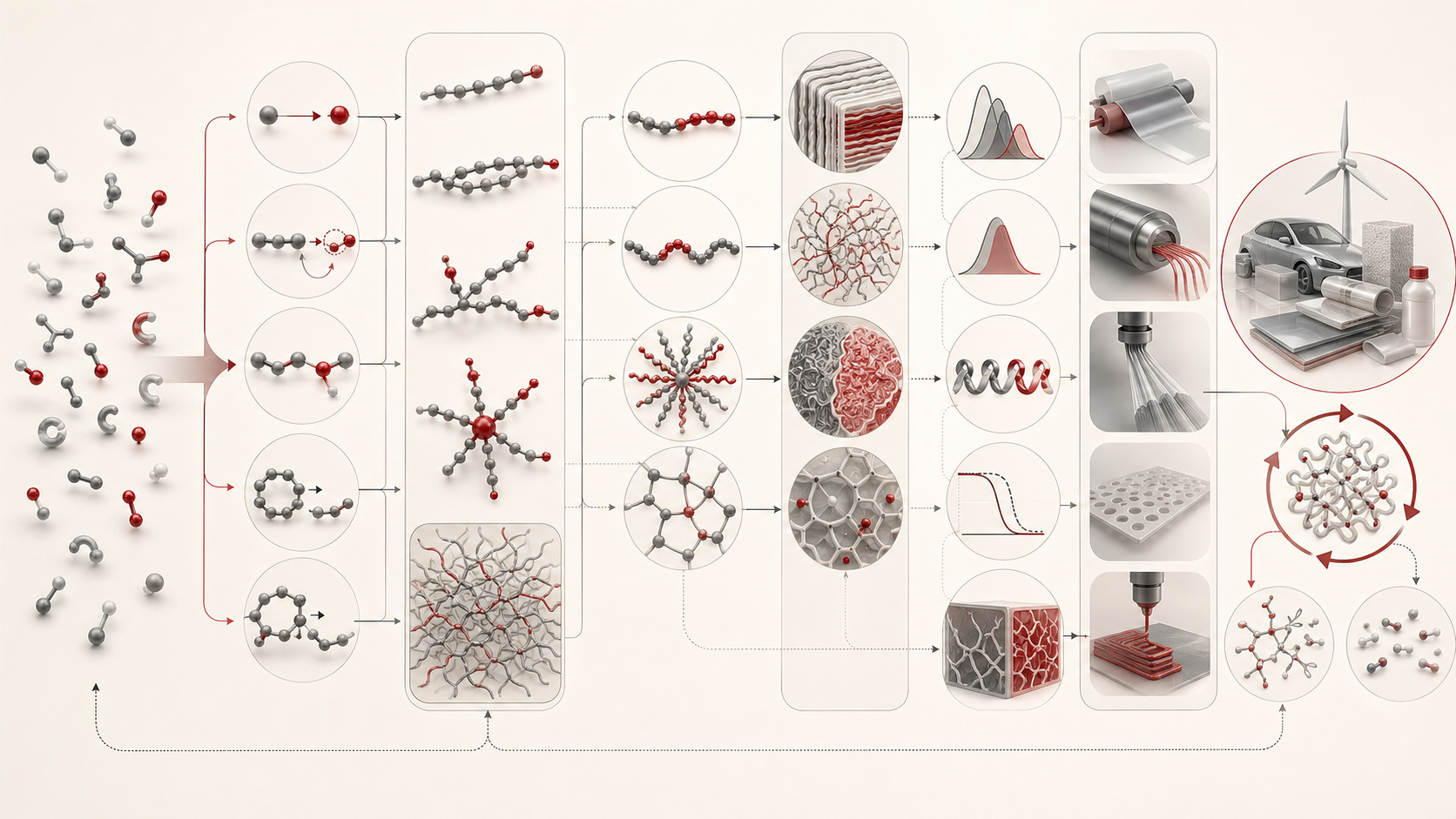
What Polymer Chemistry Studies
Polymer chemistry studies macromolecular substances whose molecular structure is built from repeating or recurring units. In synthetic polymers, those units are usually derived from monomers that undergo polymerization. In biological polymers, such as proteins, polysaccharides, nucleic acids, lignin, cellulose, chitin, and natural rubber, macromolecular structure is produced by biological systems but can still be analyzed through chemical principles.
Polymers are chemically distinctive because their properties often depend on populations of molecules rather than a single molecular formula. A small molecule may be represented by a defined structure and molecular mass. A polymer sample usually contains chains with a distribution of molar masses, end groups, architectures, conformations, and sometimes compositions. A polymer material may also contain additives, plasticizers, fillers, stabilizers, pigments, residual monomers, processing aids, catalysts, degradation products, reinforcing fibers, and interfacial phases.
This makes polymer chemistry both molecular and statistical. It asks what chains are made of, how long they are, how they are connected, how they move, how they pack, how they interact, how they degrade, and how they become useful materials. It is chemistry that must treat individual bonds and population distributions at the same time.
Polymer chemistry also differs from small-molecule chemistry because synthesis and processing are tightly linked. A polymer’s final properties may depend not only on the polymerization reaction but on extrusion, drawing, annealing, curing, cooling rate, solvent casting, printing, spinning, foaming, orientation, crystallization, crosslinking, or additive dispersion. The same nominal polymer can become a film, fiber, foam, gel, elastomer, adhesive, coating, membrane, biomedical device, or structural composite depending on how it is processed.
For researchers and scientists, polymer chemistry requires attention to molecular identity, distributional identity, and material identity. A polymer is not fully described by a repeat unit. It must be described by molar mass, dispersity, architecture, tacticity, morphology, additives, processing history, aging state, test conditions, and intended use.
From Monomers to Macromolecules
A monomer is a small molecule capable of becoming part of a polymer chain. Ethylene can become polyethylene. Styrene can become polystyrene. Methyl methacrylate can become poly(methyl methacrylate). Caprolactam can become nylon 6. Lactic acid derivatives can become polylactide. The chemical route from monomer to polymer determines chain growth, molecular weight, branching, stereochemistry, end groups, and material behavior.
The transformation from monomer to macromolecule changes more than size. A polymer chain has conformational freedom, entanglement, long-range connectivity, cooperative motion, and collective behavior. A polymer can be flexible even if individual bonds are strong. It can be tough because chains deform and dissipate energy. It can be brittle if motion is restricted. It can crystallize partially, remain amorphous, swell in solvent, form networks, phase-separate, conduct ions, respond to temperature, or degrade through chain scission.
Polymer chemistry therefore requires attention to multiple levels of structure:
- Constitution: which atoms and bonds form the repeating units.
- Configuration: fixed stereochemical arrangement along the chain.
- Conformation: spatial arrangement accessible by bond rotation.
- Architecture: linear, branched, star, comb, network, graft, block, bottlebrush, dendritic, or cyclic form.
- Morphology: amorphous regions, crystalline lamellae, domains, phases, pores, fibers, and interfaces.
- Processing history: extrusion, casting, curing, drawing, annealing, molding, printing, spinning, foaming, or crosslinking conditions.
Macromolecular behavior also depends on chain motion. Polymer chains are not rigid rods in most systems. They coil, rotate, entangle, stretch, relax, crystallize, adsorb, diffuse, and sometimes break. The time scale of chain motion determines whether a polymer behaves as glassy, rubbery, viscous, elastic, brittle, tough, sticky, or processable under a given condition.
For researchers, this means polymer identity is not exhausted by naming the monomer. Polyethylene can be low-density, linear low-density, high-density, ultra-high-molecular-weight, crosslinked, filled, oxidized, recycled, or blended. These differences matter because polymer chemistry is chain chemistry expressed through material structure.
Polymerization Mechanisms
Chain-Growth Polymerization
Chain-growth polymerization forms polymers by adding monomers to an active chain end. Radical, cationic, anionic, coordination, ring-opening, and controlled radical mechanisms can all produce chain-growth polymers. The active center may be a radical, ion, metal complex, or other reactive species. Chain initiation, propagation, transfer, termination, and inhibition determine molar mass and architecture.
Free-radical polymerization is widely used because it tolerates many monomers and conditions. However, conventional radical polymerization often produces broad molar-mass distributions and limited control over architecture. Controlled or reversible-deactivation radical polymerization methods can improve control over chain length, block copolymer formation, and functional end groups.
Step-Growth Polymerization
Step-growth polymerization occurs when monomers, oligomers, and chains react with one another through functional groups. Polyesters, polyamides, polycarbonates, polyurethanes, phenolics, epoxies, and many thermosets are often produced through step-growth chemistry. High molar mass usually requires high conversion and careful stoichiometric balance between functional groups.
Step-growth systems show why polymer chemistry is sensitive to reaction completeness. A conversion that seems high in small-molecule synthesis may still be insufficient for high-molar-mass polymer formation. Side reactions, impurities, water, monofunctional contaminants, and imbalance between functional groups can strongly limit chain length.
Ring-Opening Polymerization
Ring-opening polymerization converts cyclic monomers into polymers by opening ring structures. Lactones, lactides, epoxides, cyclic carbonates, lactams, cyclic siloxanes, and cyclic olefins can be polymerized through ring-opening routes. This chemistry is important for biodegradable polyesters, polyethers, silicones, polyamides, biomedical polymers, and specialty materials.
Ring-opening routes are especially important when polymer design must connect synthesis to degradation. Polylactide, polycaprolactone, and related aliphatic polyesters are often studied because hydrolyzable backbones can support biomedical and compostability-related applications under appropriate conditions. But degradability depends strongly on crystallinity, molar mass, additives, geometry, temperature, water availability, microbial context, and time.
Coordination and Stereospecific Polymerization
Coordination polymerization uses metal catalysts to control monomer insertion, stereochemistry, tacticity, branching, and microstructure. Ziegler-Natta and metallocene catalysts transformed polyolefin chemistry by enabling control over polyethylene, polypropylene, and related materials. Stereoregularity can determine whether a polymer crystallizes, how it melts, and whether it behaves as a useful thermoplastic.
Coordination polymerization also shows the importance of catalysis in polymer chemistry. Catalyst identity, ligand structure, support, cocatalyst, temperature, monomer purity, hydrogen concentration, and reactor conditions can all influence molecular weight, comonomer incorporation, branching, and tacticity. The catalyst does not merely make the polymer faster; it helps define the polymer’s architecture.
Network-Forming Polymerization
Some polymerizations form networks rather than soluble chains. Thermosets, elastomers, hydrogels, adhesives, coatings, dental resins, epoxy networks, phenolic resins, vulcanized rubber, and photocured polymers depend on crosslinking. Once a network is formed, the material may no longer melt or dissolve like a linear thermoplastic. Network structure controls stiffness, swelling, toughness, glass transition, solvent resistance, and shape stability.
Network formation requires special care because gelation can occur suddenly. Before gelation, a reacting mixture may flow. After gelation, an infinite network spans the material. Conversion, functionality, stoichiometry, cure schedule, diffusion, phase separation, vitrification, and shrinkage all affect final properties. A thermoset is therefore not simply a polymer with crosslinks; it is a cured chemical history locked into material form.
Architecture, Sequence, Stereochemistry, and Copolymers
Polymer architecture controls function. A linear polymer may crystallize, entangle, and melt. A branched polymer may have lower crystallinity and different melt viscosity. A star polymer may have compact dimensions. A comb or bottlebrush polymer may create steric bulk and unusual mechanical behavior. A network polymer may swell but not dissolve. A block copolymer may self-assemble into ordered nanostructures. A graft copolymer may combine a backbone with side-chain functionality.
Copolymers extend polymer design by incorporating more than one monomer type. Random copolymers distribute monomers statistically along chains. Alternating copolymers arrange monomers in a repeating pattern. Block copolymers connect long segments of different composition. Graft copolymers attach side chains to a backbone. Sequence-controlled polymers attempt to place monomer units with greater precision, approaching some of the informational control seen in biological macromolecules.
Stereochemistry is also critical. Tacticity describes the relative stereochemical arrangement of substituents along a polymer chain. Isotactic, syndiotactic, and atactic forms of a polymer can have different crystallinity, melting behavior, mechanical properties, and solubility. Polypropylene is a classic example: stereoregular polypropylene can crystallize and become a useful structural polymer, while atactic polypropylene behaves very differently.
Architecture also shapes self-assembly. Block copolymers can microphase-separate into lamellae, cylinders, spheres, gyroids, or other morphologies when chemically distinct blocks are covalently connected but thermodynamically incompatible. These nanoscale structures are important in membranes, lithography, elastomers, drug delivery, photonic materials, and toughened plastics.
For researchers, architecture must be reported clearly because it can dominate properties. Two samples with the same monomer composition may behave differently if one is linear and the other branched, one is random and the other blocky, one is isotactic and the other atactic, or one is lightly crosslinked and the other highly crosslinked. Polymer chemistry is molecular topology as well as molecular composition.
Molar Mass, Degree of Polymerization, and Dispersity
Polymer samples usually contain chains of different lengths. This makes average molar mass and molar-mass distribution central to polymer chemistry. Number-average molar mass, mass-average molar mass, and dispersity describe different aspects of chain populations. A polymer with the same repeat unit can behave very differently if its chains are short, long, narrowly distributed, broadly distributed, branched, crosslinked, or degraded.
The degree of polymerization describes the number of monomeric units in a macromolecule, oligomer, block, or chain. A polymer with higher degree of polymerization generally has higher molar mass, but end groups, copolymer composition, branching, and chain defects can complicate direct comparison.
Molar mass affects viscosity, entanglement, tensile strength, toughness, solubility, diffusion, melt processing, crystallization, degradation, and biological clearance. Low-molar-mass polymers may flow easily but have weak mechanical properties. Very high-molar-mass polymers may be tough but difficult to process. Dispersity can influence processability, crystallization, mechanical behavior, and reproducibility.
Dispersity also changes interpretation. A polymer sample with the same number-average molar mass can contain very different high-mass tails. Those high-mass chains may strongly affect melt viscosity, entanglement, toughness, and processing. Low-mass fractions may affect extractables, migration, odor, volatility, plasticization, biological clearance, or degradation behavior. Average values alone can hide functionally important populations.
For researchers, molar-mass data must be tied to method. Size-exclusion chromatography, light scattering, osmometry, mass spectrometry for oligomers, viscometry, and end-group analysis may produce related but different results. Calibration standards, solvent, temperature, polymer conformation, branching, aggregation, column interactions, and detector type can alter interpretation. A molar-mass value without method context is incomplete evidence.
Structure, Morphology, and Polymer Properties
Polymer properties emerge across length scales. At the molecular scale, bond rotation, chain stiffness, polarity, hydrogen bonding, ionic groups, aromatic rings, side chains, and backbone chemistry influence mobility and interactions. At the chain scale, molar mass, branching, architecture, tacticity, and sequence matter. At the mesoscale, crystallinity, phase separation, domain size, lamellae, pores, fibers, and filler dispersion shape behavior. At the macroscale, processing, orientation, defects, interfaces, and aging determine performance.
Important polymer properties include:
- Mechanical behavior: modulus, strength, toughness, elongation, creep, fatigue, and fracture.
- Thermal behavior: glass transition, melting, crystallization, thermal degradation, and heat deflection.
- Transport behavior: gas permeability, water uptake, solvent swelling, diffusion, and barrier performance.
- Electrical behavior: insulation, dielectric response, ionic conductivity, electronic conductivity, and breakdown strength.
- Optical behavior: transparency, haze, refractive index, color, photostability, and luminescence.
- Surface behavior: adhesion, wetting, friction, fouling, biocompatibility, and coating performance.
- Chemical durability: oxidation, hydrolysis, UV degradation, solvent resistance, and environmental stress cracking.
Because polymers are processed materials, the same chemical composition can produce different properties depending on cooling rate, drawing, annealing, crystallization, filler dispersion, orientation, humidity, and aging. Polymer chemistry must therefore connect synthesis to processing and performance.
Crystallinity is especially important. Semicrystalline polymers contain both ordered crystalline regions and disordered amorphous regions. Crystalline regions can increase stiffness, chemical resistance, barrier behavior, and melting transitions. Amorphous regions can contribute toughness, transparency, mobility, and impact behavior. The balance between crystalline and amorphous phases affects nearly every property.
Morphology can also be hierarchical. A polymer may contain lamellae, spherulites, fibrils, domains, pores, fibers, particles, and interfaces. In blends, phase separation can create dispersed domains or co-continuous structures. In composites, fillers can reinforce or weaken depending on dispersion and interfacial adhesion. In membranes, pore size and tortuosity shape transport. Polymer properties are therefore morphological as well as molecular.
Thermal and Mechanical Behavior
The glass transition is one of the central concepts in polymer materials. Below the glass-transition region, amorphous polymer segments have limited cooperative motion and the material may behave as a glassy solid. Above the glass-transition region, chain segments gain mobility and the material may become rubbery or more flexible. Semicrystalline polymers may also have melting transitions associated with crystalline domains.
Thermoplastics soften or melt when heated and can often be reshaped. Thermosets form crosslinked networks that do not melt in the same way. Elastomers are lightly crosslinked or physically networked materials that can undergo large reversible deformation. Hydrogels are polymer networks swollen with water. Fibers often rely on chain orientation and crystallinity. Adhesives depend on wetting, interfacial chemistry, viscoelasticity, and cohesive strength.
Mechanical behavior depends on time and temperature. Polymers are often viscoelastic: they show both elastic and viscous response. A polymer may behave differently under rapid impact, slow loading, long-term creep, cyclic fatigue, or elevated temperature. This makes polymer testing context-dependent. A single tensile modulus cannot fully describe a polymer material.
Temperature can also shift failure mode. A polymer that is tough above its glass-transition region may become brittle below it. A thermoplastic that performs well at room temperature may creep under sustained load at elevated temperature. A coating that adheres under dry conditions may fail during humidity cycling. A membrane that is selective at one temperature may swell and lose selectivity at another.
For researchers, thermal and mechanical evidence should be tied to use conditions. The relevant question is not only what the polymer’s modulus or transition temperature is, but how it behaves under the actual temperature, humidity, stress, strain rate, chemical exposure, lifetime, and processing history implied by the application.
Polymer Rheology, Processing, and Manufacturing History
Polymer rheology studies how polymer melts, solutions, gels, resins, and suspensions flow and deform. Rheology is central because polymers are often manufactured by extrusion, injection molding, blow molding, fiber spinning, coating, printing, casting, calendering, compression molding, foaming, or additive manufacturing. A polymer’s processability can determine whether its molecular properties are useful in practice.
Polymer melts often show non-Newtonian behavior. Viscosity can decrease with shear rate, a behavior known as shear thinning. Entangled chains can stretch, align, disentangle, relax, or break under flow. Long-chain branching can strongly alter melt strength. Molecular-weight distribution affects viscosity because high-molar-mass tails can dominate flow behavior. Fillers, fibers, pigments, and additives can further complicate processing.
Processing history can create orientation, residual stress, crystallinity changes, weld lines, voids, skin-core structures, anisotropy, phase separation, or degradation. A molded part may have different properties near the surface than in the interior. A drawn fiber may be strong along one direction but weaker in another. A rapidly cooled film may have different crystallinity from an annealed film. A printed polymer may contain interlayer weaknesses.
Manufacturing can also cause chemical change. Heat, shear, oxygen, moisture, catalysts, acids, bases, metal residues, and UV exposure can cause chain scission, crosslinking, oxidation, hydrolysis, discoloration, or additive loss. Reprocessing recycled polymers may reduce molar mass, alter crystallinity, accumulate contaminants, or change odor and color. Polymer chemistry therefore follows the material through processing, not only through synthesis.
For researchers and engineers, polymer processing should be treated as part of the material record. A property measured on a compression-molded plaque may not predict performance in an injection-molded part, blown film, spun fiber, printed lattice, or solvent-cast membrane. Processing is not downstream from polymer chemistry; it is polymer chemistry under force, heat, and time.
Additives, Fillers, Blends, and Composites
Most commercial polymer materials are formulations, not pure polymers. They may contain plasticizers, stabilizers, antioxidants, UV absorbers, flame retardants, pigments, dyes, lubricants, processing aids, nucleating agents, impact modifiers, antimicrobial agents, antistatic agents, compatibilizers, crosslinkers, curing agents, residual catalysts, reinforcing fibers, mineral fillers, carbon black, silica, clays, glass fibers, carbon fibers, or nanoparticles.
Additives can improve performance, but they also affect safety, aging, recyclability, migration, odor, color, processing, and environmental fate. A plasticizer can increase flexibility but may migrate. A stabilizer can slow oxidation but become depleted. A flame retardant can reduce flammability but introduce toxicity or persistence concerns. A pigment can affect UV stability, heat absorption, and recycling quality.
Fillers and reinforcements can change stiffness, strength, thermal expansion, conductivity, barrier behavior, and cost. Their effectiveness depends on particle size, aspect ratio, loading, dispersion, interfacial adhesion, orientation, and compatibility. A filler that is poorly dispersed can create defects rather than reinforcement. A fiber composite can be strong along one direction but vulnerable to delamination or matrix cracking.
Polymer blends combine two or more polymers. Because many polymers are immiscible, blends often phase-separate. Compatibilizers can improve interfacial adhesion and domain structure. Blends can improve toughness, processability, cost, barrier properties, or heat resistance, but they can also complicate recycling if the components cannot be separated or reprocessed together.
For researchers, polymer evidence should specify formulation. A named polymer grade may behave differently from a pure polymer because additives, fillers, stabilizers, and processing aids are part of the material’s real chemistry. Polymer materials are often engineered mixtures whose function depends on interfaces among phases.
Functional, Conductive, Responsive, and Biomedical Polymers
Functional polymers are designed to do more than provide passive structure. They may conduct ions or electrons, respond to pH or temperature, bind specific molecules, release drugs, change shape, emit light, transport gases, self-heal, adhere to tissue, resist fouling, catalyze reactions, or form selective membranes. Their chemistry often combines backbone design, side-chain functionality, morphology, and environmental response.
Conductive and semiconducting polymers use conjugated structures or doped states to support electronic transport. They are important in organic electronics, sensors, antistatic coatings, flexible devices, electrochromic materials, and energy systems. Their performance depends on conjugation length, ordering, doping, morphology, contacts, oxidation, moisture, and processing.
Ionic polymers and polyelectrolytes carry fixed or mobile charges. They are central to ion-exchange membranes, fuel cells, water treatment, hydrogels, drug delivery, flocculants, batteries, and biological materials. Their behavior depends on charge density, counterions, hydration, salt concentration, pH, swelling, and phase morphology.
Biomedical polymers require special discipline because material performance is inseparable from biological context. Biocompatibility depends on surface chemistry, degradation products, extractables, leachables, sterilization, protein adsorption, immune response, mechanical behavior, and application route. A polymer that is safe as a bulk implant may not be appropriate as nanoparticles, fibers, degradation fragments, or injectable gels without separate evidence.
Responsive polymers can change swelling, solubility, charge, shape, permeability, or mechanical properties in response to temperature, pH, light, redox conditions, enzymes, ions, or electric fields. These materials are promising for sensors, soft robotics, controlled release, separations, and adaptive coatings, but their reliability depends on reversibility, fatigue, hysteresis, response time, and stability under real conditions.
For researchers, functional polymers must be evaluated by function and durability together. A responsive effect observed once may not survive cycling. A conductive polymer may degrade under air or bias. A hydrogel may swell differently in buffer and biological fluid. Function is only meaningful when tied to environment and lifetime.
Polymer Characterization
Polymer characterization links macromolecular structure to material behavior. Common methods include nuclear magnetic resonance spectroscopy, infrared spectroscopy, Raman spectroscopy, mass spectrometry for oligomers or degradation products, size-exclusion chromatography, light scattering, differential scanning calorimetry, thermogravimetric analysis, dynamic mechanical analysis, rheology, X-ray scattering, microscopy, mechanical testing, contact-angle measurement, permeability testing, and electrochemical or dielectric measurements for functional polymers.
Different methods answer different questions. NMR may reveal monomer composition, tacticity, end groups, or sequence information. Size-exclusion chromatography estimates molar-mass distribution relative to calibration and method assumptions. Differential scanning calorimetry identifies thermal transitions. Rheology reveals flow and relaxation behavior. Dynamic mechanical analysis tracks viscoelastic response over temperature and frequency. Microscopy reveals morphology, phase separation, fibers, cracks, or filler dispersion.
Characterization must be tied to the claim being made. A polymer described as biodegradable requires degradation evidence under specified conditions. A polymer described as recyclable requires processing and property-retention evidence. A membrane described as selective requires permeability and selectivity measurements under relevant humidity, pressure, and mixture conditions. A biomaterial described as biocompatible requires appropriate biological testing, not merely benign chemistry in isolation.
Polymer characterization is often method-dependent. Size-exclusion chromatography can depend on solvent, standards, column chemistry, detector type, and polymer conformation. Differential scanning calorimetry can depend on heating rate and thermal history. Mechanical testing can depend on strain rate, sample geometry, humidity, and temperature. Permeability can depend on film thickness, crystallinity, swelling, pressure, and penetrant mixture.
For researchers, strong polymer evidence combines chemical, thermal, mechanical, morphological, and aging data. A polymer’s repeat unit is a starting point. Its real material identity emerges through measured distributions, transitions, morphologies, interfaces, and performance under relevant conditions.
Aging, Weathering, and Degradation Pathways
Polymer materials change over time. Aging can involve physical aging, crystallization, relaxation, plasticizer migration, additive depletion, oxidation, hydrolysis, chain scission, crosslinking, UV damage, microbial attack, swelling, environmental stress cracking, fatigue, creep, embrittlement, discoloration, odor formation, or surface cracking. The same polymer may age differently in air, water, soil, sunlight, biological fluid, solvent, high temperature, or mechanical stress.
Physical aging is important in glassy polymers. Over time, nonequilibrium polymer chains can slowly relax toward denser states, changing modulus, brittleness, permeability, and dimensional stability. Semicrystalline polymers can undergo secondary crystallization. Elastomers can harden or soften depending on oxidation, chain scission, crosslinking, or plasticizer loss.
Chemical degradation pathways depend on backbone chemistry. Polyesters and polycarbonates may hydrolyze under certain conditions. Polyolefins may oxidize under heat, UV, and oxygen unless stabilized. Polyamides can absorb water and change mechanical behavior. Polyurethanes can undergo hydrolysis or oxidation depending on structure. Silicones, fluoropolymers, and aromatic polymers have different stability profiles.
Weathering combines multiple stresses: ultraviolet light, heat, oxygen, humidity, pollutants, salt, freeze-thaw cycling, abrasion, and biological exposure. Laboratory accelerated aging can be useful, but it must be connected to real mechanisms. A high-temperature test may accelerate degradation but may also create pathways not present in normal use. Weathering evidence should state conditions and limitations.
For researchers, degradation is not simply failure. It can be designed where appropriate, as in resorbable biomedical materials or chemically recyclable polymers. But degradation must be controlled, characterized, and connected to end products. Fragmentation into smaller particles is not the same as mineralization or safe biodegradation.
Polymer Sustainability, Degradation, and Circularity
Polymer materials raise major sustainability questions because they are widely used, persistent, diverse, and often difficult to collect, sort, recycle, or safely degrade. Some polymers are designed for long service life, which can be valuable in infrastructure, medical devices, vehicles, electronics, and energy systems. Others become short-lived waste after packaging or single-use applications. A responsible polymer strategy must distinguish durability from persistence, reuse from downcycling, biodegradation from fragmentation, and recycling claims from actual recovery systems.
Polymer degradation can occur through hydrolysis, oxidation, photolysis, thermal scission, enzymatic attack, mechanical fragmentation, environmental stress cracking, and microbial activity. Degradation may reduce molecular weight, change mechanical properties, release additives, produce oligomers, or create microplastic and nanoplastic particles. Biodegradable polymers require careful interpretation because degradation depends on environment, time, temperature, moisture, microbial community, oxygen availability, and material thickness.
Circular polymer design may include:
- designing polymers for mechanical recycling without severe property loss;
- using chemically recyclable backbones where feasible;
- reducing toxic additives and problematic stabilizers;
- simplifying multilayer packaging when separation is impossible;
- developing bio-based feedstocks without shifting harm to land, food, or water systems;
- designing materials that degrade safely only in appropriate contexts;
- building collection, sorting, labeling, and processing systems that match the chemistry.
Sustainable polymer chemistry is therefore not only about inventing new materials. It is about aligning molecular design with infrastructure, behavior, economics, justice, and environmental fate. A recyclable polymer is not meaningfully circular without collection, sorting, contamination control, reprocessing capacity, markets for recycled material, and property retention. A bio-based polymer is not automatically sustainable if feedstock production creates land-use, water, fertilizer, labor, or biodiversity harms.
Microplastics and nanoplastics also require serious attention. Polymer fragmentation can produce particles that persist, transport additives, interact with organisms, and move through air, water, soil, food systems, and wastewater. The chemistry of polymer waste is not only bulk polymer chemistry; it is also surface chemistry, colloid chemistry, toxicology, and environmental transport.
For researchers, polymer sustainability claims should be specific. What polymer? What additives? What use phase? What degradation environment? What time scale? What recovery system? What evidence for mineralization, recycling, reuse, or safe disposal? Responsible polymer chemistry requires evidence at the material, product, system, and lifecycle levels.
Responsible Use of Polymer Evidence
Polymer claims can affect packaging, healthcare, water systems, textiles, electronics, transportation, construction, agriculture, food safety, and environmental policy. Responsible use requires careful distinction between laboratory performance, product readiness, and real-world behavior.
Responsible polymer practice includes:
- not treating monomer identity as sufficient to predict material performance;
- reporting molar mass, dispersity, architecture, additives, and processing history where relevant;
- linking thermal and mechanical properties to test conditions;
- evaluating aging, weathering, chemical exposure, fatigue, creep, and degradation;
- distinguishing biodegradation from fragmentation;
- testing recyclability in realistic collection and processing systems;
- reporting extractables, leachables, residual monomer, and additives when safety matters;
- using validated standards for medical, food-contact, structural, or regulated applications.
Responsible interpretation also requires avoiding simplistic polymer labels. “Plastic” is not one material. “Bioplastic” can mean bio-based, biodegradable, both, or neither depending on context. “Compostable” depends on facility conditions and certification. “Recyclable” depends on local collection and processing systems. “Biocompatible” depends on application, exposure route, sterilization, degradation, and biological endpoint.
The ethical strength of polymer chemistry lies in connecting molecular design to material consequence. Polymers can enable lightweight structures, medical technologies, water purification, clean-energy systems, protective coatings, electronics, and durable goods. They can also create persistent waste, exposure risks, and environmental burdens. Polymer chemistry becomes responsible when performance, processing, degradation, and end-of-life behavior are designed together.
Mathematical Lens: Chain Length, Dispersity, Elasticity, and Transport
Polymer chemistry is quantitative because polymer samples are distributions. The number-average molar mass can be written as:
M_n = \frac{\sum_i N_i M_i}{\sum_i N_i}
\]
Interpretation: \(M_n\) gives each molecule equal statistical weight. \(N_i\) is the number of molecules with molar mass \(M_i\). Number-average molar mass is sensitive to lower-molar-mass chains.
The mass-average molar mass is:
M_w = \frac{\sum_i N_i M_i^2}{\sum_i N_i M_i}
\]
Interpretation: \(M_w\) weights heavier chains more strongly. High-molar-mass tails can strongly influence \(M_w\), viscosity, entanglement, and mechanical behavior.
Dispersity is commonly expressed as:
Đ = \frac{M_w}{M_n}
\]
Interpretation: A value close to one indicates a narrow molar-mass distribution, while larger values indicate broader distributions. Dispersity affects reproducibility because two polymer samples with similar average molar mass may have different low-mass and high-mass fractions.
Degree of polymerization relates molar mass to repeat-unit molar mass in simplified homopolymer cases:
X_n \approx \frac{M_n}{M_0}
\]
Interpretation: \(X_n\) is number-average degree of polymerization and \(M_0\) is repeat-unit molar mass. End groups, copolymer composition, branching, and degradation can require more careful treatment.
For an ideal elastomer network, the shear modulus can be approximated as:
G \approx \nu RT
\]
Interpretation: \(G\) is shear modulus, \(\nu\) is the number of elastically active network chains per unit volume, \(R\) is the gas constant, and \(T\) is temperature. This simplified relationship shows why crosslink density matters: more active network chains generally increase stiffness.
Transport through polymer films is often described by permeability:
P = DS
\]
Interpretation: \(P\) is permeability, \(D\) is diffusivity, and \(S\) is solubility. A polymer membrane’s barrier or separation behavior depends on both how easily a species dissolves into the polymer and how quickly it diffuses through it.
For step-growth polymerization with ideal stoichiometric balance, a simplified Carothers relationship is:
X_n = \frac{1}{1-p}
\]
Interpretation: \(p\) is extent of reaction. This expression shows why very high conversion is required for high degree of polymerization in ideal step-growth systems.
For diffusion through a film at steady state, a simple flux expression can be written as:
J = -D\frac{dc}{dx}
\]
Interpretation: \(J\) is diffusive flux, \(D\) is diffusivity, and \(dc/dx\) is the concentration gradient. Polymer barrier performance depends on diffusion, solubility, morphology, crystallinity, and swelling.
These equations are useful because they show why polymer chemistry cannot rely on a single structural formula. Chain populations, network density, conversion, transport, and distributional properties determine how macromolecular materials behave.
Computational Workflows for Polymer Chemistry
Computational polymer workflows can make material comparison more transparent. A workflow can track polymer identity, monomer composition, polymerization mechanism, molar mass, dispersity, glass-transition temperature, melting temperature, crystallinity, modulus, elongation, permeability, swelling, recyclability score, additive concerns, processing history, degradation behavior, and responsible-design review.
Useful workflows include polymer candidate screening, molar-mass distribution summaries, thermal-property comparison, structure-property mapping, membrane permeability analysis, mechanical-property tradeoff scoring, aging-trend analysis, additive-risk registers, recyclability screening, degradation-pathway tracking, and formulation evidence management. More advanced workflows may integrate laboratory information management systems, rheometer files, SEC chromatograms, DSC thermograms, spectroscopy, molecular simulation, materials informatics, and lifecycle assessment.
For researchers, computational workflows should preserve assumptions. Was modulus measured at the same temperature and strain rate? Was permeability measured under dry or humid conditions? Was glass transition measured on first or second heating? Was molar mass calibrated against standards or measured by absolute light scattering? Was recyclability assessed by actual reprocessing or by theoretical compatibility? These details determine whether a comparison is meaningful.
The examples below use synthetic data. They do not certify materials, select products, determine safety, validate recyclability, or replace professional polymer testing. They demonstrate how polymer chemistry reasoning can be structured, audited, and communicated responsibly.
Python Example: Polymer Candidate Screening
The following Python example uses synthetic educational data to screen polymer candidates for a hypothetical flexible barrier material. It combines glass-transition temperature, crystallinity, permeability, modulus, elongation, recyclability, and cost into a transparent ranking model. The goal is not to select a real material but to show how polymer design assumptions can be made explicit.
from pathlib import Path
from typing import Dict, List
import json

import pandas as pd


# Synthetic polymer materials screening workflow.
# Educational example only; not for engineering certification,
# medical use, packaging qualification, procurement, or product design.


def screen_polymer_candidates(polymers: pd.DataFrame) -> pd.DataFrame:
    """Score polymer candidates against a hypothetical flexible barrier target.

    Real polymer selection requires validated property data, processing trials,
    extractables/leachables review where relevant, aging studies, safety review,
    and lifecycle assessment.
    """

    polymers = polymers.copy()

    targets: Dict[str, float] = {
        "oxygen_permeability_relative": 0.20,
        "modulus_MPa": 1000.0,
        "elongation_percent": 300.0,
        "recyclability_score": 0.80,
        "relative_cost_score": 0.30,
    }

    weights: Dict[str, float] = {
        "oxygen_permeability_relative": 1.6,
        "modulus_MPa": 0.8,
        "elongation_percent": 1.0,
        "recyclability_score": 1.3,
        "relative_cost_score": 1.0,
    }

    scales: Dict[str, float] = {
        "oxygen_permeability_relative": 0.50,
        "modulus_MPa": 1000.0,
        "elongation_percent": 250.0,
        "recyclability_score": 0.25,
        "relative_cost_score": 0.30,
    }

    score_terms: List[str] = []

    for property_name in targets:
        term_name = f"{property_name}_score_term"
        polymers[term_name] = (
            weights[property_name]
            * (
                (polymers[property_name] - targets[property_name])
                / scales[property_name]
            ) ** 2
        )
        score_terms.append(term_name)

    polymers["functional_mismatch_score"] = polymers[score_terms].sum(axis=1)

    polymers["barrier_review_required"] = (
        polymers["oxygen_permeability_relative"] > 0.60
    )

    polymers["brittleness_review_required"] = (
        polymers["elongation_percent"] < 80
    )

    polymers["processing_review_required"] = (
        polymers["glass_transition_C"] > 80
    )

    polymers["responsible_design_review_required"] = (
        polymers["recyclability_score"] < 0.50
    )

    polymers["review_required"] = (
        polymers["barrier_review_required"]
        | polymers["brittleness_review_required"]
        | polymers["processing_review_required"]
        | polymers["responsible_design_review_required"]
    )

    ranked = polymers.sort_values("functional_mismatch_score").copy()
    ranked["rank"] = range(1, len(ranked) + 1)

    ranked.attrs["targets"] = targets
    ranked.attrs["weights"] = weights
    ranked.attrs["scales"] = scales

    return ranked


polymers = pd.DataFrame({
    "polymer_id": ["poly_A", "poly_B", "poly_C", "poly_D", "poly_E"],
    "polymer_class": [
        "polyolefin",
        "polyester",
        "polyamide",
        "elastomer",
        "biopolymer",
    ],
    "glass_transition_C": [-20.0, 72.0, 48.0, -55.0, 58.0],
    "melting_temperature_C": [130.0, 255.0, 220.0, None, 165.0],
    "crystallinity_percent": [55.0, 38.0, 42.0, 5.0, 30.0],
    "oxygen_permeability_relative": [0.80, 0.18, 0.12, 2.80, 0.35],
    "modulus_MPa": [900.0, 2400.0, 1800.0, 4.0, 3200.0],
    "elongation_percent": [450.0, 120.0, 180.0, 700.0, 40.0],
    "recyclability_score": [0.82, 0.74, 0.52, 0.35, 0.68],
    "relative_cost_score": [0.28, 0.42, 0.55, 0.38, 0.62],
})

ranked = screen_polymer_candidates(polymers)

output_dir = Path("outputs")
output_dir.mkdir(exist_ok=True)

ranked.to_csv(output_dir / "polymer_candidate_screening_ranked.csv", index=False)

manifest: Dict[str, object] = {
    "workflow": "synthetic_polymer_candidate_screening",
    "target_profile": ranked.attrs["targets"],
    "weights": ranked.attrs["weights"],
    "scales": ranked.attrs["scales"],
    "best_candidate": ranked.iloc[0]["polymer_id"],
    "responsible_use": [
        "Synthetic educational data only.",
        "Real polymer selection requires validated property data, processing trials, aging studies, safety review, and lifecycle assessment.",
    ],
}

with (output_dir / "polymer_design_manifest.json").open(
    "w",
    encoding="utf-8"
) as file:
    json.dump(manifest, file, indent=2)

print(ranked[[
    "polymer_id",
    "polymer_class",
    "functional_mismatch_score",
    "rank",
    "review_required",
]])
This workflow shows why polymer selection is a design argument. The chosen target values, weights, and scales encode assumptions about what the material should do. If the priority changes from barrier performance to toughness, compostability, optical clarity, cost, biocompatibility, or high-temperature stability, the ranking may change.
R Example: Molar-Mass Distributions and Property Tradeoffs
The following R example uses synthetic polymer data to calculate dispersity and create simple property tradeoff scores. In real polymer characterization, molar-mass averages depend on method, calibration, solvent, column behavior, detector type, and polymer conformation, so reported values should be tied to measurement conditions.
# Synthetic polymer chemistry workflow.
# Educational example only; not for product qualification.

polymer_fractions <- data.frame(
  polymer_id = c("poly_A", "poly_A", "poly_A", "poly_A", "poly_A"),
  fraction_id = c("f1", "f2", "f3", "f4", "f5"),
  molecule_count = c(1000, 1800, 2400, 1600, 700),
  molar_mass_g_mol = c(25000, 55000, 90000, 135000, 210000)
)

properties <- data.frame(
  polymer_id = c("poly_A", "poly_B", "poly_C", "poly_D", "poly_E"),
  oxygen_permeability_relative = c(0.80, 0.18, 0.12, 2.80, 0.35),
  modulus_MPa = c(900, 2400, 1800, 4, 3200),
  elongation_percent = c(450, 120, 180, 700, 40),
  recyclability_score = c(0.82, 0.74, 0.52, 0.35, 0.68),
  relative_cost_score = c(0.28, 0.42, 0.55, 0.38, 0.62)
)

Mn <- sum(
  polymer_fractions$molecule_count *
    polymer_fractions$molar_mass_g_mol
) / sum(polymer_fractions$molecule_count)

Mw <- sum(
  polymer_fractions$molecule_count *
    polymer_fractions$molar_mass_g_mol^2
) / sum(
  polymer_fractions$molecule_count *
    polymer_fractions$molar_mass_g_mol
)

dispersity <- Mw / Mn

molar_mass_summary <- data.frame(
  polymer_id = "poly_A",
  Mn_g_mol = Mn,
  Mw_g_mol = Mw,
  dispersity = dispersity
)

normalize <- function(x) {
  if (max(x) == min(x)) {
    return(rep(0, length(x)))
  }
  (x - min(x)) / (max(x) - min(x))
}

properties$barrier_score <-
  1 - normalize(properties$oxygen_permeability_relative)

properties$toughness_proxy <-
  normalize(properties$elongation_percent) *
  normalize(properties$modulus_MPa)

properties$responsible_design_score <- (
  0.60 * properties$recyclability_score +
    0.40 * (1 - normalize(properties$relative_cost_score))
)

properties$combined_score <- (
  0.45 * properties$barrier_score +
    0.25 * properties$toughness_proxy +
    0.30 * properties$responsible_design_score
)

properties$rank <- rank(-properties$combined_score, ties.method = "min")
ranked <- properties[order(properties$rank), ]

ranked$review_required <- (
  ranked$oxygen_permeability_relative > 0.60 |
    ranked$elongation_percent < 80 |
    ranked$recyclability_score < 0.50
)

dir.create("outputs", showWarnings = FALSE)

write.csv(
  molar_mass_summary,
  file = "outputs/polymer_molar_mass_summary.csv",
  row.names = FALSE
)

write.csv(
  ranked,
  file = "outputs/polymer_property_tradeoff_ranking.csv",
  row.names = FALSE
)

sink("outputs/polymer_chemistry_report.txt")
cat("Synthetic Polymer Chemistry Report\n")
cat("=================================\n\n")
cat("Molar-mass summary for poly_A:\n")
print(molar_mass_summary)
cat("\nProperty tradeoff ranking:\n")
print(ranked[, c(
  "polymer_id",
  "barrier_score",
  "toughness_proxy",
  "responsible_design_score",
  "combined_score",
  "rank",
  "review_required"
)])
cat("\nResponsible-use note:\n")
cat("Synthetic educational data only. Real polymer decisions require validated characterization, processing trials, aging studies, safety review, and lifecycle evaluation.\n")
sink()

print(molar_mass_summary)
print(ranked)
This workflow illustrates why polymer data should be reported with context. A molar-mass average without distribution, method, calibration, and sample history is incomplete. A property ranking without processing conditions, uncertainty, and degradation behavior is also incomplete.
SQL Example: Polymer Chemistry Evidence Register
Polymer chemistry interpretation becomes more reliable when polymer identity, synthesis route, molar-mass data, thermal transitions, mechanical properties, processing history, degradation tests, and responsible-design evidence are traceable. A simple evidence register can preserve the context needed to audit polymer claims.
CREATE TABLE polymer_material (
    polymer_id TEXT PRIMARY KEY,
    polymer_name TEXT NOT NULL,
    polymer_class TEXT,
    monomer_or_repeat_unit TEXT,
    polymerization_mechanism TEXT,
    architecture TEXT,
    additive_or_filler_notes TEXT,
    responsible_use_notes TEXT
);

CREATE TABLE polymer_synthesis_record (
    synthesis_id INTEGER PRIMARY KEY,
    polymer_id TEXT NOT NULL,
    synthesis_batch TEXT,
    catalyst_or_initiator TEXT,
    solvent_system TEXT,
    reaction_temperature_c REAL,
    reaction_time_h REAL CHECK (reaction_time_h >= 0),
    conversion_percent REAL CHECK (conversion_percent BETWEEN 0 AND 100),
    purification_method TEXT,
    FOREIGN KEY (polymer_id) REFERENCES polymer_material(polymer_id)
);

CREATE TABLE polymer_molar_mass_measurement (
    molar_mass_id INTEGER PRIMARY KEY,
    polymer_id TEXT NOT NULL,
    measurement_datetime TEXT,
    method_name TEXT,
    solvent TEXT,
    calibration_basis TEXT,
    Mn_g_mol REAL CHECK (Mn_g_mol >= 0),
    Mw_g_mol REAL CHECK (Mw_g_mol >= 0),
    dispersity REAL CHECK (dispersity >= 1),
    quality_flag TEXT,
    FOREIGN KEY (polymer_id) REFERENCES polymer_material(polymer_id)
);

CREATE TABLE polymer_property_measurement (
    property_id INTEGER PRIMARY KEY,
    polymer_id TEXT NOT NULL,
    test_datetime TEXT,
    sample_processing_history TEXT,
    glass_transition_c REAL,
    melting_temperature_c REAL,
    crystallinity_percent REAL CHECK (crystallinity_percent BETWEEN 0 AND 100),
    modulus_MPa REAL CHECK (modulus_MPa >= 0),
    elongation_percent REAL CHECK (elongation_percent >= 0),
    oxygen_permeability_relative REAL CHECK (oxygen_permeability_relative >= 0),
    test_condition_notes TEXT,
    quality_flag TEXT,
    FOREIGN KEY (polymer_id) REFERENCES polymer_material(polymer_id)
);

CREATE TABLE polymer_degradation_test (
    degradation_id INTEGER PRIMARY KEY,
    polymer_id TEXT NOT NULL,
    test_type TEXT,
    exposure_medium TEXT,
    temperature_c REAL,
    duration_days REAL CHECK (duration_days >= 0),
    molar_mass_loss_percent REAL CHECK (molar_mass_loss_percent >= 0),
    mass_loss_percent REAL CHECK (mass_loss_percent >= 0),
    fragmentation_observed INTEGER CHECK (fragmentation_observed IN (0, 1)),
    degradation_product_notes TEXT,
    review_status TEXT,
    FOREIGN KEY (polymer_id) REFERENCES polymer_material(polymer_id)
);

CREATE TABLE polymer_responsible_design_review (
    review_id INTEGER PRIMARY KEY,
    polymer_id TEXT NOT NULL,
    recyclability_review_completed INTEGER CHECK (recyclability_review_completed IN (0, 1)),
    additive_review_completed INTEGER CHECK (additive_review_completed IN (0, 1)),
    extractables_leachables_review_completed INTEGER CHECK (extractables_leachables_review_completed IN (0, 1)),
    lifecycle_review_completed INTEGER CHECK (lifecycle_review_completed IN (0, 1)),
    review_notes TEXT,
    review_status TEXT,
    FOREIGN KEY (polymer_id) REFERENCES polymer_material(polymer_id)
);

SELECT
    p.polymer_id,
    p.polymer_class,
    p.architecture,
    m.Mn_g_mol,
    m.Mw_g_mol,
    m.dispersity,
    prop.glass_transition_c,
    prop.crystallinity_percent,
    prop.modulus_MPa,
    prop.elongation_percent,
    prop.oxygen_permeability_relative,
    d.fragmentation_observed,
    CASE
        WHEN m.dispersity > 3.0 THEN 'molar mass distribution review required'
        WHEN prop.elongation_percent < 80 THEN 'brittleness review required'
        WHEN prop.oxygen_permeability_relative > 0.60 THEN 'barrier review required'
        WHEN d.fragmentation_observed = 1 THEN 'degradation-fragmentation review required'
        ELSE 'standard review'
    END AS screening_result
FROM polymer_material p
JOIN polymer_molar_mass_measurement m
    ON p.polymer_id = m.polymer_id
JOIN polymer_property_measurement prop
    ON p.polymer_id = prop.polymer_id
LEFT JOIN polymer_degradation_test d
    ON p.polymer_id = d.polymer_id
ORDER BY screening_result, prop.oxygen_permeability_relative ASC;
The purpose of this register is to keep polymer interpretation attached to evidence. A molar-mass value should preserve method and calibration. A mechanical property should preserve processing history and test conditions. A degradation claim should preserve medium, time, temperature, and products. A recyclability claim should preserve reprocessing and property-retention evidence. Polymer data become stronger when provenance is part of the record.
GitHub Repository
The companion repository for this article can support reproducible workflows for polymer candidate screening, molar-mass distributions, dispersity calculations, property tradeoff rankings, degradation records, SQL provenance, and responsible polymer interpretation.
Complete Code Repository
The full code distribution for this article, including selected polymer chemistry examples, expanded computational workflows, reproducible data structures, provenance documentation, molar-mass summaries, property tradeoff models, degradation records, SQL evidence registers, and scientific-computing scaffolding, is available on GitHub.
Limits, Uncertainty, and Responsible Interpretation
Polymer chemistry is difficult to generalize because polymer properties depend on distributions, processing history, additives, morphology, and environment. A repeat unit does not fully define the material. Two polymer samples with the same nominal chemistry may differ in molar mass, dispersity, tacticity, branching, crystallinity, filler dispersion, additives, residual monomer, aging state, or thermal history.
Measurement uncertainty is also significant. Size-exclusion chromatography can depend on calibration standards and solvent behavior. Glass-transition values can depend on heating rate and thermal history. Mechanical properties can depend on sample geometry, humidity, strain rate, temperature, and orientation. Permeability can depend on swelling, crystallinity, penetrant mixture, and film defects. Degradation tests can depend on environment and time scale.
Sustainability claims require special caution. Biodegradation is not the same as fragmentation. Bio-based feedstock is not automatically low-impact. Recyclability is not meaningful without collection, sorting, compatibility, reprocessing, and market demand. Chemical recycling may reduce some burdens but add energy, solvent, catalyst, or emissions burdens. Durable polymers may be beneficial in long-life infrastructure and harmful in short-lived waste streams.
Safety claims also require application context. A polymer used in a structural component, food-contact film, medical implant, textile, coating, water-treatment membrane, electronic device, or agricultural product faces different exposure routes and performance requirements. Residual monomer, additives, catalysts, extractables, leachables, degradation products, particles, and processing residues may matter differently across applications.
The computational examples associated with this article are synthetic and educational. They do not certify polymers, qualify products, establish safety, validate recyclability, determine biodegradation, predict real lifetime, or replace professional polymer characterization, toxicological review, engineering testing, regulatory analysis, or lifecycle assessment. They are designed to show how polymer chemistry reasoning can be structured and audited.
Responsible interpretation should avoid both polymer optimism and polymer fatalism. Polymers are not inherently good or bad. They are powerful material systems whose value depends on design, use, durability, exposure, recovery, and end-of-life behavior. Polymer chemistry becomes trustworthy when these conditions are made explicit.
Conclusion
Polymer chemistry shows how molecular repetition becomes material function. Monomers become chains; chains become distributions; distributions become morphologies; morphologies become materials; materials become products, infrastructures, exposures, wastes, and circularity challenges. A polymer is therefore not only a macromolecule. It is a chemical system whose behavior emerges across scales.
The field’s central lesson is that structure-property relationships are layered. Repeat-unit chemistry matters, but so do polymerization mechanism, molar mass, dispersity, stereochemistry, architecture, crystallinity, glass transition, entanglement, additives, fillers, processing, aging, and environment. A polymer material cannot be understood from formula alone.
For chemistry as a discipline, polymer chemistry is essential because it connects molecular design to the materials that shape everyday life: packaging, textiles, medical devices, adhesives, electronics, coatings, infrastructure, membranes, elastomers, composites, and soft matter. It also carries responsibility because polymer durability can become persistence, polymer convenience can become waste, and polymer performance can hide additives, degradation products, and end-of-life burdens.
A mature polymer chemistry therefore asks not only how to make macromolecules, but how to make macromolecular materials that are useful, durable where durability is needed, recoverable where recovery is possible, degradable only when degradation is appropriate, and accountable across their full lifecycle.
Related articles
- What Is Chemistry?
- Chemical Bonding and Molecular Structure
- Intermolecular Forces and the Properties of Matter
- Materials Chemistry and the Design of Function
- Solid-State Chemistry and Crystalline Materials
- Surface Chemistry, Interfaces, and Catalysis
- Colloids, Soft Matter, and Complex Fluids
- Nanochemistry and Molecular-Scale Materials
- Semiconductor, Electronic, and Photochemical Materials
- Computational Chemistry and Molecular Modeling
- Laboratory Automation, Chemical Data, and Instrument Workflows
- Green Chemistry, Responsibility, and Sustainable Transformation
Further reading
- Hiemenz, P.C. and Lodge, T.P. (2007) Polymer Chemistry. 2nd edn. Boca Raton: CRC Press.
- Odian, G. (2004) Principles of Polymerization. 4th edn. Hoboken: Wiley.
- Rubinstein, M. and Colby, R.H. (2003) Polymer Physics. Oxford: Oxford University Press.
- Sperling, L.H. (2005) Introduction to Physical Polymer Science. 4th edn. Hoboken: Wiley.
- International Union of Pure and Applied Chemistry (n.d.) What Are Polymers? Available at: https://iupac.org/polymer-edu/what-are-polymers/
- National Institute of Standards and Technology (n.d.) Polymer Property Predictor and Database. Available at: https://www.nist.gov/programs-projects/polymer-property-predictor-and-database
- National Institute of Standards and Technology (n.d.) Polymer Analytics. Available at: https://www.nist.gov/programs-projects/polymer-analytics
- National Academies of Sciences, Engineering, and Medicine (1994) Polymer Science and Engineering: The Shifting Research Frontiers. Washington, DC: National Academies Press. Available at: https://www.nationalacademies.org/publications/2307/polymer-science-and-engineering-the-shifting-research-frontiers
References
- Hiemenz, P.C. and Lodge, T.P. (2007) Polymer Chemistry. 2nd edn. Boca Raton: CRC Press.
- International Union of Pure and Applied Chemistry (n.d.) What Are Polymers? Available at: https://iupac.org/polymer-edu/what-are-polymers/
- International Union of Pure and Applied Chemistry (n.d.) Degree of Polymerization. Available at: https://goldbook.iupac.org/terms/view/D01569
- International Union of Pure and Applied Chemistry (n.d.) Dispersity. Available at: https://goldbook.iupac.org/terms/view/12226
- International Union of Pure and Applied Chemistry (n.d.) Glass Transition. Available at: https://goldbook.iupac.org/terms/view/G02640
- International Union of Pure and Applied Chemistry (n.d.) Glass-Transition Temperature. Available at: https://goldbook.iupac.org/terms/view/G02641
- International Union of Pure and Applied Chemistry (n.d.) Macromolecule. Available at: https://goldbook.iupac.org/terms/view/M03667
- National Academies of Sciences, Engineering, and Medicine (1994) Polymer Science and Engineering: The Shifting Research Frontiers. Washington, DC: National Academies Press. Available at: https://www.nationalacademies.org/publications/2307/polymer-science-and-engineering-the-shifting-research-frontiers
- National Institute of Standards and Technology (n.d.) Polymer Analytics. Available at: https://www.nist.gov/programs-projects/polymer-analytics
- National Institute of Standards and Technology (n.d.) Polymer Property Predictor and Database. Available at: https://www.nist.gov/programs-projects/polymer-property-predictor-and-database
- Odian, G. (2004) Principles of Polymerization. 4th edn. Hoboken: Wiley.
- Rubinstein, M. and Colby, R.H. (2003) Polymer Physics. Oxford: Oxford University Press.
- Sperling, L.H. (2005) Introduction to Physical Polymer Science. 4th edn. Hoboken: Wiley.