
Last Updated May 28, 2026
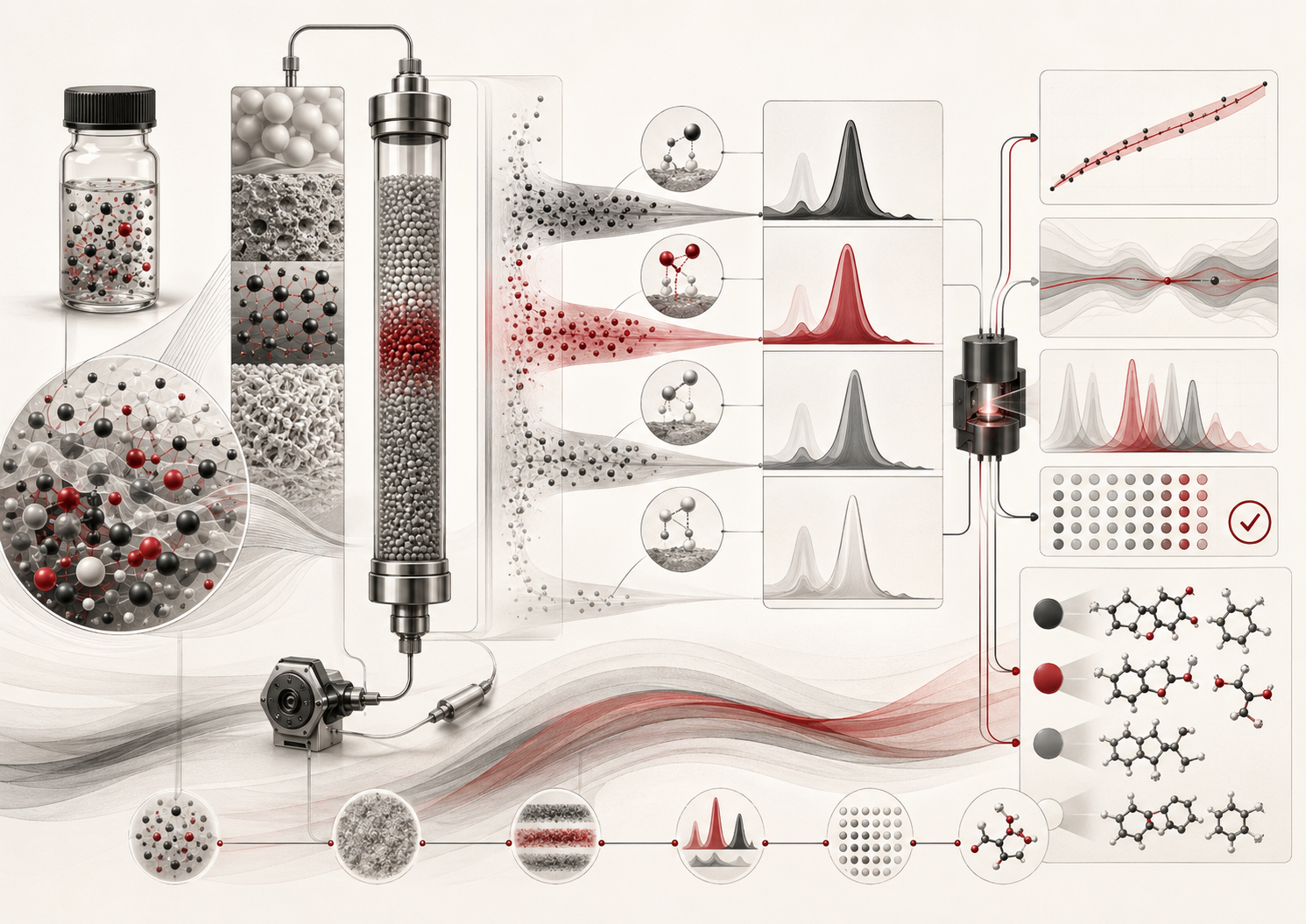
Chromatography is one of chemistry’s most important methods for making complex mixtures intelligible. Many chemical samples do not arrive as pure substances. They arrive as environmental extracts, biological fluids, food matrices, industrial formulations, reaction mixtures, polymer additives, petroleum fractions, fragrance components, pharmaceutical impurities, natural products, forensic residues, atmospheric particles, or water samples containing many compounds at different concentrations. Chromatography makes chemical identification possible by separating these components before they are detected, quantified, compared, or structurally interpreted.
The central thesis of this article is that chromatography is not merely a technique for producing peaks. It is a disciplined way of transforming mixtures into ordered chemical evidence. Compounds partition between phases, move through a system at different rates, produce measurable detector signals, and are interpreted through retention behavior, peak shape, detector response, calibration, reference standards, spectra, uncertainty, and method validation.
Chromatography is therefore both a separation science and an identification system. It does not identify compounds by separation alone, but it creates the conditions under which identification becomes defensible. A chromatographic peak is evidence only when its retention behavior, detector response, integration, resolution, calibration, reference comparison, sample preparation, and quality-control context are visible.
Main Library
Publications
Article Map
Chemistry
Related Topic
Data Systems & Analytics
Related Topic
Environmental Monitoring Systems
Related Topic
Biology
Why Separation Matters in Chemistry
Chemical identification is difficult when many substances are present at once. A detector may respond to several compounds simultaneously. A spectrum may contain overlapping signals. A biological or environmental matrix may suppress, enhance, obscure, or chemically transform the analyte of interest. A trace impurity may be hidden beneath a major component. A reaction mixture may contain starting material, intermediate, product, solvent, catalyst, byproducts, and decomposition products. Without separation, many analytical signals become ambiguous.
Chromatography addresses this problem by exploiting differences in how chemical species distribute between two phases. One phase remains fixed or effectively fixed; the other moves. Compounds that interact more strongly with the stationary phase move more slowly. Compounds that remain more strongly in the mobile phase move more quickly. The result is temporal or spatial separation: components emerge at different times, distances, or volumes and can be detected individually.
This makes chromatography central to analytical chemistry, pharmaceutical science, environmental monitoring, toxicology, food chemistry, forensic chemistry, metabolomics, proteomics, petroleum analysis, polymer science, natural-products chemistry, and industrial quality control. Separation science is often the difference between a vague chemical signal and a defensible chemical conclusion.
Separation is also important because detectors are selective in different ways. A UV detector may respond only to chromophores. A fluorescence detector may respond to strongly fluorescent molecules or derivatized analytes. A conductivity detector may respond to ionic species. A mass spectrometer may detect ions but can be affected by ion suppression and adduct formation. Chromatography improves interpretation by controlling when analytes reach the detector and by reducing overlap among compounds.
For researchers and scientists, the core lesson is that chromatography is not simply a preparatory step. It is part of the evidence system. The quality of the separation determines whether downstream identification, quantification, and interpretation are chemically meaningful.
What Chromatography Does
A chromatographic experiment produces a chromatogram: a detector response plotted against time, volume, or distance. Peaks correspond to substances or groups of substances that pass the detector at different points in the separation. The position of a peak provides retention information. The area or height of a peak can support quantification. The shape of a peak reveals information about system performance, overload, interaction mechanisms, diffusion, mass-transfer limitations, and method suitability.
However, a chromatographic peak is not automatically a compound identity. A peak may represent one substance, multiple co-eluting substances, degradation products, matrix interference, column bleed, solvent front, carryover, baseline disturbance, or detector artifact. Identification depends on additional evidence: retention time comparison, retention index, standards, spectral matching, mass-to-charge features, fragmentation patterns, peak purity, orthogonal separations, isotope patterns, and chemical plausibility.
Chromatography is therefore best understood as an evidence-generating system. It separates, orders, and concentrates chemical signals, but interpretation requires method knowledge, reference data, quality control, and awareness of uncertainty.
A chromatographic method does several things at once:
- it introduces a sample into a controlled separation environment;
- it distributes analytes between mobile and stationary phases;
- it creates retention differences based on chemical properties;
- it converts separated bands into detector signals;
- it allows peaks to be integrated, compared, calibrated, and interpreted;
- it provides a record that can be audited through raw data, method conditions, and quality controls.
Chromatography also makes time part of chemical evidence. Two substances may produce similar detector signals, but if they elute at different times under a validated method, they can be distinguished. Conversely, two substances may be chemically different but co-elute, creating a single misleading peak. A chromatogram is therefore not merely a plot. It is a controlled experiment in differential movement.
For researchers, chromatographic evidence should be interpreted through separation quality. Peak area, retention time, and detector response are only useful when peak resolution, integration, method conditions, calibration, and sample context are known.
Stationary Phases, Mobile Phases, and Chemical Selectivity
The central concept in chromatography is differential interaction. Molecules move differently because they differ in polarity, volatility, size, charge, hydrophobicity, hydrogen-bonding ability, ionic character, shape, acidity, basicity, solubility, adsorption affinity, and interaction with the stationary and mobile phases. A chromatographic method is designed by choosing conditions that make meaningful chemical differences become measurable retention differences.
The stationary phase provides selective interaction. In gas chromatography, the stationary phase is often a liquid-like polymer film on the inside of a capillary column. In liquid chromatography, the stationary phase may be a bonded silica material, ion-exchange resin, size-exclusion medium, chiral selector, affinity ligand, porous particle, monolith, or polymeric medium. The mobile phase carries analytes through the system. In gas chromatography, it is an inert carrier gas. In liquid chromatography, it may be a solvent mixture with controlled pH, ionic strength, gradient composition, modifier concentration, or buffer system.
Changing either phase changes the separation. A reversed-phase liquid chromatography method may separate analytes according to hydrophobicity and solvent composition. An ion-exchange method may separate analytes by charge and pH-dependent binding. A size-exclusion method may separate molecules by hydrodynamic size. A chiral method may distinguish enantiomers that are otherwise identical in many physical properties. A gas chromatography method may separate volatile compounds according to volatility, boiling point, and interaction with the stationary phase.
Selectivity is often the most powerful lever in chromatography. A highly efficient system cannot separate compounds well if the chemistry of the method does not create meaningful retention differences. Changing stationary phase chemistry, mobile-phase composition, pH, gradient slope, temperature, ion-pairing reagent, buffer, modifier, or derivatization strategy can change selectivity more profoundly than simply using a longer column.
Chromatographic selectivity also depends on sample chemistry. Acidic and basic analytes may change ionization state with pH. Proteins and polymers may change conformation or aggregation state. Metal-binding compounds may interact with trace metals. Lipids may form adducts or complexes. Highly polar compounds may require hydrophilic interaction chromatography, ion chromatography, or derivatization. The method must match the chemistry of the analyte and matrix.
For researchers, method development should begin with chemical hypotheses. What properties distinguish the analytes? Polarity? Charge? Size? Volatility? Chirality? Binding affinity? Hydrophobicity? Stability? The best chromatographic method is the one whose phase chemistry makes those differences visible.
Major Chromatographic Methods
Gas Chromatography
Gas chromatography separates volatile and thermally stable compounds. A sample is vaporized, carried through a column by an inert gas, and separated according to volatility and stationary-phase interactions. Gas chromatography is widely used for solvents, fuels, fragrances, environmental contaminants, forensic residues, pesticides, flavor compounds, fire debris, petroleum fractions, and volatile organic compounds.
When coupled with mass spectrometry, gas chromatography becomes one of the most powerful tools for chemical identification. Retention behavior and electron-ionization mass spectra together provide orthogonal evidence. The retention time helps locate the compound in the separation, while the mass spectrum provides fragmentation information that can be compared with reference libraries.
Liquid Chromatography
Liquid chromatography separates compounds dissolved in a liquid mobile phase. High-performance liquid chromatography and ultra-high-performance liquid chromatography are central to pharmaceutical analysis, biomolecular analysis, food testing, environmental chemistry, metabolomics, proteomics, and materials characterization. Liquid chromatography is especially useful for compounds that are nonvolatile, thermally unstable, polar, ionic, large, or biologically relevant.
Liquid chromatography can be paired with ultraviolet-visible detection, fluorescence detection, refractive-index detection, conductivity detection, electrochemical detection, evaporative light-scattering detection, charged-aerosol detection, or mass spectrometry. The detector changes what evidence is available. A UV detector may provide quantification at selected wavelengths, while mass spectrometry can provide molecular mass and fragmentation information.
Thin-Layer and Planar Chromatography
Thin-layer chromatography is a planar technique in which compounds move across a coated surface by capillary action. It is simple, inexpensive, visually intuitive, and useful for reaction monitoring, teaching, preliminary screening, and qualitative comparisons. Its retention factor can help compare compounds under defined conditions, but TLC is usually less precise and less information-rich than instrumented GC or LC methods.
Planar chromatography can still be valuable when speed, low cost, visual screening, or many parallel samples matter. However, plate quality, solvent saturation, spot size, development distance, visualization chemistry, humidity, and analyst interpretation can affect results.
Ion Chromatography
Ion chromatography separates ions and polar molecules, often using ion-exchange principles. It is widely used for inorganic anions and cations, water chemistry, environmental monitoring, food analysis, industrial process control, semiconductor manufacturing, and pharmaceutical counterion analysis. Conductivity detection is common, often with suppression to reduce background signal.
Ion chromatography is especially useful when ionic species must be measured in aqueous matrices. Method quality depends on eluent composition, suppressor behavior, column selectivity, calibration, matrix effects, and potential interferences from co-eluting ions.
Size-Exclusion Chromatography
Size-exclusion chromatography separates molecules by effective size in solution. Large molecules are excluded from some pore volume and elute earlier; smaller molecules access more pore volume and elute later. The method is central to polymer characterization, protein analysis, aggregation studies, biomolecular purification, and formulation analysis. It does not usually separate primarily by chemical affinity, although secondary interactions can still occur.
Size-exclusion chromatography is method-sensitive because apparent size depends on solvent, polymer conformation, column calibration, pore structure, aggregation, ionic strength, and interactions with the stationary phase. For polymers, molar mass estimates require appropriate calibration or light-scattering detection. For proteins, aggregation and nonspecific interactions can complicate interpretation.
Affinity and Chiral Chromatography
Affinity chromatography separates molecules through specific binding interactions, such as ligand-receptor, antibody-antigen, enzyme-substrate, metal-affinity, lectin-glycan, or tagged-protein interactions. Chiral chromatography separates enantiomers using chiral stationary phases or selectors. These methods show that chromatography can exploit not only broad physical properties but also highly specific molecular recognition.
Chiral chromatography is especially important in pharmaceutical chemistry because enantiomers can differ in biological activity, metabolism, toxicity, and regulatory relevance. Affinity chromatography is especially important in biotechnology because selective binding can purify or characterize complex biomolecules.
Hydrophilic Interaction, Supercritical Fluid, and Multidimensional Chromatography
Hydrophilic interaction chromatography is useful for polar analytes that are poorly retained by conventional reversed-phase methods. Supercritical fluid chromatography can be useful for chiral separations, lipids, nonpolar analytes, and high-throughput method development. Multidimensional chromatography connects two or more separation mechanisms to increase resolving power in complex mixtures.
For researchers, method choice should follow analyte chemistry, matrix complexity, detector needs, sample stability, and the decision being supported. Chromatography is not one technique; it is a family of separation strategies built around chemical selectivity.
Sample Preparation, Matrix Effects, and Method Context
Chromatographic evidence begins before injection. Sampling, storage, extraction, dilution, filtration, centrifugation, derivatization, digestion, protein precipitation, solid-phase extraction, liquid-liquid extraction, headspace sampling, purge-and-trap concentration, and cleanup can all determine what reaches the chromatographic system. A separation can be excellent, but if the sample is degraded, contaminated, lost during extraction, or chemically transformed before analysis, the result may be misleading.
Matrix effects are central. Biological fluids contain proteins, salts, lipids, metabolites, and enzymes. Environmental waters contain natural organic matter, particles, ions, microbes, and trace contaminants. Food matrices contain fats, proteins, carbohydrates, pigments, flavors, preservatives, and processing byproducts. Industrial samples may contain polymers, surfactants, additives, solvents, catalysts, and degradation products. These matrices can alter recovery, retention, detector response, ionization, baseline, and column lifetime.
Sample preparation should therefore be matched to the analytical goal. A trace-contaminant method may prioritize enrichment and cleanup. A metabolomics workflow may prioritize broad coverage and minimal bias. A pharmaceutical impurity method may prioritize stability and quantitative recovery. A polymer-additive method may require dissolution, extraction, or pyrolysis. A volatile-organic method may use headspace or purge-and-trap techniques to preserve volatile analytes.
Derivatization can make compounds more volatile, more detectable, more stable, more fluorescent, more retained, or more separable. But derivatization also adds reaction chemistry to the method. Incomplete derivatization, side reactions, reagent impurities, and derivative instability can all affect results. Derivatized chromatography must be interpreted as evidence about the derivative and its relationship to the original analyte.
For researchers, sample preparation should be documented with the same care as instrument settings. Extraction solvent, volume, pH, temperature, time, internal standards, cleanup materials, recovery, storage, hold time, and dilution factors are not background details. They are part of the chromatographic evidence chain.
Chromatography and Chemical Identification
Chromatographic identification depends on matching observed evidence to a chemical hypothesis. Retention time alone is rarely definitive because different compounds can co-elute or have similar retention behavior under a particular method. Stronger identification combines multiple lines of evidence.
Common identification evidence includes:
- Retention time: comparison of an unknown peak with a reference standard under the same method.
- Retention index: normalized retention behavior, especially useful in gas chromatography.
- Peak purity: assessment of whether a peak represents one component or multiple overlapping components.
- Spectral evidence: UV-visible spectra, fluorescence spectra, mass spectra, or diode-array detector data associated with a chromatographic peak.
- Mass-to-charge evidence: molecular ions, adducts, isotopic patterns, and fragment ions in LC-MS or GC-MS.
- Reference standards: authentic materials run under matching conditions.
- Orthogonal methods: confirmation using a different chromatographic mechanism, detector, or spectroscopic method.
- Chemical plausibility: consistency with sample source, reaction chemistry, degradation pathways, and known matrix behavior.
For example, in GC-MS, a compound may be tentatively identified by library matching of its mass spectrum. The identification becomes stronger if the retention behavior agrees with a standard or retention index, if characteristic fragment ions are present, if the peak is well resolved, and if the compound is plausible for the sample. In LC-MS/MS, identification may depend on accurate mass, isotope pattern, retention time, precursor ion, product ions, collision-energy behavior, and reference-standard confirmation.
Thus, chromatography separates the mixture, but identification is an inferential process that combines separation with detection, reference data, statistical matching, and chemical reasoning.
Identification confidence should be graded honestly. A peak with a retention-time match only may be tentative. A peak with retention time and UV spectrum may be stronger but still uncertain if co-elution is possible. A peak with retention time, mass spectrum, MS/MS fragments, isotope pattern, and reference-standard match under the same method can support a much stronger identification. The language of the claim should match the evidence.
For researchers, the practical rule is simple: a chromatographic peak should not be promoted to a compound identity without enough orthogonal evidence to justify the claim being made.
Quantification, Calibration, and Internal Standards
Quantitative chromatography connects peak area or peak height to amount. The relationship is established through calibration standards, detector response, sample preparation, injection precision, and data processing. In simple external calibration, standards of known concentration are analyzed and a calibration model is fitted. Unknown concentrations are then estimated from their peak responses.
External calibration can be appropriate when sample preparation and matrix effects are controlled. Internal standards are often used when injection variability, extraction recovery, detector drift, or matrix effects must be corrected. An internal standard is added in known amount and should behave similarly to the analyte. In isotope dilution, an isotopically labeled analyte analog provides especially strong correction because it closely follows the analyte through preparation, separation, and detection while remaining distinguishable.
Calibration evidence should include concentration range, calibration model, residuals, weighting, blank response, limit of detection, limit of quantification, precision, accuracy, recovery, carryover, and quality-control standards. A high \(R^2\) value is not enough. Low-level performance, residual structure, matrix effects, and calibration verification matter.
Quantification also depends on integration. Peak boundaries, baseline correction, smoothing, unresolved shoulders, co-elution, detector saturation, and manual interventions can change peak area. Integration settings should be documented, and manual changes should be traceable.
For researchers, reported concentrations should be understood as the output of a complete measurement chain: sampling, preparation, separation, detection, integration, calibration, correction, quality control, and uncertainty estimation. A concentration is not a raw chromatographic fact; it is a calibrated interpretation.
Peak Shape, Resolution, Co-Elution, and Method Suitability
Peak shape carries information about chromatographic performance. A symmetrical, well-resolved peak is easier to integrate and interpret than a broad, tailing, fronting, overloaded, split, or shoulder-containing peak. Peak asymmetry can indicate column interactions, sample overload, active sites, pH mismatch, poor solvent compatibility, degradation, voids, contamination, or method problems.
Resolution matters because co-elution can produce false identification, biased quantification, or hidden impurities. If two compounds elute together, a detector may report one peak. A mass spectrometer may partially disentangle co-eluting ions, but ion suppression and spectral overlap can still complicate interpretation. A diode-array detector may detect spectral impurity, but similar spectra can still mask overlap. A single detector rarely solves every co-elution problem.
Method suitability checks help determine whether a chromatographic system was capable of producing reliable data at the time of analysis. Suitability criteria may include retention time, resolution, plate count, tailing factor, signal-to-noise, repeatability, sensitivity, pressure, baseline stability, calibration verification, and carryover limits. These checks are especially important in regulated or high-consequence work.
Peak shape can also reveal chemistry. Strong adsorption can cause tailing. Ionization changes can broaden peaks. Metal interactions can distort chelating compounds. Large biomolecules can aggregate or interact with stationary phases. Polymers can show broad distributions rather than sharp peaks. Chromatographic peak behavior should be interpreted chemically, not only numerically.
For researchers, method suitability should not be treated as a formality. It is the evidence that the separation system was working well enough for the claims being made.
Hyphenated Methods: GC-MS, LC-MS, LC-DAD, and Multidetector Evidence
Chromatography becomes especially powerful when paired with detectors that provide structural or spectral evidence. GC-MS combines separation of volatile compounds with electron-ionization mass spectra and library matching. LC-MS combines liquid-phase separation with mass-to-charge information, isotope patterns, adduct evidence, and fragmentation. LC-DAD combines retention time with UV-visible spectra across wavelengths. LC-fluorescence, GC-FID, ICP-MS coupling, and multidetector size-exclusion chromatography each provide different evidence.
Hyphenated methods strengthen identification because they add orthogonal information. A peak’s retention time may match a standard. Its mass spectrum may match a library. Its MS/MS fragments may match known transitions. Its UV spectrum may match a chromophore. Its isotope pattern may support a formula. Its retention index may fit a reference range. Each piece reduces ambiguity when method conditions are controlled.
However, hyphenated methods also introduce new sources of complexity. In LC-MS, adduct formation, ion suppression, in-source fragmentation, and co-elution can complicate interpretation. In GC-MS, thermal degradation, column bleed, derivatization artifacts, and library limitations can mislead. In LC-DAD, similar chromophores can produce similar spectra. In multidetector workflows, detector timing and peak alignment must be controlled.
For researchers, the strength of hyphenated evidence lies in convergence. A strong identification explains how retention behavior, detector response, spectral evidence, and reference comparison support the same chemical conclusion. It also states what uncertainties remain.
Instrumentation, Data, and Signal Processing
Chromatographic instruments differ by method, but most share a common architecture: sample introduction, mobile-phase delivery, separation column or medium, detector, data system, and method-control software. In gas chromatography, the instrument includes an injector, carrier-gas control, oven, capillary column, detector, and often a mass spectrometer. In liquid chromatography, the system includes solvent reservoirs, degassers, pumps, mixers, autosamplers, columns, detectors, and waste handling. In ion chromatography, suppressors and conductivity detection may be central. In preparative chromatography, collection and fractionation are part of the workflow.
Data processing is not a trivial afterthought. Peak detection, baseline correction, integration, smoothing, deconvolution, retention-time alignment, internal-standard correction, calibration fitting, blank subtraction, signal normalization, and library searching can all alter conclusions. A poorly chosen baseline can bias quantification. An unresolved shoulder can hide an impurity. A retention-time shift can misassign a compound. A library match can be misleading if the spectrum is noisy or the compound class is poorly represented in the library.
Good chromatographic data practice includes:
- preserving raw instrument files whenever possible;
- recording column chemistry, dimensions, particle size, film thickness, temperature program, gradient program, flow rate, injection volume, detector settings, and acquisition method;
- documenting integration parameters and manual interventions;
- using blanks, standards, internal standards, quality controls, and suitability checks;
- distinguishing retention-time matches from confirmed identifications;
- tracking calibration range, residuals, replicate precision, detection limits, and quantitation limits;
- linking reported peak areas, concentrations, and identifications to raw data and processing history.
Instrument history is also important. Column age, injection count, guard-column replacement, detector maintenance, pump performance, septum bleed, liner condition, mobile-phase preparation, autosampler carryover, and pressure trends can all affect results. Chromatography is sensitive to system state.
For researchers, chromatographic data should be auditable from reported result back to raw signal, method file, integration settings, calibration, sample preparation, and QC status. Without that traceability, a clean chromatogram can still support a weak claim.
Uncertainty, Quality Control, and Method Validation
Chromatographic evidence is affected by many sources of uncertainty: sample collection, extraction recovery, dilution, derivatization, injection precision, column aging, temperature control, solvent composition, detector noise, peak integration, matrix effects, co-elution, calibration model choice, standard purity, and analyst decisions. A rigorous method makes these sources visible rather than hiding them behind a clean chromatogram.
Quality-control practices may include blanks, duplicate injections, replicate preparations, calibration verification standards, continuing calibration checks, system suitability tests, internal standards, surrogate standards, matrix spikes, control charts, retention-time windows, resolution criteria, signal-to-noise thresholds, and peak-purity checks. The specific controls depend on the field: pharmaceutical impurity analysis, environmental monitoring, forensic toxicology, metabolomics, and teaching laboratories require different levels of validation and documentation.
System suitability is especially important because chromatography is sensitive to the state of the system. A column may degrade. A detector may drift. A pump may produce flow instability. A mobile phase may change composition. A sample matrix may foul the column. Suitability checks help determine whether the system was capable of producing reliable results at the time of analysis.
Method validation connects chromatographic performance to intended use. Validation may include specificity, selectivity, accuracy, precision, linearity, range, limit of detection, limit of quantification, robustness, ruggedness, carryover, recovery, stability, and uncertainty. The required evidence depends on the consequence of the result. A research screen, teaching experiment, validated pharmaceutical assay, environmental compliance method, and forensic analysis do not require the same validation standard.
For researchers, uncertainty should be reported in proportion to consequence. A preliminary chromatographic screen may support exploration. A regulatory concentration claim requires validated quantification. A forensic or clinical conclusion requires strict method control, documentation, and confirmatory evidence. Chromatographic evidence becomes stronger when its limits are stated clearly.
Chromatography and Computational Chemistry
Computational tools increasingly shape separation science. Chemometric models can classify chromatographic fingerprints. Retention prediction models can support method development. Molecular descriptors can help estimate hydrophobicity, volatility, polarity, charge, or retention behavior. Machine learning can assist with peak detection, retention-time alignment, deconvolution, anomaly detection, compound prioritization, and library searching. Mass spectral databases and fragmentation tools support GC-MS and LC-MS identification.
At the same time, computational predictions should not be confused with validated chemical identification. Retention prediction depends on training data, column chemistry, mobile-phase conditions, temperature, gradient profile, matrix effects, and instrument behavior. Library searching depends on spectral quality, database coverage, fragmentation conditions, and match scoring. Machine-learning models may fail when samples fall outside the domain represented in the training data.
Reproducible chromatography therefore benefits from computational workflows that preserve raw data, processing parameters, reference libraries, calibration files, candidate scores, and decision thresholds. The goal is not automation alone. The goal is auditable chemical reasoning.
Computational workflows are also useful for quality monitoring. Retention-time drift, peak-area precision, baseline noise, resolution trends, tailing factors, pressure changes, and QC recoveries can be monitored over time. This turns chromatographic systems into measurable processes rather than isolated runs.
For researchers, computation should make chromatography more transparent. It should not hide peak-picking decisions, integration changes, library thresholds, calibration weighting, or model assumptions. The strongest computational chromatography preserves the evidence trail.
Responsible Use of Chromatographic Evidence
Chromatography is used in high-consequence contexts: pharmaceutical quality, food safety, environmental compliance, drinking-water analysis, toxicology, forensic investigation, workplace exposure, process control, and medical research. Responsible interpretation requires caution about what the data can and cannot support.
Responsible chromatographic practice includes:
- not treating a single retention-time match as definitive identification;
- distinguishing tentative identification from confirmed identification;
- using reference standards and orthogonal evidence when conclusions matter;
- documenting sample preparation, instrument conditions, integration settings, and data processing;
- reporting uncertainty, detection limits, quantitation limits, calibration range, and quality controls when quantitative claims are made;
- preserving raw data and audit trails;
- avoiding overconfident claims from weak library matches or unresolved peaks;
- using validated methods in regulated or safety-critical contexts.
Responsible use also means communicating what chromatography does not prove alone. A retention-time match does not prove identity. A detected impurity does not automatically establish source. A quantified contaminant does not automatically establish exposure or harm without context. A chromatographic fingerprint can support comparison, but it may not reveal causal mechanism. A clean chromatogram can miss compounds that are not extracted, not retained, not detected, or not stable under method conditions.
The ethical strength of chromatography lies in disciplined separation, transparent identification, and honest reporting of uncertainty. A chromatogram can be persuasive, but it becomes scientific evidence only when its method, data processing, reference comparisons, and limitations are made visible.
Mathematical Lens: Retention, Resolution, Efficiency, and Calibration
Chromatography is a measurement science with a compact but powerful mathematical vocabulary. The retention time \(t_R\) is the time at which an analyte peak reaches its maximum detector response. The dead time or hold-up time \(t_M\) represents the time for an unretained species to pass through the system. The retention factor \(k\) is commonly written as:
k = \frac{t_R – t_M}{t_M}
\]
Interpretation: A larger \(k\) indicates stronger retention relative to an unretained species. Very low retention can cause poor separation from the solvent front, while excessive retention can make methods slow or peaks broad.
If two analytes \(A\) and \(B\) have retention factors \(k_A\) and \(k_B\), selectivity can be expressed as:
\alpha = \frac{k_B}{k_A}
\]
Interpretation: \(k_B > k_A\). Selectivity reflects the ability of a method to distinguish two compounds through differential interaction. A method with poor selectivity may not separate compounds no matter how efficient the column is.
Resolution measures how well two adjacent peaks are separated. A common expression is:
R_s = \frac{2(t_{R,B} – t_{R,A})}{w_A + w_B}
\]
Interpretation: \(t_{R,A}\) and \(t_{R,B}\) are the retention times of adjacent peaks, while \(w_A\) and \(w_B\) are their baseline widths. Resolution is central to chemical identification because co-elution can create false positives, false negatives, biased quantification, or mistaken structural assignments.
Column efficiency is often described using the theoretical plate number:
N = 16\left(\frac{t_R}{w}\right)^2
\]
Interpretation: \(w\) is the baseline width of the peak. Higher \(N\) generally indicates narrower peaks and greater separation efficiency under the method conditions used.
The height equivalent to a theoretical plate is:
H = \frac{L}{N}
\]
Interpretation: \(L\) is column length. Smaller plate height generally indicates higher efficiency, although practical performance also depends on selectivity, retention, pressure, temperature, and analysis time.
The Van Deemter relationship expresses the dependence of plate height on mobile-phase velocity:
H = A + \frac{B}{u} + Cu
\]
Interpretation: \(A\) represents multiple-path effects, \(B/u\) represents longitudinal diffusion, \(Cu\) represents mass-transfer limitations, and \(u\) is linear velocity. This equation explains why there is often an optimal flow region rather than a simple rule that faster or slower is always better.
Quantitative chromatography often uses calibration models. A simple external calibration may be written as:
S_i = \beta_0 + \beta_1 c_i + e_i
\]
Interpretation: \(S_i\) is peak area or height, \(c_i\) is concentration, \(\beta_0\) is the intercept, \(\beta_1\) is sensitivity, and \(e_i\) is residual error. The model must be validated within the relevant calibration range.
Internal-standard calibration often uses a response ratio:
\frac{S_{\mathrm{analyte}}}{S_{\mathrm{IS}}} = \beta_0 + \beta_1 c_{\mathrm{analyte}} + e
\]
Interpretation: \(S_{\mathrm{IS}}\) is internal-standard signal. Internal standards can correct for injection variability, extraction recovery, detector drift, and some matrix effects when they behave similarly to the analyte.
These equations are useful because they reveal the structure of chromatographic evidence. Retention, selectivity, resolution, efficiency, flow, and calibration are not isolated calculations. They define whether a method can separate, identify, and quantify compounds reliably.
Computational Workflows for Chromatography
Computational workflows can make chromatographic interpretation more transparent. A workflow can track sample identity, preparation method, instrument method, column identity, mobile phase, detector, raw file, processed file, peaks, retention times, peak widths, peak areas, candidate matches, calibration models, quality-control status, system suitability, integration rules, and identification confidence.
Useful workflows include retention-factor calculation, resolution screening, system-suitability monitoring, peak integration review, calibration-curve fitting, internal-standard correction, replicate precision summaries, retention-time alignment, candidate matching, blank subtraction, peak-purity review, drift monitoring, and evidence-register construction. More advanced workflows may integrate vendor files, chromatography data systems, mass spectrometry outputs, LIMS records, spectral libraries, notebooks, and audit trails.
For researchers, computational workflows should preserve the distinction between peaks, candidates, confirmed identities, and quantified results. A peak is a detector response. A candidate is a possible interpretation. A confirmed identity requires evidence. A concentration requires calibration and QC. A responsible workflow should carry those distinctions forward.
The examples below use synthetic data. They do not validate a method, identify real compounds, certify regulatory results, or replace professional chromatographic review. They demonstrate how chromatography reasoning can be structured, audited, and communicated responsibly.
Python Example: Retention, Resolution, and Candidate Identification
The following Python example uses synthetic educational chromatographic data. It calculates retention factors, adjacent-peak resolution, simple system-suitability flags, and candidate matches based on retention-time agreement. In real chemical identification, retention time alone is not sufficient; reference standards, spectral evidence, method validation, uncertainty, and sample context are needed.
from pathlib import Path
from typing import Dict, List
import json

import pandas as pd


# Synthetic chromatography workflow for retention and candidate matching.
# Educational example only; not for laboratory, forensic, clinical,
# environmental, pharmaceutical, or regulatory identification.


def calculate_retention_factor(retention_time_min: float, dead_time_min: float) -> float:
    """Calculate chromatographic retention factor k."""
    if dead_time_min <= 0:
        raise ValueError("Dead time must be positive.")
    return (retention_time_min - dead_time_min) / dead_time_min


def calculate_resolution(
    retention_left_min: float,
    retention_right_min: float,
    width_left_min: float,
    width_right_min: float,
) -> float:
    """Calculate adjacent-peak resolution using baseline widths."""
    denominator = width_left_min + width_right_min
    if denominator <= 0:
        raise ValueError("Peak widths must be positive.")
    return 2.0 * (retention_right_min - retention_left_min) / denominator


peaks = pd.DataFrame({
    "peak_id": ["p1", "p2", "p3", "p4", "p5"],
    "sample_id": ["unknown_mix"] * 5,
    "retention_time_min": [1.22, 2.85, 4.10, 5.36, 7.02],
    "baseline_width_min": [0.18, 0.25, 0.31, 0.34, 0.42],
    "peak_area": [15200, 88400, 45100, 61700, 29300],
    "blank_area": [120, 210, 800, 150, 95],
})

reference_library = pd.DataFrame({
    "compound": [
        "solvent_front",
        "caffeine",
        "benzoic_acid",
        "acetophenone",
        "ethyl_vanillin",
    ],
    "reference_retention_time_min": [1.20, 2.88, 4.06, 5.42, 7.00],
    "evidence_type": [
        "system marker",
        "synthetic reference standard",
        "synthetic reference standard",
        "synthetic reference standard",
        "synthetic reference standard",
    ],
})

dead_time_min = 0.92
retention_time_tolerance_min = 0.08
minimum_resolution_threshold = 1.50
blank_ratio_threshold = 0.05

peaks["retention_factor_k"] = peaks["retention_time_min"].apply(
    lambda value: calculate_retention_factor(value, dead_time_min)
)

resolution_rows: List[Dict[str, object]] = []

for i in range(len(peaks) - 1):
    left = peaks.iloc[i]
    right = peaks.iloc[i + 1]

    resolution = calculate_resolution(
        retention_left_min=float(left["retention_time_min"]),
        retention_right_min=float(right["retention_time_min"]),
        width_left_min=float(left["baseline_width_min"]),
        width_right_min=float(right["baseline_width_min"]),
    )

    resolution_rows.append({
        "left_peak": left["peak_id"],
        "right_peak": right["peak_id"],
        "resolution_Rs": resolution,
        "resolution_review_required": resolution < minimum_resolution_threshold,
    })

resolution_table = pd.DataFrame(resolution_rows)

candidate_rows: List[Dict[str, object]] = []

for _, peak in peaks.iterrows():
    for _, ref in reference_library.iterrows():
        delta = abs(
            float(peak["retention_time_min"])
            - float(ref["reference_retention_time_min"])
        )

        blank_ratio = float(peak["blank_area"]) / float(peak["peak_area"])

        if delta <= retention_time_tolerance_min:
            if blank_ratio < blank_ratio_threshold:
                status = "tentative retention-time match"
            else:
                status = "tentative match requiring blank review"

            candidate_rows.append({
                "peak_id": peak["peak_id"],
                "candidate_compound": ref["compound"],
                "retention_time_min": peak["retention_time_min"],
                "reference_retention_time_min": ref["reference_retention_time_min"],
                "delta_min": delta,
                "blank_ratio": blank_ratio,
                "evidence_type": ref["evidence_type"],
                "identification_status": status,
            })

candidate_table = pd.DataFrame(candidate_rows)

output_dir = Path("outputs")
output_dir.mkdir(exist_ok=True)

peaks.to_csv(output_dir / "chromatographic_peak_metrics.csv", index=False)
resolution_table.to_csv(output_dir / "adjacent_peak_resolution.csv", index=False)
candidate_table.to_csv(output_dir / "tentative_candidate_matches.csv", index=False)

manifest: Dict[str, object] = {
    "workflow": "synthetic_chromatography_identification",
    "dead_time_min": dead_time_min,
    "retention_time_tolerance_min": retention_time_tolerance_min,
    "minimum_resolution_threshold": minimum_resolution_threshold,
    "blank_ratio_threshold": blank_ratio_threshold,
    "peak_count": int(len(peaks)),
    "candidate_match_count": int(len(candidate_table)),
    "responsible_use": [
        "Retention time matching alone is not definitive identification.",
        "Real workflows require standards, spectral evidence, uncertainty, method validation, quality controls, and expert review.",
    ],
}

with (output_dir / "chromatography_manifest.json").open(
    "w",
    encoding="utf-8"
) as file:
    json.dump(manifest, file, indent=2)

print(peaks)
print(resolution_table)
print(candidate_table)
The workflow demonstrates a core principle: chromatographic evidence becomes stronger when calculations, thresholds, reference comparisons, and limitations are explicit. A peak assignment should be traceable to the data and should state whether it is tentative, confirmed, rejected, or unresolved.
R Example: Calibration, Replicates, and Quantitative Reporting
The following R example models a simple calibration workflow using synthetic peak areas and an internal standard. It fits a linear calibration curve using response ratios, estimates concentrations for unknown replicate injections, and writes outputs suitable for a reproducible notebook or report.
# Synthetic chromatography calibration workflow.
# Educational example only; not for validated analytical reporting.

standards <- data.frame(
  standard_id = c("blank", "std_01", "std_02", "std_03", "std_04", "std_05"),
  concentration_mg_L = c(0, 2, 5, 10, 20, 40),
  analyte_peak_area = c(120, 10550, 26300, 52600, 104900, 209300),
  internal_standard_area = c(50000, 50300, 49850, 50100, 49900, 50250)
)

unknowns <- data.frame(
  sample_id = c("unknown_A", "unknown_A", "unknown_A"),
  injection_id = c("inj_01", "inj_02", "inj_03"),
  analyte_peak_area = c(78400, 79100, 77950),
  internal_standard_area = c(50120, 49980, 50220)
)

standards$response_ratio <-
  standards$analyte_peak_area / standards$internal_standard_area

unknowns$response_ratio <-
  unknowns$analyte_peak_area / unknowns$internal_standard_area

calibration_model <- lm(
  response_ratio ~ concentration_mg_L,
  data = standards
)

intercept <- coef(calibration_model)[1]
slope <- coef(calibration_model)[2]

unknowns$estimated_concentration_mg_L <-
  (unknowns$response_ratio - intercept) / slope

summary_table <- data.frame(
  sample_id = "unknown_A",
  mean_analyte_peak_area = mean(unknowns$analyte_peak_area),
  sd_analyte_peak_area = sd(unknowns$analyte_peak_area),
  mean_response_ratio = mean(unknowns$response_ratio),
  sd_response_ratio = sd(unknowns$response_ratio),
  mean_concentration_mg_L =
    mean(unknowns$estimated_concentration_mg_L),
  sd_concentration_mg_L =
    sd(unknowns$estimated_concentration_mg_L),
  replicate_count = nrow(unknowns)
)

summary_table$relative_sd_percent <-
  100 * summary_table$sd_concentration_mg_L /
    summary_table$mean_concentration_mg_L

summary_table$precision_review_required <-
  summary_table$relative_sd_percent > 15

dir.create("outputs", showWarnings = FALSE)

write.csv(
  standards,
  file = "outputs/chromatography_calibration_standards.csv",
  row.names = FALSE
)

write.csv(
  unknowns,
  file = "outputs/chromatography_unknown_estimates.csv",
  row.names = FALSE
)

write.csv(
  summary_table,
  file = "outputs/chromatography_quant_summary.csv",
  row.names = FALSE
)

sink("outputs/chromatography_calibration_report.txt")
cat("Synthetic Chromatography Calibration Report\n")
cat("==========================================\n\n")
cat("Calibration model using response ratio:\n")
print(summary(calibration_model))
cat("\nUnknown sample summary:\n")
print(summary_table)
cat("\nResponsible-use note:\n")
cat("Synthetic educational data only. Real quantitative chromatography requires validated methods, calibration checks, system suitability, quality controls, uncertainty analysis, and documented sample preparation.\n")
sink()

print(summary_table)
Quantitative chromatography requires careful control of calibration, sample preparation, injection precision, detector response, carryover, matrix effects, peak integration, blank subtraction, and uncertainty. A numerical concentration estimate is only as strong as the method that produced it.
SQL Example: Chromatography Evidence Register
Chromatographic interpretation becomes more reliable when samples, preparation records, instrument methods, columns, runs, raw files, peaks, candidate assignments, calibration records, QC checks, and system suitability are traceable. A simple evidence register can preserve the context needed to audit separation-based chemical claims.
CREATE TABLE chromatography_sample (
    sample_id TEXT PRIMARY KEY,
    sample_name TEXT NOT NULL,
    sample_matrix TEXT,
    collection_datetime TEXT,
    storage_condition TEXT,
    preparation_method TEXT,
    preparation_notes TEXT
);

CREATE TABLE chromatography_method (
    method_id TEXT PRIMARY KEY,
    method_name TEXT NOT NULL,
    method_version TEXT,
    chromatography_type TEXT,
    column_chemistry TEXT,
    column_dimensions TEXT,
    mobile_phase_or_carrier TEXT,
    gradient_or_temperature_program TEXT,
    flow_rate_description TEXT,
    detector_type TEXT,
    method_status TEXT
);

CREATE TABLE chromatography_run (
    run_id TEXT PRIMARY KEY,
    sample_id TEXT NOT NULL,
    method_id TEXT NOT NULL,
    injection_datetime TEXT,
    raw_file_uri TEXT,
    processed_file_uri TEXT,
    integration_method_version TEXT,
    run_status TEXT,
    FOREIGN KEY (sample_id) REFERENCES chromatography_sample(sample_id),
    FOREIGN KEY (method_id) REFERENCES chromatography_method(method_id)
);

CREATE TABLE chromatographic_peak (
    peak_id TEXT PRIMARY KEY,
    run_id TEXT NOT NULL,
    retention_time_min REAL CHECK (retention_time_min >= 0),
    baseline_width_min REAL CHECK (baseline_width_min >= 0),
    peak_area REAL CHECK (peak_area >= 0),
    peak_height REAL CHECK (peak_height >= 0),
    signal_to_noise REAL CHECK (signal_to_noise >= 0),
    integration_quality_flag TEXT,
    blank_flag INTEGER CHECK (blank_flag IN (0, 1)),
    FOREIGN KEY (run_id) REFERENCES chromatography_run(run_id)
);

CREATE TABLE chromatography_candidate_identification (
    candidate_id INTEGER PRIMARY KEY,
    peak_id TEXT NOT NULL,
    candidate_name TEXT,
    reference_retention_time_min REAL,
    retention_time_delta_min REAL,
    spectral_match_score REAL CHECK (spectral_match_score BETWEEN 0 AND 1),
    reference_standard_used INTEGER CHECK (reference_standard_used IN (0, 1)),
    identification_level TEXT,
    identification_notes TEXT,
    FOREIGN KEY (peak_id) REFERENCES chromatographic_peak(peak_id)
);

CREATE TABLE chromatography_calibration (
    calibration_id INTEGER PRIMARY KEY,
    method_id TEXT NOT NULL,
    analyte_name TEXT,
    calibration_model TEXT,
    concentration_range TEXT,
    slope REAL,
    intercept REAL,
    r_squared REAL CHECK (r_squared BETWEEN 0 AND 1),
    internal_standard TEXT,
    limit_of_detection REAL CHECK (limit_of_detection >= 0),
    limit_of_quantification REAL CHECK (limit_of_quantification >= 0),
    calibration_quality_flag TEXT,
    FOREIGN KEY (method_id) REFERENCES chromatography_method(method_id)
);

CREATE TABLE chromatography_quality_control (
    qc_id INTEGER PRIMARY KEY,
    run_id TEXT NOT NULL,
    qc_type TEXT,
    qc_status TEXT,
    expected_value REAL,
    measured_value REAL,
    acceptance_min REAL,
    acceptance_max REAL,
    qc_notes TEXT,
    FOREIGN KEY (run_id) REFERENCES chromatography_run(run_id)
);

CREATE TABLE chromatography_system_suitability (
    suitability_id INTEGER PRIMARY KEY,
    run_id TEXT NOT NULL,
    retention_time_check_status TEXT,
    resolution_check_status TEXT,
    plate_count_check_status TEXT,
    tailing_check_status TEXT,
    carryover_check_status TEXT,
    suitability_notes TEXT,
    FOREIGN KEY (run_id) REFERENCES chromatography_run(run_id)
);

SELECT
    p.peak_id,
    r.sample_id,
    m.chromatography_type,
    m.detector_type,
    p.retention_time_min,
    p.peak_area,
    p.signal_to_noise,
    p.integration_quality_flag,
    c.candidate_name,
    c.retention_time_delta_min,
    c.spectral_match_score,
    c.reference_standard_used,
    c.identification_level,
    q.qc_status,
    s.resolution_check_status,
    CASE
        WHEN q.qc_status IS NOT NULL AND q.qc_status != 'pass'
            THEN 'quality control review required'
        WHEN s.resolution_check_status IS NOT NULL
             AND s.resolution_check_status != 'pass'
            THEN 'resolution review required'
        WHEN p.blank_flag = 1
            THEN 'blank contamination review required'
        WHEN p.signal_to_noise < 10
            THEN 'low signal review required'
        WHEN c.identification_level IN ('retention time only', 'tentative')
            THEN 'identification confidence review required'
        WHEN c.reference_standard_used = 0
            THEN 'reference standard review required'
        ELSE 'standard review'
    END AS chromatography_review_status
FROM chromatographic_peak p
JOIN chromatography_run r
    ON p.run_id = r.run_id
JOIN chromatography_method m
    ON r.method_id = m.method_id
LEFT JOIN chromatography_candidate_identification c
    ON p.peak_id = c.peak_id
LEFT JOIN chromatography_quality_control q
    ON r.run_id = q.run_id
LEFT JOIN chromatography_system_suitability s
    ON r.run_id = s.run_id
ORDER BY chromatography_review_status, p.retention_time_min;
The purpose of this register is to keep chromatographic interpretation attached to evidence. A peak assignment should preserve sample identity, method version, column chemistry, detector type, raw data, integration method, retention behavior, candidate evidence, calibration, QC status, system suitability, and identification level. Chromatography data become stronger when provenance is part of the record.
GitHub Repository
The companion repository for this article can support reproducible workflows for retention-factor calculation, adjacent-peak resolution, candidate matching, calibration modeling, internal-standard correction, replicate summaries, system-suitability review, SQL provenance, and responsible chromatographic interpretation.
Complete Code Repository
The full code distribution for this article, including selected chromatography examples, expanded computational workflows, reproducible data structures, provenance documentation, retention and resolution scripts, calibration summaries, SQL evidence registers, and scientific-computing scaffolding, is available on GitHub.
Limits, Uncertainty, and Responsible Interpretation
Chromatography is powerful, but it is not self-interpreting. A peak is not automatically a compound. A retention-time match is not automatically a confirmed identity. A clean baseline is not proof that all relevant compounds were detected. A high-resolution separation is not useful if sample preparation lost the analyte or if the detector is insensitive to the compound of interest.
Uncertainty can enter at every stage: sampling, storage, extraction, derivatization, injection, separation, detection, integration, calibration, candidate assignment, and reporting. Matrix effects can change recovery and detector response. Co-elution can bias quantification. Column aging can shift retention time. Mobile-phase changes can alter selectivity. Manual integration can introduce analyst variability. Library matches can be wrong.
Chromatographic claims should therefore match the evidence. A screening workflow can identify candidates for follow-up. A validated targeted method can quantify specific analytes. A GC-MS library match can support tentative identification. A reference-standard match under the same method can support stronger confirmation. A regulatory or forensic conclusion requires method controls appropriate to the consequence.
Computational workflows help, but they do not remove judgment. Peak detection algorithms can miss shoulders or split broad peaks. Retention prediction can fail outside its training domain. Machine-learning classification can overfit fingerprints. Automated integration can be consistent but consistently wrong. Chromatography still requires chemical interpretation.
The computational examples associated with this article are synthetic and educational. They do not identify real compounds, validate analytical methods, certify environmental or pharmaceutical results, establish forensic conclusions, or replace professional chromatographic review. They are designed to show how separation-science reasoning can be structured and audited.
Responsible interpretation should avoid both overconfidence and underuse. Chromatography can provide extremely strong evidence when properly designed, validated, and documented. But its conclusions depend on separation quality, detector evidence, calibration, controls, and honest treatment of uncertainty.
Conclusion
Chromatography shows how chemistry makes complex mixtures interpretable. By moving compounds through stationary and mobile phases, it transforms overlapping chemical complexity into ordered retention patterns. Those patterns support identification, quantification, comparison, purification, quality control, and structural interpretation when paired with appropriate detectors, standards, calibration, and uncertainty analysis.
The field’s central lesson is that separation is evidence. A chromatographic peak is not merely a visual feature on a plot. It is the result of sample preparation, phase chemistry, flow, retention, diffusion, mass transfer, detection, integration, and interpretation. Its meaning depends on the method that produced it.
For chemistry as a discipline, chromatography is essential because it connects real samples to defensible analysis. Environmental waters, biological fluids, pharmaceutical products, industrial streams, food matrices, reaction mixtures, petroleum samples, polymers, forensic residues, and natural products are rarely simple. Chromatography provides one of the main ways chemistry handles that complexity.
A mature chromatographic practice does not ask only, “Is there a peak?” It asks: Is the peak resolved? What method produced it? What evidence supports the candidate? What standards were used? What uncertainty remains? What quality controls passed? What decision will the result support? The reliability of chemical identification depends on answering those questions with discipline.
Related articles
- What Is Chemistry?
- Measurement, Quantification, and the Experimental Basis of Chemistry
- Chemical Metrology, Standards, and Reference Materials
- Mathematics for Chemistry and Molecular Systems
- Computational Notebooks and Reproducible Chemical Research
- Spectroscopy and the Measurement of Molecular Structure
- Mass Spectrometry and Molecular Detection
- Electroanalytical Chemistry and Chemical Sensors
- Laboratory Automation, Chemical Data, and Instrument Workflows
- Analytical Chemistry and the Identification of Matter
- Environmental Chemistry and the Chemical Conditions of Habitability
- Biochemistry and the Molecular Basis of Life
Further reading
- Harris, D.C. (2020) Quantitative Chemical Analysis. 10th edn. New York: W.H. Freeman.
- Skoog, D.A., Holler, F.J. and Crouch, S.R. (2017) Principles of Instrumental Analysis. 7th edn. Boston: Cengage Learning.
- Snyder, L.R., Kirkland, J.J. and Dolan, J.W. (2010) Introduction to Modern Liquid Chromatography. 3rd edn. Hoboken: Wiley.
- Poole, C.F. (2012) The Essence of Chromatography. Amsterdam: Elsevier.
- International Union of Pure and Applied Chemistry (n.d.) Retention Time in Chromatography. Available at: https://old.goldbook.iupac.org/html/R/R05364.html
- International Union of Pure and Applied Chemistry (n.d.) Resolution in Chromatography. Available at: https://goldbook.iupac.org/terms/view/R05317
- International Union of Pure and Applied Chemistry (n.d.) Effective Theoretical Plate Number. Available at: https://goldbook.iupac.org/terms/view/E01898
- United States Pharmacopeia (2021) <621> Chromatography. Available at: https://www.usp.org/sites/default/files/usp/document/harmonization/gen-chapter/harmonization-november-2021-m99380.pdf
- Royal Society of Chemistry Education (n.d.) Chromatography. Available at: https://edu.rsc.org/download?ac=13852
- National Institute of Standards and Technology (n.d.) Mass Spectrometry Data Center. Available at: https://chemdata.nist.gov/
References
- Harris, D.C. (2020) Quantitative Chemical Analysis. 10th edn. New York: W.H. Freeman.
- International Union of Pure and Applied Chemistry (n.d.) Effective Theoretical Plate Number. Available at: https://goldbook.iupac.org/terms/view/E01898
- International Union of Pure and Applied Chemistry (n.d.) Resolution in Chromatography. Available at: https://goldbook.iupac.org/terms/view/R05317
- International Union of Pure and Applied Chemistry (n.d.) Retention Time in Chromatography. Available at: https://old.goldbook.iupac.org/html/R/R05364.html
- National Institute of Standards and Technology (n.d.) Mass Spectrometry Data Center. Available at: https://chemdata.nist.gov/
- Poole, C.F. (2012) The Essence of Chromatography. Amsterdam: Elsevier.
- Skoog, D.A., Holler, F.J. and Crouch, S.R. (2017) Principles of Instrumental Analysis. 7th edn. Boston: Cengage Learning.
- Snyder, L.R., Kirkland, J.J. and Dolan, J.W. (2010) Introduction to Modern Liquid Chromatography. 3rd edn. Hoboken: Wiley.
- United States Pharmacopeia (2021) <621> Chromatography. Available at: https://www.usp.org/sites/default/files/usp/document/harmonization/gen-chapter/harmonization-november-2021-m99380.pdf
- Wallace, W.E. (2023) ‘NIST Mass Spectrometry Data Center, Standard Reference Data, and Software’, Journal of the American Society for Mass Spectrometry. Available at: https://pmc.ncbi.nlm.nih.gov/articles/PMC10517720/
Using the Chemistry article-map sequence:
“`html
“`