
Last Updated May 28, 2026
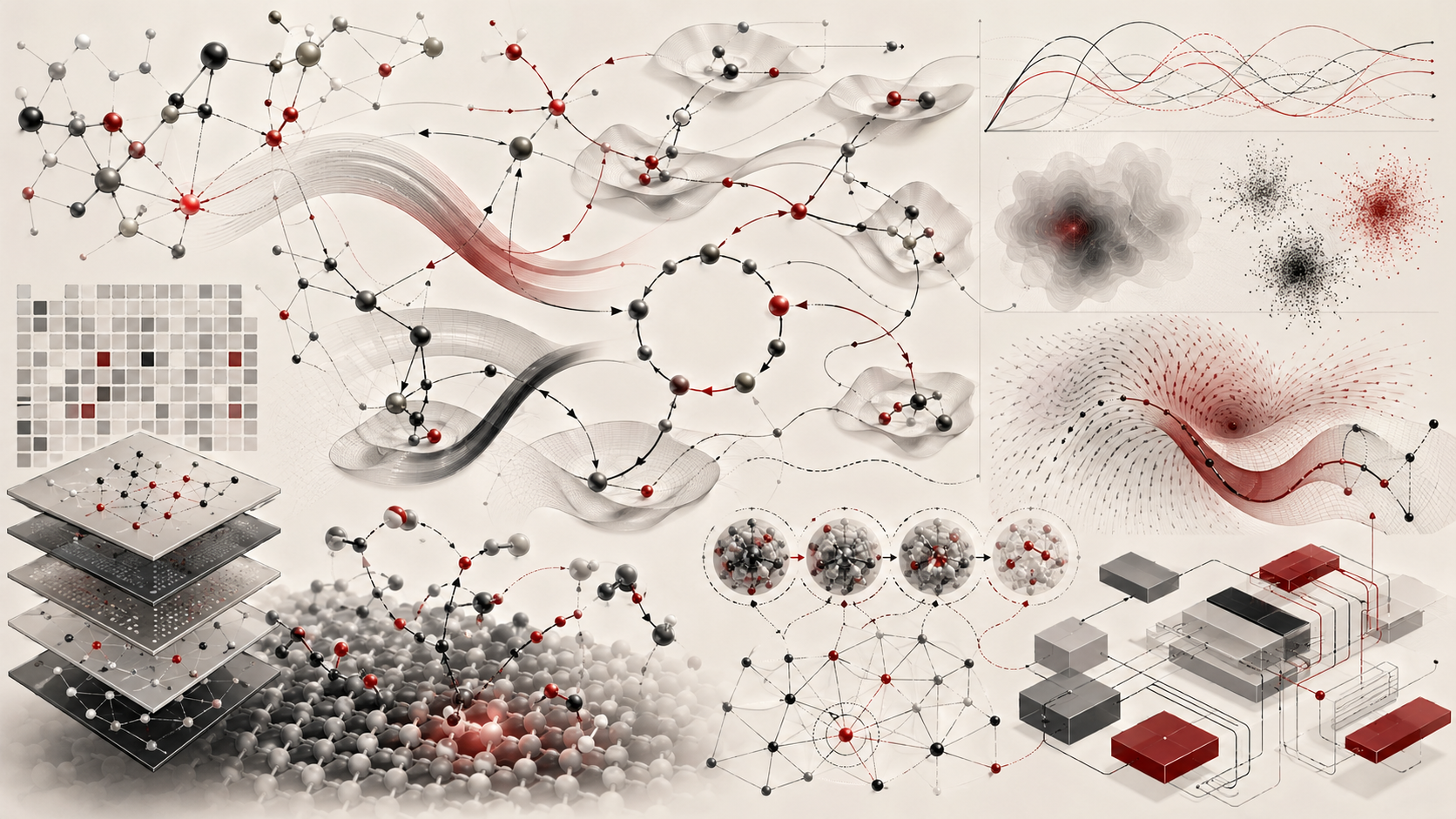
Reaction networks and chemical systems modeling study chemical change as connected structure. Chemical reactions rarely exist as isolated events. They belong to systems: a single reaction may feed another reaction, compete with a parallel pathway, recycle an intermediate, consume a radical, regenerate a catalyst, shift an equilibrium, branch into multiple products, or couple to transport, temperature, light, surfaces, enzymes, electrodes, or environmental conditions.
The central thesis of this article is that chemical systems modeling turns chemistry into connected quantitative structure. It allows chemists to move beyond single-reaction intuition and analyze how many reactions interact through time, composition, thermodynamics, kinetics, transport, feedback, uncertainty, and evidence.
A balanced equation is essential, but it is not enough. The equation \(A + B \rightarrow C\) describes one transformation. A reaction network asks what else happens: whether \(C\) decomposes, whether \(A\) participates in a side reaction, whether an intermediate accumulates, whether a catalyst is regenerated, whether a chain carrier propagates, whether heat accelerates the system, whether transport limits the observed rate, and whether a small perturbation changes the entire outcome.
Main Library
Publications
Article Map
Chemistry
Related Topic
Mathematical Modeling
Related Topic
Data Systems & Analytics
Related Topic
Environmental Monitoring Systems
Why Reaction Networks Matter
Reaction networks matter because most chemical systems contain more than one reaction. Even when a single net equation is written, the actual system may contain multiple elementary steps, intermediates, side reactions, catalyst cycles, equilibrium reactions, radical propagation steps, transport effects, thermal feedback, surface processes, photochemical steps, or electrochemical constraints.
This matters practically. In synthesis, side reactions reduce yield. In catalysis, an off-cycle species can deactivate the catalyst. In combustion, thousands of radical reactions determine ignition, flame speed, pollutant formation, and heat release. In atmospheric chemistry, small radical concentrations can control ozone formation and pollutant lifetimes. In biochemistry, metabolic pathways depend on network flux rather than one isolated reaction. In environmental chemistry, redox, acid-base, solubility, adsorption, and microbial reactions interact across soils, sediments, waters, and aerosols.
Reaction networks also help chemists understand emergence. A network can behave differently from the sum of its individual reactions. It may show steady states, oscillations, thresholds, runaway behavior, bistability, buffering, inhibition, branching, induction periods, or unexpected sensitivity to a small parameter. A single rate law may be simple, but a network of rate laws can create complex system behavior.
The discipline is especially important because modern chemical problems are increasingly systems problems. Battery lifetime depends on electrode reactions, electrolyte decomposition, transport, interphase growth, and thermal behavior. Atmospheric pollution depends on emissions, sunlight, radicals, nitrogen oxides, volatile organic compounds, aerosols, humidity, and meteorology. Catalytic selectivity depends on active sites, intermediates, adsorption, desorption, poisoning, and competing pathways.
For researchers and scientists, reaction-network modeling provides a way to represent complexity without abandoning quantitative discipline. It makes connected chemical change explicit, testable, and computationally reproducible.
From Single Reactions to Chemical Systems
A single reaction model asks how reactants become products. A reaction-network model asks how multiple species and reactions interact.
A simple consecutive network is:
A \rightarrow B \rightarrow C
\]
Interpretation: \(B\) is both product of the first reaction and reactant of the second. Its concentration may rise, peak, and fall over time.
A parallel network is:
A \rightarrow B
\]
A \rightarrow C
\]
Interpretation: \(B\) and \(C\) compete as products. Selectivity depends on the relative rates of the two pathways.
A reversible network is:
A \rightleftharpoons B
\]
Interpretation: Both kinetic rates and equilibrium constraints shape composition over time.
A catalytic network may involve:
C + S \rightleftharpoons CS
\]
CS \rightarrow C + P
\]
Interpretation: The catalyst \(C\) is not consumed in the net reaction but participates in the pathway through an intermediate catalyst-substrate complex.
These examples are simple, but the same logic scales. A combustion mechanism may contain thousands of reactions. A biochemical network may contain hundreds of metabolites and enzyme-catalyzed steps. A catalytic microkinetic model may contain adsorbed surface species, gas-phase molecules, elementary surface reactions, and site balances. A realistic environmental model may contain acid-base, redox, mineral, adsorption, and microbial reactions coupled to transport.
For researchers, reaction networks are a bridge between molecular chemistry and systems behavior. They connect mechanism to composition, composition to time, time to flux, and flux to system outcome.
Species, Reactions, and Elementary Steps
A reaction network begins with species and reactions. Species may include molecules, ions, radicals, excited states, adsorbed surface species, enzyme complexes, transition-metal intermediates, solvated species, electrochemical intermediates, polymer chains, mineral phases, or catalytic sites. Reactions describe how those species interconvert.
An elementary step is a reaction treated as a single molecular event within the mechanism. For example:
A + B \rightarrow C
\]
Interpretation: This may be treated as elementary only if it represents a single mechanistic step rather than a shorthand for hidden intermediates.
This distinction is essential. The rate law for an elementary step is often directly connected to molecularity. The rate law for an overall reaction is usually not directly inferred from the balanced equation. It must be measured experimentally or derived from a proposed mechanism using justified approximations.
A reaction network should therefore distinguish:
- species, the chemical entities being tracked;
- elementary steps, the mechanistic reaction events;
- overall reactions, the net transformations;
- intermediates, species formed and consumed within the network;
- catalysts, species regenerated overall;
- side products, products from competing pathways;
- constraints, such as mass balance, charge balance, site balance, phase balance, or energy balance.
A good network model is not merely a list of equations. It is a structured chemical hypothesis. It states which species exist, which reactions are allowed, which rates control them, which constraints must be preserved, and which observations can test the model.
For researchers, the quality of a network model begins with the quality of its chemical ontology: what counts as a species, what counts as a step, and what evidence supports including each pathway.
Stoichiometric Matrices and Network Structure
Reaction networks can be represented compactly using a stoichiometric matrix. Suppose a network has \(m\) species and \(n\) reactions. The stoichiometric matrix \(S\) has one row for each species and one column for each reaction.
Each entry \(S_{ij}\) represents the stoichiometric change of species \(i\) in reaction \(j\). Reactants have negative entries. Products have positive entries. Species not involved in a reaction have zero entries.
For example, consider:
A \rightarrow B
\]
B \rightarrow C
\]
Interpretation: The first reaction converts \(A\) to \(B\), while the second converts \(B\) to \(C\).
The species vector is:
\mathbf{c} =
\begin{bmatrix}
A \\
B \\
C
\end{bmatrix}
\]
Interpretation: The concentration vector stores the species being tracked by the model.
The stoichiometric matrix is:
S =
\begin{bmatrix}
-1 & 0 \\
1 & -1 \\
0 & 1
\end{bmatrix}
\]
Interpretation: Reaction 1 consumes \(A\) and produces \(B\). Reaction 2 consumes \(B\) and produces \(C\).
Stoichiometric matrices are useful because they separate network structure from rate laws. The matrix describes what changes when each reaction occurs. The rate law describes how fast each reaction occurs. Together, they form a dynamic model.
Stoichiometry also reveals conservation relationships. In a closed system, total atoms are conserved even as molecules interconvert. Charge may be conserved. Total catalyst may be conserved across active, resting, and inhibited forms. Total surface sites may be conserved across adsorbed species and empty sites. These conservation laws can be represented as linear constraints on the concentration vector.
For researchers, matrix representation is powerful because it makes chemical accounting explicit. If the matrix is wrong, the simulation may still run, but it will not represent the chemistry.
Rate Laws and Reaction Rates
Each reaction in a network has a rate. A simple mass-action rate law for:
aA + bB \rightarrow \mathrm{Products}
\]
Interpretation: This represents an idealized reaction consuming \(A\) and \(B\) with stoichiometric coefficients \(a\) and \(b\).
can be written:
r = k[A]^a[B]^b
\]
Interpretation: For an elementary mass-action step, the rate depends on rate constant \(k\) and reactant concentrations raised to their molecularity. Overall reactions may not follow this form.
More general rate laws may include reaction orders not equal to stoichiometric coefficients, saturation effects, inhibition, adsorption terms, enzyme kinetics, reversible terms, photochemical terms, electrochemical potentials, transport limitations, or nonideal activities.
For a network, reaction rates can be collected into a vector:
\mathbf{r}(\mathbf{c},T,\mathbf{p})
\]
Interpretation: \(\mathbf{c}\) is the concentration vector, \(T\) is temperature, and \(\mathbf{p}\) is a parameter vector containing kinetic, thermodynamic, transport, or catalytic parameters.
Rate laws connect chemistry to time. They determine how fast each pathway contributes to the changing composition of the system. In a network, even a small rate can matter if it drains an important intermediate, produces a radical, poisons a catalyst, creates an impurity, or opens a branching pathway.
The rate vector is therefore the kinetic engine of a reaction-network model. If rate laws are poorly chosen, the model may reproduce a few observations while failing mechanistically.
For researchers, rate laws should be treated as evidence-bearing claims. They should be connected to mechanism, units, data, assumptions, and domain of validity.
Ordinary Differential Equation Models
Many reaction networks are modeled using ordinary differential equations. The general form is:
\frac{d\mathbf{c}}{dt} = S\mathbf{r}(\mathbf{c},T,\mathbf{p})
\]
Interpretation: Concentration changes are determined by stoichiometric structure \(S\) multiplied by the reaction-rate vector \(\mathbf{r}\).
This equation is one of the most important mathematical forms in chemical systems modeling. It says that concentration changes are the result of stoichiometric changes multiplied by reaction rates.
For the simple consecutive network:
A \rightarrow B \rightarrow C
\]
Interpretation: \(A\) is consumed, \(B\) is an intermediate, and \(C\) is the final product in this simplified sequence.
with first-order rates:
r_1 = k_1[A]
\]
r_2 = k_2[B]
\]
Interpretation: Reaction 1 depends on \(A\); reaction 2 depends on \(B\). The rate constants determine the time structure of the network.
the ODEs are:
\frac{d[A]}{dt} = -k_1[A]
\]
\frac{d[B]}{dt} = k_1[A] – k_2[B]
\]
\frac{d[C]}{dt} = k_2[B]
\]
Interpretation: \(A\) decreases, \(C\) increases, and \(B\) may accumulate temporarily if formed faster than it is consumed.
ODE models allow chemists to simulate concentration-time behavior, compare mechanisms, fit parameters, test hypotheses, and predict system response. They also reveal features that are hard to see from equations alone: induction periods, intermediate maxima, delayed product formation, nonlinear response, and sensitivity to initial conditions.
For researchers, ODE models are useful only when their chemical assumptions are explicit. The equations are not the chemistry; they are a representation of a proposed chemical system.
Steady States, Transients, and Dynamic Behavior
A reaction network may be transient, steady, oscillatory, or unstable depending on rates, feedback, input, output, and constraints.
A steady state occurs when concentrations no longer change with time:
\frac{d\mathbf{c}}{dt} = 0
\]
Interpretation: A steady state means net concentration change is zero. It does not necessarily mean the system is at thermodynamic equilibrium.
A steady state is not necessarily equilibrium. At equilibrium, forward and reverse processes balance with no net thermodynamic driving force. At a nonequilibrium steady state, material or energy may continuously flow through the system while concentrations remain approximately constant.
This distinction is critical in biochemical, industrial, atmospheric, and environmental systems. A living cell is not at global thermodynamic equilibrium, but many metabolites may maintain quasi-steady concentrations because production and consumption rates balance. A continuous reactor may maintain steady outlet composition while reactants flow in and products flow out. An atmospheric radical may maintain a low steady concentration because it is rapidly produced and consumed.
Transient behavior matters too. Intermediates can spike briefly. A pollutant can persist before degradation accelerates. A radical chain can remain dormant until branching begins. A catalyst may show induction periods before becoming active. A runaway reaction may appear stable before heat feedback dominates.
Dynamic behavior can also reveal mechanism. The time at which an intermediate peaks, the shape of a product curve, the delay before catalysis begins, or the response to a pulse input may distinguish between competing network structures.
For researchers, reaction-network modeling makes dynamic behavior visible. It turns time-dependent composition into mechanistic evidence.
Parallel, Consecutive, and Branching Pathways
Network structure controls chemical outcome. Three simple motifs are especially important: parallel, consecutive, and branching pathways.
In a parallel network:
A \rightarrow B
\]
A \rightarrow C
\]
Interpretation: \(B\) and \(C\) are competing products. Selectivity depends on the relative rates of the pathways.
If \(B\) is desired, the chemist may tune catalyst, temperature, solvent, pH, light, pressure, concentration, residence time, or surface condition to favor the \(A \rightarrow B\) pathway.
In a consecutive network:
A \rightarrow B \rightarrow C
\]
Interpretation: \(B\) may be an intermediate, desired product, or unstable transient depending on the research question.
Maximizing \(B\) may require stopping the reaction early, lowering temperature, changing catalyst, removing product, or suppressing the second step.
In a branching network:
A \rightarrow B
\]
B \rightarrow C
\]
B \rightarrow D
\]
Interpretation: The intermediate \(B\) opens multiple downstream pathways, so its formation and consumption determine product distribution.
Branching networks are common in radical chemistry, catalysis, metabolism, combustion, polymerization, atmospheric chemistry, and degradation processes. They can make selectivity highly sensitive to small changes in conditions.
For researchers, these motifs show why a single conversion value is insufficient. A process can consume reactant efficiently while producing the wrong products. Chemical systems modeling therefore focuses on concentration, selectivity, yield, flux, and pathway distribution.
Chain Reactions, Autocatalysis, and Feedback
Some reaction networks contain feedback. Feedback occurs when a product, intermediate, radical, catalyst, inhibitor, pH change, temperature rise, or surface state affects its own production or consumption.
Chain reactions are classic examples. They often involve initiation, propagation, branching, and termination steps. A radical generated in one step can react to produce another radical, sustaining a chain. Combustion, atmospheric oxidation, halogenation, polymerization, and ozone chemistry can all involve chain behavior.
Autocatalysis occurs when a product accelerates its own formation:
A + P \rightarrow 2P
\]
Interpretation: Product \(P\) participates in producing more \(P\), creating positive feedback.
Autocatalysis can create sigmoidal kinetics, threshold behavior, rapid transitions, and nonlinear dynamics. In some systems, autocatalysis and inhibition can produce oscillations, pattern formation, or bistability.
Feedback makes chemical systems difficult to understand from isolated reactions. A slow step may become important because it generates a chain carrier. A trace impurity may inhibit a radical network. A small temperature rise may accelerate a heat-producing reaction, producing thermal runaway. A buffering reaction may suppress pH change until capacity is exhausted.
Negative feedback also matters. Product inhibition can slow a reaction. Catalyst deactivation can reduce rate over time. Radical termination can suppress chain growth. Buffering can stabilize pH. Surface poisoning can suppress catalytic flux. These processes can stabilize a system, create induction periods, or mask underlying reactivity.
For researchers, feedback is one of the reasons chemical systems must be modeled as systems. It turns local reaction steps into global behavior.
Catalytic Networks and Microkinetic Models
Catalysis is naturally network-based. A catalyst participates in multiple elementary steps and is regenerated overall. A catalytic cycle may include substrate binding, activation, intermediate formation, product release, catalyst regeneration, and deactivation pathways.
For heterogeneous catalysis, microkinetic models often track gas-phase species, adsorbed species, surface vacancies, active sites, and surface reactions. A simplified adsorption step may be written:
A + * \rightleftharpoons A*
\]
Interpretation: \(*\) represents an open surface site and \(A*\) represents adsorbed \(A\).
A surface reaction may be:
A* + B* \rightarrow C* + *
\]
Interpretation: Two adsorbed species react on the surface, producing adsorbed \(C\) and freeing one site.
and product desorption may be:
C* \rightarrow C + *
\]
Interpretation: Product \(C\) leaves the surface, regenerating an open catalytic site.
A site balance is required:
\theta_* + \theta_A + \theta_B + \theta_C = 1
\]
Interpretation: Fractional surface coverages must sum to the total available site fraction under this simplified one-site model.
Microkinetic models help identify rate-controlling steps, dominant surface species, inhibition effects, coverage dependencies, catalyst deactivation pathways, and selectivity patterns. They are central to heterogeneous catalysis, electrocatalysis, photocatalysis, fuel cells, ammonia synthesis, hydrocarbon oxidation, emissions control, and carbon-conversion chemistry.
Catalytic networks also appear in homogeneous and enzymatic systems. A transition-metal catalyst may move through oxidation states, ligand substitutions, oxidative addition, insertion, reductive elimination, and off-cycle resting states. An enzyme may bind substrate, change conformation, form intermediates, release product, and be inhibited or regulated.
For researchers, catalysis is pathway control, and pathway control is network control.
Equilibrium, Thermodynamic Consistency, and Detailed Balance
Reaction-network models must respect thermodynamics. If reversible reactions are included, forward and reverse rate constants cannot be chosen arbitrarily when equilibrium constants are known.
For a reversible elementary step:
A \rightleftharpoons B
\]
Interpretation: The forward and reverse rates must be consistent with the equilibrium composition under the modeled assumptions.
with forward rate constant \(k_f\) and reverse rate constant \(k_r\), the equilibrium constant is related to their ratio:
K = \frac{k_f}{k_r}
\]
Interpretation: For a simple idealized reversible elementary step, the equilibrium constant is the ratio of forward and reverse rate constants.
More complex networks require thermodynamic consistency across cycles. If a reaction network contains a closed loop, the product of equilibrium constants around the loop must be consistent with the net thermodynamic change. Violating this can create artificial perpetual driving forces inside the model.
Detailed balance states that, at thermodynamic equilibrium, each elementary forward process is balanced by its reverse process. This is stronger than saying that net concentration change is zero. In an equilibrium system, there should be no net flux around closed cycles.
Thermodynamic consistency is especially important in combustion models, atmospheric chemistry, biochemical networks, electrochemical systems, and catalytic microkinetic models. A model may fit data over a narrow range while violating thermodynamic constraints outside that range.
For researchers, good chemical systems modeling treats kinetics and thermodynamics as linked. Rate laws describe time, but they must not contradict equilibrium, free energy, conservation laws, or detailed balance when those constraints apply.
Stiffness, Timescales, and Numerical Solvers
Reaction networks often contain processes occurring on very different timescales. A proton-transfer equilibrium may be fast. A radical reaction may be extremely fast. A catalyst deactivation process may be slow. A diffusion process may be intermediate. A product degradation reaction may occur over days or years.
When fast and slow processes coexist, the ODE system may be stiff. Stiffness means that numerical solvers must take small steps for stability even when the quantities of interest change slowly. Combustion, atmospheric chemistry, enzyme networks, geochemical systems, electrochemistry, and large catalytic mechanisms can all be stiff.
Choosing a solver is therefore not a technical afterthought. Explicit methods may fail or require impractically small timesteps. Implicit solvers, adaptive timestepping, Jacobian information, scaling, tolerances, and conservation checks may be necessary.
Numerical modeling also requires careful units. Rate constants may use seconds, minutes, liters, moles, pressures, activities, surface coverages, or site densities. A unit mismatch can make a model look mathematically valid while being chemically meaningless.
Stiffness and scaling are also interpretive issues. A species present at nanomolar concentration may be chemically decisive. A radical may have a tiny concentration but large flux. A slow deactivation process may determine catalyst lifetime. A solver that suppresses small values or drifts from conservation laws can distort the chemistry.
For researchers, chemical systems modeling requires numerical discipline as much as chemical insight. Solver choice, timestep control, tolerances, units, and conservation checks are part of the scientific method.
Parameter Estimation and Model Identifiability
A reaction-network model needs parameters: rate constants, activation energies, adsorption constants, equilibrium constants, catalytic parameters, inhibition constants, transport coefficients, photochemical yields, electrochemical transfer coefficients, and initial conditions. Some may be measured independently. Others must be estimated from data.
Parameter estimation compares model predictions to observations, such as concentration-time data, product distributions, spectroscopic signals, pressure changes, heat release, electrical current, isotopic labeling, or chromatographic peak areas. The goal is to find parameter values that make the model consistent with evidence.
But fitting is not the same as understanding. A complex model may fit data for the wrong reasons. Multiple parameter sets may produce similar outputs. Some parameters may be unidentifiable because the data do not contain enough information to estimate them uniquely. Correlated parameters may trade off against each other.
Model identifiability asks whether the available data can actually determine the parameters. This is essential for trustworthy mechanistic modeling. A model with too many poorly constrained parameters can become a storytelling machine rather than a scientific tool.
Good parameter estimation therefore requires experimental design. Time points, temperature variation, initial concentrations, isotope labels, perturbations, and independent measurements can all help constrain parameters. Validation data should be separated from fitting data where possible.
For researchers, parameter estimation should combine mechanism, data, parsimony, uncertainty, and validation. A fitted parameter is only as meaningful as the evidence that identifies it.
Sensitivity Analysis and Uncertainty
Sensitivity analysis asks how model outputs change when parameters or inputs change. For a model output \(y\) and parameter \(p_i\), a sensitivity may be represented as:
\frac{\partial y}{\partial p_i}
\]
Interpretation: This derivative estimates how strongly output \(y\) responds to parameter \(p_i\) under the tested conditions.
A high sensitivity means that small changes in the parameter strongly affect the output. A low sensitivity means the output is relatively insensitive to that parameter under the tested conditions.
Sensitivity analysis helps identify:
- rate-controlling reactions;
- important uncertain parameters;
- dominant pathways;
- experimental priorities;
- robust predictions;
- fragile assumptions;
- parameters that need better measurement.
Uncertainty analysis goes further by asking how uncertainty in inputs and parameters propagates to uncertainty in model predictions. This is crucial for combustion safety, atmospheric chemistry, environmental risk, pharmaceutical stability, industrial reactors, catalytic design, and biological systems modeling.
Uncertainty may come from rate constants, thermodynamic data, initial concentrations, temperature, measurement noise, missing reactions, numerical tolerances, model structure, or boundary conditions. A model should not only produce a prediction. It should communicate how reliable that prediction is and what assumptions control it.
For researchers, sensitivity and uncertainty analysis prevent chemical systems modeling from becoming false precision. They show which conclusions are stable and which depend on fragile assumptions.
Reaction-Path Analysis and Network Reduction
Large reaction networks can be difficult to interpret. Reaction-path analysis helps identify which pathways carry the most flux through the network. It can show how atoms, electrons, radicals, carbon skeletons, nitrogen atoms, sulfur atoms, catalytic sites, or energy move through a system.
Flux through a reaction may be represented as:
J_j = r_j
\]
Interpretation: The flux through reaction \(j\) may be represented by its rate \(r_j\), depending on the chosen units and model context.
For a particular species contribution:
J_{ij} = S_{ij}r_j
\]
Interpretation: \(J_{ij}\) is the contribution of reaction \(j\) to the production or consumption of species \(i\).
Network reduction removes reactions or species that have little effect on outputs of interest under specified conditions. This is common in combustion and atmospheric chemistry, where full mechanisms may be too large for efficient simulation.
Reduction must be handled carefully. A reaction that appears unimportant under one condition may become important under another. A minor pathway may dominate trace pollutant formation. A low-flux pathway may control ignition timing, catalyst deactivation, or radical branching. Removing a species may break thermodynamic consistency, atom balance, or conservation relationships.
Reaction-path analysis and reduction are therefore interpretive tools, not shortcuts around chemical judgment. They should preserve the chemistry needed for the question being asked.
For researchers, network reduction should always be tied to purpose: which outputs, conditions, species, and tolerances matter?
Applications Across Chemical Science
Reaction networks appear throughout chemistry. In combustion, networks describe fuel decomposition, radical branching, oxygen chemistry, heat release, flame propagation, soot precursors, and pollutant formation.
In atmospheric chemistry, networks describe ozone formation, nitrogen oxides, volatile organic compounds, radical cycling, aerosol chemistry, halogen chemistry, photolysis, and pollutant lifetimes.
In biochemistry, networks describe metabolism, enzyme regulation, signaling, redox cofactors, proton gradients, gene-metabolism coupling, and biochemical flux.
In catalysis, networks describe active sites, adsorbed species, catalytic cycles, inhibition, selectivity, deactivation, and catalyst regeneration.
In environmental chemistry, networks describe acid-base equilibria, mineral dissolution, redox transformations, contaminant degradation, adsorption, microbial metabolism, and transport.
In materials chemistry, networks describe polymerization, degradation, curing, corrosion, battery side reactions, solid-state diffusion, interphase formation, and surface transformations.
In industrial chemistry, networks describe reactor performance, selectivity, conversion, recycle streams, heat management, catalyst lifetime, impurity formation, and process optimization.
Reaction networks are therefore not a specialized modeling trick. They are a general language for chemical systems. Wherever chemical change is connected, sequential, competitive, reversible, catalytic, or feedback-driven, network thinking is needed.
For researchers, reaction-network reasoning is one of the strongest ways to connect fundamental chemistry to applied systems: synthesis, safety, climate, health, manufacturing, environment, and technology.
Computational Chemical Systems Modeling
Computational chemical systems modeling represents networks in machine-readable and reproducible form. It may use reaction lists, stoichiometric matrices, ODE systems, partial differential equations, stochastic simulations, microkinetic models, reactor models, metabolic models, graph representations, or hybrid data-model frameworks.
A reproducible chemical systems workflow should document the full modeling chain:
- species list;
- reaction list;
- stoichiometric coefficients;
- rate laws;
- parameter values and sources;
- units;
- initial conditions;
- temperature and pressure assumptions;
- equilibrium constraints;
- solver selection;
- tolerances;
- validation data;
- sensitivity and uncertainty analysis;
- model limitations.
For large mechanisms, machine-readable formats are essential. YAML, JSON, CSV, SQL, SBML, Cantera mechanisms, CHEMKIN-style formats, and domain-specific mechanism files can help preserve structure. But format alone is not enough. A mechanism file without provenance, units, assumptions, and validation can still be unreliable.
Computational workflows should also separate model structure from analysis. The reaction network, parameter dataset, solver code, output tables, plots, and reports should be versioned and reproducible. This is especially important when models are used for design decisions, safety analysis, environmental interpretation, or scientific publication.
For researchers, chemical systems modeling is strongest when computation is treated as evidence infrastructure: transparent, auditable, parameterized, validated, and explicit about uncertainty.
Mathematical Lens: Reaction Networks and Chemical Systems Modeling
Reaction-network modeling is built from stoichiometry, rate laws, differential equations, fluxes, sensitivities, and constraints. A species concentration vector can be written:
\mathbf{c} =
\begin{bmatrix}
c_1 \\
c_2 \\
\vdots \\
c_m
\end{bmatrix}
\]
Interpretation: The concentration vector stores the \(m\) species tracked by the network model.
The rate vector is:
\mathbf{r} =
\begin{bmatrix}
r_1 \\
r_2 \\
\vdots \\
r_n
\end{bmatrix}
\]
Interpretation: The rate vector stores the \(n\) reaction rates in the network.
The stoichiometric matrix has dimensions:
S \in \mathbb{R}^{m \times n}
\]
Interpretation: \(S\) connects \(m\) species to \(n\) reactions by recording stoichiometric changes.
The reaction-network ODE is:
\frac{d\mathbf{c}}{dt} = S\mathbf{r}(\mathbf{c},T,\mathbf{p})
\]
Interpretation: Species concentrations change according to network stoichiometry and reaction rates.
A mass-action rate law can be written:
r_j = k_j\prod_i c_i^{\nu_{ij}}
\]
Interpretation: For an idealized elementary mass-action reaction, rate \(r_j\) depends on rate constant \(k_j\) and reactant concentrations.
Arrhenius temperature dependence is:
k_j(T) = A_j e^{-E_{a,j}/(RT)}
\]
Interpretation: Rate constants can depend on temperature through pre-exponential factor \(A_j\), activation energy \(E_{a,j}\), gas constant \(R\), and temperature \(T\).
The steady-state condition is:
S\mathbf{r}(\mathbf{c},T,\mathbf{p}) = 0
\]
Interpretation: Net concentration change is zero under the specified model and conditions.
Flux contribution is:
J_{ij} = S_{ij}r_j
\]
Interpretation: This term shows how reaction \(j\) contributes to the production or consumption of species \(i\).
Sensitivity can be written:
S_{y,p_i} = \frac{\partial y}{\partial p_i}
\]
Interpretation: The sensitivity of output \(y\) to parameter \(p_i\) helps identify influential parameters and fragile assumptions.
A conservation relationship is:
L^T\mathbf{c} = \mathrm{constant}
\]
Interpretation: \(L\) represents a conserved quantity such as total atoms, total charge, total enzyme, or total catalytic sites.
These equations show that reaction networks turn chemical change into structured systems mathematics. They preserve chemical meaning while enabling simulation, inference, uncertainty analysis, and prediction.
Computational Workflows for Reaction Networks
Computational workflows can make reaction-network modeling more transparent. A workflow can track species, reactions, stoichiometric matrices, rate laws, parameters, units, initial conditions, solver choices, output trajectories, flux tables, sensitivity analysis, uncertainty estimates, mechanism metadata, validation evidence, and provenance records.
Useful workflows include stoichiometric matrix construction, ODE simulation, parallel-pathway selectivity, flux contribution tables, steady-state checks, conservation checks, parameter sensitivity, simple parameter fitting, pathway ranking, model reduction scaffolds, and SQL evidence systems.
For researchers, reaction-network workflows should preserve four distinctions:
- Net reaction versus mechanism: a balanced overall equation may hide multiple elementary steps.
- Stoichiometry versus kinetics: the matrix describes possible changes; rate laws describe how fast they occur.
- Steady state versus equilibrium: constant concentration does not necessarily mean thermodynamic equilibrium.
- Simulation versus evidence: a numerical trajectory is only meaningful when the model structure, parameters, units, and validation are visible.
The examples below use synthetic educational data. They do not validate real mechanisms, predict real hazards, certify reactor behavior, establish atmospheric chemistry, approve catalytic processes, or replace professional chemical-systems review. They demonstrate how reaction-network reasoning can be organized, audited, and communicated responsibly.
Python Example: Stoichiometry, ODE Simulation, Selectivity, Sensitivity, and Provenance
The following Python example uses synthetic educational data. It builds a stoichiometric matrix, simulates a consecutive network, evaluates parallel-pathway selectivity, estimates sensitivity of final product to a rate constant, and writes provenance outputs. In real chemical systems modeling, these scaffolds would require validated mechanisms, units, parameters, solver choices, uncertainty, and experimental comparison.
from pathlib import Path
from typing import Dict, List
import json
import platform
import sys

import numpy as np
import pandas as pd


# Synthetic reaction-network workflow.
# Educational example only; not for safety analysis,
# validated kinetics, reactor design, environmental compliance,
# or operational decision-making.


def require_columns(data: pd.DataFrame, required: List[str], table_name: str) -> None:
    """Raise an error if required columns are missing."""
    missing = [column for column in required if column not in data.columns]
    if missing:
        raise ValueError(f"{table_name} is missing required columns: {missing}")


def simulate_consecutive_network(
    k1: float,
    k2: float,
    dt: float = 0.25,
    total_time: float = 50.0,
) -> pd.DataFrame:
    """Simulate A -> B -> C using explicit Euler integration."""
    species = ["A", "B", "C"]

    stoichiometry = np.array(
        [
            [-1.0, 0.0],
            [1.0, -1.0],
            [0.0, 1.0],
        ]
    )

    time = np.arange(0.0, total_time + dt, dt)
    concentration = np.array([1.0, 0.0, 0.0], dtype=float)

    rows = []

    for t in time:
        rows.append({
            "time": t,
            "A": concentration[0],
            "B": concentration[1],
            "C": concentration[2],
            "total_concentration": concentration.sum(),
        })

        rates = np.array([
            k1 * concentration[0],
            k2 * concentration[1],
        ])

        dc_dt = stoichiometry @ rates
        concentration = concentration + dc_dt * dt

        # Avoid tiny negative values from explicit stepping.
        concentration = np.maximum(concentration, 0.0)

    trajectory = pd.DataFrame(rows)
    trajectory["mass_balance_error"] = (
        trajectory["total_concentration"] - trajectory["total_concentration"].iloc[0]
    )

    return trajectory


def final_c_for_k1(k1: float, k2: float = 0.08) -> float:
    """Return final C concentration for sensitivity analysis."""
    trajectory = simulate_consecutive_network(k1=k1, k2=k2)
    return float(trajectory["C"].iloc[-1])


species = ["A", "B", "C"]
reactions = ["r1_A_to_B", "r2_B_to_C"]

stoichiometric_matrix = pd.DataFrame(
    [
        [-1.0, 0.0],
        [1.0, -1.0],
        [0.0, 1.0],
    ],
    index=species,
    columns=reactions,
)

trajectory = simulate_consecutive_network(k1=0.20, k2=0.08)

parallel_cases = pd.DataFrame({
    "case": ["B_favored", "C_favored", "balanced"],
    "k_to_B": [0.30, 0.05, 0.15],
    "k_to_C": [0.05, 0.30, 0.15],
})

require_columns(parallel_cases, ["case", "k_to_B", "k_to_C"], "parallel_cases")

parallel_cases["fraction_to_B"] = (
    parallel_cases["k_to_B"] / (parallel_cases["k_to_B"] + parallel_cases["k_to_C"])
)

parallel_cases["fraction_to_C"] = (
    parallel_cases["k_to_C"] / (parallel_cases["k_to_B"] + parallel_cases["k_to_C"])
)

parallel_cases["B_to_C_selectivity"] = (
    parallel_cases["fraction_to_B"] / parallel_cases["fraction_to_C"]
)

base_k1 = 0.20
delta = 0.01

c_low = final_c_for_k1(base_k1 - delta)
c_high = final_c_for_k1(base_k1 + delta)

sensitivity = (c_high - c_low) / (2.0 * delta)

sensitivity_table = pd.DataFrame({
    "parameter": ["k1"],
    "base_value": [base_k1],
    "delta": [delta],
    "final_C_low": [c_low],
    "final_C_high": [c_high],
    "central_difference_sensitivity": [sensitivity],
})

output_dir = Path("outputs")
output_dir.mkdir(exist_ok=True)

stoichiometric_matrix.to_csv(output_dir / "synthetic_stoichiometric_matrix.csv")
trajectory.to_csv(output_dir / "synthetic_consecutive_network_trajectory.csv", index=False)
parallel_cases.to_csv(output_dir / "synthetic_parallel_selectivity.csv", index=False)
sensitivity_table.to_csv(output_dir / "synthetic_parameter_sensitivity.csv", index=False)

manifest: Dict[str, object] = {
    "workflow": "synthetic_reaction_network_workflow",
    "data_type": "synthetic educational reaction-network records",
    "network": "A -> B -> C and A -> B / A -> C examples",
    "ode_form": "dc_dt = S @ r(c, p)",
    "integration_method": "explicit Euler for transparent educational demonstration",
    "k1": 0.20,
    "k2": 0.08,
    "dt": 0.25,
    "total_time": 50.0,
    "python_version": sys.version,
    "platform": platform.platform(),
    "numpy_version": np.__version__,
    "pandas_version": pd.__version__,
    "output_files": [
        "outputs/synthetic_stoichiometric_matrix.csv",
        "outputs/synthetic_consecutive_network_trajectory.csv",
        "outputs/synthetic_parallel_selectivity.csv",
        "outputs/synthetic_parameter_sensitivity.csv",
        "outputs/reaction_network_manifest.json",
    ],
    "responsible_use": [
        "Synthetic educational data only.",
        "Real reaction-network workflows require validated mechanisms, units, rate constants, solver selection, uncertainty analysis, thermodynamic consistency checks, and experimental comparison.",
    ],
}

with (output_dir / "reaction_network_manifest.json").open(
    "w",
    encoding="utf-8"
) as file:
    json.dump(manifest, file, indent=2)

print("Stoichiometric matrix")
print("---------------------")
print(stoichiometric_matrix.to_string())

print("\nConsecutive network trajectory, first rows")
print("-----------------------------------------")
print(trajectory.head(12).round(6).to_string(index=False))

print("\nConsecutive network trajectory, final rows")
print("-----------------------------------------")
print(trajectory.tail(6).round(6).to_string(index=False))

print("\nParallel pathway selectivity")
print("----------------------------")
print(parallel_cases.round(6).to_string(index=False))

print("\nParameter sensitivity")
print("---------------------")
print(sensitivity_table.round(6).to_string(index=False))
This workflow demonstrates reaction-network evidence discipline rather than real kinetic validation. It separates stoichiometric structure, rate laws, numerical integration, selectivity, sensitivity, and provenance. A real workflow would add solver validation, uncertainty estimates, independent kinetic data, thermodynamic consistency, and experimental comparison.
R Example: Flux Tables and Parameter Sensitivity
The following R example uses synthetic educational data to build a stoichiometric matrix, calculate flux contributions, and estimate a simple finite-difference sensitivity. In real chemical systems modeling, these calculations should be tied to validated mechanisms, units, solver settings, and uncertainty review.
# Synthetic reaction-network scaffold.
# Educational example only; not for validated kinetics,
# reactor design, safety analysis, or environmental compliance.

species <- c("A", "B", "C")

S <- matrix(
  c(
    -1,  0,
     1, -1,
     0,  1
  ),
  nrow = 3,
  byrow = TRUE
)

colnames(S) <- c("r1_A_to_B", "r2_B_to_C")
rownames(S) <- species

concentration <- c(A = 0.60, B = 0.30, C = 0.10)

k1 <- 0.20
k2 <- 0.08

rates <- c(
  r1_A_to_B = k1 * concentration[["A"]],
  r2_B_to_C = k2 * concentration[["B"]]
)

dc_dt <- S %*% rates

flux_table <- data.frame(
  species = rownames(S),
  dc_dt = as.numeric(dc_dt)
)

simulate_network <- function(k1, k2 = 0.08, dt = 0.25, total_time = 50) {
  time <- seq(0, total_time, by = dt)

  A <- 1.0
  B <- 0.0
  C <- 0.0

  for (t in time[-1]) {
    r1 <- k1 * A
    r2 <- k2 * B

    A <- max(A - r1 * dt, 0)
    B <- max(B + (r1 - r2) * dt, 0)
    C <- max(C + r2 * dt, 0)
  }

  return(C)
}

base_k1 <- 0.20
delta <- 0.01

C_low <- simulate_network(base_k1 - delta)
C_high <- simulate_network(base_k1 + delta)

sensitivity <- (C_high - C_low) / (2 * delta)

sensitivity_table <- data.frame(
  parameter = "k1",
  base_value = base_k1,
  delta = delta,
  final_C_low = C_low,
  final_C_high = C_high,
  central_difference_sensitivity = sensitivity
)

dir.create("outputs", showWarnings = FALSE)

write.csv(
  S,
  file = "outputs/r_stoichiometric_matrix.csv"
)

write.csv(
  flux_table,
  file = "outputs/r_flux_table.csv",
  row.names = FALSE
)

write.csv(
  sensitivity_table,
  file = "outputs/r_parameter_sensitivity.csv",
  row.names = FALSE
)

sink("outputs/r_reaction_network_report.txt")
cat("Synthetic Reaction Network Scaffold Report\n")
cat("==========================================\n\n")
cat("Stoichiometric matrix:\n")
print(S)
cat("\nRates:\n")
print(rates)
cat("\nFlux table:\n")
print(flux_table)
cat("\nSensitivity table:\n")
print(sensitivity_table)
cat("\nResponsible-use note:\n")
cat("Synthetic educational data only. Real reaction-network modeling requires validated mechanisms, units, rate constants, solver selection, uncertainty analysis, thermodynamic consistency checks, and experimental comparison.\n")
sink()

print(S)
print(rates)
print(flux_table)
print(sensitivity_table)
This scaffold shows how R can support reaction-network summaries and sensitivity review. The central issue is not the language but the evidence chain. Stoichiometry, rates, fluxes, and sensitivities should remain connected to mechanism, units, parameters, solver assumptions, and validation evidence.
SQL Example: Reaction Network Evidence Register
Reaction-network modeling becomes more reliable when species, reactions, stoichiometry, rate laws, parameters, solver settings, simulation outputs, validation data, sensitivity results, and interpretation claims are traceable. A simple evidence register can preserve the context needed to audit chemical systems models.
CREATE TABLE reaction_network (
    network_id TEXT PRIMARY KEY,
    network_name TEXT NOT NULL,
    network_domain TEXT,
    system_description TEXT,
    temperature_K REAL,
    pressure_bar REAL,
    phase_description TEXT,
    network_source_uri TEXT,
    network_notes TEXT
);

CREATE TABLE chemical_species (
    species_id TEXT PRIMARY KEY,
    network_id TEXT NOT NULL,
    species_name TEXT NOT NULL,
    species_formula TEXT,
    species_type TEXT,
    phase_or_site TEXT,
    charge INTEGER,
    species_review_status TEXT,
    FOREIGN KEY (network_id) REFERENCES reaction_network(network_id)
);

CREATE TABLE reaction_step (
    reaction_id TEXT PRIMARY KEY,
    network_id TEXT NOT NULL,
    reaction_label TEXT NOT NULL,
    reaction_type TEXT,
    reversibility INTEGER CHECK (reversibility IN (0, 1)),
    elementary_step INTEGER CHECK (elementary_step IN (0, 1)),
    reaction_equation TEXT,
    mechanism_notes TEXT,
    reaction_review_status TEXT,
    FOREIGN KEY (network_id) REFERENCES reaction_network(network_id)
);

CREATE TABLE stoichiometric_coefficient (
    coefficient_id TEXT PRIMARY KEY,
    reaction_id TEXT NOT NULL,
    species_id TEXT NOT NULL,
    coefficient_value REAL,
    role TEXT,
    coefficient_review_status TEXT,
    FOREIGN KEY (reaction_id) REFERENCES reaction_step(reaction_id),
    FOREIGN KEY (species_id) REFERENCES chemical_species(species_id)
);

CREATE TABLE rate_law_record (
    rate_law_id TEXT PRIMARY KEY,
    reaction_id TEXT NOT NULL,
    rate_law_expression TEXT,
    rate_law_family TEXT,
    unit_description TEXT,
    assumption_notes TEXT,
    rate_law_review_status TEXT,
    FOREIGN KEY (reaction_id) REFERENCES reaction_step(reaction_id)
);

CREATE TABLE kinetic_parameter (
    parameter_id TEXT PRIMARY KEY,
    rate_law_id TEXT NOT NULL,
    parameter_name TEXT,
    parameter_symbol TEXT,
    parameter_value REAL,
    parameter_unit TEXT,
    parameter_source_uri TEXT,
    uncertainty_value REAL,
    uncertainty_unit TEXT,
    parameter_review_status TEXT,
    FOREIGN KEY (rate_law_id) REFERENCES rate_law_record(rate_law_id)
);

CREATE TABLE model_run (
    model_run_id TEXT PRIMARY KEY,
    network_id TEXT NOT NULL,
    run_name TEXT,
    solver_name TEXT,
    solver_version TEXT,
    timestep_description TEXT,
    tolerance_description TEXT,
    initial_condition_uri TEXT,
    output_uri TEXT,
    conservation_check_status TEXT,
    thermodynamic_consistency_status TEXT,
    run_review_status TEXT,
    FOREIGN KEY (network_id) REFERENCES reaction_network(network_id)
);

CREATE TABLE model_output_summary (
    output_id TEXT PRIMARY KEY,
    model_run_id TEXT NOT NULL,
    output_quantity TEXT,
    species_id TEXT,
    output_value REAL,
    output_unit TEXT,
    output_time REAL,
    output_time_unit TEXT,
    output_review_status TEXT,
    FOREIGN KEY (model_run_id) REFERENCES model_run(model_run_id),
    FOREIGN KEY (species_id) REFERENCES chemical_species(species_id)
);

CREATE TABLE validation_record (
    validation_id TEXT PRIMARY KEY,
    model_run_id TEXT NOT NULL,
    validation_dataset_uri TEXT,
    validation_quantity TEXT,
    validation_metric TEXT,
    validation_metric_value REAL,
    validation_status TEXT,
    validation_notes TEXT,
    FOREIGN KEY (model_run_id) REFERENCES model_run(model_run_id)
);

CREATE TABLE sensitivity_record (
    sensitivity_id TEXT PRIMARY KEY,
    model_run_id TEXT NOT NULL,
    parameter_id TEXT,
    output_quantity TEXT,
    sensitivity_value REAL,
    sensitivity_method TEXT,
    sensitivity_review_status TEXT,
    FOREIGN KEY (model_run_id) REFERENCES model_run(model_run_id),
    FOREIGN KEY (parameter_id) REFERENCES kinetic_parameter(parameter_id)
);

CREATE TABLE reaction_network_claim (
    claim_id TEXT PRIMARY KEY,
    network_id TEXT NOT NULL,
    model_run_id TEXT,
    claim_text TEXT,
    claim_type TEXT,
    confidence_level TEXT,
    limitation_notes TEXT,
    review_status TEXT,
    FOREIGN KEY (network_id) REFERENCES reaction_network(network_id),
    FOREIGN KEY (model_run_id) REFERENCES model_run(model_run_id)
);

SELECT
    n.network_id,
    n.network_name,
    n.network_domain,
    s.species_name,
    r.reaction_label,
    r.reaction_type,
    r.elementary_step,
    rl.rate_law_family,
    rl.rate_law_expression,
    p.parameter_name,
    p.parameter_value,
    p.parameter_unit,
    run.solver_name,
    run.conservation_check_status,
    run.thermodynamic_consistency_status,
    v.validation_status,
    sens.output_quantity AS sensitivity_output,
    sens.sensitivity_value,
    claim.claim_type,
    claim.confidence_level,
    CASE
        WHEN n.temperature_K IS NULL
            THEN 'temperature review required'
        WHEN s.species_review_status IS NOT NULL
             AND s.species_review_status != 'pass'
            THEN 'species review required'
        WHEN r.reaction_review_status IS NOT NULL
             AND r.reaction_review_status != 'pass'
            THEN 'reaction review required'
        WHEN rl.rate_law_review_status IS NOT NULL
             AND rl.rate_law_review_status != 'pass'
            THEN 'rate-law review required'
        WHEN p.parameter_review_status IS NOT NULL
             AND p.parameter_review_status != 'pass'
            THEN 'parameter review required'
        WHEN run.conservation_check_status IS NOT NULL
             AND run.conservation_check_status != 'pass'
            THEN 'conservation review required'
        WHEN run.thermodynamic_consistency_status IS NOT NULL
             AND run.thermodynamic_consistency_status != 'pass'
            THEN 'thermodynamic consistency review required'
        WHEN v.validation_status IS NOT NULL
             AND v.validation_status != 'pass'
            THEN 'validation review required'
        WHEN claim.review_status IS NOT NULL
             AND claim.review_status != 'reviewed'
            THEN 'interpretation review required'
        ELSE 'standard review'
    END AS reaction_network_review_status
FROM reaction_network n
LEFT JOIN chemical_species s
    ON n.network_id = s.network_id
LEFT JOIN reaction_step r
    ON n.network_id = r.network_id
LEFT JOIN rate_law_record rl
    ON r.reaction_id = rl.reaction_id
LEFT JOIN kinetic_parameter p
    ON rl.rate_law_id = p.rate_law_id
LEFT JOIN model_run run
    ON n.network_id = run.network_id
LEFT JOIN validation_record v
    ON run.model_run_id = v.model_run_id
LEFT JOIN sensitivity_record sens
    ON run.model_run_id = sens.model_run_id
LEFT JOIN reaction_network_claim claim
    ON n.network_id = claim.network_id
ORDER BY reaction_network_review_status, n.network_id, r.reaction_id;
The purpose of this register is to keep reaction-network interpretation attached to evidence. A chemical systems model should preserve species identity, reaction definitions, stoichiometry, rate laws, parameter sources, solver settings, conservation checks, thermodynamic consistency, validation data, sensitivity results, and interpretation review. Reaction-network modeling becomes stronger when its evidence trail is structured.
GitHub Repository
The companion repository for this article can support reproducible workflows for stoichiometric matrices, ODE simulation, pathway flux analysis, parallel-pathway selectivity, sensitivity scaffolds, parameter fitting, mechanism metadata, conservation checks, SQL evidence registers, and responsible chemical systems interpretation.
Complete Code Repository
The full code distribution for this article, including selected reaction-network examples, expanded computational workflows, reproducible data structures, provenance documentation, stoichiometric matrix scaffolds, ODE simulations, flux summaries, sensitivity examples, SQL evidence registers, and scientific-computing infrastructure, is available on GitHub.
Limits, Uncertainty, and Responsible Interpretation
Reaction-network modeling is powerful, but it is not self-interpreting. A network diagram does not prove mechanism. A simulated trajectory does not validate rate constants. A good fit does not guarantee identifiability. A reduced mechanism may fail outside the conditions used to reduce it. A numerically stable model may still be chemically wrong.
Uncertainty enters reaction-network modeling at many levels: species definitions, missing reactions, incorrect stoichiometry, uncertain rate constants, temperature dependence, activity corrections, transport limitations, catalyst deactivation, radical pathways, photochemical yields, solver tolerances, initial conditions, boundary conditions, and measurement noise.
Reaction networks are also context-dependent. A pathway that is negligible at low temperature may dominate at high temperature. A side reaction that is harmless at short time may dominate over long storage. A catalyst may perform differently under clean laboratory feed and industrial feed. An atmospheric mechanism may depend on sunlight, humidity, aerosols, and emissions. A biochemical network may shift under stress, nutrient change, or genetic variation.
Computational workflows add additional risks. Unit errors can create plausible-looking nonsense. Solver settings can suppress important fast processes. Extrapolation beyond validated conditions can mislead. Parameter fitting can overfit. Network reduction can remove rare but important pathways. Sensitivity analysis can miss interactions if performed too narrowly.
The computational examples associated with this article are synthetic and educational. They do not validate real mechanisms, predict hazards, certify reactor performance, establish atmospheric chemistry, approve catalytic systems, or replace professional chemical-systems review. They are designed to show how reaction-network reasoning can be structured and audited.
Responsible interpretation should match claim strength to evidence. A model can explore hypotheses, organize mechanisms, prioritize experiments, estimate sensitivity, and support design. It becomes trustworthy only when mechanism, parameters, units, solvers, validation, and uncertainty are transparent.
Conclusion
Reaction networks and chemical systems modeling extend chemistry beyond isolated equations. They show how species, elementary steps, intermediates, catalysts, side reactions, equilibria, fluxes, feedback, transport, and uncertainty interact through time.
A reaction-network model combines stoichiometric structure with rate laws. It represents the system as differential equations, simulates concentration change, evaluates pathway flux, tests parameter sensitivity, preserves conservation relationships, and connects mechanism to evidence. It helps chemists understand not only whether a reaction can occur, but how many reactions cooperate, compete, branch, inhibit, accelerate, or stabilize one another.
Modern chemistry increasingly depends on this systems view. Combustion, atmospheric chemistry, catalysis, environmental fate, metabolism, polymerization, corrosion, battery degradation, pharmaceutical stability, and industrial reactors all involve connected pathways. Single-reaction intuition is useful, but it is not enough when system behavior emerges from network structure.
To understand reaction networks is to understand chemistry as a system: not a single transformation, but a connected architecture of change, constrained by stoichiometry, driven by kinetics and thermodynamics, shaped by feedback and uncertainty, and tested through computation and evidence.
Related articles
- What Is Chemistry?
- Mathematics for Chemistry and Molecular Systems
- Stoichiometry and the Quantitative Language of Reactions
- Chemical Kinetics and Reaction Mechanisms
- Equilibrium and the Dynamics of Reversible Systems
- Catalysis and the Control of Chemical Pathways
- Physical Chemistry and the Chemical Interpretation of Matter
- Analytical Chemistry and the Identification of Matter
- Computational Chemistry and Molecular Modeling
- Cheminformatics and Molecular Data Science
- Python for Chemistry, Simulation, and Laboratory Data
- R for Chemistry, Statistics, and Experimental Analysis
Further reading
- Feinberg, M. (2019) Foundations of Chemical Reaction Network Theory. Cham: Springer. Available at: https://link.springer.com/book/10.1007/978-3-030-03858-8
- Laidler, K.J. (1987) Chemical Kinetics. 3rd edn. New York: Harper & Row. Available at: https://archive.org/details/chemicalkinetics0000laid
- Atkins, P., de Paula, J. and Keeler, J. (2018) Atkins’ Physical Chemistry. 11th edn. Oxford: Oxford University Press. Available at: https://global.oup.com/academic/product/atkins-physical-chemistry-9780198769866
- Cantera Developers (n.d.) Cantera: Open-source chemical kinetics, thermodynamics, and transport. Available at: https://cantera.org/
- MIT OpenCourseWare (2014) Lecture 32: Kinetics: Reaction Mechanisms. Available at: https://ocw.mit.edu/courses/5-111sc-principles-of-chemical-science-fall-2014/pages/unit-v-chemical-kinetics/lecture-32/
- Gillespie, D.T. (1977) ‘Exact stochastic simulation of coupled chemical reactions’, The Journal of Physical Chemistry, 81(25), pp. 2340–2361. Available at: https://pubs.acs.org/doi/10.1021/j100540a008
- Horn, F. and Jackson, R. (1972) ‘General mass action kinetics’, Archive for Rational Mechanics and Analysis, 47, pp. 81–116. Available at: https://link.springer.com/article/10.1007/BF00251225
- National Institute of Standards and Technology (n.d.) NIST Chemical Kinetics Database. Available at: https://kinetics.nist.gov/
- National Institute of Standards and Technology (n.d.) NIST Chemistry WebBook. Available at: https://webbook.nist.gov/chemistry/
- Systems Biology Markup Language (n.d.) SBML. Available at: https://sbml.org/
References
- Atkins, P., de Paula, J. and Keeler, J. (2018) Atkins’ Physical Chemistry. 11th edn. Oxford: Oxford University Press. Available at: https://global.oup.com/academic/product/atkins-physical-chemistry-9780198769866
- Cantera Developers (n.d.) Chemical Reactions: Cantera Documentation. Available at: https://cantera.org/dev/reference/kinetics/index.html
- Cantera Developers (n.d.) Cantera: Open-source chemical kinetics, thermodynamics, and transport. Available at: https://cantera.org/
- Feinberg, M. (2019) Foundations of Chemical Reaction Network Theory. Cham: Springer. Available at: https://link.springer.com/book/10.1007/978-3-030-03858-8
- Gillespie, D.T. (1977) ‘Exact stochastic simulation of coupled chemical reactions’, The Journal of Physical Chemistry, 81(25), pp. 2340–2361. Available at: https://pubs.acs.org/doi/10.1021/j100540a008
- Horn, F. and Jackson, R. (1972) ‘General mass action kinetics’, Archive for Rational Mechanics and Analysis, 47, pp. 81–116. Available at: https://link.springer.com/article/10.1007/BF00251225
- International Union of Pure and Applied Chemistry (n.d.) Compendium of Chemical Terminology: Elementary Reaction. Available at: https://goldbook.iupac.org/terms/view/E02035
- International Union of Pure and Applied Chemistry (n.d.) Compendium of Chemical Terminology: Reaction Rate. Available at: https://goldbook.iupac.org/terms/view/R05156
- Laidler, K.J. (1987) Chemical Kinetics. 3rd edn. New York: Harper & Row. Available at: https://archive.org/details/chemicalkinetics0000laid
- MIT OpenCourseWare (2014) Unit V: Chemical Kinetics. Available at: https://ocw.mit.edu/courses/5-111sc-principles-of-chemical-science-fall-2014/pages/unit-v-chemical-kinetics/
- National Institute of Standards and Technology (n.d.) NIST Chemical Kinetics Database. Available at: https://kinetics.nist.gov/
- National Institute of Standards and Technology (n.d.) NIST Chemistry WebBook. Available at: https://webbook.nist.gov/chemistry/
- Systems Biology Markup Language (n.d.) SBML. Available at: https://sbml.org/