
Last Updated May 28, 2026
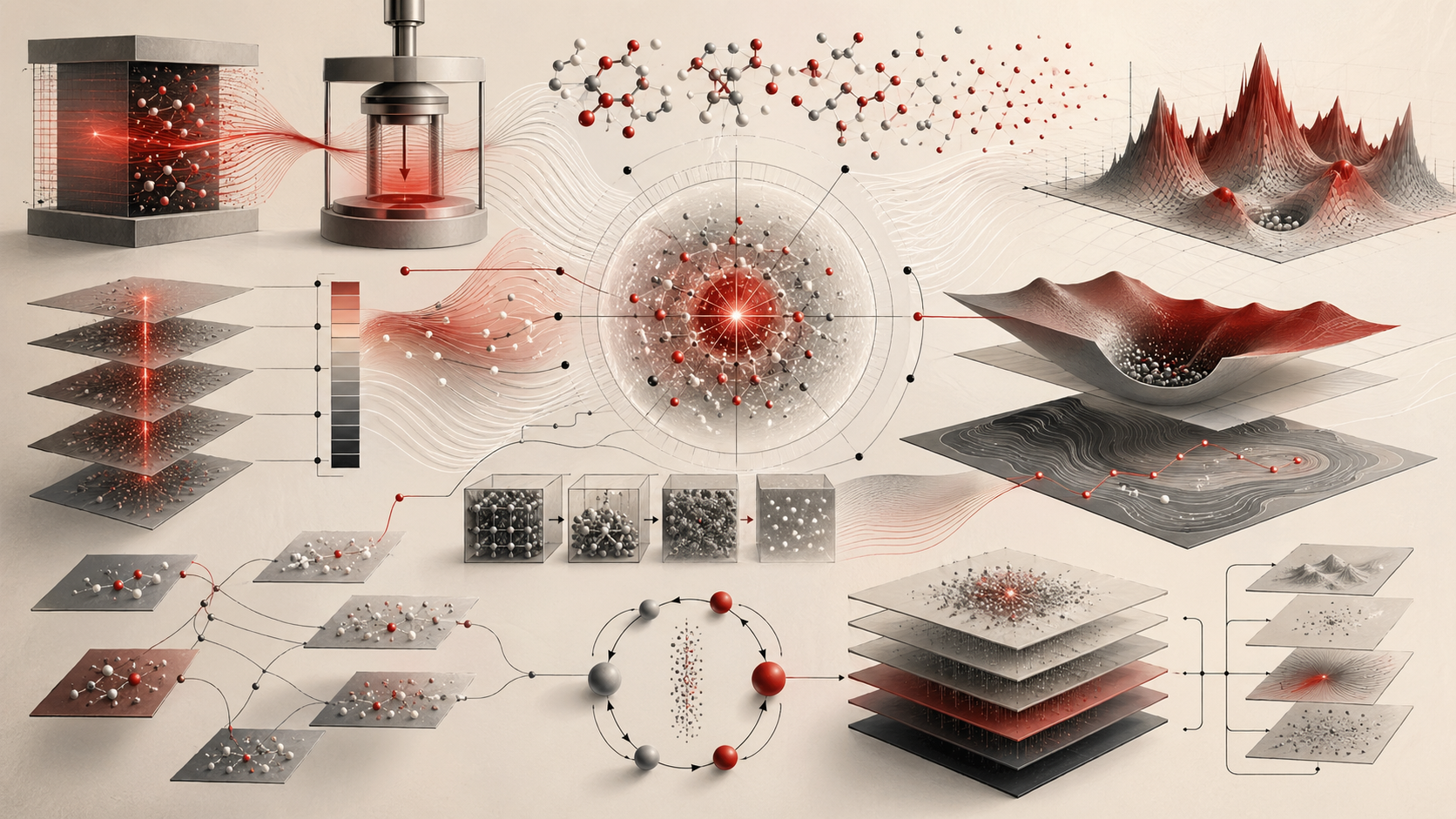
Chemical thermodynamics explains the energetic constraints that govern chemical change. Stoichiometry tells how much matter can react; thermodynamics asks what energy is involved, what direction is favored, what equilibrium is possible, how temperature matters, and why some transformations proceed while others require work, coupling, pressure, heat, light, electricity, catalysts, or different conditions.
The central thesis of this article is that thermodynamics defines the energetic boundary conditions within which chemical systems operate. It does not by itself determine reaction speed, mechanism, pathway, or molecular detail. But it explains what is energetically favored, what equilibrium is possible, how heat and work enter chemical systems, and how entropy and free energy structure chemical possibility.
Chemical systems do not change arbitrarily. Reactions absorb or release heat. Phase transitions require energy. Dissolution can warm or cool a solution. Bonds are broken and formed. Entropy changes when gases form, crystals dissolve, molecules disperse, ions hydrate, proteins fold, or mixtures separate. Equilibrium reflects a balance between energetic driving forces and molecular disorder.
Main Library
Publications
Article Map
Chemistry
Related Topic
Mathematical Modeling
Related Topic
Physics
Related Topic
Environmental Monitoring Systems
Why Chemical Thermodynamics Matters
Chemical thermodynamics matters because chemistry is not only transformation of matter. It is transformation of matter under energetic constraint. A reaction may be balanced stoichiometrically and still be unfavorable under given conditions. A compound may be possible on paper but unstable in practice. A phase may exist only within a temperature-pressure range. A battery may store useful energy because electron transfer is thermodynamically organized. A protein may fold because many weak interactions and solvent effects produce a favorable free-energy landscape.
Thermodynamics helps answer questions such as:
- Will a reaction release or absorb heat?
- Is a process energetically favorable under specified conditions?
- How much maximum non-expansion work can a reaction provide?
- What equilibrium composition is expected?
- How does temperature shift equilibrium?
- Why does a liquid boil, a solid melt, or a gas condense?
- How do entropy and enthalpy compete?
- Why do some reactions need to be coupled to others?
- What energetic limits constrain industrial chemical processes?
Thermodynamics also protects chemistry from misleading intuition. “Exothermic” does not automatically mean “spontaneous.” “Spontaneous” does not mean “fast.” “Stable” does not mean “unreactive.” “High-energy” may refer to enthalpy, free energy, kinetic barrier, excited state, or stored chemical potential, depending on context.
Thermodynamics is also essential for modern public-interest science. Energy storage, hydrogen production, carbon capture, phase-change materials, heat management, corrosion, chemical manufacturing, water treatment, atmospheric chemistry, and biological energy flow all require clear energetic accounting.
For researchers and scientists, thermodynamics provides the disciplined language needed to distinguish heat from work, enthalpy from free energy, spontaneity from rate, equilibrium from completion, and energetic favorability from mechanistic accessibility.
Systems, Surroundings, and State Functions
Thermodynamics begins by defining the system and surroundings. The system is the part of the universe being studied: a reaction mixture, a gas, a solution, a battery cell, a protein, a crystal, a calorimeter, or an industrial reactor. The surroundings are everything else that can exchange energy or matter with the system.
Systems are often classified as:
- open systems, which exchange both matter and energy;
- closed systems, which exchange energy but not matter;
- isolated systems, which ideally exchange neither matter nor energy.
Chemical thermodynamics also distinguishes state functions from path functions. A state function depends only on the state of the system, not the path taken to reach it. Internal energy, enthalpy, entropy, Gibbs free energy, temperature, pressure, volume, and chemical potential are treated as state functions. Heat and work are path functions because they describe energy transfer during a process.
If a system moves from state 1 to state 2, the change in a state function is independent of path:
\Delta X = X_2 – X_1
\]
Interpretation: A state-function change depends only on initial and final states, not on the route between them.
But the heat and work exchanged can depend on how the process occurs. A gas expansion may be reversible or irreversible, isothermal or adiabatic, gentle or sudden. The final state may be the same while path-dependent heat and work differ.
This distinction matters because chemical mechanisms describe pathways, while thermodynamic changes compare states. A reaction may proceed through many possible mechanisms, but the overall thermodynamic change between defined initial and final states is the same if the states are the same.
For researchers, careful system definition is not a formality. It determines what energy flows are counted, what matter crosses boundaries, and what thermodynamic claims can be made.
Internal Energy, Heat, and Work
Internal energy, represented by \(U\), is the total energy associated with the microscopic state of a system. It includes molecular motions, interactions, and other internal energetic contributions. Chemists usually focus on changes in internal energy rather than absolute values.
The first law of thermodynamics expresses conservation of energy:
\Delta U = q + w
\]
Interpretation: Change in internal energy equals heat transferred to the system plus work done on the system under the common chemistry sign convention.
Heat is energy transferred because of a temperature difference. Work is energy transferred by organized force acting through distance, expansion against pressure, electrical work, surface work, or other ordered transfer modes.
For pressure-volume work against constant external pressure:
w = -P_{\mathrm{ext}}\Delta V
\]
Interpretation: Expansion does work on the surroundings and gives negative work on the system under the chemistry sign convention.
This equation shows why gases matter in thermochemistry. Reactions that produce or consume gas can involve expansion work. Under constant volume, heat relates to internal energy change. Under constant pressure, heat relates more directly to enthalpy change.
Internal energy is foundational, but many chemical experiments occur at constant pressure. That is why enthalpy becomes so important in laboratory thermochemistry, reaction energetics, phase transitions, and process calculations.
For researchers, heat and work should not be collapsed into a vague idea of “energy.” They are distinct transfer modes with different experimental meanings and different thermodynamic accounting.
Enthalpy and Heat of Reaction
Enthalpy, represented by \(H\), is defined as:
H = U + pV
\]
Interpretation: Enthalpy combines internal energy with the pressure-volume term relevant to constant-pressure processes.
At constant pressure, the heat transferred by a system undergoing only pressure-volume work is equal to the enthalpy change:
q_p = \Delta H
\]
Interpretation: Constant-pressure heat is measured as enthalpy change when only pressure-volume work occurs.
This makes enthalpy central to chemical thermochemistry. The enthalpy change of reaction, \(\Delta H_{\mathrm{rxn}}\), describes heat absorbed or released under specified conditions. If \(\Delta H_{\mathrm{rxn}} < 0\), the reaction is exothermic. If \(\Delta H_{\mathrm{rxn}} > 0\), the reaction is endothermic.
Examples are familiar:
- Combustion reactions are often strongly exothermic.
- Some dissolution processes release heat, while others absorb heat.
- Melting and vaporization require enthalpy input.
- Neutralization reactions often release heat.
- Photosynthetic carbon fixation requires energy input from light-driven processes.
Enthalpy is not the same as total “stored energy” in a loose sense. It is a thermodynamic state function with defined conditions and units. Reaction enthalpy depends on physical state, temperature, pressure, and reaction specification. The enthalpy change for forming liquid water is not the same as for forming water vapor.
For researchers, thermochemical equations must include physical states and conditions when precision matters. Otherwise, enthalpy values can be compared incorrectly.
Calorimetry and Measuring Thermal Change
Calorimetry measures heat transfer. In a simple constant-pressure solution calorimetry experiment, heat absorbed by the solution may be estimated using:
q = mc\Delta T
\]
Interpretation: Heat transfer is estimated from mass \(m\), specific heat capacity \(c\), and temperature change \(\Delta T\).
If a reaction warms the surroundings, the reaction is releasing heat. If the surroundings cool, the reaction is absorbing heat. Sign convention must be handled carefully:
q_{\mathrm{rxn}} = -q_{\mathrm{surroundings}}
\]
Interpretation: Heat gained by the surroundings is heat lost by the reaction system, assuming no other losses or heat capacities are neglected.
Calorimetry is central to reaction enthalpy, neutralization enthalpy, dissolution enthalpy, heat capacity, phase transitions, combustion energetics, food energy, biochemical energetics, and materials analysis. More sophisticated calorimetric methods include bomb calorimetry, differential scanning calorimetry, isothermal titration calorimetry, thermogravimetric analysis coupled to heat-flow measurements, and microcalorimetry.
Calorimetry also illustrates the difference between measurement and model. The temperature change is observed. The heat transfer is inferred through heat capacity assumptions, calibration, insulation quality, thermal equilibration, stirring, mass, instrument design, and baseline correction.
For researchers, calorimetric results become trustworthy when assumptions are explicit: what system is measured, what heat capacities are included, how calibration was performed, what thermal losses were corrected, and what uncertainty remains.
Hess’s Law and Thermochemical Cycles
Hess’s law follows from enthalpy being a state function. If a reaction can be expressed as a sum of steps, then the overall enthalpy change is the sum of the enthalpy changes of those steps:
\Delta H_{\mathrm{overall}} = \sum_i \Delta H_i
\]
Interpretation: Enthalpy changes add when chemical equations are added consistently.
This allows chemists to calculate reaction enthalpies that are difficult to measure directly. Standard enthalpies of formation are especially useful. The standard reaction enthalpy can be estimated as:
\Delta H^\circ_{\mathrm{rxn}} =
\sum_{\mathrm{products}}\nu_i\Delta H^\circ_{f,i}
–
\sum_{\mathrm{reactants}}\nu_i\Delta H^\circ_{f,i}
\]
Interpretation: Standard reaction enthalpy is calculated from stoichiometric sums of standard formation enthalpies for products and reactants.
Hess’s law underlies thermochemical cycles, combustion analysis, lattice enthalpy estimation, formation enthalpy calculations, and many reaction-energy comparisons. It is also a powerful example of how stoichiometry and thermodynamics work together. The equation must be balanced; the states must be specified; coefficients must be applied correctly.
Thermochemical cycles also help compare pathways. If a direct reaction enthalpy is difficult to measure, an indirect route through known formation, combustion, hydration, dissolution, or phase-transition values may be used. The path is computational, not physical: the enthalpy change depends on state differences.
For researchers, Hess’s law is a discipline of thermodynamic accounting. The calculation is only as good as the reaction specification, phase information, reference states, and source data behind it.
Bond Enthalpy and Molecular Energetics
Reaction enthalpy can sometimes be estimated using average bond enthalpies. The simplified idea is:
\Delta H_{\mathrm{rxn}} \approx
\sum D_{\mathrm{bonds\ broken}}
–
\sum D_{\mathrm{bonds\ formed}}
\]
Interpretation: Breaking bonds requires energy; forming bonds releases energy. The approximate difference estimates reaction enthalpy.
This model is useful for qualitative reasoning, especially in gas-phase reactions and introductory thermochemistry. It helps explain why combustion releases heat: strong bonds in products such as \(CO_2\) and \(H_2O\) are formed.
However, average bond enthalpies are approximations. Bond strength depends on molecular environment, phase, resonance, strain, substituents, charge, spin state, coordination, solvation, and electronic structure. A carbon-hydrogen bond in methane is not identical to a carbon-hydrogen bond in an aromatic ring, aldehyde, radical precursor, or metal complex.
Bond enthalpy reasoning is therefore a model, not a substitute for evaluated thermodynamic data. It gives molecular intuition but must be used cautiously, especially in condensed phases, ionic systems, organometallic chemistry, biological environments, and materials chemistry.
For researchers, energetics connects molecular and macroscopic scales. Bonds and interactions are molecular; enthalpy is a thermodynamic state function measured or calculated for specified systems. Chemical reasoning often needs both.
Entropy and the Dispersal of Energy
Entropy, represented by \(S\), is one of the most important and frequently misunderstood thermodynamic quantities. It is often introduced as “disorder,” but that phrase can mislead. More carefully, entropy measures the number of accessible microscopic arrangements consistent with a macroscopic state and the dispersal of energy among those arrangements.
A statistical expression for entropy is:
S = k_B\ln W
\]
Interpretation: \(k_B\) is the Boltzmann constant and \(W\) is the number of accessible microstates.
In chemical contexts, entropy often increases when:
- gas molecules are produced from liquids or solids;
- a substance dissolves and disperses;
- temperature increases and more energy states become accessible;
- molecules mix;
- ordered structures melt or vaporize;
- large constrained molecules become more conformationally flexible.
But entropy cannot be reduced to a visual impression of messiness. Some processes that appear more “ordered” locally can still be thermodynamically favorable because the entropy of surroundings increases. Protein folding, crystallization, micelle formation, hydrophobic association, adsorption, and phase separation all require careful system-and-surroundings reasoning.
The second law states that for a spontaneous process in an isolated universe:
\Delta S_{\mathrm{universe}} > 0
\]
Interpretation: Spontaneous change in an isolated total system increases total entropy.
Chemical thermodynamics often reformulates this condition using Gibbs free energy for systems at constant temperature and pressure. This reformulation is especially useful because chemists usually study a system rather than the entire universe.
For researchers, entropy is not a slogan. It is a thermodynamic quantity that connects microscopic accessibility, energy dispersal, temperature, surroundings, and spontaneous change.
Gibbs Free Energy and Chemical Spontaneity
Gibbs free energy, represented by \(G\), is central to chemical spontaneity under constant temperature and pressure:
G = H – TS
\]
Interpretation: Gibbs free energy combines enthalpy and entropy into a state function useful for constant-temperature, constant-pressure conditions.
For a process:
\Delta G = \Delta H – T\Delta S
\]
Interpretation: Free-energy change depends on enthalpy change, entropy change, and temperature.
If \(\Delta G < 0\), the process is thermodynamically favorable under the specified conditions. If \(\Delta G > 0\), it is unfavorable as written under those conditions. If \(\Delta G = 0\), the system is at equilibrium.
This equation shows why enthalpy alone is not enough. A process can be endothermic and still favorable if entropy increases enough. A process can be exothermic and unfavorable if entropy decreases enough at the relevant temperature. Temperature determines the weight of the entropy term.
Gibbs free energy also represents the maximum non-expansion work obtainable from a process under suitable reversible conditions. This is why free energy is central to batteries, electrochemistry, metabolism, photosynthesis, fuel cells, corrosion, and biochemical energy coupling.
The word “spontaneous” can be misleading. It does not mean fast. Diamond’s transformation to graphite is thermodynamically favorable under ordinary conditions, but kinetically slow. Combustion may be thermodynamically favorable but require ignition. Thermodynamics gives direction; kinetics gives rate and pathway.
For researchers, free energy is a condition-sensitive criterion of thermodynamic favorability, not a guarantee of observable reaction on a given timescale.
Free Energy, Equilibrium, and the Reaction Quotient
For a reaction not necessarily at standard conditions:
\Delta G = \Delta G^\circ + RT\ln Q
\]
Interpretation: Free energy under current conditions depends on standard free energy, temperature, and reaction quotient.
For a general reaction:
aA + bB \rightleftharpoons cC + dD
\]
Interpretation: The balanced reaction defines the activity powers in the reaction quotient.
the reaction quotient is written in terms of activities:
Q = \frac{a_C^c a_D^d}{a_A^a a_B^b}
\]
Interpretation: \(Q\) describes current composition relative to the reaction as written.
At equilibrium, \(\Delta G = 0\) and \(Q = K\). Therefore:
\Delta G^\circ = -RT\ln K
\]
Interpretation: Standard free energy and the equilibrium constant are thermodynamically linked.
This relationship is one of the most important equations in chemistry. It connects thermodynamic driving force to equilibrium composition. If \(\Delta G^\circ\) is strongly negative, \(K\) is large and products are favored at equilibrium. If \(\Delta G^\circ\) is strongly positive, \(K\) is small and reactants are favored.
Equilibrium is not a static absence of change. It is a thermodynamic condition where forward and reverse processes balance and free energy is minimized under the relevant constraints.
For researchers, the reaction quotient is essential because real systems rarely begin at standard conditions. Composition, pressure, pH, activity, concentration, and phase all influence the actual free-energy change.
Temperature Dependence and the van ’t Hoff Relationship
Temperature can shift equilibrium because enthalpy and entropy contribute differently to free energy. The van ’t Hoff relationship gives a useful approximation for the temperature dependence of equilibrium constants:
\ln K = -\frac{\Delta H^\circ}{RT} + \frac{\Delta S^\circ}{R}
\]
Interpretation: If \(\Delta H^\circ\) and \(\Delta S^\circ\) are approximately constant over the temperature range, \(\ln K\) varies linearly with \(1/T\).
This equation suggests that a plot of \(\ln K\) versus \(1/T\) can estimate \(\Delta H^\circ\) from the slope and \(\Delta S^\circ\) from the intercept. It also helps explain why increasing temperature can favor endothermic processes and disfavor some exothermic processes, depending on the reaction.
Temperature effects are central to chemical synthesis, equilibrium control, industrial reactors, atmospheric chemistry, solubility, phase transitions, biological stability, and materials processing. Heating a system is not simply “adding energy.” It changes molecular populations, equilibrium positions, rates, phase stability, and entropy contributions.
The van ’t Hoff relationship also has limits. If heat capacity changes are significant, if the mechanism or phase changes over the temperature range, or if nonideality is strong, a simple linear fit may mislead.
For researchers, temperature is a chemical variable, not only a physical setting. Any equilibrium constant or thermodynamic interpretation should be tied to temperature.
Phase Transitions and Energetics of Matter
Phase transitions are thermodynamic transformations among solid, liquid, gas, and other phases. Melting, freezing, vaporization, condensation, sublimation, deposition, crystallization, and glass transition all involve energetic and entropic changes.
At a phase transition temperature under specified pressure, two phases can coexist at equilibrium. The Gibbs free energies of the phases are equal. Heat added during a phase transition changes the phase rather than simply increasing temperature.
The enthalpy of vaporization, for example, is the energy required to convert liquid to gas at a specified temperature and pressure. The Clausius-Clapeyron relationship provides a useful approximation for vapor pressure behavior:
\ln P = -\frac{\Delta H_{\mathrm{vap}}}{RT} + C
\]
Interpretation: Vapor pressure depends on temperature and enthalpy of vaporization over an approximate fitted range.
Phase energetics links thermodynamics to condensed matter. Intermolecular forces, entropy, pressure, temperature, molecular size, polarity, hydrogen bonding, ionic interactions, crystal packing, and defects all shape phase behavior. A molecule’s thermodynamic behavior depends not only on its formula but on its physical state and environment.
Phase transitions are also central to materials reliability. Polymorphs can differ in solubility and stability. Glass transitions affect polymers. Hydrates can change pharmaceutical behavior. Phase separation affects batteries, membranes, alloys, and biomolecular condensates.
For researchers, phase is not a detail added after molecular structure. It is part of the thermodynamic identity of matter.
Chemical Potential and Mixtures
Chemical potential, represented by \(\mu_i\), describes how Gibbs free energy changes when the amount of a component changes while other relevant variables are held constant:
\mu_i = \left(\frac{\partial G}{\partial n_i}\right)_{T,p,n_{j\neq i}}
\]
Interpretation: Chemical potential is the partial molar Gibbs free energy of component \(i\).
Chemical potential is one of the deepest ideas in thermodynamics because it governs reaction equilibrium, phase equilibrium, diffusion, osmosis, vapor pressure, electrochemistry, solution behavior, and mixtures.
A substance tends to move or transform in ways that reduce appropriate free-energy differences. Diffusion can be understood through gradients in chemical potential. Phase equilibrium occurs when chemical potentials of a substance are equal in coexisting phases. Reaction equilibrium occurs when the chemical potentials of reactants and products satisfy the stoichiometric balance condition.
For ideal mixtures, chemical potential can often be expressed using logarithmic concentration or activity relationships. A simplified form is:
\mu_i = \mu_i^\circ + RT\ln a_i
\]
Interpretation: Chemical potential increases with activity \(a_i\) relative to the standard chemical potential \(\mu_i^\circ\).
Real mixtures require activity coefficients because interactions matter. This is especially important in electrolyte solutions, concentrated solutions, biochemical systems, environmental waters, molten salts, ionic liquids, industrial mixtures, and high-pressure gases.
For researchers, chemical potential shows that thermodynamics is not limited to isolated reactions. It is a theory of composition, movement, phase, and transformation.
Coupled Reactions, Biochemistry, and Energy Carriers
Many important chemical transformations are thermodynamically unfavorable on their own. They proceed because they are coupled to favorable processes. In biochemical systems, ATP hydrolysis is the familiar example, but the broader principle applies across metabolism, ion gradients, redox reactions, membrane transport, biosynthesis, molecular motors, and electrochemical systems.
If two processes are coupled, their free energy changes add:
\Delta G_{\mathrm{total}} = \Delta G_1 + \Delta G_2
\]
Interpretation: A thermodynamically unfavorable step can proceed when coupled to a sufficiently favorable step so that total free-energy change is negative.
More generally:
\Delta G_{\mathrm{total}} = \sum_i \Delta G_i
\]
Interpretation: Coupled thermodynamic processes add through their free-energy changes.
Energy carriers are not magical reservoirs. They participate in reactions whose free-energy changes can be coupled to other transformations. The effective \(\Delta G\) depends on concentrations, pH, ionic strength, compartmentalization, enzyme catalysis, and coupling mechanism.
This is one reason biological thermodynamics is subtle. Living systems maintain nonequilibrium states through energy flow. They do not violate thermodynamics; they operate within thermodynamic constraints by exchanging matter and energy with their surroundings.
Coupling also appears outside biology. Electrolysis couples electrical work to chemical transformation. Photochemistry couples photon absorption to excited-state reactions. Industrial processes couple heat, pressure, separation, and reaction. Carbon capture systems couple absorption or adsorption to regeneration energy.
For researchers, coupled reactions show that thermodynamic favorability belongs to a defined system boundary. Whether a process is favorable depends on what is included in the coupled system.
Thermodynamics in Materials, Environment, and Industry
Thermodynamics is central to materials, environmental chemistry, and industrial systems.
In materials science, thermodynamics helps explain phase diagrams, alloy formation, crystal stability, polymorphism, sintering, melting, vapor deposition, corrosion, battery materials, ceramic processing, polymer transitions, and semiconductor growth. A material’s useful properties often depend on phase stability and free-energy landscapes.
In environmental chemistry, thermodynamics helps explain acid-base speciation, carbonate equilibria, mineral dissolution and precipitation, redox conditions, gas solubility, sorption, contaminant partitioning, atmospheric chemistry, ocean chemistry, and nutrient cycling. Environmental systems are open, heterogeneous, and often far from simple ideal behavior, but thermodynamic constraints remain essential.
In industry, thermodynamics supports reactor design, separations, distillation, heat integration, ammonia synthesis, fuel processing, combustion, fertilizer production, petroleum refining, hydrogen production, carbon capture, metallurgy, and process optimization. Thermodynamic efficiency and heat management are economic and environmental issues as well as chemical ones.
Thermodynamics also shapes environmental justice and infrastructure risk. Energy-intensive chemical processes, heat burdens, combustion emissions, water treatment chemistry, mine drainage, contaminated sediments, and industrial waste streams all involve thermodynamic constraints that can affect communities unevenly. Clear energy and mass accounting matters for public accountability.
For researchers, thermodynamics connects molecular transformation to planetary and industrial scale. It is not only a theory of reactions; it is a framework for understanding chemical systems under material, energetic, and environmental constraint.
Limits of Thermodynamic Reasoning
Thermodynamics is powerful, but it has limits. It tells whether a process is favorable under specified conditions, not how fast it occurs. It compares states, not necessarily mechanisms. It can identify equilibrium constraints, but real systems may be kinetically trapped, metastable, catalytically controlled, transport-limited, diffusion-limited, photochemically driven, electrically driven, biologically regulated, or constrained by surfaces and interfaces.
A reaction with negative \(\Delta G\) may be extremely slow. A substance may persist because of a kinetic barrier. A material may be metastable but technologically useful. A biological system may maintain a nonequilibrium steady state through continuous energy input. A catalyst can change pathway and rate without changing the equilibrium constant.
Thermodynamic calculations also depend on data quality and assumptions. Standard states, activities, temperature, pressure, phase, ionic strength, concentration, nonideality, and reference conditions all matter. A thermodynamic value without context can mislead.
Thermodynamics can also be misused rhetorically. Claims about “efficiency,” “energy storage,” “carbon removal,” “green hydrogen,” “chemical recycling,” “negative emissions,” or “self-sustaining” processes can sound persuasive while omitting system boundaries, heat losses, separation work, regeneration energy, or lifecycle constraints.
For researchers, good chemical reasoning combines thermodynamics with kinetics, mechanism, structure, transport, measurement, and uncertainty. Energetics is necessary, but not sufficient.
Thermodynamic Data, Computation, and Reproducibility
Modern thermodynamic work depends on data. Formation enthalpies, standard entropies, heat capacities, Gibbs energies, vapor pressures, equilibrium constants, activity coefficients, phase diagrams, calorimetry records, electrochemical potentials, and computational thermochemistry all require traceable sources.
Reproducibility requires that thermodynamic workflows preserve:
- system boundaries;
- reaction equations and physical states;
- temperature and pressure;
- standard-state conventions;
- units and sign conventions;
- activity or concentration assumptions;
- phase assumptions;
- data sources and versions;
- calibration records;
- uncertainty estimates;
- model equations and solver settings;
- validation evidence.
Computational thermodynamics can support calorimetry analysis, Hess’s law calculations, equilibrium constants from free energy, van ’t Hoff fitting, phase-transition models, coupled free-energy accounting, process energy balances, and chemical-potential frameworks. But it can also create false confidence if constants are mixed across incompatible conditions or if assumptions are hidden.
For researchers, thermodynamic computation should not only return a number. It should make the evidence chain auditable: what was calculated, from what data, under what assumptions, with what uncertainty, and for what domain of validity.
Mathematical Lens: Chemical Thermodynamics and Energetics
Chemical thermodynamics can be summarized through energy balances, state functions, entropy, free energy, and equilibrium relationships. The first law of thermodynamics is:
\Delta U = q + w
\]
Interpretation: Internal energy changes through heat and work exchange.
Pressure-volume work is:
w = -P_{\mathrm{ext}}\Delta V
\]
Interpretation: Expansion against external pressure transfers work from the system to the surroundings.
Enthalpy is:
H = U + pV
\]
Interpretation: Enthalpy is useful for constant-pressure thermal processes.
Constant-pressure heat is:
q_p = \Delta H
\]
Interpretation: Under appropriate conditions, constant-pressure heat equals enthalpy change.
Calorimetry is:
q = mc\Delta T
\]
Interpretation: Heat transfer is estimated from mass, heat capacity, and temperature change.
Hess’s law is:
\Delta H_{\mathrm{overall}} = \sum_i \Delta H_i
\]
Interpretation: Enthalpy changes add across a thermochemical cycle.
Standard reaction enthalpy is:
\Delta H^\circ_{\mathrm{rxn}} =
\sum_{\mathrm{products}}\nu_i\Delta H^\circ_{f,i}
–
\sum_{\mathrm{reactants}}\nu_i\Delta H^\circ_{f,i}
\]
Interpretation: Formation enthalpies and stoichiometric coefficients determine standard reaction enthalpy.
Entropy is:
S = k_B\ln W
\]
Interpretation: Entropy connects macroscopic thermodynamics to accessible microscopic arrangements.
Gibbs free energy is:
\Delta G = \Delta H – T\Delta S
\]
Interpretation: Free-energy change combines enthalpy and entropy under constant-temperature, constant-pressure reasoning.
Free energy under nonstandard conditions is:
\Delta G = \Delta G^\circ + RT\ln Q
\]
Interpretation: Current composition changes thermodynamic driving force through the reaction quotient.
Free energy and equilibrium are related by:
\Delta G^\circ = -RT\ln K
\]
Interpretation: Standard free energy determines the equilibrium constant under the specified standard-state convention.
The van ’t Hoff relationship is:
\ln K = -\frac{\Delta H^\circ}{RT} + \frac{\Delta S^\circ}{R}
\]
Interpretation: Equilibrium constants vary with temperature according to enthalpy and entropy under simplifying assumptions.
Chemical potential is:
\mu_i = \left(\frac{\partial G}{\partial n_i}\right)_{T,p,n_{j\neq i}}
\]
Interpretation: Chemical potential is the change in Gibbs free energy with amount of component \(i\).
Coupled reactions satisfy:
\Delta G_{\mathrm{total}} = \sum_i \Delta G_i
\]
Interpretation: Coupled processes are thermodynamically evaluated through the sum of their free-energy changes.
Electrochemical free energy is:
\Delta G = -nFE
\]
Interpretation: Redox free energy relates to electron count \(n\), Faraday’s constant \(F\), and cell potential \(E\).
These equations show that thermodynamics is a system of relationships, not a list of isolated formulas. Energy, entropy, temperature, pressure, composition, equilibrium, and phase are connected.
Computational Workflows for Chemical Thermodynamics
Computational workflows can make thermodynamic reasoning more transparent. A workflow can track calorimetry inputs, heat capacities, reaction quantities, formation enthalpies, free-energy values, equilibrium constants, temperature-dependent \(K\) values, phase-transition parameters, coupled reaction sums, electrochemical potentials, source data, and provenance.
Useful workflows include calorimetry analysis, Hess’s law calculations, formation enthalpy tables, Gibbs free energy and equilibrium conversion, van ’t Hoff fitting, Clausius-Clapeyron vapor-pressure scaffolds, coupled free-energy accounting, electrochemical free-energy calculations, chemical-potential records, and SQL evidence registers.
For researchers, thermodynamic workflows should preserve four distinctions:
- Heat versus work: both are energy transfer modes, but they are not the same measurement.
- Enthalpy versus free energy: heat release does not automatically mean thermodynamic favorability under all conditions.
- Standard conditions versus actual conditions: \(\Delta G^\circ\) and \(\Delta G\) answer different questions.
- Thermodynamic favorability versus kinetic accessibility: favorable processes can be slow or blocked by barriers.
The examples below use synthetic educational data. They do not validate real industrial processes, certify safety, approve energy-system claims, establish environmental compliance, or replace professional thermodynamic review. They demonstrate how thermodynamic reasoning can be organized, audited, and communicated responsibly.
Python Example: Calorimetry, Free Energy, Equilibrium, Phase Energetics, and Provenance
The following Python example uses synthetic educational data. It calculates calorimetric reaction enthalpy, converts standard Gibbs free energy to equilibrium constants, estimates vapor pressure from a Clausius-Clapeyron scaffold, evaluates coupled free energy, and writes provenance outputs. In real thermodynamic work, these workflows should preserve calibrated instruments, source data, standard states, phase conventions, uncertainty, and validation evidence.
from pathlib import Path
from typing import Dict, List
import json
import math
import platform
import sys

import numpy as np
import pandas as pd


# Synthetic chemical thermodynamics workflow.
# Educational example only; not for process design,
# energy-system certification, environmental compliance,
# safety analysis, or clinical use.


def require_columns(data: pd.DataFrame, required: List[str], table_name: str) -> None:
    """Raise an error if required columns are missing."""
    missing = [column for column in required if column not in data.columns]
    if missing:
        raise ValueError(f"{table_name} is missing required columns: {missing}")


R_J_mol_K = 8.314462618
temperature_K = 298.15

calorimetry = pd.DataFrame({
    "experiment": ["neutralization_demo", "dissolution_demo"],
    "solution_mass_g": [100.0, 75.0],
    "specific_heat_j_g_k": [4.184, 4.184],
    "temperature_change_K": [6.2, -3.1],
    "reaction_amount_mol": [0.0500, 0.0250],
})

require_columns(
    calorimetry,
    [
        "experiment",
        "solution_mass_g",
        "specific_heat_j_g_k",
        "temperature_change_K",
        "reaction_amount_mol",
    ],
    "calorimetry",
)

calorimetry["q_solution_j"] = (
    calorimetry["solution_mass_g"]
    * calorimetry["specific_heat_j_g_k"]
    * calorimetry["temperature_change_K"]
)

calorimetry["q_reaction_j"] = -calorimetry["q_solution_j"]

calorimetry["delta_h_reaction_kj_mol"] = (
    calorimetry["q_reaction_j"]
    / 1000.0
    / calorimetry["reaction_amount_mol"]
)

free_energy = pd.DataFrame({
    "reaction": ["A_to_B", "C_to_D", "E_to_F", "G_to_H"],
    "delta_g_standard_kj_mol": [-15.0, 0.0, 10.0, -35.0],
})

free_energy["equilibrium_constant"] = free_energy["delta_g_standard_kj_mol"].apply(
    lambda dg_kj: math.exp(-(dg_kj * 1000.0) / (R_J_mol_K * temperature_K))
)

free_energy["log10_K"] = free_energy["equilibrium_constant"].apply(math.log10)

coupled_reactions = pd.DataFrame({
    "process": ["unfavorable_synthesis", "favorable_coupling", "combined_process"],
    "delta_g_kj_mol": [22.0, -35.0, 22.0 - 35.0],
})

coupled_reactions["thermodynamic_status"] = np.where(
    coupled_reactions["delta_g_kj_mol"] < 0,
    "favorable as written under modeled conditions",
    np.where(
        coupled_reactions["delta_g_kj_mol"] > 0,
        "unfavorable as written under modeled conditions",
        "at equilibrium under modeled conditions",
    ),
)

phase_cases = pd.DataFrame({
    "temperature_K": [290, 300, 310, 320, 330],
})

delta_h_vap_j_mol = 40_700.0
reference_temperature_K = 373.15
reference_pressure_bar = 1.0

# Clausius-Clapeyron relative vapor pressure scaffold:
# ln(P2/P1) = -DeltaHvap/R * (1/T2 - 1/T1)
phase_cases["vapor_pressure_bar"] = phase_cases["temperature_K"].apply(
    lambda temp: reference_pressure_bar
    * math.exp(
        -delta_h_vap_j_mol / R_J_mol_K
        * (1.0 / temp - 1.0 / reference_temperature_K)
    )
)

electrochemical = pd.DataFrame({
    "cell": ["demo_low_voltage", "demo_high_voltage"],
    "electrons_transferred": [2, 2],
    "cell_potential_V": [0.50, 1.10],
})

F_C_mol = 96485.33212

electrochemical["delta_g_kj_mol"] = (
    -electrochemical["electrons_transferred"]
    * F_C_mol
    * electrochemical["cell_potential_V"]
    / 1000.0
)

output_dir = Path("outputs")
output_dir.mkdir(exist_ok=True)

calorimetry.to_csv(output_dir / "synthetic_calorimetry_enthalpy.csv", index=False)
free_energy.to_csv(output_dir / "synthetic_free_energy_equilibrium.csv", index=False)
coupled_reactions.to_csv(output_dir / "synthetic_coupled_free_energy.csv", index=False)
phase_cases.to_csv(output_dir / "synthetic_phase_vapor_pressure.csv", index=False)
electrochemical.to_csv(output_dir / "synthetic_electrochemical_free_energy.csv", index=False)

manifest: Dict[str, object] = {
    "workflow": "synthetic_chemical_thermodynamics_workflow",
    "data_type": "synthetic educational thermodynamics records",
    "gas_constant_J_mol_K": R_J_mol_K,
    "faraday_constant_C_mol": F_C_mol,
    "temperature_K": temperature_K,
    "equations": [
        "q = m*c*delta_T",
        "q_reaction = -q_surroundings",
        "Delta G standard = -R*T*ln(K)",
        "Delta G total = sum(Delta G_i)",
        "ln(P2/P1) = -DeltaHvap/R*(1/T2 - 1/T1)",
        "Delta G = -n*F*E",
    ],
    "python_version": sys.version,
    "platform": platform.platform(),
    "numpy_version": np.__version__,
    "pandas_version": pd.__version__,
    "output_files": [
        "outputs/synthetic_calorimetry_enthalpy.csv",
        "outputs/synthetic_free_energy_equilibrium.csv",
        "outputs/synthetic_coupled_free_energy.csv",
        "outputs/synthetic_phase_vapor_pressure.csv",
        "outputs/synthetic_electrochemical_free_energy.csv",
        "outputs/chemical_thermodynamics_manifest.json",
    ],
    "responsible_use": [
        "Synthetic educational data only.",
        "Real thermodynamic workflows require validated constants, calibrated measurements, standard-state definitions, phase conventions, uncertainty estimates, and expert review.",
    ],
}

with (output_dir / "chemical_thermodynamics_manifest.json").open(
    "w",
    encoding="utf-8"
) as file:
    json.dump(manifest, file, indent=2)

print("Calorimetry and reaction enthalpy")
print("---------------------------------")
print(calorimetry.round(6).to_string(index=False))

print("\nFree energy and equilibrium constants")
print("-------------------------------------")
print(free_energy.round(6).to_string(index=False))

print("\nCoupled free-energy accounting")
print("------------------------------")
print(coupled_reactions.round(6).to_string(index=False))

print("\nPhase-transition vapor-pressure scaffold")
print("----------------------------------------")
print(phase_cases.round(8).to_string(index=False))

print("\nElectrochemical free-energy scaffold")
print("------------------------------------")
print(electrochemical.round(6).to_string(index=False))
This workflow demonstrates thermodynamic evidence discipline rather than real process validation. It separates calorimetry, free-energy conversion, coupling, phase energetics, electrochemical work, and provenance. A real workflow would add uncertainty intervals, source thermodynamic tables, standard-state review, phase verification, instrument calibration, and independent comparison.
R Example: Hess’s Law, van ’t Hoff Fitting, and Coupled Free Energy
The following R example uses synthetic educational data to calculate a reaction enthalpy from formation enthalpies, fit a van ’t Hoff-style relationship, and evaluate coupled free-energy sums. In real thermodynamic work, these calculations should be tied to validated tables, temperature range, phase conventions, standard states, and uncertainty estimates.
# Synthetic chemical thermodynamics scaffold.
# Educational example only; not for process design,
# safety analysis, environmental compliance, or energy-system certification.

species <- data.frame(
  species = c("CH4", "O2", "CO2", "H2O_l"),
  coefficient = c(-1, -2, 1, 2),
  delta_h_f_kj_mol = c(-74.8, 0.0, -393.5, -285.8)
)

species$contribution_kj_mol <-
  species$coefficient * species$delta_h_f_kj_mol

delta_h_rxn <- sum(species$contribution_kj_mol)

hess_summary <- data.frame(
  reaction = "CH4 + 2 O2 -> CO2 + 2 H2O(l)",
  delta_h_rxn_kj_mol_reaction = delta_h_rxn
)

R_gas_constant <- 8.314462618

equilibrium <- data.frame(
  temperature_K = c(290, 300, 310, 320, 330),
  K = c(0.42, 0.60, 0.83, 1.10, 1.42)
)

equilibrium$inverse_temperature <- 1 / equilibrium$temperature_K
equilibrium$ln_K <- log(equilibrium$K)

model <- lm(ln_K ~ inverse_temperature, data = equilibrium)

slope <- coef(model)[["inverse_temperature"]]
intercept <- coef(model)[["(Intercept)"]]

delta_h_standard_j_mol <- -slope * R_gas_constant
delta_s_standard_j_mol_k <- intercept * R_gas_constant

vanthoff_summary <- data.frame(
  slope = slope,
  intercept = intercept,
  delta_h_standard_kj_mol = delta_h_standard_j_mol / 1000,
  delta_s_standard_j_mol_k = delta_s_standard_j_mol_k,
  r_squared = summary(model)$r.squared
)

coupled <- data.frame(
  process = c("unfavorable_synthesis", "favorable_coupling", "combined_process"),
  delta_g_kj_mol = c(22.0, -35.0, 22.0 - 35.0)
)

coupled$thermodynamic_status <- ifelse(
  coupled$delta_g_kj_mol < 0,
  "favorable as written under modeled conditions",
  ifelse(
    coupled$delta_g_kj_mol > 0,
    "unfavorable as written under modeled conditions",
    "at equilibrium under modeled conditions"
  )
)

dir.create("outputs", showWarnings = FALSE)

write.csv(
  species,
  file = "outputs/r_hess_law_species_contributions.csv",
  row.names = FALSE
)

write.csv(
  hess_summary,
  file = "outputs/r_hess_law_summary.csv",
  row.names = FALSE
)

write.csv(
  equilibrium,
  file = "outputs/r_vanthoff_equilibrium_data.csv",
  row.names = FALSE
)

write.csv(
  vanthoff_summary,
  file = "outputs/r_vanthoff_summary.csv",
  row.names = FALSE
)

write.csv(
  coupled,
  file = "outputs/r_coupled_free_energy.csv",
  row.names = FALSE
)

sink("outputs/r_chemical_thermodynamics_report.txt")
cat("Synthetic Chemical Thermodynamics Scaffold Report\n")
cat("=================================================\n\n")
cat("Hess's law species contributions:\n")
print(species)
cat("\nHess's law summary:\n")
print(hess_summary)
cat("\nvan 't Hoff input data:\n")
print(equilibrium)
cat("\nvan 't Hoff summary:\n")
print(vanthoff_summary)
cat("\nCoupled free-energy accounting:\n")
print(coupled)
cat("\nResponsible-use note:\n")
cat("Synthetic educational data only. Real thermodynamic workflows require validated constants, calibrated measurements, standard-state definitions, phase conventions, uncertainty estimates, and expert review.\n")
sink()

print(species)
print(hess_summary)
print(vanthoff_summary)
print(coupled)
This scaffold shows how R can support thermochemical accounting, equilibrium temperature analysis, and coupled free-energy interpretation. The central issue is not the language but the evidence chain. Formation enthalpies, equilibrium constants, fitted parameters, and free-energy claims should remain connected to conditions, sources, units, and uncertainty.
SQL Example: Chemical Thermodynamics Evidence Register
Chemical thermodynamics becomes more reliable when systems, species, reaction states, thermodynamic constants, calorimetry records, equilibrium records, phase-transition data, coupled reactions, computational models, and interpretation claims are traceable. A simple evidence register can preserve the context needed to audit energetic claims.
CREATE TABLE thermodynamic_system (
    system_id TEXT PRIMARY KEY,
    system_name TEXT NOT NULL,
    system_domain TEXT,
    system_boundary_description TEXT,
    system_type TEXT,
    temperature_K REAL,
    pressure_bar REAL,
    solvent_or_medium TEXT,
    standard_state_description TEXT,
    system_notes TEXT
);

CREATE TABLE thermodynamic_species (
    species_id TEXT PRIMARY KEY,
    system_id TEXT NOT NULL,
    species_name TEXT NOT NULL,
    formula TEXT,
    phase TEXT,
    charge INTEGER,
    standard_state_description TEXT,
    species_review_status TEXT,
    FOREIGN KEY (system_id) REFERENCES thermodynamic_system(system_id)
);

CREATE TABLE thermodynamic_reaction (
    reaction_id TEXT PRIMARY KEY,
    system_id TEXT NOT NULL,
    reaction_label TEXT NOT NULL,
    reaction_equation TEXT,
    reaction_domain TEXT,
    reversible INTEGER CHECK (reversible IN (0, 1)),
    reaction_review_status TEXT,
    FOREIGN KEY (system_id) REFERENCES thermodynamic_system(system_id)
);

CREATE TABLE thermodynamic_property_record (
    property_id TEXT PRIMARY KEY,
    species_id TEXT,
    reaction_id TEXT,
    property_name TEXT,
    property_symbol TEXT,
    property_value REAL,
    property_unit TEXT,
    temperature_K REAL,
    pressure_bar REAL,
    phase TEXT,
    source_uri TEXT,
    uncertainty_value REAL,
    uncertainty_unit TEXT,
    property_review_status TEXT,
    FOREIGN KEY (species_id) REFERENCES thermodynamic_species(species_id),
    FOREIGN KEY (reaction_id) REFERENCES thermodynamic_reaction(reaction_id)
);

CREATE TABLE calorimetry_record (
    calorimetry_id TEXT PRIMARY KEY,
    system_id TEXT NOT NULL,
    experiment_name TEXT,
    calorimeter_type TEXT,
    mass_g REAL,
    heat_capacity_j_g_k REAL,
    temperature_change_K REAL,
    heat_transfer_j REAL,
    reaction_amount_mol REAL,
    delta_h_kj_mol REAL,
    calibration_uri TEXT,
    calorimetry_review_status TEXT,
    FOREIGN KEY (system_id) REFERENCES thermodynamic_system(system_id)
);

CREATE TABLE equilibrium_thermodynamic_record (
    equilibrium_id TEXT PRIMARY KEY,
    reaction_id TEXT NOT NULL,
    reaction_quotient REAL,
    equilibrium_constant REAL,
    delta_g_standard_kj_mol REAL,
    delta_g_current_kj_mol REAL,
    temperature_K REAL,
    activity_model_description TEXT,
    equilibrium_review_status TEXT,
    FOREIGN KEY (reaction_id) REFERENCES thermodynamic_reaction(reaction_id)
);

CREATE TABLE phase_transition_record (
    phase_transition_id TEXT PRIMARY KEY,
    species_id TEXT NOT NULL,
    transition_type TEXT,
    phase_from TEXT,
    phase_to TEXT,
    transition_temperature_K REAL,
    transition_pressure_bar REAL,
    enthalpy_transition_kj_mol REAL,
    entropy_transition_j_mol_k REAL,
    source_uri TEXT,
    phase_transition_review_status TEXT,
    FOREIGN KEY (species_id) REFERENCES thermodynamic_species(species_id)
);

CREATE TABLE coupled_process_record (
    coupled_process_id TEXT PRIMARY KEY,
    system_id TEXT NOT NULL,
    process_name TEXT,
    component_process_description TEXT,
    delta_g_total_kj_mol REAL,
    coupling_mechanism_description TEXT,
    coupling_review_status TEXT,
    FOREIGN KEY (system_id) REFERENCES thermodynamic_system(system_id)
);

CREATE TABLE computational_thermodynamics_model (
    model_id TEXT PRIMARY KEY,
    system_id TEXT NOT NULL,
    model_type TEXT,
    software_name TEXT,
    software_version TEXT,
    input_uri TEXT,
    output_uri TEXT,
    standard_state_handling TEXT,
    activity_model_description TEXT,
    validation_status TEXT,
    model_review_status TEXT,
    FOREIGN KEY (system_id) REFERENCES thermodynamic_system(system_id)
);

CREATE TABLE thermodynamic_interpretation_claim (
    claim_id TEXT PRIMARY KEY,
    system_id TEXT NOT NULL,
    reaction_id TEXT,
    model_id TEXT,
    claim_text TEXT,
    claim_type TEXT,
    confidence_level TEXT,
    limitation_notes TEXT,
    review_status TEXT,
    FOREIGN KEY (system_id) REFERENCES thermodynamic_system(system_id),
    FOREIGN KEY (reaction_id) REFERENCES thermodynamic_reaction(reaction_id),
    FOREIGN KEY (model_id) REFERENCES computational_thermodynamics_model(model_id)
);

SELECT
    s.system_id,
    s.system_name,
    s.system_domain,
    s.system_boundary_description,
    s.temperature_K,
    s.pressure_bar,
    s.standard_state_description,
    sp.species_name,
    sp.phase,
    r.reaction_label,
    r.reaction_equation,
    prop.property_symbol,
    prop.property_value,
    prop.property_unit,
    cal.experiment_name,
    cal.delta_h_kj_mol,
    eq.equilibrium_constant,
    eq.delta_g_standard_kj_mol,
    phase.transition_type,
    phase.enthalpy_transition_kj_mol,
    coupled.process_name,
    coupled.delta_g_total_kj_mol,
    model.model_type,
    model.validation_status,
    claim.claim_type,
    claim.confidence_level,
    CASE
        WHEN s.system_boundary_description IS NULL
            THEN 'system-boundary review required'
        WHEN s.temperature_K IS NULL
            THEN 'temperature review required'
        WHEN s.standard_state_description IS NULL
            THEN 'standard-state review required'
        WHEN sp.species_review_status IS NOT NULL
             AND sp.species_review_status != 'pass'
            THEN 'species review required'
        WHEN r.reaction_review_status IS NOT NULL
             AND r.reaction_review_status != 'pass'
            THEN 'reaction review required'
        WHEN prop.property_review_status IS NOT NULL
             AND prop.property_review_status != 'pass'
            THEN 'property review required'
        WHEN cal.calibration_uri IS NULL
             AND cal.calorimetry_id IS NOT NULL
            THEN 'calorimetry calibration review required'
        WHEN cal.calorimetry_review_status IS NOT NULL
             AND cal.calorimetry_review_status != 'pass'
            THEN 'calorimetry review required'
        WHEN eq.equilibrium_review_status IS NOT NULL
             AND eq.equilibrium_review_status != 'pass'
            THEN 'equilibrium thermodynamics review required'
        WHEN phase.phase_transition_review_status IS NOT NULL
             AND phase.phase_transition_review_status != 'pass'
            THEN 'phase-transition review required'
        WHEN coupled.coupling_review_status IS NOT NULL
             AND coupled.coupling_review_status != 'pass'
            THEN 'coupling review required'
        WHEN model.model_review_status IS NOT NULL
             AND model.model_review_status != 'pass'
            THEN 'computational thermodynamics review required'
        WHEN claim.review_status IS NOT NULL
             AND claim.review_status != 'reviewed'
            THEN 'interpretation review required'
        ELSE 'standard review'
    END AS thermodynamics_review_status
FROM thermodynamic_system s
LEFT JOIN thermodynamic_species sp
    ON s.system_id = sp.system_id
LEFT JOIN thermodynamic_reaction r
    ON s.system_id = r.system_id
LEFT JOIN thermodynamic_property_record prop
    ON sp.species_id = prop.species_id
    OR r.reaction_id = prop.reaction_id
LEFT JOIN calorimetry_record cal
    ON s.system_id = cal.system_id
LEFT JOIN equilibrium_thermodynamic_record eq
    ON r.reaction_id = eq.reaction_id
LEFT JOIN phase_transition_record phase
    ON sp.species_id = phase.species_id
LEFT JOIN coupled_process_record coupled
    ON s.system_id = coupled.system_id
LEFT JOIN computational_thermodynamics_model model
    ON s.system_id = model.system_id
LEFT JOIN thermodynamic_interpretation_claim claim
    ON s.system_id = claim.system_id
ORDER BY thermodynamics_review_status, s.system_id, r.reaction_id;
The purpose of this register is to keep thermodynamic interpretation attached to evidence. A thermodynamic result should preserve system boundaries, states, standard conditions, reaction definitions, property values, calorimetry records, equilibrium records, phase-transition data, coupled-process assumptions, computational models, and interpretation review. Chemical thermodynamics becomes stronger when its evidence trail is structured.
GitHub Repository
The companion repository for this article can support reproducible workflows for calorimetry analysis, Hess’s law calculations, formation enthalpy tables, Gibbs free-energy and equilibrium conversion, van ’t Hoff fitting, Clausius-Clapeyron vapor-pressure scaffolds, coupled free-energy accounting, electrochemical free-energy calculations, SQL evidence registers, and responsible thermodynamic interpretation.
Complete Code Repository
The full code distribution for this article, including selected chemical thermodynamics examples, expanded computational workflows, reproducible data structures, provenance documentation, calorimetry calculations, Hess’s law examples, free-energy and equilibrium scaffolds, phase-transition models, SQL evidence registers, and scientific-computing infrastructure, is available on GitHub.
Limits, Uncertainty, and Responsible Interpretation
Chemical thermodynamics is powerful, but it is not self-interpreting. A negative \(\Delta G\) does not prove a fast reaction. An exothermic reaction is not automatically favorable under all conditions. A standard thermodynamic value does not automatically apply to a concentrated, nonideal, multiphase, biological, or industrial system. A calculated equilibrium constant does not reveal the mechanism by which equilibrium is approached.
Uncertainty enters thermodynamic interpretation at many levels: system boundaries, state definitions, temperature, pressure, phase, standard states, activity coefficients, heat-capacity corrections, calorimeter calibration, data-source quality, concentration versus activity assumptions, gas nonideality, phase transitions, solvation, and coupled-process boundaries.
Thermodynamic data are also conditional. Formation enthalpies depend on specified standard states. Entropies depend on temperature and phase. Equilibrium constants depend on temperature and reaction definition. Calorimetric values depend on calibration and heat capacity assumptions. Chemical potentials depend on composition and activity models.
Computational thermodynamic workflows add additional risks. Units can be mixed. Sign conventions can be reversed. States can be omitted. Standard and nonstandard quantities can be confused. Activity corrections can be ignored. Heat losses can be hidden. System boundaries can be chosen in ways that make an energy claim look stronger than it is.
The computational examples associated with this article are synthetic and educational. They do not validate real industrial processes, certify safety, approve energy-system claims, establish environmental compliance, or replace professional thermodynamic review. They are designed to show how thermodynamic reasoning can be structured and audited.
Responsible thermodynamic interpretation should match claim strength to evidence. A strong thermodynamic claim should specify system boundary, state, temperature, pressure, phase, standard-state convention, data source, units, uncertainty, and domain of applicability whenever possible.
Conclusion
Chemical thermodynamics and energetics explain the energetic structure of chemical change. They connect heat, work, internal energy, enthalpy, entropy, free energy, equilibrium, phase, and chemical potential into a coherent framework for understanding what transformations are favored and under what conditions.
Thermodynamics does not replace stoichiometry, kinetics, mechanism, molecular structure, or experimental measurement. It depends on them and complements them. Stoichiometry defines quantitative reaction relationships. Kinetics explains rate and pathway. Molecular structure explains interactions. Measurement gives evidence. Thermodynamics defines the energetic constraints that all of them must respect.
Modern chemical science needs thermodynamic discipline because energy, materials, climate, manufacturing, biology, and environmental systems are thermodynamic problems as well as chemical problems. Battery design, hydrogen production, carbon capture, solvent selection, materials processing, water treatment, biological energy flow, and industrial heat management all require rigorous energetic accounting.
To understand chemical thermodynamics is to understand chemistry as energy-governed transformation: reactions release or absorb heat, phases appear or disappear, equilibria shift, systems do work, entropy shapes possibility, and free energy defines the direction of change.
Related articles
- What Is Chemistry?
- The Chemical Revolution and the Rise of Modern Chemistry
- Measurement, Quantification, and the Experimental Basis of Chemistry
- Chemical Metrology, Standards, and Reference Materials
- Mathematics for Chemistry and Molecular Systems
- Stoichiometry and the Quantitative Language of Reactions
- Intermolecular Forces and the Chemistry of Condensed Matter
- Chemical Kinetics and Reaction Mechanisms
- Equilibrium and the Dynamics of Reversible Systems
- Oxidation, Reduction, and Electron Transfer
- Catalysis and the Control of Chemical Pathways
- Electrochemistry, Batteries, and Energy Storage
Further reading
- Atkins, P., de Paula, J. and Keeler, J. (2018) Atkins’ Physical Chemistry. 11th edn. Oxford: Oxford University Press. Available at: https://global.oup.com/academic/product/atkins-physical-chemistry-9780198769866
- McQuarrie, D.A. and Simon, J.D. (1997) Physical Chemistry: A Molecular Approach. Sausalito: University Science Books. Available at: https://uscibooks.aip.org/books/physical-chemistry-a-molecular-approach/
- Callen, H.B. (1985) Thermodynamics and an Introduction to Thermostatistics. 2nd edn. New York: Wiley. Available at: https://www.wiley.com/en-us/Thermodynamics+and+an+Introduction+to+Thermostatistics%2C+2nd+Edition-p-9780471862567
- Denbigh, K. (1981) The Principles of Chemical Equilibrium. 4th edn. Cambridge: Cambridge University Press. Available at: https://www.cambridge.org/core/books/principles-of-chemical-equilibrium/8D4D49C1D85DBD66D14B3C4DA2C7675C
- MIT OpenCourseWare (2008) Thermodynamics & Kinetics. Available at: https://ocw.mit.edu/courses/5-60-thermodynamics-kinetics-spring-2008/
- MIT OpenCourseWare (2014) Principles of Chemical Science. Available at: https://ocw.mit.edu/courses/5-111sc-principles-of-chemical-science-fall-2014/
- National Institute of Standards and Technology (n.d.) NIST Chemistry WebBook. Available at: https://webbook.nist.gov/chemistry/
- National Institute of Standards and Technology (2024) CODATA Recommended Values of the Fundamental Physical Constants: 2022. Available at: https://physics.nist.gov/cuu/Constants/
- BIPM (2019) The International System of Units (SI Brochure). 9th edn. Available at: https://www.bipm.org/en/publications/si-brochure
- Royal Society of Chemistry (n.d.) Thermodynamics Resources. Available at: https://edu.rsc.org/resources
References
- Atkins, P., de Paula, J. and Keeler, J. (2018) Atkins’ Physical Chemistry. 11th edn. Oxford: Oxford University Press. Available at: https://global.oup.com/academic/product/atkins-physical-chemistry-9780198769866
- BIPM (2019) The International System of Units (SI Brochure). 9th edn. Available at: https://www.bipm.org/en/publications/si-brochure
- Callen, H.B. (1985) Thermodynamics and an Introduction to Thermostatistics. 2nd edn. New York: Wiley. Available at: https://www.wiley.com/en-us/Thermodynamics+and+an+Introduction+to+Thermostatistics%2C+2nd+Edition-p-9780471862567
- Denbigh, K. (1981) The Principles of Chemical Equilibrium. 4th edn. Cambridge: Cambridge University Press. Available at: https://www.cambridge.org/core/books/principles-of-chemical-equilibrium/8D4D49C1D85DBD66D14B3C4DA2C7675C
- International Union of Pure and Applied Chemistry (n.d.) Compendium of Chemical Terminology: Chemical Potential. Available at: https://goldbook.iupac.org/terms/view/C01032
- International Union of Pure and Applied Chemistry (n.d.) Compendium of Chemical Terminology: Enthalpy. Available at: https://goldbook.iupac.org/
- International Union of Pure and Applied Chemistry (n.d.) Compendium of Chemical Terminology: Entropy. Available at: https://goldbook.iupac.org/
- International Union of Pure and Applied Chemistry (n.d.) Compendium of Chemical Terminology: Gibbs Energy. Available at: https://goldbook.iupac.org/
- McQuarrie, D.A. and Simon, J.D. (1997) Physical Chemistry: A Molecular Approach. Sausalito: University Science Books. Available at: https://uscibooks.aip.org/books/physical-chemistry-a-molecular-approach/
- MIT OpenCourseWare (2008) Thermodynamics & Kinetics. Available at: https://ocw.mit.edu/courses/5-60-thermodynamics-kinetics-spring-2008/
- National Center for Biotechnology Information (n.d.) PubChem. Available at: https://pubchem.ncbi.nlm.nih.gov/
- National Institute of Standards and Technology (n.d.) NIST Chemistry WebBook. Available at: https://webbook.nist.gov/chemistry/
- National Institute of Standards and Technology (2024) CODATA Recommended Values of the Fundamental Physical Constants: 2022. Available at: https://physics.nist.gov/cuu/Constants/