
Last Updated May 28, 2026
Python for simulation, bioinformatics, and scientific workflows gives life scientists a flexible computational language for modeling biological systems, analyzing sequence data, automating pipelines, validating datasets, visualizing results, and making scientific work reproducible from raw inputs to documented outputs. Biology increasingly depends on computation: population models, physiological simulations, ecological scenarios, molecular sequence analysis, genomic file parsing, laboratory automation, metadata validation, workflow orchestration, and reproducible notebooks. Python is valuable because it connects all of these tasks in a single scientific ecosystem.
This article introduces Python as a practical foundation for simulation, bioinformatics, and workflow engineering in the life sciences. It explains how Python supports numerical modeling with arrays and differential equations, data analysis with tabular structures, visualization, sequence parsing, workflow automation, provenance tracking, file validation, reproducible notebooks, command-line tools, and modular project architecture. The emphasis is not on Python as a general programming language alone, but on Python as a scientific infrastructure layer for biological reasoning.
Main Library
Publications
Article Map
Biology
Related Topic
Mathematical Modeling
Related Topic
Environmental Science
Related Topic
Chemistry
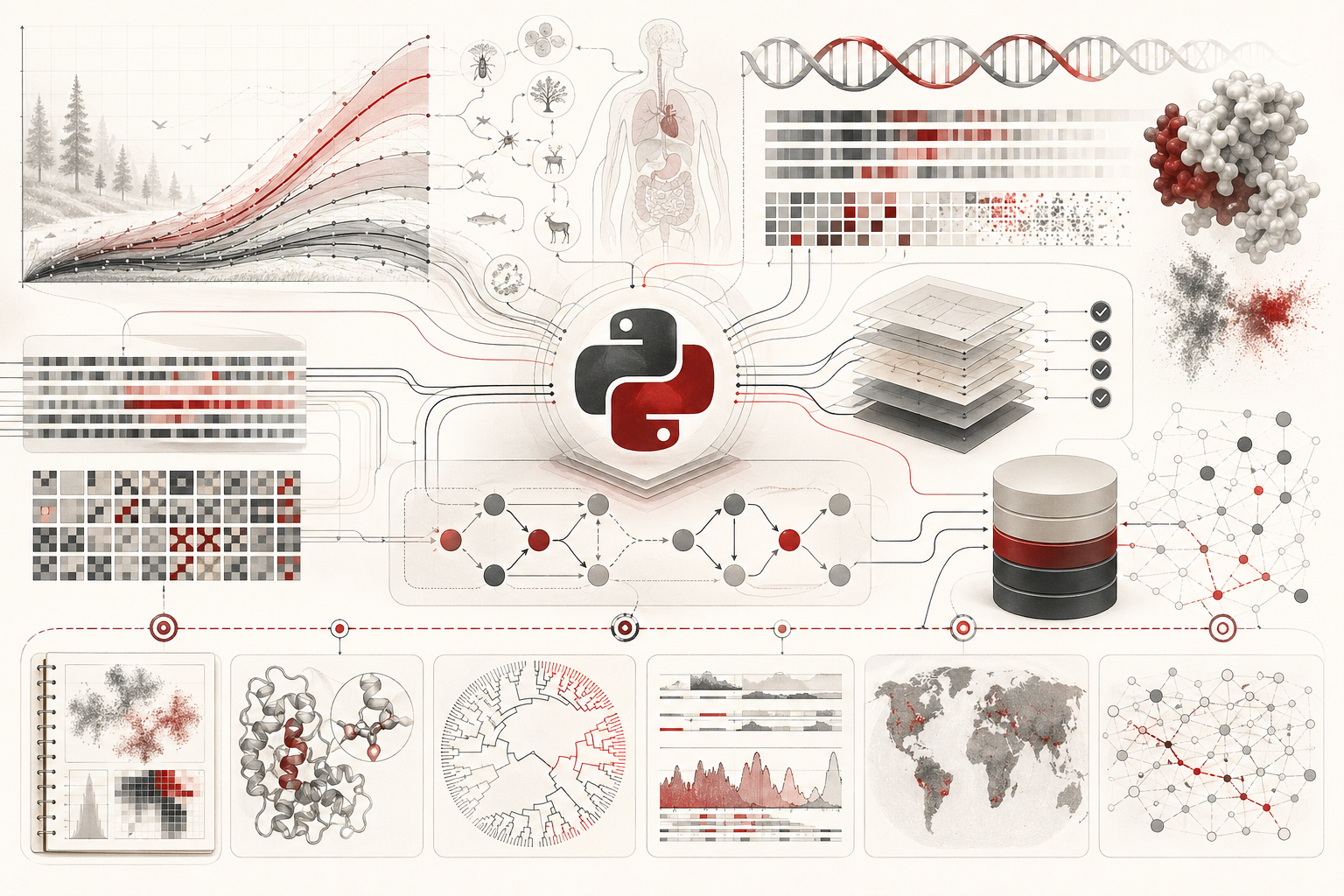
The article is written for biologists, ecologists, marine biologists, biomedical researchers, genomics scientists, laboratory scientists, computational biologists, bioinformaticians, statisticians, biotechnology teams, environmental scientists, data engineers, and scientific software developers. It emphasizes simulation, transparency, reproducibility, metadata, workflow design, validation, uncertainty, and responsible interpretation across biological scales.
The article also extends the discussion into reproducible computational practice through Python-first workflows, NumPy-style array modeling, SciPy-style differential-equation thinking, pandas-style metadata validation, Biopython-style sequence analysis, Matplotlib-style visualization, Jupyter notebooks, Snakemake-inspired workflow design, SQL-backed provenance, cross-language validation helpers, and a linked full-stack GitHub repository containing Python, R, Julia, Fortran, Rust, Go, C, C++, SQL, notebooks, data files, validation notes, and reproducibility documentation.
Why Python matters for life-science computation
Python matters for life-science computation because modern biology increasingly requires more than statistical analysis alone. Researchers must simulate systems, parse files, validate metadata, automate workflows, manage directories, connect tools, inspect sequence data, query databases, transform tables, generate figures, and rerun analyses when new data arrive. Python is useful because it is both a scientific-computing language and a general automation language.
In biological research, this combination is powerful. A simulation model can read parameters from a CSV file, solve a system of equations, generate trajectories, save outputs, validate results, and create figures. A bioinformatics workflow can read FASTA files, summarize sequence length and GC content, count k-mers, connect sample metadata, and produce reproducible tables. A laboratory data pipeline can check required columns, flag missing units, record checksums, and generate a provenance manifest. A notebook can document the reasoning behind exploration while scripts preserve reusable analysis.
Python also integrates well with other scientific languages and tools. It can work alongside R for statistics, Julia for high-performance scientific computing, C and C++ for performance-critical kernels, Fortran for legacy numerical methods, Rust for safe command-line utilities, Go for portable services, SQL for metadata and provenance, and shell workflows for orchestration.
Python is therefore not a replacement for every language in biology. It is a coordinating language: a flexible layer for simulation, automation, bioinformatics, validation, visualization, and reproducible scientific work.
Simulation as biological reasoning
Simulation is a form of biological reasoning. A simulation does not merely produce numbers; it formalizes assumptions about how a biological system changes over time. Population growth, predator-prey dynamics, epidemic spread, gene regulation, physiological compartments, enzyme kinetics, diffusion, cell signaling, ecological restoration, and disease progression can all be studied through simulation when the system’s rules are stated clearly.
Python is especially useful for simulation because it connects mathematical models to code. A researcher can represent state variables as arrays, parameters as dictionaries or tables, time steps as loops, stochastic events as random draws, differential equations as functions, and outputs as structured data. The simulation becomes inspectable: the assumptions are visible in code.
For example, a population model can describe how growth depends on carrying capacity. A physiological model can represent flows among compartments. A gene-regulatory model can represent activation and repression. An ecological model can represent interaction between species. A stochastic model can represent variation among runs. A sensitivity analysis can show which parameters most strongly affect outcomes.
Simulation should not be confused with prediction. A simulation is only as strong as its assumptions, parameters, validation, and biological grounding. Its value lies in making causal structure explicit, exploring scenarios, identifying sensitivities, and testing whether a hypothesized mechanism could plausibly generate observed behavior.
Arrays, DataFrames, and biological structure
Biological data often appear in two major computational forms: arrays and tables. Arrays are useful for numerical simulation, matrices, images, time series, spatial grids, genomic count matrices, and multi-dimensional measurements. Tables are useful for samples, metadata, observations, features, treatments, batches, quality-control flags, and provenance.
Python’s scientific ecosystem is built around this distinction. NumPy-style arrays support numerical computation, vectorized operations, linear algebra, random number generation, and matrix-based modeling. pandas-style DataFrames support tabular data, missing values, grouping, joining, metadata validation, summaries, and file input/output. In life science, both are needed.
A genomic count matrix may be represented as an array for normalization but linked to sample metadata stored as a table. An ecological survey may use a species-by-site matrix alongside a site metadata table. A simulation may produce an array of state trajectories and then convert it into a table for plotting and reporting. A laboratory workflow may store raw measurement values in a table but compute model diagnostics as arrays.
Good Python biology keeps these structures connected. It avoids letting count matrices drift away from sample metadata, simulation outputs drift away from parameter settings, or figures drift away from the scripts that produced them.
Bioinformatics and sequence analysis
Bioinformatics is one of Python’s most important life-science domains. Biological sequence data require parsing, cleaning, summarizing, comparing, translating, aligning, annotating, and connecting to metadata. Python is useful because it can handle both biological strings and scientific data structures.
A basic sequence workflow may read FASTA records, calculate sequence length, compute GC content, count k-mers, detect ambiguous bases, translate coding sequences, summarize samples, and export a table. More advanced workflows may integrate alignment files, variant calls, genome annotations, protein structures, taxonomic labels, or expression matrices.
Biopython is important because it provides biological data structures and tools for computational molecular biology. It supports many common tasks involving sequences, records, alignments, files, and biological databases. Even when a project uses command-line tools for heavy-duty alignment or assembly, Python often remains useful as the glue language for metadata, file handling, validation, reporting, and downstream analysis.
Bioinformatics also requires caution. Sequence files may contain inconsistent identifiers. Metadata may not match sample names. Low-quality reads can distort inference. Contamination can mislead analysis. Reference choice matters. File formats encode assumptions. Python workflows should therefore make validation and provenance central, not optional.
Scientific workflows and pipeline thinking
A scientific workflow is a structured sequence of steps that turns inputs into outputs. In life science, workflows may include data acquisition, quality control, trimming, alignment, counting, normalization, modeling, visualization, reporting, and archiving. The workflow itself is part of the evidence system.
Python supports workflow thinking at multiple levels. A simple project may use a run_all.py script that executes analysis steps in order. A larger project may use workflow managers such as Snakemake, which expresses dependencies among inputs, outputs, rules, environments, and execution targets. A high-throughput project may use cluster or cloud execution. A reproducibility-focused project may use checksums, manifests, containers, environment files, and automated tests.
The important idea is dependency awareness. If an input file changes, which outputs must be regenerated? If a parameter changes, which simulation results are obsolete? If a script changes, which figures should be rebuilt? If a sample fails quality control, which downstream models should update?
Pipeline thinking prevents scientific drift. It keeps data, code, outputs, and interpretation connected.
Jupyter notebooks and reproducible exploration
Jupyter notebooks are valuable because they combine code, narrative text, outputs, equations, and visualizations in one interactive document. They are excellent for exploration, teaching, prototyping, and explaining scientific reasoning. In biology, notebooks can show how a dataset was inspected, how a simulation behaves, how a sequence summary was created, or why a model was chosen.
But notebooks must be used carefully. A notebook can become difficult to reproduce if cells are run out of order, outputs are saved without clear inputs, hidden state accumulates, or exploratory code is mixed with final analysis. For robust projects, notebooks should often be paired with scripts. Scripts define reusable workflows; notebooks explain and explore them.
A good Python life-science project may use scripts for core functions, notebooks for demonstration and interpretation, tests for validation, SQL for provenance, and workflow files for orchestration. This structure allows exploration without losing reproducibility.
Quality control, validation, and provenance
Quality control is essential in Python-based life-science workflows. A script can check whether required columns exist, whether sample identifiers are unique, whether FASTA sequence identifiers match metadata, whether units are present, whether numeric fields parse correctly, whether counts are nonnegative, whether parameter files contain required values, and whether outputs were generated from the expected inputs.
Validation should occur early. It is better for a workflow to fail loudly when metadata are inconsistent than to silently produce misleading results. Python is useful because validation logic can be written directly into reusable functions and scripts.
Provenance records the history of data and computation. It answers: which input file was used, which script ran, which parameters were applied, which output was produced, when the workflow ran, and what assumptions were made? A reproducible Python project may record provenance in CSV files, JSON manifests, SQL tables, logs, checksums, or workflow reports.
In biology, provenance is not administrative overhead. It protects scientific meaning.
Python for ecological and physiological modeling
Python is useful for ecological and physiological modeling because both fields involve dynamic systems. Ecological models may represent populations, species interactions, dispersal, restoration scenarios, habitat change, nutrient cycling, disease transmission, or food-web dynamics. Physiological models may represent compartments, flows, feedback loops, drug kinetics, hormone regulation, metabolism, neural activity, or immune response.
These systems often require simulation. A model may be deterministic or stochastic, continuous or discrete, individual-based or population-level, spatial or nonspatial, mechanistic or empirical. Python can represent each of these through functions, arrays, data frames, random processes, differential-equation solvers, and visualization.
The most useful models are transparent. Parameters should be documented. Units should be clear. Initial conditions should be recorded. Outputs should be saved. Sensitivity should be explored. Biological interpretation should be modest. A simulation that cannot be traced is not a scientific model; it is an opaque calculation.
Python for genomics and high-throughput biology
High-throughput biology produces large, structured datasets: sequencing reads, count matrices, variant tables, protein data, single-cell measurements, imaging features, metabolomics profiles, microbial community tables, and multi-omics metadata. Python is useful because it can automate the file handling, validation, transformation, and reporting required by these workflows.
A genomics workflow may involve sequence files, sample metadata, feature counts, normalization, quality-control metrics, gene annotations, and downstream visualization. Python can parse identifiers, verify file presence, check metadata alignment, compute simple summaries, call external tools, and assemble reports.
Specialized bioinformatics tools remain essential. Python should not replace validated aligners, variant callers, assemblers, or statistical genomics methods when those are required. But Python can make the surrounding workflow reproducible: organizing inputs, tracking parameters, validating outputs, summarizing results, and connecting computational steps.
The high-throughput lesson is simple: large datasets require stronger structure, not less.
Visualization and scientific communication
Visualization is central to Python-based life science because simulation and bioinformatics both generate patterns that must be inspected. A simulation trajectory may reveal stability, collapse, oscillation, or sensitivity. A sequence summary may reveal length variation, GC-content differences, or ambiguous-base problems. A workflow summary may reveal failed samples, missing metadata, or batch structure. A model diagnostic may reveal assumption failure.
Matplotlib and related tools allow figures to be generated from code. This matters because figures should be reproducible. A figure should not be manually reconstructed after analysis. The plot should reflect documented data transformations and be regenerated when inputs change.
Good Python visualization should make biological structure visible without overstating certainty. It should show units, uncertainty, variation, sample structure, and model assumptions where relevant. A simulation plot should identify parameter settings. A sequence plot should identify what was counted. A workflow plot should show provenance or dependencies clearly.
Scientific communication is stronger when plots are connected to code and code is connected to data.
Mathematical lens: simulation, bioinformatics, and workflows
Several mathematical ideas connect Python simulation, bioinformatics, and scientific workflows. These expressions do not replace biological evidence, domain interpretation, experimental validation, or data-quality review. They help clarify how state updates, numerical simulation, stochastic transitions, sequence summaries, workflow dependencies, and reproducibility checks can be represented formally.
Discrete-time simulation
x_{t+1}=f(x_t,\theta)
\]
Interpretation: The system state at the next time step depends on the current state \(x_t\) and model parameters \(\theta\). This form is useful for simulations that update biological state over repeated time steps.
Logistic growth
\frac{dN}{dt}=rN\left(1-\frac{N}{K}\right)
\]
Interpretation: Population size \(N\) changes according to intrinsic growth rate \(r\) and carrying capacity \(K\). Growth slows as the population approaches environmental limits.
Euler approximation
N_{t+\Delta t}=N_t+\Delta t \cdot rN_t\left(1-\frac{N_t}{K}\right)
\]
Interpretation: Euler approximation estimates the next state by adding a small time-step change to the current state. It is simple and transparent, but time-step size must be chosen carefully.
Stochastic transition
X_{t+1}\sim P(X_{t+1}\mid X_t)
\]
Interpretation: Stochastic simulation represents uncertainty by drawing the next state from a conditional probability distribution. This is useful when biological transitions vary across individuals, samples, or runs.
GC content
GC=\frac{G+C}{A+T+G+C}
\]
Interpretation: GC content summarizes the fraction of valid nucleotides that are guanine or cytosine. It can support sequence summaries, quality checks, and comparative analysis.
K-mer count
C(w)=\sum_{i=1}^{L-k+1} I(s_i \ldots s_{i+k-1}=w)
\]
Interpretation: A k-mer count records how often subsequence \(w\) of length \(k\) appears in sequence \(s\). K-mer summaries support sequence comparison, classification, assembly logic, and feature construction.
Workflow as a directed acyclic graph
G=(V,E)
\]
Interpretation: A workflow graph contains nodes \(V\) and dependencies \(E\). Nodes may represent files, tasks, scripts, reports, or validation steps; edges represent what depends on what.
Reproducibility hash
H(f_t)=H(f_{t+1})
\]
Interpretation: If file content remains unchanged across time, its hash remains stable. Hashes help verify whether inputs, outputs, or manifests have changed between workflow runs.
Python workflows
The following examples are compact article-level workflows. The full GitHub repository expands them into richer Python-first implementations with SQL provenance, cross-language validation, simulation outputs, sequence summaries, workflow manifests, and reproducible project documentation.
Python example: logistic growth simulation
import pandas as pd

def simulate_logistic_growth(
    initial_population: float,
    growth_rate: float,
    carrying_capacity: float,
    dt: float,
    steps: int,
) -> pd.DataFrame:
    """Simulate logistic population growth using Euler approximation."""
    population = initial_population
    rows = []

    for step in range(steps + 1):
        time = step * dt
        rows.append({"time": time, "population": population})

        growth = growth_rate * population * (1 - population / carrying_capacity)
        population = max(population + dt * growth, 0.0)

    return pd.DataFrame(rows)

trajectory = simulate_logistic_growth(
    initial_population=25,
    growth_rate=0.35,
    carrying_capacity=1000,
    dt=0.1,
    steps=200,
)

print(trajectory.tail().round(4).to_string(index=False))
Python example: sequence summary from FASTA records
from collections import Counter
import pandas as pd

def parse_fasta_text(fasta_text: str) -> dict[str, str]:
    """Parse a small FASTA-formatted string into a dictionary."""
    records = {}
    current_id = None
    current_sequence = []

    for line in fasta_text.strip().splitlines():
        line = line.strip()

        if line.startswith(">"):
            if current_id is not None:
                records[current_id] = "".join(current_sequence).upper()
            current_id = line[1:].split()[0]
            current_sequence = []
        else:
            current_sequence.append(line)

    if current_id is not None:
        records[current_id] = "".join(current_sequence).upper()

    return records

def gc_content(sequence: str) -> float:
    valid_bases = [base for base in sequence if base in {"A", "C", "G", "T"}]
    if not valid_bases:
        return float("nan")
    counts = Counter(valid_bases)
    return (counts["G"] + counts["C"]) / len(valid_bases)

fasta_text = """
>sample_01
ATGCGCGTAATTAACCGGTT
>sample_02
ATATATGGCCNNATGCGTAA
"""

records = parse_fasta_text(fasta_text)

summary = pd.DataFrame(
    {
        "sequence_id": sequence_id,
        "length": len(sequence),
        "gc_content": gc_content(sequence),
        "ambiguous_bases": sum(base not in {"A", "C", "G", "T"} for base in sequence),
    }
    for sequence_id, sequence in records.items()
)

print(summary.round(4).to_string(index=False))
Python example: k-mer counting
from collections import Counter

def count_kmers(sequence: str, k: int) -> Counter:
    """Count k-mers in a DNA sequence."""
    sequence = sequence.upper()
    valid = {"A", "C", "G", "T"}

    kmers = Counter()

    for i in range(len(sequence) - k + 1):
        kmer = sequence[i:i + k]
        if set(kmer).issubset(valid):
            kmers[kmer] += 1

    return kmers

sequence = "ATGCGCGTAATTAACCGGTT"
kmer_counts = count_kmers(sequence, k=3)

for kmer, count in kmer_counts.most_common(8):
    print(kmer, count)
Python example: metadata validation
import pandas as pd

metadata = pd.DataFrame(
    {
        "sample_id": ["sample_01", "sample_02", "sample_03"],
        "organism": ["model_species", "model_species", "model_species"],
        "condition": ["control", "treated", "treated"],
        "sequence_file": ["sample_01.fasta", "sample_02.fasta", "sample_03.fasta"],
        "qc_flag": ["pass", "pass", "review"],
    }
)

required_columns = {"sample_id", "organism", "condition", "sequence_file", "qc_flag"}
valid_qc_flags = {"pass", "review", "fail"}

missing_columns = sorted(required_columns - set(metadata.columns))
invalid_qc_flags = sorted(set(metadata["qc_flag"]) - valid_qc_flags)

validation_report = pd.DataFrame(
    {
        "check": ["required_columns", "unique_sample_ids", "valid_qc_flags"],
        "passed": [
            len(missing_columns) == 0,
            metadata["sample_id"].is_unique,
            len(invalid_qc_flags) == 0,
        ],
        "details": [
            "none" if not missing_columns else ", ".join(missing_columns),
            "unique" if metadata["sample_id"].is_unique else "duplicates detected",
            "none" if not invalid_qc_flags else ", ".join(invalid_qc_flags),
        ],
    }
)

print(validation_report.to_string(index=False))
Python example: workflow provenance manifest
import hashlib
import pandas as pd

def sha256_text(content: str) -> str:
    """Create a stable hash for text content."""
    return hashlib.sha256(content.encode("utf-8")).hexdigest()

artifacts = pd.DataFrame(
    {
        "artifact": ["parameters.csv", "sequences.fasta", "simulation_output.csv", "sequence_summary.csv"],
        "role": ["input", "input", "output", "output"],
        "content_preview": [
            "growth_rate,carrying_capacity",
            "ATGCGCGTAATTAACCGGTT",
            "time,population",
            "sequence_id,length,gc_content",
        ],
    }
)

artifacts["sha256"] = artifacts["content_preview"].apply(sha256_text)

workflow_steps = pd.DataFrame(
    {
        "step": [1, 2],
        "operation": ["simulate_logistic_growth", "summarize_sequences"],
        "input_artifact": ["parameters.csv", "sequences.fasta"],
        "output_artifact": ["simulation_output.csv", "sequence_summary.csv"],
    }
)

print(artifacts[["artifact", "role", "sha256"]].to_string(index=False))
print(workflow_steps.to_string(index=False))GitHub repository
The article body includes compact Python examples so the scientific argument remains readable. The full repository expands those examples into a rigorous Python-first workflow for biological simulation, bioinformatics, and scientific workflow engineering, including logistic-growth simulation, stochastic simulation scaffolds, FASTA parsing, GC-content analysis, k-mer counting, sequence metadata validation, workflow manifests, checksum provenance, SQL audit structures, notebook documentation, cross-language validation helpers, and full-stack scientific-computing examples across Python, R, Julia, Fortran, Rust, Go, C, C++, SQL, and notebooks.
Limits, responsible use, and common pitfalls
Python is powerful, but it does not make a biological workflow valid by itself. A simulation can be reproducible and still biologically wrong. A sequence summary can be correctly computed but based on contaminated data. A pipeline can run successfully while silently using mismatched metadata. A notebook can look clear while depending on hidden execution order. Scientific code must therefore be validated against biological knowledge, data quality, and study design.
Common pitfalls include undocumented parameters, hard-coded file paths, unvalidated sample identifiers, missing units, unclear random seeds, silent overwriting of outputs, untracked manual edits, notebooks run out of order, external tools called without version records, sequence identifiers that do not match metadata, and simulations interpreted beyond their assumptions.
Another pitfall is confusing automation with reproducibility. Automation means the computer can run the steps. Reproducibility means the workflow is documented, inspectable, rerunnable, and tied to inputs, outputs, parameters, code, environment, and provenance.
Responsible Python-based biology requires modular code, validation checks, documented assumptions, versioned data, clear outputs, interpretable models, and scientific humility.
Why Python-based life-science workflows matter
Python-based life-science workflows matter because biological research increasingly depends on computational continuity. Data move from instruments to files, from files to scripts, from scripts to tables, from tables to models, from models to figures, and from figures to claims. If that chain is broken, scientific evidence becomes fragile.
Python helps preserve the chain. It can automate routine steps, formalize simulations, validate metadata, parse biological files, generate outputs, record provenance, and connect analysis to visualization. It also helps teams work across domains: a bioinformatician can build sequence workflows, an ecologist can simulate populations, a biomedical researcher can validate assay files, and a data engineer can structure pipelines.
The deeper value of Python is not convenience. It is traceability. Python allows biological work to become more explicit, testable, reusable, and auditable.
Conclusion
Python for simulation, bioinformatics, and scientific workflows provides a flexible computational foundation for modern life science. It supports dynamic modeling, sequence analysis, metadata validation, data transformation, workflow orchestration, visualization, provenance, and reproducible reporting.
Simulation uses Python to make biological assumptions explicit. Bioinformatics uses Python to parse, summarize, and validate molecular data. Scientific workflows use Python to connect inputs, scripts, outputs, parameters, and documentation. Together, these capabilities help biological research move from isolated calculations toward transparent evidence systems.
Used responsibly, Python does not merely process biological data. It strengthens the computational architecture that makes biological knowledge inspectable, reproducible, and scientifically trustworthy.
Related articles
- Biology
- Python for Biological Modeling and Automation
- R for Biological Data Analysis and Visualization
- R for Biostatistics, Ecology, and Genomics
- Data, Measurement, and Reproducibility in the Life Sciences
- Mathematical Biology and the Logic of Living Systems
- Differential Equations in Population and Physiological Modeling
- Networks, Systems, and Biological Complexity
- Probability, Variation, and Biological Inference
- Statistics, Uncertainty, and Measurement in Biology
- Genomics and the Expansion of Biological Knowledge
- Observation, Experiment, and the Methods of Biological Inquiry
Further reading
- Python Software Foundation (n.d.) Python Documentation. Available at: https://docs.python.org/3/
- NumPy Developers (n.d.) NumPy. Available at: https://numpy.org/
- SciPy Developers (2026) SciPy. Available at: https://scipy.org/
- pandas Development Team (n.d.) pandas: Python Data Analysis Library. Available at: https://pandas.pydata.org/
- Matplotlib Development Team (n.d.) Matplotlib: Visualization with Python. Available at: https://matplotlib.org/
- Biopython Project (n.d.) Biopython. Available at: https://biopython.org/
- Cock, P.J.A. et al. (2009) ‘Biopython: freely available Python tools for computational molecular biology and bioinformatics’, Bioinformatics, 25(11), pp. 1422–1423. Available at: https://pmc.ncbi.nlm.nih.gov/articles/PMC2682512/
- Project Jupyter (n.d.) Project Jupyter. Available at: https://jupyter.org/
- Snakemake (2026) Snakemake Documentation. Available at: https://snakemake.readthedocs.io/
- scikit-learn Developers (n.d.) scikit-learn: Machine Learning in Python. Available at: https://scikit-learn.org/
References
- Biopython Project (n.d.) Biopython. Available at: https://biopython.org/
- Cock, P.J.A. et al. (2009) ‘Biopython: freely available Python tools for computational molecular biology and bioinformatics’, Bioinformatics, 25(11), pp. 1422–1423. Available at: https://pmc.ncbi.nlm.nih.gov/articles/PMC2682512/
- Matplotlib Development Team (n.d.) Matplotlib: Visualization with Python. Available at: https://matplotlib.org/
- NumPy Developers (n.d.) NumPy. Available at: https://numpy.org/
- pandas Development Team (n.d.) pandas: Python Data Analysis Library. Available at: https://pandas.pydata.org/
- Project Jupyter (n.d.) Project Jupyter. Available at: https://jupyter.org/
- Python Software Foundation (n.d.) Python Documentation. Available at: https://docs.python.org/3/
- SciPy Developers (2026) SciPy. Available at: https://scipy.org/
- scikit-learn Developers (n.d.) scikit-learn: Machine Learning in Python. Available at: https://scikit-learn.org/
- Snakemake (2026) Snakemake Documentation. Available at: https://snakemake.readthedocs.io/