
Last Updated May 28, 2026
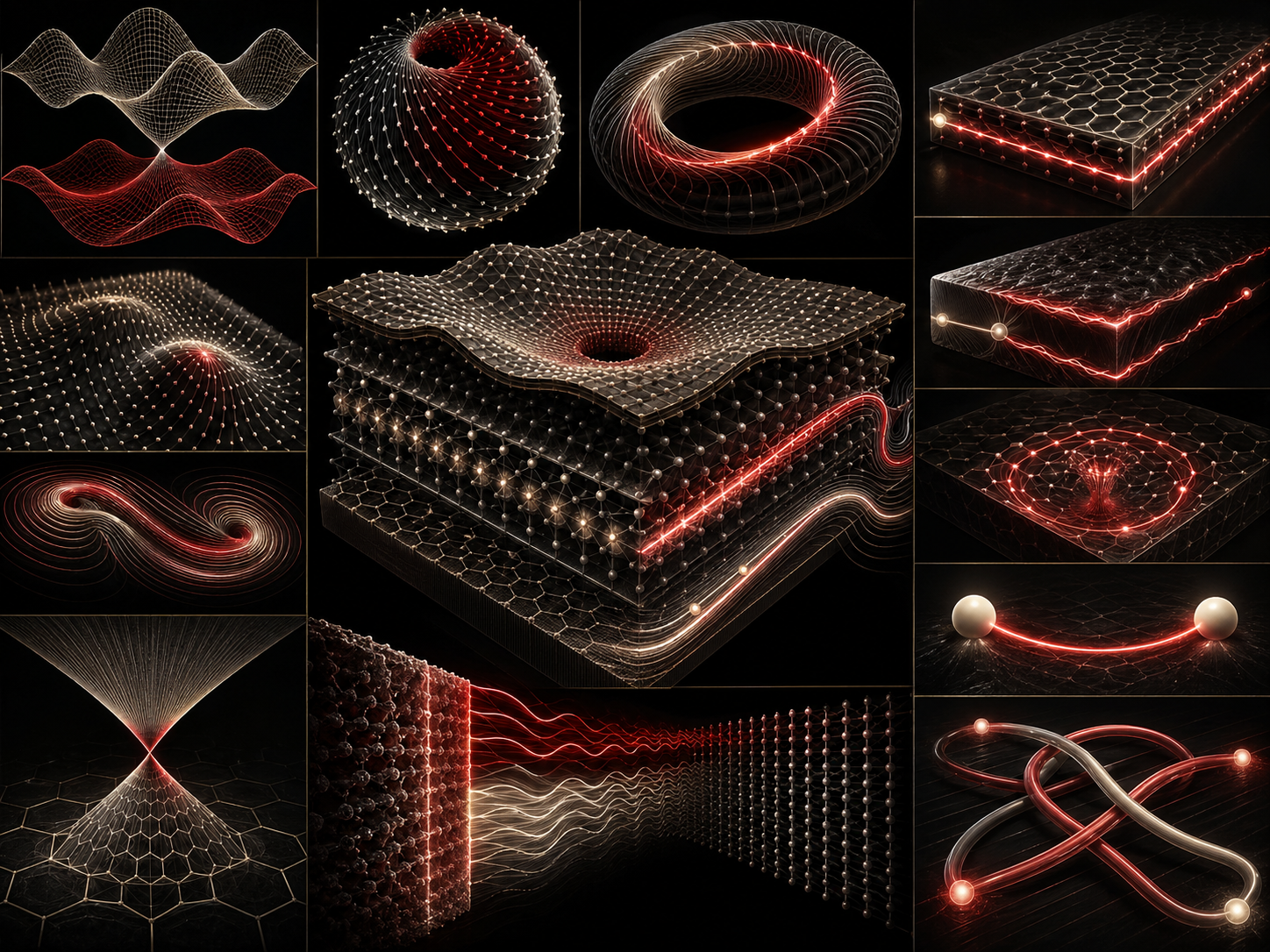
Topological matter and quantum phases show that matter can be classified not only by symmetry, order parameters, and local microscopic structure, but also by global properties of quantum states that remain stable under continuous deformation. A topological phase may look locally ordinary: it can have an energy gap, no conventional broken symmetry, and no obvious local order parameter. Yet its wavefunctions may carry topological invariants that force robust boundary states, quantized response, protected degeneracies, fractional excitations, anomalous surface modes, or nonlocal entanglement structure.
This is one of the major conceptual shifts in modern condensed matter physics. The Landau paradigm explains many phases through symmetry breaking: crystals break translation symmetry, magnets break spin-rotation symmetry, and superconductors break a \(U(1)\) phase symmetry. Topological phases require a broader language. Their defining features often lie in Berry phase, Berry curvature, Chern number, winding number, \(Z_2\) index, anyonic statistics, ground-state degeneracy, entanglement, and the relation between bulk topology and boundary physics.
This article develops Topological Matter and Quantum Phases as a research-grade article within the Physics knowledge series. It explains topology in physics, adiabatic deformation, energy gaps, Berry phase, Berry curvature, Chern numbers, quantum Hall effects, fractional quantum Hall fluids, anyons, topological insulators, topological superconductors, Majorana modes, symmetry-protected topological phases, intrinsic topological order, bulk-boundary correspondence, edge and surface states, topological phase transitions, band topology, interacting topology, disorder, entanglement, experimental signatures, and computational topology workflows. Selected R and Python examples appear in the article body, while the companion GitHub repository contains expanded computational resources for SSH winding numbers, two-band Chern models, Berry curvature, Wilson loops, edge-state toy models, \(Z_2\) metadata, quantum Hall response, topological superconducting chains, SQL provenance tables, C/C++/Fortran/Rust examples, and reproducible topological-matter workflows.
Main Library
Publications
Article Map
Physics
Related Topic
Mathematics
Related Topic
Data Systems & Analytics
Related Topic
Astronomy
Why Topological Matter Matters
Topological matter matters because it expands the classification of phases beyond local order. In many familiar phases, one identifies order by measuring a local quantity: magnetization, density modulation, crystalline periodicity, superconducting amplitude, or nematic orientation. Topological phases may not reveal themselves through any simple local order parameter. Instead, they are defined by global features of quantum states, such as winding, curvature, protected boundary modes, quantized response, and long-range entanglement.
This shift has both conceptual and practical importance. Conceptually, topology shows that quantum phases can be robust because their defining properties are discrete. A Chern number cannot change by an infinitesimal perturbation. It changes only when the system passes through a singular event, usually a closing and reopening of an energy gap. Practically, this robustness motivates research into low-dissipation edge transport, fault-tolerant quantum information, Majorana platforms, spintronics, topological photonics, metamaterials, and quantum materials.
Topological matter also changes what counts as explanation. In ordinary band theory, one may ask whether a material is metallic or insulating based on whether bands cross the Fermi level. In topological band theory, one also asks how the occupied states twist over the Brillouin zone. In ordinary many-body theory, one may ask what local order parameter distinguishes one phase from another. In topological many-body theory, one also asks whether the ground state contains nonlocal entanglement, anyonic excitations, or topological degeneracy.
For the Physics knowledge series, this article belongs near Many-Body Physics and Emergent Collective Behavior, Phase Transitions, Critical Phenomena, and the Renormalization Group, Group Theory and Representation Theory in Physics, Quantum Field Theory I: Fields, Particles, and Second Quantization, Superconductivity, Superfluidity, and Macroscopic Quantum Order, Semiconductor Physics and Electronic Materials, and Computational Physics and Scientific Simulation. It provides the bridge from local Hamiltonians to global quantum structure.
From Symmetry Breaking to Topology
The Landau theory of phases explains phase transitions through symmetry and order parameters. A ferromagnet has a magnetization direction. A crystal has broken continuous translation symmetry. A superconductor has a complex order parameter with a coherent phase. This framework remains one of the most powerful ideas in physics.
Topological phases do not replace the Landau paradigm; they extend it. Some topological phases also involve symmetry. Others do not. Some are protected by time-reversal, particle-hole, chiral, crystalline, or internal symmetries. Others are intrinsically topologically ordered even without symmetry protection. The key point is that topology can classify phases that are locally indistinguishable by ordinary symmetry-breaking order parameters.
Two gapped quantum systems can be in the same phase if one Hamiltonian can be continuously deformed into the other without closing the energy gap and without breaking required symmetries. If such a deformation is impossible, the systems may belong to distinct topological phases.
This gives a new kind of phase distinction: not “which symmetry is broken?” but “can one quantum ground state be continuously transformed into another while preserving the gap and symmetries?” The answer may depend on topology rather than local order.
This distinction is crucial for modern condensed matter physics. It explains why two materials can both be bulk insulators but behave differently at their boundaries. It explains why response coefficients can be quantized. It explains why a phase can be stable against disorder yet fragile under symmetry breaking. It also explains why some phases are better understood through geometry and entanglement than through ordinary order parameters.
What Topology Means in Physics
Topology studies properties that remain unchanged under continuous deformation. A circle can be stretched into an ellipse without changing its topology. A sphere cannot be continuously deformed into a torus without cutting or gluing. In physics, the objects being classified are often not ordinary shapes in real space, but wavefunctions, mappings, parameter spaces, Hamiltonians, vector bundles, and many-body ground states.
For band structures, topology often appears as a map from momentum space to a space of quantum states. In a crystal, momentum values live in the Brillouin zone. For a two-dimensional crystal, the Brillouin zone has the topology of a torus. If the occupied quantum states twist nontrivially over this torus, the band structure may carry a nonzero Chern number or another topological invariant.
Topological invariants are discrete. A winding number is an integer. A Chern number is an integer. A \(Z_2\) invariant is binary. These quantities cannot vary smoothly under small perturbations. Their stability explains why topological phases can exhibit robust physical behavior even in the presence of disorder or microscopic imperfections.
The word “global” is important. A topological invariant usually cannot be read from a single point in space or momentum. It depends on how quantum states are arranged over an entire space of parameters. This is why topology often appears through integrals, winding numbers, holonomies, boundary modes, and response coefficients. The local details matter, but the phase is classified by a global structure.
Energy Gaps and Adiabatic Continuity
The energy gap is central to topological classification. A gapped system has a finite separation between the ground state and the lowest excitation, or between occupied and unoccupied bands in a band insulator. This gap allows the occupied-state structure to be defined robustly.
If a Hamiltonian \(H(\lambda)\) depends continuously on a parameter \(\lambda\), and the energy gap remains open for all \(\lambda\), then many topological invariants remain unchanged. A topological phase transition usually requires the gap to close:
\Delta E \rightarrow 0
\]
Interpretation: A topological invariant can change when the protecting gap closes.
and then reopen with a different topological invariant. This is why band inversions, Dirac points, Weyl points, and critical gap closings often appear at transitions between ordinary and topological phases.
Adiabatic continuity provides a practical definition of phase equivalence. If two systems can be connected without closing the gap, they are topologically equivalent under the relevant symmetry constraints. If they cannot, they may represent distinct quantum phases.
This gap-centered view also explains why topology is often robust but not indestructible. Weak perturbations may deform wavefunctions without changing the invariant. Strong disorder, strong interactions, symmetry breaking, or parameter tuning may close the gap or destroy the assumptions that protect the phase. Topological protection is therefore conditional, not absolute.
Band Topology and Bloch Bundles
In a crystalline solid, electron states are described by Bloch theory. A Bloch state can be written as a plane-wave factor times a cell-periodic state:
\psi_{n\mathbf{k}}(\mathbf{r})
=
e^{i\mathbf{k}\cdot\mathbf{r}}
u_{n\mathbf{k}}(\mathbf{r})
\]
Interpretation: Bloch states separate lattice-periodic structure from crystal momentum dependence.
The band index \(n\) labels the energy band, and \(\mathbf{k}\) labels crystal momentum in the Brillouin zone. Band topology asks how the cell-periodic states \(|u_{n\mathbf{k}}\rangle\) vary as \(\mathbf{k}\) moves across the Brillouin zone.
For a single isolated band, one can imagine a quantum state attached to each point in momentum space. For multiple occupied bands, one studies the occupied subspace at each \(\mathbf{k}\). Together these states form a geometric object over the Brillouin zone. Its topology can be nontrivial, even if the energy spectrum is fully gapped.
This is the geometric heart of topological band theory. The material’s topology is not merely in its real-space atomic arrangement, but in the way its quantum states are organized over momentum space. Berry connection, Berry curvature, Chern number, Wilson loops, and \(Z_2\) indices are tools for describing that organization.
Band topology is especially powerful because it connects directly to measurable response. A Chern number can determine Hall conductance. A nontrivial \(Z_2\) index can imply protected helical edge or surface states. A Weyl node can act as a source or sink of Berry curvature. Topological classification therefore turns abstract geometry into experimentally visible transport and spectroscopy.
Berry Phase and Berry Curvature
Berry phase appears when a quantum state evolves adiabatically around a closed loop in parameter space. If \(|u_n(\mathbf{R})\rangle\) is an eigenstate depending on parameters \(\mathbf{R}\), the Berry connection is:
\mathbf{A}_n(\mathbf{R})
=
i\langle u_n(\mathbf{R})|\nabla_{\mathbf{R}}u_n(\mathbf{R})\rangle
\]
Interpretation: Berry connection acts like a gauge potential in parameter space.
The Berry phase around a closed loop \(C\) is:
\gamma_n
=
\oint_C
\mathbf{A}_n\cdot d\mathbf{R}
\]
Interpretation: Berry phase is the geometric phase accumulated around a closed parameter-space loop.
The Berry curvature is the curl of the Berry connection:
\mathbf{\Omega}_n
=
\nabla_{\mathbf{R}}\times\mathbf{A}_n
\]
Interpretation: Berry curvature is the geometric field strength associated with the Berry connection.
Berry curvature acts like a magnetic field in parameter space. In crystalline band theory, the relevant parameter space is often momentum space. Berry curvature then influences anomalous velocity, Hall response, orbital magnetization, polarization, and topological invariants.
Berry phase is one of the central mathematical bridges between quantum mechanics and topology. It shows that a quantum state can accumulate geometric information not captured by ordinary dynamical phase alone.
Gauge structure is essential here. The phase convention of a quantum eigenstate can be changed without changing physical observables. Berry connection depends on that convention, but Berry phase around closed loops and integrals of Berry curvature can be gauge-invariant under appropriate conditions. This is why topology appears naturally with gauge language: the physical information lies not in a single local phase choice, but in the global consistency of quantum states over parameter space.
Chern Numbers and Quantized Response
For a two-dimensional band, the Chern number is obtained by integrating Berry curvature over the Brillouin zone:
C_n
=
\frac{1}{2\pi}
\int_{\mathrm{BZ}}
\Omega_n(\mathbf{k})\,d^2k
\]
Interpretation: A Chern number counts the total Berry curvature over the Brillouin zone.
For occupied bands, the total Chern number is:
C
=
\sum_{n\in \mathrm{occ}} C_n
\]
Interpretation: The total occupied-band Chern number controls quantized response.
The Chern number is an integer. In the integer quantum Hall effect, it determines the Hall conductance:
\sigma_{xy}
=
C\frac{e^2}{h}
\]
Interpretation: Hall conductance is quantized by the Chern number.
This relationship is profound because it connects a transport coefficient measured in the laboratory to a topological invariant of quantum states. The quantization is not a microscopic accident. It is a consequence of topology, gauge structure, and the energy gap.
Chern numbers are among the clearest examples of topology producing measurable physics. They explain why Hall conductance plateaus can be extraordinarily precise and robust against disorder.
They also illustrate a larger principle: topological invariants are not merely labels. They control response. In different systems, related invariants can control charge transport, spin response, thermal Hall conductance, magnetoelectric coupling, polarization, edge-state count, or protected degeneracy. Topology becomes physics when the invariant constrains what the system can do.
Integer Quantum Hall Effect
The integer quantum Hall effect occurs in a two-dimensional electron system at low temperature and strong magnetic field. Instead of varying smoothly, the Hall conductance forms plateaus:
\sigma_{xy}
=
\nu\frac{e^2}{h}
\]
Interpretation: Integer quantum Hall conductance is quantized in units of \(e^2/h\).
where \(\nu\) is an integer in the simplest integer quantum Hall case. The longitudinal resistance vanishes on plateaus while Hall resistance is quantized.
Topologically, the integer quantum Hall effect is described by filled bands or Landau levels carrying nonzero Chern number. Disorder localizes many bulk states, while extended states mediate plateau transitions. Chiral edge states carry current along the boundary.
The integer quantum Hall effect is historically central because it showed that a macroscopic electronic transport measurement could be quantized with extraordinary precision and explained by topology. It helped establish the idea that quantum phases can be classified by invariants beyond symmetry breaking.
The effect also changed the meaning of measurement standards. Quantized Hall resistance is so precise because the relevant value is tied to fundamental constants and topology, not to microscopic sample details. In this sense, topological matter reveals a rare form of material universality: imperfect samples can display exact quantization because the response is protected by a global invariant.
Fractional Quantum Hall Effect
The fractional quantum Hall effect is an interacting topological quantum fluid. It occurs when electrons in a strong magnetic field form correlated many-body states with fractionally quantized Hall conductance:
\sigma_{xy}
=
\nu\frac{e^2}{h}
\]
Interpretation: Fractional quantum Hall conductance can occur at fractional filling factors.
where \(\nu\) can be fractional. The fractional effect cannot be understood as merely filling noninteracting bands. It depends essentially on electron-electron interactions.
Fractional quantum Hall states support fractionally charged excitations and anyonic statistics. Their ground states can exhibit topological degeneracy on manifolds with nontrivial topology. Their edge theories are often described by chiral conformal field theory or effective Chern–Simons theory.
This makes the fractional quantum Hall effect a prototype of intrinsic topological order: a phase not defined by local symmetry breaking, but by long-range entanglement, fractionalization, and topological response.
The fractional quantum Hall effect also shows why topology and interactions cannot be separated in modern many-body physics. Noninteracting band topology explains many phases, but fractional quantum Hall fluids require collective quantum organization. The phase is not a property of individual electrons; it is a property of the many-body wavefunction.
Bulk-Boundary Correspondence
Bulk-boundary correspondence states that a nontrivial topological invariant in the bulk forces protected boundary phenomena. A two-dimensional Chern insulator has chiral edge states. A three-dimensional topological insulator has protected surface states. A topological superconductor may support Majorana boundary modes or vortex-bound states.
The boundary is not an accidental surface imperfection. It is required because a topological material must connect to a topologically different environment, such as vacuum. Somewhere between the topological bulk and the trivial exterior, the gap must effectively close or boundary modes must appear.
This principle explains why topological materials are often experimentally identified through transport, spectroscopy, scanning probes, or surface-sensitive measurements. The bulk invariant is abstract, but the boundary can carry observable states.
Bulk-boundary correspondence is also conceptually important because it connects two views of the same phase. The bulk view emphasizes invariants and wavefunction geometry. The boundary view emphasizes robust channels, edge modes, surface Dirac cones, Majorana end states, Fermi arcs, or thermal edge transport. The boundary is the observable consequence of the bulk’s global quantum structure.
Still, boundary signatures must be interpreted carefully. Real surfaces may reconstruct, oxidize, disorder, couple to trivial bands, or host unrelated surface states. Strong evidence for topology usually requires agreement among bulk theory, surface or edge measurements, transport signatures, symmetry constraints, and material-specific modeling.
Topological Insulators
A topological insulator is insulating in the bulk but supports conducting states at its edge or surface. Unlike an ordinary metal surface, these boundary states are protected by the topology of the bulk band structure and relevant symmetries.
In a two-dimensional quantum spin Hall insulator, counterpropagating edge states carry opposite spin structure under time-reversal symmetry. In a three-dimensional topological insulator, the surface may host spin-momentum-locked Dirac-like states. Backscattering can be suppressed when time-reversal symmetry is preserved and certain scattering channels are forbidden.
Topological insulators often arise through spin-orbit coupling and band inversion. A band inversion means that bands with different orbital or parity character exchange order relative to an ordinary insulator. If the resulting gap carries nontrivial topology, protected boundary states may appear.
These materials demonstrate how topology can be hidden in the bulk and exposed at the surface. The bulk may appear electrically inert, but the boundary can carry robust transport. This unusual combination makes topological insulators important for condensed matter physics, spintronics, proximity-induced superconductivity, and platforms for more exotic topological phases.
Topological insulators also require care in experimental interpretation. A conducting surface is not automatically topological. The key question is whether the surface states are required by the bulk invariant and protected by the relevant symmetry, rather than arising from trivial band bending, surface chemistry, disorder, or ordinary metallic states.
\(Z_2\) Topology and Time-Reversal Symmetry
Time-reversal-invariant topological insulators are not classified by an ordinary Chern number, because time-reversal symmetry forces the net Chern number to vanish in many cases. Instead, they are classified by a \(Z_2\) invariant:
\nu \in \{0,1\}
\]
Interpretation: A \(Z_2\) invariant gives a binary classification of trivial and nontrivial phases.
The value \(\nu=0\) corresponds to a topologically trivial phase, while \(\nu=1\) corresponds to a nontrivial time-reversal-protected topological insulator. This binary invariant distinguishes ordinary insulators from quantum spin Hall or three-dimensional topological insulator phases.
The \(Z_2\) classification shows that topology does not always require broken time-reversal symmetry or magnetic fields. Spin-orbit coupling and time-reversal symmetry can produce protected boundary states even when the total Hall conductance is zero.
The physics is tied to Kramers structure. In time-reversal-invariant systems with half-integer spin, states come in Kramers pairs. Protected helical edge or surface states can avoid certain backscattering processes as long as time-reversal symmetry remains intact. Breaking that symmetry can gap the boundary or alter the protection.
This makes \(Z_2\) topology a clear example of symmetry-protected topology. The phase is not defined by a broken symmetry, but it is protected by an unbroken symmetry. The distinction is subtle and central: symmetry is not the order parameter, but it is part of the topological classification.
Topological Superconductors and Majorana Modes
Topological superconductors combine superconducting pairing with nontrivial topology. Because superconductors are described in particle-hole redundant Bogoliubov–de Gennes form, their quasiparticle excitations can support unusual boundary states.
One-dimensional topological superconductors can host Majorana zero modes at their ends. A simplified Majorana operator satisfies:
\gamma^\dagger=\gamma
\]
Interpretation: A Majorana quasiparticle operator is self-adjoint.
meaning the excitation is its own antiparticle in the quasiparticle sense. Majorana zero modes are of interest because spatially separated modes can encode nonlocal quantum information, and their exchange statistics may support topological quantum computation in suitable platforms.
Topological superconductivity is studied in engineered nanowires, proximitized topological insulators, superconducting vortices, iron-based materials, unconventional superconductors, and other hybrid systems. It remains an active research frontier because experimental signatures can be subtle and alternative explanations must be carefully excluded.
The major conceptual point is nonlocality. Two separated Majorana modes can form a fermionic degree of freedom whose information is not localized at either endpoint alone. That nonlocal encoding is what makes Majorana platforms attractive for fault-tolerant quantum information. It is also what makes experimental verification demanding: a zero-bias feature alone is not enough to establish topological Majorana physics without ruling out disorder, Andreev bound states, smooth confinement, and other trivial mechanisms.
Symmetry-Protected Topological Phases
Symmetry-protected topological phases are short-range entangled phases that are nontrivial only when certain symmetries are preserved. If the protecting symmetry is broken, the phase may be continuously connected to a trivial state.
Examples include topological insulators protected by time-reversal symmetry, certain topological crystalline insulators protected by spatial symmetries, and one-dimensional spin chains protected by combinations of internal and spatial symmetry.
The key point is that topology and symmetry can cooperate. The phase is not defined by broken symmetry, but by a topological obstruction that exists only under symmetry constraints. This creates a middle category between ordinary symmetry-breaking phases and intrinsic topological order.
Symmetry-protected phases also clarify the difference between stable and fragile features. A protected edge mode may be robust against perturbations that preserve the protecting symmetry, but vulnerable to perturbations that break it. A topological crystalline phase may depend on mirror, rotational, or translational symmetry. Disorder that preserves a symmetry statistically may behave differently from disorder that destroys it locally. The protection has rules, and those rules must be specified.
For computational classification, this means that a topological invariant is never just a number. It belongs to a symmetry class, dimensionality, interaction regime, and boundary condition. The same Hamiltonian may be topological under one set of allowed deformations and trivial under another.
Intrinsic Topological Order
Intrinsic topological order is deeper than symmetry protection. It does not depend on preserving a particular symmetry. Instead, it is characterized by long-range entanglement, fractionalized excitations, topological ground-state degeneracy, and emergent gauge structure.
The fractional quantum Hall effect is the canonical example. Other examples include certain quantum spin liquids, toric-code-like phases, and lattice gauge theories. These phases cannot be transformed into trivial product states by local unitary transformations without closing the gap.
Intrinsic topological order forces physics to take entanglement seriously as a phase-defining property. The phase is not simply “what pattern is visible?” but “what kind of nonlocal quantum information structure does the ground state contain?”
This kind of order also changes the meaning of excitation. In ordinary phases, excitations may be quasiparticles above a locally ordered background. In intrinsically topological phases, excitations can carry fractional charge, anyonic statistics, or nontrivial fusion rules. The excitation content is part of the phase’s identity.
Intrinsic topological order is therefore a bridge between condensed matter, quantum information, and field theory. It connects many-body wavefunctions to error-correcting codes, emergent gauge fields, modular tensor categories, Chern–Simons theory, and the algebra of anyonic excitations.
Anyons and Fractional Statistics
In three spatial dimensions, indistinguishable particles are classified as bosons or fermions. In two dimensions, richer exchange statistics are possible. Anyons acquire a phase under exchange that can be neither \(0\) nor \(\pi\):
\psi \rightarrow e^{i\theta}\psi
\]
Interpretation: Anyonic exchange can multiply the wavefunction by a fractional statistical phase.
More exotic non-Abelian anyons transform states within a degenerate Hilbert space when particles are braided. The order of exchanges matters. This makes non-Abelian anyons important for proposals in topological quantum computation.
Anyons are not speculative decoration. Fractional quantum Hall systems provide strong evidence for fractionalized quasiparticles, and active experiments seek clearer control of Abelian and non-Abelian anyonic behavior.
Anyonic statistics are topological because they depend on braiding rather than ordinary local trajectories. If one quasiparticle winds around another, the quantum state can change in a way determined by the topology of the path. This makes anyons fundamentally different from ordinary quasiparticles in three-dimensional systems.
In topological quantum computation, the hope is to store and manipulate information in such nonlocal braiding operations. Because the result depends on topology rather than microscopic path details, the computation may be protected from certain local errors. Real platforms, however, must still contend with finite temperature, quasiparticle poisoning, disorder, measurement error, and imperfect control.
Topological Phase Transitions
A topological phase transition changes a topological invariant. Unlike a conventional Landau transition, it may occur without a local order parameter becoming nonzero. In band systems, a common mechanism is gap closing and reopening.
For a two-band Hamiltonian:
H(\mathbf{k})=\mathbf{d}(\mathbf{k})\cdot\boldsymbol{\sigma}
\]
Interpretation: A two-band Hamiltonian can be represented by a vector coupling to Pauli matrices.
the energy spectrum is:
E_\pm(\mathbf{k})=\pm|\mathbf{d}(\mathbf{k})|
\]
Interpretation: The two energy bands are separated by the magnitude of the \(d\)-vector.
The gap closes when:
|\mathbf{d}(\mathbf{k})|=0
\]
Interpretation: A band gap closes when the \(d\)-vector vanishes.
At such a point, the mapping from momentum space to the Bloch sphere can change its topological degree. The system then reopens with a different invariant.
Topological transitions are therefore singular reorganizations of quantum-state geometry. They are not necessarily marked by a conventional symmetry-breaking order parameter, but they are physically sharp because the gap closes.
In interacting systems, the story can be more complicated. A transition may involve many-body gap closing, topological order changing, symmetry fractionalization changing, edge reconstruction, or emergent critical fields. Disorder can smear some spectral features while preserving topological distinctions. The unifying idea remains that a topological invariant cannot change under smooth, symmetry-preserving, gapped deformation.
Disorder and Topological Protection
Topological phases are often robust to weak disorder, but this statement must be precise. Topological protection does not mean immunity to all perturbations. It means that certain features cannot be removed unless the protecting conditions fail: the bulk gap closes, the protecting symmetry is broken, or interactions/disorder drive the system into another phase.
In quantum Hall systems, disorder is essential to plateau formation because it localizes bulk states between extended critical states. In topological insulators, nonmagnetic disorder may preserve time-reversal-protected surface transport, while magnetic disorder can gap or localize boundary states. In topological superconductors, disorder can protect, destroy, or complicate Majorana signatures depending on symmetry class and platform.
Robustness is therefore conditional. Topological language clarifies what is stable, under which perturbations, and why.
Disorder also forces a more careful definition of topology. In perfectly periodic systems, one often works in momentum space. With disorder, crystal momentum may no longer be a good quantum number. Topological invariants may then be defined through twisted boundary conditions, real-space Chern markers, scattering matrices, noncommutative geometry, or transport response. The topological phase can survive even when the clean band picture breaks down, provided the relevant mobility gap and symmetry structure remain intact.
This is one reason topological phases are experimentally important. Real materials are never perfectly clean. A useful topological classification must say which imperfections matter and which do not.
Topological Semimetals and Gapless Topology
Many topological phases are classified by energy gaps, but topology can also appear in gapless systems. Weyl semimetals, Dirac semimetals, nodal-line semimetals, and related materials have band crossings protected by symmetry or topology. Instead of a global bulk gap, these systems contain stable gapless points or lines in momentum space.
A Weyl point acts like a monopole of Berry curvature in momentum space. Around the node, one can define a topological charge by integrating Berry curvature over a closed surface enclosing the crossing:
\chi
=
\frac{1}{2\pi}
\oint_S
\mathbf{\Omega}(\mathbf{k})\cdot d\mathbf{S}
\]
Interpretation: A Weyl node carries a topological charge given by Berry-curvature flux through a surrounding surface.
This topological charge protects the node unless it annihilates with a node of opposite charge or the protecting symmetry/structure changes. Weyl semimetals can exhibit surface Fermi arcs, anomalous transport, chiral anomaly-related signatures, and unusual optical or magnetotransport responses.
Gapless topology shows that topological matter is not limited to insulators. It can also classify stable singularities in band structures. A band crossing can be robust not because it is accidental, but because it carries a topological charge.
As with gapped topological phases, experimental interpretation requires caution. Surface Fermi arcs, magnetotransport anomalies, and spectroscopic crossings must be distinguished from trivial bands, disorder effects, sample inhomogeneity, and measurement artifacts. Topological semimetals require a combined analysis of symmetry, band structure, surface states, and response.
Entanglement and Nonlocal Order
Topological phases are deeply connected to entanglement. Symmetry-breaking order can often be diagnosed locally. Topological order often cannot. Instead, one studies entanglement entropy, entanglement spectrum, nonlocal string order, topological entanglement entropy, modular matrices, and ground-state degeneracy.
For a gapped two-dimensional topologically ordered state, entanglement entropy may contain a universal correction:
S_A
=
\alpha L
–
\gamma
+
\cdots
\]
Interpretation: Topological entanglement entropy appears as a universal correction to area-law scaling.
where \(L\) is boundary length and \(\gamma\) is the topological entanglement entropy. This correction encodes information about total quantum dimension and anyonic content.
This is one of the reasons topological matter is central to modern many-body physics. It links phases of matter to quantum information, error correction, tensor networks, and the structure of Hilbert space itself.
The entanglement perspective also clarifies the distinction between short-range and long-range entangled phases. Symmetry-protected topological phases are short-range entangled but cannot be trivialized without breaking symmetry. Intrinsic topological order is long-range entangled and cannot be trivialized by local operations even without symmetry constraints. This classification is more quantum-information-theoretic than classical-order-parameter-based.
For computational physics, entanglement diagnostics are often essential in interacting systems where band topology is insufficient. Matrix product states, tensor networks, exact diagonalization, density matrix renormalization group methods, entanglement spectra, and modular transformations all contribute to the practical study of topological phases beyond noninteracting bands.
Experimental Signatures
Topological phases are detected through multiple experimental signatures. Quantum Hall systems show quantized Hall conductance and chiral edge transport. Topological insulators show surface or edge states through transport, angle-resolved photoemission spectroscopy, scanning tunneling microscopy, and magnetotransport. Topological superconductors may show zero-bias conductance peaks, Josephson anomalies, vortex-bound states, or interferometric signatures, though interpretation requires caution.
Other signatures include anomalous Hall response, spin Hall response, magnetoelectric effects, surface Dirac cones, Fermi arcs in Weyl semimetals, quantized thermal Hall conductance, nonlocal transport, quasiparticle interference patterns, and braiding-like measurements in engineered systems.
No single signature is always decisive. Disorder, interactions, finite temperature, sample geometry, contacts, trivial surface bands, inhomogeneity, and competing phases can imitate or obscure topological behavior. Strong evidence often comes from converging measurements plus theory-consistent material modeling.
Experimental topology is therefore inferential. A topological invariant is not usually measured directly. It is inferred from response, spectroscopy, boundary behavior, symmetry, numerical modeling, and consistency across measurements. A responsible topological claim distinguishes between suggestive signatures, model-dependent evidence, and robust phase identification.
This is especially important in frontier areas such as Majorana platforms, fractionalized excitations, quantum spin liquids, and non-Abelian anyons. The most exciting claims are also the ones that require the strongest exclusion of conventional alternatives.
Measurement, Units, and SI Interpretation
Topological invariants are usually dimensionless. A Chern number is an integer. A winding number is an integer. A \(Z_2\) invariant is binary. Berry phase is dimensionless and often measured in radians.
Physical responses tied to topology do have units. Hall conductance is measured in siemens and is quantized in units of:
\frac{e^2}{h}
\]
Interpretation: The conductance quantum sets the scale for quantized Hall response.
Thermal Hall conductance involves temperature and the Boltzmann constant. Magnetic flux is measured in webers and may be quantized in units of \(h/e\) or \(h/2e\), depending on the system. Momentum-space quantities such as Berry curvature depend on the units used for wavevector \(k\), typically inverse meters or inverse lattice spacing.
Computational workflows should document whether lattice spacing is set to unity, whether \(e=\hbar=1\) natural units are used, and whether momentum coordinates are dimensionless angles over the Brillouin zone. These conventions affect numerical values even when topological integers remain invariant.
This distinction is important. The invariant may be unitless, but the physical response is not. A Chern number becomes a Hall conductance only after constants such as \(e\) and \(h\) are restored. A lattice momentum coordinate may be dimensionless in code, but it corresponds to physical inverse length once lattice spacing is specified. A reproducible workflow should record both the mathematical convention and the physical interpretation.
Mathematical Lens
A mathematics-first view begins with a gapped Hamiltonian:
H(\mathbf{k})|u_n(\mathbf{k})\rangle
=
E_n(\mathbf{k})|u_n(\mathbf{k})\rangle
\]
Interpretation: Bloch eigenstates and eigenvalues define the band structure over momentum space.
The Berry connection for band \(n\) is:
\mathbf{A}_n(\mathbf{k})
=
i\langle u_n(\mathbf{k})|\nabla_{\mathbf{k}}u_n(\mathbf{k})\rangle
\]
Interpretation: Berry connection describes the geometric gauge structure of Bloch states.
The Berry curvature in two dimensions is:
\Omega_n(\mathbf{k})
=
\partial_{k_x}A_{n,y}
–
\partial_{k_y}A_{n,x}
\]
Interpretation: Berry curvature is the curl-like field strength of the Berry connection.
The Chern number is:
C_n
=
\frac{1}{2\pi}
\int_{\mathrm{BZ}}
\Omega_n(\mathbf{k})\,d^2k
\]
Interpretation: The Chern number is the quantized integral of Berry curvature over the Brillouin zone.
For a two-band model:
H(\mathbf{k})
=
d_x(\mathbf{k})\sigma_x
+
d_y(\mathbf{k})\sigma_y
+
d_z(\mathbf{k})\sigma_z
\]
Interpretation: A two-band Hamiltonian maps momentum space into a three-component \(d\)-vector.
define:
\hat{\mathbf{d}}(\mathbf{k})
=
\frac{\mathbf{d}(\mathbf{k})}{|\mathbf{d}(\mathbf{k})|}
\]
Interpretation: The normalized \(d\)-vector maps momentum space to the unit sphere.
The Chern number of the lower band can be written as:
C
=
\frac{1}{4\pi}
\int_{\mathrm{BZ}}
\hat{\mathbf{d}}\cdot
\left(
\partial_{k_x}\hat{\mathbf{d}}
\times
\partial_{k_y}\hat{\mathbf{d}}
\right)
d^2k
\]
Interpretation: The Chern number counts how the normalized \(d\)-vector wraps the sphere.
For a one-dimensional winding model with complex function \(q(k)\), the winding number is:
\nu
=
\frac{1}{2\pi i}
\int_{\mathrm{BZ}}
dk\,
\frac{d}{dk}
\ln q(k)
\]
Interpretation: The winding number counts how many times \(q(k)\) wraps around the origin.
Bulk-boundary correspondence links these invariants to boundary modes. A nonzero Chern number implies chiral edge states. A nontrivial \(Z_2\) invariant implies protected helical boundary states under time-reversal symmetry. A nontrivial one-dimensional topological superconductor can host Majorana end modes.
This mathematical lens shows why topology is not merely metaphorical. It is encoded in gauge structure, maps, integrals, homotopy, symmetry classes, vector bundles, and many-body entanglement. The physical phase is classified by the global structure of the quantum state, not just by local microscopic details.
Variables, Units, and Physical Interpretation
Topological matter uses variables that connect band geometry, quantum response, boundary states, and nonlocal order. The table below summarizes several central quantities.
| Symbol or Term | Meaning | Typical Unit or Dimension | Physical Interpretation |
|---|---|---|---|
| \(\mathbf{k}\) | Crystal momentum | m\(^{-1}\) or dimensionless lattice units | Coordinates in the Brillouin zone |
| \(|u_n(\mathbf{k})\rangle\) | Cell-periodic Bloch state | normalized quantum state | Momentum-dependent band eigenstate |
| \(\mathbf{A}_n\) | Berry connection | depends on \(k\) convention | Gauge potential in parameter or momentum space |
| \(\Omega_n\) | Berry curvature | area in \(k\)-space convention | Geometric curvature controlling topological response |
| \(C\) | Chern number | dimensionless integer | Topological invariant tied to quantized Hall conductance |
| \(\nu\) | Winding or \(Z_2\) index | dimensionless | Topological classification depending on model and symmetry |
| \(\Delta E\) | Energy gap | J or eV | Separation protecting a topological phase |
| \(\sigma_{xy}\) | Hall conductance | S | Transverse conductance, quantized in units of \(e^2/h\) |
| \(\gamma\) | Berry phase | radians | Geometric phase acquired around a closed loop |
| \(\gamma_{\mathrm{TEE}}\) | Topological entanglement entropy | dimensionless | Universal entanglement correction in intrinsic topological order |
| \(\gamma_i\) | Majorana operator | operator | Self-adjoint quasiparticle mode in topological superconductors |
| \(\chi\) | Weyl-node chirality or topological charge | dimensionless integer | Berry-curvature monopole charge of a Weyl node |
Note: Topological variables often describe global quantum structure, geometric phase, protected response, and nonlocal order rather than ordinary local order parameters.
Worked Example: Two-Band Chern Number
Consider a two-band Hamiltonian:
H(k_x,k_y)
=
\sin k_x\,\sigma_x
+
\sin k_y\,\sigma_y
+
\left(
m+\cos k_x+\cos k_y
\right)\sigma_z
\]
Interpretation: This two-band lattice Hamiltonian is a teaching model for Chern-insulator physics.
This model is a common teaching model for Chern-insulator physics. Define:
\mathbf{d}(k_x,k_y)
=
\left(
\sin k_x,
\sin k_y,
m+\cos k_x+\cos k_y
\right)
\]
Interpretation: The \(d\)-vector determines the two-band Hamiltonian geometry.
The lower-band Chern number can be computed from:
C
=
\frac{1}{4\pi}
\int_{\mathrm{BZ}}
\hat{\mathbf{d}}\cdot
\left(
\partial_{k_x}\hat{\mathbf{d}}
\times
\partial_{k_y}\hat{\mathbf{d}}
\right)
d^2k
\]
Interpretation: This integral measures how the band geometry wraps the unit sphere.
where:
\hat{\mathbf{d}}=\frac{\mathbf{d}}{|\mathbf{d}|}
\]
Interpretation: Normalizing the \(d\)-vector maps momentum space to a unit sphere.
The gap closes when \(\mathbf{d}=0\). Because \(\sin k_x=0\) and \(\sin k_y=0\), possible gap closings occur at high-symmetry momenta. At those points, the mass term becomes:
m+\cos k_x+\cos k_y
\]
Interpretation: Gap closings occur when the mass term vanishes at high-symmetry momenta.
This quantity can vanish for special values of \(m\). As \(m\) crosses those values, the Chern number changes. This demonstrates the central mechanism of topological phase transitions: the invariant changes only when the bulk gap closes.
The example also shows why numerical topology must be handled carefully. Near a gap closing, the normalized vector \(\hat{\mathbf{d}}\) becomes ill-defined because \(|\mathbf{d}|\) approaches zero. Computed Chern numbers may converge slowly or become unstable near the transition. A good computational workflow records grid resolution, minimum gap, parameter values, and whether the calculation is safely away from the critical point.
Computational Modeling
Computational modeling makes topological matter concrete. A one-dimensional workflow can compute the SSH winding number. A two-dimensional workflow can compute Berry curvature and Chern number for a lattice band model. A Wilson-loop workflow can track hybrid Wannier centers. An edge-state workflow can compare periodic and open boundary conditions. A topological-superconductor workflow can analyze a Kitaev chain. A metadata workflow can preserve model parameters, symmetry assumptions, lattice conventions, numerical resolution, source provenance, and computed invariants.
The selected examples below focus on the SSH winding number and a two-band Chern model because they are foundational, readable, and directly reusable. The GitHub repository extends the same logic into richer computational resources: R winding-number tables, Python Chern-number calculations, Berry-curvature grids, Wilson-loop examples, edge-state toy models, Kitaev-chain diagnostics, quantum Hall response tables, symmetry-class metadata, Julia band-topology calculations, C++ parameter sweeps, Fortran invariant tables, SQL topological-matter provenance, Rust command-line utilities, C examples, documentation, and reproducible sample data.
These workflows are intentionally compact. Their purpose is not to replace specialized electronic-structure or many-body software, but to show the essential computational habits: define the Hamiltonian, document conventions, preserve parameters, compute an invariant, track gap closings, test numerical convergence, and connect the invariant to physical interpretation.
R Workflow: SSH Winding Number
R is useful for transparent topological parameter sweeps and reproducible model tables. The Su–Schrieffer–Heeger model has a complex off-diagonal function:
q(k)=t_1+t_2e^{-ik}
\]
Interpretation: The SSH model’s off-diagonal function traces a loop in the complex plane.
Its winding number counts how many times \(q(k)\) winds around the origin as \(k\) traverses the Brillouin zone.
# SSH Winding Number
#
# This workflow computes the winding number of:
#
#   q(k) = t1 + t2 exp(-i k)
#
# by unwrapping the phase of q(k) over the Brillouin zone.
#
# If |t2| > |t1|, the curve winds around the origin and the
# model is in the topological SSH phase under the usual convention.

library(tibble)
library(dplyr)
library(purrr)
library(tidyr)

compute_winding <- function(t1, t2, n_grid = 2000) {
  k <- seq(-pi, pi, length.out = n_grid)

  q <- t1 + t2 * exp(-1i * k)

  phase <- Arg(q)
  unwrapped_phase <- phase

  for (i in 2:length(unwrapped_phase)) {
    delta <- unwrapped_phase[i] - unwrapped_phase[i - 1]

    if (delta > pi) {
      unwrapped_phase[i:length(unwrapped_phase)] <-
        unwrapped_phase[i:length(unwrapped_phase)] - 2 * pi
    }

    if (delta < -pi) {
      unwrapped_phase[i:length(unwrapped_phase)] <-
        unwrapped_phase[i:length(unwrapped_phase)] + 2 * pi
    }
  }

  winding <- (last(unwrapped_phase) - first(unwrapped_phase)) / (2 * pi)

  tibble(
    t1 = t1,
    t2 = t2,
    winding_number = round(winding),
    raw_winding = winding,
    is_topological = abs(t2) > abs(t1)
  )
}

parameter_table <- tribble(
  ~t1, ~t2,
  1.0, 0.5,
  1.0, 1.5,
  1.0, 2.0,
  1.5, 1.0,
  0.5, 1.0
)

winding_table <- parameter_table %>%
  mutate(result = map2(t1, t2, compute_winding)) %>%
  select(result) %>%
  unnest(result)

print(winding_table)
This workflow shows how a topological invariant can be computed from phase winding. Nothing singular happens under small changes of \(t_1\) or \(t_2\) unless the curve \(q(k)\) crosses the origin, which corresponds to a gap closing.
The workflow also demonstrates why topology is well suited to parameter sweeps. One can vary hopping amplitudes continuously and see that the integer invariant remains stable across a whole region of parameter space. The invariant changes only when the model passes through the transition where the loop crosses the origin.
Python Workflow: Chern Number for a Two-Band Model
Python is useful for numerical band topology, grid calculations, and scientific computing. The following workflow estimates the Chern number of a two-band Chern-insulator model using the \(\hat{\mathbf{d}}\)-vector formula.
"""
Chern Number for a Two-Band Chern-Insulator Model

Hamiltonian:

    H(kx, ky) =
        sin(kx) sigma_x
      + sin(ky) sigma_y
      + (m + cos(kx) + cos(ky)) sigma_z

For the lower band, the Chern number can be computed from:

    C = (1 / 4pi) integral d^2k
        d_hat · (partial_kx d_hat x partial_ky d_hat)

This implementation uses finite differences on a periodic grid.
It is a transparent teaching example, not a production topological
band-structure package.
"""

from __future__ import annotations

import numpy as np
import pandas as pd


def d_vector(kx: np.ndarray, ky: np.ndarray, mass: float) -> np.ndarray:
    """
    Return d-vector for the two-band lattice model.
    """
    dx = np.sin(kx)
    dy = np.sin(ky)
    dz = mass + np.cos(kx) + np.cos(ky)

    return np.stack([dx, dy, dz], axis=-1)


def normalize_vectors(vectors: np.ndarray) -> np.ndarray:
    """
    Normalize vector field along the final axis.
    """
    norm = np.linalg.norm(vectors, axis=-1, keepdims=True)

    if np.any(norm == 0):
        raise ValueError("Gap closing encountered: d-vector norm is zero.")

    return vectors / norm


def estimate_chern_number(mass: float, n_grid: int = 201) -> dict:
    """
    Estimate Chern number using finite-difference derivatives.
    """
    k_values = np.linspace(-np.pi, np.pi, n_grid, endpoint=False)
    delta_k = 2 * np.pi / n_grid

    kx, ky = np.meshgrid(k_values, k_values, indexing="ij")

    d_hat = normalize_vectors(d_vector(kx, ky, mass))

    d_hat_kx_forward = np.roll(d_hat, shift=-1, axis=0)
    d_hat_kx_backward = np.roll(d_hat, shift=1, axis=0)
    d_hat_ky_forward = np.roll(d_hat, shift=-1, axis=1)
    d_hat_ky_backward = np.roll(d_hat, shift=1, axis=1)

    partial_kx = (d_hat_kx_forward - d_hat_kx_backward) / (2 * delta_k)
    partial_ky = (d_hat_ky_forward - d_hat_ky_backward) / (2 * delta_k)

    cross_term = np.cross(partial_kx, partial_ky)
    berry_density = np.sum(d_hat * cross_term, axis=-1)

    chern_raw = np.sum(berry_density) * delta_k * delta_k / (4 * np.pi)

    return {
        "mass": mass,
        "n_grid": n_grid,
        "chern_raw": chern_raw,
        "chern_rounded": int(np.round(chern_raw)),
        "minimum_gap_proxy": float(
            np.min(np.linalg.norm(d_vector(kx, ky, mass), axis=-1))
        ),
    }


def main() -> None:
    """
    Run Chern-number estimates for several mass values.
    """
    masses = [-3.0, -1.0, -0.5, 0.5, 1.0, 3.0]

    results = pd.DataFrame(
        [estimate_chern_number(mass=mass, n_grid=201) for mass in masses]
    )

    print("Two-band Chern model results:")
    print(results.round(8).to_string(index=False))


if __name__ == "__main__":
    main()
This workflow demonstrates the core computational idea behind many band-topology calculations: define a Hamiltonian, compute eigenstate or \(\hat{\mathbf{d}}\)-vector geometry over the Brillouin zone, integrate a curvature-like quantity, and identify integer-valued topological phases separated by gap closings.
GitHub Repository
The article body includes selected computational examples so the conceptual and mathematical argument remains readable. The full repository contains the expanded computational resources: R SSH winding-number tables, Python Chern-number calculations, Berry-curvature grids, Wilson-loop examples, edge-state toy models, Kitaev-chain diagnostics, quantum Hall response tables, symmetry-class metadata, Julia band-topology calculations, C++ parameter sweeps, Fortran invariant tables, SQL topological-matter provenance, Rust command-line utilities, C examples, documentation, and reproducible sample data.
From Local Hamiltonians to Global Quantum Structure
Topological matter reveals that quantum phases are not exhausted by symmetry breaking or local order. A Hamiltonian can be local, a material can be gapped, and every local measurement can appear ordinary, while the global structure of the quantum state remains topologically nontrivial. That nontrivial structure can force boundary modes, quantized response, fractionalized excitations, or protected degeneracies.
Within the Physics knowledge series, this article belongs near Many-Body Physics and Emergent Collective Behavior, Phase Transitions, Critical Phenomena, and the Renormalization Group, Superconductivity, Superfluidity, and Macroscopic Quantum Order, Group Theory and Representation Theory in Physics, Path Integrals and the Functional Formulation of Physics, Quantum Field Theory I: Fields, Particles, and Second Quantization, and Computational Physics and Scientific Simulation. It provides one of the most important modern bridges between condensed matter, geometry, topology, quantum information, and field theory.
The next conceptual steps are natural. Quantum Materials and Correlated Electron Systems develops strongly interacting materials. Topological Quantum Computation and Anyonic Systems develops braiding and fault-tolerant quantum information. Weyl, Dirac, and Topological Semimetals develops gapless topological matter. Computational Topology in Quantum Materials develops numerical classification and materials workflows.
The deeper lesson is methodological. Topological matter teaches that a phase can be defined by what cannot be removed through smooth deformation. It shifts attention from local appearance to global quantum structure, from order parameters to invariants, and from isolated bulk spectra to the relation between bulk, boundary, symmetry, and entanglement.
Related Articles
- What Is Physics?
- Measurement, Mathematics, and the Structure of Physical Inquiry
- Many-Body Physics and Emergent Collective Behavior
- Phase Transitions, Critical Phenomena, and the Renormalization Group
- Superconductivity, Superfluidity, and Macroscopic Quantum Order
- Group Theory and Representation Theory in Physics
- Quantum Field Theory I: Fields, Particles, and Second Quantization
- Path Integrals and the Functional Formulation of Physics
- Quantum Information, Decoherence, and Measurement
- Semiconductor Physics and Electronic Materials
- Computational Physics and Scientific Simulation
- Quantum Materials and Correlated Electron Systems
- Topological Quantum Computation and Anyonic Systems
- Weyl, Dirac, and Topological Semimetals
- Computational Topology in Quantum Materials
Further Reading
- Hasan, M.Z. and Kane, C.L. (2010) ‘Colloquium: Topological Insulators’, Reviews of Modern Physics, 82(4), pp. 3045–3067. Available at: https://link.aps.org/doi/10.1103/RevModPhys.82.3045 (Accessed: 25 April 2026).
- Kane, C.L. and Mele, E.J. (2005) ‘\(Z_2\) Topological Order and the Quantum Spin Hall Effect’, Physical Review Letters, 95, 146802. Available at: https://link.aps.org/doi/10.1103/PhysRevLett.95.146802 (Accessed: 25 April 2026).
- MIT OpenCourseWare (2018) Quantum Physics III: Berry’s Phase and Berry’s Connection. Available at: https://ocw.mit.edu/courses/8-06-quantum-physics-iii-spring-2018/resources/l17-2/ (Accessed: 25 April 2026).
- MIT OpenCourseWare (2021) Modern Quantum Many-Body Physics for Condensed Matter Systems. Available at: https://ocw.mit.edu/courses/8-513-modern-quantum-many-body-physics-for-condensed-matter-systems-fall-2021/ (Accessed: 25 April 2026).
- Nobel Prize (1985) The Nobel Prize in Physics 1985. Available at: https://www.nobelprize.org/prizes/physics/1985/summary/ (Accessed: 25 April 2026).
- Nobel Prize (1998) The Nobel Prize in Physics 1998. Available at: https://www.nobelprize.org/prizes/physics/1998/summary/ (Accessed: 25 April 2026).
- Nobel Prize (2016) Advanced Information: Topological Phase Transitions and Topological Phases of Matter. Available at: https://www.nobelprize.org/uploads/2018/06/advanced-physicsprize2016-1.pdf (Accessed: 25 April 2026).
- Qi, X.-L. and Zhang, S.-C. (2011) ‘Topological Insulators and Superconductors’, Reviews of Modern Physics, 83(4), pp. 1057–1110. Available at: https://link.aps.org/doi/10.1103/RevModPhys.83.1057 (Accessed: 25 April 2026).
- Thouless, D.J., Kohmoto, M., Nightingale, M.P. and den Nijs, M. (1982) ‘Quantized Hall Conductance in a Two-Dimensional Periodic Potential’, Physical Review Letters, 49(6), pp. 405–408. Available at: https://link.aps.org/doi/10.1103/PhysRevLett.49.405 (Accessed: 25 April 2026).
- Wen, X.-G. (2004) Quantum Field Theory of Many-Body Systems. Oxford: Oxford University Press. Publisher information available at: https://global.oup.com/academic/product/quantum-field-theory-of-many-body-systems-9780198530947 (Accessed: 25 April 2026).
References
- Hasan, M.Z. and Kane, C.L. (2010) ‘Colloquium: Topological Insulators’, Reviews of Modern Physics, 82(4), pp. 3045–3067. Available at: https://link.aps.org/doi/10.1103/RevModPhys.82.3045 (Accessed: 25 April 2026).
- Kane, C.L. and Mele, E.J. (2005) ‘\(Z_2\) Topological Order and the Quantum Spin Hall Effect’, Physical Review Letters, 95, 146802. Available at: https://link.aps.org/doi/10.1103/PhysRevLett.95.146802 (Accessed: 25 April 2026).
- MIT OpenCourseWare (2018) Quantum Physics III: Berry’s Phase and Berry’s Connection. Available at: https://ocw.mit.edu/courses/8-06-quantum-physics-iii-spring-2018/resources/l17-2/ (Accessed: 25 April 2026).
- MIT OpenCourseWare (2021) Modern Quantum Many-Body Physics for Condensed Matter Systems. Available at: https://ocw.mit.edu/courses/8-513-modern-quantum-many-body-physics-for-condensed-matter-systems-fall-2021/ (Accessed: 25 April 2026).
- Nobel Prize (1985) The Nobel Prize in Physics 1985. Available at: https://www.nobelprize.org/prizes/physics/1985/summary/ (Accessed: 25 April 2026).
- Nobel Prize (1998) The Nobel Prize in Physics 1998. Available at: https://www.nobelprize.org/prizes/physics/1998/summary/ (Accessed: 25 April 2026).
- Nobel Prize (2016) Press Release: The Nobel Prize in Physics 2016. Available at: https://www.nobelprize.org/prizes/physics/2016/press-release/ (Accessed: 25 April 2026).
- Qi, X.-L. and Zhang, S.-C. (2011) ‘Topological Insulators and Superconductors’, Reviews of Modern Physics, 83(4), pp. 1057–1110. Available at: https://link.aps.org/doi/10.1103/RevModPhys.83.1057 (Accessed: 25 April 2026).
- Thouless, D.J., Kohmoto, M., Nightingale, M.P. and den Nijs, M. (1982) ‘Quantized Hall Conductance in a Two-Dimensional Periodic Potential’, Physical Review Letters, 49(6), pp. 405–408. Available at: https://link.aps.org/doi/10.1103/PhysRevLett.49.405 (Accessed: 25 April 2026).
- Wen, X.-G. (2004) Quantum Field Theory of Many-Body Systems. Oxford: Oxford University Press. Publisher information available at: https://global.oup.com/academic/product/quantum-field-theory-of-many-body-systems-9780198530947 (Accessed: 25 April 2026).