
Last Updated May 28, 2026
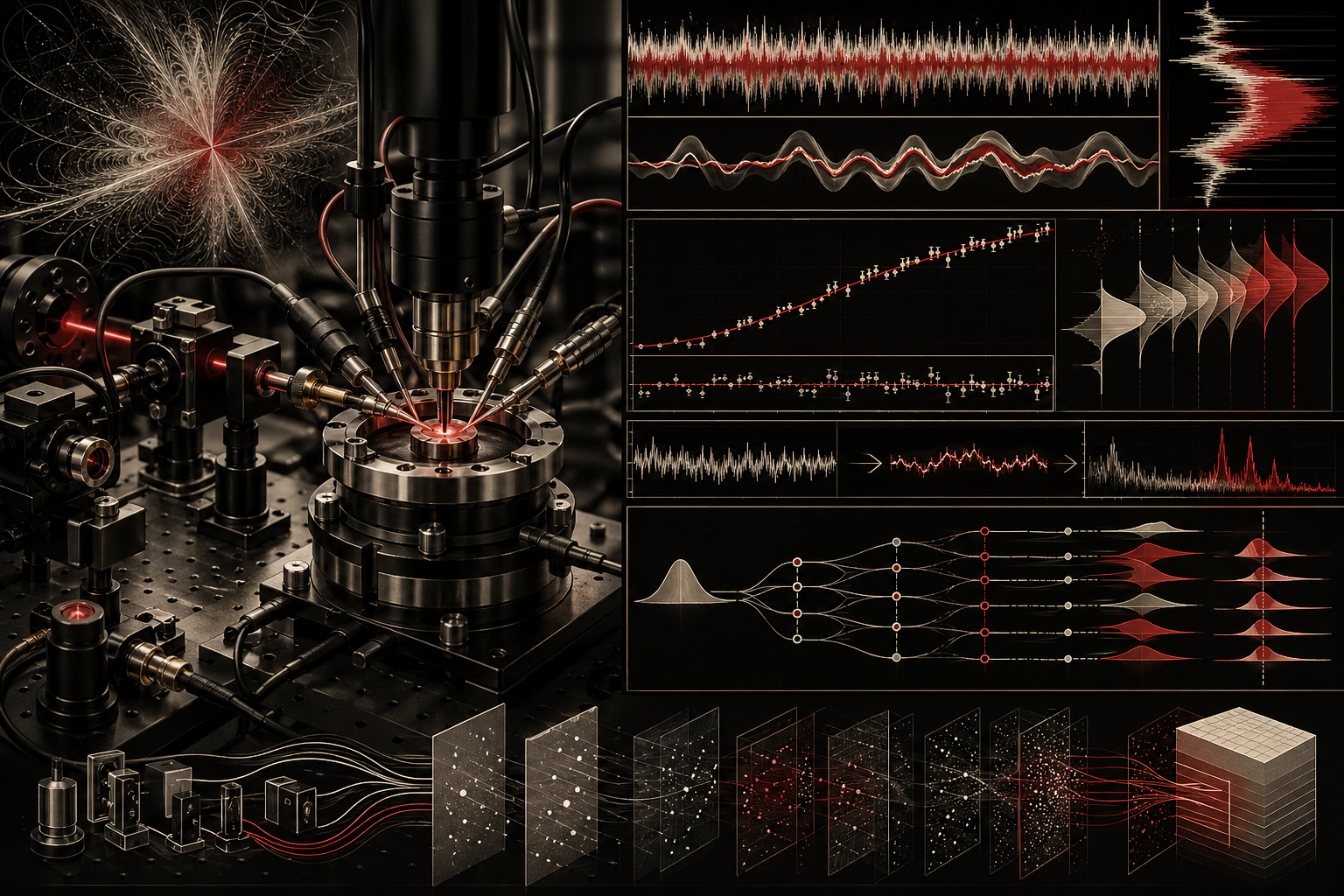
Experimental physics is the discipline of making physical claims accountable to measurement: designing instruments, controlling noise, calibrating sensors, estimating uncertainty, testing models, and deciding what can legitimately be inferred from data. Theory gives physics mathematical structure, but experiment gives it contact with the world. A measurement is never a bare number. It is the result of an apparatus, a calibration chain, a model of the measurand, environmental conditions, signal processing, uncertainty analysis, and interpretive judgment.
Measurement is therefore not a routine technical afterthought. It is one of the central intellectual practices of physics. A detector does not simply “read reality.” It converts physical interaction into a signal. That signal contains noise, drift, finite resolution, calibration error, background, bias, sampling limitations, and model assumptions. Experimental physics asks how to build a trustworthy path from physical phenomenon to measured quantity, from measured quantity to uncertainty statement, and from uncertainty statement to scientific inference.
This article develops Experimental Physics: Measurement, Noise, Calibration, and Inference as a research-grade article in the Physics knowledge series. It explains measurement models, measurands, instruments, calibration, traceability, precision, accuracy, repeatability, reproducibility, Type A and Type B uncertainty, systematic effects, random noise, Gaussian and non-Gaussian error, uncertainty propagation, least-squares fitting, calibration curves, signal-to-noise ratio, filtering, Fourier analysis, Bayesian inference, model comparison, residual diagnostics, experimental design, blind analysis, replication, open data, and reproducible laboratory computation. Selected R and Python workflows appear in the article body, while the companion GitHub repository contains expanded computational resources for calibration curves, uncertainty propagation, noise simulation, Allan deviation examples, Bayesian measurement inference, regression diagnostics, signal processing, Monte Carlo uncertainty, metadata schemas, SQL provenance tables, C/C++/Fortran/Rust examples, and reproducible experimental-physics workflows.
Main Library
Publications
Article Map
Physics
Related Topic
Mathematics
Related Topic
Data Systems & Analytics
Related Topic
Astronomy
Why Experimental Physics Matters
Experimental physics matters because physical knowledge must eventually be answerable to observation. The most elegant theory remains incomplete if it cannot be tested, constrained, calibrated, or connected to measurable consequences. Conversely, the most precise measurement remains incomplete if its connection to theory, instrumentation, uncertainty, and inference is unclear. Experimental physics lives at this boundary: where physical systems become signals and signals become evidence.
Many of the great transformations in physics were experimental as well as theoretical. Spectroscopy revealed atomic structure. Michelson–Morley constrained the ether hypothesis. Millikan’s oil-drop experiment measured electric charge. Cloud chambers, bubble chambers, and particle detectors revealed subatomic processes. Precision measurements tested relativity. Blackbody radiation, photoelectric experiments, and scattering experiments helped force quantum theory into being. Modern detectors now measure gravitational waves, neutrinos, cosmic microwave background anisotropies, quantum states, nanoscale forces, and single photons.
Experimental physics is also the discipline of humility. Instruments have limits. Signals are contaminated by noise. Calibrations drift. Samples vary. Backgrounds mimic effects. Models simplify. Statistical significance can mislead when assumptions fail. Precision can be meaningless without accuracy. Accuracy can be impossible without traceability. A measurement without uncertainty is not a finished scientific result.
For the Physics knowledge series, this article belongs near Measurement, Mathematics, and the Structure of Physical Inquiry, Computational Physics and Scientific Simulation, Mathematical Methods in Physics, Statistical Physics and the Emergence of Macroscopic Order, Quantum Mechanics and the Limits of Classical Intuition, and General Relativity: Geometry, Gravity, and Spacetime Curvature. It is the methodological bridge between physical theory and empirical warrant.
Measurement as Model-Mediated Knowledge
A measurement is not simply the act of looking at an instrument. It is a model-mediated process. The experimentalist must define what quantity is being measured, how the instrument responds to the physical system, how raw signals are converted into estimates, how calibration is performed, how uncertainty is evaluated, and how the final result is interpreted.
A simple measurement model can be written as:
y = f(x_1,x_2,\ldots,x_n)
\]
Interpretation: A measurement result is often inferred from several measured, calibrated, or referenced input quantities.
where \(y\) is the estimated quantity and \(x_i\) are input quantities such as instrument readings, calibration coefficients, environmental corrections, background estimates, geometric factors, and physical constants. The measurement result is therefore not only a value. It is a value plus a model plus an uncertainty statement.
For example, measuring resistance with a voltmeter and ammeter might use:
R = \frac{V}{I}
\]
Interpretation: Ohm’s law estimates resistance from voltage and current measurements.
But this apparently simple expression may conceal voltmeter calibration, ammeter calibration, contact resistance, thermal drift, lead resistance, instrument resolution, noise, temperature dependence, and the assumption that the device obeys Ohm’s law under the test conditions.
Experimental physics therefore begins with a conceptual discipline: define the measurand. The measurand is the quantity intended to be measured. Ambiguity at this stage propagates through the entire experiment. A measurement of “temperature,” “length,” “frequency,” “voltage,” “mass,” “field strength,” or “cross section” becomes scientifically meaningful only when the physical context and measurement model are specified.
Measurands, Instruments, and Observations
The measurand is the target quantity. The instrument is the physical system used to estimate it. The observation is the recorded output. These three are related but not identical.
A detector may measure voltage, current, charge, photon counts, pulse height, time delay, phase shift, frequency shift, displacement, temperature, or pressure. The desired physical quantity may be energy, force, field strength, particle flux, scattering angle, decay rate, gravitational strain, or material property. A model is needed to connect the detector output to the physical measurand.
A generic observation model can be written as:
x_{\mathrm{obs}}
=
x_{\mathrm{true}}
+
b
+
\epsilon
\]
Interpretation: Observed values may differ from the target quantity because of bias and random error.
where \(b\) is bias and \(\epsilon\) is random error. This simple expression is not enough for real experiments, but it clarifies the distinction between systematic displacement and random variability.
In many experiments, the measurement process is indirect. A photodiode current estimates light intensity. A thermistor resistance estimates temperature. A strain gauge estimates deformation. A time-of-flight signal estimates velocity. A scattering distribution estimates interaction structure. The experimental task is to justify the inferential chain from raw signal to physical quantity.
Good experimental design therefore requires instrument knowledge. A physicist must ask: What does the instrument actually respond to? What are its linearity limits? What are its calibration conditions? What background does it see? What is its bandwidth? What is its noise floor? What environmental variables influence its output? What assumptions are embedded in its conversion from signal to quantity?
Precision, Accuracy, Resolution, and Sensitivity
Precision, accuracy, resolution, and sensitivity are related but distinct concepts. Precision describes the closeness of repeated measurements to one another. Accuracy describes closeness to the true or accepted value. Resolution describes the smallest distinguishable change in the instrument output. Sensitivity describes how strongly the output changes in response to a change in input.
A measurement can be precise but inaccurate if repeated values cluster tightly around the wrong value. A measurement can be accurate on average but imprecise if repeated values scatter widely around the correct value. An instrument can have fine resolution but poor accuracy if it is miscalibrated. A highly sensitive instrument can still be limited by noise, drift, nonlinearity, or environmental coupling.
Sensitivity can be represented as a derivative:
S
=
\frac{dY}{dX}
\]
Interpretation: Sensitivity measures how strongly an instrument output changes in response to an input change.
where \(Y\) is instrument output and \(X\) is input quantity. A large sensitivity means a small change in input produces a large change in output. But sensitivity alone does not guarantee detectability. Detectability depends on noise as well.
Signal-to-noise ratio is often written as:
\mathrm{SNR}
=
\frac{\mu_{\mathrm{signal}}}{\sigma_{\mathrm{noise}}}
\]
Interpretation: Signal-to-noise ratio compares characteristic signal amplitude with noise scale.
where \(\mu_{\mathrm{signal}}\) is a characteristic signal amplitude and \(\sigma_{\mathrm{noise}}\) is the noise standard deviation. A weak signal can be measurable if noise is low and the measurement model is well calibrated. A strong signal can be unreliable if the instrument saturates, drifts, or responds to background.
Calibration and Traceability
Calibration connects an instrument reading to known standards or reference values. Without calibration, an instrument output is merely an output. Calibration asks how that output corresponds to a physical quantity under specified conditions.
A simple linear calibration model is:
y = \alpha + \beta x
\]
Interpretation: A linear calibration model maps instrument reading to reference quantity through offset and scale.
where \(x\) is the instrument reading, \(y\) is the reference quantity, \(\alpha\) is the offset, and \(\beta\) is the scale factor. More complex calibration may require nonlinear models, temperature corrections, hysteresis terms, frequency response, background subtraction, or multivariate correction.
Traceability means that a measurement result can be related to a reference through an unbroken chain of calibrations, each contributing uncertainty. In metrology, traceability is not a vague claim of quality. It requires documentation: standards used, calibration dates, environmental conditions, uncertainty budgets, procedures, and links to higher-level references.
The calibration chain matters because instruments drift. A voltage reference changes with temperature and time. A scale can shift. A photodetector response can age. A timing system can drift. A pressure sensor can have hysteresis. Calibration is therefore not a one-time ritual but part of the measurement model.
Experimental physics also requires calibration verification. A calibration curve may fit the reference data but fail outside the calibrated range. A detector may be linear only within a specified region. A calibration performed under one environmental condition may not apply under another. The calibration model must match the actual use conditions.
Noise in Physical Measurement
Noise is unwanted variability or disturbance in a measurement signal. It may arise from thermal fluctuations, electronic circuits, photon counting statistics, mechanical vibration, electromagnetic interference, environmental drift, quantization, background radiation, detector dark counts, or stochastic physical processes in the system itself.
Thermal noise in a resistor is associated with temperature and resistance. Shot noise arises from the discrete nature of charge or particle detection. \(1/f\) noise appears in many electronic and physical systems, with stronger low-frequency fluctuations. White noise has approximately flat spectral density across frequency. Drift produces slow changes over time. Periodic interference can arise from power lines, mechanical resonances, or environmental cycles.
A common additive noise model is:
y_i = s_i + \epsilon_i
\]
Interpretation: A measured signal can be modeled as true signal plus noise.
where \(s_i\) is the true signal and \(\epsilon_i\) is noise. If the noise is Gaussian with zero mean:
\epsilon_i \sim \mathcal{N}(0,\sigma^2)
\]
Interpretation: A Gaussian noise model assumes zero-mean random variation with variance \(\sigma^2\).
then many standard estimators have convenient properties. But experimental noise is not always Gaussian, independent, or stationary. Noise can be correlated, heavy-tailed, heteroscedastic, nonstationary, or coupled to the signal.
Noise analysis is therefore more than computing a standard deviation. Experimentalists must ask: Is the noise white or colored? Is it stationary? Does it depend on signal amplitude? Is there drift? Is there environmental coupling? Are samples independent? Is averaging valid? Are there outliers? Is the noise distribution known or assumed?
Signal Processing and Detection
Signal processing converts raw observations into more useful representations. It may include filtering, averaging, Fourier transforms, lock-in detection, windowing, baseline subtraction, pulse detection, time-frequency analysis, deconvolution, smoothing, or matched filtering. The goal is not to make data look cleaner. The goal is to extract information while preserving uncertainty and avoiding distortion.
The Fourier transform is central because many signals are easier to analyze by frequency:
X(f)
=
\int_{-\infty}^{\infty}x(t)e^{-i2\pi ft}\,dt
\]
Interpretation: The Fourier transform represents a time-domain signal in frequency space.
Power spectral density describes how variance is distributed across frequency. A noisy time series may reveal peaks at characteristic frequencies, broadband noise floors, resonance structure, or drift at low frequencies.
Filtering must be used carefully. A low-pass filter can remove high-frequency noise but also suppress real fast dynamics. A high-pass filter can remove drift but distort slow physical signals. A notch filter can remove power-line interference but may also remove physical content at that frequency. Signal processing choices are part of the measurement model and should be documented.
Detection theory asks whether a signal is distinguishable from noise. In many experiments, the question is not simply “What value was measured?” but “Is a signal present?” A detection threshold must account for false positives, false negatives, multiple comparisons, background models, and prior expectations. Precision experiments often depend as much on background rejection as on signal measurement.
Random and Systematic Effects
Random effects cause measurements to vary unpredictably across repeated observations. Systematic effects shift results in a structured way. The distinction is useful, but it can be context-dependent. An effect that appears random in one measurement model may appear systematic in another if it is associated with a known correction or input quantity.
Random effects can often be reduced by averaging independent measurements. If observations have standard deviation \(\sigma\), the standard error of the mean is:
u_{\bar{x}}
=
\frac{\sigma}{\sqrt{n}}
\]
Interpretation: The uncertainty of the mean decreases with the square root of independent sample count.
where \(n\) is the number of independent observations. This relation assumes independence and stable variance. If the data are autocorrelated or drifting, the effective number of independent observations may be much smaller than the sample count.
Systematic effects cannot generally be eliminated by simple averaging. A miscalibrated scale remains miscalibrated no matter how many times it is read. A temperature-dependent detector response remains biased if temperature is not measured or corrected. Background contamination remains unless modeled, subtracted, shielded, or experimentally separated.
Good experimental practice identifies systematic effects through controls, reversals, null tests, environmental monitoring, independent calibration, alternative methods, blind analysis, and sensitivity studies. The question is not whether systematic effects exist. They almost always do. The question is whether they are understood, bounded, corrected, and included in the uncertainty budget.
Type A and Type B Uncertainty
Measurement uncertainty is often evaluated using Type A and Type B components. Type A uncertainty is evaluated by statistical analysis of repeated observations. Type B uncertainty is evaluated by other means, such as calibration certificates, manufacturer specifications, prior measurements, physical judgment, resolution limits, environmental bounds, or theoretical constraints.
A Type A standard uncertainty may be estimated from repeated measurements:
u_A
=
\frac{s}{\sqrt{n}}
\]
Interpretation: Type A uncertainty can be estimated from repeated observations using the standard error of the mean.
where \(s\) is the sample standard deviation. A Type B standard uncertainty might come from a rectangular distribution. If an input is believed to lie within \(\pm a\) with equal probability, the standard uncertainty is:
u_B
=
\frac{a}{\sqrt{3}}
\]
Interpretation: A rectangular uncertainty interval has standard uncertainty \(a/\sqrt{3}\).
if a uniform distribution is appropriate.
The combined standard uncertainty is often calculated by root-sum-square combination:
u_c
=
\sqrt{
u_1^2+u_2^2+\cdots+u_n^2
}
\]
Interpretation: Independent standard uncertainty components combine by root-sum-square addition.
when the components are independent and expressed as standard uncertainties. If components are correlated, covariance terms must be included.
An expanded uncertainty may be reported as:
U = k u_c
\]
Interpretation: Expanded uncertainty multiplies combined standard uncertainty by a coverage factor.
where \(k\) is a coverage factor. A common approximate choice is \(k=2\) for roughly 95 percent coverage under normal assumptions, but the correct interpretation depends on distribution, degrees of freedom, and measurement context.
Propagation of Uncertainty
Many measurement results are computed from input quantities. If:
y=f(x_1,x_2,\ldots,x_n)
\]
Interpretation: A measurement function maps input quantities to an output measurand.
then uncertainty in the inputs propagates to uncertainty in \(y\). For independent inputs and small uncertainties, the linearized propagation formula is:
u_y^2
=
\sum_{i=1}^{n}
\left(
\frac{\partial f}{\partial x_i}
\right)^2
u_{x_i}^2
\]
Interpretation: Input uncertainties propagate through the squared sensitivity coefficients of the measurement model.
If inputs are correlated, covariance terms appear:
u_y^2
=
\sum_i
\left(
\frac{\partial f}{\partial x_i}
\right)^2
u_{x_i}^2
+
2\sum_{i<j}
\frac{\partial f}{\partial x_i}
\frac{\partial f}{\partial x_j}
\mathrm{cov}(x_i,x_j)
\]
Interpretation: Correlated inputs require covariance terms in the propagated uncertainty.
For resistance:
R=\frac{V}{I}
\]
Interpretation: Resistance can be inferred from voltage and current measurements.
the relative uncertainty for independent voltage and current uncertainties is approximately:
\left(\frac{u_R}{R}\right)^2
=
\left(\frac{u_V}{V}\right)^2
+
\left(\frac{u_I}{I}\right)^2
\]
Interpretation: Relative uncertainties in voltage and current combine to give relative uncertainty in resistance.
Linear propagation is powerful, but it has limits. If the function is strongly nonlinear, uncertainties are large, distributions are non-Gaussian, or constraints matter, Monte Carlo propagation may be more appropriate. In Monte Carlo uncertainty propagation, one samples input quantities from their distributions, computes \(y\) repeatedly, and summarizes the resulting output distribution.
Calibration Curves and Least-Squares Fitting
Calibration curves connect instrument readings to reference values. A common model is linear:
y_i = \alpha + \beta x_i + \epsilon_i
\]
Interpretation: A linear calibration model includes offset, scale factor, and residual error.
where \(x_i\) is the instrument reading, \(y_i\) is the reference value, \(\alpha\) is an offset, \(\beta\) is a scale factor, and \(\epsilon_i\) is residual error. The least-squares estimate minimizes:
S(\alpha,\beta)
=
\sum_{i=1}^{n}
\left[
y_i-(\alpha+\beta x_i)
\right]^2
\]
Interpretation: Ordinary least squares chooses calibration parameters that minimize squared residuals.
If uncertainties differ by point, weighted least squares minimizes:
S(\alpha,\beta)
=
\sum_{i=1}^{n}
\frac{
\left[
y_i-(\alpha+\beta x_i)
\right]^2
}{u_i^2}
\]
Interpretation: Weighted least squares gives more influence to points with smaller uncertainty.
where \(u_i\) is the standard uncertainty of reference value \(y_i\) or the relevant combined uncertainty for each calibration point.
Calibration is not complete when a line is fitted. The experimentalist must examine residuals, uncertainty in slope and intercept, prediction intervals, extrapolation limits, nonlinearity, hysteresis, repeatability, drift, environmental sensitivity, and whether the calibration conditions match the measurement conditions.
A calibration curve should not be used beyond its valid range without justification. Extrapolation can be dangerous because instrument behavior may become nonlinear, saturated, or unstable outside the calibration domain.
Residuals, Diagnostics, and Model Checking
Residuals are the differences between observed values and model predictions:
r_i = y_i-\hat{y}_i
\]
Interpretation: Residuals show what remains after the fitted model has explained the observations.
Residual analysis asks whether the remaining errors look consistent with the assumptions of the model. If residuals show curvature, the model may be missing nonlinearity. If residual variance grows with signal size, uncertainty may be heteroscedastic. If residuals are correlated in time, independence assumptions may fail. If residuals contain periodic structure, environmental or instrumental coupling may be present.
Good residual diagnostics include plots against fitted value, time, temperature, instrument channel, operator, run order, and other experimental variables. A residual pattern is often a clue to missing physics or missing instrumentation detail.
Model checking also includes external validation. A calibration model should be tested on withheld standards or independent measurements. A detector model should be checked with control signals. A background model should be checked in sideband regions or blank runs. A fitted parameter should be compared across independent methods when possible.
Experimental inference is therefore iterative. Measure, fit, inspect residuals, revise model, test controls, update uncertainty budget, document assumptions, and repeat. A clean final number often rests on a long chain of diagnostic work.
Bayesian Inference in Experimental Physics
Bayesian inference provides a framework for combining data, prior information, likelihood models, and uncertainty. Bayes’ theorem is:
p(\theta|D)
=
\frac{
p(D|\theta)p(\theta)
}{
p(D)
}
\]
Interpretation: Bayes’ theorem updates prior information with observed data to form a posterior distribution.
where \(\theta\) represents parameters, \(D\) represents data, \(p(D|\theta)\) is the likelihood, \(p(\theta)\) is the prior, \(p(\theta|D)\) is the posterior, and \(p(D)\) is the evidence.
In experimental physics, Bayesian methods are useful for parameter estimation, uncertainty propagation, hierarchical models, calibration transfer, background estimation, rare-event searches, model comparison, and combining multiple sources of information. They are especially valuable when measurement models are nonlinear, uncertainty distributions are non-Gaussian, or nuisance parameters must be marginalized.
A simple Gaussian measurement model is:
x_i \sim \mathcal{N}(\theta,\sigma^2)
\]
Interpretation: A Gaussian measurement model treats observations as noisy measurements of an underlying parameter.
If \(\sigma\) is known and the prior is weak, the posterior mean will resemble the sample mean. But Bayesian analysis becomes more distinctive when prior calibration information, physical constraints, correlated errors, or hierarchical structure matter.
Bayesian inference does not remove the need for experimental judgment. The likelihood must reflect the measurement process. Priors must be justified. Sensitivity to assumptions should be tested. Posterior intervals should not be presented as more certain than the model warrants.
Experimental Design
Experimental design asks how to collect data so that the resulting inference is meaningful, efficient, and robust. A poorly designed experiment may generate large amounts of data without answering the physical question. A well-designed experiment aligns measurand, apparatus, controls, calibration, sampling, uncertainty, and analysis plan.
Core design questions include: What is the target quantity? What range must be measured? What precision is required? What systematic effects are plausible? What controls are needed? What calibration standards are available? How will environmental variables be monitored? How many repetitions are needed? What model will be fitted? What would count as a failed assumption?
Randomization helps prevent confounding between run order and experimental conditions. Blocking helps compare conditions within controlled groups. Replication estimates variability. Blinding can reduce analyst bias. Null experiments test whether the apparatus produces a false signal when the true effect should be absent. Reversal experiments change the sign of an effect while leaving many backgrounds unchanged.
Experimental design is not separate from physics. The physical model tells the experimentalist what variables matter. The instrument model tells the experimentalist what can be measured. The statistical model tells the experimentalist what can be inferred. The design connects all three.
Blind Analysis, Replication, and Reproducibility
Blind analysis is used when analysts might unconsciously tune methods toward an expected result. In a blind analysis, the true signal region, normalization, offset, or final parameter may be hidden until the analysis method is fixed. This is common in precision measurements and rare-event searches where small biases can matter.
Replication tests whether a result can be reproduced under similar or independent conditions. Internal replication may involve repeated runs, different instruments, different operators, or different analysis pipelines. External replication may involve independent laboratories. In physics, strong claims often become credible through convergence among multiple methods, not through a single measurement alone.
Reproducibility also requires computational transparency. Code, data, metadata, calibration files, processing scripts, random seeds, software versions, instrument settings, and analysis decisions should be preserved when possible. A result that cannot be retraced from raw data through final inference remains fragile.
Open data and open code are not always possible because of privacy, security, proprietary instrumentation, or collaboration policies. But the principle remains: the analysis path should be auditable. Experimental physics depends on traceable reasoning as much as traceable instruments.
Measurement, Units, and SI Interpretation
The International System of Units provides the common language of physical measurement. Units are not formatting details; they are part of the meaning of a measurement. A reported quantity without units is incomplete. A model that mixes units inconsistently is physically invalid.
Many physical measurements are linked to SI units through calibration chains. Length, time, mass, electric current, temperature, amount of substance, and luminous intensity form the SI base structure, while derived units such as newton, joule, watt, pascal, tesla, volt, ohm, and hertz express physical relations among them.
Dimensional analysis is a first check on any measurement model. If a result claims to estimate velocity, it must have dimensions of length per time. If an uncertainty is reported for voltage, it must have voltage units. If a calibration slope maps volts to kelvin, its units must reflect that conversion.
Experimental computation should preserve units explicitly in documentation, code comments, metadata, and output tables. Unit mistakes are among the most common and consequential errors in scientific computing. A reproducible measurement workflow should state whether values are in SI units, normalized units, instrument counts, dimensionless ratios, or calibrated physical units.
Mathematical Lens
A mathematics-first view of experimental physics begins with a measurement model:
y=f(x_1,x_2,\ldots,x_n)
\]
Interpretation: A measurement model maps input quantities to an inferred result.
For repeated observations:
\bar{x}
=
\frac{1}{n}\sum_{i=1}^{n}x_i
\]
Interpretation: The sample mean estimates a central value from repeated observations.
and sample variance:
s^2
=
\frac{1}{n-1}
\sum_{i=1}^{n}
(x_i-\bar{x})^2
\]
Interpretation: Sample variance estimates the spread of repeated observations.
The standard uncertainty of the mean is:
u_{\bar{x}}
=
\frac{s}{\sqrt{n}}
\]
Interpretation: The standard uncertainty of the mean decreases with independent repetitions.
For independent uncertainty components:
u_c
=
\sqrt{
\sum_i u_i^2
}
\]
Interpretation: Independent standard uncertainty components combine by root-sum-square addition.
For propagation through a measurement function:
u_y^2
=
\sum_{i=1}^{n}
\left(
\frac{\partial f}{\partial x_i}
\right)^2
u_{x_i}^2
\]
Interpretation: Linearized uncertainty propagation uses sensitivity coefficients and input uncertainties.
With covariance:
u_y^2
=
\mathbf{J}
\Sigma
\mathbf{J}^{T}
\]
Interpretation: The Jacobian-covariance form expresses uncertainty propagation for correlated inputs.
where \(\mathbf{J}\) is the Jacobian of the measurement function and \(\Sigma\) is the covariance matrix of input quantities.
A linear calibration model is:
y_i=\alpha+\beta x_i+\epsilon_i
\]
Interpretation: A calibration model relates reference values to instrument readings and residual error.
Least squares minimizes:
S(\alpha,\beta)
=
\sum_i
\left[
y_i-(\alpha+\beta x_i)
\right]^2
\]
Interpretation: Least squares estimates calibration parameters by minimizing squared residuals.
A Gaussian likelihood for independent measurements is:
p(D|\theta)
=
\prod_{i=1}^{n}
\frac{1}{\sqrt{2\pi\sigma_i^2}}
\exp
\left[
-\frac{(y_i-f(x_i;\theta))^2}{2\sigma_i^2}
\right]
\]
Interpretation: A Gaussian likelihood assigns probability to data given model parameters and measurement uncertainties.
Bayesian inference gives:
p(\theta|D)
\propto
p(D|\theta)p(\theta)
\]
Interpretation: Posterior inference combines likelihood and prior information.
This mathematical lens shows that experimental physics is not merely data collection. It is structured inference under uncertainty.
Variables, Units, and Physical Interpretation
Experimental physics uses quantities that connect instruments, models, uncertainty, and inference. The table below summarizes several central terms.
| Symbol or Term | Meaning | Typical Unit | Physical Interpretation |
|---|---|---|---|
| \(x_i\) | Input quantity or observation | varies | Measured or assumed input to a measurement model |
| \(y\) | Measurement result | varies | Estimated value of the measurand |
| \(u_x\) | Standard uncertainty of \(x\) | same as \(x\) | Standard-deviation-like uncertainty measure |
| \(u_c\) | Combined standard uncertainty | same as measurand | Combined uncertainty from multiple sources |
| \(U\) | Expanded uncertainty | same as measurand | Coverage-factor-scaled uncertainty |
| \(k\) | Coverage factor | dimensionless | Multiplier used to obtain expanded uncertainty |
| \(\sigma\) | Standard deviation or noise scale | same as signal | Random variability or noise amplitude |
| \(\alpha\) | Calibration offset | same as output quantity | Zero-point correction in calibration model |
| \(\beta\) | Calibration slope | output/input | Scale factor converting instrument reading to reference value |
| \(r_i\) | Residual | same as measured output | Difference between observation and fitted model |
| \(\mathrm{SNR}\) | Signal-to-noise ratio | dimensionless | Relative strength of signal compared with noise |
| \(\theta\) | Model parameter | varies | Physical or calibration parameter inferred from data |
Note: Measurement results are not just values. They are values embedded in models, units, uncertainty, calibration, and inference.
Worked Example: Combined Uncertainty
Suppose a resistance is estimated using Ohm’s law:
R=\frac{V}{I}
\]
Interpretation: Resistance is inferred from voltage and current measurements.
Let:
V=10.00\ \mathrm{V}
\]
Interpretation: The measured voltage is 10.00 volts.
with standard uncertainty:
u_V=0.02\ \mathrm{V}
\]
Interpretation: The voltage standard uncertainty is 0.02 volts.
and:
I=2.000\ \mathrm{A}
\]
Interpretation: The measured current is 2.000 amperes.
with standard uncertainty:
u_I=0.005\ \mathrm{A}
\]
Interpretation: The current standard uncertainty is 0.005 amperes.
The resistance estimate is:
R=
\frac{10.00}{2.000}
=
5.000\ \Omega
\]
Interpretation: The nominal resistance estimate is 5.000 ohms.
For independent voltage and current uncertainties, the relative uncertainty is:
\left(\frac{u_R}{R}\right)^2
=
\left(\frac{u_V}{V}\right)^2
+
\left(\frac{u_I}{I}\right)^2
\]
Interpretation: Relative voltage and current uncertainties combine to give relative resistance uncertainty.
Substitute values:
\left(\frac{u_R}{R}\right)^2
=
\left(\frac{0.02}{10.00}\right)^2
+
\left(\frac{0.005}{2.000}\right)^2
\]
Interpretation: The relative uncertainty terms are computed from measured values and standard uncertainties.
=
(0.002)^2+(0.0025)^2
\]
Interpretation: Voltage contributes 0.2% relative standard uncertainty, while current contributes 0.25%.
=
4.0\times10^{-6}+6.25\times10^{-6}
=
1.025\times10^{-5}
\]
Interpretation: The squared relative uncertainty terms add under independence.
Therefore:
\frac{u_R}{R}
=
\sqrt{1.025\times10^{-5}}
\approx
0.00320
\]
Interpretation: The relative standard uncertainty in resistance is about 0.320%.
and:
u_R
=
5.000(0.00320)
\approx
0.016\ \Omega
\]
Interpretation: The standard uncertainty in resistance is approximately 0.016 ohms.
The result can be reported as:
R = 5.000 \pm 0.016\ \Omega
\]
Interpretation: This reports the resistance with standard uncertainty.
as a standard uncertainty, or with expanded uncertainty \(U=ku_R\). If \(k=2\):
U\approx0.032\ \Omega
\]
Interpretation: The expanded uncertainty is approximately twice the standard uncertainty for \(k=2\).
The reported result would then be:
R = 5.000 \pm 0.032\ \Omega
\quad (k=2)
\]
Interpretation: This reports resistance with expanded uncertainty using coverage factor \(k=2\).
This example is simple, but it shows the structure of experimental reasoning: define a measurement model, identify input uncertainties, propagate them, state assumptions, and report the result with appropriate units and uncertainty.
Computational Modeling
Computational modeling helps experimental physics become reproducible. A calibration workflow can estimate slope, offset, residuals, and prediction uncertainty. A noise workflow can simulate white noise, drift, and sinusoidal interference. A signal-processing workflow can estimate spectra and signal-to-noise ratio. A Monte Carlo workflow can propagate nonlinear uncertainty. A Bayesian workflow can infer physical parameters with uncertainty. A metadata system can preserve instrument settings, calibration dates, units, environmental variables, model assumptions, code versions, random seeds, and data provenance.
The selected examples below focus on calibration and uncertainty because they are foundational, readable, and directly reusable. The GitHub repository extends the same logic into richer computational resources: R calibration diagnostics, Python noise and uncertainty propagation, Bayesian measurement inference, Monte Carlo uncertainty, Fourier noise analysis, Allan deviation examples, regression diagnostics, calibration metadata, Julia experimental calculations, C++ signal sweeps, Fortran uncertainty tables, SQL provenance schemas, Rust command-line utilities, C examples, documentation, and reproducible sample data.
R Workflow: Calibration Curve and Residual Diagnostics
R is useful for calibration tables, regression diagnostics, uncertainty summaries, and reproducible statistical reporting. The following workflow fits a linear calibration model and summarizes residuals.
# Calibration Curve and Residual Diagnostics
#
# This workflow fits a simple linear calibration model:
#
#   reference_value = alpha + beta * instrument_reading + error
#
# It estimates the calibration offset, slope, residual standard error,
# and residual diagnostics. In real laboratory work, uncertainty in
# both reference values and instrument readings may require more
# advanced errors-in-variables or weighted calibration models.

library(tibble)
library(dplyr)
library(broom)

calibration_data <- tibble(
  instrument_reading_v = c(
    0.02, 0.98, 2.01, 3.03, 3.98,
    5.02, 6.01, 7.03, 8.00, 9.01
  ),
  reference_value_v = c(
    0.00, 1.00, 2.00, 3.00, 4.00,
    5.00, 6.00, 7.00, 8.00, 9.00
  )
)

calibration_model <- lm(
  reference_value_v ~ instrument_reading_v,
  data = calibration_data
)

calibration_augmented <- augment(calibration_model) %>%
  rename(
    fitted_reference_v = .fitted,
    residual_v = .resid
  )

calibration_summary <- tidy(calibration_model)

residual_summary <- calibration_augmented %>%
  summarise(
    mean_residual_v = mean(residual_v),
    residual_sd_v = sd(residual_v),
    max_abs_residual_v = max(abs(residual_v)),
    root_mean_square_residual_v = sqrt(mean(residual_v^2))
  )

print(calibration_summary)
print(residual_summary)
print(calibration_augmented)
This workflow illustrates a basic calibration pipeline: fit the instrument response, estimate slope and intercept, inspect residuals, and summarize model error. A production laboratory workflow would add calibration certificate metadata, reference uncertainties, environmental variables, instrument identifiers, validity ranges, and traceability documentation.
Python Workflow: Noise, Signal-to-Noise Ratio, and Uncertainty Propagation
Python is useful for signal simulation, numerical uncertainty propagation, and reproducible experimental pipelines. The following workflow simulates a sinusoidal signal with noise, estimates signal-to-noise ratio, and propagates uncertainty for a resistance measurement.
"""
Noise, Signal-to-Noise Ratio, and Uncertainty Propagation

This workflow demonstrates three experimental-physics tasks:

1. Simulate a measured signal with additive Gaussian noise.
2. Estimate signal-to-noise ratio.
3. Propagate uncertainty for R = V / I.

The workflow is intentionally transparent rather than optimized.
"""

import numpy as np
import pandas as pd

RANDOM_SEED = 42
N_SAMPLES = 2000
SAMPLING_RATE_HZ = 1000.0
SIGNAL_FREQUENCY_HZ = 25.0
SIGNAL_AMPLITUDE_V = 2.0
NOISE_STANDARD_DEVIATION_V = 0.25

def simulate_signal() -> pd.DataFrame:
    """
    Simulate a sinusoidal voltage signal with additive Gaussian noise.
    """
    rng = np.random.default_rng(RANDOM_SEED)

    time_s = np.arange(N_SAMPLES) / SAMPLING_RATE_HZ

    clean_signal_v = SIGNAL_AMPLITUDE_V * np.sin(
        2.0 * np.pi * SIGNAL_FREQUENCY_HZ * time_s
    )

    noise_v = rng.normal(
        loc=0.0,
        scale=NOISE_STANDARD_DEVIATION_V,
        size=N_SAMPLES,
    )

    measured_signal_v = clean_signal_v + noise_v

    return pd.DataFrame(
        {
            "time_s": time_s,
            "clean_signal_v": clean_signal_v,
            "noise_v": noise_v,
            "measured_signal_v": measured_signal_v,
        }
    )

def estimate_signal_to_noise(signal_table: pd.DataFrame) -> dict:
    """
    Estimate signal-to-noise ratio using known clean signal and noise.
    """
    signal_rms = np.sqrt(np.mean(signal_table["clean_signal_v"] ** 2))
    noise_rms = np.sqrt(np.mean(signal_table["noise_v"] ** 2))
    snr_linear = signal_rms / noise_rms
    snr_db = 20.0 * np.log10(snr_linear)

    return {
        "signal_rms_v": signal_rms,
        "noise_rms_v": noise_rms,
        "snr_linear": snr_linear,
        "snr_db": snr_db,
    }

def propagate_resistance_uncertainty(
    voltage_v: float,
    voltage_uncertainty_v: float,
    current_a: float,
    current_uncertainty_a: float,
) -> dict:
    """
    Propagate uncertainty for R = V / I.

    For independent V and I:
        (u_R / R)^2 = (u_V / V)^2 + (u_I / I)^2
    """
    resistance_ohm = voltage_v / current_a

    relative_uncertainty = np.sqrt(
        (voltage_uncertainty_v / voltage_v) ** 2
        + (current_uncertainty_a / current_a) ** 2
    )

    resistance_uncertainty_ohm = resistance_ohm * relative_uncertainty

    return {
        "voltage_v": voltage_v,
        "voltage_uncertainty_v": voltage_uncertainty_v,
        "current_a": current_a,
        "current_uncertainty_a": current_uncertainty_a,
        "resistance_ohm": resistance_ohm,
        "relative_uncertainty": relative_uncertainty,
        "resistance_uncertainty_ohm": resistance_uncertainty_ohm,
        "expanded_uncertainty_k2_ohm": 2.0 * resistance_uncertainty_ohm,
    }

def main() -> None:
    """
    Run signal simulation and uncertainty propagation.
    """
    signal_table = simulate_signal()
    snr_summary = estimate_signal_to_noise(signal_table)

    resistance_summary = propagate_resistance_uncertainty(
        voltage_v=10.00,
        voltage_uncertainty_v=0.02,
        current_a=2.000,
        current_uncertainty_a=0.005,
    )

    print("Signal sample:")
    print(signal_table.head(10).round(6).to_string(index=False))

    print("\nSignal-to-noise summary:")
    print(pd.DataFrame([snr_summary]).round(6).to_string(index=False))

    print("\nResistance uncertainty summary:")
    print(pd.DataFrame([resistance_summary]).round(8).to_string(index=False))

if __name__ == "__main__":
    main()
This workflow demonstrates the computational structure of experimental analysis: generate or ingest data, estimate noise, calculate signal-to-noise ratio, propagate measurement uncertainty, and report results in physical units. A full experimental pipeline would also save raw data, calibration metadata, uncertainty budgets, instrument settings, environmental conditions, and analysis version information.
GitHub Repository
The article body includes only selected computational examples so the conceptual and mathematical argument remains readable. The full repository contains the expanded computational infrastructure: R calibration diagnostics, Python noise and uncertainty propagation, Bayesian measurement inference, Monte Carlo uncertainty, Fourier noise analysis, Allan deviation examples, regression diagnostics, calibration metadata, Julia experimental calculations, C++ signal sweeps, Fortran uncertainty tables, SQL provenance schemas, Rust command-line utilities, C examples, documentation, and reproducible sample data.
From Measurement to Physical Inference
Experimental physics transforms physical interaction into evidence. That transformation requires instruments, calibration, uncertainty analysis, noise modeling, signal processing, statistical inference, and disciplined interpretation. The central question is not simply “What did the instrument read?” The central question is “What physical claim is justified by this measurement process, under these assumptions, with this uncertainty?”
Within the Physics knowledge series, this article belongs near Measurement, Mathematics, and the Structure of Physical Inquiry, Computational Physics and Scientific Simulation, Mathematical Methods in Physics, Statistical Physics and the Emergence of Macroscopic Order, Quantum Mechanics and the Limits of Classical Intuition, and General Relativity: Geometry, Gravity, and Spacetime Curvature. It provides the empirical foundation for every physical theory that claims contact with reality.
The next conceptual steps are natural. Detectors, Sensors, and Instrumentation in Physical Science develops the apparatus side of experimental physics. Signal Processing for Physics Experiments develops the frequency-domain and detection side. Uncertainty Quantification and Error Propagation in Physics develops the uncertainty framework in greater depth. Bayesian Inference and Model Selection in Physics develops the inference architecture for modern experimental analysis.
Related Articles
- Physics
- What Is Physics?
- Measurement, Mathematics, and the Structure of Physical Inquiry
- Mathematical Methods in Physics
- Computational Physics and Scientific Simulation
- Statistical Physics and the Emergence of Macroscopic Order
- Quantum Mechanics and the Limits of Classical Intuition
- Quantum Information, Decoherence, and Measurement
- General Relativity: Geometry, Gravity, and Spacetime Curvature
- Atomic, Molecular, and Optical Physics
- Semiconductor Physics and Electronic Materials
- Plasma Physics and the Fourth State of Matter
- Environmental Monitoring Systems
- Natural Science
Further Reading
- BIPM (2026) The International System of Units. Available at: https://www.bipm.org/en/measurement-units (Accessed: 25 April 2026).
- BIPM (2026) SI Brochure. Available at: https://www.bipm.org/en/publications/si-brochure (Accessed: 25 April 2026).
- JCGM (2008) Evaluation of Measurement Data — Guide to the Expression of Uncertainty in Measurement. Available at: https://www.iso.org/sites/JCGM/GUM/JCGM100/C045315e-html/C045315e_FILES/MAIN_C045315e/Pre_e.html (Accessed: 25 April 2026).
- JCGM (2023) Guide to the Expression of Measurement Uncertainty — Part 1: Introduction. Available at: https://www.bipm.org/fr/doi/10.59161/JCGMGUM-1-2023 (Accessed: 25 April 2026).
- MIT OpenCourseWare (2016–2017) Experimental Physics I & II “Junior Lab”. Available at: https://ocw.mit.edu/courses/8-13-14-experimental-physics-i-ii-junior-lab-fall-2016-spring-2017/ (Accessed: 25 April 2026).
- MIT OpenCourseWare (2016–2017) Experimental Physics I & II: Experiments. Available at: https://ocw.mit.edu/courses/8-13-14-experimental-physics-i-ii-junior-lab-fall-2016-spring-2017/pages/experiments/ (Accessed: 25 April 2026).
- NIST (2009) NIST Technical Note 1297: Guidelines for Evaluating and Expressing the Uncertainty of NIST Measurement Results. Available at: https://www.nist.gov/pml/nist-technical-note-1297 (Accessed: 25 April 2026).
- NIST (2010) NIST Policy on Metrological Traceability. Available at: https://www.nist.gov/calibrations/traceability (Accessed: 25 April 2026).
- NIST (2026) Uncertainty of Measurement Results. Available at: https://physics.nist.gov/cuu/Uncertainty/ (Accessed: 25 April 2026).
- Possolo, A. (2015) Simple Guide for Evaluating and Expressing the Uncertainty of NIST Measurement Results. NIST Technical Note 1900. Available at: https://nvlpubs.nist.gov/nistpubs/TechnicalNotes/NIST.TN.1900.pdf (Accessed: 25 April 2026).
- Stanford Encyclopedia of Philosophy (2005) ‘Experiment in Physics’. Available at: https://plato.stanford.edu/archives/fall2005/entries/physics-experiment/ (Accessed: 25 April 2026).
- Stanford Encyclopedia of Philosophy (2018) ‘Measurement in Science’. Available at: https://plato.stanford.edu/archives/win2018/entries/measurement-science/ (Accessed: 25 April 2026).
References
- BIPM (2026) The International System of Units. Available at: https://www.bipm.org/en/measurement-units (Accessed: 25 April 2026).
- JCGM (2008) Evaluation of Measurement Data — Guide to the Expression of Uncertainty in Measurement. Available at: https://www.iso.org/sites/JCGM/GUM/JCGM100/C045315e-html/C045315e_FILES/MAIN_C045315e/Pre_e.html (Accessed: 25 April 2026).
- MIT OpenCourseWare (2016–2017) Experimental Physics I & II “Junior Lab”. Available at: https://ocw.mit.edu/courses/8-13-14-experimental-physics-i-ii-junior-lab-fall-2016-spring-2017/ (Accessed: 25 April 2026).
- NIST (2009) NIST Technical Note 1297: Guidelines for Evaluating and Expressing the Uncertainty of NIST Measurement Results. Available at: https://www.nist.gov/pml/nist-technical-note-1297 (Accessed: 25 April 2026).
- NIST (2010) NIST Policy on Metrological Traceability. Available at: https://www.nist.gov/calibrations/traceability (Accessed: 25 April 2026).
- NIST (2026) Uncertainty of Measurement Results. Available at: https://physics.nist.gov/cuu/Uncertainty/ (Accessed: 25 April 2026).
- Stanford Encyclopedia of Philosophy (2005) ‘Experiment in Physics’. Available at: https://plato.stanford.edu/archives/fall2005/entries/physics-experiment/ (Accessed: 25 April 2026).