
Last Updated May 28, 2026
Population dynamics and ecological modeling examine how populations change through time, how birth, death, immigration, emigration, density dependence, species interactions, spatial structure, environmental variability, and human pressure shape those changes, and how mathematical and computational models help ecology understand persistence, fluctuation, collapse, recovery, and long-term resilience. Population dynamics sits at the center of ecological reasoning because populations are the scale at which organisms become measurable ecological actors: too large to be reduced to isolated individuals alone, yet specific enough to reveal the mechanisms through which environments, interactions, and constraints shape living systems.
Population dynamics is also one of the places where biology becomes explicitly quantitative without losing contact with field reality. Demographic rates, survivorship, fecundity, recruitment, dispersal, carrying capacity, stochasticity, spatial connectivity, harvest, disease, predation, competition, and climate variability can all be expressed as structured hypotheses about how populations behave. Models do not replace field observation, natural history, laboratory work, or long-term monitoring. They organize them. They make assumptions visible, allow scenarios to be compared, and help scientists ask whether a population is likely to persist, recover, oscillate, invade, collapse, or cross a threshold.
Main Library
Publications
Article Map
Biology
Related Topic
Environmental Science
Related Topic
Earth Science
Related Topic
Mathematical Modeling
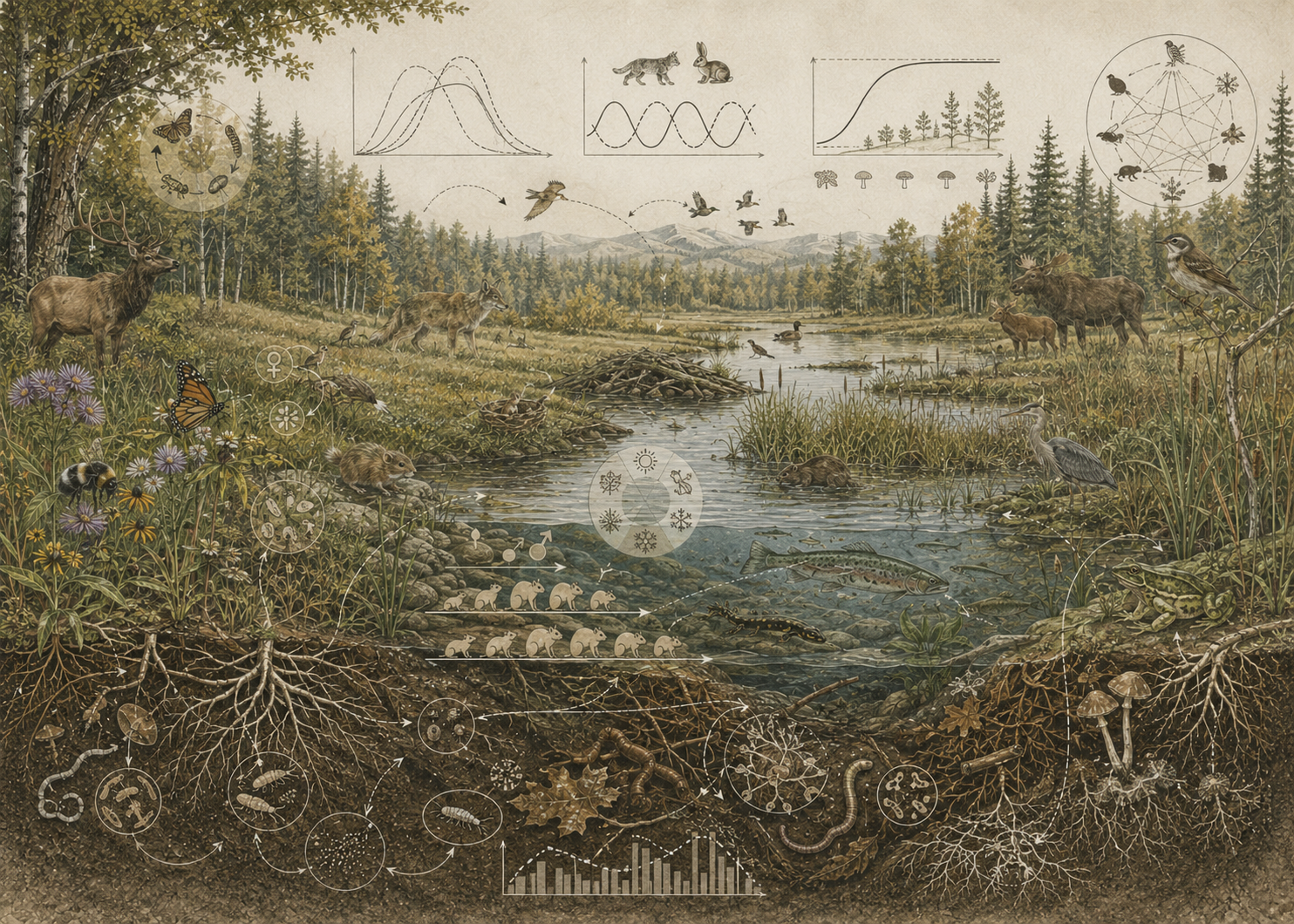
This article develops population dynamics and ecological modeling as a foundational framework for understanding living systems through time. It examines demography, exponential and logistic growth, density-dependent and density-independent regulation, age and stage structure, matrix population models, predator-prey and competition models, metapopulations, spatial dynamics, stochasticity, population viability analysis, ecological forecasting, fisheries modeling, conservation, restoration, environmental risk assessment, and sustainability-adjacent biology.
The article is written for ecologists, marine biologists, freshwater scientists, medical and environmental-health readers, computational biology readers, biodiversity experts, conservation planners, restoration practitioners, fisheries scientists, environmental risk analysts, and research biologists who need a rigorous account of how demographic processes are modeled, interpreted, and applied across real ecological systems.
The article also extends population ecology into quantitative and computational biology through stochastic logistic simulations, quasi-extinction analysis, stage-structured matrix projection, eigenvalue growth estimation, sensitivity screening, metapopulation occupancy models, harvest scenarios, R workflows, Python workflows, SQL provenance structures, and a linked full-stack GitHub repository containing Python, R, Julia, Fortran, Rust, Go, C, C++, SQL, notebooks, data files, and reproducibility documentation.
What population dynamics is
Population dynamics is the study of how and why the size, structure, and distribution of populations change through time. At its most basic level, it asks how many individuals are present, how quickly that number is changing, what demographic processes are responsible, and how those changes depend on ecological context. But population dynamics is not simply about counting organisms. It is about understanding the mechanisms that produce persistence, expansion, fluctuation, scarcity, regulation, recovery, and extinction.
In ecology, a population is usually defined as the individuals of a species occupying a particular place and time with the potential to interact, reproduce, disperse, and share ecological conditions. Once that population is treated as a dynamic system rather than a static count, a wide range of ecological questions becomes possible. Why do some populations grow rapidly while others remain constrained? Why do some oscillate while others stabilize? Why do fragmented populations collapse more easily? Why do invasive species erupt under some conditions but fail under others? Why do exploited fish stocks recover in some systems and not in others? Why do disease outbreaks spread through some host populations but fade in others?
Ecological modeling extends this work by expressing demographic change mathematically and computationally. Models do not replace field ecology. They clarify it. They help ecologists identify mechanisms, compare hypotheses, estimate hidden processes, project trajectories, and test how populations might respond under changing conditions.
For research biologists, population dynamics is especially important because it supplies a bridge between individual biology and system-level ecology. Physiology, behavior, genetics, disease, climate, land use, and species interaction all matter ecologically when they alter birth, death, movement, survival, recruitment, or reproductive success at the population level.
Why populations are the core unit of ecology
Populations are the core unit of ecology because ecological consequences emerge at scales larger than the individual but smaller than the whole ecosystem. An individual organism can be alive, reproducing, stressed, healthy, infected, or dispersing, but the ecological meaning of those conditions becomes visible only when many such organisms are considered together across time. The population is therefore the level at which survival becomes persistence, fecundity becomes recruitment, movement becomes colonization, mortality becomes decline, and environmental pressure becomes demographic change.
This matters because many of ecology’s most important problems are population-level problems. Species conservation depends on whether populations can remain viable. Fisheries management depends on whether exploited populations can replenish themselves. Restoration depends on whether populations can re-establish, expand, reproduce, and remain connected. Disease ecology depends on host, vector, and pathogen population structure. Climate-change biology depends on whether environmental shifts alter demographic rates enough to cause decline, redistribution, or collapse.
Population dynamics therefore sits at a junction between organismal biology, evolutionary biology, and ecosystem science. It links physiology and life history to abundance; links abundance to interaction networks; and links ecological pattern to management decisions. For research biologists more broadly, population dynamics is often the level at which organismal evidence becomes ecologically interpretable.
The population level is also where invisibility becomes danger. A population may appear present while its age structure becomes unstable, its recruitment declines, its genetic diversity erodes, or its habitat connectivity collapses. Ecological modeling helps detect these hidden forms of vulnerability before disappearance becomes obvious.
Demography, birth, death, and rate of change
The most basic population model begins with demography: births, deaths, immigration, and emigration. In discrete terms, population change can be written as:
N_{t+1}=N_t+B-D+I-E
\]
Interpretation: \(N_t\) is population size at time \(t\), \(B\) is births, \(D\) is deaths, \(I\) is immigration, and \(E\) is emigration. This equation is conceptually simple, but it is one of the most important in ecology because it states that population change is always the net consequence of gains and losses.
From this starting point, ecologists distinguish between abundance and rate. A population may be large but declining, or small but growing. What matters is not only how many organisms exist, but whether the underlying demographic rates support persistence. This is why population ecology relies heavily on birth rates, death rates, survivorship, recruitment, fecundity, generation time, dispersal probabilities, stage transitions, and mortality schedules.
Demography also reveals that population size alone can be misleading. Two populations of equal abundance may have very different futures if one is composed mostly of reproductive adults and the other mostly of senescent individuals, or if one exists in a connected landscape and the other in near-isolation. A restored habitat may contain many individuals but still fail if recruitment is weak. A fish stock may appear numerically robust but decline if age structure is truncated. A disease host population may appear stable while transmission conditions change through shifts in age or spatial distribution.
Population dynamics therefore requires both counting and structuring those counts. The question is not only “how many?” but “which individuals, in which stages, under what conditions, with what rates of survival, reproduction, and movement?”
Exponential growth
In idealized conditions where resources are abundant and constraints are weak, populations can grow exponentially. The classic continuous-time expression is:
\frac{dN}{dt}=rN
\]
Interpretation: \(N\) is population size and \(r\) is the intrinsic rate of increase. This model captures the compounding logic of growth.
The solution is:
N_t=N_0e^{rt}
\]
Interpretation: Population size changes from initial abundance \(N_0\) through time according to exponential growth or decline, depending on the sign and magnitude of \(r\).
This model is powerful because it captures the compounding logic of growth. The larger the population becomes, the more individuals are available to reproduce, and the faster the population can increase. Exponential growth is therefore not linear accumulation; it is multiplication through time.
Although real populations do not grow exponentially forever, the model remains foundational because it identifies a baseline dynamic. It is often appropriate over short time periods, during colonization events, during early phases of invasion, in microbial or laboratory populations under abundant resource conditions, or in recovery phases when density is still far below constraint. It also clarifies why unchecked growth cannot continue indefinitely in finite environments.
The model matters historically as well as biologically. Much of theoretical population ecology begins with the exponential equation and then asks what must be added to make it biologically realistic. That question leads directly to density dependence, environmental limits, stage structure, spatial movement, species interactions, stochasticity, and management pressure.
The value of exponential growth is not that it describes all real populations. It is that it gives ecology a minimal model against which departures can be interpreted.
Logistic growth and carrying capacity
The logistic model introduces environmental limitation into population growth. Its standard form is:
\frac{dN}{dt}=rN\left(1-\frac{N}{K}\right)
\]
Interpretation: \(K\) is carrying capacity, often defined as the population size an environment can support over time under given conditions. The term \(\left(1-\frac{N}{K}\right)\) reduces effective growth as population size approaches environmental limits.
This model is biologically important because it captures a core ecological reality: resources, space, hosts, nesting sites, prey, nutrients, suitable habitat, and other conditions do not remain indefinitely abundant. As a population increases, competition intensifies, fecundity may decline, mortality may rise, and growth slows. The logistic model formalizes this process.
Yet ecological maturity begins where simplistic reading ends. Carrying capacity is not a fixed universal ceiling written into nature once and for all. In real ecosystems, it changes with seasons, rainfall, temperature, habitat quality, disturbance, interspecific interactions, disease, land use, and human pressure. A drought year, pollution event, altered flow regime, heat wave, habitat fragmentation, invasive species arrival, or land-use shift can effectively lower carrying capacity. Restoration, protection, or improved connectivity can sometimes raise it.
The logistic model is therefore best understood as a heuristic and starting point, not as a complete theory of real populations. Still, it remains one of ecology’s most influential models because it shows how growth can be self-limiting and why populations often slow, level, overshoot, fluctuate, or crash rather than increase without bound.
Density dependence and density independence
One of the central distinctions in population ecology is between density-dependent and density-independent regulation. Density-dependent factors are those whose effects change with population density. When populations become crowded, competition for resources may intensify, disease transmission may accelerate, predation may become more efficient, territorial conflict may increase, and reproductive output may decline. Density-independent factors affect populations regardless of density, such as fire, drought, storms, cold snaps, heat waves, toxic contamination, flood pulses, or other environmental shocks.
This distinction matters because it changes how ecologists interpret population change. If a decline is strongly density-dependent, recovery dynamics may differ from declines caused by abrupt density-independent disturbance. Sparse populations may experience Allee effects, mate limitation, social disruption, low genetic diversity, or demographic fragility, while very dense populations may experience reduced per-capita success because the environment or interaction network cannot sustain them.
In reality, these mechanisms often interact. A wildfire may abruptly reduce abundance in a density-independent way, but the remaining population’s recovery may depend on density-dependent processes such as reproductive opportunity, competitive release, predation pressure, mate encounter, or disease risk. A disease outbreak may spread more rapidly in dense populations, but climate or land use may determine whether the outbreak begins. A drought may reduce carrying capacity, increasing competition and lowering fecundity.
Good ecological modeling therefore resists false binaries. It treats population regulation as a layered interaction between biotic feedbacks, abiotic shocks, temporal variability, and spatial context.
Age structure, stage structure, and life history
Many populations cannot be understood adequately with a single undifferentiated abundance variable. The probability of survival, reproduction, dispersal, or maturation often differs sharply between juveniles and adults, seedlings and mature plants, larvae and reproductive insects, eggs and adult fish, or subadults and breeders. This is why ecological modeling often uses age-structured or stage-structured models.
Structured models matter because population growth depends not only on how many individuals exist, but on where they are in the life cycle. A population with many individuals but few breeding adults may be demographically fragile. A long-lived species may be highly sensitive to adult survival; a short-lived species may depend more strongly on recruitment pulses. A fish population may decline if harvest selectively removes older, larger, highly fecund individuals. A forest may appear stable while regeneration fails. A threatened turtle, seabird, or large mammal may be far more sensitive to adult survival than to short-term variation in juvenile recruitment.
Matrix population models formalize this structure by modeling transitions among classes and estimating long-term growth rate, reproductive value, stable stage distribution, and sensitivity or elasticity of demographic parameters. The classic Leslie matrix tradition remains foundational because it showed how life-cycle structure can be represented mathematically rather than treated as narrative detail.
These models are especially important in conservation, plant ecology, fisheries, forestry, wildlife management, and restoration planning because they reveal which vital rates most strongly influence future population trajectories. They move ecology beyond simple abundance toward mechanistic demography.
Predator-prey, competition, and interaction models
Populations do not usually exist in isolation. They are embedded in communities of consumers, resources, competitors, hosts, parasites, pathogens, mutualists, engineers, and predators. As a result, population dynamics often depends on interaction models rather than single-species models alone.
The most famous examples are the Lotka-Volterra equations for predator-prey and competitive interactions. In predator-prey form, the prey population can increase when predators are rare, while predators increase when prey are abundant, often producing oscillatory dynamics under simplified assumptions. In competition form, the growth of one population is reduced by the presence of another through shared resource limitation.
These models are historically foundational, but their enduring value is conceptual rather than literal. They teach ecologists that population trajectories are relational. Abundance is shaped not only by the internal properties of a population, but by who else is present, how strong the interaction is, and how environmental context modifies that interaction. Modern ecological modeling often extends or replaces simple Lotka-Volterra forms with more realistic consumer-resource, stage-structured, trait-based, disease-transmission, food-web, or mechanistic models, but the core insight remains: populations are made intelligible through interactions.
This matters for applied ecology. Predator recovery can reshape prey populations. Pollinator decline can affect plant reproduction. Parasite dynamics can regulate host abundance. Invasive species can alter competition. Disease ecology depends on contact structure and transmission. Population dynamics is therefore never far from community ecology.
Metapopulations, space, and landscape dynamics
Spatial structure transforms population dynamics. Many species do not occupy one continuous, well-mixed habitat. They exist instead as networks of local populations across fragmented, patchy, or heterogeneous landscapes. Some local populations go extinct while others persist. Some patches are colonized while others remain empty. Connectivity, dispersal, patch quality, matrix resistance, and rescue effects determine long-term persistence. This is the logic of metapopulation theory.
Metapopulation models are especially important in fragmented landscapes, freshwater systems, archipelagos, agricultural mosaics, restoration settings, marine reef networks, wetland complexes, and conservation corridors. They show why local extinction does not necessarily imply regional extinction if recolonization is possible, but also why isolation can turn ordinary local losses into irreversible regional collapse.
Spatial ecological modeling extends this logic further through landscape resistance, habitat suitability, dispersal kernels, corridor design, source-sink dynamics, range-shift forecasting, and climate adaptation planning. Population persistence is therefore often a geographic problem as much as a demographic one. A species can fail not only because conditions are poor within patches, but because movement among patches becomes too difficult, too risky, or too rare.
For conservation and restoration biology, this is decisive. A restored site that cannot be reached by the species it is meant to support may remain empty. A protected patch that is too isolated may lose populations over time. A river system blocked by dams or culverts may prevent recolonization after local disturbance. Space is not context added after population modeling. It is part of the population system.
Stochasticity, risk, and population viability
Real populations are shaped by chance as well as deterministic forces. Demographic stochasticity arises because births and deaths are discrete events. Environmental stochasticity arises because weather, resources, disease, disturbance, and other conditions fluctuate. Genetic stochasticity matters especially in small populations. Catastrophic events can abruptly alter trajectories. These forms of uncertainty become especially important when populations are small, fragmented, exploited, or already stressed.
Population viability analysis emerged to address this problem by estimating extinction risk, quasi-extinction thresholds, persistence probabilities, or the likely demographic consequences of alternative management scenarios. It does not predict the future with certainty. Its usefulness lies in scenario comparison, sensitivity analysis, and explicit treatment of uncertainty. It can identify whether a population is most threatened by low adult survival, poor recruitment, habitat loss, inbreeding, catastrophes, harvest, disease, or management delays.
Population viability analysis turns vague concern into structured risk reasoning. It asks not merely whether a species is declining, but how quickly, under what assumptions, with what confidence, and through which mechanisms. It also helps reveal whether intervention should focus on adult survival, habitat protection, connectivity, reproductive success, invasive species control, disease management, or reduction of external mortality.
This is why population viability work has become central in conservation biology. It brings together demography, uncertainty, and decision-making under conditions where waiting for perfect knowledge may itself increase risk.
Ecological forecasting and model-based decision-making
Ecological forecasting extends population modeling from explanation toward prediction. Rather than only asking why a population changed in the past, forecasting asks how it is likely to respond in the near future under current or altered conditions. Forecasts may be statistical, mechanistic, or hybrid; short-term or long-term; and increasingly iterative, meaning they are regularly updated with new data.
This approach matters because ecological management often cannot wait for complete knowledge. Managers must make decisions about invasive species, migration timing, restoration effectiveness, fish harvest, endangered species recovery, pesticide risk, habitat intervention, and disease control under uncertainty. Forecasting helps convert ecological data into actionable but revisable guidance.
The best forecasting frameworks are not static. They are adaptive. They incorporate monitoring, uncertainty, and model revision. In this sense, population modeling becomes part of a learning system rather than a one-time calculation. The model is not only a representation of ecology; it is a tool for improving ecological judgment.
This matters especially under climate change, where historical conditions are becoming less reliable guides to future population behavior. Forecasting helps ecologists ask not only whether a population has declined, but whether its conditions of persistence are shifting.
Fisheries, conservation, restoration, and risk assessment
Few areas show the practical power of population modeling more clearly than fisheries science. Stock assessments use demographic and statistical models to estimate stock condition, project future trajectories, and inform sustainable harvest guidance. In marine systems especially, models often integrate catch, survey, age, length, mortality, recruitment, and biological data to estimate sustainable removals while protecting long-term stock health.
Conservation biology uses related methods for endangered species recovery, corridor design, reintroduction, and extinction-risk assessment. Population models can compare management strategies, estimate the consequences of delayed action, and identify demographic leverage points. Restoration ecology uses them to evaluate whether restored habitats can support self-sustaining populations or whether ongoing intervention remains necessary.
Environmental risk assessment increasingly uses population models as well, especially where toxicological, pesticide, land-use, or hydrological impacts may alter survival, reproduction, or recovery in non-target organisms. Here the question is not only whether individuals are harmed, but whether populations can absorb, recover from, or be pushed beyond ecological thresholds by cumulative pressure.
In all of these fields, the central value of population modeling is disciplined comparison. It allows scientists and managers to ask which assumptions lead to persistence, which lead to collapse, and which uncertainties matter most.
Population dynamics and sustainability-adjacent biology
Population dynamics is deeply relevant to sustainability-adjacent biology because sustainability is not only about resources or policy abstractions. It is about whether living populations can persist, recover, adapt, and remain functionally present in changing environments. A habitat may still physically exist while the populations that depend on it become demographically nonviable. A managed landscape may appear productive while pollinator, soil, freshwater, or fish populations erode beneath the surface. Population models help reveal such hidden instability.
This makes population dynamics central to conservation biology, restoration ecology, agroecology, forestry, marine biology, freshwater biology, disease ecology, soil biology, biodiversity science, environmental health, and biodiversity governance. It helps ecologists evaluate fragmentation, exploitation, contamination, invasive spread, climate stress, and recovery potential. It also links directly to broader concerns about resilience. A population is resilient not simply because it survives a disturbance once, but because its demographic and spatial structure allow persistence across repeated shocks.
Population dynamics also clarifies why ecological presence is not the same as ecological security. A species can remain visible while its population becomes functionally doomed without recruitment, connectivity, genetic diversity, or sufficient adult survival. This is one of the most important contributions population ecology makes to long-term environmental thinking: it reveals trajectories beneath appearances.
In that sense, population dynamics gives sustainability a biological grammar. It supplies the terms through which persistence, vulnerability, adaptability, recovery, and collapse can be made ecologically precise.
Quantitative ecology: mathematics, R, and Python
Population dynamics is one of the clearest places where biology becomes mathematical without losing contact with ecological reality. The simplest continuous-time growth model is:
\frac{dN}{dt}=rN
\]
Interpretation: \(N\) is population abundance and \(r\) is the intrinsic rate of increase. This is the simplest continuous-time expression of population growth.
The logistic extension is:
\frac{dN}{dt}=rN\left(1-\frac{N}{K}\right)
\]
Interpretation: \(K\) is carrying capacity. The model adds environmental limitation to the exponential growth structure.
In discrete-time form, one simple logistic update can be written as:
N_{t+1}=N_t+rN_t\left(1-\frac{N_t}{K}\right)
\]
Interpretation: Population abundance at the next time step is current abundance plus growth adjusted by carrying capacity.
These equations are useful because they express a biologically intuitive idea: growth depends both on present population size and on environmental limitation. Yet real ecological work rarely stops there. Modern population dynamics expands into structured matrices, stochastic simulations, state-space models, integrated population models, spatially explicit models, Bayesian forecasting, and management strategy evaluation.
A more realistic single-species stochastic update can be written as:
N_{t+1}=N_t+r_tN_t\left(1-\frac{N_t}{K_t}\right)+I_t-E_t-H_t
\]
Interpretation: \(r_t\) and \(K_t\) vary through time, \(I_t\) and \(E_t\) are immigration and emigration, and \(H_t\) may represent harvest, culling, toxicological loss, or other external removal. Real populations are shaped by moving environments, spatial structure, and management pressure rather than by one constant rate alone.
For structured demography, the general matrix population form is:
\mathbf{n}_{t+1}=\mathbf{A}\mathbf{n}_t
\]
Interpretation: \(\mathbf{n}_t\) is the vector of class abundances at time \(t\), and \(\mathbf{A}\) is a projection matrix encoding survival, growth, and fecundity transitions. This formulation links life history directly to long-term growth rate, reproductive value, and demographic sensitivity.
Worked example: logistic growth with harvest
Suppose a population has \(N_t=80\), intrinsic growth rate \(r=0.18\), carrying capacity \(K=500\), and harvest \(H=5\). A simple one-step update is:
N_{t+1}=80+0.18(80)\left(1-\frac{80}{500}\right)-5
\]
Interpretation: This is a discrete logistic update with external harvest removed after growth.
The growth increment before harvest is:
0.18(80)(0.84)=12.096
\]
Interpretation: Under the simplified assumptions, density-adjusted growth adds about 12.096 individuals before harvest.
After harvest, the next population size is:
N_{t+1}=80+12.096-5=87.096
\]
Interpretation: This simplified result suggests short-term growth under the given assumptions. If \(K\) falls under drought, harvest increases, or a catastrophic event occurs, the trajectory can change sharply.
That is why stochastic simulation and scenario analysis are essential in real population ecology.
R and Python workflows
The following examples are compact article-level workflows. The full GitHub repository expands them into richer multi-language implementations with SQL provenance, validation notes, stochastic logistic simulations, harvest scenarios, quasi-extinction analysis, stage-structured projection matrices, eigenvalue growth estimation, sensitivity screening, metapopulation occupancy models, and reproducible computational population ecology scaffolding.
R example: stochastic logistic growth with harvest and quasi-extinction risk
# Stochastic logistic population model with harvest and quasi-extinction analysis
#
# This workflow:
# - simulates many population trajectories
# - allows growth rate and carrying capacity to vary through time
# - includes harvest pressure and catastrophic events
# - estimates extinction and quasi-extinction risk
#
# It is a compact population viability analysis scaffold, not a substitute for
# species-specific model calibration.

set.seed(123)

simulate_population <- function(
  years = 50,
  n_sims = 1000,
  initial_population = 80,
  growth_rate_mean = 0.18,
  growth_rate_sd = 0.08,
  carrying_capacity_mean = 500,
  carrying_capacity_sd = 40,
  harvest = 5,
  catastrophe_probability = 0.05,
  catastrophe_multiplier = 0.60,
  quasi_extinction_threshold = 20
) {
  trajectories <- matrix(
    NA_real_,
    nrow = years + 1,
    ncol = n_sims
  )

  trajectories[1, ] <- initial_population

  for (sim in seq_len(n_sims)) {
    population_size <- initial_population

    for (year in seq_len(years)) {
      growth_rate_t <- rnorm(
        1,
        mean = growth_rate_mean,
        sd = growth_rate_sd
      )

      carrying_capacity_t <- max(
        quasi_extinction_threshold,
        rnorm(
          1,
          mean = carrying_capacity_mean,
          sd = carrying_capacity_sd
        )
      )

      population_size <- population_size +
        growth_rate_t * population_size *
        (1 - population_size / carrying_capacity_t) -
        harvest

      if (runif(1) < catastrophe_probability) {
        population_size <- population_size * catastrophe_multiplier
      }

      population_size <- max(0, population_size)
      trajectories[year + 1, sim] <- population_size

      if (population_size == 0) {
        trajectories[(year + 1):(years + 1), sim] <- 0
        break
      }
    }
  }

  final_sizes <- trajectories[years + 1, ]
  minimum_sizes <- apply(trajectories, 2, min, na.rm = TRUE)

  list(
    trajectories = trajectories,
    extinction_risk = mean(final_sizes == 0),
    quasi_extinction_risk = mean(
      minimum_sizes <= quasi_extinction_threshold
    ),
    mean_final = mean(final_sizes),
    median_final = median(final_sizes)
  )
}

results <- simulate_population()

cat("Extinction risk:", results$extinction_risk, "\n")
cat("Quasi-extinction risk:", results$quasi_extinction_risk, "\n")
cat("Mean final population size:", results$mean_final, "\n")
cat("Median final population size:", results$median_final, "\n")

matplot(
  results$trajectories[, 1:100],
  type = "l",
  lty = 1,
  col = rgb(0, 0, 0, 0.12),
  xlab = "Year",
  ylab = "Population size",
  main = "Stochastic Population Trajectories"
)

abline(h = 20, lty = 2)
This R workflow is far more useful than a single deterministic growth curve because it introduces environmental variability, harvest pressure, catastrophe risk, and a quasi-extinction threshold. A research biologist could adapt it for endangered vertebrates, fisheries, invasive species, plant restoration populations, disease-host systems, or toxicological risk scenarios.
Python example: stage-structured population projection and sensitivity prototype
import numpy as np
import pandas as pd

# Simple 3-stage projection matrix:
# juveniles, subadults, adults.
#
# Rows represent the destination stage at the next time step.
# Columns represent the source stage at the current time step.
projection_matrix = np.array([
    [0.0, 0.0, 1.8],   # adult fecundity produces juveniles
    [0.45, 0.0, 0.0],  # juvenile survival to subadult
    [0.0, 0.70, 0.82]  # subadult transition + adult survival
])

initial_stage_vector = np.array([50, 20, 15], dtype=float)
time_steps = 20

trajectory = np.zeros((time_steps + 1, len(initial_stage_vector)))
trajectory[0, :] = initial_stage_vector

for time_step in range(time_steps):
    trajectory[time_step + 1, :] = (
        projection_matrix @ trajectory[time_step, :]
    )

trajectory_df = pd.DataFrame(
    trajectory,
    columns=["juveniles", "subadults", "adults"]
)

trajectory_df["total_population"] = trajectory_df.sum(axis=1)

print(trajectory_df.round(2))

# Dominant eigenvalue = asymptotic population growth rate.
eigenvalues, eigenvectors = np.linalg.eig(projection_matrix)

dominant_index = np.argmax(np.real(eigenvalues))
lambda_dominant = np.real(eigenvalues[dominant_index])

print("Dominant lambda:", round(lambda_dominant, 4))

# Stable stage distribution.
stable_stage = np.real(eigenvectors[:, dominant_index])
stable_stage = stable_stage / stable_stage.sum()

print("Stable stage distribution:", np.round(stable_stage, 4))

# Sensitivity-style perturbation:
# what happens if adult survival declines by 10 percent?
projection_matrix_perturbed = projection_matrix.copy()
projection_matrix_perturbed[2, 2] *= 0.90

eigenvalues_perturbed, _ = np.linalg.eig(projection_matrix_perturbed)
lambda_perturbed = np.max(np.real(eigenvalues_perturbed))

print(
    "Lambda after 10 percent adult survival decline:",
    round(lambda_perturbed, 4)
)

print(
    "Change in lambda:",
    round(lambda_perturbed - lambda_dominant, 4)
)
This Python workflow is more useful because it moves into true demographic structure rather than treating the population as an undifferentiated count. It shows how to project life-cycle stages, estimate asymptotic growth, inspect stable stage structure, and test sensitivity to a change in one vital rate. That makes it directly relevant to conservation biology, fisheries, forestry, wildlife demography, restoration planning, and population viability analysis.
Python example: metapopulation occupancy and rescue-effect screening
import numpy as np
import pandas as pd

rng = np.random.default_rng(42)

def simulate_metapopulation(
    patches=20,
    years=40,
    colonization_rate=0.20,
    extinction_rate=0.08,
    connectivity_effect=0.35,
    rescue_effect=0.25,
    initial_occupied=0.45,
):
    """Simulate simple patch occupancy with connectivity and rescue effects."""
    occupied = rng.random(patches) < initial_occupied
    connectivity = rng.uniform(0.1, 1.0, patches)

    rows = []

    for year in range(years + 1):
        rows.append(
            {
                "year": year,
                "occupied_patches": int(occupied.sum()),
                "occupancy_rate": float(occupied.mean()),
            }
        )

        new_occupied = occupied.copy()
        regional_occupancy = occupied.mean()

        for patch in range(patches):
            if occupied[patch]:
                local_extinction = extinction_rate * (
                    1 - rescue_effect * regional_occupancy
                )
                if rng.random() < max(0.0, local_extinction):
                    new_occupied[patch] = False
            else:
                colonization_probability = colonization_rate * (
                    connectivity[patch] + connectivity_effect * regional_occupancy
                )
                if rng.random() < min(1.0, colonization_probability):
                    new_occupied[patch] = True

        occupied = new_occupied

    return pd.DataFrame(rows)

scenarios = {
    "low_connectivity": {"colonization_rate": 0.12, "connectivity_effect": 0.15},
    "moderate_connectivity": {"colonization_rate": 0.20, "connectivity_effect": 0.35},
    "high_connectivity": {"colonization_rate": 0.28, "connectivity_effect": 0.55},
}

summary = []

for name, params in scenarios.items():
    trajectory = simulate_metapopulation(**params)
    summary.append(
        {
            "scenario": name,
            "initial_occupancy": trajectory["occupancy_rate"].iloc[0],
            "final_occupancy": trajectory["occupancy_rate"].iloc[-1],
            "minimum_occupancy": trajectory["occupancy_rate"].min(),
        }
    )

print(pd.DataFrame(summary).round(3).to_string(index=False))
This metapopulation scaffold shows how patch occupancy, colonization, local extinction, connectivity, and rescue effects can be combined into a compact spatial-demographic workflow. A full research workflow could add habitat suitability, dispersal kernels, patch area, matrix resistance, climate exposure, monitoring uncertainty, and validation against observed occupancy data.
These examples are still compact enough for an article, but they now reflect the kinds of workflows ecologists actually use: stochastic simulation, structured demography, quasi-extinction analysis, parameter perturbation, life-cycle interpretation, spatial occupancy modeling, and reproducible decision-support scaffolding rather than textbook growth curves alone.
GitHub repository
The article body includes compact R and Python examples so the ecological and scientific argument remains readable. The full repository expands those examples into a broader computational population ecology workflow, including stochastic logistic simulations, harvest scenarios, quasi-extinction analysis, stage-structured projection matrices, eigenvalue growth estimation, sensitivity screening, metapopulation occupancy models, SQL provenance structures, reproducible data files, and full-stack scientific-computing examples across Python, R, Julia, Fortran, Rust, Go, C, C++, SQL, and notebooks.
The full code distribution for this article, including selected article examples, expanded computational workflows, reproducible data structures, provenance documentation, and full-stack scientific-computing scaffolding, is available on GitHub.
Limits of ecological models
Ecological models are indispensable, but they are never the same thing as the living systems they describe. Every model simplifies. The key question is not whether a model is perfectly realistic, but whether it is useful for the question at hand, transparent about assumptions, and tested against evidence.
A single-species logistic model may be appropriate for short-term growth in a bounded environment, but inadequate for migratory populations, strongly seasonal systems, spatially structured landscapes, or species with complex life histories. Predator-prey models may illuminate interaction logic while missing trait variation, refugia, adaptive behavior, or environmental forcing. Viability analyses may clarify risk while remaining sensitive to parameter uncertainty and data limitations. Forecasts may be useful while still needing regular update and validation.
The mature use of population models therefore requires humility. Models can reveal mechanism, compare scenarios, and support management, but they can also mislead if treated as oracles. Good ecological reasoning asks what has been included, what has been omitted, how uncertainty is handled, and whether model outputs are ecologically plausible.
A good model is not the most complicated model. It is the model whose structure matches the biological question, whose assumptions are visible, whose uncertainty is acknowledged, and whose outputs improve ecological judgment.
Why this matters for scientific work
Population dynamics and ecological modeling matter across conservation biology, restoration ecology, fisheries, wildlife management, agroecology, forestry, marine biology, freshwater biology, disease ecology, environmental health, ecotoxicology, biodiversity science, and climate adaptation because each of these fields depends on whether living populations can persist under changing conditions. For ecologists, population dynamics gives demographic precision to ecological change. For marine biologists and fisheries scientists, it links recruitment, mortality, harvest, age structure, and stock recovery. For freshwater scientists, it clarifies how flow, barriers, habitat patches, and water quality shape persistence. For restoration practitioners, it tests whether restored systems can support self-sustaining populations rather than temporary occupancy.
For medical and environmental-health readers, population dynamics helps explain host, vector, pathogen, and reservoir dynamics under changing environments. For computational readers, it provides a clear domain in which differential equations, stochastic simulation, matrix algebra, Bayesian inference, forecasting, and scenario testing all become biologically meaningful. For research biologists more broadly, it supplies a shared language for linking organismal mechanism to ecological consequence.
Population dynamics is therefore not only a technical subfield. It is one of the main ways biology thinks about the future of living systems. It asks whether life can continue under constraint, disturbance, uncertainty, and change.
Conclusion
Population dynamics and ecological modeling reveal that populations are not static collections of organisms but living systems shaped by reproduction, mortality, structure, movement, interaction, disturbance, uncertainty, and time. To model a population is to ask what allows persistence, what generates fluctuation, what produces decline, and what conditions make recovery possible.
This makes population dynamics one of the deepest quantitative foundations of ecology. It links demography to interaction, space to persistence, uncertainty to risk, and theory to management. It helps explain why some populations expand, why some oscillate, why some stabilize, and why others disappear. It also makes ecology practically consequential by giving conservationists, fishery scientists, restoration practitioners, environmental-health researchers, and risk assessors tools for reasoning under real conditions of uncertainty and constraint.
Population dynamics is therefore more than a technical chapter in biology. It is one of the principal ways ecology understands the fate of living systems through time. It gives the study of life a temporal grammar: growth, decline, recovery, extinction, resilience, and the fragile continuity of populations under changing conditions.
Related articles
- Biology
- Ecology and the Interdependence of Life
- Populations, Communities, and Ecosystem Dynamics
- Biodiversity and the Structure of Living Systems
- Biomes, Habitats, and the Geography of Life
- The Biosphere and Planetary Life Support Systems
- Biogeochemical Cycles and the Conditions of Habitability
- Evolution and the History of Life
- Natural Selection, Adaptation, and Fitness
- Mutation, Variation, and the Sources of Novelty
- Population Genetics and the Mathematics of Inheritance
- Extinction, Contingency, and Evolutionary History
- Genomics and the Expansion of Biological Knowledge
Further reading
- Leslie, P.H. (1945) ‘On the use of matrices in certain population mathematics’, Biometrika, 33(3), pp. 183–212. Available at: https://doi.org/10.1093/biomet/33.3.183
- Lotka, A.J. (1925) Elements of Physical Biology. Baltimore, MD: Williams & Wilkins. Digital text available at: https://archive.org/details/elementsofphysic017171mbp
- Volterra, V. (1926) ‘Fluctuations in the abundance of a species considered mathematically’, Nature, 118, pp. 558–560. Available at: https://doi.org/10.1038/118558a0
- Levins, R. (1969) ‘Some demographic and genetic consequences of environmental heterogeneity for biological control’, Bulletin of the Entomological Society of America, 15(3), pp. 237–240. Available at: https://doi.org/10.1093/besa/15.3.237
- Shaffer, M.L. (1981) ‘Minimum population sizes for species conservation’, BioScience, 31(2), pp. 131–134. Available at: https://doi.org/10.2307/1308256
- Caswell, H. (2001) Matrix Population Models: Construction, Analysis, and Interpretation. 2nd edn. Sunderland, MA: Sinauer Associates. Publisher information available at: https://global.oup.com/academic/product/matrix-population-models-9780878930968
- Hanski, I. (1999) Metapopulation Ecology. Oxford: Oxford University Press. Publisher information available at: https://global.oup.com/academic/product/metapopulation-ecology-9780198540656
- Morris, W.F. and Doak, D.F. (2002) Quantitative Conservation Biology: Theory and Practice of Population Viability Analysis. Sunderland, MA: Sinauer Associates. Publisher information available at: https://global.oup.com/academic/product/quantitative-conservation-biology-9780878935468
- Dietze, M.C. (2017) Ecological Forecasting. Princeton, NJ: Princeton University Press. Publisher information available at: https://press.princeton.edu/books/hardcover/9780691160573/ecological-forecasting
- U.S. Geological Survey (2020) Ecological Forecasting—21st Century Science for 21st Century Management. Available at: https://pubs.usgs.gov/publication/ofr20201073
- NOAA Fisheries (n.d.) Stock Assessment Model Descriptions. Available at: https://www.fisheries.noaa.gov/insight/stock-assessment-model-descriptions
- IPBES (2019) Global Assessment Report on Biodiversity and Ecosystem Services. Available at: https://www.ipbes.net/global-assessment
References
- Caswell, H. (2001) Matrix Population Models: Construction, Analysis, and Interpretation. 2nd edn. Sunderland, MA: Sinauer Associates. Publisher information available at: https://global.oup.com/academic/product/matrix-population-models-9780878930968
- Dietze, M.C. (2017) Ecological Forecasting. Princeton, NJ: Princeton University Press. Publisher information available at: https://press.princeton.edu/books/hardcover/9780691160573/ecological-forecasting
- EFSA (2026) Environmental risk assessment of pesticides. Available at: https://www.efsa.europa.eu/en/topics/environmental-risk-assessment-pesticides
- Hanski, I. (1999) Metapopulation Ecology. Oxford: Oxford University Press. Publisher information available at: https://global.oup.com/academic/product/metapopulation-ecology-9780198540656
- Intergovernmental Science-Policy Platform on Biodiversity and Ecosystem Services (2019) Global Assessment Report on Biodiversity and Ecosystem Services. Available at: https://www.ipbes.net/global-assessment
- Intergovernmental Science-Policy Platform on Biodiversity and Ecosystem Services (2019) Summary for Policymakers of the Global Assessment Report on Biodiversity and Ecosystem Services. Available at: https://files.ipbes.net/ipbes-web-prod-public-files/inline/files/ipbes_global_assessment_report_summary_for_policymakers.pdf
- Leslie, P.H. (1945) ‘On the use of matrices in certain population mathematics’, Biometrika, 33(3), pp. 183–212. Available at: https://doi.org/10.1093/biomet/33.3.183
- Levins, R. (1969) ‘Some demographic and genetic consequences of environmental heterogeneity for biological control’, Bulletin of the Entomological Society of America, 15(3), pp. 237–240. Available at: https://doi.org/10.1093/besa/15.3.237
- Lotka, A.J. (1925) Elements of Physical Biology. Baltimore, MD: Williams & Wilkins. Digital text available at: https://archive.org/details/elementsofphysic017171mbp
- Morris, W.F. and Doak, D.F. (2002) Quantitative Conservation Biology: Theory and Practice of Population Viability Analysis. Sunderland, MA: Sinauer Associates. Publisher information available at: https://global.oup.com/academic/product/quantitative-conservation-biology-9780878935468
- NOAA Fisheries (n.d.) Stock Assessment Model Descriptions. Available at: https://www.fisheries.noaa.gov/insight/stock-assessment-model-descriptions
- NOAA Fisheries (2012) Fish Stock Assessment 101: Part 2—A Closer Look at Stock Assessment Models. Available at: https://www.fisheries.noaa.gov/feature-story/fish-stock-assessment-101-part-2-closer-look-stock-assessment-models
- Shaffer, M.L. (1981) ‘Minimum population sizes for species conservation’, BioScience, 31(2), pp. 131–134. Available at: https://doi.org/10.2307/1308256
- U.S. Geological Survey (2020) Ecological Forecasting—21st Century Science for 21st Century Management. Reston, VA: U.S. Geological Survey. Available at: https://pubs.usgs.gov/publication/ofr20201073
- Volterra, V. (1926) ‘Fluctuations in the abundance of a species considered mathematically’, Nature, 118, pp. 558–560. Available at: https://doi.org/10.1038/118558a0