
Last Updated May 28, 2026
Coevolution, symbiosis, and the dynamics of mutual change examine how species reciprocally shape one another’s evolutionary trajectories, how long-term biological associations generate cooperation, conflict, dependence, and innovation, and how mutual change reorganizes organisms, ecosystems, and the history of life. Coevolution is central to biology because species do not evolve in isolation. Predators and prey, hosts and pathogens, plants and pollinators, corals and symbionts, roots and fungi, animals and microbes, and many other partners alter one another’s selective environments across time. Symbiosis matters because close biological association can range from mutual benefit to commensalism to parasitism, and because these relationships often become major drivers of development, physiology, ecology, and evolutionary transformation.
This article treats coevolution and symbiosis as a scientist-facing subject rather than a general survey of interesting partnerships. It approaches reciprocal selection, host-symbiont association, cooperation, conflict, dependence, breakdown, and integration as analytically serious biological processes that can be studied across scales, from molecular signaling and immune recognition to food webs, ecosystem resilience, and macroevolutionary diversification. For ecologists, conservation biologists, marine and freshwater researchers, plant scientists, microbiologists, agroecologists, restoration ecologists, disease ecologists, medical readers, computational biologists, and systems biologists, this field is not a narrow specialty. It is one of the principal ways biology explains how traits, bodies, communities, and ecosystems become historically entangled.
Main Library
Publications
Article Map
Biology
Related Topic
Evolution
Related Topic
Ecology
Related Topic
Microbiology
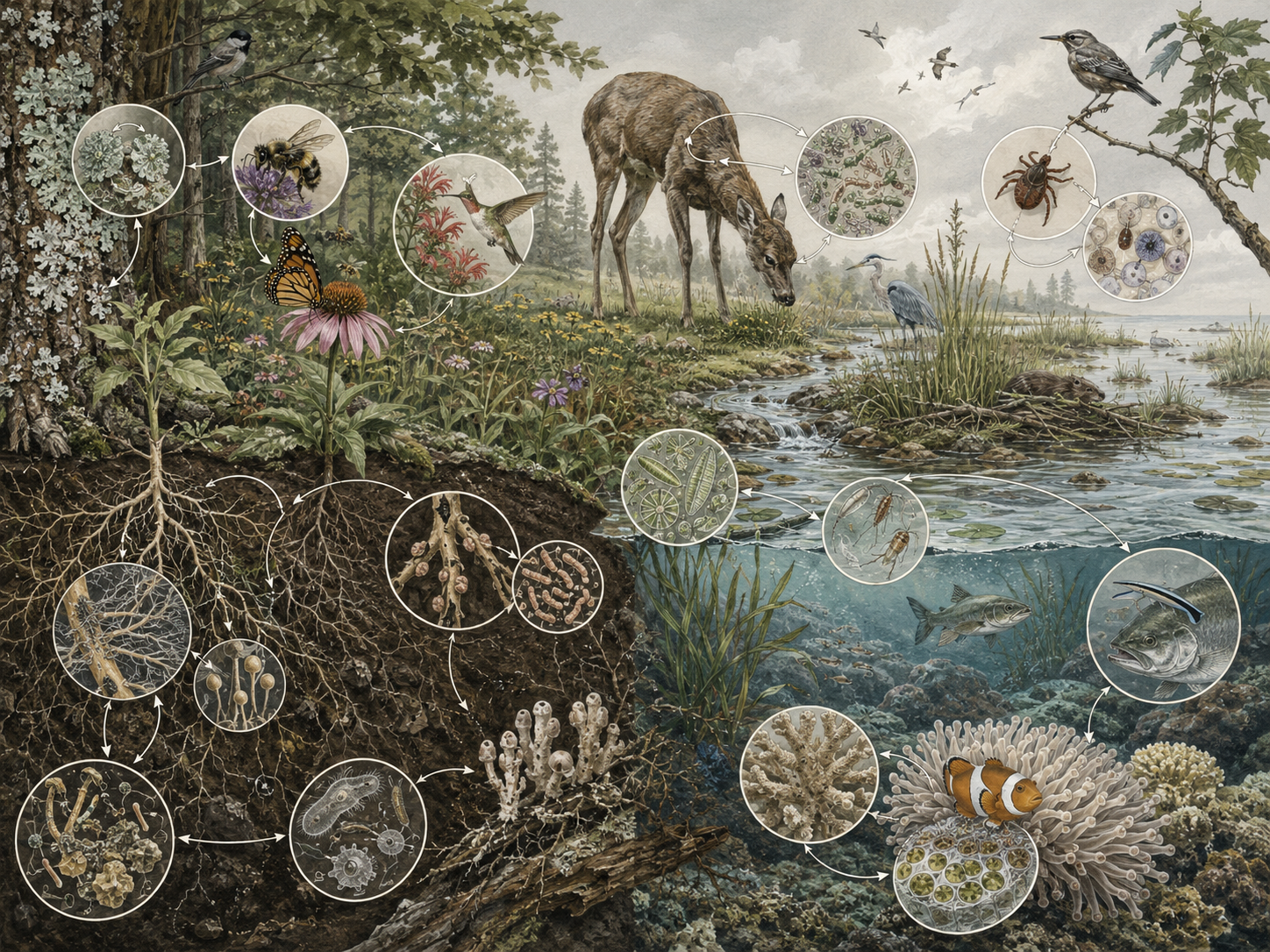
This article develops coevolution and symbiosis as a scale-spanning framework for understanding reciprocal biological change. It examines reciprocal selection, close association, mutualism, parasitism, commensalism, arms races, cooperative stabilization, host-symbiont integration, biological dependence, plant-animal interactions, marine symbiosis, host-microbe systems, development, conservation risk, disease ecology, bioinformatics, systems biology, and computational modeling.
The article is written for evolutionary biologists, ecologists, microbiologists, plant scientists, marine biologists, freshwater scientists, medical and environmental-health readers, disease ecologists, conservation practitioners, restoration ecologists, agroecologists, systems biologists, and computational biology readers who need a rigorous account of how reciprocal biological relationships shape adaptation, dependence, breakdown, and ecological resilience.
The article also extends coevolution into quantitative and computational biology through partner-frequency dynamics, payoff models, benefit-cost thresholds, host-symbiont interaction matrices, reciprocal frequency change, host-pathogen arms-race simulation, network dependency scoring, R workflows, Python workflows, SQL provenance structures, and a linked full-stack GitHub repository containing Python, R, Julia, Fortran, Rust, Go, C, C++, SQL, notebooks, data files, and reproducibility documentation.
What coevolution and symbiosis are
Coevolution refers to cases in which two or more species reciprocally affect one another’s evolution. The key idea is feedback. An evolutionary change in one lineage alters the selective environment of another lineage, which then feeds back into the first. That reciprocal structure is what makes coevolution distinct from one species merely adapting to an abiotic environment or taking advantage of another organism without eliciting a consequential evolutionary response in return.
Symbiosis refers to close association between species living in direct contact, often across extended periods and often with consequences large enough to shape physiology, development, ecology, and selection. Symbiosis is therefore not automatically harmonious. It includes mutualism, commensalism, and parasitism, and many real biological partnerships move along or across those categories as conditions change. The scientific usefulness of the concept lies precisely in its refusal to romanticize intimacy. Close association can generate cooperation, exploitation, accommodation, policing, conflict, dependence, and breakdown.
Taken together, coevolution and symbiosis explain why the living world is relational rather than merely organism-centered. Many traits, tissues, developmental systems, immune responses, ecological strategies, and evolutionary outcomes arise through sustained interaction among lineages rather than within isolated species alone. Biology becomes more accurate when it treats organisms not as independent units first and interacting entities second, but as systems partly constituted by historically repeated interaction.
Coevolution as reciprocal evolutionary change
The key feature of coevolution is reciprocity. Not every interaction between species is coevolutionary. One species may exploit a host, feed on a plant, or inhabit an ecological niche shaped by another lineage without producing a measurable selective response in return. Coevolution requires repeated biological feedback strong enough to alter trait frequencies, developmental tendencies, life-history schedules, or genomic architecture across interacting populations.
That feedback can take many forms. A flowering plant may evolve traits that alter pollinator behavior, while pollinators evolve sensory or morphological traits that affect plant reproduction. A host may evolve defenses against a parasite, while the parasite evolves ways around those defenses. A microbial symbiont may evolve traits that increase host dependence, while the host evolves mechanisms to recruit, regulate, or selectively tolerate the symbiont. Selection is therefore often distributed across lineages rather than contained within one species at a time.
Coevolution belongs near the foundation of evolutionary biology because it shows that environments are not only physical settings. They are also biological worlds made partly of other evolving organisms. For this reason, reciprocal change is relevant not only to natural history and comparative evolution but also to disease ecology, agroecology, conservation, and restoration, where the persistence of a species may depend on whether key coadapted partners remain present and functional.
Symbiosis and the spectrum of close association
Symbiosis is often introduced through three familiar categories: mutualism, commensalism, and parasitism. That tripartite framework remains useful because it distinguishes benefit, neutrality, and harm at least as starting points. But modern symbiosis research shows that these categories are not fixed boxes. A partnership that appears mutualistic under one nutrient regime, thermal state, host genotype, or community context may become neutral, unstable, or exploitative under another. Symbiosis is best understood not as a static label but as a structured relationship whose outcome depends on mechanism and context.
This broader framing matters because symbiosis complicates biological individuality. Organisms are often constituted by associations with microbes, nutritional partners, protective allies, reproductive manipulators, parasites, or metabolic complements. In such cases biology cannot be fully understood through the boundaries of a single genome or a visibly discrete body. Symbiosis raises serious questions about what counts as an organismal unit, how selection is partitioned across partners, and whether some traits are truly host traits, symbiont traits, or emergent traits of the association.
This is especially important in contemporary biology because host-microbe systems, microbiomes, coral symbioses, lichens, mycorrhizal associations, animal-bacterial partnerships, and other intimate relationships have shown that many living systems are historically layered consortia rather than solitary entities. Symbiosis is therefore not a marginal ecological curiosity. It is one of the main ways biological complexity is built and maintained.
Mutualism, parasitism, commensalism, and shifting relations
One of the most important lessons of modern symbiosis research is that these categories are often conditional rather than absolute. Mutual benefit may depend on nutrient availability, temperature, population density, partner abundance, community context, developmental stage, infection burden, or background stress. A symbiont that provides nutrients under scarcity may impose net cost under abundance. A microbe tolerated as part of a healthy microbiome may become pathogenic under immune compromise or ecological disturbance. A plant-fungal partnership may support growth in poor soil but become less favorable in enriched environments.
This matters because mutual change is often negotiated under constraint. Symbioses persist not because interests are perfectly aligned, but because biological mechanisms reduce the scope for destabilizing exploitation. Partner choice, host sanctions, spatial segregation, restricted transmission, reward allocation, developmental gating, immune filtering, or conditional resource exchange can all help stabilize beneficial association. Conversely, when these controls weaken, relationships may shift toward cheating, parasitism, or collapse.
Symbiosis is therefore not merely coexistence. It is structured negotiation under evolutionary pressure. This is one reason the subject matters to agroecology, microbiome science, disease ecology, reef biology, and restoration: the stability of interaction is often as important as the presence of the partners themselves.
Coevolutionary arms races and cooperative stabilization
Coevolution is often imagined through antagonistic arms races, and for good reason. Hosts and pathogens, predators and prey, parasites and defenses, and plants and herbivores may evolve reciprocal escalation in toxicity, resistance, immune recognition, counter-defense, deception, crypsis, or detection. In such systems reciprocal selection can generate rapid trait turnover, cyclical frequency change, and strong spatial variation in outcome. Antagonistic coevolution is especially important because it can maintain diversity, drive local adaptation, and create evolutionary instability that reverberates through populations and communities.
But coevolution can also stabilize cooperation. Mutualistic interactions may generate increasingly fine-tuned coordination if both partners gain by sustaining association and if exploitative alternatives are constrained. Pollination systems, nutrient exchange partnerships, defensive alliances, and host-microbiome filtering all show that reciprocal change need not culminate in escalation. It may also produce specialization, signal compatibility, metabolic complementarity, and partial integration.
The contrast between arms race and stabilization matters because coevolution is not a single emotional story of conflict or harmony. It is a dynamic process in which reciprocal change may produce escalation, accommodation, integration, oscillation, or breakdown depending on the biology of the partners, the spatial structure of populations, and the ecological conditions under which interaction unfolds.
Host-symbiont integration and biological dependence
Some of the most important symbioses generate deep forms of integration. In these systems the host is not merely tolerating a partner but is developmentally, physiologically, or immunologically organized to recruit, manage, and depend upon it. Symbionts may contribute nutrition, defense, signaling, developmental cues, or environmental tolerance in ways that make the host difficult to understand in isolation. In parallel, symbionts may evolve toward specialization within the host environment, reducing independence as free-living organisms.
This matters because dependence can become historically entrenched. Once host tissues, developmental schedules, immune filtering, or metabolic pathways begin to assume the presence of a recurring partner, the biology of both lineages changes. Mutual change is no longer just ecological interaction; it becomes partial integration. In some cases the association approaches a new level of biological organization in which function is distributed across partners and selection acts on the stability of the relationship itself.
Biology gains explanatory power when it treats such associations not as temporary ecological contacts but as systems of partial integration built through long reciprocal history. This is especially important in microbiome biology, marine symbiosis, mycorrhizal research, and host-microbe developmental studies, where the absence of the partner is not simply a missing ecological variable but a profound disruption of normal biological form.
Plant, animal, microbial, and marine examples of mutual change
Plant-pollinator systems, seed-dispersal associations, ant agriculture, host-microbe interactions, coral-algal partnerships, root-fungal exchange systems, and host-pathogen dynamics all illustrate mutual change. In pollination, floral morphology, timing, scent, color, nectar traits, and pollinator behavior may co-adjust across lineages. In herbivory, plant defense chemistry and herbivore counter-adaptation can produce reciprocal selective escalation or filtering of specialist interactions. In microbial systems, host immune defenses and pathogen evasion strategies may generate rapidly shifting regimes of resistance, virulence, and tolerance.
Marine systems are especially revealing because symbiosis often underwrites visible ecosystem function. Coral-associated partnerships, squid-bacterial systems, and other marine host-microbe interactions show that coadaptation can shape development, signaling, nutrient exchange, light management, and habitat persistence. Soil and plant systems are equally rich, because root-microbe interactions, fungal associations, nutrient exchange, nitrogen fixation, and herbivore-defense relations structure the functioning of terrestrial ecosystems. Freshwater systems add another layer through host-parasite dynamics, aquatic mutualisms, benthic microbial associations, and environmentally mediated disease processes.
These examples matter because they show that coevolution is not confined to one branch of biology. It is a general explanatory principle across terrestrial, freshwater, marine, microbial, plant, and host-associated systems. Reciprocal change is one of the great cross-cutting logics of life.
Coevolution, development, and biological form
Coevolution and symbiosis matter not only for ecology and evolutionary history but also for development. Some biological forms and functions emerge only because associated species are present at critical times. Host tissues may mature differently when symbionts colonize them. Developmental pathways may be tuned to microbial signals, nutritional exchange, or environmental cues generated by interacting partners. Immune education, tissue differentiation, metabolic readiness, and reproductive timing may all depend partly on relational inputs.
This is important because it extends coevolution beyond external ecology into organismal construction. Development is not always self-contained. In many systems it is historically shaped by the expected presence of other organisms. Symbiotic partners may influence morphology, immunity, metabolism, or reproductive function in ways that blur the line between environment and developmental architecture. Form can therefore be relationally produced rather than merely internally specified.
This makes coevolution relevant to Development, Differentiation, and the Making of Organisms as well as to symbiosis research proper. Biology becomes more accurate when it admits that some organisms are developmentally built in dialogue with other lineages.
Ecology, conservation, and systems risk
Coevolution and symbiosis are deeply relevant to ecology and conservation because many ecosystems depend on long-built interactions among species rather than just on species presence considered independently. Pollination networks, mycorrhizal associations, coral symbioses, gut microbial partnerships, nitrogen-fixing systems, host-defense alliances, and predator-prey dynamics all contribute to resilience, nutrient cycling, reproductive success, and ecological function. When such interactions are disrupted, the loss is not only taxonomic but relational.
This matters for conservation because protecting species without understanding their coevolved dependencies can produce shallow or unstable outcomes. A restored habitat may remain functionally incomplete if pollinators, microbial partners, mycorrhizal fungi, seed dispersers, or keystone antagonists are missing. Likewise, a species may persist numerically while losing the reciprocal interactions that stabilize its role in the ecosystem. Conservation biology therefore needs interaction history, not just species lists.
For systems thinking, coevolution reveals that ecosystems are not merely assemblages of separate organisms. They are layered histories of mutual adjustment, exploitation, accommodation, and dependence. Breakdown of those histories can produce nonlinear effects, including reproductive collapse, altered disease dynamics, trophic instability, and failed recovery under restoration or climate stress.
Marine, freshwater, soil, plant, and microbial relevance
Marine biology offers especially powerful examples of symbiosis and coevolution, from coral-associated partnerships and squid-bacterial systems to parasitic cycles and microbial ecological networks that regulate nutrient turnover and host performance. Such systems show that reciprocal evolutionary change can become a major component of physiology, ecological resilience, and habitat persistence. Reef decline, bleaching, pathogen spread, and altered water chemistry all reveal how fragile some long-built marine associations can be.
Freshwater systems likewise depend on host-microbe interactions, aquatic mutualisms, plant-animal relationships, parasite-host coadaptation, and environmentally sensitive transmission networks. Soil biology and plant science are perhaps even more coevolution-rich, because root-microbe interactions, mycorrhizal associations, nutrient exchange systems, rhizosphere signaling, and herbivore-defense relations structure terrestrial ecosystem function at nearly every level. Microbial systems are especially revealing because they show both antagonistic coadaptation and beneficial partnership under rapid generational turnover and intense selective feedback.
Agroecology, forestry, and restoration ecology all benefit from this perspective. Soil fertility, plant resilience, disease resistance, pollination stability, and ecological recovery often depend on restoring or sustaining the biological relationships through which systems actually function. The unit of concern is often not a species alone but a reciprocally structured association.
Medical, biomedical, and disease ecology relevance
Coevolution is foundational to medicine and disease ecology because hosts and pathogens continually shape one another’s evolution. Immune defenses, virulence strategies, resistance, tolerance, tissue tropism, and transmission dynamics all reflect reciprocal historical change. Emerging infectious threats, antimicrobial resistance, zoonotic spillover, and microbiome instability all become more intelligible when placed in a coevolutionary frame.
Biomedicine is also increasingly shaped by symbiosis, especially through microbiome research and host-associated microbial ecology. The recognition that host biology often includes deep microbial partnership has changed how immunity, metabolism, development, and disease susceptibility are understood. Health is not simply the absence of pathogens; it is often the regulated maintenance of complex host-associated communities under changing conditions.
Disease ecology extends this still further by showing that coevolution does not occur only within bodies, but across environmental transmission systems, communities, vectors, reservoirs, and altered habitats. This places coevolution in direct relation to Immunology and Biological Defense, Microbiology and the Hidden Majority of Life, and Animal Biology and the Organization of Complex Life. For medical and environmental-health readers, reciprocal biological change is not background theory. It is part of why disease systems remain dynamic, adaptive, and difficult to control.
Bioinformatics, systems biology, and computational relevance
Modern coevolution research increasingly depends on genomics, comparative phylogenetics, network reasoning, community analysis, and computational inference. Sequence comparisons can reveal correlated divergence, phylogenetic congruence, signatures of host-symbiont association, and patterns of repeated adaptation in recognition, defense, metabolism, or signaling. Computational methods also allow researchers to model partner frequencies, interaction matrices, transmission pathways, and stability conditions in large or data-rich systems.
Systems biology is equally important because symbioses often operate through networks of metabolism, signaling, immunity, environmental filtering, and ecological feedback. A host-symbiont system rarely depends on one trait alone. It often emerges from interacting pathways distributed across species and nested within communities. This makes coevolution one of the clearest places where historical biology, ecology, and systems analysis converge.
For computational readers, the subject is especially rich because reciprocal change provides analytically tractable yet biologically deep problems: frequency dependence, partner matching, sanctions, community assembly, evolutionary game structure, phylogenetic congruence, and nonlinear breakdown under environmental stress. Coevolution is one of the best domains in which to connect theory with living complexity.
Quantitative coevolution: mathematics, R, and Python
Coevolution and symbiosis are not only conceptual. They can also be approached quantitatively through changes in partner frequencies, interaction outcomes, transmission dynamics, network dependence, and comparative divergence. The goal of modeling is not to reduce biological relationship to a toy payoff matrix, but to clarify how reciprocal dependence, sanctions, compatibility, cheating, and environmental change alter system behavior.
Partner frequency and reciprocal feedback
For a two-type system one may begin with the familiar frequency relation:
p+q=1
\]
Interpretation: \(p\) and \(q\) are frequencies of alternative host or symbiont types. This is useful because coevolution often begins with changing frequencies of traits in interacting populations.
If partner-dependent fitness differs among types, the next-generation frequency of a type can be expressed in standard selection form:
p’=\frac{pW_p}{\bar{W}}
\]
Interpretation: \(W_p\) is the fitness of type \(p\), and \(\bar{W}\) is mean population fitness. This makes explicit that the fate of a trait depends not only on its own baseline value but on how interaction structure modifies relative success.
Simple interaction payoff
A minimal expression for partner-dependent performance can be written as:
W_i=W_0+\beta I
\]
Interpretation: \(W_i\) is the fitness-related outcome for type \(i\), \(W_0\) is baseline performance, \(\beta\) is the strength of interaction, and \(I\) is a simplified interaction term such as compatible partner prevalence, sanction intensity, or symbiont abundance. This is not a complete ecological model, but it makes explicit that success may depend on partner state.
Host-symbiont dynamics under cost and benefit
A slightly richer model treats net host performance as benefit minus symbiont cost:
H_{net}=H_0+bS-cS
\]
Interpretation: \(H_0\) is baseline host performance, \(S\) is symbiont prevalence or load, \(b\) is benefit per unit symbiont effect, and \(c\) is cost. When \(b>c\), association is net beneficial. When \(c>b\), the same relationship can become net costly. This captures one of the core insights of modern symbiosis research: outcome depends on context, not label alone.
Interaction networks and dependency risk
Many coevolutionary systems involve more than two species. A plant may depend on multiple pollinators, a pollinator may serve multiple plants, and a host may interact with many microbial partners. A simple weighted dependency score for node \(i\) can be written as:
D_i=\sum_{j=1}^{n}w_{ij}r_j
\]
Interpretation: \(w_{ij}\) is the interaction weight between species \(i\) and partner \(j\), and \(r_j\) is the reliability, persistence, or functional condition of partner \(j\). This helps translate relational ecology into a screening question: how exposed is a species or function to partner decline?
Worked example: simple partner effect
Suppose a host’s baseline success is \(W_0=1.0\), the interaction coefficient is \(\beta=0.3\), and compatible symbiont prevalence is \(I=0.5\). Then:
W_i=1.0+0.3(0.5)=1.15
\]
Interpretation: The host’s simplified performance metric rises to 1.15 under the assumed interaction. Real systems are more complex, but the example shows how partner-dependent biology can be formalized rather than treated only verbally.
R and Python workflows
The following examples are compact article-level workflows. The full GitHub repository expands them into richer multi-language implementations with SQL provenance, validation notes, partner-frequency dynamics, benefit-cost threshold screening, reciprocal frequency change, host-pathogen arms-race simulation, mutualistic network dependency scoring, relationship-state classification, and reproducible computational coevolution scaffolding.
R example: context-dependent mutualism and breakdown screening
# Context-dependent host-symbiont outcome screening.
#
# This workflow shows how a relationship that is beneficial under one
# context can become neutral or costly when environmental stress changes
# the balance between benefit and cost.

library(dplyr)

env <- tibble(
  stress = seq(0, 1, by = 0.02)
) %>%
  mutate(
    benefit = 0.8 - 0.3 * stress,
    cost = 0.2 + 0.4 * stress,
    net_effect = benefit - cost,
    relationship_state = case_when(
      net_effect > 0.05 ~ "beneficial",
      net_effect >= -0.05 ~ "near_neutral",
      TRUE ~ "costly"
    )
  )

threshold <- env %>%
  filter(net_effect <= 0) %>%
  slice(1)

print(head(env))
print(threshold)
This workflow is useful for ecologists, microbiome researchers, and restoration practitioners because it makes explicit how a relationship categorized as mutualistic can become neutral or damaging when environmental context shifts.
R example: two-population reciprocal frequency change
# Simplified reciprocal frequency model for host and symbiont compatibility.
#
# This is not a full evolutionary model. It is a compact teaching scaffold
# showing how interacting traits can converge, lag, or remain offset.

library(dplyr)

time <- 0:40
host_match <- numeric(length(time))
symbiont_match <- numeric(length(time))

host_match[1] <- 0.4
symbiont_match[1] <- 0.5

for (t in 2:length(time)) {
  host_match[t] <- min(
    max(host_match[t - 1] + 0.08 * (symbiont_match[t - 1] - host_match[t - 1]), 0),
    1
  )

  symbiont_match[t] <- min(
    max(symbiont_match[t - 1] + 0.10 * (host_match[t - 1] - symbiont_match[t - 1]), 0),
    1
  )
}

df <- tibble(
  time = time,
  host_match = host_match,
  symbiont_match = symbiont_match,
  mismatch = abs(host_match - symbiont_match)
)

print(df)
This simple reciprocal update is useful for demonstrating how interacting traits can converge, lag, or remain offset depending on the strength of feedback between partners.
Python example: host-symbiont benefit-cost simulation
import numpy as np
import pandas as pd

stress = np.linspace(0, 1, 51)

benefit = 0.8 - 0.3 * stress
cost = 0.2 + 0.4 * stress
net_effect = benefit - cost

df = pd.DataFrame(
    {
        "stress": stress,
        "benefit": benefit,
        "cost": cost,
        "net_effect": net_effect,
    }
)

df["relationship_state"] = np.where(
    df["net_effect"] > 0.05,
    "beneficial",
    np.where(df["net_effect"] >= -0.05, "near_neutral", "costly"),
)

print(df.head())
print(df[df["net_effect"] <= 0].head(1))
This workflow translates context dependence into a directly inspectable threshold problem: under what environmental conditions does a beneficial association become costly?
Python example: simple coevolutionary infection dynamics
import numpy as np
import pandas as pd

def simulate_host_pathogen(
    steps=60,
    host_defense=0.4,
    pathogen_escape=0.5,
    feedback=0.03,
):
    """Simulate simplified reciprocal adjustment between host defense and pathogen escape."""

    records = []
    host = host_defense
    pathogen = pathogen_escape

    for time in range(steps + 1):
        infection_pressure = max(pathogen - host, 0)

        records.append(
            {
                "time": time,
                "host_defense": host,
                "pathogen_escape": pathogen,
                "infection_pressure": infection_pressure,
            }
        )

        host = min(max(host + feedback * infection_pressure, 0), 1)
        pathogen = min(max(pathogen + feedback * max(host - pathogen, 0), 0), 1)

    return pd.DataFrame(records)

df = simulate_host_pathogen()

print(df.head(15))
This simplified workflow supports a common disease-ecology line of reasoning: reciprocal adjustment between defense and escape can produce changing infection pressure even without a fully parameterized epidemiological model.
Python example: dependency risk in a mutualistic network
import pandas as pd

interactions = pd.DataFrame(
    [
        {"focal": "plant_a", "partner": "pollinator_1", "weight": 0.50, "partner_reliability": 0.80},
        {"focal": "plant_a", "partner": "pollinator_2", "weight": 0.30, "partner_reliability": 0.45},
        {"focal": "plant_a", "partner": "pollinator_3", "weight": 0.20, "partner_reliability": 0.70},
        {"focal": "plant_b", "partner": "pollinator_1", "weight": 0.20, "partner_reliability": 0.80},
        {"focal": "plant_b", "partner": "pollinator_4", "weight": 0.80, "partner_reliability": 0.30},
    ]
)

interactions["weighted_support"] = (
    interactions["weight"] * interactions["partner_reliability"]
)

dependency = (
    interactions.groupby("focal")
    .agg(
        dependency_support=("weighted_support", "sum"),
        partner_count=("partner", "count"),
    )
    .reset_index()
)

dependency["risk_class"] = dependency["dependency_support"].apply(
    lambda score: "high_risk" if score < 0.45 else "moderate_risk" if score < 0.65 else "lower_risk"
)

print(dependency)
This workflow is useful for conservation and restoration screening because it turns “missing partners” into a measurable interaction-risk problem. It can be extended with empirical pollination data, mycorrhizal colonization, host-symbiont dependence, or food-web interaction matrices.
These examples remain compact enough for an article, but they point toward the kinds of workflows scientists actually use: benefit-cost threshold screening, reciprocal frequency modeling, host-pathogen adjustment, relationship-state classification, mutualistic network scoring, and explicit analysis of how interaction structure shapes biological outcome.
GitHub repository
The article body includes compact R and Python examples so the biological and scientific argument remains readable. The full repository expands those examples into a broader computational coevolution workflow, including partner-frequency dynamics, benefit-cost threshold screening, reciprocal frequency change, host-pathogen arms-race simulation, mutualistic network dependency scoring, relationship-state classification, SQL provenance structures, reproducible data files, and full-stack scientific-computing examples across Python, R, Julia, Fortran, Rust, Go, C, C++, SQL, and notebooks.
Limits, uncertainty, and modern relational thinking
Coevolution and symbiosis are powerful concepts, but they should not be used loosely. Not every ecological interaction is coevolutionary, and not every close association is stable, beneficial, or evolutionarily integrated. Reciprocal evolutionary influence must be demonstrated rather than assumed. Likewise, apparent specialization does not by itself prove long-term coadaptation, and phylogenetic congruence does not always guarantee direct reciprocal selection. Parallel responses to shared environment, community filtering, and historical contingency may produce patterns that look coevolutionary without fully being so.
Symbiosis should not be romanticized. Close association includes parasitism and commensalism as well as mutualism. Some partnerships are unstable, some context-dependent, some exploitative despite superficial coordination, and some beneficial only under narrow environmental conditions. This is especially important in an era of warming, eutrophication, acidification, habitat fragmentation, altered nutrient regimes, antibiotic exposure, and large-scale ecological disturbance, all of which can destabilize associations once assumed to be robust.
Models are useful because they clarify assumptions, expose mechanisms, and make scenario comparison possible. But a payoff matrix is not a coral reef, a benefit-cost threshold is not a microbiome, and a network score is not a complete conservation diagnosis. Quantitative tools are strongest when they support biological interpretation rather than replacing it.
Modern biology is strongest when it treats mutual change as historically real, mechanistically complex, and distributed across networks of cooperation and conflict rather than reducing it to simple stories of harmony. Relational thinking gains power not by exaggerating intimacy, but by specifying feedback, mechanism, scale, and uncertainty.
Why this matters for scientific work
For working scientists, coevolution and symbiosis matter because many biological questions are misframed when organisms are treated as independent units. A restoration failure may reflect missing fungal, microbial, or pollinator partners rather than poor planting alone. A disease problem may reflect host-pathogen coadaptation, reservoir structure, or microbiome disruption rather than a pathogen acting in isolation. A conservation crisis may involve the loss of reciprocal interactions before the disappearance of species themselves becomes obvious. A developmental phenotype may depend partly on symbiotic cues that were never measured.
This means coevolution should often be treated as explanatory infrastructure rather than as an advanced topic reserved for specialists. Ecologists need it to understand community stability and interaction structure. Conservation biologists need it because species persistence often depends on reciprocal histories. Marine and freshwater scientists need it because symbiotic breakdown can reorganize whole systems. Medical professionals and disease ecologists need it because reciprocal adaptation underlies virulence, resistance, tolerance, and microbiome-mediated health. Computational biologists need it because it offers analytically rich systems in which feedback, dependence, and historical contingency are central rather than peripheral.
The scientific importance of coevolution lies partly in this breadth. It is one of the main ways biology moves beyond listing organisms toward explaining why living systems take the forms they do, why they persist, and why they sometimes unravel.
Conclusion
Coevolution, symbiosis, and the dynamics of mutual change show that life evolves in relation. Species reshape one another’s selective environments, enter close partnerships that range from beneficial to exploitative, and build long histories of dependence, conflict, accommodation, and integration. Through these processes, ecological interactions become evolutionary history.
To understand coevolution is therefore to understand one of the deepest ways biology moves beyond isolated organisms. To understand symbiosis is to see that many living systems are composed through association rather than mere independence. Together, these ideas explain why cooperation and conflict, host and symbiont, organism and microbiome, plant and pollinator, prey and predator all belong to one history of reciprocal transformation. That is why coevolution and symbiosis remain central not only to evolutionary biology, but also to ecology, conservation, microbiology, plant science, marine and freshwater biology, disease ecology, medicine, and biotechnology.
Coevolution is thus more than interaction extended through time. It is one of the principal ways biology explains how living systems become historically entangled.
Related articles
- Biology
- Natural Selection, Adaptation, and Fitness
- Speciation, Diversity, and the Tree of Life
- Extinction, Contingency, and Biological Transformation
- Evolution and the History of Life
- Microevolution, Macroevolution, and Deep Time
- Ecology and the Interdependence of Life
- Plant Biology and the Life of Primary Producers
- Animal Biology and the Organization of Complex Life
- Microbiology and the Hidden Majority of Life
- Fungi and the Networks of Decomposition and Exchange
- Immunology and Biological Defense
- Restoration Ecology and the Repair of Living Systems
Further reading
- Thompson, J.N. (2005) The Geographic Mosaic of Coevolution. Chicago: University of Chicago Press. Publisher information available at: https://press.uchicago.edu/ucp/books/book/chicago/G/bo3533766.html
- Bronstein, J.L. (ed.) (2015) Mutualism. Oxford: Oxford University Press. Publisher information available at: https://global.oup.com/academic/product/mutualism-9780199675654
- Janzen, D.H. (1980) ‘When is it coevolution?’, Evolution, 34(3), pp. 611–612. Available at: https://academic.oup.com/evolut/article/34/3/611/6871303
- Sachs, J.L., Skophammer, R.G. and Regus, J.U. (2011) ‘Evolutionary transitions in bacterial symbiosis’, Proceedings of the National Academy of Sciences, 108(Supplement 2), pp. 10800–10807. Available at: https://www.pnas.org/doi/10.1073/pnas.1100304108
- Herre, E.A., Knowlton, N., Mueller, U.G. and Rehner, S.A. (1999) ‘The evolution of mutualisms: exploring the paths between conflict and cooperation’, Trends in Ecology & Evolution, 14(2), pp. 49–53. Available at: https://doi.org/10.1016/S0169-5347(98)01529-8
- McFall-Ngai, M. (2014) ‘Divining the essence of symbiosis: insights from the squid-Vibrio model’, PLOS Biology, 12(2), e1001783. Available at: https://journals.plos.org/plosbiology/article?id=10.1371/journal.pbio.1001783
- Kiers, E.T. et al. (2003) ‘Host sanctions and the legume-rhizobium mutualism’, Nature, 425, pp. 78–81. Abstract information available at: https://ui.adsabs.harvard.edu/abs/2003Natur.425…78K/abstract
- Werner, G.D.A. et al. (2018) ‘Symbiont switching and alternative resource acquisition strategies drive mutualism breakdown’, Proceedings of the National Academy of Sciences, 115(20), pp. 5229–5234. Available at: https://doi.org/10.1073/pnas.1721629115
- West, S.A., Kiers, E.T., Simms, E.L. and Denison, R.F. (2002) ‘Sanctions and mutualism stability: why do rhizobia fix nitrogen?’, Proceedings of the Royal Society B, 269(1492), pp. 685–694. Abstract information available at: https://pubmed.ncbi.nlm.nih.gov/11934359/
References
- Bronstein, J.L. (ed.) (2015) Mutualism. Oxford: Oxford University Press. Publisher information available at: https://global.oup.com/academic/product/mutualism-9780199675654
- Herre, E.A., Knowlton, N., Mueller, U.G. and Rehner, S.A. (1999) ‘The evolution of mutualisms: exploring the paths between conflict and cooperation’, Trends in Ecology & Evolution, 14(2), pp. 49–53. Available at: https://doi.org/10.1016/S0169-5347(98)01529-8
- Janzen, D.H. (1980) ‘When is it coevolution?’, Evolution, 34(3), pp. 611–612. Available at: https://doi.org/10.1111/j.1558-5646.1980.tb04849.x
- Kiers, E.T., Rousseau, R.A., West, S.A. and Denison, R.F. (2003) ‘Host sanctions and the legume-rhizobium mutualism’, Nature, 425, pp. 78–81. Abstract information available at: https://ui.adsabs.harvard.edu/abs/2003Natur.425…78K/abstract
- McFall-Ngai, M. (2014) ‘Divining the essence of symbiosis: insights from the squid-Vibrio model’, PLOS Biology, 12(2), e1001783. Available at: https://doi.org/10.1371/journal.pbio.1001783
- Nuismer, S.L. (2017) Introduction to Coevolutionary Theory. New York: W.H. Freeman. Bibliographic information available at: https://search.worldcat.org/title/954201020
- Sachs, J.L., Skophammer, R.G. and Regus, J.U. (2011) ‘Evolutionary transitions in bacterial symbiosis’, Proceedings of the National Academy of Sciences, 108(Supplement 2), pp. 10800–10807. Available at: https://doi.org/10.1073/pnas.1100304108
- Thompson, J.N. (2005) The Geographic Mosaic of Coevolution. Chicago: University of Chicago Press. Publisher information available at: https://press.uchicago.edu/ucp/books/book/chicago/G/bo3533766.html
- Van Valen, L. (1973) ‘A new evolutionary law’, Evolutionary Theory, 1, pp. 1–30. Bibliographic context available at: https://novel-coronavirus.onlinelibrary.wiley.com/doi/abs/10.1038/npg.els.0001667
- Werner, G.D.A., Cornelissen, J.H.C., Cornwell, W.K., Soudzilovskaia, N.A., Kattge, J., West, S.A. and Kiers, E.T. (2018) ‘Symbiont switching and alternative resource acquisition strategies drive mutualism breakdown’, Proceedings of the National Academy of Sciences, 115(20), pp. 5229–5234. Available at: https://doi.org/10.1073/pnas.1721629115
- West, S.A., Kiers, E.T., Simms, E.L. and Denison, R.F. (2002) ‘Sanctions and mutualism stability: why do rhizobia fix nitrogen?’, Proceedings of the Royal Society B, 269(1492), pp. 685–694. Abstract information available at: https://pubmed.ncbi.nlm.nih.gov/11934359/
- Yamamura, N. (1993) ‘Vertical transmission and evolution of mutualism from parasitism’, Theoretical Population Biology, 44(1), pp. 95–109. Available at: https://doi.org/10.1006/tpbi.1993.1020