
Last Updated May 4, 2026
Greek & Roman Medicine examines the healing traditions of the classical Mediterranean through theories of the body, balance, regimen, environment, diagnosis, prognosis, anatomy, pharmacology, surgery, public health, military care, medical ethics, temple healing, household remedies, and the long transmission of classical medical knowledge across Byzantine, Syriac, Islamic, and European intellectual worlds. As a major category within the Healing Traditions knowledge series, it studies Greek and Roman medicine first through primary sources, medical corpora, material culture, sanctuary evidence, archaeological remains, philosophical writings, pharmacological texts, military institutions, and the lived conditions of ancient bodies, and only after that through modern scholarship.
In the history of ideas, Greek and Roman medicine contributed major conceptions of health as equilibrium, disease as disorder, and healing as a disciplined art grounded in observation, reasoning, bodily management, and the relationship between nature, habit, environment, and human flourishing. It did not produce a single medical doctrine. It generated a complex field: Hippocratic observation, humoral theory, dietetics, prognosis, medical ethics, Hellenistic anatomy, pharmacology, surgery, Roman baths and sanitation, military medicine, temple healing, household care, and Galenic system-building. These practices and theories did not replace older sacred healing all at once. They developed within a plural therapeutic world in which sanctuaries, dreams, offerings, physicians, herbs, regimen, surgery, baths, and philosophical reflection often coexisted.
This category explores Hippocratic medicine, Galenic authority, humoral theory, dietetics, anatomy, physiology, medical sects, pharmacology, surgery, women’s health, reproductive medicine, temple healing, public health, Roman urban infrastructure, military medicine, slavery and unequal access to care, medical writing, archaeology, and the long afterlife of classical medicine. It considers how Greek and Roman physicians understood bodily temperament, climate, food, exercise, sleep, age, emotion, sex difference, labor, status, environment, and place, while also tracing how medical knowledge became textual, institutional, philosophical, and transmissible across civilizations.
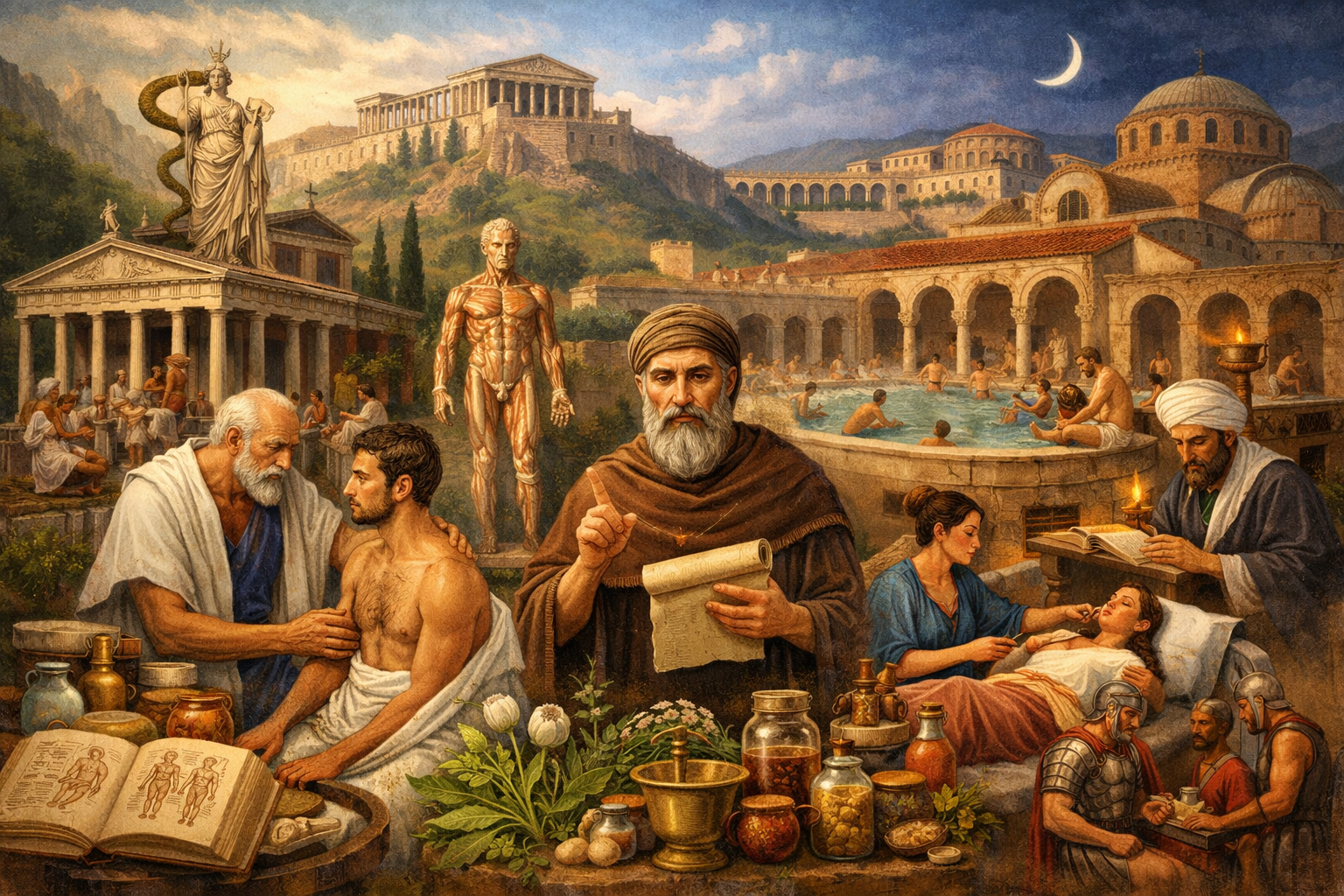
Greek and Roman medicine matters because it helped define one of the most influential ways of thinking about health in world history: the body as an ordered whole, disease as imbalance or disturbance, and healing as a disciplined art of observation, regimen, prognosis, and practical judgment. Classical medicine did not simply offer remedies. It offered a way of seeing the human organism in relation to diet, climate, age, temperament, labor, place, sleep, exercise, emotion, social status, and habit. That intellectual habit of connecting bodily states to broader natural and social conditions gave ancient medicine much of its lasting power.
This category is especially important to the broader architecture of this site because it connects Healing Traditions to Ancient Near Eastern and Mediterranean Healing Traditions, Healing Spaces, Baths & Sacred Environments, Herbalism & Traditional Knowledge, Islamic Medicine, Religious Studies, Greek and Roman Thought, Ethics & Moral Philosophy, Biology, Environmental Science, and Diet, Nourishment & Food as Medicine. It shows how healing became a field of knowledge, practice, ethics, civic infrastructure, and philosophical reflection.
The goal of this pillar is not to treat classical medicine as modern medicine in embryonic form, nor to romanticize ancient theories whose physiological assumptions are now outdated. It is to understand Greek and Roman medicine as a powerful civilizational system of care: observational, textual, philosophical, environmental, practical, institutional, and socially unequal. Classical medicine was not only what physicians wrote. It also lived in sanctuaries, baths, households, military camps, cities, athletic spaces, women’s reproductive care, pharmacological trade, and the material practices through which bodies were fed, trained, treated, disciplined, and interpreted.
Why This Series Matters
Greek and Roman medicine matters because it helped define one of the most influential ways of thinking about health in world history. The body was interpreted as an ordered whole. Disease was understood as disorder, imbalance, disturbance, excess, deficiency, corruption, crisis, or misalignment. Healing was imagined as an art of disciplined observation joined to practical judgment. Classical physicians did not merely apply remedies. They read signs, tracked disease processes, managed habits, advised regimen, judged prognosis, and situated the patient within a wider natural and social environment.
This series also matters because Greek and Roman medicine stands at the intersection of science, philosophy, ethics, religion, environment, and social life. Hippocratic writings emphasize prognosis, regimen, and attentive case observation. Hellenistic medicine expands anatomical inquiry. Roman medicine places healing within cities, armies, baths, households, and imperial institutions. Galen then gives classical medicine one of its most durable systematizing voices, joining anatomy, physiology, logic, causation, ethics, and philosophical argument into a medical architecture that shaped later civilizations for centuries.
At the same time, Greek and Roman medicine should never be reduced to great male authors alone. It also involved midwives, attendants, enslaved caregivers, household remedies, women’s reproductive labor, military surgeons, pharmacological trade, temple visitors, bath workers, athletes, patients, votive offerings, inscriptions, tools, water systems, and the practical work of sustaining bodies under ordinary and extreme conditions. Its social world was broad, uneven, and deeply material.
For that reason, Greek and Roman medicine should be read as both a history of knowledge and a history of care. It illuminates how ancient societies connected suffering to environment, ethics to regimen, civic order to sanitation, war to trauma, and healing to both natural explanation and sacred hope. Its afterlife in Byzantine, Syriac, Islamic, and later European traditions gives it a central place in the long civilizational history of medicine.
The Intellectual Frame of Greek & Roman Medicine
Greek and Roman medicine should be understood not as a single doctrine but as a large and evolving field of healing thought within the classical Mediterranean. It includes temple healing, Hippocratic clinical observation, humoral theory, dietetics, anatomy, surgery, pharmacology, Roman sanitation, military medicine, household therapeutics, and Galenic system-building. Greek physicians helped move medicine toward naturalistic explanation, while Roman contexts gave medicine new institutional settings in cities, armies, baths, roads, and imperial administration.
This broader frame matters because medicine in antiquity was both practical and civilizational. It shaped how people thought about food, seasons, exercise, rest, passions, aging, reproduction, urban environments, and the responsibilities of physicians. It also became one of the great transmitted bodies of ancient knowledge, passing into Byzantine, Syriac, Islamic, and later European traditions through translation, commentary, correction, and reuse.
A serious understanding must hold several dimensions together at once: medicine as theory, medicine as regimen, medicine as technical intervention, medicine as moral profession, medicine as social institution, and medicine as an evolving archive of texts, practices, debates, spaces, bodies, and material evidence. Greek and Roman medicine was never only one thing. It was an ecosystem of healing thought and practice.
That ecosystem also had limits. Classical medicine preserved powerful observational habits, but it also carried erroneous physiological assumptions, gendered and hierarchical interpretations of the body, unequal access to care, and theories that later hardened into inherited authority. Its importance lies not in being right about everything, but in showing how a civilization built a disciplined, transmissible, ethically charged, and deeply influential way of interpreting health.
Before Hippocrates: Sacred Healing and the Medical Background of Greece
A strong account of Greek medicine should begin before Hippocrates. Greek healing did not emerge all at once as a fully naturalized science. It developed in a world where sanctuaries, ritual, divine associations, dream incubation, inherited healing lineages, purification, offerings, and sacred spaces remained central. Asclepius, one of the great healing figures of antiquity, and the Asclepiads as hereditary or professional healing lineages form part of the background against which more explicitly rational medical writing emerged.
This background matters because classical medicine did not move in a simple line from “magic” to “science.” Sacred healing, household remedies, practical care, and naturalistic explanation coexisted. Patients might consult a physician, visit a sanctuary, use herbs, pray, sleep in a healing precinct, bathe, make offerings, and alter their diet without experiencing these practices as mutually exclusive. Ancient therapeutic life was plural.
The emergence of more naturalistic medicine was therefore a development within a larger healing culture, not an absolute break from it. Hippocratic and later medical writers often distinguished their methods from divine or miraculous explanations, but sacred healing remained socially important. The classical Mediterranean remained a world in which healing involved both nature and the gods, both regimen and ritual, both written medicine and public testimony of cures.
For this pillar, that plural beginning is essential. It prevents a triumphalist story in which Greek medicine becomes modernity before its time. Instead, Greek and Roman medicine appears as a complex tradition negotiating the relationship between sacred hope, bodily observation, philosophical explanation, practical care, and social trust.
Alcmaeon and Early Greek Medical Naturalism
Alcmaeon of Croton deserves explicit place in the architecture of the field. He stands near the border of medicine and Presocratic natural philosophy and is one of the early figures through whom Greek thought begins to treat bodily processes, sensation, and health in naturalistic terms. Whether understood as physician, philosopher-scientist, or both, Alcmaeon helps mark the transition from sacred and traditional healing toward explanatory medicine grounded in nature, opposition, and bodily order.
His significance lies less in one isolated doctrine than in the larger intellectual movement he represents: the search to account for life, sensation, disease, and health through processes internal to the body and its relation to the world. In that sense, Alcmaeon belongs to the prehistory of systematic medicine. He helps show that medicine was developing alongside philosophy, cosmology, and inquiry into nature.
Early Greek medical naturalism matters because it shifts the explanatory center of illness. Instead of treating disease only as divine attack or ritual danger, naturalistic approaches ask how bodily processes, environmental conditions, and internal balances produce sickness. This does not eliminate religion from healing life, but it creates a new kind of medical authority: the healer as reader of nature.
This transition should be treated carefully. Naturalism did not mean modern mechanism. It meant that the body could be explained through patterns, oppositions, mixtures, qualities, and processes belonging to nature. The physician’s authority began to depend on the ability to reason about those patterns.
Medicine, Nature, and the Order of the Body
A central contribution of Greek medicine is the idea that the body should be understood through nature rather than solely through supernatural intervention. Illness, on this view, has causes, patterns, rhythms, and observable manifestations. The physician’s task is to read the body’s signs, understand processes of imbalance, and restore order where possible. This naturalizing move is one of the defining achievements of classical medicine.
Yet the concept of nature in Greek and Roman medicine was never merely mechanical. Nature implied process, tendency, constitution, order, and sometimes purpose. To heal the body often meant to assist or guide nature, to read its rhythms correctly, and to avoid interventions that violated its course. Classical medicine therefore joined practical care to a larger ontology of bodily order.
This also explains why regimen became so central. If the body belongs to nature, then food, sleep, exercise, climate, season, age, sex, labor, and emotion are not external variables. They are part of the body’s ongoing relation to the world. Health is not only a state inside the skin; it is a managed relationship between body and environment.
This view remains historically powerful even where specific ancient theories are outdated. Classical medicine gives the history of healing one of its most enduring claims: the body must be interpreted in relation to the conditions of life.
Hippocratic Medicine: Observation, Regimen, and Prognosis
Hippocratic medicine is especially important for its emphasis on close observation, prognosis, and regimen. Rather than promising miraculous cures, Hippocratic physicians often focused on tracking symptoms, anticipating the likely course of disease, and managing the patient’s life through diet, rest, fluids, exercise, bathing, timing, and moderation. In this sense, classical medicine is as much about disciplined interpretation as intervention.
Prognosis mattered because it allowed the physician to demonstrate judgment, prepare patients and families for likely outcomes, and situate treatment within the unfolding temporality of illness. Classical medicine therefore gave unusual attention to disease as a process, not merely a static condition. Symptoms changed, crises occurred, turning points mattered, and the physician’s credibility depended partly on anticipating what would happen next.
Observation also had ethical force. The physician had to be attentive, restrained, serious, and careful in speech. The patient’s condition had to be interpreted over time. Medicine became a practice of watching, remembering, comparing, and judging. This is one reason Hippocratic medicine became such a durable model: it connected knowledge to disciplined conduct.
For this pillar, Hippocratic medicine should not be treated only as a set of doctrines. It is a model of medical practice: observation, prognosis, regimen, professional identity, and written reflection on the art of healing.
The Hippocratic Corpus as a Medical Archive
The Hippocratic Corpus is not the work of a single author, but a collection of many medical texts associated with the Hippocratic tradition. It covers diverse topics, audiences, methods, and even conflicting perspectives, which makes it less a single doctrine than a medical archive of classical practice, theory, and reflection. Its importance lies not only in individual ideas but in the emergence of medicine as a written, teachable, and critically transmissible discipline.
Because the corpus preserves plurality rather than uniformity, it reveals the medical world of antiquity as internally diverse. It contains reflections on ethics, regimen, epidemics, environment, reproduction, surgery, professional conduct, prognosis, and disease interpretation. The corpus shows medicine becoming textualized without becoming intellectually closed.
This matters for the history of knowledge. Medical writing allows cases, observations, arguments, and techniques to be preserved beyond immediate practice. It also allows disagreement. A written corpus can become a site of teaching, debate, revision, and authority. Medicine becomes not only what a healer does at the bedside, but what a community of practitioners reads, copies, interprets, and transmits.
A dedicated article on the Hippocratic Corpus should therefore treat it as an archive of medical pluralism. Its importance is not that it gives one seamless Hippocratic doctrine, but that it shows Greek medicine becoming a disciplined field of writing, observation, and argument.
Humoral Theory, Balance, and Temperament
Few ideas are more identified with Greek and Roman medicine than humoral theory. The doctrine of the humors treated health as a condition of balance among bodily fluids and disease as a form of disequilibrium. Humoral theory also shaped classical ideas of temperament, constitution, age, season, sex difference, and the relation between physical and psychological states. However limited its physiological basis appears now, it provided an enduring framework for diagnosis, regimen, and therapeutic reasoning across many centuries.
Its historical importance lies partly in its capacity to connect the body to climate, food, season, age, labor, emotion, place, and habit. Humoralism offered a way to interpret both acute disturbance and long-term constitution. A fever, melancholic disposition, digestive problem, seasonal illness, or reproductive condition could be understood through the language of qualities, mixtures, and balance.
The theory also had social consequences. Because humoral thinking linked body and character, it could support moralized readings of temperament, gender, ethnicity, age, and social role. It provided a language for care and regulation, but also a language for hierarchy and stereotype. A mature pillar must therefore treat humoralism as both a medical model and a cultural system.
Humoral theory’s long afterlife in Islamic, medieval European, and early modern medicine makes it one of the central bridges between antiquity and later healing traditions. It is one of the most consequential ideas in the global history of medicine, even where modern physiology has displaced it.
Airs, Waters, Places: Climate and Environment
Greek medicine linked health to environment. Climate, winds, water, season, geography, and civic setting were thought to affect both the incidence of disease and the constitution of bodies. This environmental orientation gave classical medicine a broad ecological dimension: bodily health could not be understood apart from place. In that respect, ancient medicine connected physiology, geography, and public life in ways that remain conceptually rich.
The environmental imagination of classical medicine is important because it treats the body as situated. Water quality, seasonal variation, air, settlement patterns, diet, and local climate all matter. The physician must therefore read not only the patient but the place in which the patient lives. The body is a local body, shaped by habitation.
This environmental sensitivity also had problematic dimensions. Ancient writers sometimes linked climate and geography to character, constitution, and cultural difference in ways that could become ethnographic stereotype. A serious treatment should recognize both the ecological sophistication and the cultural dangers of such reasoning.
For this site’s wider architecture, this section creates a strong link between Greek and Roman Medicine, Environmental Science, Religion and Ecology, and Healing Spaces. Classical medicine reminds us that health has long been understood as inseparable from air, water, place, and public conditions.
Dietetics, Exercise, Sleep, and the Regimen of Life
Regimen was one of the most practical and pervasive concerns of classical medicine. Food, drink, exercise, bathing, sexual activity, sleep, waking rhythms, labor, rest, and seasonal adjustment all belonged to the medical management of life. Greek and Roman medicine therefore treated health not only as the absence of acute disease but as the ongoing right ordering of habits.
This is one reason the tradition sits so close to ethics and philosophy. Medicine was also a way of disciplining daily life. Food itself could be therapeutic, and dietetics often blurred the line between nourishment and remedy. A physician might advise not only what drug to take, but how to eat, walk, bathe, rest, sleep, work, train, and moderate desire.
This is one of the clearest places where classical medicine exceeds narrow definitions of treatment. Ancient medicine was not only what happened at the bedside or in an emergency. It was also a sustained attempt to govern living bodies through measured habit, bodily moderation, and practical wisdom.
For the Healing Traditions architecture, this makes Greek and Roman medicine especially relevant to Diet, Nourishment & Food as Medicine. Regimen links medicine to ordinary life, showing that care was imagined as a daily discipline rather than a one-time intervention.
Alexandria, Hellenistic Anatomy, and the Rise of Medical Research
A strong version of the pillar must give the Hellenistic world a clear role. Alexandria became one of the crucial medical centers of the ancient Mediterranean and a major site of anatomical and physiological inquiry. Figures such as Herophilus and Erasistratus belong here as representatives of a more specialized research environment in which anatomy, localization, nerves, vessels, pulse, and bodily systems were explored with unusual intensity.
Alexandria matters not only because of individual physicians, but because it represented a new scale of scholarly concentration, collection, and investigation. Medical knowledge could be tied to libraries, learned institutions, dissection, anatomical debate, and technical research. If Hippocratic medicine helped establish clinical observation, Hellenistic Alexandria intensified the anatomical imagination of classical medicine.
This matters because anatomy changes what medicine can ask. The physician no longer reads only external signs and disease course; the physician also seeks knowledge of hidden structures. That shift raises methodological and ethical questions about dissection, the dead body, experimental access, and the relation between visible symptoms and internal mechanism.
Alexandria should therefore anchor a major article cluster in this series. It marks the transition from medicine as clinical and environmental art toward medicine as anatomical and research-based inquiry.
Anatomy, Physiology, and the Limits of Classical Knowledge
Classical medicine developed important anatomical and physiological inquiry, though under real constraints. Galen especially stressed the value of anatomy and helped develop experimental physiology, while Hellenistic physicians pushed anatomical study with unusual intensity. At the same time, limits on human dissection and the extension of animal findings to human anatomy produced enduring errors. Greek and Roman medicine therefore reveals both the power and the limits of premodern empirical knowledge.
This tension is central to the history of medicine: ancient physicians could combine close observation, technical intelligence, and remarkably durable conceptual frameworks with mistakes produced by methodological restriction, inherited authority, and limited access to the human interior. Classical medicine is therefore a history of insight and limitation together.
Physiology was also interpreted through broader theories of nature, qualities, pneuma, heat, mixture, function, and purpose. The body was not understood as a machine in the modern sense. It was a living, ordered, dynamic system whose parts had functions within a larger whole. This made anatomy inseparable from philosophy.
A mature pillar should avoid both dismissal and reverence. Classical anatomy and physiology were neither modern science nor mere speculation. They were serious efforts to understand bodily organization under the constraints of their world.
Medical Sects in Antiquity: Dogmatists, Empiricists, Methodists, and Pneumatists
Greek and Roman medicine was never a single uncontested orthodoxy. It contained disputes among medical sects concerning causes, evidence, theory, and method. Dogmatists or Rationalists stressed hidden causes and explanatory theory. Empiricists emphasized experience and practice over speculative anatomy or invisible causes. Methodists sought simplified approaches to treatment, while Pneumatists gave special attention to pneuma and vital processes. These controversies matter because they show ancient medicine as an argumentative field, not a fixed canon.
Such disputes reveal a deeper question at the heart of medicine itself: what counts as knowledge in the face of pain, uncertainty, and bodily opacity? Should the physician trust theory, experience, analogy, anatomy, observation, past cases, or simplified classification? How much can be known about hidden causes? When does explanation help care, and when does it become speculative distraction?
These questions remain recognizable even in modern medicine. The ancient sects show that medicine has always had an epistemological problem: practitioners must act under uncertainty, often before complete knowledge is available. The patient suffers now; theory may be incomplete; experience may be limited; signs may be ambiguous.
For the article series, medical sects should receive a dedicated cluster because they reveal classical medicine as an intellectual culture of debate. Medicine was not merely a body of inherited content. It was an argument about evidence, causation, and method.
Surgery, Trauma, and Practical Intervention
Although classical medicine is often remembered for theory and regimen, it also included practical intervention. Ancient medical practice addressed wounds, fractures, hemorrhage, dislocations, trauma, abscesses, and surgical procedures. In Roman contexts, surgery was especially important in military settings, where physicians dealt with battlefield injury and urgent bodily repair. This practical side of classical medicine reminds us that ancient healing was not only speculative but also hands-on and technically demanding.
Surgery highlights a different kind of knowledge: not long-term constitutional management, but the urgent technical response to bodily rupture. Splinting, wound care, extraction, cauterization, incision, bandaging, and manual expertise formed essential parts of the classical medical world. These practices depended on tools, training, dexterity, experience, and the ability to judge risk.
Trauma also exposes the social world of ancient bodies. Injuries came from war, labor, slavery, athletics, childbirth, travel, tools, animals, architecture, and accident. The wounded body was often a body marked by social condition: soldier, laborer, enslaved person, athlete, sailor, worker, child, or woman in childbirth.
A serious Greek and Roman Medicine pillar should therefore treat surgery and trauma not as marginal technical topics, but as central evidence of ancient medicine’s practical and social realities.
Pharmacology, Herbs, Compounds, and Therapeutic Substances
Greek and Roman medicine developed a large pharmacological tradition. Physicians and compilers used plants, minerals, oils, wines, resins, animal products, compounds, and prepared substances to purge, cool, warm, dry, soothe, bind, stimulate, or restore. Pharmacology in antiquity was embedded in humoral reasoning and empirical practice alike: remedies were chosen in light of bodily constitution, symptoms, and the assumed qualities of substances.
This field linked medicine to botany, trade, household knowledge, agriculture, empire, and everyday material culture. Drugs came not only from local fields or gardens, but from imperial exchange, botanical knowledge, market networks, and accumulated practical recipes. In this sense, pharmacology connected medicine to the wider material world of antiquity.
Dioscorides is indispensable here because materia medica became one of the major ways classical medical knowledge survived and traveled. Pharmacological texts made therapeutic substances portable across place and time. They also linked learned medicine to practical knowledge held by farmers, herbalists, merchants, household caregivers, and local specialists.
This section connects Greek and Roman Medicine directly to Herbalism & Traditional Knowledge. It also shows why healing traditions must be studied materially: medicine is not only theory; it is also plants, jars, oils, resins, tools, routes, markets, and hands.
Celsus, Dioscorides, and Soranus
A comprehensive pillar should bring forward major named figures beyond Hippocrates and Galen. Celsus is important for his encyclopedic treatment of medicine, especially surgery and practical Roman medical knowledge. Dioscorides is indispensable to the history of materia medica and pharmacology, preserving one of antiquity’s most influential compendia of therapeutic substances. Soranus is central to gynecology, reproduction, childbirth, and women’s medicine.
Together these figures give surgery, drugs, and reproductive medicine firmer historical anchors within the broader Greco-Roman medical world. They also help prevent the series from reducing classical medicine to only two great names. Greek and Roman medicine was a broad intellectual and practical tradition with many authoritative voices and specialized domains.
Celsus reveals the Roman encyclopedic impulse: the gathering, organizing, and presenting of medical knowledge as part of a wider educated culture. Dioscorides reveals the pharmacological imagination and the centrality of therapeutic substances. Soranus reveals the importance of women’s bodies, reproductive care, and gynecological expertise in the medical tradition.
These figures should form a named-author cluster in the article map because they show the breadth of classical medicine: not only theory, but surgery; not only physiology, but drugs; not only male bodies, but childbirth and reproductive care.
Galen: System, Method, and Medical Authority
Galen is indispensable to any serious pillar on Greek and Roman medicine. A Greek physician working in the Roman imperial world, he synthesized Hippocratic themes, stressed anatomy, engaged experimentation, and wrote extensively not only on medicine but also on logic, ethics, causation, and philosophy of mind. His authority became dominant in Europe, Byzantium, and the Muslim Middle East for centuries. Greek medicine in many ways came to be represented through Galen’s systematizing voice.
His historical importance lies not only in what he argued, but in the extraordinary longevity of his authority. Galen became a canonical mediator through whom later civilizations understood the body, disease, humors, anatomy, physiology, medical method, and the proper identity of the physician. That makes him both a thinker within antiquity and a bridge to later medical history.
Galen also embodies the closeness of medicine and philosophy. He saw the physician as a reasoner, investigator, and moral-intellectual figure. Medicine required logic, observation, anatomical knowledge, methodological discipline, and philosophical seriousness. In this sense, Galen’s physician is not merely a technician, but an intellectual authority.
Yet Galenic authority also created problems. Because Galen became so canonical, later medicine often inherited both his insights and his errors. His long afterlife is therefore a history of preservation and constraint, continuity and correction. A serious article series should treat Galen as both foundation and problem.
Medicine and Philosophy in the Classical World
Greek and Roman medicine never stood entirely apart from philosophy. Questions of causation, nature, balance, soul, perception, ethics, method, evidence, and regimen moved between medical and philosophical discourse. Galen’s deep engagement with philosophy makes this especially clear, but the overlap is older and broader than Galen alone. Classical medicine helped form a picture of the human being as both bodily and rational, vulnerable to disorder yet capable of disciplined self-management.
The relationship also runs the other way: philosophy often borrowed from medical language when thinking about balance, disorder, discipline, passions, and the governance of life. To heal the soul, discipline desire, regulate passions, or restore moral balance were philosophical concerns often expressed through medical analogies.
This closeness matters because medicine was not only a technical art but a way of thinking about human flourishing. Regimen, moderation, self-control, sleep, diet, sexual activity, exercise, and emotional balance were medical and ethical matters at once. The healthy life and the good life were not identical, but they were deeply related.
For this site, this creates a strong bridge between Greek and Roman Medicine, Greek and Roman Thought, Ethics and Moral Philosophy, and Psychology. Classical medicine belongs to the history of care and the history of self-formation.
Ethics, Bedside Conduct, and the Figure of the Physician
The Hippocratic tradition is important not only for theory and observation, but also for the ethical figure of the physician. Medical texts in the corpus address professional conduct, bedside manner, duties to patients, restraint, secrecy, reputation, and the moral formation expected of practitioners. Classical medicine therefore contributed not only technical knowledge but also a model of medicine as a profession requiring judgment, seriousness, moderation, and responsibility.
This ethical tradition matters because the physician’s authority in antiquity depended not only on skill, but on character. Trust, self-command, measured speech, disciplined presence, and professional seriousness formed part of medical legitimacy. The healer had to persuade, observe, act, and speak in ways appropriate to suffering and uncertainty.
Bedside conduct also reveals the social vulnerability of the patient. The patient depends on the physician’s knowledge, honesty, and judgment. That asymmetry required ethical reflection. Ancient medicine recognized that care is never only technical; it is relational, interpretive, and morally charged.
This branch should connect strongly to modern medical humanities. Classical medicine offers one of the earliest sustained reflections on the physician as a moral professional, even though its ethical world differed from contemporary medical ethics in major ways.
Women’s Health, Gynecology, and Reproduction
Greek and Roman medical writing included substantial reflection on women’s health, reproduction, fertility, childbirth, gynecology, menstruation, pregnancy, lactation, and sex difference. The Hippocratic corpus preserves important, if often deeply gendered, attempts to understand reproductive processes and bodily differences. Soranus gives this field even more definition through systematic attention to gynecology and obstetrics.
This material matters because medicine in antiquity was inseparable from family structure, domestic authority, inheritance, social reproduction, and the medical interpretation of sexed bodies. Women’s medicine was a major field, though often interpreted through patriarchal assumptions and asymmetrical power. Female bodies were frequently treated as medically distinctive, unstable, reproductive, and in need of management.
A mature pillar should therefore approach women’s medicine with both historical seriousness and critical attention. These texts preserve important evidence for reproductive care, childbirth assistance, and gynecological thought, but they also reveal how medical knowledge could reproduce gender hierarchy. The sexed body was interpreted through social assumptions as much as through observation.
Women’s health should not appear as a side topic. Reproduction, childbirth, household care, fertility, and infant survival were central to ancient life. Classical medicine cannot be understood fully without them.
Public Health, Baths, Water, Sanitation, and the Roman City
Roman medicine is especially important for the history of public health. Roman urban life drew attention to sanitation, water supply, baths, sewage, streets, military camps, and environmental management. Roman infrastructure made health a civic as well as personal matter. The aqueduct, bath, sewer, drainage channel, latrine, road, and organized military camp all belong to the broader story of health in the Roman world.
Bathing culture, aqueducts, drainage, and urban maintenance show that Roman health was not reducible to the physician-patient encounter. Civic order, engineering, and environmental management formed part of the broader field of care. The Roman city itself became a medical environment, for better and for worse.
This does not mean Roman cities were hygienic in the modern sense. Ancient urban environments still carried serious risks: crowding, waste, parasites, contaminated water, poor housing, labor stress, and unequal access to resources. But Roman infrastructure shows a public dimension of health that is crucial to the history of medicine.
For this site, this section connects strongly to Environmental Science, Intelligent Infrastructure Systems, Healing Spaces, and public health history. It shows that health is not only biological or individual; it is infrastructural.
Military Medicine, Valetudinaria, and the Roman Imperial World
The Roman army helped shape medical practice. Military physicians treated wounds, managed camps, responded to trauma, and worked within organized structures of mobility, logistics, discipline, and imperial expansion. Roman military medicine is especially important because soldiers could be treated in organized facilities often referred to as valetudinaria. This makes Roman medicine not only domestic or elite, but also imperial, practical, and institutional.
Military medicine reveals the harshest edge of classical care: the treatment of broken bodies in contexts of conquest, marching, camp life, siege, labor, and violence. It brings surgery, logistics, sanitation, emergency care, and organized institutional treatment into a shared field. The army required bodies to be maintained, repaired, and returned to function.
This branch also complicates the ethics of care. Military medicine can be technically sophisticated while serving systems of war and domination. The same practices that preserved soldiers’ lives also supported imperial violence. A serious pillar should therefore treat military medicine as both an important medical development and a social instrument of empire.
The Roman military world also reveals how care becomes administrative. Healing is not only bedside practice; it can be part of logistics, infrastructure, manpower, discipline, and state power.
Temples, Religion, and Healing
Classical medicine did not eliminate religion. Healing sanctuaries, divine associations, dedications, dream incubation, votive offerings, purification, and religious practices coexisted with naturalistic medicine. Greek medicine is important precisely because it did not move from “magic” to “science” in a clean line; rather, different forms of healing overlapped, competed, and interacted.
The persistence of temple healing reminds us that patients did not always inhabit the neat intellectual categories later historians impose. Ancient people moved across multiple healing frameworks, often pragmatically and without contradiction. A patient might seek divine aid and medical advice, ritual purification and regimen, sanctuary sleep and pharmacological treatment.
Asclepian healing is especially important because it shows religion as institutionally therapeutic. The sanctuary was a built environment, a ritual system, a place of testimony, a site of pilgrimage, and a social institution of hope. Healing was not only divine intervention; it was structured through place, preparation, water, sleep, offerings, memory, and communal expectation.
This section connects Greek and Roman Medicine to Healing Spaces and to Ancient Near Eastern and Mediterranean Healing Traditions. It keeps the pillar grounded in the plural reality of ancient therapeutic life.
Slavery, Labor, Poverty, and Unequal Bodies
Greek and Roman medicine must also be studied through social asymmetry. Not all bodies were cared for equally, interpreted equally, or valued equally. Slavery, poverty, gender, citizenship, military status, labor, age, household position, and class shaped access to care and the meaning of bodily vulnerability. Classical medicine was produced in societies structured by deep inequality.
This matters because medical texts often present universal claims about the body while being written within socially unequal worlds. The bodies of enslaved people, laborers, women, children, soldiers, athletes, elites, and urban poor were not positioned in the same way. Some received learned care. Some were treated instrumentally. Some were cared for within households. Some were repaired for labor or military use. Some suffered without record.
Labor is especially important. Work, toil, agriculture, mining, military service, domestic labor, athletics, and slavery exposed bodies to injury, exhaustion, illness, and chronic strain. A history of classical medicine that focuses only on elite authors misses the embodied reality of ancient social life.
For the broader Sustainable Catalyst approach, this section helps keep the pillar from becoming neutral intellectual history. Medicine is always situated in power. Greek and Roman medicine was a system of knowledge and care, but it was also embedded in hierarchy, empire, slavery, patriarchy, and unequal public life.
Transmission into Late Antiquity, Islamic Medicine, and Europe
Greek and Roman medicine achieved much of its long historical force through transmission. Galen’s works shaped medical scholars of Europe and the Middle East for many centuries, and the broader classical medical tradition passed into Byzantine, Syriac, Islamic, and later Latin European learning. That afterlife was not merely preservative. Islamic physicians and philosophers engaged Galenic medicine critically and creatively. Classical medical knowledge survived by commentary, translation, correction, expansion, and reinterpretation.
This long afterlife is one of the strongest reasons the field matters. Greek and Roman medicine did not remain trapped in antiquity. It became a living archive repeatedly re-read, reassembled, contested, and repurposed across languages, religions, and civilizations. Hippocratic and Galenic ideas traveled through schools, libraries, translation movements, commentarial traditions, hospitals, and universities.
Transmission also changed the tradition. Arabic, Syriac, Byzantine, and Latin readers did not simply receive Greek medicine passively. They reorganized it, debated it, integrated it with philosophy, expanded pharmacology, corrected parts of it, and placed it within new institutional worlds. The classical inheritance became part of Islamic medicine and later medieval European medicine through active intellectual labor.
This makes Greek and Roman medicine a bridge pillar. It connects ancient healing to Islamic medicine, medieval medicine, early modern medicine, and the longer history of medical knowledge as a trans-civilizational archive.
Core Themes in This Series
One major theme in this field is balance: health as equilibrium and disease as disorder. A second is regimen: the management of diet, exercise, sleep, environment, bathing, sexuality, and habit as part of medicine. A third is observation: the physician as interpreter of signs, symptoms, disease course, crisis, and probable outcomes.
A fourth theme is authority: the formation of written corpora, named physicians, medical sects, anatomical traditions, and enduring systems. A fifth is plurality: temple healing, household practice, sectarian disputes, learned medicine, military care, and public infrastructure coexisting within the same world. A sixth is transmission: the way classical medicine moved into Byzantine, Syriac, Islamic, and later European traditions.
Additional themes include embodiment, the body as lived and vulnerable rather than abstract; environment, the relation of health to air, water, climate, city, and place; institution, the role of armies, baths, cities, sanctuaries, and care spaces; social asymmetry, the unequal distribution of care across class, gender, labor, slavery, and status; and material practice, the tools, texts, drugs, sanctuaries, baths, and spaces through which healing became real.
Greek & Roman Medicine Pillar Map
The following article map is designed as a serious research agenda for the Greek & Roman Medicine pillar, with emphasis on Hippocratic care, Galenic systematization, humoral theory, environment, regimen, anatomy, medical sects, pharmacology, surgery, public health, temple healing, social inequality, and the long transmission of classical medicine.
Greek & Roman Medicine is organized to move from foundational concepts and sacred healing backgrounds into Hippocratic medicine, humoral theory, regimen, Hellenistic anatomy, medical sects, named authorities, surgery, pharmacology, Roman public health, military medicine, social inequality, archaeological evidence, and the transmission of classical medicine into Byzantine, Syriac, Islamic, and European traditions. The goal is to treat classical medicine as a full civilizational field: theoretical, practical, environmental, ethical, institutional, sacred, social, and textual.
Foundations, Concepts, and Intellectual Worldviews
- What Is Greek & Roman Medicine? (planned)
Introduces classical medicine as a broad healing tradition shaped by observation, regimen, humoral theory, natural philosophy, sanctuaries, surgery, pharmacology, and public life. - Why Greek & Roman Medicine Still Matters (planned)
Explains the long influence of Hippocratic and Galenic medicine on later Islamic, Byzantine, European, and global medical traditions. - Nature, Balance, and the Classical Art of Healing (planned)
Studies health as equilibrium, disease as disturbance, and medicine as the art of assisting nature. - The Body, Order, and the Logic of Classical Health (planned)
Examines the classical body as an ordered whole shaped by constitution, mixture, habit, environment, and age. - Health, Disease, and the Search for Causation in Antiquity (planned)
Explores ancient debates over causes, signs, hidden processes, visible symptoms, and medical explanation. - Medicine, Nature, and the Ordered Cosmos in Greek Thought (planned)
Connects medicine to Greek ideas of nature, order, process, balance, and the intelligibility of the living body. - Medicine and Philosophy in the Classical Mediterranean (planned)
Studies the overlap between medical and philosophical thinking about causation, soul, ethics, perception, and bodily order. - Medicine, Ethics, and the Good Management of Life (planned)
Explores medicine as a discipline of living through moderation, habit, regimen, professional conduct, and moral responsibility. - Greek & Roman Medicine in Comparative Perspective (planned)
Compares classical medicine with older Egyptian, Mesopotamian, South Asian, Chinese, and Islamic healing traditions. - Greek & Roman Medicine and the Civilizational History of Healing (planned)
Situates classical medicine within the broader global history of medical knowledge, institutional care, and healing systems.
Sacred Origins, Religion, and Popular Healing
- Asclepius, Temple Healing, and the Sacred Origins of Classical Medicine (planned)
Introduces Asclepius, healing sanctuaries, sacred sleep, divine aid, and the religious background of Greek healing. - Temple Healing, Asclepius, and the Religious Dimensions of Care (planned)
Studies sanctuary healing as a social institution involving ritual, offering, testimony, sacred space, and divine encounter. - Dream Incubation, Pilgrimage, and Sacred Healing in the Ancient Mediterranean (planned)
Explores incubation, sacred dreams, pilgrimage journeys, ritual preparation, and the healing power of place. - Votive Offerings, Testimony, and the Material Culture of Healing Sanctuaries (planned)
Examines anatomical votives, cure inscriptions, offerings, and public memory in healing sanctuaries. - Magic, Amulets, and Popular Healing in the Classical World (planned)
Studies protective objects, ritual words, household practices, and non-elite healing alongside learned medicine. - Purification, Ritual, and the Sacred Management of Illness (planned)
Explores purification, pollution, sacred danger, ritual preparation, and the religious interpretation of bodily disorder. - Before Hippocrates: Sacred Healing and the Medical Background of Greece (planned)
Shows how Hippocratic medicine emerged within a plural healing world rather than by simply replacing sacred healing.
Early Greek Naturalism and the Hippocratic World
- Alcmaeon of Croton and Early Greek Medical Thought (planned)
Studies Alcmaeon as a figure at the border of medicine, philosophy, sensation, bodily order, and naturalistic explanation. - Presocratic Naturalism and the Emergence of Medical Explanation (planned)
Explores how early Greek inquiry into nature shaped medical thinking about body, process, opposition, and causation. - The Hippocratic Tradition: Observation, Prognosis, and Regimen (planned)
Examines Hippocratic medicine as a disciplined art of observing disease course, managing life, and judging outcomes. - The Hippocratic Corpus and the Making of Medical Writing (planned)
Studies the corpus as a diverse medical archive preserving ethics, cases, regimen, surgery, environment, and professional reflection. - Case Histories, Clinical Notes, and the Writing of Disease (planned)
Explores how disease became recordable through cases, symptoms, sequence, crisis, and written observation. - Prognosis, Crisis, and Critical Days in Hippocratic Medicine (planned)
Studies disease as a temporal process and prognosis as a key marker of medical judgment. - Signs, Symptoms, and the Art of Bedside Observation (planned)
Examines how physicians read pulse, fever, excretions, pain, complexion, sleep, appetite, and bodily signs. - The Physician’s Character: Ethics, Conduct, and the Hippocratic Ideal (planned)
Explores medical ethics, trust, restraint, professional conduct, and the moral formation of the healer. - Medical Education, Apprenticeship, and the Formation of Expertise (planned)
Studies how classical physicians learned, practiced, traveled, taught, and established medical authority. - Books, Schools, and the Transmission of Medical Learning (planned)
Examines how medicine became textual, teachable, disputable, and portable across the classical world.
Humors, Regimen, and the Managed Body
- Humoral Theory and the Problem of Bodily Balance (planned)
Studies the humors as a framework for health, disease, temperament, constitution, and therapeutic reasoning. - Temperament, Constitution, and the Classical Reading of the Body (planned)
Explores how physicians interpreted bodily difference through temperament, mixture, age, sex, season, and place. - Airs, Waters, Places: Climate and Environment in Ancient Medicine (planned)
Examines health as shaped by wind, water, climate, geography, season, and civic environment. - Season, Geography, and Environmental Determinants of Health in Antiquity (planned)
Studies how ancient medicine linked disease patterns to location, climate, settlement, and seasonal change. - Diet, Exercise, Sleep, and the Regimen of Daily Life (planned)
Explores regimen as the medical governance of food, movement, rest, sleep, bathing, sex, and work. - Food as Medicine in Greek and Roman Regimen (planned)
Studies dietetics, nourishment, digestion, qualities of foods, and the boundary between food and remedy. - Bathing, Rest, Sexual Activity, and the Management of the Body (planned)
Examines everyday practices through which classical medicine regulated bodily rhythms and desires. - Aging, Life Stages, and the Medical Ordering of Human Development (planned)
Studies childhood, adulthood, old age, constitutional change, vulnerability, and medical advice across the life course. - Childhood, Infancy, and Pediatric Care in Greek and Roman Medicine (planned)
Explores infant vulnerability, nursing, childhood illness, household care, and medical ideas about development. - Old Age, Frailty, and the Classical Understanding of Bodily Decline (planned)
Examines aging, weakness, regimen for elders, chronic decline, and the ethics of care for frail bodies.
Disease, Suffering, and Clinical Experience
- Pain, Fever, Crisis, and Prognosis in Classical Healing (planned)
Studies how physicians interpreted fever, pain, crisis, turning points, and the temporal course of illness. - Epidemics, Plague, and Collective Disease in the Classical World (planned)
Examines epidemic illness, public fear, environmental explanation, civic disorder, and collective vulnerability. - Acute Illness, Chronic Disorder, and the Experience of Long Suffering (planned)
Explores how classical medicine understood sudden disease, lingering disorder, recurrence, and uncertain recovery. - Disability, Impairment, and the Limits of Care in Antiquity (planned)
Studies bodily limitation, social status, stigma, care, work capacity, and the boundaries of ancient medicine. - Mental Disturbance, Melancholy, and the Ancient Medical Mind (planned)
Examines melancholy, madness, passions, sleep, dreams, bodily causes, and ancient interpretations of mental disturbance. - Sleep, Dreams, and the Medical Interpretation of the Inner Life (planned)
Connects dream interpretation, incubation, humoral theory, mental states, and the inner life of the patient. - Emotion, Passion, and the Vulnerable Body in Classical Medicine (planned)
Studies the relationship between emotional life, bodily disorder, regimen, philosophy, and self-command.
Women, Reproduction, and the Sexed Body
- Women’s Medicine, Fertility, and Reproduction in the Hippocratic World (planned)
Studies reproductive medicine, fertility, menstruation, pregnancy, and gendered assumptions in Hippocratic texts. - Soranus and Women’s Medicine in the Greco-Roman World (planned)
Examines Soranus as a major authority on gynecology, childbirth, midwifery, and reproductive care. - Childbirth, Midwifery, and the Medical Management of Reproduction (planned)
Explores birth, maternal risk, midwives, household care, infant survival, and reproductive vulnerability. - Sex Difference, Gendered Bodies, and Medical Thought in Antiquity (planned)
Critically studies how classical medicine interpreted sexed bodies through biology, hierarchy, reproduction, and social expectation.
Alexandria, Anatomy, and Physiology
- Alexandria and the Hellenistic Transformation of Medicine (planned)
Studies Alexandria as a center of anatomical research, scholarly collection, medical inquiry, and technical innovation. - Herophilus and the New Anatomy of Alexandria (planned)
Examines anatomical localization, nerves, brain, pulse, and the intensified study of bodily structures. - Erasistratus and the Physiology of the Body (planned)
Explores physiology, vessels, bodily systems, and Hellenistic efforts to understand internal function. - Anatomy, Dissection, and the Limits of Ancient Physiology (planned)
Studies dissection, anatomical access, methodological constraint, animal analogy, and enduring error. - The Brain, Nerves, and Sensation in Hellenistic Medicine (planned)
Examines classical and Hellenistic debates over sensation, nervous function, brain, and mind-body relation. - The Heart, Vessels, and the Circulation of Vital Processes in Antiquity (planned)
Studies ancient ideas of heart, arteries, veins, blood, pneuma, heat, and vital processes. - Animal Dissection, Experiment, and the Reach of Ancient Physiology (planned)
Explores how animal anatomy informed medical knowledge and how that method enabled insight and error. - The Dead Body, Autopsy, and the Boundaries of Anatomical Knowledge (planned)
Examines the cultural, ethical, and methodological limits surrounding dissection and anatomical investigation.
Sects, Debate, and Medical Epistemology
- Dogmatists, Empiricists, Methodists, and Pneumatists in Ancient Medicine (planned)
Introduces the major medical sects and their disputes over theory, experience, causes, and method. - Theory, Experience, and Proof in Classical Medical Debate (planned)
Studies competing views of evidence, observation, reasoning, memory, analogy, and practical success. - Hidden Causes, Visible Signs, and the Epistemology of Ancient Healing (planned)
Examines whether physicians should infer hidden causes or rely on visible signs and experience. - Pneuma, Vital Force, and the Physiology of Life (planned)
Explores pneuma, vitality, respiration, motion, and ancient theories of life processes. - Asclepiades of Bithynia and Alternative Medicine in Rome (planned)
Studies Asclepiades and alternative approaches to atoms, pores, motion, regimen, and Roman medical life. - Rufus of Ephesus and Clinical Observation (planned)
Examines clinical attention, anatomical knowledge, patient questioning, and medical observation. - Aretaeus of Cappadocia and the Description of Disease (planned)
Studies disease description, clinical language, chronic illness, and the literary precision of medical observation.
Named Authorities and Canonical Authors
- Celsus and the Roman Medical Encyclopedia (planned)
Examines Celsus as an encyclopedic source for Roman medicine, surgery, therapy, and learned practical knowledge. - Dioscorides, Plants, and the Classical Art of Pharmacology (planned)
Studies Dioscorides and the materia medica tradition of plants, substances, remedies, and pharmacological transmission. - Scribonius Largus and the Ethics of Roman Remedies (planned)
Explores remedies, medical ethics, pharmacology, and the moral obligations of therapeutic practice. - Galen and the Systematization of Classical Medicine (planned)
Introduces Galen as the great synthesizer of Hippocratic, anatomical, physiological, philosophical, and therapeutic medicine. - Galen on Anatomy, Experiment, and Medical Method (planned)
Studies Galen’s anatomical investigations, animal dissection, experimental method, and claims about medical knowledge. - Galen on Logic, Causation, and the Philosophical Physician (planned)
Examines Galen’s view that medicine requires logic, causation, ethics, and philosophical seriousness. - Galenic Authority and the Making of a Medical Canon (planned)
Explores how Galen became authoritative across Byzantine, Islamic, medieval European, and early modern medicine.
Surgery, Trauma, and Technical Intervention
- Surgery, Wounds, and Practical Medicine in Greece and Rome (planned)
Studies incision, wound care, cautery, instruments, manual expertise, and the technical side of classical healing. - Fractures, Dislocations, and Orthopedic Knowledge in Antiquity (planned)
Examines splinting, reduction, bandaging, musculoskeletal injury, and practical anatomical knowledge. - Battlefield Trauma, Hemorrhage, and Emergency Care in the Ancient World (planned)
Explores wounds, bleeding, military surgery, emergency care, and the bodily violence of ancient warfare. - Surgical Instruments and the Material Culture of Ancient Medicine (planned)
Studies scalpels, forceps, probes, hooks, cupping vessels, cautery tools, and archaeological evidence of medical practice.
Pharmacology, Substances, and Everyday Therapeutics
- Pharmacology, Herbs, and Therapeutic Compounds in Antiquity (planned)
Introduces the classical pharmacological world of plants, minerals, oils, resins, animal substances, and compounds. - Plants, Minerals, Oils, and Drugs in Classical Healing (planned)
Studies the substances used in therapy and their relation to qualities, humors, preparation, and application. - Poisons, Antidotes, and Toxic Knowledge in the Ancient Mediterranean (planned)
Explores toxic substances, antidotes, venom, political fear, military danger, and pharmacological expertise. - Household Remedies, Domestic Recipes, and Everyday Therapeutics (planned)
Studies non-elite healing, family care, domestic recipes, women’s knowledge, and everyday therapeutic practice. - Medicine, Botany, and Trade in the Pharmacological Imagination (planned)
Connects pharmacology to trade routes, empire, agriculture, botanical knowledge, and material exchange.
Roman Medicine, Public Health, and Institutions of Care
- Greek Medicine in Rome and the Transformation of Medical Authority (planned)
Studies how Greek medical knowledge entered Roman society and changed under Roman social and institutional conditions. - Roman Public Health: Baths, Water, Sewers, and the Urban Environment (planned)
Examines sanitation, aqueducts, baths, sewers, drainage, urban maintenance, and the civic dimensions of health. - Baths, Bathing Culture, and Therapeutic Life in the Roman World (planned)
Explores bathing as hygiene, social life, therapeutic regimen, architecture, and public infrastructure. - Aqueducts, Sewers, and the Civic Infrastructure of Health (planned)
Studies water systems, sewage, engineering, public works, and the environmental management of urban bodies. - Urban Crowding, Sanitation, and Environmental Risk in Ancient Rome (planned)
Examines disease risk, density, waste, housing, animals, labor, and unequal exposure in Roman cities. - Hospitals, Infirmaries, and Spaces of Care in the Classical and Late Antique World (planned)
Studies care spaces, infirmaries, valetudinaria, late antique institutions, and the emergence of organized treatment settings. - Military Medicine and the Roman Imperial World (planned)
Explores army physicians, trauma care, camp hygiene, military logistics, and medicine as part of imperial administration. - Valetudinaria and the Organization of Roman Military Care (planned)
Examines Roman military infirmaries, institutional treatment, and the organization of care for soldiers. - Camp Hygiene, Logistics, and the Medical Order of Empire (planned)
Studies sanitation, water, waste, injury, movement, supply, and health management in military camps. - Medicine at Sea: Naval Health, Travel, and Mobility in the Ancient Mediterranean (planned)
Explores maritime illness, travel, ships, ports, trade, naval movement, and the medical risks of mobility.
Society, Household, Labor, and Unequal Bodies
- Slavery, Labor, and Unequal Access to Care in Greek and Roman Society (planned)
Studies how enslaved people, laborers, elites, soldiers, women, and the poor experienced care differently. - Poverty, Status, and the Social Geography of Illness (planned)
Examines how class, citizenship, household status, urban location, and wealth shaped exposure and treatment. - Medicine in the Household: Family Care, Domestic Authority, and Everyday Healing (planned)
Explores household remedies, domestic caregivers, family authority, women’s knowledge, and ordinary medical practice. - Athletics, Training, and the Medicalized Body in Greek and Roman Culture (planned)
Studies athletic training, regimen, injury, discipline, diet, and the cultural ideal of the trained body. - Work, Toil, and the Stressed Body in Classical Medical Thought (planned)
Examines labor, exhaustion, injury, occupational stress, and the unequal medical burden of work. - Medicine, Sexuality, and the Moral Regulation of Bodily Desire (planned)
Studies sexual activity, moderation, reproduction, desire, gender, and the medical regulation of embodied life.
Archaeology, Space, and Material Evidence
- The Archaeology of Healing: Sanctuaries, Tools, and Embodied Evidence (planned)
Studies healing through material remains: tools, votives, sanctuaries, bones, inscriptions, baths, and treatment spaces. - Anatomical Votives, Inscriptions, and the Testimony of the Sick (planned)
Explores votive body parts, cure inscriptions, patient testimony, gratitude, and public memory of healing. - Pergamon, Kos, Epidaurus, and the Geography of Classical Healing (planned)
Examines major healing centers and the spatial networks through which medical and sacred authority developed. - Medical Iconography, Representation, and the Visual Culture of Care (planned)
Studies images of physicians, patients, gods, tools, anatomical forms, and healing scenes in classical visual culture.
Transmission, Reception, and the Long Afterlife of Classical Medicine
- Greek and Roman Medicine in Late Antiquity (planned)
Studies the transformation of classical medicine amid Christianity, late antique institutions, commentary, and changing care structures. - Greek Medicine in Byzantium (planned)
Explores Byzantine preservation, compilation, commentary, and adaptation of classical medical knowledge. - Syriac Translation and the Passage of Classical Medicine (planned)
Examines Syriac translators, scholarly networks, and the movement of Greek medical texts into new linguistic worlds. - From Galen to al-Razi: Classical Medicine in Islamic Transmission (planned)
Studies the critical and creative reception of Greek medicine in Islamic medical scholarship. - Avicenna and the Reordering of Greek Medical Knowledge (planned)
Explores how Avicenna synthesized, reorganized, and extended classical medicine within Islamic intellectual life. - Classical Medicine in Medieval Latin Europe (planned)
Studies translation, scholastic medicine, universities, hospitals, and the Latin afterlife of Hippocratic and Galenic learning. - Humoralism After Antiquity: Medieval and Early Modern Legacies (planned)
Examines the long life of humoral theory in medicine, dietetics, temperament, and early modern care. - Reception, Critique, and the Long Afterlife of Galenic Medicine (planned)
Concludes the series by tracing Galenic authority, correction, critique, and eventual transformation in later medical history.
This structure allows the category to remain expansive while preserving intellectual clarity. Greek & Roman Medicine should function as a major bridge between ancient healing, classical thought, public health, healing spaces, herbalism, Islamic medicine, and the long history of medical knowledge.
Closing Perspective
Greek & Roman Medicine gives the Healing Traditions knowledge series one of its most important civilizational anchors. It shows how medicine became a field of disciplined observation, written transmission, professional identity, philosophical reasoning, regimen, anatomy, pharmacology, surgery, public health, and institutional authority. It also shows that medicine did not develop apart from religion, household life, military violence, urban infrastructure, gender hierarchy, slavery, or social power.
The strongest reason to study this field is that it reveals medicine as a way of interpreting life. Classical physicians asked how bodies change across seasons, places, ages, diets, exercises, passions, and environments. They asked how illness unfolds in time, how signs should be read, how nature may be assisted, how the physician should behave, and how knowledge should be transmitted. Their answers were imperfect, but the questions remain foundational.
For the broader Sustainable Catalyst architecture, this pillar is essential. It links Healing Traditions to Ancient Near Eastern and Mediterranean Healing, Greek and Roman Thought, Healing Spaces, Herbalism, Islamic Medicine, Environmental Science, Biology, Ethics, and public health. Greek and Roman medicine reminds us that healing is never only technical. It is also environmental, ethical, institutional, social, textual, and civilizational.
Related Reading
- Healing Traditions
- Ancient Near Eastern and Mediterranean Healing Traditions
- Healing Spaces, Baths & Sacred Environments
- Herbalism & Traditional Knowledge
- Islamic Medicine
- Ayurveda and South Asian Healing Traditions
- Chinese Medicine
- Diet, Nourishment & Food as Medicine
- Vital Energy Healing Traditions
- Religious Studies
- Greek and Roman Thought
- Ethics & Moral Philosophy
- Biology
- Environmental Science
- Cultural Anthropology
Primary Sources and Archives
- Hippocratic Corpus: The Hippocratic Corpus preserves foundational Greek medical texts on regimen, epidemics, prognosis, ethics, surgery, women’s health, environment, and professional conduct.
- Galenic writings: Galen’s works on anatomy, physiology, method, causation, therapeutics, logic, and philosophy became central to later Byzantine, Islamic, and European medical traditions.
- Dioscorides: Dioscorides’ pharmacological writings form one of the major classical archives of materia medica, therapeutic substances, and plant-based medicine.
- Celsus: Celsus preserves important Roman evidence for surgery, medicine, and encyclopedic medical knowledge.
- Soranus: Soranus is central to the study of Greco-Roman gynecology, reproduction, childbirth, and women’s medicine.
- National Library of Medicine: National Library of Medicine (n.d.) Greek Medicine. Available at: https://www.nlm.nih.gov/hmd/topics/greek-medicine/index.html (Accessed: 12 April 2026).
- Perseus Digital Library: Perseus Digital Library (n.d.) Greek and Latin Texts. Available at: https://www.perseus.tufts.edu/ (Accessed: 12 April 2026).
- Archaeological and material evidence: Healing sanctuaries, anatomical votives, inscriptions, surgical tools, baths, aqueducts, military sites, and urban remains provide essential material evidence for classical healing beyond literary texts.
Internal Interpretive Traditions
- Hippocratic traditions: observation, prognosis, regimen, ethics, case writing, environmental medicine, and the formation of medical professionalism.
- Asclepian and sanctuary traditions: temple healing, dream incubation, votive offerings, ritual preparation, sacred sleep, pilgrimage, and cure testimony.
- Hellenistic anatomical traditions: Alexandrian medicine, Herophilus, Erasistratus, dissection, anatomical localization, and physiological inquiry.
- Medical sects: Dogmatists, Empiricists, Methodists, Pneumatists, and related debates over theory, evidence, experience, causes, and method.
- Galenic traditions: anatomy, humoral theory, physiology, logic, therapeutics, philosophical medicine, and the long authority of Galenic synthesis.
- Roman institutional traditions: baths, aqueducts, sewers, urban health, military medicine, valetudinaria, surgery, household care, and imperial medical infrastructure.
- Transmission traditions: Byzantine commentary, Syriac translation, Islamic medical scholarship, Latin medieval medicine, university medicine, and the later critique of Galenic authority.
Modern Scholarship
- Jouanna, J. Work on Greek medicine from Hippocrates to Galen.
- Singer, P.N. Work on Galen, philosophy, and ancient medicine.
- Serageldin, I. Work on ancient Alexandria and the development of medical science.
- Mansfeld, J. Work on Alcmaeon and early Greek thought.
- Dawes, G.W. Work on ancient and medieval empiricism.
- Kleisiaris, C.F., Sfakianakis, C. and Papathanasiou, I.V. Work on ancient Greek healthcare and the Hippocratic ideal.
- Karabatos, I., Vasileiou, A. and Ploumis, N. Work on public health in ancient Rome.
- Santacroce, L., Bottalico, L. and Charitos, I.A. Work on Greek medical practice at ancient Rome.
- Drampalos, E. et al. Work on infirmaries and care institutions in antiquity and the Middle Ages.
- van Schaik, K.D. Work on ancient focused history and physical examination.
- Adamson, P. Work on al-Razi and the philosophical-medical transmission of classical knowledge.
Further Reading
- Adamson, P. (2021) ‘Abu Bakr al-Razi’, Stanford Encyclopedia of Philosophy. Available at: https://plato.stanford.edu/entries/abu-bakr-al-razi/ (Accessed: 12 April 2026).
- Dawes, G.W. (2017) ‘Ancient and Medieval Empiricism’, Stanford Encyclopedia of Philosophy. Available at: https://plato.stanford.edu/entries/empiricism-ancient-medieval/ (Accessed: 12 April 2026).
- Drampalos, E., Karamanou, M., Androutsos, G. and Poulakou-Rebelakou, E. (2015) ‘The influence of theory on the formation of the infirmary during antiquity and the Middle Ages’, International Journal of General Medicine, 8, pp. 385–390. Available at: https://pmc.ncbi.nlm.nih.gov/articles/PMC4648214/ (Accessed: 12 April 2026).
- Jouanna, J. (2012) Greek Medicine from Hippocrates to Galen. Leiden: Brill. Available at: https://library.oapen.org/bitstream/handle/20.500.12657/38157/627416.pdf?sequence=1&isAllowed=y (Accessed: 12 April 2026).
- Karabatos, I., Vasileiou, A. and Ploumis, N. (2021) ‘All roads lead to Rome: Aspects of public health in ancient Rome’, Infezioni in Medicina, 29(4), pp. 634–639. Available at: https://pmc.ncbi.nlm.nih.gov/articles/PMC8805493/ (Accessed: 12 April 2026).
- Kleisiaris, C.F., Sfakianakis, C. and Papathanasiou, I.V. (2014) ‘Health care practices in ancient Greece: The Hippocratic ideal’, Journal of Medical Ethics and History of Medicine, 7, 6. Available at: https://pmc.ncbi.nlm.nih.gov/articles/PMC4263393/ (Accessed: 12 April 2026).
- Mansfeld, J. (2021) ‘Alcmaeon’, Stanford Encyclopedia of Philosophy. Available at: https://plato.stanford.edu/archives/win2021/entries/alcmaeon/ (Accessed: 12 April 2026).
- Santacroce, L., Bottalico, L. and Charitos, I.A. (2017) ‘Greek medicine practice at ancient Rome’, Journal of Biological Regulators and Homeostatic Agents. Available at: https://pmc.ncbi.nlm.nih.gov/articles/PMC5750616/ (Accessed: 12 April 2026).
- Serageldin, I. (2013) ‘Ancient Alexandria and the dawn of medical science’, Global Cardiology Science and Practice, 2013(4), pp. 395–404. Available at: https://pmc.ncbi.nlm.nih.gov/articles/PMC3991212/ (Accessed: 12 April 2026).
- Singer, P.N. (2016) ‘Galen’, Stanford Encyclopedia of Philosophy. Available at: https://plato.stanford.edu/entries/galen/ (Accessed: 12 April 2026).
- van Schaik, K.D. (2018) ‘The focused history and physical – circa 100 BCE’, Proceedings (Baylor University Medical Center), 31(4), pp. 521–522. Available at: https://pmc.ncbi.nlm.nih.gov/articles/PMC6258198/ (Accessed: 12 April 2026).
References
- Adamson, P. (2021) ‘Abu Bakr al-Razi’, Stanford Encyclopedia of Philosophy. Available at: https://plato.stanford.edu/entries/abu-bakr-al-razi/ (Accessed: 12 April 2026).
- Dawes, G.W. (2017) ‘Ancient and Medieval Empiricism’, Stanford Encyclopedia of Philosophy. Available at: https://plato.stanford.edu/entries/empiricism-ancient-medieval/ (Accessed: 12 April 2026).
- Drampalos, E., Karamanou, M., Androutsos, G. and Poulakou-Rebelakou, E. (2015) ‘The influence of theory on the formation of the infirmary during antiquity and the Middle Ages’, International Journal of General Medicine, 8, pp. 385–390. Available at: https://pmc.ncbi.nlm.nih.gov/articles/PMC4648214/ (Accessed: 12 April 2026).
- Encyclopaedia Britannica (n.d.) ‘Galen’. Available at: https://www.britannica.com/biography/Galen (Accessed: 12 April 2026).
- Encyclopaedia Britannica (n.d.) ‘History of medicine: Hellenistic and Roman medicine’. Available at: https://www.britannica.com/science/history-of-medicine/Hellenistic-and-Roman-medicine (Accessed: 12 April 2026).
- Encyclopaedia Britannica (n.d.) ‘Humour’. Available at: https://www.britannica.com/science/humor-ancient-physiology (Accessed: 12 April 2026).
- Faria, M.A. (2015) ‘Another medical journey to ancient Rome and Roman medicine with an international medical student body from all over the world’, Surgical Neurology International, 6, 81. Available at: https://pmc.ncbi.nlm.nih.gov/articles/PMC4476137/ (Accessed: 12 April 2026).
- Jouanna, J. (2012) Greek Medicine from Hippocrates to Galen. Leiden: Brill. Available at: https://library.oapen.org/bitstream/handle/20.500.12657/38157/627416.pdf?sequence=1&isAllowed=y (Accessed: 12 April 2026).
- Karabatos, I., Vasileiou, A. and Ploumis, N. (2021) ‘All roads lead to Rome: Aspects of public health in ancient Rome’, Infezioni in Medicina, 29(4), pp. 634–639. Available at: https://pmc.ncbi.nlm.nih.gov/articles/PMC8805493/ (Accessed: 12 April 2026).
- Kleisiaris, C.F., Sfakianakis, C. and Papathanasiou, I.V. (2014) ‘Health care practices in ancient Greece: The Hippocratic ideal’, Journal of Medical Ethics and History of Medicine, 7, 6. Available at: https://pmc.ncbi.nlm.nih.gov/articles/PMC4263393/ (Accessed: 12 April 2026).
- Mansfeld, J. (2021) ‘Alcmaeon’, Stanford Encyclopedia of Philosophy. Available at: https://plato.stanford.edu/archives/win2021/entries/alcmaeon/ (Accessed: 12 April 2026).
- National Center for Biotechnology Information (2023) ‘Brief Introduction to Galen and the Two Works’, in On Avoiding Distress and On My Own Opinions. Available at: https://www.ncbi.nlm.nih.gov/books/NBK613949/ (Accessed: 12 April 2026).
- National Library of Medicine (n.d.) Greek Medicine. Available at: https://www.nlm.nih.gov/hmd/topics/greek-medicine/index.html (Accessed: 12 April 2026).
- Santacroce, L., Bottalico, L. and Charitos, I.A. (2017) ‘Greek medicine practice at ancient Rome’, Journal of Biological Regulators and Homeostatic Agents. Available at: https://pmc.ncbi.nlm.nih.gov/articles/PMC5750616/ (Accessed: 12 April 2026).
- Serageldin, I. (2013) ‘Ancient Alexandria and the dawn of medical science’, Global Cardiology Science and Practice, 2013(4), pp. 395–404. Available at: https://pmc.ncbi.nlm.nih.gov/articles/PMC3991212/ (Accessed: 12 April 2026).
- Singer, P.N. (2016) ‘Galen’, Stanford Encyclopedia of Philosophy. Available at: https://plato.stanford.edu/entries/galen/ (Accessed: 12 April 2026).
- van Schaik, K.D. (2018) ‘The focused history and physical – circa 100 BCE’, Proceedings (Baylor University Medical Center), 31(4), pp. 521–522. Available at: https://pmc.ncbi.nlm.nih.gov/articles/PMC6258198/ (Accessed: 12 April 2026).