
Last Updated May 28, 2026
Water, energy, and the material conditions of life examine the physical and chemical constraints that make living systems possible: water as the medium of biological organization, energy as the basis of ordered process, gradients as usable differences, membranes as regulated boundaries, and material exchange as the condition under which cells, organisms, and ecosystems persist. Life is not merely made of molecules. It is maintained under specific conditions that allow molecules to interact, reactions to proceed, structures to remain stable, gradients to be preserved, energy to be coupled to work, and biological systems to regulate themselves despite environmental change.
This article develops Water, Energy, and the Material Conditions of Life as a foundational article within the Biology knowledge series. It treats water and energy not as introductory background topics, but as central constraints in biological explanation. Water is a solvent, transport medium, thermal buffer, reactant, structural participant, and ecological force. Energy is not a static possession but a continuous throughput required for maintenance, growth, repair, transport, reproduction, metabolism, and response. Material conditions—temperature, pH, osmolarity, ions, oxygen, nutrients, pressure, salinity, hydration, and redox state—determine whether living organization can persist.
Main Library
Publications
Article Map
Biology
Related Topic
Chemistry
Related Topic
Earth Science
Related Topic
Environmental Science
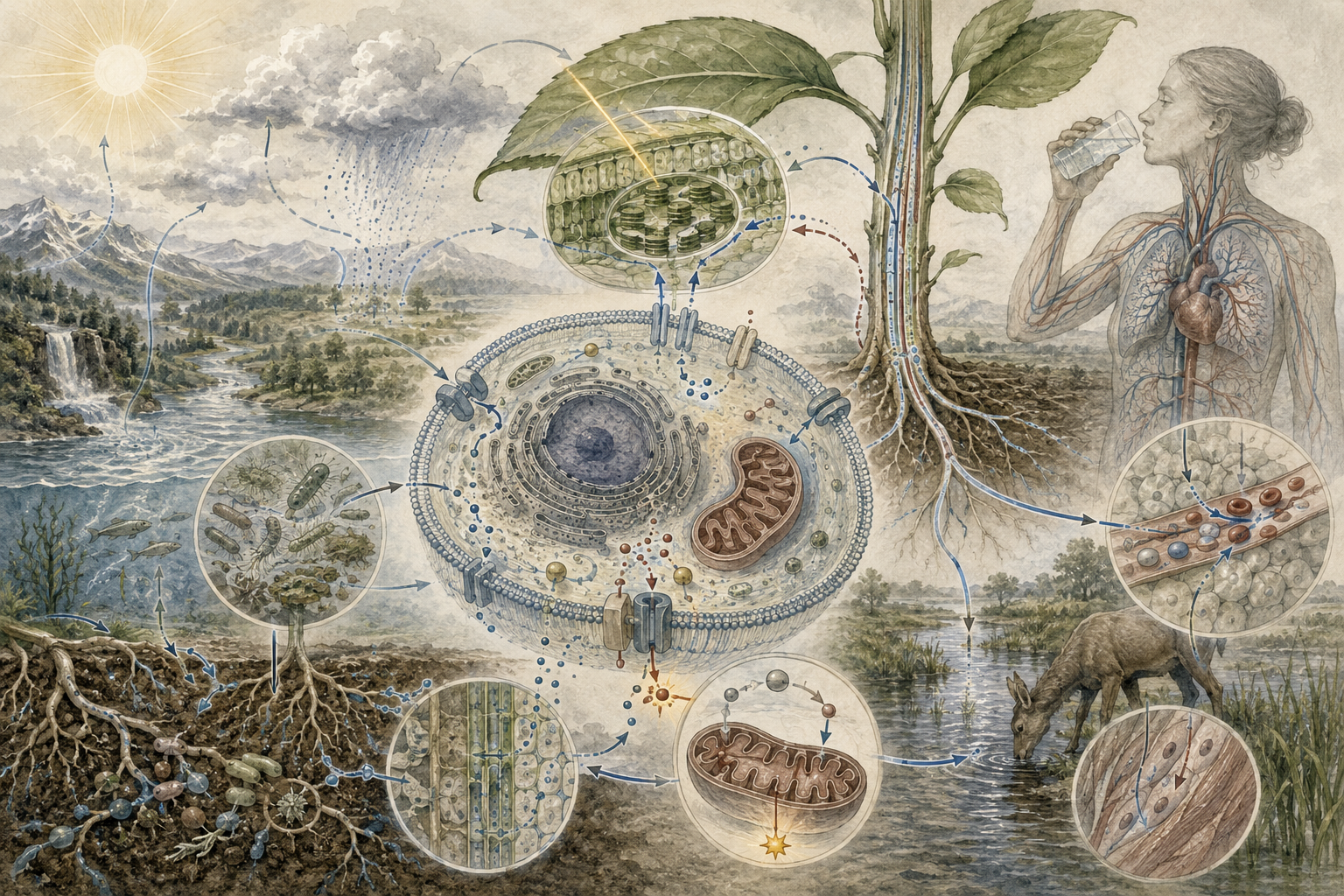
The article develops water, energy, and material conditions across aqueous chemistry, hydrogen bonding, molecular structure, ATP, metabolism, gradients, membranes, osmosis, homeostasis, hydration, ion balance, oxygen delivery, nutrient flow, thermoregulation, ecological productivity, marine systems, freshwater systems, soil biology, plant physiology, disease physiology, biotechnology, bioreactor design, environmental stress, and computational biology. It shows why life cannot be understood only through genes, molecules, or complexity. Living systems require material conditions that permit biological information, structure, and metabolism to become active.
The article also extends the subject into quantitative and computational biology through osmotic pressure, water potential, diffusion, permeability flux, homeostatic setpoint dynamics, exponential growth, Monod-style substrate limitation, ATP budgets, oxygen limitation, thermal stress indices, material-condition scoring, R workflows, Python workflows, SQL provenance structures, and a linked full-stack GitHub repository containing Python, R, Julia, Fortran, Rust, Go, C, C++, SQL, notebooks, data files, validation notes, and reproducibility documentation.
Why Life Has Material Conditions
Life does not occur under arbitrary conditions. Living systems depend on material environments that permit molecular interaction, transport, structural stability, regulated exchange, and usable energy transfer. Water, dissolved ions, gases, nutrients, temperature range, pH, osmotic balance, pressure, hydration state, and access to energy sources are not secondary details added onto life from the outside. They are part of the conditions under which life can emerge, persist, and remain organized. Biology therefore studies not only organisms and molecules, but also the physical and chemical constraints that make biological order possible.
This matters because life is not self-sustaining in the sense of independence from environment. Living systems maintain internal order only through continuous exchange with surroundings. Cells require water, ions, energy carriers, membrane gradients, and matter flux. Organisms require food, oxygen or other terminal electron acceptors, thermal regulation, controlled hydration, and internal chemistry. Ecosystems depend on solar input, nutrient cycling, hydrology, and trophic transfer. The material conditions of life are therefore not a background setting. They are part of what life scientifically is.
This perspective also prevents a common error: treating life as if it were defined only by information, genes, or complexity. Biological information matters, but information becomes living only under material conditions that permit replication, expression, transport, metabolism, compartmentalization, repair, and regulation. A genome outside usable chemical and energetic context cannot maintain life. A membrane without energy gradients cannot sustain active transport. A cell without water cannot support the molecular mobility required for metabolism. Water and energy are therefore not peripheral to biology. They are among the conditions through which biological information becomes active life.
Material conditions also clarify why life is vulnerable. A biological system may contain the right molecules and still fail if oxygen becomes unavailable, pH moves outside viable range, water potential collapses, temperature denatures proteins, salinity disrupts osmotic balance, or ATP production cannot meet demand. Life persists not because matter is magically alive, but because material relations are continuously maintained within functional ranges.
Water as the Medium of Life
Water is the principal medium of life on Earth. Its polarity, hydrogen-bonding behavior, thermal properties, and solvent capacity make it unusually suited to support biological chemistry. Water dissolves many ions and polar molecules, supports transport, participates directly in reactions, buffers temperature change, and shapes molecular structure through hydrophilic and hydrophobic effects. Protein folding, membrane formation, cytoplasmic organization, nucleic-acid stability, enzyme activity, and metabolic reaction networks all depend on aqueous conditions.
Water matters biologically because it does more than fill space. It creates the conditions under which molecular interaction becomes organized and reproducible. Cells are aqueous systems. Blood, cytoplasm, interstitial fluids, marine environments, freshwater systems, soil water films, plant xylem, phloem transport, mucosal surfaces, and microbial biofilms all illustrate that life depends on water not merely for hydration, but for chemistry, transport, regulation, and stability. Without water, many of the reactions and structural relations that define living systems would either fail or occur under radically different constraints.
Water also connects cell biology to ecology. Hydration state affects cells, but water availability also shapes ecosystems, productivity, species distribution, soil fertility, marine stratification, freshwater oxygen dynamics, plant growth, microbial decomposition, and disease ecology. Water is therefore simultaneously molecular, physiological, ecological, and planetary.
This is why biology cannot treat water as a passive background. Changes in water availability, salinity, osmolarity, flow, temperature, oxygen content, and dissolved nutrients reorganize biological systems from the cellular level to the ecosystem level. Water is both the medium of biochemical life and one of the largest-scale forces shaping habitats, organisms, and ecological resilience.
Water Structure and Biological Chemistry
The biological importance of water arises from its molecular properties. Because water is polar, it interacts strongly with ions and other polar molecules. Because it forms hydrogen bonds, it helps organize protein folding, nucleic-acid stability, membrane behavior, and aqueous molecular networks. Because it has a high heat capacity, it helps buffer organisms and environments against rapid temperature change. Because it can participate in hydrolysis and condensation reactions, it is chemically active as well as physically supportive.
These properties explain why water is central to biological structure. Hydrophobic interactions help drive membrane formation and protein folding. Solvation affects ion distribution and enzyme behavior. Hydrogen bonding contributes to DNA base pairing, protein secondary structure, and molecular recognition. Thermal buffering supports physiological stability and aquatic habitat persistence. Water is therefore not just the background medium of biology; it actively shapes biological organization.
Water also imposes constraints. Too little water disrupts molecular mobility, transport, and reaction networks. Too much water without osmotic control can cause swelling, lysis, dilution, or loss of ion balance. Salinity, pH, dissolved gases, solute concentration, temperature, and pressure all alter how water functions biologically. The life-supporting role of water is therefore not simply the presence of H2O, but the maintenance of usable aqueous conditions.
That distinction is especially important in extreme environments. Microbes in hypersaline brines, organisms in deep-sea pressure regimes, plants under drought stress, cells in freezing conditions, and tissues under dehydration all show that water’s biological role depends on context. Living systems must manage water chemically, physically, and physiologically.
Energy Throughput and Living Order
Living systems require continuous energy throughput because order does not maintain itself spontaneously. Cells must synthesize molecules, transport substances, preserve gradients, repair damage, divide, regulate internal conditions, and respond to changing environments. Organisms must move, grow, thermoregulate, reproduce, defend themselves, and maintain tissues. These activities require energy input and transformation. Biology therefore treats energy not as an optional supplement to life, but as one of the basic conditions of living persistence.
This principle also explains why biology must be read in light of thermodynamics. Living systems do not violate physical law; they maintain local order by taking in energy and exporting entropy through heat, waste, and transformed matter. In that sense, life depends not only on matter but on patterned energy use. Living order is sustained through flow, not through isolation from physical process.
Energy throughput is one of the main reasons biology must be understood across scales. ATP turnover in a cell connects to tissue function. Tissue function connects to whole-organism metabolism. Whole-organism metabolism connects to food webs, primary production, decomposition, oxygen use, and biogeochemical cycling. The same principle—ordered life requires energy flow—appears from molecular biology to ecosystem science.
This also means that energy scarcity, energy excess, and energy misallocation can all become biological problems. Starvation, hypoxia, mitochondrial dysfunction, thermal stress, metabolic disease, ecosystem productivity loss, and bioprocess failure all show that living systems depend on energy that is usable, regulated, and coupled to appropriate work.
ATP and the Coupling of Biological Work
Adenosine triphosphate, or ATP, is the cell’s principal immediately usable energy carrier. ATP hydrolysis is coupled to many forms of biological work, including active transport, biosynthesis, intracellular signaling, motility, protein folding, nucleic-acid synthesis, vesicle trafficking, maintenance of ion gradients, and mechanical movement. Its significance lies not in storing all energy permanently, but in functioning as a transferable intermediate between energy-harvesting processes and energy-consuming processes.
ATP matters because it makes energy biologically operational. Cells do not merely contain energy in a vague sense. They couple chemical potential to specific tasks. This coupling is one of the clearest examples of how life turns chemistry into organization. ATP is therefore central not only to metabolism, but to the possibility of regulated biological work.
ATP also illustrates a broader principle: biological systems require usable energy, not simply total energy. Heat alone does not automatically drive organized work. Fuel molecules alone do not automatically maintain life. Energy must be captured, transformed, stored temporarily, coupled, and regulated. ATP, proton gradients, redox carriers, and membrane potentials are therefore part of the machinery through which energy becomes biological function.
This principle is also practical. In cell culture, tissue physiology, microbial growth, plant metabolism, and bioprocess engineering, biological performance often depends on whether energy demand and energy supply are aligned. A cell may have nutrients available but fail under oxygen limitation. A tissue may contain metabolic substrates but fail under impaired perfusion. A bioreactor may contain engineered cells but underperform if oxygen transfer, pH, substrate supply, or waste removal becomes limiting.
Gradients, Membranes, and Usable Difference
Life depends not only on energy quantity but on organized difference. Membranes establish boundaries across which cells maintain concentration gradients, charge differences, osmotic relations, redox differences, and transport asymmetries. These gradients are biologically valuable because they can be harnessed to perform work. Chemiosmosis, active transport, nerve signaling, osmoregulation, nutrient uptake, acid-base balance, and many regulatory processes depend on the maintenance and controlled release of such differences.
This makes membranes and gradients central to the material conditions of life. A cell without regulated separation from its environment would not be able to preserve internal chemistry or selectively interact with the outside world. Biological order therefore depends on boundaries that are not absolute barriers but selectively permeable interfaces. Life persists through controlled exchange, not through complete openness or complete closure.
Gradients are also environmental. Oxygen gradients shape aquatic systems, soils, biofilms, sediments, tumors, and tissues. Light gradients shape photosynthesis and marine productivity. Salinity gradients shape osmoregulation. Nutrient gradients shape microbial growth and plant roots. Temperature gradients affect enzyme function and membrane fluidity. Biology is therefore a science of gradients as well as molecules.
This is one reason material biology connects cell biology to ecology. A proton gradient across an inner mitochondrial membrane, an oxygen gradient in lake water, a moisture gradient in soil, and a nutrient gradient near a plant root are not identical systems, but they share an important biological logic: structured differences drive regulated processes.
Metabolism and the Transformation of Matter and Energy
Metabolism is the integrated set of chemical reactions through which living systems obtain, transform, store, and use energy and matter. Catabolic pathways break down molecules and release usable energy; anabolic pathways build new molecules and require energy input. In cells, these pathways are coordinated rather than isolated. Metabolism is therefore not merely a list of reactions. It is a dynamic network through which living systems sustain themselves materially and energetically.
This networked view matters because it connects food, oxygen, ATP, biosynthesis, waste production, and growth within one framework. Glycolysis, the citric acid cycle, oxidative phosphorylation, photosynthesis, fermentation, chemolithotrophy, anaerobic respiration, and other pathway systems illustrate that life depends on stepwise transformation rather than one-time energy release. Biology explains material persistence through organized throughput, not static possession.
Metabolism is also where water, energy, and material conditions converge. Reactions occur in aqueous media. Enzymes require suitable pH, temperature, hydration, and ionic conditions. ATP and redox carriers couple energy to work. Membranes and gradients support chemiosmotic energy conversion. Nutrients and wastes must move through compartments, tissues, organisms, and environments. Metabolism is therefore the operational center of material life.
Metabolism also connects directly to ecological and planetary systems. Photosynthesis captures energy into chemical form. Respiration releases energy from organic molecules. Decomposition returns matter to cycling pools. Microbial metabolism transforms nitrogen, sulfur, carbon, iron, and methane. Material biology therefore scales from enzymatic reaction to ecosystem function.
Homeostasis, Water Balance, and Regulation
Water balance and energy balance are central parts of homeostasis. Organisms must regulate hydration, osmotic pressure, ion composition, pH, temperature, oxygen delivery, glucose availability, and energy supply within viable ranges even while external conditions change. This is urgent because biological molecules and cellular processes depend on narrow chemical and physical conditions. Too much deviation in salt balance, hydration, acidity, temperature, ATP supply, or redox state threatens function and survival.
Homeostasis therefore shows that the material conditions of life are not fixed once and for all. They must be actively regulated. In many organisms this involves kidneys, membranes, endocrine signals, nervous regulation, respiratory control, circulatory systems, and cellular transport machinery. In simpler organisms it involves direct osmotic and membrane-level control. Regulation is what turns precarious material dependence into viable persistence.
This also means homeostasis is not static sameness. It is regulated adjustment. A body or cell may change behavior, transport rates, metabolic state, water flux, or energy allocation to remain within survivable ranges. Homeostasis is therefore dynamic stability under constraint.
Water balance illustrates this especially clearly. Cells must maintain volume, ion balance, and osmotic conditions. Plants must regulate water potential, transpiration, stomatal behavior, and xylem transport. Aquatic organisms must manage salinity and ion gradients. Mammals must regulate blood volume, plasma osmolarity, kidney function, and thirst. In all cases, the material condition becomes biological because it is actively sensed, regulated, and defended.
Oxygen, Temperature, pH, and Material Limits
Water and energy do not operate alone. Oxygen availability, temperature, pH, salinity, pressure, and nutrient concentration shape whether metabolism and regulation can continue. Oxygen supports high-yield aerobic metabolism for many organisms, but it also creates oxidative challenges. Temperature affects enzyme kinetics, membrane fluidity, oxygen solubility, metabolic demand, and organismal performance. pH affects protein structure, ionization, transport, enzyme activity, and acid-base balance.
These material limits are central to physiology and ecology because they define viable ranges. A fish in warming water may face both increased metabolic demand and reduced oxygen availability. A plant under drought may face hydraulic stress, altered stomatal behavior, impaired photosynthesis, and changed carbon allocation. A cell under ischemia may face ATP depletion, ion imbalance, swelling, and death. A microbe in a saline environment must regulate osmotic pressure and membrane function. Life therefore persists only by remaining within material boundaries or evolving mechanisms to tolerate extreme conditions.
Material limits also help explain why environmental change can be biologically disruptive even before organisms disappear. Warming, acidification, deoxygenation, dehydration, salinization, eutrophication, and pollution alter the physical and chemical conditions under which living systems function. The material conditions of life are therefore central to environmental science and sustainability-adjacent biology.
This is also why physiology and ecology belong together. A warming ocean, drying soil, acidified lake, hypoxic tissue, or nutrient-limited culture becomes biologically meaningful because it changes the conditions under which cells and organisms can maintain metabolism, membranes, gradients, and repair.
Ecological, Sustainability, and Environmental Relevance
Water and energy are ecological realities. Ecosystems depend on solar input, hydrologic movement, nutrient cycling, decomposition, trophic transfer, biomass production, oxygen dynamics, soil moisture, and thermal regimes. Photosynthesis captures energy into chemical form. Consumers redistribute that energy and matter. Decomposers return material to biogeochemical cycles. Water availability shapes productivity, habitat structure, species distribution, and resilience under disturbance.
For ecologists, the material conditions of life are not merely cellular or organismal. They are systemic. Drought, heat stress, nutrient limitation, flooding, salinization, deoxygenation, and changing energy availability reshape ecological order because they alter the fundamental conditions under which living processes occur. Ecology therefore extends water-and-energy biology from physiology into whole systems.
This is where the subject becomes sustainability-adjacent. Climate change, biodiversity loss, soil degradation, freshwater stress, ocean warming, eutrophication, food-system vulnerability, and habitat fragmentation are all partly problems of altered material conditions. Sustainability science therefore depends on biology that can connect water, energy, gradients, metabolism, and regulation across scales.
The same framing helps avoid vague environmental language. Ecosystems do not simply “respond” to stress in the abstract. They respond through water availability, oxygen demand, pH shifts, nutrient flows, thermal stress, metabolic costs, population growth limits, and biological thresholds. Material biology makes environmental change measurable and mechanistic.
Marine, Freshwater, Soil, Plant, and Microbial Relevance
Marine biology makes the dependence of life on water and gradients especially clear. Ocean life exists within continuous aqueous environments shaped by salinity, pressure, temperature, oxygen availability, pH, light penetration, and nutrient distribution. Osmoregulation, membrane function, ion transport, photosynthetic productivity, marine microbial metabolism, and marine food webs all depend on how organisms manage water balance and energy use under these conditions.
Marine systems also reveal how environmental change destabilizes material conditions of life. Warming, acidification, stratification, deoxygenation, and nutrient shifts alter enzyme behavior, membrane stability, metabolic demand, oxygen availability, and community structure. In that sense, marine biology shows that water is not merely the medium of life, but also one of its most consequential environmental constraints.
Freshwater systems make water balance equally visible. Rivers, lakes, wetlands, and aquifers differ in flow, temperature, oxygen, nutrient load, dissolved organic matter, salinity, and disturbance regime. These conditions shape microbial respiration, algal growth, fish physiology, amphibian survival, plant productivity, and ecosystem resilience. Freshwater biology is therefore inseparable from material gradients.
Soil biology depends on water films, oxygen gradients, pore space, mineral surfaces, organic matter, pH, and microbial metabolism. Plant biology depends on water potential, transpiration, stomatal regulation, photosynthesis, xylem transport, root uptake, and carbon allocation. Microbiology depends on hydration, solutes, electron acceptors, nutrient availability, and gradients. Across these domains, water and energy are not abstractions. They are the material realities that shape life.
Medical, Biomedical, and Disease Ecology Relevance
Medicine and biomedicine depend deeply on the material conditions of life. Disorders of hydration, electrolyte balance, acid-base chemistry, ATP production, glucose handling, mitochondrial function, oxygen delivery, circulation, kidney function, and temperature regulation are all disorders of the conditions under which living systems remain viable. Physiology, pathology, critical care, nephrology, endocrinology, neurology, cardiology, oncology, and infectious disease all rely on understanding how water and energy balance support regulated biological order.
At the cellular level, biomedical relevance is equally clear. Ischemia limits oxygen and ATP production. Dehydration changes osmotic balance. Channelopathies alter ion gradients. Mitochondrial disorders impair usable energy production. Sepsis disrupts systemic regulation of fluids and metabolism. Hyperthermia and hypothermia affect enzymes, membranes, circulation, and neural function. Medical science therefore studies not only disease entities but also the water-energy conditions that determine whether cells and tissues can continue to function.
Disease ecology adds another layer. Pathogens, hosts, vectors, and environments are all constrained by water availability, temperature, nutrients, oxygen, and physiological stress. Mosquito breeding, fungal growth, bacterial persistence, host hydration, immune function, and environmental survival all depend on material conditions. Water and energy biology therefore connects clinical medicine to ecological and environmental health.
This framing also helps explain why environmental change can become medical risk. Heat waves, drought, flooding, water contamination, hypoxia, malnutrition, and vector shifts are material changes with biological consequences. Disease is often mediated through the same conditions that structure life: water, temperature, energy, nutrients, gradients, and physiological regulation.
Biotechnology, Bioprocessing, and Computational Relevance
Biotechnology operationalizes water, energy, and material constraints in applied systems. Fermentation, cell culture, metabolic engineering, biosensing, bioreactor design, wastewater treatment, environmental biotechnology, tissue engineering, synthetic biology, and assay development all depend on controlled media composition, nutrient supply, oxygen transfer, pH, osmolarity, temperature, hydration, mixing, and energetic throughput. In biotechnology, the material conditions of life become design variables.
Bioprocessing makes this especially clear. A cell line or microbe may have the genetic capacity to produce a useful molecule, but production depends on medium composition, oxygen transfer, mixing, substrate delivery, waste removal, osmotic balance, temperature control, and energy allocation. Material conditions determine whether biological potential becomes reliable output.
Computational biology extends this by treating gradients, fluxes, growth, homeostasis, oxygen use, water balance, and metabolic states as measurable and modelable quantities. Process optimization, metabolic modeling, culture-growth analysis, transport simulation, and energy-budget modeling all reflect the fact that modern life science increasingly studies living systems through explicitly material and quantitative frameworks.
This is why reproducibility matters in material biology. A biological result may depend on media formulation, pH drift, dissolved oxygen, temperature, mixing rate, osmolarity, passage history, substrate availability, or water activity. Without metadata and provenance, biological interpretation becomes fragile. Computational workflows can help preserve those conditions as part of the evidence chain.
Mathematical Lens
Water and energy biology is especially suited to quantitative treatment because flux, growth, osmoregulation, homeostasis, oxygen limitation, and energetic allocation can often be represented mathematically. This does not eliminate biological complexity, but it makes selected relations clearer, testable, and reproducible.
A simple van ’t Hoff approximation for osmotic pressure is:
Interpretation: Osmotic pressure increases with solute concentration, temperature, and solute dissociation behavior.
where \(\Pi\) is osmotic pressure, \(i\) is the van ’t Hoff factor, \(C\) is molar concentration, \(R\) is the gas constant, and \(T\) is absolute temperature. This is useful because water movement across membranes depends strongly on solute differences.
In plant and soil-water contexts, water potential can be summarized as:
Interpretation: Total water potential combines solute, pressure, gravitational, and matric contributions.
where \(\Psi_s\) is solute potential, \(\Psi_p\) is pressure potential, \(\Psi_g\) is gravitational potential, and \(\Psi_m\) is matric potential. This is useful because water moves from higher to lower water potential, shaping plant physiology, soil water, and ecosystem function.
A simple diffusive relation is:
Interpretation: Diffusive flux follows the concentration gradient and is scaled by the diffusion coefficient.
where \(J\) is flux, \(D\) is diffusion coefficient, and \(\frac{dC}{dx}\) is the concentration gradient. This is useful for nutrients, gases, membrane transport, soil water films, aquatic gradients, and tissue exchange.
A simple model of regulatory return toward a target value \(x^*\) is:
Interpretation: Homeostatic recovery is represented as correction proportional to deviation from the target state.
where \(k\) is the correction-rate constant. The continuous solution is:
Interpretation: The state approaches the setpoint exponentially under a simple recovery model.
This captures the general idea of homeostatic adjustment, including pH recovery, osmotic regulation, hydration correction, thermal return, or ion balance.
A simple model for unconstrained growth is:
Interpretation: Exponential growth describes abundance increase when per-capita growth rate remains approximately constant.
where \(N_0\) is initial abundance, \(r\) is per-capita growth rate, and \(t\) is time. This is useful for culture growth, microbial populations, early-stage cell proliferation, and simple bioenergetic throughput studies.
A Monod-style growth relation can be written as:
Interpretation: Substrate-limited growth increases with substrate availability but approaches a maximum rate.
where \(\mu(S)\) is substrate-dependent growth rate, \(\mu_{\max}\) is maximum growth rate, \(S\) is substrate concentration, and \(K_s\) is the half-saturation constant. This is useful for microbial growth, algal productivity, fermentation, wastewater systems, and nutrient-limited ecosystems.
A simplified energy or substrate allocation balance can be written as:
Interpretation: Input energy is allocated among growth, maintenance, repair, and losses.
This is useful because organisms and cells often face tradeoffs between growth, maintenance, repair, product formation, storage, and survival.
Variables, Units, and Material Interpretation
Quantitative water-and-energy biology depends on variables that connect solutes, gradients, water movement, energy throughput, growth, regulation, and material constraint. The table below summarizes several central quantities.
| Symbol or Term | Meaning | Typical Unit or Scale | Biological Interpretation |
|---|---|---|---|
| \(\Pi\) | Osmotic pressure | atm, Pa, or kPa | Pressure associated with solute-driven water movement across a semipermeable boundary |
| \(i\) | van ’t Hoff factor | dimensionless | Accounts for effective number of dissolved particles produced by a solute |
| \(C\) | Molar concentration | mol/L or mol/m3 | Solute concentration affecting osmotic pressure, diffusion, or substrate availability |
| \(R\) | Gas constant | L atm mol-1 K-1 or J mol-1 K-1 | Physical constant used in osmotic and thermodynamic relations |
| \(T\) | Absolute temperature | K | Temperature scale relevant to osmotic pressure, reaction rates, and thermal constraints |
| \(\Psi\) | Total water potential | MPa or pressure units | Potential determining direction of water movement in plant, soil, and environmental contexts |
| \(\Psi_s, \Psi_p, \Psi_g, \Psi_m\) | Water-potential components | MPa or pressure units | Solute, pressure, gravitational, and matric contributions to water movement |
| \(J\) | Flux | amount per area per time | Rate of molecular movement through membrane, tissue, water column, soil, or gradient |
| \(D\) | Diffusion coefficient | area per time | How rapidly a solute or gas spreads through a medium |
| \(x\) | Distance | length | Spatial dimension over which concentration or material condition changes |
| \(x^*\) | Setpoint or target state | same as regulated variable | Reference condition toward which homeostatic regulation moves |
| \(k\) | Correction-rate constant | per unit time | Rate of return toward a regulated state |
| \(N(t)\) | Abundance at time \(t\) | cells, organisms, biomass proxy, or count | Population or culture size under growth conditions |
| \(r\) | Per-capita growth rate | per unit time | Rate of abundance increase under specified material conditions |
| \(\mu(S)\) | Substrate-dependent growth rate | per unit time | Growth rate as a function of substrate availability |
| \(K_s\) | Half-saturation constant | same as \(S\) | Substrate level associated with half of maximum growth rate |
| \(E_{\mathrm{input}}\) | Energy input | energy units, ATP equivalents, or substrate equivalents | Available energy or substrate budget entering a biological system |
The table shows why material biology requires precise measurement context. A solute concentration, oxygen value, water potential, temperature, or energy budget becomes biologically meaningful only when linked to cells, organisms, ecosystems, or engineered systems.
Worked Example: Osmotic Pressure and Homeostatic Return
Suppose a solution has \(C=0.30\) mol/L, \(i=1\), \(R=0.08206\) L atm mol-1 K-1, and \(T=298\) K. Under the van ’t Hoff approximation:
Interpretation: Osmotic pressure is estimated from solute concentration, temperature, and effective particle number.
Substituting the values:
Interpretation: Even a moderate solute concentration can generate substantial osmotic pressure.
Solving:
Interpretation: The solution has an estimated osmotic pressure of approximately 7.34 atmospheres.
This is useful because even modest solute differences can generate biologically significant osmotic pressure across membranes. Cells, marine organisms, kidney tissues, plant roots, and cell-culture systems all depend on osmotic conditions.
Homeostatic recovery can be analyzed similarly. Suppose a regulated variable begins at \(x_0=10\), the target is \(x^*=2\), and \(k=0.4\). The continuous solution is:
Interpretation: The regulated variable moves toward the target as the deviation decays over time.
At \(t=5\):
Interpretation: The system begins eight units above the target and corrects at rate 0.4 per time unit.
Solving:
Interpretation: After five time units, the system has returned much closer to the regulated target.
This is useful because it converts regulation into an interpretable recovery trajectory. It also shows why homeostasis is not fixed stillness. It is dynamic return toward viable range.
Computational Modeling
Computational modeling helps make water-and-energy biology explicit because material conditions are measurable, dynamic, and often limiting. Osmotic pressure can be estimated from solute concentration. Homeostatic return can be simulated after perturbation. Growth rate can be estimated from abundance data. Oxygen limitation can be represented with saturation curves. Energy allocation can be summarized as a budget across growth, maintenance, repair, and loss.
The selected examples below focus on compact, reusable workflows: osmotic pressure, homeostatic return, growth-rate estimation, energy allocation, oxygen limitation, and material-condition scoring. The GitHub repository extends the same logic into richer workflows for water-potential components, permeability flux, substrate-limited growth, thermal and osmotic stress scoring, ATP budgets, SQL provenance, notebooks, validation scripts, and multi-language scientific-computing examples.
The purpose is not to reduce life to physical variables alone. The purpose is to keep material constraints visible. Biological interpretation becomes stronger when water, oxygen, pH, temperature, solutes, energy flow, gradients, and metadata are included in the evidentiary chain.
R Workflow: Osmotic Pressure, Homeostasis, Growth, and Energy Allocation
R is useful for material biology because it supports tabular summaries, model fitting, reproducible reporting, and condition scoring. The following workflow calculates osmotic pressure, simulates homeostatic return toward a setpoint, estimates growth rate and doubling time, and summarizes a simple energy-allocation budget.
# Water, Energy, and Material Conditions Workflow
#
# This workflow demonstrates four material-biology tasks:
#
#   1. Estimate osmotic pressure across solute conditions.
#   2. Simulate homeostatic return toward a setpoint.
#   3. Estimate growth rate and doubling time from abundance data.
#   4. Summarize energy allocation across growth, maintenance, repair, and loss.
#
# These examples can be adapted for cell culture, marine physiology,
# plant water stress, microbial growth, bioreactor design, oxygen limitation,
# or ecological material-condition analysis.

library(tibble)
library(dplyr)

# ------------------------------------------------------------
# 1. Osmotic pressure using van 't Hoff approximation
# ------------------------------------------------------------

solute_df <- tibble(
  scenario = c("baseline", "moderate_saline", "high_saline", "dilute"),
  van_t_hoff_factor = c(1, 2, 2, 1),
  concentration_mol_L = c(0.15, 0.30, 0.60, 0.05),
  temperature_K = c(298, 298, 298, 298)
)

R_gas <- 0.082057 # L atm mol^-1 K^-1

solute_df <- solute_df %>%
  mutate(
    osmotic_pressure_atm =
      van_t_hoff_factor * concentration_mol_L * R_gas * temperature_K,
    relative_water_stress =
      osmotic_pressure_atm / max(osmotic_pressure_atm)
  )

# ------------------------------------------------------------
# 2. Homeostatic return toward a setpoint
# ------------------------------------------------------------

dt <- 0.01
time <- seq(0, 20, by = dt)

homeostasis_df <- tibble(
  time = time,
  state = 0,
  setpoint = 2
)

homeostasis_df$state[1] <- 10

correction_rate <- 0.4

for (i in 2:nrow(homeostasis_df)) {
  dx <- -correction_rate *
    (homeostasis_df$state[i - 1] - homeostasis_df$setpoint[i - 1])

  homeostasis_df$state[i] <- homeostasis_df$state[i - 1] + dx * dt
}

homeostasis_df <- homeostasis_df %>%
  mutate(deviation = state - setpoint)

# ------------------------------------------------------------
# 3. Growth-rate estimation under material conditions
# ------------------------------------------------------------

growth_data <- tibble(
  time_h = c(0, 12, 24, 36, 48),
  abundance = c(1.0e5, 1.4e5, 2.0e5, 2.8e5, 4.0e5)
)

growth_model <- lm(log(abundance) ~ time_h, data = growth_data)

growth_summary <- tibble(
  growth_rate_per_h = coef(growth_model)[["time_h"]],
  estimated_initial_abundance = exp(coef(growth_model)[["(Intercept)"]]),
  doubling_time_h = log(2) / growth_rate_per_h,
  r_squared_log_space = summary(growth_model)$r.squared
)

growth_fit <- growth_data %>%
  mutate(
    predicted_abundance = exp(predict(growth_model)),
    residual_log_scale = resid(growth_model)
  )

# ------------------------------------------------------------
# 4. Simple energy-allocation budget
# ------------------------------------------------------------

energy_df <- tibble(
  pool = c("growth", "maintenance", "repair", "loss"),
  energy_units = c(42, 33, 15, 10)
) %>%
  mutate(
    fraction_of_input = energy_units / sum(energy_units)
  )

print(round(solute_df, 4))

print(head(round(homeostasis_df, 4), 12))
print(tail(round(homeostasis_df, 4), 12))

print(round(growth_summary, 4))
print(round(growth_fit, 3))

print(round(energy_df, 4))
This workflow is useful because it keeps material constraints visible. Osmotic pressure, setpoint recovery, growth, and energy allocation can be compared across conditions, organisms, cultures, or environmental contexts.
Python Workflow: Osmotic Stress, Setpoint Dynamics, Oxygen Limitation, and Growth
Python is useful for material biology because it supports simulation, numerical modeling, pipeline design, and reproducible data processing. The following workflow computes osmotic pressure and relative water stress, simulates homeostatic setpoint dynamics, models oxygen limitation, and estimates material-condition growth scenarios.
"""
Water, Energy, and Material Conditions Workflow

This workflow demonstrates four quantitative material-biology tasks:

1. Estimate osmotic pressure and relative water-stress index.
2. Simulate homeostatic setpoint dynamics.
3. Model oxygen limitation using a saturation curve.
4. Compare growth under substrate and oxygen limitation.

The examples are compact, but the same structures can be extended to
cell culture, marine deoxygenation, plant water stress, microbial ecology,
bioreactor design, wastewater systems, and physiological modeling.
"""

from __future__ import annotations

import numpy as np
import pandas as pd

R_GAS = 0.082057  # L atm mol^-1 K^-1

def osmotic_pressure_conditions() -> pd.DataFrame:
    """
    Estimate osmotic pressure across solute conditions.
    """
    conditions = pd.DataFrame(
        {
            "scenario": ["baseline", "moderate_saline", "high_saline", "dilute"],
            "van_t_hoff_factor": [1.0, 2.0, 2.0, 1.0],
            "concentration_mol_L": [0.15, 0.30, 0.60, 0.05],
            "temperature_K": [298.0, 298.0, 298.0, 298.0],
        }
    )

    conditions["osmotic_pressure_atm"] = (
        conditions["van_t_hoff_factor"]
        * conditions["concentration_mol_L"]
        * R_GAS
        * conditions["temperature_K"]
    )

    conditions["relative_water_stress"] = (
        conditions["osmotic_pressure_atm"]
        / conditions["osmotic_pressure_atm"].max()
    )

    return conditions

def simulate_homeostasis(
    initial_state: float = 10.0,
    setpoint: float = 2.0,
    correction_rate: float = 0.4,
    t_max: float = 20.0,
    dt: float = 0.01,
) -> pd.DataFrame:
    """
    Simulate return toward a regulated setpoint.
    """
    time = np.arange(0, t_max + dt, dt)
    state = np.zeros_like(time)

    state[0] = initial_state

    for i in range(1, len(time)):
        dx = -correction_rate * (state[i - 1] - setpoint)
        state[i] = state[i - 1] + dx * dt

    return pd.DataFrame(
        {
            "time": time,
            "state": state,
            "setpoint": setpoint,
            "deviation": state - setpoint,
        }
    )

def oxygen_limitation_curve(
    half_saturation: float = 2.0,
    max_energy_rate: float = 1.0,
) -> pd.DataFrame:
    """
    Model relative energy availability as a function of oxygen level.
    """
    oxygen_mg_L = np.linspace(0, 10, 101)

    relative_energy_rate = (
        max_energy_rate * oxygen_mg_L / (half_saturation + oxygen_mg_L)
    )

    return pd.DataFrame(
        {
            "oxygen_mg_L": oxygen_mg_L,
            "relative_energy_rate": relative_energy_rate,
            "oxygen_limitation": 1.0 - relative_energy_rate,
        }
    )

def monod_growth_rate(
    substrate: np.ndarray,
    mu_max: float,
    ks: float,
) -> np.ndarray:
    """
    Calculate Monod-style substrate-limited growth rate.
    """
    return mu_max * substrate / (ks + substrate)

def material_condition_growth_scenarios() -> pd.DataFrame:
    """
    Compare growth potential under substrate limitation.
    """
    substrate = np.linspace(0, 20, 200)

    scenarios = {
        "baseline": {"mu_max": 0.50, "ks": 2.0},
        "low_affinity": {"mu_max": 0.50, "ks": 6.0},
        "stress_limited": {"mu_max": 0.30, "ks": 3.0},
    }

    rows = []

    for scenario, params in scenarios.items():
        mu = monod_growth_rate(
            substrate=substrate,
            mu_max=params["mu_max"],
            ks=params["ks"],
        )

        rows.append(
            pd.DataFrame(
                {
                    "scenario": scenario,
                    "substrate": substrate,
                    "growth_rate": mu,
                    "mu_max": params["mu_max"],
                    "Ks": params["ks"],
                }
            )
        )

    return pd.concat(rows, ignore_index=True)

def main() -> None:
    """
    Run compact material-condition analysis examples.
    """
    osmotic_df = osmotic_pressure_conditions()
    homeostasis_df = simulate_homeostasis()
    oxygen_df = oxygen_limitation_curve()
    growth_df = material_condition_growth_scenarios()

    print("Osmotic pressure and water-stress index:")
    print(osmotic_df.round(4).to_string(index=False))

    print("\nHomeostatic setpoint dynamics:")
    print(homeostasis_df.head(12).round(4).to_string(index=False))
    print(homeostasis_df.tail(12).round(4).to_string(index=False))

    print("\nOxygen limitation and relative energy availability:")
    print(oxygen_df.head(12).round(4).to_string(index=False))
    print(oxygen_df.tail(12).round(4).to_string(index=False))

    print("\nSubstrate-limited growth scenarios:")
    print(growth_df.head(12).round(4).to_string(index=False))
    print(growth_df.tail(12).round(4).to_string(index=False))

if __name__ == "__main__":
    main()
This Python workflow is useful because material conditions are often limiting variables. The same logic can be adapted for aquatic oxygen limitation, microbial culture optimization, marine stress physiology, plant water stress, bioreactor performance, tissue hypoxia, or ecological productivity modeling.
GitHub Repository
The article body includes compact R and Python examples so the biological and scientific argument remains readable. The full repository expands those examples into a more rigorous computational water-and-energy biology workflow, including osmotic pressure modeling, water-potential components, membrane diffusion, permeability flux, homeostatic setpoint dynamics, exponential growth fitting, Monod-style substrate limitation, oxygen-limitation modeling, ATP and energy-budget allocation, thermal and osmotic stress scoring, material-condition scoring, SQL provenance structures, validation notes, reproducible data files, and full-stack scientific-computing examples across Python, R, Julia, Fortran, Rust, Go, C, C++, SQL, and notebooks.
Limits, Scaling, and Modern Material Biology
Water and energy are foundational, but they are not simple. Aqueous chemistry changes with solutes, pH, temperature, pressure, and biological context. Energy availability depends on substrates, oxygen, electron acceptors, membrane gradients, enzyme systems, and regulatory state. Homeostasis operates differently in microbes, plants, animals, tissues, ecosystems, and engineered systems. Material conditions must therefore be interpreted across scale.
This is why modern biology increasingly treats water and energy not as background assumptions, but as dynamic variables. Cell culture media, ocean chemistry, soil moisture, plant water potential, oxygen gradients, tissue perfusion, mitochondrial function, and ecological productivity are all examples of material conditions that must be measured, modeled, and interpreted. The same biological system may behave differently under altered hydration, salinity, temperature, oxygen, pH, or nutrient status.
Models and workflows are useful because they clarify assumptions, expose constraints, and make comparison possible. But an osmotic-pressure calculation is not a full cell, a setpoint model is not a complete organism, and a stress score is not a complete ecological theory. Quantitative material biology is strongest when it supports biological interpretation rather than replacing it.
This caution is especially important in sustainability-facing and biomedical work. A water-stress index may indicate risk but not fully explain plant survival. A dissolved-oxygen model may capture limitation but not community adaptation. A bioreactor growth curve may show reduced production but not identify all causal mechanisms. Material biology therefore requires measurement, context, and humility about scale.
Why This Matters for Scientific Work
For working scientists, water and energy matter because many biological problems are misread when material conditions are treated as background. A cell-culture experiment may fail because media osmolarity, oxygen transfer, or pH drift changes cellular behavior. A disease process may depend on hydration, ion gradients, ATP depletion, hypoxia, or acid-base imbalance. A marine ecosystem may reorganize because warming and deoxygenation alter metabolic performance. A plant-stress response may depend on water potential and transpiration rather than on genetics alone. A microbial community may shift because substrate, electron acceptors, moisture, and gradients change.
This means water and energy should often be treated as explanatory infrastructure. Cell biologists need them because membranes, organelles, and reactions operate under material constraints. Ecologists need them because productivity, decomposition, and resilience depend on water and energy flow. Biomedical scientists need them because tissue viability depends on oxygen, ATP, hydration, and ion balance. Computational biologists need them because gradients, fluxes, growth, and regulation can be modeled and tested.
The scientific importance of water and energy lies partly in this breadth. They are among the principal ways biology explains how life remains active, constrained, vulnerable, and possible under real physical and chemical conditions.
They also make biological systems operationally governable. A scientist can measure osmolarity, oxygen, temperature, pH, nutrient concentration, substrate availability, ATP demand, growth rate, and water potential. Those measurements can improve experiments, clinical decisions, conservation assessments, bioprocess designs, and environmental monitoring. Material conditions are therefore not only theoretical foundations. They are practical variables in biological work.
Conclusion
Water, energy, and the material conditions of life show that living systems are sustained not by abstract vitality but by regulated matter-energy relations under specific physical and chemical constraints. Water provides the medium. ATP and metabolism provide usable energy. Membranes and gradients create organized difference. Homeostasis preserves viable ranges. Ecology and marine biology reveal the environmental scale of these dependencies. Medicine and biotechnology reveal their clinical and applied significance.
To understand life scientifically is therefore to understand that living order depends on throughput, balance, and constraint. Life persists not outside the material world, but through highly organized participation in it. Water, energy, gradients, and material exchange are not merely conditions around life. They are part of the physical basis through which life becomes possible.
This perspective strengthens biology across scales. It links molecular chemistry to cellular regulation, physiology to ecology, environmental change to biological stress, and biotechnology to controlled material design. Water and energy are therefore not background topics in biology. They are among the central explanatory foundations of living order.
Related Articles
- Biology
- What Is Biology?
- Biology and the Scientific Understanding of Living Order
- Biomolecules and the Chemical Basis of Life
- Cell Theory and the Basic Unit of Life
- Cell Structure, Membranes, and Organelles
- Metabolism, Energy, and Biological Function
- Enzymes, Regulation, and Biochemical Pathways
- Physiology and the Regulation of Living Systems
- Ecology and the Interdependence of Life
- Biogeochemical Cycles and the Conditions of Habitability
Further Reading
- Alberts, B. et al. (2002) ‘Catalysis and the use of energy by cells’, in Molecular Biology of the Cell. 4th edn. New York: Garland Science. Available at: https://www.ncbi.nlm.nih.gov/books/NBK26838/
- Alberts, B. et al. (2002) ‘How cells obtain energy from food’, in Molecular Biology of the Cell. 4th edn. New York: Garland Science. Available at: https://www.ncbi.nlm.nih.gov/books/NBK26882/
- Ahmad, M. and Madsen, H. (2023) ‘Biochemistry, electron transport chain’, in StatPearls. Treasure Island, FL: StatPearls Publishing. Available at: https://www.ncbi.nlm.nih.gov/books/NBK526105/
- Dunn, J. and Grider, M.H. (2023) ‘Physiology, adenosine triphosphate’, in StatPearls. Treasure Island, FL: StatPearls Publishing. Available at: https://www.ncbi.nlm.nih.gov/books/NBK553175/
- Konieczny, L. (2023) Energy in Biology: Demand and Use. Available at: https://www.ncbi.nlm.nih.gov/books/NBK599597/
- OpenStax (2013) ‘Energy and metabolism’, in Concepts of Biology. Available at: https://openstax.org/books/concepts-biology/pages/4-1-energy-and-metabolism
- OpenStax (2018) ‘Water’, in Biology 2e. Available at: https://openstax.org/books/biology-2e/pages/2-2-water
- OpenStax (2018) ‘Osmoregulation and osmotic balance’, in Biology 2e. Available at: https://openstax.org/books/biology-2e/pages/33-1-osmoregulation-and-osmotic-balance
- OpenStax (2018) ‘Oxidative phosphorylation’, in Biology 2e. Available at: https://openstax.org/books/biology-2e/pages/7-4-oxidative-phosphorylation
References
- Ahmad, M. and Madsen, H. (2023) ‘Biochemistry, electron transport chain’, in StatPearls. Treasure Island, FL: StatPearls Publishing. Available at: https://www.ncbi.nlm.nih.gov/books/NBK526105/
- Alberts, B. et al. (2002) ‘Catalysis and the use of energy by cells’, in Molecular Biology of the Cell. 4th edn. New York: Garland Science. Available at: https://www.ncbi.nlm.nih.gov/books/NBK26838/
- Alberts, B. et al. (2002) ‘How cells obtain energy from food’, in Molecular Biology of the Cell. 4th edn. New York: Garland Science. Available at: https://www.ncbi.nlm.nih.gov/books/NBK26882/
- Dunn, J. and Grider, M.H. (2023) ‘Physiology, adenosine triphosphate’, in StatPearls. Treasure Island, FL: StatPearls Publishing. Available at: https://www.ncbi.nlm.nih.gov/books/NBK553175/
- Konieczny, L. (2023) Energy in Biology: Demand and Use. Available at: https://www.ncbi.nlm.nih.gov/books/NBK599597/
- OpenStax (2013) ‘Energy and metabolism’, in Concepts of Biology. Available at: https://openstax.org/books/concepts-biology/pages/4-1-energy-and-metabolism
- OpenStax (2018) ‘Osmoregulation and osmotic balance’, in Biology 2e. Available at: https://openstax.org/books/biology-2e/pages/33-1-osmoregulation-and-osmotic-balance
- OpenStax (2018) ‘Oxidative phosphorylation’, in Biology 2e. Available at: https://openstax.org/books/biology-2e/pages/7-4-oxidative-phosphorylation
- OpenStax (2018) ‘Water’, in Biology 2e. Available at: https://openstax.org/books/biology-2e/pages/2-2-water