
Last Updated May 4, 2026
Indus Region Thought: Civilizational Memory, Sacred Exchange, and the Intellectual Worlds of the Northwest explores the intellectual, religious, ethical, civilizational, artistic, legal, devotional, and cultural traditions that emerged across northwest South Asia, where the Indus basin and its surrounding regions became a long-standing crossroads of urban order, sacred symbolism, trade, empire, monastic transmission, Persianate culture, Sufi devotion, Sikh ethics, and regional memory. As a major category within the Philosophy knowledge series, this pillar studies Indus Region thought not as a narrow history of one religion, one empire, or one philosophical school, but as a layered civilizational field shaped by the Harappan world, Vedic and Brahmanical encounters, Gandharan Buddhism, Sindhi and Punjabi devotional cultures, Islamic and Persianate scholarship, Sikh theology, colonial knowledge, partition memory, and the continuing struggle to preserve regional continuity after historical rupture.
This field includes several overlapping layers of thought: the symbolic and civic worlds of the Harappan civilization; the Vedic, Brahmanical, Hindu, and Jain strands that interacted with the northwest; the Buddhist, monastic, textual, artistic, and scholastic traditions of Gandhara; the Islamic, Persianate, legal, poetic, and Sufi worlds of Sindh and Punjab; the ethical, devotional, exegetical, musical, and political traditions of Sikh thought; and the later literary, colonial, reformist, nationalist, partition, diasporic, and post-partition traditions through which the Indus region continued to interpret itself under changing conditions of empire, mobility, memory, and fracture.
The series proceeds from a central methodological claim: Indus Region thought cannot be understood only through formal philosophical treatises. In this region, reflection on truth, order, ritual, sovereignty, sacred landscape, memory, plurality, devotion, artistic form, community, and human responsibility has often been carried through archaeology, symbolism, urban form, visual culture, oral tradition, poetry, hagiography, scripture, commentary, legal practice, music, pilgrimage, shrine devotion, sacred architecture, colonial archives, testimony, and regional literary memory. The field therefore requires a broad understanding of philosophy, one capable of reading city planning, sculpture, river systems, seals, monasteries, shrines, song, scripture, law, and partition witness as serious modes of thought.
The goal of this pillar is not to collapse the Indus region into one civilizational origin story, one religious tradition, one modern nation, or one nostalgic regional memory. It is to show why Indus Region thought remains philosophically indispensable precisely because it joins urban intelligence, sacred geography, artistic transmission, frontier exchange, devotion, multilingual memory, religious plurality, political sovereignty, colonial classification, and post-partition fracture into one of the great contact-zone archives of world intellectual history.
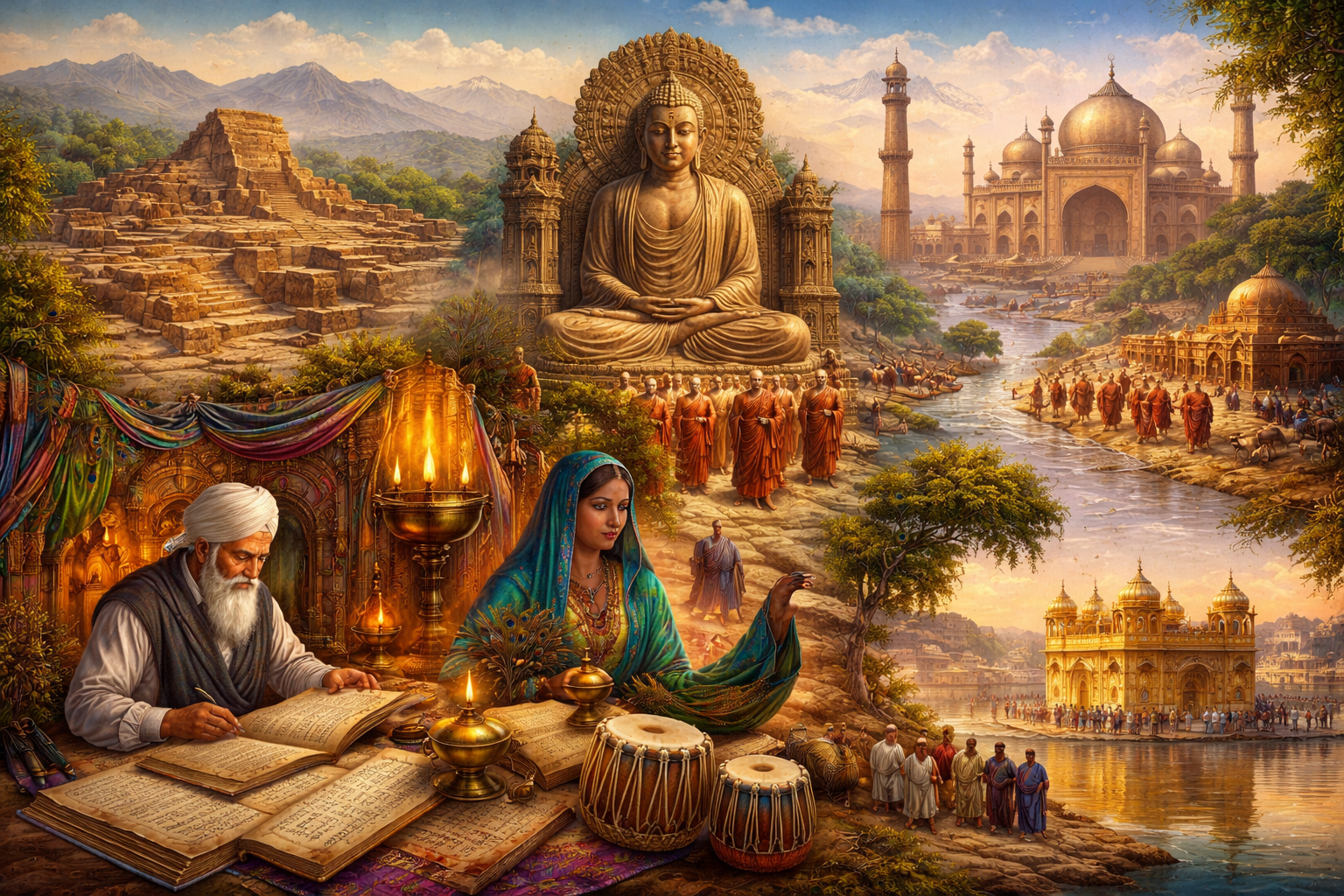
Indus Region thought is especially important to a broader philosophy architecture because it restores the northwest of South Asia to its proper place as one of the great connective zones of world intellectual history. In this respect, the category links not only to South Asian Traditions, Persian Thought, and Islamic and Mystical Thought, but also to Religion and Society, Religion and Law, Culture, Meaning, and Symbolism, Poetry, Memory, and Imagination, Classical Literature and Civilizational Memory, and Political Philosophy and Justice. Questions of urban order, sacred geography, image, scripture, devotion, legal authority, frontier exchange, linguistic plurality, regional identity, partition, and memory become sharper when the Indus region is treated as a major intellectual field rather than as a peripheral zone attached to larger imperial narratives.
A full accounting must also recognize that “Indus Region” is not a simple geographic label. It names an interconnected civilizational zone extending across the Indus basin and its surrounding corridors, including Sindh, Punjab, Gandhara, the northwestern frontier zones, Kashmir-adjacent linkages where relevant, and the routes linking South Asia to Central Asia, Persia, the Arabian Sea, and the broader Islamic world. Merchants, monks, artisans, jurists, saints, rulers, scribes, poets, chroniclers, mystics, pastoral communities, temple networks, shrine communities, pilgrimage communities, colonial archaeologists, reformers, refugees, and diasporic writers moved across cities, monasteries, caravan routes, river systems, shrines, forts, ports, courts, archives, and borders. The result is not one unified doctrine but a dense field of reflection on sacred order, political authority, ritual life, ethical relation, aesthetic form, cultural continuity, and the terms of living together across frontiers of language, religion, and empire.
Why This Series Matters
Indus Region thought deserves serious study for several reasons. First, it preserves one of the great connective intellectual zones of Eurasian history, where urban civilization, river systems, trade, empire, frontier movement, sacred geography, and artistic exchange produced durable worlds of meaning long before later national boundaries. Second, it shows how thought can develop not only in systematic treatises but in city planning, seals, sculpture, shrine practice, devotional poetry, hagiography, legal cultures, sacred music, manuscript transmission, and shared landscapes. Third, it provides indispensable materials for understanding how civilizational memory persists across rupture, conquest, migration, religious change, colonial classification, and partition.
This field is also central for understanding how the northwest of South Asia became a zone of transmission between South Asia, Central Asia, Persia, the Arabian Sea, and the broader Islamic world. Gandhara connected Buddhist, Central Asian, Hellenistic, and South Asian worlds. Sindh and Punjab connected Indic, Islamic, Persianate, Sufi, Sikh, and vernacular worlds. The Indus basin itself connected ecology, settlement, mobility, agriculture, urban order, and sacred memory.
It also restores Sindh, Punjab, Gandhara, and the Indus basin to their proper place as intellectual regions in their own right rather than merely peripheral appendages of larger imperial histories. Harappa and Mohenjo-daro should not be treated merely as archaeological ruins; Gandhara should not be treated only as Buddhist art; Sindh should not be reduced to conquest history; Punjab should not be reduced to partition; and Sikh thought should not be treated as a narrow religious appendix. Each belongs to a broader intellectual ecology of form, memory, law, devotion, and ethical life.
Finally, this pillar broadens philosophy itself by showing that some of the deepest reflection on order, transcendence, devotion, community, coexistence, image, memory, and ethical responsibility occurs through visual form, ritual continuity, poetry, legal practice, sacred geography, and testimony as much as through abstract doctrinal systems. Indus Region thought therefore belongs at the level of civilizational interpretation rather than as a marginal supplement to South Asian, Persian, Islamic, or colonial intellectual history.
The Civilizational Frame of Indus Region Thought
The phrase “Indus Region thought” is useful because it names a field broader than any single religion and deeper than any single empire. It points to a northwestern zone of South Asia formed across river valleys, trade corridors, frontier cities, agricultural settlements, monasteries, courts, shrines, temples, seminaries, pilgrimage routes, ports, and archives. This is not a claim of homogeneity. It is a claim that these worlds participated in overlapping concerns with sacred order, symbolic meaning, sovereignty, ritual life, ethical discipline, artistic form, memory, and coexistence.
At its deepest layers, this field begins with the Harappan or Indus civilization, whose urban planning, material culture, water systems, seals, iconography, measurement systems, and undeciphered script force later reflection on the relation between order, symbol, ritual, ecology, and interpretation. It then intersects with the Vedic and wider Brahmanical worlds of the northwest, where ritual, law, lineage memory, sacred speech, and early Sanskritic forms of order interacted with regional landscapes and older civilizational residues. It expands through Gandhara, where Buddhist thought, monastic institutions, Gandhari textual cultures, Central Asian movement, and regional forms of cosmopolitanism produced one of the most remarkable intellectual-artistic zones of the ancient world.
Later, Sindh and Punjab become indispensable as spaces in which Islamic, Persianate, Sufi, vernacular, bhakti-adjacent, and Sikh forms of reflection intertwined with older landscapes, agricultural rhythms, and regional memories. Over time, these worlds were reshaped by imperial conquest, caravan movement, monastic decline, Islamic expansion, Persianate court culture, shrine-centered devotion, vernacularization, colonial categorization, archaeology, nationalism, partition, diaspora, and archive recovery.
The result was not one stable canon but a layered intellectual field in which archaeology, poetry, art, religion, law, devotion, and memory repeatedly converged. Indus Region thought is therefore best understood as a zone of dense historical mediation rather than as one school or doctrine.
Plurality, Layering, and Intellectual Formation
No fullest account of Indus Region thought can proceed as though these traditions belonged to one homogeneous worldview. The field is internally plural. Harappa differs from Gandhara; Sindh differs from Punjab; Buddhist monastic culture differs from shrine-centered Sufi devotion; Sikh theology differs from Persianate statecraft; archaeological symbolism differs from vernacular poetry; Vedic ritual worlds differ from later regional devotional forms. Urban symbolism, monastic scholasticism, frontier exchange, courtly culture, saintly authority, agrarian ethics, scriptural interpretation, and devotional song all speak in different registers, even when they address overlapping questions of truth, order, suffering, transcendence, and communal life.
This layered condition is especially important for avoiding reduction. To describe Indus Region thought only as archaeology misses devotion, poetry, and living memory. To describe it only as Buddhism misses Islamic, Sufi, Sikh, Brahmanical, Jain, and vernacular afterlives. To describe it only as Islamic or Persianate misses the deeper regional ground of urban, symbolic, sacred, and ecological continuity. To describe it only as Sikh or Punjabi misses Sindh, Gandhara, the Harappan archive, and the long northwest frontier as a zone of exchange. The field is therefore best understood as a complex ecology of thought rather than a single civilizational stream.
The result is an intellectual archive best understood as a contact zone of sacred inheritance and historical transformation: Harappan symbolism, Vedic encounter, Gandharan Buddhism, Sindhi Sufism, Punjabi devotion, Persianate governance, Sikh theology, bhakti and vernacular ethics where relevant, colonial archaeology, partition testimony, and the enduring regional imagination of river, shrine, city, frontier, and memory.
This plurality does not mean that every tradition says the same thing. It means that the region’s intellectual life was formed through adjacency, translation, contestation, overlap, borrowing, refusal, and reinterpretation. Indus Region thought is therefore not merely a set of isolated traditions. It is a major field through which northwest South Asia made order, transcendence, coexistence, continuity, and change intelligible.
Method, Scope, and the Ethics of Interpretation
A serious pillar on Indus Region thought must proceed with methodological care because the field includes undeciphered scripts, archaeological inference, sacred traditions, living communities, colonial categories, contested national histories, and traumatic memories of partition. Its sources are not uniform. Some are material and archaeological. Some are textual and scriptural. Some are musical, oral, devotional, or performative. Some survive through colonial archives and museum classifications. Some survive through household memory and oral testimony.
The first methodological principle is humility before evidence. The Harappan world raises powerful questions about symbol, order, and civic intelligence, but its undeciphered script prevents easy claims about doctrine, theology, or formal philosophy. Interpretation must therefore distinguish between what material evidence strongly suggests, what it permits, and what remains speculative.
The second principle is genre breadth. Philosophy here appears through urban planning, water systems, seals, Buddhist sculpture, Gandhari manuscripts, shrine practice, Sufi poetry, Sikh scripture, Persian chronicles, Punjabi love epics, colonial reports, and partition testimony. Restricting the field to formal philosophical prose would erase much of its actual intellectual life.
The third principle is regional specificity. Sindh, Punjab, Gandhara, the frontier zones, and the wider Indus basin should not be dissolved into a generic “South Asia.” Each has distinct ecologies, languages, religious histories, artistic forms, and political ruptures.
The fourth principle is historical responsibility. Partition, displacement, and border formation must be addressed directly, but without allowing trauma to become the only frame. The Indus region is not only a region of rupture. It is also a region of creativity, devotion, memory, and long civilizational exchange.
Major Lines of Inquiry
One major line of inquiry is urban order, symbol, and interpretation. The Indus region repeatedly raises questions about how cities, water, seals, architecture, craft, measurement, and material form encode social and sacred meaning.
A second line is sacred geography and river civilization. The river, the floodplain, the frontier pass, the shrine, the temple, the monastery, the caravan route, and the port all serve as intellectual structures, not merely physical settings.
A third line is art, image, and cosmopolitan form. Gandharan art and later regional visual cultures reveal how thought can be carried through sculpture, iconography, ornament, relic practice, music, and built environment.
A fourth line is plurality, exchange, and coexistence. Vedic, Brahmanical, Buddhist, Islamic, Sufi, Sikh, Hindu, Jain, Persianate, vernacular, and colonial forms interact in ways that make plurality not peripheral but constitutive.
A fifth line is devotion, ethics, and community. Sindhi and Punjabi traditions repeatedly return to questions of love, justice, humility, hospitality, dignity, labor, discipline, and relation across boundaries.
A sixth line is frontier and transmission. The Indus region is one of the great corridors through which languages, religions, visual forms, legal cultures, manuscripts, and political ideas moved.
A seventh line is memory, loss, and continuity. Regional identity in the Indus world often depends on remembering worlds that have been buried, transformed, partitioned, or displaced.
An eighth line is empire, sovereignty, and local worlds. The region repeatedly negotiates the relation between imperial power and regional forms of belonging, devotion, law, and authority.
A ninth line is language, translation, and archive. The movement among undeciphered signs, Sanskrit, Prakrit, Gandhari, Pali, Persian, Arabic, Sindhi, Punjabi, Urdu, and English reveals how memory is repeatedly mediated through language.
A tenth line is partition and the fracture of historical worlds. Modern political borders and mass displacement transform older regional continuities into questions of archive, belonging, mourning, testimony, and survival.
Harappan Worlds: Symbol, Order, and the Problem of Interpretation
Any fullest account of Indus Region thought must begin with the Harappan or Indus civilization, not because it gives us a complete philosophical canon, but because it establishes one of the great material-intellectual problems of world history: how to interpret a civilization whose symbolic order survives more clearly in urban form, craft, water systems, seals, measurement, and archaeological residue than in deciphered textual argument.
Harappan cities reveal a striking concern with order, standardization, circulation, and the management of collective life. Streets, drainage, measurement, storage, craft production, and water systems suggest a world in which social order and material intelligence were closely linked. Mohenjo-daro and Harappa therefore matter not only as archaeological sites but as archives of civic form. Their remains ask how urban design can encode assumptions about social organization, sanitation, ecological adaptation, craft discipline, and shared life.
The seals and recurring motifs point to symbolic worlds that remain partially inaccessible, yet their very opacity has become intellectually generative. The undeciphered script prevents confident reconstruction of doctrine, but the repeated signs, animals, figures, and standardized objects reveal a symbolic culture of high complexity. The challenge is to think carefully with what survives without pretending to know more than the evidence allows.
Water management, purification, measurement, abstraction, craft standardization, trade calibration, and ecological adaptation all suggest not merely technique but implicit civilizational thought. Harappa therefore matters not only as an archaeological beginning, but as a challenge to philosophy itself: how do we reconstruct a world of mind from infrastructures of order when its script remains undeciphered and its concepts survive primarily in material logic?
Vedic and Brahmanical Worlds in the Northwest
The Indus region cannot be made fully comprehensive if the Vedic and Brahmanical relationship to the northwest remains underdeveloped. Whatever the debates over continuity, rupture, migration, and transformation, the northwest became an important arena in which Vedic ritual worlds, Brahmanical law, lineage memory, sacred speech, and early Sanskritic forms of order encountered older landscapes and emerging regional traditions.
This does not mean collapsing the Indus region into a simple Vedic narrative. It means recognizing that Punjab and related northwestern zones became sites where sacrificial language, cosmological ordering, ritual hierarchy, and later Brahmanical legal and intellectual frameworks interacted with a region already dense in urban memory and frontier exchange. A fullest account also asks how these Sanskritic worlds were later translated, resisted, vernacularized, or reworked in relation to Buddhist, devotional, Islamic, Sufi, Sikh, and regional forms of life.
Hindu and Jain strands may not dominate every part of the region in the same way as some other parts of South Asia, but they cannot disappear from the picture. Temple worlds, pilgrimage, vernacular bhakti, regional devotional cultures in Sindh and Punjab, and mercantile or urban traces of Jain participation all belong within a maximal regional architecture where historically relevant.
This layer matters philosophically because it places the Indus region inside long debates over sacred speech, ritual order, law, caste, renunciation, devotion, embodiment, and regional belonging. The northwest is not merely a zone of political passage. It is also a zone where Sanskritic, vernacular, Buddhist, Islamic, and Sikh worlds repeatedly met and redefined one another.
Gandhara: Buddhism, Schools, Texts, Art, and Cosmopolitan Exchange
Gandhara is one of the decisive intellectual-artistic zones of the ancient world. Located at the intersection of South Asia, Central Asia, and Hellenistic influence, it became a region where Buddhist doctrine, monastic life, artistic experimentation, and intercultural movement came together in unusually dense form. Here the image itself became a philosophical event.
Gandharan Buddhist traditions matter because they reveal how ideas travel not as abstractions alone but through monasteries, routes, patrons, sculptural workshops, relic cults, manuscript cultures, and visual languages. The region’s art is often discussed for its Hellenistic features, but its deeper significance lies in showing how Buddhism adapted itself to a world of cosmopolitan encounter without losing doctrinal and devotional force.
A strongest-sense account also treats Gandhara as a doctrinal and scholastic zone. Gandhari textual traditions, Kharoṣṭhī manuscript culture, Sarvāstivāda and related scholastic currents, monastic institutions, relic-centered pedagogy, and the transmission of Buddhist texts and artistic forms into Central Asia and China all belong here. Gandhara is not only a place where Buddhism was represented; it is a place where it was thought, taught, translated, visualized, and transmitted across civilizational boundaries.
The relation among image, relic, monastery, patronage, text, and doctrinal teaching is therefore central rather than incidental. Gandhara belongs at the heart of Indus Region thought because it shows how philosophy can become sculptural, monastic, cosmopolitan, and mobile.
Sindh: River, Shrine, Poetry, and Sacred Plurality
Sindh occupies a central place in the intellectual history of the Indus region because it binds together river civilization, Islamic expansion, Persianate literary culture, vernacular devotion, shrine-centered social life, and regional memory. It is one of the places where continuity is most visible through transformation rather than simple preservation.
Sindhi thought is carried not only through formal theology or law but through shrine cultures, poetry, hagiography, music, and the ethical vocabularies of love, humility, hospitality, longing, and resistance to domination. Sufi traditions in Sindh are especially important because they create a moral and spiritual language capable of holding plurality without dissolving conviction. In this world, devotion is not merely private piety; it is a social ethic and a mode of interpreting shared life across religious and communal difference.
A fullest pass should also saturate Sindh with its named voices. Shah Abdul Latif Bhittai, Sachal Sarmast, and Lal Shahbaz Qalandar belong at the center of this archive, not at its edge. Through them, Sindh becomes a world of vernacular metaphysics, devotional ethics, and plural symbolic imagination in which Hindu, Muslim, and regional idioms repeatedly overlap without becoming identical.
Sindh also forces a philosophy of river memory. The Indus is not only geography. It is livelihood, symbol, route, ecological condition, and historical continuity. To think Sindh seriously is to think the relation between river, shrine, song, language, and communal endurance.
Punjab: Devotion, Ethics, Sufism, and Sikh Thought
Punjab is one of the great ethical and devotional centers of the Indus world. Here agrarian life, vernacular poetry, Sufi imagination, Sikh theology, and the pressures of empire and community form a deeply layered field of reflection on justice, humility, love, sovereignty, labor, memory, and human relation.
Punjabi Sufi traditions matter because they translate metaphysical and devotional themes into vernacular ethics. Love, longing, and union are not merely mystical abstractions; they become ways of thinking about social hierarchy, human dignity, oppression, and the crossing of boundaries. Figures such as Baba Farid, Bulleh Shah, and Waris Shah are central here because they turn poetry into ethical critique and shared regional consciousness.
At the same time, Sikh thought gives the region one of its most powerful articulations of ethical monotheism, disciplined devotion, equality, memory, labor, and communal responsibility. Guru Nanak and the later Gurus are indispensable not only religiously but philosophically, because they bring together scripture, song, discipline, social equality, and the moral ordering of collective life.
A strongest account should also make room for Gurmat, the Guru Granth Sahib as scripture and sung philosophy, sangat and langar as ethical institutions, the miri-piri relation, Khalsa as political theology, and Sikh memory under Mughal, colonial, and partition conditions. Punjab is therefore not only a regional culture. It is an ethical world.
Islamic, Persianate, and Scholarly Worlds of the Indus
The Indus region became a major site of Islamic and Persianate intellectual life, but this must be understood in regional rather than merely imperial terms. Courts, scribal culture, legal administration, poetry, Sufi lineages, madrasas, ulama networks, Persian historiography, and Persianate literary forms all shaped the intellectual life of Sindh and Punjab, while frontier conditions ensured continued interaction with Central Asia and the broader Islamic world.
Persianate culture in the Indus region was not only administrative or courtly. It provided a language of history, ethics, kingship, literary cultivation, refinement, and spiritual imagination. Yet these forms were continually translated into local and vernacular settings, especially through devotion, music, poetry, shrine-based practice, and regional memory. The frontier here is not simply a militarized edge. It is a zone of translation, adaptation, and layered sovereignty.
A fullest account therefore adds more institutional density to the Islamic layer: legal cultures in Sindh and Punjab, madrasa transmission, Persian historiography, multilingual scholarly production, and the relation between saintly authority and juristic norm. This helps prevent the region’s Islamic history from being reduced to devotion alone and restores its full scholarly and political range.
This Islamic-Persianate layer matters because it asks how law, sovereignty, poetry, shrine authority, and regional belonging can coexist in a zone repeatedly shaped by imperial movement. The Indus region becomes one of the major places where Persianate political culture and vernacular devotion meet.
Language, Translation, and the Multilingual Archive
The Indus region is one of the great multilingual zones of Eurasian history, and no maximal account can afford to leave language in the background. The intellectual history of the region passes through undeciphered Indus signs, Vedic and Sanskritic layers, Gandhari and Prakrits, Pali and Buddhist textual languages, Persian, Arabic, Sindhi, Punjabi, and later Urdu and English. Each language carries not just content but a different regime of memory, authority, style, archive, and world-making.
This multilingualism is not incidental. It is one of the region’s defining philosophical facts. Translation, adaptation, and overlap repeatedly shaped how traditions were received and transformed. The same sacred landscape might be narrated differently in Persian chronicles, Punjabi poetry, Sikh scripture, shrine legend, colonial archaeology, oral testimony, and national history.
The Indus region is therefore an archive of linguistic mediation, where no single language has absolute sovereignty over memory. This matters especially after colonial modernity and partition, when language became tied to identity, nationhood, religious community, archive access, and historical claim.
A serious pillar should therefore treat language not as a neutral vehicle but as a field of power. Translation can preserve, distort, claim, or recover memory. Multilingualism is one of the ways the region survives rupture.
Frontier Theory: Translation, Hybridity, and Unstable Sovereignty
A fullest-sense pass should treat the frontier not merely as a backdrop but as an intellectual condition. The northwestern frontier is a producer of thought because it places settled and mobile worlds, local and imperial claims, sacred and military geographies, and multiple languages into unstable relation. In this setting, translation is not a secondary act. It is constitutive of how traditions survive.
The frontier therefore generates hybridity, but not in a superficial sense. It produces forms of adaptation, negotiation, partial sovereignty, religious borrowing, legal improvisation, artistic experimentation, and political ambiguity that are central to the region’s intellectual life. Gandhara, Sindh, Punjab, and the larger northwestern corridor all become sharper when the frontier is treated as a generator of doctrine, devotion, institution, and image.
Unstable sovereignty is one of the frontier’s central philosophical conditions. The region has repeatedly negotiated imperial power, local authority, tribal organization, monastic autonomy, shrine authority, agrarian society, court patronage, colonial rule, and national border-making. Authority is rarely simple. It is layered, contested, and negotiated.
A strong pillar should therefore treat frontier life as a theory of relation: between routes and settlements, saints and rulers, courts and shrines, manuscripts and oral memory, borders and older regional continuities.
Aesthetics, Memory, and the Philosophy of Form
Indus Region thought cannot be fully understood without taking form seriously. Architecture, sculpture, ornament, music, poetic meter, shrine space, manuscript decoration, craft, and the visual language of material culture all function as carriers of thought. This is especially true in a region where some of the earliest layers remain archaeologically mute in textual terms yet highly articulate in material terms.
Gandharan sculpture, Harappan seals, shrine architecture in Sindh and Punjab, Sikh liturgical-musical traditions, and vernacular poetic forms all show that aesthetics in the Indus world are not merely decorative. They are epistemic and ethical. Form teaches, remembers, orients, and orders. In this sense, aesthetics becomes a philosophy of relation: between body and symbol, devotion and image, memory and place, repetition and transcendence.
A fullest account should therefore treat literary and visual form as central modes of reflection. In the Indus region, civilization often speaks most forcefully through image, sound, site, and texture. Testimony, lyric, shrine song, sculptural form, and sacred architecture are not secondary to thought. They are among its most durable vehicles.
This also explains why the region’s intellectual history cannot be understood from texts alone. The Indus world asks us to read cities, statues, rivers, routes, ruins, songs, and silences as intellectual evidence.
Cities, Routes, and the Transmission of Knowledge
No serious treatment of Indus Region thought is complete without the infrastructures through which knowledge moved. River systems, caravan routes, mountain passes, ports, monasteries, courts, shrines, guilds, seminaries, pilgrimage networks, and colonial archives all shaped the movement of ideas. Intellectual history in this region was not only a matter of isolated texts or figures. It was built through routes of circulation.
Harappa and Mohenjo-daro matter as urban-symbolic sites of early civic intelligence. Taxila matters as an ancient crossroads of learning and exchange. Gandharan monasteries matter as nodes of Buddhist mobility. Sindhi shrine networks matter as devotional and ethical infrastructures. Punjabi centers matter as spaces of poetic, Sufi, and Sikh transmission. Ports linking Sindh to the Arabian Sea and routes connecting the northwest to Central Asia widened the region’s intellectual horizon far beyond local geography.
The frontier is not just a place of passage. It is a producer of thought. Routes shape what can be transmitted, translated, combined, contested, or forgotten. Rivers and roads are therefore intellectual infrastructure.
A strongest-sense pillar should treat these routes as part of the content of thought itself. Ideas do not move without bodies, institutions, languages, roads, rivers, patrons, manuscripts, merchants, monks, singers, saints, and refugees.
Colonial Knowledge, Archaeology, and the Invention of the Indus Past
A strongest-sense account must examine how colonial power reorganized the region’s intelligibility. Archaeology, census categories, museum systems, philology, religious classification, legal codification, cartography, and the mapping of civilization itself became tools through which the Indus past was reordered. Colonial knowledge did not merely discover the region; it also invented frameworks through which the region came to be seen, curated, and politically instrumentalized.
This means that the modern Indus archive is inseparable from questions of who excavates, who names, who displays, who classifies, and who claims continuity. The politics of museum display, heritage, archive, and civilizational classification are therefore not secondary. They are part of the region’s intellectual history in their own right.
The excavation and interpretation of Harappan sites gave the region new visibility, but also placed it inside modern regimes of expertise and national competition. The Indus past became a field of archaeology, museum display, heritage politics, and civilizational claim. This created new knowledge, but also new forms of ownership and dispute.
A serious pillar should therefore ask how modern knowledge systems shape ancient memory. Archaeology is not outside thought. It is one of the modern ways the region thinks, argues, remembers, and claims itself.
Colonial Modernity, Partition, and the Problem of Continuity
A strongest-sense account must include the modern rupture layer. Colonial archaeology, census knowledge, religious categorization, print publics, linguistic politics, reform movements, and nationalist histories all transformed how the Indus region understood itself. Under colonial modernity, older regional continuities were increasingly reorganized into harder civilizational, religious, and political partitions.
Partition is especially decisive here. It fractured Punjab and reshaped Sindh, turning older zones of shared life into sites of displacement, border violence, memory, and loss. The modern intellectual problem of the Indus region is therefore not only one of preservation, but of how continuity can be imagined after rupture. Archive, testimony, regional nostalgia, literature, and the politics of belonging all become part of the region’s later thought.
A fullest account should also make more room for named modern afterlives: Iqbal in relation to Punjab and the northwest, Faiz in relation to memory and political poetics, Amrita Pritam in relation to partition, gender, and Punjab, and modern Sindhi literary memory as a record of displacement, longing, and regional fracture. In this modern layer, the Indus region becomes an especially powerful case for understanding how regional memory survives political rupture.
Partition turns philosophy toward witness. It asks how memory can be carried when maps, homes, shrines, languages, and families are torn apart. The intellectual life of the region continues through mourning, migration, recovery, and reinterpretation.
Women, Household, Devotion, and the Transmission of Memory
A fully comprehensive account should not leave women and gendered life at the margins. In the Indus region, household order, devotional participation, poetic voice, saintly affiliation, labor, kinship, and communal memory all shape intellectual life in ways that are not reducible to formal institutions. Women appear not only as subjects of law or social order but as transmitters of memory, participants in devotional worlds, and voices in the region’s poetic and ethical imagination.
This is especially important in vernacular, devotional, familial, and partition contexts, where the boundaries between formal doctrine and lived moral world are porous. A strongest treatment therefore includes women not only in modern reform frames, but across the longue durée of domestic, shrine-centered, poetic, and communal life. Women in Sindhi and Punjabi literary traditions, women in Sikh and household ethical worlds, and women in partition testimony all belong to the region’s intellectual archive.
The household is not only a private space. It is one of the places where language, song, faith, memory, food, kinship, mourning, and ethical formation are transmitted. Women’s labor, testimony, and devotional practice are therefore part of the region’s intellectual infrastructure.
Partition testimony makes this especially clear. Women’s memory often records forms of violence, displacement, survival, and moral continuity that official histories cannot fully contain. A serious pillar must treat this memory as intellectual witness, not merely social background.
Expanded Article Architecture
The following structure gathers the Indus Region Thought pillar into a long-range article architecture. It preserves the planned article list from the source draft while adding short descriptions under every planned article and expanding the architecture with related articles that strengthen the pillar’s coverage of Harappan urbanism, Gandharan Buddhism, Sindhi and Punjabi devotion, Sikh thought, Persianate scholarship, language, colonial archaeology, partition memory, women’s testimony, and regional continuity.
Foundations of Indus Region Thought
- What Is Indus Region Thought? (planned)
Introduces the Indus region as a layered intellectual field shaped by urban symbolism, river civilization, sacred geography, frontier exchange, devotion, multilingual memory, and partition rupture. - The Indus Basin as a Civilizational and Intellectual Zone (planned)
Frames the Indus basin as a major connective region where ecology, urban order, trade, sacred memory, empire, and regional thought intersect. - River, Frontier, Shrine, Monastery, and City: The Conceptual Geography of the Indus World (planned)
Studies the major spatial forms through which Indus Region thought becomes intelligible: rivers, frontier corridors, shrines, monasteries, cities, ports, and routes. - Plurality and Layering in Northwest South Asian Intellectual History (planned)
Examines how Harappan, Vedic, Buddhist, Islamic, Sufi, Sikh, Persianate, vernacular, and colonial worlds overlap without collapsing into one doctrine.
Harappan Worlds, Urban Order, and the Problem of Interpretation
- Harappa, Mohenjo-daro, and the Problem of Interpreting Urban Symbolism (planned)
Studies Harappan cities as archives of civic order, material intelligence, symbolic density, and interpretive uncertainty. - Water, Order, and Civic Intelligence in the Indus Civilization (planned)
Examines drainage, water management, urban planning, standardization, ecological adaptation, and the civic logic of Harappan life. - Indus Seals, Script, and the Limits of Decipherment (planned)
Explores seals, signs, iconography, animals, recurring motifs, and the philosophical limits created by an undeciphered script. - Craft, Measurement, Trade, and the Material Logic of Harappan Civilization (planned)
Studies weights, craft standardization, trade calibration, production, exchange, and material order as evidence of collective intelligence. - Archaeology, Silence, and the Ethics of Interpreting the Indus Past (planned)
Examines how to think responsibly with archaeological evidence when textual certainty is unavailable and modern claims exceed what the record can prove.
Vedic, Brahmanical, Hindu, Jain, and Regional Sacred Worlds
- Vedic Worlds in the Northwest and the Transformation of Sacred Geography (planned)
Studies Vedic ritual, sacred speech, lineage memory, cosmological order, and the role of the northwest in early Sanskritic imagination. - Brahmanical Law, Ritual, and Regional Memory in the Indus Zone (planned)
Examines Brahmanical legal, ritual, and social frameworks as they interacted with regional landscapes and later devotional traditions. - Temple, Pilgrimage, and Vernacular Devotion in Sindh and Punjab (planned)
Studies temple worlds, pilgrimage practices, devotional landscapes, vernacular religious culture, and local sacred memory. - Jain, Mercantile, and Urban Traces in the Northwest (planned)
Explores historically relevant Jain, mercantile, and urban strands in the wider Indus region’s multilingual and interreligious archive. - Bhakti, Vernacular Ethics, and Devotional Exchange in the Indus Region (planned)
Examines bhakti-adjacent and vernacular devotional traditions where they intersect with Sufi, Sikh, Hindu, and regional ethical worlds.
Gandhara, Buddhism, Art, and Cosmopolitan Transmission
- Gandhara as a Crossroads of Buddhism, Art, and Empire (planned)
Introduces Gandhara as a major intellectual-artistic zone connecting Buddhist doctrine, monastic life, Central Asian movement, and cosmopolitan visual form. - Taxila and the Networks of Ancient Learning in the Northwest (planned)
Studies Taxila as a crossroads of learning, mobility, political exchange, and ancient intellectual circulation. - Gandharan Art and the Philosophy of Religious Image (planned)
Examines Gandharan sculpture as a philosophical event in which image, devotion, doctrine, patronage, and cross-cultural form meet. - Gandhari Texts, Sarvāstivāda, and Buddhist Scholasticism in Gandhara (planned)
Studies Gandhari manuscripts, Kharoṣṭhī writing, Buddhist scholasticism, Sarvāstivāda currents, and textual transmission. - Buddhist Monastic Mobility and Transmission from Gandhara to Central Asia and China (planned)
Examines how Buddhist texts, images, monks, relic practices, and institutional forms moved from Gandhara into Central Asia and China. - Relics, Monasteries, and Pedagogy in the Gandharan Buddhist World (planned)
Studies relic culture, monastic institutions, patronage, ritual teaching, and the embodied transmission of Buddhist thought.
Sindh: River, Shrine, Sufism, and Vernacular Metaphysics
- Sindh as River Civilization, Sacred Geography, and Regional Memory (planned)
Studies Sindh through the Indus River, sacred landscapes, regional continuity, shrine culture, poetry, and civilizational memory. - Shah Abdul Latif Bhittai, Sachal Sarmast, and the Vernacular Metaphysics of Sindh (planned)
Examines major Sindhi poetic voices through love, longing, plurality, devotion, metaphysics, and regional ethical imagination. - Sindhi Sufism, Shrine Worlds, and the Ethics of Plural Devotion (planned)
Studies Sufi shrines, devotional music, hagiography, saintly authority, ethical relation, and shared sacred space in Sindh. - Lal Shahbaz Qalandar and the Social Life of Ecstatic Devotion (planned)
Examines Lal Shahbaz Qalandar through shrine devotion, music, embodied piety, social plurality, and the public ethics of sacred charisma. - Sindhi Poetry, Music, and the Moral Language of Longing (planned)
Studies poetry and music as carriers of metaphysics, love, grief, hospitality, resistance, and regional memory. - Sindh after Partition: Displacement, Language, and the Memory of Shared Worlds (planned)
Examines how partition transformed Sindhi memory, language, migration, identity, and the afterlife of shared regional life.
Punjab: Sufism, Sikh Thought, Ethics, and Community
- Punjab as an Ethical and Devotional World (planned)
Introduces Punjab as a major region of agrarian ethics, Sufi poetry, Sikh thought, vernacular devotion, labor, memory, and communal responsibility. - Baba Farid, Bulleh Shah, and the Language of Love, Justice, and Longing (planned)
Studies Punjabi Sufi poetry as an ethical critique of hierarchy, spiritual pride, social exclusion, and empty religiosity. - Waris Shah and the Poetics of Memory, Desire, and Region (planned)
Examines Waris Shah’s poetic world through love, gender, social order, regional identity, longing, and Punjabi cultural memory. - Guru Nanak and the Ethical Foundations of Sikh Thought (planned)
Studies Guru Nanak through divine unity, disciplined devotion, equality, labor, critique of hierarchy, and the moral ordering of life. - Gurmat, Sangat, Langar, and the Social Philosophy of Sikh Community (planned)
Examines Gurmat, congregational life, shared food, equality, service, discipline, and the institutional ethics of Sikh community. - The Guru Granth Sahib as Scripture, Song, and Ethical Vision (planned)
Studies the Guru Granth Sahib as sung scripture, devotional philosophy, poetic archive, and ethical guide. - Khalsa, Miri-Piri, and the Political Theology of Sikh Sovereignty (planned)
Examines Khalsa formation, the relation of spiritual and temporal authority, discipline, sovereignty, memory, and political responsibility. - Sikh Memory under Mughal, Colonial, and Partition Conditions (planned)
Studies Sikh historical memory through persecution, sovereignty, reform, colonial transformation, partition, and diasporic continuity.
Islamic, Persianate, Legal, and Scholarly Worlds
- Persianate Culture, Ulama Networks, and Legal Scholarship in Sindh and the Northwest (planned)
Studies Persianate court culture, legal scholarship, madrasas, ulama networks, historiography, and scholarly transmission. - Islamic Law, Shrine Authority, and Regional Order in the Indus World (planned)
Examines the relation between juristic norm, saintly authority, shrine practice, local custom, and regional social order. - Persian Historiography and the Political Memory of the Indus Region (planned)
Studies Persian chronicles, courtly memory, conquest narratives, sovereignty, and the literary framing of regional history. - Madrasas, Scribes, Courts, and the Institutional Life of Knowledge (planned)
Examines schools, scribal practices, courts, legal institutions, and manuscript circulation as infrastructures of Islamic and Persianate thought. - Saints, Jurists, and Rulers in the Moral Order of Sindh and Punjab (planned)
Studies the layered authority of saints, jurists, rulers, shrines, and local communities in the formation of public moral life.
Frontier, Routes, Language, and Aesthetic Form
- Frontier Routes, Caravans, and the Movement of Ideas Across the Northwest (planned)
Studies routes, passes, caravans, river systems, ports, and pilgrimage networks as infrastructures of intellectual exchange. - The Frontier as Translation, Hybridity, and Unstable Sovereignty (planned)
Examines the frontier as an intellectual condition producing translation, adaptation, legal improvisation, artistic hybridity, and layered authority. - Shrine Networks, Saints, and the Social Life of Devotion in the Indus Region (planned)
Studies shrine networks as devotional, ethical, musical, social, and regional infrastructures of memory. - The River, the Frontier, and the Making of Regional Consciousness (planned)
Examines how river ecology and frontier mobility shape regional identity, moral imagination, and historical continuity. - Language, Translation, and the Multilingual Archive of the Indus World (planned)
Studies Indus signs, Sanskrit, Prakrit, Gandhari, Pali, Persian, Arabic, Sindhi, Punjabi, Urdu, and English as layered archives of memory. - Aesthetics, Ornament, and the Philosophy of Form in the Indus World (planned)
Examines visual form, sculpture, ornament, poetic meter, shrine architecture, sacred music, and craft as philosophical media. - Architecture, Memory, and Sacred Space in Sindh and Punjab (planned)
Studies built environments, shrines, gurdwaras, temples, mosques, and civic landscapes as carriers of sacred and regional memory.
Colonial Knowledge, Archaeology, Partition, and Modern Literary Afterlives
- Colonial Archaeology and the Invention of the Indus Past (planned)
Examines archaeology, excavation, museum systems, colonial categories, heritage politics, and the modern reconstruction of the Indus civilization. - Museum, Archive, and Civilizational Classification Under Empire (planned)
Studies museum display, archival classification, census categories, philology, and the colonial ordering of regional memory. - Partition, Displacement, and the Fracture of Regional Continuity (planned)
Examines partition as a civilizational rupture that transformed Punjab, Sindh, language, home, memory, border, and regional belonging. - Iqbal, Faiz, Amrita Pritam, and the Modern Literary Afterlives of the Indus Region (planned)
Studies modern literary voices through Punjab, political poetics, partition grief, gendered witness, longing, revolution, and regional memory. - Archive, Testimony, and the Recovery of Indus Regional Memory (planned)
Examines oral history, testimony, family memory, archives, displacement narratives, and the recovery of regional life after rupture. - Women, Devotion, Household Memory, and Partition Witness in the Indus Region (planned)
Studies women as transmitters of household memory, devotional practice, poetic voice, partition testimony, and ethical continuity. - Border, Diaspora, and the Afterlife of Indus Regional Belonging (planned)
Examines how migration, diaspora, border-making, language loss, and memory work reshape Indus regional identity after partition. - Why Indus Region Thought Still Matters (planned)
Concludes the series by explaining why Indus Region thought remains vital for philosophy, archaeology, religious studies, art history, literary memory, political theology, and regional intellectual history.
The Wider Significance of the Series
This series treats Indus Region thought as a major archive whose significance extends far beyond regional intellectual history. It helps explain how communities reflected on symbol, sacred geography, devotion, artistic form, coexistence, sovereignty, memory, and civilizational continuity. It also contributes to comparative work in philosophy, religious studies, archaeology, art history, literary history, political theology, Sikh studies, Islamic studies, Buddhist studies, South Asian studies, and regional intellectual history by presenting a field in which urban order, Vedic and Brahmanical encounter, Buddhism, Islamic and Sufi traditions, Sikh theology, Persianate culture, and regional memory all meet.
More broadly, the series argues that the Indus region is indispensable for understanding how thought develops through contact zones rather than isolated civilizational containers. It reveals how river basins, caravan routes, shrines, monasteries, courts, ports, frontier corridors, archives, and borderlands can become intellectual engines. It shows how memory survives through architecture, poetry, archive, devotion, multilingual form, sacred music, visual culture, and shared landscape even after conquest, migration, colonial classification, and partition.
The strongest reason to study this field is that its central questions remain alive. How does a civilization speak when its script is undeciphered? How does memory survive when cities become ruins? How does devotion cross boundaries without erasing difference? How do river, shrine, and frontier shape ethical life? How does partition fracture regional continuity, and how can testimony preserve what borders attempt to divide? These are not only Indus Region questions. They are enduring questions of human history, and this tradition is one of the major ways they can be studied with depth.
Related Reading
- South Asian Traditions — for broader religious, philosophical, ritual, and literary traditions across South Asia.
- Persian Thought — for Persianate literary, mystical, philosophical, courtly, and political traditions connected to Sindh, Punjab, and the wider northwest.
- Islamic and Mystical Thought — for Sufism, saintly authority, shrine devotion, metaphysics, and inward ethical formation.
- Religion and Law — for jurisprudence, legal authority, sacred obligation, communal normativity, and the relation between religion and public order.
- Religion and Society — for pluralism, shared sacred spaces, devotion, social authority, and religious life as public culture.
- Culture, Meaning, and Symbolism — for seals, icons, shrines, rituals, material culture, and the symbolic ordering of social life.
- Poetry, Memory, and Imagination — for Sindhi and Punjabi poetry, partition memory, devotional lyric, grief, longing, and witness.
- Political Philosophy and Justice — for sovereignty, law, frontier authority, colonial classification, partition, and political belonging.
Primary Sources and Archives
- British Library / International Dunhuang Programme (n.d.) Manuscripts from the Silk Roads. Available at: https://idp.bl.uk/discover/collection-categories/manuscripts/.
- British Library / International Dunhuang Programme (2013) Kharoṣṭhī Manuscripts: References and Links. Available at: https://idp.bl.uk/references/Kharosthi_2013/.
- British Museum (n.d.) Gandhara School. Available at: https://www.britishmuseum.org/collection/term/x23061.
- Shiromani Gurdwara Parbandhak Committee (SGPC) (n.d.) Sri Guru Granth Sahib. Available at: https://sgpc.net/sri-guru-granth-sahib/.
- Shiromani Gurdwara Parbandhak Committee (SGPC) (2025) Sikh Rehat Maryada. Available at: https://sgpc.net/wp-content/uploads/2025/06/Sikh-Rehat-Maryada-English-n.pdf.
- Shiromani Gurdwara Parbandhak Committee (2020) Gurdwara Gazette: Sikh Reference Library and Guru Granth Sahib Manuscripts. Available at: https://sgpc.net/gazette/2020/January/January-English.pdf.
- SriGranth.org (n.d.) Sri Guru Granth Sahib Resource. Available at: https://www.srigranth.org/guru_granth_sahib.html.
- SriGranth.org (n.d.) Sri Guru Granth Sahib, Opening Folio. Available at: https://www.srigranth.org/servlet/gurbani.gurbani?Action=Page&Param=1.
- The 1947 Partition Archive (n.d.) Official Website. Available at: https://www.1947partitionarchive.org/.
- The 1947 Partition Archive (n.d.) Archive Access. Available at: https://www.1947partitionarchive.org/archive_access/.
- The 1947 Partition Archive (n.d.) Collections. Available at: https://www.1947partitionarchive.org/collections/.
- UNESCO World Heritage Centre (n.d.) Archaeological Ruins at Moenjodaro. Available at: https://whc.unesco.org/en/list/138/.
- UNESCO World Heritage Centre (n.d.) Taxila. Available at: https://whc.unesco.org/en/list/139/.
- UNESCO World Heritage Centre (n.d.) Safeguarding Moenjodaro. Available at: https://whc.unesco.org/en/activities/303/.
Further Reading
- Asher, C.B. and Talbot, C. (2018) India before Europe. 2nd edn. Cambridge: Cambridge University Press. Available at: https://www.cambridge.org/gb/universitypress/subjects/history/south-asian-history/india-europe-2nd-edition.
- Coningham, R. and Young, R. (2015) The Archaeology of South Asia: From the Indus to Asoka, c. 6500 BCE–200 CE. Cambridge: Cambridge University Press. Available at: https://www.cambridge.org/core/books/archaeology-of-south-asia/7B2D4E2D2E0E7057D7FC4D5C24D831F8.
- Eaton, R.M. (2000) Essays on Islam and Indian History. New Delhi: Oxford University Press.
- Errington, E. and Cribb, J. (eds.) (1992) The Crossroads of Asia: Transformation in Image and Symbol in the Art of Ancient Afghanistan and Pakistan. Cambridge: Ancient India and Iran Trust.
- Flood, F.B. (2009) Objects of Translation: Material Culture and Medieval “Hindu-Muslim” Encounter. Princeton, NJ: Princeton University Press. Available at: https://press.princeton.edu/books/paperback/9780691148948/objects-of-translation.
- Kenoyer, J.M. (1998) Ancient Cities of the Indus Valley Civilization. Karachi: Oxford University Press.
- Possehl, G.L. (2002) The Indus Civilization: A Contemporary Perspective. Walnut Creek, CA: AltaMira Press.
- Salomon, R. (1999) Ancient Buddhist Scrolls from Gandhāra: The British Library Kharoṣṭhī Fragments. Seattle: University of Washington Press.
- Schimmel, A. (1975) Mystical Dimensions of Islam. Chapel Hill: University of North Carolina Press. Available at: https://uncpress.org/book/9780807812717/mystical-dimensions-of-islam/.
- Singh, N.G. (ed.) (1995) The Sikh Religion, Culture and Ethnicity. Patiala: Punjabi University Press.
- Talbot, I. (2007) Punjab and the Raj, 1849–1947. New Delhi: Manohar.
References
- Asher, C.B. and Talbot, C. (2018) India before Europe. 2nd edn. Cambridge: Cambridge University Press. Available at: https://www.cambridge.org/gb/universitypress/subjects/history/south-asian-history/india-europe-2nd-edition.
- British Museum (n.d.) Gandhara School. Available at: https://www.britishmuseum.org/collection/term/x23061.
- Coningham, R. and Young, R. (2015) The Archaeology of South Asia: From the Indus to Asoka, c. 6500 BCE–200 CE. Cambridge: Cambridge University Press. Available at: https://www.cambridge.org/core/books/archaeology-of-south-asia/7B2D4E2D2E0E7057D7FC4D5C24D831F8.
- Eaton, R.M. (2000) Essays on Islam and Indian History. New Delhi: Oxford University Press.
- Errington, E. and Cribb, J. (eds.) (1992) The Crossroads of Asia: Transformation in Image and Symbol in the Art of Ancient Afghanistan and Pakistan. Cambridge: Ancient India and Iran Trust.
- Flood, F.B. (2009) Objects of Translation: Material Culture and Medieval “Hindu-Muslim” Encounter. Princeton, NJ: Princeton University Press. Available at: https://press.princeton.edu/books/paperback/9780691148948/objects-of-translation.
- International Dunhuang Programme / British Library (2013) Kharoṣṭhī Manuscripts: References and Links. Available at: https://idp.bl.uk/references/Kharosthi_2013/.
- International Dunhuang Programme / British Library (n.d.) Manuscripts from the Silk Roads. Available at: https://idp.bl.uk/discover/collection-categories/manuscripts/.
- Kenoyer, J.M. (1998) Ancient Cities of the Indus Valley Civilization. Karachi: Oxford University Press.
- Possehl, G.L. (2002) The Indus Civilization: A Contemporary Perspective. Walnut Creek, CA: AltaMira Press.
- Salomon, R. (1999) Ancient Buddhist Scrolls from Gandhāra: The British Library Kharoṣṭhī Fragments. Seattle: University of Washington Press.
- Schimmel, A. (1975) Mystical Dimensions of Islam. Chapel Hill: University of North Carolina Press. Available at: https://uncpress.org/book/9780807812717/mystical-dimensions-of-islam/.
- Shiromani Gurdwara Parbandhak Committee (n.d.) Sri Guru Granth Sahib. Available at: https://sgpc.net/sri-guru-granth-sahib/.
- Shiromani Gurdwara Parbandhak Committee (2020) Gurdwara Gazette: Sikh Reference Library and Guru Granth Sahib Manuscripts. Available at: https://sgpc.net/gazette/2020/January/January-English.pdf.
- Shiromani Gurdwara Parbandhak Committee (2025) Sikh Rehat Maryada. Available at: https://sgpc.net/wp-content/uploads/2025/06/Sikh-Rehat-Maryada-English-n.pdf.
- Singh, N.G. (ed.) (1995) The Sikh Religion, Culture and Ethnicity. Patiala: Punjabi University Press.
- SriGranth.org (n.d.) Sri Guru Granth Sahib Resource. Available at: https://www.srigranth.org/guru_granth_sahib.html.
- SriGranth.org (n.d.) Sri Guru Granth Sahib, Opening Folio. Available at: https://www.srigranth.org/servlet/gurbani.gurbani?Action=Page&Param=1.
- Talbot, I. (2007) Punjab and the Raj, 1849–1947. New Delhi: Manohar.
- The 1947 Partition Archive (n.d.) Official Website. Available at: https://www.1947partitionarchive.org/.
- The 1947 Partition Archive (n.d.) Archive Access. Available at: https://www.1947partitionarchive.org/archive_access/.
- The 1947 Partition Archive (n.d.) Collections. Available at: https://www.1947partitionarchive.org/collections/.
- UNESCO World Heritage Centre (n.d.) Archaeological Ruins at Moenjodaro. Available at: https://whc.unesco.org/en/list/138/.
- UNESCO World Heritage Centre (n.d.) Taxila. Available at: https://whc.unesco.org/en/list/139/.
- UNESCO World Heritage Centre (n.d.) Safeguarding Moenjodaro. Available at: https://whc.unesco.org/en/activities/303/.