
Last Updated May 3, 2026
Yiddish legend, folklore, and sacred imagination constitute a major field of Jewish, literary, religious, historical, mystical, comic, domestic, and diasporic inquiry in which holiness, danger, exile, divine hiddenness, moral testing, supernatural fear, communal memory, women’s ritual practice, humor, mourning, and cultural survival converge. This is not a single formal mythology preserved in one fixed canon. It is a layered vernacular world shaped by biblical memory, rabbinic tradition, aggadic expansion, medieval Ashkenazi piety, martyr memory, kabbalistic symbolism, Hasidic storytelling, practical protection, women’s domestic ritual, Yiddish humor, market life, communal vulnerability, migration, catastrophe, witness, archival rescue, and the living continuation of Yiddish speech and story.
The field includes several overlapping layers. One concerns the vernacular afterlife of Bible, Midrash, Talmud, aggadah, liturgy, ethical literature, and mystical tradition as lived through Yiddish-speaking Jewish communities. Another concerns the folkloric worlds of Ashkenazi communities from medieval German lands through Poland-Lithuania, Galicia, Ukraine, Romania, Hungary, the Baltic region, and other Yiddish-speaking environments, where storytelling, demonology, healing, holiday play, women’s ritual speech, dream interpretation, wise-fool humor, and communal legend flourished. A third concerns Hasidic and post-Hasidic storytelling, in which rebbes, hidden righteous ones, miracle, providence, ecstatic devotion, holy folly, and reversal become central narrative forms. A fourth concerns the long historical arc from prewar Yiddish civilization through wartime destruction and into postwar survival, memorial writing, theater, song, scholarship, archives, translation, revival, and living religious continuity.
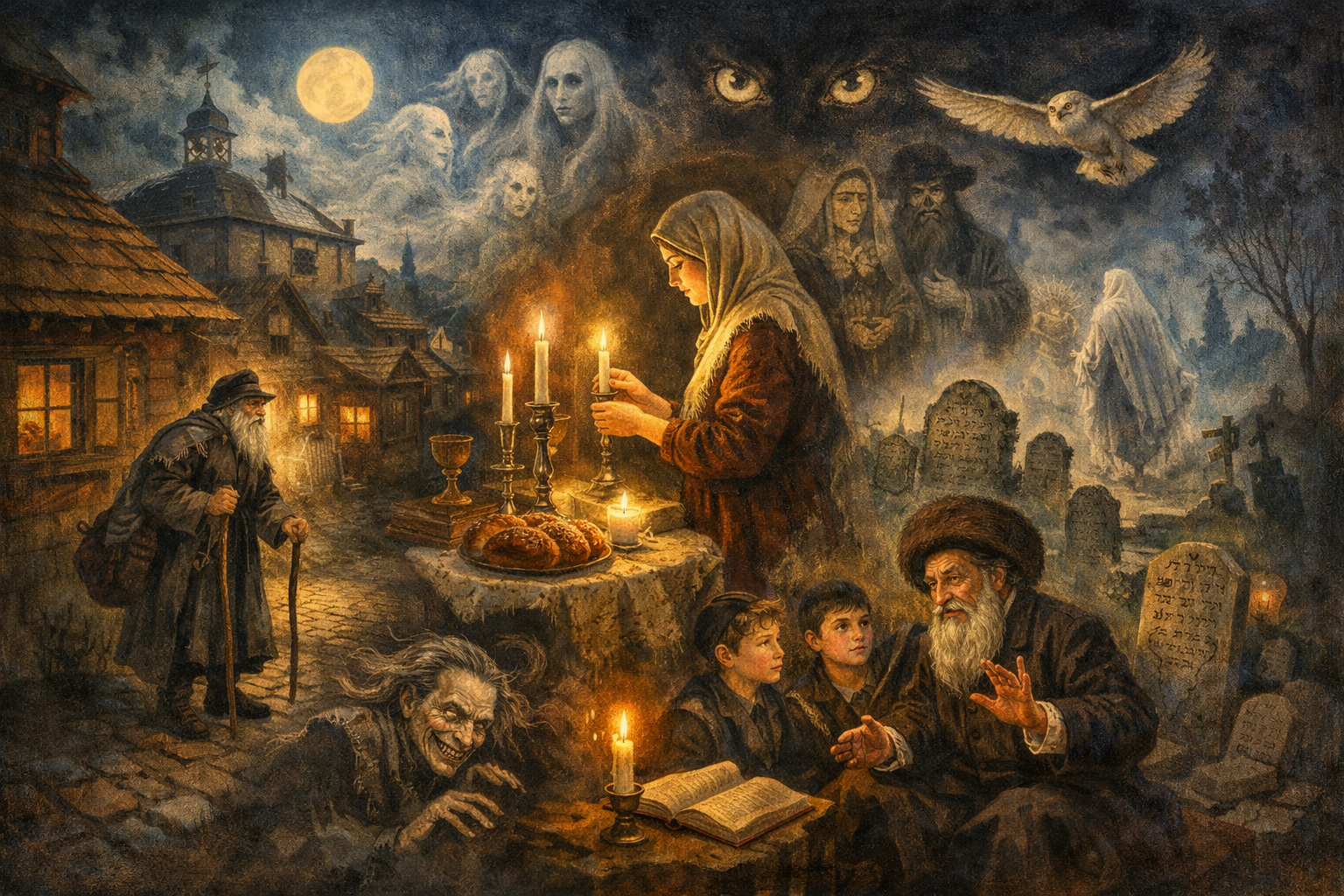
Yiddish sacred imagination is not reducible to religion in a narrow formal sense. It emerges at the meeting point of liturgy, law, custom, magic, healing, prayer, festive inversion, market life, kitchen ritual, study-house learning, cemetery visitation, dream interpretation, humor, communal storytelling, and historical vulnerability. The shtetl, the town, the marketplace, the synagogue, the study house, the kitchen, the bathhouse, the wedding hall, the road, the poorhouse, the rebbe’s court, and the cemetery all become narrative environments in which divine providence, spiritual danger, communal scrutiny, hidden holiness, and human frailty are simultaneously felt. Yiddish folklore is therefore not merely entertainment. It is a vernacular theology of exile, protection, moral testing, grief, humor, hidden sanctity, and endurance.
The field also includes the immense afterlife of Yiddish folklore in literature, theater, music, ethnography, visual culture, memorial books, survivor testimony, postwar witness writing, archival rescue, scholarship, translation, and revival work. Dybbuk legend, Hasidic tale, Purim play, marketplace humor, folk song, dream tale, cemetery story, wise-fool narrative, and domestic superstition survive not only in oral transmission but in collected, dramatized, translated, staged, sung, archived, and reimagined forms. This does not make the tradition less mythic. It shows that Yiddish sacred imagination endured by adapting its symbolic life to radically altered historical conditions while continuing to carry older worlds of memory, fear, hope, laughter, and holiness.
This pillar approaches Yiddish legend, folklore, and sacred imagination as a layered vernacular archive rather than as a quaint collection of old tales. It asks how biblical and rabbinic worlds were reinhabited through Yiddish speech; how dybbuk lore dramatizes the unfinished claims of the dead; how practical Kabbalah and domestic protection shaped everyday sacred life; how Hasidic stories made charisma and divine nearness narratable; how women’s ritual practice carried blessing, worry, and continuity; how humor became a form of moral survival; how the shtetl became a sacred social landscape; how postwar literature and memory transformed folklore after catastrophe; and how Yiddish continues as a language of religious life, cultural inheritance, performance, scholarship, and sacred imagination.
Why This Field Matters
Yiddish legend, folklore, and sacred imagination deserve serious study because they preserve one of the richest vernacular archives of Jewish life in diaspora. The field reveals how ordinary communities imagined holiness, danger, providence, suffering, humor, protection, temptation, mourning, shame, hope, and divine hiddenness. It shows how sacred imagination survives not only in scripture, commentary, law, or philosophy, but in story, custom, ghost lore, domestic ritual, festive play, joke, proverb, folk song, and vernacular memory.
The field also matters because it preserves forms of emotional and moral life often absent from formal theological writing. Yiddish folklore records fear of demons, anxieties around birth and death, matchmaking pressure, poverty, communal shame, hidden sin, unresolved obligation, messianic longing, envy, gossip, illness, spiritual danger, and comic endurance in the face of absurdity. Its power lies in its nearness to daily life. A candle, amulet, whispered blessing, cemetery visit, wedding omen, rebbe story, or joke about a fool can carry the weight of a whole worldview.
Yiddish sacred imagination is indispensable for understanding the lived interplay between religion and folklore. Yiddish-speaking communities did not inhabit sharply separate spheres of “official Judaism” and “popular imagination.” Halakhic life, kabbalistic symbolism, healing practice, omen, amulet, ghost lore, women’s ritual, Purim inversion, Hasidic wonder, ethical instruction, and storytelling frequently overlapped. The result is not a deviation from Jewish tradition, but one of its vernacular forms.
The field also broadens mythology itself. A people without one formal mythological canon may nevertheless sustain a vast and profound world of supernatural, legendary, moral, comic, and sacred imagination. Yiddish folklore is not fully understood if treated only as an appendix to Judaism, only as a subset of East European folklore, only as a reservoir for modern literature, or only as nostalgia for a lost world. It is a major archive of diasporic cultural intelligence.
The Problem of the Archive
A research-grade account must begin with the archive itself. Yiddish legend, folklore, and sacred imagination do not survive in one official mythographic corpus. They are dispersed across oral storytelling, Hasidic tale collections, Yiddish chapbooks, ethical literature, women’s prayers, ritual manuals, folk songs, Purim plays, jokes, proverbs, memoirs, ethnographic field notes, theater scripts, cemetery lore, memorial books, rabbinic anecdotes, kabbalistic materials, magical texts, survivor testimony, archival collections, Yiddish journalism, modern literature, and continuing religious speech.
The archive is linguistically layered. Hebrew, Aramaic, Yiddish, Germanic, Slavic, Polish, Ukrainian, Russian, Romanian, Hungarian, and other linguistic environments all helped shape the field. Sacred language and vernacular language interact constantly. Hebrew and Aramaic carry liturgy, law, scriptural memory, and mystical authority; Yiddish brings sacred worlds into the kitchen, marketplace, inn, road, bedroom, wedding hall, and children’s imagination. Translation is therefore not secondary. It is one of the field’s central processes.
The archive is also historically fractured. Much of Eastern European Yiddish civilization was destroyed in the Holocaust. Many stories survive through rescue: manuscripts, recordings, memory books, ethnographic expeditions, postwar testimony, theater, song, archival institutions, and the labor of writers, scholars, survivors, religious communities, and cultural workers. Yiddish folklore must therefore be studied not only as tradition, but as survival after rupture.
Interpretation must ask not only what a story means, but how it was transmitted, who told it, who collected it, what language carried it, what religious environment shaped it, what gendered or domestic world preserved it, and what historical violence altered its conditions of survival. The archive is not merely a collection of tales. It is a layered field of speech, ritual, memory, performance, loss, and rescue.
Myth Without a Single Canon
Yiddish legend, folklore, and sacred imagination are best approached as a plural vernacular field rather than as a single mythology. There is no one Yiddish pantheon, no single Jewish folk epic, no unified system of supernatural beings, and no canonical body of tales equivalent to a formal mythology. The field lives through story-worlds: dybbuk lore, Hasidic wonder, demonological fear, hidden righteous legends, Chelm stories, Purim play, dream tales, domestic protections, cemetery encounters, women’s prayers, folk songs, and literary transformations.
This absence of a single canon is not a weakness. It is the structure of the tradition. Yiddish sacred imagination grows from the meeting of Jewish textual inheritance with vernacular life under diasporic conditions. Bible, Midrash, Talmud, Kabbalah, Hasidism, synagogue, schoolroom, market, kitchen, cemetery, wedding, holiday, poverty, persecution, migration, and memory all become narrative sources.
Genre matters. A Hasidic wonder tale does different work from a dybbuk story. A joke about Chelm does different work from a cemetery legend. A women’s prayer does different work from a rabbinic anecdote. A Purim-shpil does different work from a survivor’s memorial story. A proverb carries different authority than a mystical tale. A theatrical dybbuk differs from a community belief about possession and soul disorder.
This pillar therefore treats “myth” broadly but carefully: as a field of stories, figures, practices, places, beings, rituals, jokes, objects, and symbolic forms through which communities imagine divine nearness, hiddenness, moral responsibility, danger, exile, death, comic survival, and sacred continuity.
The Civilizational Frame of Yiddish Sacred Imagination
The phrase “Yiddish legend, folklore, and sacred imagination” is useful because it names a field broader than folklore in the narrow sense and more historically lived than theology alone. It points to a vernacular world formed in Ashkenazi Jewish communities from medieval German lands into Eastern Europe and then carried into new diasporic settings in the twentieth century. This is not a claim of uniformity. It is a claim that Yiddish-speaking communities participated in overlapping symbolic worlds shaped by Torah and tale, law and custom, prayer and fear, mystical symbolism and domestic practice, martyrdom memory and comic resilience.
At its deepest layers this world draws on Bible, Midrash, Talmud, aggadah, penitential tradition, liturgical rhythms, ethical literature, mystical lore, and the medieval Ashkenazi religious imagination. But these layers become specifically Yiddish not simply through translation into a vernacular language. They become Yiddish by being lived in kitchens, cemeteries, marketplaces, homes, schools, study houses, wedding halls, poor households, inns, roads of exile, immigrant neighborhoods, and postwar sites of memory.
Yiddish sacred imagination is therefore the vernacular habitation of Jewish tradition under diasporic conditions. It is not Jewish theology simplified into folk belief. It is Jewish life as spoken, feared, joked about, protected, sung, mourned, dramatized, remembered, and passed across generations in a language of intimacy.
Over time this world was reshaped by movement eastward, by contact with Slavic, Polish, Lithuanian, Germanic, Romanian, Hungarian, and other folk environments, by the rise of Hasidism, by the Haskalah, by modern Yiddish print culture, by ethnographic collection, by mass migration, by the destruction of Eastern European Jewry, and by the postwar conditions in which Yiddish continued through writing, archives, journalism, theater, song, scholarship, translation, and living religious communities. The proper object of study is therefore not a “pure” folk Judaism, but a layered vernacular archive in which religion, folklore, memory, and diaspora experience continually interact.
Plurality, Layering, and Narrative Transformation
No fullest account can proceed as though Yiddish folklore belonged to one fixed and homogeneous worldview. The field is internally plural. Lithuanian, Polish, Galician, Ukrainian, Hungarian, Romanian, Bessarabian, and other Yiddish-speaking regions preserved overlapping but distinct tonalities of custom, storytelling, religious style, humor, and supernatural fear. Hasidic worlds differ from non-Hasidic Orthodox environments. Women’s domestic traditions do not simply replicate rabbinic discourse. Kabbalistic and demonic materials are not identical to comic tales of poverty and wit.
Maskilic and secular literary worlds do not merely reject folklore; they often reuse it critically, nostalgically, ironically, or artistically. Modern Yiddish literature transforms dybbuk lore, Hasidic legend, shtetl memory, and folk humor into literary art. Postwar Yiddish memorial and literary culture again transforms inherited materials under conditions of loss, survival, and witness.
This layered condition is especially important for avoiding reduction. To describe Yiddish folklore only as “Jewish superstition” misses the seriousness of its moral and theological imagination. To describe it only as pious storytelling erases fear, envy, desire, erotic anxiety, social pressure, and communal instability. To describe it only through Hasidic tales misses ghost lore, domestic ritual, women’s oral traditions, practical Kabbalah, children’s fears, and the comic intelligence of everyday life.
The result is a narrative archive best understood as a contact zone of sacred inheritances and lived worlds: rabbinic teaching, biblical afterlife, midrashic expansion, practical and theoretical Kabbalah, Hasidic charisma, Ashkenazi custom, women’s piety, East European folk environments, Yiddish humor, wartime witness, postwar literary continuation, archival rescue, and living communal speech.
Biblical, Rabbinic, and Aggadic Afterlives
Yiddish legend often carries forward the symbolic world of Bible, Talmud, Midrash, and aggadah into ordinary communal settings. Ancient sacred narratives are not merely repeated. They are vernacularized, moralized, localized, dramatized, and emotionally reinhabited in the speech-world of diaspora.
Rabbinic figures, biblical heroes, angels, demons, messianic expectations, miracles, divine tests, prophetic dreams, and moral exempla reappear in Yiddish story-worlds in ways that collapse distance between sacred history and present vulnerability. A biblical or rabbinic motif may become a teaching for a poor household, a warning against arrogance, a comfort in suffering, a joke about human foolishness, or a sign that divine providence still moves beneath ordinary life.
Aggadic tradition is especially important because it already contains imaginative expansion, moral parable, legend, wonder, and narrative theology. Yiddish folklore extends this mode into vernacular culture. It gives everyday Jewish life a story-language for thinking about hidden justice, divine patience, human absurdity, the suffering of the innocent, and the possible nearness of redemption.
This afterlife is central to the field. Yiddish legend is not detached from Jewish textual tradition; it is one of the ways that tradition becomes socially embodied in ordinary speech, local memory, and domestic instruction.
Medieval Ashkenaz, Martyr Memory, and Sacred Fear
A fullest account begins before the classic Eastern European shtetl. Medieval Ashkenaz contributed martyr memory, penitential intensity, demonology, sacred fear, magical protections, liturgical grief, and vernacular religiosity that later entered Yiddish-speaking worlds in transformed form. The movement from German Ashkenaz into eastern lands was not merely geographic. It carried a portable sacred imagination shaped by persecution, prayer, ritual, and memory.
Martyr memory matters because it gives Yiddish sacred imagination a deep background of historical vulnerability. The community is not imagined as secure. It lives under pressure, always aware of violence, accusation, expulsion, and the fragility of life. This does not produce only despair. It also produces forms of ritual endurance, spiritual defense, communal obligation, and fierce memory.
Medieval Ashkenazi piety also intensified concern with sin, repentance, divine judgment, demons, purity, prayer, and the moral weight of ordinary conduct. Later Yiddish folk materials inherit many of these concerns in vernacular forms: fear of improper death, danger at thresholds, anxiety around childbirth, the use of protective names, and stories in which hidden sin returns as supernatural disturbance.
This medieval layer is indispensable because it prevents Yiddish folklore from being reduced to picturesque shtetl life. Beneath the comic and domestic surface stands a deep tradition of sacred fear, suffering, protection, and memory.
Yiddish as Sacred Vernacular
Yiddish is central to this field because it carries sacred tradition into intimate life. Hebrew and Aramaic preserve liturgy, scripture, law, and learned authority; Yiddish brings sacred imagination into the idiom of the mother, the child, the market, the kitchen, the joke, the lament, the rebuke, the blessing, and the story told at night. It is a vernacular of nearness.
To call Yiddish a sacred vernacular does not mean that it replaces Hebrew. It means that Yiddish makes sacred worlds socially habitable. It carries explanations of biblical stories, moral lessons, women’s prayers, Hasidic tales, children’s warnings, folk songs, proverbs, and everyday religious language into ordinary speech. It allows the sacred to enter the rhythms of domestic and communal life.
Yiddish also carries humor in a way that matters theologically and morally. Its idioms of complaint, tenderness, irony, exaggeration, self-mockery, grief, and blessing make it a language of survival. Through Yiddish, suffering can be narrated without being made noble too easily; absurdity can be exposed without abandoning faith; and holiness can remain hidden inside ordinary weakness.
The language itself is therefore not merely a medium. It is part of the archive. To study Yiddish folklore in translation is possible, but something of rhythm, intimacy, comedy, and sacred texture always depends on the language that carried it.
Divine Hiddenness and Ordinary Holiness
One of the most powerful features of Yiddish storytelling is the conviction that holiness may appear in hidden, humble, or socially unexpected forms. The ordinary world is never merely ordinary. A poor man, beggar, widow, child, fool, stranger, tailor, peddler, or traveler may reveal deeper sacred significance. The person overlooked by the community may be the one through whom divine judgment or mercy appears.
This theme is especially important in Hasidic and folk traditions. Hidden holiness disrupts social ranking. The outwardly simple person may possess spiritual greatness; the respected scholar may lack mercy; the beggar may be a test; the fool may speak truth; the stranger may bring providence. Yiddish sacred imagination repeatedly warns against judging by appearance.
Divine hiddenness also gives ordinary life narrative depth. Poverty, illness, misfortune, a missed journey, a strange dream, a failed match, or a chance encounter may conceal meaning not visible at first. The world is not transparent. It requires humility, patience, and attention to signs.
This does not mean that every suffering is easily explained. Yiddish storytelling often lives with unresolved pain. Its holiness is frequently hidden precisely because the world feels incomplete. The tradition preserves faith not by denying anguish, but by keeping open the possibility that meaning may be concealed within fragility.
Dybbuks, Shedim, and the Unseen World
Yiddish folklore is densely populated by dybbuks, shedim, wandering souls, ominous spirits, ghostly visitors, and supernatural dangers that inhabit weddings, sickbeds, thresholds, cemeteries, roads, dreams, and periods of transition. The unseen is intimate to daily life rather than remote from it. It presses against the household, the body, the grave, the wedding, and the conscience.
The dybbuk is especially important because it dramatizes unfinished moral business. A possessing spirit may represent unresolved sin, broken vows, frustrated desire, improper death, unhealed grief, or the claims of the dead upon the living. Dybbuk lore turns spiritual disorder into a social and embodied drama. The afflicted body becomes a site where hidden history speaks.
Shedim and demonic beings occupy a different but related world of danger. They may appear around liminal spaces, vulnerable times, improper behavior, or moments when ordinary protection fails. Demonology gives narrative form to fear: fear of illness, envy, sexuality, childbirth, night, loneliness, death, and moral contamination.
These beings should not be dismissed as superstition in the shallow sense. They are part of a vernacular moral cosmology. They reveal how communities imagined unseen danger, spiritual vulnerability, and the fragile boundary between the living and the dead.
Soul, Cemetery, and the Nearness of the Dead
The dead remain socially and spiritually significant in Yiddish folklore. Stories of wandering souls, dybbuks, righteous ancestors, grave visitation, dream visitations, cemetery encounters, unfinished vows, and anxious attention to the fate of the departed form a major strand of the tradition. Death is ritually and narratively active, not neatly sealed off from communal life.
The cemetery is one of the central sacred landscapes of Yiddish imagination. It is a place of fear, memory, petition, obligation, and encounter. A grave may be visited for prayer or help. A forgotten promise may return through the dead. A dream of a deceased relative may carry warning or consolation. A cemetery story may reveal that the community’s moral life extends beyond visible society.
Stories of wandering souls often concern the unfinished. The dead may return because something remains unresolved: a wrong unconfessed, a promise broken, a marriage blocked, a sin unatoned, a body improperly treated, or a memory neglected. The supernatural thus becomes an ethical structure. The dead return when the moral world has not been repaired.
Yiddish cemetery lore therefore reveals a theology of relation. The living and the dead remain bound through memory, prayer, obligation, fear, and hope. Death changes relation; it does not abolish it.
Practical Kabbalah, Healing, and Protective Writing
A fully comprehensive account must include amulets, protective names, written formulas, exorcistic practices, healing customs, dream interpretation, boundary-making rituals, protective Psalms, ritual names, and the uneasy border between sanctioned devotion and suspect magic. These materials reveal a vernacular sacred science of danger and defense.
Protection is central because Yiddish folklore imagines life as spiritually exposed. Childbirth, infancy, illness, weddings, travel, poverty, death, envy, and transition all create vulnerability. Amulets, charms, mezuzot, candles, names, books, prayers, written formulas, and ritual acts become ways of defending fragile life against the unseen.
Practical Kabbalah and folk healing also show that written language can be materially active. Letters, names, verses, and formulas are not merely signs. In protective practice, writing becomes an object of sacred force. The text enters the body, the room, the threshold, the cradle, or the sickbed.
This layer must be interpreted carefully. Some practices were contested by rabbis; some were normalized in popular life; some existed at the edges of formal legitimacy. The tension itself is important. It reveals a community negotiating between law, fear, need, and the desire for divine protection.
Hasidic Wonder Tales and Rebbe Legend
Among the most important formations in the field are Hasidic stories of rebbes, hidden saints, miracle-working tzaddikim, providential reversals, mystical trials, ecstatic prayer, redemptive journeys, and transformative encounters. These tales are not simply edifying anecdotes. They are among the great narrative vehicles of Jewish charisma, theology, and sacred pedagogy.
The rebbe in Hasidic storytelling is a figure of mediation. He may see what others cannot see, interpret hidden spiritual conditions, repair broken souls, protect communities, rebuke arrogance, reveal concealed holiness, or transform a mundane event into a moment of divine instruction. His authority is narrative as well as institutional. Stories make charisma memorable.
Hasidic wonder tales also reinterpret suffering and chance. A delayed journey, failed business, strange visitor, poor meal, wandering beggar, hidden sin, or accidental meeting may reveal providence. The story trains listeners to imagine divine nearness within the ordinary, but also to recognize the limits of human understanding.
These tales belong centrally to Yiddish sacred imagination because they show how storytelling becomes devotional practice. To tell the story of a rebbe is not only to report a miracle. It is to inhabit a world in which holiness remains possible inside history.
Hidden Righteous Ones and Concealed Holiness
The figure of the hidden righteous person is central to the moral world of Yiddish legend. The hidden tzaddik, unnoticed saint, humble beggar, poor tailor, or socially marginal figure may carry spiritual weight invisible to the community. Sanctity is repeatedly displaced from social prestige to hidden character, humility, suffering, and secrecy.
This motif critiques external judgment. The person honored by society may be spiritually empty; the person mocked by society may be sustaining the world. The legend teaches that holiness is not identical with rank, learning, wealth, performance, or reputation. It may be concealed beneath poverty, silence, eccentricity, or ordinary work.
Hidden righteousness also speaks to diasporic vulnerability. In a world where Jewish life is precarious, the community imagines unseen sources of protection. The world may be held together by people no one recognizes. The hidden righteous person becomes an answer to divine hiddenness: holiness is concealed, but not absent.
These legends are therefore ethically powerful. They teach humility before human mystery and suspicion toward social vanity. They insist that the moral center of the world may be hidden from those most confident they understand it.
Wise Fools, Chelm, and Yiddish Comic Wisdom
Yiddish narrative culture is rich in irony, absurdity, self-mockery, wise-fool traditions, marketplace humor, rabbinic jokes, poverty jokes, marriage jokes, and tales of communal foolishness. Humor becomes a form of survival, a critique of pretension, a way of living with pain, and a mode of revealing truths inaccessible to pompous authority.
Chelm is especially important as a comic story-world. The Wise Men of Chelm are foolish precisely in ways that reveal the fragility of reason, bureaucracy, communal self-importance, and human certainty. Their logic is absurd, but the absurdity often exposes real social foolishness. Chelm is not merely a town of fools; it is a mirror.
Wise-fool traditions also invert power. The poor man, fool, child, beggar, or socially weak figure may expose the learned, wealthy, or arrogant. The joke becomes a small democratic force within a hierarchical world. It allows criticism without direct confrontation and insight without solemnity.
Yiddish humor is not separate from sacred imagination. It often lives near grief. Its laughter is sharpened by poverty, exile, vulnerability, and historical absurdity. To laugh in Yiddish folklore is not to escape suffering, but to refuse to let suffering have the final word.
Women, Domestic Worlds, and Everyday Sacred Life
No fullest treatment of Yiddish legend and folklore is adequate without giving central place to women as guardians of domestic ritual, tellers of tales, transmitters of anxiety and blessing, mourners, singers, matchmakers, caretakers, and keepers of everyday sacred time. The lighting of candles, preparation of food, shaping of Sabbath atmosphere, management of illness, fear surrounding childbirth, grief of mourning, and speech of advice, rebuke, consolation, and warning all form part of the imaginative world through which Yiddish life became spiritually legible.
Women’s religious worlds often operated through practices that formal theology underrecords: tkhines, candle prayers, kitchen customs, lullabies, whispered protections, birth rituals, remedies, domestic warnings, household blessings, and mourning speech. These forms are not secondary to the archive. They are among its central vessels.
Women also occupy decisive symbolic roles inside legendary and folkloric worlds. Mothers, brides, widows, matchmakers, possessed daughters, righteous women, grieving wives, practical caretakers, and women who see what others miss all carry moral and theological weight. Their vulnerability reveals the fragility of communal life, while their endurance preserves continuity under exile and danger.
A deepest account of Yiddish sacred imagination therefore cannot remain centered only on rabbis, rebbes, or male scholars. It must recognize the household as one of the principal theaters of Jewish sacred storytelling.
Childbirth, Marriage, Mourning, and Life-Cycle Danger
Yiddish folklore is especially intense around life-cycle transitions. Birth, naming, circumcision, childhood, marriage, pregnancy, illness, death, mourning, and burial are times when the boundary between ordinary life and unseen danger becomes thin. Folklore gives these transitions language, ritual structure, and protective imagination.
Childbirth and infancy were especially vulnerable. Protective names, amulets, prayers, ritual gestures, warnings, and stories about spirits or danger reflect the fragility of life before modern medicine and under difficult social conditions. The newborn is not only biologically vulnerable; the child is spiritually exposed.
Marriage is another charged site. Weddings bring blessing, joy, anxiety, sexuality, family negotiation, social pressure, economic obligation, and the risk of supernatural intrusion. Dybbuk stories often gather around wedding or marriage disruption because marriage dramatizes unresolved desire, social blockage, and the claims of the dead upon the living.
Mourning and burial likewise reveal the nearness of the unseen. Proper rites matter because the dead remain in relation to the living. Life-cycle folklore therefore shows that Yiddish sacred imagination is not abstract. It is concentrated at the most vulnerable moments of human passage.
Shtetl Space, Sacred Geography, and the Social Life of Place
No serious treatment of Yiddish sacred imagination can ignore the role of place. The shtetl is not merely a sociological setting. It is a narrative environment. The synagogue, study house, kitchen, market, inn, bathhouse, cemetery, road, wedding hall, poorhouse, schoolroom, and rebbe’s court all become charged sites where divine providence, demonic danger, moral testing, communal judgment, hidden holiness, and human absurdity unfold.
Sacred geography in Yiddish tradition is often modest in scale but immense in density. A grave of a revered rabbi, a room where candles are lit, a threshold crossed under danger, a road traveled to visit a rebbe, a poor family’s table, or a cemetery visited in fear and hope may hold more symbolic charge than monumental architecture. Diaspora does not abolish sacred geography. It miniaturizes, domesticates, and intensifies it.
Place becomes holy not only because it is ancient or official, but because it has been inhabited by prayer, memory, danger, repetition, and relation. The wedding hall can become a site of possession. The cemetery can become a place of unfinished relation between the living and the dead. The road can become a theater of exile, providence, or miraculous encounter. The humble home can become a fortress of blessing against invisible threat.
To map Yiddish legend is therefore to map the dense sacred life of diaspora space itself: not only the grand sites of religious history, but the everyday places where holiness, fear, and communal memory gather.
Holiday Lore, Purim Play, and Ritual Time
Festival life, Sabbath atmosphere, Passover memory, Purim inversion, penitential periods, wedding seasons, mourning periods, and the ritual year all contribute to the temporality of Yiddish sacred imagination. Narrative is often embedded in liturgical and seasonal rhythms. Time itself becomes storied.
Sabbath is especially central because it transforms domestic space and ordinary time. Candles, food, blessing, song, rest, and family rhythm turn the home into sacred time. Folklore gathers around this transformation: stories of Sabbath protection, hidden holiness, poverty made luminous, or divine favor appearing through humble observance.
Purim is equally important because it authorizes inversion, satire, performance, parody, and comic release. Purim-shpil traditions show how sacred history, communal humor, social criticism, and theatrical play can coexist. In Purim performance, laughter becomes ritualized. The world is turned upside down in order to reveal truths that ordinary order conceals.
Holiday lore therefore demonstrates that Yiddish folklore is not only about beings and stories. It is also about sacred time: the repeated rhythms through which a vulnerable community renews memory, protection, hope, and joy.
Small Forms: Proverbs, Jokes, Riddles, Blessings, and Curses
A complete account must include the small forms through which Yiddish folklore enters everyday life: proverbs, jokes, riddles, blessings, curses, cautions, schoolroom lore, children’s fears, insults, matchmaking sayings, market wit, and domestic warnings. These forms may appear minor beside dybbuk drama or Hasidic wonder tale, but they often carry the densest everyday wisdom.
Proverbs condense moral judgment. Jokes expose contradiction. Blessings and curses reveal the force of speech. Riddles train perception. Warnings mark the boundaries of danger. Children’s lore preserves fear and wonder in miniature. A single Yiddish saying can carry theology, social critique, resignation, comic defiance, and practical intelligence at once.
Small forms are highly portable. They move across families, streets, schools, markets, immigrant neighborhoods, books, theater, and memory. They survive displacement because they are compact, repeatable, and emotionally charged. Even when long narrative traditions are interrupted, proverbs and jokes endure.
Yiddish folklore therefore lives not only in major tales but in daily speech. The smallest forms often reveal the deepest structures of fear, humor, caution, faith, and social order.
Literature, Theater, and Modern Yiddish Afterlives
A fullest treatment includes the transformation of Yiddish folk materials in literature, drama, theater, music, journalism, and visual culture. Writers and collectors did not merely preserve folklore. They reinterpreted it under the pressures of modernity, migration, secularism, politics, catastrophe, and memorial culture.
S. An-sky’s The Dybbuk is one of the most important examples. It transformed possession lore, ethnographic imagination, Hasidic setting, love tragedy, and spiritual unrest into a modern theatrical myth of Yiddish culture. The dybbuk became not only a folkloric being, but a dramatic figure for memory, desire, displacement, and the unfinished claims of the dead.
Writers such as I.L. Peretz, Sholem Aleichem, and Isaac Bashevis Singer drew deeply from Hasidic legend, folk humor, demonology, shtetl memory, ethical tale, and supernatural imagination. Their work does not simply reproduce folklore; it reworks it through modern literary consciousness, irony, nostalgia, skepticism, and metaphysical intensity.
Yiddish theater and song also carried folklore into public performance. The stage, the printed story, the gramophone, the newspaper, the archive, and the translated book all became new vessels for older symbolic worlds. Modernity did not end Yiddish folklore. It changed its media.
Rupture, Witness, and Cultural Survival After 1945
After 1945, Yiddish became one of the languages through which destroyed worlds were remembered, mourned, documented, and symbolically reinhabited. Survivor writing, memorial books, archival preservation, scholarship, theater, song, translation, and cultural institutions allowed folklore to persist as witness and inheritance.
The Holocaust radically changed the conditions of Yiddish folklore. The shtetl became not only a living social environment but also a site of memory, mourning, reconstruction, and loss. Stories once told within communities now often survive as fragments, testimonies, archives, performances, or literary acts of recovery.
Yizkor books and postwar memorial writing are especially important because they preserve local worlds after their destruction. They record towns, customs, personalities, rabbis, schools, songs, stories, jokes, fears, and holy places as acts of communal remembrance. Folklore becomes memorial practice.
A complete account must also acknowledge living Yiddish after catastrophe. Yiddish continued in religious communities, especially Hasidic and Haredi environments, and in literary, theatrical, scholarly, musical, and activist revivals. The tradition survives not only as archive but as speech, study, performance, and ongoing communal life.
Ethics, Symbolism, and the Moral Imagination
The narrative traditions of Yiddish legend, folklore, and sacred imagination repeatedly ask what it means to live faithfully under conditions of insecurity, exile, dependence, communal scrutiny, poverty, mourning, and divine hiddenness. Their symbols are morally dense. The wandering beggar may signify both vulnerability and secret holiness. The demon may externalize disorder, desire, fear, or communal instability. The rebbe may represent guidance, miracle, charisma, or the burden of sanctity. The dybbuk may dramatize the unfinished moral claims of the dead upon the living. The wise fool may expose the vanity of learning without mercy. The Sabbath candle may turn fragility into a sign of sacred endurance.
These narratives also contain historical and social intelligence, though often indirectly. They reflect on precarity, minority existence, gendered vulnerability, class difference, reputation, communal pressure, matchmaking, poverty, illness, migration, and the costs of survival under external threat. Even when they do not speak in the language of politics, they preserve a moral sociology of diaspora: how a people organizes shame, fear, charity, wit, memory, and hope under unstable conditions.
At their highest level, these traditions show how Yiddish-speaking Jewish civilization thought through story. They disclose a theology of divine concealment and nearness, an ethics of humility and obligation, a demonology of everyday danger, a poetics of humor and sorrow, a metaphysics of wandering and return, and a tenacious symbolic effort to preserve holiness under conditions of vulnerability.
Yiddish legend, folklore, and sacred imagination therefore belong not at the margins of mythology, but close to the center of any serious account of how communities imagine the unseen, ritualize fear, remember suffering, laugh through hardship, and sustain meaning through vernacular culture.
Major Questions of Interpretation
This pillar is organized around several major questions. How should Yiddish legend, folklore, and sacred imagination be studied when the archive includes Bible, Midrash, rabbinic tale, Kabbalah, Hasidic storytelling, dybbuk lore, domestic ritual, women’s prayers, jokes, songs, theater, ethnography, memorial writing, and living religious speech? How can the field be read without reducing it to superstition, nostalgia, literary source material, or religious doctrine alone?
The pillar also asks how vernacular story carries sacred knowledge. How do dybbuk stories dramatize moral disorder and unfinished death? How do Hasidic wonder tales narrate charisma, providence, and hidden holiness? How do women’s domestic practices sustain sacred time and protective knowledge? How does Yiddish humor hold grief and insight together? How does the shtetl function as a sacred social landscape? How do archives, theater, literature, and survivor testimony transform folklore after catastrophe?
These questions keep the category from becoming a simple inventory of colorful tales. They open Yiddish legend, folklore, and sacred imagination as a field of religious, domestic, literary, mystical, comic, gendered, historical, performative, and post-catastrophic inquiry. The tradition is not only a collection of stories. It is a major archive through which a diasporic Jewish civilization imagined holiness, danger, divine hiddenness, communal vulnerability, humor, and survival.
Expanded Article Architecture
The following structure gathers the pillar into a long-range architecture suitable for a major mythology knowledge series. It is designed to support biblical and rabbinic afterlives, medieval Ashkenaz, Yiddish vernacular sacred culture, Kabbalah, dybbuk lore, demons, wandering souls, Hasidic tales, hidden righteousness, comic wisdom, women’s domestic ritual, life-cycle danger, shtetl sacred geography, holiday lore, literature, theater, postwar witness, archival rescue, and living Yiddish continuity. All entries below should be treated as planned unless already completed elsewhere on the site.
Foundations and Source Problems
- What Is Yiddish Legend, Folklore, and Sacred Imagination? (planned)
- The Problem of Sources in Yiddish Folklore and Sacred Imagination (planned)
- Yiddish Sacred Imagination Without a Single Mythological Canon (planned)
- How to Read Yiddish Folklore Without Reducing It to Superstition (planned)
- Oral Tradition, Print Culture, Theater, and the Survival of Yiddish Story Worlds (planned)
- Ethnography, Collection, and the Rescue of Yiddish Cultural Memory (planned)
- Translation, Archive, and the Problem of Hearing Yiddish in English (planned)
Medieval Ashkenaz and Sacred Background
- Medieval Ashkenaz and the Deep Origins of Yiddish Sacred Imagination (planned)
- Martyrdom, Catastrophe, and Sacred Memory Before the Shtetl (planned)
- Penitential Piety, Sacred Fear, and the Moral Imagination of Ashkenaz (planned)
- Demonology, Protection, and Vernacular Religion in Medieval Ashkenaz (planned)
- Migration Eastward and the Making of the Yiddish Story World (planned)
Biblical, Rabbinic, and Aggadic Afterlives
- Biblical Afterlives and Rabbinic Memory in Yiddish Story Worlds (planned)
- Midrash, Aggadah, and the Vernacular Imagination of Everyday Holiness (planned)
- Talmudic Sages in Yiddish Tale, Joke, and Moral Instruction (planned)
- Angels, Prophets, Miracles, and Divine Testing in Vernacular Jewish Story (planned)
- Ethical Literature, Mussar, and the Popular Moral Imagination (planned)
- Yiddish as a Sacred Vernacular: Language, Story, and Diaspora Memory (planned)
Kabbalah, Protection, and the Unseen
- Kabbalah in the Vernacular: Mystical Symbolism in Yiddish Folklore (planned)
- Practical Kabbalah, Amulets, and the Written Defense Against Evil (planned)
- Holy Names, Protective Psalms, and the Material Power of Text (planned)
- Dreams, Omens, and the Interpretation of Hidden Meaning (planned)
- Healing, Illness, and the Management of Unseen Threat (planned)
- Boundary-Making, Thresholds, and the Ritual Defense of the Home (planned)
Dybbuks, Demons, Souls, and the Dead
- What Is a Dybbuk? Possession, Soul, and Moral Disorder in Jewish Folklore (planned)
- Demons, Shedim, and Spiritual Danger in Yiddish Tradition (planned)
- Ghosts, Wandering Souls, and the Nearness of the Dead (planned)
- Cemetery Lore, Grave Visitation, and Sacred Memory in Ashkenazi Life (planned)
- Exorcism, Broken Vows, and the Social Drama of Possession (planned)
- Death, Mourning, and the Unfinished Claims of the Departed (planned)
Hasidic Storytelling and Sacred Charisma
- Hasidic Wonder Tales and the Charisma of the Rebbe (planned)
- The Hidden Tzaddik and the Legend of Concealed Holiness (planned)
- Miracle, Providence, and Moral Instruction in Hasidic Storytelling (planned)
- Naḥman of Bratslav and the Sacred Power of Tale (planned)
- Journey to the Rebbe, Pilgrimage, and the Narrative Geography of Hasidism (planned)
- Hasidic and Non-Hasidic Jewish Story Worlds (planned)
- Holy Folly, Ecstasy, and the Unstable Boundary of Wisdom (planned)
Humor, Wise Fools, and Comic Intelligence
- Wise Fools, Beggars, and the Comic Wisdom of Yiddish Narrative (planned)
- Chelm and the Folklore of Holy Absurdity (planned)
- Yiddish Jokes, Poverty, and the Moral Force of Laughter (planned)
- Foolish Scholars, False Piety, and the Critique of Pretension (planned)
- Market Humor, Matchmakers, Tricksters, and Social Satire (planned)
- Humor, Sorrow, and the Diasporic Moral Imagination (planned)
Women, Domestic Worlds, and Everyday Sacred Life
- Women’s Piety, Candlelight, and the Domestic Sacred (planned)
- Tkhines, Women’s Prayer, and Vernacular Devotional Speech (planned)
- Mothers, Brides, Widows, and Women’s Moral Worlds in Yiddish Legend (planned)
- Lullabies, Lament, and the Emotional Life of Yiddish Oral Tradition (planned)
- Kitchen Ritual, Foodways, and the Sacred Labor of the Home (planned)
- Women’s Worry, Blessing, and Protective Knowledge (planned)
Life-Cycle Danger and Ritual Passage
- Wedding, Birth, and Transition: Folklore of Life-Cycle Danger (planned)
- Childbirth, Naming, and Protective Practice in Yiddish Folk Religion (planned)
- Marriage, Matchmaking, and Supernatural Anxiety (planned)
- Possessed Brides, Broken Vows, and the Drama of Blocked Marriage (planned)
- Illness, Child Fear, and the Fragility of Family Life (planned)
- Deathbed, Burial, Mourning, and the Ritual Management of the Soul (planned)
Shtetl, Marketplace, Cemetery, and Sacred Place
- The Shtetl as Story World: Marketplace, Home, and Study House (planned)
- Synagogue, Beit Midrash, Kitchen, and the Sacred Geography of Everyday Life (planned)
- Roads, Inns, Travelers, and the Folklore of Wandering (planned)
- Cemetery, Grave, and the Haunted Landscape of Memory (planned)
- The Rebbe’s Court as Sacred Theater and Social World (planned)
- Poverty, Charity, and the Moral Geography of the Jewish Town (planned)
Holiday Lore, Ritual Time, and Performance
- Purim Humor, Purim-shpil, and the Ritual Inversion of the Folk Year (planned)
- Sabbath, Festival Time, and the Sacred Temporality of Yiddish Life (planned)
- Passover Memory, Exile, and Vernacular Retelling (planned)
- High Holy Days, Judgment, and the Folklore of Repentance (planned)
- Hanukkah, Light, Memory, and Domestic Sacred Practice (planned)
- Holiday Food, Song, and the Embodied Calendar of Yiddish Life (planned)
Children, Small Forms, and Everyday Speech
- Children’s Fears, School Lore, and the Sacred Imagination of Childhood (planned)
- Proverbs, Jokes, Riddles, Blessings, and Curses in Yiddish Oral Culture (planned)
- Names, Nicknames, Insults, and the Social Life of Speech (planned)
- Cautionary Tales, Nursery Fear, and Moral Training (planned)
- Small Forms and the Survival of Yiddish Folk Intelligence (planned)
Modern Literature, Theater, and Secular Reworkings
- The Dybbuk in An-sky and the Ethnographic Imagination of Jewish Culture (planned)
- Yiddish Folklore in Peretz, Sholem Aleichem, and Bashevis Singer (planned)
- Hasidic, Non-Hasidic, Maskilic, and Secular Reworkings of Folklore (planned)
- Yiddish Theater, Ghost Story, and the Stage Life of Folk Imagination (planned)
- Folk Song, Klezmer, and the Musical Transmission of Memory (planned)
- Modern Yiddish Literature and the Transformation of Sacred Legend (planned)
Catastrophe, Witness, Archive, and Continuity
- Yiddish After 1945: Rupture, Memory, and Cultural Survival (planned)
- Survivor Testimony and the Moral Authority of Postwar Yiddish (planned)
- Postwar Yiddish Literature as Witness, Mourning, and Continuation (planned)
- Yizkor Books, Memorial Writing, and the Reconstruction of Lost Worlds (planned)
- Archives, Folklore Collection, and the Rescue of Yiddish Cultural Memory (planned)
- Yiddish Theater, Song, and Performance After Catastrophe (planned)
- Living Yiddish in Religious Communities After World War II (planned)
- Myth, Folklore, and Collective Memory in Yiddish Civilization (planned)
- Why Yiddish Legend, Folklore, and Sacred Imagination Still Matter (planned)
Closing Perspective
Yiddish legend, folklore, and sacred imagination reveal one of the great vernacular archives of Jewish civilization. They preserve biblical and rabbinic afterlives, medieval Ashkenazi sacred fear, dybbuks and wandering souls, shedim and protective names, Hasidic wonder and rebbe charisma, hidden righteous ones, wise fools, Chelm, women’s candlelit piety, lullabies and laments, wedding anxieties, cemetery stories, Purim plays, shtetl social drama, postwar testimony, archival rescue, and living Yiddish continuity.
This is what makes the category so important within Mythology. Yiddish traditions show how mythology can survive through vernacular speech, domestic ritual, comic intelligence, ghost story, sacred protection, theater, song, archive, and witness. They also show why mythology must be studied through language, gender, ritual, minority life, exile, trauma, humor, memory, and everyday sacred practice, not only through story summary.
The strongest reason to study this field is that it clarifies how communities preserve meaning under conditions of vulnerability. The candle protects the home; the dybbuk exposes unfinished moral history; the rebbe story opens ordinary life to providence; the fool reveals wisdom through absurdity; the cemetery keeps the dead near; the mother’s blessing carries fear and hope; the joke turns suffering into speech; the archive rescues what violence tried to erase. These traditions do not belong only to the past. They continue wherever Yiddish is spoken, studied, sung, translated, performed, remembered, and renewed.
Related Reading
- Mythology
- Abrahamic Traditions
- Yiddish Literature and Cultural Memory
- Yiddish Thought
- Mysticism and Contemplative Traditions
- Comparative Sacred Themes
- Religion and Society
- Religion and Law
- Culture, Meaning, and Symbolism
- Tragedy, Drama, and Collective Memory
Primary Sources
Yiddish Folklore, Ethnography, and Oral Tradition
- S. An-sky’s ethnographic materials, expedition records, and literary adaptations, especially for dybbuk lore, folk belief, Hasidic environments, Jewish ethnographic consciousness, and the modern recovery of Yiddish cultural memory.
- YIVO Institute for Jewish Research archival collections relating to Yiddish folklore, ethnography, oral history, theater, music, language, Hasidism, Eastern European Jewish life, and postwar cultural continuity.
- Yiddish folk songs, proverbs, jokes, blessings, curses, riddles, women’s prayers, domestic sayings, and oral narratives preserved in collected and archival form.
Hasidic, Rabbinic, and Vernacular Sacred Story
- Hasidic tale collections concerning the Baal Shem Tov, Naḥman of Bratslav, rebbes, hidden tzaddikim, miracle stories, providential reversals, and holy fools.
- Rabbinic, aggadic, and ethical narratives reworked in Yiddish storytelling, popular preaching, moral instruction, and vernacular religious culture.
- Tkhines and women’s devotional materials, especially for domestic piety, childbirth, candle lighting, mourning, and vernacular sacred speech.
Dybbuk, Demonology, and Protective Practice
- Dybbuk stories, possession narratives, exorcism accounts, wandering-soul traditions, cemetery tales, ghost stories, and related materials concerning the moral claims of the dead.
- Amulets, protective names, practical Kabbalah materials, healing practices, dream interpretation, ritual protections, and household defenses against spiritual danger.
- Community traditions concerning birth, marriage, illness, mourning, evil eye, envy, and the unseen forces surrounding life-cycle transition.
Theater, Literature, Song, and Memorial Culture
- An-sky, S. The Dybbuk and related writings, central for the theatrical transformation of Jewish possession lore and ethnographic imagination.
- Works by I.L. Peretz, Sholem Aleichem, Isaac Bashevis Singer, and other Yiddish writers who transformed folklore, Hasidic memory, demonology, shtetl social life, and comic wisdom into modern literature.
- Yizkor books, memorial volumes, survivor testimony, postwar Yiddish writing, theater programs, song collections, and archival rescue projects that preserve the memory of destroyed Yiddish communities.
Reference and Research Gateways
- The YIVO Encyclopedia of Jews in Eastern Europe. A core reference for dybbuk lore, Hasidism, Purim-shpil, Chelm, Yiddish ethnography, Eastern European Jewish life, and postwar Yiddish cultural institutions: https://www.yivoencyclopedia.org/
- Yiddish Press, National Library of Israel. Useful for the range and persistence of Yiddish journalism, literary culture, public discourse, and modern vernacular life: https://www.nli.org.il/en/discover/newspapers/jpress/all-sections/yiddish-press
- YIVO Institute for Jewish Research. Useful for archival, linguistic, historical, musical, theatrical, and ethnographic materials connected to Yiddish civilization: https://yivo.org/
Further Reading
- Hasan-Rokem, G. (2004) ‘Jewish Folklore and Ethnography’, in The Oxford Handbook of Jewish Studies. Oxford: Oxford University Press.
- An-sky, S. (1971) The Dybbuk and Other Writings. New York: Schocken.
- Ausubel, N. (1948) A Treasury of Jewish Folklore. New York: Crown.
- Buber, M. (1947) Tales of the Hasidim. New York: Schocken.
- Faierstein, M.M. (2011) ‘Transmigration of the Soul and Dybbuks’, in Jewish Mysticism and Magic. Cambridge: Cambridge University Press.
- Roskies, D.G. (1995) A Bridge of Longing: The Lost Art of Yiddish Storytelling. Cambridge, MA: Harvard University Press.
- Wisse, R. (2013) No Joke: Making Jewish Humor. Princeton: Princeton University Press.
- Yerushalmi, Y.H. (1982) Zakhor: Jewish History and Jewish Memory. Seattle: University of Washington Press.
- Zborowski, M. and Herzog, E. (1952) Life Is with People: The Culture of the Shtetl. New York: International Universities Press.
- Sherman, J. (ed.) (2004) Yiddish after the Holocaust. Oxford: Boulevard Books.
- The YIVO Encyclopedia of Jews in Eastern Europe. A core reference for Eastern European Jewish culture, Hasidism, dybbuk lore, Chelm, Yiddish language, folklore, theater, and cultural institutions. https://www.yivoencyclopedia.org/
- National Library of Israel, Yiddish Press. Useful for Yiddish journalism, public discourse, cultural life, and modern vernacular continuity. https://www.nli.org.il/en/discover/newspapers/jpress/all-sections/yiddish-press
- Baumgarten, J. (2005) Introduction to Old Yiddish Literature. Oxford: Oxford University Press.
- Dauber, J. (2006) Antonio’s Devils: Writers of the Jewish Enlightenment and the Birth of Modern Hebrew and Yiddish Literature. Stanford: Stanford University Press.
- Idel, M. (1988) Kabbalah: New Perspectives. New Haven: Yale University Press.
- Nigal, G. (1994) The Hasidic Tale. Oxford: Littman Library of Jewish Civilization.
- Wex, M. (2005) Born to Kvetch: Yiddish Language and Culture in All of Its Moods. New York: St. Martin’s Press.
References
- An-sky, S. (1971) The Dybbuk and Other Writings. New York: Schocken.
- Ausubel, N. (1948) A Treasury of Jewish Folklore. New York: Crown.
- Baumgarten, J. (2005) Introduction to Old Yiddish Literature. Oxford: Oxford University Press.
- Bohlman, P.V. (2004) ‘Music’, in The Oxford Handbook of Jewish Studies. Oxford: Oxford University Press.
- Buber, M. (1947) Tales of the Hasidim. New York: Schocken.
- Dauber, J. (2006) Antonio’s Devils: Writers of the Jewish Enlightenment and the Birth of Modern Hebrew and Yiddish Literature. Stanford: Stanford University Press.
- Etkes, I. (2017) ‘The Rise of Hasidism’, in The Cambridge History of Judaism. Cambridge: Cambridge University Press.
- Faierstein, M.M. (2011) ‘Transmigration of the Soul and Dybbuks’, in Jewish Mysticism and Magic. Cambridge: Cambridge University Press.
- Hasan-Rokem, G. (2004) ‘Jewish Folklore and Ethnography’, in The Oxford Handbook of Jewish Studies. Oxford: Oxford University Press.
- Idel, M. (1988) Kabbalah: New Perspectives. New Haven: Yale University Press.
- Nigal, G. (1994) The Hasidic Tale. Oxford: Littman Library of Jewish Civilization.
- Roskies, D.G. (1995) A Bridge of Longing: The Lost Art of Yiddish Storytelling. Cambridge, MA: Harvard University Press.
- Sherman, J. (ed.) (2004) Yiddish after the Holocaust. Oxford: Boulevard Books.
- Wex, M. (2005) Born to Kvetch: Yiddish Language and Culture in All of Its Moods. New York: St. Martin’s Press.
- Wisse, R. (2013) No Joke: Making Jewish Humor. Princeton: Princeton University Press.
- Yerushalmi, Y.H. (1982) Zakhor: Jewish History and Jewish Memory. Seattle: University of Washington Press.
- YIVO Encyclopedia (n.d.) The YIVO Encyclopedia of Jews in Eastern Europe. New York: YIVO Institute for Jewish Research.
- YIVO Encyclopedia (n.d.) ‘Dybbuk, The’. New York: YIVO Institute for Jewish Research.
- YIVO Encyclopedia (n.d.) ‘Wise Men of Chelm’. New York: YIVO Institute for Jewish Research.
- YIVO Encyclopedia (n.d.) ‘Naḥman of Bratslav’. New York: YIVO Institute for Jewish Research.
- YIVO Encyclopedia (n.d.) ‘Gzeyres Taḥ ve-Tat’. New York: YIVO Institute for Jewish Research.
- Zborowski, M. and Herzog, E. (1952) Life Is with People: The Culture of the Shtetl. New York: International Universities Press.