
Last Updated May 5, 2026
The White Snake tradition is one of the most enduring narrative worlds in Chinese folklore because it binds love, metamorphosis, transgression, religion, gender, cultivation, medicine, sacred geography, and moral ambiguity into a single story that has never remained fixed. At its center stands a being who is at once spirit, snake, woman, lover, healer, adept, wife, mother in many later versions, and transgressor in the eyes of religious authority. Around her gathers one of the richest dramatic constellations in Chinese narrative tradition: the mortal Xu Xian or Xu Xuan, the loyal Green Snake companion, the monk Fahai, the pharmacy and domestic worlds of Hangzhou, and the famous West Lake and Leifeng Pagoda settings through which desire, law, and supernatural transformation are staged.
The legend does not survive because it offers one stable moral lesson. It survives because it repeatedly forces Chinese culture to ask whether love across ontological boundaries is monstrous, tragic, redemptive, dangerous, liberating, or simply more truthful than the institutions that condemn it. In earlier versions, the transformed snake may appear closer to a dangerous spirit or demonic seductress. In later performance, fiction, opera, and modern adaptation, Bai Suzhen increasingly becomes a sympathetic heroine whose emotional life, healing power, and fidelity challenge the very categories used to imprison her. The White Snake tradition is therefore not only a supernatural romance. It is one of Chinese culture’s great meditations on love under prohibition.
Series context: This article is part of the Chinese Myth, Folklore & Legend knowledge series. For the broader category structure, return to the Mythology category.
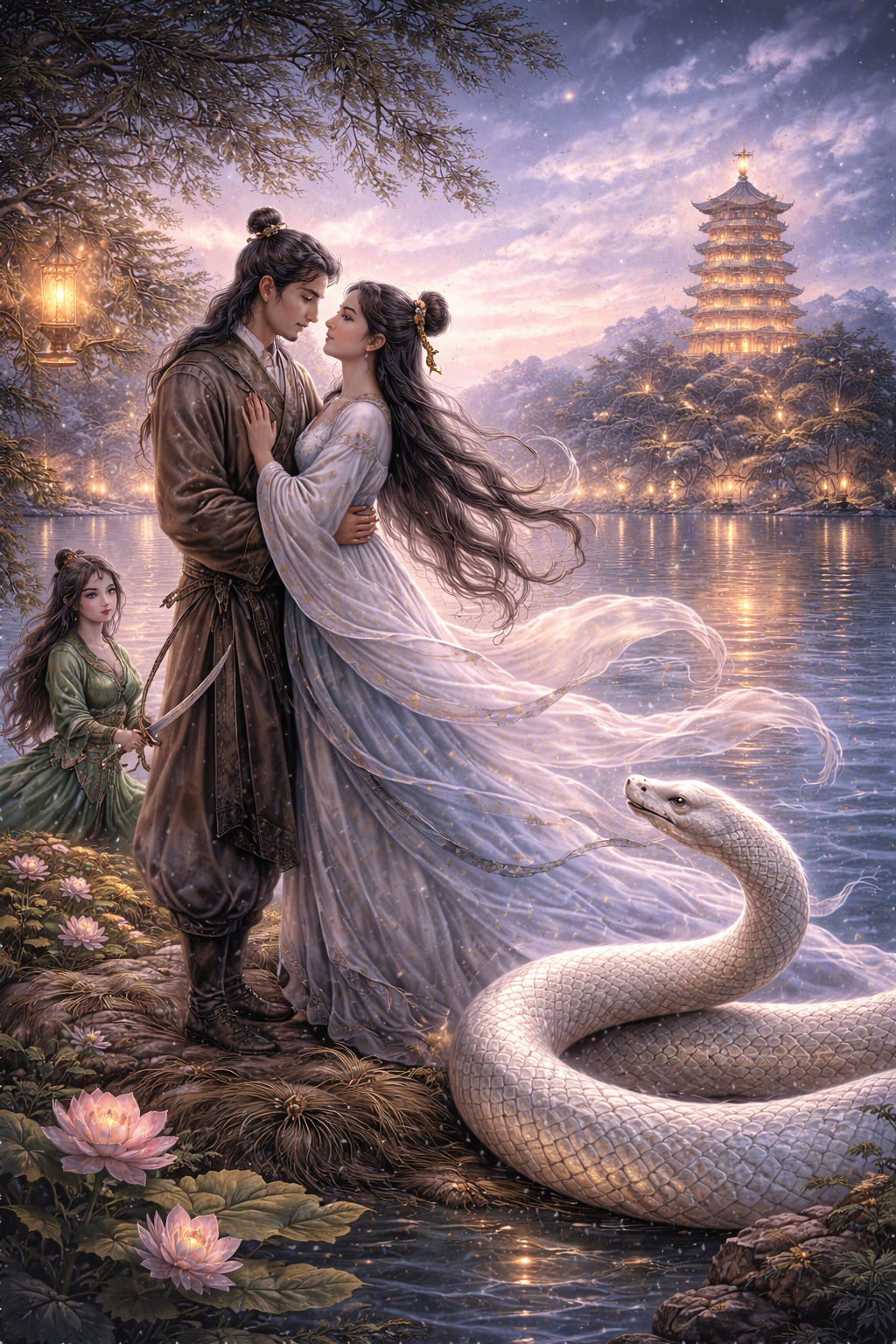
The White Snake legend did not emerge fully formed. It developed gradually across animal-spirit lore, regional storytelling, vernacular fiction, local Hangzhou associations, Buddhist and Daoist religious imagery, dramatic performance, opera, ballad, precious scroll, and modern adaptation. Over time, the story came to center on Bai Suzhen, the White Snake spirit who takes human form; Xu Xian, the mortal man she loves and marries; Xiaoqing or Green Snake, her companion; and Fahai, the monk who opposes the union and insists on its unnaturalness. Yet those recognizable names and roles are the result of cumulative development, not a single ancient canonical origin.
This layered development is the source of the legend’s power. In one register, the story belongs to Chinese traditions of animal transformation: long-lived creatures cultivate power and cross species boundaries. In another register, it belongs to romance: Bai Suzhen and Xu Xian love across an impossible divide. In another, it belongs to religious conflict: Fahai enforces a boundary between human and spirit, Buddhist authority and forbidden intimacy. In another, it belongs to gendered cultural memory: the woman marked as monstrous may become the story’s deepest moral center. The White Snake tradition endures because it can sustain all these readings at once.
What Is the White Snake Tradition?
The White Snake tradition is a long-evolving Chinese legend centered on a snake spirit who assumes human form and enters into a loving relationship with a mortal man. In its later and most influential forms, that spirit is Bai Suzhen 白素貞, often portrayed not as a crude demon but as a cultivated, elegant, emotionally serious, and spiritually accomplished woman. The legend’s central conflict arises because her union with Xu Xian 許仙 violates a presumed natural and religious boundary between human and nonhuman life. From this premise unfolds one of the great stories of Chinese vernacular culture.
What makes the tradition so powerful is that it refuses to remain a simple monster tale. The White Snake is not merely an external threat to social order. She becomes wife, healer, partner, mother in many versions, and sufferer. Her humanity is narratively persuasive even when her ontology remains unstable. The story therefore unsettles any easy confidence that the human is morally superior to the supernatural, or that law is more righteous than love.
The legend is also a story about interpretation. Is Bai Suzhen a demon who deceives Xu Xian? A cultivated spirit who has earned human form? A loving wife whose nonhuman origin is used against her? A transgressive being whose love reveals the cruelty of rigid classification? A dangerous presence who must be restrained? The answer changes across versions, periods, media, and interpretive communities. The White Snake survives because each retelling reopens the case.
That openness makes the tradition unusually modern in its emotional and ethical structure. It asks whether identity should be judged by origin or conduct, whether love can cross species and cosmic boundaries, whether religious authority can become cruel in the name of order, and whether the figure called monstrous may in fact be the story’s most humane presence. In this sense, the White Snake tradition is less a single tale than a long argument conducted through narrative.
From Snake Spirit to Literary Heroine
At an earlier level, the snake spirit belongs to a much wider Chinese field of stories about animals that cultivate power, assume human form, and enter the social world. Like the fox spirit, the snake spirit emerges from traditions in which age, cultivation, and transformation blur species boundaries. Yet the White Snake eventually becomes something more specific and culturally singular. She is not simply one metamorphic spirit among many. She develops into one of the major heroines of Chinese narrative culture.
This transformation matters because it shows how folklore evolves by deepening character. In more schematic supernatural traditions, the transformed animal may function mainly as omen, seductress, monster, or warning. In the White Snake tradition, however, narrative elaboration produces emotional interiority. Bai Suzhen gradually becomes a figure of fidelity, intelligence, moral seriousness, healing power, vulnerability, and pain. The legendary animal spirit becomes a protagonist capable of competing with, and often surpassing, the humans around her in ethical depth.
This movement from creature to heroine is also a movement from fear to sympathy. Earlier snake-spirit materials may emphasize danger, predation, or sexual threat. Later White Snake traditions increasingly emphasize love, marriage, domestic life, and injustice. That shift does not erase the danger of the supernatural; it complicates it. Bai Suzhen remains a snake spirit, and the revelation of her form still produces terror. But the story increasingly asks whether terror is the right moral response to her.
The legend therefore belongs to a larger pattern in Chinese supernatural literature: the monster becomes emotionally legible. The fox woman, the ghost lover, the snake wife, and the transformed spirit all raise similar questions. Does nonhuman origin cancel moral worth? Does concealment make love false? Can cultivation turn animality into personhood? The White Snake tradition gives those questions one of their most powerful narrative forms.
Early Snake-Spirit Materials and the Three Pagodas
The White Snake legend’s recognizable later form was preceded by earlier snake-spirit and West Lake materials. One important precursor is the story known as “The Three Pagodas of West Lake” 西湖三塔記, preserved in Qingpingshantang huaben 清平山堂話本. This story already places supernatural danger within the landscape of West Lake and includes a female figure associated with a white snake, though the emotional and moral structure differs sharply from later sympathetic White Snake versions. The creature-world is stranger, harsher, and less romanticized.
This earlier layer is important because it shows that the White Snake tradition did not begin as the refined love story many later audiences know. The components of the legend—West Lake, transformed beings, a young male protagonist, supernatural seduction, religious or magical containment—were still being arranged. The story-world had not yet fully become Bai Suzhen’s story. The woman/snake figure had not yet acquired the full emotional dignity of the later heroine.
The shift from such earlier materials to the later White Snake tradition is one of the most important developments in Chinese folklore. A dangerous transformed being gradually becomes a tragic and sympathetic woman. A tale of supernatural threat becomes a story of forbidden love and unjust confinement. A landscape of danger becomes a landscape of memory. The story does not simply add details; it changes moral direction.
This early source history also helps prevent anachronism. It would be misleading to project the later Bai Suzhen backward into every earlier snake-spirit tale. The White Snake tradition is cumulative. It grows by absorbing older motifs, reorganizing them, and gradually changing the audience’s emotional allegiance. The legend’s power lies in that history of transformation.
Feng Menglong and the Leifeng Pagoda Version
Feng Menglong’s 馮夢龍 story “Bai Niangzi Forever Sealed in Leifeng Pagoda” 白娘子永鎮雷峰塔, in Jingshi tongyan 警世通言, is one of the major literary turning points in the development of the White Snake tradition. It gives the Leifeng Pagoda motif a decisive place and helps consolidate the narrative movement toward the version later known through opera, storytelling, and popular culture. Yet even here, the story remains morally complex. Bai Niangzi is still marked as a dangerous transformed being, but the narrative world has moved closer to the sympathetic structure that later retellings will deepen.
Feng’s version is important because it links love, deception, religious intervention, containment, and West Lake memory in a form that later tradition could repeatedly rework. It also preserves an ending in which the White Snake remains imprisoned beneath Leifeng Pagoda, an image that became one of the most powerful symbols in the entire legend. The pagoda becomes not only a building, but a mythic technology of suppression.
Primary Source
西湖水乾,江潮不起,雷峰塔倒,白蛇出世。When West Lake dries, when the river tide no longer rises, when Leifeng Pagoda falls—then the White Snake will come forth again.Feng Menglong, Jingshi tongyan 警世通言, “Bai Niangzi Forever Sealed in Leifeng Pagoda” 白娘子永鎮雷峰塔. Available at: https://ctext.org/wiki.pl?chapter=730335&if=gb
The warning turns geography into prophecy. West Lake, tide, tower, and snake become linked in a landscape of suppression and eventual return.
This closing formula is especially revealing because it makes confinement conditional rather than metaphysically final. The White Snake is sealed, but the text imagines circumstances under which she may return. The very act of suppression preserves the possibility of reemergence. That is one reason the story could be retold so often. Leifeng Pagoda is not only the end of the tale; it is the place where future retellings wait.
Later versions increasingly alter the emotional balance. Bai Suzhen becomes more fully sympathetic; Xu Xian becomes more recognizably Xu Xian rather than Xu Xuan; Green Snake becomes Xiaoqing; and the child, rescue, and reunion motifs vary across performance and popular retelling. Feng’s version is therefore not the final form of the legend, but one of its crucial narrative hinges.
Bai Suzhen, Xu Xian, and the Structure of the Legend
In the mature legend, Bai Suzhen meets Xu Xian, often on or near West Lake, and their meeting develops into love, marriage, and shared domestic life. Xu Xian is usually represented not as a grand heroic figure but as an ordinary mortal man, often associated with medicine or apothecary life. This is one of the story’s decisive strengths. The supernatural does not descend upon an emperor, warrior, or sage. It enters ordinary human existence. Marriage, livelihood, household order, and emotional attachment become the stage on which the uncanny unfolds.
This domestic framing gives the legend unusual dramatic pressure. Because Bai Suzhen enters the world not only as apparition but as wife, the question is no longer merely whether spirits exist. The question is whether ordinary human institutions can recognize truth when it arrives in impossible form. Xu Xian’s role is therefore structurally important. He is not merely beloved. He is the point at which attraction, fear, weakness, dependence, conformity, and love intersect.
Bai Suzhen’s role is even more complex. She is the supernatural being who crosses into human life, but the story increasingly defines her by conduct rather than by origin. She loves, heals, labors, protects, suffers, and resists. In later versions, she may become pregnant or bear a son, which intensifies the domestic and maternal dimensions of the legend. Her snake nature remains narratively decisive, but it no longer exhausts her meaning.
The central structure of the legend therefore depends on a contradiction: Bai Suzhen is both what religious authority says she is and more than what religious authority can see. She is a snake spirit, but also a wife. She conceals her form, but she may reveal a deeper fidelity than the humans who judge her. She transgresses boundary, but the boundary itself comes under moral suspicion. The story’s power lies in keeping all these truths in tension.
Love Across Boundaries
At the heart of the White Snake tradition lies the problem of love across boundaries. Bai Suzhen and Xu Xian do not simply belong to different families, classes, or regions. They belong to different orders of being. Their union therefore becomes a test case for one of the deepest questions in supernatural folklore: can genuine feeling overturn ontological prohibition? The legend repeatedly answers with both yes and no. Yes, because their bond is emotionally real. No, because the world around them refuses to let that reality stand uncontested.
This boundary-crossing love is what lifts the legend above simpler spirit seduction narratives. Bai Suzhen’s attachment is not always manipulative, and Xu Xian is not always purely victimized. The story becomes tragic precisely because it often grants the authenticity of their bond while showing that authenticity alone is insufficient protection against law, fear, religious policing, and cosmic classification. Love is real, but the world remains hostile to its form.
This boundary problem also gives the legend its philosophical depth. If a nonhuman being can cultivate refinement, assume human form, love with fidelity, practice medicine, and suffer under unjust confinement, then the boundary between human and nonhuman no longer maps neatly onto the boundary between moral and immoral. The myth forces the audience to ask whether humanity is a biological category, a social category, a moral category, or an unstable combination of all three.
The love story is therefore also an argument about recognition. Xu Xian loves Bai Suzhen as woman and wife, but fears her as snake. Fahai recognizes her as nonhuman, but fails, in many sympathetic readings, to recognize her as morally complex. The audience must decide which recognition matters more. The White Snake legend endures because that decision is never simple.
Transformation, Cultivation, and the Supernatural Body
Bai Suzhen’s power depends on transformation, but transformation in this legend is inseparable from cultivation. She is not merely a snake who accidentally becomes human. She is often imagined as a being who has refined herself over long periods of practice and spiritual development. This links the legend to broader Chinese ideas of cultivation visible in Daoist and folkloric traditions, where long-lived beings accumulate power and gradually exceed the limits of their kind.
That cultivated transformation is significant because it complicates the moral picture. Bai Suzhen’s human form is not purely deception. It is also attainment. She has become capable of entering the human world through discipline and refinement. The body she inhabits is therefore both disguise and achievement. This ambiguity runs through the entire legend. Her supernatural body is feared because it can change, yet its very mutability is part of what makes her a figure of aspiration rather than simple monstrosity.
The legend also asks what kind of truth a body tells. When Bai Suzhen appears as a woman, is that false because she began as snake? Or is it true because cultivation has transformed her capacity for personhood? When she reverts to serpentine form, does that reveal her essence, or does it reveal only what human fear is trained to see? The story does not provide one answer. It dramatizes the crisis of form itself.
This crisis links White Snake to the broader world of Chinese animal transformation. Fox spirits, snake spirits, and other cultivated beings repeatedly trouble the assumption that form and moral identity coincide. Bai Suzhen is the most powerful example because the story gives her emotional depth. She does not only change shape. She changes the meaning of shape.
Medicine, Compassion, and the Domestic World
One of the most important features of many White Snake versions is the association of Bai Suzhen and Xu Xian with medicine. This matters because it anchors the legend in care rather than in predation alone. Bai Suzhen is often portrayed not merely as lover but as healer, and the household or pharmacy becomes a site of beneficence, practical service, and everyday virtue. In narrative terms, this is decisive. The supernatural woman does not simply drain life. She helps sustain it.
This medical dimension deepens the legend’s moral inversion. The being officially condemned as unnatural may be more compassionate and socially beneficial than the forces that seek to expose or imprison her. Healing stands against accusation. Care stands against prohibition. The story’s emotional logic depends partly on this contrast. Bai Suzhen becomes harder to dismiss as dangerous because she is repeatedly shown doing good within the ordinary world.
The pharmacy setting also makes the legend domestic and civic. Medicine belongs to the everyday needs of the community: illness, childbirth, fever, injury, protection, and recovery. By placing Bai Suzhen in this world, the story asks whether a transformed spirit can become socially useful, even indispensable. Her presence is not only erotic or uncanny. It is practical.
There is also a subtle irony in the medical motif. Fahai and other religious authorities may diagnose Bai Suzhen as dangerous because of what she is; the community may experience her as beneficial because of what she does. The legend places ontology and ethics in conflict. If the nonhuman heals while the human authorities destroy or imprison, what kind of judgment is truly moral?
Fahai, Law, and Religious Prohibition
No figure is more important to the legend’s moral conflict than Fahai, the monk who insists that Bai Suzhen’s union with Xu Xian cannot be permitted. Fahai is often not represented as personally evil in a simple sense. Rather, he embodies a principle of prohibition. He speaks for a world in which supernatural transgression must be corrected, unstable boundaries must be restored, and the human household must be protected from spirit intrusion. Yet in many later tellings, the audience’s sympathy often shifts away from him and toward the woman he opposes.
This reversal is one of the great achievements of the tradition. The religious authority who should, in theory, stand for righteousness can come to appear rigid, cruel, or spiritually deficient, while the snake spirit comes to appear loving, loyal, and morally more luminous. The legend does not always abolish Fahai’s seriousness, but it repeatedly subjects law to emotional and ethical critique. The enforcer of order becomes suspect when order itself seems unjust.
Fahai’s role is especially important because he represents knowledge without sympathy. He sees Bai Suzhen’s nonhuman origin. He recognizes what Xu Xian cannot or will not recognize. But recognition is not the same as wisdom. In sympathetic versions, Fahai’s failure lies not in seeing the snake, but in seeing only the snake. His religious clarity becomes morally incomplete.
At the same time, the story’s power depends on not making Fahai too simple. If he were merely a villain, the legend would lose much of its tension. He represents real anxieties within Chinese supernatural culture: the danger of spirit deception, the vulnerability of mortal men, the fragility of household order, and the need to control beings that cross boundaries. The legend is strongest when Fahai is taken seriously and still found wanting.
The Dragon Boat Festival, Revelation, and the Crisis of Form
In many familiar versions of the legend, the Dragon Boat Festival becomes the moment of revelation. Through realgar wine or related ritual conditions, Bai Suzhen can no longer sustain her human appearance and reverts to her serpentine form, producing terror, collapse, or fatal shock in Xu Xian. This scene is one of the most memorable in the entire tradition because it compresses the central anxiety of the legend into a single visual crisis: what happens when beloved form gives way to hidden reality?
The scene matters not only for its drama, but for its symbolic precision. The festival itself is associated with expelling poison, warding off danger, and protecting the human world. Under those conditions, Bai Suzhen’s humanity becomes unsustainable. Culture reveals what culture fears. The crisis of form is therefore also a crisis of classification. The wife becomes snake. The home becomes haunted by ontology. Love is forced to confront the terror of truth.
Yet even this revelation is ambiguous. Does the snake form expose Bai Suzhen’s deceit, or expose the fragility of Xu Xian’s recognition? Does the beloved become monstrous, or does human love prove unable to endure nonhuman truth? The scene depends on shock, but the meaning of the shock changes across retellings. In more sympathetic versions, the revelation becomes tragic not because Bai Suzhen is evil, but because the human world cannot integrate what she is.
The Dragon Boat Festival scene also links the legend to broader Chinese seasonal and ritual practices. Festival time is not merely background. It is a moment when protective substances, pollution anxieties, disease prevention, and spirit danger converge. The legend uses that ritual atmosphere to dramatize the fragility of Bai Suzhen’s human life. Her body becomes the site where festival protection and supernatural love collide.
Green Snake, Companionship, and Feminine Doublehood
The Green Snake, often called Xiaoqing 小青, is one of the most important secondary figures in the legend because she complicates the story’s emotional and symbolic structure. She is companion, sister-like ally, fellow spirit, servant in some versions, confidante, and sometimes a more volatile counterpart to Bai Suzhen’s composure. Where Bai Suzhen may be associated with cultivated refinement, Green Snake often introduces fiercer energy, sharper resistance, and more immediate emotional expression.
This dual structure is narratively valuable because it gives the legend a form of feminine doublehood. Bai Suzhen is not isolated. Her supernatural life is mirrored, intensified, and questioned by another transformed being. The pair allow the story to explore not only love across human and nonhuman boundaries, but also solidarity, hierarchy, difference, and loyalty within the supernatural feminine world itself. Green Snake prevents Bai Suzhen from being reduced to a solitary symbolic object.
In earlier textual forms, the companion figure does not always appear as the Xiaoqing later audiences know. In some versions, she may be a maid, a green or blue fish spirit, or otherwise different from the later green snake companion. This variability matters because it shows that Xiaoqing, like Bai Suzhen, is a product of narrative development. Her later power comes from performance and adaptation as much as from early text.
Modern reinterpretations have often intensified Xiaoqing’s importance. She may appear as the more rebellious figure, the one less willing to accept human hypocrisy or religious constraint. She may embody desire, anger, loyalty, or nonhuman freedom more openly than Bai Suzhen. Through her, the legend can explore not only romantic love, but female alliance and resistance to the structures that punish it.
West Lake, Leifeng Pagoda, and the Sacred Geography of the Legend
The White Snake tradition is inseparable from place, especially West Lake and Leifeng Pagoda. These are not neutral settings. They are symbolic landscapes in which beauty, memory, religion, and repression converge. West Lake offers one of the most aesthetically charged environments in Chinese cultural geography, making it an ideal setting for romance and supernatural presence alike. Leifeng Pagoda, by contrast, becomes the architectural sign of containment, punishment, and suspended resolution.
This spatial structure matters because it turns the legend into more than plot. West Lake becomes the site of meeting, tenderness, and cultivated life; the pagoda becomes the site of confinement and judgment. Beauty and imprisonment therefore coexist within one sacred geography. The landscape itself participates in the story’s emotional logic. Love blossoms in one place and is sealed in another.
Leifeng Pagoda’s physical history has further intensified its legendary significance. The older pagoda collapsed in the twentieth century and was later rebuilt, but in cultural memory it remains inseparable from the White Snake story. This gives the legend a rare material force. Readers and visitors can attach the narrative to an actual place, even as that place has itself changed through time.
West Lake and Leifeng Pagoda therefore function as sites of layered memory. They belong to tourism, landscape aesthetics, Buddhist architecture, local history, folklore, opera, and myth. The White Snake tradition makes those layers emotionally legible. To see the lake and pagoda under the sign of the legend is to see love, punishment, beauty, and return written into space.
Opera, Performance, and the Cultural Expansion of the Story
The White Snake legend attained much of its enduring cultural power through performance, especially in operatic and theatrical traditions. Once staged, the story became visible as gesture, costume, voice, movement, martial display, water battle, revelation, imprisonment, lament, and dramatic confrontation. Bai Suzhen’s grace, Fahai’s authority, Green Snake’s intensity, Xu Xian’s vulnerability, and the spectacular revelation and flood scenes all found ideal expression in performance. The legend’s emotional and symbolic richness was amplified by embodiment.
This performative expansion is crucial because it helped transform the White Snake from a narrative tradition into one of the great public myths of Chinese culture. Opera does not merely repeat the legend. It deepens identification with it. The audience sees love opposed, form unravel, bodies threatened, and devotion endure. Through performance, the story’s ambiguity becomes communal feeling.
Performance also changes moral emphasis. A written tale may warn against demonic seduction; an opera can invite sympathy through aria, gesture, costuming, and suffering embodied on stage. The audience hears Bai Suzhen’s lament, sees her devotion, and witnesses the violence of separation. The snake spirit becomes harder to condemn when performed as a grieving woman before a live audience.
This is one reason the legend could move from moral caution toward tragic romance and sympathetic reinterpretation. Performance allows emotion to exceed doctrinal judgment. The stage gives Bai Suzhen a body, a voice, and a claim on collective feeling. In that sense, opera helped make the monster into a heroine.
Gender, Desire, and the Moral Reversal of the Monster
One of the deepest reasons the White Snake tradition endures is that it repeatedly reverses the expected moral distribution of a monster tale. The supernatural woman who should be treated as dangerous becomes emotionally legible, ethically compelling, and often more admirable than the men or institutions around her. Bai Suzhen may conceal her nature, but the concealment is often motivated by love and the desire for ordinary life rather than by simple predation. The real violence may come not from the transformed woman, but from the demand that she can never belong.
This reversal has major implications for gender and desire. The legend can be read as a story about fear of female power, but also as a story about sympathy for a woman whose power is criminalized when it seeks tenderness rather than domination. Bai Suzhen becomes one of the most powerful figures in Chinese folklore precisely because she destabilizes the moral language used to contain her. She is called transgressive, yet transgression may be the most humane thing in the story.
The story also reveals how female desire is policed through ontology. Bai Suzhen is not condemned only because she loves; she is condemned because she loves from the wrong kind of body. Her nonhuman origin becomes a way to mark her love as illegitimate, even when the narrative shows that love as sincere. This allows the legend to speak powerfully to broader histories of gendered exclusion, where women’s agency is treated as dangerous when it crosses prescribed boundaries.
At the same time, the legend’s gender politics remain complex. Bai Suzhen may be empowered, but she is also punished. She may be morally luminous, but her story often ends in confinement. Her sympathy does not automatically free her. The legend’s emotional force lies partly in this unresolved tension: it recognizes her dignity while staging a world that refuses to grant her full belonging.
Religion, Compassion, and the Problem of Boundary Policing
The White Snake tradition is one of the most powerful Chinese stories about the moral danger of boundary policing. Fahai’s religious authority is not meaningless; supernatural beings can be dangerous in Chinese folklore, and transformed spirits may deceive humans. Yet the legend repeatedly asks whether the enforcement of boundary becomes unjust when it refuses to attend to conduct, compassion, and love. If Bai Suzhen heals, loves, protects, and suffers, what does religious knowledge become when it sees only impurity?
This question gives the story unusual theological and ethical depth. The problem is not simply religion versus love. It is religion without compassion versus a love that forces moral reconsideration. Fahai’s position may be doctrinally coherent, but the audience is often invited to feel its cruelty. Bai Suzhen’s position may be transgressive, but the audience is often invited to feel its truth.
The legend therefore participates in a broader Chinese religious conversation about form, karma, transformation, and salvation. A being’s origin matters, but so may cultivation. Boundary matters, but so may mercy. Discipline matters, but so may recognition. The White Snake tradition forces these values into conflict rather than resolving them abstractly.
In this way, the story remains spiritually uncomfortable. It does not let the audience rest in simple condemnation of the spirit or simple dismissal of religious authority. It asks whether a religious system can recognize transformed love when it appears in an unacceptable body. That question is one reason the legend continues to resonate in modern reinterpretation.
Modern Afterlives: Film, Television, and Reinterpretation
The White Snake tradition has continued to flourish in modern media, including opera, film, television, animation, fantasy fiction, comics, and global popular culture. Modern retellings often intensify the romantic and feminist dimensions of the legend, presenting Bai Suzhen as a heroine constrained by religious patriarchy, social fear, or ontological prejudice. Others foreground Xiaoqing, spiritual cultivation, martial spectacle, reincarnation, or the tragic beauty of impossible love.
This modern adaptability is not a break from tradition; it is one of the tradition’s defining features. The White Snake legend has always changed across form and audience. Vernacular fiction, opera, precious scroll, local storytelling, theater, and film have each reshaped the story. Modern reinterpretations therefore continue a long pattern of rewriting rather than violating an original fixed version.
The legend is especially suited to contemporary adaptation because its core questions remain legible. What counts as humanity? Can love cross categories that society treats as absolute? Is the monster truly monstrous? When does protection become control? Can a woman marked as dangerous speak for herself? These questions resonate across modern gender, identity, ecological, and posthuman conversations, even when the story remains rooted in Chinese folklore.
Modern adaptations also tend to recover the emotional power of the figures most constrained in older moral versions. Bai Suzhen and Xiaoqing increasingly become agents rather than warnings. Xu Xian may become less passive or more conflicted. Fahai may be humanized, demonized, or reinterpreted as a tragic enforcer of rules he did not create. The legend remains alive because it allows every age to renegotiate its moral center.
Source History and Interpretive Caution
A careful reading of the White Snake tradition must distinguish among early snake-spirit materials, Qingpingshantang huaben’s “Three Pagodas of West Lake,” Feng Menglong’s Jingshi tongyan version, local Hangzhou associations, later vernacular retellings, precious scrolls, dramatic elaborations, opera versions, and modern film, television, and literary reinterpretations. The story does not have one single canonical form that should be projected backward onto all earlier materials.
Names and roles also change over time. The figure now widely known as Bai Suzhen is not always named that way in earlier forms. Xu Xian may appear as Xu Xuan or through earlier male protagonists. Green Snake’s identity shifts across versions, as does the balance between maid, fish spirit, snake companion, sister-like ally, and independent protagonist. Fahai’s moral status also varies, from righteous religious subduer to rigid antagonist. These changes are not incidental. They are the history of the legend.
It is also important not to treat later sympathetic readings as if they erase earlier demonizing versions. The White Snake tradition is powerful precisely because it contains both. A monster tale becomes a love story, but traces of monster logic remain. A cautionary tale becomes a feminist or romantic tragedy, but traces of religious boundary anxiety remain. The legend’s depth lies in the unresolved coexistence of these interpretive layers.
Finally, source genre matters. A vernacular story, a stage script, a precious scroll, a local legend, a tourist account, and a modern film do not do the same work. Each medium changes the story’s emotional center. The best reading follows the legend’s transformations rather than forcing all versions into one stable moral conclusion. White Snake is not a fixed tale. It is a tradition of retelling.
Why the White Snake Tradition Still Matters
The White Snake tradition still matters because it preserves one of the most morally complex supernatural heroines in Chinese folklore. Bai Suzhen is neither safely human nor simply monstrous. She is a transformed being whose love, healing, cultivation, concealment, and suffering force the audience to reconsider what counts as personhood. Her story asks whether moral worth should be judged by origin, appearance, law, conduct, or love.
The legend also matters because it joins several of the strongest elements in Chinese narrative culture: transformation, local sacred geography, religious conflict, emotional fidelity, medicine, festival revelation, opera, and the long afterlife of performance. Few stories move so fluidly between folklore, vernacular fiction, temple geography, theater, film, and modern reinterpretation. The White Snake tradition remains alive because it is narratively inexhaustible.
It matters, too, because it gives voice to a figure marked as dangerous by systems that cannot fully understand her. Bai Suzhen belongs with fox women, ghost lovers, and other supernatural female figures who expose the limits of human authority. She is feared because she crosses boundaries, but the story’s deepest sympathy often lies with the boundary-crosser rather than the boundary-keeper.
Finally, the White Snake legend matters because it refuses closure. It can be told as romance, cautionary tale, religious conflict, supernatural drama, feminist parable, cultivation narrative, local legend, or tragic myth of impossible union. Each retelling activates a different center of gravity. Some emphasize the danger of broken boundaries. Others emphasize the cruelty of those who police them. The legend survives because it can carry opposing readings without collapsing. Like Bai Suzhen herself, it changes form and returns.
Related Reading
- Chinese Myth, Folklore & Legend
- Fox Spirits, Transformation, and Ambiguity in Chinese Folklore
- Ghosts, Revenants, and the Moral Logic of the Unsettled Dead
- Strange Tales and the Rise of Supernatural Literature
- Reading the Soushen Ji: Anomaly, Wonder, and the Medieval Supernatural
- Daoism, Immortality, and the Supernatural Imagination
- Animals, Omens, and Symbolic Creatures in Chinese Folk Imagination
Primary Sources
- Hong Pian 洪楩, ed. (n.d.) Qingpingshantang huaben 清平山堂話本, “Three Pagodas of West Lake” 西湖三塔記. Chinese Text Project edition. Useful for early West Lake snake-spirit materials that precede the fully sympathetic White Snake legend. Available at: https://ctext.org/wiki.pl?chapter=185607&if=gb&remap=gb
- Feng, M. 馮夢龍 (1624) Jingshi tongyan 警世通言, Volume 28, “Bai Niangzi Forever Sealed in Leifeng Pagoda” 白娘子永鎮雷峰塔. Chinese Text Project edition. Available at: https://ctext.org/wiki.pl?chapter=730335&if=gb
- Jingu qiguan 今古奇觀 (n.d.) Volume 6, “Bai Niangzi Forever Sealed in Leifeng Pagoda” 白娘子永鎮雷峰塔. Chinese Text Project edition. Useful as a later anthology transmission of the Leifeng Pagoda story. Available at: https://ctext.org/wiki.pl?chapter=465999&if=gb
- Leifengta qizhuan 雷峰塔奇傳 (n.d.) Chinese Text Project edition. Useful for later narrative elaboration of the Leifeng Pagoda / White Snake tradition. Available at: https://ctext.org/wiki.pl?if=gb&res=906942
- Feng, M. 馮夢龍 (1624) Jingshi tongyan 警世通言 / Stories to Caution the World. Chinese Text Project overview page. Available at: https://ctext.org/wiki.pl?if=en&remap=gb&res=149517
Further Reading
- Balivet, A. (2019) The Many Transformations of White Snake. PhD dissertation, University of Wisconsin-Madison. Available at: https://asset.library.wisc.edu/1711.dl/MKNK5FP5V6YM79E/R/file-f7383.pdf
- Idema, W.L. (ed. and trans.) (2009) The White Snake and Her Son: A Translation of The Precious Scroll of Thunder Peak with Related Texts. Indianapolis: Hackett.
- Luo, L. (2019) “Falling in Love with the White Snake: On Woodbridge’s The Mystery of the White Snake.” Literature and Modern China. Available at: https://literatureandmodernchina.org/index.php/lmc/article/view/2
- University of British Columbia Library Open Collections (2023) “Leifeng Pagoda (Leifeng ta 雷峰塔).” Available at: https://open.library.ubc.ca/cIRcle/collections/ubccommunityandpartnerspublicati/52387/items/1.0423506
- Chinese Text Project (n.d.) Qingpingshantang huaben 清平山堂話本, “Three Pagodas of West Lake” 西湖三塔記. Available at: https://ctext.org/wiki.pl?chapter=185607&if=gb&remap=gb
- Chinese Text Project (n.d.) Jingshi tongyan 警世通言, “Bai Niangzi Forever Sealed in Leifeng Pagoda” 白娘子永鎮雷峰塔. Available at: https://ctext.org/wiki.pl?chapter=730335&if=gb
- Chinese Text Project (n.d.) Leifengta qizhuan 雷峰塔奇傳. Available at: https://ctext.org/wiki.pl?if=gb&res=906942
- eHangzhou (2023) “Chinese love story: Legend of the White Snake.” Available at: https://www.ehangzhou.gov.cn/2023-02/15/c_283567.htm
- Chen, Y. (2024) “A Review of the Research on the Legend of the White Snake.” Open Journal of Social Sciences, 12. Available at: https://www.scirp.org/journal/paperinformation?paperid=134236
- Birrell, A. (1993) Chinese Mythology: An Introduction. Baltimore: Johns Hopkins University Press. Available at: https://archive.org/details/chinesemythology0000birr
- Yang, L. and An, D. (2005) Handbook of Chinese Mythology. Santa Barbara: ABC-CLIO. Available at: https://archive.org/details/handbookofchines0000yang
References
- Balivet, A. (2019) The Many Transformations of White Snake. PhD dissertation, University of Wisconsin-Madison. Available at: https://asset.library.wisc.edu/1711.dl/MKNK5FP5V6YM79E/R/file-f7383.pdf
- Birrell, A. (1993) Chinese Mythology: An Introduction. Baltimore: Johns Hopkins University Press. Available at: https://archive.org/details/chinesemythology0000birr
- Chen, Y. (2024) “A Review of the Research on the Legend of the White Snake.” Open Journal of Social Sciences, 12. Available at: https://www.scirp.org/journal/paperinformation?paperid=134236
- Chinese Text Project (n.d.) Jingu qiguan 今古奇觀, Volume 6, “Bai Niangzi Forever Sealed in Leifeng Pagoda” 白娘子永鎮雷峰塔. Available at: https://ctext.org/wiki.pl?chapter=465999&if=gb
- Chinese Text Project (n.d.) Jingshi tongyan 警世通言, Volume 28, “Bai Niangzi Forever Sealed in Leifeng Pagoda” 白娘子永鎮雷峰塔. Available at: https://ctext.org/wiki.pl?chapter=730335&if=gb
- Chinese Text Project (n.d.) Jingshi tongyan 警世通言 / Stories to Caution the World. Available at: https://ctext.org/wiki.pl?if=en&remap=gb&res=149517
- Chinese Text Project (n.d.) Leifengta qizhuan 雷峰塔奇傳. Available at: https://ctext.org/wiki.pl?if=gb&res=906942
- Chinese Text Project (n.d.) Qingpingshantang huaben 清平山堂話本, “Three Pagodas of West Lake” 西湖三塔記. Available at: https://ctext.org/wiki.pl?chapter=185607&if=gb&remap=gb
- eHangzhou (2023) “Chinese love story: Legend of the White Snake.” Available at: https://www.ehangzhou.gov.cn/2023-02/15/c_283567.htm
- Idema, W.L. (ed. and trans.) (2009) The White Snake and Her Son: A Translation of The Precious Scroll of Thunder Peak with Related Texts. Indianapolis: Hackett.
- Luo, L. (2019) “Falling in Love with the White Snake: On Woodbridge’s The Mystery of the White Snake.” Literature and Modern China. Available at: https://literatureandmodernchina.org/index.php/lmc/article/view/2
- University of British Columbia Library Open Collections (2023) “Leifeng Pagoda (Leifeng ta 雷峰塔).” Available at: https://open.library.ubc.ca/cIRcle/collections/ubccommunityandpartnerspublicati/52387/items/1.0423506
- Yang, L. and An, D. (2005) Handbook of Chinese Mythology. Santa Barbara: ABC-CLIO. Available at: https://archive.org/details/handbookofchines0000yang